GHCL: The Soda Ash Company That Got Rich on Someone Else's Price Spike
I. Introduction & Episode Roadmap (8 min)
Picture a purchasing manager at a detergent plant in Gujarat on an ordinary weekday morning. On one side of the desk is a quote from GHCL, the domestic supplier whose works at Sutrapada on the Saurashtra coast have been making soda ash for decades. On the other is the landed price of an imported cargo, perhaps Chinese, perhaps Turkish, perhaps American, sitting at a west-coast port. The two numbers are never far apart. If they drift apart, the manager picks up the phone. That small daily comparison, repeated across hundreds of glass furnaces and detergent lines, sets the price of almost everything GHCL sells.
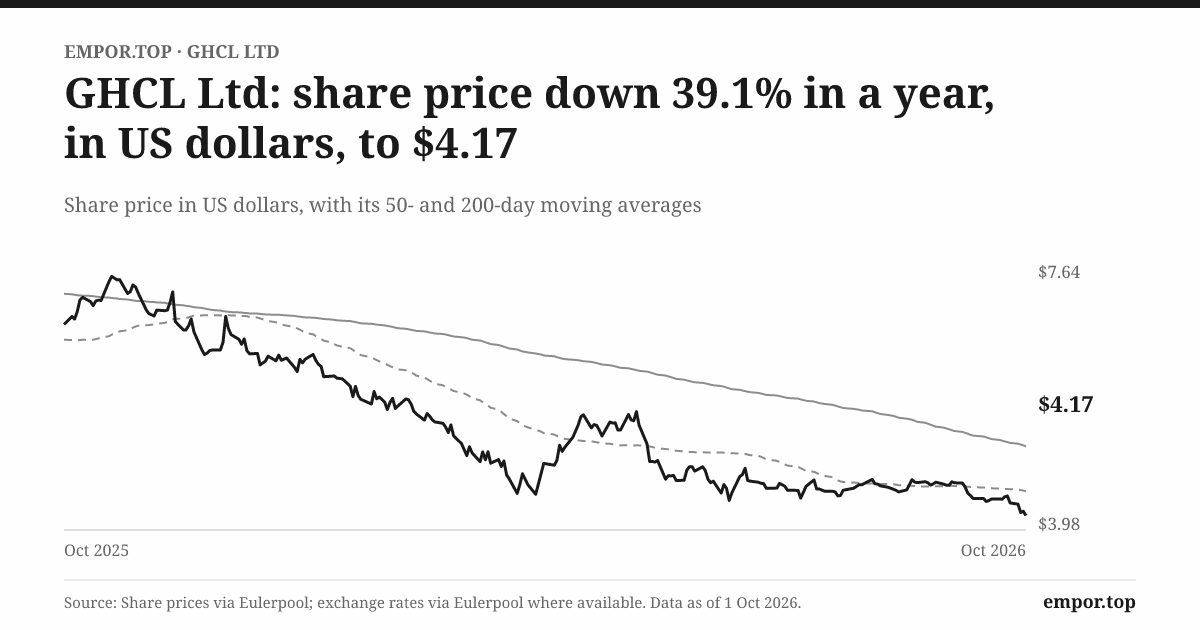
GHCL Limited is India's second-largest maker of soda ash, with roughly a quarter of the domestic market.12 On 1 October 2026 the stock closed at ₹401.85, giving a market value of about ₹3,694 crore. That is about one times book value and about three times EBITDA, for a company that holds more cash than debt.3 By almost any screen, it looks cheap.
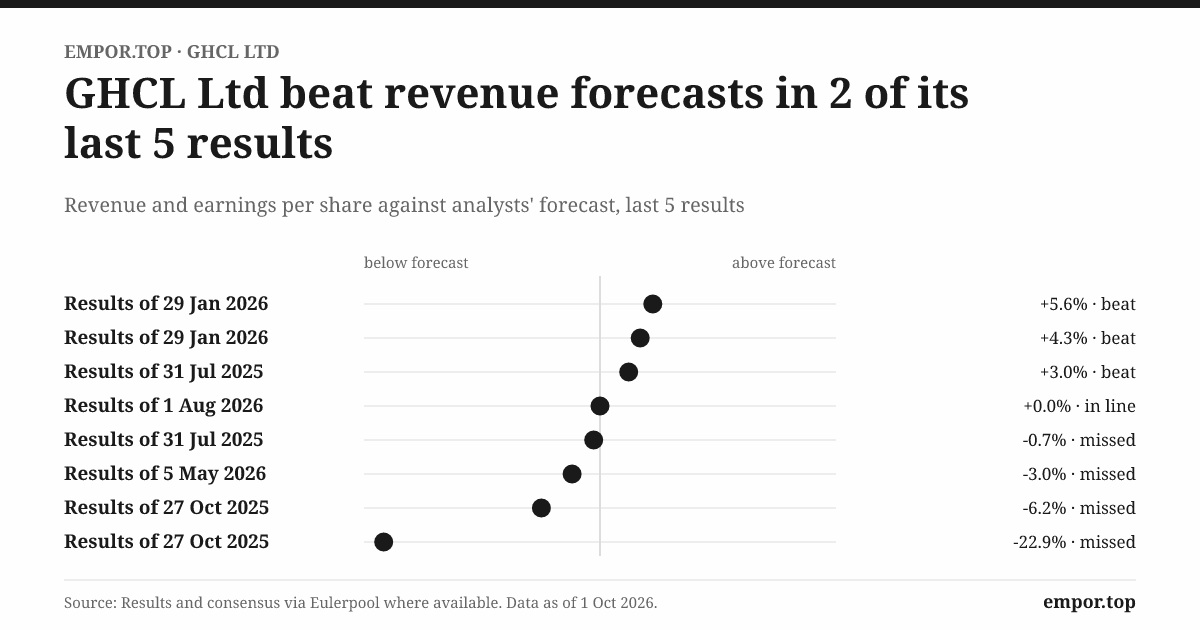
The puzzle is why. In the year to March 2023, GHCL earned about $142 million of net profit on about $566 million of revenue. Three years later, in FY26, it earned about $54 million on $347 million.31 No plant blew up. No customer walked away. No fraud surfaced. The business did roughly what it always does, and yet profit fell by almost two-thirds and the share price now sits about 39% below its 52-week high.
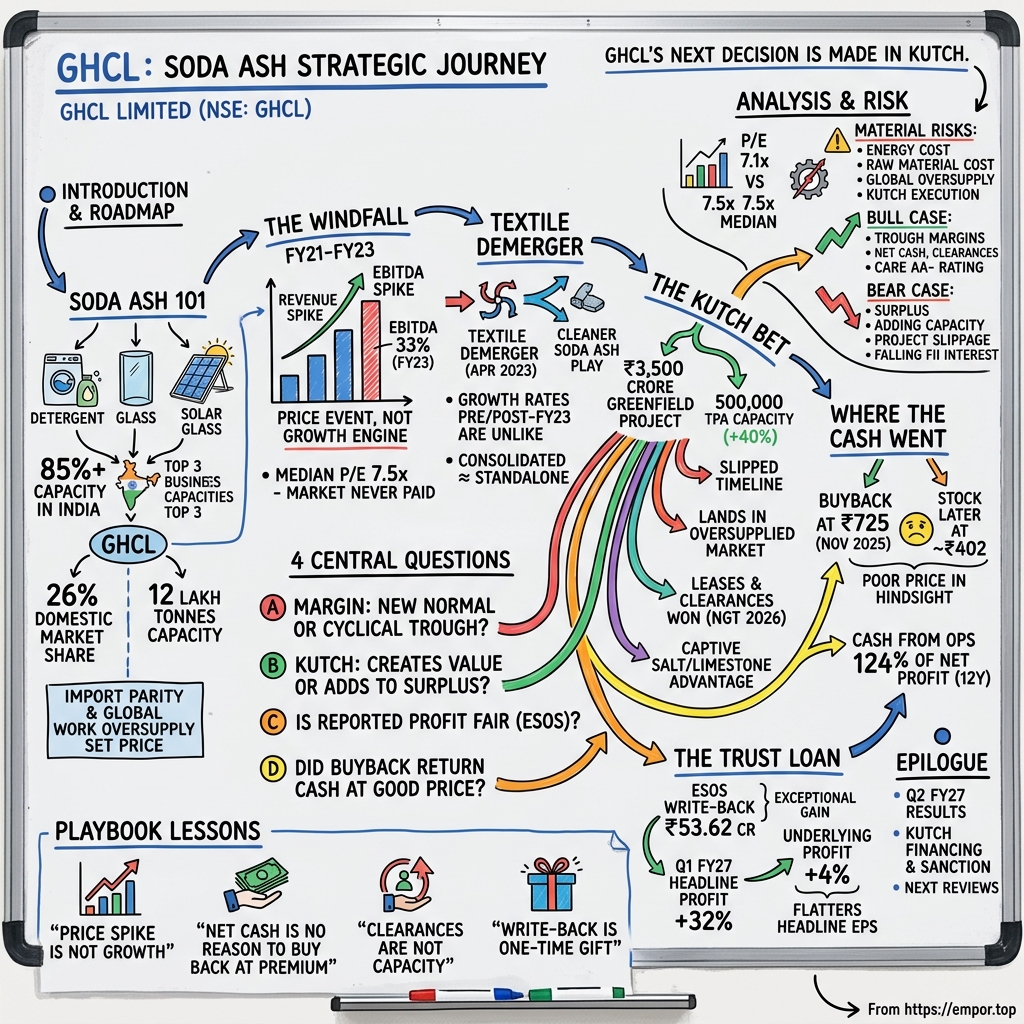
That gap, between a business that did not break and earnings that did, is the story. It has four threads, and this episode keeps pulling on them:
- Is today's margin the new normal, or a trough in a cycle? GHCL's FY26 EBITDA margin of about 24% is low against its own recent past. Is the past the anomaly, or the present?
- Does the Kutch expansion create value, or add capacity into a surplus? The company plans a ₹3,500 crore greenfield plant that would lift capacity by about 40%, into a market management itself calls oversupplied.
- Is reported profit a fair measure after the ESOS write-back? A 2008 broker scandal produced an accounting gain in mid-2026 that inflated the latest headline growth.
- Did the company return cash at a good price? In November 2025 GHCL spent ₹300 crore buying back its own shares at ₹725. They now trade near ₹400.
What makes GHCL unusual is the combination. It is a family-chaired commodity oligopolist in which the promoters own only about a fifth of the shares, with almost no debt, three years after the biggest windfall in its history. Most commodity companies at the bottom of a cycle are fighting their lenders. GHCL is deciding what to do with its cash. That is a better problem, but it is still a problem, and the choices it makes in the next eighteen months will decide whether the windfall years were the high point or a down payment.
To see why, start with the product itself, and with a price that is set a long way from Gujarat.
 Subscribe on LinkedIn
II. Soda Ash 101: An Oligopoly Whose Price Is Set in China (18 min)
The white powder in everything
Soda ash is sodium carbonate, a white powder that nobody outside the industry thinks about and almost everybody uses. It is the flux that lets sand melt into glass at a manageable temperature. It is a builder in washing powder, softening water so detergents work. It goes into sodium silicate, into chemicals, into paper. GHCL sells two grades: "light" ash, the fluffy kind detergent makers prefer, and "dense" ash, the heavier grain glass furnaces need. It also makes sodium bicarbonate, the same compound as baking soda, sold to food and pharmaceutical users.2
The newest demand pull is solar glass. Every photovoltaic panel is covered by a sheet of low-iron glass, and that glass needs dense soda ash. As India pushes domestic solar manufacturing, a new class of buyer has appeared alongside the old detergent and container-glass customers.4
The simplest way to think about soda ash is as salt plus limestone plus energy. The dominant synthetic method, the Solvay process, reacts brine with limestone, using ammonia as a recyclable go-between and burning large quantities of fuel to make steam and power. Whoever controls cheap salt, cheap limestone and cheap energy has the low-cost plant. Everything else is logistics.
Three big players and an importer's shadow
India's soda ash industry is an oligopoly. The top three producers hold more than 85% of domestic capacity, according to CRISIL Ratings.2 GHCL is the second-largest, with about 12 lakh tonnes (1.2 million tonnes) of annual capacity at March 2023.2 The other two large suppliers are Tata Chemicals and the Nirma group; Gujarat-based state companies and smaller players fill out the rest. GHCL puts its own share at roughly 26% of the domestic market.3
On paper, that looks like a cosy structure. Three firms, high capital cost to enter, a product customers need every day. In many industries that would mean pricing power.
Not here. India also imports about 1.0 million tonnes of soda ash a year, close to GHCL's entire output.3 Those imports come from producers whose costs and strategies have nothing to do with Indian demand. When China, the world's largest producer, adds capacity faster than its own glass and chemical industries absorb it, the surplus washes out into Asian markets. The Gujarat buyer from the opening scene sees it as a cheaper cargo at the port. GHCL then has a choice: match it or lose the order.
CRISIL put it plainly: "Soda ash prices are linked to the global market and thus remain susceptible to volatility."2 That sentence is the key to the whole company.
What the oligopoly does and doesn't protect
So what does being one of three big producers actually buy GHCL? It buys volume and relationships. Domestic producers deliver faster and more reliably than a cargo that has to be ordered weeks ahead and cleared at port. Large detergent and glass makers want a dependable local base load. GHCL has no customer above 10% of revenue, and in FY24 about 95% of its sales were in India: ₹3,255 crore at home against ₹181 crore of exports.1 Its buyers are, in CRISIL's description, "leading detergent and glass manufacturers."2 GHCL does not publish how much of its revenue the top five customers account for, nor the length of its contracts or whether any carry minimum volumes.
The verdict is not subtle. The oligopoly protects GHCL's tonnes and its customer terms. It does not protect its price. Import parity, the landed cost of foreign ash, is the ceiling, and global oversupply sets where that ceiling sits.
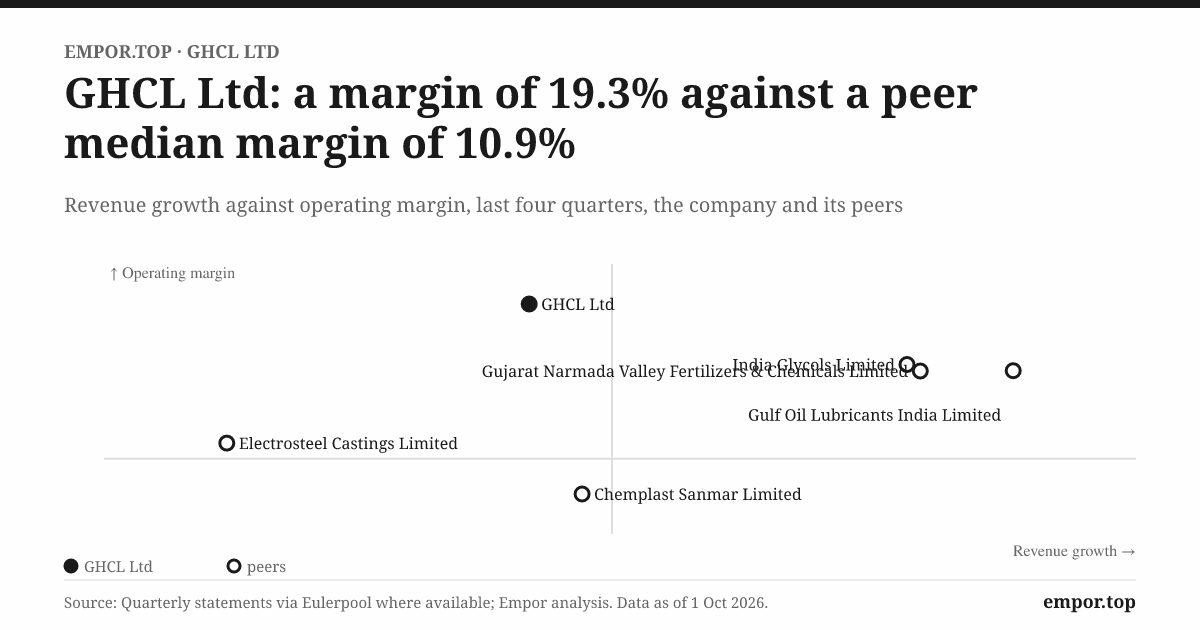
If GHCL cannot set price, its edge has to come from cost. Here the company has a real story. It sources about 25% of its salt and 35% of its limestone from captive sources, and has access to lignite for fuel.2 Captive inputs mean that when global prices fall, GHCL's costs fall less painfully than a rival buying every input on the open market, and when prices spike, it keeps more of the gain. The proof of that claim is in the margins. Even in a soft year like FY26, GHCL reported an EBITDA margin of about 24%,3 which is a respectable return for a bulk chemical whose price it does not control.
Management's own warning
Any bullish reading of today's margins has to sit next to what management said in August 2026. On the Q1 FY27 results, the company described the market as one of "underlying stable demand but surplus supplies," pointed to volatility and shipping disruption, and warned that margins would "moderate as the year progresses" because of energy and raw-material costs.4
That statement matters more than any inference an outsider can draw from the numbers. Demand is fine. Supply is the problem. And the people who run the plants are telling investors not to extrapolate the first quarter.
So the first central question already has a partial answer: today's margin is being squeezed by a global surplus that GHCL cannot fix and that management does not expect to ease soon. To understand how unusual the good years were, though, you have to go back to the moment when the world ran short of soda ash, and GHCL got rich without doing anything different.
III. The Windfall: FY21–FY23, When Price Did All the Work (14 min)
The rating note that said the quiet part
In September 2023, CRISIL Ratings published a routine rationale on GHCL's debt. Buried in the analytical prose were three numbers that told the whole story of the previous year. Operating income had risen 49%. EBITDA had risen 104%. And volumes, CRISIL noted, were flat. The rise had come "owing to significant rise in soda ash prices."2
Read that again. GHCL roughly doubled its operating profit in a year while selling the same amount of product. Nothing about its plants, customers or strategy explained it. The world's price had moved, and GHCL rode it.
How the spike happened
The post-pandemic years scrambled the global soda ash market. Energy prices surged, which hit the energy-hungry Solvay producers in Europe and China hardest. Demand from glass, including solar glass, rebounded sharply. Freight costs jumped, which raised the landed price of imports into India and gave domestic producers room to lift their own prices toward the new, higher import parity.
For a producer with captive salt and limestone, this was close to the perfect setup. Rivals' costs rose faster than GHCL's. The ceiling on price, set by imports, rose with them. GHCL's net profit went from about $44 million in FY21 to about $142 million in FY23.31 Its EBITDA margin reached about 33% in FY23.3 Return on capital employed climbed from about 15% to about 34%.1
The cycle in one sequence
The windfall then unwound in a pattern familiar to anyone who has watched commodity companies.
First, the spike tied up cash. In FY23 GHCL's cash from operations was only about 54% of its EBITDA, against a normal of 70% to 100%.1 Inventory built up as raw materials were bought at high prices; raw-material inventory stood at ₹457 crore at March 2023 against ₹336 crore a year later.1
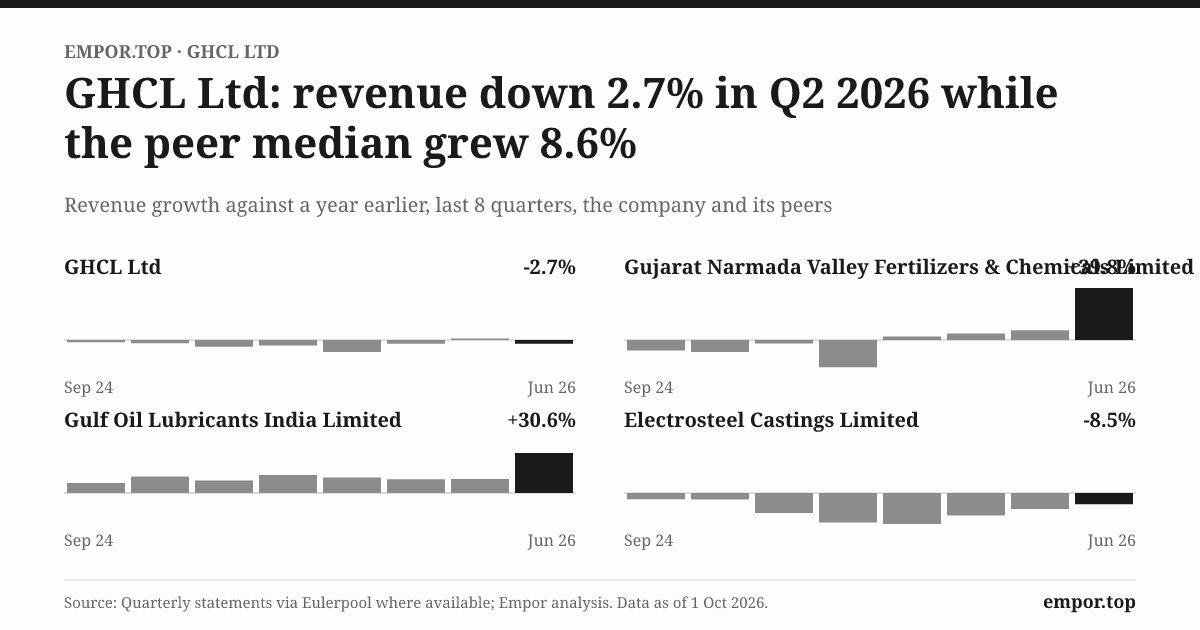
Second, prices fell. In FY24 the company cut prices by about 17% as global supply caught up.23 Revenue fell in each of the three years after FY23, and kept falling into Q1 FY27, when revenue of ₹774 crore was about 3% lower than a year earlier.5
Third, margins slid back toward their old range. GHCL's reported EBITDA margin went from about 24% in FY22 to about 33% in FY23, then about 26% in FY24, about 30% in FY25, and about 24% in FY26.3 Net profit ended FY26 at about $54 million, roughly where it would have been on a pre-spike trend.
A puzzle in the quarterly data
One number in the record looks like a contradiction. Standardised data shows an operating margin of about 46% for the March 2025 quarter and about 44% for FY25 as a whole, far above anything in GHCL's own reported EBITDA margins, which put FY25 at about 30%.3 Profit before tax in that same quarter was lower than this "operating profit," which cannot happen in a normal year without a large cost sitting below the operating line. The sensible reading is that the standardised operating figure for that quarter does not reflect GHCL's own presentation of its results. The company's reported EBITDA margin, which runs smoothly from 26% to 30% to 24%, is the right baseline. The 46% quarter should not anchor anyone's sense of what this business can earn.
Growth that wasn't
Strip out the spike, and GHCL's long-run record is slow. Revenue grew about 1.8% a year over ten years and fell about 12% a year over the last three.3 Those ten-year figures straddle a demerger, as the next section explains, so treat them as indicative only. But even read generously, there is no volume engine here.
The market seems to have understood this all along. GHCL's median price-to-earnings ratio over the last five years was about 7.5 times.3 Even at the peak, when the company was earning record profits, investors refused to pay a growth multiple for them. They treated the windfall as a windfall.
Trough or new normal?
This is where the first central question sharpens. The "trough" case says FY26's 24% margin sits at the bottom of GHCL's recent range, and in a cyclical industry the bottom eventually turns. The "new normal" case says the range itself was inflated by a once-in-a-generation shock to energy and freight, and that a world of Chinese surplus pushes margins back toward their pre-pandemic level.
The evidence leans toward the second, with a caveat. The windfall years were explained by price, not by anything GHCL built, and management is warning of further pressure. The caveat is that GHCL's cost position is real, and if the surplus clears, the company is well placed to benefit. The market's 7.5 times median says investors are not betting on that.
Before going further, there is a problem with the historical chart itself. Half of what GHCL used to be is no longer part of the company.
IV. The Textile Demerger: Why the Ten-Year Chart Lies (10 min)
Two companies under one name
For most of its history, GHCL was two businesses wearing one ticker. One was the soda ash operation in Gujarat. The other was a spinning division in Tamil Nadu, turning cotton into yarn for the textile industry. The two had nothing in common except a shareholder register and a family chairman. Investors trying to value the company had to price a commodity chemical and a commodity textile maker at the same time, with different cycles and different capital needs.
On 12 June 2023, GHCL Textiles Limited listed separately on the exchanges.1 The demerger had become effective on 1 April 2023, with a one-for-one swap: every GHCL shareholder received one GHCL Textiles share for each GHCL share held.1
What moved and why it matters
The accounting was not trivial. GHCL booked a dividend payable of about ₹1,597 crore, representing the distribution of the textile business to shareholders, against net assets transferred of about ₹1,359 crore.1 The auditor made the demerger accounting a key audit matter in FY24, meaning it was one of the judgements most important to the audit. There was no qualification.1
On the balance sheet, shareholders' equity fell from about $493 million to about $360 million between March 2023 and March 2024, while property, plant and equipment dropped from about $371 million to about $229 million across the demerger year.13 None of that money disappeared. It walked out the door in the form of a separately listed company that shareholders now own directly.
The FY2023 figures were restated for continuing operations: revenue of ₹4,539 crore, soda ash and allied businesses only.1 That is the correct comparison base for anything after FY23. Figures before that, in long-run data sets, include the spinning business. Any growth rate or margin trend that runs across FY23 compares two different companies.
That is the practical warning: the ten-year chart lies. When someone says GHCL's revenue grew 1.8% a year over a decade, they are partly measuring the removal of a division, not the performance of the soda ash plant.
What's left between the siblings
Separations rarely sever every link. In FY24 GHCL bought about ₹18.5 crore of traded goods from GHCL Textiles and paid small sums for business support, renewable energy certificates and insurance reimbursements.1 Added up, these were about 0.5% of revenue. The balances were unsecured and interest-free, on terms described as equivalent to arm's length, with no guarantees in either direction.1 Related-party trade with the sibling is trivial.
The consolidated figures, meanwhile, are essentially the standalone company. In FY26 standalone net profit was about ₹479 crore against about ₹472 crore consolidated.3 The main subsidiary is Dan River Properties LLC in the United States, a residual from an old textile venture.1
The demerger made GHCL a cleaner company and a simpler investment: one product, one cycle, one set of plants. It also sharpened the question of what that one product should do next. In 2023, as the textile business left, GHCL's managers were already sketching the biggest bet in the company's modern history, on a salt flat in Kutch.
V. The Kutch Bet: ₹3,500 Crore Into a Surplus Market (22 min)
A tribunal in August
On 21 August 2026, the National Green Tribunal, India's specialist environmental court, dismissed three appeals that had challenged the environmental clearances for GHCL's planned soda ash plant in Kutch.6 For the company, it was a significant legal win. For anyone tracking the project, it was a reminder of how long it had already taken.
The plan was not new. CRISIL's September 2023 rationale described a large greenfield soda ash expansion, with about 70% of the land acquired and approvals pending, at an estimated outlay of about ₹4,500 crore.2 Three years later, the project has its clearances confirmed but no plant.
What the project is
The Kutch plan is a greenfield soda ash plant of 500,000 tonnes a year, roughly 40% on top of GHCL's existing capacity, at a current estimated cost of about ₹3,500 crore.6 The site comes with a 30-year lease over about 6,449 hectares for salt production.6
That salt lease is the strategic heart of it. Kutch's salt pans, on the edge of the Rann, are among the most productive salt-making areas in India. A plant sitting on its own captive salt would extend the cost advantage that already defines GHCL. If the company's core claim is that its moat is cost, Kutch is the attempt to widen that moat.
The cost estimate that fell
Here is the oddity. In 2023, the outlay was about ₹4,500 crore.2 Today it is about ₹3,500 crore.6 Capital projects almost never get cheaper as they are delayed. Steel, equipment and labour usually cost more each year a project slips. A ₹1,000 crore fall in the estimate, during three years of delay, needs explaining.
There are only a few possibilities. The scope may have shrunk: a smaller first phase, fewer product lines, or shared infrastructure dropped. The design may have changed, perhaps toward a cheaper process or a different energy source. Or the earlier figure may simply have been a high early estimate. GHCL has not published a reconciliation of the two numbers, and the 500,000-tonne figure attached to the lower estimate does not on its own reveal whether the scope has changed. Until it does, investors cannot tell whether the cheaper plant is a better plan or a smaller one. Either is possible, and they mean very different things.
Reinvestment: from pause to spending
For several years after the windfall, GHCL invested modestly. Cash spent on investing activities ran at about $65 million in FY24, $42 million in FY25 and $36 million in FY26.3 Capital expenditure was about ₹265 crore in FY26.3 Capital commitments, contracts signed but not yet paid, rose from about ₹89 crore to about ₹275 crore during FY24.1 Property, plant and equipment has edged up since the demerger.
There are no acquisitions to judge. GHCL's capital allocation record over the last decade is essentially two decisions: exit textiles through the demerger, and build in Kutch. The first has been done. The second has not started in earnest.
The side bets: bromine and vacuum salt
Alongside Kutch, GHCL has two smaller projects. One is a bromine plant of 2,800 tonnes a year; bromine is a chemical used in flame retardants, pharmaceuticals and oil drilling fluids, and can be extracted from the same brines that feed salt works. Management expects bromine to earn EBITDA margins above 40%.4 The other is a vacuum salt plant of 1.7 lakh (170,000) tonnes, producing high-purity salt for food and industrial use.4
These matter as diversification, and bromine's margin target is attractive. But they are small next to soda ash. Their real significance is as a test of execution. At the Q4 FY26 results, management had them completing by the end of FY26. By August 2026 they were in "advanced stages of commissioning," with commercial launch moved to Q2 FY27.4 That is roughly two quarters of slippage on small, technically simple projects.
Clearances are not capacity
That pattern is the right lens for Kutch. A tribunal win, a land lease and a confirmed environmental clearance are necessary steps. They are not tonnes of soda ash, and they are not revenue. Indian Chemical News described progress on the large project as "slow."4 GHCL has not announced a board-approved capex sanction for the full plant, a financing plan or a commissioning date.
Set against the company's record, the history narrows the bullish claim rather than rejecting it. The cost-advantage logic is credible: captive salt, a cleared site, a lower estimate. The timing claim has failed repeatedly, from a 2023 plan to a 2026 project still without a sanction, and even the small side projects have slipped. And the price claim is unproven: a plant that adds about 40% to GHCL's capacity will arrive into a market management itself calls oversupplied.
What returns would look like
GHCL's return on capital employed shows how sensitive the economics are to price. It was about 37% in FY25 and about 15.5% in FY26 on essentially the same asset base.3 A new plant built at today's costs, selling into today's prices, would earn something closer to the second number than the first, and possibly less in its early years while volumes ramp.
CRISIL has set a guardrail: it expects GHCL's debt-to-equity ratio to stay below 1 times during the Kutch implementation.2 With equity of roughly ₹3,500 crore and almost no debt today, the company could in theory finance most of the project with borrowing and stay within that limit, or fund much of it from cash and operating flows.
That leaves the core decision visible. The case for Kutch is credible on cost and unproven on timing and price. It deserves to be held open until the board sanctions the capex and names a date. And yet, while that project waited, GHCL made another big decision about its cash, and the price it paid is now hard to look at.
VI. Where the Cash Went: A Buyback at ₹725 (16 min)
A tender in November
In November 2025, GHCL opened a tender offer to buy back up to 41.4 lakh of its own shares at ₹725 each, a total of ₹300 crore.7 The record date was 14 November; the offer ran from 20 to 26 November.7 The price was a premium of about 28% over the market price at announcement. The promoters, the Dalmia family's holding companies, chose not to tender.7
The company completed the purchase and extinguished about 41.4 lakh shares, about 4.3% of its equity.3 Today the stock trades at ₹401.85. The ₹725 tender price is about 80% above it.
That is the scene for the fourth central question. To judge it fairly, you have to look first at how much cash GHCL actually generates, and then at the price it paid to give some back.
The cash is real
One test separates real commodity businesses from accounting stories: does profit turn into cash? For GHCL it does. Over the twelve years from FY2015 to FY2026, cash from operations totalled about ₹7,349 crore against net profit of about ₹5,931 crore, about 124%.31 In FY26 alone, operating cash flow was about 99% of EBITDA.3
Why does cash exceed profit? Three reasons, all healthy.
First, depreciation. GHCL is a plant-heavy business, and depreciation is a large, non-cash charge. In FY26 EBITDA was about $80 million against operating profit of about $68 million; the difference is mostly wear on equipment that was paid for years ago.3
Second, working capital discipline. Inventory, which used to sit at about 193 days of cost in FY15, was down to about 105 days in FY26. Working capital days fell from about 159 at the FY23 peak to about 43.3 Part of that improvement came from the textile business, with its heavy cotton stocks, leaving the group. The rest reflects tighter management of the soda ash cycle.
Third, the windfall years built a cash pile. Free cash flow over the twelve years was about ₹4,304 crore. Dividends absorbed only about 21% of it, and cash and short-term investments rose by about ₹1,074 crore.3 Debt fell from about $202 million to about $9 million, leaving debt to equity at 0.02.31
The weak years confirm the pattern rather than contradict it. Cash conversion dipped to about 54% of EBITDA in FY23 and stayed below 75% in FY24 and FY25 as inventory built and unwound.3 It is cyclical, but it does not leak.
A note on receivables
GHCL's customers pay quickly. Debtor days were about 21 in FY26, against 56 in FY15.3 One detail looks odd at first: the FY24 ageing schedule placed about ₹98 crore of the ₹180 crore of trade receivables in the six-to-twelve-month bucket, with about ₹82 crore under six months.1 For a company with three weeks of receivables on average, that bucket looks too large, and GHCL does not explain it in the note. The company reported no disputed trade receivables and only a negligible amount older than a year.1 Credit risk is not a driver of this story.
The payout
In FY26, GHCL's total payout to shareholders was about ₹415 crore, the ₹300 crore buyback plus a dividend of ₹12 a share. That was about 87% of the year's profit.3 The standard dividend payout ratio, which counts only dividends, shows just 24%.3 Of about ₹603 crore of operating cash in FY26, the company spent roughly ₹265 crore on capex, about ₹35 crore on debt repayment, and the rest on shareholders.3
The earlier record is modest. GHCL bought back 32 lakh shares in 2020.1 Employee stock options were exercised in 2022 and 2023, adding small numbers of shares. There were no rights issues, preferential allotments or warrants in the FY24 report.1
Was the price right?
Here the verdict splits.
The defence of the buyback is real. GHCL had more cash than it needed for operations. Debt was near zero. Promoters stayed out, so the premium went entirely to public shareholders who chose to sell, and the remaining holders, including the family, saw their percentage stake rise slightly. Before the buyback, standalone net worth was about ₹3,483 crore, and the company was earning about 18% on it.7 At ₹725 the stock traded at a P/E of about 9.4 times FY25 earnings, not a heroic multiple.7
The case against is harder to dismiss. FY25 earnings were already falling, and the market was already in surplus. The company paid a 28% premium for its own shares while its largest project waited for a sanction and while the price of its product was trending down. Those who tendered received ₹725. Those who stayed now hold shares worth about ₹402. In hindsight, the buyback transferred value from continuing holders to departing ones.
Did GHCL return cash at a good price? The cash was real and the balance sheet could afford it. The price was poor, judged by everything that has happened since. And it came at a moment when the company was signalling that its next decade depended on a ₹3,500 crore build.
There is another item in the cash history, much older and much stranger, that resurfaced in 2026. It began with a broker in 2008.
VII. The Trust Loan: ₹53.62 Crore That Came Back (12 min)
A sale nobody authorised
In 2008, a broker sold shares belonging to the GHCL Employees Stock Option Trust without authority.5 The trust had been set up to hold GHCL shares for employee option schemes, funded by a loan from the company. When the shares vanished, so did the security behind that loan. GHCL eventually wrote the loan down, recognising a "permanent diminution" of ₹53.62 crore.5
For years, that was simply an old loss in the notes. Then, in the June 2026 quarter, a settlement returned 7,45,966 GHCL shares and 8,56,466 GHCL Textiles shares to the trust (the textile shares being the trust's entitlement from the demerger swap).5 With the assets back, GHCL wrote back the ₹53.62 crore as an exceptional gain. A further ₹55.90 crore remains recoverable from the trust.5
What it did to the headline
Q1 FY27 net profit was reported at ₹191.18 crore, up 32% on the year before.5 That number drove the headlines. It is not the right number.
Strip out the write-back, net of the roughly ₹13.5 crore of tax on it, and underlying net profit was about ₹151 crore against about ₹145 crore a year earlier, growth of roughly 4%.5 Profit before the exceptional item was about ₹204 crore.5 The difference between 32% and 4% is the difference between a recovery story and a business treading water.
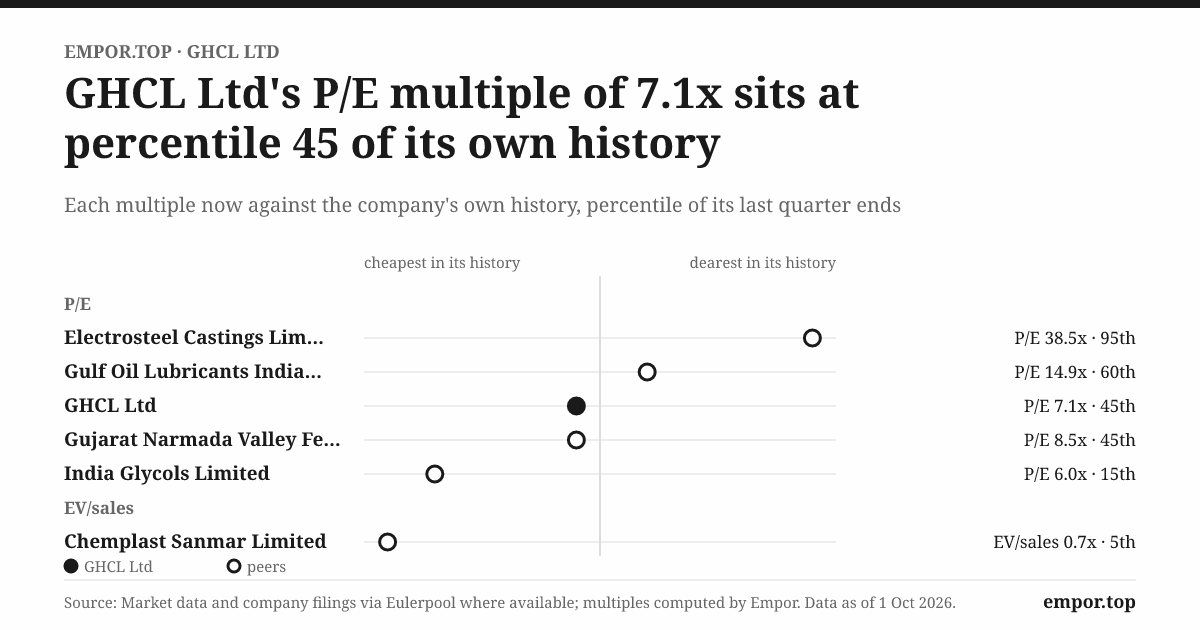
The same distortion affects valuation. Trailing earnings per share of ₹55.90 include the gain, so the reported P/E of 7.1 times flatters the company slightly.3 On underlying earnings the multiple is a little higher, closer to the five-year median of 7.5 times.
Fair measure or not?
There is a reasonable argument that the write-back is harmless over time. The original write-off reduced profit years ago; the reversal adds it back now. Over the life of the trust the two net to zero.
But the timing matters, because investors price the present. And the trust is not a third party. It is consolidated and funded by the company, which makes it the one related-party item in GHCL's accounts that needs explaining. Whether the remaining ₹55.90 crore is collected, written down or left hanging will show up in the Q2 FY27 results.
Other income, kept in proportion
The rest of GHCL's non-operating income is modest. In FY24 other income was about ₹52 crore, mostly gains on liquid mutual funds and interest, about 5% of profit before tax.1 The treasury book is conservative: debt mutual funds from large Indian fund houses, plus a small listed equity holding in a handful of banks and GTC Industries.1 In Q1 FY27 other income was about ₹24 crore, about 9% of pre-tax profit.5 It is not a hidden profit engine.
Reported profit, then, is a fair measure over the full cycle and a slightly flattering one this year. The trust episode is resolved in accounting terms but not in cash terms. It also raises a question about the people who manage GHCL's capital, which is where the story turns next.
VIII. The People Running It: Management, Pay and Credibility (12 min)
On the line
On GHCL's Q4 FY26 call, the voices answering analysts were R.S. Jalan, the managing director, and Raman Chopra, the chief financial officer and executive director.3 Jalan has been the company's operational face for years, a soda ash veteran who talks in the language of tonnes, energy cost and import parity. Chopra handles capital and the numbers. Together they have run GHCL through the windfall, the demerger, the buyback and the Kutch delays.
Above them sits the Dalmia family. Anurag Dalmia chairs the board; Neelabh Dalmia is an executive director responsible for growth and diversification projects, which includes bromine, vacuum salt and Kutch.1
Pay against profit
Key management compensation was about ₹24.75 crore in FY24 against about ₹27.16 crore in FY23.1 Jalan received about ₹12.89 crore (down from ₹14.88 crore), Chopra about ₹7.89 crore (down from ₹8.87 crore), and Neelabh Dalmia about ₹3.14 crore.1 Non-executive commissions included ₹1.0 crore to Anurag Dalmia and about ₹0.23 crore to Sanjay Dalmia.1
Pay fell about 9% in a year when profit fell about 30%. The link is loose but in the right direction. GHCL pays no royalty, brand fee or management fee to the promoter group, a common source of leakage at Indian family companies.1 That is a meaningful point in its favour.
Jalan and Chopra also held vested, unexercised options at the buyback date, 1,00,000 and 50,000 respectively.7 Options give them a stake in the share price, but they are a small fraction of the company, and the family's own stake of about a fifth is thin for a family-chaired business.
The credibility record
Management credibility is best measured by promises against outcomes. Three are on the table.
The Kutch plan has gone from a 2023 rating note to a 2026 tribunal ruling without a sanction or a date. Some of that is legal process outside the company's control; the appeals were real. But a three-year delay on the company's most important project is the dominant fact of this management team's recent tenure.
The bromine and vacuum salt projects slipped about two quarters between the Q4 FY26 and Q1 FY27 calls.4 Small, but recent, and the same direction.
The buyback price, judged by events, was poor.
The skeptic's questions
A skeptical long-short investor would put two questions to the board. Why spend ₹300 crore buying shares at a 28% premium while Kutch was still pending and soda ash prices were falling? And why has the project slipped for three years, while the estimate fell by ₹1,000 crore without a published reconciliation? Neither question has a public answer. Both are fair.
Governance and contingencies
Shareholders have shown little dissent. At the 42nd AGM in July 2025, the resolution on auditor remuneration passed with about 99.55% in favour.9
GHCL's contingent liabilities are small against its balance sheet: about ₹188 crore at March 2024, of which indirect taxes were about ₹131 crore and income tax about ₹48 crore.1 The largest individual item, an income tax demand of about ₹88 crore for assessment years 2015-16 and 2016-17, arose because credit for tax already paid was not given; the company calls it "a mistake apparent from record" and has applied for rectification.1 Older disputes include a transfer-pricing and buyback tax demand of about ₹42 crore and a CENVAT credit denial of about ₹68 crore stretching back to 2008-09.1 The auditor issued no qualification in FY24, noting only a slight delay in some TDS payments and a late ₹0.66 crore transfer to the Investor Education and Protection Fund, since paid.1
Pay is sensible, governance is clean, and dissent is negligible. The question about this management team is not honesty. It is execution and timing. And the shareholders who have been answering that question most clearly are the ones heading for the exit.
IX. Who Owns It, and Why Foreigners Are Leaving (6 min)
The shareholding pattern filed for June 2026 tells a quiet story. Foreign portfolio investors held about 22.4% of GHCL, down from about 24.7% the quarter before, and the number of foreign holders fell from 197 to 165.9 Mutual funds edged up to about 9.5%; domestic institutions in total held about 11.2%.9 Promoters held about 19.8%.9
The promoter stake is spread across a chain of Dalmia family holding companies: Hindustan Commercial, Gems Commercial, Banjax, Hexabond and Oval Investment, each holding roughly 3% before the buyback.7 Because the promoters did not tender in November 2025, their percentage stake rose slightly as other shares were cancelled.
A promoter holding of about 20% is low for an Indian family-chaired company, where 50% or more is common. It cuts both ways. It means outside shareholders hold most of the votes, which can discipline management. It also means that at a price near book value, a determined buyer would not need to buy out a dominant family to gain influence. GHCL's soda ash plants, salt leases and net cash are the sort of assets a strategic player could value above the market.
The foreign selling, meanwhile, is consistent with a market that does not trust cyclical earnings. The stock fell about 39% from its high, and foreign funds sold into the fall. They are, in effect, voting that today's margin is closer to normal than to trough.
That vote sets up the lessons this story has to teach.
X. Playbook: Business & Investing Lessons (10 min)
1. A price spike is not a growth strategy. CRISIL's 2023 note recorded EBITDA up 104% with volumes flat. GHCL did not get better; the world got short of soda ash. The market priced it at about 7.5 times earnings throughout, which was the right instinct. When a commodity producer's profits triple without its tonnes moving, the profit belongs to the cycle. GHCL's best year was a weather report, not a business plan.
2. Net cash is not a reason to buy back at a premium. The November 2025 tender at ₹725 was affordable, legal, and generous to the public holders who sold. It was also done with a falling product price, a pending ₹3,500 crore project and a stock that now trades near ₹400. A strong balance sheet gives a board the option to buy back stock; it does not tell the board when. A buyback is a bet on your own price, and GHCL bet at the top.
3. Clearances are not capacity. The tribunal ruling of August 2026 was a genuine win, three years after the plan first appeared. It produced no tonnes. The bromine and vacuum salt plants, far smaller, slipped two quarters in a single reporting cycle. For investors, the unit of progress is a board sanction, a financing plan and a commissioning date, in that order. A tribunal can clear a plant, but it cannot build one.
4. Clean the base before you compare. The 2023 textile demerger turned GHCL into a pure soda ash maker and broke every long-run chart in the process. A ten-year growth rate of 1.8% a year measures a company that partly no longer exists. Before you judge a decade, check whose decade it was.
5. A write-back is a one-time gift, not a trend. The Q1 FY27 headline said +32%. The business said about +4%. The difference was a ₹53.62 crore reversal of a 2008 broker loss, which nets to zero over time. An old loss coming home is good news once, and only once.
XI. Analysis & Bear vs. Bull Case (14 min)
The price and what it assumes
GHCL trades at about 7.1 times trailing earnings against a five-year median of 7.5 times.3 It sits at about one times book, about 3.1 times EV/EBITDA, and its enterprise value of about ₹2,584 crore is well below its market value because it holds net cash.3 Free cash flow yield is about 3.7%, return on invested capital about 18%, and the operating margin about 24% on the company's own EBITDA measure, against about 33% at the peak.3
Those numbers describe a market that assumes the profit pool of FY22 to FY25 will not return. Investors are paying for a cyclical soda ash maker earning mid-cycle-to-trough margins, with a cash pile, and are giving little or no credit for Kutch. The case turns on two things: the global soda ash price and the returns on the new plant. Volume growth in India is a secondary driver.
The moat, argued once
Porter's five forces. - Supplier power is meaningful. Energy and fuel, including coal and lignite, are large costs that GHCL only partly controls, and management names them as the reason margins will moderate.4 - Buyer power is low by concentration, since no customer exceeds 10% of revenue,1 but high in practice because every buyer can compare GHCL's quote with an imported cargo. Import parity is the buyer's weapon. - Substitutes are weak. There is no practical replacement for soda ash in glass-making, and detergent formulations change slowly. - New entrants are limited by capital cost and access to salt and limestone. GHCL's own Kutch project, with a 30-year salt lease and a ₹3,500 crore price tag, shows what it takes to enter.6 - Rivalry among the top three domestic producers, holding more than 85% of capacity,2 is moderated by the oligopoly but sharpened by imports.
Hamilton Helmer's 7 Powers. GHCL has two. Scale economies: a 1.2 million tonne plant spreads its fixed costs across more output than smaller rivals. Cornered resource: captive salt and limestone, extended by the Kutch lease. It has no pricing power, no network effects, no switching costs worth naming and no brand that matters to a glass furnace. The moat is narrow and real: it shows up as a better margin than an importer-exposed rival at any given price, not as the ability to set the price.
The bull case
Margins are at the low end of their recent range, and commodity cycles turn. The balance sheet is net cash. The industry is an oligopoly with a cost leader. The Kutch project now has confirmed clearances and a lower cost estimate. CARE Ratings reaffirmed its AA-/Stable long-term and A1+ short-term ratings on 31 July 2026, after the FY26 results.8 Bromine and vacuum salt are about to begin commercial production. The stock trades at book value, below its own median multiple.
The bear case
Management says the market is in surplus and that margins will moderate. Kutch would add about 40% to GHCL's capacity into that surplus. The project has slipped for three years, and the lower estimate is unexplained. The company spent ₹300 crore on a buyback at a price 80% above today's. Foreign holders are leaving. Headline earnings are flattered by a one-off. And the rating agencies, despite net cash, have not upgraded the company.
Weighing it
The disconfirming evidence that matters most is that rating. CRISIL put GHCL on a Positive outlook in 2023;2 three years and a net-cash balance sheet later, CARE's July 2026 action was a reaffirmation, not an upgrade.8 Agencies that see the books treat GHCL's cash flows as cyclical and its project risk as real. The bull case's strongest point, the balance sheet, is already in the price at one times book. The bear case's strongest point, surplus supply, comes from the company itself.
The material risks follow from that. Energy and raw-material cost hits margins directly. Global oversupply and imports set price. Kutch execution and cost decide whether the next decade earns its cost of capital, and whether debt rises toward CRISIL's 1 times cap. Currency is minor: unhedged dollar receivables were only about ₹9 crore at March 2024,1 though a weaker rupee indirectly helps by lifting import parity.
Two numbers to watch
Two KPIs capture almost everything:
- EBITDA margin, which stood at about 24.4% in FY26, down from about 30% in FY25.3 It is the clearest read on whether price is recovering against cost. (GHCL does not publish realised price per tonne in a regular series, which is why the margin carries the weight.)
- Kutch capex sanctioned and commissioning date. Today there is a cleared site, a ₹3,500 crore estimate and no sanction.6 When those become a board resolution and a date, the second central question gets an answer.
XII. Epilogue (5 min)
Tonight GHCL is a company in waiting. The plants at Sutrapada run. The salt pans fill. The trucks leave for detergent and glass makers across western India. And the important decisions are all one step away.
The first arrives with the Q2 FY27 results. They will show whether the remaining ₹55.90 crore owed by the ESOS trust has been collected, written down or left open, and whether bromine and vacuum salt have finally produced revenue. If both happen, management's execution record gets its first win in a while. If either slips again, the pattern of delay strengthens.
The second is the full FY27 margin. Management has guided investors to expect moderation. If the year ends near or above FY26's 24.4%, the "trough" case gains ground. If it ends meaningfully lower, the "new normal" case wins, and the 7.5 times median multiple starts to look generous rather than cheap.
The third is the Kutch sanction. When the board approves the full capex and names a financing mix, investors will finally learn how much debt GHCL is willing to take, whether the ₹3,500 crore figure holds, and when the plant is meant to run. A sanction with a credible schedule and mostly internal funding would ease the capital allocation worries. A sanction that leans heavily on debt, into a surplus market, would sharpen them.
The fourth is the next review by CARE and CRISIL. An upgrade would signal that the agencies see the project as manageable. Another flat reaffirmation would say they still see a cyclical company with a big unbuilt plant.
Each of these moments maps onto one of the four questions this story began with. The margin answers whether today is the trough. The sanction answers whether Kutch creates value. The trust settlement answers whether profit is clean. And all three together answer whether the ₹725 buyback was a reasonable call or a costly one.
The tension that remains is the oldest one in a cash-rich commodity company: return the money, or build the plant. GHCL has tried to do a little of both. Sooner or later, Kutch will force it to choose.
XIII. Outro (3 min)
Go back to the purchasing manager in Gujarat, a GHCL quote in one hand and the landed price of an imported cargo in the other. That manager will keep making the same comparison every week, and GHCL will keep answering it. The company makes a product whose price it does not set, from salt and stone it partly owns, for buyers who can always look elsewhere. For three years it has had more cash than it needed and has spent that time deciding how big it wants to be.
GHCL's best year was made in China, and its next decision is made in Kutch.
References
-
Integrated Annual Report 2023-24 — GHCL Limited, 2024-06 ↩↩↩↩↩↩↩↩↩↩↩↩↩↩↩↩↩↩↩↩↩↩↩↩↩↩↩↩↩↩↩↩↩↩↩↩
-
Rating Rationale GHCL Limited — CRISIL Ratings, 2023-09-12 ↩↩↩↩↩↩↩↩↩↩↩↩↩↩
-
GHCL audited results for quarter and year ended March 31, 2026 — ScanX, 2026 ↩↩↩↩↩↩↩↩↩↩↩↩↩↩↩↩↩↩↩↩↩↩↩↩↩↩↩↩↩↩↩↩↩↩↩
-
GHCL Q1 profit jumps 32% despite global headwinds — Indian Chemical News, 2026 ↩↩↩↩↩↩↩↩
-
GHCL posts 32% profit rise in Q1FY27 on ₹53.62 cr ESOS settlement — ScanX, 2026 ↩↩↩↩↩↩↩↩↩
-
GHCL wins legal victory as NGT dismisses appeals challenging Kutch project clearances — Sahi, 2026-08-21 ↩↩↩↩↩↩
-
Letter of Offer for Buyback of Shares — GHCL Limited, 2025-11 ↩↩↩↩↩↩↩
-
GHCL Limited: Credit Ratings Reaffirmed at CARE AA- Stable and A1+ — Investywise, 2026-07-31 ↩↩
-
GHCL Limited corporate announcements (results, call filings, shareholding patterns, AGM voting results) — NSE India ↩↩↩↩
 LinkedIn
 WhatsApp
 Reddit
 Hacker News
 Email
Email Kindle
 RSS Feed
 Spotify
 Apple Podcasts
 Amazon Music
 Audible
 YouTube