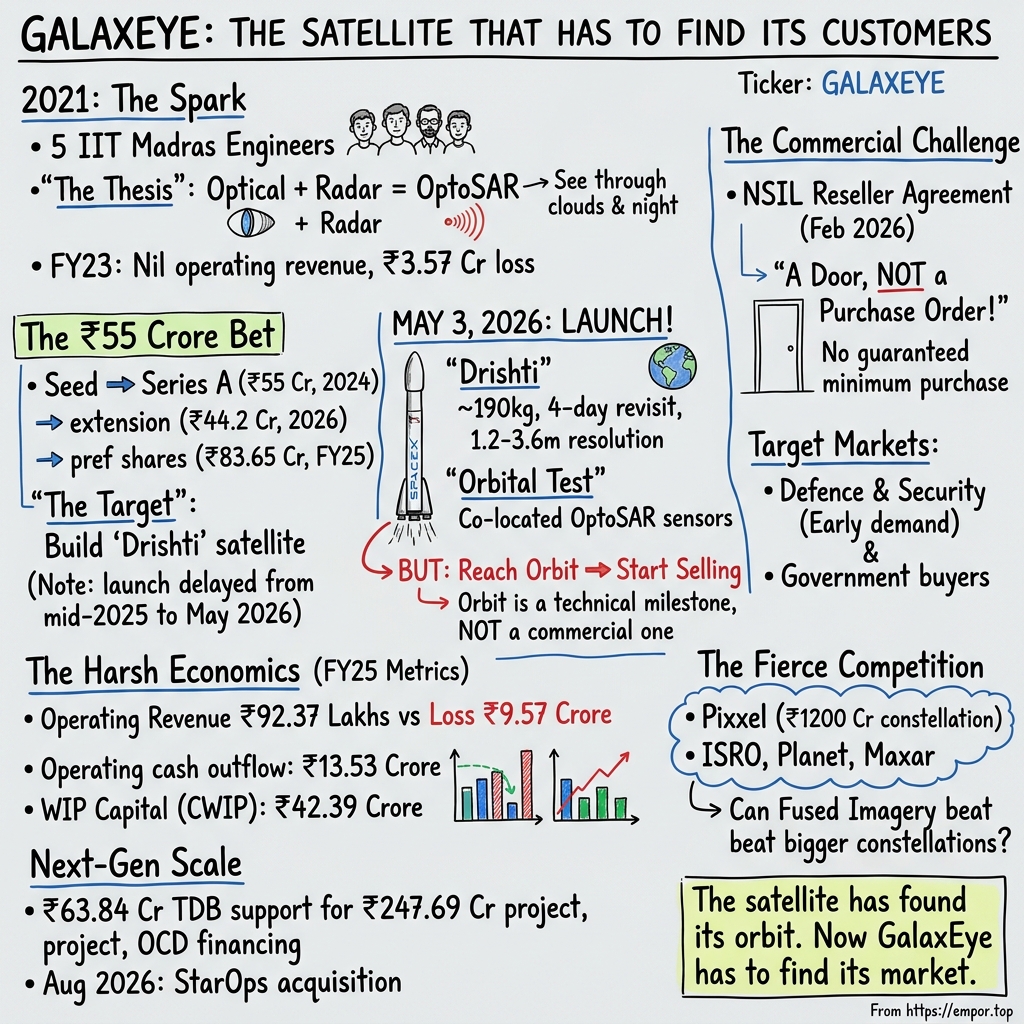
GalaxEye: The Satellite That Has to Find Its Customers
I. One Satellite, Two Ways to See the Earth
At half past noon, Indian time, on May 3, 2026, a SpaceX Falcon 9 lifted off from Space Launch Complex 4E at Vandenberg in California, and somewhere inside its payload stack sat a box of about 190 kilograms that five engineers from Chennai had spent five years trying to build.1 The satellite was called Drishti, the Sanskrit word for sight, and it carried something no Earth-observation satellite had flown before in commercial form: a synthetic aperture radar and a multispectral optical camera bolted to the same platform, designed to look at the same patch of ground at the same moment and fuse the two pictures on board.12 GalaxEye called the result OptoSAR. The company's chief executive, Suyash Singh, described it as "the culmination of over five years of sustained R&D."2
The idea behind the box is easy to say aloud. An ordinary camera in orbit takes a picture a person can read at a glance, a field, a port, a column of trucks, but only when the sun is up and the clouds have parted. A radar sees through cloud and darkness because it supplies its own illumination, bouncing microwaves off the ground and timing their return, but the image it produces looks to an untrained eye like a grainy photocopy of a moonscape. Put both instruments on one spacecraft, fire them together, and in principle a customer gets the radar's reliability with the camera's legibility. That is the whole proposition, and it is a good one.
A satellite, however, is not a business. A satellite becomes a business only when somebody pays, repeatedly, to use what it sees, and when what they pay covers the cost of building, launching and replacing the machine. That gap between seeing and selling is the subject of this story, and in GalaxEye's case it turned out to be wider than anyone said aloud on launch day. On July 7, 2026, nine weeks after the Falcon 9 rose over California, the company announced that Drishti had suffered an anomaly in the final stage of its early orbit phase following a geomagnetic solar storm, that communication had become intermittent and then been lost, and that the likelihood of recovery "currently appears low."34 The company said the satellite had validated its deployments, attitude control, onboard computing and communications before it went quiet.3 It did not say that Drishti had delivered a commercial image, and no imagery from the mission has been released.
So the stakes of this episode are not the ones that seemed likely in May. GalaxEye remains a private Indian company, GalaxEye Space Solutions Private Limited, incorporated in 2021 and still unlisted, with no draft prospectus on file with the Securities and Exchange Board of India as of SEBI's November 2026 processing list.56 Its public record is short: three years of audited numbers, a handful of funding announcements, a reseller agreement, a government development-finance deal and an acquisition. In the last audited year, the twelve months to March 2025, it booked operating revenue of ₹92.37 lakh, a little under ₹1 crore, against a loss of ₹9.57 crore.5 That was before Drishti flew, and it remains the most recent full picture the company has filed.
Three questions run through what follows. Can a sensor architecture that is technically distinctive become repeatable revenue, when the first satellite meant to prove it never reached commercial service? Does the public money now flowing in, most visibly ₹63.84 crore of optionally convertible debentures from the government's Technology Development Board, lower the risk of building the system, or add a financing obligation without a committed buyer?7 And can five founders who have shown they can build hard hardware also show they can run a commercial operation, keep their schedules and report their numbers clearly enough for a public-market investor to underwrite them?
The launch did move GalaxEye from engineering promise to an orbital test. The test ended early. What it proved, what it did not, and what the company has done since are the evidence a future shareholder will have to weigh, long before any listing.
 Subscribe on LinkedIn
II. Five Engineers Bet on Seeing Through Clouds
GalaxEye was founded in May 2021 at IIT Madras, the engineering campus in Chennai that has become one of India's more productive deep-technology incubators.8 Five co-founders put their names to it, and all five are still listed by the company today: Suyash Singh as chief executive, Denil Chawda as chief technology officer, Pranit Mehta running sales operations, Kishan Thakkar running engineering and Rakshit Bhatt running product.8 A newspaper profile of the founders later traced their route "from hyperloop to orbit", a reference to the student engineering culture at IIT Madras that taught them to build strange machines on student budgets and impossible deadlines.9 That continuity matters for an investor. The people accountable for turning the original idea into a company are the same people who had the idea, and their record is the record of this one venture.
The problem they chose was specific: cloud cover can obscure optical imagery when users need it, while radar can be hard to interpret without specialists. Military planners, insurers assessing flood damage and agronomists estimating a kharif crop all face that problem. When NewSpace India Limited later agreed to resell the data, it described the advantage in exactly those terms: both payloads on a single satellite bus, "enabling simultaneous capture of the same area of interest and real-time data fusion onboard," which eliminates the timing and alignment errors that arise when images from separate satellites are stitched together afterwards.10
That is technically coherent. Radar and optical data from different satellites are routinely combined today, but the two passes may be hours or days apart, a ship moves, a flood recedes, and the geometric registration between the two images takes work. One platform firing both sensors at once removes that friction. Whether customers value the removal enough to pay a premium is a separate question, and the founding years did not answer it.
What they did produce was a steady sequence of engineering steps. In January 2022 the team began rail testing an early proof of concept of the Drishti sensor; in December 2022 it generated its first synthetic aperture radar image; in February 2024 it ran user trials of the sensor with the Indian Army's Northern Command; in May 2024 it demonstrated what it called the world's first SAR sensor on a high-altitude pseudo-satellite; and in December 2024 it flew a technology demonstration in space on ISRO's POEM platform, which uses the spent upper stage of a PSLV rocket as a temporary orbital testbed.8 Each of those was a real milestone. None was a recurring product. They were steps toward Drishti, and they were paid for by investors rather than customers.
The money came early and in modest amounts at first. GalaxEye raised a seed round of $3.5 million, which the company dates to December 2022 and press coverage places in 2022.811 That cheque financed a high-risk build phase, and the accounts show how far the business was from paying for itself. In the year to March 2023, the company recorded no operating revenue at all and a loss of ₹3.57 crore.12 The next year it booked revenue of just ₹2.60 lakh while the loss widened to ₹6.46 crore.5 That is the normal shape of a hardware start-up in its build years, and it says nothing bad about the idea. It does establish the baseline: the founding thesis attracted capital and talent, not customers.
The founding years also set a second baseline, about time. When GalaxEye announced its Series A in August 2024, it targeted the first Drishti launch for mid-2025, and the same report noted that the original plan had been the September quarter of 2023.11 By October 2025 the target was the first quarter of 2026.13 In February 2026 the satellite was described as poised to launch on February 25.14 It actually flew on May 3, 2026.1 Some of that drift was outside the company's control, since small satellites ride on other people's rockets and rideshare manifests move, and the chief executive has attributed earlier slippage to vendor component deliveries and testing.15 But the pattern is not one slip. It is a first satellite that arrived roughly two and a half years after the earliest public target and about ten months after the target set when the Series A was raised. That is common enough among first-time satellite builders that it should not be read as a character flaw. It is reason enough to treat every forward date the company now gives, for its next satellites and its constellation, as a hypothesis to be tested against delivery.
III. The ₹55 Crore Bet Becomes a Satellite
In August 2024, GalaxEye announced a Series A of $6.5 million, about ₹55 crore, led by Mela Ventures with existing investor Speciale Invest, and with participation from ideaForge, Rainmatter Capital, Navam Capital, Faad Capital and Anicut Capital.11 The round was described as still open, the stated purpose was to fund the first satellite, and the launch was then targeted for mid-2025.11 The company's own timeline records a $10 million Series A in June 2024, which suggests the headline grew as the round filled.8 Mela Ventures' Krishnakumar Natarajan explained the bet in the language of addressable markets: the combined technology could help "defence, maritime, insurance and agriculture."11
The cap table that resulted is mostly invisible. One strategic investor is the exception. In September 2024, Infosys told India's National Stock Exchange that it would invest up to ₹17 crore in GalaxEye for a minority holding of no more than 20 percent.16 That ceiling is useful in an unexpected way. If ₹17 crore could buy at most a fifth of the company, the price Infosys agreed to implies an equity value of at least about ₹85 crore at that point. That is a floor, not a valuation. Infosys may have invested less than its ceiling, the stake may have been well under 20 percent, and the instrument was very likely preference shares carrying rights that ordinary shares will not. ideaForge, the listed Indian drone maker, separately took a minority stake for ₹8.28 crore as part of the same round, without a disclosed percentage.11 Neither GalaxEye nor its investors have published a post-money valuation for any round.
The audited accounts show the money landing. In the year to March 2025, GalaxEye recorded ₹83.65 crore of premium on preference shares issued during the year, plus ₹1.06 crore of share application money that had been pending allotment at the prior year-end.5 That premium is financing, recorded in the equity section of the balance sheet. It is not operating income and it is not evidence of demand. It tells a listener that institutional investors bought preferred stock at a price well above face value, which is how almost every Indian venture round is structured, and that they did so in the year the company was building Drishti.
Then came the extension. In March 2026, two months before launch, GalaxEye raised ₹44.2 crore in an extended Series A from existing investors, led in size by Mounttech Growth Fund, with Rainmatter, Mela, Speciale Invest and LV Angel Fund among the named participants.17 Just before that, SIDBI's venture arm lent the company ₹5 crore.18 An extension from insiders shortly before a binary event is a common pattern and an ambiguous signal. It shows that the people with the best information were willing to put more money in. It also shows that the company did not, or could not, bring in a new lead investor to price a Series B before the satellite had flown. The terms of the extension, its price relative to the 2024 round and any protective rights attached to it have not been disclosed. A round of this kind can be flat or structured with extra protections without anyone outside the cap table knowing, so a listener should not read it as a step-up.
Even the total raised is uncertain in public accounts. One funding database put cumulative funding at about $14 million through March 2026, Inc42 put it at about $27 million by July 2026, and Analytics India Magazine said around $20 million.171920 The company has not published a reconciled figure, and the reported round totals span different dates, currencies and definitions. They should not be added together and treated as a cash balance.
What can be said about the founders' own economics is equally limited. The company reported zero managerial remuneration in its FY2025 filing.5 That rules out large cash salaries for directors in that year. It does not reveal what the founders own after three equity rounds, whether there is an employee stock option pool, how large it is, or whether any vesting or performance conditions apply to founder shares. Those are exactly the items a draft prospectus would have to disclose, and their absence now is a diligence gap, not reassurance.
A small test of controls
The capital history contains one concrete governance episode, and it is worth telling precisely because it is small. In the year to March 2024, GalaxEye raised ₹1.06 crore in a private placement from Seraphim Space Enterprise, a specialist space investor. Indian company law requires private-placement money to be held in a separate bank account and not used until the return of allotment is filed. GalaxEye put the money in its ordinary account and spent it before filing. The company and its directors reported the lapse themselves, and on September 24, 2024 the Registrar of Companies in Chennai imposed penalties of ₹2 lakh on the company and ₹1 lakh on each of three directors, ₹5 lakh in total.12 Seraphim stayed invested.12
The sums are trivial. The episode matters because it is one of very few behavioural data points about how the company handles rules when it is short of time and cash, and the answer has two parts: it broke a procedural rule in the rush to spend investor money, and then it reported itself. One self-reported lapse does not establish a pattern. It does mean the auditor's report and annexures attached to the FY2025 filing, which would reveal any qualifications or reportable control weaknesses, are worth reading closely in any future offer document.
So what did all this financing buy? It bought a satellite, delivered to orbit in May 2026, and a company with the engineering team, mission-control centre and supplier relationships to build another. It did not buy proof of demand. That proof was supposed to come from selling Drishti's pictures, and the channel for selling them had already been arranged.
IV. A Reseller Agreement Is a Door, Not a Purchase Order
In February 2026, NewSpace India Limited, the Department of Space company that serves as ISRO's commercial arm, executed a reseller agreement with GalaxEye.1014 Under it, NSIL would "access and market entire product portfolio of GalaxEye," including what the company calls SyncFused OptoSAR data, across agriculture, disaster management, natural-resource inventory, infrastructure planning and environmental monitoring.10 NSIL's chairman, M Mohan, framed it as an example of the self-reliance agenda; Suyash Singh said it would bring the company's capabilities "to a wider set of users."10 Coverage described GalaxEye as the first private Indian satellite operator to secure a data-reseller arrangement with the state company.14
That last claim, if accurate, is the real value of the deal. NSIL already sells imagery from India's IRS satellites and has relationships with government departments, state agencies and foreign buyers that a four-year-old start-up could not easily build.10 A trusted public-sector reseller can shorten the distance between a new dataset and the procurement officer who might buy it. It also lends a credential: a defence or disaster-management buyer evaluating an unfamiliar supplier can take comfort that ISRO's commercial arm has agreed to carry the product.
But a door is not a purchase order. Neither the press release nor any coverage discloses a minimum purchase, a guaranteed volume, a contract value, exclusivity, or the revenue split between NSIL and GalaxEye.1014 NSIL's own clarifications for its empanelment process indicate that it expects imagery details and sample data once a satellite has been successfully commissioned, which means the channel was always contingent on the satellite working.21 A reseller earns its keep by reselling, and it can only resell what exists.
To see why that matters, it helps to understand how money is made from pictures of the Earth. A customer is not buying a satellite; it is buying an answer to a question, whether a border post has new vehicles, how many hectares of paddy flooded, whether a pipeline corridor has been encroached. The value of the answer depends on whether the satellite can collect the requested view when it is needed, at a resolution that resolves the object of interest, and deliver it fast enough to matter. It then depends on whether the customer can interpret it, which is where GalaxEye's fusion argument comes in, and finally on whether the customer comes back. Imagery can be sold one scene at a time, as tasking orders or archive purchases, or embedded in recurring monitoring contracts. The second kind is far more valuable to an investor because it compounds. Nothing in GalaxEye's public record yet shows which kind of business it will be.
The revenue it did book before launch is suggestive but thin. In FY2025 the company recorded ₹92.37 lakh of domestic service revenue, classified in its filing under spacecraft manufacture, with zero foreign-currency income.5 Revenue rose from ₹2.60 lakh the year before, which looks dramatic as a percentage and is small in rupees. GalaxEye does not say who paid, for what, or whether the work recurs. With no satellite in orbit, the revenue cannot have been satellite imagery. The most plausible reading is engineering services, studies, or drone- and aircraft-based sensor work of the kind shown in its Army trials, but the company does not break it down, and the reading remains an inference. Trade receivables of ₹24.90 lakh at March 2025, against nil the year before, show that at least some of that revenue had not yet been collected at year-end.5
Management has been consistent about where it expects early demand. In October 2025 Singh said the company already had "interest from defence and security agencies, utilities, agriculture, and financial companies."13 Around launch he told the press that defence and security demand would anchor initial revenues once commercial datasets followed commissioning.22 In an interview days after launch, he called sovereign Earth observation "a critical layer of national security infrastructure."23 All of that is plausible. India's armed forces have well-documented appetite for all-weather surveillance, and a domestic supplier has advantages in that market that a foreign one cannot match. All of it is also stated expectation rather than booked orders. Interest is what a customer says before it is asked to sign.
The government route has a second edge. Public buyers do not just buy; they specify. A defence customer may dictate resolution thresholds, security handling, ground-station arrangements and pricing formulas, and it may run a tender in which GalaxEye's fused product is scored against cheaper single-sensor alternatives. A company whose early revenue depends on a small number of sovereign buyers inherits their procurement calendars and their bargaining power. GalaxEye does not disclose customer concentration, contract length, payment terms or what share of revenue comes from repeat customers, so none of this can be measured yet.
The decisive questions for the reseller channel are therefore simple to state and impossible to answer from what the company has published. Will the first users be repeat customers or one-off pilots? Will the same product sell to insurers, agribusiness and infrastructure companies at prices that make commercial sense, or only to government buyers whose budgets and procurement rules set the terms? Those questions were supposed to begin receiving answers in the summer of 2026, after Drishti's planned commissioning. That is where the story turned.
V. Drishti Reaches Orbit; the Commercial Test Begins
The spacecraft that reached orbit on May 3 was ambitious for a first attempt. GalaxEye lists it at about 190 kilograms, flying in a sun-synchronous orbit at roughly 500 kilometres, carrying an X-band radar alongside an optical imager with panchromatic, colour, near-infrared, coastal-blue and red-edge bands.1 The radar used a deployable antenna about 3.5 metres long, and an NVIDIA Jetson Orin computer was on board to process data in orbit.2 The company's published specification for the fused product was a spatial resolution of 1.2 to 3.6 metres and a revisit of four days over a given location.1 Reports at launch described it as India's largest privately developed Earth-observation satellite.2
Those numbers deserve a moment of translation. A resolution of a little over a metre means that, at best, a single pixel covers roughly the footprint of a small car; at 3.6 metres it covers a parked lorry. That is good enough to watch ports, airfields, flood extents, crop condition and construction, and not good enough to identify a particular vehicle. A four-day revisit means a given spot on Earth comes into view about twice a week. For a customer monitoring a slow-moving situation, such as a crop season or a reservoir, that is useful. For one tracking a ship or a convoy, it is too slow, which is why every Earth-observation company's real pitch is the constellation that comes after the first satellite. These figures are company specifications, not measured performance, and none of them is evidence of what a customer would pay.
Launch is the most visible milestone in a satellite programme and in some ways the least informative. Between reaching orbit and earning money lie several separate tests. The spacecraft must deploy its solar arrays and antennas, stabilise its attitude, establish reliable communication and pass through what engineers call LEOP, the launch and early orbit phase. Then the instruments must be switched on, calibrated against known ground targets and shown to meet their specifications, which is commissioning. Then the data must be turned into analysis-ready products that customers can load into their own systems. Then someone must order them, and finally the same someone must order them again at a price that covers the cost. GalaxEye said at launch that it would begin an eight-week commissioning and calibration phase before initiating commercial data sales, which pointed to sales beginning around early July.222
The first wobble came within days. On May 8, open-source trackers following the satellite suggested it might be slowly tumbling in orbit. Singh rejected the claim directly: "The satellite is alive and kicking. We're still in the commissioning phase. It's all on track." He added that because the satellite was unusual, "we don't follow the same strategy effectively," and said that the company's "best sell to our customers is consistency."24 There is no reason to doubt that the spacecraft was alive at that point; the company later said it had maintained communication and validated several systems over a few weeks of operation.3
On July 7, roughly when commercial sales had been expected to begin, the company said its initial root-cause analysis indicated radiation effects had "likely impacted a critical onboard system."43 It also said its Bengaluru mission-control centre had been validated before the event.420 Singh said the mission had "provided invaluable engineering insights that will directly strengthen our future missions," and the company announced plans for two new OptoSAR satellites within 24 months.19
Read carefully, the announcement is candid on cause and silent on the one thing an investor most wants to know. It does not say that the radar and the optical camera were both switched on and produced fused imagery. It describes the satellite as having lost contact before finishing LEOP, which means it never formally entered commissioning of its instruments as a commercial asset, whatever the chief executive meant in May by "commissioning phase." No OptoSAR image from Drishti has been published, and the company has not said whether one was captured. Nor has it disclosed whether the satellite was insured, what it cost in total, or how much of the investment it will write off. As of March 2025, capital work-in-progress, most of it presumably the satellite, stood at ₹42.39 crore, and spending continued for another year before launch.5
It is important to keep the technical loss and the commercial miss apart, because they say different things about the company. Satellites are lost to space weather often enough that the industry treats it as an ordinary hazard, and a first spacecraft from a young builder is more likely than a mature one to carry a component or design choice that proves vulnerable. That is a technical risk the industry prices in, and the fact that the platform, communications and attitude systems worked for weeks is genuine evidence that the team can build a functioning spacecraft. It narrows the claim "GalaxEye can build satellites" rather than rejecting it.
The commercial miss is a different matter. The eight-week path to commercial data that management described in May did not happen, so FY2027 has opened without a revenue-generating satellite in orbit, and the claim that the fused product is something customers will pay for remains untested in orbit. The pre-launch exchange about tumbling also deserves a careful reading. Singh's "all on track" may have been accurate on May 8, and nothing suggests the company knew then what would happen in July. But it is a reminder that a satellite operator's public statements in the first weeks after launch are inherently provisional, and that the reliable measure of progress is released imagery, not reassurance.
The schedule record now reads differently too. Before July, the story was one of a first satellite that launched late. After July, it is a first satellite that launched late and did not reach service, followed by a new promise of two satellites within 24 months, which would mean mid-2028. Measured against a record in which the earliest public launch target was missed by about two and a half years, that new date is the single most important credibility test management has set itself.
VI. One Fused Image Has to Beat a Bigger Constellation
Drishti was meant to enter a market that already sells plenty of pictures. Globally, Planet Labs, the largest listed pure-play Earth-observation company, generated about $308 million of revenue in its fiscal year to January 2026, with a gross margin of about 56 percent, and lost about $95 million at the operating level.25 Maxar and Airbus sell very high-resolution optical imagery from established archives; ICEYE, Capella and Umbra fly commercial radar constellations. At home, ISRO operates its own optical and radar satellites, and its data reach government users through established channels. Against that backdrop, GalaxEye's single satellite was never going to compete on coverage or archive depth. It had to compete on its claimed edge: OptoSAR.
That is the moat claim, and it deserves one full, fair test.
The case for it is real. The company has a United States patent for the core OptoSAR technology, according to an interview with its chief executive in September 2026.26 No one else flies the combination commercially in the same form. For a customer who needs to know what is happening under cloud and needs a picture an analyst can read, a single synchronised product removes a step and a source of error. For a sovereign buyer, a domestic supplier of that capability carries a strategic premium. And a design that pairs two sensors on one bus arguably uses launch mass and ground infrastructure more efficiently than two separate satellites.
The case against it begins with the customer's alternatives. Buyers can already combine radar from one provider with optical from another, and analytics software for co-registering the two has improved steadily. If the fused product is only somewhat better than a multi-vendor blend, buyers who are price-sensitive will blend. Its value depends on use cases where simultaneity really matters: fast-changing scenes such as vessels, vehicles, floods and fires. Those are the cases where revisit frequency matters most, which is precisely where a single satellite with a four-day revisit is weakest. A fused image is worth more than two separate ones only if it arrives when the customer needs it.
The structure of the market adds pressure. Buyers have choices among public datasets, foreign suppliers and several private providers, and India's largest buyers are government agencies that can set specifications and price through tenders. There is no evidence yet of switching costs: GalaxEye has no installed base of customers whose workflows depend on its data. Suppliers matter in an asset-heavy build, from radar components to launch slots, and the company has already blamed component deliveries for earlier delays.15 New entrants keep arriving with different sensors or cheaper analytics. In the language of Hamilton Helmer's seven powers, the most plausible eventual sources of advantage are a cornered resource, the patented architecture, and some form of scale economy if a constellation is built, but neither exists in commercial form today.
The most concrete evidence about the competitive position comes from a contest GalaxEye entered and lost. In August 2025, IN-SPACe, the government's space-sector regulator and promoter, selected a consortium led by Pixxel, with PierSight, SatSure and Dhruva Space, to build India's first privately operated national Earth-observation constellation: 12 satellites carrying panchromatic, multispectral, hyperspectral and radar sensors, at a cost of more than ₹1,200 crore over five years.27 The winning consortium "edged out consortia led by Astra Microwave Products Limited and GalaxEye Space."27 This is the strongest disconfirming evidence on record for the moat claim, because it involves the same capability, the same type of customer and the same management team. A government panel looking at sovereign Earth-observation capacity, the market GalaxEye names as its anchor, chose a multi-sensor constellation assembled from several companies over a bid led by the company that puts the sensors on one bus. The evaluation criteria and scores were not published, and a lost tender can turn on price, partners or bid structure rather than technology. It does not reject the OptoSAR thesis. It does narrow it: the government has shown it will happily build mixed-sensor capacity without GalaxEye, and that state-backed domestic capacity will be competing for the same sovereign budgets.
The Pixxel-led programme also makes the competitive clock concrete. GalaxEye's next two satellites are targeted for mid-2028. The national constellation is being deployed over roughly the same period. If sovereign buyers' needs for all-weather imagery are substantially met by that system and by ISRO's own satellites, the reachable market for a private OptoSAR operator shrinks to the specific cases where simultaneity is worth paying for, plus export customers, plus commercial users such as insurers and agribusiness who have historically been slow and price-sensitive buyers of satellite data.
The reseller agreement offers no guaranteed demand.10 There is a further subtlety: NSIL also sells imagery from ISRO's own satellites, so GalaxEye's products will sit in a catalogue alongside alternatives its own reseller already offers.10
Weighing all this, the history narrows the claim that a technical first equals a moat to something more modest: GalaxEye owns a differentiated, patented capability that has not yet produced an image in commercial service, has not yet earned a price premium, and has already lost one large sovereign contest to a mixed-sensor rival. The claim is intact but unproven. The evidence that would confirm it is specific: paid imagery revenue from a working satellite, a share of customers buying again, a contribution margin per contract after collection and processing costs, and above all cases where a customer chose fused data over a cheaper blend from separate providers. The evidence that would falsify it would be the same metrics coming back weak once satellites are in service, or sovereign buyers continuing to award capacity to mixed-sensor constellations.
VII. ₹63.84 Crore to Build the Next Satellite
On September 24, 2026, eleven weeks after Drishti went silent, the Technology Development Board, a body under the Department of Science and Technology, signed an agreement to provide GalaxEye with ₹63.84 crore of support from the government's Research, Development and Innovation Fund.7 The money is for a multisensor satellite using the OptoSAR architecture, with an approved total project cost of ₹247.69 crore, and the stated objective is to move the technology from technology readiness level 6 to level 9 and toward sub-0.5-metre imaging, aimed at wide-area surveillance, long-range monitoring and the detection and classification of people and vehicles.7 TDB's secretary, Rajesh Kumar Pathak, described India's space ecosystem as entering a new phase, and the company said the funding would "accelerate the development and validation of our OptoSAR technology."7
The technology readiness scale is a ladder NASA invented, and its rungs matter here. Level 6 means a prototype has been demonstrated in a relevant environment; level 9 means the system has been proven in successful mission operations. After Drishti, GalaxEye can credibly claim that its spacecraft platform worked in space for some weeks. It cannot claim that OptoSAR has been proven in operations, which is exactly why the government is funding the climb from 6 to 9. The target resolution is also a step change. Moving from Drishti's 1.2-to-3.6-metre fused product to below half a metre is the difference between seeing a lorry and seeing whether it has a tarpaulin, and it moves GalaxEye's ambitions directly into defence-grade surveillance. This is a new system, not a copy of Drishti.
Set against the project's size, the government support is meaningful but partial. ₹63.84 crore is about 26 percent of the approved cost, which leaves ₹183.85 crore that must come from somewhere else: the company's own funds, new equity, other debt, or customers.7 To put that remainder in context, it is more than twice the preference-share premium the company raised in its biggest audited financing year.5 The announcement does not say how the balance will be funded.
The instrument matters as much as the amount. TDB is providing the money as optionally convertible debentures, not as a grant.7 An optionally convertible debenture is a loan that the holder may choose to convert into shares on agreed terms. If GalaxEye does well, the government may convert and become a shareholder, diluting the founders and existing investors at a price set in a contract nobody outside has seen. If it does poorly, the debentures remain debt that must be repaid. The conversion price, interest rate, tenor, security and covenants have not been published.7 International coverage translated the amount into dollars inconsistently, which is a reminder to anchor on the rupee figure in the official announcement.28
The distinction an investor must hold onto is between technology de-risking and market de-risking. A government development financier backing a higher-resolution sensor reduces the risk that GalaxEye cannot build the next machine. It does nothing, by itself, to reduce the risk that nobody buys the output. The announcement describes development and validation; it mentions no procurement contract, no anchor customer and no commitment from any ministry to buy imagery.7 Applications like human and vehicle detection point toward defence buyers, and it would be natural for those buyers to follow a capability they helped fund. Natural is not contracted.
A skeptical investor would press the question further. After Drishti failed to reach service, GalaxEye had a plan to build two more satellites, plus a separate government-backed project for an even more capable system. How much capital should be committed to a higher-specification satellite before the company has sold a single fused image? The strongest answer is that in space, the second and third satellites are where the economics begin, because one satellite cannot offer the revisit that makes data commercially useful, and that waiting for proof from a single machine would mean ceding the market. The weaker version of that answer is that each new commitment raises the amount of capital that must eventually be repaid by customers who have not yet appeared.
Buying the bus
Six weeks before the TDB agreement, GalaxEye made its first acquisition. On August 10, 2026, it bought StarOps, a Bengaluru spacecraft-engineering company incorporated in 2022 that traces its origins to TeamIndus, the private Indian lunar-lander venture.29 StarOps brought an engineering team, several of whom had worked on the TeamIndus lander and rover, qualified satellite bus platforms in the 50, 150 and 250 kilogram classes, subsystem technologies, testing infrastructure, and what it described as more than 66 percent indigenisation across its satellite systems.29 Singh said the deal significantly strengthened the company's satellite-engineering capabilities, and that "from day one, our vision has been to build a company that develops and owns the technologies defining the future of space."29
The strategic logic is clear. A satellite has two halves: the payload, the instruments that do the seeing, and the bus, the platform that provides power, pointing, propulsion and communications. GalaxEye's distinctive knowledge lies in the payload. After the anomaly that silenced Drishti, the company said it would move more of its supply chain and manufacturing in-house.3 Owning a qualified bus design and the team that built it gives GalaxEye more control over exactly the kind of system that failed, along with the chance to shorten build schedules and reduce dependence on outside vendors, a recurring source of its earlier delays.15
What is not public is the price, the form of consideration, whether it was paid in cash or GalaxEye shares, StarOps' revenue or losses, and any earn-out or retention terms.2930 Because the terms are unknown, there is no basis for saying GalaxEye overpaid or underpaid. If the consideration was largely in shares, the founders and investors have been diluted by an unknown amount; if it was cash, it came out of a treasury that has no satellite revenue to replenish it. The tests are measurable: whether the next two satellites are built on StarOps-derived buses, whether they launch within the 24-month window, and whether they cost less and work longer than Drishti did. Better engineering, though, does not by itself produce signed buyers, and the next section asks how long the money can last while the company waits for them.
VIII. The Cash Is There; the Revenue Engine Is Not Yet Visible
On March 31, 2025, fourteen months before Drishti flew, GalaxEye's balance sheet looked comfortable for a company of its size. It held ₹43.34 crore of current investments, about ₹33.17 crore of it in mutual funds and ₹10 crore in fixed deposits, plus ₹3.44 crore of cash, and it had no borrowings, no lease obligations and no director guarantees.531 Its finance cost for the whole year was ₹28,753.5 For a start-up that had just closed a Series A, that is what a balance sheet should look like: the money parked safely, waiting to be spent on the satellite.
The income statement and cash-flow statement tell the other half of the story. The company lost ₹9.57 crore before tax in FY2025, but it consumed ₹13.53 crore of cash in its operations, about ₹3.96 crore more than the accounting loss.531 The largest identified reason was a ₹4.75 crore increase in other current assets, partly offset by higher provisions and other liabilities.31 GalaxEye does not break down what those other current assets were, and at ₹6.88 crore by year-end they were about seven times the year's revenue.5 In a company of this kind they are most likely advances to suppliers, prepaid launch or component costs, and tax credits waiting to be recovered, all of which are normal for a satellite builder in the final year before launch. The point for an investor is not that the gap is suspicious. It is that in a young company, cash consumption is the better measure of the burn, and the burn ran ahead of the loss.
Below operating cash flow sat the real spending. GalaxEye invested a net ₹24.49 crore in capital work-in-progress during the year, taking the CWIP balance from ₹17.91 crore to ₹42.39 crore.531 That is the satellite being assembled on the balance sheet. It sits in investing cash flow, not operating cash flow, which is correct accounting and also a reason to read both lines together. Add the operating outflow to the capital spend and the company was using cash at a rate of something like ₹38 crore a year in its final pre-launch year, before counting any further spending in FY2026 on launch, insurance if any, and ground operations.
The revenue line shows how little of this was being paid for by customers. Operating revenue of ₹0.92 crore was smaller than other income of ₹1.09 crore, which came from ₹53 lakh of interest, ₹42 lakh of gains on selling investments and about ₹14 lakh of other non-operating items.5 In plain terms, GalaxEye earned more from parking its investors' money than from selling anything. That is unremarkable for a pre-launch hardware company and important to say clearly, because a headline that revenue grew more than thirty-fold in a year can make the business sound further along than it is.
The cost base was built for building. Employee-benefit expense was ₹5.95 crore, more than six times revenue, and one MCA-data aggregator counted 68 EPFO-linked employees for the year.532 The company does not separately disclose research and development spending. Payroll at that level, with no satellite yet in service, is the cost of keeping an engineering team together across a long build, and it will not shrink when the next satellites are under construction.
The March 2025 snapshot is now stale in every important respect. Since then the company has spent through FY2026 and half of FY2027, launched and lost a satellite, raised ₹44.2 crore in the March 2026 extension and ₹5 crore of SIDBI debt, bought StarOps on undisclosed terms and signed for ₹63.84 crore of government debentures that will presumably be drawn in tranches against project milestones.1718297 An outside observer cannot reconcile those flows into a current cash balance, so no responsible runway figure can be given. What can be said is directional. The company entered its launch year with tens of crores in the bank and a burn in the high tens of crores a year, it has since added roughly ₹49 crore of new money from insiders and a public lender, and it has committed to a programme of two satellites plus a ₹247.69 crore government-backed project, of which only about a quarter is funded by TDB.7 Unless revenue arrives quickly, more equity will be needed, almost certainly before any listing, and the price of that equity will be set by investors looking at a company whose first satellite did not enter service.
One more line in the filings is worth noting without overreading. A third-party summary of the company's charge registrations lists open charges in favour of HSBC and SIDBI, while flagging conflicting amounts for the HSBC charge.33 A registered charge is security for a facility, not proof that money was drawn, and the FY2025 balance sheet shows no borrowings.5 The SIDBI charge is consistent with the ₹5 crore venture debt reported in March 2026.18 Any future offer document would have to set out the full debt and debenture position, including the TDB instrument, and that disclosure will matter more than any single number available today.
The test for the next audited accounts, for FY2026, is therefore simple. They should show how much was spent on Drishti in total and how much of it has been written off or impaired; how large the treasury remained at March 2026; what the other current assets and receivables consist of; and whether revenue from any source was growing faster than payroll. Productive reinvestment in a satellite company looks like capital turning into working spacecraft and then into contracts. A costly constellation ahead of demand looks like capital turning into more spacecraft while revenue stays where it is. The FY2025 accounts could not distinguish between the two. The FY2026 and FY2027 accounts will begin to.
IX. Founders Still Own the Promise; the Disclosures Set the Limits
Five years after they founded GalaxEye, the same five engineers still run it.8 In that time they have moved from prototype to satellite and from student-scale funding to a strategic investment, and now have to manage a satellite failure investigation, a reseller relationship with a state company, a large government financing agreement and an acquired engineering team. That is a long way to travel in five years, and it is the clearest evidence of their ability.
The record of their behaviour is mixed in a way that is typical of young hardware founders. On delivery, the earliest public launch target, the September quarter of 2023, was missed by about two and a half years, and the target set at the 2024 Series A, mid-2025, by about ten months.111 On candour, the record is better than many. When Drishti went quiet, the company announced the loss of contact itself, named a probable cause, said plainly that recovery appeared unlikely, and attached a new plan to the bad news.43 That is what a public-market investor wants to see from management. What it did not do was publish what the satellite had achieved in imaging terms, which is the information that would let outsiders judge how close OptoSAR came to working.
On compliance, the 2024 private-placement lapse remains the one documented breach; the company self-reported it and was penalised.12 It should be followed by clean subsequent filings, and the evidence for that will sit in the auditor's report and annexures attached to the FY2025 annual report.5 Until a future offer document reproduces the full auditor's report, any assessment of internal controls rests on a single episode in each direction: a breach and a self-report.
The board and incentives are largely opaque. The FY2025 filing names Suyash Singh and Denil Chawda among the directors who signed the accounts and lists nominee directors appointed by investors, but it does not describe an independent board, an audit committee or shareholder voting results, none of which a private company is obliged to publish.5 It reports nil managerial remuneration.5 It also reports nil related-party transactions and loans in its summary form, but the full related-party note is in the attached annual report rather than the summary.5 The founders' individual shareholdings after three equity rounds, any employee option pool, any founder vesting and any preferential rights attached to investors' preference shares are not public. A public-market investor would need every one of those before buying, because they determine who controls the company after listing and how much of each rupee of future value flows to ordinary shareholders.
Management's own words provide the remaining test, and here the record shows a habit worth watching: the constellation keeps getting bigger in the telling, even as the first satellite has failed. In October 2025 the company said it planned 8 to 10 satellites over four years.13 NSIL's release said 10-plus within four years.10 At launch the plan was 10 OptoSAR satellites by 2030, with several within 30 months.2 Days later Singh spoke of around ten satellites over three and a half years, which would cut revisit to daily.24 In September 2026, after the loss, he described a path to a constellation of 30 satellites.26 To his credit, in that same interview he said the pace of scaling would depend on "technology performance, customer demand and the economics of scaling," which is exactly the right set of conditions.26 But the most concrete near-term promise remains the two satellites within 24 months announced in July 2026, and that is the one by which the market will judge the larger ambition.19
The trust test for this team is behavioural rather than rhetorical. It will be passed if the company explains the root cause of Drishti's loss in enough detail to show the fix, discloses commercial conversion when it begins, publishes the terms of the TDB debentures and the StarOps acquisition in its next accounts, and shows that the capital it deploys produces measurable customer outcomes. It will be failed if the next satellites slip the way the first did, while the constellation in the pitch deck keeps growing.
X. Analysis & Bear vs. Bull Case
The argument about GalaxEye has changed shape in six months. In May the question was whether it could reach orbit. In July it became whether it could stay there. Now it is the question every Earth-observation company eventually faces: will customers keep paying for what the satellites send back, and at prices that repay the cost of building them?
The bull case starts with the problem. Cloud cover and darkness are real, persistent obstacles to optical imaging, radar is hard to read, and a platform that fuses the two at the moment of collection addresses both. The architecture is patented and, for now, unique in commercial form.26 The first spacecraft, though lost, validated its platform, communications, attitude control and onboard computing, and the company's mission-control operation worked.3 GalaxEye has a state-owned reseller with access to government and international buyers.10 It has patient capital from investors who added money just before launch, a strategic shareholder in Infosys, and a government development financier willing to fund its next-generation system.17167 With StarOps, it now owns qualified satellite buses and the engineers who built them, which could shorten future build cycles and reduce exposure to the supplier delays that slowed Drishti.29 And the demand it has targeted, sovereign surveillance in a country that wants domestic capability, is backed by budgets rather than hope.
The bear case starts with the numbers. Its last audited year still showed a small revenue base beside heavy losses and cash needs,5 and treasury income exceeded customer revenue.5 It discloses no minimum purchases, recurring revenue, customer retention or contribution margin, because it has yet to have a satellite in service to generate any. Its first satellite failed before entering commercial service, with no published imagery and no disclosure of insurance or write-off.3 Its first launch also came years after the earliest target.11 It lost the sovereign constellation contest to a mixed-sensor consortium.27 The TDB money is convertible debt with unpublished terms, the StarOps price is undisclosed, and the next satellite project is more than two hundred times the company's last annual revenue.7295
Porter's framework sharpens the bear case without settling it. Buyer power is high, because the largest buyers are governments that set specifications and price, and can choose among ISRO data, foreign suppliers and several domestic start-ups. Substitutes are plentiful, because radar and optical data can be bought separately and combined. Supplier power matters in a business that depends on scarce launch slots and specialised components. Entry barriers protect incumbents somewhat, because satellites are expensive, but they protect a company with no satellite in orbit very little. GalaxEye's possible answers are a patent, a first-mover reputation in fused data, and vertical integration, and each still has to be converted into pricing power.
What the price would have to believe
There is no public valuation to test. No round price has been published, there is no listed market for the shares, and no offer document exists. The only public valuation anchor remains the roughly ₹85 crore floor implied by Infosys's 2024 disclosure.16 The later rounds were almost certainly priced higher, but by how much is not known, and private-share platforms publish figures that are inconsistent with each other and with the filings. A private quote of that kind should not stand in for evidence about customer economics. Because the capitalisation table, preference terms, option pool and conversion terms of the TDB debentures are all undisclosed, no fully diluted share count can be built, and because cash, debt and debenture balances after March 2025 are unknown, enterprise value cannot be reliably calculated either.
What can be done is to work backwards from the capital the company has committed to spend. Take the ₹247.69 crore TDB-approved project as a rough guide to what a next-generation system costs.7 Suppose the satellites it produces earn money for five years, a common design life for small Earth-observation satellites, and that the capital needs a 15 percent annual return, a modest hurdle for a venture-stage space company in India. Simple annuity arithmetic says the project would need to generate about ₹74 crore of cash every year, after the costs of operating the satellites, processing data and selling it, just to return its capital. That is about eighty times GalaxEye's FY2025 operating revenue. If the satellites last seven years instead, the requirement falls to about ₹60 crore; at a 12 percent return over seven years, to about ₹54 crore. Every version of the sum lands in the same place: the company needs to build a revenue line measured in tens of crores per satellite programme, with healthy margins, before its capital commitments make economic sense. That is not impossible. It is a long way from where the audited numbers stand.
Planet Labs remains a distant benchmark: even at its scale, it still lost about $95 million at the operating level.25 Its market capitalisation was about $4.7 billion in mid-November 2026, roughly fifteen times trailing revenue on an equity-value basis.34 Planet is not a direct peer: it is American, sells mainly optical data from a large fleet, has a global commercial and government customer base, and is far larger. It belongs in the aspirational category, not the comparable set, and applying its multiple to GalaxEye's revenue would be meaningless. What it does show is that even at hundreds of millions of dollars of revenue, satellite imaging has struggled to produce operating profit, and that public investors are nonetheless willing to pay high revenue multiples for scaled, recurring Earth-observation businesses. The direct domestic peers, Pixxel, SatSure, PierSight and Dhruva Space among them, are private, and none publishes the revenue, margin and valuation data needed for a proper multiple comparison.27
Reconciling the two views is straightforward because both point the same way. Any valuation a future investor pays for GalaxEye will embed assumptions about a working constellation, a recurring customer base and margins approaching those of scaled peers, none of which exist yet. In a listing, scarcity of Indian space-technology stocks, the national-security narrative and limited free float could push a price well above what the operating evidence supports. That would be a statement about demand for the story, not about the business.
The verdicts follow from the evidence. On the moat, a distinctive sensor architecture is demonstrated as a design and patented, but a durable commercial advantage remains unproven, because switching costs, retention, pricing and cost position are unknown and one sovereign contest has been lost. On management, technical execution is real, candour after the loss was good, timeline discipline has been weak and ownership and incentive transparency are limited. On economics, the bear case has the stronger evidence today, because recurring commercial demand has not been demonstrated and the only satellite meant to demonstrate it is silent.
The three numbers that will settle it are paid imagery and analytics revenue from satellites in service; the share of that revenue from customers who buy again; and the contribution margin per contract after collection, processing and distribution costs. A skeptical investor's demand is simple: before funding a constellation, show that one working satellite can produce repeat contracts at attractive margins, and disclose enough of the financing terms to judge who will own the result.
XI. Business & Investing Lessons
The first lesson comes from Drishti's launch and loss. Both the world first and the silence before a sale were true, and the order matters. In capital-intensive technology, the world first is the cheapest part of the achievement to announce and the hardest part to monetise. A first opens the door; only a working, selling system walks through it.
The second lesson belongs to the NSIL agreement. It was a genuine credential and a real channel into public buyers, but it guaranteed no demand. A reseller can open a market; only a buyer can validate it. Founders often mistake access for demand, and investors often price them as if they were the same.
The third lesson comes from the TDB agreement signed after the loss. It offered public funding for further development, but covered only part of the project and came as convertible debt. Public capital can buy time for hard science; it cannot buy recurring demand, and it does not come free. The bill is paid either in dilution or in repayment, and the terms decide which.
The fourth lesson comes from GalaxEye's lost IN-SPACe bid for the national constellation. A technical first is not the same as being the customer's first choice. That choice showed the buyer was content to assemble all-weather capability from several companies' satellites. Elegance in the sensor matters only if the customer is willing to pay for elegance.
And the last lesson is the one that frames the company's future. In orbit, engineering becomes public: everyone knows whether the satellite is talking. In the accounts, commercialisation becomes measurable: everyone will know whether anyone paid. GalaxEye has had its engineering tested in public once. It has not yet had its commerce tested at all.
XII. Epilogue
Tonight, in mid-November 2026, GalaxEye still has no satellite in commercial service. Drishti remains in orbit, with no word that contact has been restored since July.4 The company says some spacecraft systems were validated, while its commercial case still rests on its patent, reseller and financing arrangements, StarOps and the next-satellite plan.3261072919
The first moment that will matter is quiet and documentary: the FY2026 audited accounts. They will show what Drishti cost, whether it has been written off, whether it was insured, how much cash remained on March 31, 2026, and what revenue the company earned in the year it launched. If they show a write-off absorbed by a strong treasury and revenue growing from services and pre-orders, the company enters its rebuild with credibility. If they show a thin treasury and flat revenue, the next financing round will be priced accordingly, and the founders will have to accept terms that reflect a company whose first product did not reach market.
The second moment is the first new satellite. The 24-month promise made in July 2026 is the clearest test of whether StarOps and the lessons of Drishti have changed how the company builds. A launch near mid-2028, followed by commissioned instruments and released OptoSAR imagery, would answer the technical question that Drishti left open and restart the commercial one. A repeat of the first satellite's slippage would make the 30-satellite ambition hard to take seriously.
The third moment is the first contract. Watch for NSIL announcing a sale of GalaxEye data, a defence or disaster-management agency naming GalaxEye as a supplier, or the company disclosing paid imagery revenue and the share of customers who reorder. That is the event that would turn the reseller agreement from a door into a corridor, and it is the event that the TDB project, with its emphasis on surveillance and vehicle detection, seems designed to make possible.
The fourth is the fine print. The TDB terms and the price and form of the StarOps acquisition, alongside the source of the remaining ₹183.85 crore of the approved project cost, will together decide how much of GalaxEye's future belongs to its founders, its venture investors and the government.7 A future offer document would have to set all of it out, along with the cap table, the preference rights and the auditor's report. Until it does, those are diligence items, not reassurances.
The tension that remains is the one the company was founded on. GalaxEye has shown that it can build a machine that sees in two ways at once. It has not yet shown that the world needs that view often enough, and will pay for it reliably enough, to fund the machines that come after.
XIII. Outro
Somewhere above the monsoon clouds, roughly 500 kilometres up, a 190-kilogram spacecraft is still circling the Earth with a radar antenna and a camera aimed at the ground, two eyes built to see through weather that blinds one of them.1 It was designed to make one more usable picture of the planet. For a few weeks it proved that its makers could fly it. Then a storm on the sun reached it, and it went silent before anyone bought what it saw.
That is the most honest image of GalaxEye today: a company that has built a new way of seeing and has not yet found anyone to sell the view to. Its next satellites will carry the lessons of the first. Its business will be decided by something no sensor can measure. The satellite found its orbit and lost its voice. Now GalaxEye has to find its market.
References
-
GalaxEye Successfully Launches Mission Drishti OptoSAR Satellite — SatNews, 2026-05-03 ↩↩↩↩↩↩
-
India's first OptoSAR satellite loses contact after solar storm, but mission delivers key breakthrough — Business Today, 2026-07-08 ↩↩↩↩↩↩↩↩↩
-
GalaxEye plans two new OptoSAR satellites after Mission Drishti — IANS, 2026-07-07 ↩↩↩↩↩
-
GalaxEye Space Solutions FY2025 Financial Report (MCA Form AOC-4) — UnlistedZone, filed 2026-01-18 ↩↩↩↩↩↩↩↩↩↩↩↩↩↩↩↩↩↩↩↩↩↩↩↩
-
Processing Status of Draft Offer Documents — SEBI, 2026-11-09 ↩
-
TDB-DST signs agreement with GalaxEye for ₹63.84 crore RDI support to develop next-generation multisensor satellite — Technology Development Board, 2026-09-24 ↩↩↩↩↩↩↩↩↩↩↩↩↩↩↩
-
From hyperloop to orbit: the IIT alumni who want to see through clouds — Business Standard, 2026-05-27 ↩
-
NSIL & GalaxEye execute Reseller Agreement — NewSpace India Limited, 2026 ↩↩↩↩↩↩↩↩↩↩↩
-
GalaxEye bags $6.5 Mn from Mela Ventures, others to launch its first satellite — Inc42, 2024-08-01 ↩↩↩↩↩↩↩↩
-
Adjudication Order under Section 42 of the Companies Act in the matter of GalaxEye Space Solutions — Registrar of Companies, Chennai, 2024-09-24 ↩↩↩↩
-
Space-tech firm GalaxEye to launch world's first multi-sensor EO satellite in 2026 — PTI via The Week, 2025-10-13 ↩↩↩
-
GalaxEye pioneers India's first private satellite data pact with ISRO's NSIL — Indian Defence News, 2026-02-18 ↩↩↩↩
-
Startup Deep Dive: GalaxEye — Indian Startup Times, 2026-07-02 (updated October 2026) ↩↩↩
-
Infosys disclosure of investment in GalaxEye Space Solutions — Infosys via NSE, 2024-09-19 ↩↩↩
-
Spacetech startup GalaxEye raises ₹44 crore in Series A extension — Venture Intelligence, 2026-03-13 ↩↩↩↩
-
Space tech startup GalaxEye secures ₹5 crore from SIDBI VC — Venture Intelligence, 2026-03-02 ↩↩↩
-
GalaxEye loses connection with 'Mission Drishti' satellite, eyes 2 more launches — Inc42, 2026-07-07 ↩↩↩↩
-
GalaxEye's Mission Drishti satellite hit by solar storm after system validation — Analytics India Magazine, 2026-07-07 ↩↩
-
Response to queries on EOI for satellite empanelment and reseller terms — NewSpace India Limited ↩
-
GalaxEye eyes 8-week timeline to begin commercial data rollout; defence demand to anchor early revenues — The Economic Times, 2026-05-04 ↩↩
-
Sovereign Earth observation is foundational to national security: GalaxEye CEO Suyash Singh — Aviation & Defence Universe, 2026-05-09 ↩
-
'Alive and kicking': GalaxEye CEO rejects tumbling rumours, says Drishti satellite on track — ANI via The Tribune, 2026-05-08 ↩↩
-
Planet Labs PBC annual report on Form 10-K for fiscal year ended 2026-01-31 — SEC EDGAR, 2026-03-23 ↩↩
-
From OptoSAR to 30 satellites: inside GalaxEye's expansion plan — CIOL, 2026-09-26 ↩↩↩↩↩
-
Pixxel-led consortium to build India's first commercial earth observation satellite constellation — PTI via The Week, 2025-08-12 ↩↩↩↩
-
India's GalaxEye lands convertible from state fund for radar-optical satellite — Dealroom News, 2026-09-25 ↩
-
GalaxEye Acquires StarOps, erstwhile part of TeamIndus — GalaxEye, 2026-08-10 ↩↩↩↩↩↩↩↩
-
GalaxEye buys StarOps to build satellites in-house, plans two launches — Dealroom News, 2026-08-10 ↩
-
GalaxEye Space Solutions financial summary and cash-flow table — WWIPL ↩↩↩↩
-
GalaxEye Space Solutions Private Limited company profile — The Company Check ↩
-
GalaxEye Space Solutions company profile and charges — RecurClub ↩
-
Planet Labs (PL) market capitalization — Financial Modeling Prep, 2026-11-13 ↩
 LinkedIn
 WhatsApp
 Reddit
 Hacker News
 Email
 Kindle
 RSS Feed
 Spotify
 Apple Podcasts
 Amazon Music
 Audible
 YouTube