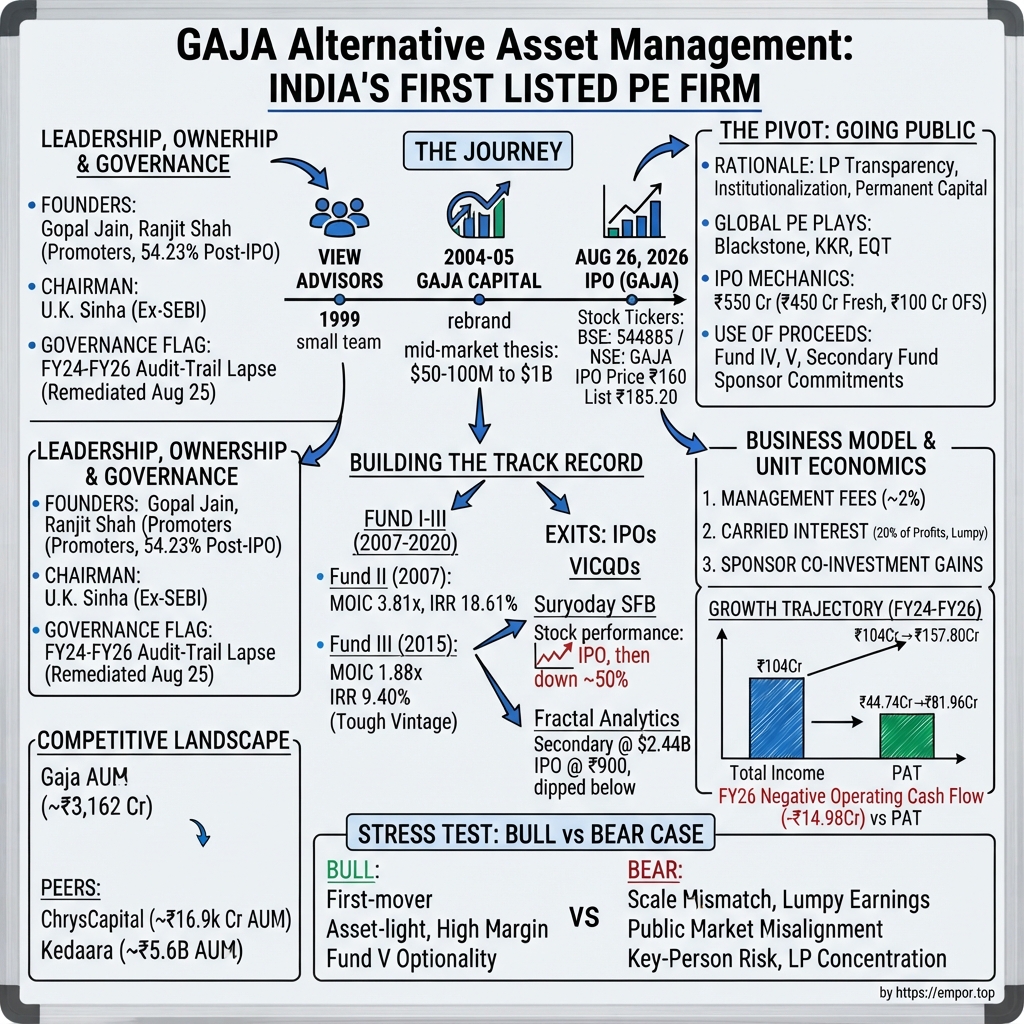
Gaja Alternative Asset Management: The Private Equity Firm That Went Public
I. Introduction & Episode Roadmap
At 10:00 a.m. on August 26, 2026, a bell rang in Mumbai for a company that has never manufactured anything, never sold a product to a consumer, and never operated a store, a factory, or a warehouse. What it sells is judgment — the judgment to pick roughly one Indian mid-market company a year out of thousands, buy a minority slice of it, and wait five to seven years to find out whether that judgment was correct.
The ticker was GAJA. The company was Gaja Alternative Asset Management Limited, the corporate entity behind the private equity brand Gaja Capital. And the trade that opened that morning was unusual in a specific, almost recursive way. Private equity firms exist to buy private companies and eventually list them. On that Wednesday, the firm skipped the intermediary. It listed itself.
The shares opened at ₹185.20 against an issue price of ₹160, a debut premium of roughly 16 percent, capping a three-day book that had been subscribed 31.33 times.1234 India's financial press reached, immediately and correctly, for the word "first": the first standalone, pure-play alternative asset manager to list on an Indian exchange.3 Mutual funds and insurers had listed before. Wealth managers had listed. Brokerages had listed. But the general partner of a private equity fund — the entity that collects the management fee, books the carried interest, and decides which companies get capital — had not.
Hold that structure in your head, because it is the central puzzle of this story and it does not resolve cleanly.
When a limited partner — a pension fund, an insurer, a family office — commits money to Gaja Capital Fund IV, it is buying exposure to the portfolio. It gets the underlying companies, the gains and the losses, net of fees. When a public shareholder buys GAJA on the BSE, it is buying something structurally different: a claim on the fees that the portfolio generates, plus the firm's own comparatively small co-investment stake. Gaja's own offer document says this in plain language, and it is the single most important sentence in the entire filing: investors in the offer become shareholders in the asset management company itself, not investors in the underlying funds.4
That is not a trick. It is how Blackstone, KKR, Apollo, Carlyle and EQT AB all work as listed companies. But it means the analysis of GAJA is not "is Gaja Capital good at private equity?" It is a narrower and harder question: does being good at private equity, at Gaja's specific scale, reliably convert into a growing, cash-generative, publicly-ownable earnings stream?
This is the story of how a two-person idea from 1999 became a ₹3,162 crore active-capital manager with 37 employees, why its founders decided that the next stage of institutionalization ran through a stock exchange rather than a fundraising roadshow, and what the record — fund by fund, exit by exit — actually supports versus what the pitch claims.10 It is also the story of a stock that, thirteen days after that opening bell, was trading at ₹154 — below its issue price.16
 Subscribe on LinkedIn
II. Origins: From View Advisors to Gaja Capital (1999–2005)
Picture Indian private equity in 1999. There is essentially no such thing.
There are development finance institutions. There are a handful of venture experiments left over from the software boom. There are foreign funds that fly in, look at the regulatory apparatus, look at the exit market, and fly out. The domestic institutional pool that today underwrites billion-dollar funds — the insurers, the family offices, the sovereign allocators with India desks — does not exist in any meaningful form. If you wanted to raise a private equity fund from Indian capital in 1999, you were mostly raising it from people who had to be taught what a private equity fund was.
Into this, in April 1999, a company was incorporated under the name View Advisors Private Limited.5 Its co-founder, Gopal Jain, was an electrical engineer out of IIT Delhi who had gone into financial services rather than technology — a common enough path in that cohort, though the destination he chose was not.7 By the time of the 2026 listing, the company's filings described him as having spent over 26 years in the industry, associated with the entity since the day it was registered.7
The rebrand to Gaja Capital — the brand under which the firm still operates today — came around 2004–20056, and with it arrived the second founder, Ranjit Jayant Shah — another IIT engineer, this one from Bombay, with an MBA from the University of Michigan — who joined as a director in 2006 and today holds the title of Executive Vice-Chairman, responsible for strategy, new initiatives and investor relations.8 The pairing matters: one partner oriented toward deal judgment, one toward the institutional machinery of raising and keeping capital. Twenty years later, that division of labour is still visible in how the firm presents itself.
The thesis, and why it was a choice rather than a default
The founding thesis has been recited so consistently across two decades that it functions almost as liturgy: find Indian mid-market companies with enterprise value in the $50–100 million range and build a credible path to $1 billion of value over five to seven years. Gaja's filings define the deal band concretely — cheques and target companies in the ₹500 million to ₹2,500 million range — and the sector lanes as education, financial services, consumer, and digital technology.155
It is worth pausing on why the mid-market was a deliberate choice and not simply what a small new firm could afford.
Large-cap buyouts in India in the 2000s were a bad business for a domestic firm with no track record. The cheques were larger than a first-time fund could write. The competition was KKR, Blackstone and Warburg Pincus, with global balance sheets and relationship access. And critically, Indian promoter-founders in that era rarely sold control — the buyout structure that made large-cap private equity work in the US and Europe simply was not available at scale. What was available was a family-run business doing ₹200 crore of revenue, profitable, under-professionalized, with no CFO worth the title and no board worth the name, whose founder wanted growth capital but not a new boss.
That is a genuinely different product from a buyout. It is minority growth equity, and it makes the manager's returns depend far more on picking well and helping a bit than on financial engineering. It also — and this is the cost, one that shows up decades later in Gaja's own risk disclosures — leaves the investor without control over exit timing. Gaja's offer document concedes precisely this: the funds hold minority stakes in illiquid portfolio companies, which limits control over when and how a position is monetized.15 Every claim about exit skill in this story has to be read against that constraint.
The seed track record
Before there was a fund, there were deals. Between 2005 and 2007, Gaja deployed ₹21.09 crore on a deal-by-deal basis — capital raised transaction by transaction rather than committed to a blind pool. Those "Prior Investments," as the filings label them, were fully realised at a gross multiple on invested capital of 5.61x.[^6]
Twenty-one crore rupees is, by the standards of the business Gaja is in today, a rounding error. But its function in the story is not size — it is proof. A 5.61x fully-realised outcome is the credential that lets a two-person firm walk into a room in 2007 and ask for a nine-figure rupee commitment to a blind pool. It is also a number that deserves a caveat that Gaja itself does not offer: a handful of deals chosen one at a time, with the ability to decline any deal that did not fit, is a fundamentally easier problem than deploying a committed fund on a clock. Small-sample gross multiples from a deal-by-deal era are evidence of taste, not evidence of a repeatable process at scale.
The test of the process came next, and it came at the worst possible moment.
III. Building the Track Record: Funds I–III (2007–2020)
Gaja Capital Fund II closed with ₹902.43 crore of commitments and a 2007 vintage stamp.[^6]
Sit with that date. A fund that raises money in 2007 and begins deploying into 2008 is, whether it knows it or not, walking directly into the global financial crisis. Indian equities lost roughly half their value. Credit disappeared. Promoters who had been talking about growth capital in January were talking about survival by October. For a first proper blind-pool fund from a firm nobody had heard of, this was either a career-ending vintage or the best possible thing that could have happened.
It turned out to be the latter, and the mechanism is not mysterious: a fund that raises in a bubble and deploys in the wreckage buys cheap. Fund II ultimately made eight portfolio investments, fully realised five and partially realised three, and as of March 31, 2026 reported a multiple on invested capital of 3.81x, a total value to paid-in capital ratio of 2.41x, and an internal rate of return of 18.61 percent. The exits came through three initial public offerings and two strategic or financial sale transactions.[^6]
The gap between the 3.81x MOIC and the 2.41x TVPI is worth explaining in plain terms, because Gaja quotes both and the two numbers describe different things. MOIC here is measured on the capital actually put into the deals that were realised — it flatters, because it excludes the drag of fees and of capital that sat uninvested. TVPI measures value returned plus value remaining against every rupee the limited partners actually paid in, fees included. TVPI is what an LP experienced. MOIC is what the deals did. When a manager leads with MOIC, that is a presentational choice, and a reader should mentally anchor on the TVPI and the IRR instead. On those measures, Fund II returned roughly 2.4 times paid-in capital at an 18.6 percent annualized rate over a very long hold — a genuinely good outcome, particularly for a debut institutional vehicle, but not the eye-watering result the headline multiple implies.
The sectors that built the reputation
Fund II is where Gaja's sector identity crystallized. The portfolio through this era ran heavily to education and education-adjacent human capital — TeamLease, CL Educate, EuroKids, Educational Initiatives — and to financial services, most consequentially RBL Bank and Suryoday Small Finance Bank.9
The education concentration was a genuine differentiator, and the logic was sound: India was adding formal-sector employment and formal-sector schooling simultaneously, the businesses were cash-generative and fragmented, and almost no other institutional investor wanted them because the regulatory treatment of education in India is a thicket. Being the specialist buyer in a sector other people find annoying is a real, if unglamorous, edge. It is the private equity equivalent of a niche insurer: you win by knowing more about a smaller thing.
The financial services bets were the opposite kind of decision — competitive, well-covered sectors where Gaja was buying into the Indian credit expansion story alongside everyone else.
Fund III: the honest data point
Gaja Capital Fund III was formed in 2015 with ₹1,598.38 crore — nearly double Fund II — and was fully deployed across ten investments by 2020. Its reported figures as of March 2026: MOIC of 1.88x, TVPI of 1.53x, and an IRR of 9.40 percent.[^6]
That IRR is the number to sit with, and it is the number that most cleanly tests the "consistent track record" claim that anchors the equity story.
Nine-point-four percent is not a disaster. Over a 2015–2020 deployment window it is a survivable outcome. But it is materially below what a limited partner underwrites when it accepts a decade of illiquidity, and it is roughly half of Fund II's rate. Gaja's own framing — supported by the peer benchmarking in its offer document — is that Fund III still ranks in the first quartile among Indian alternative investment funds of comparable vintage on both TVPI and IRR.[^6] That framing is almost certainly accurate, and it is also the precise place where a careful reader should slow down.
First-quartile is a relative statement. If the entire 2015 vintage of Indian private equity was mediocre — and a window covering demonetization in 2016, the GST transition in 2017, the IL&FS-triggered credit freeze in 2018, and COVID in 2020 was about as unkind a five-year deployment stretch as India has offered — then being the best of a weak cohort produces a first-quartile ranking and a single-digit IRR simultaneously. Both statements are true. Only one of them pays a limited partner.
So what does the history do to the claim? It does not reject the proposition that Gaja can pick companies. Fund III did not lose money; it compounded at a positive, if unexciting, rate through a genuinely hostile cycle, which is itself a form of evidence. What the history does is narrow the claim: the defensible version is "Gaja has performed at or above its domestic peer cohort across vintages," not "Gaja consistently delivers strong absolute returns." Those are different products, and only the second one justifies a premium multiple on the manager. The falsifying evidence to watch is not another quartile chart — it is whether Fund IV's eventual realised TVPI lands closer to Fund II's 2.41x or Fund III's 1.53x.
The Suryoday exit, and what an IPO exit actually proves
The named exit that best illustrates the texture of Gaja's realisations is Suryoday Small Finance Bank.
Suryoday priced its IPO in March 2021 at ₹305 per share.18 In that offer, Gaja Capital Fund II Limited sold 2,021,952 equity shares, aggregating approximately ₹61.51 crore.19 By the definition the industry uses, this was a clean exit: a listed liquidity event, cash returned, position monetized.
What happened afterwards is the part worth telling. In early September 2026, Suryoday traded around ₹155 — roughly half the issue price, more than five years on, and below its own book value of about ₹196 per share.20
Now, be precise about what this does and does not say. Gaja's fund realised at or near ₹305 in 2021; the subsequent decline was borne by public shareholders who bought at listing, not by Fund II. As a matter of fund economics, Gaja's exit was fine. As a matter of narrative, it is a useful corrective to the frame that private equity firms "identify winners" and then hand them to public markets. The IPO was the liquidity event. What the stock did over the following five years was the market's slower verdict on the business's durability — and that verdict was harsh.
This distinction between the manager's realised outcome and the asset's ultimate quality is a permanent feature of the general partner business model, and it becomes far more visible when the general partner itself is listed. Public shareholders in GAJA are now, in effect, being asked to underwrite a firm whose reported success can diverge from the post-exit performance of the companies it sold. That is not a scandal. It is a structural fact that should inform how much a buyer pays for a track record built partly on exit timing.
Which brings us to the fund that is not yet finished, and the exit that happened in the year of the listing itself.
IV. The Current Portfolio: Fund IV and What's Driving Value Today (2021–2026)
If you want to understand what a public shareholder in GAJA is actually underwriting, stop looking at Fund II. Fund II is history — a very good chapter, mostly harvested. The economics of the listed company from here are overwhelmingly a function of Fund IV, the funds that follow it, and the fees they generate.
Gaja Capital Fund IV was formed in 2021 with ₹1,775.04 crore. As of the offer document, it had made six investments and deployed 62.00 percent of total fund capital, reporting a MOIC of 1.74x, TVPI of 1.47x, and an IRR of 27.91 percent.[^6]
A 27.91 percent IRR is a striking number in Indian private equity. It is also, for now, largely an accounting construct, and to the firm's credit the offer document says so: it explicitly notes that Fund IV remains under deployment and that its 1.74x is not representative of a mature MOIC.[^6]
Here is why that caveat is not boilerplate. IRR is exquisitely sensitive to time. A holding marked up 70 percent eighteen months after purchase produces a spectacular annualized rate; the same holding sold for the same price six years later produces a pedestrian one. Early-stage fund IRRs are therefore systematically flattered — the industry calls it the J-curve running in reverse when marks move up fast — and they are computed on marks, meaning valuations the manager itself determines under a fair-value framework, not on cash that has landed in a limited partner's account. The gap between the 1.74x MOIC and the 1.47x TVPI tells you the same story from a different angle: a meaningful chunk of Fund IV's reported value is still unrealised.
An investor should treat Fund IV's 27.91 percent the way one treats a startup's first-year growth rate — informative about direction, near-useless as a forecast.
Where the money actually went
The Fund IV-era portfolio reveals a firm that has moved decisively away from the education-and-lending identity that built Fund II. The current investment roster spans Fractal Analytics in enterprise AI and analytics; Sarvam, the Indian-language foundation-model company; Signzy in digital onboarding infrastructure; LeadSquared in sales software; Xpressbees in logistics; Avendus in investment banking; alongside continuing education exposure through EuroKids and Educational Initiatives, and newer consumer bets including Eggoz, Bakers Circle, Carnation, The Indus Valley and G.O.A.T.9
Speaking to Business Standard in early September 2026, days after the listing, Gopal Jain described artificial intelligence as "a five layer cake" and said the firm had "invested in two layers of that cake," identifying intelligent software, applied AI and AI-first services as the areas where India's advantages are already proven.25
That framing is worth interrogating rather than admiring. "India's advantages are already proven" is a claim about services — the country's genuine, three-decade-old comparative advantage in delivering technical work at scale to global enterprises. Applying it to a foundation-model company is a different bet entirely. Gaja invested approximately ₹95 crore in Sarvam AI on August 4, 2026, as part of a $74 million Series B extension in which Nvidia put in roughly $25 million and Glade Brook Capital about $20 million.26 Foundation-model economics — enormous compute costs, uncertain differentiation, unproven willingness-to-pay — bear almost no resemblance to the mid-market growth-equity playbook that produced Gaja's track record. It is a reasonable venture bet. It is not evidence for the thesis that made the firm's name, and it should be underwritten as a separate, higher-variance line.
The Fractal test case
The most instructive recent episode is Fractal Analytics, because it ran all the way through to a public listing inside the window investors can observe.
In July 2025, Fractal completed a $170 million secondary share sale at a $2.44 billion valuation, with Gaja among a large consortium of participating investors.21 In February 2026, Fractal ran its own IPO, pricing at ₹900 per share.22 The shares debuted at ₹876 on the NSE on February 16, 2026, a discount of roughly 2.7 percent to the issue price, and closed the session more than 4 percent lower.23 By early September 2026, the stock changed hands around ₹795 — some 12 percent below where it was sold to the public seven months earlier.24
Two data points do not make a pattern, but Suryoday and Fractal together do something specific to the story: they narrow it. The claim "Gaja identifies companies that go on to become successful public companies" is not supported by the two most recent, most checkable examples. The claim "Gaja gets its capital out at good marks" survives both episodes intact. A prospective shareholder should be clear which of those two claims they are paying for — and should note that the second one, unlike the first, depends on exit windows staying open.
Thirty-seven people, three thousand crore
One number reframes everything else in this section. Gaja manages roughly ₹3,162 crore of active capital with 37 people — 23 permanent employees and 14 on contract.1017
Run the arithmetic and you get something close to ₹85 crore of active capital per head. That is extraordinary operating leverage, and it is the single strongest structural argument for owning the manager rather than the funds: incremental assets under management arrive at very high incremental margin, because a mid-market private equity firm that doubles its capital base does not double its headcount. It is the same economics that make listed asset managers attractive everywhere.
It is also, read from the other side, a concentration of institutional knowledge in a very small number of skulls. Twenty-three permanent employees means the investment committee, the sector expertise, the limited-partner relationships and the exit judgment sit with perhaps a dozen people. The offer document's own risk factors lean on the leadership team's average 17-year tenure as a strength.4 The same fact, phrased less kindly, is that the firm has not yet demonstrated it can operate without its founders — a point the market will eventually test whether or not the company chooses to address it.
That tension — between a business model that scales beautifully and an organisation that has never been scaled — is exactly what the listing was pitched as solving.
V. The Pivot: Why a Private Equity Firm Lists Itself (2025–2026)
The argument for taking a private equity firm public sounds strange the first time you hear it, because the industry's entire appeal to its own practitioners has always been the absence of public markets. No quarterly earnings. No analysts. No stock price flashing red while you are trying to hold a position for seven years. The private in private equity was never incidental.
So why give it up?
Gopal Jain's public answer has been consistent across the roadshow and the weeks after. Limited partners, he has argued, have stopped confining their diligence to the portfolio and started interrogating the manager: compensation structures, succession planning, governance, how decisions actually get made. "Institutionalization is the need of the hour," he told one interviewer, adding that "the next step of institutionalization is going public and this is a proven playbook globally."13
Strip the phrasing and there is a real mechanism underneath. A large institutional allocator writing a ₹300 crore cheque into a blind pool with a ten-year life is not primarily worried about whether the manager can pick companies — the track record addresses that. It is worried about whether the manager will still exist, intact and motivated, in year eight. Will the partners who sourced the deals still be there? Is there a written succession plan or a handshake? How is carry split, and does the split create incentives for good people to leave? Those questions are unanswerable from the outside for a private partnership. A listed company has to answer them, continuously, in filings.
That is the honest version of the "transparency as an asset" argument, and it is not nothing. Whether it is worth the cost of quarterly reporting on a business whose results are inherently lumpy is a separate question, and one the market will price.
The pool that made the timing plausible
The backdrop is a genuinely fast-growing capital pool. Total commitments to alternative investment funds in India reached ₹16.90 lakh crore by March 2026, having compounded at 29.2 percent annually since March 2019, with Category II vehicles — the bucket private equity funds sit in — accounting for 75.2 percent of the total.10 Industry projections cited in Gaja's own materials put alternatives AUM at ₹41–44 lakh crore by March 2030, a 25–27 percent compound growth rate.124
Two cautions. First, those projections were commissioned by the company for its own offer document, a dependency the filing itself acknowledges as a risk — third-party market research paid for by an issuer is not independent evidence.4 Second, and more importantly, a rising pool does not automatically lift a small manager. Capital in alternatives concentrates ferociously: allocators consolidate relationships as their cheque sizes grow, which structurally favours the largest managers. A market growing at 27 percent can coexist perfectly well with a sub-scale manager growing at zero.
Following a template, at one two-hundredth the scale
Gaja is explicit that it is running a known play. Blackstone, KKR, Apollo, Carlyle and Sweden's EQT AB all converted management-fee and carried-interest streams into listed, quarterly-reporting equity. Gaja is doing the same thing.
The difference is scale, and the difference is enormous. Those managers operate in the hundreds of billions to over a trillion dollars of assets. Gaja's active capital of ₹3,162 crore is roughly $380 million at prevailing rates.10 This is a first-in-India move; it is emphatically not a first-in-category move globally, and the global precedents do not straightforwardly transfer. Blackstone's listed equity works partly because permanent-capital vehicles, credit platforms and insurance mandates give it fee streams that barely blink at a bad vintage. A four-fund manager with ten-year vehicles has no such shock absorber.
The mechanics
The offer totalled ₹550 crore — a ₹450 crore fresh issue of 2,81,25,000 shares and a ₹100 crore offer for sale of 62,50,000 shares — priced in a band of ₹152–160 with a face value of ₹5, and lead-managed by JM Financial and IIFL Capital Services.417
Ahead of the opening, the company allotted roughly 1.03 crore shares to anchor investors at the ₹160 top of the band, raising ₹165 crore. Nippon India Mutual Fund and Invesco Mutual Fund anchored the book with ₹30 crore each, joined by HDFC Life and SBI Life among institutions, and by three well-known individual investors participating through vehicles — Akash Bhansali via Winro Commercial (India), Mukul Agarwal via Sanshi Fund I, and Ashish Kacholia via Bengal Finance.11
The book, over August 19–21, drew bids for 79,35,33,846 shares against 2,53,28,946 on offer — 31.33 times overall, with qualified institutional buyers at 43.58 times, non-institutional investors at 62.35 times, and retail at 11.04 times.2 Grey-market indications ran around 18 percent above the issue price in the days before listing.14
The retail number is the interesting one. At 11 times against 43 and 62 times for the institutional and high-net-worth books, retail was the least enthusiastic constituency — which is not the usual pattern for a heavily hyped Indian IPO, and suggests the "first listed PE firm" narrative resonated more with professional allocators than with the retail base that typically drives listing pops.
The use of proceeds is the whole story
Read the objects of the issue literally and the transaction reveals what it is actually for. Of the fresh proceeds, approximately ₹372 crore was earmarked for sponsor commitments and bridge-loan repayment: about ₹57 crore toward Fund IV commitments and repayment of a bridge loan, ₹210 crore as the sponsor commitment to the proposed Fund V, and ₹105 crore as the sponsor commitment to a new secondaries vehicle, with the remainder for general corporate purposes.1715
In plain English: over 80 percent of the money raised from public shareholders goes to fund the firm's own obligation to invest alongside its limited partners.35
Every private equity manager must put its own capital into its funds — SEBI mandates a minimum sponsor commitment, and Gaja notes it has committed approximately ₹274 crore across its funds, about 6.41 percent of total fund size, well above the 2.5 percent regulatory floor.12 Historically, that money comes from the partners' own pockets or from bank debt against future carry. What this IPO did was substitute permanent public equity for both.
This is a genuinely important structural point, and it cuts in two directions at once. It de-risks the partners, who no longer have to write personal cheques to scale the platform. It also dilutes the alignment story: the "we eat our own cooking" claim means something different when the cooking is bought with other people's equity. And it means the growth plan has a hard capital constraint — each new fund requires a fresh sponsor commitment, so scaling the platform means either retaining earnings or returning to the market.
Jain framed the arithmetic ambitiously: Fund V is proposed at ₹2,500 crore and the Eastgate Secondaries Fund at ₹1,250 crore, which on completion would take income-generating capital from roughly ₹3,500 crore to ₹7,250 crore.12 He also drew a distinction that deserves to be held against him later: "Gaja is not an AUM-maximisation business; enterprise value here is driven by growth in fee paying committed capital" and fund performance.12
That is a testable statement. It is also, as the next section shows, a statement the recent financials complicate.
VI. Business Model & Unit Economics
There are three ways money arrives at a private equity general partner, and understanding the difference between them is the entire analytical exercise for a listed manager.
The first is the management fee — roughly 2 percent a year on committed or invested capital, depending on where a fund sits in its life. This is the annuity: contractual, visible, and payable whether the portfolio is up or down. It funds salaries and keeps the lights on.
The second is carried interest — conventionally 20 percent of fund profits above a hurdle rate, paid only when investments are actually realised. This is the upside, and it is almost pure margin, because the cost of earning it was already borne by the management fee. It is also lumpy, timing-dependent, and, in Gaja's own words, "inherently unpredictable in timing."15
The third is sponsor commitment income — the gain on the firm's own capital invested alongside limited partners. This behaves like a small, levered proxy for fund performance.
What actually happened to Gaja's revenue mix
Total income rose from ₹103.96 crore in FY24 to ₹123.31 crore in FY25 to ₹157.80 crore in FY26 — a compound growth rate of 23.20 percent.412 Profit after tax nearly doubled over the same period, from ₹44.74 crore to ₹81.96 crore, a 35.34 percent CAGR, with the PAT margin expanding from 43.04 percent to 51.94 percent.412
Those are excellent headline numbers. The composition underneath them is where the story gets complicated, and it is the most important thing in this article that the promotional coverage largely skipped.
Carried interest contributed ₹75.41 crore in FY26 — 47.79 percent of total income, up from 17.69 percent in FY24.104 Management fee income was ₹60.08 crore in FY26, representing 38.07 percent of total income, down from 72.96 percent two years earlier.104
Note carefully that the second of those is not merely a shift in proportion. In absolute rupees, management fee income fell — from ₹75.85 crore in FY24 to ₹57.52 crore in FY25 to ₹60.08 crore in FY26. Gaja's own risk disclosures confirm the pattern: base management fee income declined for two consecutive years.15
So the profit growth that makes the equity story attractive was not driven by the annuity. It was driven by the lumpy, exit-dependent line. The annuity shrank.
The mechanism is well understood in the industry and is not evidence of anything sinister: as a fund passes the end of its investment period, the fee base typically steps down from committed capital to invested capital, and as positions are exited the base shrinks further. Fund III, deployed by 2020, is deep into that decline; Fund IV at 62 percent deployment cannot yet offset it. This is the ordinary sawtooth of a manager between fundraises.
But it matters enormously for how a public shareholder should think about the FY26 result. Recall Jain's own formulation: enterprise value here is driven by growth in fee-paying committed capital.12 By that standard — his standard — the FY26 numbers are not yet evidence of the thesis working. Fee-paying capital contracted. Profit rose because a good year of realisations happened to land in the same fiscal year as the IPO. If Fund V's close slips, the management fee line keeps eroding and the carry line has no obligation to repeat.
This is the specific reason the market's valuation of GAJA is so hard to anchor. One independent review captured it neatly: at the top of the band the shares priced at roughly 27.5 times headline earnings, but at over 72 times if one strips out carried interest and values only the recurring fee stream.10 Those two multiples describe two entirely different businesses. Which one an investor is buying depends on a question nobody can answer yet — whether Gaja's carry is a recurring feature of a maturing platform or a windfall from a single harvest cycle.
The cash flow problem
Now the item that a skeptical investor would put at the top of the diligence list.
In FY26, despite reporting ₹81.96 crore of profit after tax, Gaja recorded negative cash flow from operating activities of ₹14.98 crore, driven principally by a ₹65.17 crore increase in other financial assets and other bank balances.1036 Separately, screening data flags debtor days of approximately 354.16
Three hundred and fifty-four days of receivables means that, on average, money the company has recognised as earned takes roughly a year to arrive. For carried interest, that is partly structural — carry is often crystallised on paper when a fund crosses its hurdle and settled later, sometimes much later, as distributions flow. It is not automatically a red flag.
It is, however, exactly the metric that separates a real fee business from an accounting one, and it is the reason the negative operating cash flow deserves more weight than a single-year anomaly usually would. Gaja's own filings note that the company has had negative cash flow from operating, investing and financing activities in past periods, attributing this to the irregular timing of carried interest and the funding schedule of sponsor commitments.15 The company also carries clawback provisions in its Fund IV agreements — meaning carry already taken can, in defined circumstances, have to be returned if later fund performance disappoints.15
Put those together and the picture is coherent rather than alarming, but it sets a clear test. A business whose entire public pitch is institutional-quality, transparent, fee-based earnings needs its accounting profit and its cash profit to converge. If FY27 and FY28 show PAT rising while operating cash flow stays negative and debtor days stay near a year, the correct conclusion is that reported earnings are running ahead of economic reality. If cash catches up, the FY26 gap was the timing artefact management says it is.
The balance sheet, and who the money comes from
The balance sheet itself is unambiguously clean. Net worth stood at ₹606.52 crore at FY26 against total borrowings of ₹41.56 crore — a debt-to-equity ratio of 0.07x — with total assets of ₹706.49 crore and cash and equivalents of ₹71.07 crore.41015 Return on equity was 16.47 percent and the cost-to-income ratio improved to 44.61 percent from 47.12 percent two years earlier.415
Low leverage is not a virtue here so much as a necessity: a business with volatile, timing-dependent cash receipts cannot safely carry much debt. The 0.07x is what prudence looks like in this model, not what conservatism looks like relative to peers.
The funding base is the softer spot. Gaja's top ten limited partners accounted for approximately 63.42 percent of total commitments as of March 31, 2026, drawn from a base spanning more than 20 countries across India, the US, Europe and the Middle East, with 65.31 percent of FY26 income sourced from overseas investors.15410
Sixty-three percent in ten relationships is deep but narrow. It means Fund V's ₹2,500 crore target is, realistically, a re-up conversation with a small number of existing allocators rather than a broad market raise. That is a faster path to a close if those relationships hold — and a much more fragile one if two or three of them rotate out of India, consolidate managers, or simply decide that a listed general partner has different incentives than the private one they originally backed.
VII. Leadership, Ownership & Governance
The most quietly consequential decision Gaja made before listing had nothing to do with pricing or bankers. It was who to put in the chairman's seat.
Upendra Kumar Sinha
U.K. Sinha ran SEBI from 2011 to 2017 — six years as India's chief securities regulator, spanning the period in which the alternative investment fund regulations that govern Gaja were themselves written. Before that he was Chairman and Managing Director of UTI Asset Management and chairman of the Association of Mutual Funds in India, and earlier still a Joint Secretary in the Ministry of Finance covering both banking and capital markets, with more than 38 years of professional experience across those roles.2930 He was appointed Non-Executive Chairman of Gaja in 2025, ahead of the listing.
As a credibility signal, this is about as strong as India's market for board seats allows. A former SEBI chairman presiding over the governance of the country's first listed alternative asset manager tells allocators, regulators and public shareholders simultaneously that this firm intends to be inspected.
It also deserves to be named plainly rather than simply admired. This is a regulator-to-boardroom transition, in the same regulated industry, with the appointment landing in the year before an IPO that required regulatory clearance. Nothing about it is improper — the practice is common in India and globally, and Sinha's post-SEBI board career has spanned multiple large listed companies. But an independent reader should weigh it as what it is: a governance asset acquired at least partly for its signalling value, whose real test is whether the board it chairs behaves differently from a private partnership's when something goes wrong.
The founders
Gopal Jain, Managing Director and Chief Executive Officer, has been with the entity since incorporation in 1999, sits on its Audit Committee, and previously served on SEBI's own Alternative Investment Policy Advisory Committee and the executive committee of the Indian Venture and Alternate Capital Association.7 That last detail is worth registering: the founder of India's first listed private equity manager helped advise on the policy framework for the asset class he operates in.
Ranjit Jayant Shah, Executive Vice-Chairman since 2006, holds engineering and MBA credentials from IIT Bombay and Michigan and owns strategy, new initiatives and stakeholder relations, serving on the Stakeholder Relationship Committee.8
Imran Jafar is the third executive director and a named promoter. The promoter group as disclosed comprises Gopal Jain, Ranjit Jayant Shah, Imran Jafar, Chitra Jain and Mona Ranjit Shah.417 The senior leadership's average tenure was 17 years as of March 31, 2026 — a genuinely unusual figure in an industry where partner defection is the norm and where the standard failure mode is a successful fund followed by a team splitting to raise their own vehicle.4
Who sold, and how much
The offer for sale is where a reader should be unsentimental.
Within the ₹100 crore offer for sale, Ranjit Shah sold ₹29.35 crore of shares, Imran Jafar ₹20 crore, and Sudesh Jain ₹10 crore, with the balance from other individual shareholders including Sanjay Hiralal Patel, Sushane Chopra, Anshuman Goyal, Abhinav Jain and Suparna Kumar.14 Promoter holding fell from 71.03 percent before the offer to 54.23 percent after.516
Fifty-four percent is still a controlling bloc, and the reduction is modest by Indian IPO standards — this was not a founder cash-out. But it is also not the pure primary capital raise the "institutionalization" framing implies. Three named insiders took partial personal liquidity at listing, in a transaction whose stated purpose was to fund the firm's future sponsor commitments. Both things are true, and the second one should be stated rather than absorbed into the first.
The audit trail finding
Here is the compliance item, and it requires proportionality rather than either dismissal or alarm.
The statutory auditors' reports on the company's consolidated financial statements for FY24, FY25 and FY26 each carry a formal adverse remark relating to the audit-trail feature in the company's accounting software.1536 The specifics: the required audit-trail facility was not available throughout FY24 and FY25, and in FY26 it was not enabled from April 1, 2025 until August 27, 2025. The company implemented an audit-trail-enabled system from August 28, 2025.36
An audit trail, in layman's terms, is the accounting software equivalent of a security camera in a vault — a tamper-evident log of every entry and every subsequent edit, with who and when. India made it mandatory for companies to maintain one in their accounting software, and auditors are required to report on it. Without it, an auditor cannot affirmatively verify that historical entries were not altered after the fact.
Three consecutive fiscal years of adverse remarks, running right up to the IPO year, is a real lapse and should not be waved away by a company whose equity story is governance. Two facts bound how much weight it carries. First, this specific requirement has produced adverse remarks across a very large number of Indian mid-cap issuers since it took effect — it is a widespread compliance failure, not a Gaja signature. Second, the remediation is done and dated, with the enabled system in place from late August 2025.
The proportionate reading: a genuine, repeated, now-remediated control weakness, more consistent with under-investment in back-office systems by a 23-person firm than with concealment. The forward-looking test is simple and binary — whether the FY27 audit report is clean.
The board-seat question, and one disclosure worth naming
Gaja's model puts its senior partners on portfolio company boards. That is standard minority-growth-equity practice — board representation is how a minority investor exercises influence it cannot exercise through control — but it creates a permanent web of related-party and conflict considerations that intensifies when the manager is itself listed.
The clearest illustration involved RBL Bank, where Gopal Jain served as a Non-Executive Non-Independent Director while Gaja Capital Fund II held a stake. He resigned with effect from the conclusion of the bank's board meeting on June 18, 2026, alongside Veena Mankar.31
The sequencing matters and the tempting narrative is wrong. That resignation was not a pre-IPO governance clean-up. It was part of a wholesale board reconstitution triggered by Emirates NBD's acquisition of a controlling stake in RBL Bank, completed on June 18, 2026, after which five Emirates NBD executives joined the board.32 Jain's exit was a consequence of a change of control at the portfolio-adjacent company, not a Gaja-initiated decision. Read correctly, the episode is not a resolved issue — it is a reminder that this structural feature of the model persists.
One further disclosure belongs here because it appears in the offer document and would appear in any serious diligence file: Gaja's filings disclose that Gopal Jain appears on an RBI list of defaults above ₹1 crore under non-suit-filed accounts, arising from a directorship held between 2008 and 2013, and note that he does not appear on the wilful defaulters list.15 The distinction is meaningful — a non-suit-filed default entry attaching to a former directorship is a categorically different thing from a wilful default finding — but it is a disclosed item on the promoter of a newly listed financial firm, and readers should know it exists rather than encounter it later.
Governance, in other words, is the pitch and also the exposure. Which raises the question of what the competitive landscape does with that pitch.
VIII. Industry Structure & Competitive Landscape
Every private equity firm in India operates inside the same regulatory container, and it is worth describing because it constrains what any of them can do.
Gaja acts as investment manager to Category I and Category II alternative investment funds under SEBI's AIF Regulations, and as an adviser to offshore vehicles investing into India, with subsidiary structures in the Cayman Islands and Mauritius that create foreign exchange exposure and their own licensing dependencies.51533 The regulatory perimeter has been moving: SEBI's rule changes through 2024 and 2025 tightened related-party definitions, expanded disciplinary-history disclosure obligations, and reworked the framework for co-investment schemes. Gaja's own filings flag dependence on the regulations and on pending renewals across investment adviser registration, global business licences and tax residence certificates.15
None of this is Gaja-specific. It is a moving target for the whole industry, and if anything a listed manager subject to continuous disclosure is better positioned to absorb it than a private one. But it does mean an investor in GAJA carries policy risk that has nothing to do with whether the portfolio companies perform.
The war game
Now the comparison that the "first to list" headline obscures.
ChrysCapital, founded the same year as Gaja, closed a record $2.2 billion single fund — a vehicle larger than Gaja's entire active capital base by a factor of roughly five and a half — and has raised approximately $5 billion across nine funds while completing around 80 exits.27 Kedaara Capital, a younger firm, raised on the order of $1.7 billion for what was at the time India's biggest private equity fund and operates with Clayton, Dubilier & Rice as a global partner.28 Multiples Alternate Asset Management, founded by Renuka Ramnath, manages over $2 billion. Everstone and True North round out the established domestic mid-market and buyout set.
Against that field, "India's first listed alternative asset manager" is a marketing distinction, not a competitive one. It confers no advantage in a bake-off for a mid-market deal, and its advantage in a limited-partner meeting is contested: some allocators value the disclosure, others will ask pointed questions about whether a manager with public shareholders will feel pressure to raise more capital faster than its strategy supports.
Run the five forces properly and the picture is sobering.
Buyer power sits with limited partners, and it is high. Ten relationships control 63 percent of Fund IV commitments. Those allocators can choose among dozens of India-focused managers, several of them with larger funds and longer records, and their cheque sizes are growing faster than Gaja's fund sizes — which structurally pushes them toward bigger managers over time.
Supplier power sits with portfolio company founders, and it is rising. In a minority growth deal, the founder is choosing the investor as much as the reverse. Good Indian mid-market companies in 2026 have options that did not exist in 2007: domestic capital is abundant, global funds have moved down-market, and the IPO window has been open enough that many founders can bypass private equity entirely.
Rivalry is intensifying, from above. The most consequential competitive development for a firm in Gaja's band is not another mid-market specialist. It is Blackstone, KKR and Warburg Pincus increasingly writing cheques small enough to compete for the same assets. When a global fund with a lower cost of capital and a bigger brand shows up for a ₹200 crore growth round, the mid-market specialist's structural advantage — being the only serious bidder — disappears.
Barriers to entry are moderate but real, and they are entirely about track record and limited-partner trust. That is precisely the asset Gaja is trying to compound in public rather than in private.
Substitution is the underrated force. Private capital's substitutes in India have improved materially: an active IPO market, a deepening credit market, and family offices willing to invest directly rather than through a fund and its fee load.
Through Hamilton Helmer's 7 Powers, Gaja's position is thinner than the narrative suggests. There is no network economy — a private equity fund's value to one limited partner does not rise because another joins. There is no meaningful scale economy at $380 million; if anything Gaja sits below the threshold where fixed costs get spread efficiently, which is why the platform's economics improve with size rather than defend against it. There is no cornered resource in the strict sense, though a two-decade specialist reputation in education and financial services is a partial one. Switching costs exist but run the wrong way — a limited partner's costs are in the initial diligence, and a fund's ten-year lock is contractual rather than a chosen loyalty. Counter-positioning is arguably the only power Gaja can genuinely claim: a listed structure that larger private rivals cannot easily copy without accepting the same disclosure burden. Whether that is a power or merely a difference depends entirely on whether allocators pay for it.
Process power — the accumulated, hard-to-imitate operational capability that comes from doing the same thing well for twenty years — is the most plausible remaining candidate, and the honest verdict is that Fund III's outcome leaves it unproven rather than established.
Which sets up the two competing readings of the same set of facts.
IX. Bull Case: Why It Could Win From Here
Start with the strongest version of the argument, made properly rather than as a list of adjectives.
The scarcity is genuine, and scarcity has value in equity markets. There is exactly one way for an Indian public-market investor to own the economics of Indian private equity, and it trades under GAJA. An investor who believes the AIF pool compounds toward ₹41–44 lakh crore by 2030 has no other listed vehicle for that view.10 Scarcity value is not a business advantage — it does not help win a deal or raise a fund — but it is a real driver of a stock's multiple, and it persists until the second Indian manager lists.
The operating model converts growth into profit at an unusually high rate. This is the most durable element of the bull case and the one supported by the hardest evidence. Total income grew 23 percent compounded while profit grew 35 percent, and the margin moved from 43 percent to 52 percent — the signature of a business where new capital arrives at high incremental margin because the cost base is 37 people.41210 If Fund V and the secondaries vehicle close near target, income-generating capital roughly doubles from around ₹3,500 crore to ₹7,250 crore, and the incremental headcount required to manage it is a fraction of the existing base.12 The margin expansion is not a promise; it already happened, twice.
The growth is funded and does not require dilution or leverage. The ₹372 crore earmarked for sponsor commitments means the two new funds' co-investment obligations are pre-paid from IPO proceeds rather than from partner cheques, bank debt, or a follow-on equity raise.3517 With debt-to-equity at 0.07x and net worth of ₹606.52 crore, the balance sheet can support the plan as designed.4
The team has held together, which is rarer than it sounds. Seventeen years of average senior tenure, with the CEO in place since incorporation and the vice-chairman since 2006, is a legitimate structural asset in an industry whose base rate is partner fragmentation.478 It is also the reason the strategy has been consistent enough to benchmark across vintages at all. This must be stated with its counterweight attached, though: continuity and key-person concentration are the same fact viewed from different sides, and no succession plan has been disclosed.
The current fund is performing, on the numbers available. Fund IV's 27.91 percent IRR and Fund III and Fund IV's first-quartile placement among comparable-vintage Indian AIFs on both TVPI and IRR are the affirmative evidence for manager skill.[^6] The appropriate confidence level is "encouraging and unproven," not "demonstrated" — Fund IV is 62 percent deployed and marked, not realised.
A secondaries strategy is a sensible structural addition, if it works. The Eastgate Secondaries Fund targets a genuine gap: India has fifteen years of accumulated private equity positions in funds approaching or past their intended life, held by limited partners who want liquidity and general partners who cannot deliver it. Secondaries generate fees on capital that is deployed faster and often marked more conservatively, which improves the fee annuity's stability. The caution is that Gaja has never run one — this is a new strategy from a firm whose entire credential is a different strategy, and certification of the idea is not commercialization of it.
X. Bear Case / Stress Test: Why It May Not
Now argue the other side with the same seriousness, because a short-seller would.
Being first to list does not fix being sub-scale. Gaja's ~$380 million of active capital sits against ChrysCapital's $2.2 billion single fund and roughly $5 billion raised lifetime, and Kedaara's ~$1.7 billion vehicle with a global partner attached.2728 Limited partner capital consolidates upward. An allocator that wants $200 million of India mid-market exposure cannot express that through a ₹2,500 crore fund without becoming an uncomfortably large share of it — which means Gaja's fund-size ambition, not its performance, may be the binding constraint on its addressable capital.
The earnings are not what the headline multiple implies. Recall that the recurring fee line shrank in absolute terms across FY24–FY26 while carried interest carried the profit growth.1510 A shareholder buying at roughly 27 times headline earnings is implicitly assuming carry recurs at something like FY26 levels. Value only the recurring fee stream and the same price is over 72 times.10 The truth is somewhere between, and nobody — including management — can know where until Fund IV realises and Fund V closes.
The alignment gap is structural and permanent. A GAJA shareholder does not own the funds. If Fund IV returns 3x, the shareholder captures the manager's 20 percent slice of the profit above the hurdle plus the gain on the firm's roughly 6.41 percent sponsor stake — not the 3x.412 Conversely, if a fund disappoints, the shareholder still bears the reputational damage to future fundraising. It is an asymmetric, levered claim on manager economics that behaves nothing like an index of Indian private equity, and the market may well misprice it in both directions.
Myth vs. reality
Three consensus claims deserve direct testing against the record.
Myth: Gaja has a consistent track record of strong returns. Reality: the record is consistent in relative terms and uneven in absolute terms. Fund II delivered 2.41x TVPI at 18.61 percent IRR; Fund III delivered 1.53x at 9.40 percent.[^6] Both were first-quartile for their vintages. Only one of them produced the kind of return that justifies a decade of illiquidity. The claim survives in its narrowed form — Gaja performs at or above its domestic peer group — and the falsifying test is Fund IV's realised TVPI, not its current mark.
Myth: Gaja finds companies that go on to become successful public companies. Reality: not supported by the two most recent checkable examples. Suryoday traded at roughly half its 2021 issue price five years on; Fractal listed below its February 2026 issue price and was around 12 percent below it by September 2026.202324 Gaja's own realisations in both cases were sound. The narrowed, defensible claim is about exit execution, not about picking enduring public-market compounders — and exit execution is a cyclical skill that depends on windows being open.
Myth: management fees are the stable annuity underpinning the equity story. Reality: over the disclosed period, they were the declining line. This is the sharpest divergence between the pitch and the filings, and it is management's own disclosure that bounds the claim.15 The annuity framing becomes true again only if Fund V closes on target and fee-paying committed capital resumes growing — which is the single most important thing to watch.
Key-person risk is unaddressed, in the very area the IPO claimed to address. The listing was pitched on limited partners demanding clarity about succession.13 The disclosed answer is a leadership team averaging 17 years of tenure — which describes the past, not the future.4 No successor, no formal bench plan, and no disclosed transition framework beyond the founding trio has been announced. That is an uncomfortable position for a firm that made governance its equity narrative, and a skeptical investor is entitled to note that the IPO monetized the promise of institutionalization before delivering its most substantive component.
The compliance record has a live blemish. Three consecutive years of adverse audit remarks, remediated in August 2025, is a common failing but a badly-timed one for this particular story.1536 Recurrence in FY27 would be materially more damaging to GAJA than to a typical mid-cap, precisely because governance is what it sells.
The funding base is narrow. Fund V's success runs through a top-ten relationship set controlling 63.42 percent of Fund IV commitments, two-thirds of which is offshore money.1510 The bull case requires that base to broaden. If Fund V closes at target but with the same concentration, the platform has grown without becoming more resilient.
And the market has already voted, provisionally. The shares listed at ₹185.20 and traded at ₹154 by September 8, 2026 — below the ₹160 issue price, and roughly 20 percent below the debut.116 Thirteen sessions is not a verdict on a business. But it does indicate that the scarcity premium that drove a 31x subscription did not survive contact with the free float.
XI. Risk Radar
Five risks matter here, and they are worth stating with their mechanisms rather than as labels.
Exit-window risk is the dominant one. Carried interest — nearly half of FY26 income — is earned only on realisation.1015 Realisation in India means an IPO, a strategic sale, or a secondary to another fund. All three depend on market conditions Gaja does not control. Fractal's below-issue debut in February 2026 and its subsequent drift are a live illustration of how the IPO route narrows without warning.2324 A closed window does not reduce the value of the portfolio; it defers the moment the manager gets paid, and for a listed manager reporting quarterly, deferral looks like a miss.
Regulatory risk operates on structure, not just compliance cost. SEBI's evolving treatment of related parties, disciplinary disclosure and co-investment schemes touches how Gaja can structure deals and how it must disclose conflicts, and the firm depends on renewals across multiple licences and jurisdictions.15 Changes here can alter fund economics directly.
Key-person risk compounds with a 37-person organisation. The departure of any one of the three executive directors would raise immediate questions at every limited partner in the base, and most fund documents contain key-person provisions that can suspend a fund's investment period if named individuals leave. This is not a soft risk; it is contractual.
Cash-conversion risk is the one to monitor most closely in the near term, for the reasons set out above: negative operating cash flow of ₹14.98 crore against ₹81.96 crore of profit, with debtor days near a year.101636
Governance-recurrence risk is narrow but consequential: a repeat adverse audit finding in FY27 would undercut the specific thing this equity is being valued for.
Notably, one risk that does not apply here is refinancing or cost-of-capital risk. With ₹41.56 crore of borrowings against ₹606.52 crore of net worth, and the sponsor commitments pre-funded from IPO proceeds, Gaja has no meaningful near-term capital dependency.417 That is a genuine structural comfort in a sector where leveraged managers have historically been the ones that broke.
XII. Business & Investing Lessons
Three transferable ideas come out of this story, and they generalise well beyond one Indian private equity firm.
Institutionalization shows up as disclosure before it shows up as returns. The interesting thing about Gaja's listing is that nothing about the investment process changed. The same 37 people run the same strategy for the same limited partners. What changed is that the manager's own compensation, governance, succession and financial performance became public information. The wager is that allocators will pay — in the form of larger commitments and faster closes — for information about the manager, independent of the manager's returns. That is a real hypothesis about how capital markets mature, and it will be visible in exactly one place: whether Fund V closes larger and broader than Fund IV.
Read use-of-proceeds language literally, especially for financial companies. For an operating company, IPO proceeds usually build something — a factory, a network, a product. Here, over 80 percent of the fresh capital funds the firm's contractual obligation to invest alongside its own limited partners.35 The public equity is being converted into general partner capital. That is not hidden — it is stated in the objects of the issue — but it changes what a shareholder owns, because it means each future fund launch consumes balance sheet rather than generating it. Growth in this model is capital-consumptive in a way the phrase "asset-light" obscures.
Quartile rankings and average multiples hide the distribution, and the distribution is the point. Gaja's materials note an average MOIC of roughly 3.3x across all funds as of March 2026.4 That number is arithmetically defensible and analytically close to useless: it blends a fully-realised deal-by-deal portfolio from 2005, a crisis-vintage fund that did well, a mid-cycle fund that did not, and an immature fund carried at marks. The useful analysis is always fund by fund and, where the data permits, deal by deal. Any manager that leads with a blended multiple across vintages of wildly different maturity is making a presentational choice, and the reader's job is to unbundle it.
XIII. What to Watch: KPIs
Most of what gets published about a newly listed company is noise. For GAJA, three metrics carry nearly all the signal, and none of them require calculation — they will be disclosed.
First, and above everything else: fee-paying committed capital. This is management's own chosen measure of enterprise value, and it is currently going the wrong way, with base management fee income having declined for two consecutive years.1215 The concrete events that resolve it are the final closes of Fund V, targeted at ₹2,500 crore, and the Eastgate Secondaries Fund at ₹1,250 crore.12 Watch not only whether the targets are hit but who commits — a Fund V that closes at target while the top-ten concentration falls meaningfully below 63 percent is a fundamentally different, more durable business than one that closes at target on the same ten relationships.15
Second: operating cash flow against reported profit. The FY26 gap — negative ₹14.98 crore of operating cash flow against ₹81.96 crore of PAT, with debtor days near 354 — is either a timing artefact of carry recognition or the beginning of a pattern.101636 Two more fiscal years settle it. If cash converges toward earnings, the accounting is conservative and the business is what it says it is. If the gap persists or widens while PAT keeps rising, an investor is looking at accrued income that may never fully arrive, with clawback provisions sitting behind it.15
Third: Fund IV's realised TVPI as it matures past 62 percent deployment. Not the IRR, and not the MOIC — the total value to paid-in ratio, and specifically the share of it that is distributed rather than marked.[^6] This is the number that adjudicates between the Fund II version of Gaja and the Fund III version.
Two secondary items deserve monitoring without being elevated to KPIs: any formal succession or bench-strength disclosure beyond the founding trio, which would close the most obvious gap in the governance pitch; and the FY27 audit report, where a clean opinion on the audit trail closes the compliance question and a repeat finding reopens it in a much more damaging register.36
The first real data point arrives imminently: the company scheduled its first earnings conference call as a listed entity for September 10, 2026, to discuss Q1 FY27 results.16 There is no prior call transcript to compare against — this will be the first time management faces analyst questioning in public. What gets asked about the management fee trajectory and the cash conversion, and how concretely it is answered, will say more about this company's transition to public ownership than the IPO did.
XIV. Epilogue
Thirteen trading sessions after the bell, the scoreboard reads like this: a debut at ₹185.20, a slide to ₹154, a market capitalisation of about ₹2,166 crore, a promoter group holding 54.23 percent, and roughly 1.33 lakh shareholders who did not exist as a constituency in August.116
The stock is below its issue price. That is not a judgment on the business — thirteen sessions never is — but it is a useful clearing of the air. The scarcity narrative that produced a 31x subscription and an 18 percent grey-market premium has been spent.214 What remains is a small, profitable, unusually efficient asset manager with a genuinely good balance sheet, a genuinely uneven return record, a shrinking fee annuity, a cash-conversion question, and a growth plan that depends on two funds that do not yet exist.
The bigger question runs past Gaja entirely.
If this works — if Fund V closes broader, if the fee line resumes growing, if the carry converts to cash and the audit reports come back clean — then a template exists. Every Indian private equity and venture firm with two decades of track record and a succession problem now has a demonstrated path: list the manager, use public equity to fund the sponsor commitments, and let disclosure do the work that private reputation used to do. "Who manages the fund" becomes its own investable asset class, and India's alternatives industry acquires a public-market mirror it has never had.
If it does not work — if the market decides that a four-fund manager's earnings are too lumpy to value, or if limited partners conclude that a general partner answering to public shareholders has subtly different incentives than one answering only to them — then Gaja will have been an interesting experiment rather than a template, and the industry will go back to raising capital the way it always has.
There is a second-order question underneath, and it is the one that should interest anyone thinking about this asset class over a decade rather than a quarter. Does public ownership change how a manager behaves with limited partner capital? A private partnership optimising for a twenty-year franchise and a listed company optimising for reported earnings are not obviously the same animal. The pressure to grow fee-paying capital is now visible every quarter, in public, to shareholders who cannot see the portfolio. Whether that pressure makes Gaja a better-disciplined institution or a more aggressive fundraiser is not something the first thirteen days can answer.
The company has argued that transparency is an asset. It is about to find out what transparency costs.
References
-
Gaja Alternative Asset Management jumps on debut — Business Standard, 2026-08-26 ↩↩↩
-
Gaja Alternative Asset Management IPO ends with 31.33 times subscription — Business Standard, 2026-08-24 ↩↩↩
-
SEBI — Gaja Alternative Asset Management Limited RHP filing, August 2026 ↩
-
Gaja Alternative Asset Management Limited IPO Details: RHP, Financials & Key Risks — Bajaj Broking ↩↩↩↩↩↩↩↩↩↩↩↩↩↩↩↩↩↩↩↩↩
-
Gaja Alternative Asset Management IPO Date, Review, Price, Allotment Details — IPO Watch ↩↩↩↩
-
Gopal Jain — Managing Director and Chief Executive Officer, Gaja Capital ↩↩↩↩
-
Ranjit Jayant Shah — Executive Vice-Chairman, Gaja Capital ↩↩↩
-
Gaja Alternative Asset Management IPO Review, GMP: Apply or Avoid? — INDmoney ↩↩↩↩↩↩↩↩↩↩↩↩↩↩↩↩↩↩
-
Gaja Alternative Asset Management Raises ₹165 Crore From Anchor Investors — Free Press Journal ↩
-
Gaja Alternative Asset Management's ₹450-Crore IPO Push, Gopal Jain Reveals Fund Expansion Roadmap — Free Press Journal ↩↩↩↩↩↩↩↩↩↩↩↩
-
Gaja Capital heads to IPO amid rising investor demand for transparency — TradingView News (Moody's) ↩↩
-
Gaja Alternative Asset Management IPO opens: Analysts rate it a long-term play; GMP at 18% — Business Standard, 2026-08-19 ↩↩↩
-
Gaja Alternative Asset Management IPO (19-21 August) Analysis — Equity Research India ↩↩↩↩↩↩↩↩↩↩↩↩↩↩↩↩↩↩↩↩↩↩↩
-
Screener.in — Gaja Alternative Asset Management financials (consolidated) ↩↩↩↩↩↩↩↩
-
Gaja Alternative Asset Management IPO: From Issue Details to Financials — Trade Brains ↩↩↩↩↩↩
-
Suryoday Small Finance Bank IPO Date, Price, GMP, Details — Chittorgarh ↩
-
Fractal Analytics Bags $170 Mn Via Secondary Sale At $2.4 Bn Valuation — Inc42 ↩
-
Fractal Analytics Share Lists at ₹876: Hold or Sell? — INDmoney, 2026-02-16 ↩↩↩
-
Gaja Capital's next bet is India's AI stack, from Fractal to Sarvam AI — Business Standard, 2026-09-07 ↩
-
Sarvam AI board to approve $74 Mn funding from NVIDIA, Glade Brook, others — Entrackr ↩
-
ChrysCapital closes record $2.2 billion fundraise — Business Standard, 2025-11-04 ↩↩
-
Kedaara set to raise $1.7 billion for India's biggest PE fund — Business Standard, 2024-02-28 ↩↩
-
Upendra Kumar Sinha — Non-Executive Chairman, Gaja Capital ↩
-
Shri U. K. Sinha takes charge as Chairman, SEBI — SEBI press release, February 2011 ↩
-
RBL Bank Limited Announces Executive Changes — MarketScreener, 2026-06-18 ↩
-
Emirates NBD takes control of RBL Bank after securing 60% stake — MENA India Corridor, 2026-06-19 ↩
-
BSE — Gaja Alternative Asset Management Updated DRHP (UDRHP), filed 2025-12-04 ↩
-
Gaja Alternative Asset Management shares list at 16% premium on NSE — Upstox, 2026-08-26 ↩
-
Gaja Alternative Asset Management Limited IPO Note — Sushil Finance ↩↩↩
-
Gaja Alternative Asset Management IPO Date, Price & Details — Anand Rathi ↩↩↩↩↩↩↩
 LinkedIn
 WhatsApp
 Reddit
 Hacker News
 Email
Email Kindle
 RSS Feed
 Spotify
 Apple Podcasts
 Amazon Music
 Audible
 YouTube