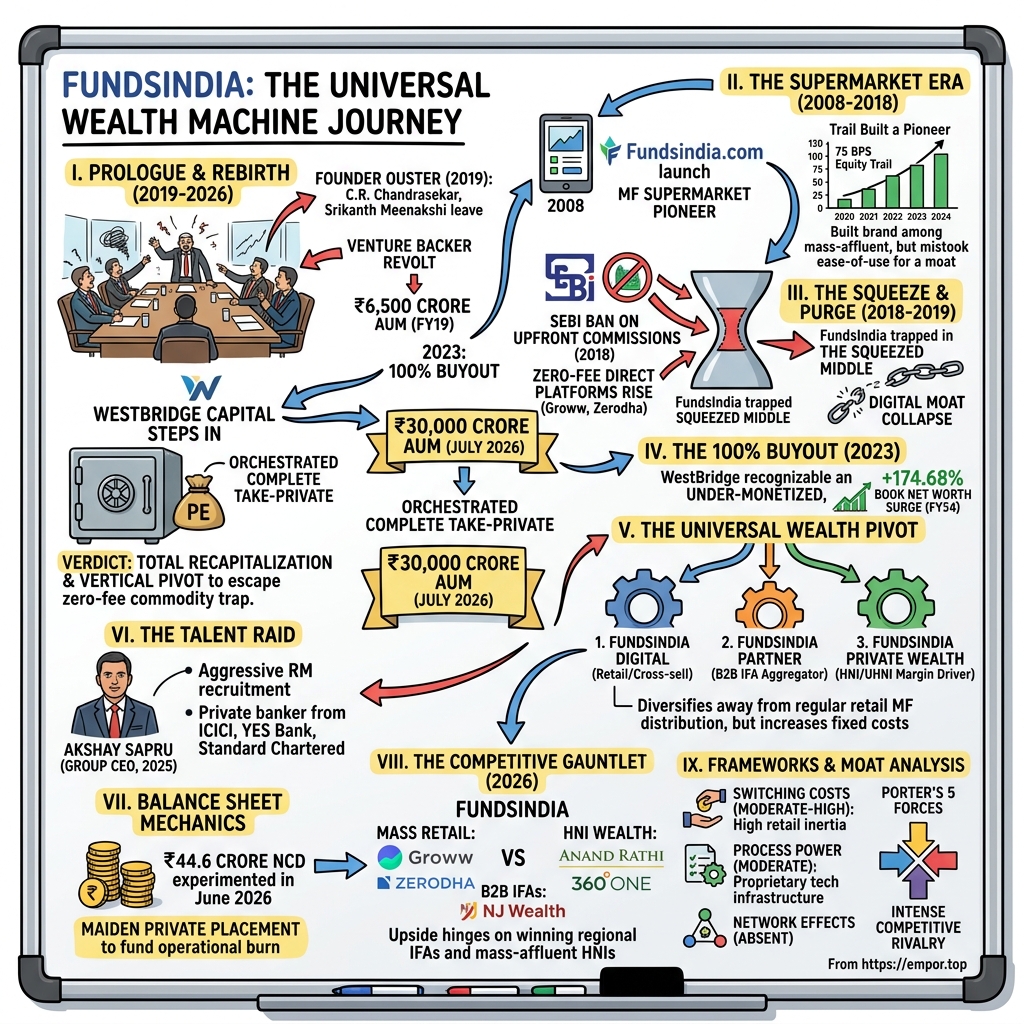
FundsIndia: The Universal Wealth Machine
I. Prologue: The Boardroom Coup & The ₹30,000 Crore Rebirth (00:00–08:30)
In the summer of 2019, two men who had spent a decade teaching middle-class Indians to buy mutual funds on a screen walked out of the company they had built. C.R. Chandrasekar and Srikanth Meenakshi, co-founders of Wealth India Financial Services, the Chennai company behind fundsindia.com, left after a standoff with the venture investors who sat on their board.1 The timing was cruel. Regulators had just stripped the fat out of mutual fund distribution, and a new breed of discount brokers was handing investors commission-free direct plans. The platform the founders left behind held roughly ₹6,500 crore of client assets, a number that had stopped moving.2
Seven years later, the same company is a different animal. It crossed ₹30,000 crore of assets under management in July 2026.3 It no longer has venture capitalists on its cap table, or any outside shareholders at all: WestBridge Capital, the India-focused investment firm, bought 100% of the company on August 22, 2023, taking out Faering Capital, Foundation Capital, Inventus Capital and the residual founder stakes in a single transaction.4 It has been split into three businesses, handed to a career private banker, and loaded with a maiden issue of secured debentures. Management now talks of becoming a "universal wealth manager" and of ₹1 lakh crore of assets by 2030.5
That is the question this story tries to answer. Can a pioneering fintech that lost its founders and its digital edge be rebuilt into an institutional wealth business that compounds, and one a public-market investor would one day want to own?
The short answer so far is that FundsIndia's second life was not a software triumph. It was a recapitalization and a change of trade. The owners stopped trying to win a price war against free apps and began building the kind of relationship-driven, people-heavy distribution business that India's listed wealth firms have turned into stock-market darlings. The asset growth is real. So is the cost: a company that earned ₹7.5 crore in FY24 lost ₹27.9 crore in FY25 as its workforce more than doubled.2
Before going further, one matter of status. FundsIndia is tagged a startup on Empor because it is not listed. It has not filed a draft red herring prospectus or any other offer document with SEBI, NSE or BSE as of September 30, 2026. There is therefore no price band, no disclosed offer structure, no audited restated financials in prospectus form and no formal risk factors. Everything in this story is built from registry filings, company material and press coverage, and several things a public investor would demand — the price WestBridge paid, FY26 audited accounts, the revenue split by vertical — the company has not disclosed.
The roadmap runs in eight movements. First, the supermarket era and the trail commission that made it work. Then the regulatory squeeze and the boardroom purge. Then WestBridge's take-private and the logic of buying an under-monetized licence. Then the three-engine pivot, the arrival of the private bankers, and the balance sheet that funds them. Finally, the competitive battlefield, the frameworks, the bull and bear cases, and what it would take for this business to be worth listing.
 Subscribe on LinkedIn
II. The Supermarket Era: How the Trail Built a Pioneer (08:30–22:00)
Wealth India Financial Services was incorporated in Chennai on October 16, 2008, just as the global financial crisis was emptying equity funds around the world.6 Its pitch was simple and, at the time, new: a single website on which an Indian saver could buy schemes from many fund houses without walking into a bank branch or meeting an agent. The company registered as a mutual fund distributor with AMFI under ARN-69583, and over time added a stockbroking licence on BSE and NSE, a depository participant registration with CDSL and a SEBI research analyst licence.7
Those licences matter more than they look. In India, a platform that wants to sell regular-plan mutual funds needs an ARN; one that wants to hold shares for clients needs a broker and depository footprint; one that publishes recommendations needs to be a registered research analyst. None of these is exclusive, and thousands of entities hold ARNs. But assembling all of them, keeping a clean compliance record through the SEBI inspection cycle and wiring them into a single account experience took years. That bundle is the most tangible thing WestBridge would eventually buy.
The trail: getting paid by someone else
The economic engine was the trail commission. When an investor buys the "regular" version of a mutual fund scheme through a distributor, the fund house pays that distributor a slice of the scheme's annual expense ratio for as long as the money stays invested. FundsIndia earns an ongoing trail of roughly 50 to 90 basis points a year on equity assets and 10 to 30 basis points on debt and liquid funds.7
Picture it as a tollbooth that charges by the year rather than by the trip. An investor who put ₹1 lakh into an equity fund via FundsIndia in 2010 and left it there would still be generating income for the distributor a decade later, and more income each year the market rose, because the fee is a percentage of market value. The customer never writes a cheque to the distributor; the cost is embedded in a slightly higher expense ratio than the direct version of the same fund. That invisibility was the model's great commercial strength, and its structural weakness.
For a digital platform, the trail looked like a perfect annuity. Customer acquisition was cheap in the early years because FundsIndia had little online competition, servicing costs were low because the software did the work, and every SIP instalment added to a base that kept paying. The founders layered on product: automated SIPs, value-added strategies such as "FI Stable 25" and "Power STP," research notes and portfolio reviews.6 Assets climbed to about ₹6,500 crore by FY18–FY19.2
Capital raised, and what it bought
The growth was financed modestly. FundsIndia raised about $15 million in three venture rounds: a Series A led by Inventus Capital in 2010, a Series B with Foundation Capital in 2012, and a ₹70 crore ($11 million) Series C led by Faering Capital in June 2015.2 Round valuations were never disclosed, and neither were the terms of the preferred shares the investors received. What can be said is that the capital was small relative to the brand the company built, which is a point in the founders' favour: this was not a cash furnace.
The historical falsification test: was the distribution edge a moat?
The claim implicit in the founder era was that FundsIndia had a franchise: a trusted brand, a sticky base of SIP investors and a software experience that would keep customers paying an embedded fee. The strongest test of that claim came in two steps.
The first was January 2013, when SEBI required every scheme to offer a direct plan with no distribution commission. From that date, any investor could buy the identical portfolio for 50 to 100 basis points a year less by going straight to the fund house. For several years that option was clumsy — fund-house websites were poor and consolidating holdings across AMCs was painful — so convenience kept regular-plan platforms in business. The second step came when discount brokers and fintech apps made direct plans as easy to buy as regular ones, which removed the convenience premium altogether. Once that happened, the new-to-market investor who had never known anything else went direct.
The history narrows the claim sharply. FundsIndia did build something durable: an installed base of investors who, through inertia, tax lots and trust, kept their regular-plan SIPs running. It did not build a proprietary interface that could hold new customers against a free alternative selling the same product. Brand and convenience were real but not cornered; they could be reproduced by any well-funded app. The KPI that would confirm or falsify the narrower claim is the one the company does not publish today: net new SIP registrations in the Digital business against redemptions and switches to direct plans.
III. The Squeeze, The Strike, and The Purge (22:00–37:00)
In October 2018, SEBI tightened the screws on the distribution economy. The regulator's reforms of mutual fund total expense ratios mandated a full-trail commission model and banned upfront commissions paid out of scheme expenses, while lowering the ceilings on what larger schemes could charge.8 For a distributor, the effect was twofold. Revenue that used to arrive in a lump at the moment of sale now arrived slowly, over years. And the size of the pie itself shrank, because lower expense ratios left less room for the distributor's share.
At FundsIndia, the reform landed on a business whose growth was already slowing. Assets had plateaued around ₹6,500 crore, commission realizations fell, and the cash generation that had funded the company's modest overhead dried up.2
Two shocks at once
The regulatory shock alone might have been survivable. The competitive shock was not. Zerodha had launched Coin for direct mutual funds, Groww was building an app-first investing brand, and Kuvera and Paytm Money followed with commission-free offerings.9 These firms were not trying to earn a mutual fund trail at all; they treated funds as a customer-acquisition product for broking, lending or payments. A distributor whose entire income came from the trail was now competing against rivals who were happy to earn nothing on the same product.
This is the "squeezed middle" in its purest form. FundsIndia was too dependent on regular-plan commissions to switch to direct plans without destroying its revenue. Yet it was too self-service, too digital, to justify the higher fees that offline advisers and private banks earned by sitting across the table from wealthy clients.
The purge
What followed was a fight over what to do about it. The venture investors — Foundation, Faering and Inventus — pushed for faster monetization and cost discipline; the founders resisted. In June 2019, Chandrasekar and Meenakshi were ousted, and news of their exit amid a spat with investors surfaced publicly weeks later.1 Girirajan Murugan, the former chief technology officer, became chief executive.10 Research head Vidya Bala and core research analysts left in the aftermath; Bala went on to co-found PrimeInvestor, a subscription research service.2
The departure of the research team was more damaging than it first appeared. FundsIndia's research content was part of what distinguished it from a bare transaction platform; it was the reason some investors accepted a regular plan's higher cost. Losing the people who produced it, just as the price difference with direct plans became starkly visible, removed one of the few arguments for the embedded fee.
The four-year drift
Under interim stewardship from July 2019 to August 2023, assets rose from about ₹6,500 crore to roughly ₹11,000–12,000 crore.2 That is a little under doubling in four years, over a stretch in which Indian equity indices recovered from the pandemic crash and then rallied hard. Because trail-based AUM rises mechanically with markets, a gain of that size is consistent with a book that was mostly marking up in value rather than winning new customers at scale. The company has not disclosed net flows for the period, so the precise split between market appreciation and organic inflow cannot be established. But the direction is clear: FundsIndia survived the purge, did not collapse, and did not break out.
For an underwriter, this era carries two lessons. It shows that the legacy book is sticky — assets did not run for the exits even as founders and research leaders walked out. And it shows that stickiness is not growth. A base that holds but does not attract is a harvestable asset, which is exactly how a private equity firm would come to see it.
IV. The WestBridge Buyout: The 100% Take-Private (37:00–52:00)
On August 22, 2023, WestBridge Capital completed the purchase of 100% of Wealth India Financial Services Private Limited.4 In one sweep it bought out Faering, Foundation and Inventus along with the founders' remaining equity. WestBridge partners Sandeep Singhal, the firm's co-founder, and Deepak Ramineedi joined the board.6
The transaction price was not disclosed.2 That single fact shapes everything that follows in the valuation discussion. There is no observed private-market mark to anchor on, whether flattering or not. Anyone quoting an enterprise value for FundsIndia is estimating, not reading.
Why a PE firm would want this asset
The thesis is not hard to reconstruct from what WestBridge did next. By 2023, India's listed wealth and distribution firms — Prudent Corporate Advisory, Anand Rathi Wealth, 360 ONE WAM — were trading at earnings multiples that would be generous for a software company. Prudent, a B2B aggregator serving independent advisers, and Anand Rathi, a relationship-manager-led HNI house, were both valued at tens of times earnings and several percent of client assets.2 An unlisted distributor with a working licence stack, a debt-free balance sheet and over ₹11,000 crore of sticky, mostly equity AUM could be bought at a private discount to those multiples and, if scaled, sold later at a public premium. That is classic scale-and-multiple arbitrage: buy the asset cheaper than the market values its listed cousins, grow it, and exit into the public multiple.
A cleaner cap table was part of the value. Three venture funds of different vintages, each with its own fund-life deadline, sitting alongside founder residuals, is a recipe for exactly the gridlock that had paralysed the board in 2019. With a single owner, strategy decisions no longer required negotiation between holders with different horizons.
Recapitalization
WestBridge put money in as well as buying shares from others. The company's book net worth rose by about 175% in FY24, reflecting fresh equity after the acquisition.11 The company had paid-up share capital of about ₹13.7 crore against authorized capital of about ₹42.6 crore — headroom to issue more shares without a charter amendment.12 In FY24, FundsIndia reported operating revenue of ₹88.8 crore and a profit after tax of ₹7.5 crore.2 That was the last year it made money.
Governance at the point of purchase
Structurally, the story is simple, which is itself a positive for a future public investor. Wealth India Financial Services remains the sole operating company. Registry filings do not show material royalty or brand fees paid to WestBridge entities, and auditors have not reported adverse CARO qualifications.12 Murugan moved from chief executive to a board seat, clearing the way for a new leadership bench.6
The simplicity has a flip side. With one owner, there are no minority shareholders whose presence forces disclosure, and there is no public record of the preference terms, management equity grants or any shareholder agreement that will govern how WestBridge exits. When an offer document appears, the first diligence items will be the structure of the WestBridge holding, the size of any employee stock option pool, and whether the listing is primarily an offer for sale by the sponsor. A 100% owner selling into an IPO is, by definition, a seller: the public investor should expect the offer to be designed to maximize the price of the shares WestBridge sells.
Was it a bargain?
The price is unknown, but a rough frame helps. At the time of the deal, assets were about ₹12,000 crore and trailing profit was a few crore.2 Applying the 2.0%–3.5% of AUM range commonly cited for mutual fund distribution transactions gives an indicative value in the ₹240–420 crore range at purchase — an illustration of scale, not a claim about what WestBridge paid. If the business is now worth even the low end of the same range on ₹30,000 crore of assets, the asset base alone has more than doubled the implied value in three years. Most of that gain came from growth rather than from any change in the business's profitability, which has gone the other way.
V. The Universal Wealth Pivot: Triangulating Retail, IFAs, and HNIs (52:00–1:08:00)
The reorganization announced in late 2024 and early 2025 formally ended FundsIndia's identity as a pure digital supermarket. The company split into FundsIndia Digital, FundsIndia Partner and FundsIndia Private Wealth, each with its own chief executive.6 In March 2026, management described the destination as a "universal wealth manager" — one firm reaching the mass affluent through an app, small-town savers through independent advisers, and wealthy families through private bankers.5
The numbers tell the cost of that ambition. Revenue rose about 33% in FY25 to ₹118.2 crore. Expenses rose about 78% to ₹146.1 crore, turning FY24's profit into a ₹27.9 crore loss.2 Headcount went from roughly 318 before the takeover to 704.2
Engine 1: FundsIndia Digital
Led by Rhishabh Garg, Digital is the legacy business and still the bulk of the book.6 It earns regular-plan trail on retail equity and debt funds and cross-sells term insurance, the National Pension System, corporate fixed deposits — which carry upfront margins of about 0.25% to 1.5% — and stockbroking.7 Its job in the new structure is to defend the base and feed the other two engines with customers who have grown wealthy enough to need more. Over 18 lakh registered customers and more than 3 lakh active investing accounts sit in this business.6
The ratio between those numbers is telling. Roughly one registered customer in six is actively investing. The rest are dormant sign-ups accumulated over 18 years. That makes "18 lakh users" a marketing number and "3 lakh active accounts" the economic one.
Engine 2: FundsIndia Partner
Led by Manish Gadhvi, Partner supplies technology, research and back-office execution to independent financial advisers, mostly outside the largest metros, and shares the fund house's trail with them.6 This is the model Prudent Corporate Advisory and NJ India Invest have turned into two of the largest distribution franchises in the country.7 The appeal is capital efficiency: the adviser owns the client relationship and bears the cost of servicing it, while the platform collects a slice of every rupee the adviser places. FundsIndia earns less per rupee of AUM than in Digital, but spends far less to acquire it.
Engine 3: FundsIndia Private Wealth
Led by Srinivas Mendu, Private Wealth serves clients with portfolios from about ₹50 lakh to over ₹10 crore through dedicated relationship managers.6 It distributes portfolio management services, alternative investment funds, specialised investment funds and structured bonds — products that pay higher placement and advisory fees than mass-market mutual funds.7 It is also, by far, the most expensive business to build: relationship managers carry high fixed salaries, joining bonuses and targets that take years to mature, and wealthy clients expect offices in Mumbai, Delhi NCR and Bengaluru, not a Chennai call centre.13
What the pivot does to the economics
A simple way to read FY25 is as a revenue yield problem. Assuming average FY25 AUM of perhaps ₹13,000–15,000 crore — the company does not publish averages — ₹118 crore of revenue implies a gross yield around 80 to 90 basis points on assets. Costs of ₹146 crore amount to roughly 100 basis points or more on the same base. In other words, FundsIndia spent more to service and grow each rupee of assets than it earned on that rupee. That gap can close in two ways: assets grow faster than costs, which the FY26 AUM surge suggests is happening, or yield rises as Private Wealth's higher-fee products become a larger share of the mix. Both must happen for the model to work.
The historical falsification test: operating leverage
The claim embedded in "universal wealth manager" is that scale brings operating leverage: once the platform, compliance stack and brand are paid for, each additional crore of assets drops disproportionately to profit. FundsIndia's own FY25 disproves that claim in its strong form. Assets accelerated from about ₹11,000–12,000 crore toward ₹15,800 crore by March 2025, yet losses widened sharply because the new growth was bought with people, not code.2 The company then reached ₹25,000 crore by March 2026, up 58% in a year, and ₹30,000 crore by July 2026.3
The evidence narrows the claim rather than rejecting it. Operating leverage in this model is delayed, not absent: a relationship manager hired in FY25 costs full salary from day one but may take two to three years to bring in a mature book. If the FY25 cohort of hires is productive, FY26 and FY27 should show revenue per employee rising and the loss narrowing. If revenue per employee stays flat while AUM climbs mainly on market appreciation, the "leverage" was never there. The company has not filed FY26 accounts publicly, and that filing is the single most important data point for the pivot.
VI. The Talent Raid: Akshay Sapru and the Private Bankers (1:08:00–1:20:00)
In July 2025, WestBridge named Akshay Sapru director and Group CEO.14 He came with 27 years in banking and financial services, most recently as country head for private banking, liabilities products and Spectrum banking at YES Bank, and earlier in senior roles at ICICI Bank, ABN AMRO/RBS and IndusInd Bank.14 Murugan, who had run the company through the drift years, stepped back to the board.6
The appointment is the clearest statement of what WestBridge thinks FundsIndia is now. A company built by technologists and run for four years by its former CTO is being led by someone whose career was spent on the other side of the table: acquiring wealthy clients, managing relationship teams and selling bank products. The three vertical chiefs complete the picture. Gadhvi runs the adviser network; Mendu runs private wealth; Garg runs digital.6
The private-banking playbook
The logic is straightforward. Reaching ₹1 lakh crore of assets from ₹30,000 crore cannot be done through app downloads alone. Search ads and referral bonuses bring in small-ticket SIP investors; they do not bring in a family with ₹20 crore to allocate. That money moves when a relationship manager the family trusts moves. The Indian wealth industry runs on this churn: RMs at large private banks and wealth houses regularly change employers, and a portion of their clients follow them.
FundsIndia's advantage in that market is a payout structure that can be more generous than a bank's, backed by an owner willing to fund the upfront cost. Its disadvantage is brand. A family that has banked with ICICI or Kotak for twenty years may follow a trusted RM to a new desk; it may equally hesitate before moving its money to a firm it knows as a mutual fund app.
Judging management by behaviour, not biography
A resume is not a result, and Sapru's tenure is barely a year old. What can be judged is the behaviour of the owner-management system since 2023. Capital has been allocated aggressively to growth, and the company has been candid about the scale of that spending: the FY25 loss was filed in MCA records, not hidden behind adjusted metrics.2 There are no disclosed related-party extractions by the sponsor.12 Against that, the company publishes very little of what a public investor would use to hold management to account: no vertical-level AUM, no RM count, no revenue per RM, no client retention data.
Management's headline promise — ₹1 lakh crore by 2030 — is also the kind of target that is easy to reach in a strong market and impossible in a weak one, because so much of AUM is market value. A public investor should treat it as an aspiration and watch the components: net inflows, the share of AUM from Partner and Private Wealth, and the ratio of revenue to cost.
Incentives
Management incentives are not disclosed. It is reasonable to assume, given WestBridge's model, that senior executives hold equity or options that pay out on an exit event, which would align them with a listing or sale in the 2028–2030 window. That alignment is good for growth and potentially bad for the public buyer: a team rewarded on the exit price has every reason to present the business at its best in the year of the IPO. The size of any option pool, the vesting schedule and whether grants accelerate on listing are among the first things to check in any future prospectus.
VII. Balance Sheet Mechanics: Receivables, Cash Burn, and the ₹44.6 Crore NCD (1:20:00–1:32:00)
In June 2026, Wealth India Financial Services completed its maiden private placement of secured non-convertible debentures, raising ₹44.6 crore, or about $5.2 million.13 The buyers were domestic high-net-worth and accredited investors, reached through FundsIndia's own Private Wealth channel, and the proceeds were earmarked for technology and multi-city private wealth offices.15
That detail — a wealth manager selling its own debt to its own clients — is the most revealing thing on the balance sheet. It shows the distribution engine works: FundsIndia could place a ₹44.6 crore issue without a bank or a rated public offering. It also shows that growth now needs external funding, and that WestBridge chose debt over fresh equity to provide it.
Receivables: the best part of the balance sheet
For a lender, the reassuring feature is the quality of what FundsIndia is owed. More than 85% of its trade receivables are due from SEBI-regulated asset management companies, for trail commissions deducted from scheme assets under a regulatory formula.11 Bad debts on AMC commissions have been close to nil throughout the company's history.11 Broking receivables settle through the clearing corporations on India's T+1 cycle.11 In plain terms: FundsIndia's customers pay it on time because the payment is automatic, and the payer is a regulated fund house.
That quality is a genuine asset, but its limit should be clear. Receivable safety says nothing about the size of future receivables. A market fall does not make AMCs default; it makes the trail smaller.
Profit into cash
In FY24, profit and cash roughly moved together: trail commissions settle monthly and there is little working capital to finance.2 FY25 broke that pattern. The ₹27.9 crore loss was a cash loss, driven by salaries, RM sign-on packages, a technology overhaul and marketing.2 Operating cash flow turned negative and, absent the FY26 filing, the company has not disclosed whether the burn narrowed as AUM surged.
The size of the NCD issue offers a clue to management's expectations. ₹44.6 crore is less than two years of burn at the FY25 rate. If the company expected losses to keep growing, it would have raised more, or raised equity. A modest debt issue suggests the plan assumes losses narrow quickly as the new AUM starts paying trail. That is a reasonable plan, but it is a plan, not an outcome.
Capital structure
Before the NCD, FundsIndia had no long-term bank borrowings.13 Its other long-term obligations are office leases, accounted for under Ind AS 116, for its Chennai registered office at Royapettah, a technology and operations hub at RMZ Eco World in Bengaluru, and regional wealth branches.6 There is no public credit rating from CRISIL, ICRA, CARE or India Ratings, and the NCD's coupon, tenor and security package have not been disclosed. Client margins and settlement money are held in segregated client bank accounts as SEBI requires.11
What a public-market investor cannot do today is build an enterprise-value bridge. The company's cash balance at the end of FY26 is not published, the NCD terms are not public, and lease liabilities are not quantified in any available document. Any enterprise value figure is therefore an approximation built from equity estimates plus the ₹44.6 crore of debt, less unknown cash.
The sponsor question
The deeper question is how long WestBridge will fund losses. A 100% owner can inject equity at will, with no minority to dilute; the only cost is to the sponsor's own fund returns. That makes a formal "down round" unlikely. It does not make continued funding certain. If a market downturn arrives while the business is still losing money, WestBridge faces a choice between writing more cheques and slowing the private wealth build-out. The NCD holders, by contrast, have fixed claims and security, and would rank ahead of the equity in any stress.
VIII. The Competitive Gauntlet: Discount Brokers vs. National Aggregators vs. Private Banks (1:32:00–1:48:00)
In 2026, an Indian retail saver can buy a direct mutual fund on Groww in a few taps and pay no distribution fee. A family office can hand a ₹25 crore mandate to 360 ONE WAM. FundsIndia, at ₹30,000 crore of assets, has to compete at both ends and in the middle.3
Below: the free apps
Groww leads in active mutual fund SIPs and retail broking; Zerodha Coin, Kuvera (now part of CRED), INDmoney, Paytm Money and Angel One all sell direct plans without commission.2 For the mass retail investor who knows which fund they want, FundsIndia has no price answer. Its only answers are advice, goal-based portfolios and inertia. Those can hold existing customers; they are unlikely to win many new self-directed ones. The realistic role of FundsIndia Digital is therefore a feeder and a defended annuity, not a growth engine.
In the middle: the aggregators
The adviser channel is where FundsIndia's growth case lives, and it is also where the incumbents are strongest. NJ India Invest runs the largest IFA network in India; Prudent Corporate Advisory is listed and has built its franchise on serving advisers in smaller towns.16 FundsIndia Partner competes on software, research and automation — portfolio rebalancing, CRM tools, consolidated reporting — but so do its rivals, and both have many times its adviser base. An IFA switching platform must move client folios and learn new systems, so poaching advisers is slow. The evidence that it is happening is the pace of FundsIndia's AUM growth since 2024, but without a vertical split it is impossible to say how much of that growth comes from Partner.
Above: the wealth houses and banks
At the top, Anand Rathi Wealth runs a standardized, RM-led allocation model for HNIs, 360 ONE dominates ultra-high-net-worth clients and alternatives, and Nuvama and the private banks compete for the same families.17 FundsIndia Private Wealth is the newest and smallest entrant. Its opening is the "mass affluent to lower HNI" band — ₹50 lakh to a few crore — where large banks under-serve clients and premium wealth houses are too expensive.
The peer set, properly built
For valuation, not all of these are equally comparable. Direct operating peers are those that earn distribution income on client assets in India through advisers or RMs: Prudent (the closest match for Partner and Digital) and Anand Rathi (the closest match for Private Wealth). 360 ONE and Nuvama are aspirational category leaders with asset-management, lending and institutional businesses FundsIndia lacks; their multiples reflect those businesses and should not be applied directly. Groww, now listed, is a platform peer but its economics rest on broking and scale that FundsIndia does not have.
The listed direct peers trade richly. Prudent has been valued at roughly 45 to 55 times earnings and 3.5% to 4.5% of AUM; Anand Rathi at about 50 to 65 times earnings and 6% to 8% of AUM.16 17 360 ONE trades nearer 30 to 35 times earnings and Nuvama 25 to 30 times.18 These are equity-value multiples of trailing profit and client assets, and they apply to companies that are profitable, with long records of disclosed flows.
What those multiples imply — and don't
A P/E multiple cannot be applied to FundsIndia at all: it has no profit. An AUM-based yardstick is the only one available. Applying the 2.0% to 3.5% range used in distribution M&A to ₹30,000 crore gives an indicative value of about ₹600 to ₹1,050 crore; applying Prudent's listed 3.5% to 4.5% gives roughly ₹1,050 to ₹1,350 crore.2 Anand Rathi's range of 6% to 8% would imply ₹1,800 crore or more, but that multiple is earned by a firm with a high-yield HNI book and strong margins, which FundsIndia does not yet have.
The central point is that an AUM multiple is a shortcut for "what these assets will earn." Prudent earns a profit on its AUM; FundsIndia currently does not. Applying a profitable peer's AUM multiple to a loss-making book implicitly assumes the loss disappears. That is the bet a buyer would be making.
IX. Frameworks & Strategic Moat Analysis (1:48:00–2:00:00)
The question for any long-term owner is whether FundsIndia has structural advantages or is a competent distributor riding a strong decade for Indian financial savings. The evidence at hand: about 3 lakh active investing accounts, more than 80% of revenue from recurring trail tied to market value, and AUM that grew 58% in the year to March 2026.6 7 3
Hamilton Helmer's 7 Powers
Switching costs — moderate to high in the legacy book. An investor with a dozen running SIPs, years of tax lots and embedded capital gains faces real friction in moving to direct plans: switching a regular plan to direct is a redemption and re-purchase, which can trigger tax. This is the most defensible advantage FundsIndia has, and the 2019–2023 drift is its proof — the book held even when the company was in turmoil. But it protects the past, not the future: new investors face no such cost.
Scale economies — moderate. Compliance, research, depository integration and technology are spread over ₹30,000 crore of assets. The private wealth build-out dilutes these economies, because RMs and branches scale with clients rather than with code.
Network effects — absent. An additional investor or adviser does not make the platform more valuable to others.
Counter-positioning — absent. In the retail business FundsIndia was the one counter-positioned against: discount brokers built a model FundsIndia could not copy without destroying its own revenue. The Partner and Private Wealth pivots copy incumbents rather than attack them from an angle they cannot follow.
Process power — moderate but unproven as an advantage. Eighteen years of SIP engines, transfer strategies and automated reviews represent real know-how. Whether they outperform what Prudent or NJ offer advisers is not demonstrated in any disclosed metric.
Brand and cornered resource — weak. FundsIndia owns no fund house and no lending book, and distributor licences are non-exclusive.7 Its brand is known to retail savers, less so to the wealthy families Private Wealth needs.
The verdict: FundsIndia has a real but backward-looking moat in its retail book, and a process base that may help it win advisers, but no power that forces customers to choose it over a rival for new money.
Porter's Five Forces
Buyers — strong. Retail clients can go direct at zero cost; HNIs negotiate fees and can deal with fund houses directly.
Suppliers — strong. The top six fund houses control over 60% of industry assets, and their commission grids operate within SEBI's expense-ratio ceilings.7 A distributor of FundsIndia's size is a price-taker.
New entrants — moderate. Licensing and compliance deter small players, but deep-pocketed consumer platforms such as PhonePe, CRED and Jio Financial keep entering.
Substitutes — strong. Direct plans, index funds, ETFs and direct equity all route around regular-plan distribution.
Rivalry — intense, both on price at the bottom and on RM talent at the top.
The five forces describe an industry where value accrues mainly to scale and to trusted relationships. FundsIndia's strategy makes sense against that map: it is moving toward the parts of the value chain where relationships, not interfaces, earn money. But the map also explains why that movement is expensive.
X. Skeptical Stress Test: Bear vs. Bull Case (2:00:00–2:12:00)
Picture an investment committee weighing management's target of ₹1 lakh crore of AUM by 2030 against today's ₹30,000 crore, a ₹27.9 crore loss in the last published year, and a regular equity trail of 50 to 90 basis points.5 3 2 7 The question is simple: is this a compounding wealth franchise in the making, or a cost base in search of a bull market?
The bear case
Equity cyclicality. More than 80% of revenue is trail on market-valued assets.7 A 25% fall in Indian equities would cut equity-linked AUM and trail by a similar proportion, with a lag of weeks, while RM salaries and leases stay fixed. In a business that is already losing money, that is a sharp swing.
The regulatory guillotine. SEBI has cut distribution economics before, in 2018, and keeps reviewing expense ratios, B-30 incentives and exchange fees.8 Any further cut falls straight to the bottom line.
The cost-of-growth trap. The ₹44.6 crore NCD buys time, not a destination.13 If it is spent before operating cash flow turns positive, WestBridge must either fund more losses or slow private wealth hiring — and a slowdown would leave the company with the costs of a half-built franchise.
Talent flight. In HNI wealth management, clients often follow their RM. Assets won by poaching bankers can be lost the same way.
The bull case
Financialization. Indian households are steadily moving savings out of gold and property and into mutual funds, equities and structured products. That tailwind has lasted a decade and has decades more to run.
The adviser multiplier. IFAs in non-metro India are among the fastest-growing distribution channels. Each adviser won brings a book of clients at low acquisition cost to FundsIndia.
Private wealth cross-sell. The company has 18 lakh registered retail users.6 If even a small fraction have become wealthy enough for PMS, AIF or structured-bond products, converting them costs far less than acquiring HNIs cold.
The exit arbitrage. At ₹75,000 crore to ₹1 lakh crore of AUM with positive margins, FundsIndia would look like a smaller Prudent or a younger Anand Rathi — firms the public market values at several percent of AUM.
A scenario frame for intrinsic value
With no price and no profit, the honest approach is a set of transparent scenarios for a 2030 exit, discounted back at 15% a year for four years (a divisor of about 1.75). Each is a sketch of what has to be true, not a target.
In a bear case, AUM reaches about ₹50,000 crore, blended yield compresses to 0.6%, and a mature net margin of 20% yields around ₹60 crore of profit. At 25 times earnings that is about ₹1,500 crore in 2030, or roughly ₹860 crore today.
In a base case, AUM reaches about ₹75,000 crore at a 0.65% yield, giving close to ₹490 crore of revenue; a 25% margin gives about ₹120 crore of profit. At 30 times, that is about ₹3,600 crore in 2030, roughly ₹2,050 crore today.
In a bull case, management hits ₹1 lakh crore with a richer mix lifting yield to 0.7%, or ₹700 crore of revenue, at a 30% margin — about ₹210 crore of profit. At 35 times that is around ₹7,350 crore in 2030, roughly ₹4,200 crore today.
Three sensitivities dominate. First, margin: every five points of mature net margin moves the base-case value by about a fifth. Second, the exit multiple: the listed peers' 45-plus times earnings reflects today's enthusiasm for Indian wealth stocks and may not survive to 2030. Third, dilution: the scenarios assume WestBridge funds any remaining losses without issuing shares to others and that employee options are modest; neither is disclosed.
Reconciling the views
The comparable-AUM view puts the business at about ₹600 crore to ₹1,350 crore today; the scenarios span about ₹860 crore to ₹4,200 crore. They overlap at the low end, which is instructive: the market-multiple view today is roughly what the bear case is worth. Anything above that requires believing the pivot will produce Prudent-like margins on a larger, richer book.
When an IPO eventually comes, the price may land above the central range for reasons unrelated to business value: scarcity of listed wealth platforms, the strength of the "financialization" narrative, a small free float if WestBridge sells only a slice. None of those makes the business worth more. The underwriting stands or falls on three numbers: net inflows excluding market gains, the share of AUM in Partner and Private Wealth, and the gap between revenue and cost.
XI. The Playbook: Durable Business & Investing Lessons (2:12:00–2:22:00)
1. A commodity sold through a nicer screen is still a commodity. In 2018, FundsIndia's interface was better than any fund-house website and its research was respected. None of it mattered once Zerodha and Groww put the identical fund on an identical screen for free.9 The lesson for founders is that a distribution business built on someone else's product owns only what it can charge for when a rival charges nothing. For investors, the test of a fintech moat is not how much customers like the app; it is how many of them stay when the same product is free next door. "If your margin is someone else's expense ratio, your moat is a regulator's patience."
2. Sticky is not the same as growing. The book held through the founders' ouster, the research team's exit and four years of drift, rising from about ₹6,500 crore to ₹11,000–12,000 crore largely on market tides.2 That stickiness is what WestBridge bought, and it was worth buying. But it was a harvest, not a franchise. Investors who confuse low churn with competitive strength will overpay for annuities that are slowly running down. "An installed base is a pension, not a plan."
3. One owner can do what a boardroom cannot. Three venture funds with different clocks and two founders with a different vision spent years unable to agree. WestBridge's 100% purchase in August 2023 ended the argument in a day and let the company raise money, hire bankers and re-organize without a negotiation.4 Founders and early investors should note the corollary: when a cap table becomes a veto machine, the eventual buyer captures the value of fixing it. "Sometimes the most valuable thing a buyer acquires is the end of the argument."
4. When you leave the screen, you pay in salaries. FundsIndia went from about 318 employees to 704, and from a ₹7.5 crore profit to a ₹27.9 crore loss, in the year it chose relationships over software.2 2 The move may prove wise. But it changed the business from one whose costs are written once to one whose costs walk in every morning. "Code scales by copying; trust scales by hiring."
XII. Epilogue: The Road to ₹1 Lakh Crore (2:22:00–2:28:00)
Tonight, FundsIndia is a ₹30,000 crore platform owned by a single private-equity sponsor, run by a private banker, split into three businesses of very different economics, and funded partly by debentures sold to its own clients.3 4 14 13 It has grown assets at a pace its founders never managed and has not yet shown that growth can pay for itself.
The next chapter will be decided by a handful of moments.
The first is the FY26 filing with the Ministry of Corporate Affairs. It will show whether revenue caught up with the costs of FY25's hiring spree. A narrowing loss on sharply higher AUM would be the first real proof that the private-wealth and adviser engines are maturing. A wider loss would mean the model needs more assets per rupee of cost than the company has, and more capital than the NCD provided.
The second is disclosure itself. Until FundsIndia reports how much of its AUM sits in Digital, Partner and Private Wealth, the most important question — is the business becoming a higher-yielding wealth manager or remaining a trail collector with a larger payroll? — cannot be answered from outside.
The third is the market. An extended correction in Indian equities before the company turns profitable would test both the bear case and WestBridge's patience at the same time.
The last is the IPO clock. If assets approach ₹50,000 to ₹60,000 crore with losses shrinking, a draft red herring prospectus would be the natural next step for a sponsor with a finite fund life. That document will finally answer the questions that remain open: the price WestBridge paid, the terms of its shares, the size of the employee pool, the split of the offer between fresh issue and sale by the sponsor. A public investor should read it asking one question above all: how much of the value being offered is profit already earned, and how much is the promise of a margin the company has not yet shown?
XIII. Outro (2:28:00–2:30:00)
In June 2019, two founders left a Chennai boardroom believing, perhaps, that the thing they had built had reached its limit — a mutual fund supermarket in an age of free shelves.1 They were half right. The supermarket had reached its limit. The customers had not.
FundsIndia's second life is a bet that affluent India, having learned to invest on a screen, will pay for someone to sit beside it when the sums get large. That bet has quadrupled the company's assets and erased its profits. Whether it becomes a compounding machine or an expensive detour will be decided not by its app, nor by its owner, but by the next thousand wealthy families who decide whether a banker's handshake is worth the fee.
References
-
FundsIndia Co-Founders Quit Amid Boardroom Spat With Investors — VCCircle, 2019-07-31 ↩↩↩
-
FundsIndia — Company Profile, Financials & Valuation — Inc42 ↩↩↩↩↩↩↩↩↩↩↩↩↩↩↩↩↩↩↩↩↩↩↩
-
FundsIndia Crosses ₹30,000 Crore AUM Milestone — CXO Digital Pulse, 2026-07-22 ↩↩↩↩↩↩
-
WestBridge Capital Portfolio & Buyout Details — Preqin, 2025-12-31 ↩↩↩↩
-
FundsIndia Plans to Build 'Universal Wealth Manager' Platform in India — The Financial Express, 2026-03-24 ↩↩↩
-
About Us, Corporate History & Solutions — FundsIndia ↩↩↩↩↩↩↩↩↩↩↩↩↩↩
-
Terms and Conditions & Regulatory Disclosures — FundsIndia ↩↩↩↩↩↩↩↩↩↩
-
SEBI Master Circular for Mutual Funds (TER Rationalization & Commission Directives) — Securities and Exchange Board of India ↩↩
-
FundsIndia Company Financing & Ownership History — Tracxn, 2026-06-25 ↩↩
-
FundsIndia Platform Overview & Executive Team — Dealroom, 2026-08-10 ↩
-
Wealth India Financial Services Private Limited Financial Reports — Tofler, 2026-03-31 ↩↩↩↩↩
-
Wealth India Financial Services Private Limited Corporate Information — ZaubaCorp, 2026-05-15 ↩↩↩
-
FundsIndia Raises ₹44.6 Crore via Maiden Secured NCD Issue — The Economic Times, 2026-06-12 ↩↩↩↩↩
-
Akshay Sapru Appointed Group CEO of FundsIndia — Business Standard, 2025-07-18 ↩↩↩
-
FundsIndia Completes Maiden Corporate Debt Placement — IBS Intelligence, 2026-06-16 ↩
-
Prudent Corporate Advisory Services Limited Investor Presentations & Results — NSE India ↩↩
-
Anand Rathi Wealth Limited Investor Presentations & Financials — NSE India ↩↩
-
360 ONE WAM Limited Investor Disclosures & AUM Mix — NSE India ↩
 LinkedIn
 WhatsApp
 Reddit
 Hacker News
 Email
Email Kindle
 RSS Feed
 Spotify
 Apple Podcasts
 Amazon Music
 Audible
 YouTube