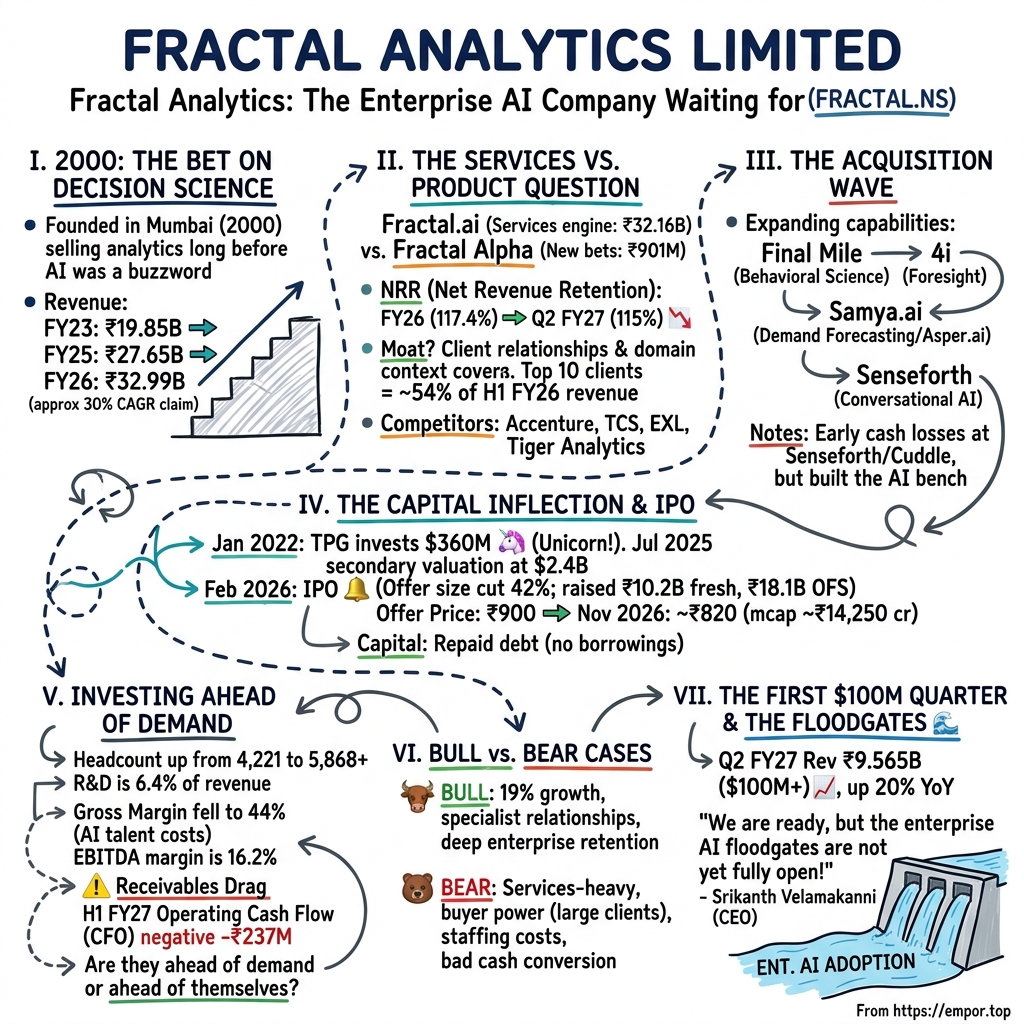
Fractal Analytics: The Enterprise AI Company Waiting for the Floodgates
I. The Quarter Fractal Crossed $100 Million
On the morning of November 4, 2026, Srikanth Velamakanni opened Fractal Analytics' second-quarter call with a line that sounded more like a warning than a boast. A hundred days had passed since the last call, he said, and in the world of AI that is a very long time. AI was now contributing to scientific breakthroughs, but "the world of enterprises is still catching up." Then came the sentence that framed everything that followed: "The enterprise AI floodgates have not opened yet."1
Only after that did he deliver the headline. For the first time in its 26-year history, Fractal had booked more than $100 million of revenue in a single quarter.1 In rupees, the quarter to September 2026 brought in about ₹957 crore, up 20% from a year earlier.12 Adjusted EBITDA rose 30%, and net income more than doubled.1
Most CEOs who cross a milestone like that lead with the milestone. Velamakanni led with the gap between what AI can do and what large companies are actually buying. That ordering is the whole story of Fractal in miniature.
The company has spent a quarter of a century inside some of the world's largest enterprises, selling them better decisions built on data. It now argues that a vast new wave of AI spending is coming. And it is asking public investors to pay for a business that is already growing while that wave is still offshore.
Look under the headline and the number splits in two. Half of that 20% growth came from the rupee. In constant currency, which strips out exchange-rate moves, revenue grew only 10% year over year.1 Fractal earns most of its money in dollars, pounds and euros and reports in rupees, so a weakening rupee makes every foreign invoice look bigger at home.
That is real money, and it helps margins too, but it is not evidence that clients are buying more. The demand signal was the 10%, and 10% is a respectable but ordinary growth rate for a company priced as an AI story.
Profitability told a more encouraging tale. The adjusted EBITDA margin reached 16.2%, about 1.2 percentage points higher than a year earlier.1 Net income of about ₹79 crore was up 139%, a jump flattered by the comparison base and by falling stock-compensation charges, but still a sign that the business was getting more profitable as it grew.1
Before going further, it helps to be clear about what Fractal Analytics Limited actually is. The listed company, which joined the NSE and BSE in February 2026, is the Indian parent of an international group of operating subsidiaries, most importantly in the United States, plus an associate stake in the medical-imaging company Qure.ai.32
The figures in this story are consolidated group numbers unless stated otherwise. The private-equity names that appear in Fractal's history, TPG and the investment vehicle Quinag, were large shareholders, not parent companies. No controlling group sits above the listed entity collecting royalties or management fees.3
The business itself comes in two very unequal pieces. Fractal.ai is the engine: the analytics, AI and engineering services that Fractal sells to large enterprises. In the September quarter it supplied about ₹936 crore of the ₹957 crore total.4 Fractal Alpha is the small, higher-risk portfolio of product businesses, chiefly the revenue-management software Asper.ai and the data-science learning platform Analytics Vidhya. Alpha's revenue was about ₹34 crore in the quarter, growing fast but still loss-making.1
So the stakes for an investor come down to three questions. Can Fractal's client relationships and specialist expertise turn AI demand into repeatable revenue, rather than a string of one-off projects? Can its heavy investment in talent and products produce attractive margins and, crucially, cash? And does the price the public market now puts on the company leave any room for the execution risk that comes with both?
There is a tension sitting right on the surface. Management says the real enterprise AI opportunity is still early. Investors, though, are already paying for a business that has grown through several technology cycles, from spreadsheets and statistical models to big data, cloud and machine learning, without needing a flood. To understand whether the next cycle changes Fractal's economics or simply its vocabulary, the story has to go back to Mumbai in 2000, long before anyone sold "enterprise AI."
 Subscribe on LinkedIn
II. The Bet on Better Decisions
In 2000, at the height of the dot-com frenzy, a small group of young founders in Mumbai set up a company with a decidedly unfashionable mission. While the money was chasing portals and e-commerce, they wanted to help big companies make better decisions using data and analytics.3 Srikanth Velamakanni and Pranay Agrawal, the two co-founders who still run the business, were at its centre.35
It was an odd moment to make that bet. Most large enterprises in 2000 did not have data-science teams. Many did not even have clean data. The idea that a firm in Mumbai could sit beside a credit-card issuer or a consumer-goods giant and help it decide whom to lend to, what to charge, or which customers were about to leave, required clients to trust both the math and the people doing it.
Fractal's early work was concentrated in exactly the industries where that math paid off fastest: banking and financial services, where risk models translate directly into losses avoided, and consumer businesses, where pricing and promotion decisions move margins by the basis point.3
Over the following two decades the company widened its reach into retail, healthcare and life sciences, and technology, media and telecom.3 The widening mattered because it taught Fractal a lesson it still trades on: an algorithm is only as useful as the person who understands the decision it is meant to improve.
A demand-forecasting model for a snack maker and a claims model for an insurer use similar statistics, but the domain knowledge that makes them useful is completely different. Fractal's answer was to organise around industries and client problems, and to accumulate reusable intellectual property, such as frameworks, code libraries, tools and eventually products, that would make each new engagement faster and more valuable than the last.
That is the durable strategic choice running through the whole history. Fractal sells expertise into complex enterprise decisions, and it tries to wrap that expertise in reusable technology. Velamakanni described the company's work on the May 2026 year-end call in almost the same terms the founders used two decades earlier.
Inside a large enterprise, he said, thousands of decisions get made every day: what price to charge, where to send a shipment, which customer to follow up with. Most of those decisions sit inside complex systems where data is fragmented, processes are slow, and small mistakes are expensive. "This is where Fractal does its work."6
The point worth holding onto is that "AI" is not a new beginning for Fractal. It has been selling analytics-led work for years, and machine learning has been part of that work for most of the past decade. What generative AI and agentic systems change is the toolkit, and potentially the speed at which clients are willing to let software act on decisions rather than merely inform them.
Management argues that this widens the market by orders of magnitude.6 That is a claim about the future. The record so far is about a specialist services firm that kept growing through every shift in the technology underneath it.
The record is strong on revenue. Fractal says its consolidated revenue grew at a 30% compound annual rate over the decade to FY25.7 That is the company's own figure; the audited history in its offer documents covers only FY23 through FY25 and a half-year after that.3 Within that audited window, revenue rose from about ₹1,985 crore in FY23 to about ₹2,765 crore in FY25.3 It then reached about ₹3,300 crore in FY26.8
Growth was uneven inside the window: roughly 11% in FY24, a much stronger 26% in FY25, then 19% in FY26.38 The decade-long 30% is therefore a faster pace than the business has recently managed, which is the first hint that Fractal may be settling into a lower base rate even as its AI narrative grows louder.
The profit record is far less smooth, and it repays a closer look. FY23 looks wonderful on paper because it included a large accounting gain. Fractal had incubated Qure.ai, which uses AI to read medical scans, and spun it out; when Fractal lost control of the company in FY23, accounting rules required it to remeasure its remaining stake, producing a non-cash gain of roughly ₹541 crore.3
That gain flattered reported profit without adding a rupee of operating cash. The very next year, FY24, Fractal reported a loss.3 For anyone trying to understand the underlying business, revenue growth is the cleaner long-run signal, and earnings need their exceptional items stripped out before they mean much.
Qure.ai itself is a reminder that Fractal's incubation instinct can create real value. Velamakanni said on the November call that Fractal owns about 31.5% of the company, which has worked on detecting lung cancer and tuberculosis from chest X-rays.1
But because Qure.ai is an associate, Fractal books its share of the associate's losses, which cost it about ₹23 crore in the September quarter alone.1 Velamakanni complained that the market treats the stake as a drag rather than an asset.1 He may be right about the value. The accounting, however, is what investors see each quarter.
So the first chapter ends on the question that the rest of the story has to answer. Fractal set out to build reusable intellectual property alongside its consulting work. Twenty-six years later, did that IP become a product business with software-like economics, or did it mainly make a high-skill services business better at what it already did? The answer begins with how a typical Fractal engagement actually works.
III. The Client Project That Became the Product Question
Picture the way a Fractal relationship usually starts. A large company, say a global consumer-goods maker, has a specific decision it wants to get better at: how deep to discount in which stores, how much inventory to hold ahead of a holiday, which marketing channels actually move sales.
Fractal assembles a team around that decision, typically a mix of data scientists, engineers, designers and people who know the industry, along with whatever tools and accelerators it has built for similar problems. The scope is written into a statement of work. Fractal bills against it, periodically or on milestones, and the client pays within agreed credit terms.3
That is the mechanics, and they matter more than any marketing language. The core of Fractal's revenue comes from bespoke analytics, AI and engineering projects staffed with scarce specialists and billed under client-specific scopes.3 The company does not disclose a subscription base, a share of recurring revenue, or any minimum committed spend by its clients.3
On the November call, the new CFO Shilpa Kedia described the mix in a way that clarified the point: about 58% of quarterly revenue came from input-based engagements, essentially paying for people's time and effort, while 42% came from output- and outcome-based engagements, including roughly 4% from products.1
The scale of the two segments makes the same point in rupees. In FY26, Fractal.ai generated about ₹3,217 crore of revenue; Fractal Alpha generated about ₹90 crore.78 That remains the core business.
Half the revenue, ten clients
The clients Fractal serves are not small. Its stated target is what it calls "must win clients": companies with at least $10 billion of revenue, a $20 billion market value, or 30 million customers. Velamakanni told investors in May 2026 that the aim is to do between $2 million and $100 million a year with each one, and that smaller clients are harder to serve profitably.6 It is a deliberate choice to go deep with giants rather than wide with the mid-market.
That depth has a cost. Fractal's top ten clients accounted for about 54% of Fractal.ai revenue in FY25, and a similar 54% in the first half of FY26; the top twenty made up about 70%.3 Only some are named. Philips, Mars, Mondelez and the enterprise-AI software company C3 AI appear among the top ten; the rest were withheld because the clients did not consent to being named.3 The agreements with those ten clients ran from two to nine years, with renewal options.3
There is good news buried in those disclosures. Every one of the top ten clients from FY23 to FY25 was still a client as of September 2025.3 Management has also said the concentration is easing: top-ten clients fell from 53.2% to 51.7% of revenue in the September 2026 quarter compared with a year earlier, even as the number of $1-million-plus clients rose to 58 and the number above $5 million reached 20.1 Six clients now each bring in more than $20 million a year, up from four a year earlier.1 Fractal, in other words, is growing its biggest relationships while also broadening.
The most important clue to the quality of these relationships is net revenue retention, or NRR. The idea is simple. Take the clients you had a year ago, and compare what they spend today with what they spent then. If the answer is above 100%, the clients who stayed are spending more, enough to outweigh any who left or cut back. Fractal's NRR was about 121% in FY23, eased to 114% in FY25, recovered to 117% in FY26, and was 115% in the September 2026 quarter.361
Those are genuinely good numbers for a services firm. They say that once Fractal is inside a client, the client tends to buy more. But two cautions apply. First, the direction since FY23 has been down before recovering, which means expansion within the existing base has slowed from its peak.
Second, NRR is not the same as contractual durability. A software company with 115% NRR typically has subscription contracts that renew automatically and cost the client real pain to cancel. A services company with the same NRR has clients who chose to spend more this year and can choose to spend less next year.
Fractal's own history shows exactly that: in 2022 a BFSI client cut its spending after an internal restructuring.3 More recently, in the TMT vertical, Velamakanni described on the May 2026 call how one large APAC client had sharply reduced its business after moving operations into a joint venture, how an enterprise-software client had cut back during its own restructuring, and how a project at a large "Magnificent Seven" technology company was delayed by data problems, holding back revenue recognition.6 None of those clients disappeared. All of them spent less. That is what buyer power looks like in a services business.
If concentration is one side of buyer power, payment terms are the other. Here the disclosures are partly reassuring and partly not. Fractal's receivables are mostly current; at September 2025, only a tiny sliver of billed balances, about ₹1.4 crore, was more than three years old.3 The company does not name its largest debtors, but it does say that one customer accounted for more than 10% of outstanding receivables, including unbilled amounts, at several balance-sheet dates.3 The filings do not report unusual credit terms for the concentrated clients.
What has weighed on cash is the pace at which receivables grow. Trade receivables reached about ₹843 crore at September 2026, and in the first half of FY27 they rose by about ₹140 crore, a major reason operating cash flow came in slightly negative.2
Days sales outstanding, the average time it takes to collect, rose by five days to 76 in the quarter, which management called a timing effect of collections slipping into the next quarter.1 That may prove right. It is also exactly the kind of drift that a concentrated client base makes consequential, because a handful of large payers taking longer can move the whole number.
Fractal does not compete in a vacuum. Industry assessments place it among a field that includes global consulting and IT firms such as Accenture, Deloitte, IBM and TCS, and specialist analytics providers such as EXL, Mu Sigma, Tredence and Tiger Analytics.93 The largest of those firms are many times Fractal's overall size. Fractal competes in a narrower specialist arena where relative market share is not disclosed, by Fractal or by the industry analysts who map the field.
So where does the moat case stand? It is specific, not absolute. Years spent inside a client's business give Fractal context, domain knowledge and familiarity with messy internal data that a new vendor would take months to acquire. Retention above 100% suggests that this context is worth something. But a large enterprise can multi-source, pause projects, insource the work, or renegotiate rates, and with half of core revenue coming from ten clients, each of those decisions lands heavily on Fractal.3 Buyer power remains substantial.
That leaves the productive tension in plain view. If Fractal's edge is embedded expertise, the company has to keep recruiting scarce talent and keep converting that talent into higher-value work. And for much of its history, it has tried to accelerate that conversion not only by hiring, but by buying.
IV. The Acquisitions That Built Fractal's Wider AI Bench
At some point in the 2010s, Fractal stopped building every capability it needed from scratch and started shopping. The timeline in its offer documents reads like a deliberate attempt to assemble an AI bench wider than any single analytics firm could grow organically.3
The first moves were into the soft sciences of decision-making. Final Mile, a behavioral-science consultancy, brought expertise in why people actually make the choices they make, which is often not what a rational model predicts.3 4i added foresight analytics.3 These were unusual acquisitions for a data firm.
They signalled a belief that the hard part of enterprise decisions is not computing the answer but getting people and organisations to act on it. Velamakanni still makes the argument today, listing "a contextual understanding of design and behavioural sciences" as one of three things enterprise AI requires, and the one "most often missed."6
Later deals pushed in more commercial directions. Samya.ai, acquired in 2021, added AI for revenue growth management, the discipline consumer-goods companies use to set prices, promotions and product mix.103 Senseforth brought conversational AI, the chatbots and virtual agents that handle customer conversations.3 Neal Analytics, a cloud and data-engineering specialist, added the plumbing that every AI project eventually needs.3 Each deal filled a gap between what Fractal's data scientists could design and what a client needed delivered.
The most visible line of descent runs from Samya.ai to Asper.ai. Fractal said at the time that the acquisition would help drive the "next generation of enterprise revenue growth management," and the technology was developed into Asper's tools for demand forecasting and decision analytics.103 By May 2026, management said Asper's annualised recurring revenue had grown at roughly 77% a year for three years.6
That is evidence of genuine product development. It is not yet evidence of material recurring sales at the scale of the listed company, because Fractal Alpha remained a small part of the group in FY26.78
The newest bets are bigger in ambition. Cogentiq, Fractal's agentic AI platform, is meant to be the layer that lets AI agents plan tasks, coordinate with each other, reach into enterprise systems and execute work reliably.6 Applications built on it include Cogentiq CX for customer service and Cogentiq Invoice to Cash for collections.1
On the November call, Velamakanni said all Cogentiq revenue was licensed, that a frontier AI lab was referring Cogentiq CX into deals its own voice product could not cover, and that the platform beats alternatives "in many, many situations, competitive situations."1
Those are claims a listener should note and then check against reported numbers. In the September quarter, total product revenue across the group was about ₹38 crore, or 4% of revenue, at a run rate above ₹150 crore a year and growing 39%. Contracted product revenue still to be delivered stood above ₹200 crore.1
Here management has set a public yardstick. Asked by an analyst about a target of roughly 20% of revenue from products and licensing, Velamakanni said the aim was about a $100 million product run rate in roughly twelve quarters, and admitted that the curve would need to be a "hockey stick" because it is "non-linear by design."1
The analyst pointed out that this implied roughly 78% compound annual growth, and that each quarter it was missed, the climb got steeper.1 Velamakanni's answer was that investors should watch whether the product share keeps rising, from 4% to 5% to 6% and beyond.1 That is a fair test, and it is the one this story will use.
The bets that consumed cash
The case for optimism needs to be weighed against Fractal's own record of technical bets that did not quickly become businesses. The auditor's annexures to Fractal's financial statements record cash losses at subsidiaries including Cuddle AI, an analytics assistant, in FY24 and FY25, and at Senseforth, the conversational-AI acquisition, in FY24.
Theremin, another subsidiary, had cash losses in the preceding year noted in the FY25 annexure, and Analytics Vidhya also appears among the subsidiaries flagged for cash losses across the years presented.113 Fractal Alpha as a whole lost money every year from FY23 to FY26, although the losses narrowed steadily, from about ₹54 crore to about ₹15 crore.6
That history does not mean Cogentiq or Asper will fail. It does mean that Fractal has, more than once, built impressive technology that consumed resources for years without reaching commercial scale. Given that record, the right way to frame the current product portfolio is as a set of options with a narrowing but still unproven path to material revenue, not as a software business hiding inside a services company.
The other half of any acquisition story is the price paid. Here Fractal's disclosure is thin. Samya's purchase price was not disclosed, and nor were the prices of the other acquisitions in its history.103 Without those numbers, no one outside the company can compare what Fractal paid with what similar businesses fetched, or judge whether it overpaid.
What investors can watch is the outcome side of the ledger: segment revenue and contribution, impairments, and cash consumed. On those tests, the record so far shows capabilities absorbed into the core services business and a product segment that is growing fast from a small base while still losing money.
The deal machine is speeding up again. In 2026, Fractal transferred Analytics Vidhya's education businesses into a wholly owned subsidiary, widening its talent-and-training capabilities, though not yet into a material growth engine.7 In early November 2026, Asper.ai completed what management called a capital-light transaction with Pricing One, a European pricing firm, which Velamakanni described as "more of an acqui-hire."1 He added that the M&A pipeline was healthy, the board was "very keen," and that "nothing is stopping us now because we have plenty of cash in hand."1
That last line deserves to be read twice. Cash is plentiful largely because of the IPO, and an acquirer that discloses little about past prices is now promising more deals. The test for each will be the one the product portfolio already faces: products and acquisitions earn credit only when they show durable customer adoption and material revenue, not launches, pilots, or technical capability alone. To understand where all that cash came from, and who else took money off the table, the story has to step back to the moment outside capital transformed Fractal's ambitions.
V. From Private Growth to the TPG Round
In January 2022, as the global boom in technology valuations reached its peak, Fractal announced that TPG, the American private-equity firm, would invest $360 million in the company.12 The financing included secondary purchases of shares from existing holders as well as fresh capital, and it valued Fractal at more than $1 billion.12 At 21 years old, a company that had spent two decades quietly building models for consumer-goods firms and banks became an Indian AI unicorn.
The round was a financing inflection, not a turnaround or a change of control. Fractal did not need rescuing; it was growing and profitable at an operating level. What the TPG money provided was capital for a pre-IPO expansion, including acquisitions and hiring, and liquidity for earlier shareholders who had waited years for a way to sell.
TPG joined Quinag, an earlier institutional backer, as one of the company's two largest institutional shareholders.3 Neither controlled Fractal. Both held compulsorily convertible preference shares, which were converted into ordinary equity in January 2026 ahead of the listing.3
Private valuations moved up from there. A secondary transaction in July 2025 was reported to value Fractal at about $2.4 billion.13 It is worth being careful with numbers like that. A private valuation is a price agreed between a small number of buyers and sellers in a specific transaction. It says something about what sophisticated investors were willing to pay at that moment, but it is not proof of operating performance, and as the IPO soon showed, it does not guarantee what public investors will pay.
The IPO and the sales that accompanied it reshaped the ownership. Promoters and the promoter group, essentially the founders and their related entities, held about 18.2% before the offer.3 By September 2026, after the fresh issue diluted everyone and pre-IPO holders sold, that stake stood at about 16.8%.14
Foreign institutional investors owned roughly 40%, and domestic institutions about 13%.14 That is a notably low founder stake for an Indian company, where promoter holdings of 50% or more are common. It means public shareholders are not simply riding alongside a controlling family. It also means the founders' economic exposure to the share price is meaningful but not overwhelming.
There is a small detail in the September filing that investors should keep an eye on. About 3.65% of promoter holdings were pledged as collateral, up slightly from 3.42% in June. That equals about 0.62% of all shares.1415 At that scale, the pledge is not a threat to control or a forced-selling risk, but the direction is worth tracking because pledges tend to matter only when they grow.
Management pay sits alongside ownership as the other half of the incentive picture. Fractal's key management personnel received about ₹19.3 crore of remuneration in FY25, up from about ₹11.8 crore in FY24.3 Velamakanni's own gross remuneration was about ₹9.4 crore in FY25, and his disclosed schedule for FY26 was about ₹10.5 crore, of which roughly a third was variable pay.3
Pranay Agrawal, who leads the US operations, was paid about ₹9.9 crore by Fractal USA in FY25, under a contract that specified $1.2 million a year.3 Equity incentives sit on top through Fractal's ESOP and management incentive plans.3 Those numbers are significant but not outlandish against a company of Fractal's size; key-management pay was about 0.7% of FY25 revenue.3
What does this history say about stewardship? Velamakanni remains the strategic voice of the company, explaining its AI investment thesis publicly and in detail, sometimes at greater length than analysts ask. That is a credibility asset when the explanations prove accurate and a liability when they do not. The historical earnings record, with its Qure.ai gain, its FY24 loss and its lumpy cash conversion, means that promises are best evaluated against what subsequently shows up in segment growth, margins and cash.
So the next question writes itself. Did the IPO convert a decade of private-market ambition into productive capital, or did it primarily give existing holders an exit?
VI. The IPO That Was Smaller Than the Plan
In the first days of February 2026, Fractal's bankers did something that companies preparing for a listing rarely want to do in public. They shrank the deal. The issue that had been planned at about ₹4,900 crore was cut to roughly ₹2,834 crore, a reduction of more than 40%, and priced in a band of ₹857 to ₹900 a share.163 The markets of early 2026 were nervous about what AI would do to Indian technology services, and the valuation Fractal's earlier backers had dreamed of was not on offer.
The shares were sold at the top of the band, ₹900, and listed on February 16, 2026.1713 The debut was muted. TechCrunch read it as a sign of persistent investor anxiety in India about whether AI would help or hollow out the country's IT and analytics champions.13 At the offer price, Fractal's post-issue market value was roughly ₹15,470 crore.17
The split between the money going to the company and the money going to sellers is the single most revealing fact about the IPO. The fresh issue raised about ₹1,024 crore for Fractal itself. The offer for sale, in which existing shareholders sold their shares to the public, raised about ₹1,810 crore, and that money went to the sellers, not to the company.317
Almost two-thirds of the IPO, then, was liquidity for earlier holders. That is not unusual for a company backed by private equity, and it is not a criticism in itself. But it does mean the "growth capital" story covered only about a third of the deal.
At ₹900, investors were paying a demanding price. The offer valued the company at close to 79 times its FY25 earnings.3 That multiple assumed a business whose earnings were about to grow quickly, and in fairness, FY26 net income did rise about 30%.8 It also assumed that public investors would keep paying a premium for AI exposure.
They did not, at least not consistently. The share price climbed to about ₹1,120 in May, slid to roughly ₹697 in October, and closed around ₹820 on November 19, 2026, giving Fractal a market value of roughly ₹14,250 crore.18 That is below the IPO mark. It is not a verdict on long-run value, but it is a useful reminder that the IPO price was a starting assumption, not a floor.
Where the money went
The company's own share of the proceeds has been put to work. The first use was debt. Fractal had a floating-rate term loan, originally $32 million, refinanced in September 2024.3 After the IPO it repaid about ₹289 crore of borrowings in the first half of FY27, and at September 2026 it reported no borrowings at all, against about ₹131 crore of lease liabilities for its offices.2 Management had promised at the time of the offering to repay the debt, and it did so in April.6
The rest is being deployed more slowly. In the September quarter Fractal used about ₹81 crore of IPO proceeds, mostly on research and development, and still held about ₹608 crore of unused proceeds at quarter end.1 The monitoring agency appointed to track the money, CARE, reported no deviation from the stated objects.19 Including IPO money, mutual funds and fixed deposits, the group held about ₹1,728 crore of cash and investments at September 2026.1
That cash pile has a side effect worth noting. Treasury income is not Fractal's main earnings engine, but it is not trivial either: other income was about ₹48 crore in the first half of FY27, against consolidated pre-tax profit of about ₹201 crore.2 Nearly a quarter of pre-tax profit, in other words, came from sources other than operations. As the cash is spent on R&D and acquisitions, that cushion will shrink, which makes it all the more important that the investments earn their keep.
The IPO also created a benchmark for management credibility. Fractal told investors what the capital would enable: research and development, sales capacity, possible acquisitions, and a debt-free balance sheet.3 The debt repayment is done. The rest is a promise that will be tested quarter by quarter against growth, customer adoption and cash returns. That brings the story to the battlefield where those returns will be won or lost.
VII. Why Fractal Wins—or Gets Bid Away
Imagine a chief commercial officer at a global pharmaceutical company with a high-stakes decision on the table. She wants AI systems that help her sales force decide which doctors to visit, what to say, and when. She has budget. She also has options. Her company's cloud provider has its own AI tools. A frontier model lab is pitching agents. Her usual global consulting firm has a new AI practice with thousands of people. Two or three specialist analytics firms are bidding. Fractal is one of them.
That scene is not hypothetical in spirit. In the March 2026 quarter, Fractal said it was selected as a strategic execution partner by a top-five US life-sciences company to deliver two AI "companions" across commercial pharmaceutical marketing and field-force effectiveness.6
The company said healthcare and life sciences grew 66% in FY26 and became Fractal's second-largest vertical on a quarterly run-rate basis.6 It is exactly the kind of win the bull case depends on. The question is what made Fractal win it, and whether that advantage holds the next time the work is re-bid.
Start with the structure. Enterprises buy problem-solving capacity and implementation. Cloud providers and foundation-model companies supply the platforms and tools: the computing power, the models, the data infrastructure. Fractal's economic role sits between them. It applies those capabilities to a specific client's decisions and workflows, in the client's industry, inside the client's messy data.
Velamakanni's own framing, offered on the May 2026 call, was that the last two years of AI belonged to infrastructure and were "decisively won by the Frontier AI Labs and AI infrastructure providers," while the next several years will be about AI-led transformation, to be won by firms that can translate AI into outcomes inside complex organisations.6
Notice what that framing concedes. Fractal is not trying to capture the platform layer. It is betting that the application and transformation layer will be large and durable enough to support specialists. That is plausible. It is also the layer where competition is fiercest and where the platform owners themselves are moving, offering more and more of the tooling that once required specialist teams.
The field is crowded. Everest Group's 2025 assessment of analytics and AI services specialists includes Fractal alongside Mu Sigma, EXL, Tredence, Tiger Analytics, LatentView, C5i and others.9 Everest's broader landscape, which includes the big generalists, adds Accenture, Deloitte, IBM, TCS, Cognizant and other large firms.9 Such assessments are positioning evidence, describing capability and market impact as the analyst sees them. They are not market-share data, and no published source establishes Fractal's share of its market.
The bull case rests on four connected strengths. The first is long client relationships, reflected in retention above 100%.31 The second is domain depth. Fractal organises around industries, and its teams understand how a consumer-goods company sets trade promotions or how a lender prices risk.
The third is a "decision-backwards" approach: start with the decision the client wants to improve and work backwards to the data and models, rather than starting with a technology and looking for a problem. The fourth is the ability to combine data science, engineering and business context in one team, which is precisely what large AI projects require and what a pure IT-services provider or a pure strategy consultancy can struggle to assemble.
There is one more element. Partnerships with the platform companies are starting to bring Fractal into deals rather than squeezing it out of them. On the November call, Velamakanni said Fractal was receiving inbound leads from frontier AI labs, that it had been Microsoft's retail and consumer-goods partner of the year, and that work with AWS was expanding.1
He also acknowledged that the partnership muscle "needs to be strengthened" and that Fractal "has not capitalized on it as much in previous years."1 That candour is useful: it tells investors that a promising channel is young.
Where the bid gets taken away
The bear case rests on the same facts seen from the other side. Client concentration is high, so a few procurement decisions can swing growth. Delivery is staffing-dependent, so margins depend on recruiting and keeping scarce people. Enterprises run multi-vendor procurement, deliberately keeping more than one supplier to hold prices down.
They can insource work once they have learned how to do it. And models and cloud platforms may commoditise parts of what Fractal sells today. A demand-forecasting model that once took a team of data scientists months to build may become a feature in a cloud product.
Fractal's claimed decade-long 30% growth rate through FY25 had slowed to 10% constant-currency growth in the September 2026 quarter.761 In May, asked about the outlook for FY27, Velamakanni declined to give specific guidance but said "historical revenue growth rates are a good indication" of where Fractal should grow next year.6
Six months later, constant-currency growth was running below FY26's pace. Velamakanni has also pushed the payoff further out: on the November call, he said he expected enterprise AI to scale meaningfully "as early as FY 2028," and that revenue per employee would improve "in that fiscal."1 The goalposts have not moved dramatically, but they have moved later.
Retention is the best available clue to switching costs, and it deserves to be read with its limits in mind. The NRR figures discussed earlier suggest that once Fractal's teams are embedded, they find more work.361
Those numbers suggest durable expansion, not guaranteed pricing power. Spending cuts at retained clients show why.36
Industry mix is the live signal to watch. In the September 2026 quarter, healthcare and life sciences grew 79% year over year and BFSI grew 30%, while consumer goods and retail, Fractal's largest vertical, grew only 11%. TMT remained weak despite a sequential improvement of 6%.1
Velamakanni attributed the vertical differences mostly to industry conditions rather than execution: consolidation and inflation in consumer goods, abundant budgets in life sciences.1 That explanation is plausible. It also means Fractal's growth rate is substantially determined by the health of its clients' industries, which is a characteristic of a services company, not of a product moat.
The evidence-backed verdict is this. The "why win" case is specialist capability plus long enterprise relationships, and it is real: NRR above 100%, a broadening base of $1-million and $20-million clients, and marquee wins in a fast-growing vertical.
The "why not" case is buyer leverage and people-intensive delivery, and it is equally real: concentration, budget cuts at retained clients, and a constant-currency growth rate that has slowed. Neither case is settled. What will settle it is price realisation, the trend in concentration, NRR and, above all, revenue per employee. That last one leads directly to the most uncomfortable number in the latest quarter.
VIII. Hiring Ahead of Demand, Then Waiting for Cash
On the November call, Shilpa Kedia, only weeks into her job as CFO after careers at Johnson & Johnson and Unilever, delivered a line that explained the quarter's mixed signals in one sentence. "We have invested ahead of the curve," she said, "which is reflected in the gross margin for the quarter, while operating leverage has continued in SG&A."1
That sentence contains two opposing forces, and the whole investment debate lives between them. To understand them, start with the hiring.
Fractal's headcount rose from about 4,200 at the end of FY23 to about 5,900 at the end of FY26.37 Research and development spending climbed from about 5.2% of revenue in FY25 to about 6.4% in FY26.37 In FY26 Fractal spent about ₹212 crore on R&D, 48% more than a year earlier.6 This is not a company harvesting an old franchise. It is a company reinvesting heavily on the bet that the AI wave will reward whoever has the people and products ready when it arrives.
The margin goes the wrong way
The cost of that bet appeared in the September 2026 quarter. Gross margin, which Fractal defines as revenue minus direct delivery costs, mostly employee pay, fell about 2.25 percentage points year over year to 44%.1 Management's bridge explained the move. Investment in AI engineering talent, which Kedia called "both scarce and expensive today," cut gross margin by about 2.8 points. Annual merit increases, the yearly pay rises, cut it by another 2.2 points. A weaker rupee added back about 2.7 points.1
Put plainly, without the currency tailwind, gross margin would have fallen nearly five points. The rupee is doing a lot of work in Fractal's numbers, and currencies can turn.
Who are these expensive hires? Velamakanni explained to a Morgan Stanley analyst that they were not researchers but "forward deployed engineers": senior AI engineers who sit with clients, whiteboard problems, and build solutions on platforms such as Cogentiq.1 "These are meant to be billed," he said.1
That distinction matters. Research spending is a bet on future products. Delivery hires who are not yet fully billed are a bet on near-term demand. If clients start buying, those engineers turn into revenue quickly; if they hesitate, Fractal is carrying expensive capacity.
The tell is revenue per employee. Asked whether the new engineers would soon be billing clients, Velamakanni said revenue per employee was "marginally up" in rupee terms but "a little lower" in dollar terms, and that this was about added capacity, not pricing.1 That is the number to watch, because it reveals whether the hires are productive.
There is also a credibility point here. On the May 2026 year-end call, Velamakanni had said Fractal wanted to increase its growth rate "while expanding gross margins, not by sacrificing gross margins."6 In FY26, gross margin had indeed expanded about 0.9 points to 46.8%, helped by more output-based contracts and price increases.6
Six months later it had fallen sharply. Management explained the reversal clearly, including a shift in the timing of wage increases into June, and promised that gross margin would "recover quite significantly in Q3 and Q4."1 That is a specific, testable promise, which is the best kind. The next two quarters will show whether it was kept.
If gross margin fell, how did adjusted EBITDA margin rise? The answer lies below the gross line, in selling, general and administrative costs. SG&A grew only 5% in absolute terms while revenue grew 20%, so SG&A fell from about 27% to 23.6% of revenue.1 That is operating leverage: overhead growing more slowly than sales. It produced the 16.2% adjusted EBITDA margin, up about 1.2 points.1
That margin should be read in context. Fractal's Q4 FY26 adjusted EBITDA margin was about 22%, but that quarter included a UK grant benefit and variable-pay adjustments that together added about 1.5 points, benefits management said "may or may not repeat."6
For the full year FY26, adjusted EBITDA margin was 17.6%, only slightly above FY25's 17.4%.6 Management's stated aim is to take Fractal.ai's EBITDA margin "as close to 22%" while maximising growth.1 The September quarter shows real progress from a year earlier, but the business is still several points short of that target.
Reported profit needs the same care. Net income rose 139% in the quarter, while adjusted EBITDA rose 30%.1 Part of the gap came from much lower stock-compensation charges, which fell from 2.8% to 0.5% of revenue.1 Some of that is genuine normalisation after the IPO-related retention bonuses; some of it is simply a comparison with an unusually expensive prior-year quarter. One quarter does not settle the quality of the earnings trend.
There is an accounting detail in the R&D numbers worth understanding. In the September quarter, Fractal spent about ₹60 crore on R&D, roughly 6.3% of revenue, but only about ₹40 crore was expensed. The rest was capitalised.1 Capitalising a cost means recording it as an asset on the balance sheet and spreading the expense over future years, as one would with a building or a machine.
Accounting rules allow this when development work is expected to produce future economic benefits, such as a software product. It is legitimate, but it changes when costs hit reported profit: capitalised R&D flatters this year's earnings and burdens future years with amortisation. In FY26, about ₹134 crore of the ₹212 crore R&D spend was expensed.6 Whether the capitalised portion was a wise investment depends entirely on whether Cogentiq and Asper go on to earn returns.
Follow the cash
The most immediate warning sign is not in the profit and loss account. It is in the cash-flow statement. Operating cash flow for the first half of FY27 was negative by about ₹24 crore.2 Before working-capital changes, the business generated about ₹300 crore of cash, but that was more than consumed by a ₹140 crore rise in receivables, other working-capital movements, and about ₹56 crore of tax paid.2
Management offered a different emphasis. Kedia attributed the negative first half mainly to the payout of variable compensation in the June quarter, and said the first-half pattern was "in line with our historical trend."1 That is partly borne out by history: the first half of FY26 also showed negative operating cash flow, with a similar ₹140 crore rise in receivables.3
On a trailing twelve-month basis, cash from operations was about ₹407 crore, up 11%.1 FY26 as a whole produced about ₹409 crore of operating cash, about 70% of adjusted EBITDA, which the outgoing CFO, Ashwath Bhat, called "more representative of our steady state" than FY25's unusually strong 82% conversion.6
So the cash picture is seasonal, lumpy and, on a full-year basis, reasonable. But it carries two warnings. First, a services company that converts only about 70% of adjusted EBITDA into operating cash in a normal year has less room for error than its profit line suggests.
Second, the improvement in FY25 conversion came from a twelve-day reduction in days sales outstanding, from 86 to 74.6 Collections have since drifted back up to 76 days.1 Billed and unbilled receivables, and the timing of collections from a handful of large clients, are the operational levers that will decide whether profit becomes cash.
The investor's scoreboard follows from all this. Watch billable utilisation and revenue per employee, which show whether the hires are productive. Watch gross margin, which shows whether pricing holds up as costs rise. Watch capitalised R&D, which shows how much of the investment is being parked on the balance sheet. And watch operating cash flow relative to profit.
The causal question beneath all of it is simple. If AI demand accelerates, does Fractal's early hiring turn into profitable delivery? Or has it added fixed cost before customers have committed? The answer depends heavily on the people making those calls, which is where the story turns next.
IX. The Founders' Test After the Listing
On September 16, 2026, Fractal held its 26th annual general meeting, the first since listing. The resolution to adopt the FY26 accounts passed with 99.90% of votes cast in favour and 0.10% against.20 It was a resounding endorsement. It was also, as with most AGMs, a formality. Public holders were still learning how much influence they had in a company where the founders hold a relatively modest stake but still run the show.
The two people at the centre are the co-founders who started the company in 2000. Srikanth Velamakanni, co-founder and group CEO, is the strategist and public voice: expansive, enthusiastic about AI, given to big framings such as his May 2026 estimate that the world needs "1000 times more software than what exists today" and that AI will reduce the effort to build it by about 90%, leaving a "100x net opportunity."6
Pranay Agrawal, co-founder and CEO, has long run the business from the United States, where most of the revenue is earned, as chief executive of Fractal USA.31 Between them, they have led the company through every phase of the story told here.
The finance chair has changed. Ashwath Bhat, CFO at the time of the IPO and on the May 2026 call, had been replaced by Shilpa Kedia by the November call.61 Velamakanni presented the change as part of a deliberate effort to raise the bar on leadership, and gave Kedia a charter to accelerate growth while improving profitability, and to turn research and product investment into a growth lever.1
A CFO change within the first year of listing is not unusual, and the company framed it positively. It does mean the person accountable for the margin and cash promises made in November is new to the numbers.
Pay is meaningful but not extravagant. Key management pay of about ₹19 crore in FY25 was about 0.7% of revenue.3 Velamakanni's disclosed FY26 schedule included variable pay alongside base salary, and equity incentives form part of the broader package.3 The filings do not provide a multi-year pay-versus-performance table, so the link between pay and outcomes is hard to assess from outside.
The related-party question is one that Indian investors rightly ask of every newly listed company, and Fractal's answer is relatively clean. Because no parent company sits above Fractal, there is no parent royalty or group management fee to worry about.3 The external related-party transactions disclosed in the prospectus were small. Apart from managerial remuneration, FY25 included about ₹1.4 crore of interest income from director Pranay Agrawal, about 0.1% of revenue, plus about ₹1 crore of consulting services from a related firm, Tario Partners, and small reimbursements from Qure.ai.3
Agrawal had borrowed from the company in earlier years; the loan was repaid.3 In the six months to September 2025, Fractal also received about ₹49 crore from Velamakanni toward partly paid shares, a capital transaction rather than an operating one.3
None of these is a material operating revenue stream or a channel for extracting value from minority holders. Transactions within the group are eliminated on consolidation. The company describes the external items as conducted at arm's length, though it does not provide a pricing benchmark against which to check that claim.3
The fairest way to assess capital allocation is through outcomes rather than labels. The record contains real positives: the debt was repaid on schedule, the IPO proceeds are being used as stated, and Qure.ai, incubated and spun out, has become an asset that management values highly.2191
The same record also contains real cautions: acquisitions whose prices were never disclosed, subsidiaries that recorded cash losses for years, and a product segment that has never turned a profit.3116 Management now promises more M&A. The appropriate stance is not suspicion but a ledger: each new deal should be judged by what it adds to growth, margins and cash.
What the auditor flagged
The audit record deserves a precise reading. Fractal's group auditor gave an unmodified opinion on the restated financial statements, meaning it found them fairly presented.3 But the annexures to the audit report noted two control issues. First, the accounting software used by the holding company and some subsidiaries lacked a complete audit trail, the electronic log of who changed what and when, for parts of FY24.311
Second, the auditor could not comment on some payroll software controls because it lacked sufficient evidence from the third-party service provider.3 These are not accusations of wrongdoing, and audit-trail gaps were common among Indian companies when the requirement was introduced. For a company whose largest cost is payroll, though, they are worth following in subsequent audit reports.
There is also a small legal footnote. A historical delay in depositing tax deducted at source led Fractal to pay about ₹2.6 crore in compounding charges in FY25; the company says the matter was resolved without admission of guilt.3 Income-tax claims under appeal, about ₹10 crore at September 2025, are modest.3
The 99.90% AGM vote should be read for what it is. Approving the accounts is rarely contentious anywhere. The more informative tests of governance will come later: votes on related-party transactions, on executive pay and equity plans, the pattern of public-holder voting when it diverges from institutions, and changes in promoter pledges and board independence. Three of Fractal's nine directors are listed as independent.5 That meets the bar but does not exceed it.
The founders' test, then, is not whether they have behaved badly. On the disclosed evidence, they have not. It is whether their ambitious claims about AI translate into disciplined numbers now that the scoreboard is public. That brings the story to the central investment question: what is the market paying for, and what would prove it wrong?
X. Analysis & Bear vs. Bull Case
On November 19, 2026, Fractal's shares closed at around ₹820, below their ₹900 IPO price.18 Since listing, the stock had touched a high of roughly ₹1,120 in May, around the time of the strong year-end results and the debt repayment, and a low near ₹697 in October.18 The swing of more than a third from peak to trough in under six months says that investors have not yet decided what kind of company Fractal is.
At ₹820, the market valued Fractal at about ₹14,250 crore, against FY26 revenue of about ₹3,300 crore.188 The IPO price had implied about ₹15,470 crore and close to 79 times FY25 earnings.173 Today's multiple is lower partly because the price fell and partly because earnings grew. Using reported figures, FY26 net income of about ₹287 crore puts the stock on roughly 50 times last year's earnings.6
Adding the first half of FY27 and dropping the first half of FY26 gives trailing twelve-month net income of very roughly ₹365 crore, or about 39 times.16 Subtracting the roughly ₹1,728 crore of cash and investments leaves an enterprise value of about ₹12,500 crore, or something like 19 times trailing adjusted EBITDA.118 Those are rough calculations, not company disclosures, but they convey the shape of the bet: the market is paying a growth multiple for a business currently growing about 10% in constant currency.
The bull case is built from disclosed evidence. Revenue has grown substantially over many years. FY26 growth was 19%, the most recent quarter 20% as reported. NRR has stayed above 100% throughout the listed record, and the base of large clients is broadening.813 The September quarter showed adjusted EBITDA margin expansion through operating leverage, and management has promised further sequential and year-on-year improvement through the rest of FY27.1
Fractal is debt-free with a substantial cash cushion.2 It has marquee wins in the fastest-growing vertical, a product portfolio growing at about 39%, and partnerships with the platform giants that are starting to produce leads.16 If AI adoption broadens as management expects, Fractal is already inside the companies that will spend the most.
The bear case is built from the same evidence. Constant-currency growth was only 10% in the September quarter, below FY26's 13%, despite management's May suggestion that historical growth rates were a good guide.16 Gross margin fell sharply, and the rupee masked nearly half the true decline.1
Operating cash flow was negative in the first half, with receivables growing and DSO drifting up.21 Top-ten clients still account for more than half of core revenue.31 The product business is 4% of revenue and needs a hockey stick to hit management's target.1 And the payoff from the AI hiring has been pushed toward FY28.1
Weighing the two cases, Porter's five forces framework helps organise the competitive picture. Buyer power is high: Fractal's clients are giant enterprises, concentrated in its revenue, and practised at multi-sourcing. The BFSI and TMT spending cuts show they use that power.36
Rivalry is meaningful, among specialists such as EXL, Tredence, Tiger and LatentView and among global giants such as Accenture and TCS.9 Supplier power shows up through talent: the scarce AI engineers that Fractal needs are the same people every rival and every platform company wants, and their cost is exactly what squeezed the September gross margin.1
The threat of new entrants is moderate, since any team of skilled engineers can bid for projects, but winning enterprise trust takes years. The threat of substitution is the most important long-run force: as cloud platforms and frontier models automate analytics tasks, parts of what Fractal sells could become a feature rather than a service. Partially offsetting all of these are switching costs, embedded in the domain context Fractal accumulates inside each client, of which NRR above 100% is the best evidence.
Then there is the question of durable power. Hamilton Helmer's 7 Powers framework asks which durable advantages a company possesses. Applied selectively, two seem plausible for Fractal. Process power, meaning an organisation's embedded way of doing hard things well, fits Fractal's decision-backwards method, its behavioral-science capability and its accumulated playbooks. Something close to switching costs, in the form of customer-specific knowledge, also fits. Others do not. Scale economies are limited, because delivery is staffed: each new project needs its own team, so costs grow with revenue.
Network effects, where each customer makes the product more valuable for others, are not established by any disclosed evidence. Nor is a cornered resource: Fractal has no exclusive access to talent, data or technology. Counter-positioning, where an incumbent cannot copy a newcomer without harming its own business, may become relevant if large IT-services firms struggle to adopt outcome-based pricing, but that is speculation.
Brand matters inside the specialist community but has not been shown to command a price premium. The verdict is a moat built on relationships and talent: real, but narrower than a software moat and vulnerable to multi-sourcing and technology shifts.
The optionality case needs a stress test too. Cogentiq, Asper.ai and the newer products may matter strategically, particularly if Cogentiq becomes, as Velamakanni hopes, "the default way in which we deliver all our services," improving the economics of the core.1 But the Alpha segment is small, and the history of cash losses at several product subsidiaries cautions against treating launches as revenue.116
An activist investor would push on exactly this: how much capitalised R&D is flowing into products, what each product earns, and when the segment will break even. Management has offered an answer, saying Alpha will approach break-even by the end of FY27 and break even in FY28.1 That is another specific promise worth tracking.
On acquisitions, the same skeptic would ask for prices. Fractal has never disclosed what it paid for its major deals, so no one can compare those prices with industry benchmarks.310 With management now openly hunting for acqui-hires and industry specialists, and with "plenty of cash in hand," the risk is that capital is deployed faster than its returns can be measured.1 The useful tests are segment growth, impairments and cash returns.
Three KPIs capture most of what will decide this story. The first is Fractal.ai's organic, constant-currency growth, read alongside client concentration. Its latest reading is 10% year over year with top-ten concentration at about 52%, growth slowing from 13% in FY26 while concentration edges down.16 The second is gross margin together with revenue per employee.
Gross margin was 44% in the September quarter, down about 2.25 points; revenue per employee was slightly lower in dollar terms.1 The third is operating cash flow against profit and receivables growth. First-half operating cash flow was slightly negative, DSO up five days to 76, and full-year FY26 cash conversion about 70% of adjusted EBITDA.216
The most revealing evidence comes from comparing what management said in May with what it said in November. In May, after a strong fourth quarter, the message was operating leverage, gross-margin expansion and "the era of enterprise AI is here."6 In November, the message was that "the enterprise AI floodgates have not opened yet," that expensive talent was being hired ahead of demand, and that meaningful scale-up might come in FY28.1 Both statements can be true.
But one is a statement of arrival and the other of anticipation, and the gap between them is precisely the period in which investors are paying the cost of being early. Analysts noticed. Their questions in November focused on margins, the timing of billing for the new engineers, the product revenue target and the break-even date for Alpha.1 Management's answers were detailed and mostly specific, which is to its credit. They were also mostly promises about the next two to six quarters.
One analyst asked the most interesting question of all: if Fractal were still private, with ₹1,700 crore in cash, how would it grow faster?1 Velamakanni's answer was unusually candid. With private investors, he said, Fractal might have chosen to stop worrying about gross margin and utilisation for several quarters and invest more aggressively in R&D and forward-deployed engineers.
As a public company, it was respecting an "implicit agreement" with investors to move profitability toward about 22% while maximising growth.1 That reveals the trade-off at the heart of the valuation. The public market is asking Fractal to be both an AI growth story and a margin-improvement story at the same time.
Valuation, finally, should be treated as a test rather than a verdict. Fractal has been listed for only nine months, so there is no meaningful history of its own multiples to compare against. The fairer comparison is current market value against normalised earnings and free cash generation, adjusted for the cash pile and for the Qure.ai stake that sits outside operating profit.
On those terms, the market is assuming that Fractal grows meaningfully faster than its current constant-currency rate, expands margins toward management's 22% target, and turns those margins into cash. If all three happen, the price may prove reasonable. If growth stays near 10% and cash conversion stays lumpy, the multiple would be hard to defend. Either way, the lower share price has reduced the IPO's valuation risk, but it has not removed the execution risk.
XI. Lessons from a Business That Sells Judgment
Go back to the client project that started it all: a company with a decision to make, a Fractal team assembled to help, and a statement of work that pays for the help. Twenty-five years after the founding, the technology Fractal uses has changed beyond recognition.
The thing it sells has not. It sells judgment, better decisions made with the help of data, delivered by people who understand both the math and the business. The lessons from its journey are lessons about what that kind of company can and cannot become.
The first lesson: a relationship is an asset only when the client keeps expanding the work. Fractal's best evidence of a moat is that its top ten clients stayed and that retained clients spent about 17% more in FY26.36 But the same history includes a BFSI client that cut spend after a restructuring and TMT clients that reduced their business without leaving.36 Long tenure is not a contract. For founders, the lesson is that client loyalty has to be earned again each budget cycle. For investors, it is that NRR is the metric to watch, and that concentration turns each renewal into an event.
The second lesson: AI expertise is a cost before it is an advantage. Fractal hired expensive forward-deployed engineers because, in Velamakanni's words, getting enterprise AI right requires deep engineers who sit with clients and solve their problems.1 That bet cut nearly three points off gross margin in a single quarter.1 The engineers will be an advantage only when they are billed, at rates that cover their cost. A services company cannot hire its way into a moat; it can only hire its way into the chance of one.
The third lesson: a product launch is a hypothesis, not a business. Fractal has launched Cogentiq, Cogentiq CX, Flyfish, Vaidya and more, and it has a twelve-quarter target for a $100 million product run rate.16 It also has a record of subsidiaries such as Cuddle AI and Senseforth that consumed cash for years.11 The difference between a demo and a business is revenue that recurs without a team rebuilding it each time. Until the product share of revenue rises steadily from its current 4%, the products are an option, not a valuation pillar.
The fourth lesson: capital discipline is measured after the check clears. Fractal bought Samya, Senseforth, Neal Analytics and others without disclosing what it paid.310 It raised fresh IPO money, repaid its debt as promised, and now holds a large cash pile with an active M&A pipeline.21 Discipline is not a promise made before a deal; it is a record of returns after it. The public record now has to show what those choices earn.
The fifth lesson: cash is the final customer vote. In FY25, Fractal collected faster, cut days sales outstanding by twelve, and converted about 82% of adjusted EBITDA into operating cash.6 In the first half of FY27, receivables rose by about ₹140 crore and operating cash flow dipped below zero.2 Clients can praise a supplier on a satisfaction survey, and Fractal's Net Promoter Score was a strong 76 in the September quarter.1 What they do with their payment schedules is the more honest signal.
XII. Epilogue
Fractal will enter its first full year as a listed company in an unusual position. It has no borrowings and a large cash pile.2 It has a growing AI workforce that it hired ahead of demand.
And it has reached that scale after a quarter-century of selling analytics to the world's largest companies.1 It also has a share price below its IPO price, a constant-currency growth rate half the reported one, and a CEO who says the wave he has built the company for has not yet arrived.181
The next few results days will decide which way the story bends. The December quarter is the first test. Management has promised that gross margin will "recover quite significantly" in the second half, that profitability will improve both sequentially and year on year, that consumer goods will grow sequentially, and that TMT will keep recovering.1
If those promises are kept, the September dip will look like what management says it is: a timing issue around wage increases and a short-term investment in engineers. If gross margin stays near 44%, the market will conclude that expensive AI talent is a permanent cost of doing business, not a temporary investment.
The second test is growth. The number to watch is constant-currency growth, not the reported figure, and its source: existing clients, new wins, acquisitions or currency. Management says the entire recent growth was organic.1 With new acquisitions coming, that will become harder to see, and investors should look for a clear bridge separating acquired from organic growth. If constant-currency growth climbs back toward the mid-teens, the "floodgates" thesis gains credibility. If it stays near 10%, Fractal looks more like a well-run specialist services firm growing at a specialist's pace.
The third test is cash. Management expects DSO to return to its historical range by the end of the year.1 A strong second-half cash performance, with full-year conversion near or above the 70% that management calls steady state, would ease the concern. Another year in which receivables outrun revenue would raise harder questions about the bargaining power of Fractal's largest clients.
The fourth test is products. Velamakanni has given investors a simple metric: the product share of revenue should rise from 4% to 5%, 6% and 7% in the coming quarters.1 He has also promised that Fractal Alpha will approach break-even by the end of FY27.1 Those are clean, checkable claims. Launches, pilots, benchmarks and partner announcements do not count toward them; reported revenue does.
The fifth test is governance, slower-moving but important. Promoter pledges are small but rising.14 Future votes on related-party matters and equity plans, the voting patterns of public holders, and the independence of the board will tell minority investors more than a 99.90% vote on the accounts ever could.20
Behind all five tests sits the question the story began with. When enterprise AI finally scales, and Fractal has bet its next decade that it will, the economic value will flow somewhere. Some will go to the platforms and model makers who supply the intelligence. Some will go to the enterprises that use it.
Fractal is betting that a meaningful share will flow to the firms that make it work inside complex organisations. The numbers of the next few years will settle whether Fractal owns a larger share of that value, or mainly supplies the people who help others capture it.
XIII. Outro
On the November call, Fractal crossed $100 million in quarterly revenue, but its CEO said the bigger news had not happened yet.1 That is what makes Fractal unlike a generic AI boom story.
It is a 26-year-old decision-science business already inside many of the companies most likely to spend heavily on AI.
The image to leave with is a company already in the room. Its engineers are at the whiteboard and its contracts are signed, and its CEO is watching the door, waiting for the customers to decide how much of AI they are ready to buy. That judgment, about the timing of the wave, is now the one on trial.
References
-
Q2 FY27 Earnings Call Transcript — Fractal Analytics Limited, 2026-11-04 ↩↩↩↩↩↩↩↩↩↩↩↩↩↩↩↩↩↩↩↩↩↩↩↩↩↩↩↩↩↩↩↩↩↩↩↩↩↩↩↩↩↩↩↩↩↩↩↩↩↩↩↩↩↩↩↩↩↩↩↩↩↩↩↩↩↩↩↩↩↩↩↩↩↩↩↩↩↩↩↩↩↩↩↩↩↩↩↩↩
-
Unaudited Consolidated and Standalone Financial Results, Q2 FY27 — Fractal Analytics Limited, 2026-11-03 ↩↩↩↩↩↩↩↩↩↩↩↩↩↩
-
Red Herring Prospectus — Fractal Analytics Limited, 2026-02-02 ↩↩↩↩↩↩↩↩↩↩↩↩↩↩↩↩↩↩↩↩↩↩↩↩↩↩↩↩↩↩↩↩↩↩↩↩↩↩↩↩↩↩↩↩↩↩↩↩↩↩↩↩↩↩↩↩↩↩↩↩↩↩↩↩↩↩↩↩↩↩↩↩↩↩
-
Q2 FY27 Investor Presentation — Fractal Analytics Limited, 2026-11-04 ↩
-
Q4 and FY2026 Earnings Call Transcript — Fractal Analytics Limited, 2026-05-12 ↩↩↩↩↩↩↩↩↩↩↩↩↩↩↩↩↩↩↩↩↩↩↩↩↩↩↩↩↩↩↩↩↩↩↩↩↩↩↩↩↩
-
Annual Report FY 2025–26, Corporate Overview — Fractal Analytics Limited, 2026 ↩↩↩↩↩↩↩
-
Press Release: Audited Consolidated and Standalone Financial Results for the year ended March 31, 2026 — Fractal Analytics Limited, 2026-05 ↩↩↩↩↩↩↩
-
Everest Group Analytics and AI Services Specialists PEAK Matrix Assessment 2025 — Fractal Analytics Limited ↩↩↩↩
-
Fractal Acquires Samya.ai to Drive Next Generation of Enterprise Revenue Growth Management — PR Newswire, 2021-06-22 ↩↩↩↩↩
-
Annual Report FY 2024–25, including Annexure A to the Independent Auditor's Report — Fractal Analytics Limited ↩↩↩↩↩
-
AI startup Fractal becomes unicorn with $360 million investment from TPG — TechCrunch, 2022-01-05 ↩↩
-
Fractal Analytics' muted IPO debut signals persistent AI fears in India — TechCrunch, 2026-02-16 ↩↩↩
-
Shareholding Pattern as on September 30, 2026 — Fractal Analytics Limited ↩↩↩↩
-
Shareholding Pattern as on June 30, 2026 — Fractal Analytics Limited ↩
-
Fractal Analytics cuts IPO size by over 40% to $314 mn ahead of launch — Business Standard, 2026-02-03 ↩
-
Fractal Analytics Share Price — Business Standard, 2026-11-19 ↩↩↩↩↩↩
-
Monitoring Agency Report Filing for September 2026 Quarter — NSE, 2026-11-03 ↩↩
-
26th AGM Voting Results — Fractal Analytics Limited, 2026-09-16 ↩↩
 LinkedIn
 WhatsApp
 Reddit
 Hacker News
 Email
 Kindle
 RSS Feed
 Spotify
 Apple Podcasts
 Amazon Music
 Audible
 YouTube