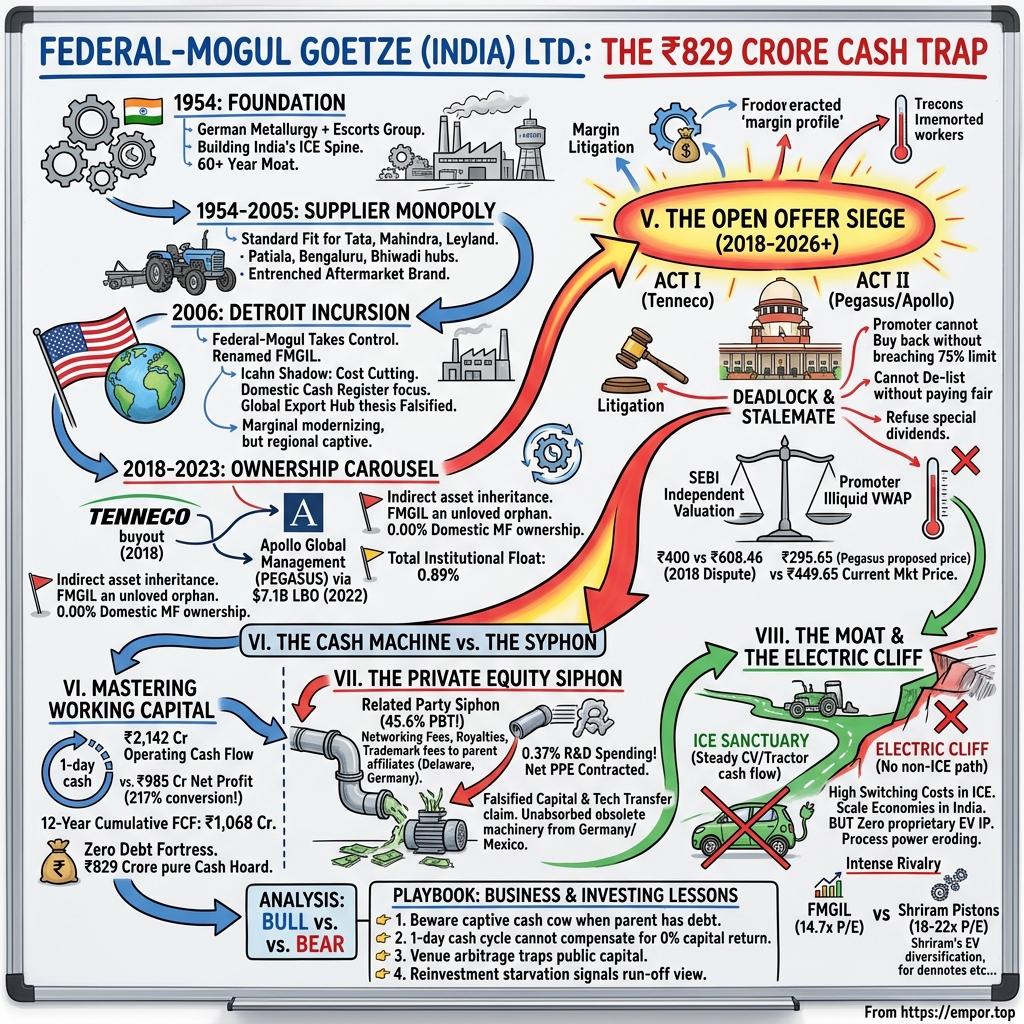
Federal-Mogul Goetze (India) Limited: The ₹829 Crore Cash Trap
I. Introduction & Episode Roadmap
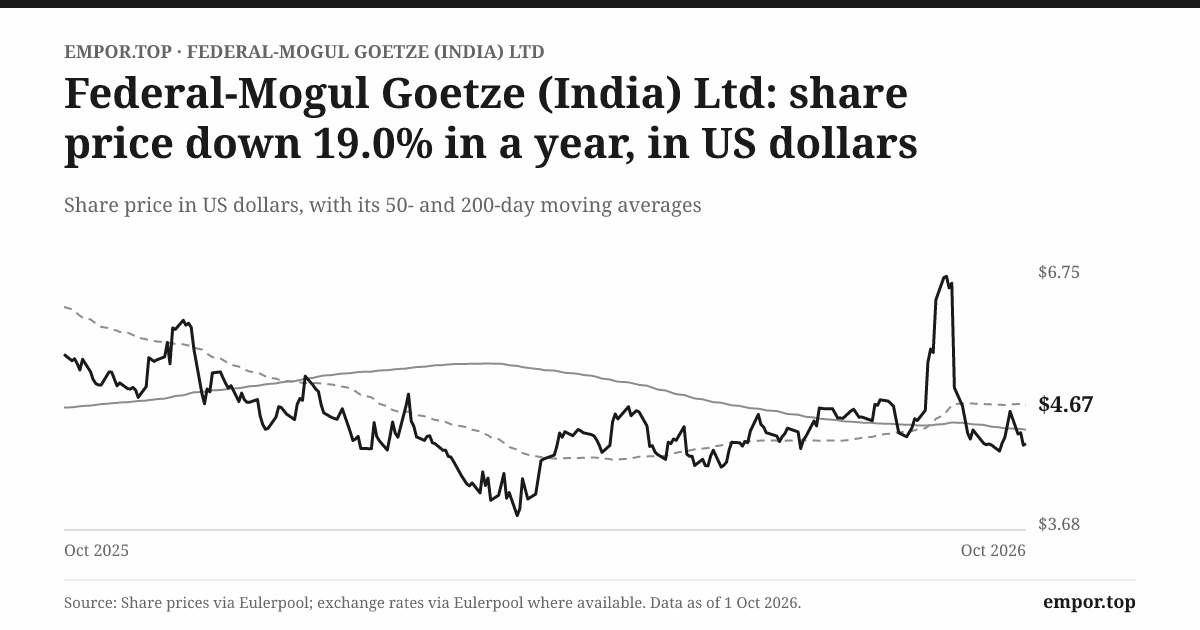
On the morning of 1 October 2026, the quote for FMGOETZE on the National Stock Exchange read ₹449.651. A passing trader would see nothing remarkable: a sixty-plus-year-old maker of pistons, piston rings and cylinder liners, a mid-sized industrial company priced at about ₹2,500 crore1. Look at the balance sheet, though, and the picture changes. About ₹829 crore of that value sits in bank accounts and fixed deposits at Indian scheduled banks2. That is roughly one rupee in every three of the company's market value, held as cash, earning bank interest.
Take the cash away and the market values the operating business, three factories and a brand that rural mechanics have trusted for decades, at about ₹1,672 crore1. That is about 5.4 times EBITDA1. Engine-component businesses with no debt, double-digit returns and a leading position in a core product category usually cost a good deal more.
So the puzzle for this story is simple. Is Federal-Mogul Goetze (India) Limited, FMGIL, a domestic powertrain cash machine the market has priced too cheaply? Or is it an orphaned subsidiary, built so that its cash goes to its owners abroad and stays away from the people who own the other quarter of its shares?
The answer argued here is that it is neither a classic value trap nor a failing operation. It is better described as a case of venue arbitrage. The controlling owner sits two layers up, in a private-equity structure in Delaware and New York. The minority shareholders sit in India, and they are protected mainly by Indian takeover law, which has been tied up in litigation since 2018. In between sits a well-run factory business whose cash has nowhere to go.
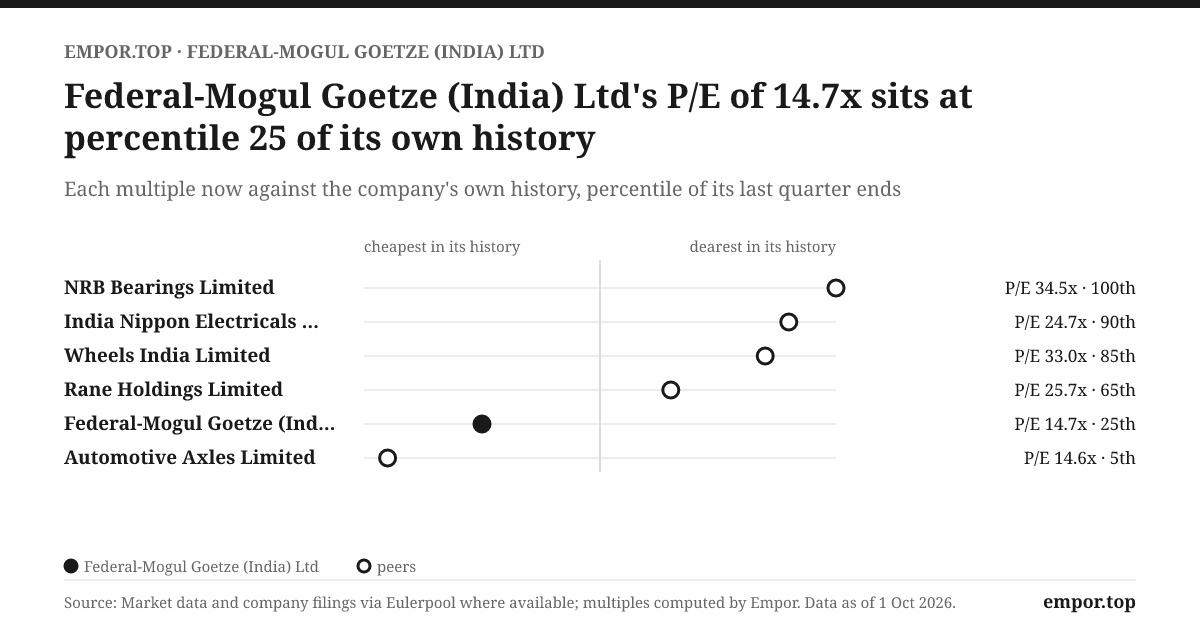
Start with the operating record, because it is what makes the puzzle sharp. Over the twelve fiscal years from FY2015 to FY2026, the company booked about ₹985 crore of net profit and generated about ₹2,142 crore of cash from operations, close to 2.2 rupees of operating cash for every rupee of reported profit2. It has no bank debt2. Its return on invested capital over the last twelve months was about 23%1. The stock trades at 14.7 times trailing earnings, below its own five-year median of about 17.4 times1.
Now look at the ownership. The promoter group owns exactly 74.98% of the company3, just under the 75% cap that Indian rules set for a listed company's controlling shareholder. Domestic mutual funds own nothing3. Dividends over the same twelve years came to about ₹45 crore, around 4% of the free cash the business produced2. In FY2026 alone, by contrast, the company paid about ₹78 crore in management fees, royalties and trademark fees to affiliates abroad2.
The ownership chain explains much of this. The company traces its origins to 19542. Federal-Mogul Corporation of the United States took control in 20062. Tenneco bought Federal-Mogul worldwide in 20182. Apollo Global Management then bought Tenneco in a $7.1 billion deal agreed in February 20224 and completed in November 20225. That puts four corporate regimes in about twenty years above one listed Indian company. Each change of control above the company has, at least in principle, triggered a duty under Indian takeover law to offer to buy out minority shareholders. The price of that offer has been in court ever since[^6].
The story runs in six parts. It starts with the industrial origins and how a German metallurgy partnership became part of India's internal-combustion backbone. It follows the ownership carousel, then the open-offer war between India's market regulator and two of the largest buyers of industrial assets in the world. It then looks at what may be India's tightest working-capital machine in auto parts, and at the cash flowing out to affiliates beside it. Next comes the electrification question, which hangs over any company that makes only engine parts. It closes with frameworks, lessons, the bull and bear cases, and the court ruling that could decide everything.
The first stop is a foundry age, when "made in India" was a policy requirement rather than a slogan.
 Subscribe on LinkedIn
II. German Metallurgy Meets License Raj: The Escorts-Goetze Foundation (1954–2005)
Picture India in the 1950s. Independence was less than a decade old. Planners in New Delhi had decided the country would build its own industrial base rather than import it, and the tools for doing so were tariffs, industrial licences and import substitution. Tractors and trucks were the vehicles that mattered: machines that would feed and move a country of about 360 million people. Every one of them needed an engine, and every engine needed pistons and rings that could survive heat, pressure and poor fuel on Indian roads.
Goetze (India) Limited was founded into that world in 19542. Its name carried the lineage of Goetze, the German piston-ring specialist. Its early Indian partner was the Escorts group, the tractor and engineering business that became one of the best-known names in the north Indian industrial belt6. The arrangement followed a common pattern of License Raj joint ventures. The Indian partner brought licences, government relationships and a route to customers. The foreign partner brought something India could not yet make itself: the metallurgy and machining tolerances needed to make a ring that seals a combustion chamber to within microns.
That precision is easy to underrate, so it helps to explain what these parts do. A piston moves up and down inside an engine cylinder thousands of times a minute. The rings around it do two jobs: they keep combustion gases above the piston and keep lubricating oil below it. If a ring is slightly too loose, the engine burns oil and loses power. If it is slightly too tight, it scuffs the cylinder wall and wears out. The liner is the replaceable sleeve the piston runs inside. None of these parts is glamorous, but all of them are critical. An engine designer picks a ring supplier and then builds the engine's tolerances around that supplier's product.
That is where the company's main moat comes from. Once a ring or piston was validated in an engine, the vehicle maker had little reason to change supplier and a lot of reason not to. Over the decades, the company built its footprint around three hubs: Patiala in Punjab, Bengaluru in Karnataka and Bhiwadi in Rajasthan2. Each was placed close to a cluster of engine makers serving India's truck, tractor and two-wheeler fleets.
The second half of the moat sits outside the factory gate. India's vehicles are kept running long after Western fleets would have scrapped them, and they are repaired in roadside workshops by mechanics who buy parts by brand name. In that market, the Goetze name became a byword for a replacement ring, with a premium that a lesser-known brand would struggle to match2. The aftermarket is the quieter and steadier side of the business. Vehicle makers negotiate hard on new-engine supply. A mechanic in a district town mostly wants a part that will not bring the customer back angry a month later.
The outcome is a business that still earns almost all its revenue at home. In FY2026, India accounted for about 92% of product sales and exports for about 8%2. That domestic weight was a strength in a protected economy. It also set limits, discussed later, on what the company could become under its foreign owners.
What matters most from this era is not the founding date but what it locked in: high switching costs in Indian engine platforms and a brand with real value in the repair trade. Those assets are the reason the business still earns well today. They are also the reason a series of foreign owners found it worth holding on to without necessarily wanting to grow it.
By the mid-2000s the License Raj had given way to liberalisation, and global parts groups were consolidating. The next owner arrived from Michigan.
III. The Detroit Incursion: Federal-Mogul Takes Control (2006–2017)
Federal-Mogul Corporation in the mid-2000s was a company coming back from a near-death experience. The Michigan-based parts maker had spent years in Chapter 11 bankruptcy because of asbestos claims inherited from earlier acquisitions. It came out of that process with a cleaned-up balance sheet and a strong focus on cost. Its later controlling shareholder, Carl Icahn, was known for squeezing value out of industrial assets rather than for patient expansion.
In 2006, Federal-Mogul took control of the Indian company, and the business took the name it still carries: Federal-Mogul Goetze (India) Limited2. Promoter ownership moved toward the regulatory ceiling. The listed company stayed listed, but its strategic direction would now be set in Southfield, Michigan.
The decade that followed brought some real modernisation. The most important structural change was a joint venture. FMGIL owns 51% of Federal-Mogul TPR (India) Limited, and TPR Co. Ltd. of Japan owns the other 49%2. TPR is a major Japanese piston-ring maker, and the venture gave the Indian group a route to Japanese-designed engines, which matter a great deal in India's passenger-car and two-wheeler markets. The joint venture is consolidated in all the figures that follow.
At the time, the most appealing argument for this ownership was the "export hub" thesis. A low-cost Indian manufacturing base, plugged into a global group's customer list, should become a supplier to the world. India had become a serious auto-components exporter during this period, and several listed Indian parts companies built large overseas businesses. Federal-Mogul Goetze looked well placed to do the same.
Historical falsification test: the global export hub. The claim was that integration into a multinational group would turn the Indian plants into a low-cost export platform for global engine programmes. The company's own record contradicts it. Exports stayed at a high single-digit share of revenue through the decade, and in FY2026 they were about ₹157 crore out of roughly ₹1,958 crore of consolidated revenue, or about 8%2. Revenue measured in US dollars went in a circle: about $258 million in FY2015, as low as $149 million in the Covid year of FY2021, and about $222 million in FY20262. Ten-year revenue growth in rupees has been about 4% a year2, roughly in line with inflation. The thesis is rejected. Whatever the group's global strategy was, it did not include making the listed Indian company its export engine. High-value platforms for Europe and North America were supplied from plants owned elsewhere in the group.
There are reasonable explanations for that choice. A multinational with plants on several continents allocates programmes for cost, proximity and politics, and for many Western customers an Indian plant may not have been the best option. Whatever the motive, the effect on minority shareholders is the same. Growth that might have been booked in a company they partly own was booked in sister companies they do not own at all.
Profitability during this period depended on commodity cycles more than on strategy. Operating margins ranged from about 7.5% in FY2015 to about 12% in FY2018, before collapsing to below 5% in the FY2020–FY2021 downturn2. Aluminium and pig iron are the company's main raw materials. Pass-through clauses in vehicle-maker contracts adjust prices only after a lag of one or two quarters2, so every sharp move in metal prices squeezed margins temporarily.
What this era established was the operating identity the company still has: a disciplined, India-focused production base, well run on the factory floor and kept narrow in scope. Federal-Mogul treated it as a profit centre, not as a platform for growth. Then, in 2018, the company changed hands again without anyone in India selling a single share.
IV. The Corporate Carousel: From Tenneco to Apollo's Pegasus (2018–2023)
The key feature of this period is that none of the important decisions were made in India. In 2018, Tenneco, a US maker of emissions-control and ride-performance systems, bought Federal-Mogul worldwide2. The Indian listed company was a small asset inside a much larger deal, but under Indian takeover regulations, a change in control at the top of the chain counts as an indirect acquisition of the listed subsidiary. That triggers a mandatory open offer to public shareholders.
Then the chain moved again. On 23 February 2022, Tenneco agreed to be acquired by funds managed by Apollo Global Management in an all-cash deal valued at about $7.1 billion including debt4. Apollo completed the acquisition in November 20225, and Tenneco became a privately held company. The Indian listed company now sat beneath a series of holding entities, including AP IX Pegasus Holdings, at the bottom of a leveraged buyout2. Its direct promoter holdings are held through Federal-Mogul Holding Limited in Mauritius, with about 60%, and Federal-Mogul Vermögensverwaltungs GmbH in Germany, with about 15%2.
That second deal raised a structural problem. A private-equity owner has a defined investment horizon and debt to service, and it measures success by its returns at exit. A listed Indian subsidiary with a minority float is an awkward asset for that kind of owner. Cash cannot be moved upward freely without sharing it with minority holders. The minority cannot be bought out cheaply because Indian law requires a fair price. Delisting requires a reverse book-building process in which public shareholders effectively set the price.
There is an important boundary in the numbers. Tenneco's global operation, with about 169 plants, tens of thousands of employees and engineering centres around the world, belongs to the unlisted parent2. None of it appears in the listed company's accounts. FMGIL operates only from its Indian factories and carries none of the parent's debt2. That protects minority shareholders from the parent's leverage. It also means the listed company receives none of the parent's growth capital.
Investor behaviour shows how the market reacted. As of June 2026, foreign portfolio investors held about 0.39% of the company, domestic institutions about 0.50%, and domestic mutual funds held nothing at all3. The rest of the roughly 25% public float is in the hands of retail and non-institutional investors3. India's mutual-fund industry, which owns some of almost every listed company with a sound balance sheet and double-digit returns, has stayed out of this one completely.
The reasons are not hard to find. A fund manager looking at FMGIL sees a stock with a thin float, so a sizeable position is hard to build or sell. The dividend is negligible. The share price depends on a court case the fund cannot influence. Control sits with an owner whose interests may run against the fund's. For an institution, buying in would mean taking legal and governance risk for what is, in the end, a mid-sized engine-parts business.
The verdict on this era: Apollo inherited a listed Indian subsidiary it cannot easily buy out and seems to have little reason to grow. The company became an orphan on the exchange, profitable and well run but owned by investors who cannot direct its cash and controlled by an owner focused elsewhere. The forum where that tension plays out is the courtroom, which is where the story goes next.
V. The Open Offer Siege: SEBI vs. The Private Equity Giants (2018–2026)
The courtroom phase has been running for almost eight years, and the facts can be set out without dramatising them. When control of a listed Indian company changes, even indirectly, the acquirer must offer to buy shares from public holders at a price set by formula. For indirect acquisitions, the formula is designed to stop a buyer from picking a convenient benchmark. One of the safeguards gives the Securities and Exchange Board of India, SEBI, the power to order an independent valuation where the shares are not frequently traded or where the offer price looks wrong.
Act I: the Tenneco offer. After Tenneco's 2018 deal, the acquirers made an open offer for FMGIL shares, with the offer price reported at ₹400 per share2. Minority shareholders objected that this undervalued the company. SEBI agreed that the price needed a closer look. In January 2020, SEBI directed the acquirer to revise the open-offer price upward after an independent valuation[^6]. The acquirers challenged SEBI's directions before the Securities Appellate Tribunal and then the Supreme Court of India2. The point is less any particular rupee figure than the principle: in this case, SEBI has insisted that it, and not the buyer, gets the final word on what a fair price is.
Act II: the Apollo offer. Apollo's 2022 purchase of Tenneco set off a second indirect-acquisition obligation, through the Pegasus holding entities7. The two disputes now overlap. Each concerns the same minority float, valued at different dates, with different parties on the buy side. The matter went from SEBI to the Securities Appellate Tribunal[^9] and on to the Supreme Court[^10]. The company's own disclosures describe the open-offer matter as sub-judice as of September 20262.
What the litigation means in practice is more important than the legal details. As long as the case is pending, nobody can know the price at which the promoter will eventually have to buy minority shares, or whether it will have to. A rational controlling shareholder in that position has every reason not to do anything that raises the value of the minority shares before the price is fixed. Paying out a large special dividend, for example, would hand cash to the public float and could also strengthen the case for a higher fair value. Keeping the cash in the company is the low-risk option for the owner.
The structure makes the deadlock tighter. The promoter holds 74.98%3. Under SEBI's minimum public shareholding rules, a listed company's public float must stay at 25% or more. That rules out the simplest way to return cash, a share buyback, unless public shareholders tender in exact proportion, because any buyback that lifted the promoter above 75% would breach the rule. The company has not done a buyback, rights issue or preferential allotment over the past decade2. A special dividend would go to everyone pro rata, including the promoter's 75%, which shows that the obstacle is not mechanical. It is a choice made inside a legal standoff.
There is a fair argument on the promoter's side. An acquirer of a global group, it can say, should not have its whole deal reopened because one subsidiary in one country is thinly traded, and in such cases independent valuation turns an objective formula into a matter of opinion. That position is legitimate, and courts in several countries have accepted versions of it. But the cost of the dispute falls almost entirely on the minority. The promoter keeps control and the operating cash flow. The minority keeps a share price that reflects years of uncertainty.
The verdict here is the core of the story. The open-offer deadlock is the structural cause of FMGIL's valuation discount. The owner cannot lift its stake further without breaching the ceiling, cannot delist without paying a fair value set by a process it does not control, and has not paid the special dividends that would share the cash equally. The ₹829 crore is real money. Getting it to minority shareholders depends on a court.
To see why that cash keeps building, the next step is to look at how efficiently the factories turn sales into rupees.
VI. The Cash Machine: Working Capital Mastery and the 1-Day Cycle
The cash conversion is the most impressive thing about FMGIL, so it is worth understanding how it works. On the dispatch docks, finished rings and pistons leave on credit terms of roughly 30 to 60 days to vehicle makers and distributors2. Raw-material suppliers, meanwhile, are paid much more slowly. Between those two clocks, the company's working capital has shrunk almost to zero.
The fact sheet puts it in one figure: the cash conversion cycle, the number of days between paying for raw material and collecting cash from a customer, fell from 91 days in FY2019 to 1 day in FY20262. In practice, the company's suppliers now fund almost its entire production cycle.
Three changes produced that result.
First, collections improved. Debtor days, the average time customers take to pay, peaked at 93 days in the Covid year of FY2021 and fell to about 50 days by FY20262.
Second, the plants carry far less stock. Inventory days dropped from about 139 in FY2015 to about 66 in FY20262. Halving the stock a manufacturer holds frees a large amount of cash once and lowers the cost of running the business every year after.
Third, the company pays slowly. Days payable were about 115 in FY20262. That is high for a manufacturer and says something about the company's bargaining power with its own suppliers. It is also the lever most likely to reverse if suppliers push back, or if the parent group's purchasing practices change.
The receivables are the obvious place to check whether this is too good to be true. A company can flatter cash conversion by pushing customers or by booking revenue it has not yet billed. The record does not show either. Consolidated trade receivables were about ₹266 crore at March 2026, down from about ₹334 crore a year earlier2. On the standalone book, about 77% of receivables were not yet due, about 20% were overdue by less than six months and about 3% were overdue by more than six months2. The company reports no unbilled revenue, no contract assets and no disputed receivables2. Bad-debt write-offs in FY2026 were about ₹10 lakh, an insignificant amount2. The overall loss allowance is about ₹5.4 crore. One detail matters: about ₹2 crore of that is set aside against amounts owed by related parties2. An Indian subsidiary making provisions against money owed by its own group is unusual and fits the governance picture that runs through this story.
The cash conversion also has a simpler source: depreciation. The company has been charging roughly ₹80–90 crore a year of depreciation against a factory base that, in net terms, has been shrinking2. That shows up in the twelve-year totals, with operating cash at about 2.2 times net profit and cumulative free cash flow of roughly ₹1,068 crore2. Depreciation is a real cost over time, because machines wear out and must eventually be replaced. A business that turns depreciation into cash and does not reinvest it is not producing cash for free. It is running down its asset base. That theme comes back in the next section.
The balance sheet shows where the cash went. Borrowings, which were about $31 million in FY2015, are now essentially zero apart from about ₹1 crore of lease liabilities under accounting rules2. Cash and bank deposits rose from about $4 million to about $95 million over the same period2. Net cash is about ₹828 crore2. That money is held entirely in plain bank deposits: about ₹655 crore in short-term deposits, about ₹123 crore in deposits marked with a lien, and the rest in current accounts. There is nothing in mutual funds, commercial paper or equities2. The lien-marked deposits are worth watching. They are not freely available in the same way, and the company's disclosures do not explain the related obligations in detail.
Interest on those deposits was about ₹35 crore in FY20262. Together with interest on tax refunds, foreign-exchange gains and commission income, other income came to about ₹50 crore, roughly one-fifth of consolidated profit before tax2. That figure matters for valuation. About a fifth of reported profit comes from cash that sits, in effect, as a bank deposit owned 75% by the promoter, and its value to minority holders depends on whether they ever receive any of it.
The verdict for this section: on the factory floor and in the finance function, FMGIL is an elite cash generator. Its working-capital discipline is among the best in Indian auto parts, and the receivables look clean. The question is not whether the business produces cash. It is where the cash goes. Some of it stays on the balance sheet. A notable share leaves through another route.
VII. The Private Equity Siphon: Related Parties and Reinvestment Starvation
The clearest view of the second route comes from the related-party note in the FY2026 annual report. There, FMGIL shows payments to its affiliates totalling about ₹78 crore, roughly $8 million, in a single year2.
The breakdown is specific. About ₹33.7 crore went to Federal-Mogul Powertrain LLC, an affiliate in the United States, as management support charges under what the company calls a "networking fee model", covering centralised executive, engineering and sales services2. That was up from about ₹30.3 crore a year earlier2. Royalties came to about ₹41.3 crore, paid mainly to German sister companies: Federal Mogul Nurnberg GmbH (about ₹18.6 crore), Federal Mogul Burscheid GmbH (about ₹14.3 crore) and Federal Mogul Holding Deutschland GmbH (about ₹6.5 crore), with a smaller amount to the Japanese joint-venture partner TPR2. Trademark fees of about ₹2.9 crore went to Federal-Mogul Motorparts LLC2.
To see what that means for shareholders, compare it with profit. Combined fees were roughly 4% of consolidated revenue and about 46% of standalone profit before tax and exceptional items2. Put differently, for every two rupees of pre-tax profit the Indian company kept, close to one more rupee had already gone abroad to affiliates as a cost. Dividends to all shareholders over the twelve years from FY2015 to FY2026 were about ₹45 crore2. In a single year, then, the affiliates collected well over the total dividends paid out over twelve.
The mechanism is worth spelling out because it is common in multinational subsidiaries. A dividend is paid after tax and shared pro rata, so 25% of every rupee goes to minority holders. A management fee or royalty is paid before tax, is deductible for the Indian company, and goes 100% to the affiliate receiving it. For a parent that owns 75%, a rupee taken as a fee is worth more than a rupee taken as a dividend, because the minority receives nothing from it.
The company and its tax advisers give the other side of the argument. The payments are covered by transfer-pricing documentation under India's income-tax rules, and the company reports that its advisers have found them to be at arm's length2. There is a serious case for paying for real services and technology. A piston-ring maker without access to its group's metallurgy, coatings and engine-programme relationships would be a weaker business. The question is not whether the payments buy something. It is whether what they buy is worth what the minority gives up.
Historical falsification test: the technology-transfer thesis. The claim is that royalties and networking fees buy the Indian company advanced global technology and modern plant. The best evidence against it comes from the company's own statutory technology-absorption disclosure in the FY2026 annual report. That disclosure says that several imported machining and casting lines transferred from group plants in Germany and Mexico remain unabsorbed because of "old technology, service support / spare parts from OEMs not available"2. The original equipment makers of those machines no longer support them. That is a strong admission. It means at least part of what the Indian company received from its group was outdated equipment that it has struggled to bring into production.
The rest of the reinvestment record fits that picture. Research and development spending was about ₹7.3 crore in FY2026, around 0.37% of standalone revenue2, up from about 0.30% the year before8. Net property, plant and equipment, measured in dollars, fell from about $89 million in FY2015 to about $62 million in FY20262. In rupee terms, that is a decade in which the asset base did not grow while revenue rose only slowly. Over the same period the cash pile multiplied many times over.
There is one counter-signal, and it should be acknowledged. Capital spending more than doubled in FY2026, to about ₹122 crore, or 6.2% of revenue, from about ₹47 crore the year before, and capital work in progress rose to about ₹72 crore2. That could be the start of real modernisation. It could also be more imported tooling that never quite enters production. The company does not give a project-by-project breakdown of that spending. Whether it turns into new capacity in the next two years is one of the most useful things a minority holder can track.
The verdict on technology transfer: the history narrows the claim sharply. The fees probably buy real know-how in some areas, especially ring coatings and access to Japanese engine programmes through TPR. But the company's own disclosure shows that the wider version of the claim, that affiliates are actively modernising the Indian plants, is not supported. A fairer description is that the Indian company pays full price for a share of a global group's capabilities and gets less than full value back in equipment.
The workforce data point the same way. FMGIL had about 2,711 permanent staff and workers in FY2026, plus about 2,601 contract workers, for a total of about 5,3122. Close to half of the people on the shop floors are not permanent employees. That is common in Indian manufacturing, and it keeps costs flexible. It also limits how much accumulated process skill the company keeps.
The audit report adds two smaller cautions. Deloitte Haskins & Sells LLP named provisions and contingencies relating to litigation as the only key audit matter, with contingent liabilities of about ₹107 crore, mainly disputed income-tax and GST demands2. Its CARO report also noted that the electronic books were not backed up daily on servers located in India until 16 December 2025, and that the accounting software's audit trail was not enabled at the database level to track direct changes2. Neither point suggests misstatement. Both are reminders that a subsidiary run from a global centre has data and control structures that partly sit outside India.
Leadership changed during the year as well. On 11 August 2025, Managing Director T. Kannan stepped down and whole-time director and CFO Manish Chadha resigned. Amit Mittal took over as both Managing Director and Chief Financial Officer2. Combining those two roles concentrates authority in one executive at the moment when related-party flows and the treasury are getting the most scrutiny. At the 71st AGM on 24 September 2026, every resolution passed with more than 99% support9. That outcome says less about minority satisfaction than about the arithmetic of a 75% promoter vote.
The overall verdict: whether or not anyone intends it, the structure lets the controlling group take value from India through pre-tax fees, while reinvestment stays thin and minority holders receive a token dividend. That makes the next question unavoidable: what is the business worth if its owner has stopped investing in its future?
VIII. The Moat & The Electric Cliff: Powers, Forces, and Terminal Value
Every engine-parts company in India now faces the same awkward fact. A battery-electric scooter or car has no pistons, no piston rings and no cylinder liners. FMGIL's product range consists entirely of those internal-combustion parts, and the company reports no electric-vehicle revenue2. So the moat question has two parts: how strong the business is today, and how long the market it serves will last.
Hamilton Helmer's 7 Powers, applied.
Switching costs: strong in combustion engines. Getting a new ring or liner validated on an engine takes long durability testing, and engine platforms run for years once launched. The company's contracts run on multi-year platform agreements of around five to seven years2. Once it is designed in, FMGIL is hard to remove for the life of the engine. This is the core of its moat, and the evidence supports it: customer concentration is moderate and there are no reported terminations of major customers2.
Scale economies: real, but bounded by India. Three Indian plant clusters and a large share of the domestic ring market give the company purchasing power and spread fixed costs over high volumes. That benefit applies only to the domestic business. As Section III showed, the group did not use the Indian plants to win global scale.
Branding: moderate, and concentrated in the aftermarket. The Goetze name supports pricing in the repair market. It carries much less weight in negotiations with large vehicle makers.
Cornered resource: absent. The key patents, coatings and engine relationships belong to the global group, and the Indian company pays royalties to use them2. A cornered resource has to be owned. This one is rented.
Process power: eroding. With unabsorbed imported lines and almost half the workforce on contract2, the evidence for process know-how that is distinctive and owned in India is weaker than the company's history suggests.
Network effects and counter-positioning do not apply in any meaningful way.
The net result is two real powers, switching costs and domestic scale, and both depend on combustion engines continuing to exist.
Porter's Five Forces, briefly.
Buyer power is high. Vehicle makers are large, sophisticated buyers. The top three customers accounted for about 21% of consolidated revenue in FY2026, though none reached 10% individually2. Price-indexation clauses protect the company from commodity swings with a one-to-two-quarter lag2, which means the buyer decides the timing and FMGIL absorbs the shock in between.
Supplier power is moderate. Aluminium and iron are commodities, and the long days-payable figure suggests FMGIL negotiates from strength.
New entrants are not a serious threat in combustion engines. Nobody builds a new piston-ring plant for a technology that is past its peak.
Substitutes are the existential force. Battery-electric drivetrains remove the entire product category. That is not market-share loss but disappearance of the market, and it will play out over years rather than quarters.
Rivalry is intense and gives the clearest comparison. The main domestic competitor, Shriram Pistons & Rings, has trended toward higher valuation multiples, at about 18–22 times earnings, against FMGIL's 14.7 times[^13]1. The difference is strategy. Shriram has pushed into electric-vehicle components and precision parts through acquisitions and new product lines[^13]. Whether those bets pay off is a separate question, and diversification is not proof of value. But the market is clearly willing to pay more for a combustion-engine company that has a credible path beyond combustion engines. FMGIL, owned by a parent that does not appear to be funding one, has no such path.
The combustion sanctuary. The bull case has a real refuge. Indian trucks, tractors, buses, stationary diesel generators and locomotive engines will take much longer to electrify than scooters and small cars. Heavy loads, long distances, rural use and charging gaps favour diesel and gas engines for many years. CARE Ratings lists the long-term shift to electric powertrains as a rating constraint but kept the company at CARE A+ (Stable) and A1+10, which suggests it sees the risk as slow-moving. The most likely outcome is gradual erosion, led by two-wheelers and passenger cars, with commercial vehicles and tractors lasting much longer.
The verdict: FMGIL has a real but rented moat in a slowly shrinking market. Switching costs and scale make it a strong cash generator for perhaps the next decade. Without owned intellectual property, without electric-vehicle products and with a parent that is not investing for the next cycle, its valuation multiple is held down by its future, not by its present. The lessons follow.
IX. Playbook: Business & Investing Lessons
Lesson 1: Beware the captive cash cow when the parent has debt. In November 2022, Apollo completed a buyout of Tenneco valued at about $7.1 billion5. At the bottom of that structure sat an Indian company with no debt and a growing pile of cash. Minority investors in subsidiaries tend to see a debt-free balance sheet as protection. In a levered group, the same balance sheet looks different from the top, because its cash can reach the parent through fees, royalties and transfer prices, not only through dividends. A debt-free subsidiary inside a levered private-equity empire is not a fortress; it is collateral waiting to be tapped.
Lesson 2: A 1-day cash cycle cannot make up for a near-zero payout. FMGIL produced about ₹1,068 crore of free cash flow in twelve years and paid out roughly 4% of it as dividends2. Its operating performance was excellent. Its capital return was minimal. Investors who judged the stock on cash generation were judging a number they could not reach. Cash on a balance sheet is only an asset if minority shareholders have a path to receive it; otherwise, it is working capital for the promoter's treasury.
Lesson 3: Venue arbitrage traps public capital. A 74.98% promoter holding3, a 75% statutory ceiling, and an open offer stuck before the Supreme Court[^10] together leave the minority with neither an exit nor a share of the cash. No single rule produced this result. It comes from several reasonable rules interacting with an owner whose incentives are set elsewhere. When regulation caps the promoter at 75% and litigation freezes the open offer, the minority float is not an investment; it is a hostage.
Lesson 4: How little an owner reinvests shows how long it expects to stay. An R&D budget of about 0.37% of sales, imported lines that cannot be maintained, and roughly ₹78 crore a year in fees to affiliates2 together tell investors more about the owner's plans than any statement could. Owners who expect to hold a business for a decade or more invest in it. Owners who expect it to fade take cash out of it. If the owner will not reinvest in the next technology cycle, it has already decided the business is in run-off.
X. Analysis & Bear vs. Bull Case
Picture an institutional investor comparing two companies. One is FMGIL at ₹449.651, valued at about 5.4 times EBITDA after cash. The other is its main domestic rival, which has historically traded at roughly 18–22 times earnings[^13]. Both make rings and pistons, both sell to the same vehicle makers, and both depend on combustion engines. Why the gap?
The answer depends on what the price assumes. Take away the roughly ₹828 crore of net cash and the operating business is valued at about ₹1,672 crore1, against roughly ₹240 crore of consolidated pre-tax profit, about a fifth of which is interest and other income2. Back out that income and the factories earn perhaps ₹190 crore before tax. That puts the operating business at well under ten times pre-tax operating profit. The market is treating the earnings as finite and the cash as only partly reachable. That is a fair reading of a business with a fading terminal value and blocked capital return. It does not imply the business is in decline today.
The bull case.
- The court catalyst. If the Supreme Court upholds SEBI's power to order an independent valuation[^10], the owner may have to buy minority shares at a price set by a valuer instead of by the market's discounted view, or decide to delist. In either case, the cash pile would finally count in the price minority holders receive.
- Cash as a floor. Net cash covers about a third of the market value12, and the business adds to it each year. CARE describes liquidity as exceptional10.
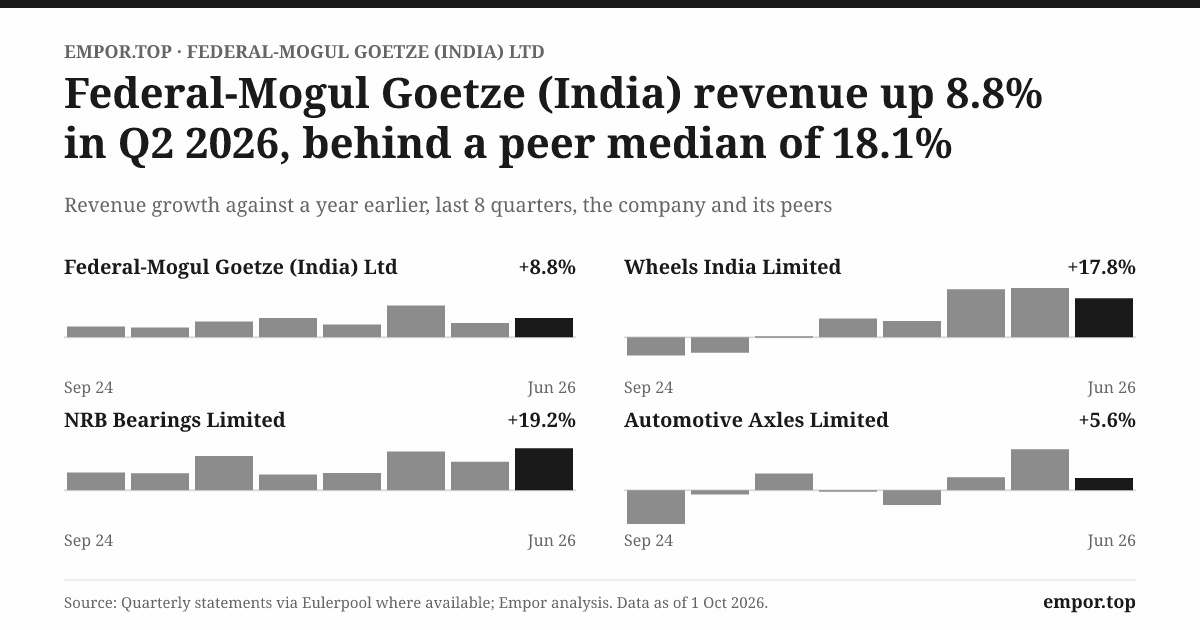
- A durable domestic core. Trucks, tractors and gensets give the combustion business a long tail, and the last three years produced revenue growth of about 6% a year and profit growth of about 19% a year2.
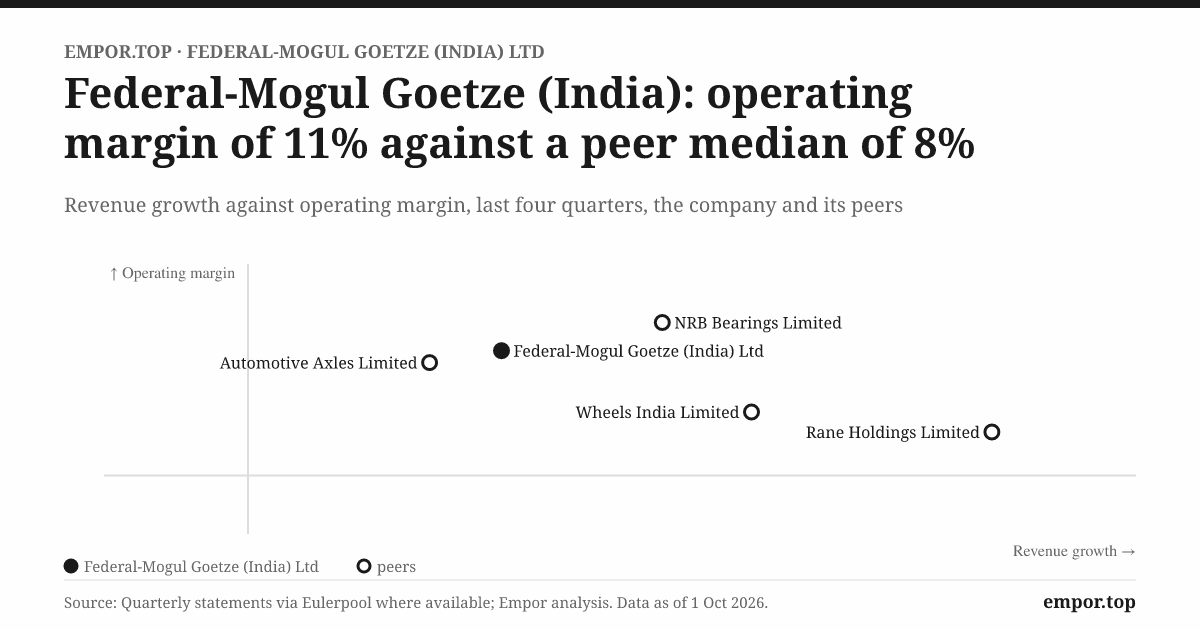
- High returns. A return on invested capital of about 23%1 with almost no working capital is a quality figure on its own.
The bear case.
- The fee drain grows. Networking fees rose by about 11% in FY2026, faster than consolidated revenue2. If fees keep growing faster than operating profit, more of the earnings will leave India before tax.
- The trap lasts. The open-offer dispute has already run for about eight years. Another five would leave the cash earning deposit interest of a few percent after tax while the rupee weakens against the dollar.
- No electric-vehicle option. As two-wheeler and passenger-car fleets electrify, a significant share of the addressable engine volume will disappear, and the company has no products to replace it.
- Persistent discount. With no mutual-fund ownership3 and little trading liquidity, the stock may stay cheap even if the operations stay strong.
An activist's checklist. A skeptical long-short investor would ask four questions. Why is a company with ₹829 crore in cash paying only a token dividend? Why do management fees rise faster than revenue? Why is equipment the company itself calls obsolete being imported from affiliates? And why does the minority have so little say over a combined MD and CFO role? None of these questions shows wrongdoing. All of them show where minority holders lack power.
The KPIs to watch. Three measures will say more than anything else:
- The Supreme Court open-offer case: still pending as of September 20262. Hearing dates and any judgment matter more than any quarterly result.
- Related-party fees against operating profit: about ₹78 crore in FY2026, around 4% of revenue and up year on year2. If this crosses 5% of revenue, or keeps growing faster than operating profit, the rent-extraction reading is confirmed.
- Whether capital spending becomes capacity: capital work in progress rose to about ₹72 crore in FY20262. Watch whether it turns into working production lines or joins the list of unabsorbed imported equipment.
At today's price the stock assigns little value to the business beyond its near-term cash flows. That provides downside support from the truck and tractor business. The upside will stay limited until the legal deadlock breaks.
XI. Epilogue & Outro
What decides the story next.
As of tonight, the company stands where it has stood for years: profitable, liquid and stuck. The next event that matters is not a results release but a Supreme Court listing in SEBI's case against the Pegasus acquirers[^10]. There are three plausible outcomes. If SEBI wins, Apollo's entities face an open offer at an independently assessed price, and the cash pile finally counts in what minority holders receive. If the acquirers win, the formula-based price stands, the discount probably persists, and the promoter's best remaining options are delisting or simply holding on. If the case is not decided, which is the outcome of the last eight years, the cash keeps building and the minority keeps waiting.
The second clock is technological. India's next round of commercial-vehicle emissions rules, along with growth in CNG and experiments with hydrogen combustion engines, will decide whether the piston has twenty years left in India or ten. Each extra year of runway adds to the value of the cash flows. Each year electrification gains ground faster than expected reduces it. FMGIL has no voice in that debate unless its owner decides to give it one.
Both clocks connect to this story's central questions. Can the cash reach public shareholders? Are the fees fair? How long will the combustion engine last in India? None has been settled. The minority shareholder holds a claim on an excellent factory and a large cash balance, and has no control over when either pays out.
Outro.
Go back to the foundries where this began. For more than seven decades, molten metal has been poured and machined into rings that seal the engines of trucks on India's highways and tractors in Punjab's fields. The work has been done well. Every rupee of profit turns into more than two rupees of cash, the receivables are clean, and the suppliers effectively fund the production cycle.
The irony is that operational excellence has left the company frozen in place. Financial owners far away cannot agree with an Indian regulator on what a share of this engineering is worth, so the cash sits in bank deposits and the share price waits on a court. Federal-Mogul Goetze is an Indian cash machine that its own owners will neither invest in, nor let go, nor share.
References
-
Federal-Mogul Goetze India Share Price & Company Research — Moneycontrol, 2026-10-01 ↩↩↩↩↩↩↩↩↩↩↩
-
71st Annual Report 2025–26 — Federal-Mogul Goetze (India) Limited, 2026-05-25 ↩↩↩↩↩↩↩↩↩↩↩↩↩↩↩↩↩↩↩↩↩↩↩↩↩↩↩↩↩↩↩↩↩↩↩↩↩↩↩↩↩↩↩↩↩↩↩↩↩↩↩↩↩↩↩↩↩↩↩↩↩↩↩↩↩↩↩↩↩↩↩↩↩↩↩↩↩↩
-
Shareholding Pattern and Announcements — National Stock Exchange of India, 2026-06-30 ↩↩↩↩↩↩↩
-
Tenneco Agrees to Be Acquired by Apollo in $7.1 Billion Deal — Reuters, 2022-02-23 ↩↩
-
Apollo Global Management Completes Acquisition of Tenneco — Apollo Global Management, 2022-11-17 ↩↩↩
-
Company Portal and Profile — Federal-Mogul Goetze (India) Limited, 2026-10-01 ↩
-
Takeover and Open Offer Rulings Archive — Securities and Exchange Board of India, 2026-09-01 ↩
-
70th Annual Report 2024–25 — Federal-Mogul Goetze (India) Limited, 2025-05-26 ↩
-
Voting Results & Scrutinizer Report of 71st AGM — Federal-Mogul Goetze (India) Limited, 2026-09-24 ↩
-
Rating Rationale: Federal-Mogul Goetze (India) Limited — CARE Ratings, 2025-04-08 ↩↩
 LinkedIn
 WhatsApp
 Reddit
 Hacker News
 Email
Email Kindle
 RSS Feed
 Spotify
 Apple Podcasts
 Amazon Music
 Audible
 YouTube