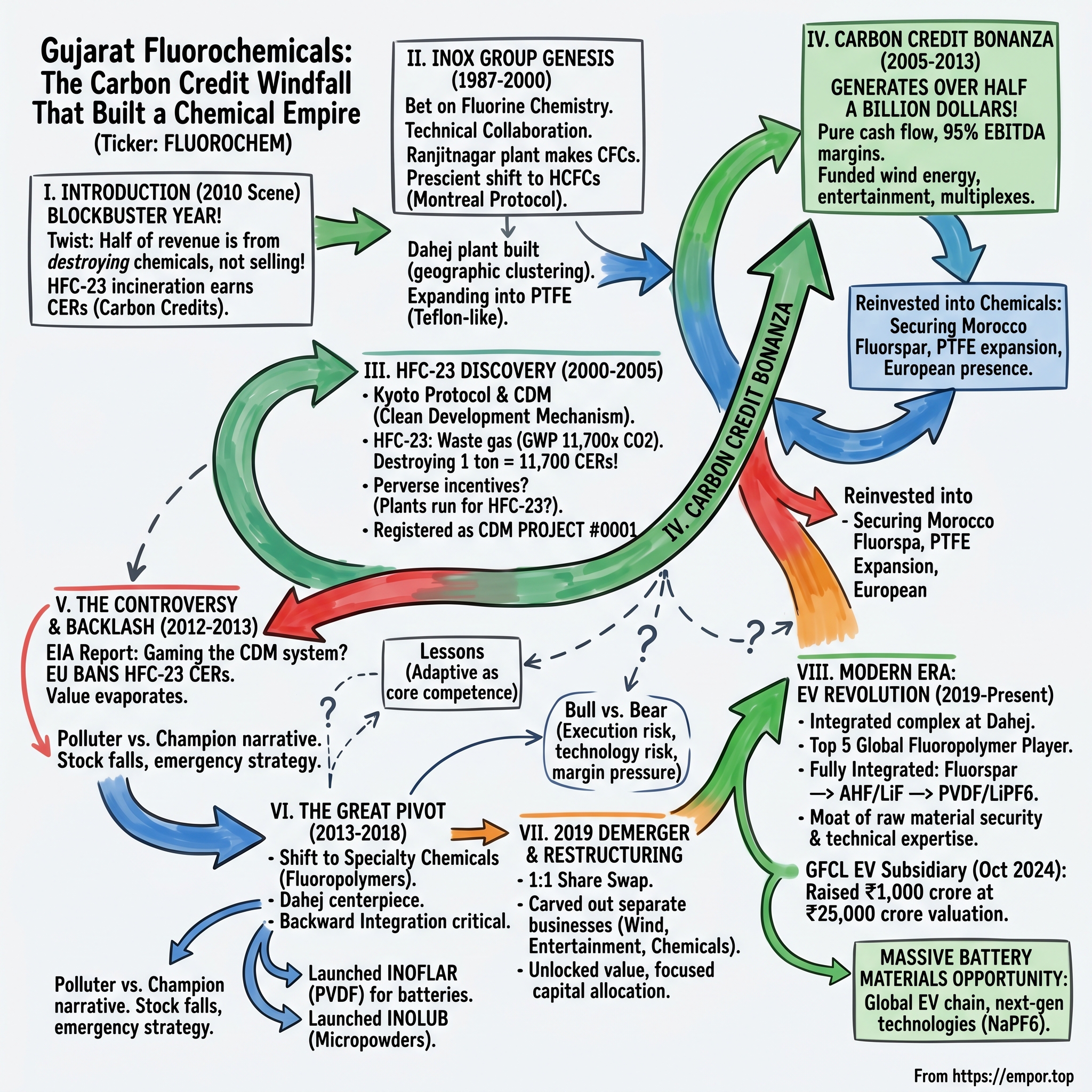
Gujarat Fluorochemicals: The Carbon Credit Windfall, Conglomerate Arbitrage, and the Great Fluoropolymer Pivot
I. Introduction & Cold Open: The Arbitrage Machine
Somewhere in the scrubby industrial flatland of Panchmahal district in Gujarat, during the first half of the 2000s, a steel chimney burned a gas that nobody wanted, nobody bought, and nobody would ever see. The gas was HFC-23 — trifluoromethane — the unavoidable molecular waste left behind when manufacturing HCFC-22, the refrigerant that once cooled most of India's air conditioners. For decades, chemical plants worldwide simply vented it into the sky. It was worthless.
Then the United Nations made it the most valuable material on the site.
Under the Kyoto Protocol's Clean Development Mechanism, destroying one tonne of HFC-23 earned a producer 11,700 Certified Emission Reductions, because the gas warms the atmosphere 11,700 times as powerfully as carbon dioxide.3 Gujarat Fluorochemicals Limited registered its HFC-23 waste-gas decomposition plant as CDM Project 0001 — literally the first project in the UNFCCC registry — and proceeded to burn its waste for money.3 The incineration cost pennies. The credits sold in Europe for tens of euros. In peak years, the carbon line on GFL's income statement rivalled everything the company actually manufactured, and Indian and Chinese HCFC-22 producers collectively extracted billions of dollars from the scheme before European regulators shut the door.[^8]4
That regulatory opening provided a dramatic origin story, but it was not the long-term investment case. It represents the origin of the investment thesis, and the distinction matters enormously.
The core thesis under examination. Gujarat Fluorochemicals took an ephemeral regulatory windfall — a gift of policy design, not of engineering or customer demand — and attempted to convert it into something durable: a backward-integrated fluoropolymer business running from mined fluorspar all the way to finished PTFE, PVDF, FKM, and PFA. Today the company trades on the National Stock Exchange under the symbol FLUOROCHEM as a pure-play chemicals entity, having shed its cinema and wind-turbine siblings in a 2019 demerger.[^3][^10] The bull case holds that GFL is the lowest-cost integrated fluoropolymer producer outside China, positioned to capture market share as 3M exits the entire PFAS category.6 The bear case frames GFL as a cyclical commodity chemicals business with a complex governance history, currently committing roughly ₹6,000 crore to battery materials into the teeth of a Chinese price collapse.5
Both readings draw from the same financial disclosures. The task of this analysis is to decide which elements of each thesis survive contact with the company's two-decade record.
The roadmap. The analysis begins with the INOX Group and the licence-era origins of an Indian refrigerant maker. It examines the carbon-credit bonanza and, more importantly, details where that cash flowed — one of the most instructive chapters in the company's financial history. It traces the forced pivot into fluoropolymers after the 2013 credit cliff, the demerger that separated chemical operations from the broader group, and the current structure of the business. The report evaluates the industry dynamics against Chinese scale and Western regulations, weighs the GFCL EV battery-materials investment against the company's historical record of converting technical milestones into revenue, and concludes with the key metrics that indicate whether the transition is succeeding.
A note on posture: this is not a corporate summary. Where management has made a claim, the analysis examines the evidence that could challenge it, stating plainly whether the record rejects, narrows, or leaves the claim unproven. Several of GFL's assertions do not withstand scrutiny; a few do. Sorting them is the central task.
 Subscribe on LinkedIn
II. INOX Group Heritage & Fluorine Foundations (1987–2000)
To understand how a business group later famous for cinema screens ended up manufacturing one of the world's hardest polymers, one must first understand what it meant to build a chemical plant in India before 1991.
Under the License Raj, plant capacity was not a business decision but a bureaucratic allocation. An entrepreneur did not simply decide to make refrigerant gas; they applied to produce a specified quantity, at a specified location, alongside a specified foreign technical collaborator whose fee required separate state approval. The winners in that system were not necessarily the most efficient operators, but the families capable of navigating New Delhi's regulatory apparatus, marshaling capital across ventures, and enduring long delays.
The Jain family's INOX Group built its early foundation in industrial gases—the capital-intensive business of separating atmospheric air into oxygen, nitrogen, and argon for steel mills and hospitals. It was a trade driven by gas cylinders, localized logistics, and long-term customer relationships. The sector taught a distinct operational discipline: manage heavy fixed assets, establish regional monopolies around processing units, and maximize returns through plant utilization rather than financial engineering. That operating discipline became the template for the group's expansion into fluorine.
Gujarat Fluorochemicals was incorporated in 1987 under Inox Leasing and Finance Limited, the family's core holding vehicle—a structure that would carry major governance implications three decades later when the group finally collapsed it.9 The company went public shortly after inception and constructed its first plant at Ranjitnagar in Gujarat's Panchmahal district to produce chlorofluorocarbon (CFC) refrigerants using licensed American process technology. This reliance on imported know-how was standard across the Indian chemical industry at the time, given the absence of a mature domestic industrial research base.
The Montreal problem, which turned out to be the Montreal opportunity. Almost as soon as GFL brought its CFC production lines online, global environmental policy forced a shift. The 1987 Montreal Protocol mandated a phaseout of ozone-depleting chlorofluorocarbons, forcing every producer globally to identify replacements for newly built facilities.
The interim solution for the next two decades was hydrochlorofluorocarbon-22 (HCFC-22)—a compound less harmful to the ozone layer, chemically similar, and compatible with existing manufacturing equipment. GFL retooled its lines for HCFC-22 and made a pivotal strategic choice: rather than purchasing raw material inputs on the open market, management elected to build its own upstream capacity.
The logic of going backwards. Producing HCFC-22 requires reacting chloroform with hydrogen fluoride. Chloroform is derived from chlorine and methanol, while chlorine is produced through the electrolysis of brine—a process that also generates caustic soda. Hydrogen fluoride requires reacting fluorspar with sulfuric acid. Each intermediate input is a commodity subject to its own price volatility, supply bottlenecks, and cyclical swings.
A merchant producer must buy raw inputs at peak prices during supply squeezes while risking low selling prices during product downturns. In contrast, an integrated producer consolidates supply-chain volatility into a single manageable margin. In the early 1990s, GFL commissioned a chemical complex at Dahej on the Gujarat coast to produce caustic soda and chlorine. While appearing to be a standard commodity expansion, the facility marked the first phase of a quarter-century vertical integration effort.
The strategic model resembles an integrated steelmaker owning iron ore reserves. During market booms, captive raw-material assets tie up capital for modest returns. During industry downturns—whether caused by supply disruptions, export limits, or production cuts in China—captive supply allows a plant to maintain operations. GFL spent three decades absorbing the capital costs of backward integration to secure protection against supply shocks.
Testing the founding myth. Corporate accounts consistently present GFL as an early pioneer in Indian fluorine chemistry. Historical disclosures point to a more gradual evolution. Throughout the 1990s, the company relied on foreign process technology rather than proprietary innovation. Its initial entry into polytetrafluoroethylene (PTFE) production at Dahej encountered challenges typical of new fluoropolymer entrants: while basic chemical synthesis is straightforward, manufacturing to exact commercial specifications is technically demanding. PTFE is polymerized from tetrafluoroethylene, a volatile and dangerous monomer, and the resulting resin must satisfy precise particle-size, molecular-weight, and purity standards required by international buyers. Basic PTFE synthesis is manageable; producing polymer resins that satisfy stringent European industrial qualifications requires a prolonged learning curve.
GFL's record during the 1990s reveals a clear pattern: a well-capitalized industrial family built a functional refrigerant operation, executed a prudent backward-integration strategy, and spent a decade mastering complex polymer manufacturing processes. While representing a solid operational foundation, this history reflects capacity building rather than early technological leadership. Investors evaluating current management claims regarding semiconductor-grade PFA or battery-grade PVDF should note this context: while end markets have evolved, long industrial qualification cycles remain a structural barrier.
What changed everything was not chemistry. It was a treaty.
III. The HFC-23 Carbon Credit Gold Rush (2000–2013)
Few corporate events reshape a balance sheet faster than an external authority declaring that a zero-value waste stream is suddenly worth a fortune.
How the machine worked. The Kyoto Protocol committed developed nations to strict emissions targets. Because reducing emissions at a European power station was expensive, while eliminating equivalent greenhouse gas volumes in developing nations was relatively cheap, the Clean Development Mechanism bridged the gap. Under the scheme, a project in a developing economy that verifiably avoided one tonne of carbon dioxide equivalent earned a Certified Emission Reduction—a credit European emitters could purchase to fulfill domestic compliance requirements.
The mechanism's design priced every project by its global-warming potential, placing industrial waste gases at the extreme end of the valuation scale. Trifluoromethane, or HFC-23, traps heat 11,700 times more effectively than carbon dioxide by the metric the mechanism used.3 Consequently, a thermal oxidizer—essentially a specialized furnace—destroying a few hundred tonnes of waste gas annually could generate millions of carbon credits.
GFL's project was the first in the registry, validated and registered under the UNFCCC's CDM framework as project 0001.3 Securing the top slot reflected a group that recognized the scheme as a high-yield financial instrument early and acted before the queue formed.
The economics of burning garbage. The underlying cost structure was remarkably lean. Capital expenditure was limited to an incineration unit, while operating costs consisted primarily of fuel and emission monitoring. The raw material was an unwanted byproduct the plant produced continuously and had previously vented. The output was a financial asset traded in European compliance markets. The unit operated less like a traditional chemical facility and more like a cash-printing licence.
Across the CDM era, Indian and Chinese HCFC-22 producers accumulated windfall earnings that eclipsed their core refrigerant operations, and the scale of the transfer became a public controversy in India well before the scheme ended.[^8] For GFL, carbon revenues were not a minor margin boost; in peak years, carbon credit sales rivaled the earnings of the rest of the enterprise combined, generating the capital that funded a decade of group expansion.
Why the windfall ended. The mechanism contained a structural flaw that regulators eventually confronted.
Because destroying HFC-23 generated far more revenue than selling HCFC-22 refrigerant gas, producers faced a perverse financial incentive. Rather than minimizing waste gas, an operator could maximize it—running HCFC-22 lines harder than refrigerant demand justified and adjusting process conditions to generate more byproduct, effectively treating the refrigerant as an auxiliary byproduct of carbon credit production. Regardless of whether individual facilities exploited this loop, the mechanism had no defense against the incentive structure.
The European Union reacted decisively. From May 2013, industrial-gas credits—HFC-23 and nitrous oxide projects—were banned from use in the EU Emissions Trading Scheme, which was the only demand centre that mattered.4 Carbon credit prices collapsed toward zero. A revenue stream generating hundreds of millions of dollars annually did not gradually decline; it vanished.
What the episode reveals. Viewing the carbon credit era purely as a story of management foresight misses its critical investment lesson.
The episode underscores the vulnerability of regulatory revenue. Profits created by policy decisions can be rescinded by regulatory reform without warning. Unlike standard industry downturns marked by inventory destocking, price erosion, or gradual market share loss, regulatory policy shifts take effect on a specific date, after which revenue drops to zero. Any business whose profit pool rests on a policy choice rents that profit pool on terms set by external authorities.
This structural exposure remains relevant for GFL today. The company operates alongside two live descendants of that regulatory risk. The refrigerant segment sells molecules whose production volumes are governed by international phase-down schedules under the Kigali Amendment, while the fluoropolymer segment—the primary profit engine—makes materials facing an ongoing restriction review by the European Chemicals Agency under PFAS regulations. Investors who describe the 2013 cliff as an isolated anomaly mis-specify the company. Regulatory dependency remains a recurring feature of fluorine chemistry.
The critical question for investors is what the company did with roughly a decade of windfall cash while it lasted. That capital deployment forms the next chapter of GFL's financial record.
IV. Capital Allocation & The Conglomerate Reinvestment Trap (2005–2018)
Here is the counterfactual that haunts Gujarat Fluorochemicals.
Imagine a version of the company that took its carbon windfall and pursued a single objective: building the world's most complete non-Chinese fluoropolymer complex a decade earlier, funded with equity rather than debt. That entity would have entered the 2020s with a fully paid-for asset base, a pristine balance sheet, and no governance questions to address.
That is not the company that emerged, and understanding why remains essential diligence for investors.
Where the money went. The carbon windfall did not accumulate inside GFL. Instead, cash moved through group channels toward the INOX Group's most capital-intensive expansions, which had no strategic overlap with fluorine chemistry.
The first destination was cinema. INOX Leisure built a national multiplex chain—a business requiring continuous real-estate capital expenditures, long leases, and per-screen economics heavily dependent on occupancy rates. While viable in its own right, it shared neither customers, suppliers, processes, nor core competencies with fluorochemistry.
The second destination was wind energy. INOX Wind entered turbine manufacturing in the late 2000s, encountering severe sector-wide headwinds. The Indian wind power sector suffered a compound crisis: financially stressed state distribution companies delayed payments, grid evacuation infrastructure lagged installed capacity, a transition from feed-in tariffs to reverse auctions squeezed realizations, and a prolonged working-capital cycle turned unpaid receivables into permanent balance-sheet fixtures.
The third destination was internal development—specifically captive power generation at Dahej and early fluoropolymer lines. While this capital deployment was productive and forms the core of the current bull thesis, it constantly competed for capital with the group's non-chemical ventures.
The mechanism that turned diversification into contagion. Holding unrelated businesses creates a valuation discount, but funding them from a single corporate treasury creates a governance challenge.
The primary instrument for transferring capital was the inter-corporate deposit—loans extended from one group entity to another with board approval and related-party disclosures. While legally compliant, these transfers altered the investment profile of the lending entity. When the cash flows of a profitable chemical enterprise backstop a struggling wind unit, shareholders in the chemical company no longer hold a pure-play chemical asset. They hold a chemical producer combined with an unquantified, involuntary credit exposure to renewable energy manufacturing.
Investors could not easily model that structural risk; they could only discount it. The market responded accordingly, applying a persistent conglomerate haircut to reflect the risk that generated cash flows might be diverted away from the chemical segment.
Testing the synergy claim. Management framed this structure around portfolio synergies, arguing that energy, leisure, and chemicals benefited from shared promoter oversight and capital allocation. Evaluating this claim against historical financial outcomes yields a clear result.
Return on equity serves as the benchmark for capital efficiency. GFL's return on equity compressed significantly from its carbon-credit peak through the late 2010s. While part of this contraction was structural—attributable to the loss of near-100-percent-margin carbon credits—the remainder stemmed from capital deployed into low-yielding assets. Reinvested funds flowed either into fluoropolymer capacity requiring multi-year customer qualification cycles or into group ventures earning below their cost of capital. Minority shareholders expressed concern through voting patterns on related-party resolutions at annual general meetings, using the primary governance mechanism available to them.
The verdict, stated plainly. The portfolio synergy rationale is not supported by the financial record. The defining mechanism of corporate synergy—deploying shared capital to achieve higher risk-adjusted returns than independent business units could achieve alone—operated in reverse. Cash generated by the high-margin chemical business subsidized lower-return operations. The market's conglomerate discount was an accurate reflection of capital allocation dynamics.
Two forward-looking developments provide important context for the company's current structure. First, the 2019 demerger and subsequent corporate restructuring were executed specifically to eliminate cross-subsidization mechanisms, establishing structural boundaries between chemical and non-chemical operations.[^10]9 Second, current management is allocating approximately ₹6,000 crore toward EV battery materials—a capital commitment far closer to the core fluorochemical business, yet one that remains an unproven growth initiative.5
The key metric for evaluating management's capital allocation track record going forward is straightforward: the net balance of related-party loans and inter-corporate deposits extended outside the listed chemical entity. Maintaining a zero balance across future reporting periods provides the empirical evidence required to demonstrate sustained capital discipline.[^2]
That evaluation is possible only because of the subsequent decade spent rebuilding the core chemical earnings base following the carbon credit cliff.
V. The Great Pivot: From Carbon Credits to Fluoropolymers (2013–2019)
Consider the strategic predicament facing management in the second half of 2013. The company's most profitable line item had vanished permanently by regulatory fiat.4 The core refrigerant business faced international phase-down schedules with clear terminal dates. The group's non-chemical ventures were consuming rather than generating cash. Meanwhile, GFL's primary growth engine—a partially built fluoropolymer capability at Dahej—remained years away from producing higher-margin specialty grades.
Navigating that transition required executing a complex operational repositioning under severe time constraints.
Why fluoropolymers were the only sensible destination. Carbon-fluorine bonds are among the strongest in organic chemistry. That single chemical property defines the entire product category: wrapping a carbon backbone in fluorine creates materials resistant to concentrated acids, aggressive solvents, extreme temperatures, and ultraviolet radiation.
Consequently, fluoropolymers are essential wherever component failure carries extreme risk. Polytetrafluoroethylene (PTFE) lines chemical plant reactors and gaskets. Perfluoroalkoxy (PFA) carries ultrapure fluids through semiconductor fabrication plants, where microscopic metal leaching can ruin silicon wafers. Fluoroelastomers (FKM) seal automotive fuel systems against modern synthetic blends. Polyvinylidene fluoride (PVDF) serves in exterior architectural coatings, chemical piping, lithium-ion battery cathode binders, and cell separator coatings.
Each application shares a key economic trait: the fluoropolymer represents a minor fraction of the finished product's cost but a major share of its operational risk. That dynamic underpins pricing power for specialized grades. Conversely, commodity granular PTFE—where buyer risk is low and substitution is straightforward—commands no such premium.
The Moroccan move. In 2011, GFL took a step uncommon among Indian peers by moving directly upstream into raw materials through a fluorspar joint venture in Morocco.
Fluorspar—calcium fluoride—is the foundational input for all fluorine chemistry. Mining and consumption have historically concentrated in China, leaving global markets vulnerable to Chinese export controls and environmental supply disruptions. For a manufacturer whose entire product suite relies on fluorine, dependence on an input dominated by its primary global competitors creates a severe strategic vulnerability.
Securing non-Chinese acid-grade fluorspar integrated the value chain on paper: running from raw ore to hydrofluoric acid, chloroform, HCFC-22, tetrafluoroethylene monomer, PTFE, and downstream polymers. Very few global chemical producers operate across that complete sequence, providing GFL with a structurally defensible foundation.
However, the defensive value of this integration requires careful framing. Fluorspar remains a traded commodity rather than a proprietary asset. Captive supply does not guarantee a structural price advantage in quiet markets; rather, it ensures operational availability during supply shocks and limits raw-material margin squeezes. While captive fluorspar provides valuable supply-chain insurance, it does not constitute an unassailable strategic moat. Rivals can still purchase fluorspar globally, albeit at higher costs or with longer lead times during market tightness.
Building a face for customers. Shifting from selling commodity gas cylinders domestically to supplying engineered polymers internationally required a fundamentally different commercial infrastructure. GFL established dedicated product brands—including the INOLUB line for PTFE micropowders and the INOFLAR range for PVDF and coatings—and set up wholly owned subsidiaries in Germany and the United States to manage local inventory, staff application laboratories, and provide regional technical support.[^2]
In specialty chemical markets, commercial relationships are anchored by technical application engineers who assist clients with processing challenges. Because these technical services create customer switching costs, manufacturers cannot easily delegate distribution to third parties without sacrificing margin.
Testing the parity claim. Management asserted during this period that GFL had attained technological parity with global incumbents Chemours, Solvay, Arkema, and Daikin. The empirical evidence narrows this claim.
Throughout the 2010s, GFL's fluoropolymer output remained heavily weighted toward commodity granular PTFE—the segment with the lowest qualification hurdles and weakest pricing power. While management targeted high-value applications, adoption timelines were governed by customer qualification schedules. For example, a European chemical company certifying a new PFA source for semiconductor applications requires multi-year testing programs involving sample batches, leachables analysis, field trials, and multi-tiered customer approvals. These qualification timelines cannot be shortened arbitrarily.
The empirical evidence narrows management's parity assertion rather than rejecting it outright. GFL demonstrated commercial competence across an expanding range of polymer grades and built the physical infrastructure required for specialty production.[^2] However, over a decade of expansion, the company did not fully demonstrate the ability to convert technical capability into market share within high-margin niches on management's projected timelines. The critical test for the business going forward remains product mix: specifically, whether specialty fluoropolymers can reach and sustain more than half of segment revenues across full industry cycles.
That operational transition could only be fully evaluated by public markets once the chemical enterprise was decoupled from the group's broader conglomerate structure.
VI. The 2019 Demerger & Corporate Restructuring
Corporate restructurings are usually presented as value creation. Most are value revelation — the assets do not change, only the ability to see them.
The scheme. In 2019, the INOX Group separated its chemical operations from the listed entity that held its wind and leisure interests, transferring them into a new company initially named Inox Fluorochemicals and later renamed Gujarat Fluorochemicals Limited.[^10] Existing shareholders received mirror shares in the new entity—ensuring economic ownership remained identical while establishing a complete legal ring-fence around the chemical assets. The standalone chemical company subsequently began trading on the National Stock Exchange under the ticker FLUOROCHEM.[^3]
What actually changed. Three structural shifts occurred, in ascending order of importance.
First, financial transparency improved. As a standalone entity, the chemical business had to publish its own segment results, capital expenditures, and borrowings. Analysts no longer needed to extract chemical performance from consolidated conglomerate figures.
Second, the eligible investor base expanded. Institutional specialty-chemicals funds operate under strict mandates that often exclude holding companies with cinema multiplex or wind turbine exposure. The corporate re-rating that followed reflected this widened buyer pool as much as operational performance.
Third, and most critically, the restructuring established a cash ring-fence. Separation bound the chemical company's board to serve its own shareholders directly. Transferring cash to wind or leisure units now required formal inter-company transactions between separately listed entities—making related-party capital flows visible, subject to shareholder votes, and politically costly.
Why this is necessary but not sufficient. Structural separation removes the mechanism of capital diversion while leaving the core decision-makers unchanged. Because the same promoter family retains voting control over the chemical enterprise, the demerger addresses corporate structure rather than governance posture.
Consequently, management's post-2019 capital allocation record provides the true test of this restructuring. That context explains why investors closely scrutinize the company's ₹6,000 crore investment into battery materials.5 As the first major discretionary capital deployment under the standalone structure, the commitment serves as a primary test of capital discipline.
Collapsing the tiers. The group subsequently simplified its ownership hierarchy further. A composite scheme of arrangement filed in 2024 provided for amalgamating the promoter holding vehicle, Inox Leasing and Finance Limited, directly into GFL, eliminating an intermediate tier in the corporate structure and converting indirect promoter holdings into direct ownership.9
Multi-tiered holding structures add complexity and introduce potential minority risk. Promoters holding shares through unlisted entities may pledge or encumber those stakes in ways that surface only during a liquidity crisis. Consolidating ownership into a direct 63.8% promoter stake removed that structural ambiguity while closing an unlisted vehicle previously available for routing related-party flows.9
Both restructurings represent sound governance hygiene. They establish safeguards against capital leakage without guaranteeing operational success. Evaluating GFL's long-term thesis ultimately requires examining its product portfolio and competitive positioning.
VII. Modern Business Anatomy & Segment Breakdown
The Dahej complex functions as a physical argument for complete vertical integration. Brine is electrolyzed into chlorine and caustic soda. Chlorine reacts with methanol to yield chloroform, while fluorspar combines with sulfuric acid to produce anhydrous hydrofluoric acid. Chloroform and anhydrous HF react to form HCFC-22, which is cracked into tetrafluoroethylene monomer before polymerizing into PTFE. Virtually no intermediate leaves the site until it has been processed into a higher-value compound.
Financial disclosures divide this continuous manufacturing chain into three reporting segments, each exhibiting distinct economic characteristics.
Segment one: fluoropolymers, the engine. Fluoropolymers generate the majority of corporate revenue and a disproportionate share of operating profit.[^2] However, the headline segment figures obscure an underlying product spectrum.
At one end of the portfolio sits commodity granular PTFE—the standard resin used in gaskets, seals, tape, and equipment linings. This product line features large volumes, numerous qualified global suppliers, and periodic re-tendering by buyers. Pricing is set by marginal producers, a role dominated in recent years by Chinese manufacturers.
At the opposite end are high-barrier technical grades characterized by complex synthesis and deep customer lock-in: perfluoroalkoxy (PFA) tubing for semiconductor fluid delivery, fluoroelastomers (FKM) for automotive sealing systems, fine-powder PTFE for expanded membranes and wire insulation, and polyvinylidene fluoride (PVDF) for architectural coatings and battery components. In these applications, substituting a supplier requires the end customer's own clients to re-certify the final assembly. This qualification process typically spans 18 to 36 months, creating substantial switching costs once a producer achieves vendor status.
For investors, aggregate fluoropolymer revenue growth provides incomplete signal quality. Volume expansion driven by selling additional granular PTFE into a weak export market reflects cyclical commodity dynamics, whereas revenue gains from a new semiconductor-grade PFA qualification represent long-term recurring demand.
Segment two: fluorochemicals and refrigerants. This segment encompasses the historical core refrigerant portfolio—including R-22, R-32, R-125, R-134a, and blends such as R-410A—alongside a growing stream of fluorinated building blocks for agrochemical and pharmaceutical clients.[^2]
Refrigerant operations function under administrative constraints. The Kigali Amendment imposes a structured phase-down schedule for hydrofluorocarbons based on global-warming potential, capping production volumes of specific molecules on predetermined dates. While quota step-downs systematically reduce long-term market volume for regulated compounds, restricted supply can temporarily support realized prices for existing quota holders during the transition. Ultimately, the long-term volume trajectory for this product line is determined by international environmental treaties rather than plant-level economics.
The fluorinated specialty intermediates present a different economic profile. Supplying a customized fluorine building block for an active agrochemical or pharmaceutical ingredient requires inclusion in regulatory registration filings. This positioning creates high switching barriers, specification-driven purchasing, and insulation from refrigerant phase-down timelines.
Segment three: bulk chemicals, the drag that isn't. This segment includes caustic soda, chlorine, methylene dichloride, and anhydrous hydrofluoric acid.[^2] Evaluated as standalone operations, these products represent textbook bulk commodities: price-taking, energy-intensive, and vulnerable to regional overcapacity. They dilute consolidated gross margins and return metrics, making them obvious targets for portfolio optimization critiques.
However, the integration model alters their role. Rather than representing independent commodity investments, bulk chemicals serve as the initial inputs for the broader value chain. Chlorine consumed entirely within the Dahej site avoids merchant market pricing pressures. The key analytical question—which financial disclosures do not isolate—is what proportion of bulk chemical production is consumed internally versus sold into open markets. Captive consumption functions as a structural cost advantage, whereas external merchant sales operate as low-return commodity sales. Investors cannot cleanly separate the two from published statements.
The cycle, and what FY24 revealed. The 2023–24 fiscal year presented severe cyclical challenges across global fluoropolymer markets. Customers who built excess inventory during post-pandemic supply disruptions engaged in prolonged destocking, while new Chinese capacity entered export markets at discounted pricing. Consequently, GFL's consolidated EBITDA margin compressed significantly from previous peak levels.[^2]8
This downturn provided an empirical test of product positioning. A producer possessing genuine pricing power maintains price realizations while absorbing volume declines, whereas a price-taking supplier suffers losses across both metrics. GFL experienced falling fluoropolymer realisations alongside margin contraction, demonstrating that its product mix during the period remained heavily weighted toward commodity grades.
The episode establishes a clear benchmark for evaluating future performance. If GFL's strategy of deepening its specialty mix succeeds, subsequent industry downturns should exhibit visibly milder margin compression—providing a clear, observable test of structural progress over time.
VIII. Industry Structure, Competition & Helmer's 7 Powers
Evaluating the global fluoropolymer industry requires balancing two conflicting market dynamics operating in opposite directions.
First, major Western chemical producers are retreating from per- and polyfluoroalkyl substances. Second, Chinese manufacturers are expanding output capacity faster than global markets can absorb.
The Western retreat. In December 2022, 3M announced it would exit all per- and polyfluoroalkyl substances manufacturing by the end of 2025 and work to discontinue PFAS use across its product portfolio.6 The company framed the decision around environmental regulations, litigation risks, and shifting stakeholder expectations. Whatever the corporate framing, the arithmetic consequence was substantial: a primary Western fluoromaterials producer, representing over a billion dollars in annual sector sales, was removing itself from the supply side.6
For GFL, this represented the most favorable industry shift in a decade, a theme management has highlighted repeatedly in public investor calls.7 Yet the mechanics of market-share capture warrant scrutiny: assuming a peer exit automatically translates into revenue gains overlooks key supply-chain realities.
When a qualified supplier of critical chemical materials exits, buyers do not simply run a spot price auction. Instead, customers initiate multi-year qualification programs—and the initial gains typically flow to established secondary suppliers. Entrants lacking prior vendor relationships must pitch cold against expanding incumbents. Consequently, market share reallocates first to existing secondary sources, second to credible entrants with local technical and laboratory infrastructure, and rarely to uncertified suppliers. GFL established its German and US subsidiaries specifically to position itself in those first two tiers.[^2]
Moreover, bullish interpretations often overlook the fundamental motivation behind 3M's departure. The company did not exit due to weak unit economics, but to eliminate environmental and legal liability. A major manufacturer choosing to abandon a profitable product line rather than absorb its regulatory tail makes a clear statement about the category's long-term risks—a risk profile GFL implicitly accepts as it expands capacity.
The Chinese wall. The opposite side of the global market is dominated by Chinese fluorochemical producers—including Dongyue Group and Zhejiang Juhua—backed by integrated fluorspar access, massive domestic scale, and a structural tolerance for lower return on capital during market-share expansion.
This structural dynamic represents the central competitive challenge for GFL. Expanded Chinese capacity in commodity PTFE and battery materials is not a temporary cyclical imbalance, but a permanent market feature that establishes clearing prices across open global channels. GFL cannot match Chinese producers on scale or production cost in non-protected markets. Instead, the company must compete where purchasing decisions prioritize factors other than price: regulated Western markets, supply-chain security mandates, and high-barrier specialty grades where technical qualification takes precedence over price quotations.
Porter's five forces, evaluated against sector realities. Supplier power remains low for GFL because the enterprise controls key upstream raw materials—the primary benefit of its long-term backward integration strategy. Buyer power varies sharply by product grade: distributors of standard industrial gaskets exercise substantial leverage, whereas semiconductor fluid delivery engineers face high switching barriers. Barriers to entry are formidable in absolute terms, as handling hazardous monomers deters new entrants; however, these barriers have not constrained well-capitalized Chinese producers. The threat of substitution poses a subtle but significant risk—not from alternative polymers, but from regulation-driven engineering redesigns that eliminate fluoropolymers altogether. Finally, industry rivalry remains intense and largely price-driven within commodity segments.
Helmer's powers, assessed against evidence rather than assertion.
Process power — supported by operational integration. The fully integrated Dahej complex converts raw fluorspar into finished polymers within a single site, eliminating the merchant margin markups paid by non-integrated Western processors at each intermediate stage. Management characterizes this configuration as a major cost advantage over non-integrated competitors, a claim supported by the physical asset structure.[^2] However, the exact magnitude of this cost advantage remains a management estimate rather than an independently audited figure, fluctuating with underlying fluorspar, energy, and logistics costs.
Switching costs — high in specialty grades, negligible in commodities. Switching barriers are substantial in semiconductor-grade PFA, automotive FKM seals, and battery-grade PVDF, where customer requalification cycles require 18 to 36 months of continuous testing. Conversely, switching costs are negligible for standard granular PTFE. Because GFL's revenue mix still skews toward commodity resins, company-wide switching-cost power remains lower than specialty product benchmarks suggest. This capability represents an expanding target rather than an established competitive moat.
Cornered resource — limited structural advantage. The company's Moroccan fluorspar venture provides raw-material supply insurance during market disruptions, but does not constitute exclusive or proprietary access to global fluorspar reserves.
Scale economies — effective regionally, secondary globally. Within India, GFL's dominant PTFE capacity and integrated manufacturing footprint provide clear scale advantages over domestic peers, reinforced by trade remedies against low-cost imports. On the global stage, however, GFL remains a mid-sized producer competing against far larger Chinese manufacturing clusters. Regional scale offers meaningful domestic protection, but does not translate into global pricing power.
Branding, network effects, and counter-positioning — absent. Industrial buyers evaluate polymer resins on technical specifications rather than brand equity, network effects do not exist in chemical manufacturing, and GFL operates a conventional industrial business model. Assertions of brand power in commodity resin markets reflect marketing terminology rather than economic moat factors.
Net competitive assessment. GFL's market position is defined by a strong domestic cost structure and an emerging specialty fluoropolymer portfolio, operating amidst two opposing global forces: a major Western producer exit creating market vacancies, and expanding Chinese production capacity depressing global prices. These dynamics represent competing pressures. Which force dominates over the coming years will largely determine GFL's financial trajectory.
Into this shifting competitive environment, management has initiated a third, major capital commitment.
IX. The GFCL EV Optionality Bet: Battery Materials
Every mature chemical company eventually stands in front of the same whiteboard. The core business generates cash but grows slowly, and the equity trades on those mature cash flows. Somewhere on the board, someone writes a word that promises a higher valuation multiple.
For GFL, that word was batteries.
The carve-out. The company established GFCL EV Products Limited as a wholly owned subsidiary to pursue battery and energy-storage chemicals, and in November 2023 announced a capital expenditure commitment of roughly ₹6,000 crore—well over $700 million—to be deployed over four to five years.5
Structurally, housing the venture in a separate subsidiary is logical. It isolates accounting, makes capital allocation and returns transparent rather than buried within a segment, and preserves the flexibility to bring in strategic partners or raise equity at the subsidiary level without diluting the parent. Investors can acknowledge the clean corporate structure while reserving judgment on operational execution.
What the products actually are. The portfolio centers on three main chemical inputs.
Lithium hexafluorophosphate—LiPF6—is the conductive salt dissolved in a lithium-ion cell's liquid electrolyte. If the battery cell functions like a river carrying lithium ions between electrodes, LiPF6 is the component enabling ionic conductivity. It is also chemically sensitive, decomposing on contact with trace moisture to form hazardous hydrofluoric acid. Manufacturing and handling require precisely the fluorine chemistry and moisture-control expertise GFL developed over decades. The technical rationale for GFL producing LiPF6 is straightforward: it applies existing core capabilities to an emerging customer base.
PVDF binder acts as the adhesive securing the cathode's active material onto the aluminum foil current collector. It must maintain chemical inertness inside the cell across a decade of charge cycles. GFL already produces PVDF for industrial coatings and chemical processing; battery-grade resin represents a step up in purity and consistency, competing directly against established positions held by Solvay and Arkema.
Sodium hexafluorophosphate—NaPF6—serves as the sodium-ion equivalent. Sodium-ion technology trades lower energy density for reduced material costs and supply security, making it most suitable for stationary energy storage. Developing NaPF6 offers low-cost optionality if manufacturing lines are flexible, but becomes speculative if dedicated assets are required; GFL has not disclosed a separate capital figure for NaPF6.
Testing the EV thesis. Management has framed GFCL EV as a central growth driver for the enterprise, projecting multi-year annual revenues reaching into the billions of dollars. Two lines of empirical evidence challenge that timeline.
First, the pricing collapse in the flagship product. Global LiPF6 prices fell by roughly three-quarters between 2022 and 2024, dropping from peak levels above $60,000 per tonne to the low five figures. This decline stemmed from massive Chinese capacity expansion among the same group of competitors GFL faces in traditional fluoropolymers. A capital expansion plan modeled around 2022 pricing and margins confronts a structurally diminished return profile in the 2024–2026 market environment. This reflects a supply overhang rather than a demand deficit, and supply imbalances created by low-cost Chinese producers rarely resolve in favor of a higher-cost new entrant.
Second, the company's historical record of commercial conversion. The relevant metric for evaluating whether GFL can translate technical development into timely, profitable revenue is not the overall growth of the battery market, but its own track record in adjacent products. The fluoropolymer pivot serves as a clear case study: moving from initial strategic decisions to commercial volumes of specialty grades required nearly a decade—consistently exceeding management's projected target dates. While plant announcements, pilot runs, and technical qualifications progressed as planned, profitable commercial scale lagged by years. Technical qualification does not guarantee commercial monetization, and GFL's history highlights the gap between the two.
In line with that pattern, GFCL EV's contribution to consolidated revenue remained immaterial relative to group sales through recent reporting periods, even as capital deployment proceeded.[^2]7 During earnings calls, analysts have repeatedly pressed management regarding the timing of revenue realization, the depressed pricing environment for LiPF6, and the alignment between capital expenditure guidance and cash generation—with responses focusing on customer qualification pipelines rather than firm commercial dates.7
The calibrated conclusion. The projection that GFCL EV will become a primary earnings driver in the latter half of the 2020s remains unproven and materially narrowed. It is narrowed because the sharp drop in LiPF6 prices eliminates the high-margin bull case regardless of execution; the viable path forward is a supply-security play—offering a non-Chinese option for Western and Indian cell manufacturers seeking supply-chain diversification. That represents a viable business, but one with lower returns than initially projected. It remains unproven because GFL's historical timeline from customer qualification to profitable volume has been prolonged.
The markers that would validate this revised investment thesis are concrete and verifiable: binding, disclosed off-take agreements with identified non-Chinese cell manufacturers or gigafactories, followed by demonstrated capacity utilization at the new facilities. Product qualification notices alone are insufficient. Until binding off-take commitments and production volume are confirmed, GFCL EV is best evaluated as a growth option carrying a defined, ongoing capital cost—a cost that market models frequently discount.
X. Historical Falsification Pass & Management Credibility Audit
Strip away the underlying chemistry and carbon-credit history, and the central investment question focuses on governance: has management delivered on its long-term guidance over a two-decade record?
The cast. Managing Director Vivek Kumar Jain has led the chemical business, standing out as the family member most aligned with fluorine operations rather than the group's adjacent ventures. Devansh Jain, representing the next generation, has held executive responsibilities across group entities, including the wind energy business—the primary source of the historical conglomerate discount. Operating leadership under family ownership is anchored by Chief Executive Officer and Deputy Managing Director Dr. Bir Kapoor, a technical executive who manages day-to-day chemical operations.1[^2]
This structure—combining promoter ownership with professional operating management—aligns with standard corporate practices among Indian industrial groups, offering a clearer operational division than pure family management. However, ultimate capital allocation decisions—including the ₹6,000 crore battery materials commitment—remain firmly with the promoter family.
Claim one: a fluoropolymer moat with pricing power. The FY24 downturn tested this proposition directly. Global inventory destocking paired with aggressive Chinese export pricing compressed GFL's operating margins, while commodity PTFE prices behaved like any cyclical material.[^2]8 Pricing power that evaporates during a cyclical downturn reflects operating leverage rather than an economic moat.
Verdict: falsified in commodity grades; intact but unproven in specialty grades. The specialty portfolio features real, observable switching costs driven by long customer qualification cycles. What remains unproven is whether specialty volumes are sufficient to protect consolidated margins during broader industry downturns. The key forward indicator is whether specialty fluoropolymers durably exceed half of segment sales while maintaining segment margins through market troughs.
Claim two: capital allocation discipline. Historical returns were eroded during the decade when carbon-credit cash flows funded multiplex expansion and wind turbine manufacturing rather than core chemical assets.
Verdict: historically falsified; structurally remediated; behaviourally unproven. The 2019 demerger and holding-company restructuring eliminated the primary mechanisms for cross-subsidization.[^10]9 The EV battery materials initiative represents the first major test of capital discipline under the standalone structure. Key metrics to monitor include maintaining zero net inter-corporate deposits or loans to non-consolidated group entities, alongside consolidated return on capital employed recovering into the high teens once current capital spending matures.
Claim three: rapid commercialisation of new products. Across refrigerant transitions and the fluoropolymer build-out, GFL has consistently met technical development milestones on schedule while lagging commercial revenue targets by several years.
Verdict: falsified on commercial speed; validated on eventual execution. GFL has not abandoned any major chemistry program due to technical failure. However, commercial scaling routinely requires more time and capital than management initially projects. For investors, this execution pattern represents a discount-rate penalty rather than a terminal-value threat—though on a ₹6,000 crore capital program, extended delays impose a meaningful drag on net present value.
Claim four: regulatory oversight as a protective moat. The assertion that stringent regulation protects chemical incumbents is contradicted by the company's operational history. Regulatory frameworks function less as protective barriers and more as external policy levers.
The 2013 EU ban on industrial-gas credits demonstrated this dynamic by eliminating a primary profit stream on a set date.4 International phase-down schedules under the Kigali Amendment apply similar downward pressure on refrigerant volumes over time, while the European Chemicals Agency's proposed PFAS restrictions introduce regulatory uncertainty to the fluoropolymer segment.
The PFAS risk requires nuanced evaluation. Fluoropolymers such as PTFE and PVDF are large, stable, immobile molecules that present lower environmental risks than bioaccumulative short-chain PFAS compounds. However, proposed European restrictions have periodically targeted broad chemical classes, while manufacturing processing aids face strict regulatory scrutiny. The principal risk is not an outright ban on PTFE, but rather rising compliance costs, substitution pressure in consumer applications, and European customers proactively engineering fluoropolymers out of new designs.
Verdict: falsified as a moat; reclassified as an ongoing operational risk. Key indicators of progress include the successful commercial qualification and disclosure of non-PFAS processing-aid routes, alongside evidence of sustained volume growth in European markets.
On overall management credibility. The empirical record reveals a management team with strong technical capability and clear strategic direction, alongside a habit of optimistic commercial timelines and a history of capital allocation that has been structurally reformed but not yet proven across a full capital cycle. This profile warrants weighting binding off-take contracts and facility utilization above management guidance, while treating projected timelines as conservative baselines.
XI. Capital Allocation, ROE Drag & The Activist Stress Test
If a well-resourced activist investor were to build a position and issue a public letter, what would the pitch deck present?
Slide one: the returns gap. GFL's return on equity in recent years has run in the low-to-mid teens on a three-year average basis, while Indian specialty-chemical peers such as SRF and Navin Fluorine have delivered materially higher returns over comparable periods.2 The activist's framing writes itself: same country, same customers, same regulatory regime, same access to capital, but significantly better peer returns. From this perspective, the returns gap is a strategic choice rather than an unavoidable circumstance.
The company's rebuttal is legitimate and deserves emphasis. GFL is in a heavy investment phase, with annual capital expenditure running at a level that consumes most of operating cash flow, and assets under construction earn nothing while sitting on the denominator.[^2]8 Depressed returns during an asset build-out are not necessarily evidence of poor allocation; they are the standard accounting reality of major capital expansion.
The activist's counter argument is the one that lands: that defense can only be deployed once per cycle. If the previous expansion cycle also depressed returns, and returns never recovered to peer levels afterward, then "investing for the future" risks becoming a permanent operating state rather than a temporary phase. The burden of proof rests with management, and that proof requires completing the capital expenditure cycle and demonstrating a visible recovery in returns.
Slide two: the governance tail. The historical record of related-party capital transfers does not disappear from market memory simply because a scheme of arrangement was filed. Governance discounts among Indian mid-cap companies compress slowly and re-expand quickly. The activist's demand on this point is straightforward for management to grant and valuable to minority shareholders: an explicit, board-adopted policy prohibiting loans or advances to promoter-affiliated entities, accompanied by enhanced disclosure of all intra-group flows.
Slide three: portfolio surgery. The activist would likely target the bulk chemicals segment—a lower-return commodity operation that dilutes consolidated returns and consumes capital that could otherwise support specialty capacity. Management's valid counter argument remains integration: the chlorine and hydrofluoric acid that supply the fluoropolymer manufacturing chain are not separable assets. But the activist's sharper demand is not to sell the assets, but to provide disclosure. By publishing the split between internal captive transfers and external merchant sales, management can allow the market to value the captive volume as a structural cost advantage while pricing merchant sales at commodity multiples. Withholding that disclosure invites the market to value the entire segment at the lower valuation multiple.
Slide four: the battery timeout. The activist's most aggressive proposal would involve phasing the GFCL EV expansion—completing the initial module, securing binding off-take contracts, and gating the remainder of the ₹6,000 crore investment on confirmed customer demand rather than market forecasts.5 Against a global competitor base that has already reduced product prices by three-quarters, committing capital ahead of contracted demand mirrors the specific capital deployment pattern that generated the company's historical governance discount.
The balance-sheet overlay. Two quieter factors belong in any thorough credit file. First, credit rating rationales: GFL's rating reports are public, and rating agency commentary regarding leverage, capital expenditure intensity, and cash-flow coverage provides an independent assessment of whether the balance sheet can comfortably support the investment program.8 A rating downgrade or negative outlook during an aggressive build-out would signal balance-sheet strain far more clearly than a single quarterly margin result. Second, working-capital conversion: during industry destocking periods, working capital absorbs cash as inventory days extend, compounding the drain from capital spending. A producer can manage a soft demand environment or a heavy investment cycle individually; navigating both simultaneously while using debt financing represents the primary structural risk for chemical manufacturers.
This analysis does not imply impending financial distress—GFL entered this investment cycle with an operating core business and an investment-grade, accessible balance sheet.8 Rather, it outlines the specific operational and financial mechanisms through which the bear case could materialize.
XII. Bear vs. Bull Thesis & Key Forward KPIs
The bull case, stated at its strongest.
The central bull argument rests on the intersection of two secular supply shifts. The first is the Western retreat from fluoropolymer manufacturing, highlighted by 3M's decision to exit the category.6 The second is a broader effort by industrial buyers and policymakers in the United States and Europe to secure qualified non-Chinese suppliers for critical materials. GFL stands as one of the few producers outside China that is fully backward-integrated from raw mineral to finished polymer while maintaining a competitive cost structure.
Underpinning that position is GFL's cost structure. Fully integrating production at Dahej allows GFL to deliver product into Western markets at a lower cost than non-integrated compounders who buy monomer or resin on the merchant market, supported by lower domestic construction, labor, and power expenses.[^2] In a normalized pricing environment, that operational framework generates margins that non-integrated Western processors cannot match.
Beyond the core business lies growth optionality. If GFCL EV secures even a modest share of Western and Indian battery cell demand for LiPF6 and binder-grade PVDF, it opens a separate revenue stream independent of the primary fluoropolymer cycle, built directly on GFL's existing fluorine chemistry capabilities.5
The bear case, stated at its strongest.
The bear counter-argument frames Chinese overcapacity not as a temporary cyclical phase, but as a structural market reality. Across PTFE, refrigerants, and battery materials, Chinese producers command sufficient capacity to dictate global clearing prices. Backed by lower capital costs and long horizon expectations, Chinese state-backed and low-cost operators can keep prices below GFL's historical target returns for extended periods. In that environment, GFL's cost advantage over Western processors offers little protection, because Chinese producers—not Western compounders—serve as the marginal price setters. Consolidated margins settle structurally below peak levels, turning the sharp margin compression seen in fiscal 2024 into a baseline rather than a cyclical bottom.[^2]8
Compounding that headwind is the regulatory environment surrounding PFAS. Proposed European restrictions risk transforming GFL's core product family from a growth driver into a managed-decline category across its highest-value export markets. European industrial customers do not require an outright regulatory ban to impact order volumes; procurement teams frequently begin engineering fluoropolymers out of next-generation product designs as soon as formal restriction proposals surface.
Finally, the bear case highlights a recurring capital allocation risk taking a new form. Rather than expanding multiplexes or wind turbines, capital flows into battery material facilities built for a market already facing Chinese overcapacity. Financed partly through debt during a period of slowing Western EV adoption, this capital deployment risks asset impairments and balance-sheet leverage precisely when the core fluorochemical business requires operational flexibility.5
Where the weight of evidence sits.
Evaluating the two arguments against empirical disclosures reveals a key asymmetry: the bull thesis relies on a product mix shift toward specialty grades that management has signaled for a decade but which remains incomplete in aggregate segment results, whereas the bear thesis reflects forces already visible in financial statements. While this asymmetry does not invalidate the bull case—3M's market exit and GFL's integrated asset structure represent tangible facts—it shifts the burden of proof onto management to deliver verifiable operational results.
The timing of these dynamics underscores the tension. The primary long-term demand catalyst in GFL's history—the withdrawal of a major Western producer—coincided with a severe cyclical pricing downturn across its primary fluoropolymer lines. Expanding margins during a major competitor's exit represents a key test for a specialty producer, making real execution across subsequent quarters the defining metric.
The three KPIs that matter.
Everything above compresses into a concise set of observable metrics for tracking performance.
One: the specialty share of fluoropolymer revenue. The percentage of fluoropolymer sales derived from PVDF, FKM, PFA, FEP, and fine-powder grades versus commodity granular PTFE. This single ratio determines whether GFL operates as a specialty materials company subject to cyclicality or a cyclical commodity chemical producer selling selective specialty products. It remains the primary driver of margin durability, downturn resilience, and competitive moat strength.
Two: GFCL EV off-take and utilization. Disclosed commercial contracts with named non-Chinese customers, alongside resulting revenue and capacity utilization at battery-material facilities. Technical qualification notices do not substitute for commercial volume; GFL's historical record highlights a multi-year gap between product qualification and revenue realization. Until utilization is confirmed and rising, the battery materials program remains a capital outflow with an unproven growth option attached.
Three: consolidated return on capital employed, read alongside working-capital days. Return on capital employed provides the definitive metric for capital allocation quality. A recovery into the high teens as the current capital expenditure cycle matures would validate the expansion strategy; a failure to recover after commissioning new assets would confirm that the returns gap versus peers is structural rather than transitional. Working-capital trends provide an early-warning signal—normalizing inventory and receivable days confirms genuine end-demand recovery, whereas lengthening days alongside reported revenue growth indicates product is accumulating in distribution channels rather than end-use applications.
XIII. Earnings Call Decoder & Article Writer Playbook
Reading consecutive GFL earnings calls in sequence reveals analytical patterns that no single transcript discloses.7
What the prepared remarks do. Executive opening statements consistently emphasize broad structural trends: electrification, semiconductor demand, green hydrogen, data center cooling, 3M's category exit, and China-plus-one sourcing shifts. While each represents a valid industry trend, none can be falsified on a quarterly timeframe, making them comfortable anchor topics for management commentary.
Management also tends to attribute soft quarters to external conditions—such as inventory destocking, Chinese export pricing, currency fluctuations, and customer purchasing patterns—while crediting strong quarters to internal strategy, portfolio transformation, and a growing specialty product mix. While this narrative asymmetry is common across corporate reporting, it makes prepared remarks an unreliable gauge of operational execution.
What the Q&A does. The question-and-answer session provides clearer operational signals, with analysts consistently probing four specific areas.7
First, analysts focus on GFCL EV revenue timelines and LiPF6 pricing assumptions. Management responses frequently cite qualification pipelines and customer confidentiality rather than binding off-take volumes—a stance that may be commercially necessary but remains non-verifiable for investors.
Second, analysts question the duration of Western destocking. Management commentary across fiscal 2024 and fiscal 2025 repeatedly projected a demand recovery one to two quarters ahead. Tracking these statements across successive calls reveals a pattern of shifting timelines, where projected recovery dates were repeatedly deferred.
Third, analysts press on Chinese import pressure in domestic and European markets. Management responses on this topic tend to be more concrete, as the underlying drivers—import price levels, trade-remedy filings, and affected product grades—are verifiable matters of record rather than forward-looking projections.
Fourth, analysts seek to reconcile capital expenditure guidance against internal cash generation. These queries effectively probe balance-sheet leverage, providing responses that are best evaluated alongside independent credit rating assessments rather than accepted at face value.8
The reading protocol. Evaluating corporate disclosures requires comparative rather than single-quarter analysis. Comparing management's statements on a given initiative with commentary from three quarters earlier reveals whether execution timelines are holding. Similarly, tracking whether metrics disclosed during favorable periods continue to be reported during downcycles highlights selective disclosure. Ultimately, verifiable evidence—such as binding customer contracts, confirmed utilization rates, and demonstrated cost advantages—provides a far more reliable measure of long-term progress than macro-level commentary on global supply trends.
XIV. Epilogue: What Would You Do?
Sit in the executive chair for a moment.
Consider a company that built its early balance sheet on an extraordinary windfall for incinerating waste gas, watched that revenue stream end on a date set in Brussels, and spent the following decade constructing an industrial manufacturing base from the wreckage of a policy trade.4 Management executed a rare operational buildout: an integrated supply chain running from mined minerals to high-performance polymers that only a handful of global chemical producers control. Now, its largest Western competitor is exiting the product category entirely.6 The market opening that three decades of capacity building prepared the enterprise for is open.
Yet alongside that opportunity sits a proposal to commit ₹6,000 crore — well over $700 million — to a separate battery materials business, whose flagship product lost three-quarters of its market price to the same Chinese producers currently compressing core fluoropolymer margins.5
The strategic choices present two distinct paths.
Under a harvest strategy, management would slow the battery capital program, gate future outlays on binding customer off-take contracts, direct capital toward capturing market share vacated by exiting Western peers, allow completed assets to mature into earnings, and rely on a recovering return on capital employed to drive a valuation re-rating. This path aligns with the company's historical record: a demonstrated strength in chemical synthesis and vertical integration, contrasted with a history of deploying capital into unproven adjacent ventures.
Under a build strategy, management accepts that fluoropolymers face an ongoing regulatory shadow in Europe, that an enterprise dependent on a single product family remains exposed to policy shifts, and that battery chemicals represent the primary growth category with genuine technical adjacency. On this view, investing through a price downturn is a matter of strategic timing — establishing qualified production capacity ahead of a recovery in Western cell manufacturing, when supply-security mandates reward non-Chinese sourcing.
Evaluating these options requires looking beyond macro projections for electric vehicles. The critical empirical indicator is straightforward: whether the company secures and discloses binding off-take contracts before or after completing its capital spending.
The corporate trajectory comes full circle. Having established its financial foundation on a carbon-credit arbitrage created by international regulators — and lost it when those rules changed — Gujarat Fluorochemicals now stakes its future on two external variables: a fluoropolymer division whose market access depends partly on European regulatory reviews, and a battery materials venture whose price baseline is set in China. Across four decades, the company has rarely controlled the external terms on which its products are priced. What it has controlled is the physical infrastructure: an integrated manufacturing chain running from brine to chlorine, chloroform, monomer, and polymer on a single coastal site.
Whether that integrated footprint functions as a durable competitive moat or simply an efficient chemical factory is the central question the next three years will answer.
References
-
Gujarat Fluorochemicals Limited — Official Investor Relations Portal ↩
-
GFL Financial Ratios, Balance Sheet & Shareholding — Moneycontrol ↩
-
UNFCCC CDM Project 0001: HFC23 Waste Gas Decomposition Project — United Nations Framework Convention on Climate Change ↩↩↩↩
-
EU Ban on HFC-23 Industrial Gas Carbon Offsets Takes Effect — Reuters, 2013-04-30 ↩↩↩↩↩
-
GFL Announces Rs 6,000 Crore Capex Plan for EV Battery Materials Subsidiary GFCL EV — Business Standard, 2023-11-20 ↩↩↩↩↩↩↩↩
-
3M to Exit PFAS Manufacturing by End of 2025 — 3M Press Release, 2022-12-20 ↩↩↩↩↩
-
Gujarat Fluorochemicals Earnings Call Transcripts & Management Q&A — Trendlyne ↩↩↩↩↩
-
Credit Rating Rationale for Gujarat Fluorochemicals Limited — CRISIL Ratings, 2024-03-28 ↩↩↩↩↩↩↩
-
Composite Scheme of Arrangement: Amalgamation of Inox Leasing & Finance into GFL — BSE Corporate Announcements, 2024-06-18 ↩↩↩↩↩
 LinkedIn
 WhatsApp
 Reddit
 Hacker News
 Email
Email Kindle
 RSS Feed
 Spotify
 Apple Podcasts
 Amazon Music
 Audible
 YouTube