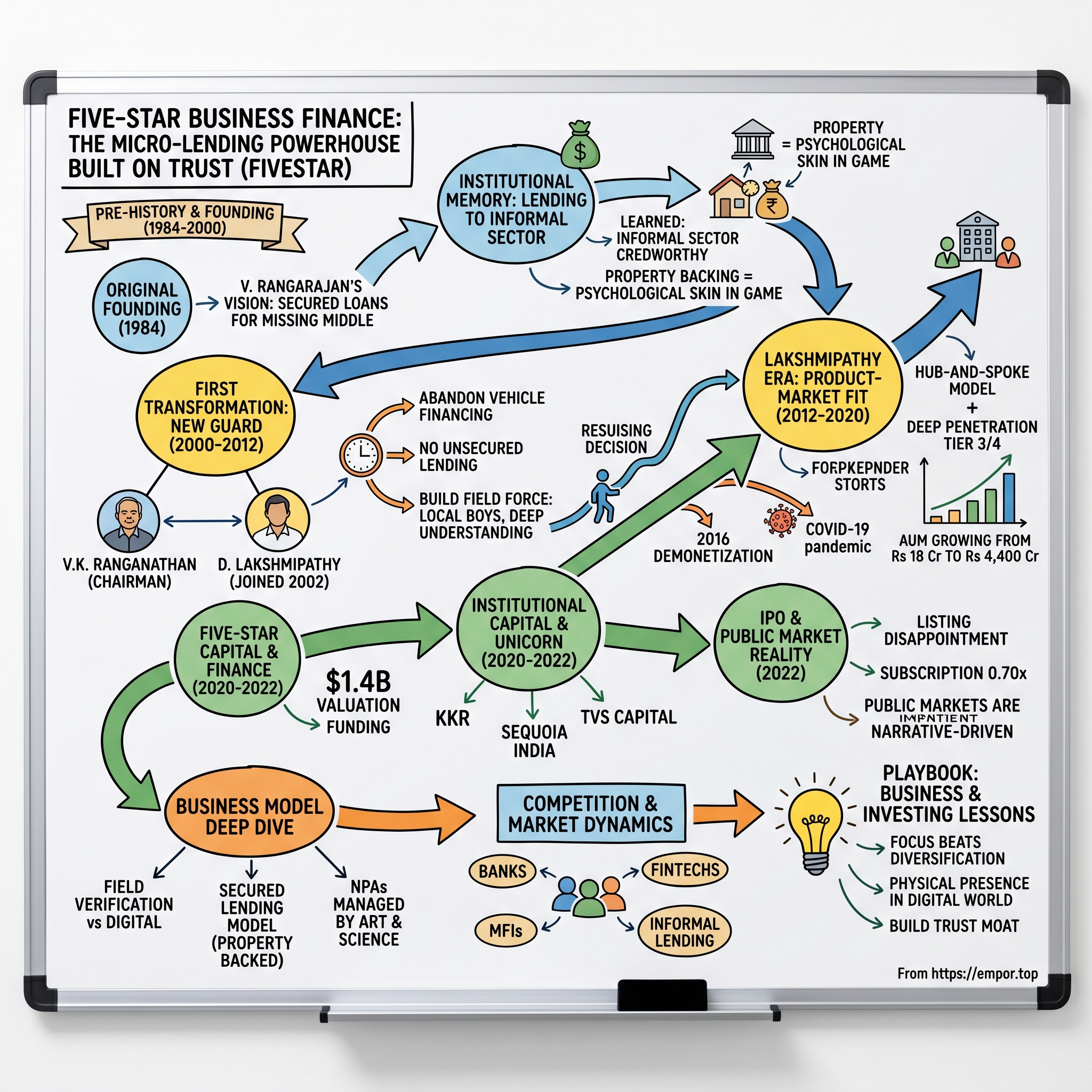
Five-Star Business Finance: The Micro-Lending Powerhouse Built on Trust
I. Introduction & Episode Roadmap
In a district town in coastal Andhra Pradesh, a small-business owner running a two-table tiffin center answers detailed questions about his daily operations. The interviewer is not a journalist, but a field officer in a branded polo shirt who arrived on a motorcycle. The officer sits on a plastic stool for forty minutes, counts footfall between 7:00 a.m. and 9:00 a.m., asks a neighboring flower vendor if the shopkeeper pays suppliers on time, and photographs a stack of handwritten receipts. Over the following days, the officer returns, visits the local sub-registrar's office to inspect the title deed for the shopkeeper's single-story home, verifies property tax payments, and estimates a monthly cash flow—derived from customer counts, meal pricing, and inventory—that appears on no formal tax return.
That is the core underwriting process. No credit bureau score resolves this borrower, nor does a Goods and Services Tax (GST) trail or a formal salary slip exist. Yet based on this field assessment, a loan of roughly ₹3 lakh is sanctioned against the borrower's home at an interest rate in the low twenties, repayable over seven to eight years.
Multiplied across more than half a million active customers and 856 branches, that model forms the foundation of Five-Star Business Finance Limited. Headquartered in Chennai, the non-deposit-taking, systemically important non-banking financial company (NBFC) closed the June 2026 quarter with assets under management of ₹13,722 crore and a return on assets (RoA) of 8.11%.12 To put that performance in context, well-run Indian banks typically earn between 1% and 2% on assets, while top affordable-housing lenders generate 3% to 4%. Five-Star earns roughly double the return of leading affordable-housing lenders through physical, field-level customer evaluations.
This model presents a distinct paradox. In an era dominated by instant digital credit, Account Aggregator infrastructure, cash-flow underwriting based on Unified Payments Interface (UPI) data, and algorithmic scorecards, Five-Star's strategy relies on physical branches, field staff, manual documentation, and collateral secured against residential property. The company's investor presentation highlights the slogan "Reaching the Unreached."3 The central analytical question is whether this positioning reflects a durable structural moat or a temporarily uncontested market segment benefiting from high lending yields.
Four primary themes frame this analysis.
First is the distinction between secured micro-lending and traditional microfinance. India's financial sector has experienced repeated credit cycles in unsecured group-lending portfolios—including Andhra Pradesh in 2010, demonetization in 2016, COVID-19 in 2020, and regional credit stress across Karnataka and Tamil Nadu in 2024–25. Five-Star contends that requiring property collateral fundamentally alters borrower behavior and mitigates systemic default risks. This analysis tests that claim by evaluating the trajectory of Five-Star's asset quality between FY25 and FY27.
Second is the strategic concept of counter-positioning. The primary structural argument for Five-Star is not superior operational efficiency compared to traditional banks, but rather that established banks cannot easily replicate its high-touch model without compromising their own cost structures or incurring regulatory and reputational risks. Evaluating this counter-positioning argument is critical, as such strategic advantages can erode if market dynamics shift.
Third is the evolution of its capital structure. Five-Star stands out as a rare brick-and-mortar, cash-collection lender that attracted extensive backing from global private equity firms, including Matrix Partners, Peak XV, Norwest Venture Partners, TPG, KKR, and TVS Capital. These investors valued the company as a unicorn in 2021, took it public in 2022, and subsequently reduced their holdings over the next three years. The timing and structure of these private equity exits offer insight into how institutional capital evaluated the long-term sustainability of an 8% return on assets.
Fourth is the evaluation of recent operational headwinds against historical growth narratives. The prevailing market consensus once framed Five-Star as possessing unassailable margins, pristine asset quality, and decades of high-growth runway. By September 2026, gross Stage 3 assets reached 3.46%, credit costs stood at 1.85% of assets, lending yields moderated to approximately 22.25%, year-on-year profit after tax growth slowed to 1.9% in the June quarter, and the Joint Managing Director and CEO who managed operations for a decade resigned.124 While these metrics do not undermine the core viability of the enterprise, they require a re-examination of the valuation and growth assumptions established during its 2021 funding rounds. This analysis examines the company's updated operational trajectory.
Understanding this shift requires examining the company's origins, which differ substantially from its current scale and market profile.
 Subscribe on LinkedIn
II. The Pre-History & Original Founding (1984–2002)
In Chennai during the mid-1980s, India's licence-permit economy still governed manufacturing, and consumer credit remained rare. In the commercial lanes off Mount Road, small financiers operated on a long-standing model: accept deposits from local families based on personal trust, lend against vehicles or equipment to familiar traders, and collect payments in person. Regulation was light, and reputation served as primary capital.
Into this market, Five Star Business Credits Limited was incorporated in Chennai in 1984.5 The company's disclosure materials credit the founding to V.K. Ranganathan, whose stated intent was to lend on a secured basis to borrowers bypassed by formal financial institutions.[^6] While the precise composition of the original promoter family is not detailed in public filings, official records document its incorporation date, original name, and Chennai base.
The initial operating model was straightforward and hyper-local: small hire-purchase loans for vehicles, equipment, and household durables. Underwriting relied directly on personal familiarity, with promoters and field staff drawing on local reputation and direct knowledge of borrowers' families and residences.
That model faced severe systemic pressure during the late 1990s. Between 1996 and 2000, India's non-banking financial company (NBFC) sector underwent widespread consolidation following the collapse of CRB Capital Markets, which severely eroded public confidence in deposit-taking lenders. In response, the Reserve Bank of India introduced a mandatory registration framework, minimum net-owned-fund thresholds, stricter prudential norms, and tight restrictions on public deposits for unrated NBFCs. Thousands of small lenders folded, sold out, or ceased operations. Surviving entities generally fit one of two profiles: those backed by large industrial conglomerates with deep capital reserves, or those operating with minimal financial leverage.
Five-Star fell into the second category. Its survival stemmed from strict financial conservatism: minimal borrowing and minimal expansion. Through the late 1990s and early 2000s, its loan portfolio remained tiny, on the order of a dozen crore rupees—a rounding error compared to its eventual scale.[^6]
This survival highlights a critical structural distinction: extreme risk aversion can function as insurance during market distress, but it does not constitute a long-term growth strategy. Five-Star survived the NBFC crisis intact, but after eighteen years of operation, it possessed little more than a licence, a clean regulatory record, a small team, and virtually no scalable franchise.
The core limitation was structural. Hire-purchase lending to local consumers offered no clear path to scale. The product was commoditized, ticket sizes were small, competition from traditional bank branches was intense, and the risk model provided no competitive edge. To expand, the business required three missing elements: institutional growth capital, a differentiated underwriting process that traditional banks could not easily replicate, and a large, underserved target market.
Those elements began to take shape through a strategic shift that attracted little initial attention.
III. The First Transformation & RKV Amalgamation (2002–2012)
Mergers between small Indian non-banking financial companies in 2002 rarely attracted market attention. They were routinely completed through administrative schemes of amalgamation, high court orders, and updates to regulatory registers. The amalgamation of RKV Finance Limited into Five Star Business Credits during 2002 fit that pattern.[^6] Yet the transaction proved transformative for Five-Star because of the leadership it brought to the firm.
D. Lakshmipathy—identified as Lakshmipathy Deenadayalan in corporate filings—served as Managing Director of RKV Finance. An engineer by training, he joined Five-Star's board as Joint Managing Director following the merger, bringing an operational playbook rather than institutional capital.[^6]6 At RKV, he had pioneered lending against small-ticket, self-occupied residential properties owned by informal business operators. These were neither conventional housing mortgages nor personal consumption loans, but working and growth capital for micro-enterprises, secured by the borrower's primary residence.
That playbook addressed a fundamental gap in India's financial system. India is home to tens of millions of micro-entrepreneurs, including kirana store owners, tailors, tea-shop operators, mechanics, and small traders. Traditional commercial banks typically decline to lend to these operators due to a lack of formal documentation, such as audited financial statements, tax returns, invoicing records, or salary slips. In conventional bank underwriting terminology, these borrowers are classified as "unscorable." Because verifying unrecorded cash flows requires labor-intensive field evaluation, bank credit policies rationally equate unscorable applicants with uncreditworthy ones.
Lakshmipathy's core thesis was that an unscorable borrower is not inherently uncreditworthy. An informal business operator may run a stable, cash-generating enterprise that lacks formal documentation. By deploying field officers to physically inspect the business, estimate cash flow from observational evidence, and secure the loan against the borrower's primary residential property, creditworthiness could be evaluated from first principles.
This field-level underwriting model carries substantial operational costs. It requires a dense branch footprint, localized field officers, and specialized legal work to verify property titles in semi-urban areas where land records are often fragmented or unmapped. The model remains economically viable only if borrowers accept interest rates high enough to absorb these operational expenses. Informal micro-entrepreneurs accepted these yields because their alternative was not a commercial bank loan at 12%—for which they did not qualify—but informal moneylenders charging annual rates of 36% to 60%.
Throughout the 2000s, Five-Star focused on institutionalizing this operational framework. V.K. Ranganathan, as chairman, introduced standard governance practices derived from Chennai's traditional financial sector—including structured audit controls and rigorous documentation standards—to what had previously operated as a localized firm. This structure combined RKV's lending thesis with established governance controls, facilitating a strategic shift away from auto and consumer hire-purchase loans toward secured micro-business credit.
Initial expansion proceeded slowly. By 2012—a decade after the amalgamation—Five-Star maintained a single-digit branch network and a loan book in the low tens of crores of rupees.[^6] This extended phase allowed the company to observe full loan cycles and test its underwriting assumptions through seasoning seven-year loans across varied economic conditions.
The decade provided empirical baseline data that could not be derived from financial modeling alone. Execution during this period established practical benchmarks for property title verification timelines in rural Tamil Nadu, cash-flow estimation error margins, resilient loan-to-value thresholds during regional downturns, and the optimal loan-portfolio size manageable by a single field officer.
By 2012, Five-Star had established a tested operating playbook, though its capital base remained constrained. The subsequent decade would test whether this high-touch model could scale across broader geographic markets.
IV. The Lakshmipathy Era: Finding Product-Market Fit in Micro-Secured Credit (2012–2020)
The year 2012 marked a major operational turning point. When D. Lakshmipathy formally assumed the chief executive role, Five-Star transitioned from exploratory expansion to a standardized, repeatable lending model.6 What followed was a rapid expansion phase in Indian specialty finance, driven by deliberate product structuring and field execution.
The shape of the product
Five-Star standardized a loan structure designed around a specific set of parameters.
Ticket sizes were set within the ₹1 lakh to ₹10 lakh band, with average sanctions clustering between ₹2.5 lakh and ₹3 lakh.7 This range was strategically calibrated: low enough to discourage mainstream commercial banks with higher overhead costs, but large enough to absorb the fixed costs of physical field investigations and legal title searches over a meaningful loan balance.
Every loan was secured, primarily by self-occupied residential property—and occasionally small commercial real estate—with the loan-to-value (LTV) ratio maintained well below standard mortgage lending benchmarks.7 This conservative LTV structure served two functions: it provided a buffer for terminal recovery and ensured that the borrower's home equity substantially exceeded the loan amount, creating a strong behavioral incentive to prioritize repayment.
Loan tenors ranged from seven to ten years on an amortizing equated monthly installment (EMI) structure. Extended tenors kept monthly payments manageable relative to informal cash flows, making a ₹3 lakh loan at high-twenties interest rates serviceable. However, these multi-year tenors also meant that underlying credit performance required years to fully manifest in portfolio metrics.
Pricing remained central to the economic model. During this growth decade, loans were originated at interest rates in the mid-twenties percentage range, with Five-Star's blended lending rate averaging approximately 22.25% by mid-2026 following several years of downward repricing.2 Positioned between high-cost informal moneylenders and strict commercial banks, this structure provided borrowers with lower rates than informal alternatives while generating spreads sufficient to fund Five-Star's labor-intensive distribution network.
The field officer as the product
While broader trends in Indian retail lending emphasized digital automation and paperless underwriting, Five-Star expanded its physical workforce.
This reliance on field officers stemmed from an absence of structured financial data. For first-time formal borrowers in Tier-4 towns, credit bureau files were often thin or nonexistent. Banking data via Account Aggregators yielded minimal insight for cash-based enterprises, and Goods and Services Tax (GST) filings did not exist below statutory thresholds. The core premise of digital lending—that a borrower leaves a machine-readable financial footprint—did not apply to this segment.
Consequently, Five-Star's field staff conducted manual, substantive evaluations of unbooked cash flows. Officers performed on-site footfall counts, estimated inventory levels, interviewed neighboring shopkeepers and suppliers, and reconciled physical evidence against verbal claims. Concurrently, legal teams conducted title verifications on properties in unmapped layouts, tracing land tax receipts and verifying ownership to confirm the absence of competing claims.
This operational framework created a practical barrier to entry. Replicating the model required maintaining a large, locally recruited, tightly supervised field staff capable of executing standardized qualitative assessments across hundreds of small towns. Furthermore, the economics of the model depended on maintaining lending yields higher than mainstream banks were typically willing to charge.
Distribution expanded through a hub-and-spoke network, clustering branches within districts to minimize travel distances and maintain relationship-driven collections. From a small branch network in 2012, Five-Star expanded to more than 250 branches by FY20, concentrated in Tamil Nadu, Andhra Pradesh, and Telangana.[^6]7 Over the same period, assets under management grew from a base in the low tens of crores of rupees to approximately ₹4,400 crore by FY20, while reported gross non-performing assets remained below 2%.[^6]
This performance indicated either an effective localized underwriting model or deferred credit recognition masked by rapid portfolio growth. While subsequent events tested these underwriting practices, the initial expansion established Five-Star as a major regional lender.
Disconfirming evidence: COVID and the 90-DPD reality check
Prior to its public listing, market commentary frequently characterized secured micro-mortgage lending as resilient against broader economic downturns, operating on the premise that property collateral protected the lender against credit losses.
The disruptions of COVID-19 provided a direct test of this assumption.
During the 2020 national lockdowns, cash flows for informal micro-enterprises contracted sharply. Because collection models relied on physical monthly visits by field officers, collection efficiency declined, prompting loan restructurings under Reserve Bank of India resolution frameworks and increasing overdue balances.
Compounding these operational disruptions was a regulatory shift in asset classification for non-banking financial companies. The transition toward a strict 90-days-past-due (90-DPD) standard, along with clarified rules for day-end classification and loan upgrades, accelerated the movement of delinquent cash-collected accounts into reported Stage 3 assets.
This period clarified the structural function of real estate collateral. Property collateral does not prevent liquidity-driven defaults, as real estate equity cannot substitute for immediate cash flow. Instead, collateral provides terminal recovery leverage and creates a strong incentive for borrowers to prioritize secured obligations over unsecured debt when cash is constrained.
Consequently, the pandemic demonstrated that while secured micro-lending achieves higher ultimate recovery rates and superior payment priority compared to unsecured microfinance, portfolio delinquency remains linked to underlying borrower cash flows.
Five-Star navigated the pandemic with its operational framework intact, though its asset quality metrics reflected broader economic stress. Crucially, its performance through this period laid the groundwork for attracting substantial institutional equity investment.
V. The Institutional Equity Era: PE Benchmark & Unicorn Valuation (2020–2022)
Pitching the business to a Mumbai investment committee in 2020 presented an unusual proposition. The presentation featured no smartphone application screenshots, cohort retention metrics, or API-driven digital architecture. Instead, it showed photographs of physical branches in small district towns and explained that field officers evaluated borrowers using motorcycles and paper clipboards.
Global growth investors backed the strategy regardless. Matrix Partners India, Sequoia Capital India (later Peak XV Partners), Norwest Venture Partners, TPG Asia, KKR, and TVS Capital joined the share register across successive funding rounds, committing hundreds of millions of dollars in institutional capital.8 In March 2021, Five-Star announced a $234 million funding round—combining primary equity capital and secondary share purchases from early backers—that valued the enterprise at approximately ₹10,300 crore, or $1.4 billion.8 A brick-and-mortar micro-lender collecting monthly cash installments in district towns had achieved unicorn status.
Institutional investors underwrote not a technology story, but a high net interest spread.
What the capital actually did
The mechanism by which institutional equity generated value illustrates how capital structure directly influenced Five-Star's operating results.
At its simplest, a non-banking financial company's profitability depends on the spread between its lending yields and borrowing costs, minus operating expenses and credit losses. Five-Star's lending rate was set by its market position in informal micro-mortgages, while operating expenses were determined by its field-heavy distribution network. Consequently, funding costs represented the primary controllable lever for margin expansion.
An NBFC's cost of capital is driven by its credit rating, which reflects capital adequacy, leverage, asset quality, and operating track record. By injecting equity into the balance sheet, the private equity consortium reduced financial leverage to unusual levels for a fast-growing lender, maintaining debt-to-equity ratios in the low single digits, often closer to 1.5x than 3x. This capital cushion, combined with its operational record, supported successive credit rating upgrades into the AA- category from agencies including ICRA and CARE.9
As a result, borrowing costs fell steadily over the period, with Five-Star's cost of funds reaching 8.80% by the June 2026 quarter.2 Because lending rates remained relatively stable, each reduction in funding costs expanded net interest margins. The company sustained margins around 16%, reporting 15.94% for FY26 compared to 16.19% in the prior fiscal year.310
However, this conservative capital structure also placed a structural ceiling on equity returns.
Low leverage inflates return on assets while constraining return on equity. Five-Star's RoA of approximately 8% stood out in retail finance, but its FY26 return on equity of 16.06% was more modest, and by the June 2026 quarter, RoE had drifted to about 14.5% alongside an RoA of 8.11%.102 An over-capitalized lender operates with unused balance-sheet capacity—providing resilience in a downturn, but creating capital inefficiency during an upcycle. This dynamic demonstrates that Five-Star's headline 8% RoA resulted partly from capital structure decisions rather than operating advantages alone.
For a public company, this balance sheet structure creates an ongoing strategic trade-off: management must either increase leverage and accept potential rating downgrades and higher borrowing costs, accelerate growth to absorb retained earnings, or return capital to shareholders. When growth slows, public market investors increasingly scrutinize that choice.
This dynamic set up the transition as private markets handed the narrative to public investors, who evaluated the business through a different lens.
VI. The IPO Reality Check: Trimming the Offer & Market Debut (2022)
There is a particular kind of silence in an IPO war room when the subscription numbers stop moving. Five-Star's bankers experienced it in November 2022.
The company had filed for a public offering in November 2021 at a proposed size of ₹2,752 crore — structured essentially as an offer for sale, meaning the proceeds would go to selling shareholders rather than into the business.11 That structure is telling in itself: the company did not need money. It was already over-capitalised. The IPO existed to give the private equity consortium a listed exit route.
By the time the offer opened, in November 2022, market conditions had turned and the issue had been cut down to roughly ₹1,960 crore, priced in a band of ₹450 to ₹474 with the final price set at the top.1213 The offer ran from November 9 to November 11.
Then the reality check. The book did not fill. On the final day of subscription the issue stood at about 70% overall — with qualified institutional buyers subscribing 1.77 times their portion, non-institutional investors reaching only 61%, and retail individual investors coming in at a startling 11%.14 Read that retail number again. An Indian IPO in a well-known consumer-facing sector with an oversubscribed institutional book and 11% retail participation is a market delivering a verdict: professional investors were willing to own the spread, and ordinary investors would not pay ₹474 for it.
Listing day, November 21, 2022, confirmed the message. The stock opened at ₹468.80 on the NSE, below the issue price, and listed at ₹449.95 on the BSE — a discount of roughly 5%.15
It is worth correcting a version of this story that circulates in secondary summaries, which describes the listing as a flat-to-slightly-positive debut around ₹489. The primary contemporaneous reporting is unambiguous: this was a weak debut below the issue price on both exchanges.15
What the market was actually worried about
Public investors were not disputing the historical numbers. They were pricing three doubts, all of which the subsequent four years have partially validated.
The first was yield sustainability. A lender earning mid-twenties rates from low-income borrowers is, by construction, a target — for regulators concerned about fair pricing, and for competitors attracted by the spread. Any discounted-cash-flow model of Five-Star is really a model of how long the yield holds.
The second was asset quality under a real cycle. The company's remarkable credit history had been built during a period of rising rural incomes and, latterly, through a pandemic cushioned by regulatory forbearance. The portfolio had never fully seasoned under a strict classification regime in a normal economy.
The third was the overhang. Everyone could read the register. A cap table stacked with funds approaching or past the end of their holding periods, in a company whose IPO had been an offer for sale, meant a predictable supply of stock for years.
All three doubts were legitimate, and all three would be tested — but before testing them, it is worth being precise about what the machine actually does, because the unit economics are the thing that everything else either protects or erodes.
VII. Deep Dive: Business Model, Unit Economics & The 7 Powers
Strip away the narrative, and Five-Star is an arithmetic expression. Understanding that expression is central to evaluating the business.
The waterfall, in plain English
Start with what the borrower pays: roughly 22% to 23% on new business as of mid-2026, down from the mid-twenties several years prior.2
Subtract Five-Star's cost of capital: about 8.8%.2 The resulting gross spread is large by any lending benchmark, providing the core resource that funds all operations.
Next, subtract operating expenses. This is where the physical field model requires substantial resources—covering branch rents, officer salaries, motorcycles, fuel, field supervision, legal reviews, and title verifications. Five-Star's operating expense burden ran near 6% of assets in the June 2026 quarter, reflecting ongoing branch expansion and hiring ahead of expected revenue generation.2
Finally, subtract credit costs: provisions and write-offs ran at approximately 1.85% of assets in the June 2026 quarter, with management projecting roughly ₹60 crore of quarterly write-offs and aiming for a long-term rate of 1.7%.2
What remains after tax is the company's return on assets of roughly 8%.2
This waterfall highlights a key operational dynamic. Although the gross spread is wide, operating expenses near 6% and credit costs near 2% together consume around eight percentage points. The business generates high margins not because its spread is immune to compression, but because the spread is wide enough to absorb an expensive, labor-heavy field model and meaningful credit losses while leaving a high residual return. Consequently, the return on assets is sensitive to yield compression: a 200-basis-point drop in yield, holding operating and credit costs constant, would reduce RoA by roughly a quarter.
The loan itself
A typical loan averages approximately ₹2.7 lakh sanctioned to a micro-enterprise owner, secured by a self-occupied residential property with verified title and land tax receipts, amortizing over seven to ten years with monthly installment payments.7 While collections increasingly move to digital channels, field officer relationships drive baseline compliance. Collection efficiency reached 97.9% in the June 2026 quarter, down slightly from the 98.1% peak reported in the March 2026 quarter, which management described on its FY26 earnings call as among the highest in company history.216
Five-Star surpassed 500,000 active loan customers during the June 2026 quarter and expanded its network to 856 branches after adding twelve branches over the three-month period.2
Helmer's 7 Powers, applied honestly
Counter-positioning represents the company's strongest strategic thesis. The core argument is not that commercial banks lack capital or technology, but that adopting Five-Star's high-touch model would disrupt their existing cost structures and operating practices. Mainstream bank branches cannot economically justify spending days of field officer time to underwrite a ₹2.5 lakh loan. Furthermore, charging informal micro-entrepreneurs yields above 20% presents reputational and political risks for major banks that specialized lenders absorb more routinely. This dynamic creates a structural barrier against direct bank entry.
However, counter-positioning protects against legacy commercial banks rather than specialized non-bank competitors. As competing specialists enter the market, long-term durability depends increasingly on process capability.
Process power resides in the company's hard-to-replicate operational routines: a standardized field underwriting workflow combining informal cash-flow estimation with local property title verification across 856 branches. Process power builds gradually through institutional routines, but it is difficult to verify externally in real time because underwriting defects manifest with a multi-year lag in the credit performance of older loan cohorts. This lag is particularly relevant when evaluating asset quality metrics.
Scale economies function primarily at the regional level. Branch density within specific districts lowers customer acquisition costs and reduces field officer travel times. This concentration explains why 88% of Five-Star's assets under management are located across four southern states—with Andhra Pradesh accounting for 36%, Tamil Nadu 28%, Telangana 19%, and Karnataka 5% as of the FY26 presentation.3 Regional density provides operational efficiency, though it also concentrates geographic risk.
Notably absent from this competitive structure are strong brand equity, high switching costs, or network effects. Borrowers face no structural lock-in. Once a micro-entrepreneur establishes a three-year credit bureau record, that customer transitions into the scorable, bankable segment that commercial institutions actively seek to acquire.
Porter's five forces
Buyer power remains low initially because informal borrowers prioritize credit access, approval speed, and longer repayment tenors over pricing. However, buyer power increases automatically as borrowers build formal credit histories.
Threat of new entrants is substantial. Entry requires capital, credit ratings, branch infrastructure, and trained field personnel. While these requirements create high entry barriers, wide lending spreads continue to attract well-funded specialist lenders.
Supplier power—exercised by funding banks, mutual funds, and institutional investors—remains favorable. Low leverage and an AA- credit rating provide access to term loans, non-convertible debentures, securitization, and direct assignment, allowing Five-Star's cost of funds to decline even during broader rate cycles.29 Nevertheless, wholesale funding leaves the company exposed to broader sector liquidity shifts if institutional market confidence weakens.
Substitutes encompass informal moneylenders, gold loans, microfinance institutions, and digital unsecured credit providers competing for micro-borrower cash flows.
Rivalry among specialized non-banking lenders represents the primary force driving yield compression and competitive pressure across the sector.
VIII. Industry Structure, Competitive Landscape & Relative Scale
Five-Star operates at the intersection of three distinct lending segments, each competing for its target customer base from a different strategic angle.
From above are the affordable housing financiers—such as Aavas Financiers, Home First Finance, and Aptus Value Housing Finance. Although their primary products differ, focusing on home purchase and construction rather than business capital, the underlying customer demographic overlaps substantially. The collateral relies on the same asset class—residential real estate—while lending rates range in the low-to-mid teens compared to Five-Star's low twenties. Affordable housing lenders sustain these lower rates through longer tenors, larger average ticket sizes, lower operational intensity, and access to subsidized refinancing through the National Housing Bank. Consequently, while housing lenders report returns on assets between 3% and 7%—below Five-Star's historical metrics—they do so at a structurally lower price point.
Directly alongside are MSME loan-against-property specialists, including SBFC Finance and unlisted players like Veritas Finance. Veritas has constructed a micro-loan-against-property portfolio in South India using a field-underwriting framework that closely matches Five-Star's distribution model. Veritas represents an important analytical benchmark, demonstrating that field-based underwriting procedures can be replicated by focused specialists with sufficient capital.
From below, microfinance institutions and small finance banks are moving upmarket from unsecured group loans into secured individual lending, driven by portfolio stress across unsecured microfinance portfolios during 2024 and 2025.
Five-Star's historic advantage across these segments stemmed from product positioning. By framing its offerings as micro-business capital rather than home finance, the company commanded yields several hundred basis points above what housing finance institutions charged against similar residential collateral. That positioning, combined with peak cost-to-income efficiency below 20%, drove its outlier profitability.
However, this structure creates a clear strategic vulnerability. As a Five-Star customer completes 36 consecutive monthly installments, the borrower's credit bureau profile shifts significantly. A previously unscorable informal operator becomes a documented borrower with a three-year secured repayment track record. At that stage, competing housing financiers or commercial banks can target the customer for a balance transfer at substantially lower interest rates.
This refinancing and takeover risk impacts the business model in three distinct ways. First, it shortens effective loan tenors below their contractual seven-to-ten-year terms, reducing cumulative interest income per acquired customer. Second, it induces adverse selection, as creditworthy borrowers are most likely to be refinanced elsewhere, leaving behind a higher-risk residual portfolio. Third, it compels Five-Star to preemptively reprice performing accounts downward, contributing to the drift in blended yields from the mid-twenties toward 22.25%.2
During the June 2026 earnings call, management asserted that "most yield contraction has already occurred" and that further rate reductions were not expected unless funding costs fell substantially.216 This guidance represents a shift from earlier management commentary, which framed yield reductions primarily as proactive competitive adjustments rather than an adjusting market equilibrium.
In summary, Five-Star's field capabilities and cost structure remain defensible against mainstream commercial banks. However, against direct MSME specialists and the natural credit graduation of its customer base, its pricing premium faces ongoing pressure, as evidenced by its historical yield trajectory. The central question for the coming years is whether operating leverage from its 856-branch network can offset this yield compression.
That outcome depends on operational execution—and execution remains tied to the leadership steering the firm.
IX. Management Credibility, Capital Allocation & Compensation Audit
On July 28, 2025, the board of Five-Star Business Finance met to consider a resignation letter from the executive who had overseen much of the firm's operational expansion over the prior decade.
Rangarajan Krishnan had joined Five-Star around 2015 and risen to Joint Managing Director and Chief Executive Officer. As a professional manager within a promoter-led institution, he directed branch expansion, standardized underwriting discipline across geographic markets, and led investor communications through the company's private equity funding rounds and public listing. His resignation, accepted at that board meeting, took effect at the close of business on August 14, 2025, with the company citing his decision to pursue an entrepreneurial journey after ten years with the firm.17[^19] Day-to-day operational oversight reverted to Chairman and Managing Director Lakshmipathy Deenadayalan.17
This executive transition carries analytical weight due to three converging factors: its timing, the absence of a named successor, and the concentration of operational authority back to the promoter just as the lender began expanding beyond its core southern markets amid rising credit stress.
The leadership as it stands
Lakshmipathy Deenadayalan has served as chief executive since January 2012, guiding the firm's shift into secured micro-business credit.6 He holds a direct promoter stake reported at roughly 18.6%, with additional equity held by family members including Hema Lakshmipathy and Shritha Lakshmipathy.6 Unlike the company's institutional equity investors, the promoter family has maintained its equity position, aligning its financial interests directly with the long-term performance of the enterprise.
Srikanth Gopalakrishnan serves as Joint Managing Director and Chief Financial Officer, taking a prominent role in investor communications. On recent earnings calls, Srikanth outlined the company's cost structure strategy for FY27, stating that operating expenses would remain roughly flat for the year with operating leverage expected to arrive from FY28 onwards.2 This projection establishes a clear operational benchmark against which management's execution can be evaluated.
The compensation question
For the fiscal year ended March 31, 2025, Lakshmipathy's total compensation was reported at approximately ₹10.4 crore, comprising a base salary of roughly ₹6.2 crore alongside performance-linked incentives and other components. This followed a board decision approving fixed pay of ₹51.66 lakh per month effective April 1, 2024, with scope for annual revision of up to 20%.6
Evaluating executive compensation requires context. While a ₹10.4 crore pay package for the leader of a firm generating over ₹1,100 crore in annual net profit may align with broader market practices, the timing presents an analytical contrast. The compensation structure, established in 2024 with built-in escalation provisions, coincided with a sharp deceleration in earnings growth. Net profit after tax grew just 1.9% year on year in the June 2026 quarter, following full-year FY26 profit after tax growth of about 2% year on year to ₹1,099 crore.21018 When executive remuneration continues to escalate under pre-agreed formulas while earnings growth moderates, the divergence draws scrutiny from institutional shareholders regarding governance and pay-for-performance alignment.
The PE exit: reading the sell side of the register
The trajectory of private equity ownership provides important context for Five-Star's public market valuation.
In September 2023, Norwest Venture Partners X Mauritius, Matrix Partners India Investment Holdings II and TPG Asia VII SF sold 2.55 crore shares for ₹1,863 crore in open market deals.19 In December 2023, TPG Asia, Matrix and Peak XV Partners Investments V completed a secondary sale, realising ₹1,656 crore.19 In September 2024, roughly 11.2% of the company—about 28 million shares—changed hands in block deals worth ₹2,034.6 crore, with Peak XV and other private equity holders as the likely sellers, following a disclosed intention by TPG, Matrix and Peak XV to sell up to 8.81%.202122
In total, early institutional investors distributed well over ₹5,500 crore of stock into public markets across three years following the initial public offering.
Market analysts evaluate this sustained divestment through two perspectives. The conventional view attributes the sales to fund mechanics: closed-end private equity vehicles face defined fund lifecycles, and having entered positions as early as the mid-2010s, their divestment strategy followed standard liquidity pathways.
A secondary perspective focuses on the speed and concentration of the exits. When institutional sponsors view a portfolio company as substantially undervalued, they frequently retain equity stakes to capture long-term upside. The rapid execution of multi-billion-rupee block trades within twenty-four months of post-IPO lock-in expirations across essentially the entire sponsor group suggests that institutional investors evaluated the shares as fully valued relative to underlying operational risks.
This continuous secondary market supply has exerted persistent pressure on Five-Star's stock price. As of mid-September 2026, the stock traded around ₹549, giving a market capitalisation near ₹16,200 crore at roughly 2.2 times book and about 14.5 times earnings.23 This valuation reflects market caution regarding the long-term sustainability of the firm's historical return profile.
That skepticism has a factual foundation, and it is time to test the bull thesis claim by claim.
X. The Historical Falsification Pass: Testing Core Moat & Growth Claims
The consensus Five-Star story, as told during its 2021 and 2022 funding and public offering phases, rested on four load-bearing claims. Each deserves to be tested against the company's subsequent operating disclosures rather than theoretical projections.
Claim 1: An unassailable ~8% return on assets
The mechanism capable of breaking this claim is spread compression driven by either regulatory tightening or competitive pressure.
Disclosed operational metrics confirm that compression has already occurred. Blended lending rates declined from the mid-twenties during the initial expansion decade to approximately 22.25% by the June 2026 quarter.2 Net interest margin contracted from 16.19% in FY25 to 15.94% in FY26.10 The investor presentation for the June 2026 quarter reflected record quarterly disbursements alongside visible margin pressure.1 Meanwhile, the Reserve Bank of India's sustained supervisory emphasis on fair lending practices, pricing transparency, and rate reasonableness for low-income borrowers remains an ongoing regulatory condition for non-banking financial companies.
What preserved return on assets near 8% through this yield compression was a parallel drop in funding costs to 8.80%.2 Headline profitability was defended not by pricing power, but by lower borrowing costs—a benefit tied to the broader interest rate environment and credit rating strength, which cannot decline indefinitely.
Verdict: the strong claim is rejected; a narrowed version survives. An 8% return on assets does not demonstrate an unassailable moat. Instead, it reflects a wide lending spread being progressively taxed by market competition, with that tax absorbed so far by cheaper funding rather than net margins. The revised claim—that Five-Star can maintain returns above specialty-lending peers, albeit at a moderating level—remains plausible but unproven beyond the current funding cycle.
Falsification KPI: net interest margin sustained below 14.5%, particularly if funding costs remain flat or rise. Management stated it does not expect further yield reductions absent a drop in borrowing costs; an uncompensated rate cut would directly contradict that guidance.216
Claim 2: Zero-loss secured micro-collateral
The mechanism capable of breaking this claim is legal and social friction in collateral enforcement. Liquidating a self-occupied residence in a small town is protracted and politically sensitive, regardless of statutory provisions under SARFAESI. Foreclosing on a family's primary home over a ₹3 lakh debt creates local resistance, political scrutiny, and reputational damage that a lender reliant on community relationships cannot easily absorb.
Financial disclosures provide empirical evidence testing this thesis. Gross Stage 3 assets, which stood at roughly 1.4% during FY25, rose to 3.18% in the December 2025 quarter, 3.37% in March 2026, and 3.46% by June 2026.41024 Annualized credit costs reached 1.85% of assets in the June 2026 quarter.2 Quarterly write-offs are projected at approximately ₹60 crore by management, representing permanent credit losses on a secured book.2 Provision coverage on Stage 3 exposures sits at just over 40%, indicating management's assessment of recovery timelines: if residential collateral were quickly liquidatable at conservative loan-to-value ratios, 40% coverage would be unusually high. The coverage level reflects the reality that asset recovery requires years.
This performance contrasts with earlier management guidance, which projected credit costs between 75 and 100 basis points alongside stable asset quality.16 Credit costs of 1.85% in the subsequent quarter ran at nearly double the upper end of that guidance range. Management attributed elevated slippages to transitory regional stress and maintained that credit costs would trend down toward 1.7%.2
Verdict: the claim is rejected outright in its "zero-loss" form. The defensible interpretation aligns with the evidence: property collateral acts as a behavioral deterrent against strategic default and elevates payment priority, but it does not function as a cash-liquidity guarantee. A secured micro-lending portfolio experiences permanent credit write-offs.
Falsification KPI: gross Stage 3 assets exceeding 4.0%, or credit costs failing to decline toward the guided 1.7% level over coming quarters. Conversely, a sustained sequential reduction in both metrics on an expanding loan book would validate management's containment thesis.
Claim 3: Pan-India scalability
The mechanism capable of breaking this claim is the localized nature of field underwriting. Credit evaluation relies on officers with deep knowledge of local commercial ecosystems and legal teams familiar with district land records—neither of which transfers seamlessly across state borders.
Disclosed branch metrics highlight this constraint. After more than a decade of geographic expansion and a network of 856 branches, four southern states still account for 88% of total assets under management. Andhra Pradesh alone represents 36% of assets across 276 branches, while Tamil Nadu accounts for 28% across 211 branches.3 Although branch additions outside the core southern footprint have continued, overall asset concentration has shifted slowly. Because newly established branches require time to reach optimal productivity, operating expenses have risen toward 6% of assets, pushing anticipated operating leverage out to FY28 in management's projections.2
Verdict: the claim is unproven and behind schedule. Geographic expansion has expanded branch counts faster than asset concentration. Scaling the underwriting model beyond traditional markets remains a major operational test, now conducted under a restructured executive team following the 2025 departure of the Joint Managing Director and CEO.
Falsification KPI: the proportion of assets under management generated outside the four southern states, alongside asset productivity per branch in newer non-South vintages relative to mature southern branches. Persistent underperformance in non-South branch productivity, combined with elevated credit costs in newer markets, would confirm that the underwriting model is regionally bound rather than nationally scalable.
Claim 4: Aligned promoter and institutional incentives
The initial alignment thesis has evolved following capital structure changes. Institutional private equity sponsors have distributed the majority of their holdings into public markets, while the former professional chief executive has departed. Operational oversight rests primarily with the promoter family—maintaining a substantial equity stake—alongside an expanded executive remit for the Chief Financial Officer.
Verdict: the alignment structure has shifted from a joint promoter-institutional partnership to a promoter-led enterprise with a dispersed public shareholder base. While promoter equity retention provides direct alignment with long-term performance, the transition removes a layer of institutional sponsor oversight that featured prominently in earlier investment thesis framing.
Evaluating these four core claims reveals a clear pattern. The enterprise operating in 2026 presents a lower-slope, higher-variance growth profile than the thesis articulated during its 2021 funding rounds. Assessing the specific operational and macro risks underlying that variance provides the context for evaluating its forward outlook.
XI. Regulatory Radar, Material Risks & Stress Test
Every high-yield lender serving low-income borrowers in India operates under the reality that its business model remains vulnerable to regulatory shifts. Five-Star is no exception, and its primary risks stem from specific structural vulnerabilities rather than broad market dynamics.
Pricing regulation. The Reserve Bank of India (RBI) has maintained supervisory oversight on high-yield retail lending through scale-based regulations for non-banking financial companies, fair-practices codes, mandatory all-in rate disclosures, and direct interventions against pricing or governance lapses. Rather than imposing formal interest rate caps—which remain rare outside microfinance—regulatory pressure operates implicitly. Heightened scrutiny deters lenders from maintaining top-tier rates, while mandated yield disclosures make borrowing costs transparent and easier for competitors to challenge. With Five-Star's blended lending rate already trending downward, regulatory oversight limits its ability to reverse yield cuts even if competitive pressures abate.
Geographic concentration. With 36% of its portfolio concentrated in Andhra Pradesh and 88% spread across four southern states, Five-Star's balance sheet remains tied to a narrow set of regional variables.3 Environmental factors such as coastal cyclones and floods periodically disrupt borrower cash flows and field collections. Furthermore, because local micro-enterprises rely heavily on agricultural activity, farm income cycles directly influence repayment performance. State political dynamics represent an additional layer of exposure; political announcements of agricultural debt relief—even when technically excluding NBFC commercial loans—can temporarily erode district-level repayment discipline. While a return to the severe legislative interventions that marked the 2010 Andhra Pradesh microfinance crisis remains unlikely for secured credit, regulatory or administrative constraints on physical collection practices remain a practical risk.
Refinancing and adverse selection. As detailed in previous sections, the primary operational vulnerability is the natural transition of Five-Star's best-performing borrowers into target clients for lower-cost lenders. This mechanism requires no macroeconomic shock—only time and active credit bureau monitoring.
Execution and credit culture at scale. Managing operational quality across an expanding footprint presents a subtle risk. An underwriting model reliant on individual officer judgment faces quality risks when scaling rapidly. Expanding to 856 branches—with over 100 added within two years—requires onboarding field officers in a competitive labor market and placing them under relatively new middle managers. On a long-tenor loan book, the lag between underwriting dilution and default recognition typically spans two to three years. The rise in gross Stage 3 assets from 1.4% to 3.46% between FY25 and the June 2026 quarter reflects two competing interpretations: a temporary spillover from broader microfinance sector stress, or vintage deterioration in loans originated during rapid expansion. Management points to quarterly slippage remaining flat at 0.70% and collection efficiency near 98% to argue for the temporary spillover thesis.2 Distinguishing between these two explanations will require several additional quarters of seasoned performance data.
Funding and cost-of-capital risk. Five-Star's profitability has relied substantially on declining borrowing costs. Any reversal—whether triggered by broader interest rate shifts, credit rating revisions, or sector-wide liquidity tightening—would directly compress net margins, given limited scope to raise lending yields. The firm's main line of defense rests on its conservative capital structure: low financial leverage, diversified funding across bank term loans, debentures, and securitization, alongside an AA- category credit rating reaffirmed by CARE in 2026.9
Key personnel. Beyond top executive transitions, operational consistency depends heavily on middle management. Regional credit managers and branch cluster heads enforce underwriting discipline across local offices. Because turnover at this layer is not publicly disclosed, evaluating operational stability in expanding branches remains an analytical challenge.
Investors seeking to independently evaluate these operational risks must look beyond high-level summaries to specific primary disclosures.
XII. Transcripts & Conference Calls Guide for Investors
Evaluating a specialized lender requires examining executive language alongside audited metrics. While financial results arrive quarterly under formal audit, shifts in executive tone and narrative emphasis surface during earnings calls. For Five-Star, a core group of primary documents provides key analytical signals.
The FY26 fourth-quarter call, held in late April 2026. This earnings call serves as a baseline for subsequent performance tracking. Management reported a quarterly net profit of ₹269 crore and a full-year net profit of ₹1,099 crore, highlighted unique-customer collection efficiency of 98.1% as among the highest in company history, and proposed a final dividend.101618 Crucially, executive guidance projected credit costs within a 75 to 100 basis point range alongside stable asset quality, while establishing an FY27 assets-under-management growth target of approximately 20%.1610
The June 2026 quarter call, held on July 27, 2026. The subsequent quarter presented a direct contrast with earlier expectations. Five-Star reported record disbursements of ₹1,496 crore—up 23% sequentially and 16% year-on-year—and surpassed 500,000 active customers, bringing assets under management to ₹13,722 crore, representing a 10% annual and 4% sequential expansion. However, operational metrics revealed emerging pressure: gross Stage 3 assets rose to 3.46% from 3.37%, annualized credit costs reached 1.85%, the cost-to-asset ratio approached 6%, year-on-year net profit growth slowed to 1.9%, and return on equity moderated to approximately 14.5%.124 Two specific management commitments warrant tracking: Chief Financial Officer Srikanth Gopalakrishnan stated that operating expenses would remain flat for the fiscal year with operating leverage materializing from FY28, while noting that blended lending rates averaged 22.25% with most yield contraction already completed.2
The divergence between FY26 credit cost guidance and Q1 FY27 results offers an essential point of analysis. While a single quarter of elevated slippage on a long-tenor portfolio does not signal structural failure, executive framing of this gap indicates whether management treats the outcome as a forecasting error, a vintage seasoning issue, or a temporary environmental disruption.
The FY25 annual report and the FY26 annual report. The FY25 annual report, titled "Resilience," details managerial strategy during the year when asset quality first showed upward drift and Joint Managing Director Rangarajan Krishnan departed.[^27] In these filings, disclosures regarding related-party transactions, the Companies Auditor's Report Order (CARO) annexure on internal financial controls, auditor observations, and branch audit coverage require scrutiny. For an 856-branch lender collecting cash in field locations, internal audit rigor functions as the primary operational defense against systemic control failures.
The November 2022 Red Herring Prospectus. This initial public offering prospectus establishes an empirical baseline for corporate accountability. The document outlines historical underwriting promises, yield sustainability assumptions, risk factors disclosed prior to public market trading, and the original private equity ownership structure.12 Evaluating these disclosures against 2026 operational realities provides a clear benchmark for assessing management's long-term forecasting accuracy.
Rating rationales from CARE and ICRA. Credit rating agency reports provide independent evaluation based on non-public borrower-level data. Their rationales explicitly highlight geographic state concentration, portfolio seasoning, and yield compression risks with greater directness than standard investor presentations.9
Synthesizing these sources reveals a management team that provides detailed quantitative disclosures, but has recently missed key forward guidance targets. How leadership addresses this gap over subsequent quarters will offer a direct test of management credibility.
XIII. Playbook: Business & Investing Lessons
The Five-Star case yields four strategic lessons for specialty finance and business strategy more broadly.
Collateral provides behavioral leverage rather than immediate liquidity. The primary value of securing loans against self-occupied residential property lies not in liquidating real estate upon default, but in altering the borrower's payment priority. When an informal micro-entrepreneur faces cash flow constraints, repayment choices prioritize secured obligations over unsecured debt—such as credit cards or group microfinance loans—to protect the family home. That payment priority, rather than quick asset liquidation, serves as the core risk mitigation mechanism. It explains why Five-Star's gross Stage 3 assets reached 3.46% during recent industry stress rather than escalating into the double-digit default rates seen across unsecured portfolios. However, behavioral leverage has structural limits: payment priority protects cash flow allocation during a temporary downturn, but it cannot generate liquidity during a prolonged financial contraction.
Counter-positioning generates initial pricing power, but that advantage naturally decays. Five-Star commanded lending yields in the low-twenties by serving informal micro-entrepreneurs that traditional commercial banks could not economically underwrite. While this structural misalignment protects against mainstream banks, it offers little defense against dedicated non-bank specialists replicating the field model or against successful borrowers building credit histories and graduating to lower-cost lenders. For specialized lenders earning outlier margins in underserved markets, high yields should be modeled as a decaying curve from day one, requiring management to build an operating cost structure capable of sustaining profitability as spreads normalize.
Low financial leverage preserves balance sheet resilience but caps equity returns. Operating with low debt-to-equity provides distinct advantages: it secures credit rating upgrades that reduce funding costs and insulates the lender against wholesale liquidity shocks. However, conservative capitalization imposes a structural cost by depressing return on equity relative to asset profitability. The gap between Five-Star's 8.11% return on assets and its 14.5% return on equity illustrates this trade-off. Investors evaluating high-return-on-asset lenders must distinguish between operational efficiency and balance sheet structure, recognizing that expanding equity returns requires increasing financial leverage—a move that could compromise the credit ratings underpinning low borrowing costs.
Physical underwriting addresses a lack of formal financial data, but that addressable gap shrinks as digital infrastructure expands. Five-Star's labor-intensive field model is not an aversion to technology, but a rational response to evaluating cash-heavy micro-enterprises without formal credit records. However, data scarcity is temporary as payment digitization, expanding credit bureau coverage, and tax formalization extend into Tier-3 and Tier-4 markets. High-touch field models remain effective for informal borrowers today, but long-term viability requires leveraging technology to reduce field operating expenses over time. Five-Star's cost-to-asset ratio approaching 6% indicates that operational cost compression has not yet materialized.
XIV. Analysis & Bull vs. Bear Case
Evaluating Five-Star's forward outlook requires weighing its structural profitability cushion against emerging operational headwinds and competitive dynamics.
The bull case
The market expansion thesis rests on a vast addressable market. India is home to tens of millions of informal micro-enterprises lacking access to formal secured credit, and Five-Star's customer base of over half a million represents a minor fraction of that total addressable borrower pool.2 Growth runway is not the primary constraint.
The lender's structural profitability cushion provides its strongest investment argument. Generating a return on assets of roughly 8% enables the firm to absorb elevated credit stress while sustaining net profitability. During recent quarters, gross Stage 3 assets increased from approximately 1.4% to 3.46%, annualized credit costs reached 1.85%, and operating expenses approached 6% of assets amid active branch expansion; nevertheless, Five-Star generated ₹1,099 crore in FY26 net profit and maintained modest year-on-year profit growth in the June 2026 quarter.1024 Most specialty lenders confronting simultaneous margin compression, expense inflation, and asset-quality drift would experience earnings contraction. Five-Star's wide net interest spread provided the margin buffer necessary to absorb these operational pressures.
The company's distribution footprint contains embedded operational leverage. Five-Star's network of 856 branches across Tier-3 to Tier-6 locations represents a fixed-cost investment that has largely been incurred.2 If management delivers on its operational guidance—maintaining flat operating expenses through FY27 to realize operating leverage starting in FY28—the cost-to-asset ratio should decline as newer branches mature, helping offset potential yield compression.2 The bull thesis relies heavily on the realization of this efficiency curve.
Capital structure and funding access further reinforce balance sheet resilience. Supported by a net worth of ₹7,653 crore, low financial leverage, an AA- credit rating profile reaffirmed in 2026, and borrowing costs that decreased to 8.80%, Five-Star maintains sufficient internal capital generation to fund target assets-under-management growth of 20% without requiring equity dilution.29
The bear case
Yield and margin compression represent documented operational trends rather than hypothetical risks. Blended lending yields have moderated from historical levels in the mid-twenties to 22.25%, while net interest margin narrowed from 16.19% in FY25 to 15.94% in FY26.210 The bear thesis contends that yields will continue drifting toward the high teens as specialized non-bank competitors enter the market and seasoned borrowers seek lower-cost refinancing, while cost-of-funds reductions reach natural structural limits.
Asset-quality normalization has similarly materialized in disclosed performance metrics. Gross Stage 3 assets progressed from 1.4% to 3.18%, 3.37%, and 3.46% over five consecutive quarters, accompanied by a 40% provision coverage ratio and approximately ₹60 crore in projected quarterly write-offs.410242 Skeptics view this trend as vintage deterioration within rapidly expanded branch cohorts that could push Stage 3 loans toward 4% or higher, keeping credit costs elevated above 1.5% rather than returning to management's guided target of 75 to 100 basis points.16
The tension between portfolio growth and credit quality is evident in Q1 FY27 results. Five-Star generated record quarterly disbursements of ₹1,496 crore during a period when Stage 3 delinquencies increased sequentially and year-on-year net profit growth slowed to 1.9%.124 Expanding origination volume while asset quality drifts highlights a strategic trade-off: if credit stress reflects temporary environmental factors, volume growth remains sound; if delinquency stems from diluted underwriting discipline, accelerating disbursements expands future credit losses.
Governance and capital market dynamics present additional headwinds. Following the departure of the Joint Managing Director and CEO, operational authority reverted to the promoter, while executive compensation structures remained tied to formulas established during periods of faster earnings expansion. Concurrently, multi-year equity sales by private equity sponsors have increased market float, leaving the stock trading at approximately 2.2 times book value and 14.5 times earnings—multiples that reflect reduced growth expectations.61723
Where the frameworks land
Applying 7 Powers analysis yields a nuanced competitive scorecard. Counter-positioning remains effective against traditional commercial banks, but faces ongoing erosion from specialized non-bank lenders. Process power in field underwriting is established, yet remains vulnerable to rapid staff expansion and executive turnover while being difficult to verify externally in real time. Regional scale economies provide local branch density benefits, but exacerbate geographic portfolio concentration. The company lacks structural brand equity, switching costs, cornered resources, or network effects.
Through Porter's Five Forces framework, buyer power is expanding as performing borrowers build scorable credit histories. Threat of entry from specialized non-bank lenders drives active yield competition, while supplier power for wholesale funding remains favorable but structurally exposed to credit market liquidity. Product substitutes remain widely available across informal and formal lending channels, and competitive rivalry has already driven visible yield compression.
The one-sentence synthesis
Five-Star remains a specialized lender with proven field underwriting capabilities and a wide spread, but it faces ongoing margin pressure from competition and borrower graduation while simultaneously directing resources toward branch expansion and credit provisions.
The KPIs that matter
Three key performance metrics provide the primary indicators for tracking Five-Star's operational trajectory:
Gross Stage 3 assets and annualized credit costs. This paired metric evaluates collateral effectiveness, underwriting discipline, and management guidance reliability. Sequential stability or improvement across an expanding portfolio would confirm risk containment, whereas continued drift above 4.0% would indicate structural underwriting weakness.
The cost-to-asset ratio. This metric directly tests management's operating leverage projection. Achieving flat operating expenses through FY27 followed by a declining cost-to-asset ratio from FY28 will demonstrate branch network efficiency; a rising expense ratio would indicate that expansion costs are failing to yield proportional revenue, removing a primary buffer against yield compression.
Asset concentration outside the four southern states. While opening branch locations in new geographies is straightforward, the proportion of total assets under management originated outside traditional southern markets indicates whether the company's field underwriting model can successfully scale nationally.
XV. Epilogue & "If We Were CEOs"
Return to the tiffin center owner in coastal Andhra Pradesh introduced at the start of this story. Six years into his loan, he has made seventy consecutive payments. His credit bureau record is now fully established, and his shop has expanded by two tables. A representative from a competing housing finance company has already visited, offering to refinance the loan at an interest rate several percentage points lower. The shopkeeper is no longer an unbanked borrower; he has graduated into a prime customer.
That single interaction encapsulates the strategic challenge facing Five-Star's leadership over the next five years, pointing to three operational priorities.
First, management must approach repricing deliberately rather than reactively. Executive leadership has maintained that most yield contraction is already complete.2 However, a more defensible strategy may require selectively lowering rates on seasoned, high-performing accounts—the primary targets for takeover by competitors—in order to retain them, while maintaining full pricing on newly originated, informal accounts. Allowing high-quality borrowers to migrate to competitors at full rates exposes the portfolio to compounding adverse selection. While proactive rate reductions would further compress net interest margins—a challenging choice for a listed firm whose valuation relies heavily on wide spreads—retaining seasoned accounts protects overall asset quality.
Second, geographic diversification must be measured by seasoned asset volume rather than branch count. Despite a decade of expansion, four southern states continue to account for 88% of total assets under management.3 Institutionalizing operations outside the core southern footprint requires establishing capabilities that do not easily scale across state lines: localized legal expertise for fragmented land records, regional credit officers with delegated authority, and a tolerance for slower initial growth while underwriting procedures mature in unfamiliar markets. Management's guidance pushing expected operating leverage out to FY28 and beyond represents an explicit acknowledgment of the timelines required.2
Third, the company must create a formal product graduation pathway to retain performing clients. A borrower with a five-year flawless repayment track record represents a low-cost origination opportunity, yet customer churn occurs primarily because Five-Star lacks product offerings suited to scorable borrowers. Creating a dedicated housing finance subsidiary—capable of securing lower-cost funding to provide lower-yield, longer-tenor mortgages—would allow the lender to retain maturing clients within its ecosystem rather than losing them to affordable-housing peers like Aavas Financiers or Aptus Value Housing Finance. Although establishing a separate vehicle requires regulatory approvals and distinct capital allocation, addressing customer takeover risk ultimately requires a structural product solution.
Underlying all three priorities is a core leadership question. Five-Star enters this operational phase following the departure of the Joint Managing Director and CEO who oversaw much of its operational expansion, with operational authority reconcentrated under a promoter who has guided the firm's strategy for over two decades, alongside a Chief Financial Officer who has committed to specific timelines for operating leverage and margin stabilization.
Five-Star has established a significant proof of concept: that informal micro-enterprise credit demand can be underwritten profitably at institutional scale by combining localized human evaluation with residential real estate collateral as a behavioral enforcement mechanism. Building that framework required nearly four decades of operational evolution, a pivotal amalgamation, a decade of underwriting validation, and substantial institutional equity capital.
What remains unproven is whether the lender's high historical returns can endure increasing market competition, client graduation to lower-cost lenders, and expansion beyond its core southern footprint. Financial disclosures over recent quarters indicate that lending margins and returns on assets are compressing as the portfolio expands. Both dynamics coexist: Five-Star continues to operate a profitable, specialized lending franchise, even as market forces gradually reduce its historic pricing premium. For long-term investors, the central analytical question is not whether margin compression will occur, but to what extent current equity valuations have already priced in that trajectory.
References
-
Five-Star Business Finance Q1 FY27 slides: record disbursements, margin pressure — Investing.com, 2026 ↩↩↩↩↩
-
Five-Star Business Finance Ltd (BOM:543663) Q1 2027 Earnings Call Highlights — Yahoo Finance / GuruFocus, 2026 ↩↩↩↩↩↩↩↩↩↩↩↩↩↩↩↩↩↩↩↩↩↩↩↩↩↩↩↩↩↩↩↩↩↩↩↩↩
-
Five-Star Business Finance Limited — Investor Presentation, March 2026 ↩↩↩↩↩↩
-
Five-Star Business Finance Ltd (FIVESTAR) Q1 FY27 Results Analysis — Cofacto, 2026 ↩↩↩↩↩↩
-
Five-Star Business Finance Limited — Red Herring Prospectus / DRHP, BSE, 2021 ↩
-
Five-Star Business Finance Limited — Leadership & Management Team Analysis, Simply Wall St ↩↩↩↩↩↩
-
Five-Star Business Finance — "Blazing a trail", Initiating Coverage, JM Financial, 2023-05-31 ↩↩↩↩
-
Small business lender Five Star gets $234 mn in new investment round — Business Standard, 2021-03-26 ↩↩
-
CARE Ratings Press Release — Five-Star Business Finance Limited, 2026-07-14 ↩↩↩↩↩
-
Five-Star Business Finance Posts ₹1,099 Cr Profit, Targets 20% FY27 AUM Growth — Whalesbook, 2026 ↩↩↩↩↩↩↩↩↩↩
-
Five Star Business Finance files Rs 2,752 crore IPO papers with Sebi — Business Standard, 2021-11-11 ↩
-
Five-Star Business Finance Limited — Red Herring Prospectus, Kotak Investment Banking, 2022 ↩↩
-
Five Star Business Finance IPO: Listing date, GMP, issue size and more — Business Today, 2022-11-18 ↩
-
Five Star Business Finance IPO subscription status — Business Standard, 2022-11-11 ↩
-
Five Star Business Finance makes weak debut, lists below issue price of Rs 474 — Business Standard, 2022-11-21 ↩↩
-
Five-Star Business Finance Ltd (BOM:543663) Q4 2026 Earnings Call Highlights — Yahoo Finance, 2026 ↩↩↩↩↩↩↩
-
Resignation of Key Managerial Personnel — Five-Star Business Finance, NSE filing, 2025-08-14 ↩↩↩
-
Five-Star Finance Posts ₹269 Cr Q4 FY26 Profit, Recommends ₹2 Dividend Amid Rising Asset Stress — Whalesbook, 2026 ↩↩
-
3 entities sell shares of Five Star Finance for Rs 1,863 cr via open market — Business Standard, 2023-09-01 ↩↩
-
Five Star Business Finance block deal: Equity worth Rs 2,034.60 cr sold as Peak XV, other PE investors offload 11.2% stake — Moneycontrol via TradingView, 2024-09-26 ↩
-
TPG, Matrix & Peak XV to Sell Up to 8.81% in Five-Star Business — MarketScreener, 2024 ↩
-
Five-Star Business Finance block deal: 28 mn shares change hands, stock up 4% — Business Standard, 2024-09-26 ↩
-
Five-Star Business Finance (FIVESTAR) Live Share Price, Stock Analysis — Trendlyne, 2026-09-16 ↩↩
-
Five-Star Business Finance Limited — Q3 FY26 results filing, NSE/BSE, 2026-01-28 ↩↩
 LinkedIn
 WhatsApp
 Reddit
 Hacker News
 Email
Email Kindle
 RSS Feed
 Spotify
 Apple Podcasts
 Amazon Music
 Audible
 YouTube