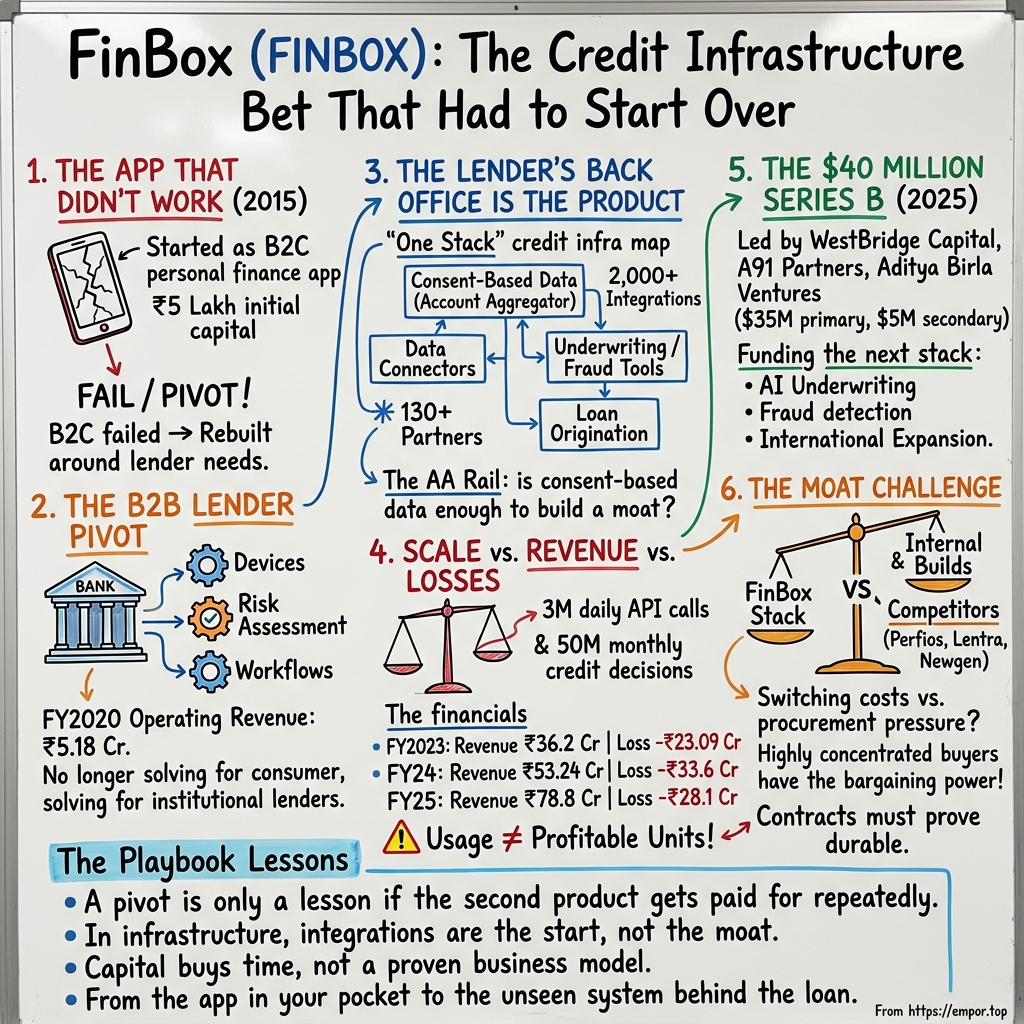
FinBox: The Credit Infrastructure Bet That Had to Start Over
I. $40 Million for the Pipes Behind the Loan
In the middle of September 2025, a Bengaluru company most borrowers have never heard of told the market that it had raised $40 million. FinBox announced a Series B round led by WestBridge Capital, with its existing backers A91 Partners and Aditya Birla Ventures putting in more money alongside, and described the cheque as a mix of new capital and shares changing hands between investors.1
Inc42 reported the split: $35 million of primary capital going into the company, and $5 million of secondary sales by early angel investors who were cashing out part of their stakes.2 For a business that sells software to lenders rather than loans to people, it was a large cheque, and it arrived with a story to match.
The story was told in volume. A week after the announcement, the founders published a letter claiming more than 3 million API calls every day across FinBox's embedded-finance stack, more than 50 million credit decisions a month running through its rules engine, more than ₹20,000 crore disbursed through more than 50 banks and fintech partners, and a network of more than 130 partners and 2,000 integrations.3
Those are the numbers of plumbing. An API call is one computer asking another a question: is this bank statement genuine, what does this borrower's phone say about their spending, does this application pass the lender's rules. Each call is small. Millions of them a day mean that FinBox's code sits inside the moment when a lender says yes or no.
The financial statements tell a smaller and more sobering story. In the year to March 2025, FinBox reported revenue of about ₹78.8 crore, up roughly 48% from the year before, against total expenses of about ₹106.8 crore and a net loss of about ₹28.1 crore.4 Put in dollars, that is a company with roughly $9 million of annual revenue, losing about 36 paise for every rupee it brought in, which had just raised nearly four times its annual revenue in fresh primary capital.
The usage figures and the revenue figures are not measuring the same thing. If every rupee of FY2025 revenue had come from those 3 million daily API calls, which it did not, each call would have earned FinBox well under a rupee. That is the first clue to the economics of this business: the volume is enormous, the price per unit of work is tiny, and the value lies in whether lenders keep paying for the whole system year after year.
The company behind the brand is Moshpit Technologies Private Limited, an unlisted company incorporated in Haryana in 2015, with a wholly owned subsidiary named Aarambh Account Aggregator Services Private Limited.5 FinBox carries the Startup tag on Empor because it has not listed. There is no draft red herring prospectus, red herring prospectus or other offer document for Moshpit on the Securities and Exchange Board of India's public-issues register,6 so there is no price band, no audited three-year restatement prepared for public investors, no risk-factor chapter and no disclosed capitalization table of the kind an IPO forces into the open.
The company has not announced an IPO timetable either. An investor looking at FinBox today is in the position of a public-market analyst handed a company two or three years before it might file: there is no share price to argue with, only a business to understand and a set of private-market signals to read with care.
That makes the task unusual. A listed company's valuation debate starts with the market's verdict and asks whether it is wrong. FinBox's debate has to start with the business itself. The record that exists consists of filings with the Ministry of Corporate Affairs, summarised by data services, a handful of founder interviews, the company's own marketing, and funding announcements. The record is enough to tell a coherent story, and it is enough to identify exactly where that story is still unproven.
The headline claims also come in more than one size. Entrackr's report of the round said FinBox had processed more than $9 billion of loan applications since inception.7 A trade publication covering the company in April 2026 said it had served more than 2 crore individuals.8 The chief executive had told PTI in December 2024 that more than 100 million loans a year were disbursed through FinBox products.9
Each figure describes something different: applications screened, people assessed, loans touched by any FinBox product, loans disbursed through its full stack. None is wrong on its own terms, and together they show a company whose software is genuinely busy. But none of them is a measure of what FinBox earns, and the distance between the activity and the accounts is the distance this story has to travel.
Three questions run through it. The first is whether FinBox found a business model after an early false start, because the company that raised $40 million in 2025 is not the company its founders set out to build in 2015. The second is whether the expanding product stack creates genuine customer lock-in, or whether lenders can swap FinBox out for a rival, a cheaper point solution or their own engineers. The third is whether growth can turn into profit without a parade of further fundraising rounds, each of which dilutes the founders and early holders and resets the clock on proof.
None of these questions can be settled by the size of the cheque. A venture round is a price agreed between a small number of informed insiders, often with protective terms that public shareholders will never receive, and FinBox did not disclose the valuation at which WestBridge invested.2 Usage claims are not contracts, and growth is not cash.
What the Series B does establish is that sophisticated investors, after diligence that outsiders cannot see, decided the business deserved roughly $35 million of new money to build more of its stack. To understand why, and whether they might be wrong, the story has to go back to the moment when the founders learned that their first product was not the business at all.
 Subscribe on LinkedIn
II. The App That Didn't Work
FinBox began as something its customers today would barely recognise. In 2015 Rajat Deshpande took what Business Today later called "the plunge", founding the company with Anant Deshpande, Srijan Nagar and Nikhil Bhawsinka, and the first product was a personal finance app.10 It was meant to sit on a consumer's phone and help them manage money. It did not become the business. Entrepreneur India's account of the company compressed the whole arc into a sentence: from a personal finance app launched in 2015, FinBox pivoted into an end-to-end credit infrastructure and risk intelligence company.11
The founders came to that first product with technical and operating backgrounds rather than banking careers. Rajat Deshpande is an alumnus of IIT Bombay who had worked at Citigroup and at GoPigeon, a logistics start-up, before FinBox.11 Business Today described him as 38 years old in early 2024.10 That profile matters to the later story.
A founding team that understands software and operations, but that came to lending from the outside, is well placed to see where banks' processes are slow and badly stitched together. It is less obviously placed to know which of those problems a bank will pay to solve, at what price, and how long a sales cycle it will tolerate.
The consumer app's failure is a quiet part of the record. The founders have said little in public about how many people used it or why it did not take off, and the company does not publish figures for that period. What is visible is the result. Two dates now coexist in FinBox's own history. The company's registry record and several databases give 2015, the year Moshpit Technologies was incorporated.5
FinBox's own founding letter for the Series B places the start in 2017, when, in the founders' words, "we asked ourselves a simple question" about how lending should work.3 Inc42 likewise reports that the company was founded in 2017.2 The two years between those dates are the gap between the company that existed and the company the founders now consider FinBox. In effect, the business was refounded inside the same legal shell.
The problem the founders turned to was the lender's, not the borrower's. Hundreds of millions of Indians had smartphones, bank accounts and digital payment histories, but thin or empty files at the credit bureaus. A lender that wanted to make small loans to such borrowers faced an information problem: it could not tell the reliable applicants from the risky ones cheaply enough to make a ₹10,000 loan pay.
FinBox's first business-to-business answer was to read signals from the phone itself, with the borrower's permission, and from bank statements. By 2022 banks and digital lenders were using its RiskEngine, DeviceConnect and BankConnect products, according to an Entrepreneur India profile of the company.12 DeviceConnect turned on-device data into a risk score. BankConnect analysed bank statements automatically, so that a lender's credit officer did not have to read them line by line.
The pivot shows up in the accounts as a slow start rather than a sudden take-off. Moshpit reported operating revenue of about ₹5.2 crore in FY2020, three years after the B2B turn, according to MCA-derived history.5 That is a small business by any standard, roughly $700,000 a year at the time, and it shows that the second product also took years to commercialise. The broader shift into lending workflows came afterwards.
In September 2021 FinBox said it had become one of the first companies to go live on India's new Account Aggregator network, through a partnership with Finvu, an RBI-licensed aggregator.13 In 2022 Entrepreneur India described an embedded-finance stack that allowed any brand or platform to become a buy-now-pay-later or credit provider.12 In June 2022 FinBox raised a $15 million round led by A91 Partners, with Flipkart Ventures, Aditya Birla Ventures and Arali Ventures participating.14 Entrackr later called that round the company's Series A.7
The pivot is the strongest single piece of evidence about the founders, and it cuts in two directions. On one side, the team recognised a failing product, did not keep pouring money into it, and rebuilt around a problem that institutions actually have. Many founders do not manage that.
On the other side, the consumer app was a real commercialisation failure, and the B2B products then took several years to reach meaningful revenue. The lesson an investor should draw is about adaptability, not infallibility. The founders proved once that they could abandon a product. They have not yet proved that every product they launch afterwards will find durable, paying demand.
The pivot also changed the shape of the commercial challenge rather than removing it. A consumer app has to win millions of individual users, each of whom can delete it in a second. An infrastructure vendor has to win a few dozen or a few hundred institutions, each of which runs a procurement process, demands security audits, negotiates price and can spread its business across several vendors.
FinBox moved from a problem of attention to a problem of contracts. Product launches, loan volumes processed and partnerships signed are evidence that FinBox can build the technology. They are not, on their own, evidence of recurring revenue. That distinction sits at the centre of what FinBox sells today.
By late 2024 the chief executive was describing the destination plainly. FinBox's focus "for the foreseeable future", he told PTI, would remain on building next-generation lending infrastructure for banks and enterprises, with the aim of becoming the "backbone" for fintech experiences across India and Asia-Pacific, and he spoke of reaching more than $1 billion in originations and of tackling supply-chain finance.9 Those are the ambitions of an infrastructure company, not an app maker. They also widen the field FinBox has to win in, because supply-chain finance and regional expansion bring new buyers, new regulators and new incumbents, each with its own procurement meeting.
III. The Lender's Back Office Becomes the Product
Picture a mid-sized non-bank lender in Pune trying to approve a two-wheeler loan for a delivery rider with no credit card and a thin bureau file. Before the money moves, the lender has to verify who the applicant is, pull whatever bureau data exists, read several months of bank statements, check for fraud, apply its own credit rules, decide on an amount and a price, generate documents, collect consent and signatures, and, if the loan is being originated with a partner such as a bank or a consumer platform, hand data back and forth with that partner in a form both sides' systems understand. Each step used to be a separate vendor, a separate integration or a separate desk of people. FinBox's pitch is that it can sell all of those steps as one stack.
The company's developer documentation describes that stack in layers.15 At the bottom are data connectors: the device-data engine, bank-statement analysis, bureau pulls and Account Aggregator access. Above them sit underwriting and fraud tools, and Sentinel, a business-rules engine that turns a lender's credit policy into automated decisions. Above those sit loan-origination software, which manages an application from first click to disbursal, and an embedded-lending layer that lets a lender offer credit inside someone else's app.
A long catalogue of integrations connects these pieces to bureaus, identity services, e-signature providers, payment rails and lenders' core systems.16 In December 2024 Rajat Deshpande grouped the products the same way in an interview with PTI: data and underwriting products such as DeviceConnect, BankConnect with Account Aggregator, BureauConnect and CollectX on one side, and credit infrastructure such as a no-code credit stack, sales-agent management and Sentinel on the other.9 Earlier that year he had told Business Today that the business had two halves, credit intelligence and infrastructure, the latter including the loan-origination system and embedded finance.10
The design matters because it changes what FinBox can charge for and how hard it is to remove. A data connector is a commodity that a lender can buy from several suppliers and switch with modest effort. A rules engine that encodes the lender's credit policy, sitting inside a loan-origination system that its sales staff and partners use every day, is a different thing. Ripping it out means re-encoding the policy, retraining staff, re-testing every integration and re-running compliance checks, all while keeping loans flowing. The deeper FinBox sits in that workflow, the more it resembles a core system and the less it resembles a vendor of data.
The customers FinBox names are serious institutions. Inc42 listed HDFC Bank, Kotak Mahindra Bank, Poonawalla Fincorp, Aditya Birla Capital, Muthoot Fincorp and Tata Capital among its clients at the time of the Series B.2 FinBox's own press release named the same six.1
In the December 2024 interview, the chief executive said the company had more than six dozen clients across India, Vietnam and Southeast Asia, that its data products handled more than 20 million API calls a month, and that its products had helped disburse more than ₹10,000 crore of loans.9 Those claims establish breadth. They do not establish how much any of those customers pays, which products each one uses, or whether a big name represents a company-wide deployment or a single team's pilot.
A simple piece of arithmetic shows why the distinction matters. If FinBox had about six dozen clients and FY2025 revenue of about ₹78.8 crore, the average client would have paid roughly ₹1 crore a year, a little over $120,000. FinBox and the press began citing about 130 partners in 2025, but that figure does not establish the number of clients or support a client-revenue average. For a large private bank, that amount is a rounding error in its technology budget.
For a small non-bank lender, it is a meaningful contract. A large bank's logo on a slide may represent a modest share of revenue, while a handful of mid-sized lenders and platforms that run their whole origination through FinBox may matter far more. The company does not disclose its revenue by customer, its top-customer concentration, or how many of its clients use more than one product, so the shape of that distribution is unknown.
What does FinBox actually charge for? The plausible answer is a blend. Some revenue is almost certainly usage-linked, with a fee per API call, per bank statement analysed or per credit decision. Some is likely platform or licence fees for the origination and rules software. Some is probably implementation and integration work, the custom engineering needed to plug a stack into a lender's existing systems. These streams behave very differently. Platform fees recur and carry high margins once the software is built.
Usage fees recur too, but move with lending volumes, so they shrink when lenders pull back in a credit downturn. Implementation fees are lumpy, labour-intensive and lower-margin, and can flatter growth in a year of many new deployments without saying much about the following year. FinBox publishes no pricing, and the summaries of its accounts that are available give no split of revenue by type.4 An investor cannot yet tell how much of the ₹78.8 crore is the durable kind.
The same caution applies to the integration count. More than 2,000 integrations and more than 130 partners is a measure of ecosystem reach,3 and in lending, reach matters: a lender that wants to add a new bureau, a new identity check or a new co-lending partner gains if its vendor is already connected to them. But an integration is a connection, not a contract.
The figure says nothing about how many of those connections carry paid traffic, how much each customer spends, or how painful it would be for any given customer to leave. A lender that uses FinBox only for bank-statement analysis can replace it in weeks. A lender that runs its entire origination workflow on FinBox would need months, and might never bother. The integration count cannot distinguish between those two customers.
FinBox has also published striking outcome claims. In December 2024 its chief executive cited, among other metrics, delinquency lower by 22% and approval rates higher by 150% for lenders using its products.9 Claims like these are common in the industry and may well be true for particular customers and particular products.
They are not independently audited, they do not say which customers or which baseline they compare against, and they are not the same as evidence that lenders renew and expand their contracts. A customer whose approval rate really had more than doubled would be expected to spend more with FinBox the following year. Net revenue retention, the measure of how much last year's customers spend this year, is the number that would settle the point, and FinBox has not published it.
The most important single data source in this stack is one FinBox does not own: India's consent-based financial data network. Over the past five years it has become a new rail through which lenders can see a borrower's bank account history with permission. FinBox was early to it, and it gave its subsidiary a name built around it. Whether that early position turns into lasting value is the next part of the story.
IV. Consent-Based Data: A New Rail, Not a Tollbooth Yet
Consider the borrower the Account Aggregator network was designed for: a small shop owner in Indore whose income flows through a savings account and a UPI handle but who has never held a credit card. A lender's app asks for permission to see the last six months of that account. The shop owner taps "approve" on a consent screen.
Within seconds, the bank holding the account sends an encrypted, standardised data packet through a licensed intermediary to the lender, which can read inflows, outflows, balances and bounced payments without asking the borrower to download a PDF statement that might have been doctored. For a lender trying to underwrite people with thin credit files, that is a significant change.
The Reserve Bank of India created this plumbing through its Master Direction for non-bank financial company Account Aggregators, first issued in 2016.17 The design is deliberately narrow. An Account Aggregator is a licensed consent manager. It moves data between financial information providers, such as banks, and financial information users, such as lenders, only with the customer's explicit consent, and it is not allowed to read or store the data for its own commercial use.
The industry body Sahamati counted 17 operational Account Aggregators, 176 financial information providers and 1,076 financial information users live on the network, with more than 2.8 billion accounts enabled and about 295 million monthly data shares as of June 2026.18 The network has moved from experiment to mass infrastructure in five years.
FinBox was early. In September 2021 it said it had become one of the first companies to go live with the Account Aggregator ecosystem, through a partnership with Finvu, and that its stack combined AA data with bureau scores, device data and almost 5,000 other metrics.13
At the time, it said it expected to assess and onboard a million new loan applicants in the following quarter, and to reach another six million borrowers over the year after.13 FinBox did not later report whether it met those targets, which is itself informative: the company's public metrics have tended to move to new and larger measures rather than return to the old ones and report progress against them.
FinBox's corporate structure also carries the mark of this rail. Moshpit's wholly owned subsidiary is called Aarambh Account Aggregator Services.5 The name suggests that the company at least considered becoming a licensed aggregator itself. The subsidiary's financial contribution and regulatory status are not disclosed in FinBox's public materials, and its revenue, costs and intercompany dealings sit inside consolidated accounts that have not been published in detail. For an investor, the existence of the subsidiary raises one diligence question: how much of the group's activity, cost or regulatory exposure sits inside it, and whether a future offer document will show it as a material business or a dormant shell.
The company's current claims for its Account Aggregator products are striking. In its Series B letter, FinBox said its AA-based underwriting improves conversion by 35% and can cut fraud by 45%.3 Those are company figures, without disclosed baselines or independent verification. They are also plausible in direction. Verified bank data does make it harder to submit fake statements, and lenders that can approve thin-file borrowers in minutes rather than days lose fewer applicants along the way.
The difficulty is that a rail is not a tollbooth. The Account Aggregator framework is open by design. Any regulated lender can connect to any of the 17 aggregators, and many data and analytics vendors offer the same consent flows and the same bank-statement parsing. Perfios, the largest Indian player in financial-data analytics, says it serves more than 1,000 financial institutions.19 Banks with large engineering teams can build their own AA integrations. The regulator designed the system so that no single intermediary could capture the data, and so the value of access to it, on its own, tends to be competed down.
Where FinBox can still capture value is in what happens after the data arrives. A lender does not want a raw data packet. It wants a decision, delivered inside its origination workflow, consistent with its credit policy and auditable by its regulator. A vendor that turns AA data into features, scores and automated decisions, and then plugs them straight into the rules engine and origination system the lender already uses, sells something harder to replicate than access. That is FinBox's claimed advantage, and it is a real one in principle. It is also exactly the advantage that Perfios, Lentra, and the lenders' own data-science teams are trying to build.
There is a second, less obvious exposure in this part of the business. FinBox does not lend, but its revenue moves with lending. When the regulator leans against excessive consumer borrowing, lenders slow approvals and the number of applications flowing through underwriting tools falls with them. Rajat Deshpande has described the Reserve Bank as a firm but fair regulator that had been cautioning about over-leverage for some time.20
That is a sensible view for a vendor to hold, and it is also a reminder that usage-linked revenue in credit infrastructure is cyclical. A platform fee paid every year regardless of volume protects FinBox in a downturn; a per-decision fee does not. The company's mix between the two is the hinge on which its resilience in a credit slowdown turns, and it is one of the figures FinBox has not published.
The evidence that would show FinBox has turned this rail into a durable edge is specific: repeat usage of its AA products by the same lenders over several years, renewals at stable or rising prices, measurable improvements in loan performance that customers will vouch for, and a revenue line for these products that grows faster than the volume of free or cheap alternatives. None of those is public.
So the honest framing is that Account Aggregator data strengthens the core of FinBox's offer, an underwriting and decisioning stack, rather than forming a separate business whose size can already be measured. It is a growth vector tied to the main engine, not a second engine. And whether that main engine is turning usage into durable revenue is the question the accounts must answer.
V. From API Calls to Contracts
Imagine the moment that matters most in this business. A lender has spent three months on a pilot with FinBox: a few thousand applications run through its bank-statement analysis and its rules engine, side by side with the old process. The pilot works. Now the lender has to decide whether to move its live lending flows onto FinBox, sign a multi-year contract, and commit its credit team to a new system.
That conversion, from pilot to production and from production to renewal, is where an infrastructure company becomes a business. FinBox's public materials count integrations, API calls and credit decisions. They do not count conversions, renewals or contract values. The accounts are the closest thing to a scoreboard.
They show a fast-growing, loss-making company with a clear three-year arc. In FY2023, FinBox reported revenue of about ₹36.2 crore and a loss of about ₹23.1 crore, according to Inc42's summary of its filings.2 Business Today, citing Tracxn, put that year's loss slightly lower at about ₹20.7 crore,10 a gap that the audited accounts would resolve.
In FY2024, revenue rose about 47% to roughly ₹53.2 crore, and the loss widened to about ₹33.6 crore.2 In FY2025, revenue rose again by about 48% to roughly ₹78.8 crore, while the loss narrowed to about ₹28.1 crore.4 Revenue has more than doubled in two years, while the loss first grew and then shrank.
The best way to read that arc is as a ratio. In FY2023 and FY2024, FinBox lost roughly ₹63 to ₹64 for every ₹100 of revenue. In FY2025 the figure dropped to about ₹36. That is a meaningful improvement in a single year, and it came from the cost side. Total expenses rose by about 23% to roughly ₹106.8 crore while revenue rose by about 48%.4
Put differently, of the roughly ₹25.6 crore of extra revenue FinBox earned in FY2025, about ₹20 crore went into extra costs and about ₹5.5 crore narrowed the loss. That is the first visible sign of operating leverage, the moment when a software company's revenue begins to outrun the cost of building and selling the product.
The arithmetic of that trajectory is worth following one step further, because it frames everything that follows. If revenue kept growing at about 48% a year and expenses at about 23%, FinBox's revenue would reach roughly ₹117 crore in FY2026 against expenses of about ₹131 crore, a loss near ₹15 crore, and roughly ₹173 crore in FY2027 against about ₹162 crore of expenses, a small profit. On that path, the company would cross into profit around FY2027 without needing another rupee of outside capital.
The path is an extrapolation, not a forecast, and the Series B changes the inputs: management raised money specifically to spend more on artificial intelligence, new origination software and international expansion. A company that has just raised nearly four times its annual revenue is unlikely to keep cost growth at 23%. FY2026's accounts, for the year to March 2026, will be the first to show how much of the new capital went into higher spending and whether the loss ratio kept falling. They have not yet been published in any summary.
There are two caveats about the figures themselves. The first is that they come from data services and press summaries of Moshpit's filings with the Ministry of Corporate Affairs, rather than from audited statements reproduced in full. The FY2025 figure of ₹78.8 crore is labelled as total revenue in some summaries, and the MCA-derived registry page separately describes operating revenue growing about 55% in that year,5 which suggests that the line between operating revenue and other income, such as interest on cash balances, is not consistently drawn.
For a company holding investor cash, that line matters, because interest income can make revenue look larger and losses smaller without saying anything about the software business. The second caveat is that the summaries do not show whether the figures are standalone or consolidated with the Aarambh subsidiary.
The bigger gap is the revenue mix. A rupee of subscription revenue from a five-year origination-software contract and a rupee of one-off integration services are worth very different amounts to an investor, because the first will probably recur with high margins and the second may not recur at all. FinBox's public statements describe products and usage, not contract structures. Its accounts, as summarised, do not separate platform fees, usage fees, data products and services. Without that split, a 48% revenue growth rate could describe a company whose recurring base is compounding steadily, or one that had an unusually busy year of implementations.
There is a second test of management's framing hidden in the numbers. In September 2025 Entrackr reported that FinBox claimed to be growing 100% year on year across its product lines.7 The company's reported revenue had grown about 48% in each of the two preceding years.24 The two statements can be reconciled.
Product-level usage can double while revenue grows more slowly if prices fall, if a growing share of activity runs through cheaper products, or if the claim refers to a later period than the last filed year. But the gap is a reminder that "growth across product lines" is a measure of activity, and the accounts are a measure of what customers paid.
The company's other activity metrics have moved in a similar way. In December 2024 FinBox's chief executive said its products had helped disburse more than ₹10,000 crore.9 In September 2025 the founders' letter put the figure at more than ₹20,000 crore.3 By April 2026 a trade publication was describing FinBox as having facilitated ₹30,000 crore in credit origination.8 Cumulative disbursal through FinBox's systems tripled in about 16 months, while annual revenue was growing at about half that pace.
That pattern is consistent with lenders putting more loans through the platform without paying proportionally more for it, which in turn suggests that a large share of FinBox's economic value is captured by the lenders rather than the vendor. It is also consistent with changing definitions of what counts as disbursed "through" FinBox. Neither reading is alarming. Both mean that disbursal volume should not be used as a proxy for revenue.
Cash conversion is the last link in the chain, and the least visible. A software company selling to banks can report revenue long before it collects the cash, through trade receivables and unbilled revenue, and large institutional customers are known for slow payment. It can also capitalise some of its engineering spending onto the balance sheet as software assets, which reduces reported losses while the cash still goes out the door.
FinBox's operating cash flow, receivables ageing and capitalised development are not available in any published summary of its accounts. Total assets were about ₹84.6 crore at the end of FY2025,4 before the Series B money arrived, but how much of that was cash, how much receivables and how much capitalised software is not public. The accounting loss is the visible figure; the cash burn could be larger or smaller.
One more relationship hints at the work still ahead. Inc42 counts about 413 people at FinBox.4 Divided into FY2025 revenue, that is roughly ₹19 lakh of revenue per employee, a little over $20,000. Mature software companies selling to banks typically earn several times that per head, because the code, once written, is sold again and again without adding people. FinBox's low figure is what a company looks like when it is still building products ahead of revenue, still doing a lot of custom implementation work for each customer, or both.
If the platform is becoming more standardised, revenue per employee should climb quickly as new customers are added without matching hires. If it stays low, FinBox may be more of a services business wrapped around software than its pitch suggests. The headcount date and the employee-cost line are not disclosed alongside each other, so the comparison is a direction, not a measurement, but it is the kind of signal that the next set of accounts will make much clearer.
Three numbers would settle most of this. The share of revenue that is contracted and recurring, together with net revenue retention, would show whether customers stay and spend more. Revenue per active customer, or per million API calls, would show whether FinBox can price its usage or whether the volume is being given away. And operating cash flow against the reported loss would show whether growth is funding itself or consuming the capital that WestBridge and others provided.
Until those appear, FinBox's growth is strong and its loss trajectory is improving, but it has not shown that usage converts into a durable, high-quality software model. That uncertainty is sharpest at the point where it meets competition, because a lender that can source the same capability elsewhere has little reason to pay up.
VI. The Moat Has to Survive a Procurement Meeting
The real test of FinBox's position does not happen on a product page. It happens in a conference room at a bank or a large non-bank lender, where a chief technology officer, a chief risk officer, a procurement lead and someone from compliance sit across from a vendor. They ask a sequence of uncomfortable questions. Why this vendor rather than the one we already use for bank-statement analysis?
Why a modular platform rather than a single origination suite from a vendor that has been around for twenty years? Why not have the lender's own engineers build it, now that they have cloud tools and AI coding assistants? And if we sign, how easily can we leave? FinBox's moat, if it has one, is whatever lets it win that meeting repeatedly, and then win the renewal meeting three years later.
The competitive field is best mapped by function, because FinBox competes with different companies at different layers of its stack. In financial-data analytics and underwriting tools, the largest domestic rival is Perfios, which reported operating revenue of about ₹670 crore in FY2025, up about 20%, and a consolidated net profit of about ₹104 crore.19 Perfios says it serves more than 1,000 financial institutions,19 and Business Today reported in March 2026 that it served more than 1,100 across 20 markets.21 Perfios's revenue is more than eight times FinBox's, and it is solidly profitable.
In lending workflow and origination software, the competition includes Lentra, which builds cloud lending platforms for banks and reported revenue of roughly ₹216 crore in FY2025, close to breakeven,22 and Newgen Software, a listed Indian company whose loan-origination and process-automation products are deployed at large banks.
Newgen reported total revenue of about ₹1,640 crore for the year to March 2026, growing about 6%, with a profit of roughly ₹300 crore.23 In lending-market infrastructure, Yubi connects borrowers, lenders and investors across debt products and reported operating revenue of about ₹660 crore in FY2025, with a net loss of about ₹416 crore.24 And in every procurement meeting, the most important competitor is the lender's own technology team.
Set against that field, FinBox is a smaller and more modular challenger. Its FY2025 revenue was about a ninth of Perfios's and about a twentieth of Newgen's. There is no consistent public market-share dataset for Indian lending technology, and any claim about FinBox's rank would be guesswork. What the comparison does show is that the categories FinBox competes in are already populated by larger, profitable or well-funded companies with long customer lists, and that the large banks FinBox names as clients are, almost by definition, also customers of some of those rivals.
The economics of the industry follow from that structure. The buyers are concentrated and powerful. India's large banks and non-bank lenders run formal procurement, can demand price cuts at renewal and can split their business across several vendors to avoid dependence on any one. That limits FinBox's pricing power, especially for products that look like commodities, such as bank-statement parsing or bureau pulls. Supplier power is moderate: FinBox depends on cloud providers, on bureaus, on the Account Aggregator network and on the lenders' own data, none of which it controls.
The chief executive said in 2024 that AWS was the company's cloud provider of choice,9 which is efficient, though it is also a cost that rises with usage. The threat of substitution is real, because a lender can stitch together point solutions or build in-house, and the barriers to entry for any single feature are falling. Against all that, the cost and risk of switching a working system are the strongest forces in FinBox's favour. Lenders are regulated, their systems are audited, and a vendor change in the middle of a lending programme is risky. That inertia is the raw material of a moat.
Hamilton Helmer's framework for durable advantage clarifies what FinBox has and has not yet shown. Switching costs are plausible, for the reasons above: the deeper FinBox sits in a lender's origination and decision workflow, the more painful it is to remove. But switching costs are only a power if they show up in retention and pricing, and FinBox does not publish either. Network effects are unproven. More lenders using FinBox does not obviously make the product better for each one, unless pooled data improves its fraud or risk models, and the company has not demonstrated that, nor would regulators necessarily allow it to pool customer data freely.
Scale economies are not quantified; FinBox is the smaller player against Perfios and Newgen, so if scale matters, it currently works against it. Proprietary data, sometimes called a cornered resource, is limited by the very design of the consent-based data system, which is meant to stop any intermediary from owning the borrower's information. The one power with visible evidence is switching costs, and even that is inferred from the product's architecture rather than shown in customer behaviour.
The customer-count record illustrates how hard it is to measure FinBox's position from outside. In December 2024 the chief executive described more than six dozen clients.9 Nine months later, Entrackr described FinBox as having more than 130 large clients,7 and by May 2026 the company's standard description said it worked with more than 130 banks, non-banks, fintech lenders and large consumer platforms.25 FinBox's own Series B letter used the word "partners" for the 130.3
Moving from about 72 to about 130 in under a year would be remarkable, and might be true. It is more likely that the definition shifted, from paying clients to a broader set of institutions that integrate with or partner with FinBox. The company has not reconciled the two measures. The point is not that one figure is wrong, but that FinBox's headline counts are marketing measures, and an investor would need the audited customer count, revenue by customer and churn to know how many institutions actually pay and stay.
Artificial intelligence belongs in both columns of this ledger. On the favourable side, better models can sharpen fraud detection and credit decisions, and a vendor that sits at the point of decision is well placed to deploy them. FinBox has leaned into this. In May 2026 it launched Atlas, which it described as an AI-native lending-infrastructure suite intended to cut loan processing from three weeks to as little as a day.25
On the unfavourable side, the same technology lowers the cost for rivals to build feature-level competitors, lets bank technology teams build more in-house, and raises customers' expectations, so that capabilities that were differentiating in 2023 become table stakes by 2027. AI improves FinBox's product and erodes its distinctiveness at the same time. Which effect wins depends on whether FinBox's advantage lies in features, which AI commoditises, or in its position inside the workflow, which AI does not easily dislodge.
This brings the story back to the founders' earlier pivot, a genuine strength. But the current platform faces a different test. It has to win procurement meetings against larger and profitable incumbents, convert pilots into production, and then hold its place when contracts come up for renewal.
Product breadth and a long list of integrations make FinBox a credible contender in those meetings. They do not yet show that it wins them more often than it loses, or that it keeps the customers it wins. The 2025 financing was a bet that it can. What that money is meant to buy, and what the round reveals about who owns FinBox, is the next question.
VII. The $40 Million Bet on the Next Stack
The Series B brought a new name onto FinBox's register. WestBridge Capital came in as the incoming investor and lead, while A91 Partners and Aditya Birla Ventures, already on the cap table, put in more.1 IndigoEdge acted as sole financial adviser on the round.1 The structure of the round says more than its headline.
The first thing to separate is primary from secondary capital. The $35 million of primary capital, about ₹306 crore at the exchange rate Inc42 used, went into the company in exchange for newly issued shares, and it is the money FinBox can spend.2 The $5 million secondary went to early angel investors who sold existing shares, and none of it reached the company.2 Secondaries are normal at this stage and are not a bad sign: early backers who have waited years for liquidity sell a slice, and new investors build a larger position.
In October 2025 Venture Intelligence reported, citing Entrepreneur, that IIFL Fintech Fund had made a partial exit from FinBox at about five times its initial investment.26 That return tells a reader that the price per share in 2025 was well above what early investors paid. It does not say what the company as a whole is worth, because the size of the stake sold, the entry price and the date of the original investment are not disclosed, and a small secondary sale can clear at a price that would not hold for the entire company.
FinBox did not disclose the valuation at which WestBridge invested, and none of the reports of the round gave one.27 That absence matters. A private round's valuation is a negotiated price between a small number of informed parties, often for preferred shares carrying liquidation preferences, anti-dilution protections and governance rights that ordinary shareholders do not get. Even when such a valuation is published, it is a price signal, not proof of value, and it cannot be carried straight into a public-market comparison. Here there is no published price to anchor on at all, so any figure for FinBox's equity value has to be built up from the business.
What can be said about ownership is limited but useful. Inc42's analysis of filings shows that, as of July 2025, shortly before the Series B, the founders together held about 48.3% of FinBox, investors held about 40.8%, and the employee stock option pool stood at about 9.4% of total equity, with A91 Emerging Fund II the largest single investor at about 17.6%.27 The founders therefore already held less than half of the company before WestBridge arrived, and a $35 million primary issue at any plausible price pushes that combined stake lower still.
The registry summary of the FY2025 annual return lists 21 shareholders and labels about 97.8% of the shares as "promoter" holdings,5 a classification that does not distinguish founders from venture investors and is not a usable guide to who controls the company. The share classes, liquidation preferences, investor rights and the fully diluted share count after the Series B are not public. They would appear in the filed allotment documents and, eventually, in any offer document, and they will determine how much of a future IPO valuation belongs to ordinary shareholders.
The company's stated uses for the money extend its core rather than diversify away from it. The founders' Series B letter named three priorities: AI-first underwriting and fraud detection, next-generation loan-origination systems, and international expansion.3 The press release framed the same plans as accelerating technology investment, fuelling international expansion and deepening the product offering.1
Each priority has a measurable proof point. AI underwriting should show up as revenue from new decisioning and fraud products. Origination software should show up as larger, longer contracts with existing customers. International expansion should show up as revenue from outside India, where FinBox has said for some time that it has clients in Vietnam and Southeast Asia,9 and where in 2024 it was setting up offices in the Philippines and Vietnam.11
The first of those priorities has already produced a product. In May 2026 FinBox launched Atlas, released in modules beginning with Atlas Flow for borrower onboarding and Atlas Origin for document handling, with credit appraisal, fraud detection and configuration modules still in development.25 FinBox said more than 15 lenders were onboard through co-build, proof-of-concept and deployment programmes, with five institutions implementing it and ten more in pilots or co-builds.25 Executives from HDFC Bank and Muthoot spoke supportively at the launch.25
The company also said it expected AI platforms to contribute 30% of its revenue in FY2027.25 That is the most specific forward commitment FinBox has made in public, and it is a useful one, because it can be checked. It is also ambitious. Five lenders implementing and ten in pilots in May 2026 must become a business worth almost a third of revenue within the following financial year, and the record of the company's earlier products suggests that conversion from pilot to paid production takes time.
There is no material acquisition in FinBox's history to benchmark the capital allocation against, and so no purchase price, goodwill or integration record to judge. The capital record is simpler: about $55 million raised from investors across several rounds since 2019, according to Inc42 and Venture Intelligence,426 of which the June 2022 round and the 2025 primary are the bulk. FinBox has spent the money building products that extend the same stack, and its revenue has grown roughly fifteenfold from FY2020 to FY2025. That is a reasonable allocation record for a venture-funded software company, though not yet a self-funding one.
Management's credibility can be tested in two places. In April 2024 Rajat Deshpande told Entrepreneur India that the company was burning a minimal amount of money because of product-suite expansion, that its runway was comfortably long, and that profitability was on the short-term horizon.11 FY2025, the year that followed, ended with a net loss of about ₹28 crore, smaller than the year before but still about a third of revenue,4 and the company then raised a large round to accelerate spending.
The comment was not a dated commitment, and a company that chooses to invest a new round of capital rather than tip into profit has not necessarily broken its word. But "short-term" has now stretched across at least two financial years, and the most recent fundraising was explicitly about spending more, not less.
The second test is continuity of leadership. In April 2026, about seven months after the Series B, co-founder and chief operating officer Anant Deshpande announced on LinkedIn that he was stepping down, saying he would take a short pause to reflect and reset, without naming his next move.8 FinBox's leadership page continues to show Rajat Deshpande as chief executive and co-founder, alongside co-founders Srijan Nagar and Nikhil Bhawsinka.28 One founder leaving after a decade is not unusual and need not signal trouble.
It does mean that one of the four people who built FinBox through the pivot is no longer running its operations, at the moment the company is trying to deploy its largest round and launch a new product family. Founder pay, the incentive terms attached to the founders' and executives' equity, and the composition of the board are not public. A future offer document would have to disclose them, and they will shape how aligned management is with the ordinary shareholders who would buy in at an IPO.
The Series B, then, bought FinBox time and capability. At its FY2025 loss rate, the primary capital alone would cover about a decade of losses, though the company is spending to grow rather than standing still, and the accounting loss is not the same as cash burn. What the round did not buy is proof. Whether that time is enough depends on what kind of company FinBox becomes with it.
VIII. Analysis & Bear vs. Bull Case
Somewhere this quarter, a lender that has run a FinBox pilot in one product line, perhaps small-business loans originated through a consumer platform, is deciding whether to extend it to gold loans, two-wheeler finance and its branch network. At the same time, FinBox is deciding how fast to hire, how many Atlas modules to finish, and how much to spend opening Southeast Asian markets before revenue arrives. Those two decisions, repeated across dozens of customers, will decide whether FinBox becomes a durable credit-infrastructure company or a well-funded vendor that never quite earns its cost of capital.
The case in FinBox's favour starts with the problem and the breadth of its stack. Revenue grew by about half each year for two years, while its loss ratio fell sharply in FY2025.24 If its products are embedded deeply enough, each new product sold into an existing customer is cheaper to sell than winning a new logo, which is how infrastructure companies compound.
The case against starts with the same customers. Large banks and non-bank lenders have bargaining power, multi-vendor procurement and capable in-house teams, and FinBox does not disclose customer concentration, win rates, churn or price trends. Its rivals in each layer are larger and in several cases profitable, and the most valuable of them, Perfios, has more than eight times FinBox's revenue.19 Disbursal volumes have grown faster than revenue, suggesting that much of the value created by FinBox's systems flows to lenders rather than to FinBox.
The founders' record cuts both ways. Their earlier pivot showed a willingness to abandon a failing product, but also how hard and slow commercialisation can be. Atlas and international expansion are still unproven bets.
Liquidity and funding deserve a sentence of their own, because they are easy to misread. The Series B was an equity raise, and equity rounds do not establish that a company has no debt, no lease obligations and a long runway. FinBox's borrowings, leases, cash balance and operating cash flow are not public. The size of the primary raise relative to the FY2025 loss makes a near-term funding crunch unlikely, but that is an inference from the scale of the numbers, not a disclosed fact.
A skeptical public-market investor would push the argument one step further. Suppose revenue per customer stays flat, retention turns out to be ordinary and the loss ratio stops falling as Series B spending ramps up. What evidence, at that point, would justify continuing to spend? The honest answer is that FinBox would be left with a narrative of usage, integrations and AI, without the economics to support a premium valuation. That is the scenario the next two years of filings need to rule out.
What the business might be worth
Without a disclosed valuation or share price, the most useful exercise is to ask what FinBox would have to become to justify different values, and to compare that with the businesses already priced. A simple scenario framework, built on FY2025 revenue of about ₹78.8 crore, shows the range.
In a central case, revenue compounds at about 35% a year for five years, slower than the recent 48% because growth rates fall as companies get larger, reaching roughly ₹350 crore by FY2030. If FinBox can then earn an operating margin of about 20%, in line with mature Indian lending-software businesses, and pays tax at about a quarter of profit, it would generate something over ₹50 crore of annual profit. At an earnings multiple of around 20, roughly where profitable, slower-growing Indian software companies have traded, the business would be worth about ₹1,000 crore to ₹1,100 crore in FY2030.
Discounted back to today at a venture-appropriate rate of 15% to 18% a year, and adjusted for further employee-option dilution, that is worth roughly ₹500 crore to ₹600 crore now, plus whatever net cash remains from the Series B. In a stronger case, growth of about 45% a year takes revenue past ₹500 crore by FY2030, margins reach 25%, and the present value roughly doubles. In a weaker case, growth slows to about 20%, revenue reaches only about ₹200 crore, margins stall around 10%, and the operating business is worth a few hundred crore at most, which means most of the company's value would be its cash.
These figures are not a valuation of FinBox. They are a map of sensitivities, and the most sensitive input is not growth but margin: the difference between a 10% and a 25% eventual margin is larger than the difference between 35% and 45% growth. Margin is exactly the variable the public record says least about, because FinBox's revenue mix, gross margin and cost structure are not disclosed.
The comparable companies sharpen the picture without settling it. Perfios is the nearest operating peer by business model. When it raised $80 million from Teachers' Venture Growth in 2024 at a valuation reported as above $1 billion,19 its previous year's revenue was about ₹558 crore, or roughly $67 million, which implies a private equity value of around 15 times trailing revenue for a profitable, larger and slower-growing company. Yubi reached a unicorn valuation while losing heavily, which says more about the funding climate of the time than about its economics.24
Newgen is a profitable listed origination-software vendor, but its growth has slowed to single digits.23 Those three are different kinds of benchmark. Perfios is a direct peer priced privately, Yubi is a category neighbour priced in a different market, and Newgen is a listed incumbent whose multiple reflects slow growth. None of their multiples can be lifted onto FinBox, because Perfios's private value includes preferred-share protections, Newgen's market value is for common shares in a listed, profitable company, and FinBox is smaller, loss-making and less disclosed than either.
Reconciling the two views gives a clear conclusion about what any eventual price would embed. A valuation for FinBox at the top of these ranges would assume that revenue keeps growing at 40% or more for several years, that most of it is recurring, that net retention is well above 100%, and that the company reaches margins similar to the best Indian software businesses.
A valuation near the bottom assumes FinBox remains a useful but replaceable vendor. Private investors may well have paid somewhere in the middle or above it. A future IPO market might price FinBox above any central range, because scarce listed exposure to Indian fintech infrastructure, strong narratives about AI and small free floats can push prices up regardless of fundamentals. That is pricing, not value.
Three signals will move FinBox from one end of this range to the other: recurring revenue and retention, receivables and cash conversion, and the loss trajectory against revenue growth and Series B spending. Together, they would show whether customers stay and spend more, reported revenue turns into cash, and operating leverage survives the new investment. The bull case has a real problem, real growth and real backing. The bear case has equal weight: losses, unproven recurring economics, powerful buyers, multi-vendor alternatives and unverified retention. The case turns on whether FinBox can convert activity into retained, profitable revenue.
IX. Playbook: Business & Investing Lessons
The first lesson goes back to the pivot from the personal finance app. That decision is the most admired moment in FinBox's story, and rightly so, because most teams cling to their first idea for too long. But the pivot was not the achievement. The achievement, if it comes, will be that the second product earns money from the same customers year after year.
The second product took several years to reach meaningful revenue, and FinBox was still losing money in FY2025, nearly a decade after its incorporation. A pivot is only a lesson if the second product gets paid for repeatedly. Founders who celebrate the turn and investors who reward it should both look past the change of direction to the evidence that the new direction pays.
The second lesson lives in the number FinBox most likes to quote: more than 2,000 integrations. As the earlier discussion showed, a long catalogue makes a vendor more useful, but an integration is a door, not a wall. It lets a customer in; it does not keep a customer from leaving.
The FinBox record is a case study in the gap between connection and lock-in: a growing list of integrations, partners and clients, alongside no public disclosure of renewal rates, net revenue retention or customer concentration. In infrastructure, integrations are a beginning, not a moat. The moat is the evidence that customers who integrated three years ago are paying more today.
The third lesson is about counting. FinBox's headline measures have changed over time rather than forming a consistent series. Each figure was impressive, and each was a new measure rather than an update of the last one.
Meanwhile, the one measure that every investor can compare across years, audited revenue, grew steadily but more slowly than the activity figures. Usage is what the customer gets; revenue is what the vendor keeps. When the two grow at different speeds, the difference is someone else's value.
The fourth lesson belongs to the September 2025 Series B, raised while FinBox was still loss-making. The round gave the company years of runway and the resources to build Atlas, chase international customers and hire. It also shows how easy it is to mistake a financing for a verdict.
WestBridge and the existing investors made an informed bet, but they made it at a price nobody outside the room knows, on terms nobody outside the room has seen, and they will be judged by the same accounts as everyone else. Capital buys time to prove the model; it does not prove the model.
There is a quieter fifth lesson in FinBox's two birthdays. The registry dates the company to its incorporation; the founders' letter dates its story to the beginning of the lending business. Neither date is false. But a company that dates its story from the pivot is choosing which history counts, and investors should always ask for the other one, because the abandoned years explain both the team's resilience and how long the second product took to pay. A company's founding date tells you when the legal entity began; the story it chooses to tell tells you which failure it has learned from.
What ties these lessons together is that they are all about FinBox specifically, not about fintech in general. Technical breadth matters only if lenders renew. Usage matters only if it is priced. Funding matters only if it is converted into economics that would have attracted the money in the first place. FinBox has done the hard part of building a product lenders use. It has not yet shown that it has built a business that lenders cannot easily leave.
X. Epilogue
Tonight FinBox is a private company with roughly 400 employees,4 a Series B balance sheet, a new AI product family that the company says has reached a few lenders, and one fewer founder than it had a year ago. Its last published accounts are for a year that ended in March 2025, before the Series B money arrived. Everything that has happened since, the new capital, the Atlas launch, the push into Southeast Asia, the change in leadership, is still waiting to show up in audited numbers.
The next moment that matters is the filing of the FY2026 accounts with the Ministry of Corporate Affairs. They will show whether revenue kept growing at about half again each year, and whether the loss ratio kept falling from the ₹36 per ₹100 of FY2025 or rose again as Series B spending began. If the loss ratio continued to fall while revenue grew, the FY2027 profit path implied by FY2025's operating leverage would still be alive. If it rose sharply, the company will have chosen growth over profit for at least another two years, and its value will depend more heavily on the AI and international bets paying off.
The FY2027 year, which runs to March 2027, carries FinBox's most concrete public promise: that AI platforms would contribute 30% of revenue.25 By the time those accounts are filed, investors will be able to see whether Atlas moved from five implementing lenders to a business worth almost a third of revenue, or whether it followed the slower path of FinBox's earlier products, where pilots and launches took years to turn into material revenue. A miss would not be fatal, but it would test management's forecasting the way FY2025's loss tested the 2024 comment about short-term profitability.
The disclosures that would settle the underwriting are mostly ones FinBox has never made. Audited standalone and consolidated statements would show how much of the business sits in the Aarambh subsidiary, how large receivables and unbilled revenue have grown, how much engineering spending has been capitalised, and whether operating cash flow is better or worse than the reported loss. A split of revenue between platform fees, usage and services would show how much of it recurs.
Customer concentration and retention figures would show whether FinBox's position inside lenders' workflows is as sticky as the product design suggests. And the filed allotment and annual-return documents would show who owns the company after the Series B, on what terms, and how much of a future IPO would belong to ordinary shareholders rather than to preferred investors with protections.
Two other threads will run through the same period. The first is geography. FinBox has spoken of clients in Vietnam and Southeast Asia since at least 2024,9 and its Series B was explicitly meant to fuel international expansion. Overseas revenue would test whether the stack travels, because each new market brings a different credit-bureau system, different data rules and a different set of local incumbents. If FinBox can show a meaningful and growing share of revenue from outside India within two or three years, it would strengthen the case that its product is a platform rather than a set of integrations tuned to one country. If international remains a line in the investor letter, the money spent on it will have bought optionality at best.
The second thread is people. With one co-founder gone and a large round to deploy, the composition of FinBox's senior team, and whether it adds an experienced finance chief and independent directors of the kind a listed company needs, will say a good deal about how seriously it is preparing for public scrutiny. A company does not need to announce an IPO to start behaving like one; it shows up in the quality of its filings, the timeliness of its accounts and the consistency of its public metrics.
Any eventual offer document would force all of this into the open at once. It would show the offer's split between a fresh issue and an offer for sale, which would reveal how much money goes to the company and how much to selling investors. It would carry formal risk factors, litigation and contingent-liability disclosures, and the accounting policies behind the revenue line. None of that exists yet, and its absence is not evidence of a clean record. It is simply the gap a future filing would have to fill.
The central tension remains where it began. The Series B bought FinBox the capacity to build more of the lending stack. The next chapter has to show that lenders will keep buying it.
XI. Outro
A decade later, almost nobody who borrows through FinBox's systems knows the company exists. Its code works behind the scenes, without a logo on the screen.
That is the strange inversion at the heart of this company. Whether the machinery becomes a lasting business, one that lenders keep paying for long after the integrations are finished and the pilots have ended, is still the story. FinBox stopped trying to be the app in your pocket; now it wants to be the system behind the loan.
References
-
FinBox raises $40M Series B led by WestBridge to scale AI-driven credit infrastructure from India to the world — FinBox, 2025-09-17 ↩↩↩↩↩
-
FinBox Raises $40 Mn To Scale B2B Credit Infrastructure — Inc42, 2025-09-17 ↩↩↩↩↩↩↩↩↩↩↩
-
FinBox's next chapter: $40M in Series B to redefine the future of lending — FinBox, 2025-09-24 ↩↩↩↩↩↩↩
-
Moshpit Technologies Private Limited filing index — QorpIQ ↩↩↩↩↩↩
-
Public Issues filings — Securities and Exchange Board of India ↩
-
FinBox raises $40 Mn in Series B round led by WestBridge — Entrackr, 2025-09-17 ↩↩↩↩↩
-
FinBox co-founder & COO Anant Deshpande steps down — The Head and Tale, 2026-04-23 ↩↩↩
-
Aim to become 'backbone' for innovative fintech experiences across India, APAC: FinBox CEO — The Week/PTI, 2024-12-09 ↩↩↩↩↩↩↩↩↩↩
-
India's coolest start-ups: How FinBox is looking to dominate the credit infra space — Business Today, 2024-01-12 ↩↩↩↩
-
The Credit Infra Partner — Entrepreneur India, 2024-04-20 ↩↩↩↩
-
Providing Out-of-the-Box Solutions — Entrepreneur India, 2022-04-12 ↩↩
-
FinBox launches Account Aggregator enabled digital lending — Free Press Journal, 2021-09-21 ↩↩↩
-
Spark Financial Holdings advises FinBox on its USD 15 Mn equity round — Spark Capital, 2022-06 ↩
-
What is FinBox Credit Stack? — FinBox Developer Documentation ↩
-
Master Direction – Non-Banking Financial Company – Account Aggregator (Reserve Bank) Directions, 2016 — Reserve Bank of India ↩
-
Perfios FY25: Profit Soars 46% To ₹104 Cr, Revenue Crosses ₹700 Cr — Inc42, 2026-03-21 ↩↩↩↩↩
-
RBI is a firm but fair regulator, has been cautioning about over-leverage for a while: Rajat Deshpande, FinBox — The Economic Times ↩
-
Perfios' Path to Building a Global Decision-Making Platform — Business Today, 2026-03-12 ↩
-
Newgen Software FY26 Profit Down 4.65% Despite Revenue Growth; Auditors Reappointed — Whalesbook, 2026 ↩↩
-
Yubi records Rs 660 Cr revenue in FY25; adjusted EBITDA improves 55% — Entrackr, 2025-10-24 ↩↩
-
FinBox launches AI platform Atlas helping customers secure loans in 24 hours — The Week/PTI, 2026-05-14 ↩↩↩↩↩↩↩
-
IIFL Fintech Fund makes 5x returns from partial exit in credit infra platform FinBox — Venture Intelligence, 2025-10-07 ↩↩
 LinkedIn
 WhatsApp
 Reddit
 Hacker News
 Email
 Kindle
 RSS Feed
 Spotify
 Apple Podcasts
 Amazon Music
 Audible
 YouTube