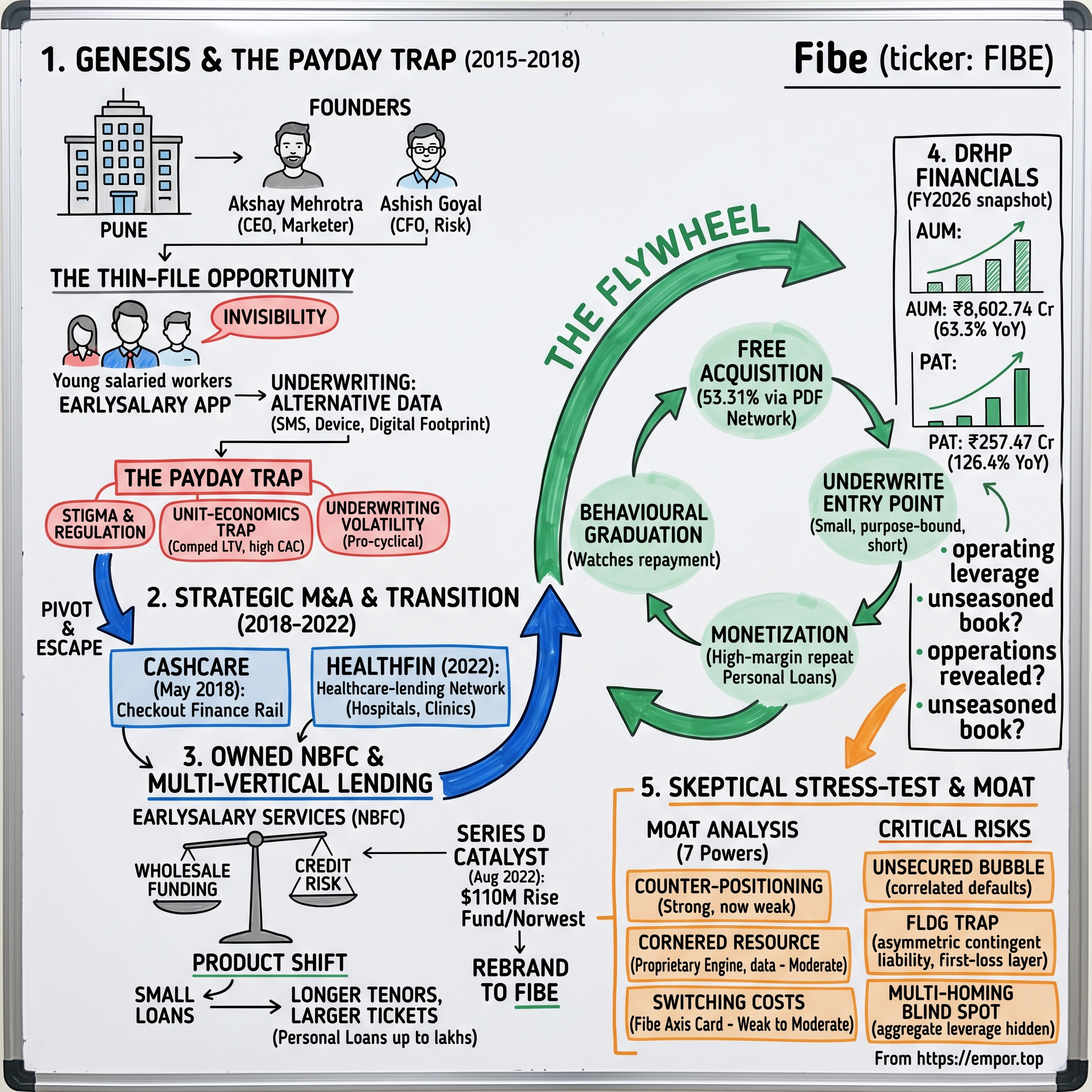
Fibe: The Anatomy of a Fintech Flywheel
I. Introduction & Episode Roadmap (10 Minutes)
The hook. Consider the arithmetic that the DRHP makes public. In FY2026 (the year ended 31 March 2026), Fibe disbursed ₹15,737.96 crore of loans — more than its entire ending loan book — while carrying provisions and write-offs that consumed roughly a tenth of its average assets, and still delivered a profit after tax of ₹257.47 crore, up 126.4% year on year.35 A traditional bank does not look like this. A traditional bank earns a net interest margin of two to three percent, loses well under 1.5% of its book to bad debt, and grows its balance sheet in the mid-teens. Fibe earns a margin in the high teens, loses close to a tenth of its book, and grew its assets 63% in a single year. It is a fundamentally different animal, and the whole investment question is whether that animal is a compounding machine or a treadmill that only looks fast because it is running downhill.
The paradigm shift. The company began in 2015 as EarlySalary, a payday-style "salary advance" app — the exact product category that would, within a few years, attract the sharpest regulatory and cultural hostility in Indian consumer finance. Rather than defend that positioning, the founders spent the next seven years dismantling it: buying a checkout-finance rail, buying a healthcare-lending network, lengthening loan tenures, and in 2022 rebranding entirely to Fibe — a coinage meant to evoke "finance" and "vibe" and to bury the word "payday." The result, by FY2026, was an ₹8,602.74 crore assets-under-management (AUM) platform.4
The "zero-CAC" flywheel. The core of management's story — and the reason this is an interesting business rather than just another balance-sheet lender — is a claim about distribution. Fibe says it acquires a majority of its new customers at effectively zero marketing cost, by embedding point-of-sale financing (which it brands "Purpose-Driven Financing," or PDF) inside schools, hospitals, insurance sales, and merchant checkouts, and then monetizing those customers through higher-margin, repeat, direct-to-consumer personal loans delivered through its own app. If that flywheel is real and durable, it is a genuine cost advantage. If it is mostly a story layered on top of ordinary digital lending, it is not. Separating the two is most of the work ahead.
Roadmap. This story proceeds in the order the business was built: the payday origins and their unit-economics trap (2015–2018); the two acquisitions and the pivot to multi-vertical, medium-tenor lending (2018–2022); the rebrand and the architecture of the flywheel; the DRHP financials; the high-yield/high-credit-cost model that sits underneath them; the competitive landscape and the moat, tested against Hamilton Helmer's 7 Powers and Porter's Five Forces; management and capital allocation; the skeptical investor's stress test; and finally what a public-market owner should watch after the listing. Prices — the last private mark, the eventual IPO band — appear throughout, but always as observations about what someone was willing to pay, never as the answer to what the business is worth.
 Subscribe on LinkedIn
II. The Genesis of EarlySalary & The Payday Trap (2015–2018) (15 Minutes)
The founders. EarlySalary was founded in Pune in 2015 by Akshay Mehrotra and Ashish Goyal.4 Neither was a stereotypical fintech outsider hacking at a problem from a garage; both were corporate-trained financial-services professionals — Mehrotra with a consumer-marketing and financial-services background, Goyal with a credit and risk background — and that pedigree shows up later in how the company managed its credit engine and its regulator relationships. Mehrotra took the chief-executive seat (today MD & Group CEO); Goyal ran finance and risk (today Group CFO, described in the filing materials as Chairperson & Group CFO).6 The founder profile matters for underwriting because it predicts behaviour: a marketer-plus-risk-officer pairing tends to grow aggressively but instrument the book carefully, which is roughly what the history shows.
The 2015 market context. The opportunity they attacked was real and specific. India's formal banking system — HDFC, ICICI, State Bank of India — was structurally uninterested in a 24-year-old earning ₹20,000–₹40,000 a month with under two years of employment history. The economics simply did not work: a physical branch cannot profitably underwrite and service a ₹15,000 loan, and the national credit bureau (CIBIL) had little or no repayment history on a first-job salaried worker, so the borrower was "thin-file" and therefore, to a legacy underwriter, unscoreable. Tens of millions of young, salaried, urban Indians were creditworthy in reality and invisible on paper. That gap is the founding insight, and it is a good one.
The early product. EarlySalary's answer was a mobile app offering short-term salary-advance loans — small tickets, roughly ₹10,000 to ₹50,000, for tenures of ten to thirty days, priced to be repaid on the next payday. It solved the invisibility problem by underwriting on alternative data: with the borrower's consent, the app read signals such as SMS transaction logs, device and app data, and basic digital footprints, and turned them into a score where the bureau had nothing to say.
The trap. The problem is that the payday model, however clever technically, is a poor business at its core, and it is worth being precise about why, because the entire subsequent strategy is an escape from these three traps.
First, stigma and regulation. When you annualize a fee on a fifteen-day loan, the implied annual percentage rate looks enormous, even if the rupee cost to the borrower is modest. Across the broader Indian "instant loan app" industry, that optics problem combined with genuinely abusive players — coercive recovery, data misuse, opaque pricing — to trigger intense scrutiny from the Reserve Bank of India (RBI), which by the early 2020s was moving toward hard digital-lending guidelines. Being adjacent to that category was a permanent reputational and regulatory liability.
Second, the unit-economics trap. This is the deepest one. If it costs you a fixed amount to acquire and underwrite a customer, and the loan is tiny and lasts two weeks, you simply cannot earn back the acquisition cost before the relationship ends. Lifetime value was compressed into a single short, small transaction, while customer-acquisition cost (CAC) was paid up front in full. Payday lending is a business where you win only if the customer comes back many times — and a well-run consumer lender does not actually want a customer who needs to borrow against their salary every single month.
Third, the underwriting problem. Scoring off SMS logs and social signals is fragile. Those signals are noisy, gameable, and — critically — pro-cyclical: they look fine until a labour-market wobble hits exactly the thin-file, early-career borrowers the model targets, at which point defaults move together. The early book was therefore volatile in a way that made cost of funds expensive and scale dangerous.
The founders clearly understood all three. Everything that follows — longer tenors, embedded distribution, an owned NBFC, proprietary scoring trained across cycles — is a systematic attempt to convert a structurally bad payday business into a structurally better multi-product consumer-credit business. Whether they fully succeeded is the question of Sections V and VI. That they correctly diagnosed the disease is not in doubt.
III. Strategic M&A and the Transition to Multi-Vertical Lending (2018–2022) (20 Minutes)
If the 2015–2018 period was about proving that thin-file young Indians could be underwritten at all, the 2018–2022 period was about escaping the payday trap through two acquisitions and one structural decision — building and capitalizing an owned non-banking financial company (NBFC).
Inflection point one — CashCare (May 2018). EarlySalary's first meaningful acquisition was CashCare, an early consumer checkout-finance platform. The strategic logic is more important than the deal, whose price was not disclosed in the public record. Until then, EarlySalary's product was cash: money landed in the borrower's bank account, and the company had no view of, or claim on, what the money was spent on. CashCare's technology let the company move upstream, to the point of sale — to embed a financing option directly at a merchant's checkout, so that the credit decision happened at the exact moment of a purchase. This is the seed of what Fibe now calls Purpose-Driven Financing and of its buy-now-pay-later and checkout-EMI capabilities.
Why does an embedded rail matter so much? Two reasons an underwriter should weigh. First, distribution: a merchant checkout is a place where customers arrive already, for free, with a concrete purchase in hand — the antithesis of buying clicks on Google and Meta. Second, credit quality: a loan tied to a specific, purpose-bound transaction (a school fee, a hospital bill) tends to behave better than an open-ended cash advance, because the borrower's intent is legible and the use is non-discretionary. Buying that rail rather than building it was capital-efficient, and it is the clearest early example of the management team choosing a distribution asset over a marketing spend.
The expanding horizon. In parallel, the product itself lengthened and grew. The company shifted from 30-day payday advances toward three-to-twenty-four-month personal loans of up to several lakh rupees. This single change quietly repaired the unit-economics trap described earlier: a larger ticket amortized the fixed acquisition and underwriting cost over a longer, more valuable relationship, and a multi-month tenor let the company earn a net interest margin rather than a one-time fee. The business was no longer payday; it was becoming a young-India personal-loan franchise with a checkout side door.
Inflection point two — HealthFin (2022). The second acquisition, HealthFin, extended the embedded-finance idea into healthcare, a category that in India is a leading cause of unplanned unsecured borrowing because so much of it is paid out of pocket. HealthFin brought pre-built integrations with hospitals and clinics, letting Fibe offer no-cost or low-cost EMIs for elective and urgent procedures — dental work, fertility treatment, surgeries. Strategically this is the same move as CashCare, applied to a vertical with high average tickets and genuine emotional urgency, which tends to produce motivated, reliable repayers.
The structural decision — an owned NBFC. Underneath both acquisitions sits the decision that makes Fibe a balance-sheet business rather than a pure marketplace: it lends substantially through its own wholly owned NBFC, EarlySalary Services Private Limited (ESPL). Owning the NBFC means Fibe earns the full spread on the loans it keeps on its own book, but it also means Fibe carries the credit risk and must continuously raise wholesale funding to grow — the double-edged fact that dominates the financial analysis later. It is worth pausing on why this choice matters more than any single acquisition. A pure lending marketplace — one that only originates loans and passes them entirely to banks for a fee — is capital-light and low-risk but also low-margin and easily disintermediated; the bank can always decide to originate for itself. By keeping a regulated NBFC and holding a large share of loans on its own book, Fibe captured the full economics and built a defensible asset, at the cost of taking on the twin burdens that define its risk profile: it must hold regulatory capital against its book (so growth is gated by equity), and it must fund that book in wholesale markets (so growth is gated by funding access and cost). Every strategic tension in the rest of this story — the need to keep raising equity, the sensitivity to rate cycles, the reliance on co-lending to stretch the balance sheet — flows from this one decision to be a principal lender rather than a mere marketplace.
Reading the M&A record as evidence. Because both acquisitions are now years in the past, they can be judged on results rather than promises, which is the fairest way to assess a management team's capital allocation. The test is simple: did the acquired capability become load-bearing, or was it quietly written down and forgotten? On the available evidence, CashCare's checkout-finance rail is visibly the ancestor of the PDF engine that supplies more than half of Fibe's new customers, and HealthFin's hospital integrations are visibly present in the healthcare vertical of that same engine. Neither was a diversification into an unrelated business; each bought a specific distribution primitive that Fibe then scaled inside its core model. That is the pattern of disciplined, strategy-serving M&A, and it stands in contrast to the trophy acquisitions and category-hopping that destroyed value at several peers in the same era.
The Series D catalyst (August 2022). Capitalizing that NBFC is expensive, and in August 2022 the company raised a $110 million Series D co-led by TPG's The Rise Fund and Norwest Venture Partners.[^7] This was the round that funded balance-sheet expansion and, not incidentally, the round announced simultaneously with the rebrand to Fibe. For an equity holder, the substance is that a large slug of primary capital went into ESPL's net worth so it could support a bigger loan book at a regulated leverage ratio — growth capital for a lender is not optional fuel, it is the whole engine, because you cannot grow AUM faster than you can grow the equity underneath it.
IV. The Rebrand & The Architecture of the Zero-CAC Flywheel (25 Minutes)
The 2022 pivot. The rename from EarlySalary to Fibe, announced alongside the Series D in August 2022, was more than cosmetics.[^7] "EarlySalary" is a description of a payday product; "Fibe" (finance + vibe) is deliberately generic, aspirational, and detached from any single loan type. Rebrands are cheap to announce and easy to dismiss, but this one had a concrete strategic purpose: to let the company sell education loans to parents, healthcare EMIs to patients, and personal loans to young professionals under one non-stigmatized banner, and to distance itself from an "instant loan app" category that the RBI was actively cleaning up. As reputational risk management ahead of a regulatory crackdown, the timing was shrewd.
The dual-engine architecture. By FY2026 the book resolved into two engines. Personal loans — direct-to-consumer cash loans through the Fibe app — made up roughly 77.4% of AUM and are the high-yield, high-margin profit engine. Purpose-Driven Financing — the embedded, point-of-transaction checkout book across education, healthcare, insurance premiums, travel, and residential solar — made up roughly 22.6% of AUM.4 The mix is the key to reading the flywheel: PDF is not the profit centre; it is the acquisition centre. The money is made on the personal-loan side; the customers are found on the PDF side.
The genius of the flywheel — and where to be skeptical. Management's flywheel has four steps, and it is worth stating them precisely and then interrogating each.
Step one — free acquisition. In FY2026, Fibe reports that 53.31% of its new customers were acquired at zero marketing cost through its merchant-embedded PDF network of over 10,387 touchpoints — schools, hospitals, insurance and solar sellers.4 The claim is credible in kind: a parent financing a school fee at the school's own portal genuinely does not cost Fibe a Google click. The number to hold lightly is "zero." There is no such thing as a free channel; PDF has real costs — merchant integration, partner revenue-share, subvention economics on no-cost EMIs, and the credit losses on the PDF book itself. "Zero-CAC" is a marketing shorthand for "we substitute merchant partnerships for paid ads," which is a real and valuable substitution, not literal zero.
Step two — underwriting the low-risk entry point. Fibe scores these point-of-sale borrowers with its proprietary, automated engine. The entry loan is small, purpose-bound, and short — a good place to learn whether a new, thin-file customer repays, at low dollar risk.
Step three — behavioural graduation. Having watched a customer repay a school-fee or hospital EMI, Fibe pre-approves the reliable ones for larger, higher-margin personal loans through the app. This is the actual monetization, and it is the economically clever part: the PDF loan is not just revenue, it is a cheap, behaviour-based credit test that de-risks the far larger personal loan that follows.
Step four — the compounding. Fibe reports that over 61% of personal-loan volume in FY2026 came from existing customers.4 If accurate and durable, that is the crux of the whole thesis: it means the majority of the profit engine is fed by customers the company already acquired cheaply, so the marginal personal loan carries almost no acquisition cost and the operating leverage is real.
The economic advantage management claims is straightforward: where a pure digital lender might spend on the order of ₹2,000–₹4,000 in performance marketing to acquire a single personal-loan customer, Fibe claims to acquire many of them for the cost of a merchant integration it has already built. The underwriter's caveat is equally straightforward. A flywheel is only as strong as its stickiest number, and in unsecured consumer credit the stickiness is suspect: the "61% repeat" figure is a snapshot, not a guarantee of retention, and consumer-lending loyalty is notoriously price-sensitive — a borrower will refinance to a rival app for a lower rate with a few taps. The flywheel lowers acquisition cost; it does not obviously lower churn or pricing power, which is why Section VII rates the switching-cost "power" as weak. Still, on the evidence, the acquisition-cost advantage is the most defensible thing about the business, and it is the single fact a bull case must lean on.
Rather than reduce this to a diagram, hold it as a sentence: purpose-bound merchant loans buy the customer and test their credit for almost nothing; the app-based personal loan monetizes the ones who pass; and the profits recapitalize the NBFC and lower the cost of funds, which lets the whole thing turn again at larger scale.
The verticals, and why each was chosen. The PDF book is not one product but a portfolio of embedded-finance verticals, each selected for a specific credit or distribution property. Education — school and college fees, plus upskilling courses — is attractive because a parent paying a child's tuition is close to the most motivated repayer in consumer credit; the social cost of default is high, the purpose is non-discretionary, and the merchant (the institution) has its own incentive to make financing frictionless. Healthcare — the HealthFin lineage — offers high tickets, genuine urgency, and a captive point of sale at the hospital or clinic. Insurance financing lets a customer spread a lump-sum annual premium into monthly instalments, a use case with predictable cash needs and a natural annual renewal cadence. Solar rooftop financing rides India's residential-solar push and brings larger, longer-dated tickets. The common thread is that each vertical is a place where a real purchase is already happening, the amount is known, and the borrower's intent is legible — which is precisely what makes the entry loan cheap to acquire and, in theory, better-behaved than an open-ended cash advance. The risk hidden in this portfolio is concentration of a different kind: no-cost EMIs depend on merchant subvention economics that can compress if merchants push back, and solar and insurance are newer, thinner books whose loss behaviour is not yet proven across a cycle.
The reachable market, held with restraint. It is tempting to size Fibe against the entirety of Indian unsecured retail credit — a market measured in tens of lakh crore and growing fast — and call the runway infinite. That is a category TAM, not a reachable market. Fibe's serviceable market is narrower and defined by its actual product, price point, and distribution: digitally-onboarded, thin-to-thin-plus-file salaried and self-employed Indians who will accept an effective yield in the mid-20s-percent range and who transact at the specific merchant and app touchpoints Fibe has wired up. At ₹8,602 crore of AUM, Fibe holds a low-single-digit share of even that narrower segment, so growth is not supply-constrained by market size — it is constrained by capital (how fast ESPL's net worth can grow), by funding cost, and by how much of the addressable pool a well-funded rival such as Bajaj Finance or Jio takes first. The binding constraint on Fibe's future is therefore not demand; it is the equity and the wholesale funding needed to serve demand safely, which is exactly why the IPO exists.
V. Financial Blueprint: Decoding the DRHP Numbers (15 Minutes)
The DRHP, as summarized in the reporting that followed the filing, lays out a three-year record (FY2024–FY2026) that is genuinely impressive on the top line and more complicated underneath.
Assets under management. AUM rose from ₹4,064.15 crore in FY2024 to ₹5,267.86 crore in FY2025 to ₹8,602.74 crore in FY2026 — a 63.3% jump in the final year and a two-year CAGR of roughly 45%.34 The final-year acceleration is the number that will dominate the roadshow; it is also the number a skeptic distrusts most, because in unsecured lending a 63% one-year book expansion means a large share of the portfolio is unseasoned — the loans are too young to have revealed their true default rate. Rapid growth in a lender mechanically flatters asset quality, because bad loans take months to go bad and the denominator is inflated by fresh disbursals. Read the growth and the credit costs together, never separately.
Disbursements. Annual disbursements grew from ₹9,492.83 crore (FY24) to ₹11,374.73 crore (FY25) to ₹15,737.96 crore (FY26).3 The striking feature is that annual disbursement exceeds ending AUM — the book turns over faster than once a year, confirming that a large part of the portfolio is short-tenor. That velocity cuts both ways: short tenors let the company re-price and exit quickly if conditions worsen, but they also mean the company must keep finding new borrowers constantly just to stand still, which puts a permanent premium on the low-cost acquisition engine of Section IV.
Revenue. Operating revenue rose from ₹771.86 crore (FY24) to ₹1,208.94 crore (FY25) to ₹1,584.55 crore (FY26) — roughly a doubling over two years, with 31% growth in the final year.35 The composition in FY2026 is instructive: interest income of about ₹1,023.2 crore (≈65% of operating revenue), fee-and-commission income of about ₹393.6 crore, and guarantee-premium income of about ₹146.3 crore, the last growing fastest at ~41%.5 That guarantee-premium line is not incidental — it is the income Fibe earns for providing default guarantees on loans it originates for partner banks under co-lending, and it is the accounting footprint of the FLDG exposure examined in Section IX. Net interest income reached about ₹734.9 crore in FY2026, up ~28.1%.1
EBITDA and profit. Reported EBITDA moved from ₹265.89 crore (FY24) to ₹357.08 crore (FY25) to ₹647.77 crore (FY26), and profit after tax from ₹101.25 crore to ₹113.73 crore to ₹257.47 crore.35 Two cautions. First, EBITDA is an odd and somewhat misleading metric for a lender, because for a financial company interest is a cost of goods, not a financing item to be added back; a public-market analyst will largely ignore EBITDA and focus on net interest income, credit cost, operating cost, and return on assets/equity. Second, and more revealing, is the shape of the profit line: PAT was almost flat between FY24 and FY25 (₹101 crore to ₹114 crore) even as revenue grew ~57%, and then it exploded 126.4% in FY26.
Operating leverage revealed — and the question it raises. Management's explanation for that pattern is maturation: FY25 profits were suppressed by brand spending (the cost of the Fibe rebrand push) and by a spike in credit costs, and by FY26 the repeat-borrower pool and automated underwriting produced dramatic operating leverage, with operating expenses as a share of AUM falling from about 10.6% in FY24 to under 8% in FY26.3 The operating-leverage story is real and consistent with the flywheel thesis — a lender feeding on existing customers should see cost-to-assets fall as it scales. But an underwriter must sit with the alternative reading: a 126% profit jump in a single year, in a business growing its book 63% with a large unseasoned tail, is exactly what the early, flattering phase of a fast-growing loan book looks like before the vintages mature. The honest position is that FY26's profitability is partly structural (operating leverage) and partly cyclical/optical (young book, benign environment), and the DRHP alone cannot tell you the split. The next two or three years of credit cost will.
Revenue quality: transactional, not recurring. A software investor is trained to prize recurring revenue, and it is worth being explicit that Fibe does not have any in the SaaS sense — there is no subscription, no contracted ARR, no renewal obligation. A lender's revenue is transactional: interest accrues on a loan that will be repaid and must be re-originated, fees are earned per disbursal, and guarantee premium is earned per co-lent rupee. What substitutes for "recurring" here is cohort re-borrowing — the >61% repeat-personal-loan figure is the closest thing Fibe has to net revenue retention, because it says a large share of next year's originations will come from customers already in the base. That is genuinely valuable, but it is softer than a contract: a repeat customer can simply not come back, or come back to a cheaper competitor, and nothing obliges them to. The durability of Fibe's revenue therefore rests entirely on the durability of borrower demand and repeat behaviour, not on any switching-cost lock-in — which is why revenue quality here is best described as high-velocity and demand-dependent rather than contractually sticky.
The balance sheet as the real product. For a balance-sheet lender, the income statement is downstream of the balance sheet, and two figures anchor it: total loans outstanding on Fibe's own book rose about 64% to roughly ₹5,020.3 crore in FY26 (the rest of the ₹8,602 crore AUM sits with co-lending partners), and the expected-credit-loss provision charge for the year was about ₹420 crore.5 The gap between ₹8,602 crore of AUM and ₹5,020 crore of on-book loans is the co-lending and off-book portion — the part that generates guarantee-premium income and FLDG risk rather than pure interest. A public-market analyst reading this business must always ask which AUM they are being shown: the on-book portion carries funding cost and full credit risk; the off-book portion carries fee and guarantee income and a capped first-loss. Conflating them overstates both the yield and the safety of the whole.
VI. The High-Yield, High-Credit-Cost Digital Lending Treadmill (20 Minutes)
This is the section where a bank investor and a Fibe bull stop understanding each other, and it deserves the most patience.
The underworld, in plain terms. A traditional bank runs a low-margin, low-loss model: it borrows cheaply from depositors, lends at modest rates, and keeps net credit losses under about 1.5%. Fibe runs the opposite model — high margin, high loss. It borrows at wholesale rates, lends to thin-file young borrowers at high rates, and accepts a loss rate that would terrify a bank, on the theory that the margin is more than wide enough to absorb it. Neither model is inherently better; they are different bets. The bank bets on safety and cheap deposits; Fibe bets that its yield stays comfortably above its losses through the cycle. The entire risk of the equity is compressed into the gap between those two numbers.
The margin. Fibe's net interest margin on AUM is very high by any lending standard — reported in the high teens, on the order of 18.6% in FY24 and around 17.3% in FY25 per the ratings and industry record.[^8]7 It achieves this by charging effective yields in roughly the 24–30% range to borrowers while funding itself at wholesale cost.
The catch. Set against that margin is a cost of credit that is nearly as large. Per CARE Ratings, Fibe's (ESPL's) credit costs as a share of average AUM rose to 10.87% in FY25 from 8.60% in FY24, driven by macro-level stress across the unsecured segment.7 Gross non-performing advances including write-offs stood at 10.12% as of March 2025, up from 8.56% a year earlier, with the provision coverage ratio improving to 71% from 66%.7 Read those numbers slowly: on a like-for-like basis, roughly a tenth of the average book was being consumed by provisions, write-offs, and guarantee payouts in FY25.
The mechanism, arithmetic first. Strip it to a per-rupee model of average assets. Fibe earns a gross yield of roughly 24–30%. It pays roughly 10–11% for its borrowed money (its cost of funds). It writes off, provisions, and guarantees away roughly 10–11% of the book (its write-off policy recognizes loss at 180 days past due). Subtract funding cost and credit cost from yield, then take out operating expenses and tax, and what is left — the net return on assets — is a thin 3–5%. The margin is enormous and the losses are enormous, and the equity holder owns the small, volatile difference between them. That is the treadmill: management must keep yields high and losses contained simultaneously, forever, and a swing of two or three points in either direction — a rate cycle that lifts funding cost, or a labour-market shock that lifts defaults — does not dent profitability, it can erase it.
The FY26 improvement, and how to read it. In FY2026, the reported picture improved: the expected-credit-loss provision charge actually fell to about ₹420 crore from ₹466.2 crore the prior year, even as the book grew sharply, and headline stage-3/GNPA metrics tightened.5 Management frames this as vindication — better underwriting, a more seasoned repeat-borrower pool, a cleaner mix. That may be right. But the same caution from Section V applies with double force here: falling credit cost on a book that grew 63% is precisely the signature of a portfolio whose newest, largest vintages have not yet had time to default. The provision ratio can look best exactly when future losses are being seeded. This is not an accusation — it is the reason a public-market investor should demand at least two more years of stable credit cost across a full seasoning cycle before treating FY26's asset quality as the new normal rather than a growth-flattered snapshot.
Cost of funds and co-lending, in mechanical detail. Two levers determine whether the treadmill is survivable, and both deserve a plain explanation. The first is the cost of funds. Because Fibe cannot take deposits, every rupee it lends from its own book must first be borrowed — through non-convertible debentures sold to institutions, term loans from banks, and commercial paper — at a price set by its credit rating and the prevailing rate environment. As the rating climbed toward A-, that price fell from the 12%-plus of the early years toward roughly 10–11%, and each point of improvement drops almost straight to pre-tax profit because it applies to the entire borrowed book.89 The vulnerability is symmetric: a monetary-tightening cycle or a rating stall raises the same cost across the whole book with no offsetting deposit base to cushion it. The second lever is co-lending. Under this model, a partner bank funds the majority of an eligible loan (say 80%) while Fibe funds the rest and, crucially, originates and services the whole thing. Fibe earns a spread and a fee on the bank's share without using its own capital — capital-light growth — but it backstops that share with a first-loss guarantee capped at 5% under RBI rules. Co-lending is thus how Fibe grows AUM faster than its own equity would allow, at the price of concentrated tail risk on the guaranteed layer. The fast-growing guarantee-premium line is the visible reward; the FLDG is the invisible cost.
The core concern, stated fairly. Fibe's model is highly sensitive to two macro variables it does not control: the price of its funding and the employment of its borrowers. Its median borrower is around 31 and disproportionately works in India's IT and services economy — a segment that has already seen hiring slowdowns and would be hit first in a downturn. If credit cost rises two points, or funding cost rises with monetary policy, the thin net spread compresses fast. The ratings agencies have signalled the business is improving — CARE upgraded ESPL's long-term rating to A- (Stable) and India Ratings rates it A- with a Positive outlook, reflecting stronger capitalization and scale.89 An A- is a respectable but not fortress rating; it says "adequate and improving," not "safe." The equity sits below all of that debt, absorbing the first loss when the treadmill speeds up.
What durable profitability actually requires here. Fibe is already profitable, so the question is not whether it can reach profit but whether the quality of that profit is durable — and for a lender, durability is defined by return on assets holding up across a full credit cycle rather than by a single strong year. The 3–5% net return on assets implied by the yield-minus-funding-minus-credit-cost arithmetic is the number to watch, because unlike a software company Fibe has no fixed-cost operating leverage to grow into once volumes scale; its largest cost, credit loss, scales with the book and is set by the economy, not by management's efficiency. Durable profitability therefore requires three things to hold simultaneously and permanently: yields must stay high enough that regulators and competition do not compress them; credit cost must stay contained through a downturn, not merely in a boom; and funding cost must keep falling or at least hold as the book grows. The evidence that would falsify the durable-profitability thesis is specific and observable — a sustained rise in credit cost back toward or above the FY25 10.87% level, a compression of net interest margin as competition or rate caps bite, or a stall in the rating that lifts funding cost — and any two of those together would take the net return on assets toward zero. That is the discipline a public-market owner should impose: not "is it profitable now" (it is), but "does the 3–5% ROA survive the first genuine stress," which the company's own history of an FY25 credit-cost spike shows is a live question rather than a hypothetical.
VII. Competitive Landscape & Moat Analysis (7 Powers) (15 Minutes)
The field. Fibe competes in three overlapping arenas. Against traditional giants, the reference point is Bajaj Finance — the uncontested king of Indian offline retail point-of-sale finance, with vast scale, a coveted deposit-adjacent funding base, an ultra-low cost of funds, and a book many multiples of Fibe's; its weakness relative to Fibe is agility in a purely app-first, thin-file segment, not resources. Against fintech peers, Fibe sits alongside KreditBee, Navi Finserv (Sachin Bansal's app-first lender), MoneyTap/Freo, CASHe, and, in the MSME-tilted corner, Lendingkart. And on the horizon sits the structural threat: Jio Financial Services, which can attach lending to Reliance's retail-and-telecom footprint and replicate the "distribution you already own" advantage at a scale Fibe cannot match.
It is worth taking the most important rivals one at a time, because "the competition" is not a monolith and each threatens a different part of Fibe's model. Bajaj Finance is the benchmark for what Fibe wants to become — a diversified consumer lender with a merchant network — but it reached that position with a funding cost Fibe cannot match and a merchant footprint built over two decades; Bajaj is less the company Fibe must out-run today than the ceiling that shows how far scale-and-funding advantages can compound. KreditBee is arguably Fibe's closest business-model peer: an app-first, thin-file consumer lender of comparable vintage and ambition, also reportedly preparing for public markets, and competing for the same borrowers with the same alternative-data underwriting — the head-to-head that most directly tests whether Fibe's data and distribution edges are real or merely first-mover timing. Navi Finserv, built by Flipkart co-founder Sachin Bansal, brings deep pockets, a strong brand, and a willingness to compete on price that can compress the whole segment's margins. CASHe and MoneyTap/Freo fish in the same salaried-young pool and keep acquisition costs elevated for everyone. And Jio Financial Services is the wildcard whose entry could re-price the entire category, because it pairs the zero-CAC distribution logic Fibe invented with a balance sheet and a customer base orders of magnitude larger — the one competitor that could out-execute Fibe's own core strategy.
The single most important competitive fact is this: Fibe's celebrated zero-CAC distribution is a better version of a strategy that its most dangerous competitors — Bajaj Finance at the merchant counter, Jio through Reliance's ecosystem — can execute with more capital and cheaper funding. The moat question is therefore not "does Fibe have a distribution edge?" (it does, today) but "is that edge defensible against players who can out-fund and out-distribute it?" Run it through Helmer's 7 Powers honestly.
Counter-positioning — strong historically, weakening now. In 2015, Fibe's edge was a textbook counter-position: it underwrote thin-file young salaried borrowers using behavioural and alternative data, and incumbent banks could not copy it without cannibalizing their own credit policies and branch economics. That was a durable power for years. It is fading. Every large bank and NBFC now runs a digital-lending app and buys alternative-data scores; the thing that once only Fibe would do is now table stakes. Counter-positioning is a power you spend down as the incumbents adapt, and Fibe has largely spent it.
Cornered resource — moderate. Fibe's most defensible remaining asset is its proprietary credit engine, trained on roughly a decade of origination and repayment data across the specific young-thin-file segment, spanning at least one genuine stress cycle in unsecured credit. Data-and-model advantages are real but perishable and hard to verify from outside: they decay as the population changes, they can be leapfrogged by a better-funded rival buying the same bureau and device signals, and Fibe's own elevated loss rates are evidence the model is good, not magical. Call it a moderate, decaying edge — worth something, not a fortress.
Scale economies — moderate and mostly about funding. As AUM crossed ₹8,600 crore and the credit rating climbed toward A-, Fibe's wholesale borrowing cost fell from the 12%-plus of its early years toward roughly 10%.89 Lower cost of funds is the clearest scale benefit for a lender, and Fibe is genuinely on the right side of it. But this is exactly the axis on which Bajaj Finance and a bank-backed entrant beat Fibe decisively: their funding is cheaper still, and cost of funds is the one competitive variable where more scale simply wins. Fibe's scale economies are real but capped by rivals with structurally lower funding.
Switching costs — weak to moderate. Once a customer holds a pre-approved Fibe limit and, increasingly, a co-branded Fibe Axis Bank credit card, there is some friction to leaving. But consumer-lending loyalty is thin: a borrower comparing rates across three apps will move for a better price, and a pre-approved limit is not a lock-in, it is a convenience. The credit card is the most interesting potential switching-cost builder in the business precisely because a card creates a habitual, top-of-wallet relationship rather than an episodic loan — which is why its traction is one of the KPIs to watch — but on today's evidence switching costs are the weakest of Fibe's powers.
Porter, briefly. The five-forces read reinforces the same conclusion. Rivalry is intense and price-competitive. Buyer power is high, because borrowers multi-home and chase rates. Supplier power — here, the wholesale funding markets and co-lending banks — is high and is the choke point on growth. Threat of substitutes is rising as banks, Bajaj, and Jio digitize. Barriers to entry are low for the product but meaningful for the distribution and data that Fibe has assembled. The net: Fibe has built a good position in a structurally tough industry, and its advantages are the kind you must keep re-earning, not the kind you can coast on.
VIII. Capital Allocation & Management Credibility (10 Minutes)
Judging management by behaviour, not slides. The strongest evidence for Mehrotra and Goyal is consistency. Through the 2021 bull market, when many Indian fintech founders diversified into crypto, wealth management, and broking chasing a higher multiple, Fibe stayed a consumer lender and kept compounding its book. That focus is rare and, for a lender, correct — the businesses that blew up in 2022–2023 were disproportionately the ones that had wandered. The two acquisitions (CashCare, HealthFin) were not trophy deals; each bought a specific distribution capability that is visibly load-bearing in today's PDF engine, which is about the best thing you can say about acquisitive capital allocation.
Regulatory navigation. The clearest test of judgment was the RBI's 2022 digital-lending guidelines, which reset how loan service providers, first-loss guarantees, and data handling had to work — and which pushed several non-compliant "loan app" players out of business. Fibe adapted its structures early and kept lending; the fact that it could file a clean DRHP in 2026 while parts of the sector were still under enforcement clouds is itself a management credential. "Don't fight the regulator" is a cheap slogan; Fibe appears to have actually lived it, and for a business whose survival depends on RBI's posture toward unsecured credit, that is not a soft skill — it is a core competency.
Ownership, control, and a governance nuance that matters. Fibe is a professionalized, venture-backed company, not a family-promoted one, and its cap table is dominated by institutions: TPG's The Rise Fund at 23.26%, Norwest at 13.38%, Eight Roads Ventures at 13.02%, Piramal Finance at 7.06%, TR Capital (via Kariba Holdings) at 5.92%, and the IFC at 5.31%.1011 The founders hold comparatively little directly — Mehrotra about 2.10% and Goyal about 1.75%, plus roughly 5.89% held jointly through Social Worth Tech India LLP.1011 Institutional control cuts two ways for a public investor. On the positive side, it usually means real board oversight, professional risk governance, and no promoter looting — genuinely valuable in Indian financials, where related-party abuses are the classic failure mode. On the cautionary side, a low combined founder stake means the founders' economic alignment with long-term shareholders is modest, and — a specific, disclosed fact — their individual stakes are low enough that they reportedly do not qualify as "promoters" under SEBI's definition.6 A company run by professional managers with small equity and no controlling promoter is a different governance object than a founder-controlled one; it is not worse, but the discipline has to come from the board and the institutions rather than from a founder betting his net worth.
A related-party item to note without over-reading. In April 2026, shortly before the filing, the two co-founders sold Series D1 convertible preference shares in a secondary transaction worth about ₹113.23 crore combined, at roughly ₹1.84 lakh per share; per the reporting, a majority of the proceeds was reinvested into the company to meet their obligations on partly-paid shares allotted back in 2022.6 This is not obviously a red flag — it appears to be housekeeping to true-up an old partly-paid allotment — but it is exactly the kind of pre-IPO founder liquidity and related-party mechanics a diligent investor should read in full in the actual DRHP, not just in summary. The founders will also sell into the OFS to a degree the final prospectus will specify.
Diligence items a future filing must answer. Several of the questions a public-market owner most wants answered are, by the nature of a draft filing, not yet fully settled, and it would be a mistake to read their absence as reassurance. The final price band and the exact fully diluted share count — including the conversion of every class of preference shares and the size of the employee option pool — will set the actual market capitalization and are not reliably knowable from the pre-band reporting. The lock-up terms that govern how quickly TPG, Norwest, Eight Roads, and the founders can sell after listing, the anchor-investor allocation, and the precise use-of-proceeds beyond the ₹562.6 crore ESPL capitalization are prospectus-stage disclosures. So are the formal risk factors, the audited related-party schedule, the contingent-liability detail behind the FLDG book, and any regulatory correspondence with the RBI or SEBI. These belong on a diligence checklist for the Red Herring Prospectus, not in a verdict today; flagging them is not skepticism for its own sake but a refusal to treat a marketing-stage summary as if it were the audited record a public investor is entitled to.
IX. The Skeptical Investor Stress-Test & Current Risk Radar (10 Minutes)
Set the flywheel narrative aside and argue the other side deliberately, because a lender is underwritten by imagining the bad state of the world, not the good one.
The unsecured-credit bubble. The bear case that matters most is macro, not company-specific. Unsecured consumer lending in India has grown at a pace the RBI itself has repeatedly flagged as a systemic concern, warning that younger borrowers are stacking loans across multiple apps and building leverage no single lender can see. Fibe's own reported stage-3/GNPA metrics look contained today — but "today" is a benign, high-growth environment. In a genuine delinquency wave, correlated defaults would hit exactly Fibe's borrower — young, thin-file, services-sector employed — and the thin net spread of Section VI would compress violently. The company's asset quality is a bet that the Indian unsecured cycle does not turn hard while its FY26 vintages are still seasoning. That bet may pay; it is a bet nonetheless.
The FLDG trap. The most under-appreciated, and specifically dangerous, structural risk is the first-loss default guarantee. Fibe originates a meaningful share of its loans for partner banks under co-lending, earning that fast-growing guarantee-premium income — and in exchange it provides a first-loss default guarantee, capped by RBI rule at 5% of the co-lent portfolio. The asymmetry is the point: Fibe books the guarantee premium as revenue in good times, but on the co-lent book it absorbs 100% of the losses up to that 5% first-loss layer before the bank takes any pain. In a stress scenario, the guarantee-premium line that looks like high-margin income today becomes a cash outflow that hits Fibe's capital first and hardest. The ₹146.3 crore of guarantee-premium income in FY26 is therefore both a growth engine and a contingent liability wearing a revenue costume.5
The multi-homing blind spot. There is a subtler version of the credit risk that deserves its own line, because it is the failure mode most specific to app-based lending. Fibe underwrites a borrower on the data it can see — its own repayment history, bureau data, device and behavioural signals. What it cannot fully see is how many other apps the same borrower has open. A young professional can hold live loans from Fibe, KreditBee, Navi, a bank credit card, and two buy-now-pay-later lines simultaneously, and each lender may believe it holds a well-underwritten, modest exposure while the borrower's aggregate leverage is dangerous. The credit bureaus reduce but do not eliminate this blindness, because reporting lags and BNPL/short-tenor exposures are unevenly captured. In a benign environment the borrower services everything and every lender's book looks healthy; in a shock, the same borrower defaults on all of them at once, and the correlated wave the RBI keeps warning about is precisely this dynamic. Fibe's short tenors and repeat-customer focus mitigate it somewhat — it sees its best customers' behaviour repeatedly — but the structural blindness is an industry condition Fibe shares, not one it has solved.
The risk radar, in order of severity.
Critical — regulatory and policy risk. This is the top of the radar because it is both high-impact and outside management's control. When the RBI raised risk weights on unsecured consumer loans, it raised the cost of capital for the banks that fund and co-lend with NBFCs like ESPL, who pass that cost through as dearer, scarcer wholesale liquidity. A single regulatory turn — higher risk weights, tighter co-lending or FLDG rules, a scale-based-regulation reclassification — can raise Fibe's funding cost and throttle its growth simultaneously. Fibe's proactive compliance history is a mitigant, not an immunity.
High — credit and asset-quality risk. The 180-days-past-due write-off policy and the ~10% credit cost mean that any labour-market shock in the IT/services economy where its median-31 borrowers work flows to the bottom line almost immediately, because the margins cushioning it are thin. This is the risk the whole story of Section VI is about.
Medium — refinancing and cost-of-capital risk. Fibe is not a bank and cannot fund itself with cheap retail deposits; it depends entirely on wholesale markets — non-convertible debentures and bank credit lines. That dependence is the permanent strategic vulnerability relative to Bajaj Finance and any bank-backed rival, and if debt markets tighten, the growth engine stalls regardless of how good the underwriting is. It sits at "medium" only because the A- rating and improving cost of funds show the funding channel is currently open and widening — but it is the risk that would move to "critical" fastest in a liquidity event.
X. Epilogue & Playbook: Key Lessons (10 Minutes)
What Fibe teaches, and how to price it. The durable lesson of Fibe is a distribution lesson. In fintech, the product — an underwriting model, an app, a loan — is copied within a quarter; the distribution is what compounds. Fibe's real invention was not a credit algorithm but the decision to stop buying customers on Google and Meta and start meeting them at the school gate and the hospital counter, and to use the small purpose-bound loan there as both a cheap acquisition and a cheap credit test for the large personal loan that follows. That is a genuinely good idea, executed for years, and it is the reason this is a business worth underwriting rather than dismissing. The second lesson is regulatory: Fibe survived and reached the IPO queue not by out-lawyering the RBI but by moving to compliance ahead of the rule, which is why it is filing while non-compliant peers are not.
Price versus value, held apart to the end. The last observable private mark was a Series E in June 2024 — about $90 million raised (roughly $65.5 million of it primary), led by TR Capital, Trifecta Capital, and Amara Partners with existing investors participating, at a reported valuation in the region of $535–600 million, and associated with roughly ₹547 crore of FY25 capital going into the NBFC.12137 That is a price someone paid for preferred stock with the protections preferred stock carries — liquidation preference, anti-dilution, information and board rights that public common shareholders will not receive — and it should not be carried forward as if it were the answer. The public offering itself is sized at roughly ₹1,500 crore in total (₹750 crore fresh plus the OFS), with a possible pre-IPO placement of up to ₹150 crore, and ₹562.6 crore of the fresh proceeds earmarked to capitalize ESPL over about two years; the remainder is general corporate purposes.12[^16]
What can and cannot be said about value from the public record is worth being exact about. The DRHP-reported operating facts support an earnings-based frame: FY26 PAT of ₹257.47 crore is real and doubled, and a fast-growing, profitable Indian NBFC of this quality would plausibly be priced somewhere in the range of a low-twenties to mid-thirties price-to-earnings multiple at listing, which would imply an equity value very roughly in the ₹5,000–9,000 crore band (on the order of $0.6–1.1 billion) — a wide range precisely because the multiple is the whole argument, and the multiple depends entirely on whether the market believes FY26's credit cost and 61%-repeat flywheel are structural or growth-flattered. That is a range with a fat error bar, not a target. It cannot be tightened responsibly from outside, because two of the inputs a real valuation needs — the exact fully diluted share count including ESOPs and the conversion of every class of preferred, and the audited net worth that sets return on equity — are not reliably established in the pre-band reporting and must be read from the filing itself. A rough return-on-equity on the disclosed profit and an estimated equity base points to the low teens, which is respectable but not the 20%+ that justifies a premium lender multiple, and that gap is the crux of the pricing debate. An honest underwriter states plainly: enterprise value cannot be cleanly computed for a lender whose "debt" is its raw material, book value cannot be pinned without the audited net worth, and any headline market capitalization printed on listing day will be an implied value driven as much by IPO scarcity, narrative, and the small free float as by the business — forces that move price without touching worth.
An intrinsic frame, as a range with a fat error bar. Rather than reverse-engineer a price, it is more honest to ask what a lender like this is intrinsically worth under different assumptions and let the answer stay a range. For a balance-sheet lender, value is ultimately a function of return on equity, growth, and cost of capital, because a lender that earns its cost of equity is worth roughly its book, and one that earns above it is worth a premium to book scaled by how far above and for how long. Fibe's disclosed FY26 profit of ₹257.47 crore, set against an equity base that the capital infusions and retained earnings put somewhere in the low thousands of crore (the exact audited net worth is not established in the reporting), implies a return on equity in the low-to-mid teens — respectable, above its cost of equity, but short of the 20%-plus that earns a marquee multiple. In a base case, one might assume AUM growth decelerating from 63% toward a still-strong 25–30% as the base gets larger, credit cost holding near its improved FY26 level, net spread stable, and ROE drifting into the mid-teens; that profile supports something in the region of two-and-a-half to four times book, or a low-twenties to low-thirties price-to-earnings multiple — the ₹5,000–9,000 crore band cited above. In a bull case, the flywheel proves structural, credit cost keeps falling, ROE pushes toward the high teens, and the market pays a growth premium — pushing the upper end higher. In a bear case, the FY26 vintage seasons badly, credit cost reverts toward 12%-plus, the net spread compresses, ROE falls to high single digits, and the business is worth little more than its book. The spread between those cases is enormous, and that width is the truthful output: this is a company whose intrinsic value is unusually sensitive to a single variable — credit cost through the cycle — which is exactly why no responsible number here is a point estimate.
The genuinely comparable peer problem. The reason the range stays wide is that Fibe has no clean listed twin. Bajaj Finance is a scale-and-funding leader in a different weight class and is properly an aspirational benchmark, not a comp. The listed Indian NBFCs that trade publicly are mostly secured or MFI lenders — Five-Star, CreditAccess Grameen, Fusion, SBFC — with different loss profiles, different capital intensity, and different multiples, and applying their numbers to Fibe would flatter or punish it arbitrarily. The closest business-model peers — KreditBee, Navi, CASHe — are private, so their marks are themselves unobservable preferred-stock prices, not public multiples. The absence of a clean comp is not a footnote; it is a substantive reason to distrust any single multiple and to weight the earnings-and-credit-cost evidence over relative pricing.
The post-listing test. Three things will confirm or falsify this underwriting faster than any narrative. First and most important, credit cost through seasoning: does the FY26 improvement hold as the enormous FY26 vintage matures, or does the ~10% loss rate reassert itself and compress the net spread? That single line decides the equity. Second, the durability of the repeat flywheel: does the ">61% of personal-loan volume from existing customers" figure hold or rise, proving the acquisition advantage is structural, and can the Fibe–Axis credit card turn episodic borrowers into habitual, sticky ones? Third, cost of funds: does the A- rating keep improving and the funding stay cheap and open, or does a rate cycle or a liquidity event expose the wholesale-only funding model? The catalysts that would force a public reckoning are external and known — an RBI move on unsecured risk weights or FLDG rules, a services-sector employment shock, or a debt-market squeeze — and any of them would test the treadmill directly.
Fibe arrives at the public market as a genuinely better business than the payday app it started as: a profitable, fast-growing consumer lender with a real distribution advantage, credible regulatory instincts, and institutional governance. It also arrives carrying the two liabilities that come with its model — a loss rate near a tenth of its book and a growth record too young to have been fully tested by a downturn. A patient owner does not need to resolve that tension today. They need to price it honestly, refuse to mistake the last private mark or the listing-day pop for value, and watch the one number — credit cost through the cycle — that will eventually tell the truth.
References
-
Fibe files DRHP with SEBI for IPO; reports AUM of ₹8,602 crore in FY26 — Business Upturn, 2026-06-30 ↩↩
-
Fibe Parent Social Worth Technologies Files DRHP With SEBI to Raise ₹750 Crore Through IPO — Groww, 2026-06-30 ↩
-
Social Worth Technologies Limited — Draft Red Herring Prospectus (DRHP) filed with SEBI, 2026-06-29 ↩↩↩↩↩↩
-
Fibe files DRHP to raise Rs 750 Cr through fresh issue — Entrackr, 2026-06-30 ↩↩↩↩↩↩
-
IPO-Bound Fibe's FY26 PAT More Than Doubles To ₹257 Cr — Inc42, 2026-06-30 ↩↩↩↩↩↩↩
-
Inside Fibe's Cap Table: Shareholding Pattern & ₹113 Cr Pre-IPO Share Sale By Cofounders — Inc42, 2026-06-30 ↩↩↩
-
Earlysalary Services Private Limited — Rating Rationale, CARE Ratings, 2025-11-14 ↩↩↩↩
-
Fibe's Long-Term Credit Rating Upgraded to A- (Stable) by CARE — PR Newswire India, 2024 ↩↩↩
-
EarlySalary Services Private Limited (Fibe) Rating Release — India Ratings and Research, 2025-08-20 ↩↩↩
-
Fibe files IPO papers; plans ₹750 crore fresh issue, 40 million-share OFS — Business Standard, 2026-06-30 ↩↩
-
Online lending startup Fibe files DRHP with SEBI for IPO; eyes Rs 750-crore fresh issue — Indian Startup News, 2026-06-30 ↩↩
-
Update: Consumer lending startup Fibe raises $90 Mn — Entrackr, 2024-06-05 ↩
-
Fintech Startup Fibe Raises $90 Million in Series E Funding — Business Standard, 2024-06-05 ↩
 LinkedIn
 WhatsApp
 Reddit
 Hacker News
 Email
Email Kindle
 RSS Feed
 Spotify
 Apple Podcasts
 Amazon Music
 Audible
 YouTube