Fermenta Biotech: The Vitamin D3 Maker That Went From A+ Profit to Loss and Back, and Whether the Second Peak Is Real
I. Introduction & Episode Roadmap (5 min)
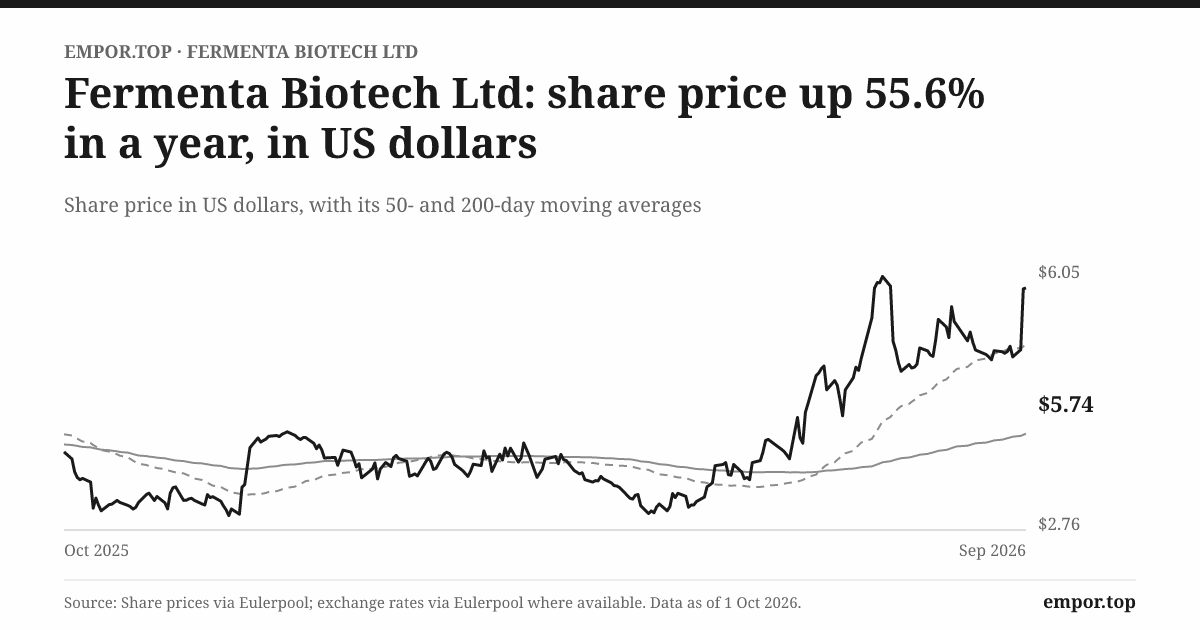
On the first morning of October 2026, a share of Fermenta Biotech changed hands at ₹549.65.1 That is within 2% of the highest price the stock has seen all year, and roughly double the ₹263 low it touched inside the same twelve months.1 The whole company, a maker of one vitamin and its close relatives, is valued at about ₹1,590 crore.1
Now hold that price chart next to the most recent results. In the quarter to June 2026, the first of fiscal 2027, Fermenta's EBITDA fell 37% from a year earlier and profit fell by more than half.3 Revenue, stripped of a property sideline, was down about 12%.3 The share price and the income statement are telling two different stories, and both cannot be right for long.
Fermenta Biotech is a BSE-listed company that makes vitamin D3, the "sunshine vitamin", and a handful of derivatives, mostly from cholesterol it extracts from the grease in sheep's wool.4 Its corporate body is old. It began life in 1951 as DIL Limited, has been listed on the BSE since 1977, and only added an NSE listing on 4 August 2026.2 Its economic identity is much younger: it has been a vitamin D3 company, in any meaningful sense, only since the consolidation that finished in 2019.
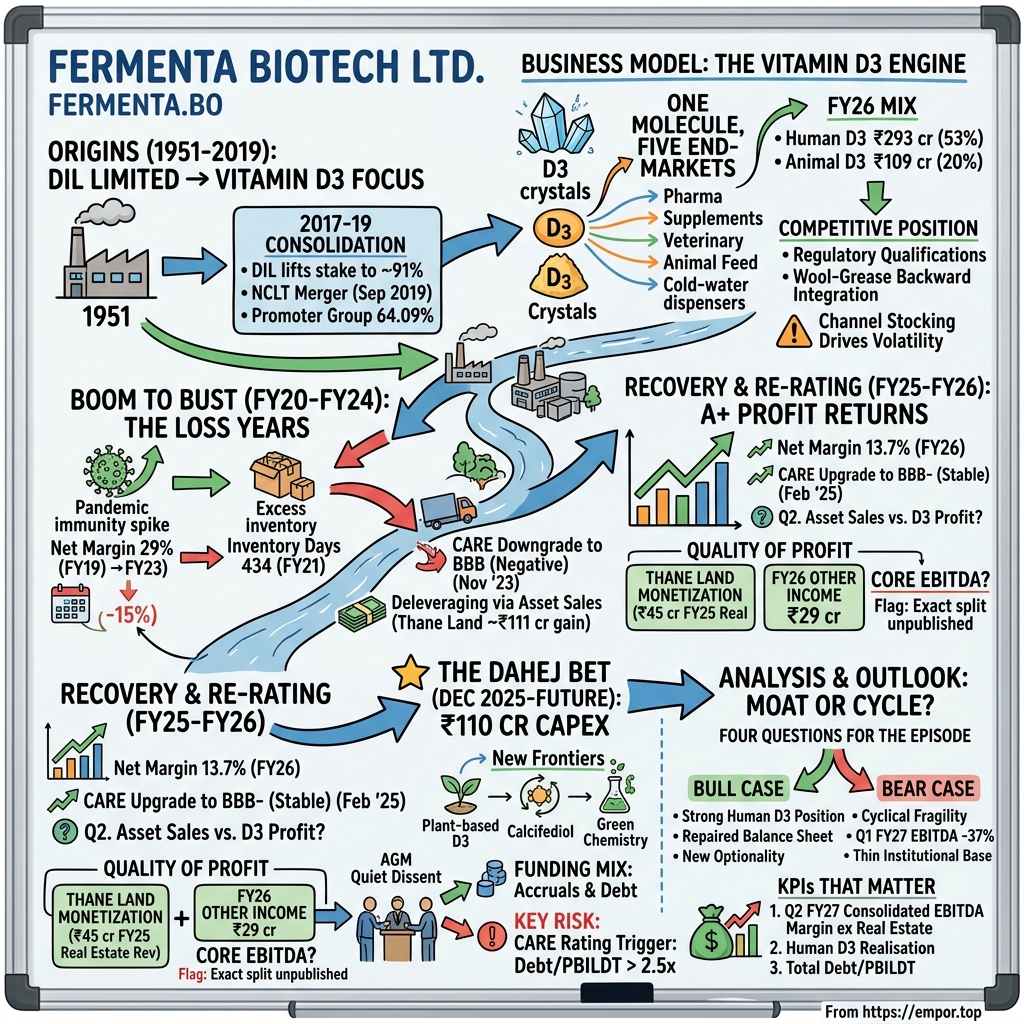
The pitch for this episode can be told in one line of numbers. Fermenta's net margin was 29% in fiscal 2019, fell to minus 15% by fiscal 2023, and climbed back to almost 14% in fiscal 2026.1 Return on equity followed the same rollercoaster, from 47% at the top to minus 16% at the bottom.1 Few listed Indian companies have travelled that distance in four years, and fewer still have then made the return trip.
That record frames the four questions this story answers.
- Is the profit of fiscal 2025 and 2026 a new earnings base, or the top of a vitamin D3 price and stocking cycle?
- How much of that profit came from selling land and from other income rather than from making D3?
- Can a newly approved ₹110 crore plant at Dahej be paid for without undoing three years of debt reduction and a hard-won credit upgrade?
- Is the share price running ahead of the earnings, in a stock that institutions barely own?
A word on the numbers before the story starts. Fermenta reports in rupees, and the rupee has fallen hard; it traded at about 96 to the US dollar on the day this story was written.1 Any series translated into dollars makes Fermenta's growth look worse in some years and better in others than it was. Where growth rates and margins matter, the figures here are in rupees from the company's own results. One data feed shows Q1 FY27 revenue "growing" 56%; the company reported a 12–13% decline, and the company's figure is the one used.3 Valuation multiples also disagree across sources, and Section IX deals with that openly rather than picking whichever number flatters the argument.
The story begins with how an old Mumbai pharma-and-chemicals business ended up betting itself on one molecule.
 Subscribe on LinkedIn
II. Origins: From DIL Limited to a One-Molecule Company (6 min)
For most of its life, DIL Limited was the kind of company Indian markets are full of: a mid-century pharmaceutical and chemicals concern with a listing, a family behind it, and no single business that defined it. The vitamin D3 operation sat in a separate company, the former Fermenta Biotech, in which DIL held a stake alongside outside investors.11
The decisive moves came between 2017 and 2019. DIL raised its holding in the old Fermenta Biotech to about 91%, buying out the stake held by a private fund, Evolvence India Life Sciences Fund, for roughly ₹83 crore.11 Then it folded the operating company into itself. The National Company Law Tribunal approved the merger on 19 September 2019, and the combined entity took the name Fermenta Biotech Limited.12 The fund's exit is worth one clause and no more: it was simply the price of taking full control of the business that mattered.
What emerged was a company owned, as it is today, by the Datla family and associates, who hold about 64% of the shares.1 Krishna Datla, the lead promoter, owns about 36% personally.1 In the years covered by its published accounts since then, the company has not raised fresh equity, run a rights issue or bought back shares; the share count stands at about 2.94 crore shares of ₹5 face value.2 Control was settled in 2017–19, and no outside owner has appeared since.
The structure also explains the cost position. Fermenta does not buy its key raw material, cholesterol, on the open market. It makes it from wool grease, the waxy lanolin that comes off sheep's fleece during washing.4 Think of a bakery that owns its own flour mill: it gives up some flexibility but avoids being squeezed by the miller when wheat is short. That backward integration is the closest thing Fermenta has to a structural cost advantage, and it comes back in the competition section.
The consolidation years also produced the numbers every later year is judged against. Translated into dollars, revenue jumped 82% in fiscal 2018, and return on equity hit 27% that year and 47% the year after.1 How much of the fiscal 2018 jump was real growth and how much was the arithmetic of consolidating a business that had previously been only partly owned, the company's published history does not separate. The honest reading is that both played a part and the split is unknown.
What is clear is that the merger was bought partly with borrowed money. Debt rose to 1.39 times equity in fiscal 2018, the highest gearing in the twelve-year record.1 Fermenta entered its vitamin D3 era with a strong product, a concentrated owner, and a balance sheet that was stretched just as the product's market was about to turn violent.
The high-water mark of fiscal 2019, a 29% net margin and a 47% return on equity, is the ghost that haunts the rest of this story.1 To understand why it did not last, it helps to understand what Fermenta actually sells and who pays for it.
III. How the Business Works: One Molecule, Five Customers' Worth of Markets (14 min)
Picture a kilogram of vitamin D3 crystals leaving Fermenta's plant. It is a fine, pale powder; a single kilogram contains enough vitamin D for an almost absurd number of daily doses, because the vitamin is dosed in micrograms. That kilogram has two possible futures.
In one, it travels to a supplement or pharmaceutical maker in Europe, which blends it into tablets, drops or fortified food. That buyer cares about regulatory paperwork, consistency and audit history, and it pays on 60 to 90 day terms.4 In the other, it goes to an animal-feed premix maker, which adds D3 to chicken or pig feed by the tonne. That buyer cares mostly about price, and it can buy from Chinese producers instead.4
The same molecule, two businesses. Understanding Fermenta means understanding that split.
What gets sold
Vitamin D3 is cholecalciferol, the form of vitamin D the human body makes in sunlight. Industrially, it is made by extracting cholesterol, converting it chemically to 7-dehydrocholesterol, then exposing that to ultraviolet light, which mimics what sunlight does in skin, before purifying the result.4 Each step is a chemistry and purification problem, and each has a yield. Fermenta's know-how lives in those yields and in the purity it can certify.
In fiscal 2026, Fermenta sold about ₹293 crore of D3 for human nutrition, roughly 53% of revenue.5 Animal-nutrition D3 brought in about ₹109 crore, or 20%.5 Non-nutrition products, mainly specialty pharmaceutical ingredients, were about 15%.5 A green-chemistry arm, selling enzymes and environmental solutions, doubled to about ₹16 crore.5 A small real-estate line, from developing surplus land in Thane, has been shrinking towards nothing and gets its own section.
The verdict on mix is straightforward. Human-nutrition D3 is the profit centre. It serves more than 400 customers in over 60 countries, and it is where regulatory approvals keep the field narrower.4 Animal D3 is the volatile edge: CARE Ratings, Fermenta's credit rater, describes the feed market as commoditised and import-driven, with intense Chinese competition.4
Who pays
D3 reaches five end-markets: pharmaceuticals, dietary supplements, food applications such as fortified drinks and cold-water-dispersible forms, veterinary products, and animal feed.4 Across them, the top five customers made up about 33% of revenue in fiscal 2025, and CARE regards concentration risk as low.4
Geographically, the business is mostly export. About 63% of fiscal 2025 sales were international.4 In fiscal 2026, India was 39% of revenue, Europe 30%, North America 13% and other markets 18%.5 In Q1 FY27, India jumped to 47% of revenue, which tells you more about export weakness that quarter than about Indian strength.3
For investors, one useful policy detail: CARE notes that pharmaceutical products are exempt from the additional US tariffs imposed in 2025.4 That shields part of the North American business from one obvious political risk, though not from price competition.
Why the price swings
Fermenta is paid per kilogram, and the price per kilogram is set by a market Fermenta does not control. When the world's supplement makers and premix blenders are restocking, they order heavily, and price and volume rise together. When their warehouses are full, they stop ordering, and both fall together. This is the bullwhip effect familiar from semiconductors and fertiliser: small changes in what consumers swallow become large swings in what manufacturers sell.
Q1 FY27 is a textbook illustration. Human D3 sales were ₹76.5 crore, up 24% on the previous quarter but down 10% on the year; volumes rose 18% quarter on quarter.3 Animal D3 fell to ₹12.6 crore, down 41% on the year, with management describing realisations down about 40% and volumes down 52%.3 The human side was recovering. The feed side was in free fall. Total revenue was ₹124.3 crore and EBITDA ₹22.3 crore, which works out to a margin of about 18%.3
Who else is in the ring
Global vitamin D3 production is concentrated among a small number of producers, with Chinese manufacturers dominating feed grade. Fermenta describes itself, and CARE describes it, as a leading D3 producer in India with backward integration.4 Neither the company nor its rater publishes Fermenta's global market share, unit costs against peers, or the names of the competitors that set the feed-grade price. That gap matters, and it will return when the moat is tested.
What protects the human-grade side is regulation. Selling to pharmaceutical and supplement makers in the US and Europe requires facilities that pass audits under regimes such as USFDA, EU-GMP and the food-safety standard FSSC.4 An approval is like a driving licence: it does not make you a good driver, but nobody gets on the road without one. It narrows the field, and it can be lost.
The business, then, is a single molecule sold in two qualities, priced by a stocking cycle that Fermenta can ride but not steer. The years from 2020 to 2024 showed exactly how violent that ride can be.
IV. The Boom, the Channel Glut and the Loss Years (FY20–FY24) (12 min)
In 2020, vitamin D became a pandemic word. Studies, headlines and doctors' offhand advice linked it with immunity, and supplement shelves emptied. For a D3 producer, it looked like the best possible news. Customers ordered more, then ordered more again in case supply ran short.
The trouble with a panic-buying boom is that the people who bought too much have to stop buying until they have used it up. CARE's later explanation for what happened to Fermenta is blunt: high channel inventory after the pandemic demand spike in human-nutrition D3, combined with weak realisations in animal-feed D3.4 Customers had warehouses full of vitamin. They stopped ordering.
The numbers on the way down
Fermenta's own warehouses tell the story first. Inventory days, a measure of how long stock sits before it is sold, rose to 434 in fiscal 2021, more than a year's worth of goods on hand.1 The company had built for a boom that was already ending.
Then the income statement followed. Net margin, 29% in fiscal 2019, slid through the pandemic years and turned to minus 15% in fiscal 2023 and minus 7% in fiscal 2024.1 Return on equity reached minus 16% at the bottom.1 Within four years of earning a 47% return on equity, the company was losing money.
The credit market noticed. CARE had rated Fermenta's long-term bank facilities A- with a stable outlook in May 2022, then cut them to BBB with a negative outlook by November 2023, and to BBB- by February 2025, before upgrading back to BBB (Stable) in October 2025.4 That is a fall of three notches in under three years, for a company with no debt crisis but a cycle it could not outrun.
How it survived
Here is the important part. Fermenta did not earn its way out of the trough. CARE notes that net profit in fiscal 2023 and 2024 was supported by gains of about ₹111 crore from selling non-core assets and investment properties.4 Debt fell by about ₹110 crore over three years, partly funded by those sales.4 In dollars, borrowings fell from about $31.5 million in fiscal 2020 to $16.8 million by fiscal 2024.1
That is a real achievement. A company in a cyclical trough that cuts debt in half without diluting shareholders has done something many do not. But it is a non-recurring achievement. The land can be sold once.
The cash puzzle
The loss years produced a strange-looking cash record. In fiscal 2023, Fermenta generated about $14.5 million of operating cash flow while reporting a net loss of about $6.4 million.1 In fiscal 2024, operating cash was more than three times EBITDA.1
The explanation is the warehouse. As inventory days fell from 434 to 166, stock that had already been paid for was turned into cash.1 It was like a shopkeeper running a clearance sale: the till fills up even as the business loses money on each item. Across twelve years, Fermenta's operating cash flow adds up to 186% of its net profit, a figure that looks like superb cash conversion and is in fact mostly the unwinding of one large overstock.1 It is not a rate any investor should project forward.
Shareholders felt the trough in the dividend. Payout was zero in fiscal 2021 and, on profits that were losses, nothing in fiscal 2023 or 2024 on the data feed's measure.1 No equity was raised to bridge the gap.
This period is the strongest evidence for the "cycle" side of the first question. The question for the recovery years is how much of the bounce came from D3 and how much came from a piece of land in Thane.
V. The Thane Land and the Quality of Profit (14 min)
In early 2026, Fermenta reported its third quarter of fiscal 2026. Vitamin D3 sales had been strong for nine months; consolidated revenue for the period was up about 25%.8 Yet the third quarter itself showed a sharp decline in profit.7 The reason was not D3. Real-estate revenue had dropped about 95% from a year earlier, and with it went a large slice of the quarter's earnings.7
It was a glimpse behind the curtain. For two years, a land development had been quietly propping up the numbers.
What the land was
Fermenta owned surplus land in Thane, near Mumbai, a legacy of its long industrial history. In 2022 it signed a term sheet with Mextech Property Developers LLP to develop it.11 The partner was described by the company as incorporated by the Nandivardhan Group and RRC Ventures, which suggests it is not a promoter entity.11 Fermenta's related-party disclosures are where investors should confirm that.
Real estate contributed about ₹45 crore of revenue in fiscal 2025, roughly 9% of the total, and only about ₹2 crore in fiscal 2026.5 Property revenue is lumpy by nature: it is booked as units are handed over, then it stops. It had no connection with the D3 cycle. It was simply land being turned into cash at a time the company needed cash.
The capital-allocation test
Selling non-core land to repay debt during a trough is, in principle, exactly what a sensible owner should do. It removes risk at the moment risk is highest. The open question is price. Fermenta has not published a benchmark that would let an outside shareholder judge whether the land fetched a fair value, and in a promoter-controlled company that question deserves an answer from the accounts rather than an assumption.
Other income: the new prop
As real estate faded, another line rose. Other income was about ₹29 crore in fiscal 2026, up from ₹7 crore in fiscal 2025.1 Against fiscal 2026 profit before tax of roughly ₹95 crore, that is about 30% of pre-tax profit, an approximate figure because the base depends on the exchange rate used to convert the data feed's dollars.1 The company has not explained what the ₹29 crore consists of in its results coverage. It could be treasury income, foreign-exchange gains, interest, or gains on investments. Each would carry a different signal about how repeatable it is.
What the core actually did
The company's own answer is that the core business improved strongly. Management reported EBITDA excluding real estate of about ₹120 crore in fiscal 2026, up 44%, and revenue excluding real estate up about 26%.6 On headline numbers, fiscal 2026 revenue reached a record ₹548 crore while profit after tax was ₹70 crore, down 8% from ₹76 crore.5
That is a meaningful pattern. Revenue at a record, profit lower. Core EBITDA up sharply, yet reported profit down. The two bridges between those numbers are the vanished property income and the arrived other income. The verdict is that fiscal 2025 earnings were clearly propped up by monetisation, while fiscal 2026 rested more on D3, but also on ₹29 crore of income Fermenta has not explained. Core D3 earnings did improve; exactly how much of reported profit is core remains an open item until the annual report's other-income and segment notes are read line by line.
Where the cash sits
There is one more loose thread. Operating cash flow rose to about ₹93 crore in fiscal 2026, up 127%, the company said.5 Yet cash and short-term investments on the data feed fell from about $8.4 million to $3.7 million over the same year, even as net cash flow was reported positive.1 The two statements cannot both be describing the same thing, and the likely answer is a definition difference between cash and treasury investments. It needs reconciling in the annual report before anyone treats the cash pile as either growing or shrinking.
Working capital is moving the wrong way. Working-capital days rose from 41 to 102 in fiscal 2026.1 Receivables sit at 82 days, the same as a year earlier and well below the 128-day peak of fiscal 2020.1 CARE still calls receivable and inventory periods high.4 Fermenta's results coverage does not disclose provisions for doubtful debts, so the quality of those receivables cannot be judged beyond their age. The fiscal 2026 cash was earned despite a working-capital build, which is a real point in its favour, but a build of that size in a cyclical business is also how the last overstock began.
With the land largely sold and the core improving, Fermenta's board did what boards do when they feel the trough is behind them. It decided to build.
VI. The Dahej Bet: ₹110 Crore After the Harvest Years (12 min)
On 11 December 2025, Fermenta's board met and approved a ₹110 crore capital project at Dahej in Gujarat, one of India's main chemicals hubs.9 The plant would make plant-based vitamin D3, calcifediol and other D3 derivatives, plus two enzymes, CAL-B lipase and penicillin G acylase.9 It would be funded, the company said, by "an optimised mix of internal accruals and debt."9
It was the first large growth decision since the trough, and it came with no revenue targets attached.9
From harvest to build
For three years before that meeting, Fermenta had been harvesting. Capital spending in dollars ran at roughly $2–5 million a year between fiscal 2023 and 2026, and net property, plant and equipment shrank from about $32 million to $25 million.1 Translated, the company spent less on its plants than they depreciated, and used the cash to pay down debt. That was right for a trough. It cannot go on forever without the asset base quietly aging.
Dahej reverses that. At ₹110 crore, the project is roughly twice Fermenta's fiscal 2026 free cash flow of about ₹62 crore.1 CARE projected gross cash accruals of ₹60–80 crore a year, against scheduled debt repayments of about ₹10–14 crore including leases.4 On those numbers, the company can fund most of Dahej from its own cash over two years, if the cash keeps coming.
What is being built, in plain words
Plant-based D3 matters because conventional D3 comes from sheep's wool, which rules it out for vegans and some religious diets. Fermenta has an Indian process patent and approval from the food regulator FSSAI for its plant-source route.9 Calcifediol is a pre-activated form of vitamin D, one step further along the body's processing chain, sold at higher prices for clinical uses. The enzymes are biological catalysts: CAL-B lipase is widely used in green chemistry, and penicillin G acylase is used to make the building block of semi-synthetic penicillins.
Each is a sensible adjacency for a D3 chemist. None is yet a business. A patent and a food-safety approval are technical and regulatory milestones, not revenue. The green-chemistry arm doubled to about ₹16 crore in fiscal 2026, around 3% of revenue.5 It is real optionality, and still small enough that its doubling barely moves the group. Fermenta's record does not show a history of turning similar milestones into large revenue lines, so the commercialisation rate of this pipeline is genuinely unknown. The honest framing is a set of options, not a growth engine.
The rating trap
Here is the tension. When CARE upgraded Fermenta in October 2025, it listed what would cause a downgrade. One trigger was total debt to PBILDT, its term for operating profit before depreciation, above 2.5 times. Another was "any significant debt-funded capex or acquisition."4 Two months later, the board approved a capex plan to be partly funded by debt.
Today's balance sheet can carry it. Debt is about 0.28 times equity.1 Total borrowings, including leases, were about ₹113 crore at March 2026.1 The main term loan, about ₹20 crore, matures in January 2028, fund-based working-capital lines were about 86% utilised on average, and CARE notes no financial covenants.4 Interest cover was a comfortable 4.45 times in fiscal 2025.4
The problem is timing. Dahej money starts going out just as Q1 FY27 EBITDA fell 37%.3 If profits keep falling while debt rises, the ratio CARE watches moves from both ends at once. The verdict: fundable, but not free of the trigger. The figure that settles it is total debt to PBILDT at March 2027. Fermenta does not disclose its R&D spending as a share of revenue in its results material, which makes it harder still to judge how much of the Dahej pipeline is proven before the concrete is poured.
Whether that bet is wise depends heavily on the people placing it, and on how far minority shareholders can trust them.
VII. The Management Question: Who Runs It and How Far to Trust Them (8 min)
The annual general meeting on 11 August 2026 was, on paper, a model of shareholder harmony. Almost every resolution passed with more than 99.9% support.10 Rajeshwari Datla was re-appointed as a non-executive director with 99.998% of votes.10 A commission for directors of up to 1% of net profit passed with 99.9966%.10
The only institutional pushback came on one item: raising the limit on transactions with Fermenta USA LLC, the group's US trading subsidiary, to as much as ₹100 crore. That resolution drew 397 votes against from public institutions and 12 from other public holders, and passed with 99.98%.10
The people
Prashant Nagre is the Managing Director and runs the operating business.3 Krishna Datla is the lead promoter and largest shareholder.1 The group has a long-serving Group CFO and President with about nine and a half years in the role, which gives finance continuity through the full boom-bust-recovery cycle. Fermenta's public materials offer little colour on their personalities; what they offer instead is a record.
The record, both sides
On the positive side: through the trough, management cut debt sharply, kept the company out of the equity market, and has since raised the dividend. The fiscal 2026 dividend was ₹3.75 per share, about ₹11 crore, up from ₹2.50, a payout of about 10% of profit.101 Over twelve years Fermenta paid out about ₹36 crore in dividends against about ₹248 crore of free cash flow, or 14%.1 That is conservative, arguably too conservative for minorities, but not reckless.
On the other side: the Fermenta USA limit. Fermenta sold about ₹21.8 crore of goods to its US subsidiary in fiscal 2026, roughly 4% of operating revenue.10 The new limit is about 4.6 times that. Fermenta USA's nine-month fiscal 2026 revenue was ₹37.5 crore, and its EBITDA swung to a loss of ₹1.1 crore from a profit of ₹1.6 crore.8 CARE notes that the US channel holds finished-goods inventory.4 Translated: the place where the company is approving much more intercompany headroom is a loss-making subsidiary that also stores stock. That is the corner of the group where the next overstock would show up first.
Pay is harder to judge. Third-party figures for the MD's remuneration disagree with each other by a wide margin, and the relationship between executive pay and profit across the cycle can only be settled from the remuneration tables in the annual reports.
Does the vote mean anything?
With promoters at 64% and institutions holding well under 1% of the voting base, near-unanimous votes are close to automatic.1 Low dissent here says very little about whether minorities approve; it mostly measures who owns the shares.
Guidance against outcome
The Q1 FY27 reversal is the test case. Management's commentary on that quarter was concrete about what happened: animal D3 realisations down about 40%, volumes down 52%, human D3 volumes up 18% sequentially.3 That is specific, quantified and unflattering, which counts in its favour. What it does not yet supply is a forecast that can be held against the next quarter. Investors should read the call transcripts on Fermenta's investor page for whether analysts pressed on realisation per kilogram and got numbers back.11
One passing note: on 20 July 2026, Aasava Management Services LLP subscribed to shares in Fermenta Environment Solutions, the green-chemistry subsidiary, leaving the parent with 91.76%.11 It is small, but it is the first outside capital in a subsidiary that management has framed as optionality.
Management, then, has proven it can defend the balance sheet in a downturn. Whether it controls anything that makes downturns less damaging is a question about competition, not people.
VIII. Moat or Cycle: Competitive Position, Porter and the 7 Powers (10 min)
Imagine two orders arriving in the same week. One is from a European supplement maker for pharma-grade D3, with audit documentation, batch certificates and 60–90 day payment terms.4 The other is a tender from a feed premix blender asking for a price, and only a price, knowing Chinese suppliers will quote too. Fermenta can win the first on qualification. It can only win the second by being cheapest.
This is the place to argue the moat once, in full.
The case for an edge
Fermenta's best argument rests on two things. First, backward integration: making cholesterol from wool grease, rather than buying it, gives it control over the most important input.4 Second, regulatory standing: the approvals to sell into regulated pharma and supplement markets are slow to earn and limit who can bid.4 A third, more speculative argument is process know-how in purification and yield, which every chemical producer claims and few can prove from the outside.
The returns record is the test. Return on capital employed was about 17% in fiscal 2026, decent for a chemicals business.1 Return on invested capital was about 12%, against 31% at the fiscal 2019 peak.1 The top five customers are about a third of revenue, so no single buyer holds Fermenta hostage.4
Porter's five forces, with evidence
Suppliers. Power is limited because Fermenta makes its own cholesterol. But the wool-grease supply chain behind that is not disclosed, so supplier concentration at the very bottom of the chain is unknown.
Buyers. Moderate. Concentration is low, but the pandemic glut proved buyers' real power: they can simply stop ordering for a year. The 192 days Fermenta took to pay its own suppliers in fiscal 2025 shows the squeeze being passed back up the chain.1
Substitutes. Plant-source and alternative D3 routes are emerging, which is why Fermenta is building one itself. Vitamin D2 exists as a cheaper alternative in some uses.
New entrants. Feed grade has low barriers, and Chinese supply sets the price. Pharma grade has higher barriers through approvals.
Rivalry. Intense in feed grade; moderate in human grade. Fermenta does not publish its market share, and its rater gives no global ranking.
Helmer's 7 Powers
Of Hamilton Helmer's seven sources of durable advantage, three are plausible here. A cornered resource in cholesterol integration and regulatory approvals. Process power in fermentation and purification know-how, though without unit-cost data it cannot be measured. Scale economies are modest at best: Fermenta is a mid-sized producer against larger Chinese rivals, and nothing in its disclosures shows a cost advantage from size. Network effects, switching costs, branding and counter-positioning do not apply in any material way to a bulk-ingredient seller.
The falsification
The decisive evidence is the company's own record. If integration and approvals protected pricing, the trough would have been shallow. It was not. Net margin fell to minus 15%, and the company survived on supplier credit and asset sales.14 Whatever advantages Fermenta has, they did not protect it from a stocking cycle.
There is also no clean peer comparison. Listed Indian vitamin and specialty-chemical names exist, but Fermenta's single-molecule exposure makes them weak analogues, and the global D3 producers that set prices are not listed in India. Without peer margins through the same cycle, any claim that Fermenta is the low-cost producer is an assertion, not a finding.
Currency adds a further caveat. With about 63% of sales abroad, a falling rupee adds to rupee revenue and margin without any change in price or volume.4 Fermenta does not disclose how much of the recent margin gain came from the exchange rate, or how it hedges.
The verdict. For human-grade D3, the edge is intact but narrower than the bull case claims: real enough to earn mid-teens returns in good years, not strong enough to prevent losses in bad ones. For feed grade, the moat claim is rejected; this is a commodity business sold at the Chinese price. The KPI that would confirm or falsify the human-grade claim is realisation per kilogram through the next downturn.
If the advantage is that conditional, the price the market pays for it deserves a hard look.
IX. The Price Ahead of the Earnings (8 min)
In August 2026, after 49 years on the BSE alone, Fermenta's 2.94 crore shares began trading on the NSE too.2 The listing was sold on liquidity: a bigger exchange, easier access, better price discovery.2 It arrived as the stock was doubling, and as foreign institutions appeared on the register for the first time in any size, at 0.37%.1
What the multiples say, and why they disagree
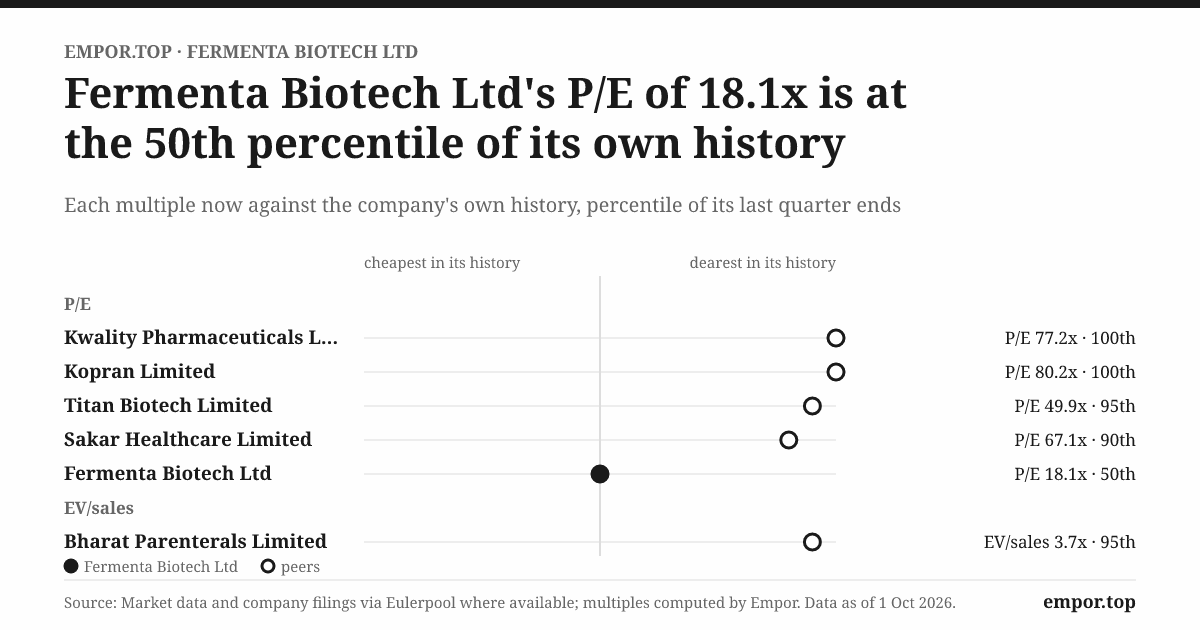
On one data feed, Fermenta trades at about 18 times earnings, below its own five-year median of about 20.5 times.1 On that view, the stock looks cheap against its history. But the same feed gives last-twelve-month earnings per share of about ₹20.38.1 Divide the share price by that, and the multiple is about 27 times. Screener shows about 29 times.1 On fiscal 2026's ₹70 crore of profit, the figure is roughly 23 times.5
The 18 times figure does not reconcile with its own inputs, so this story uses the higher, arithmetic version: on trailing earnings, Fermenta trades at roughly 27 times, above its five-year median, not below it.
The free-cash-flow yield needs the same treatment. One feed says 1.2%; fiscal 2026 free cash flow of about ₹62 crore on a ₹1,587 crore market value is closer to 4%.1 Enterprise value is about 19.6 times EBITDA and price to book about 3.9 times.1
What does the price assume? Trailing earnings still include the strong quarters of fiscal 2026. If the next three quarters look like Q1 FY27, trailing profit will fall and the multiple on today's price will rise further. Paying 27 times for a business whose earnings just fell by half implies the market expects Q1 to be the dip, not the trend.
Who owns it
The register is overwhelmingly family and retail. Promoters hold 64.09%, foreign institutions 0.37%, domestic institutions 0.04%.1 Shareholder numbers rose from about 12,900 in March 2025 to about 14,800 by August 2026.1 The largest holders, as of June 2026, were Krishna Datla, Satish Varma Azad Nadimpally, Anupama Datla Desai and Preeti Thakkar.1 Whether any promoter shares are pledged should be checked in the exchange-filed shareholding pattern.
In a stock where the free float is about a third and institutions are almost absent, price can move far on modest buying. One-year volatility is about 52%, and the stock's largest fall in five years was about 67%.1
The skeptic's case
An activist short seller would write a short memo. Operating margin in Q1 FY27 was about 11%, against about 17% a year earlier.1 The company is starting ₹110 crore of partly debt-funded capex into falling profits.9 The register is promoter-controlled with a thin float, and the only real governance friction is a related-party limit on a loss-making US subsidiary. And the stock has doubled on a story of recovery whose latest chapter is a decline.
The counter-argument is that human D3 volumes are recovering, debt is low, and the doubling partly reflects a re-rating from neglect after the NSE listing. Without researched peer multiples, no relative claim holds either way. The verdict here stays open, but the burden of proof sits with the bulls.
Which leaves the question of what this company teaches beyond itself.
X. Playbook: Business & Investing Lessons (6 min)
Look at one line from Fermenta's accounts: inventory days. At 434 in fiscal 2021, the company held more than a year of stock.1 By fiscal 2023, it was down to 166.1 Between those two numbers sits almost everything this story has to teach.
Single-molecule margins are loaned, not owned. In fiscal 2019, Fermenta earned a 29% net margin and a 47% return on equity. Four years later it was losing 15 cents on every rupee of sales. Nothing about the plant, the patents or the people changed that much. The market for one molecule did. For founders, the lesson is that a peak margin in a one-product company is a reading of the cycle, not a measure of the business. For investors, it is that the best year is the worst year to extrapolate from.
Cash flow flatters the unwinding of a mistake. In fiscal 2024, Fermenta's operating cash flow was more than three times its EBITDA. On a screen, that looks like a cash machine. In reality it was a clearance sale of an overstock built in the boom. Twelve years of 186% cash conversion are mostly one mistake being reversed. When cash runs far ahead of profit, the first question is not "how good is this business?" but "what is being liquidated?"
Sell the land to pay the debt, then ask what is left. About ₹111 crore of asset gains carried Fermenta through its trough, and the Thane land carried fiscal 2025. Monetising non-core assets in a crisis is wise. But once the land is sold, the remaining business has to earn its keep alone, and the investor's job is to measure that business without the property income. Every rescued balance sheet should be re-read as if the rescue never happened.
A downgrade trigger can be a plan. CARE wrote down that significant debt-funded capex would threaten the rating. Two months later, Fermenta approved debt-funded capex. Credit-rating sensitivities are not just warnings; they are a cheap public map of what the company's lenders fear most. When management walks towards one, it is telling you how confident it is, and how much it is willing to risk the cost of borrowing on that confidence.
Dissent is quiet where promoters hold 64%. The AGM passed every resolution above 99.9%. That says nothing about whether minority shareholders agree; it says who controls the votes. In a promoter-controlled company, the real governance signal is in the small dissent that does appear, here on a related-party limit for a loss-making subsidiary, and in what the company chooses to disclose without being asked.
These lessons all point the same direction. Before deciding whether Fermenta is a compounder or a cycle, the bull and the bear deserve a fair hearing.
XI. Analysis: Bull vs. Bear and the KPIs That Matter (8 min)
Two analysts read the Q1 FY27 release on the same afternoon. One underlines a single line: human D3 volumes up 18% quarter on quarter.3 The other underlines a different one: EBITDA down 37%.3 Both are right. The disagreement is about which number describes the future.
The bull case
The balance sheet is repaired. Debt is about 0.28 times equity, down from 1.39 times in fiscal 2018, and CARE upgraded the company in October 2025.14 Core EBITDA excluding real estate rose 44% to about ₹120 crore in fiscal 2026, so the recovery was not only land.6 Human D3, the profit centre, is recovering in volume. Dahej adds plant-based D3, calcifediol and enzymes, giving a one-molecule company its first credible routes beyond the molecule.9 And with institutions barely present, the NSE listing could broaden the shareholder base over time.
The bear case
The record shows a business that loses money in downturns and survives by selling assets. Animal D3 realisations are down about 40%.3 Working-capital days more than doubled to 102 in fiscal 2026, which is how the last overstock started.1 Capex is starting into falling profit, partly on debt, towards the exact trigger CARE named. About 30% of fiscal 2026 pre-tax profit was other income the company has not explained.1 And the share price has doubled while trailing profit is about to fall.
Weighing it
CARE itself expects net margins of about 8–10% through the cycle.4 Fiscal 2026's 13.7% sits above that, and Q1 FY27's 8.0% sits at the bottom of it.1 That is the most useful single fact in the debate: the rater that studied the business closely thinks the recent peak is above normal. The bull case needs Q1 to be the bottom; the bear case only needs Q1 to be normal.
The balanced verdict: Fermenta has a real, narrow position in human-grade D3 and a repaired balance sheet, set against a record of cyclical fragility and a share price that has already priced a recovery. The case turns on Q2 FY27, not on fiscal 2026.
Risk radar
- D3 price and Chinese supply. Revenue is per kilogram, so a price drop flows straight to margin.
- Working-capital strain. A build in inventory and receivables would turn profit into stock rather than cash, as in 2021.
- Regulatory audit failure. A failed USFDA, EU-GMP or FSSC audit would close the human-grade markets that carry the profit.
- Currency reversal. A stronger rupee would take back the export tailwind.
- Credit triggers. Rising debt against falling operating profit could breach the 2.5 times level CARE watches.
- Dahej execution. New chemistry, new plant, no revenue targets.
The KPIs that matter
- EBITDA margin excluding real estate. About 18% in Q1 FY27 (₹22.3 crore on ₹124.3 crore), down from the fiscal 2026 level.3 If Q2 FY27 holds or rises, the cycle story weakens; if it falls, the peak was real.
- Human D3 realisation per kilogram. The direction of price in the profit centre. Volumes are recovering; price is the missing confirmation.
- Total debt to PBILDT against 2.5 times. The figure that tells whether Dahej is being funded within the rating's comfort zone.
Those three numbers will arrive on specific days, and they are where the story goes next.
XII. Epilogue (5 min)
Tonight, Fermenta stands at an odd crossroads: a share price near its peak, a business whose latest quarter went the other way, and a factory project that has committed it to growth before the cycle has shown its hand. Profit was about ₹22 crore of EBITDA in its most recent quarter.3 Dahej is a ₹110 crore promise.9 The 2.5 times trigger sits in CARE's file like a tripwire.4
The next few moments will decide which version of the company is real.
Q2 and Q3 FY27 results. The first is due within weeks. If human D3 realisation holds and animal D3 stops falling, Q1 becomes a blip in a recovery, and the "new base" side of the first question gains real evidence. If both weaken again, the fiscal 2026 peak starts to look like 2019 did in hindsight: a high-water mark, not a floor.
CARE's next rationale and the March 2027 balance sheet. A rating update was listed in August 2026, and the company's credit-rating page is where the details will appear.11 If gearing rises while operating profit falls, the debt-funded Dahej spend is exactly what CARE said would prompt a review, and the third question answers itself.
The fiscal 2026 annual report. Its other-income note and segment note will reveal what the ₹29 crore of other income was and how much of reported profit came from the D3 business. That single document settles most of the second question.
Fermenta USA. If the ₹100 crore related-party limit begins to fill while the subsidiary is loss-making, it will say something about where stock is accumulating, and whether the channel is quietly stocking up again.
The register after the NSE listing. If domestic and foreign institutions build real positions over the next few quarters, the listing will have done what it promised. If shareholder numbers rise but institutions stay below 1%, the doubling was retail enthusiasm, and the fourth question tilts towards a price ahead of the earnings.
Each outcome answers a different question, but they share one underlying tension. Fermenta is a business that proves itself in good years and gives a large part of it back in bad ones. Its owners have shown they can survive the bad years. What they have not yet shown is that the bad years can be made smaller.
XIII. Outro (2 min)
Go back to the plant gate and that kilogram of pale crystals. It is the same product it was in 2019, when it earned a 29% margin, and in 2023, when it lost money. The molecule did not change. The warehouses of the world did.
Fermenta turned a 1951 chemicals company into the maker of a sunshine vitamin, and the market now has to decide whether that makes it a compounder or a cycle with a good year behind it.
References
-
Fermenta Biotech Ltd consolidated financials, shareholding and peers — Screener ↩↩↩↩↩↩↩↩↩↩↩↩↩↩↩↩↩↩↩↩↩↩↩↩↩↩↩↩↩↩↩↩↩↩↩↩↩↩↩↩↩↩↩↩↩↩↩↩↩↩↩↩↩↩
-
After 49 Years on BSE, Fermenta Biotech Lists 2.94 Crore Shares on NSE — Prittle Prattle News, 2026-08 ↩↩↩↩
-
Fermenta Biotech Q1 FY27 revenue stands at Rs. 124.3 crore, EBITDA declines 37% — Indian Pharma Post ↩↩↩↩↩↩↩↩↩↩↩↩↩↩↩
-
Press Release, Fermenta Biotech Limited — CARE Ratings, 2025-10-01 ↩↩↩↩↩↩↩↩↩↩↩↩↩↩↩↩↩↩↩↩↩↩↩↩↩↩↩↩↩↩↩↩
-
Fermenta Biotech FY26 Results: Revenue hits record ₹548 crore — Scanx ↩↩↩↩↩↩↩↩↩↩
-
Fermenta Biotech revenue rises 14% to ₹548 crore in FY26 — Scanx ↩↩
-
Fermenta Biotech Surges 9M On Vitamin D3, But Q3 Sees Sharp Decline — Whalesbook ↩↩
-
Fermenta 9MFY26 Consolidated Revenues up 25% YoY; Net profit up 20% YoY — The Tribune ↩↩
-
Fermenta Board Approves INR 110 Crore Capex at Dahej — The Tribune, 2025-12-11 ↩↩↩↩↩↩↩↩
-
Fermenta Biotech shareholders approve ₹3.75 dividend and related-party deals (AGM 2026-08-11 voting results) — Scanx ↩↩↩↩↩↩
-
Fermenta Biotech investor relations and annual reports — Fermenta Biotech ↩↩↩↩↩↩↩
-
Fermenta Biotech corporate announcements, BSE 506414 — BSE India ↩
 LinkedIn
 WhatsApp
 Reddit
 Hacker News
 Email
Email Kindle
 RSS Feed
 Spotify
 Apple Podcasts
 Amazon Music
 Audible
 YouTube