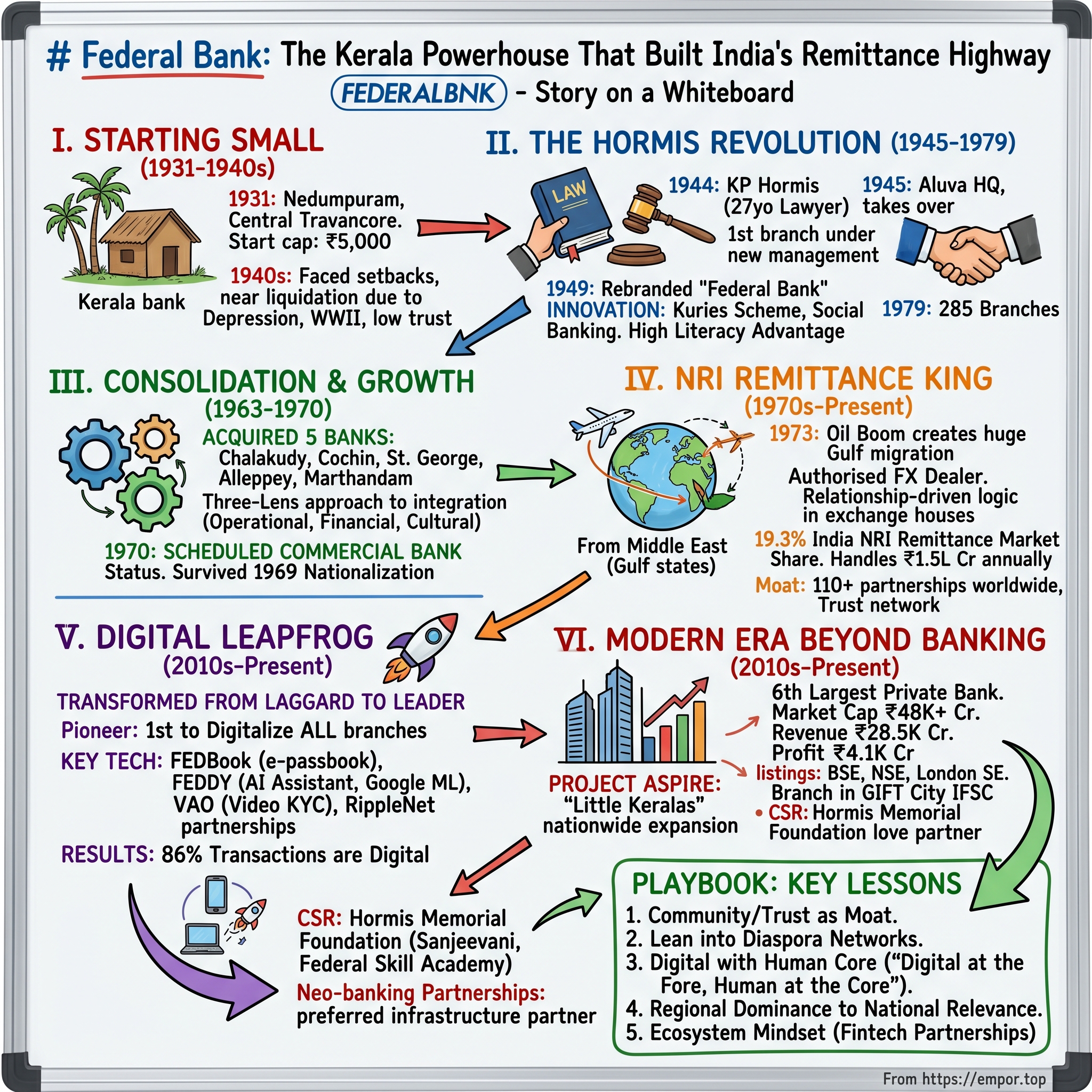
Federal Bank: The Kerala Powerhouse That Built India's Remittance Highway
I. Introduction & Episode Framework
Somewhere in a labour camp on the outskirts of Sharjah, an electrician from Thrissur finishes a twelve-hour shift, walks to an exchange house in a strip of shops near the souk, and hands over a stack of dirhams. He fills in a form he has completed a hundred times before. Within a few hours — sometimes within minutes — the money lands in a savings account in a small town in central Kerala, where it will cover a college fee, service a housing loan, or simply sit.
Multiplied by millions of transactions annually, these transfers form a critical financial pipeline. India received roughly $125.4 billion in inward remittances in FY2024-25, the largest inflow globally, with the United States and the United Arab Emirates serving as the two dominant corridors.1 For decades, a substantial share of those funds has moved along network rails built and operated by a bank headquartered not in Mumbai or New Delhi, but in Aluva, a town on the Periyar River in Kerala, from its registered office at Federal Towers.2
The institution was incorporated in 1931 with an initial share capital of ₹5,000. Today, it operates with a balance sheet of roughly ₹3.93 lakh crore and a market capitalisation of about ₹82,500 crore, with its stock trading near ₹334.50 per share on the National Stock Exchange as of mid-September 2026.34 While no longer a small regional entity, the bank remains outside the dominant tier of India's private banking market.
The core paradox
The structure of Indian commercial banking presents persistent challenges for mid-sized institutions. At the top end, major private lenders such as HDFC Bank, ICICI Bank, Axis Bank, and Kotak Mahindra Bank benefit from nationwide branch networks and extensive current-account franchises that secure low-cost corporate deposits. At the opposite end, public sector banks rely on sovereign recapitalisation during extended periods of stress. Mid-sized private banks often face squeezed margins: they must offer higher interest rates to attract deposits while struggling to price prime corporate loans competitively, which can pressure them toward higher-yield, higher-risk lending.
Federal Bank has managed to navigate these structural pressures. In FY26, the bank generated a net profit of ₹4,117.32 crore, and in the quarter ending March 2026, it recorded a return on assets of 1.36%. During that same quarter, gross non-performing assets stood at 1.62% and net non-performing assets reached 0.20% — its lowest asset-quality metrics in nearly ten years.2 These results reflect a significant evolution for an institution that a generation ago functioned largely as a regional lender focused on local agricultural and gold loans in central Kerala.
A common explanation for this resilience focuses on the bank's remittance franchise — a deposit engine anchored in the Gulf diaspora that generates stable non-resident balances. Yet while central to its history, that explanation is incomplete. High volume in remittance processing does not automatically translate into a low cost of funding, a distinction that has become increasingly critical over the past three years.
The dual transformation
Two primary strategic developments define the bank's modern trajectory.
The first is the scale of its diaspora deposit base, built on the migration corridor from Kerala to the Persian Gulf that began expanding in the 1970s. By the March 2026 quarter, Federal Bank's non-resident deposit book surpassed ₹1 lakh crore, reaching ₹1,02,619.69 crore. This represented approximately one-third of its total deposit base of ₹3,13,909.39 crore — a balance-sheet composition distinct among Indian commercial banks.2
The second development is a leadership transition. Shyam Srinivasan, chief executive officer for fourteen years from 2010 until September 2024, overhauled the bank's underwriting standards, distribution channels, and operating metrics. On 23 September 2024, KVS Manian, a veteran of more than two decades at Kotak Mahindra Bank, assumed leadership with a stated objective: positioning Federal Bank among India's top-tier private lenders.5 Management has publicly framed its current strategic roadmap as a "breakthrough phase" aimed at establishing a universal bank with a nationwide footprint.6
Whether this expansion plan can succeed without diluting underwriting quality or inflating credit costs remains the central strategic question facing the institution.
Roadmap
This analysis traces Federal Bank's development from its origins as a small local lender in princely Travancore, through its reorganization by a pioneering lawyer, a series of distressed regional acquisitions, and the Gulf oil boom that established its remittance channels. It examines Shyam Srinivasan's institutional overhaul, the bank's fintech partnership initiatives and subsequent regulatory friction with the Reserve Bank of India in March 2024, current balance-sheet fundamentals, and a scenario analysis evaluating key growth assumptions against historic execution.
The account begins with an institution that nearly folded during its first decade.
 Subscribe on LinkedIn
II. The Travancore Origins & The K.P. Hormis Era (1931–1979)
In 1931, the princely state of Travancore in southern India operated as a semi-autonomous kingdom with its own regulatory framework, currency conventions, and an economy built on agricultural commodities: coconut, rubber, pepper, cashew, and coir. Formal banking services were scarce. The primary savings mechanism across Kerala was not the bank deposit, but the kuri or chit fund — a rotating savings and credit association where members pooled money monthly and bid for the accumulated pot. This system relied on community trust and social enforcement rather than formal legal contracts.
Against this backdrop, Travancore Federal Bank Limited was incorporated on 23 April 1931 in Nedumpuram under the Travancore Companies Regulation of 1916.7 Its initial capital base of ₹5,000 was extremely modest, amounting to less than the annual income of a prosperous local trading family.
The bank's initial decade was marked by persistent undercapitalisation and loan concentration among a narrow group of local borrowers. By the mid-1940s, the institution was near failure — a trajectory common among the era's small regional lenders that frequently opened, extended credit to founding insiders, and quietly folded.
The lawyer from Perumbavoor
The bank's trajectory shifted when Kulangara Paulo Hormis, a practising lawyer from Perumbavoor, acquired a controlling interest in 1944. Hormis initiated a recapitalisation effort, increasing the share capital from ₹5,000 to ₹71,000 — a more than fourteenfold expansion that, while modest in absolute terms, provided critical financial stability.7 He relocated the headquarters to Aluva, a river town with stronger trade links to Cochin. In December 1949, the institution was renamed Federal Bank Limited, aligning its corporate structure with the newly enacted Banking Regulation Act of 1949.7
Hormis's legal background shaped the bank's operational philosophy. Trained in contractual documentation and debt enforceability, he prioritized verifiable security over uncollateralised cash-flow underwriting in a market lacking formal credit bureaus. This risk culture established an enduring institutional preference for tangible collateral, reflected decades later in a loan portfolio heavily weighted toward secured credit.
Banking the chit-fund economy
Rather than competing directly against the established kuri culture, Federal Bank integrated it into its operating model. The bank designed structured chit-style deposit schemes that offered smallholder farmers and spice traders access to credit without requiring the extensive collateral of traditional term loans. By adopting the familiar social mechanisms of local chit funds within a regulated banking framework, Federal Bank brought established community savings habits onto its balance sheet.
This approach enabled the bank to build durable, multi-generational customer relationships anchored in local trust rather than aggressive rate competition. Instead of introducing unfamiliar financial products, Federal Bank institutionalised the informal savings mechanisms rural Kerala already relied upon.
The bank's network expansion proceeded methodically. From a single branch in 1945, Federal Bank grew to 285 branches by 1979, averaging roughly eight new locations per year across three and a half decades.7 Each branch was established in communities where the bank possessed existing borrower relationships, securing a stable deposit base that funded subsequent growth.
By the late 1970s, Federal Bank had evolved from a village lender into an established regional institution with a defensible deposit franchise in Kerala — a state marked by high literacy and growing foreign exposure. This regional platform positioned the bank to absorb distressed local competitors and capitalize on the expanding migration corridor to the Persian Gulf in the decade that followed.
III. The Acquisition Spree & Building the Remittance Pipeline (1960s–2000s)
In a fragmented, lightly regulated industry, acquiring existing distribution can be far cheaper than building it organically. In Indian commercial banking, that opportunity opened during the 1960s, and Federal Bank capitalized on it systematically.
Between 1963 and 1970, the bank absorbed five regional institutions: Chalakudy Public Bank, Cochin Union Bank, Alleppey Bank, St. George Union Bank, and Marthandam Commercial Bank.7 Each target was small, several were financially distressed, and all brought established branches, customer relationships, and local deposits in strategic markets across the Travancore-Cochin belt and toward the Tamil Nadu border.
Bank integration in that era presented severe operational challenges. Without core banking software or centralized databases, merging institutions required manually reconciling ledgers, retraining staff on new operational standards, and restoring depositor confidence after local institutional failures. In the absence of modern banking technology, an acquirer's institutional reputation served as the primary integration mechanism. Federal Bank executed these transactions largely because the Hormis name and the bank's record of solvency provided essential credibility to local depositors.
This strategy allowed Federal Bank to expand its geographic footprint at distressed valuations when organic branch licensing remained slow and administratively restricted. Inorganic growth functioned as a distribution shortcut rather than a financial engineering exercise. In 1970, Federal Bank achieved scheduled commercial bank status, gaining access to Reserve Bank of India liquidity facilities and clearing infrastructure — the institutional plumbing that transformed the regional lender into a full participant in the national financial system.7
The wave nobody in Mumbai saw coming
The 1973 oil shock fundamentally reshaped the bank's addressable market. As quadrupled crude prices funded an infrastructure expansion across the Persian Gulf, Gulf states required immense foreign labor. Kerala — characterized by high literacy, English familiarity, historic maritime trade ties to the Arabian Peninsula, and limited domestic employment — supplied hundreds of thousands of workers. Electricians, nurses, drivers, masons, accountants, and engineers migrated to the United Arab Emirates, Saudi Arabia, Kuwait, Qatar, and Oman.
This migration generated a vast volume of recurring cross-border transfers. In the 1970s, formal banking channels for cross-border remittances were slow and costly, driving many workers toward hawala — an informal, unregulated money-transfer system.
Federal Bank competed with informal channels on speed and operational convenience. It established direct partnerships with exchange houses across the Gulf — the storefront money-transfer operators used by migrant workers — enabling funds deposited in Dubai to post to Kerala accounts with minimal delay. Over subsequent decades, this network grew to include more than one hundred exchange-house tie-ups, complemented by representative offices in Abu Dhabi and Dubai.
This remittance pipeline provided two distinct competitive advantages.
First, it operated as a distribution network rather than a single financial product. Gulf exchange houses selected specific Indian banks to route transactions through, and these relationships proved durable because switching partners introduced operational risk for the operator. Larger nationalized banks were slower to establish these partnerships, viewing the initial remittance market as administratively cumbersome.
Second, incoming funds frequently remained with the bank. Remittances deposited into non-resident external (NRE) and non-resident ordinary (NRO) accounts often converted into long-term savings balances. While remittance processing generates a one-time fee, converting those flows into stable deposits provides an ongoing interest spread. This balance-sheet dynamic created a low-cost funding moat that distinguished Federal Bank from peer institutions lacking a diaspora footprint.
However, this funding advantage contained a structural vulnerability. While both low-cost savings accounts and high-cost term deposits expand headline market share, they deliver markedly different net interest margins. For roughly three decades, diaspora flows primarily yielded low-cost savings balances; in more recent years, those inflows have shifted increasingly toward higher-cost term deposits.
By the 2000s, Federal Bank possessed a unique deposit franchise alongside an unaddressed structural imbalance: strong, low-cost liabilities paired with a conservative loan book concentrated in regional relationships. The bank lacked the corporate and retail lending infrastructure required to deploy its growing deposit base at optimal risk-adjusted returns — setting the stage for a major strategic transition in 2010.
IV. The Modern Transformation: Shyam Srinivasan's 14-Year Era (2010–2024)
When Shyam Srinivasan assumed the role of managing director and chief executive in 2010, Federal Bank occupied an awkward middle ground in Indian commercial banking. It was too large to operate purely as a regional community lender, yet too small and regionally concentrated to compete effectively in Mumbai's wholesale financial markets. Its brand equity among the Kerala diaspora was substantial, but its visibility among corporate treasurers in northern industrial hubs was negligible.
Srinivasan joined from Standard Chartered, where he had managed consumer banking operations across multiple Asian markets. That background dictated his operational priorities. Multinational consumer banks operated primarily as process-driven institutions built on centralized underwriting, product-level profit-and-loss accountability, and data-driven customer segmentation. Federal Bank, by contrast, relied almost entirely on localized relationship banking.
Turning judgement into process
The central operational shift during Srinivasan's tenure was moving credit decisions from individual branch managers to centralized underwriting centers. In traditional relationship banking, a branch manager relies on personal familiarity with local borrowers and regional commodity markets to evaluate risk. While effective in a stable home market, localized judgment does not scale easily across new geographies, nor is it easily standardized or audited.
Centralized underwriting standardized credit evaluation across regions. A bank expanding into industrial hubs in Tamil Nadu, Maharashtra, or the National Capital Region required a credit framework that could evaluate borrowers objectively without relying on long-standing local familiarity.
Simultaneously, Srinivasan restructured the bank's asset portfolio. To avoid the large corporate credit concentrations that triggered systemic bad loans across Indian banking in the 2010s, Federal Bank established distinct verticals for commercial banking, small and medium-sized enterprises (SMEs), commercial vehicle finance, and gold loans. Gold lending offered specific structural advantages: these loans were short-tenure, high-yielding, and fully collateralized by physical assets held directly in bank vaults. Given Kerala's high rate of household gold ownership, expanding this product allowed the bank to earn higher yields without expanding unsecured credit risk.
What the numbers said, and what they did not
Over Srinivasan's 14-year tenure, the bank's balance sheet expanded several-fold and its equity market valuation grew significantly. Return on assets, which had hovered below 1.0% in the early 2010s, climbed above 1.2%, while return on equity moved into the low-to-mid teens.
This operational turn, however, had clear structural limits. Process discipline improved asset quality, cost controls, product diversification, and institutional investor credibility. Yet it did not resolve the bank's underlying liability weakness. Federal Bank concluded the period with a robust savings deposit base but a weak current-account franchise. This funding gap meant the bank remained more dependent on higher-cost term deposits than top-tier private sector peers.
Context also matters when evaluating this performance. The period between 2010 and 2024 provided a favorable environment for secured, conservatively managed retail lenders in India. Rapid growth in consumer credit and a systemic avoidance of volatile infrastructure and metals exposure protected Federal Bank from the severe corporate defaults that impaired state-owned banks. The institution's relative stability reflected both sound operational risk choices and a deliberate decision to avoid high-risk corporate syndications.
The clock that ran out
The conclusion of Srinivasan's tenure was driven by regulatory mandate rather than internal conflict. In April 2021 the Reserve Bank of India issued instructions capping the tenure of managing directors and chief executives at private sector banks, with a fifteen-year maximum for promoter or long-serving MD & CEOs.8 For Federal Bank, this converted an open-ended succession question into a dated one: Srinivasan's term would conclude in September 2024, and the board had roughly three years to find a successor.
In corporate governance terms, this predictable timeline avoided the disruption often associated with sudden executive departures or poaching events in Indian banking. The transition proceeded on a public schedule, allowing the market and institutional shareholders to price in leadership change well in advance.
Understanding the balance sheet Srinivasan handed over is essential for evaluating Federal Bank's subsequent strategy, as the ongoing debate over its national expansion turns entirely on these underlying financial metrics.
V. Core Business Economics & Segment Breakdown
At its core, a commercial bank functions as two interconnected businesses: one that gathers deposits and another that deploys capital through loans. While public attention typically focuses on credit growth, operational differentiation among commercial banks often stems from the structure of their deposit gathering.
By the end of the fourth quarter of fiscal year 2026, Federal Bank's total business volume — combined deposits and advances — reached ₹5,78,503.76 crore, comprising gross advances of ₹2,68,369.03 crore and total deposits of ₹3,13,909.39 crore.2 By the June 2026 quarter, total balance-sheet assets expanded to roughly ₹3.93 lakh crore, with both advances and deposits increasing by approximately 15% year on year.3
The asset side: secured, mid-yield, deliberately unglamorous
The bank's loan book is divided into four main operating segments, each serving a distinct strategic purpose.
Retail banking and gold loans represent the largest single asset pillar, encompassing mortgages, auto loans, personal credit, and a sizable gold loan portfolio. Gold lending serves as the primary yield anchor within retail operations, commanding higher interest rates than mortgages while carrying low loss-given-default characteristics due to physical collateralisation. The operational risks in gold lending centre on gold-price volatility, asset custody, and valuation integrity, rather than traditional borrower default risk.
SME and commercial banking remains the primary segment targeted for balance-sheet expansion. In the fourth quarter of fiscal 2026, commercial banking advances grew 5.92% sequentially, outpacing the overall loan book.2 The segment offers attractive economics: middle-market enterprises pay higher interest rates on working capital facilities than large corporate borrowers while generating operational float through current-account balances and fee-bearing transaction services.
Corporate and wholesale banking operates at lower net interest margins but plays a structural role in balance-sheet management. When deposit inflows outpace originations in higher-yield segments, high-rated corporate lending absorbs excess liquidity without taking on excessive credit risk. Rather than operating as a major profit driver, wholesale lending functions as a pressure-release mechanism to deploy excess liquidity efficiently.
Treasury manages the bank's statutory liquidity portfolio, trades government bonds, and handles foreign-exchange conversions stemming from remittance flows. Treasury income remains inherently cyclical and sensitive to interest rate movements. Following the June 2026 quarter, chief executive KVS Manian highlighted that net profit grew nearly 37% "in a period when treasury had a challenging period," contending that earnings were driven primarily by core banking operations rather than market gains.3 This management positioning is supported by non-interest revenue performance in the fourth quarter of fiscal 2026, when fee income rose 10.54% sequentially to ₹990.92 crore.2
The liability side: the actual story
Federal Bank's liability structure reflects both its primary competitive strength and its principal structural constraint.
In the fourth quarter of fiscal 2026, the non-resident deposit book crossed the ₹1 lakh crore threshold to reach ₹1,02,619.69 crore, representing a 7.04% single-quarter increase.2 Concurrently, low-cost current and savings account (CASA) balances also surpassed ₹1 lakh crore, standing at ₹1,03,390.30 crore and lifting the bank's CASA ratio to 32.94% — an increase of 271 basis points year on year.2 By the June 2026 quarter, CASA deposits expanded by over 18% year on year, although the overall CASA ratio moderated by 71 basis points sequentially to 32.23% as asset growth required additional funding from costlier term deposits.3
These liability dynamics highlight two contrasting structural features.
On one side, expanding low-cost deposits by 18% alongside 15% advance growth indicates that the bank is not funding-constrained. During the fourth quarter of fiscal 2026, management prioritized retail deposit mobilization while "deliberately reducing the volume of high-value deposits" to lower the cost of funds to 5.46%.2 This strategy prioritized deposit quality and margin defense over nominal balance-sheet expansion.
On the other side, a CASA ratio hovering between 32% and 33% remains roughly ten percentage points below the funding profiles of tier-one private sector competitors. The deficit stems primarily from current accounts — non-interest-bearing operational balances maintained by corporate and commercial clients. While Federal Bank built an extensive savings deposit base through its Gulf diaspora franchise, its current-account penetration has remained constrained by a historically small corporate transaction-banking footprint.
This structural gap in current-account funding explains much of the net interest margin differential between Federal Bank and larger private peers, defining the central objective of its ongoing national expansion strategy.
Distribution
Despite digital channels handling the vast majority of routine transaction volumes, Federal Bank has continued to expand its physical branch footprint. The institution added 39 branches in the fourth quarter of fiscal 2026 alone, utilizing external location studies rather than management intuition to guide site selection.2 While the network remains concentrated in Kerala, physical expansion has pushed into major commercial hubs across Maharashtra, Tamil Nadu, Karnataka, and the National Capital Region.
For a mid-sized lender seeking commercial banking growth, physical branch distribution complements digital banking rather than competing with it. Digital channels efficiently process high-volume retail transactions, but local branch infrastructure remains essential for securing commercial relationships and non-interest-bearing current accounts. Establishing a physical presence in key industrial clusters represents a direct delivery mechanism for middle-market credit and cash management services. The ultimate efficacy of this branch expansion will be reflected in future current-account growth and commercial market share outside Kerala.
Before that strategy could be pursued, though, the bank had to close out an experiment that ended badly.
VI. The Fintech Experiment & The RBI Regulatory Collision (2018–2024)
Around 2018, a concept gained traction across Indian financial services: that a bank's regulatory licence could be profitably unbundled from its customer interface. Venture-funded neo-banks would own the application, product design, onboarding funnel, and primary customer relationship. A regulated lender would sit underneath, providing the licence, balance sheet, and regulatory wrapper while collecting fee share without bearing customer acquisition costs.
Federal Bank embraced this model more aggressively than most Indian peers. Operating under the strategy of "digital at the fore, human at the core," the bank became the balance-sheet partner for digital-first platforms — including Fi Money, Jupiter, and OneCard — offering digital savings accounts, co-branded credit cards, and instant personal loans through partner interfaces.
The strategic logic appeared compelling. Unable to match the acquisition spend of major private rivals like HDFC Bank, Federal Bank could instead rent distribution from platforms optimized for acquiring young, urban, digitally native customers — a demographic outside its traditional branch footprint. For several years, the model delivered on key expansion metrics: accelerating account openings, expanding card issuance, and establishing the bank's reputation as an innovative incumbent.
What was actually being outsourced
The underlying vulnerability lay in what was being outsourced. The bank was not merely renting distribution; it was delegating customer relationships and its compliance perimeter to third parties.
Under Indian banking regulations, an institution retains absolute responsibility for key operational functions. It must verify customer identities, control data collection and storage, directly manage credit underwriting, and ensure its own risk criteria dictate lending decisions. When onboarding occurs within a partner's app, credit algorithms rely on third-party data, and first-loss default guarantee structures obscure actual credit risk, compliance boundaries blur — while legal accountability remains entirely with the issuing bank.
On 13 March 2024, the Reserve Bank of India directed Federal Bank and South Indian Bank to stop issuing new co-branded credit cards, pending compliance with the regulator's revised credit and debit card directions.[^9]9 The directive did not cancel existing cards, but it halted new customer additions across the co-branded portfolio. Federal Bank stated that it was addressing the regulatory concerns and awaiting approval before resuming co-branded card issuance, while continuing to issue proprietary cards to new and existing customers.9
The regulatory timing was notable. The RBI had updated its master direction on credit and debit cards on 7 March 2024 to simplify co-branding partnerships for banks and non-banking financial companies.9 The restriction on Federal Bank followed days later, signaling that while co-branding remained permissible, the bank's specific operational arrangements fell short of supervisory expectations.
Cost, and what it revealed
The immediate financial impact was manageable. Co-branded credit cards accounted for a minor portion of Federal Bank's overall earnings, and the bank maintained its proprietary card program across branch and digital channels. The bank's board-approved credit card policy has continued to be maintained and updated, most recently as of 27 March 2026.10
The strategic implication, however, was significant. A distribution channel subject to immediate suspension by regulatory directive represents an operational dependency rather than a durable competitive moat. The neo-bank partnership framework had been presented to investors as an asset-light acquisition flywheel. The events of March 2024 demonstrated that this flywheel depended on external operational arrangements, exposing the bank to franchise risk in exchange for transaction volume.
Furthermore, executive communications prior to the regulatory action revealed underlying asset-quality pressures. On earnings calls through fiscal 2024, management had already noted tighter credit filters and an intentional moderation in unsecured loan originations. This sequence indicates that the unit economics of partner-acquired unsecured portfolios were deteriorating independently of supervisory intervention. The simultaneous tightening by management and restriction by the regulator underscored that the distribution model was encountering structural limits.
As of September 2026, publicly available disclosures do not indicate that the Reserve Bank of India has formally lifted the co-branded card restriction. The status of the co-branded card channel therefore remains unresolved.
This retrenchment forced a strategic re-evaluation: if customer acquisition could not be reliably rented through third-party platforms, the bank needed internal growth drivers. Part of that capacity was already embedded within the broader group structure.
VII. Capital Allocation, M&A History, & The Fedfina Subsidiary
Commercial banks face a structural constraint that non-financial enterprises do not: balance-sheet expansion mechanically consumes equity capital. Because every rupee of risk-weighted assets requires a proportional capital backing, a bank expanding its loan book at 15% annually must either generate sufficient internal retained earnings or repeatedly return to capital markets for equity capital.
Federal Bank has pursued both routes. It has periodically raised equity through qualified institutional placements while securing strategic investment from the International Finance Corporation and IFC-managed funds. As of the June 2026 quarter, this funding strategy yielded a total capital adequacy ratio of 16.97%, with Tier-1 capital standing at 15.89% — comfortably above regulatory minimums and sufficient to fund several years of growth at current rates without a further raise.11
That capital cushion comes with an important caveat common across commercial banking: reported capital ratios offer only a snapshot of risk-weighted assets evaluated under existing rules. Regulatory adjustments to risk weightings — such as the Reserve Bank of India's late-2023 mandate raising risk weights on unsecured retail loans and non-banking financial company exposures — can instantly absorb capital buffers without any change in underlying business operations. The capital buffer remains substantial, but it is not a fixed quantity.
Federal Bank's track record reflects a pattern of repeated, rather than occasional, equity issuances. Shareholders have experienced ongoing dilution in exchange for balance-sheet growth that has generally been profitable — a conventional bargain in commercial banking rather than evidence of exceptional capital discipline. The institution has neither avoided capital markets nor expanded purely through retained earnings.
The Fedfina experiment
The bank's most notable capital allocation move over the past decade was the creation and partial monetisation of its non-banking financial subsidiary, Fedbank Financial Services, known as Fedfina.
The strategic rationale was sound. Certain categories of credit are inefficient to originate directly within a commercial bank. Small-ticket loans against property in tier-3 and tier-4 towns, gold lending in regions where a full-service branch is unviable, and small business credit for borrowers with thin documentation require a cost structure, collection mechanism, and risk tolerance poorly suited to a bank's core operating model. An NBFC subsidiary can pursue these higher-yielding segments using its own leverage, staffing structure, and balance sheet while allowing the parent to capture overall consolidated earnings.
Fedfina listed in November 2023, raising approximately ₹1,092 crore at an issue price of ₹140 per share.12 The listing was tepid: the shares opened around ₹138, a modest discount to the offer price, reflecting investor caution about mid-tier NBFC asset quality and about competitive intensity in the small-ticket LAP segment specifically.12 Federal Bank retained a controlling stake, which stood at roughly 60.8% in 2026.13
What the record actually shows
While early commentary framed the transaction as a failed offering, subsequent market performance has challenged that view. By late August 2026 the stock traded around ₹155, above the ₹140 issue price.13 Investor arguments treating the public offering as a permanent failure are no longer supported by market prices.
The more substantive critique centers on operational returns rather than share price movements. Fedfina's return on equity has run around 12.6% on the latest reported financials, with a portfolio at the end of December 2025 composed roughly of 45.2% gold loans, 30.6% medium-ticket loans against property, 21.3% small-ticket LAP, and a small remainder in business and personal loans.13 Leading Indian NBFCs typically generate return on equity in the mid-to-high teens. While a 12% to 13% return on equity covers Fedfina's cost of capital and avoids value destruction, it fails to command a premium valuation multiple. When consolidated into a parent institution targeting mid-teens returns, the subsidiary dilutes rather than enhances overall group return on equity.
Fedfina has expanded Federal Bank's operational reach into segments the bank could not efficiently serve, while establishing a listed currency and a path for potential future monetization. However, it has not produced a valuation re-rating for the parent company, and existing financial performance provides no clear mechanism for one unless the subsidiary's returns improve materially. Investors should evaluate Fedfina as a functional operating business with optionality rather than an unrecognised catalyst for parent valuation. A sustained move in Fedfina's return on equity into the mid-teens would be the key metric required to alter that assessment.
Which brings the story to the executive now responsible for making the overall structure earn higher returns.
VIII. New Leadership: K.V. SVS Manian & "Project Breakthrough" (2024–Present)
On 23 September 2024, KVS Manian took charge as managing director and chief executive of Federal Bank.5 He arrived after more than two decades at Kotak Mahindra Bank, where he had served as joint managing director overseeing corporate, institutional, and investment banking alongside wealth management.
His appointment signaled a specific strategic diagnosis. Rather than selecting a retail specialist, a digital innovator, or a turnaround operator, the board appointed an executive from a private bank known for conservative underwriting and high returns on capital. The implicit assessment was that Federal Bank's retail infrastructure and asset-quality machinery were operating effectively, but its corporate, transaction banking, and liability operations required structural improvement.
The diagnosis, stated plainly
Manian's program—described publicly as a "breakthrough phase" aimed at joining India's top-tier private lenders and establishing a universal bank with a national franchise—rests on a primary structural insight.6
That insight is that Federal Bank's margin pressure is fundamentally a deposit-mix challenge rather than a lending rate problem. Current account balances have historically hovered in the mid-single digits as a share of total deposits, compared to low-to-high teens at larger private sector peers. Because current accounts pay no interest, they represent the lowest-cost funding in commercial banking. They are generated primarily by commercial enterprises that use the bank for day-to-day operational needs: payments, collections, payroll, trade finance, and cash management.
Current accounts cannot simply be acquired through marketing campaigns or interest-rate incentives. A bank secures them by becoming the primary operating institution for a company's daily cash flows, which requires a robust cash management platform, trade finance capabilities, specialized corporate relationship teams, and a physical presence in key industrial clusters. Importing this commercial transaction-banking capability directly reflects the operating model Manian built at Kotak Mahindra Bank.
Reported targets under the program include lifting the overall current and savings account (CASA) ratio toward the mid-30% range by FY28, up from approximately 30% when the plan was articulated, alongside broader profitability goals.6 By the fourth quarter of fiscal 2026, the CASA ratio reached 32.94%, though a sequential moderation to 32.23% in the following quarter served as a reminder that liability repositioning will not be linear.23
The three pillars, and the evidence so far
Fixing the liability architecture. This pillar forms the core of the strategic thesis. Disclosed performance presents mixed evidence of execution. CASA balances crossing ₹1 lakh crore with an 18% year-on-year growth rate indicate progress, while the deliberate reduction of high-value bulk deposits to lower the cost of funds to 5.46% demonstrates management acting on stated priorities rather than chasing headline deposit growth.23 However, expanding the non-interest-bearing current account segment outside Kerala—the vital half of the liability challenge—remains unproven.
Shifting the asset mix. Management has pursued a gradual reallocation away from low-yielding wholesale lending and partner-acquired unsecured credit toward mid-yield secured segments, including commercial vehicles, equipment finance, loans against property, gold, and middle-market working capital facilities. This pivot is reflected in segment growth data, with commercial banking, retail, and commercial vehicle and construction equipment segments leading expansion in the fourth quarter of fiscal 2026.2 Manian has framed this strategy as a "medium-term journey," a pragmatic characterization against which execution should be evaluated.2
Returns and margin dynamics. Financial results reflect ongoing margin volatility. In the fourth quarter of fiscal 2026, Federal Bank generated a return on assets of 1.36%, a net interest margin of 3.74%, and a return on equity of 13.69%, with management describing returns and margins as having reclaimed pre-rate-cut levels.2 In the first quarter of fiscal 2027, net interest income rose 26.1% year-on-year to ₹2,946 crore, return on equity reached 12.01%—up from 10.30% a year earlier—and the cost-to-income ratio improved by 239 basis points year-on-year to 52.50%, supported by a capital adequacy ratio of 16.97%.11 Crucially, however, the net interest margin contracted sequentially from 3.74% to 3.33%, illustrating how quickly margins compress when deposit competition intensifies.
Assessing the strategy
An objective evaluation reveals both structural logic and execution risks.
The core diagnosis is sound: the deficit in non-interest-bearing current accounts remains the primary constraint on Federal Bank's net interest margin, and resolving it is necessary to bridge the valuation gap with top-tier private peers. The strategic blueprint is internally consistent, supported by executive leadership with direct experience in commercial transaction banking.
However, the strategy forces the bank into competitive expansion outside its historical home market. Capturing middle-market commercial accounts in industrial hubs across Maharashtra, Gujarat, and the National Capital Region requires competing directly against established lenders like HDFC Bank, ICICI Bank, Axis Bank, and Kotak Mahindra Bank. These incumbents possess broader product suites, deeper corporate relationships, and lower overall funding costs. In seeking commercial accounts in these markets, Federal Bank faces the risk of adverse selection—attracting secondary or higher-risk corporate borrowers passed over by dominant peers.
As of September 2026, two years into Manian's tenure, execution remains in its early stages. Balance-sheet metrics reflect positive directionality in asset quality and deposit structure, but the core objective of securing a defensible corporate current-account franchise outside Kerala remains unvalidated by financial results.
IX. Competitive Landscape, 7 Powers & Porter's 5 Forces
flowchart TD
    subgraph Competitive Dynamics & Positioning
        A["Federal Bank (FEDERALBNK)"] --> B["Low-Cost Remittance Deposit Engine"]
        A --> C["Sub-Scale Current Account Franchise"]

        D["Mega Private Banks (HDFC / ICICI / Kotak)"] -->|Scale & Low Cost of Funds| A
        E["Mid-Tier Peers (IndusInd / IDFC First / RBL)"] -->|High Yield Unsecured Push| A
        F["Public Sector Banks (SBI / BOB)"] -->|Sovereign NRI Deposit Reach| A
    end
Evaluating a commercial bank's competitive durability requires examining where its funding originates and which competitors are positioned to capture it.
Hamilton Helmer's 7 Powers, applied honestly
Process Power — moderate, and narrower than usually claimed. The bank's remittance clearing infrastructure—direct integration with an extensive network of Gulf exchange houses, built over four decades—represents a genuine operating capability. It is not a formal patent or exclusive licence, but accumulated institutional plumbing that a new entrant would require years to replicate. However, process power in payment processing remains durable only while the underlying mechanism remains the most efficient option. Management has implicitly acknowledged this boundary by exploring alternative infrastructure, including blockchain-based remittance channels for non-resident clients.14 A financial institution that must periodically re-platform its primary operational moat possesses a valuable capability rather than an unassailable fortress.
Cornered Resource — moderate, and demographically dated. Multi-generational trust among Kerala households with members working in the Gulf represents an earned intangible asset that cannot be easily purchased. However, this asset carries an ageing demographic profile. First-generation Gulf migrants who opened non-resident accounts decades ago bank with Federal Bank out of long-standing familiarity. By contrast, their adult children working in urban technology hubs choose financial service providers through digital platforms based on interface convenience and product pricing.
Counter-Positioning — effectively neutralised. The neo-bank partnership framework operated as a temporary counter-positioning strategy for several years, allowing Federal Bank to acquire digital-native customers while larger incumbents hesitated due to channel conflict. The Reserve Bank of India's regulatory intervention in March 2024 removed this structural advantage, demonstrating that much of the model relied on regulatory arbitrage rather than a durable business innovation. Investors cannot treat counter-positioning as an active strategic power without evidence of a fully compliant, scalable partner architecture.
Scale Economies — low to moderate, representing the binding constraint. Federal Bank operates at a fraction of the balance-sheet scale of top-tier peers such as HDFC Bank. Consequently, it cannot amortise technology investments, compliance overhead, and national branding campaigns across a comparable asset base, nor can it match dominant institutions on prime corporate loan pricing. Its cost-to-income ratio stood at 47.28% in the fourth quarter of fiscal 2026 before rising to 52.50% in the first quarter of fiscal 2027—operating efficiency metrics that sit higher than those of leading private sector competitors.211 While recent operational metrics show positive directionality, the overall cost structure reflects a sub-scale institution.
Switching Costs — moderate on the NRI franchise, low elsewhere. A primary non-resident savings account linked to recurring standing instructions, household loan servicing, and integrated wealth products creates tangible customer switching friction. Conversely, single-transaction term deposits selected primarily on interest rate yield carry minimal switching costs.
Network Effects — low. Commercial banking intermediation inherently generates limited network effects. While the bank's exchange-house clearing arrangements exhibit mild two-sided platform characteristics, the setup functions primarily as a structured distribution arrangement rather than a self-reinforcing network effect.
Brand Power — strong regionally, negligible nationally. Across Kerala and within the Gulf diaspora, the Federal Bank brand commands genuine customer loyalty and pricing tolerance. In major northern commercial markets such as Gurugram, however, the institution remains an unfamiliar brand competing for corporate treasury relationships against four larger, well-established national competitors. This geographical brand asymmetry represents a primary obstacle to national commercial expansion.
Porter's Five Forces
Threat of new entrants — low. Commercial bank licensing in India remains tightly controlled by the regulator, initial capital requirements are substantial, and ongoing compliance obligations are expanding. As a result, the threat of new full-service bank entrants taking deposit market share remains low.
Bargaining power of borrowers — high. Prime corporate borrowers in India operate in a credit market with abundant liquidity and negotiate aggressively across lending institutions. Consequently, Federal Bank's corporate wholesale portfolio earns narrow net interest margins and functions primarily as a balance-sheet liquidity sink rather than a core earnings driver.
Bargaining power of depositors — high, and rising. Deposit mobilization represents the central competitive pressure point facing mid-sized lenders. Indian bank depositors have become increasingly rate-sensitive, while digital account onboarding has minimized the friction of moving capital between institutions. A clear reflection of this dynamic in Federal Bank's financial results is the sequential moderation in its current and savings account ratio whenever rapid credit expansion requires additional market funding.3
Threat of substitutes — moderate to high. Alternative financial instruments—including mutual funds, direct equities, sovereign retail bond platforms, and foreign currency non-resident deposit yields—compete directly for domestic household savings.15 On the transaction side, cross-border fintech platforms compete aggressively on foreign exchange spreads, while sovereign payment infrastructure—such as international linkages for the Unified Payments Interface—presents a structural challenge to fee income along the bank's core remittance corridors.
Rivalry — very high. Every primary operating segment targeted by Federal Bank is contested by larger or more specialized competitors. Gold lending is pursued by specialized non-banking financial companies and large commercial banks seeking low-loss secured assets. Small and medium-sized enterprise credit faces intense competition across the banking sector. Meanwhile, non-resident deposit gathering is contested by state-owned banks whose sovereign backing provides a distinct advantage among risk-averse diaspora savers.
The overall competitive landscape demonstrates that Federal Bank possesses one primary, gradually eroding advantage alongside several moderate operational capabilities, operating in a market structure that favors scale or specialization over mid-sized positions. This market structure does not preclude steady growth, but it means the investment case depends on rigorous operational execution rather than structural protection.
X. The Historical Falsification Layer: Stress-Testing Key Thesis Claims
Every investment case is a set of claims about the future dressed in facts about the past. This section takes the four load-bearing claims in the Federal Bank bull case and tests each against the strongest disconfirming evidence in the bank's own record.
Claim 1: "The NRI remittance pipeline is an unassailable low-cost deposit moat."
The mechanism that would break it. Two forces, working together. First, disintermediation of the payment leg: sovereign digital rails, including Unified Payments Interface international linkages, and global fintech aggregators competing on foreign exchange spreads compress the fee earned per dollar moved. Second, and more damaging, a shift in how incoming funds are deployed after arrival—moving from low-cost savings balances into market-priced term deposits.
The disconfirming evidence. The volume franchise has held up. Federal Bank has historically described a market share in remittances to India in excess of 15%, and the non-resident deposit book crossed ₹1 lakh crore in March 2026—hardly the profile of a business undergoing disintermediation.162
Margin performance, however, tells a different story from transaction volume. Federal Bank's net interest margin compressed toward the low 3% range during the recent rate cycle and, even after recovering to 3.74% in the fourth quarter of fiscal 2026, gave back 41 basis points sequentially in a single quarter to 3.33%.32 Overall deposit costs of 5.46% do not reflect the cost structure of an institution funded predominantly by captive, non-interest-bearing balances.2 Management's fourth-quarter fiscal 2026 statement regarding "deliberately reducing the volume of high-value deposits" serves as an explicit acknowledgment that a portion of recent deposit growth relied on expensive, rate-sensitive capital rather than moat-driven inflows.2
Verdict. Historical performance does not refute this claim, but it narrows its scope significantly. Federal Bank maintains a durable origination advantage across specific migration corridors—a reliable, established channel through which diaspora funds enter the Indian banking system. It does not, however, possess pricing power over those funds once deposited. The franchise guarantees volume flow rather than net interest margin spread. Any thesis treating the non-resident deposit base as a permanent source of low-cost funding is contradicted by recent margin volatility.
Falsification KPI. The structural mix of non-resident external balances between savings and term deposits, alongside relative cost of funds compared to top-tier private sector peers. If funding costs compress toward peer averages while non-resident balances continue expanding, the broader moat thesis regains validity. If margins continue oscillating with interest rate cycles, the narrower origination thesis remains correct.
Claim 2: "Fintech partnerships provide an asset-light, high-growth customer acquisition flywheel."
The mechanism that would break it. Regulatory intervention, adverse credit selection among partner-sourced customers, or a combination of both.
The disconfirming evidence. Both pressures materialized sequentially. The Reserve Bank of India's March 2024 directive halted new co-branded credit card issuance outright.[^9]9 Prior to that regulatory intervention, management had already tightened credit filters and moderated unsecured loan origination in response to rising slippages in co-branded personal loans and credit cards—confirming that partner-acquired originations were experiencing asset-quality deterioration independently of supervisory action.
Verdict. Disclosed performance disproves this claim as originally structured. A customer acquisition engine vulnerable to immediate regulatory suspension, and characterized by deteriorating underlying credit performance, does not constitute a sustainable flywheel. The strategy functioned as a temporary growth accelerant carrying unpriced operational and regulatory risks. The residual capability is more limited: Federal Bank retains proprietary digital onboarding infrastructure and an internally managed card program. That infrastructure provides operational utility, but it does not represent a structural competitive advantage over major private peers operating larger, fully owned digital distribution networks.
Falsification KPI. Formal regulatory approval restoring co-branded card issuance, alongside credit loss and slippage metrics on unsecured card and personal loan portfolios relative to the bank's core secured book.
Claim 3: "Federal Bank can replicate its southern franchise into a pan-India commercial powerhouse."
The mechanism that would break it. Adverse selection. Entering new geographic markets without established corporate relationships or strong brand recognition risks attracting borrowers passed over by dominant incumbent lenders, leading to elevated default rates.
The disconfirming evidence. This risk is supported by historical precedent. During the Reserve Bank of India's asset quality review in fiscal 2016, when lenders were required to recognize legacy stressed assets, Federal Bank's gross non-performing asset ratio rose above 3%. That credit deterioration was concentrated in corporate and middle-market commercial exposures built outside Kerala, rather than within its core home-market retail franchise.
Historically, credit losses at Federal Bank have emerged primarily from geographic expansion beyond its home state into commercial segments where the institution operated as a price-taker and non-lead lender. That historical loss pattern aligns directly with the commercial segments targeted under "Project Breakthrough."
Verdict. Historical evidence does not preclude successful expansion, but it establishes a clear requirement for underwriting discipline. Geographic expansion outside Kerala was previously tested and produced the institution's most significant asset-quality impairment of the modern era. Two mitigating factors warrant consideration. First, credit risk management was restructured under Shyam Srinivasan through centralized underwriting units specifically designed to reduce reliance on branch-level judgment. That institutional shift contributed to gross non-performing assets of 1.62% and net non-performing assets of 0.20% in fiscal 2026—near decade-low levels achieved alongside ongoing out-of-state lending.2 Second, current expansion priorities focus on commercial transaction banking and operational current accounts rather than uncollateralized corporate lending.
However, commercial current-account relationships rarely develop independently of credit extension. Transaction banking and commercial credit facilities remain operationally linked. Establishing a competitive presence in middle-market commercial banking across new industrial hubs inevitably introduces local commercial credit exposure.
Falsification KPI. Credit loss rates and non-performing asset formation within non-Kerala commercial and middle-market SME portfolios compared to home-market retail metrics. Because commercial credit impairment manifests over multi-year cycles, asset-quality metrics from fiscal 2026–27 originations will serve as the definitive evaluation metric in subsequent reporting periods.
Claim 4: "Fedfina monetisation unlocks substantial shareholder value."
The mechanism that would break it. Margin compression stemming from intense competition in small-ticket loans against property and gold lending, alongside return metrics insufficient to command a valuation premium.
The disconfirming evidence, and a correction to the conventional bear framing. The initial public offering experienced soft demand, listing below its ₹140 issue price.12 By late August 2026, the equity recovered to trade around ₹155 per share.13 Assertions framing the public offering as a permanent failure are inconsistent with prevailing market prices.
The primary operational constraint remains subsidiary return profile. A return on equity of roughly 12.6% represents a moderate result for a mid-tier non-banking financial company, sitting below the mid-to-high teen returns typically required for premium valuation multiples.13 Furthermore, gold loans constitute nearly half of the subsidiary's total advance portfolio—a product category where the parent institution competes directly alongside specialized non-bank lenders operating at lower cost structures.13
Verdict. Financial disclosures narrow this claim to a modest operational reality: Fedfina functions as a viable subsidiary serving niche customer segments outside the parent bank's economical reach, while providing a listed equity vehicle for optionality. It does not represent an unrecognised value catalyst capable of driving a structural re-rating of the parent company at current profitability levels.
Falsification KPI. Fedfina's consolidated return-on-equity trajectory. A sustained expansion into the mid-teens would alter the subsidiary's valuation dynamics, whereas persistent returns in the 11% to 13% range would confirm its status as a mature operating asset.
XI. Analyst Transcript Deep Dive & Management Credibility Audit
Two years into K.V.S. Manian's leadership, quarterly earnings calls offer a tangible record for evaluating management credibility against strategic commitments.
What analysts have pressed on
Margins, relentlessly. Net interest margin trajectory has dominated analyst inquiries. Through the recent interest-rate cycle, management's explanation evolved significantly: early commentary attributed margin compression to system-wide deposit repricing, whereas subsequent communications focused directly on the bank's structural deficit in low-cost current-account balances. Acknowledging internal liability mix rather than external interest rate dynamics represents a shift toward executive accountability, providing the explicit rationale for the bank's current strategic roadmap.6
The durability of the earnings recovery. When first-quarter fiscal 2027 net profit grew by nearly 37%, analysts questioned whether operational expansion or temporary trading gains drove the surge. Management countered that this earnings expansion occurred during a difficult period for treasury operations, contending that core banking activities generated the gain.3 Disclosed performance supports this directional claim, evidenced by expanding fee income and a 239-basis-point year-on-year improvement in the cost-to-income ratio.211 However, the accompanying 26.1% increase in net interest income was amplified by a depressed comparison base from the prior-year period.
Unsecured credit stress. Throughout fiscal 2024, analysts repeatedly questioned rising slippages across co-branded personal loans and credit cards. Management acknowledged the asset-quality deterioration, reporting tightened credit filters and a deliberate reduction in third-party partner originations. While prompt executive recognition demonstrated analytical transparency, these portfolio adjustments occurred only months before regulatory intervention halted new co-branded card issuances.
The credibility scorecard
Governance and ownership. Federal Bank operates with no promoter group, maintaining entirely public institutional and retail ownership directed by an independent board. This capital structure eliminates controlling-shareholder value extraction, but it also lacks an anchor investor with direct financial exposure to enforce executive accountability. Furthermore, the Reserve Bank of India's fifteen-year tenure cap institutionalizes chief executive turnover, mitigating key-person dependency while introducing potential strategic continuity friction.8
Succession execution. The executive transition from Shyam Srinivasan to K.V.S. Manian proceeded along a predetermined timeline without financial restatements, unannounced asset write-downs, or abrupt accounting revisions. Incoming bank executives frequently mandate legacy provisions upon assuming office; the absence of clean-up provisions indicates that reported balance-sheet asset quality accurately reflected underlying loan books during the transition.
Guidance discipline. Management's forecasting accuracy presents a clear structural asymmetry. On asset quality, executive projections have proven consistently reliable across credit cycles, culminating in gross non-performing assets of 1.62% and net non-performing assets of 0.20% in fiscal 2026—meeting or exceeding communicated targets.2 Conversely, margin guidance has frequently defaulted to optimism during periods of elevated deposit competition, with net interest margin targets missing expectations more often than beating them. This divergence highlights strong internal credit risk modeling alongside less effective forecasting of deposit pricing dynamics—the precise operational area targeted by current strategic initiatives.
Narrative consistency. Strategic communications have remained consistent across analyst briefings and investor presentations since the deployment of the current business plan, focusing steadily on liability restructuring, asset reallocation, fee income expansion, and operating cost discipline. Supplemental operational initiatives—such as the in-house wealth management platform introduced in the fourth quarter of fiscal 2026 and data-driven site selection for branch expansion—have been executed as logical extensions of the core strategy rather than reactive pivots.2
An activist's line of attack. A critical investor evaluation highlights three unaddressed strategic vulnerabilities. First, Federal Bank continues to maintain a controlling stake in a listed non-banking financial subsidiary generating a return on equity below the parent's targeted mid-teens threshold, without a publicly articulated timetable for divestment, operational restructuring, or full integration. Second, the institution is simultaneously executing branch network expansion, building an internal wealth platform, upgrading corporate transaction banking capabilities, and pursuing national geographic expansion—all while its cost-to-income ratio expanded to 52.50% in the first quarter of fiscal 2027.11 Capital allocation across multiple concurrent capital-intensive initiatives risks operational dilution. Third, management continues to project net interest margin expansion despite a historical record where margin forecasts have proven the least reliable element of executive guidance. Resolving these strategic tensions remains essential for securing investor confidence.
XII. Current Risk Radar
Deposit competition and cost of funds — high impact, high probability. Intense pricing pressure for retail deposits across large private and public sector lenders represents an immediate operational reality rather than a distant tail risk. With digital account onboarding minimizing customer switching friction, an institution expanding advances by 15% must continuously secure replacement funding.3 Results from the first quarter of fiscal 2027 illustrated this dynamic clearly: despite generating record net profits, the current and savings account ratio moderated and net interest margin contracted by 41 basis points sequentially.3 If current-account growth lags strategic projections, net interest margins will remain vulnerable to interest rate cycles.
Regulatory and compliance tightening — high impact, medium probability. The Reserve Bank of India's March 2024 order restricting co-branded card issuance demonstrated that regulatory intervention represents a concrete operational constraint.[^9] Supervisory scrutiny across digital lending partnerships, co-lending frameworks, information technology resilience, third-party governance, and heightened risk weights on unsecured retail credit intersects directly with Federal Bank's operations. The principal takeaway from the credit card restriction is that while immediate direct financial penalties are often manageable, the strategic cost of losing growth channels can be substantial.
Remittance and Gulf concentration — medium impact, medium probability. The non-resident deposit franchise remains heavily concentrated in the Gulf Cooperation Council region, leaving the bank's primary liability engine tied to hydrocarbon-driven economies. A sustained decline in oil prices, regional geopolitical volatility, or accelerated labor nationalization policies in host countries would depress cross-border transaction flows. This represents a compounding structural risk: reduced remittance volumes weaken non-interest fee income while curtailing the regular deposit inflows that underpin the bank's overall balance-sheet funding.
Execution risk under new leadership — medium impact, medium probability. Replicating a commercial banking franchise outside Kerala requires recruiting competitor relationship managers, deploying modern transaction banking technology, and transforming an operational culture shaped by a ninety-year regional focus. The credit stress of fiscal 2015–16 serves as historical evidence of the challenges associated with rapid geographic expansion. While chief executive K.V.S. Manian previously built a similar commercial banking platform at Kotak Mahindra Bank, that expansion occurred within an institution possessing a stronger national brand, lower funding costs, and a multi-year head start.
Asset quality in unsecured and middle-market credit — medium impact, medium probability. Asset quality metrics sit near decade-best levels, supported by a provision coverage ratio excluding technical write-offs of 87.07% in the fourth quarter of fiscal 20262 and 87.4% in the first quarter of fiscal 2027.11 While providing a robust loss buffer, these figures reflect conditions at a favorable point in the credit cycle. A broader economic slowdown impacting micro, small, and medium-sized enterprises or small-ticket loans against property would test underwriting standards across both the parent bank and the Fedfina subsidiary.
Technology substitution in payment rails — medium impact, rising probability. International linkages for the Unified Payments Interface and sovereign initiatives promoting low-cost cross-border payments present a long-term challenge to traditional remittance fee structures. In response, Federal Bank has pursued targeted digital initiatives, including blockchain-based remittance infrastructure.14 This risk primarily threatens processing margins rather than transaction volume: incoming transfers will continue entering India, but pricing power over transfer fees will face ongoing compression.
XIII. Bear vs. Bull Case Analysis
The bull case
The Kotak playbook actually transfers. The strongest version of the bull case centers on structural liability reform rather than remittance flows. Proponents argue that Federal Bank has identified a specific, addressable weakness—its low current-account penetration—and recruited leadership experienced in building commercial transaction banking franchises. If this expansion succeeds, the path to higher profitability rests on clear financial mechanics: expanding non-interest-bearing deposits lowers overall funding costs, expanding net interest margins and raising return on assets. Early indicators reflect alignment with this plan, evidenced by current and savings account balances crossing ₹1 lakh crore, active reductions in high-cost deposit volumes, and year-on-year improvements in cost-to-income metrics.211
A diaspora origination franchise that competitors have failed to replicate. Even in its narrowed form, sourcing roughly one-third of total deposits from non-resident accounts provides a distinct balance-sheet cushion that peer institutions lack. This non-resident pipeline offers funding resilience during tight domestic liquidity cycles, ensuring steady deposit inflows from the Gulf region independent of local market competition.
Asset quality that rivals top-tier peers. Gross non-performing assets of 1.62% and net non-performing assets of 0.20%, supported by a provision coverage ratio near 87%, place Federal Bank's asset quality on par with leading national private lenders.2 This credit profile is driven by a loan portfolio heavily weighted toward secured lending—including mortgages, gold loans, commercial vehicles, and middle-market working capital—positioning the institution to absorb potential credit downturns without severe balance-sheet impairment.
A valuation discount with a clear rerating catalyst. Federal Bank trades at a price-to-book discount relative to major private sector peers, reflecting its historically lower return on equity and sub-scale operating profile. However, that valuation gap remains tied directly to profitability metrics. Maintaining a return on assets above 1.35% alongside return on equity approaching the mid-teens would alter those fundamentals—a benchmark demonstrated in the fourth quarter of fiscal 2026, when the bank recorded a return on assets of 1.36% and a return on equity of 13.69%.2
The bear case
The mid-sized bank constraint remains structural. Federal Bank lacks the deposit scale of top-tier private lenders like HDFC Bank and ICICI Bank, while deliberately avoiding the high-yield unsecured retail credit that boosts short-term returns at several mid-tier competitors. Conservative underwriting yields stable asset quality, but it also caps profitability. From the skeptical perspective, a return on equity in the 13% to 14% range represents the natural ceiling of this conservative business model rather than an intermediate step toward 16%, while a cost-to-income ratio exceeding 47% reflects structural sub-scale inefficiencies rather than temporary operational costs.
Net interest margins remain highly cyclical, exposing guidance vulnerabilities. The 41-basis-point sequential contraction in net interest margin during the first quarter of fiscal 2027 occurred alongside record net profit and 18% growth in low-cost deposits.3 An inability to defend margins during a period of strong operational performance underscores the risks facing the bank during harsher deposit-pricing cycles, particularly given that executive margin forecasts have historically proven less reliable than credit risk projections.
Suspended growth channels leave customer acquisition unreplaced. The Reserve Bank of India's restriction on new co-branded credit card issuance remains in effect, and management has yet to establish an alternative acquisition channel of comparable scale.9 Expanding customer acquisition through physical branches incurs high overhead, while competing through proprietary digital channels forces Federal Bank into direct spending battles against larger private incumbents with far deeper technology budgets.
Out-of-state commercial expansion carries historical credit risks. The asset quality review of fiscal 2016 demonstrated the vulnerability of expanding commercial credit outside Kerala, as non-performing assets spiked in corporate loans issued beyond the bank's home market. Although centralized credit underwriting has since strengthened risk controls, the strategic disadvantage of competing for commercial borrowers in unfamiliar geographic markets remains an unpriced operational challenge.
Remittance profitability faces ongoing structural decay. Even if transaction volumes remain stable, sovereign cross-border payment rails and competing digital platforms continue to compress foreign-exchange fee margins. Simultaneously, the gradual migration of non-resident balances from low-cost savings accounts into higher-yielding term deposits erodes the bank's core funding advantage regardless of overall market share.
Reconciling the two
The bull and bear perspectives do not diverge on raw financial facts, but on how those facts are weighted. Both analyses acknowledge that Federal Bank maintains robust asset quality, a unique non-resident deposit origination engine, a historically constrained current-account franchise, and a strategic roadmap designed to address its liability mix.
The central debate reduces to a single operational question: is the current-account deficit an addressable execution gap, or is it an inescapable structural boundary facing a mid-sized lender without a dominant corporate franchise? Over the next two to three years, financial results will provide a definitive answer as execution data unfolds.
XIV. Playbook: Key Strategic & Business Lessons
Demographic corridors can substitute for scale — but only on the origination side. Federal Bank's most transferable lesson is that a sub-scale institution can build a defensible position by dominating a specific flow that larger competitors find too small, too cumbersome, or too geographically niche to prioritize. The Kerala-to-Gulf corridor was exactly that. The limit of the lesson is equally instructive: owning a corridor gives an institution access to customers, not pricing power. Corridor dominance is a distribution asset, and distribution assets generate volume rather than margin. Any business built on a demographic niche must test whether it owns the customer's wallet or merely the customer's front door.
Outsourcing distribution is fine; outsourcing the compliance perimeter is not. The fintech partnership era produced a clean, generalizable rule. A regulated business can rent marketing, technology, and user experience from a partner. It cannot rent the obligations attached to its licence. When onboarding, credit decisioning, and data handling migrate into a partner's systems, the regulator's counterparty remains the licence holder — and the licence holder has, in effect, accepted franchise risk in exchange for volume. The March 2024 regulatory restriction cost Federal Bank relatively little immediate capital, but it cost a great deal of strategic optionality.
Succession is a governance output, not a lucky break. Federal Bank replaced a fourteen-year chief executive with an external hire from a larger competitor, on a known schedule, without a transition-period write-down. That sequence is unusual enough in Indian commercial banking to be worth studying. The enabling conditions were a regulatory deadline that removed ambiguity about timing, a board with years of lead time, and an outgoing chief executive whose reported books proved robust under a successor's review. Investors should note the inverse: a bank whose leadership transition produces a large surprise provision reveals more about the prior regime than any earlier disclosure.
Liability quality compounds; loan growth does not. The deepest lesson in this story is that Federal Bank's constraint was never its ability to lend. It was the price it paid for money. A bank can grow its loan book at 20% annually for years without creating long-term value if the marginal loan is funded with marginal deposits at prevailing market rates. Value accrues to institutions that acquire funding below market rates — and in commercial banking, below-market funding comes almost entirely from operating relationships where customers maintain balances for operational convenience rather than yield. Growth without liability quality is merely activity. This principle extends well beyond banking: in any business with a cost of capital, the composition of the funding base is a far more durable source of competitive advantage than the size of the asset base.
XV. Epilogue & Investment Verdict
Ninety-five years separate the initial ₹5,000 institution incorporated at Nedumpuram from the bank that reported a balance sheet of roughly ₹3.93 lakh crore in the June 2026 quarter.73 The intervening history is not a smooth compounding curve. It has passed through near-failure, a rescue by a provincial lawyer, a decade of absorbing distressed rivals, an accidental windfall from an oil shock half an ocean away, a fourteen-year operational overhaul, a regulatory reprimand, and now a strategic bet that a bank built for Kerala can be rebuilt across India.
That final bet remains unresolved, defining the institution's future trajectory.
A balanced assessment of the bank's position reveals a well-run, conservatively underwritten lender with strong asset quality, a distinctive deposit origination franchise, a return profile that has recently touched—but not sustained—top-tier levels, and a strategic roadmap whose core diagnosis is sound but whose execution remains unproven. Its primary competitive moat is real but narrower than consensus narrative suggests: it guarantees that deposit volume arrives, not that the funding is cheap. Meanwhile, its most notable historical failure—expansion beyond its home market during the 2015–16 credit cycle—sits directly in the path of its current growth strategy.
The three things to watch
Current account balances as a share of deposits. Not the headline current and savings account ratio, which is dominated by savings balances and fluctuates with the deposit cycle, but the current-account component specifically. This metric provides the single cleanest indicator of whether the commercial transaction-banking build is taking hold. Every other strategic objective—net interest margin, return on assets, and valuation rerating—remains downstream of this liability mix.
Net interest margin through a full rate cycle. Evaluating profitability requires looking past single-quarter fluctuations in treasury and deposit repricing to observe trough levels during hostile quarters. In the first quarter of fiscal 2027, the net interest margin contracted by 41 basis points sequentially to 3.33% despite strong earnings.3 The crucial test is where margins bottom out during unfavorable conditions, and whether that floor sits higher than in previous cycles.
Credit cost and slippage in the non-Kerala commercial book. This lagging indicator will ultimately demonstrate whether national expansion avoids the credit stress of past cycles. Because commercial loan deterioration takes years to manifest, underwriting quality outside the home state requires close tracking long before bad loans appear in headline metrics.
Federal Bank stands at the most consequential strategic juncture in its modern history. The universal bank it aims to become represents a far more valuable institution than its current form. However, the existing institution has documented experience of what occurs when it pursues national expansion without the structural funding advantages enjoyed by larger competitors. Both realities exist simultaneously, and the next three years of current-account data will determine which one prevails.
References
-
NRI Remittance Trends: The Future of Sending Money to India — IDFC FIRST Bank ↩
-
Press Release: Federal Bank Q4 FY26 Results — Federal Bank, 2026-04-29 ↩↩↩↩↩↩↩↩↩↩↩↩↩↩↩↩↩↩↩↩↩↩↩↩↩↩↩↩
-
Federal Bank Q1FY27 results: Net profit jumps 37% to ₹1,177 crore — Business Standard, 2026-07-17 ↩↩↩↩↩↩↩↩↩↩↩↩↩↩
-
The Federal Bank (NSE:FEDERALBNK) Market Cap & Net Worth — StockAnalysis ↩
-
KVS Manian Takes Charge as MD & CEO of Federal Bank — Financial Express, 2024-09-23 ↩↩
-
Analysts bullish on Federal Bank after new CEO unveils plan for growth — Business Standard, 2025-02-24 ↩↩↩↩
-
Federal Bank Company History & Milestones — Business Standard ↩↩↩↩↩↩↩
-
Reserve Bank of India — Master Directions and Regulatory Circulars ↩↩
-
RBI tells 2 banks to stop adding new customers to co-branded credit cards — Business Standard, 2024-03-13 ↩↩↩↩↩
-
Policy on Credit Cards, updated as on 27.03.2026 — Federal Bank ↩
-
Federal Bank Investor Presentation for Q1 FY27 Results — InvestyWise, 2026-07 ↩↩↩↩↩↩↩
-
Fedbank Financial Services IPO Prospectus & Details — Chittorgarh, 2023-11-30 ↩↩↩
-
India's Federal Bank to offer blockchain based remittance solutions to NRIs — Gulf News ↩↩
-
FCNR Deposit Rates 2026: Up to 7% Under RBI's New Rule — India Macro Indicators ↩
 LinkedIn
 WhatsApp
 Reddit
 Hacker News
 Email
 Kindle
 RSS Feed
 Spotify
 Apple Podcasts
 Amazon Music
 Audible
 YouTube