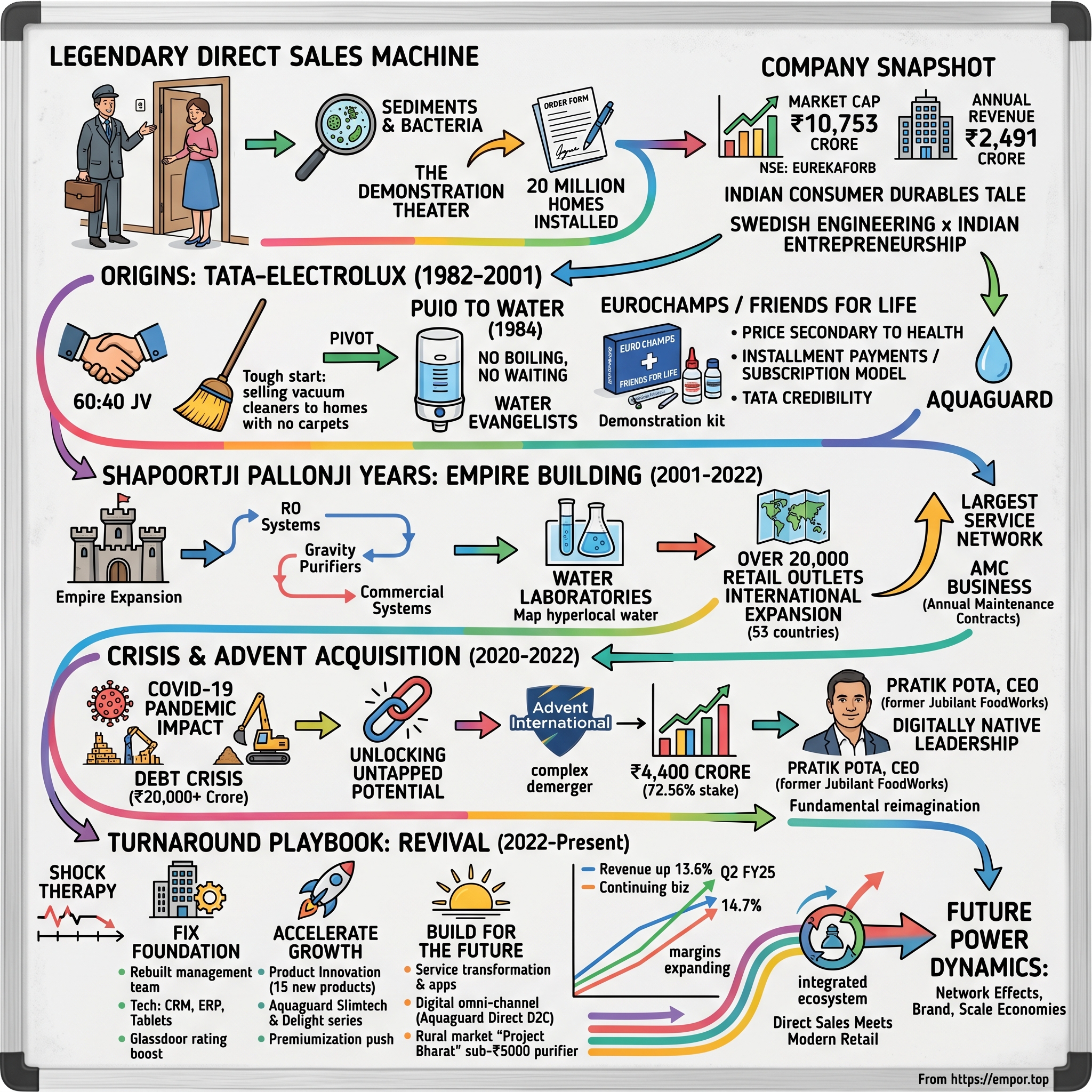
Eureka Forbes: How India's Door-to-Door Salesmen Built a ₹10,000 Crore Water Empire
I. Cold Open & Episode Setup
There is a particular sound that defined middle-class Indian domesticity in the 1990s: the soft electrical hum of a white plastic box bolted to a kitchen wall, a small green LED glowing beside the tap, and the faint gurgle of water passing through a glass tube lit by ultraviolet light. Consumers rarely called it an "ultraviolet water purifier." They called it an "Aquaguard." Many still do. A homeowner in Pune with a competitor's machine on the wall will tell a plumber that the Aquaguard is leaking. A tenant in Bengaluru will ask a landlord whether a flat comes with an Aquaguard, referring to any water purifier.
That represents a rare milestone in consumer branding: the point at which a trademark transitions into the generic term for an entire product category. Xerox achieved it in photocopying, Kleenex in facial tissues, and Band-Aid in adhesive bandages. In urban India, a water purifier brand launched in 1984 by a joint venture between a Tata entity and a Swedish appliance maker achieved it in safe drinking water. Yet category genericization also highlights a strategic risk: it measures how completely a brand once dominated a market, not whether it maintains that lead today.
For roughly a decade, Eureka Forbes illustrated that distinction. The brand enjoyed near-universal recognition while the underlying business stagnated.
Today, the company operates on the other side of a significant corporate restructuring in the Indian consumer durables sector. It trades on the National Stock Exchange and BSE as a standalone listed entity, majority-owned by the American private equity firm Advent International and led by a chief executive brought in from the fast-food industry. The business generates annual revenue near ₹2,500 crore, with EBITDA margins expanding past 11.5% — roughly double their level when private equity acquired control.12 The balance sheet, previously burdened by an overseas acquisition, has shifted to a net-cash position. Public markets value the business between ₹10,000 crore and ₹10,500 crore, implying an earnings multiple that leaves little margin for execution error.
The central paradox of the business lies in its history. Eureka Forbes was built on a distribution model that modern urban infrastructure has largely rendered obsolete. Its founding advantage relied on sending salespeople directly to middle-class homes, demonstrating water contamination on dining tables during afternoon visits. That approach depended on homemakers being present during the day, open access to residential buildings, high societal trust in visiting representatives, and a lack of alternative channels for product discovery. Gated communities with intercom security, dual-income households, e-commerce platforms such as Amazon and Flipkart, quick-commerce delivery services, and changing consumer preferences regarding unannounced visits have dismantled those conditions.
The company that built one of the largest direct sales forces in Indian corporate history had to adapt to the decline of door-to-door selling. Along the way, it navigated a European acquisition that resulted in substantial impairments, a debt crisis at its parent conglomerate that forced its divestment, a private equity carve-out and separate public listing, and new competition from startups selling purifiers designed to minimize routine servicing.
The narrative examines how a direct-sales organization transitioned into a service-led business, why that recurring operational model underpins its valuation, and what factors could challenge the thesis. The analysis moves from the joint venture's origins through the expansion of direct selling, through the Shapoorji Pallonji ownership era marked by domestic market leadership and offshore capital losses, into Advent's ₹4,400 crore carve-out and demerger, through the operating strategy under Chief Executive Officer Pratik Pota, and into the mechanics of the service-subscription model alongside the counter-positioning threats facing it.
The story begins where the company started: with a vacuum cleaner that few Indian consumers had ever seen.
 Subscribe on LinkedIn
II. Tata, Electrolux, and the Door-to-Door Sales Machine (1982–2001)
Picture a Bombay apartment in 1983. The floor is mosaic tile or polished stone, swept every morning with a broom by domestic help and swabbed with a wet cloth. Now imagine a salesman arriving at the door carrying a heavy machine and proposing that the family pay nearly a month of a clerk's salary for an electrical appliance designed to do — louder, and with an added electricity cost — what the broom already does for free.
That was the commercial obstacle Eureka Forbes was created to overcome, and the founders' response shaped the company's operating model for the next four decades.
The enterprise was incorporated in 1982 as a joint venture: 60% owned by Forbes & Company, part of the Tata Group's Forbes Gokak arm, and 40% by Swedish appliance manufacturer AB Electrolux. The arrangement reflected the standard License Raj framework of the era. India's market was closed, import tariffs were high, and a foreign consumer durables manufacturer could not sell directly into the country. It required an Indian partner with manufacturing licenses, local regulatory access, and the capital to build a distribution channel from scratch. Electrolux provided product design and direct-selling experience from international markets. The Tata association supplied institutional credibility, granting sales representatives entry into urban households.
Why the door, and not the shop
A modern viewer might question why the venture bypassed retail stores. In 1983, India's retail infrastructure was ill-equipped to market an unfamiliar appliance category. Organized modern trade did not exist. Appliance retail consisted primarily of small independent shopkeepers with glass counters, ceiling fans, limited floor space, and little incentive to run live product demonstrations for items without established demand.
Demonstration was essential to selling the concept. The EuroClean vacuum cleaner was not a product with an established value proposition; its utility became clear only when observed in action. Salespeople ran the unit across a rug the household believed to be clean, opened the dust chamber, and emptied the accumulated debris onto a sheet of white paper. The visual evidence of dust generated the sale in a way printed promotional materials or store counters could not match.
In 1984, the company applied this direct demonstration strategy to domestic water treatment, introducing Aquaguard — a brand that introduced ultraviolet water purification to Indian households.
Ultraviolet purification technology works by passing water through a quartz tube while a UV lamp exposes pathogens to specific wavelengths of light, altering the DNA of bacteria and viruses to prevent replication. The process neutralizes microbes without filtering physical particles — a critical distinction in a market where waterborne pathogens posed severe public health risks and boiling was the primary alternative. Boiling required expensive fuel, proved labor-intensive, and left water warm.
However, ultraviolet light does not remove dissolved solids, heavy metals, nitrates, or mineral salts that affect taste in groundwater. That technical limitation later allowed competitors using reverse osmosis technology to capture market share as water sources shifted.
The Eurochamp machine
The core operational asset of Eureka Forbes was its direct sales force. The company recruited young representatives branded as "Eurochamps" under the marketing slogan "Friends for Life." At its peak, the field network grew to thousands of agents deployed neighborhood by neighborhood across urban housing developments.
The sales process followed a standardized sequence. Agents carried portable water testing kits containing a simple electrolysis device. When submerged in tap water and activated, the device precipitated mineral content, turning the sample into a dark orange-brown sludge within a minute. While the visual reaction stemmed largely from electrode oxidation rather than toxic contamination, the dramatic display was highly persuasive to homeowners. Demonstrating the same test on purified water yielded a clear result, allowing agents to secure immediate purchase commitments, frequently structured through monthly installment payments to offset the appliance's ₹5,000 price tag relative to a typical ₹4,000 monthly household income.
Four structural conditions enabled this model during the 1980s and 1990s: homemakers were typically home during the day to manage purchasing decisions; residential buildings lacked restrictive security controls; public trust in uniformed representatives backed by the Tata name was high; and alternative product research channels did not exist.
The unit economics of direct selling were advantageous during this growth phase. Sales representatives operated primarily on commission, maintaining a variable cost structure relative to sales volume. Furthermore, each installation expanded an installed base requiring periodic replacement of filter cartridges and UV lamps. Although not formally categorized as a recurring subscription business at the time, this installed base of customer contacts and equipment serial numbers established the long-term enterprise value of the firm.
By the late 1990s, Eureka Forbes held dominant market share in a category it pioneered, built a brand name synonymous with water purification, and accumulated an installed base of millions of households. However, its cost structure and channel strategy remained dependent on a direct sales model built for an economic landscape that was beginning to shift. A subsequent change in corporate ownership would test whether the brand could adapt under new parent company management.
III. The Shapoorji Pallonji Era: Monopoly and the Lux AG Misstep (2001–2021)
In 2001, the Tata Group sold its stake in Forbes & Company to the Shapoorji Pallonji Group, bringing Eureka Forbes into the portfolio of India's prominent construction conglomerate — a family-owned enterprise that built parliament buildings, stadiums, and the Reserve Bank of India headquarters, while holding the largest single shareholding block in Tata Sons. Electrolux exited its 40% joint-venture stake in 2005, making Eureka Forbes a wholly owned subsidiary of Forbes & Company under the SP Group.
For the first decade, performance remained strong. Eureka Forbes maintained a dominant position in ultraviolet (UV) purifiers — holding an estimated market share above 70% in that sub-category — and expanded into reverse osmosis (RO) as India's municipal water quality and sources evolved.
The RO shift, explained simply
Reverse osmosis operates on a fundamentally different mechanism than ultraviolet treatment. Instead of neutralizing pathogens with UV light, an RO system forces water under pressure through a semipermeable membrane with microscopic pores that block dissolved salts and heavy metals. The process produces water that is both free of microbes and low in total dissolved solids — an essential requirement when households rely on mineral-heavy groundwater rather than treated municipal supplies.
That distinction became vital as Indian urbanization accelerated. Across North and West India, declining water tables, industrial runoff, and expanding borewell reliance meant bacterial contamination was no longer the sole concern. UV purifiers could not remove brackish minerals or heavy metals, whereas RO systems could. Crucially for manufacturers, RO technology also created a richer service annuity: because membranes foul, they require replacement every two to three years, while pre-filters and carbon blocks require even more frequent maintenance.
Eureka Forbes adopted RO technology, but failed to defend its market share in the retail channels where that shift was occurring. Kent RO, launched by a former petroleum engineer, aggressively targeted retail stores and television advertising with a focus on mineral retention. Hindustan Unilever's Pureit leveraged its nationwide fast-moving consumer goods distribution network. Both brands reached urban shoppers in electronics showrooms and multi-brand outlets, while Eureka Forbes remained tied to direct home sales in an era when access to residential doorsteps was rapidly tightening.
The Lux International adventure
That channel imbalance was compounded by a significant misstep in capital allocation.
In 2010, Eureka Forbes acquired a 25% stake in Lux International AG, a Swiss direct-sales company operating across Europe, Latin America, and Asia, eventually expanding its ownership to 100% by 2013. The strategic rationale assumed that Eureka Forbes could pair its Indian direct-sales expertise with Lux's international footprint to create a global direct-sales powerhouse across home cleaning and water products.
That premise overlooked a fundamental market shift: direct selling in mature European markets was already in structural decline. The conditions that supported door-to-door selling in 1990s India — low trust in remote commerce, limited retail choices, and a resident homemaker — had dissolved in Western Europe a decade prior, replaced by big-box retail and e-commerce. Eureka Forbes acquired scale in a distribution channel whose contraction was already well established.
Financial reporting soon reflected that reality. Overseas operations deteriorated through the late 2010s, leading to cumulative impairments and write-offs totaling ₹778.32 crore across Lux International AG and its Mauritius holding structure between FY19 and FY21. That sum represented more than a third of the group's annual consolidated revenue at the time — capital that otherwise could have funded domestic retail expansion, product innovation, and service digitization.
The secondary consequences extended beyond the immediate write-offs. International losses drained cash from the core Indian operations, compressed consolidated margins, and triggered credit rating actions, with both CARE and CRISIL lowering their outlooks on the parent entity complex in 2020 as liquidity constrained operations. Rather than generating cash to reinvest in its domestic market, the company was absorbing losses abroad.
The lost decade
Apart from the overseas acquisition, domestic top-line growth stagnated. Annual revenue remained largely flat in the range of ₹2,000 crore to ₹2,200 crore for nearly a decade after 2012. In a market expanding at low-double-digit annual rates, and despite possessing India's most recognized brand in water purification, Eureka Forbes achieved near-zero growth.
This period challenges a common assumption regarding the company's competitive position: that brand recognition alone functions as an enduring moat. High brand equity could not overcome an outdated distribution framework. Consumers recognized the Aquaguard name, but frequently purchased rival units simply because competing brands were available in retail stores when direct sales access was diminishing.
Concurrently, the internal cost structure turned adverse. Over time, the legacy direct-sales network absorbed fixed costs — including fixed salaries, regional management layers, supervisory overhead, and training facilities — even as per-agent sales productivity declined. A variable-cost distribution model gradually morphed into a high-fixed-cost burden servicing a shrinking sales channel.
The culmination of this period was driven by parent-level financial restructuring. Following governance friction within Tata Sons and debt pressures across the Shapoorji Pallonji Group's construction and infrastructure portfolio, the conglomerate sought to sell non-core assets to raise liquidity. Eureka Forbes — cash-generative in its domestic core, rich in brand equity, but operating outside SP Group's core construction focus and underperforming its earnings potential — became a prime candidate for divestment.
For investors, this era demonstrated how a consumer subsidiary inside a leveraged conglomerate can see its capital and managerial attention redirected toward parent-level balance-sheet pressures. The eventual divestment set the stage for an owner whose sole strategic focus was the enterprise itself.
IV. The Advent PE Buyout and Demerger (2021–2022)
Corporate carve-outs follow a recognizable pattern. A sound core business is often constrained inside a parent organization unable to provide the capital or strategic focus it requires. A financial sponsor acquires the enterprise, streamlines operations, and allows the standalone entity to realize its underlying value. The central question for investors is whether the buyer paid for the business as it was or for the turnaround it could become.
In September 2021, Advent International — a Boston-headquartered private equity firm with extensive global experience in consumer and healthcare carve-outs — announced it would acquire a controlling 72.56% stake in Eureka Forbes from the Shapoorji Pallonji Group at an enterprise value of ₹4,400 crore.[^3]
The valuation metrics illustrated the logic of the entry price. Against roughly ₹2,500 crore of annual revenue, the enterprise value represented under 1.8 times sales — a modest multiple for a market-leading consumer brand. Relative to EBITDA, however, the purchase multiple appeared elevated at roughly 25 times, primarily because operating margins had compressed into single digits under conglomerate ownership. This reflected a classic private equity carve-out entry pattern: paying a reasonable multiple of top-line revenue alongside an optically high multiple of depressed earnings, based on the thesis that profitability was constrained by operational neglect rather than structural weakness in consumer demand.
That thesis rested on a tangible operational asset: an installed base of approximately 20 million Indian households, each representing an active appliance requiring regular filter replacements and routine servicing, with customer records already captured in the company's database. Advent was not underwriting a speculative expansion in overall market demand; it was underwriting the systematic monetization of an existing customer base that the prior owner had underutilized.
The demerger mechanics
The transaction structure extended beyond a simple share purchase because Eureka Forbes operated as an unlisted subsidiary of BSE-listed Forbes & Company. The consumer durables business was demerged from Forbes & Company into a standalone entity, with Advent acquiring control through an investment vehicle named Lunolux Ltd. Eureka Forbes Limited subsequently listed on both the BSE and NSE in February 2022, completing the transaction process later that year.[^4]
This structural path had distinct market implications. Existing Forbes & Company shareholders received shares in the newly listed entity, creating an initial shareholder register populated largely by investors who had not actively sought exposure to a standalone water purification business. Such arrangements often lead to initial selling pressure as non-aligned holders exit, allowing the stock price to establish a true market equilibrium well after listing. Because the listing resulted from a demerger rather than a primary capital raise, the company received no fresh equity injection; it gained corporate independence.
What the private equity thesis actually was
Behind the strategic positioning, Advent's operational turnaround rested on four primary pillars, each targeting a specific weakness of the conglomerate era.
First, eliminate corporate friction. As an independent company with a dedicated board and focused financial reporting, Eureka Forbes no longer competed for capital or management attention against a parent group navigating broader debt obligations. Second, rationalize administrative overhead built up over decades of legacy organizational structure. Third, transition the distribution framework from heavy reliance on direct home sales to a multi-channel network spanning traditional retail outlets, e-commerce platforms, and quick-commerce delivery services. Fourth, and most critical to financial returns, professionalize after-sales service into a structured recurring revenue engine rather than treating maintenance merely as a support function.
Carve-out strategies rarely rely on novel concepts. Operational success depends on execution, and execution in this instance turned on executive leadership.
Partial monetization
In February 2024, Advent — through Lunolux — sold approximately 10% of the company in an open-market block trade for ₹979 crore, retaining a controlling position around 62.5%.3
The transaction highlighted significant early capital return. By realizing ₹979 crore for a tenth of the equity, Advent recovered a substantial portion of its original investment while maintaining majority control — a clear signal of value creation in the two years following the carve-out. However, the block trade also established a visible precedent for the sponsor's exit strategy via periodic open-market tranches. Because the remaining stake represents potential equity overhang, public shareholders invest alongside a majority owner whose ultimate mandate is capital realization.
The executive Advent brought in to execute this operational overhaul had spent the previous decade selling pizza.
V. The Turnaround Playbook: Pratik Pota and Project Udaan (2022–Present)
The appointment made sense only in the context of the specific operational problem Advent sought to solve.
In August 2022, Eureka Forbes named Pratik Pota as Managing Director and Chief Executive Officer.[^6] Pota arrived from Jubilant FoodWorks, the master franchisee of Domino's Pizza in India, where he had executed a widely watched operational turnaround — expanding store locations into smaller cities, tightening unit economics, and migrating the bulk of sales to an app-first digital ordering platform. Prior to Jubilant, he spent years in fast-moving consumer goods and beverages at PepsiCo India.
On the surface, fast food shares little with domestic water treatment. Beneath the surface, both operate as distributed service networks bound by time-sensitive physical fulfillment. Each relies on last-mile personnel executing standardized tasks at scale, and each possessed a legacy channel — telephone ordering in fast food, doorstep selling in water purifiers — that required migration to a digital platform without alienating existing customers. Pota's core expertise lay not in water purification technology, but in rebuilding an analog service operation staffed by thousands of frontline workers around software and data.
Aligning the people
The first structural shift addressed governance and incentives. Transitioning from conglomerate oversight to professional management requires structural incentives. The company introduced an expansive employee stock option plan under the banner of "Leadership through Ownership," extending equity grants deeper into the organizational hierarchy than standard practice in Indian consumer durables.
Broad equity incentives present a dual analytical reality. They align professional executives who otherwise lack ownership stakes, serving as a standard private equity tool to tie compensation to enterprise value creation. Concurrently, equity grants introduce share dilution and can artificially elevate reported operational EBITDA if stock-based compensation expenses are excluded from core operating results. For equity analysts tracking margin expansion, evaluating profitability before and after share-based compensation clarifies how much underlying efficiency improvement accrues directly to public shareholders.
Project Udaan
The operational turnaround was organized under a transformation program named Project Udaan — Hindi for "flight" — structured across four primary initiatives.
The first track focused on portfolio premiumization. Entry-level reverse osmosis units had largely commoditized into low-margin appliances relying on standardized membranes and price-based competition — a segment where a company maintaining a national service infrastructure carries an inherent cost disadvantage. Eureka Forbes pivoted the product line upward, introducing connected purifiers that monitor filter health and water quality, instant hot-and-cold water dispensers designed to replace kettles and coolers, alkaline purifiers targeting wellness consumers, and automated robotic floor cleaners under the EuroClean brand.
This premiumization strategy increases average selling prices and gross margins per unit while building product differentiation against unbranded competitors. However, it introduces strategic tension: higher price points narrow the addressable customer base precisely as management identifies low-penetration, price-sensitive households as its primary long-term growth driver. The ultimate success of this strategy will be reflected in unit volume trajectory rather than gross margin metrics alone.
The second track addressed channel restructuring. The legacy direct sales force possessed long-standing customer relationships and local territory knowledge, making abrupt liquidation impractical. Instead, management repositioned direct agents into multi-channel brand advocates while expanding retail reach across e-commerce platforms such as Amazon and Flipkart, alongside quick-commerce delivery services including Blinkit, Zepto, and Swiggy Instamart.
Deploying quick commerce for water purification presents a nuanced dynamic. While consumers rarely purchase a ₹15,000 purifier on ten-minute delivery platforms, replacement filter cartridges represent standardized repeat consumables suited for rapid delivery. This channel offers an opportunity to recapture consumable sales from customers who have lapsed on annual maintenance contracts. Conversely, it exposes the business to risk: quick-commerce platforms also list lower-cost, compatible third-party cartridges, threatening high-margin replacement revenue.
The third track centered on service digitization: replacing paper-based field dispatch with an automated technician routing platform, digitizing maintenance contract renewal reminders, and directing service requests through a mobile application. In a field service network, profitability relies directly on route density and first-time resolution rates — operational variables optimized far more effectively by software algorithms than by manual scheduling.
The fourth track targeted structural costs. Management reduced legacy administrative overhead and consolidated logistics networks, expanding reported EBITDA margins from mid-single digits in FY22 to above 11.5% by FY25.2
Is the margin real?
Evaluating this margin expansion requires distinguishing temporary cost reductions from permanent structural gains, as administrative cuts often emulate operational efficiency before plateauing.
The structural case relies on operating metrics: management achieved the 10% EBITDA margin threshold concurrently with double-digit unit volume growth.4 Margin expansion achieved alongside declining volumes typically indicates business harvesting — reducing brand investment and customer service while raising prices. Conversely, margin expansion paired with expanding unit volumes demonstrates operating leverage across a fixed cost structure previously burdened by excess capacity. Disclosed performance aligns with the latter pattern.
Skeptics note that operational leverage on legacy overhead yields finite returns. Expanding margins from 6% to 11% by eliminating conglomerate inefficiency differs fundamentally from advancing from 11% to 15%, which requires shifting sales toward higher-margin service contracts and premium hardware, or asserting pricing power. Management has moderated expectations by guiding toward incremental annual margin gains of 50 to 100 basis points rather than step-function increases.
In parallel with operating gains, the balance sheet transitioned from net bank debt to a net-cash position supported by consistent free cash flow conversion. This balance-sheet deleveraging stemmed significantly from eliminating loss-making international operations from consolidated results, removing legacy financial drag rather than creating a new competitive advantage.
This leads to the core operational engine of the business: the recurring economics of servicing installed appliances.
VI. Business Model Mechanics: Razor-and-Blade Economics and the AMC Goldmine
Every eighteen months or so, in millions of Indian homes, a light turns amber or an appliance stops dispensing. A technician arrives, unclips a housing, removes a spent sediment filter stained the color of wet clay, replaces it along with a carbon block, inspects the UV lamp and membrane, and leaves within half an hour. Routine servicing lacks the consumer glamour of a new product launch, yet it generates the majority of the company's gross profit.
The revenue architecture
Hardware sales — comprising water purifiers and vacuum cleaners — account for roughly 60% to 64% of total revenue at gross margins between 45% and 50%. Servicing, annual maintenance contracts (AMCs), and spare parts generate the remaining 36% to 40%. However, because service gross margins exceed 65% to 70%, that smaller revenue segment contributes more than 60% of total gross profit.
This margin inversion defines the commercial model. The water purifier functions less as a standalone profit driver than as a customer acquisition vehicle, with hardware sales partially subsidizing entry into a long-term service relationship.
Why the blades are so profitable
Understanding the profitability of maintenance contracts requires examining what the consumer actually purchases with an AMC. A replacement filter cartridge consists primarily of a molded plastic shell filled with activated carbon or spun polypropylene, carrying a modest bill of materials. What the customer pays for is operational reliability: the assurance that when water quality deteriorates, a trained service representative will respond promptly to restore the unit and extend its operating lifespan across a typical seven-to-ten-year cycle.
Because AMC payments are collected upfront for a full year of coverage, the business operates with negative working capital. Customer advances fund ongoing field service operations, allowing the installed base to expand without drawing heavily on corporate cash reserves.
The financial impact compounds over time. On company estimates, initial customer acquisition costs are fully recovered within 18 to 24 months of a hardware sale. Subsequent contract renewals flow predominantly to operating profit, turning an established customer relationship into a recurring annuity.
The distribution and service moat
The defensibility of this model relies on a physical service network that presents substantial barriers to entry: a network of more than 8,000 company-trained service technicians, over 20,000 retail touchpoints, and coverage spanning more than 19,000 postal codes across urban India.
Technician density serves as the primary operational variable driving cost efficiency. A field service network's cost per visit depends on route density — specifically, how many service calls a technician completes daily based on geographic proximity. Across major urban centers, Eureka Forbes maintains the highest installed base density in the industry. An incumbent servicing an installed base of 20 million units achieves lower per-visit labor and transit costs than an entrant servicing two million units, as field personnel spend less time in transit between appointments. Unlike brand recognition, which failed to protect top-line growth during the prior decade, this physical service density provides a measurable cost advantage.
The adjacency: air purifiers
The company's fastest-growing adjacent category has been air purification, where revenue tripled year-on-year during the third quarter of FY25, driven by severe seasonal winter smog in Northern India.5 Despite that surge, the category accounts for roughly 4% to 5% of total sales.
This growth requires nuanced interpretation. A rapid revenue expansion from a small base during an acute environmental season represents a transient demand event rather than an established structural shift. Demand for domestic air purifiers in India has historically proven highly seasonal and weather-dependent, fluctuating sharply between severe and mild winters.
The strategic rationale for expanding in air purification rests on operational leverage: the product line uses the same brand equity, field service infrastructure, and recurring filter-replacement mechanics as water purification. While this shared network offers a low-cost entry into an adjacent consumer market, multi-year through-cycle performance has yet to demonstrate whether air purification will develop into a sustained long-term growth engine or remain a secondary seasonal category.
The broader question facing the business is whether its core razor-and-blade model can remain protected against emerging market alternatives.
VII. Competitive Dynamics and Strategic Frameworks
A single statistic organizes every strategic discussion about the Indian water purification industry: after four decades of category building, fewer than one in ten urban households owns a water purifier, and nationwide penetration remains below 5%.
Viewed optimistically, those figures represent a substantial expansion opportunity in a market growing at a compound annual rate of 10% to 12%. Viewed skeptically, they reflect four decades of evidence that the majority of Indian households find alternative solutions adequate — whether relying on boiling, municipal supply, or 20-liter commercial water cans delivered for ₹40. Both perspectives carry weight, with the industry's ultimate trajectory tied directly to broader household income growth.
The competitive map
The market structure features concentration at the top alongside a fragmented long tail. Eureka Forbes controls roughly 40% to 45% of the overall market, maintaining dominance in ultraviolet systems and strong positioning in major urban centers. Kent RO — privately held, built on its mineral-RO positioning, and dominant across North Indian retail channels — holds approximately 30% to 35%. Hindustan Unilever's Pureit accounts for near 10%, supported by its consumer packaged goods distribution footprint, while brands such as Livpure, Havells, and Blue Star collectively hold another 10% to 12%.
This structure functions as a duopoly at the top, operating in an environment where the market leader's share faced steady pressure from a challenger that executed more effectively across retail trade channels for a decade. Eureka Forbes operates not as an unchallenged monopoly, but as an incumbent defending its market position.
Seven Powers, tested
Evaluating the business through Hamilton Helmer's Seven Powers framework separates the structural advantages that endure from those diminished by market evolution.
Branding remains functional but bounded. Aquaguard maintains strong category mindshare, reducing customer acquisition costs. However, brand equity alone failed to generate sales without retail availability during the prior decade, serving as a customer acquisition discount rather than an absolute barrier to competition.
Scale economies represent the strongest structural advantage in the portfolio, residing in the service network rather than manufacturing. Service technician density across major urban centers provides a per-visit cost advantage that competitors have struggled to replicate at scale, compounding as the installed base expands.
Switching costs exist by design. Proprietary cartridge architecture and appliance electronics ensure that third-party filters may fit improperly or trigger system error states. While this razor-and-blade strategy protects service revenue, its effectiveness is offset by an active grey market in compatible cartridges and independent technicians. Furthermore, engineered lock-in carries regulatory and reputational risk should consumer courts or competition authorities scrutinize compatibility constraints.
Counter-positioning represents a potential strategic threat. Urban Company — the home services platform — entered consumer hardware with its Native water purifiers, positioned explicitly around filters designed to last 3.5 years and eliminate the need for annual servicing.[^9]
Counter-positioning poses a structural challenge because incumbents cannot easily match the offering without undermining their primary profit center. While Eureka Forbes could technically manufacture long-life filters, adopting a model that eliminates annual service revenue would compromise the line generating the majority of its gross profit. Defending the existing service annuity remains the rational response, yet it leaves an opening for new entrants. Moreover, Urban Company enters with an established nationwide network of trained home-service technicians.
That threat remains unproven in scale. The Native brand accounts for a small market share, operates in limited cities, and its long-life filter claims have not been fully validated across a complete replacement cycle under diverse Indian water conditions, where groundwater in Gurugram presents vastly different filtration challenges than municipal water in Mumbai. Nevertheless, the emergence of long-life filters underscores that annual maintenance contracts cannot be assumed to be a permanent, unassailable profit pool. A sustained slowdown in service revenue growth or contract renewal rates during periods of installed base expansion would signal structural pressure on the core model.
Porter's five forces, briefly
Threat of substitutes remains high in lower-income segments, where boiling and bulk water cans offer low-cost alternatives — a dynamic that explains why overall market penetration has remained low. Buyer power is high for initial hardware purchases, where consumers compare multiple brands across e-commerce platforms, but low for post-purchase service, where installed appliance owners have limited options. Industry rivalry is intense in hardware pricing, particularly during promotional sales events that compress operating margins. Supplier power is moderate, as membranes and raw components are sourced from a competitive Asian supply base. Barriers to entry are low for hardware assembly but exceptionally high for nationwide service coverage, reinforcing why operational defensibility resides in the service layer rather than the physical product.
The financial record provides the empirical test for whether these strategic dynamics translate into sustainable returns.
VIII. Financial Deep Dive, Capital Allocation and Management Credibility
A turnaround becomes believable not when the first strong quarter arrives, but when the rationale behind it holds over subsequent periods.
The shape of the numbers
Annual revenue has stabilized near ₹2,500 crore, while net profit has expanded into the ₹170 crore to ₹200 crore range as EBITDA margins reached past 11.5%. Return on equity has recovered toward the mid-teens as legacy impairments from the Swiss acquisition dropped out of baseline calculations.
That accounting transition carries real analytical weight. A portion of the return recovery reflects the cessation of Lux-related write-downs rather than operational gains alone. Removing an impairment cleans up the balance sheet, but investors must separate gains driven by accounting normalization from those generated by expanding core earnings.
What the calls have shown
Earnings calls provide the clearest view of whether management's narrative matches operational execution.
On the fourth-quarter FY24 call, management reported crossing the 10% EBITDA margin threshold alongside double-digit volume growth, framing the gain as structural efficiency rather than discretionary spending cuts.4 The first quarter of FY25 delivered a 40.7% year-on-year surge in net profit to ₹31 crore on 9.4% revenue growth.6 That gap between revenue and profit growth demonstrates operating leverage—costs expanding at a slower rate than sales—driven by a digitized service renewal funnel that captures maintenance contract renewals with lower incremental sales effort.
By the third quarter of FY25, the focus evolved. While headlines highlighted a tripling in air purifier sales, analyst exchanges focused on raw material cost inflation and promotional intensity across modern trade channels.5 These questions highlighted a strategic tension: attempting to move the portfolio upscale while simultaneously offering retail discounts to preserve shelf space risks compressing gross margins before the impact shows up in headline numbers.
The AMC leakage question
Analyst inquiry has repeatedly returned to revenue leakage—specifically, customers who purchase an Aquaguard unit but rely on independent mechanics using lower-cost compatible filter cartridges for ongoing maintenance. Management has pointed to technical countermeasures, such as equipping original equipment filter cartridges with digital authentication chips that verify genuine replacement parts.
While digital authentication provides a concrete technical measure, hardware verification systems face constant risk of reverse engineering in a market with sophisticated informal supply chains. More fundamentally, authentication deters counterfeit consumables, but it does not protect against competitors offering purifiers engineered to eliminate routine servicing entirely.
Reading management's credibility
Chief Executive Officer Pratik Pota has maintained a measured approach to public guidance, declining to project rapid top-line acceleration while committing to steady annual margin expansion of 50 to 100 basis points alongside disciplined volume growth. Meeting modest, defined targets provides a clearer operational signal than missing ambitious forecasts, and management has kept its focus consistently aligned with the strategic pillars established under Project Udaan.
However, two caveats remain. The leadership team's track record spans only a few years and has not yet been tested by a prolonged demand contraction or aggressive market share challenges. Furthermore, previous management regimes also presented coherent growth strategies before international write-offs materialized, indicating that credibility belongs to the current executive team rather than the broader corporate entity.
The ultimate test of capital allocation lies ahead. With positive free cash flow and a net-cash balance sheet, the company's deployment of capital—whether toward share buybacks, dividends, domestic adjacencies, or acquisitions—will demonstrate whether financial discipline reflects an enduring management practice or a temporary phase of the private equity ownership cycle. Given the company's past losses in international expansion, the threshold for evaluating future acquisitions remains high.
IX. Current Risk Radar and the Skeptical Investor Stress Test
A short seller's case against Eureka Forbes would likely focus less on financial statements and more on a single physical reality: a service technician's scooter parked outside an urban apartment complex, accompanied by the question of who ultimately controls the customer relationship inside the kitchen.
The material risks
Service network leakage and counterfeit spares. This represents the primary operational vulnerability because it directly erodes the high-margin profit pool rather than overall top-line revenue. The threat operates on two fronts: unorganized local mechanics installing non-original equipment manufacturer (OEM) cartridges at roughly one-third of the price, and organized home-services platforms offering routine maintenance for installed Aquaguard units. Every appliance migrating to third-party servicing converts a recurring high-margin annuity customer into a one-time hardware purchaser from whom no further margin will be captured.
Regulatory and environmental pressure on RO. Conventional reverse osmosis units reject a substantial portion of input water as brine—frequently 60% to 70% in older domestic systems—sending the majority of treated water down the drain. In a water-scarce environment, this waste has drawn sustained regulatory scrutiny, including proceedings before the National Green Tribunal advocating restrictions on reverse osmosis where source water quality does not warrant it and mandating higher recovery efficiency standards. Adapting through high-recovery membranes and water-saving architectures is technically viable, but increases bill-of-materials costs and research expenditure. Furthermore, any explicit restriction on reverse osmosis sales in municipal areas with low total dissolved solids would constrain a meaningful segment of the addressable market.
Channel transition friction. Restructuring a legacy direct-sales network carries operational friction. De-emphasizing field agents risks localized revenue declines in territories where the sales representative managed the direct relationship, while creating channel conflict if products sell online at lower prices than distributor wholesale rates. Managing this channel shift requires balancing traditional distributor margins against digital expansion without sacrificing sales volume.
The private equity overhang. Advent International's remaining controlling stake of approximately 62.5% represents potential future equity supply. Private equity fund structures mandate eventual liquidity, and the sponsor has already established its precedent by executing an open-market block trade. Consequently, market expectations of future tranche sales can create structural resistance against sustained valuation expansion, irrespective of operational performance.
Valuation asymmetry. At current earnings multiples, the equity pricing reflects an expectation that operational execution will proceed without disruption. This creates an asymmetric risk profile for investors: sustained operational improvement is already embedded in the valuation, while operational hiccups or margin compression risk immediate market re-rating.
The falsification summary
Two central tenets of the historical bull case have been empirically tested by the company's own operating record.
First, the capital discipline thesis—that the enterprise functions as a consistently prudent steward of capital—was contradicted under prior ownership by the Lux International acquisition, which resulted in over ₹770 crore of cumulative impairments. While current management has maintained strict financial discipline focused on domestic operations, the team has not yet been tested by major capital deployment or cross-border acquisitions. Disciplined capital allocation under current management remains an ongoing demonstration rather than an established long-term record.
Second, the brand moat thesis was tested during the decade of top-line stagnation. Near-universal consumer recognition of the Aquaguard name failed to generate revenue growth when distribution channels lagged market shifts. The empirical evidence demonstrates that brand equity alone does not prevent market share loss. A defensible moat claim rests not on brand awareness, but on physical service density, route efficiency, and the structural economics of the installed base—the exact operational areas where current turnaround efforts are concentrated.
X. The Bull vs. Bear Case
Why this wins from here
The bull case rests on four pillars, though they carry unequal weight.
The category runway argument is the weakest despite being the most frequently cited. An urban penetration rate below 10% presents a compelling headline figure, but that figure has remained low for decades. Converting unpenetrated households requires rising middle-class incomes rather than pure operational execution—making low penetration a long-term context for growth rather than an immediate driver.
The service annuity argument is the strongest. Maintenance contracts and spare parts generate roughly 40% of sales at gross margins above 65%, collected upfront, and attached to an installed base of approximately 20 million households with seven-to-ten-year appliance lifecycles. This cash-generative recurring stream funds its own operations, requires limited ongoing capital, and remains defended by a technician density that would take competitors years and substantial capital to replicate.
The execution argument is credible but unproven over a full cycle. Expanding margins past 11.5% alongside double-digit unit volume growth provides clear evidence of operational leverage rather than short-term cost harvesting. However, initial carve-out efficiencies eliminate legacy slack that exists only once, leaving open whether margin expansion remains repeatable as operational low-hanging fruit disappears.
The balance sheet argument is solid but modest. Operating in a net-cash position with consistent free cash flow conversion eliminates debt-servicing friction. Yet cash balances alone do not generate enterprise returns, and capital allocation remains an open question for an organization whose previous major offshore expansion resulted in substantial write-downs.
What breaks it
The bear case centers on three structural threats.
Counter-positioning represents the sharpest risk because the incumbent's profit structure hinders a direct response. If purifiers engineered with multi-year filters shift from a niche alternative to the consumer standard, the high-margin maintenance contracts that generate the majority of gross profit will erode. A business reliant on recurring service revenues cannot easily match maintenance-free hardware without cannibalizing its primary profit pool.
Hardware commoditization poses a slower, steady drag. Entry-level reverse osmosis and ultraviolet units rely on increasingly standardized components, competing on price-focused e-commerce channels where promotional discounting is persistent. An incumbent maintaining a national service infrastructure carries overhead that unbranded hardware assemblers avoid, constraining pricing power in entry-tier appliances.
Valuation amplifies both vulnerabilities. Trading at a premium multiple of earnings, the equity leaves little room for margin slippage or volume growth deceleration. Concurrently, the market must absorb potential secondary share placements from Advent International's remaining controlling stake, creating structural equity overhang regardless of operational trajectory.
The metrics that matter
Three key performance indicators offer the clearest signals regarding the thesis, with the third serving as the primary diagnostic tool.
First, unit volume growth in water purifiers indicates whether retail and digital channel expansion is capturing true underlying demand or if margin gains stem from price increases that sacrifice market share.
Second, EBITDA margin trajectory against management's target of 50 to 100 basis points of annual expansion tests whether operational leverage persists as cost-cutting opportunities diminish.
Third, and most critical, service and contract renewal revenue growth relative to installed base growth reveals the health of the recurring model. If installed appliance volume outpaces service revenue growth, high-margin maintenance contracts are leaking to third-party mechanics, compatible grey-market consumables, or long-life competitors. Conversely, if service revenue keeps pace with or exceeds installed base growth, the operational moat remains intact.
XI. Epilogue, Key Takeaways and Playbook Lessons
The Eurochamp with his testing kit is gone. What he left behind is more valuable than the initial appliance sale: 20 million addresses, 20 million installed units, and 20 million customer relationships that renew or lapse every year without a sales agent ringing a doorbell.
The open question for the coming decade is whether Eureka Forbes can build a broader business around that service infrastructure. Air purification, robotic floor cleaning, and connected home-health devices all plausibly rely on the same technician network and brand trust. The precedent warrants caution — the company's prior attempt to expand beyond its core resulted in nearly ₹778 crore in cumulative write-offs — but the current adjacency logic differs structurally, extending an established domestic network rather than acquiring a contracting foreign direct-sales operation. Whether that strategic distinction holds will become clear as new categories navigate seasonal demand cycles.
Four broader lessons emerge from the company's transformation.
Service is the moat, not the product. In consumer durables, hardware serves primarily as the ticket into the household. Enterprise value accumulates in the recurring service relationship afterward, where true defensibility stems from logistical and route density rather than brand recall alone.
Beware adjacencies that mask core stagnation. The Lux International acquisition was not merely an unsuccessful deal; it was pursued while the domestic core was drifting — precisely when empire-building appears attractive but rarely succeeds. Acquiring scale in a contracting distribution channel relies on the flawed premise that market decline will pause under new ownership.
Carve-outs unlock what conglomerates suppress. The operational turnarounds executed under Advent International did not require insights unavailable to previous owners. They required dedicated management focus, aligned equity incentives, and a mandate to spend on the business rather than service parent-level financial obligations. That pattern demonstrates why carve-outs remain a reliable mechanism for unlocking value in misallocated corporate assets.
When profits depend on routine maintenance, the primary threat comes from maintenance-free alternatives. Counter-positioning does not defeat incumbents merely by offering a better appliance. It succeeds by introducing a business model that an incumbent's economic structure prevents it from copying. The rational response is not to ignore the threat, but to establish new recurring revenue streams before the existing service annuity erodes — a transition Eureka Forbes is currently navigating.
References
-
Eureka Forbes Ltd — Financials, Transcripts and Earnings Call Records, Trendlyne ↩↩
-
Advent's Lunolux Sells 10% Stake in Eureka Forbes for ₹979 Crore — Business Standard, 2024-02-16 ↩
-
Eureka Forbes Q4 Results: EBITDA Margin Crosses 10% Mark — Moneycontrol, 2024-05-24 ↩↩
-
Eureka Forbes Limited Stock Information and BSE Filings (Scrip Code: 543482) — BSE India ↩↩
-
Eureka Forbes Q1 PAT Up 40.7% YoY to ₹31 Crore — Moneycontrol, 2024-08-09 ↩
 LinkedIn
 WhatsApp
 Reddit
 Hacker News
 Email
Email Kindle
 RSS Feed
 Spotify
 Apple Podcasts
 Amazon Music
 Audible
 YouTube