Ethos Limited: Building India's Luxury Watch Empire
I. Introduction & Episode Hook
There was a particular kind of transaction that once defined how a wealthy Indian bought a Swiss watch. It happened in a hotel room in Dubai, in the back office of a Mumbai jeweller, or in the carry-on luggage of a cousin returning from Singapore. Cash changed hands, and no invoice was issued. The warranty card, if one existed, was blank or registered to someone else. If the movement failed three years later, there was no recourse—the brand's Swiss service centre had no record that the watch had ever legitimately entered the country, because it had not.
For roughly four decades after independence, that informal trade was the Indian luxury watch market: real demand served almost entirely outside the formal economy because prohibitive policies made legal commerce nearly impossible. High customs duties and import restrictions meant a Rolex could not be legally retailed in India at anything resembling a global price. So it was not retailed. Instead, it was smuggled, hand-carried, and traded in a grey market where the buyer's only protection was the seller's reputation.
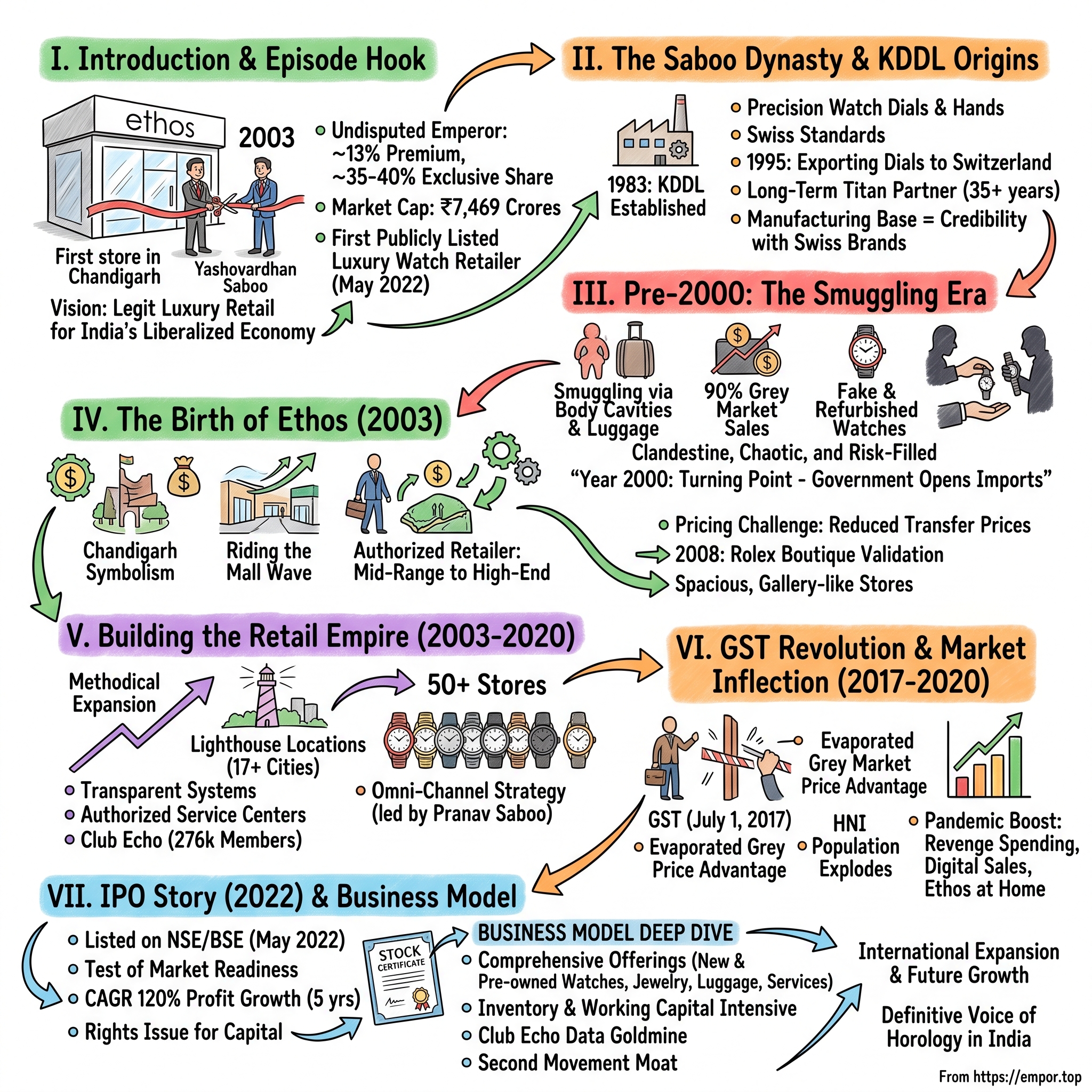
Ethos Limited was built on the bet that this model would change, and that whichever retailer established the trusted, tax-compliant, warranty-backed version of that transaction would build a valuable franchise. By fiscal 2020, the company held roughly a 13% share of India's premium and luxury watch retail sales and about 20% of the narrower exclusive-luxury segment—the largest position of any organised player.1 By fiscal 2026, it operated 98 boutiques across 32 cities and reported consolidated revenue of ₹1,612.2 crore, up 28.8% year-over-year.2
That top-line expansion is fast and substantial, but what makes Ethos compelling to analyze is the underlying divergence in profitability. In the same fiscal year that revenue rose nearly 29%, profit after tax attributable to shareholders actually declined 1.5% to ₹94.8 crore, while normalised EBITDA margin contracted 160 basis points to 11.0%.2 A 26% surge in the Swiss franc against the Indian rupee caused much of that squeeze. Yet currency fluctuations were the proximate cause rather than the core vulnerability. The underlying reality is that Ethos operates as an importer-retailer: it buys inventory in hard currency, holds it over long working-capital cycles, and sells in rupees. That structural exposure is the central hurdle the investment case must clear.
The central question is not whether India's luxury market is expanding—it clearly is—but what kind of business Ethos actually is. Is it a compounding retail platform with genuine economies of scale, a defensible moat in exclusive brand distribution, and a trusted counter-position to the grey market? Or is it a working-capital-intensive distributor that must raise equity to finance inventory, earns a mid-single-digit net margin, and operates at the discretion of Swiss brand owners who retain the power to take retail channels in-house?
The reality contains elements of both models, with the balance shifting over time. This is the story of how Ethos reached this inflection point: from a Chandigarh dial-manufacturing operation founded in 1983, to its 2003 pivot from B2B manufacturing into consumer retail, through structural shifts like GST and pandemic-era travel limits that redirected luxury spending back to domestic boutiques, to a modest 2022 initial public offering, and into a 2023–2026 expansion phase marked by capital allocation beyond watch retailing into Swiss intellectual property, a Dubai trading entity, luggage, and fine jewellery.
 Subscribe on LinkedIn
II. The Origins: From KDDL Precision Dials to Retailing Swiss Horology (1983–2003)
Chandigarh in 1983 was an unlikely base for a precision manufacturing venture, which is precisely why the choice proved effective. Le Corbusier's planned city offered orderly industrial sectors, relatively reliable power by Indian standards of the era, an educated engineering workforce, and none of Mumbai's industrial congestion or Delhi's licensing gatekeepers. Yashovardhan Saboo, an IIM Ahmedabad graduate from a business family, selected the city to establish Kamla Dials and Devices Limited, a supplier of watch dials and hands.
The strategic logic reflected its era. In the licence-permit economy of early 1980s India, the standard path to scaling a manufacturing business was securing supply contracts with a domestic market champion. In timekeeping, that champion emerged in Titan—the joint venture between the Tata Group and the Tamil Nadu Industrial Development Corporation that transformed the domestic watch market. Kamla Dials—later renamed KDDL Limited—spent the next two decades supplying components to Titan while exporting precision dials to Swiss watchmakers, building credibility inside the Swiss horological supply chain.
Yet that credibility requires careful definition, as corporate narratives often overstate its downstream impact on retail.
The market Ethos was eventually built to serve
Through the 1980s and 1990s, legal channels for buying Swiss watches in India were practically non-existent. Prohibitive customs tariffs made authorised retail economically unviable. A timepiece costing the equivalent of ₹5 lakh in Geneva faced steep duties in India, inflating the domestic shelf price so far above international levels that buyers bypassed official channels entirely. Instead, demand flowed through contraband routes, grey-market dealers with opaque sourcing, and overseas purchases by non-resident Indians.
In an unpoliced market for high-value goods, buyer risk mounted. Consumers had no reliable way to verify authenticity, distinguish new pieces from refurbished models with swapped movements, or validate warranty cards. Official after-sales service—vital for mechanical movements requiring periodic maintenance—was unavailable. Every domestic transaction relied almost entirely on personal trust in an informal dealer.
Such structural friction created significant latent value for any operator capable of formalising the trade. In a category where sophisticated counterfeits easily deceive untrained buyers, a retailer's verified guarantee constitutes a primary component of the value proposition. That realization formed the foundational logic of the Ethos retail model.
The 2003 pivot
By the early 2000s, macroeconomic shifts aligned with corporate strategy. Post-1991 trade liberalisation gradually lowered import barriers, making formal luxury retail commercially viable. At the same time, Saboo recognized the economic limitations of component manufacturing. B2B precision manufacturing for major watchmakers carried structural caps on profitability: buyers held greater scale, products were customized inputs, and pricing power remained constrained by the threat of alternative supplier qualification. Operational excellence alone could not unlock superior returns on capital.
Retail presented a contrasting economic profile. Though capital-intensive and subject to inventory risk, retail offered direct access to end consumers. In a market starved of transparency, a trusted customer relationship represented a scarce and defensible asset. In 2003, KDDL launched the luxury watch retail venture that would become Ethos.
Historical falsification: did manufacturing heritage actually confer retail advantage?
The corporate narrative surrounding Ethos often implies that KDDL's Swiss manufacturing heritage provided privileged distribution access and technical authority that competitors could not replicate. That premise warrants rigorous evaluation.
Structural realities challenge the assumption of direct transferability. The procurement divisions buying dials within Swiss conglomerates are distinct from the commercial brand organizations granting retail distribution rights. Watch brands evaluate prospective retailers on commercial criteria: prime real estate access, capital strength, boutique display standards, service capabilities, and brand positioning preservation. A component supply contract offers little leverage in those discussions. Furthermore, manufacturing operations did not generate essential retail assets—such as relationships with mall landlords, luxury merchandising expertise, consumer brand pull, or customer relationship management infrastructure. Retail also introduced working capital demands far heavier than component manufacturing, forcing the group to navigate retail economics through an extended learning curve. Major Swiss luxury conglomerates—including Swatch Group, Richemont, and LVMH—did not grant preferential commercial terms simply because KDDL manufactured watch dials.
Verdict: narrows the claim. KDDL provided two tangible advantages: patient seed capital from an operating cash-flow base and executive access to initial industry meetings. Neither was trivial in an opaque market where credibility served as a primary barrier to entry. However, the operational infrastructure of luxury retailing had to be constructed from scratch, involving substantial capital and initial execution missteps. The evidence supports a narrow conclusion: manufacturing heritage secured introductory conversations, not advantageous commercial terms. Validating a broader advantage would require demonstrating that Ethos systematically secures exclusive brand rights denied to better-capitalized peers—an assertion contradicted by its position on high-volume brands detailed in Section VII.
That distinction between meeting access and structural advantage defined the subsequent decade, as Ethos sought to demonstrate to landlords, brand owners, and consumers that organized luxury watch retailing could operate profitably in India.
III. The Genesis of Ethos & Building Trust in Organized Retail (2003–2016)
In the mid-2000s, pitching Swiss watch maisons required pitching an unproven market. An Indian retailer with no established consumer brand was asking luxury houses for authorized dealerships in a country where the brands' existing domestic footprint consisted of grey-market imports—watches sold without official invoices, serviced by untrained technicians, and bought by untracked customers. From the perspective of a Swiss brand, India represented a minor volume market paired with real reputational risk. The pitch from Ethos relied on a single thesis: an organized, tax-compliant domestic market was about to emerge, and the company intended to build its infrastructure.
After opening its first boutique in Chandigarh in 2003, Ethos placed a store-network bet on India's emerging air-conditioned shopping malls. At the time, conventional wisdom held that affluent Indians would continue buying luxury goods abroad in hubs like Dubai, London, or Singapore, driven by lower prices and guaranteed authenticity. Establishing retail outposts in domestic malls rested on the premise that these two historical advantages of purchasing overseas—price disparities and authenticity concerns—could be systematically neutralized.
Counter-positioning: the price-parity negotiation
The core mechanism enabling this shift was a price-parity negotiation with Swiss manufacturers. Because Indian customs tariffs were high, setting domestic retail prices using standard international wholesale markups would have made Indian shelf prices far higher than those in Dubai or Geneva, driving buyers back to overseas channels. To overcome this, Ethos persuaded brand owners to adjust their wholesale export pricing into India. By accepting lower wholesale margins on shipments to Indian distributors, brands allowed local shelf prices—after accounting for duties and taxes—to match global after-tax prices.
Price parity reshaped customer economics. When local prices equal international rates, buying domestically offers clear advantages: valid international warranties, accessible local service, full tax compliance, and the ability to build purchase history with a local retailer to secure access to limited-production timepieces.
However, this structural alignment relied on a strategic concession by Swiss brand owners. Brands absorbed margin reductions to establish a legitimate Indian retail presence when they lacked direct distribution infrastructure. Such concessions remain valid only as long as the brand owner's strategic priorities align with third-party distribution—a dynamic that becomes central when examining direct-to-consumer transitions later in the story.
Club Echo and the CRM moat
Luxury watch retailing features a heavily skewed customer distribution, where a small cohort of collectors generates a disproportionate share of lifetime revenue. To capture this recurring demand, Ethos created Club Echo, a customer relationship management and loyalty program that grew to contain over 300,000 registered members. Disclosures surrounding the company's initial public offering underscored this reliance on repeat clients, with existing customers generating approximately 41% of sales in fiscal 2022 and nearly 46% in the first half of fiscal 2023.3
The financial logic of this system is compelling: generating nearly half of total sales from an established client base depresses customer acquisition costs for repeat transactions. Furthermore, in a category where growth is often constrained by supply allocations of highly sought-after models rather than buyer demand, maintaining detailed profiles on 300,000 collectors allows a retailer to efficiently place rare inventory with verified buyers.
Yet this database provides an operational efficiency rather than an absolute defensive moat. Loyalty rewards rarely deter high-net-worth buyers from purchasing through rival channels if a competitor secures a scarce reference first. Collectors routinely maintain multi-dealer relationships to maximize their allocation odds, meaning Club Echo reduces acquisition costs without establishing true customer switching costs.
Digital as concierge, not checkout — and Pranav Saboo
The digital strategy of Ethos, led by Pranav Saboo—the founder's son who later became Managing Director and Chief Executive Officer—was built on the recognition that high-value luxury timepieces are rarely purchased through direct e-commerce checkout. Rather than attempting to drive online transactions for five-figure or six-figure items, Ethos structured its web platform as a digital concierge and lead-generation architecture.
The online platform acts as a qualification funnel. Prospective buyers conduct initial research and narrow choices online before being paired with specialized client advisors who arrange in-person boutique consultations. For a business carrying heavy real estate overhead and substantial working capital in inventory, using digital leads to filter high-intent foot traffic enhances both store and sales staff productivity.
Historical falsification: was the expansion playbook ever "unassailable"?
The premise to test is whether Ethos established a smooth, low-risk store expansion playbook during its first decade.
The historical record reveals a more trial-and-error process. Between 2005 and 2012, Ethos opened and subsequently closed several boutiques across high-street locations and secondary shopping centers. Fixed lease expenses outpaced revenue conversion in these sites, while brand assortments failed to align with local demand in smaller urban markets. This operational history highlights a fundamental reality of Indian luxury retail: store economics are sharply sensitive to precise micro-locations. In luxury retail, moving from a primary corridor in an anchor mall to a secondary floor can transform a profitable boutique into a persistent operating drag.
Verdict: rejects the seamless-expansion narrative. The evidence demonstrates that store discipline was acquired through costly trial and error rather than inherited capability. This distinction is critical as the store network scales. The company added 22 boutiques in fiscal 2026 alone, expanding its footprint to 98 stores across 32 cities.2 Pushing into secondary and tertiary cities naturally exposes the network to thinner luxury catchments. The key operational question is whether same-store sales growth can remain resilient across mature locations, or if overall revenue expansion will increasingly depend on adding new stores to offset slowing growth in established boutiques.
Ethos weathered its initial trial period to establish a viable retail network. Yet the catalyst for its next phase of expansion was not internal execution alone, but rather two major external developments—one regulatory and one global health crisis—that fundamentally altered domestic luxury consumption in India.
IV. Inflection Points: GST, Pandemic Luxury Boom, & Omnichannel Shift (2017–2021)
On the night of 30 June 2017, India's Parliament held a midnight session to roll out the Goods and Services Tax. For most businesses, the transition was an onerous compliance challenge. For Ethos, it proved to be a decisive regulatory catalyst. Understanding its impact requires examining how GST reshaped the economics for informal competitors rather than just organized retailers.
Why GST was a competitive weapon
The unorganized luxury trade had long competed primarily on price, sustained by operating outside the formal tax framework without import duties, value-added taxes, or official invoices. GST dismantled this model on multiple fronts. By replacing a fragmented system of state-level taxes with a unified national levy, it eliminated inter-state tax arbitrage. More critically, it implemented a digital invoicing and input-tax credit mechanism in which a business's tax claims depended strictly on its supplier's tax filings. Consequently, cash-based entities operating outside the compliance chain could no longer seamlessly transact with compliant enterprises.
The practical effect was to narrow the informal dealer's price advantage while raising operational risk. As a result, market share shifted toward tax-compliant retailers, since the informal dealer's remaining proposition—a shrinking discount in exchange for no official warranty, no authorized service, and no legal recourse—proved increasingly unattractive to buyers.
This dynamic illustrates a classic counter-positioning strategy. Incumbent grey-market dealers could not replicate the organized retail model without undermining their own cost structures: transitioning to legitimacy required paying statutory duties and taxes, thereby eliminating their sole competitive advantage.
The pandemic: a forced experiment
In 2020, COVID-19 travel restrictions created an unexpected market test: observing Indian luxury demand when overseas purchasing channels became completely inaccessible.
Three dynamics unfolded concurrently. First, overall demand remained resilient. Discretionary spending among affluent Indian households was redirected rather than eliminated, supported by savings from cancelled international travel and asset appreciation in domestic equity and real estate markets. Second, luxury watches increasingly acquired an asset narrative, as global demand drove scarce steel sports models to substantial premiums over retail prices, turning purchases into investment decisions. Third, buyers accustomed to purchasing luxury timepieces abroad turned to domestic channels, discovering that organized local retailers offered global price parity, valid international warranties, and authorized local service.
Ethos adapted by expanding its concierge model to include private home viewings, remote consultations by sales advisors, and direct hand deliveries. This adaptation relied less on novel technology than on operational trust—specifically, deploying high-value inventory outside boutiques required robust client data to identify verified buyers.
These factors drove a substantial step-change in revenue scale, expanding from below ₹400 crore in the pre-GST period to over ₹750 crore during the post-pandemic recovery—a trajectory that ultimately laid the foundation for the company's public listing.
Historical falsification: did COVID permanently relocate Indian luxury demand?
The thesis to evaluate is whether the pandemic permanently shifted Indian luxury watch purchasing onshore.
Skeptics argued at the time that the shift reflected a temporary physical constraint rather than a structural change in consumer preference. Once international travel resumed in 2022, buyers were expected to return to retail hubs in Dubai and Europe to capitalize on value-added tax refunds, duty-free pricing, and lower net costs on major purchases.
The outcome proved more nuanced. Ethos retained domestic market share primarily in categories where it offered access that overseas trips could not guarantee: priority allocations for scarce references, local after-sales support, and established client relationships that improved future allocation odds. For timepieces subject to global waiting lists, a domestic retailer with confirmed inventory allocation wins the customer regardless of international tax differentials. Conversely, for widely available entry-level luxury models stocked by authorized dealers globally, overseas price advantages reasserted themselves once travel normalized.
Verdict: narrows the claim. The permanent shift to domestic retail was real but concentrated in scarce, relationship-driven, service-dependent timepieces—the higher-margin segment of the market. The broader, entry-level segment remains vulnerable to international travel. Consequently, the core thesis is refined: Ethos's defensible position rests not on a blanket shift toward domestic buying, but on capturing purchases that consumers cannot easily execute abroad. Disclosed product mix figures reflect this pattern: in fiscal 2026, luxury and high-luxury models accounted for 71% of watch sales, with a blended average selling price of ₹2.07 lakh.2
With increased scale, regulatory tailwinds, and a redirected customer base, Ethos prepared to access public capital markets.
V. The Public Markets Debut & Capital Allocation Record (2022–2026)
When Ethos made its public market debut in May 2022, investor response was lukewarm. The offer opened on 18 May 2022 and closed on 20 May, priced at ₹878 per share at the top of its ₹836 to ₹878 price band. The issue raised approximately ₹472 crore, consisting of ₹375 crore in fresh capital alongside a ₹97 crore offer for sale.4 The offering was subscribed roughly 1.03 times—a bare pass rather than an endorsement. On its 30 May 2022 listing day, the stock closed at ₹803, down 8.6% from the issue price.5
Timing explained part of that reaction: May 2022 was a turbulent window for Indian initial public offerings as rising global interest rates dampened market sentiment. Yet the cautious reception also reflected analytical skepticism. Investors were being asked to finance inventory expansion. The prospectus listed store expansion and working capital as the primary uses of proceeds—a candid description of the business's capital requirements, but rarely a catalyst for strong market enthusiasm.
The capital raising record, stated plainly
Following its listing, Ethos raised additional equity through a qualified institutional placement, followed by a board-approved rights issue in June 2025 to raise ₹409.90 crore at ₹1,800 per share. The transaction comprised 22,77,250 shares at a 4-for-43 entitlement ratio, with a record date of 12 June 2025 and an execution window from 20 June to 3 July 2025.67 The offering was conducted under the streamlined rights framework established by the Securities and Exchange Board of India (SEBI).[^8]
Executing three equity raises within roughly three years presents a central question for investors: what did that capital purchase, and is the business trending toward self-funding capability?
The optimistic thesis notes that issuing rights at ₹1,800 per share—more than double the IPO price—represented share dilution at a significantly higher valuation than the initial public offering. Furthermore, that capital funded inventory and boutique expansion that directly expanded top-line revenue. In fiscal 2025, revenue reached ₹1,251.6 crore, up 25.3% year-over-year, while net profit grew 18% to ₹98.3 crore and same-store sales expanded 17.4%.8 Fiscal 2026 revenue subsequently grew another 28.8% to ₹1,612.2 crore.2
The critical perspective offers a starker interpretation: a retailer requiring fresh external equity every eighteen months to finance operations is not compounding internal capital—it is intermediating outside capital.
Historical falsification: is Ethos a self-funding cash compounder?
This question represents a pivotal test for the investment case, and the company's financial cash flow history evaluates it directly.
The key evidence challenging the cash-compounder narrative lies in the working capital cycle. Retailing luxury timepieces requires significant inventory depth: brand partners demand comprehensive showroom displays, customers expect wide selection, and an understocked boutique weakens brand equity. Consequently, inventory turns slowly. Ethos reported its cash conversion cycle improving from 215 days to 180 days during fiscal 2026.2 Even at 180 days, roughly six months of cost of goods sold remains tied up on the balance sheet at any moment. When revenue grows by 29%, inventory commitments must expand proportionately, absorbing a substantial share of accounting profit back into stock rather than generating distributable cash flow. Consequently, operating cash flow after working capital changes has consistently lagged EBITDA, requiring equity capital to fund the gap.
Verdict: narrows the claim substantially. The financial evidence demonstrates that Ethos is not currently a self-funding compounder. Rather, it operates as a growth-stage specialty retailer aggregating external capital to expand its inventory footprint and boutique network at respectable, though not exceptional, returns. While this is a recognized expansion model, it should be accurately classified rather than framed as a self-sustaining cash generator.
The revised, testable hypothesis is narrower: Ethos can transition to self-funding if inventory turnover improves with operational scale. The compression of its cash conversion cycle from 215 to 180 days provides initial progress in that direction, making inventory efficiency the essential metric to track. Ethos concluded March 2026 with ₹661.7 crore in cash balances, largely driven by rights issue proceeds.2 The next twelve to twenty-four months will reveal whether this cash funds a new leg of profitable expansion or simply absorbs the working capital requirements of existing operations. If inventory cycle improvements plateau while revenue continues to grow, further equity raises remain mathematically likely.
Ownership, governance, and the KDDL question
Parent company KDDL Limited, alongside Mahen Distribution Limited, maintains the controlling promoter stake in Ethos, holding 50.12% on a consolidated basis following the rights issue. This corporate structure—a listed parent company holding a controlling stake in a listed retail subsidiary while serving as a component supplier—creates a permanent related-party interface requiring continuous evaluation. Although transactions involving component supply, shared corporate services, and real estate leases are fully disclosed and audit reports remain unqualified, disclosure alone does not resolve structural governance misalignments. Minority shareholders face the inherent risk that economic value could be allocated between two listed entities under common control, with promoter participation in rights offerings serving as a mechanism to maintain relative equity ownership during capital raises.
Management assessment
The leadership structure with Yashovardhan Saboo as Chairman and Pranav Saboo as Managing Director and CEO represents an active executive transition rather than a passive generational handoff, with Pranav Saboo establishing the digital and omnichannel framework that supports current operations. In earnings calls, management has maintained consistent focus on key operational drivers—average selling price trends, exclusive brand margins, same-store sales growth, and boutique payback periods. This consistency across reporting periods offers a positive signal, as shifting narratives often mark an eroding business thesis.
A more rigorous test of management discipline involves handling operational headwinds, as demonstrated in fiscal 2026. A 26% surge in the Swiss franc against the Indian rupee—with the exchange rate shifting from approximately ₹96.98 per franc in March 2025 to ₹122.60 by May 2026—inflicted an estimated ₹18.7 crore adverse margin hit, comprising ₹5.1 crore from creditor restatements and ₹13.6 crore in mark-to-market adjustments and cost of goods sold.2 Management provided detailed accounting disclosures, explicitly separating reported EBITDA from normalized performance. Highlighting a normalized EBITDA of ₹182.7 crore alongside reported EBITDA of ₹254.0 crore ensured underlying operational shifts were transparently presented.2 Transparent, decomposed reporting of adverse events reflects sound investor communication. However, forward currency hedging strategy remains an unaddressed risk: an importer structurally short the Swiss franc while expanding annual inventory carries explicit currency risk regardless of intent.
Where that accumulated capital is deployed next represents the most debated phase of the company's trajectory.
VI. Business Model Deep Dive & Operating Segments
A visitor walking into an Ethos boutique in a top-tier mall is effectively standing inside a balance sheet. The timepieces in the vitrines are not held on consignment; in the core retail business, they represent owned inventory, purchased in Swiss francs or euros and carried on the balance sheet until sold. Understanding the company's operating segments requires evaluating which displays earn standard distribution margins and which generate higher economic returns.
The core: authorised multi-brand retail
The vast majority of total revenue stems from the authorised retail of international watch brands—a portfolio encompassing more than 70 brands, including the industry's highest-volume labels. This segment operates on classic distribution economics: the brand house dictates global positioning, sets international retail prices, allocates inventory, and captures the largest share of the value chain. The retailer provides boutique real estate, working capital, inventory risk management, sales execution, and after-sales service, earning a gross margin typically in the low-to-mid twenties on non-exclusive brands.
The key structural reality is that for these non-exclusive labels, Ethos functions as a distribution channel rather than a partner with pricing power. While execution can be strong—as reflected in its leading market share—the commercial terms are dictated upstream by Swiss brand owners.
The margin engine: exclusive brand agreements
The strategic engine of the model lies in exclusive distribution. Ethos holds exclusive Indian distribution rights for a portfolio of independent and haute horlogerie houses—including H. Moser & Cie, Jacob & Co, Urwerk, Bovet, Parmigiani Fleurier, Carl F. Bucherer, and Arnold & Son—and added four more brands in fiscal 2026: D1 Milano, Fabergé, Unimatic, and FPM Milano.2
In this segment, the underlying economics shift favorably. Because Ethos acts as both importer-distributor and retail operator, it captures both wholesale and retail margins, yielding gross margins typically exceeding 30% compared to the low twenties earned on general retail. Furthermore, because these independent brands lack alternative distribution channels in India, the commercial relationship is genuinely interdependent. A small independent Swiss maison producing limited annual volumes cannot economically build its own Indian retail footprint, making Ethos its primary access point to domestic buyers.
This portfolio represents the closest element Ethos has to a cornered resource, though its overall scale remains modest. While these independent labels carry prestige and higher gross margins, they operate at low volumes. They elevate blended gross margins and provide a distinct retail destination—offering references unavailable elsewhere in India—yet they do not generate the sales volume of major global watch conglomerates.
The blended result of this product mix was a gross margin of 29.0% in fiscal 2026, down roughly 100 basis points year-over-year, primarily driven by Swiss franc appreciation.2 While the exclusive distribution strategy functions directionally to lift margins, currency volatility temporarily offset those gains.
Pre-owned: Second Movement
Certified pre-owned retailing, operated under the Second Movement brand, presents a strong strategic rationale alongside unproven standalone economics. Second Movement provides authentication, warranty coverage, trade-in capabilities, and resale services—addressing secondary-market trust in the same manner Ethos addressed primary retail. Strategically, the platform operates as a customer retention mechanism: collectors who can reliably trade in existing pieces tend to upgrade more frequently, bringing repeat foot traffic back into the boutique network.
Historical falsification: is pre-owned a high-margin optionality bet?
The thesis to evaluate is whether Second Movement provides Ethos with a high-margin, scalable option on India's organized pre-owned luxury watch market.
Global market evidence presents a clear counter-argument. Secondary-market prices for highly speculative references—particularly steel sports models from top Swiss manufacturers—declined roughly 30% to 40% from their 2022 peaks. International platforms that acquired speculative inventory at peak valuations suffered severe inventory write-downs, triggering consolidation across the global pre-owned sector. This downturn demonstrates that pre-owned watch retailing is fundamentally a trading operation rather than a stable high-margin retail business, where holding inventory in a declining market creates balance-sheet risk regardless of authentication capabilities.
Ethos largely avoided this downturn because pre-owned sales accounted for a small fraction of overall revenue and the company avoided accumulating a large speculative inventory book. This outcome reflects effective risk management, yet it represents downside avoidance rather than positive value creation.
Verdict: leaves the claim intact but unproven. Pre-owned retailing remains a modest revenue contributor that functions primarily as a sales funnel for new watch upgrades rather than an independent profit center. It is best evaluated as a customer retention tool rather than a standalone growth engine. The critical metric to monitor is whether pre-owned revenue expands materially faster than the core business while maintaining a low balance-sheet inventory footprint. Growth driven by a consignment or trade-in structure would confirm genuine business model value, whereas growth financed through owned inventory would simply extend working capital exposure into a more volatile asset class.
Adjacencies and services
Ethos also retails Rimowa, the LVMH-owned luxury luggage brand, and Messika, the French fine jewellery house, through standalone boutiques. In fiscal 2026, the company restructured this lifestyle division into a dedicated subsidiary in which it retains a 75.05% equity stake, bringing in external equity participation at the subsidiary level.2 This corporate structure isolates capital requirements and operational risk, though it also reduces minority shareholders' proportional exposure to potential upside relative to the core watch business.
The commercial logic of these adjacencies relies on expanding customer share of wallet, offering luggage and fine jewellery to an established base of high-net-worth watch buyers. However, operational skepticism remains justified: luxury watch retailing capabilities do not automatically transfer to jewellery and luggage, which feature distinct supply chain dynamics, inventory velocity, and competitive landscapes. Whether watch distribution relationships provide a meaningful advantage in broader luxury categories remains unproven.
Meanwhile, the company's service network—staffed by Swiss-trained watchmakers across company-operated facilities—represents an essential operational asset. Although direct service revenue remains small, localized after-sales servicing capability is a strict prerequisite for securing brand distribution rights and provides a primary reason consumers purchase timepieces domestically rather than abroad. Consequently, service operations are best understood as foundational infrastructure supporting core retail sales rather than a standalone operating segment.
Distinguishing between independent profit drivers and supporting infrastructure provides the essential framework for evaluating the durability of Ethos's broader business model.
VII. Competitive Landscape, 7 Powers & 5 Forces Analysis
Every competitive analysis of a retailer eventually arrives at an uncomfortable question: is the company competing with rival retailers, or with its own suppliers? For Ethos, the evidence points decisively to the latter, reframing the long-term investment case.
The field
Among organised Indian luxury watch retailers, Ethos is decisively the largest player. Domestic peers maintain focused regional footprints—Kapoor Watch Co in Delhi-NCR with a store count in the low teens, Art of Time in Mumbai, and Johnson Watch Co in Delhi. None approaches the 98-boutique national network operated by Ethos. Against these regional competitors, scale provides tangible operational benefits: a larger store footprint secures broader brand authorisations, enables inventory rotation across locations, commands favorable commercial lease terms, and expands the customer database.
At lower price points, Titan's Helios chain and regional networks like Zimson compete in the ₹10,000 to ₹50,000 segment. This is a distinct market with different consumer demographics and unit economics, operating largely separate from Ethos's blended average selling price of ₹2.07 lakh.
Meanwhile, informal channels and overseas travel remain active alternatives for widely available luxury models.
And then there is the competitor that matters most: the brand owners themselves.
Hamilton Helmer's 7 Powers, applied honestly
Counter-Positioning (Strong). Establishing a tax-compliant, warranty-backed, serviced retail model against the informal trade represents textbook counter-positioning: informal dealers cannot adopt this model without destroying their tax-exempt cost structure. The implementation of GST rendered this advantage structural rather than merely persuasive. This is the most durable strategic advantage in the portfolio, least dependent on ongoing management execution.
Scale Economies (Moderate). Scale in luxury retail provides real but bounded benefits. It delivers commercial lease leverage, inventory rotation flexibility, and fixed-cost absorption across a larger footprint. However, it does not yield purchasing power against suppliers, because Swiss watchmakers ration inventory allocations rather than competing on wholesale volume discounts. A retailer with twice the store count receives greater volume allocation, not lower wholesale unit costs. Calling this power strong would overstate its leverage.
Cornered Resource (Moderate). Exclusive distribution agreements with over 30 independent brand houses constitute a genuine cornered resource within their scope: competitors are legally barred from retailing those brands in India. The scope, however, provides the necessary qualifier: these agreements cover high-prestige, low-volume independent watchmakers.
Switching Costs (Weak). As detailed previously, Club Echo lowers customer acquisition costs for repeat purchases without establishing meaningful lock-in or customer switching costs.
Process Power (Moderate). Integrating digital lead qualification with boutique concierge sales represents an operational advantage built over more than a decade. Because it is organizational rather than purely technological, it cannot be replicated overnight. It represents a genuine operating edge, though a well-capitalized entrant with modern clienteling tools could shorten the learning curve.
Network Economies and Branding (Weak to Absent). While the Ethos corporate brand carries trade credibility, consumers purchase individual watch labels rather than the retail banner. The business model exhibits no structural network effects.
Porter's Five Forces: the asymmetry
Supplier power is high and dominates the analysis. Swiss brand owners control inventory allocation, dictate international retail pricing, enforce boutique display standards, and retain the right to restructure or terminate distribution agreements. Every rupee of retail margin is earned downstream of that upstream authority.
Threat of new entrants is low for prospective domestic multi-brand retailers, given the substantial barriers: capital requirements for inventory, access to prime mall real estate, and brand authorisations that require years to secure. However, evaluating this force solely against domestic peers misidentifies the primary structural threat.
Buyer power is moderate. Individual retail clients possess no pricing negotiation leverage, but they operate with global price transparency and retain the option to purchase during international travel.
Threat of substitutes is low in a conventional category sense. Rivalry among organised domestic retailers is moderate, with Ethos holding the dominant market position.
Historical falsification: does exclusivity give Ethos an expanding structural moat?
Here is the central claim of the retail expansion thesis, and international operating history tests it harshly.
The primary disconfirming evidence is the consistent pattern across international luxury markets: as regional luxury markets mature, major Swiss luxury conglomerates systematically reduce multi-brand dealer networks in favor of directly operated monobrand boutiques. This sequence has played out across North America, Europe, and China. The multi-brand retailer undertakes the capital-intensive work of developing the market and demonstrating local consumer demand, only to be disintermediated in prime retail locations once market viability is established. Major luxury conglomerates—including Richemont, LVMH, and Swatch Group—alongside major independent houses have executed this transition globally. In India, the opening of flagship luxury developments has already introduced directly operated brand boutiques.
Crucially, exclusive distribution agreements do not insulate Ethos from this dynamic because they cover independent houses—such as Jacob & Co and H. Moser & Cie—that lack the scale to build direct retail networks in India. Conversely, core volume and profit drivers are held under non-exclusive authorized dealer agreements—precisely the distribution rights that maturing brand owners reclaim first.
Verdict: narrows the claim sharply, and inverts part of it. The exclusive distribution moat is real but confined to niche haute horlogerie. On core high-volume brands, Ethos holds a revocable distribution license rather than a structural moat. The price-parity wholesale concessions secured during early market development represent strategic allowances that brand owners can withdraw upon assuming direct distribution. Uncomfortably for the retailer, its success in establishing India's formal luxury market serves as the primary rationale for suppliers to eventually enter the market directly.
Falsifying indicators are explicit and observable: announcements of directly operated monobrand boutiques by major luxury houses in prime Indian developments, changes in authorized dealer status for key volume brands, or gross margin compression on the core watch portfolio unlinked to currency fluctuations. Confirming evidence would require securing exclusive distribution agreements for high-volume brands rather than additional niche labels.
Management appears to understand this structural exposure, providing the logical context for the subsequent diversification strategy.
VIII. Strategic M&A & International Expansion: Favre Leuba & Dubai (2023–2026)
Favre Leuba is, by most accounts, the second-oldest Swiss watch brand still in existence, with roots tracing back to 1737. The brand carries a genuine history in India, having enjoyed recognition on Indian wrists during the mid-twentieth century when Swiss timepieces entered through official trade channels. In recent decades, however, it lay dormant, passing between owners without regaining commercial traction.
In 2023, Ethos acquired the brand through its Swiss subsidiary Silvercity Brands AG.[^10] The reported consideration for the brand acquisition was CHF 20,000, and Silvercity installed industry veteran Patrik Hoffmann to lead the relaunch.9
A consideration of 20,000 Swiss francs represents a nominal fee for a dormant trademark portfolio rather than a standard acquisition price. The true financial commitment lies not in the initial purchase, but in the sustained capital required to revive a dormant brand: funding product development, manufacturing, distribution, trade show presentations such as Watches and Wonders, and global marketing—all of which absorb cash for years before generating meaningful revenue.
Why do it at all
The strategic logic connects directly to the structural dynamics of luxury retail. If the primary long-term threat to a multi-brand retailer is disintermediation by brand owners, owning intellectual property offers a structural hedge. While gross margins on non-exclusive retail brands average in the low twenties, brand owners capture substantially higher margins on their proprietary products. Owning intellectual property elevates Ethos within the value chain through an asset that, unlike a third-party distribution contract, cannot be revoked.
Furthermore, ownership leverages a core operational advantage: controlling India's largest luxury watch distribution network provides Favre Leuba with guaranteed domestic shelf space from inception—overcoming the distribution bottleneck that typically undermines independent brand revivals.
Execution to date
Hoffmann relaunched Favre Leuba at Geneva Watch Days in August 2024, introducing 22 models across five collections.10 The Chief collection expanded through 2025, followed by a focus on the Deep Raider line in 2026. In April 2026, the brand exhibited at Watches and Wonders Geneva for the first time—joining just 65 exhibiting brands less than two years after its relaunch—where it unveiled its 1737 collection.10 Management has publicly identified India as the brand's primary market, directing roughly half of its annual production of approximately 4,000 watches to domestic channels, alongside plans to open a standalone boutique in India.1112
An annual volume of 4,000 timepieces represents a boutique-scale operation. Measured against consolidated fiscal 2026 revenue of ₹1,612.2 crore, Favre Leuba remains immaterial to current financial performance—operating as a long-term strategic option rather than an established business segment.
Historical falsification: can Ethos revive a legacy Swiss brand?
The premise to evaluate is whether Favre Leuba provides Ethos with a high-margin proprietary brand and a durable structural hedge against supplier disintermediation.
Disconfirming evidence emerges directly from the brand's corporate history. Titan previously owned Favre Leuba and, despite operating as India's dominant watchmaker with vastly superior marketing resources and distribution scale, failed to establish sustainable global demand. A well-capitalized domestic leader attempted to revive this exact asset without success. More broadly, the historical success rate for non-traditional owners reviving dormant Swiss watch houses is low: heritage yields initial media coverage rather than sustained repeat buying. Furthermore, a consumer spending ₹3 lakh on a luxury timepiece faces established alternatives with unbroken manufacturing histories and liquid secondary resale markets.
An additional operational nuance complicates early metrics: directing half of total production into Ethos's owned store network means initial sell-through figures evaluate channel placement efficiency rather than unassisted consumer demand. Captive distribution naturally flatters early volume metrics.
Verdict: narrows the claim to a speculative option, and raises the evidentiary bar. The strategic rationale is coherent and the initial acquisition cost was nominal, but execution risk remains substantial and historical precedents are cautionary. The key metric to verify is sell-through velocity and reorder rates among third-party international retailers outside the Ethos network, as external wholesale traction provides the sole test of organic brand pull. Without verified third-party distribution growth, Favre Leuba carries negligible current valuation weight in the investment thesis, requiring its ongoing promotional expenditures to be recognized as operational overhead rather than value-accretive capital investment.
Dubai: Ficus Trading LLC
The company's second recent initiative was geographic. Ethos incorporated Ficus Trading LLC in Dubai on 16 April 2025 with paid-up capital of AED 300,000 to trade in watches, clocks, and spare parts, and acquired full ownership.1314 During the same period, it incorporated Micron Watch Services Private Limited in India to extend its technical service infrastructure.14
The Gulf Cooperation Council (GCC) strategy reflects three objectives: capturing luxury demand in the region—including among the sizeable Indian expatriate population; establishing a footprint in a premier global horological trading hub to support inventory sourcing and pre-owned operations; and positioning the business within a key international market that historically drew luxury spending away from domestic Indian retail.
However, analytical skepticism remains warranted relative to the capital deployed. An initial commitment of AED 300,000 establishes a corporate entity rather than a competitive retail market position. Dubai's luxury sector features entrenched incumbents, high commercial real estate costs, and intense competition, leaving Ethos without the first-mover scale it commands domestically. Consequently, this international entity functions primarily as an operational option and sourcing node rather than an immediate growth driver, requiring demonstrated international revenue before contributing meaningfully to valuation models.
Both initiatives share a structural pattern: deploying modest upfront capital to secure strategic optionality. While this approach represents a disciplined framework for capital allocation, it also creates a portfolio of early-stage ventures that demand continuous managerial focus and operational expenditure—a dynamic that requires ongoing tracking against core retail performance.
IX. Primary Evidence & Management Credibility Stress Test
Across fiscal 2024 through fiscal 2026, analyst questioning during Ethos earnings calls consistently converged on a single underlying concern: how effectively top-line revenue expansion converts into free cash flow.
What analysts have pressed on
Four recurring themes dominate these analyst exchanges. The first is the decomposition of growth—specifically, distinguishing organic same-store sales expansion from new store additions. The economic distinction is substantial: same-store growth flows to operating margins with minimal incremental capital, whereas new store openings demand fit-out capital expenditure, upfront inventory commitments, and multi-year payback periods. Ethos has disclosed same-store growth consistently, reporting 17.4% in fiscal 2025 and 14.2% in fiscal 2026, while expanding its retail footprint from 73 to 98 boutiques.82 That divergence highlights a central operational shift: top-line revenue expansion accelerated even as organic store-level growth moderated. This growth pattern remains sustainable only as long as newly opened locations consistently clear their internal hurdle rates.
The second theme centers on inventory duration and working capital intensity, while the third examines management's justification for equity dilution—specifically, why a company reporting expanding profits required ₹410 crore in fresh equity via its 2025 rights issue. Management's rationale focused on accelerating boutique rollouts and funding the required inventory depth. While strategically coherent, that explanation underscores a financial constraint: the company's targeted growth velocity exceeds what its internal cash flow can self-fund.
The fourth theme, emerging prominently in fiscal 2026, concerns foreign exchange vulnerability. The 26% appreciation of the Swiss franc dominated margin discussions, prompting analysts to question whether management will institute systematic currency hedging. Carrying roughly six months of inventory purchased in Swiss francs and euros creates a structural short position in foreign currencies. While hedging incurs transaction costs and limits favorable currency upside, remaining unhedged exposes net profitability to macroeconomic shifts outside operational control. Although no risk-free hedging solution exists, corporate transparency requires a clearly articulated currency management policy applied consistently across reporting periods rather than explained reactively following adverse moves.
Narrative consistency
Evaluated across multiple reporting periods, management's narrative framing has remained consistent, focusing on average selling price expansion, exclusive brand mix, same-store sales growth, store payback discipline, and network expansion. The corporate vocabulary has avoided opportunistic pivots, and operational metrics disclosed in strong quarters have continued to be published during softer periods. In fiscal 2026, management disclosed both reported and normalized EBITDA figures, ensuring that currency-driven margin compression was clearly presented.2
Conversely, the corporate structure has expanded significantly without a matching increase in detailed segment disclosures. Between fiscal 2023 and fiscal 2026, Ethos added a Swiss brand-ownership enterprise, a Dubai trading entity, a 75.05%-owned lifestyle vertical, and a dedicated service subsidiary.214 While each venture remains individually modest, collectively they add structural complexity to the consolidated balance sheet. Segment-level profitability for these non-core verticals remains insufficiently detailed for external investors to evaluate their standalone return on capital—a gap in financial reporting that obscures whether these initiatives generate net economic value or absorb operating cash.
The activist stress test
A skeptical long-short investor evaluating Ethos would construct a bear thesis focused on five structural vulnerabilities:
The margin structure is thin for the operational risk assumed. A net profit margin of approximately 6% provides a narrow buffer for a retailer carrying six months of inventory priced in foreign currencies, operating in premium leased real estate, and relying on inventory allocations controlled by brand owners. The simultaneous arrival of currency depreciation and softening domestic consumer demand would severely compress net earnings.
Return on invested capital is structurally constrained. Although EBITDA margins in the low-to-mid teens are respectable, return on invested capital is the product of operating margin and asset turnover. Capital turnover remains low because inventory sits on the balance sheet for 180 days while boutiques require capitalized store fit-outs and lease liabilities. Enhancing return on capital requires faster inventory velocity or higher-margin exclusive product sales; expanding sales volume alone offers limited leverage because higher sales require proportional inventory commitments.
Revenue expansion has relied on external equity. Executing three equity raises to fund store network expansion creates an effective growth engine only as long as new locations consistently meet return hurdles. The combination of moderating same-store growth and aggressive store openings represents a classic specialty retail pattern that demands close monitoring, even if short-term data does not confirm a multi-year trend.
Corporate complexity creates governance friction. A listed parent company controlling a listed retail subsidiary while acting as a component supplier—combined with a 75.05%-owned lifestyle vertical and offshore entities—introduces structural friction for a retailer generating ₹1,612.2 crore in revenue, increasing the risk of economic leakage between related entities.
Upstream suppliers retain strategic control. Retail execution remains subject to distribution policies, inventory allocations, and direct-to-consumer strategies set by Swiss watch conglomerates.
The counter-arguments are equally distinct. The counter-positioning advantage against the informal market remains durable under GST, the exclusive brand portfolio provides differentiated gross margins, the compression of the cash conversion cycle from 215 to 180 days demonstrates operational efficiency gains, and fiscal 2026 earnings compression was primarily currency-driven rather than operational. Ultimately, the bear case rests on structural constraints, whereas the bull case relies on operational execution—and structural vulnerabilities generally demand a higher standard of empirical evidence to dismiss.
X. Risk Radar & Material Threats
Risk for Ethos is unusually concrete. Rather than abstract macroeconomic exposure, the company faces a small set of specific operational mechanisms that translate directly into line-item pressure.
The working capital trap. With a cash conversion cycle of 180 days, Ethos finances roughly six months of inventory at any given moment. Every rupee of top-line growth demands a proportional commitment of working capital. If borrowing costs rise, inventory carrying costs escalate directly; if consumer demand decelerates, inventory cannot contract at the speed of falling sales. The cash conversion cycle then lengthens precisely when liquidity is most constrained—the primary mechanism by which rapid revenue expansion in specialty retail can deteriorate into balance-sheet distress.
Disintermediation by brand owners. As established previously, supplier disintermediation represents an existential structural threat rather than a cyclical headwind. The mechanism unfolds gradually: a major Swiss brand opens a directly operated flagship store in a city's premier retail location, capturing the highest-value sales and direct client relationships while leaving multi-brand boutiques with residual demand. Rather than arriving as a sudden crisis, profitability steadily erodes while prime store locations become increasingly difficult to defend.
Currency exposure. Fiscal 2026 demonstrated this vulnerability in reported figures: a 26% appreciation of the Swiss franc against the Indian rupee inflicted approximately ₹18.7 crore in margin damage.2 The structural limitation lies in pricing pass-through. Because global price parity underpins the domestic value proposition, Ethos cannot aggressively raise Indian retail prices to offset currency moves without pushing local shelf prices above international levels—reopening the price arbitrage that redirects affluent buyers to overseas hubs like Dubai. Currency risk and core pricing strategy are therefore in direct structural tension.
Customs and regulatory policy. Import duties on luxury timepieces remain a political variable in India, subject to periodic adjustments in the annual Union Budget. Higher import tariffs inflate landed costs across the portfolio; constrained by global price parity, Ethos cannot pass those cost increases entirely to consumers without reinstating the price gap that fuels informal grey-market imports. The same regulatory environment that strengthened organized retail through GST could impair margins under future tariff hikes.
The wealth effect and discretionary demand. Purchasing demand for timepieces priced above ₹2 lakh is directly tied to financial asset prices and wealth sentiment among affluent Indian households. This is inherently discretionary spending. A sustained downturn in equity or real estate markets would quickly depress same-store sales growth, while fixed operating commitments—such as prime shopping mall leases across a 98-boutique network—cannot flex downward on a comparable timeline.
Execution risk in strategic adjacencies. The relaunch of Favre Leuba, the Dubai expansion, and standalone boutiques for fine jewellery and luxury luggage each require dedicated executive oversight and ongoing capital outlays, yet none has demonstrated standalone economic viability. The threat stems less from a single catastrophic failure than from the cumulative financial and managerial drag of multiple unproven initiatives simultaneously requiring years of patient capital.
Taken together, the company's risk profile is structurally interconnected: Ethos operates as an inventory-heavy, currency-exposed, discretionary-demand intermediary in a market where upstream brand owners hold dominant bargaining power. Consequently, a headwind in any single operational area tends to amplify pressure across the others.
XI. Playbook: Business & Investing Lessons
Counter-positioning against the informal economy is the emerging-market moat. In developed markets, retailers build advantages through price, assortment, or logistics. In economies with large informal sectors, the most defensible advantage is legitimacy—valid invoices, international warranties, authorized service, and full tax compliance. An informal operator cannot match that proposition without dismantling its own cost structure. For investors, the corollary is that this moat depends on an active transition: the formalization thesis creates value only as long as formalization is actively taking place.
Working capital intensity is simultaneously a barrier and a tax. The six months of inventory that deters under-capitalized competitors is the same inventory footprint that absorbs operating cash flow. While this working-capital requirement blocks new entrants, the incumbent pays for that protection every year in foregone free cash flow. When evaluating a business whose defense relies on capital intensity, the critical question is whether capital requirements shrink relative to revenue as scale increases. If capital commitments grow in lockstep with top-line sales, the competitive moat functions primarily as a permanent operating cost.
For high-ticket goods, digital functions as a qualification layer rather than a checkout. In transactions ranging from ₹5 lakh to ₹50 lakh, an online platform's primary role is identifying and educating prospective buyers before connecting them with sales advisors. Applying standard e-commerce checkout logic to high-value luxury timepieces misaligns channel strategy with consumer behavior. As ticket sizes rise, digital tools shift from transaction processing to lead qualification, changing the key performance metric from online conversion rates to qualified lead quality.
Distribution generates operating cash flow; brand ownership builds terminal value. This strategic logic underpins the decision to acquire Favre Leuba and applies across specialty retail. A distributor's cash flows remain contractually contingent on a brand owner's ongoing authorization. No matter how effectively a retailer executes, its long-term terminal value carries a permanent discount for that counterparty risk. Owning intellectual property offers the primary structural escape from disintermediation—explaining why successful distributors frequently attempt to build or acquire proprietary brands, and why many fail when operational capabilities in retail do not translate to brand building.
XII. Analysis: Bear vs. Bull Case
The bull case
The macroeconomic demand backdrop forms the primary pillar of the bullish argument. Luxury and premium timepieces represent a significantly smaller share of India's total watch market compared to global averages, while the country's high-net-worth population continues to expand from a modest base. If domestic luxury penetration converges even partially toward international benchmarks over the coming decade, category growth will outpace broader GDP expansion—enabling the largest organised retailer to capture a disproportionate share of that tailwind through its established store network and brand authorisations.
Second, physical real estate assets offer a quiet compounding advantage. Prime luxury mall footprint across India remains scarce and tightly controlled. The 98 boutiques operated by Ethos across 32 cities occupy prime retail locations that new entrants cannot readily replicate without awaiting future commercial developments.2 Paired with a customer database exceeding 300,000 identified luxury buyers, this retail network forms a distribution footprint that requires substantial capital and years of execution to duplicate.3
Third, product mix dynamics continue to shift toward higher-yielding segments. As the exclusive brand portfolio expands, luxury and high-luxury models reached 71% of watch sales in fiscal 2026 alongside rising average selling prices.2 These higher-ticket, higher-margin, relationship-intensive transactions represent the precise category least vulnerable to overseas price arbitrage.
Fourth, operational efficiency has shown initial progress, with the cash conversion cycle compressing from 215 to 180 days.2 If this working capital discipline persists, the central bear objection—that the business requires perpetual equity financing—weakens materially.
The bear case
The primary objection centers on capital reliance: Ethos completed three equity raises following its public listing, relying on shareholder dilution rather than internally generated cash flow to fund expansion. Management justified the ₹410 crore rights issue in 2025 by pointing to the planned pace of boutique rollouts rather than any unique distress or acquisition opportunity.6
The core structural vulnerability remains supplier power asymmetry. International precedents demonstrate that as regional luxury markets mature, Swiss watch conglomerates routinely disintermediate multi-brand retailers by establishing directly operated monobrand boutiques.
Margin fragility became evident in fiscal 2026, when foreign exchange volatility alone proved sufficient to translate a nearly 29% top-line revenue gain into a slight contraction in net attributable profit.2 A business operating with such thin bottom-line buffers retains little operational room to absorb compounding macro or demand shocks.
Moderating organic growth demands close scrutiny: same-store sales growth slowed from 17.4% to 14.2% even as the store network expanded by roughly one-third—the exact operational divergence where a footprint expansion strategy begins to display strain.82
Finally, management is expanding into unproven strategic adjacencies—including brand ownership, fine jewellery, and international trading—without providing granular, standalone segment disclosures to validate their individual economic returns.
Framework synthesis
Synthesizing these strategic frameworks yields a consistent diagnosis. Under Porter's Five Forces, supplier power represents the overarching structural constraint governing every aspect of the retail operation. Under Hamilton Helmer's 7 Powers framework, the company's most formidable asset has been counter-positioning against the informal trade. Yet that advantage represents a finite, one-time transition: once market formalization nears completion, the competitive landscape shifts into a contest among organized players—including the brand owners themselves. Meanwhile, secondary advantages—such as cornered resources in niche exclusive brands, process power in concierge omnichannel sales, and modest scale economies—provide operating efficiency but tend to compress under supplier pressure rather than expand into structural moats.
Relative to domestic peers, Ethos remains the premier organized luxury watch retailer in India, facing no comparable domestic competitor at scale. While this represents an undeniable market advantage, it carries a troubling strategic corollary: the company's ultimate competitive threat comes not from rival domestic retailers, but from the very Swiss conglomerates whose timepieces fill its showcases.
The KPIs that matter
Three key performance indicators carry the primary analytical weight, allowing investors to evaluate the business trajectory directly from corporate disclosures.
First, same-store sales growth. This metric isolates organic consumer demand from top-line expansion purchased through new store capital. It provides the earliest indicator of softening underlying demand or network cannibalization across mature locations.
Second, the cash conversion cycle and inventory duration. This offers a direct test of whether the retail platform is maturing toward self-funding status. Continuous compression as revenue expands validates the compounding thesis; conversely, if working capital days stall or widen during top-line growth, further equity dilution remains the probable outcome.
Third, gross margin evaluated alongside exclusive-brand and high-luxury sales mix. This serves as the clearest proxy for relative bargaining power between Ethos and its upstream brand partners. Should gross margins contract during a period without major foreign exchange shifts, it will signal that supplier disintermediation is manifesting directly in financial performance.
XIII. Epilogue: The Future of Luxury in India
There is one scenario for India's next decade in which the country emerges as one of the world's premier destinations for Swiss watch exports. Demographic tailwinds, expanding household wealth, and the ongoing formalization of retail—the infrastructure Ethos spent two decades building—work in tandem to eliminate remaining structural barriers. In that environment, an operator managing 98 boutiques, holding exclusive distribution rights for more than 30 brands, maintaining a database of over 300,000 identified luxury buyers, and operating dedicated service centers staffed by Swiss-trained watchmakers stands exceptionally well positioned.
There is an alternative scenario in which India reproduces the historical pattern of other maturing luxury markets. A multi-brand pioneer proves market demand, bears the initial capital intensity and execution risk, and subsequently watches major brand owners establish directly operated flagships in top-tier retail developments. Under that outcome, the distributor is left managing niche independent labels, secondary urban catchments, and after-sales service facilities—retaining a structurally lower valuation multiple.
Which path unfolds depends less on India's macroeconomic trajectory—which remains strong—than on whether Ethos can transform its core operating model. The acquisition of Favre Leuba and the establishment of a Dubai trading enterprise represent early efforts to execute that transition, structured with modest upfront capital so that failure is not fatal, though tangible commercial success is not yet evident. Managing Director and CEO Pranav Saboo faces a strategic mandate distinct from the founder's initial build. Yashovardhan Saboo established an organized luxury retail network where legal distribution did not exist. The second-generation mandate requires building a platform that does not rely entirely on third-party brand authorizations, while maintaining sufficient profitability to finance the transition.
The execution record to date supports a measured assessment rather than a definitive verdict. Ethos correctly identified the formalization of Indian luxury retail and constructed a major store network. Yet the company has not yet demonstrated that top-line revenue expansion converts consistently into free cash flow, that strategic adjacencies earn their cost of capital, or that its retail footprint remains defensible against upstream suppliers across a full cycle. These are not fatal objections; they represent the specific operating metrics that subsequent years will test—visible through same-store sales growth, cash conversion cycles, and gross margins.
For a market that spent four decades purchasing luxury timepieces through informal channels, back offices, and duty-free halls, the fact that analytical debate now centers on these operational metrics is itself the truest measure of what has been built.
References
-
Ethos Ltd. — Initiating Coverage — HDFC Securities, 2023-02-13 ↩
-
Ethos Revenue Climbs 29% to ₹1,612 Cr; Profits Muted by Swiss Franc Surge — Trade Brains, 2026 ↩↩↩↩↩↩↩↩↩↩↩↩↩↩↩↩↩↩↩↩↩
-
Ethos IPO Date, Price, GMP, Review, Analysis & Details — Chittorgarh ↩
-
Ethos shares sink 9% over issue price on debut — Business Standard, 2022-05-30 ↩
-
Board of Ethos approves terms of proposed rights issue — Business Standard, 2025-06-07 ↩↩
-
Ethos FY25 Results: 25% Revenue Growth & Luxury Expansion — The Hour Markers ↩↩↩
-
Ethos Unit Acquires Swiss Watch Brand Favre Leuba — MarketScreener ↩
-
Heritage Brand Favre Leuba Returns With New Collection Featuring 22 New Models In Five Families — The 1916 Company ↩↩
-
'We are looking at India as our main market': Swiss watch brand Favre Leuba's CEO — Business Today, 2025-02-20 ↩
-
Favre Leuba to stage India comeback with Ethos — FashionNetwork India ↩
-
Ethos Ltd Buys 300 Equity Shares Of Ficus Trading LLC — MarketScreener ↩
-
Ethos Limited Annual Financial Results and Executive Appointment Announced — InvestyWise ↩↩↩
 LinkedIn
 WhatsApp
 Reddit
 Hacker News
 Email
Email Kindle
 RSS Feed
 Spotify
 Apple Podcasts
 Amazon Music
 Audible
 YouTube