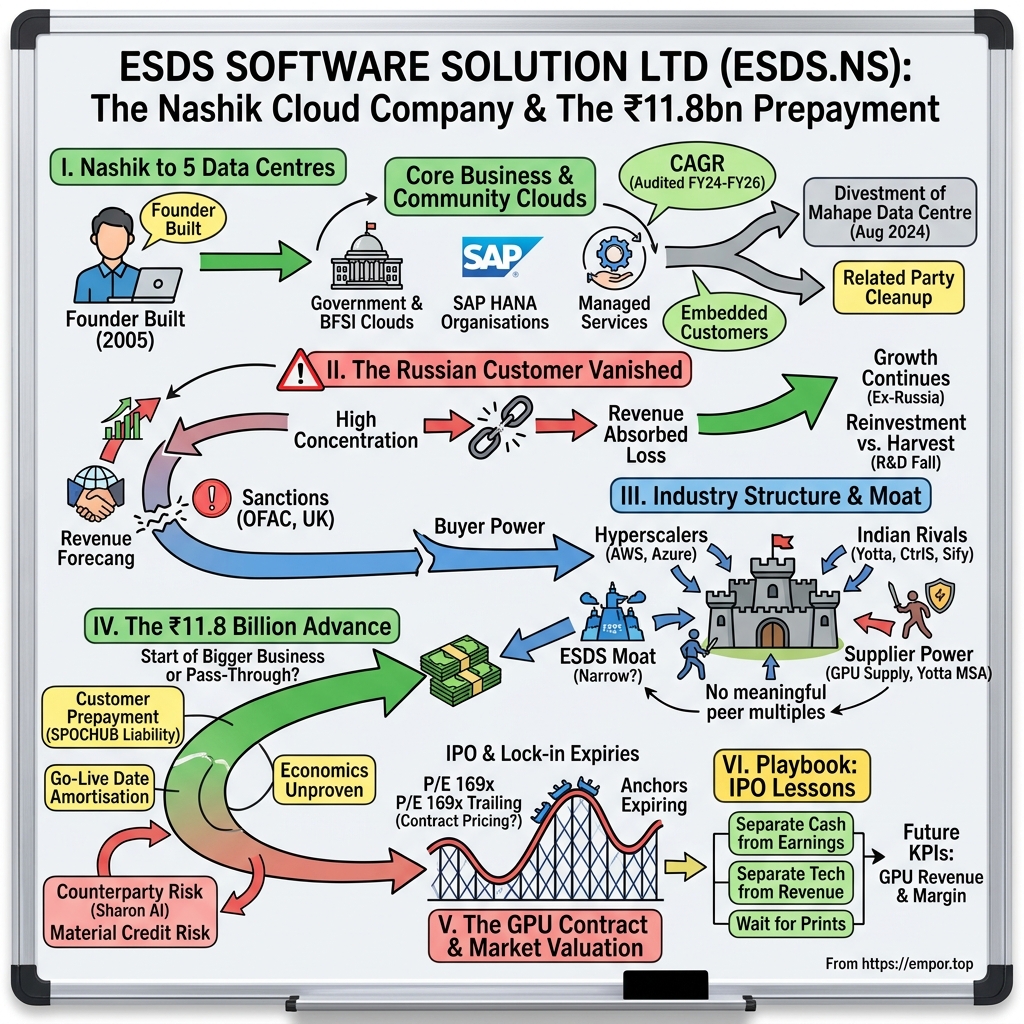
ESDS Software Solution: The Nashik Cloud Company and the ₹11.8 Billion Prepayment
I. Introduction & Episode Roadmap (0:00–8:00, 8 min)
On the morning of 4 September 2026, a company from Nashik rang in its first day as a listed stock. Nashik is known for grapes, wine and temples, not data centres. The company was ESDS Software Solution. Its shares had been offered at ₹429, the top of a ₹408–429 band, and the book had been subscribed 142.88 times.12 Institutions, wealthy individuals and retail investors had put in bids worth well over a hundred times what was on offer, for a cloud company most of them had never heard of a year earlier.
Three weeks later the stock closed at ₹1,703.50, and the next day at ₹1,724.85, about 302% above the issue price. Business Today called it the second-best new listing of the year.3 At roughly ₹1,740, IndMoney put the market value near ₹20,400 crore, about 169 times trailing earnings and about 43 times the last full year's revenue.4 That revenue was ₹472 crore in FY26.1
So the question for this episode is simple to ask and hard to answer. Is ESDS a durable, high-margin cloud infrastructure business that the market has finally found? Or is the market pricing one contract that has not yet produced a rupee of revenue?
The answer starts with a limit. The offer document gives three audited years, FY24 to FY26, and nothing before.1 Every claim about "long-run growth" or "a proven franchise" has to live inside that three-year window. That is short for any company. It is very short for one being valued like a hyper-growth platform.
Inside that window sits a good business. It is small, fast-growing and very profitable by the usual measures. Revenue grew at about 28% a year, and the FY26 EBITDA margin was close to 50%.12 But a market value of ₹20,000 crore is not a bet on that business. It is a bet on something that shows up in the accounts as a liability: an ₹11.8 billion advance from a customer for a GPU project, parked in a 99%-owned subsidiary called SPOCHUB.1
ESDS itself is easy to describe. It is a promoter-run Indian cloud and data-centre company, founded and led by Piyush Somani. It runs five data centres, in Navi Mumbai, Nashik, Bengaluru, Mohali and Noida, and it sells "community clouds" to Indian government bodies, banks and SAP users.1 It is not a hyperscaler. It is closer to a specialist landlord and operator for customers who want their computing in India, under Indian compliance, run by someone who picks up the phone.
Four questions run through the rest of the story.
First, is the ₹11.8 billion advance the start of a much larger business, or a thin-margin pass-through in which ESDS resells someone else's GPUs?
Second, is the core business real once two distortions are removed: a Russian client that vanished under sanctions, and a cash flow statement swollen by customer money?
Third, how exposed is ESDS to customers and suppliers it cannot easily replace, from government buyers to the operator of its Navi Mumbai facility?
Fourth, is a multiple of about 169 times earnings pricing a contract that has not yet started?
The audited record answers some of these. Others stay open, and the story will say which documents would settle them. The place to start is Nashik, twenty years ago, with a founder who chose to build a computing business far from the country's technology hubs.
 Subscribe on LinkedIn
II. From Nashik to Five Data Centres: How a Founder Built an Indian Cloud (8:00–20:00, 12 min)
In August 2005, Piyush Somani incorporated ESDS Software Solution in Nashik.1 The choice of city was odd. Indian technology money and talent were gathering in Bengaluru, Hyderabad, Pune and Mumbai's suburbs. Nashik, about four hours north-east of Mumbai by road, was better known for vineyards than servers. Building a hosting company there meant cheaper land and staff, and it meant selling hard to institutions that did not naturally think of Nashik when they thought of computing.
The offer document says little about those early years, and that silence matters. There are no audited numbers before FY24 in the RHP, and no older series was found in the sources opened.1 What can be said is the corporate skeleton. The company became a public limited company in 2021. It issued bonus shares, ran a rights issue in December 2021, and raised money through preferential allotments at ₹43 and later at ₹220 a share.1 Through all of it, the Somanis stayed in control. There was no sale of the company, no private-equity takeover and no change of promoter.
What ESDS actually sells
Think of ESDS as running two kinds of buildings with a service layer on top.
The first is colocation. A bank brings its own servers, and ESDS gives them a secure, cooled, powered rack in a data centre. The bank pays rent for the space and power, and fees for connectivity and security. It is the digital version of leasing a warehouse with guards and air conditioning.
The second is cloud. Here ESDS owns the servers and rents out computing and storage by the month or by usage. That comes in public, private and community forms, and now GPU-as-a-Service, which means renting out the chips used to train and run AI models.1 On top sit managed services, where ESDS runs the customer's systems, and some software sold as a subscription.
Pricing is set contract by contract, mostly as subscriptions and usage charges. The RHP says ESDS has long-term agreements with some, but not all, of its top ten clients.1 A split of revenue by line, and a figure for how much of revenue is recurring, were not extracted from the RHP. An investor who wants to know how much of the ₹472 crore is sticky subscription revenue has to go to the RHP's business and MD&A chapters for it.
The community cloud idea
The distinctive thing ESDS built is the community cloud. Instead of each small bank or municipal body building its own IT, ESDS builds one shared, compliant platform for a group of similar users. Each gets its own slice, and everyone shares the cost of security, audits and regulatory checks.
By 30 June 2026, that model served 104 government clients, 115 banks and financial institutions across 1,045 branches, 113 organisations running SAP HANA, and six smart cities.1 Those are not glamorous names. They are cooperative banks, state departments and mid-sized firms with SAP systems. But once a small bank's core systems run on a shared cloud built around Indian banking rules, moving is costly and risky. That is the franchise, and it is real enough to show up in the numbers.
Three years of numbers
Revenue from operations rose from about ₹287 crore in FY24 to ₹472 crore in FY26, growth of 26% and then 31%.1 Profit rose much faster, from about ₹14 crore to about ₹121 crore, roughly nine times in two years.1
That profit jump needs unpacking before anyone calls it operating leverage. Two things did much of the work. Finance costs fell from about ₹32 crore to about ₹12 crore as the company paid down debt, and FY24 was a low base with a light tax charge.1 Depreciation grew more slowly than revenue, which also helped. So the business did improve, but the ninefold profit jump overstates how much. The cleaner reading is that revenue compounded at about 28% a year and the cost of capital fell away.
Repairing the balance sheet
The quieter achievement of these years was the balance sheet. Secured borrowings fell from about ₹115 crore to about ₹43 crore between March 2024 and March 2026, mainly through redeeming debentures and repaying term loans.1 Debt-to-equity ended at 0.08.1
The rating agencies noticed. CRISIL moved ESDS from BBB/Stable in June 2024 to BBB+/Positive in September 2025, and India Ratings made the same move.1 That is still the lower end of investment grade. The third agency tells a messier story. Acuité had downgraded ESDS to BB+ in December 2023 and to BB in March 2025, flagging the issuer as "not cooperating", meaning the company had stopped giving it information.1 Such ratings usually reflect a company that has stopped paying an agency for coverage, not new bad news. Even so, a company working with two agencies while another marks it non-cooperative has a mixed record on disclosure, and the rationale documents were not read.
The same period brought equity raises. Preferential allotments at ₹43 and ₹220, the rights issue and pre-IPO placements with funds such as Niveshaay Hedgehog and Bharat Opportunities Fund all brought in new shareholders.1 ESDS paid for growth partly by selling stock, not only by borrowing. The ₹720 crore fresh issue in 2026 was by far the largest raise.12
For investors, the franchise is real but young in the record. Community clouds give ESDS repeat customers with real integration, and the balance sheet is stronger than it was. But three years of history, a profit jump helped by falling interest costs and a financing record that includes regular dilution argue for calling it a good small business, not a proven compounder. Its biggest test in those three years came from a client in Moscow.
III. The Russian Customer That Vanished (20:00–34:00, 14 min)
In FY25, ESDS's biggest customer was not an Indian ministry or bank. It was a Russian financial-services firm. That one client paid about ₹73 crore, 20.15% of the year's revenue.1 For a company of ESDS's size, that is a lot of revenue from one buyer, and the buyer was in a country under Western sanctions.
Then the sanctions caught up. The client was designated under US OFAC, UK and European rules, and in FY26 its revenue fell to about ₹13 crore, 2.80% of the total.1 The RHP also warns of secondary sanctions under the US CAATSA law, which can penalise non-US companies that deal with sanctioned Russian entities.1 In a single year, a client that had been a fifth of the business became a rounding error, and the relationship now carries legal risk on top.
This is the closest thing the record offers to a natural experiment. What happens to ESDS when its largest customer disappears?
The business absorbed it
Total revenue still grew 31% in FY26.1 Strip the Russian client out of both years and the arithmetic is striking. Revenue from everyone else was about ₹289 crore in FY25 and about ₹459 crore in FY26, growth of roughly 59%.1 The lost revenue, about ₹60 crore, equals about a sixth of FY25's total revenue.
That is real evidence of demand. Other customers grew fast enough to cover a hole that size and more. Seven of FY25's top ten clients were still customers in FY26.1
But look at what the figure implies about FY25. If the Russian client was a fifth of revenue that year, then FY25's 26% headline growth was flattered by one account that was already exposed to sanctions. Growth ran uneven and lumpy, driven by large single contracts, not a smooth line of many small wins.
Concentration did not go away
The Russian client's replacement at the top is another large client that ESDS does not name. The top customer was 15.93% of FY26 revenue, the top five about 35% and the top ten about 45%.1 Three years earlier the top client had been only 6% of revenue.1 So concentration rose over the period, dipped slightly, and stays high. The next top client is invisible to outside shareholders, which means an investor cannot judge its credit, its sanctions exposure or its likelihood of staying.
Government as a structural buyer
Government bodies, directly or indirectly, supplied about ₹129 crore, 27.4% of FY26 revenue, down from 34.0%.1 Government is a sticky customer in one sense: once a state department's systems run in a community cloud, few officials want the risk of moving them. But it is a demanding customer in every other sense. Governments re-tender contracts, squeeze prices at renewal and can decide to build their own capacity. The RHP states plainly that nothing in ESDS's contracts stops clients from bringing work in-house.1
Government buyers also pay slowly. Billed receivables and unbilled revenue together were about 35% of FY26 revenue, down from 42% two years before.1 That works out to roughly 130 to 150 days of revenue waiting to be collected. For an infrastructure company that bills monthly, that is long. The loss allowance for bad debts rose from about ₹23 crore to about ₹35 crore over three years.1 The charge was highest in FY25, at about ₹10 crore, and lowest in FY26, at about ₹2.4 crore.1 A falling charge alongside collections the company itself described as "lower" in FY26 deserves scrutiny. The ageing table and write-offs in note 35 of the RHP were not extracted, and they are the documents that would show whether old receivables are being collected or merely carried.
Growing, but harvesting
The more interesting signal is what ESDS stopped spending on. Research and development fell from about ₹12.7 crore, 4.4% of revenue, to about ₹6.3 crore, 1.3%, while revenue rose 65%.1 Headcount fell from 1,091 to 995, and attrition rose from 19.3% to 24.9%.1 Revenue per employee almost doubled, from about ₹26 lakh to about ₹47 lakh.
There are two ways to read that. The generous reading is efficiency: automation and scale let a leaner team run more infrastructure, and employee cost fell from about 30% to 22% of revenue.1 The skeptical reading is harvest: a company shrinking its engineering and research bench just before it plans to multiply its GPU computing capacity about thirtyfold, from 81 to 2,481 teraflops.1 A teraflop is a trillion calculations a second; the jump is like a regional airline ordering a fleet many times its current size while cutting its maintenance crew. The truth probably sits between the two, and the answer will show in service quality and client retention after the GPUs go live.
Currency
One more change hides in the FY26 mix. Revenue earned in foreign currency rose from 5.3% of the total in FY24 to 25.5% in FY26, while foreign-currency costs were under 1% of expenses.1 ESDS has become, in effect, long the US dollar. A weaker rupee helps it and a stronger one hurts it. The hedging policy was not found in the passages read. With the GPU contract likely priced in dollars, this exposure could grow a lot.
So the claim that the core business is sound survives, in a narrower form. The loss of the Russian client showed that demand from other customers is real and growing. It also showed a company whose growth depends on a few large contracts, whose biggest buyers are unnamed or governments, whose receivables run long, and whose research spending is shrinking. That raises a question about the market ESDS actually competes in, and whether anything protects it.
IV. Industry Structure: Who Else Sells Indian Cloud and Colocation? (34:00–50:00, 16 min)
Every Indian IPO prospectus has a page where the company lists its "listed peers" and their valuations. The page is meant to anchor the offer price. In ESDS's RHP, the anchor sinks. The only listed peer is E2E Networks, and its P/E is shown as (819.78), a negative number, meaning E2E had losses on the measure used and the multiple means nothing.1 The other companies ESDS names as competitors, CtrlS, Nxtra (owned by Airtel), Yotta and Sify Infinit Spaces, are private or sit inside larger groups.1
So the first fact about ESDS's industry is that the public market has almost no way to price it. There is no clean comparable. That absence is itself part of the story, and it is why the post-listing multiple has no anchor at all.
The war map
Picture the board as a war game.
At the top are the hyperscalers: Amazon Web Services, Microsoft Azure and Google Cloud. They have Indian regions, enormous engineering teams and the ability to price aggressively. For most generic cloud work, a customer's default choice is one of them.
In the middle are the Indian data-centre builders. Yotta, CtrlS, Nxtra and Sify are building large campuses, often backed by conglomerates or infrastructure capital. Several have moved into GPU clouds for AI. E2E Networks, the listed peer, sells Indian GPU cloud capacity directly.1
ESDS sits in a niche: government and financial-services community clouds, sovereignty and compliance, SAP hosting, and a mid-market that values hand-holding. Its size relative to these rivals, and its market share, are not disclosed in the materials read. That gap matters: nobody can claim ESDS has scale advantages without the scale data.
Porter's five forces
Buyer power is high. The top ten customers supply about 45% of revenue, a quarter comes from government, and nothing in the contracts prevents in-sourcing.1 Large buyers who know they matter negotiate hard at renewal.
Supplier power is real and specific. ESDS's Navi Mumbai data centre runs under a master services agreement with Yotta Data Services, which runs until 14 August 2031 and depends on Yotta's own lease upstream.1 In plain terms, one of ESDS's facilities sits in space controlled by a competitor, which in turn relies on its own landlord. On the GPU side, supply of the newest NVIDIA-based systems, such as the HGX B300 servers ESDS plans to buy, is controlled by a handful of vendors and allocated by them.1
Rivalry is intense. The hyperscalers and the Indian builders all court the same banks and ministries, and the GPU cloud market in particular is filling with well-funded entrants.
Substitutes are everywhere. Public cloud can replace colocation, customers can build their own server rooms, and GPU "neoclouds", specialist firms that rent AI chips by the hour, can replace ESDS's GPU service.
Barriers to entry are moderate. Building data centres needs capital and approvals, but capital is available, and several rivals have raised more than ESDS.
The five forces point to a tough, capital-heavy industry where buyers and suppliers hold much of the power.
Helmer's seven powers
Hamilton Helmer's framework asks what lets a company earn more than its cost of capital for a long time.
Switching costs are ESDS's best candidate. A cooperative bank running its core banking on a community cloud, or a company whose SAP HANA system sits in ESDS's racks, faces real cost and risk to move. But the evidence is indirect. ESDS does not disclose customer retention, net revenue retention or contract lengths.1 The strongest disconfirming evidence in its own record is that seven of the top ten FY25 clients stayed, which means three did not, including one lost to sanctions.1 Switching costs are plausible, but not measured.
Scale economies are modest. ESDS runs five data centres, and its rivals are building bigger ones.
Counter-positioning is weak. The hyperscalers could offer sovereign, compliant Indian clouds if they chose, and some already do.
Cornered resource could be the government and bank relationships and the compliance certifications, but government buyers can and do add vendors. Approvals are a licence to compete, not a moat.
Network effects, brand and process power do not show up in the evidence.
The margin puzzle
Here is the tension. ESDS's FY26 EBITDA margin was 49.6%, ROCE 32.8% and ROE 25.1%.2 Those are the numbers of a company with a moat. But press-reported guidance of ₹2,260 crore in FY27 and ₹4,580 crore in FY28 implies an EBITDA margin near 20.6% by FY28.3 If that is right, ESDS's own path points to margins halving as the GPU business grows. That is what you would expect if the new business is lower-margin capacity resale, not an extension of the community-cloud franchise.
Capex tells the other side. Spending on property and equipment rose from about 8% of revenue in FY24 to 31% in FY25 and 27% in FY26, funded first from internal cash and now from the IPO, which set aside ₹576 crore for data-centre and cloud and GPU equipment.12 The company is investing heavily for a competitive fight, not collecting rent from a secure position.
The moat, then, is narrower than the margin suggests. The community-cloud franchise has plausible switching costs and useful compliance positioning, and a quarter of revenue now comes from overseas, which shows the service can sell beyond India. Against that sit powerful buyers, a competitor as landlord, well-funded rivals, and no disclosed retention data. The claim stays intact but unproven. And the high margin that is supposed to show the moat is precisely what the new GPU business may dilute. That new business started with a transfer of money.
V. The ₹11.8 Billion Advance: Start of a Bigger Business or a Pass-Through? (50:00–72:00, 22 min)
Look at ESDS's balance sheet on 31 March 2025 and then on 31 March 2026. In the first, cash and equivalents were about ₹61 crore. In the second, they were about ₹1,253 crore, roughly twenty times as much.1 A company with ₹472 crore of annual revenue did not earn that. A customer sent it.
The RHP describes it in one flat sentence: the subsidiary SPOCHUB Solutions "has received an advance of ₹11,766.35 million", to be "amortised after the go-live date".1 That is about ₹1,177 crore, paid in advance for a GPU project that had not yet gone live when the books closed.
Earnings versus customer money
The trick with this advance is that it makes the cash flow statement tell a story the income statement does not.
Across FY24 to FY26, ESDS earned a cumulative profit of about ₹190 crore. Its operating cash flow over the same three years was about ₹1,583 crore.1 Most businesses would kill for cash flow eight times profit. But almost all of the gap is one line: an increase in "other current liabilities" of about ₹1,181 crore in FY26, described as "advances from customers of new project".1
Remove it and the picture is ordinary. Operating profit before working capital changes was about ₹517 crore across the three years, and trade receivables absorbed about ₹96 crore of that.1 Before the advance, cash generation ran at about 1.0 to 1.4 times profit, mostly because depreciation of ₹53–64 crore a year is a non-cash charge.1 In FY26 alone, operating cash flow excluding the advance was about ₹191 crore; after about ₹126 crore of capex, free cash flow was around ₹65 crore.1 That is a healthy number for a company this size. It is not the ₹1,200-crore cash machine a glance at the cash flow statement suggests.
Customer prepayments are a liability. ESDS owes the customer a service, and every rupee of that advance will be "settled" by delivering GPU capacity. If the costs of delivering exceed the advance's share of revenue, the cash goes out of the door. It is money held on behalf of the customer, not money that belongs to shareholders.
There is also a small accounting side-effect. Interest earned on that pile after March 2026 will lift other income. Other income was 25% of pre-tax profit in FY24 and only 5% in FY26.1 If it jumps again in FY27, investors should recognise interest on customer money, not operating improvement.
Who is the customer?
The RHP does not name SPOCHUB's customer. A document filed in the United States offers a clue that complicates the story.
Sharon AI, a US-listed-aspiring GPU cloud company, filed a registration statement (Form S-1/A) with the SEC in 2026. In it, Sharon AI describes ESDS as a customer buying capacity on 8,000 NVIDIA B300 GPUs for about US$1.25 billion over five years.5 If that is the same deal, ESDS is not only a seller of GPU capacity. It is also a buyer, committed to purchase capacity from Sharon AI, which it would presumably resell to its own customer through SPOCHUB.
That changes the economics completely. In a resale model, ESDS's margin is the spread between what its customer pays and what it owes Sharon AI, which could be thin. IndMoney reported that the arrangement includes a letter-of-credit or bank guarantee requirement of about US$140 million, and a 36-month bar on termination for convenience.4 Both come from a secondary source and need confirmation in primary documents.
The RHP and the S-1 have not been reconciled in the documents read. It is possible that the advance and the Sharon AI deal are two ends of the same chain. It is also possible they are separate. The honest statement is that it is not known who pays ESDS, for how many GPU-hours, at what price, and against what commitments ESDS itself has made.
Counterparty risk runs both ways
Sharon AI's filing itself flags material counterparty credit risk and says it had not yet closed binding financing.5 So the chain may run from an unnamed customer through a 99%-owned Indian subsidiary to a US company that is still raising the money to build the capacity. Each link has to hold. If Sharon AI's financing fails or is late, go-live slips and the advance cannot be recognised as revenue. If ESDS has given a large guarantee, a problem upstream could hit its own balance sheet.
The contingent liabilities give a partial view. At March 2026, ESDS reported contingent liabilities of about ₹55 crore, 10.4% of net worth, of which about ₹53 crore were performance bank guarantees given to customers.1 A guarantee of US$140 million, if confirmed, would be many times that. Its absence from the March 2026 table suggests either that it came later, sits somewhere else, or does not exist in that form. Only the agreements would settle it.
The litigation schedule adds two items whose nature was not read: a material claim of about ₹25 crore against the company and one of about ₹18.5 crore against promoters and directors.1 Neither is large relative to the new balance sheet, but both are worth reading before trusting the promoters with it.
The related-party thread
Now for the detail that turns this from a commercial question into a governance one. SPOCHUB, the subsidiary holding the advance, is 99% owned by ESDS. Piyush Somani holds 0.5% of it personally, and he lent it ₹1.2 crore unsecured, repayable on demand.1 The RHP states that related-party dealings are at arm's length and audited for transfer pricing.1
The stake is tiny. But the subsidiary is about to handle a contract worth more than twice ESDS's annual revenue. Why does the chairman own any of it personally? A small promoter stake in the entity where the value sits is precisely what minority shareholders should ask about, even when the numbers are small and the accounts eliminate intra-group flows.
Related-party transactions in total ran at about 5% of revenue in FY24, 24% in FY25 and 10% in FY26.1 Much of this is intra-group and cancels on consolidation. Two other items are worth knowing. ESDS paid rent to its former subsidiary ESDS Internet Services, owner of the Mahape data centre, of about ₹6.8 crore in FY24 and ₹3.0 crore in FY25. The subsidiary was divested on 29 August 2024 and the sublease ended on 30 September 2024.1 ESDS also lent about ₹4.3 crore to its Dubai subsidiary, ESDS Cloud FZ.1 Selling the Mahape entity cleaned up one related-party flow. It also means a data centre the group once controlled now sits outside it, and the buyer and price were not extracted.
Capability is not commercialisation
The technical case is real. ESDS runs GPU cloud services today, has a plan to buy 20 HGX B300 servers and 80 cloud servers with IPO money, and will expand capacity from 81 to 2,481 teraflops.1 It has a customer willing to pay in advance.
But the company's record of turning technical launches into revenue cannot be tested. The RHP does not break out GPU revenue, and there is no history of past GPU projects to compare with. The best available reading is that ESDS has shown it can win a very large contract. It has not shown that the contract makes money.
Three documents would settle this: the SPOCHUB customer agreement (price per GPU-hour and termination rights), the ESDS–Sharon AI agreement and any guarantees, and the go-live date. After that, H1 FY27 GPU revenue and gross margin will be the first real test.
For investors, the advance is the fulcrum of the whole case. It could be the start of a business several times the size of today's ESDS. It could also be a low-margin resale arrangement that fills the top line and adds counterparty risk. Which it is depends a great deal on the judgement of the family running the company.
VI. The Founders in Charge: Incentives, Pay and Credibility (72:00–84:00, 12 min)
When ESDS filed its final prospectus, the promoter family held 46.06% of the company, and the P.O. Somani Family Trust held 11.19% of that.1 After the IPO, the promoter stake fell to about 39.47%.2 The family's average cost of its shares is effectively zero, built up through founding capital, bonus issues and a rights issue at ₹1 a share.1 At a share price near ₹1,700, their stake is worth several thousand crore rupees.
That is the context for judging the people now in charge of a balance sheet about five times its size a year earlier.
The people
Piyush Somani is chairman and managing director, the founder who has run ESDS since 2005.1 Little about his personal background appears in the documents read, and this story will not guess at it. What the record shows is a founder who kept control for twenty years, built in a city without a technology cluster, and bet the company on government and banking clients before pivoting towards GPUs.
Komal Somani serves as a whole-time director.1 N.S. Ramaiah is chief financial officer. Sameer Redij, chief business officer, joined the board in FY27.1
Pay against profits
Piyush Somani's pay rose from about ₹84 lakh in FY24 to about ₹1.47 crore in FY26, roughly 75% higher.1 Profit rose about ninefold over the same period. Komal Somani's pay rose from about ₹46 lakh to ₹78 lakh.1 The CFO's pay fell, from about ₹71 lakh in FY25 to about ₹54 lakh in FY26.1
These are modest sums for a company now worth ₹20,000 crore. Pay did not race ahead of profits. There is also no promoter pledge.1 Both point to a family whose wealth is in the shares, not in salary, which usually aligns them with minority holders.
ESOP 2021 and ESOP 2024 exist, and an employee trust holds 1.29%.1 The number of options outstanding was not extracted, so dilution from them cannot be judged.
The record on capital
The capital-allocation record has three clear moves: debt cut by about 60% in two years, the Mahape subsidiary sold, and capex stepped up sharply. Research was cut at the same time.1 No buybacks, open offers or delisting attempts appeared in the RHP sections opened. The pattern is of a company that fixed its balance sheet, sold equity when it needed growth money, and is now putting a large new pile of capital to work in a single direction.
The governance picture is incomplete. The board has three independent directors, Dhandapani, Pamela Kumar and Venkatesh Natarajan, alongside three executives.1 Full board composition was not verified. The RHP records no auditor modifications on the restated statements for FY24–FY26.1 The CARO remarks on the statutory accounts, AGM voting results and the KMP attrition table were not read.
Credibility has no track record yet
There is no guidance history to test. ESDS has been listed for three weeks. The FY27 and FY28 revenue figures floating around are press-reported, sourced to sell-side commentary, and have not been found in any company filing.3 The Q1 FY27 results were reportedly approved on 24 September 2026, and any first analyst call is the most important primary evidence to come. Investors should listen for direct answers on who the GPU customer is, what margin it earns, and when it goes live. Vague answers on those three points would be information in themselves.
The balance is clear enough. Modest pay and no pledge support alignment. The SPOCHUB stake, the Dubai loan, the past Mahape rent and a sanctions-hit top client argue for caution. Credibility will be earned by executing the GPU contract, not by the IPO's subscription number. And that is precisely what the market is already paying for.
VII. Frameworks & Bear vs. Bull: Is 169x Pricing the Contract? (84:00–100:00, 16 min)
At ₹429, ESDS was valued at about ₹4,308 crore before the issue and about ₹10,647 crore after it, roughly 36 times FY26 earnings per share of ₹12.03.2 That was already a full price for a small infrastructure company. A week after listing, at about ₹1,740, the market value was about ₹20,400 crore, and the trailing P/E was about 169 times.4
Nothing changed in ESDS's audited history between the bidding and the listing. The same FY26 revenue, the same margins. What changed was that the market, having bought the shares, decided to capitalise the GPU contract.
How to read 169x
One way to see what 169 times earnings assumes: at that multiple, an investor who wanted a 10% earnings yield would need profits to rise roughly seventeenfold. The press-reported guidance of ₹4,580 crore of revenue by FY28, at the implied margin near 20.6%, points to EBITDA of roughly ₹940 crore, against about ₹234 crore in FY26.32 That would be a very large jump, and it depends entirely on the GPU contract going live, running at the assumed price, and being renewed. There is no peer multiple to test this against, since the only listed comparable has negative earnings. And the company has no valuation history of its own.
The bull case
The bulls have real evidence. Revenue grew 26% and then 31% while headcount fell.1 EBITDA margin was about 50%, ROE 25% and ROCE 33%.2 Net debt became net cash, and two rating agencies upgraded the company.1 A customer has prepaid about ₹1,177 crore, which is a statement of serious commitment. New equity will fund the build-out, and the IPO book was subscribed more than 140 times.2 If ESDS is becoming India's sovereign GPU cloud, the 2026 price may prove to be early.
The bear case
The bears have stronger evidence on some points. FY25 growth leaned on a client that then fell by about 82%.1 The implied FY28 margin is less than half today's. The advance is a liability, not earnings. The customer relationship has not been reconciled between the RHP and Sharon AI's S-1, and Sharon AI has not closed its financing.5 One data centre depends on a competitor's lease. Foreign-currency revenue is a quarter of the total, and sanctions risk has already cost a client. Receivable days are long.
And there is supply of stock to come. The anchor investors took ₹216 crore, 30% of the issue.1 Anchor and pre-IPO lock-ins expire at 30 and 90 days after allotment, which will put a large pool of shares in the hands of holders who bought at far lower prices.1
The short-seller's four questions
A skeptical long/short investor would press four points.
First, who is the real end customer, and does ESDS carry the credit risk of both its customer and its supplier?
Second, how does a 49.6% margin become 20.6%, and does that mean the GPU business earns close to nothing after depreciation and interest?
Third, why did R&D fall as revenue rose 65%, and is the company skimping on the people it needs for a thirtyfold capacity build?
Fourth, why does the chairman personally own 0.5% of the subsidiary holding the largest contract in the company's history?
None of these proves wrongdoing. All of them would need clean answers before a sophisticated buyer paid 169 times earnings.
The risks that matter
Contract credit and financing risk. If Sharon AI or the end customer fails, ESDS may face a liability it cannot pass on, and perhaps a guarantee call.
GPU pricing and supply risk. GPU rental prices can fall fast as new chips arrive. If ESDS has committed to a five-year purchase at a fixed price and its customer's price is renegotiated, the spread can vanish.
Sanctions and concentration risk. A single top client can move revenue by a sixth, as FY26 showed.
Government risk. Budget cuts, re-tenders and in-sourcing can hit a quarter of revenue.
Currency risk. A stronger rupee cuts rupee revenue from dollar contracts.
Execution risk. Scaling capacity about thirtyfold with a shrinking workforce is a hard operating task.
Two numbers to watch
Two KPIs will say more than anything else.
The first is GPU-line revenue and gross margin after go-live, together with the unwinding of the advance. Today it reads zero revenue against about ₹1,177 crore of advance. When revenue appears and the advance shrinks, the margin will show whether this is a business or a pass-through.
The second is concentration and retention in the core business: top-ten client share, now about 45% and roughly flat over two years, alongside receivable days of roughly 130 to 150.1 If the core community-cloud business keeps growing while concentration falls and collections speed up, the franchise claim strengthens.
On the evidence available, the market is paying for the contract, not for FY26. Nothing in the audited record supports 169 times earnings on its own. The claim that the contract justifies the price is unproven until H1 FY27 shows revenue and margin from the GPU line. The episode offers some broader lessons along the way.
VIII. Playbook: Business & Investing Lessons (100:00–110:00, 10 min)
Picture the ESDS story as a set of screens on a trading desk. One shows a small, profitable Indian cloud company with ₹472 crore of revenue. Another shows a cash flow statement with more than ₹1,500 crore of operating cash over three years. A third shows a share price up 302% in three weeks.3 All three are true. They are just measuring different things.
Customer prepayments are not free cash. Three years of profit came to about ₹190 crore, and three years of operating cash flow to about ₹1,583 crore.1 The gap is money a customer paid for a service still to be delivered. The right question about any prepayment is what the liability will be settled with, and what it will cost to deliver.
Concentration can hide inside a growth rate. ESDS's FY25 growth looked healthy. It was partly one Russian client that was a fifth of revenue and then almost vanished. The FY26 growth ex-client was faster than the headline. Both numbers mislead unless you check the top client.
Small related-party interests deserve reading. The chairman's 0.5% of SPOCHUB and his ₹1.2 crore loan to it are trivial in rupees. They matter because of which entity they sit in. A disclosure note that looks immaterial by size can be material by location.
A subscription multiple is not a valuation. Being oversubscribed 142.88 times tells you about demand for allotment in a hot market, not about the business's worth. It measured how many people wanted in, not what they should pay.
A young listing has no base rate. With three years of audited data, no guidance history and no earnings call yet, the prudent approach is to let the company produce two or three quarterly prints before judging management's claims. The first of those prints is due soon.
IX. Epilogue (110:00–117:00, 7 min)
On 24 September 2026, ESDS's board reportedly approved its first quarterly results as a listed company, for Q1 FY27. They are the first chance to see whether the business can carry the valuation the market has placed on it. Over the next two quarters, four events will settle much of the story: the Q1 and Q2 FY27 results, the GPU project's go-live date, Sharon AI's financing close, and the expiry of the 30-day and 90-day lock-ins.15
The FY27 revenue figure of ₹2,260 crore now circulating matters only if management confirms it.3 Until then it is a press estimate, not a promise the company can be held to.
What would confirm the bull case? The GPU line goes live on time, revenue starts to draw down the advance, gross margin on the line is clearly positive after depreciation, and management names or credibly describes the customer and the Sharon AI arrangement. Meanwhile the core community-cloud business keeps growing without one client dominating it.
What would falsify it? Go-live slips, Sharon AI's financing stalls, the GPU line runs at a margin close to zero, a guarantee turns out to be large and contingent, or the core business stalls once the GPU revenue is stripped out.
The question stays open, for a specific reason. The customer agreement, the price per GPU-hour and the guarantee terms are not in any document read for this story, and those are the facts that decide it.
There is something striking in the story regardless. A founder who started a hosting company in Nashik twenty years ago now sits at one end of a chain that runs through a US GPU company to NVIDIA's newest chips. Whether that makes ESDS India's sovereign AI cloud or an intermediary with a thin spread and a big guarantee is the story of the next year.
X. Outro & Links (117:00–120:00, 3 min)
For readers who want to go to the primary evidence, the essential document is ESDS's Red Herring Prospectus of August 2026, especially the risk factors on customer concentration, related parties and the Yotta agreement, the MD&A on cash flows, and note 35 on receivables and currency.1 Sharon AI's Form S-1/A is the other half of the GPU story and should be read alongside it.5 The Chittorgarh and Anand Rathi pages summarise the issue terms,26 and Business Today and IndMoney capture the listing-day repricing and the market's reasoning.34 For what comes next, the NSE and BSE corporate filings pages will carry the quarterly results and any disclosure about the GPU contract,78 and the CRISIL and India Ratings rationale documents will show how the credit agencies view the new balance sheet.910 E2E Networks' investor pages give the closest listed point of comparison, imperfect as it is.11
References
-
Red Herring Prospectus — ESDS Software Solution Ltd (DAM Capital), 2026-08 ↩↩↩↩↩↩↩↩↩↩↩↩↩↩↩↩↩↩↩↩↩↩↩↩↩↩↩↩↩↩↩↩↩↩↩↩↩↩↩↩↩↩↩↩↩↩↩↩↩↩↩↩↩↩↩↩↩↩↩↩↩↩↩↩↩↩↩↩↩↩↩↩↩↩↩↩↩↩↩↩↩↩↩↩↩↩
-
ESDS Software Solution IPO Date, Price, Details — Chittorgarh ↩↩↩↩↩↩↩↩↩↩↩
-
ESDS shares surge 302%, emerge as second best new listing — Business Today, 2026-09-23 ↩↩↩↩↩↩↩
-
Why ESDS Software Share Price Is Rising After IPO — IndMoney ↩↩↩↩
-
ESDS Software Solution IPO Date, Price, Details & Analysis — Anand Rathi ↩
 LinkedIn
 WhatsApp
 Reddit
 Hacker News
 Email
Email Kindle
 RSS Feed
 Spotify
 Apple Podcasts
 Amazon Music
 Audible
 YouTube