Escorts Kubota Limited: The Mechanization of Bharat and the Osaka Handshake
I. Introduction & Episode Roadmap (0:00–12:00)
Picture two buildings about 6,000 kilometres apart. One is a sprawling, slightly weather-beaten factory complex on the Mathura Road in Faridabad, just south of Delhi, where red Farmtrac and blue Powertrac tractors roll off assembly lines into the dust-hazed Haryana air. The other is the headquarters of 株式会社クボタ Kubota Corporation in Osaka, a company that began in 1890 casting iron water pipes and now sells compact tractors, mini excavators and engines on every continent. For most of the twentieth century these two companies had nothing to do with each other. Today the Osaka company owns about 54% of the Faridabad one1.
How did that happen? How did a business born as a family agency house in pre-Partition Lahore, whose founding family once fought one of the most famous takeover battles in Indian corporate history to keep foreign-based capital out, end up as the Indian subsidiary of a Japanese industrial giant? And what exactly did public shareholders end up owning along the way?
That is the story of Escorts Kubota Limited, and it comes with a contradiction that sits at the centre of any honest look at the stock.
On one side is a balance sheet that looks almost unreal for an Indian manufacturer. At March 31, 2026, the company held about ₹9,120 crore (roughly $947 million) in cash, bank deposits and financial investments, carried effectively no debt, and had just banked ₹1,600 crore from selling its railway equipment business1. Kubota's arrival brought capital, technology and a global distribution network that no Indian tractor company outside Mahindra & Mahindra can match.
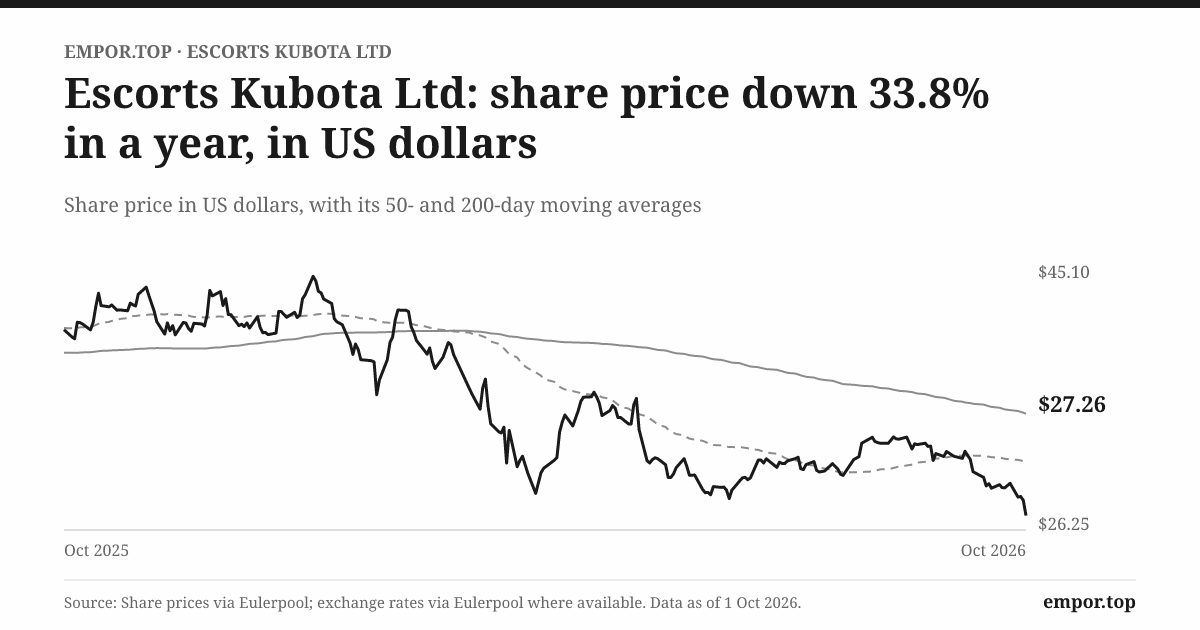
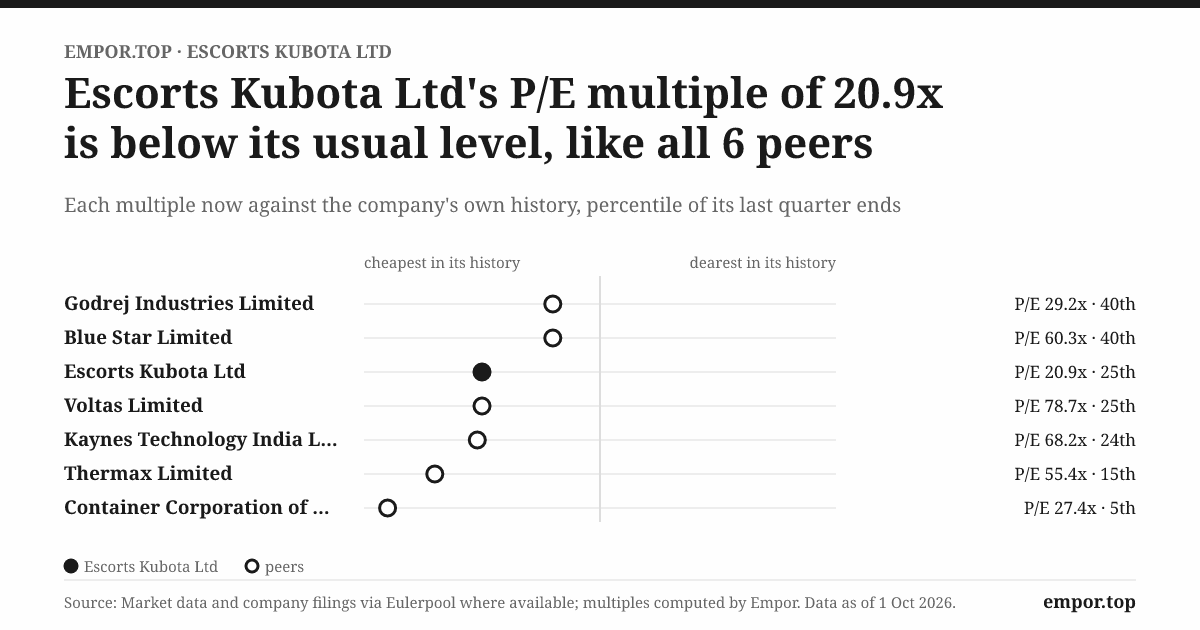
On the other side is a business that, by the numbers investors actually care about, has stalled. Domestic tractor market share hovers around 11%1. Return on equity over the twelve months to June 2026 was 11.2%, not much better than what an Indian government bond portfolio levered modestly might earn1. And on October 1, 2026, the shares closed at ₹2,625.10, their 52-week low and about 34% below the peak, valuing the company at roughly 20.9 times trailing earnings against a five-year median of about 28 times1.
A company that has never been safer is being priced as if it has never been less exciting. That gap frames four questions this story tries to answer.
First, global hub or regional supplier? Kubota talks about India as a low-cost manufacturing base for the world. Will Escorts Kubota become the export engine of the Kubota empire, or will it remain an Indian tractor maker that happens to buy expensive components from its parent?
Second, the ₹9,120 crore question. Will the board deploy the cash hoard into a transformative manufacturing build-out, or hand it back, or simply let it sit in mutual funds, quietly diluting returns for years?
Third, the southern and western frontier. Escorts has always been a northern and central India brand. Can Kubota's lightweight paddy tractors carry it into the rice bowls of the south and the orchards of the west, where Mahindra, TAFE and Sonalika are entrenched?
Fourth, the legacy royalty. Why does an entity controlled by the Nanda family, now a 14% minority owner, collect roughly nine times more in brand royalties each year than Kubota, the 54% owner, collects in technical royalties1?
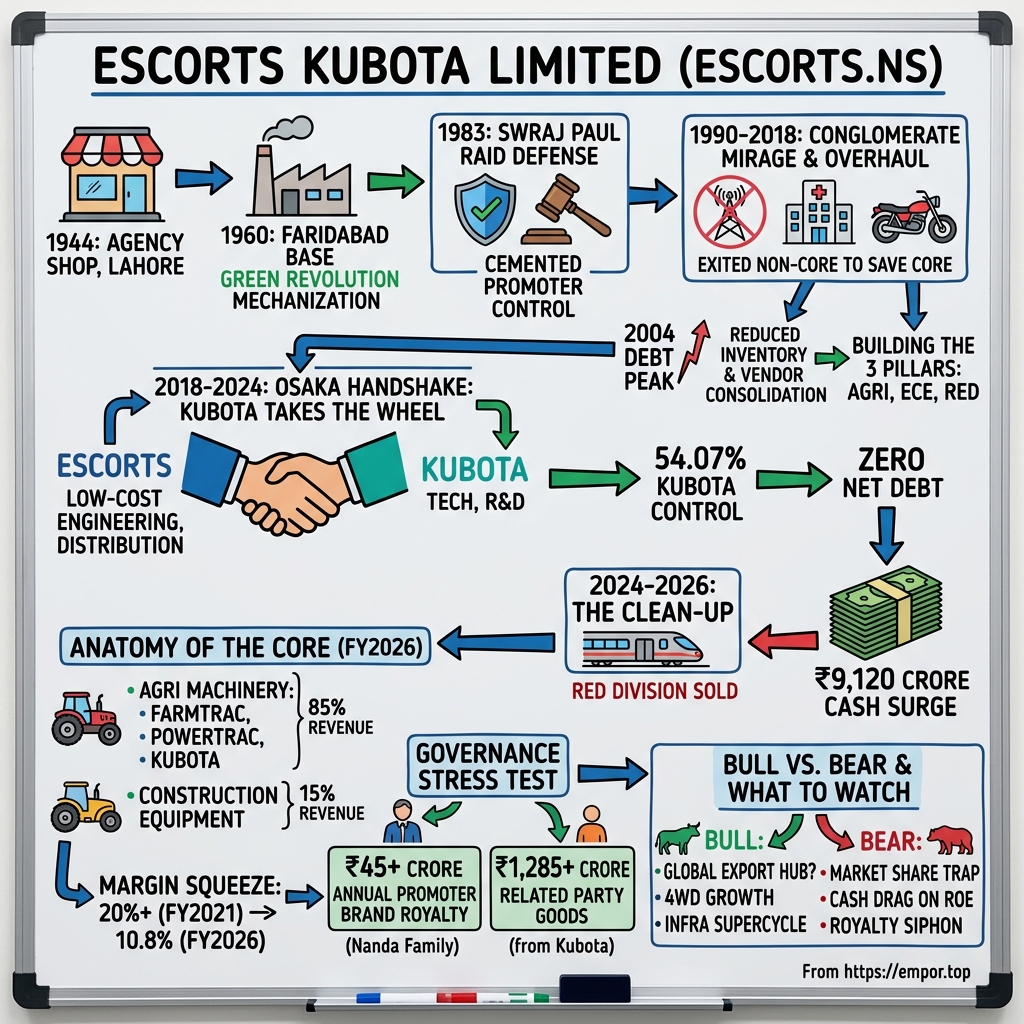
The journey runs from H.P. Nanda's defence against Swraj Paul in 1983, through a near-fatal conglomerate detour, to the slow-motion Kubota takeover of 2020 to 2024, the railway sale, and finally the mechanics of selling tractors to Indian farmers. The question underneath all of it is simple: what kind of company is this now, and what kind does it want to be?
 Subscribe on LinkedIn
II. Origins: The Agency House of Faridabad & Swraj Paul's Raid (1944–1989) (12:00–26:00)
The story begins not in a factory but in a shopfront. In 1944, in Lahore, brothers Har Prasad Nanda and Yudi Nanda were running an agency business, the kind of trading house that sold and serviced imported machinery for foreign manufacturers. Then came 1947. Partition tore Punjab in two, and like millions of Punjabi families the Nandas left Lahore and rebuilt in Delhi. Escorts (Agents) Ltd was their second start: a company with relationships, mechanical know-how and very little else.
What the Nandas understood early was that newly independent India would not be content to import machines forever. The License Raj that followed made that explicit. Imports were throttled, capacity required government permission, and the only way to grow was to manufacture locally, usually with a foreign technology partner. Escorts became a master of that model. It licensed tractor technology from Poland's Ursus and later partnered with Ford to build Ford tractors in India. In the 1960s it planted itself in Faridabad, which became the company's industrial heart and remains so today.
Timing was everything. The Green Revolution of the late 1960s and 1970s turned Punjab, Haryana and western Uttar Pradesh into the granary of India. High-yield wheat, canal irrigation and assured government procurement gave farmers in those states, for the first time, the income to buy machines. Escorts was standing right there with tractors built to haul trolleys of grain to the mandi and pull heavy implements through wheat fields. That geographic accident, a Faridabad company selling into the richest farm belt in the country, explains why Escorts remains strongest in the north and centre to this day. Brand loyalty set in that era has a very long half-life.
The raid
By the early 1980s Escorts was one of India's best-known engineering companies, with tractors, motorcycles and automotive components, and a share register in which the Nanda family itself held a relatively modest stake. That is what made it a target.
In 1983, London-based industrialist Swraj Paul, through his Caparo group, began buying Escorts shares on the market, using the then-new route that allowed non-resident Indians to invest in Indian companies2. Within months Paul had built a stake that rivalled the founding family's. H.P. Nanda's response was ferocious. The company refused to register the share transfers, the fight went into the courts and the corridors of Delhi, and the state-owned financial institutions, the Life Insurance Corporation and Unit Trust of India chief among them, became the swing voters2. Ultimately the institutions sided with management, and the bid collapsed. The episode is still taught as a landmark in Indian corporate governance: the first serious hostile bid in modern Indian business, and a demonstration that in the India of that era, political and institutional alliances mattered more than the share register2.
The lasting effect was psychological as much as legal. The Nandas had come close to losing their company with a minority stake. For four decades afterwards, Escorts' capital structure carried the fingerprints of that fright: holding companies, trusts, and arrangements designed to keep control close. The Escorts Employees Benefit and Welfare Trust still holds about 2% of the company, and Har Parshad and Co., the family's holding company, remains the largest Indian shareholder with about 9.6%3. Keep that history in mind when the royalty question arrives later. A family that once fought to keep control did not simply forget how to protect its economic interests when it eventually ceded it.
From licensee to brand owner
Out of the licensing era came the company's own brands. Farmtrac became the heavy-duty name, the tractor a Haryana farmer bought to plough and then haul sugarcane or bricks between seasons. Powertrac became the utility workhorse, sold on fuel economy to farmers in central India for whom diesel is a meaningful slice of each season's costs. The two-brand structure meant Escorts no longer depended on a foreign licensor's goodwill, and it gave the company a product ladder that spanned most of the market.
The verdict for investors is that Escorts' founding era gave it two durable assets, a northern brand franchise and an engineering base in Faridabad, and one durable habit, an instinct to protect control. The next era tested whether the family could resist the temptation that so often accompanies those assets: spreading them too thin.
III. The Conglomerate Mirage & The Near-Death Overhaul (1990–2018) (26:00–44:00)
The 1990s were intoxicating for Indian business. Liberalisation in 1991 tore down licensing, opened sectors that had been state monopolies, and convinced a generation of family groups that the future belonged to whoever could plant flags fastest. Escorts planted flags everywhere.
It went into mobile telephony through Escotel, at a time when cellular licences looked like printing presses. It had built the Escorts Heart Institute and Research Centre in Delhi, one of the country's best-known cardiac hospitals. It made Yamaha motorcycles in a joint venture, automotive shock absorbers, and construction machinery, and it sold tractors abroad, including through a US distribution venture, Farmtrac North America. Each made a certain sense in isolation. Together they produced a sprawling group where the tractor business, the only one with a real moat, was funding a portfolio of capital-hungry bets that competed with far better-capitalised rivals.
The bill arrived in the early 2000s. Telecom required relentless spending on spectrum and towers. Motorcycles were brutally competitive. The tractor industry itself went through a deep slump around the turn of the century. Leverage rose, and Escorts found itself in genuine financial distress, forced into a long programme of asset sales. Escotel was sold to Idea Cellular. The Escorts Heart Institute went to Fortis Healthcare. The Yamaha stake went to Yamaha. Piece by piece, the conglomerate was dismantled.
The surgeon's son
The person who presided over the reconstruction was Nikhil Nanda, H.P. Nanda's grandson and the son of Rajan Nanda. Where his grandfather had been a builder and a fighter, Nikhil Nanda's defining contribution was subtraction: fewer businesses, fewer suppliers, less inventory, tighter dealer credit. It is less cinematic than a takeover defence, but it is the reason there was a company left for Kubota to buy.
The financial record of the clean-up is visible in the numbers that begin in FY2015. That year, Escorts earned net profit of only about 2% of revenue, carried borrowings equal to roughly a quarter of its equity, and returned around 4% on that equity4. By FY2018 the debt was largely gone and return on equity had risen to the mid-teens; by FY2021 operating margin had climbed above 20% and borrowings were a rounding error4. That is a genuine operational turnaround. A business earning 2 paise of profit on each rupee of sales became one earning about 12 paise, without any heroic acquisition, simply by doing fewer things better and riding a strong tractor cycle.
The surviving business stood on three pillars. Agri Machinery, the tractors, was the core. Construction Equipment made pick-and-carry cranes, backhoe loaders and compactors. And the Railway Equipment Division supplied brake systems, couplers and suspension parts to Indian Railways, a steady, specification-driven business that moved on its own cycle, largely independent of the monsoon.
The overseas scar
One failure from this era deserves a pause, because it bears directly on today's "global hub" thesis. Farmtrac North America was Escorts' attempt to sell its own tractors in the United States. It did not work. The venture ended up under court receivership amid creditor actions and remains deconsolidated from the group's accounts1.
That matters because it is the company's own record on the exact capability bulls now attribute to it: selling Indian-built tractors into developed markets. The lesson management appears to have drawn is that an Indian brand cannot easily build a Western dealer network alone. The Kubota partnership is, in part, a direct answer to that lesson. Instead of building a channel, Escorts would borrow one.
For investors, the conglomerate era proves a narrower point than it is usually credited with. It shows that Escorts' durable edge was tractors and engineering rather than diversification. It does not prove that the company has since become a disciplined allocator of capital. As later sections show, the more recent question is not whether management will waste cash on telecom licences, but whether it will do anything with the cash at all.
IV. The Osaka Partnership: Kubota Takes the Wheel (2018–2024) (44:00–1:04:00)
On November 18, 2021, Kubota put out a news release from Osaka that, in Indian business terms, was an earthquake delivered politely[^4]. Kubota, already a significant shareholder in Escorts, would invest further through a preferential allotment of new shares and then launch an open offer to public shareholders, making it a joint promoter alongside the Nanda family and eventually the largest owner[^4]. The preferential issue, completed in 2022, brought in about ₹1,873 crore at ₹2,000 per share1[^5]. Four decades after H.P. Nanda had fought off a foreign-based bidder, his grandson was inviting a foreign company in, by the front door, and handing it the keys.
Why Kubota wanted India
To understand Kubota's logic, start with Japan's farms. Japanese agriculture is ageing and shrinking; average farmers are in their late sixties and the number of farms keeps falling. Kubota had long since become a global company, with its best businesses in compact tractors for North American hobby farmers and landscapers, mini excavators, and rice-farming equipment across Asia. What it did not have was a meaningful position in the world's largest tractor market by units, India, which sells somewhere around 900,000 to 1 million tractors a year.
Kubota had tried. Its own Indian venture sold premium, lightweight tractors, technically excellent but priced for a market that buys mainly on cost per horsepower. The heart of Indian demand sits in the 40 to 50 horsepower band, where Indian makers build simple, rugged machines at costs a Japanese factory cannot touch. Kubota had the technology. Escorts had the cost base, the dealers and the brands.
Why Escorts said yes
Escorts' side of the logic was about the future rather than the present. Emissions regulations were tightening. India's TREM-V norms for tractors and CEV-V for construction equipment demand engines and after-treatment systems of a sophistication that a mid-sized Indian maker would find expensive to develop alone. Precision farming, electro-hydraulics and eventually electrification all require research budgets measured in multiples of what Escorts spent. Escorts' total R&D bill in FY2026 was about ₹207 crore, under 2% of revenue1. Kubota spends more than that in a few weeks. And, as Farmtrac North America had shown, Escorts had no export channel of its own worth the name.
The slow-motion takeover
The control transfer happened in stages, each with its own legal machinery:
- In 2019, the two sides formed joint ventures: Escorts Kubota India for manufacturing, and Kubota Agricultural Machinery India for sales.
- In 2020, Kubota took an initial stake of about 9–10% in the listed company1.
- In 2022, the preferential allotment and open offer lifted Kubota's stake to about 44.8%, and the company was renamed Escorts Kubota Limited1[^5].
- On September 6, 2024, after the National Company Law Tribunal sanctioned the amalgamation of the two joint ventures into the listed company, shares were allotted to Kubota that took it to about 54%1[^6].
Nikhil Nanda remained Chairman and Managing Director and the public face of the company, but Kubota placed its people in operations, R&D and quality, and the Deputy Managing Director role is held by a Kubota executive; Akira Kato took that seat in August 2025, succeeding Seiji Fukuoka1.
Notice what Kubota did not do. It never paid a dramatic premium for the whole company. It bought in with a mix of fresh equity, which stayed on Escorts' balance sheet as cash, an open offer for a slice of public shares, and the folding-in of joint ventures it already part-owned. That is patient, low-drama acquisition. It is also the source of much of today's cash pile: the ₹1,873 crore Kubota paid for new shares did not leave the building.
What each side actually got
Kubota got a majority stake in an Indian manufacturer with a dense northern dealer network, low-cost engineering, and a ready-made channel for its own Indian-built products, for a fraction of what building such a business from scratch would have cost. The Nanda family kept a meaningful minority stake, the Chairman's seat, a royalty stream examined later, and a partner that removed existential technology risk.
Public minority shareholders got something more ambiguous: a company that became much safer and much richer in cash, and whose strategic agenda would now be set by a parent with its own global priorities. Kubota did not buy a turnaround. It bought a platform, and platforms are run for the owner's network as a whole. Whether that network's interests line up with the listed entity's is the governance question of this story. The first big test came quickly, when Kubota's global focus collided with one of Escorts' best businesses.
V. The Clean-Up: Selling the Railways Division & Cash Surge (2024–2026) (1:04:00–1:20:00)
On October 23, 2024, Escorts Kubota's board approved a sale that surprised many long-time followers of the company: the Railway Equipment Division would go to Sona BLW Precision Forgings, better known as Sona Comstar, as a slump sale, meaning the whole business transferred as a going concern for one lump-sum price, without valuing each asset separately[^7]5. The price was ₹1,600 crore5. The deal closed on June 1, 2025[^8]. A relationship with Indian Railways that stretched back roughly six decades ended with a press release.
Why sell a good business?
The railway division was not a problem child. It made brake systems, couplers, dampers and suspension parts for Indian Railways, a buyer that was spending heavily on new coaches, locomotives and the Vande Bharat programme. It was profitable, specification-protected and moved on a cycle largely independent of farm incomes.
But it was also a strange fit for a Kubota subsidiary. Kubota has no railway business anywhere else in the world. The division sold mostly to a single state-owned customer through tenders, which brings exactly the bargaining-power problems that come with any dominant government buyer: price-competitive bidding, multi-vendor policy and specifications set by the buyer. And it consumed management attention in a company that Kubota wanted focused on tractors and construction machines. For Sona Comstar, which wanted to diversify beyond automotive drivetrains, rail was attractive growth.
The strategic logic for selling is coherent. The cost is equally clear. By selling, Escorts Kubota gave up its one meaningful earnings stream not driven by the monsoon or construction activity. That is the trade-off investors should hold onto: focus bought at the price of diversification.
The accounting fog
The sale left a large footprint on the FY2026 accounts. The railway business was reclassified as a discontinued operation, and the post-tax gain on the sale of about ₹1,004 crore flowed through profit1. Including discontinued operations, reported net profit for FY2026 was about ₹2,394 crore, or about ₹218 per share; from continuing operations alone, it was about ₹1,366 crore, or about ₹124 per share1. The difference is almost entirely a one-off.
Anyone screening the stock on reported FY2026 earnings sees a company whose profit nearly doubled. That is an illusion. The more honest measure is continuing profit, which grew about 22% year on year, a respectable result in a strong tractor year but not a step change1. The trailing P/E of 20.9x on the fact sheet uses last-twelve-months earnings that already exclude most of the gain; on continuing earnings the multiple is about 21x1. Either way, the stock is not as cheap as a headline built on FY2026 reported EPS would suggest.
The treasury trap
The railway proceeds landed on a balance sheet that was already heavy with cash, and the combined pile is now large enough to change the character of the company.
Work through it slowly. At March 31, 2026, Escorts Kubota held about ₹9,120 crore in cash, bank deposits and investments, mostly in debt mutual funds and fixed-income instruments1. With about 11.19 crore shares outstanding1, that is roughly ₹815 per share, or nearly a third of the October 1 share price. Those investments produced other income of about ₹566 crore in FY20261. Continuing profit before tax was about ₹1,811 crore1. Divide one by the other and roughly 31% of pre-tax profit came not from selling tractors or cranes, but from interest and mutual-fund gains.
Put plainly: almost a third of what investors are paying for is a bond fund, and almost a third of the profits come from it. That bond fund earns perhaps 6–7% pre-tax. The operating business, measured on the capital actually employed in it, earns considerably more. Blend the two, and you get the 11.2% return on equity that so frustrates the bulls.
None of this is a crisis. Cash does not go bankrupt. But it reframes the investment case: the railway sale did not make Escorts Kubota more profitable per rupee of equity; it made it more liquid. What happens next to that liquidity, discussed in the falsification and bull–bear sections, matters as much as anything the tractor business does. Before that, though, it is worth understanding the machine that generates the operating profits, and why those profits have looked weaker on some measures.
VI. Anatomy of the Core: Tractors, Cranes, and the Indian Soil (1:20:00–1:42:00)
Walk into a tractor dealership in Karnal, Haryana, in October, after the kharif harvest, and you will see the Indian tractor business in its natural habitat. A farmer arrives with his son and perhaps an uncle. They have sold paddy to the government at the minimum support price. The monsoon was decent. A financier, often a non-bank lender, sits in a corner ready to underwrite 70–80% of the price. The farmer wants to know three things: how much diesel it burns, how much it can haul, and what it will fetch when he sells it in eight years. The brand his father drove counts for a lot. The dealer's mechanic, who will come out to the field when the hydraulics fail during sowing, counts for even more.
Multiply that scene across roughly 1,600 dealer touchpoints and you have Escorts Kubota's core business3.
What the machine produced in FY2026
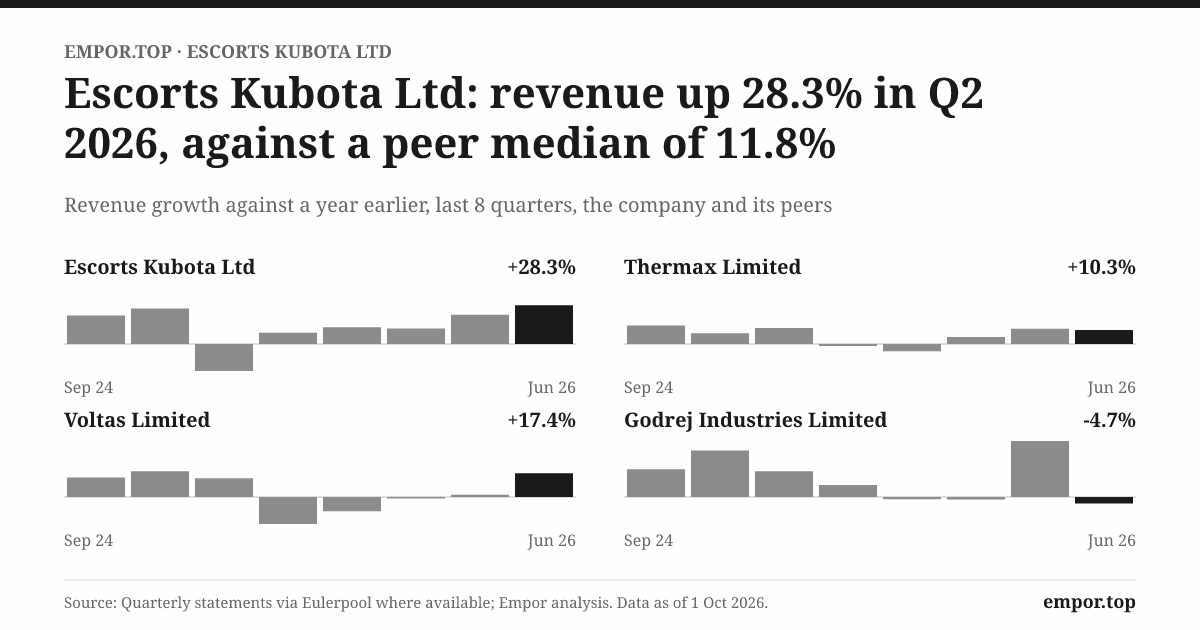
The company sold 1,33,670 tractors in FY20261. Domestic volumes rose about 15%, exports rose about 34%1. The Agri Machinery segment generated about ₹9,841 crore of revenue, 85% of the total; Construction Equipment generated about ₹1,686 crore, the remaining 15%1. Consolidated revenue from continuing operations was about ₹11,540 crore, up about 13%1.
The revenue model is simple: the company sells whole machines to dealers, who sell them to farmers and contractors. Spare parts, service and extended warranties add a recurring layer, roughly a tenth of turnover1. The remaining 85–90% is a capital-goods purchase that a farmer can postpone in a bad year. That makes the business acutely sensitive to rainfall, crop prices, rural credit availability and, in construction equipment, government infrastructure spending.
Three brands, three jobs
- Farmtrac sells the heavier end, roughly 45–60 horsepower, to wheat belt farmers who value hauling power. In north India a tractor spends a surprising share of its life on the road pulling trolleys of grain, sugarcane or construction material, earning money between farming seasons.
- Powertrac sells utility tractors around 30–45 horsepower on fuel economy, strongest in central states.
- Kubota sells lightweight, often four-wheel-drive tractors designed for wet rice paddies, where a heavy tractor sinks, and for vineyards and orchards, where a narrow machine must fit between rows. "Puddling", churning flooded fields into mud before transplanting rice seedlings, is the signature task, and it is overwhelmingly a southern and eastern Indian job.
The brand split is the company's geographic strategy in miniature: the two Indian brands defend the north and centre, the Japanese one is the spearhead into the south and west.
Cranes and compactors
Construction Equipment is the smaller second engine. Escorts has long been a leading maker of pick-and-carry hydraulic cranes, the ubiquitous yellow "Hydra" cranes seen lifting steel and precast blocks on Indian building sites, and it also sells backhoe loaders, soil compactors and, increasingly, Kubota mini excavators. This business follows highway and urban infrastructure spending rather than the monsoon, which gives a little diversification, though it is now the only non-farm leg left after the railway sale.
A cash machine with a quirk
The working-capital profile is the business's quiet strength. At the end of FY2026, customers took about 39 days to pay, about two-thirds of receivables were not yet due, and write-offs during the year were negligible at under ₹3 crore1. Meanwhile, the company took about 100 days to pay its own suppliers1. Suppliers, in effect, finance the inventory, and the cash conversion cycle came down to roughly six days1. There is no customer concentration either; no single customer accounts for even 10% of revenue1.
The caveat is that payables stretched sharply in FY2026, by about ₹547 crore, which is what pulled the cycle so low1. A chunk of those payables is owed to Kubota group companies, about ₹670 crore to Kubota Corporation and Kubota Engine Thailand alone1. Supplier financing from your own parent is comfortable, but it is not quite the same as bargaining power over arm's-length vendors.
Over twelve years the company converted about 71% of its net profit into operating cash flow1. Some of the gap reflects the one-off railway gain in FY2026, whose proceeds sit correctly in investing cash flows; the rest reflects working capital built up in tractor upswings. It is a reasonable, not exceptional, conversion record.
The margin puzzle, decomposed
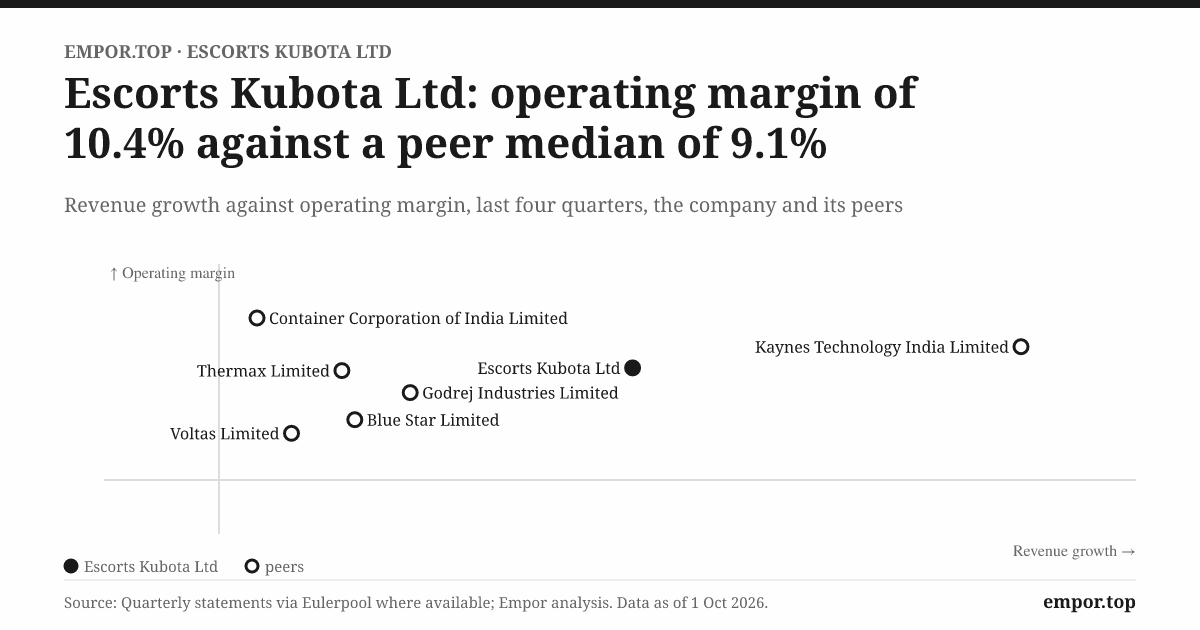
Here is the number that alarms anyone glancing at the data: on the fact sheet's measure, operating margin fell from about 23% in FY2021 to about 11% in FY20261. Quarterly, it dropped from the low twenties in mid-2025 to around 9–11% thereafter1.
Some of that drop is real and some is measurement. The data provider's "operating profit" line has been unstable across quarters, at times exceeding profit before tax, which signals that it has bundled items, likely including other income, differently in different periods. When CRISIL looked at the company's own figures, it described operating margin for the first nine months of FY2026 as expanding to about 13% from about 11%6. Profit before tax, which is cleaner, rose steadily through FY2026, and continuing profit grew about 22%1.
The real underlying story is this: Escorts' true operating margin fell from roughly the mid-to-high teens at the FY2021 peak to the low teens since. The drivers are identifiable. Steel and other commodity costs rose. The amalgamation of the Kubota joint ventures folded in a sales business with thinner margins and import-heavy cost structures. And competitors, Mahindra above all, pushed discounts to defend share in a booming FY2026. The decline is genuine, but it is a step down from a cyclical peak rather than a collapse, and the headline 10.8% figure overstates the damage.
The verdict: Escorts Kubota is an efficient volume business with excellent working-capital discipline and no customer risk, but one whose margins move with commodity prices and competitors' pricing rather than its own. That lack of pricing power is the hinge of the moat debate later. Before getting there, though, there is the question of who else takes a cut before minority shareholders see their share.
VII. The Governance Stress Test: Japanese Discipline vs. Indian Promoter Royalties (1:42:00–1:58:00)
Look at the board table in Faridabad in 2026 and it reads like a who's who of Indian business. Fifteen directors. Among the independents: R.C. Bhargava, the chairman of Maruti Suzuki and arguably the most experienced manager of an Indian–Japanese partnership alive; Sunil Kant Munjal of the Hero family; Dr. R.S. Sodhi, the former managing director of Amul; senior advocate Harish Salve; Tanya Dubash; and Vimal Bhandari1. Opposite them sit six Kubota nominees and the Nanda family1. It is hard to imagine a board with more stature.
Stature, however, is not the same as alignment. The real test of governance is in the related-party notes, where money moves between the listed company and the people who control it.
Pay: restrained
Start with the good news. Total managerial remuneration in FY2026 was about ₹24 crore, around 1.8% of continuing profit1. Nikhil Nanda received about ₹12.6 crore, flat on the prior year, and no stock options were granted1. By the standards of Indian promoter-run companies, where founder pay sometimes runs to several percent of profits, that is conservative.
The royalty clue
Now the puzzle. In FY2026, Har Parshad and Company Private Limited, the Nanda family's holding company, received about ₹45 crore in trademark and brand royalties from Escorts Kubota, up slightly from about ₹44 crore the year before1. It also received about ₹39 crore in dividends as a 9.6% shareholder13. Kubota Corporation, the 54% owner, which supplies engines, designs and technology, received about ₹5 crore in technical royalties1.
Pause on the proportions. The minority family entity collects roughly nine times the royalty of the majority technology owner. The royalty to Har Parshad is, in effect, a perpetual fee for the "Escorts" name, collected off the top before minority shareholders see a rupee. Over a decade, at the current rate, it would add up to more than ₹450 crore.
There are defensible explanations. Brand ownership historically sat with the family entity rather than the listed company; the arrangement predates Kubota; it has been approved by the audit committee as arm's length1; and Kubota, which signed up knowing the terms, may have judged it the price of a smooth partnership. But an activist would ask three uncomfortable questions. Why has the listed company never bought the trademark outright, with a fraction of its ₹9,120 crore? Why does the royalty scale with revenue rather than being fixed? And why has a 54% owner with a reputation for discipline left it in place? The company has not publicly explained why the structure persists.
The Japanese component corridor
The second flow runs the other way. In FY2026 Escorts Kubota bought about ₹1,286 crore of goods from Kubota group companies, led by about ₹883 crore from Kubota Corporation itself and about ₹210 crore from Kubota Engine in Thailand1. It sold about ₹354 crore of exports through Kubota distributors, mostly in Europe and the US1. And promoter-linked Sietz Technologies supplied about ₹125 crore of goods1.
The component purchases are the classic transfer-pricing risk in a multinational subsidiary. When a parent sells parts to a 54%-owned subsidiary, every rupee of extra price moves profit from a company where Kubota keeps 54% of earnings to one where it keeps 100%. There is no evidence that this is happening, and the transactions are audit-committee approved. But the incentive exists, and public shareholders cannot see the pricing. Watch gross margin trends alongside the related-party purchase line: if imports from Kubota rise faster than revenue while margins slide, that pattern would demand an answer.
The tax overhang
Finally, the contingent liabilities. The company disputes about ₹670 crore of tax demands, the largest being about ₹471 crore of central excise claims mostly relating to 2004–2017, pending before CESTAT, plus about ₹53 crore of Haryana Local Area Development Tax and smaller sales tax, income tax and GST disputes1. More than ₹107 crore has been paid under protest1. Auditor Walker Chandiok issued an unmodified opinion1. Against a ₹9,120 crore treasury, even an adverse outcome would be absorbable; it would sting the P&L but not threaten the company.
The governance verdict: management pay is disciplined and leverage is zero, but two value flows, the legacy royalty to the family and the growing component corridor to Kubota, run outside public shareholders' view and in the controlling shareholders' favour. Neither is large enough to break the investment case. Both are exactly the kind of leakage a patient investor should price in. That brings the analysis to the question underneath everything: is there a moat worth protecting from leakage in the first place?
VIII. Moat Analysis & Hamilton Helmer's 7 Powers (1:58:00–2:14:00)
Here is a small fact about rural India that explains more than most spreadsheets. A tractor dealership in a district town is often owned by the same family for decades. Its mechanics know which villages have which tractors, which farmer's gearbox has been rebuilt twice, and which financier will extend a loan after a bad harvest. A new tractor brand entering that district needs not just a showroom but a whole web of trust: mechanics, spare parts on hand, a resale market and a financier willing to lend against the machine. That web takes decades to weave. It is Escorts' real moat, and also its limit, because in the districts where Mahindra or TAFE wove the web first, Escorts faces the same wall.
Escorts Kubota holds about 10.9% of the domestic tractor market1. Mahindra & Mahindra holds roughly four times that. Here is how the moat stacks up through Hamilton Helmer's 7 Powers.
Scale economies: moderate. Faridabad builds well over a hundred thousand tractors a year, enough to spread engineering, purchasing and dealer-support costs. But Mahindra builds several times as many, and in a business where steel, castings and engines are bought by the tonne, the larger buyer gets better prices. Escorts has regional scale in the north; it is sub-scale nationally.
Network economies: weak. A tractor is not a platform. Connected-tractor services add a little stickiness but nothing like a software network effect.
Counter-positioning: real, but narrow. Pairing Kubota's lightweight Japanese designs with an Indian cost base lets the company attack segments, wet paddy and horticulture, where incumbents' heavy tractors are a poor fit, and where an incumbent copying the Kubota approach would mean cannibalising its core heavy-tractor franchise. The catch is that competitors have shown they can add lightweight four-wheel-drive models without dismantling their main business, as the market-share data in the next section shows.
Switching costs: moderate for dealers, low for farmers. A dealer switching brands loses tooling, parts inventory and service know-how. A farmer replacing a tractor after eight years can switch if a rival offers a better price or a financier offers better terms.
Branding: strong, regionally. Farmtrac and Powertrac are household names across Haryana, Punjab, Uttar Pradesh, Rajasthan and Madhya Pradesh. Resale value in those states supports new-tractor pricing. The power fades rapidly in the south.
Cornered resource: emerging. Exclusive access to Kubota's engines, transmissions and designs is something no other Indian maker has. It is a resource, but it belongs to Kubota, which decides how much of it flows to the listed company and at what price.
Process power: moderate and developing. Kubota is deploying its production system across Faridabad's plants. Lean manufacturing discipline is valuable, but it is learnable and competitors have their own Japanese-inspired systems.
Porter's five forces
- Buyers: moderate to high power. Individual farmers have no bargaining power on price, but demand is discretionary. In a bad monsoon, they simply do not buy, and dealer discounting follows.
- Suppliers: mixed. Domestic steel and forging vendors are many and weak; Kubota, as the source of key engines and hydraulics, is a single supplier who is also the controlling shareholder.
- Substitutes: low. There is no going back to bullocks. Custom-hiring services, where farmers rent tractors by the hour, could slow ownership growth in some regions, but mechanisation itself is a one-way street.
- Barriers to entry: very high. A new entrant needs a national dealer web, localised supply chains and financier relationships. New tractor makers rarely succeed in India; global giants like John Deere and New Holland have taken decades to build modest shares.
- Rivalry: brutal. Mahindra, TAFE with Massey Ferguson, Sonalika, John Deere and others fight every season on price, finance offers and features.
Credit analysts see the same shape. CRISIL rates the company AA+ with a positive outlook, citing integration with Kubota, its market position and its cash, while flagging cyclicality, geographic concentration in the north and centre, and vulnerability of margins to raw material costs6.
The moat verdict is that Escorts Kubota has a real but regional franchise: strong brand and distribution power in the north and centre, protected by very high barriers to entry, but without the national scale or pricing power to escape commodity costs or Mahindra's price moves. Its most distinctive asset, Kubota technology, is borrowed rather than owned. That is not a weak position. It is a bounded one. The next question is whether the bulls' big claims break through that boundary, and what the company's own record says when those claims are tested.
IX. Historical Falsification: Testing the Investment Spine (2:14:00–2:30:00)
Every Indian tractor company presentation tells roughly the same story: India is underpenetrated, mechanisation is inevitable, and its technology positions it to win. Escorts Kubota's version adds a global twist, the idea that Kubota will turn Faridabad into a workshop for the world. The useful exercise is to take each of the bulls' three biggest claims and try to break it using the company's own numbers.
Test 1: "Escorts Kubota is becoming Kubota's global export hub"
The claim. Kubota will move manufacturing of smaller tractors from higher-cost locations to India, and exports will become a large share of revenue, perhaps a quarter or more.
The best evidence for it. Export tractor volumes rose about 34% in FY20261. CRISIL noted that around half of tractor exports already move through Kubota's network and that India has been designated a low-cost export base6. Kubota has spent five years tightening its grip, which it would hardly do without plans.
The disconfirming evidence. Sales to Kubota's overseas distributors in FY2026 were about ₹354 crore, roughly 3% of revenue1. In the same year, Escorts Kubota bought about ₹1,286 crore of components from Kubota companies1. Overall, the company spent about ₹1,208 crore of foreign exchange and earned about ₹575 crore1. The money flows from India to the Kubota network, not the other way around. And the company's only previous serious attempt at a developed-market tractor business, Farmtrac North America, ended in receivership.
The verdict. The history does not reject the hub thesis, but it narrows it sharply. Today Escorts Kubota is an Indian manufacturer with a fast-growing but small export pilot, and a net importer from its parent. The claim survives as an unproven option. The test is concrete: if annual sales through Kubota's global channels pass about ₹1,500 crore, roughly four times today's level, the hub story becomes real. Below about 5% of revenue, it remains a slide in a presentation.
Test 2: "Kubota's product range will push market share toward 15%"
The claim. Combining Farmtrac, Powertrac and Kubota, with Kubota's paddy and orchard tractors opening the south and west, will lift domestic market share from around 10% into the mid-teens.
The disconfirming evidence. FY2026 was close to a perfect test. The Indian tractor industry had a boom year, with domestic volumes up around 23%1. Escorts Kubota's domestic volumes rose about 15%1. Growing slower than the market in a boom means losing share, and share settled around 10.9%1. Five years into the partnership and more than a year after the joint ventures were folded in, the combined range had not visibly moved the share needle. Rivals responded by adding their own lightweight and four-wheel-drive models, defending dealers and financiers in the regions Escorts wants to enter.
The verdict. History so far rejects the strong version of this claim. A more modest version, that Kubota models help defend share and win niches in paddy and horticulture, remains plausible but undemonstrated in the overall numbers. The KPI to watch is domestic market share: a sustained move above 12.5% would revive the expansion story; a slide below 10.5% would mean even defence is failing.
Test 3: "The cash is a war chest for a manufacturing megasite"
The claim. The cash hoard is temporary. Management will build a large greenfield plant, costing several thousand crore, to double capacity for India and exports.
The disconfirming evidence. Capital spending in FY2026 was about ₹251 crore, almost exactly equal to depreciation of about ₹255 crore1. That is maintenance spending, not expansion. The capital-spending budget has stayed in roughly that range for five years1. Meanwhile, cash and short-term investments on the balance sheet grew from about ₹168 crore at the end of FY2014 to roughly ₹6,700 crore at the end of FY2026, with total treasury assets at about ₹9,120 crore1. Over twelve years, dividends absorbed only about a quarter of free cash flow1. The median dividend payout has been about 9% of profit, though it rose to between 17% and 24% in the last two years1.
The verdict. The record rejects the idea that this cash has been aggressively reinvested. It does not rule out a future megasite; announcements can come quickly. But "war chest" is a description of intent, and the evidence of the last five years describes a savings account. The event that would change the verdict is a board-approved, funded commitment, either a greenfield plant of ₹3,000 crore or more, or a substantial buyback or special dividend.
Taken together, the three tests leave a consistent picture: Escorts Kubota today is a solid, cash-rich Indian tractor company with an export option it has not yet exercised and a cash pile it has not yet deployed. The optimistic story is not falsified; it is simply unbuilt. That distinction is where the lessons of this company begin.
X. The Playbook: Business & Investing Lessons (2:30:00–2:44:00)
Lesson 1: The Cash Fortress Paradox
The moment is March 31, 2026. Escorts Kubota closes its books with about ₹9,120 crore of treasury assets, almost a third of its market value, producing nearly a third of its pre-tax profit, while return on equity sits around 11%1. Three decades earlier, the same company nearly drowned in debt from telecom licences and motorcycles. It has swung from one extreme to the other.
A zero-debt balance sheet is magnificent insurance. It means no farm recession, however deep, can threaten the company. But insurance has a premium, and here it is paid in returns. Every rupee in a debt fund earns bond-like returns while being valued at an engineering company's multiple. The broader lesson for founders and investors: the cure for a balance sheet that nearly killed you is not a balance sheet that bores you to death. A fortress you never leave is just a very expensive waiting room.
Lesson 2: Buying the Future by Surrendering Control
The moment is November 2021, when the grandson of the man who fought off Swraj Paul invites Kubota to become the controlling owner[^4]. The Nandas looked at the cost of meeting emissions norms, precision farming and global channels, and concluded that a mid-sized Indian tractor maker could not fund that future alone.
They chose to own about 14% of a company with a world-class parent rather than a much larger share of one fighting technological obsolescence by itself. Whether that was the right trade for the family depends on what the 14% becomes. The general lesson is sharper: control is only valuable if the thing controlled can survive. In 1983 the Nandas fought foreign capital to keep Escorts; in 2021 they invited it in to save it.
Lesson 3: Parallel Joint Ventures Breed Friction Until They Merge
The moment is the five years from 2019 to 2024, when Kubota and Escorts ran manufacturing and sales joint ventures alongside a listed company that also made and sold tractors[^6]. Two sets of products, overlapping channels and constant questions about which entity captured which margin.
The amalgamation cleaned that up. But the fact it took five years and a tribunal order says something. Whenever a multinational and a listed local partner run businesses in parallel, minority shareholders end up asking where the profits really sit. The lesson for investors: when a parent runs a business next to its listed subsidiary, assume the margin lives wherever the parent owns more. The FY2026 component corridor to Kubota suggests that question has not disappeared; it has just moved into the supply chain.
Lesson 4: Focus Is Not Free
The moment is June 1, 2025, when the railway division leaves for Sona Comstar[^8]. On paper, the sale was a clean win: ₹1,600 crore in cash, a non-core business gone, a simpler story for the parent. But the railway business was the one thing in the portfolio whose fortunes did not depend on rainfall or construction cycles.
Investors love "pure plays" because they are easy to model. Parents love them because they fit global structures. Shareholders in a pure-play cyclical business, though, carry the full cycle with nothing to cushion it, except, in this case, a giant pile of cash. Escorts Kubota traded a counter-cyclical business for a counter-cyclical bank balance; the question is whether it will spend it before the next drought.
XI. Bull vs. Bear Case & What to Watch (2:44:00–2:56:00)
Imagine an analyst at a Mumbai research desk on the evening of October 1, 2026, three screens open. On one, Escorts Kubota at ₹2,625, a 52-week low. On another, the company's balance sheet. On the third, Mahindra & Mahindra, Deere and Kubota itself. The question on the yellow pad is blunt: is this a value trap chained to the farm cycle, or a mispriced platform waiting for its parent to switch it on?
How the market is pricing it
Start with valuation as data. At ₹28,880 crore of market value and roughly ₹22,150 crore of enterprise value after netting the cash, the market values the operating business at about 10.6 times EBITDA and about 2.4 times sales1. The P/E of 20.9x compares with a five-year median of 28.4x1. Price to book is about 2.4x, the dividend yield about 0.7%, and the free-cash-flow yield about 1.2%1. For context, Mahindra's farm business trades inside a conglomerate valued at roughly the low-to-mid twenties times earnings, and V.S.T. Tillers Tractors at a similar range1.
What does the price appear to assume? Roughly that the tractor cycle has peaked after a strong FY2026, that margins stay in the low teens rather than recovering to earlier peaks, and that the cash keeps earning bond returns. It does not appear to give much credit to the export hub.
The bull case
- The Kubota sourcing pivot. India is among the lowest-cost manufacturing bases in the Kubota network. If Kubota routes smaller tractors and construction machines for Europe, North America and Southeast Asia through Faridabad, exports could compound quickly from a small base. Today's 34% export volume growth would then be the opening, not the peak.
- A cheap core with free optionality. Stripping out about ₹815 per share of treasury assets, the operating business is valued at around 16–17 times continuing operating earnings, below its own history. If management deploys the cash well, or returns it, returns on equity could rise substantially without any operating improvement.
- The paddy frontier. Kubota's lightweight tractors have a genuine engineering edge in wet paddy and orchards. If the company converts that into southern and western share, it opens markets where it has historically been absent.
- Infrastructure tailwinds. Construction equipment, about ₹1,686 crore of revenue, rides India's roads, metro and housing build-out.
The bear case
- The share trap. The FY2026 boom was the best opportunity in years to gain share, and share slipped. If combined brands could not win then, it is fair to ask when they will.
- Cash drag as policy. If the board neither builds nor distributes, returns on equity stay in the low teens, and the market has every reason to keep applying a discount to a business that is part tractor maker, part bond fund.
- Related-party leakage. The family royalty takes about ₹45 crore a year off the top, and rising component purchases from Kubota could quietly move margin up the chain, out of minority shareholders' reach.
- Emissions and affordability. Stricter TREM-V norms will add cost to tractors. In a market where many buyers are smallholders financed at high interest rates, price increases of that kind can delay purchases across a cycle.
There is also a more sobering cyclical point. Since 2021 the share price has fallen by as much as 40% over five years1. Tractor stocks re-rate on the cycle; a P/E that looks cheap at the top of a farm cycle can look expensive at the bottom when earnings fall. The FY2026 base was a strong year.
The KPIs that matter
Three measures will tell an investor more than anything else:
- Exports through the Kubota network. Latest reading: about ₹354 crore in FY2026, rising strongly in volume terms but about 3% of revenue1. Crossing about ₹1,500 crore a year would validate the hub thesis.
- Capital deployment. Latest reading: capex roughly equal to depreciation and treasury assets of about ₹9,120 crore and growing1. A funded greenfield commitment or a large buyback or special dividend would change the returns story.
- Domestic tractor market share. Latest reading: about 10.9%, slipping in FY20261. Above 12.5% would signal the multi-brand strategy is working; below 10.5% would suggest the regional franchise is shrinking.
XII. Epilogue (2:56:00–3:04:00)
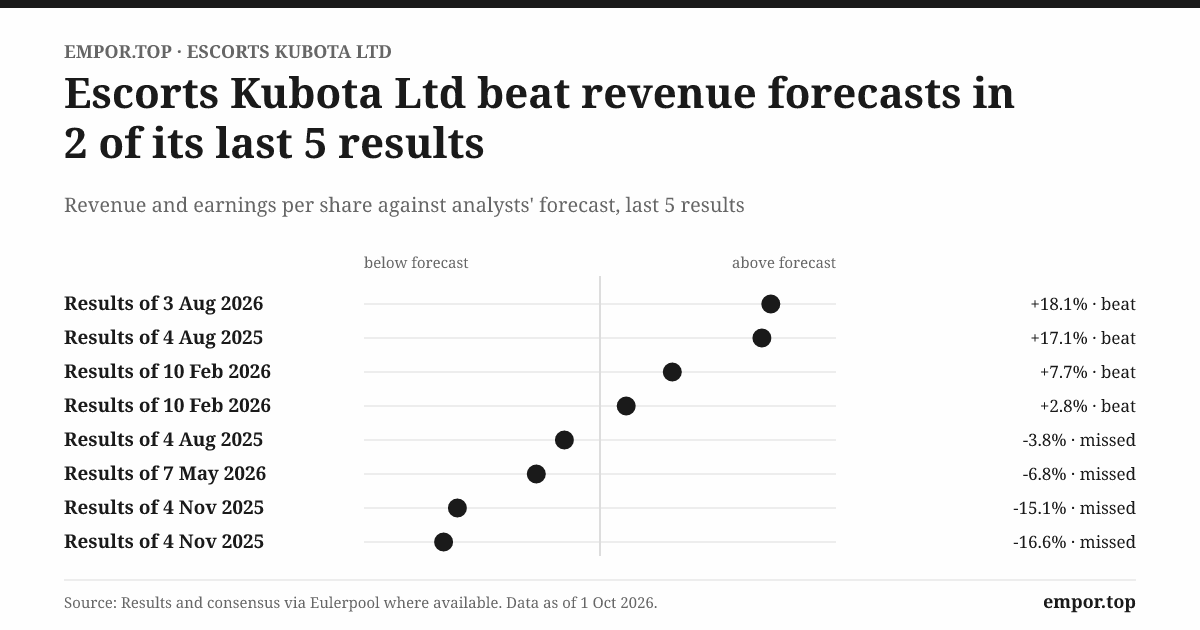
Tonight, Escorts Kubota is a company waiting on two kinds of weather. One is literal: the monsoon, whose distribution across the wheat and paddy belts will decide how many farmers walk into showrooms this winter. The early signs from the first quarter of FY2027 were constructive; revenue rose by double digits from a year earlier1[^13]. But profit before tax was roughly flat, a reminder that volume growth has not yet translated into margin recovery1.
The other weather is corporate, and it is made in Osaka as much as Faridabad.
The first moment to watch is whether the board puts a number on its ambition: a site, a capacity figure and a budget for a large new plant, or alternatively, a decision to return a meaningful share of the cash. If it builds, the cash fortress becomes a factory, and the question shifts to execution. If it distributes, returns on equity jump and the "bond fund" discount should narrow. If it does neither, the most likely outcome given the past five years, the company stays exactly what it is: safe, profitable and under-earning on its equity.
The second moment is the royalty. An audit committee as distinguished as this one could choose to renegotiate, cap or buy out the Har Parshad trademark arrangement. That would cost a small fraction of the treasury and remove a recurring irritant for minority shareholders. Its continued existence is a quiet signal of how much weight the controlling shareholders give to minority interests.
The third moment is the export ramp. When India-built Kubota-branded tractors start appearing in European and North American dealer yards in volume, the figures will show up in the related-party notes. They will tell investors whether Kubota sees Faridabad as a strategic manufacturing hub or a convenient supplier of parts and small batches.
The remaining tension is the one that has defined the company since 2021. Kubota controls the listed company, but Kubota's global interests and the listed company's interests are not identical. A Kubota executive deciding where to build the next tractor plant for the world will weigh Thailand, Japan, the US and India. Only in India does he keep just 54% of the profit. Whether Escorts Kubota becomes the export engine of a Japanese empire or remains a prosperous prisoner of the Indian farm cycle will be decided less by Indian farmers than by that calculation in Osaka.
XIII. Outro (3:04:00–3:08:00)
In 1983, H.P. Nanda went to war to keep Escorts in Indian hands, rallying institutions and courts against a bidder from London2. Four decades later, his grandson sat on the same side of the table as a Japanese partner and handed it control, not because the family had been beaten, but because it had done the arithmetic on the future and concluded that Escorts could not afford it alone[^4].
Somewhere in Haryana this October, a farmer will turn the key on a red Farmtrac and pull a trolley of paddy toward the mandi. He will not know that parts of his tractor came from a Kubota factory in Japan or Thailand, that the company that built it holds nearly a billion dollars in mutual funds and deposits, or that his purchase is one small data point in Japan's largest industrial bet on Indian agriculture. All he will know is that the tractor starts.
That, in the end, is the company's paradox: Escorts Kubota is no longer just an Indian tractor maker. It is a Japanese-controlled treasury with a tractor business attached, still waiting to decide whether to become the workshop of the world's farms.
References
-
Integrated Annual Report 2025-26 — Escorts Kubota Limited, 2026-06-25 ↩↩↩↩↩↩↩↩↩↩↩↩↩↩↩↩↩↩↩↩↩↩↩↩↩↩↩↩↩↩↩↩↩↩↩↩↩↩↩↩↩↩↩↩↩↩↩↩↩↩↩↩↩↩↩↩↩↩↩↩↩↩↩↩↩↩↩↩↩↩↩↩↩↩
-
The Swraj Paul Takeover Bid That Shook Indian Industry — Business Standard, 2018-08-25 ↩↩↩↩
-
Investor Presentation August 2026 — Escorts Kubota Limited, 2026-08-01 ↩↩↩
-
Integrated Annual Report 2024-25 — Escorts Kubota Limited, 2025-06-20 ↩↩
-
Sona Comstar to Acquire Railway Equipment Division of Escorts Kubota for Rs 1,600 cr — Moneycontrol, 2024-10-23 ↩↩
-
CRISIL Ratings Rating Rationale: Escorts Kubota Limited — CRISIL Ratings, 2026-02-11 ↩↩↩
 LinkedIn
 WhatsApp
 Reddit
 Hacker News
 Email
Email Kindle
 RSS Feed
 Spotify
 Apple Podcasts
 Amazon Music
 Audible
 YouTube