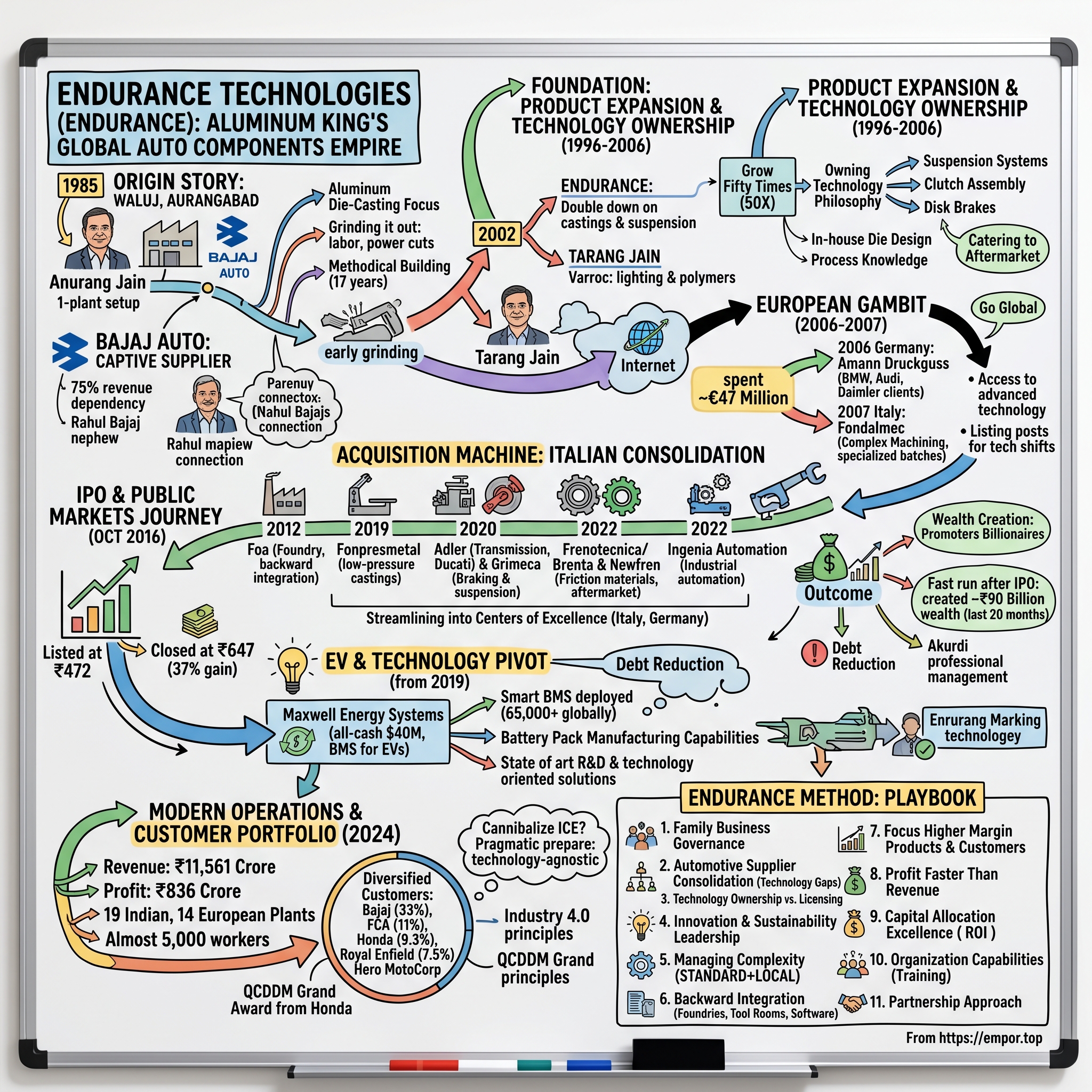
Endurance Technologies: The Aluminum King's Global Auto Components Empire
I. Introduction & Episode Setup
There is a specific sound that a high-pressure die-casting cell makes when operating properly. A robotic arm ladles molten aluminium — at roughly 700 degrees Celsius, the colour of a sunset — into a shot sleeve. A hydraulic ram fires the metal into a steel die at speeds measured in metres per second under pressures of hundreds of atmospheres. Three seconds later, the die opens, a second robot extracts a component that did not exist a moment earlier, and the cycle repeats. Execute this process ten thousand times a day across more than fifty presses, and it forms a business. Achieve a scrap rate one or two percentage points better than a competing plant, and it generates a margin.
That process defines the metallurgical core of Endurance Technologies. As of 17 September 2026, the company carried a market capitalisation of roughly ₹37,800 crore (approximately $4.3 billion), trading at a price-to-book ratio of about 5.5 times and a trailing price-to-earnings multiple near 38.1 For the financial year ended March 2026, it reported consolidated total income of ₹14,720 crore — up 26.1% year on year — alongside consolidated EBITDA of ₹2,090 crore at a 14.2% margin, and profit after tax of ₹952 crore.2 It operates 19 plants in India and 14 in Europe, split between Italy and Germany.1
How did a single-plant gravity die-casting shop in Waluj, on the industrial outskirts of Aurangabad, founded in 1985 with roughly ₹25 lakh in capital and essentially one customer, become India's largest aluminium die-caster, the country's largest two-wheeler component maker across several product lines, and a Tier-1 supplier of machined aluminium to BMW, the Volkswagen Group, Stellantis, Mercedes, Ducati and KTM?34
The answer lies not in a single master strategy, but across four distinct chapters, each of which brought severe execution risks.
The first is the family origin: Anurang Jain's mother Suman is Rahul Bajaj's sister, and that relationship provided the young Sydenham College graduate with an anchor customer before he had a finished product.3 The second is the technological pivot: a decade-long effort to develop proprietary designs for shock absorbers, front forks, clutches, and disc brakes, enabling Endurance to move beyond contract casting. The third is the European expansion of 2006–07, which secured premium four-wheeler clients but brought the company near collapse eighteen months later when the global financial crisis struck and its debt-to-equity ratio reached four to one.5 The fourth is the modern era: a series of bolt-on acquisitions in Northern Italy and Bavaria, an electric vehicle transition strategy that has so far underperformed expectations, and a regulatory tailwind from India's mandatory two-wheeler anti-lock braking system (ABS) rules.
Three recurring themes define the investment story. The first is physical: die-casting is a process business where competitive advantage compounds through yield, scrap rates, and tooling efficiency rather than brand equity or network effects. The second is financial: Anurang Jain's strict aversion to leverage is a learned discipline, forged during a near-death experience in 2009 — a distinction that matters when evaluating whether that conservatism will outlast his tenure. The third is commercial: Endurance sells to a concentrated group of buyers who command substantial bargaining power, demand routine annual price concessions, and enforce strict terms. The company's long-term profitability relies on sustaining operational efficiency under those pressures.
 Subscribe on LinkedIn
II. The Origin Story: Family, Bajaj, and the 2002 Split
Picture Waluj in the mid-1980s: a sprawling, dusty industrial estate carved out of the Marathwada plain outside Aurangabad, built around one anchor tenant. Bajaj Auto had put its scooter plant there, and around it grew the ecosystem that every large assembly plant creates — the vendor park, the tool rooms, the sheds full of lathes, and the owners who ran them.
Into this environment arrived Anurang Jain, who had just finished at Cathedral School and Sydenham College in Mumbai, looking for a manufacturing business to enter.3 The family's network offered a suggestion that was less a business plan than a courtesy: the Bajajs proposed aluminium castings for the scooters coming off the Waluj line.4 In November 1985, Anurang Engineering Co. Pvt. Ltd. was incorporated with roughly ₹25 lakh of capital and a single plant making aluminium gravity die-castings.3
It is worth being blunt about what this operation was. It was not a technology company. Gravity die-casting — pouring molten aluminium into a permanent steel mould and letting gravity fill the cavity — is among the oldest and least defensible processes in metal forming. The customer supplied the drawing, approved the tooling, and set the price. What the founder brought was capital, a family relationship, and a willingness to live in Aurangabad.
The family itself represents one of Indian industry's more unusual configurations. Anurang's father, Naresh Chandra Jain, had built businesses in the same auto-component belt; his twin brother Tarang founded Varroc in 1990, focusing on plastics, polymers, and electricals; and their mother's brother was Rahul Bajaj, then the most powerful figure in Indian two-wheelers.34 India before 1991 was a licence economy, and Bajaj's Chetak scooter carried a waiting list measured in years. Supplying that machine was not a competitive win; it was a position in a queue, and the Jains had been handed a favorable one.
The two brothers ran their holdings jointly for over a decade before formally splitting in 2002. Tarang took Varroc Engineering; Anurang took what had been renamed Endurance Technologies — the aluminium castings, the suspension work, and the mechanical aggregates.4 The split was amicable and clean. The two businesses have operated with genuine separation ever since, sparing Endurance the related-party entanglements that plague many Indian promoter families.
What deserves credit, in hindsight, is what the founder built from that initial advantage. The standard outcome for a well-connected vendor in a licence economy is comfortable stagnation: take the volume, accept the margin the customer allows, buy real estate, and hand down a captive supplier to the next generation. Endurance did not take that path. The counterfactual is visible across the Aurangabad and Pune vendor parks of the 1980s, which remain filled with businesses that started in similar positions and still operate a single shed for a single customer four decades later.
Testing the family-advantage thesis
The tempting conclusion is that the Bajaj bloodline explains Endurance's ultimate outcome. It does not, and the cleanest disconfirming evidence sits inside the same family.
Tarang Jain's Varroc started from the identical position: same surname, same Bajaj access, same Aurangabad industrial base, and same era. Yet Varroc chose a different capital strategy — aggressive, debt-funded global M&A, most notably the 2012 purchase of Visteon's lighting business, which became Varroc Lighting Systems. VLS grew to roughly €0.8 billion of revenue and a top-ten global position in automotive lighting, a scale that appeared triumphant until examined for earnings.6 European lighting operations bled cash, the debt burden sat on the parent company, and in 2022 Varroc sold VLS to Plastic Omnium. The deal was announced at an enterprise value of €600 million and closed on 7 October 2022 at €520 million after an €80 million downward adjustment for deteriorating market conditions — a sale executed explicitly to deleverage rather than reallocate capital.6
The family name thus delivered both brothers the same starting line but yielded starkly different finishes. Family access was necessary to secure Endurance its first customer and sustain its first decade, but it fails to explain the divergence. The true differentiator was capital structure and the discipline to decline high-risk acquisitions. Endurance's own record on leverage was not always pristine, as the financial stress of 2009 would later demonstrate.
The more immediate challenge in 2002 was that a clean corporate split could not resolve a severe customer concentration problem. Anurang Jain now owned an independent company whose fate remained almost entirely a derivative of one customer's model cycle.
III. Building the Foundation: Product Expansion & Technology Ownership
By 1993, customer concentration presented an obvious vulnerability: Bajaj Auto accounted for roughly 95% of sales.3 A contract die-caster with 95% revenue concentration functions less like an independent enterprise and more like an outsourced manufacturing department, exposed to the customer's pricing pressure without any of its operational security.
In response, Endurance made a pivotal strategic decision: rather than chasing new clients with the same commodity casting services—which would merely replicate its concentration risk across multiple OEMs—the company invested in proprietary technology. Over the next decade, beginning in the mid-1990s, Endurance built in-house capability across three core mechanical subsystems:
Suspension. Front forks and rear shock absorbers. For a rider, a front fork appears to be a simple metal tube; for an engineer, it is a complex hydraulic damping system. Tuning performance requires empirical knowledge accumulated over thousands of testing kilometers—intellectual property that an original equipment manufacturer (OEM) cannot easily transfer to a competing vendor.
Transmission. Clutch assemblies and continuously variable transmissions (CVTs) for scooters. A CVT uses two variable-diameter pulleys connected by a drive belt to adjust gear ratios continuously. Calibrating smooth engagement without slippage or judder requires specialized engineering.
Braking. A progression from hydraulic disc brakes to combined braking systems (CBS) and anti-lock braking systems (ABS). Each advance integrates additional sensors, electronic control logic, and strict regulatory homologation requirements, creating higher barriers to entry than basic mechanical casting.
The economic logic behind this pivot was straightforward. In contract die-casting, the customer owns the design and captures the economic rent, treating the supplier as a low-margin converter of raw metal. By developing proprietary subsystems, Endurance took ownership of the underlying designs, validated the performance data, and secured positions on vehicle platforms across their five-to-seven-year lifecycles. Replacing a supplier for safety-critical components involves substantial validation costs and schedule risks, giving the company far greater stickiness than a pure job-shop caster.
This product expansion drove substantial top-line growth. Revenue rose roughly fifty-fold over the decade leading to 2005, reaching approximately ₹500 crore.4 By the mid-2000s, Endurance had established captive tool rooms for die production and automated its foundry operations. As of 2026, the company reports employing over 400 R&D engineers and holding 91 patents.3
Where the moat argument breaks down
The standard narrative suggests Endurance built a defensive economic moat during this period. The operational record, however, points to a more complex outcome.
Despite a decade of product diversification, Bajaj Auto still generated roughly 75% of revenue by 2006, with Endurance's internal estimates indicating that customer dependence remained as high as 95% prior to its European expansion, dropping to 35% only after acquiring overseas assets.4 Serving as the primary supplier to a dominant OEM does not constitute a moat; in Porter's structural framework, it represents concentrated buyer power. Bajaj retained the leverage to negotiate routine price reductions, leaving Endurance to absorb fixed overhead costs whenever two-wheeler market demand softened.
Customer concentration has since narrowed but remains significant. In recent periods, Bajaj Auto accounted for an estimated 47% of standalone revenue and 31% of consolidated revenue.7 While international expansion diluted concentration at the consolidated level, Endurance's domestic operations remain heavily dependent on a single anchor buyer.
Consequently, Endurance built cost efficiency rather than structural pricing power. In-house tooling, foundry automation, and proprietary designs allowed the company to protect operating margins while granting annual price concessions. This operational discipline provides a durable advantage in process manufacturing, but it requires continuous execution. The key metric testing this advantage is whether standalone margins remain resilient during cyclical downturns in two-wheeler volumes.
Developing proprietary technology addressed internal profitability and product value, but it left the company geographically concentrated in India. To expand its geographic footprint, Jain turned to European acquisitions.
IV. The European Gambit: Going Global
In December 2006, an Indian auto-component manufacturer with annual revenue of roughly ₹500 crore acquired German die-caster Amann Druckguss GmbH from a private equity firm. Amann specialized in high-end aluminium die-castings for European luxury carmakers. Three months later, in March 2007, Endurance acquired a controlling stake in Italy's Fondalmec S.p.A., a die-cast machining specialist, alongside Fondpress Srl — a family-owned foundry lacking a succession plan.8 Together, the 2006–07 European acquisitions cost approximately €47 million.
Consider that expansion in context: a mid-sized Aurangabad supplier, whose revenue depended overwhelmingly on a single motorcycle manufacturer, spent a substantial multiple of its annual sales buying foundries in Bavaria and Piedmont — industrial centers governed by works councils, strong labor unions, high energy costs, and strict engineering standards.
The strategic rationale rested on three core pillars:
Customers. The acquisitions delivered immediate access to European four-wheeler OEMs — including the Volkswagen Group (comprising Audi and Porsche), BMW, Daimler, and what later became Stellantis.4 These were not customers an Indian supplier could win through cold outreach; entry required acquiring an approved, pre-qualified vendor embedded within their supply chains.
Technology. European automotive contracts demanded high-pressure die-casting of structurally critical components — such as engine blocks, transmission housings, and chassis parts — at tonnages and tolerances far exceeding two-wheeler requirements. Over the following decade, Endurance transferred these metallurgical capabilities back to India, enabling the company to bid for domestic four-wheeler structural contracts.
Margins. The European operations brought structurally higher EBITDA margins than the Indian two-wheeler business.
However, the third pillar soon encountered severe operational stress.
The 2009 test, and what it says about the debt aversion
Eighteen months after the Fondalmec acquisition closed, the global financial crisis struck. German vehicle production fell 40%, Indian sales dropped 25%, and Endurance's debt-to-equity ratio climbed to four to one.5
This crisis redefined Anurang Jain's capital allocation philosophy. Endurance did not adopt debt aversion as a founding principle; it embraced conservatism only after leveraging itself to the brink, where further market deterioration could have transferred control to its lenders. Jain responded with rigorous operational restructuring: consolidating manufacturing plants, outsourcing component work, and grinding net debt down to roughly 0.18 times equity.5 His subsequent principle — "I will not take excessive amounts of debt to grow" — carries a far clearer meaning in light of that near-collapse.3
While that financial discipline has held for over fifteen years, it remains a personal behavioral trait rather than a structural corporate mandate. As Jain, now in his sixties, prepares his son Rohan and daughter Rhea for executive leadership, investors must consider whether that crisis-tested discipline will endure across generations.3
The acquisitions also highlighted strategic limits. Endurance did not acquire a European distribution network, a consumer brand, or a structural moat over incumbent European die-casters. Instead, it purchased physical assets and approved supplier status within OEM vendor bases that require years to enter. Sustaining those accounts demands continuous operational execution on a program-by-program basis. The first-quarter results for fiscal year 2027 highlighted this structural reality, as a 22.4% drop in European profit after tax was attributed to depreciation on phasing-out vehicle programs — confirming that automotive supply contracts carry built-in expiration dates.11
The energy shock, and the limits of the "stable cash cow" story
A second stress test hit the European business in 2022. The assumption that European operations serve as a high-margin hedge against Indian automotive cyclicality depends on cost stability. Die-casting foundries require immense, continuous energy to hold metal molten at extreme temperatures. When European natural gas and electricity prices spiked, those expenses hit foundry balance sheets immediately, while contractual price adjustments from automakers lagged by several quarters.
The financial impact registered quickly on the consolidated balance sheet. In February 2022, Endurance's third-quarter net profit fell by nearly half, sending the stock down 8% before it slid toward a 52-week low later that month.9 The company's annual report for fiscal year 2023 noted that European automotive operations were severely affected by widespread semiconductor shortages and soaring energy prices.10
European operations do not function as an immune cash cow or a perfect counter-cyclical hedge. Rather, they represent a separate cyclical manufacturing business subject to distinct operational shocks. While low correlation with Indian two-wheeler demand provides genuine geographic diversification, investors expecting structural earnings stability in Europe misjudge the asset. While operational recovery followed — with European EBITDA margins reaching 18.2% in the first quarter of fiscal year 2027 — that turnaround required four years and a normalization of European energy markets beyond the company's control.11
What Endurance could control was its next phase of capital allocation.
V. The Acquisition Machine: Italian Consolidation & Bolt-On M&A
Understanding Endurance Technologies' modern operations requires looking beyond Aurangabad to Northern Italy — Turin, the Piedmont industrial belt, and the valleys housing Italy's century-old motorcycle and machining supply chain. This is where Endurance Overseas, the company's Italian holding entity, has spent fifteen years assembling its European portfolio.
These target companies are rarely glamorous. A typical business employs between 50 and 300 workers in a small industrial town, running presses depreciated for over a decade, with an order book tied to two or three German or French automakers and an aging owner without a clear family successor. Northern Italy contains hundreds of such foundries and machine shops, but lacks natural buyers: private equity funds view them as too small, automakers avoid vertical integration, and large European Tier-1 suppliers are divesting assets rather than adding them. This structural absence of competing bidders created Endurance's pricing advantage in European M&A — a favorable market condition rather than a permanent competitive moat.
The acquisition strategy contrasted directly with the aggressive global expansion attempted by Varroc. Endurance focused on small, specialized targets, acquiring physical assets, patents, and OEM qualifications without assuming target debt or taking risks that could imperil balance-sheet stability.
The deal sequence developed steadily:
2012 — FOA, Italy. Added high-pressure aluminium die-casting capacity adjacent to Endurance's existing Italian footprint.
2019 — Fonpresmetal GAP, Italy. Expanded die-casting capacity dedicated to European four-wheeler OEMs.
2020 — Adler S.p.A. and Grimeca, Italy. Adler provided proprietary clutch and transmission technology, while Grimeca brought braking and suspension patents. The strategic logic was direct: acquiring the designers eliminated ongoing licensing fees for two-wheeler clutch and braking systems.
2022 — Frenotecnica and New Fren, Italy. Frenotecnica, owner of the Brenta brand, closed effective 10 June 2022; New Fren followed effective 16 November 2022.12 Frenotecnica was acquired to establish an Italian center of excellence for premium two-wheeler components and build internal expertise in friction materials — the chemical and mechanical science behind brake pads.12 New Fren added brake discs, centrifugal clutches, friction pads, and brake shoes, alongside a Tunisian subsidiary, GDS Srl, providing a low-cost manufacturing base near Europe.12
2024 — Ingenia Automation, Italy. Effective 31 May 2024, Endurance Overseas acquired 100% of the Turin-based industrial automation firm for consideration not exceeding €3.6 million, including an earn-out of up to €0.6 million payable after 31 December 2027.13 Ingenia designs, builds, and installs robotic automation systems. Integrating an internal automation specialist is unusual for a component maker, reflecting Endurance's view of process engineering as a core proprietary asset rather than an outsourced service.
2024–26 — Stöferle, Germany. Marking Endurance's largest European deal since 2007, this acquisition departed from its history of small bolt-ons. On 12 December 2024, Endurance Overseas signed to acquire 60% of Stöferle GmbH and Stöferle Automotive GmbH — German specialists in machined aluminium automotive components — for €37.74 million.14 On 29 June 2026, it executed a transfer agreement lifting its stake from 60% to 68%.15
Was the discipline real?
Evaluating whether Endurance sustained its capital discipline requires examining three aspects of its M&A history: transaction valuations, acquisition scale, and underlying revenue quality.
On valuation: Stöferle generated €82.1 million in revenue and €17.9 million in EBITDA on a full-year basis in FY26.2 Paying €37.74 million for a 60% stake implied an enterprise value of roughly three to four times EBITDA — a modest multiple for a German machining supplier serving premium OEMs, aligning with Endurance's historic pricing discipline. In the first quarter of FY26 alone, Stöferle added €22 million in turnover and €4.5 million in EBITDA.16
On deal scale: Stöferle was roughly ten times larger than Ingenia. Categorizing Endurance's European M&A as exclusively small bolt-on deals is no longer accurate. The transaction demonstrated management's willingness to commit larger capital blocks when valuations met its criteria, making disciplined execution on future transactions critical to avoiding strategy drift.
On revenue quality: European top-line expansion in FY26 stemmed primarily from acquisitions rather than organic volume growth. European revenue rose 28.9% from €303.9 million to €391.7 million, a gain management attributed significantly to Stöferle's consolidation.217 Excluding the acquisition, underlying European organic growth remained modest; in the first quarter of FY27, European income of ₹1,146 crore represented roughly 1% growth in euro terms.11 While purchasing growth at low multiples represents sound capital allocation, top-line momentum in Europe reflected M&A consolidation rather than expanding underlying market demand.
The operational result of this expansion is a combined European and Indian casting network operating over 50 automated presses with clamping forces ranging from 400 tonnes to 2,700 tonnes, with a large majority exceeding 1,000 tonnes.18 High clamping force allows presses to produce larger, thinner, and structurally integrated components demanded by automotive lightweighting trends. Because this capital-intensive equipment requires substantial installation and qualification timelines, it represents the primary physical barrier to entry in process die-casting.
Capital investment on this scale ultimately relies on public equity markets for valuation and liquidity.
VI. IPO & Public Markets Capital Allocation
By 2016, Endurance faced a classic private equity exit window. Actis, the emerging-markets firm, had acquired its stake roughly five years earlier at a cost of ₹182.04 per share.19
When the initial public offering opened on 5 October 2016 and closed on 7 October, it priced at the top of its ₹467–472 band.19 The issue was structured entirely as an offer for sale, bringing no primary capital into the company; Actis sold up to 19,295,968 shares and Anurang Jain sold up to 5,317,056 shares, raising ₹1,161.73 crore in aggregate for a 17.5% post-offer equity stake.19 Strong institutional and retail demand drove 43.84 times subscription, allowing Actis to exit at ₹472 per share—a 147% return over its five-year holding period.19 On 19 October 2016, the stock debuted on the National Stock Exchange at ₹572, delivering a 21% listing premium.20
The offering's pure offer-for-sale structure highlighted Endurance's underlying financial independence: the company required no fresh growth capital. Listing served instead to provide liquidity for an early investor while establishing a public currency to enhance visibility with global automakers, benchmark executive incentives, and support future acquisitions.
Alignment, and the cost of alignment
Promoters hold 75.00% of the equity—the maximum allowable threshold under Indian listing rules—with foreign institutional investors holding 12.69%, domestic institutions holding 10.06%, and non-institutional public shareholders holding a float of just 2.24%.1 Within the promoter group, Anurang Jain personally holds 30.85%.7
This concentrated shareholding presents a dual-edged governance profile. The constructive case emphasizes structural alignment: promoter wealth remains concentrated entirely in the business, shares carry zero promoter pledges, and management avoids short-term earnings management. The cautious case centers on minority shareholder vulnerability. A 2.24% public float restricts trading liquidity and weakens price discovery, leaving public shareholders without effective mechanisms to influence strategy. Core governance matters—including succession planning, capital allocation, related-party transactions, and executive compensation—remain under the absolute control of a family holding three-quarters of voting rights. Public equity investors operate, structurally, without board representation or avenues for proxy intervention.
What the returns actually did after listing
The central investment thesis for listing—that operational scale and public-market oversight would continuously expand return metrics—requires empirical scrutiny.
Post-listing financial performance shows return ratios moderating rather than expanding. Return on equity (ROE) peaked between 20% and 22% in FY18–FY19 before settling into a lower range. In the FY26 financial results, three-year average ROE stood at roughly 14% and five-year average ROE at 13%, with FY26 reaching 15%; return on capital employed (ROCE) registered 17% over three years, 18% over five years, and 18% in FY26.1 Consolidated operating margins remained consistent at approximately 13% across both three-year and five-year trailing periods.1
This return moderation stems primarily from capital deployment cycles rather than operational execution failures. Endurance executed major greenfield expansion projects—including the Vallam Vadagal four-wheeler casting plant in Tamil Nadu, the Pantnagar expansion, the AURIC Shendra facility, and new lines for alloy wheels, electric vehicle battery packs, and ABS assemblies. This capital deployment coincided with significant headwinds in domestic two-wheeler volumes: regulatory cost escalation from BS-VI emission standards, pandemic disruptions, and prolonged weakness in rural demand, compounded by European energy cost spikes. Fixed capital entered the balance sheet before volume growth materialized, compressing asset turnover rather than destroying structural value.
The empirical record indicates that Endurance operates as a mid-to-high-teens return business that experiences periodic return compressions during capacity investment cycles. The decade following its IPO demonstrates that the company is not a compounding model with expanding return on capital. As of 17 September 2026, public markets valued Endurance at approximately 38 times trailing earnings and 5.5 times book value.1 That premium equity valuation leaves limited margin of safety for a business generating mid-teens return on equity.
The 75.00% promoter ownership ceiling also imposes a structural constraint on capital structure. Because the promoter group sits precisely at the regulatory maximum, Endurance cannot issue fresh equity without diluting family control below its chosen threshold. Consequently, growth capital must be generated from internal cash flows or conservative debt financing, aligning structural constraints with the founder's preference for low leverage. This architecture also limits major M&A flexibility: funding a transformative acquisition would require either increasing balance-sheet leverage or accepting promoter dilution—a choice management has not yet had to make.
The balance sheet maintains conservative leverage metrics. Outstanding borrowings stood at ₹1,327 crore against a book value of ₹486 per share as of March 2026, representing a debt-to-equity ratio of approximately 0.20.1 Credit rating agencies have affirmed this financial position: CRISIL maintained its 'CRISIL AA+/Stable/CRISIL A1+' rating on bank facilities, while ICRA reaffirmed its ratings while noting potential near-term demand softness in European operations.2122 For FY26, the board recommended a dividend of ₹11.50 per share, reflecting a dividend payout ratio in the high teens relative to net earnings.21
This conservative financial structure sets the baseline as Endurance approaches the broader technological shift confronting automotive component suppliers.
VII. The EV & Technology Pivot: Maxwell Energy & Battery Management
Take an electric two-wheeler apart and count what Endurance no longer sells.
The cylinder block: gone. The cylinder head: gone. The crankcase: gone. The clutch: gone. The CVT, in most architectures: gone. For a company whose largest single product line is aluminium castings and whose second is transmission, that is not a rounding error — it is the removal of an entire content category from the vehicle.
Now count what remains. The frame and swingarm: still there, and increasingly cast rather than welded because EV packaging rewards structural integration. Front forks and shock absorbers: still there, and arguably more important, because electric scooters are heavier. Disc brakes, CBS, ABS: still there, and mandated. Wheels: still there. Battery enclosures and motor housings: new aluminium content that did not exist before.
Management's framing is that 96% of current components are EV-compatible.3 Treat that number with care — it is a count of part types, not a measure of revenue at risk, and it says nothing about content value per vehicle. The honest version is that Endurance's exposure is bifurcated: the powertrain casting and transmission lines face genuine terminal decline in a fully electrified two-wheeler world, while chassis, suspension, and braking are indifferent to the propulsion system and may gain content.
The Maxwell bet, and the earn-out that tells the story
In May 2022, Endurance moved into the one area where electrification creates entirely new content: the electronics that manage a battery. A battery management system (BMS) is the brain of a battery pack — it monitors each cell's voltage and temperature, balances charge across cells, estimates state of charge and state of health, and cuts the pack off before anything catches fire. In a two-wheeler that has no thermal engineering budget and sits in 45-degree Indian summers, it is a safety-critical component.
Endurance acquired Maxwell Energy Systems, the embedded electronics unit carved out of ION Energy, taking an initial 51% stake for ₹135 crore (about $17.5 million) through a combination of primary investment and secondary purchase, announced 18 May 2022 and completed 1 July 2022.2324 The remaining 49% was to be acquired in phases over five years through variable payouts determined by Maxwell's financial performance, subject to a maximum additional payout of ₹173 crore.23
That earn-out structure is the most informative disclosure in this entire story, because how it settled is now public record.
On 8 May 2025, Endurance agreed to acquire the remaining 38.50% of Maxwell. The consideration was ₹75.01 million — about ₹7.5 crore — remitted in full by 16 May 2025, making Maxwell a wholly-owned subsidiary.25
That contrast is stark. A structure that contemplated up to ₹173 crore of additional payments for the residual stake, contingent on performance, closed out the final 38.5% for roughly ₹7.5 crore. Whatever the precise mechanics of the intermediate tranches, the direction is unambiguous: Maxwell did not hit the financial milestones the sellers had hoped for, and the earn-out mechanism did exactly what an earn-out is supposed to do — it transferred the disappointment to the seller rather than the buyer.
Two conclusions follow, and they point in opposite directions.
The first is negative for the technology thesis. Buying a BMS capability did not make Endurance an EV electronics champion. The major Indian electric two-wheeler OEMs — TVS with iQube, Bajaj with Chetak, Ather, and Ola — have generally kept BMS firmware in-house or sourced from global semiconductor and Tier-1 specialists, because the BMS is entangled with the vehicle's software, warranty, and safety case. Technical capability in BMS does not confer commercial position. Maxwell contributed 1.3% of consolidated income in the first quarter of FY27.26
The second is positive for the capital-allocation thesis. Endurance structured the deal so that being wrong was cheap. It paid ₹135 crore for control and ₹7.5 crore to clean up, rather than paying ₹308 crore up front for an asset that underdelivered. Compare that with a competitor buying a €92 million lighting business with debt and spending a decade regretting it.
The turn, and what would falsify the pessimism
There is now a data point on the other side. In the first quarter of FY27, Maxwell recorded total income of ₹57 crore against ₹31 crore a year earlier — roughly 85% growth — and posted its first profitable quarter, with PAT of ₹1 crore against a ₹2 crore loss.1127 Battery pack production commenced at Pune during the quarter, and cumulative EV orders across the group stood at ₹1,806 crore including Bajaj.11
The calibrated position: the claim that Maxwell makes Endurance an EV electronics play is rejected by the record. The narrower claim — that Maxwell is a small, cheaply-acquired optionality bet that has just crossed from loss-making to marginally profitable and is growing fast off a tiny base — survives and is now modestly better supported than it was two years ago. What would confirm it is a named design win with a top-three Indian electric two-wheeler OEM at platform scale, disclosed with volumes. What would falsify it is Maxwell's revenue stalling around 1% to 2% of group income while battery pack assembly turns out to be a low-margin integration business rather than an electronics business. Until one of those happens, Maxwell should be valued as an option, not as an earnings line.
Meanwhile, the core business had been doing something considerably more interesting than anyone expected.
VIII. Modern Operations, Customer Portfolio & Segment Economics
Fiscal year 2026 produced the strongest financial results in Endurance Technologies' history. Consolidated total income reached ₹14,720 crore—a 26.1% year-on-year increase—while consolidated EBITDA expanded 25.3% to ₹2,090 crore at a 14.2% margin, and profit after tax rose 13.8% to ₹952 crore.2 That compared with ₹11,560.8 crore in total income and ₹836 crore in net profit for fiscal year 2025.28 Measured against the ₹500 crore revenue base of 2005, the scale of two decades of operational expansion is clear.
Domestic operations delivered standalone total income of ₹10,696 crore, up 20%, outstripping Indian two-wheeler industry volume growth of roughly 13% to meet management's outperformance benchmark.2 European operations generated €391.7 million, up 28.9%, though that top-line expansion was substantially supported by acquisitions.17
The margin question underneath the growth
Beneath the headline figures, operational margins faced underlying pressure. Standalone EBITDA margin compressed from 13.7% to 12.6%.2 Consolidated margins held at 14.2% primarily because higher-margin European operations expanded faster.
The first quarter of fiscal year 2027 underscored this margin pressure. Standalone total income surged 35.9% to ₹3,194 crore—outstripping Indian two-wheeler industry expansion of 23.6%—yet standalone EBITDA grew just 17.1% to ₹358 crore. This pushed standalone EBITDA margin down from 13.0% to 11.2% and net profit margin down from 7.1% to 6.1%.11 The compression stemmed from rising raw material expenses, which climbed to 68.4% of total income from 64.8% due to price inflation across aluminium, steel, and copper.11
This margin compression illustrates the friction inherent in automotive supply contracts. While Endurance's agreements feature raw material pass-through clauses, price adjustments operate on a quarterly lag. When input costs surge, the supplier absorbs the working-capital burden until contractual adjustments take effect; when commodity prices drop, the inverse occurs. Across a full commodity cycle, this mechanism is largely neutral, but during periods of rapid inflation, it depresses operating margins. Management instructed investors to expect margin recovery in the second and third quarters of fiscal 2027 as pricing adjustments take effect and aluminium alloy prices ease by an anticipated ₹12 to ₹17 per kilogram.11
Investors can treat this guidance as a clear operational test. If standalone operating margins fail to rebound toward 13% by the third quarter of fiscal 2027, the margin compression shifts from a temporary settlement lag to uncompensated price concessions.
A secondary reading of the quarterly performance presents a more constructive perspective. Revenue growth of 36% against industry volume growth of 24% indicates active market-share gains. A supplier yielding structural pricing power rarely expands its growth premium by twelve percentage points; rather, that divergence reflects the commercial ramp-up of new component capacity. Expanded braking capacity, an alloy wheel facility commissioned in August 2025, and a battery pack assembly line launched in January 2026 all entered commercial production during a quarter of commodity cost inflation—timing that temporarily squeezed gross margins while expanding production volumes.16 Whether this performance represents productive capital deployment or permanent margin dilution depends on whether operating margins recover in line with management guidance.
The shape of the business today
Geographically, first-quarter revenue in fiscal year 2027 broke down into roughly 72.4% from India, 26.3% from Europe, and 1.3% from Maxwell—with India's share rising from 69.2% due to robust domestic volumes alongside stagnant European demand.1126
By product segment, aluminium die-casting and machining remains the company's foundation, generating roughly half of total revenue and serving as its primary profit engine. Suspension components represent the second major pillar, accounting for 25% to 28% of sales; transmission systems generate approximately 12%; braking systems—spanning disc brakes, combined braking systems, and ABS—contribute around 9%; and EV electronics remain below 2%.
By customer relationship, Bajaj Auto remains the primary account, generating approximately 47% of standalone revenue and 31% of consolidated revenue.7 Stellantis, Honda Motorcycle & Scooter India (HMSI), Hero MotoCorp, and Royal Enfield constitute the next largest tier of clients, alongside orders from TVS, Yamaha, Suzuki, BMW, the Volkswagen Group, KTM, and Ducati.
Order win momentum picked up sharply in the first quarter of fiscal year 2027. Endurance secured a record ₹391.6 crore in new business, highlighted by a ₹336 crore order from HMSI and a European contract from Mercedes for hybrid transmission components valued at approximately €14 million; total new orders reached ₹405 crore in India excluding Bajaj Auto, alongside €13.9 million in Europe.1127 The company also secured new braking component orders from TVS.26 The HMSI contract carries strategic significance beyond its size: as Bajaj Auto's primary domestic rival, securing ₹336 crore from HMSI in a single quarter demonstrates tangible progress in diversifying the domestic customer base.
Alongside business expansion, corporate governance housekeeping has continued. Endurance announced the merger of several Italian subsidiaries to streamline its European legal structure and capture operational synergies. After fifteen years of bolt-on M&A, consolidating regional corporate entities reduces administrative overhead, optimizes tax structures, and simplifies segment reporting—improving corporate transparency across its international operations.
IX. Playbook: The Endurance Method
Strip away the narrative, and five repeatable behaviors emerge. Each deserves precise examination, alongside its underlying limitation.
One: Own the technology rather than license it. Adler, Grimeca, and Frenotecnica were acquired for their clutch, braking, and friction-material intellectual property.12 The alternative — paying perpetual royalties to a Japanese or European licensor — remains the default model for much of the Indian auto-component industry, permanently capping margins. The limitation: acquired intellectual property depreciates. Friction compounds and hydraulic fork damping may not move at the speed of semiconductors, but they do evolve. The ongoing R&D expenditure required to keep these technologies current is a permanent operating expense rather than a one-time investment.
Two: Acquire European specialists cheaply and without their debt. The Italian and German acquisition portfolio has generally transacted at low single-digit EBITDA multiples, with Stöferle acquired at roughly three to four times EBITDA.142 The limitation: depressed acquisition multiples in Europe reflect real structural headwinds — succession voids in family businesses, private equity exit pressures, elevated energy costs, and an automotive end-market facing structural strain from electrification and rising Chinese competition.
Three: Integrate backward into the means of production. Endurance maintains captive tool rooms for die production and, through Ingenia, owns its automation systems integrator.13 In a process manufacturing industry, scrap rates and cycle times dictate profitability; controlling the engineering teams that build the automation cells provides a genuine operational edge. The limitation: this yields a cost advantage rather than structural pricing power, and cost advantages tend to erode over time unless continuously defended.
Four: Maintain a conservative balance sheet while separating operations from family holdings. The company operates with a debt-to-equity ratio of approximately 0.20, zero promoter share pledges, a AA+ credit rating, and complete operational separation from Varroc.121 The limitation: this financial conservatism is a learned personal discipline, forged during a near-collapse in 2009, and remains unproven across a future leadership transition.
Five: Sell integrated packages rather than standalone parts. Endurance's primary commercial advantage is its ability to supply the die-castings, front fork, shock absorbers, clutch, CVT, and braking assembly for a single motorcycle platform. An OEM considering re-sourcing one component must weigh the impact on its commercial terms across the remaining five while revalidating a safety-critical subsystem mid-platform. This bundled strategy raises switching costs without requiring Endurance to win every individual price debate. The limitation: this protection applies platform by platform; every new model cycle reopens commercial negotiations.
None of these five elements constitutes an unassailable competitive moat. Together, however, they explain a consistent 13% operating margin and a high-teens return on capital employed in a fiercely competitive process industry — matching the company's historical operational record.
X. Strategic Analysis: Helmer's 7 Powers & Porter's 5 Forces
Evaluating Endurance through Hamilton Helmer's 7 Powers framework produces a conclusion that is honest rather than flattering.
Process Power — present, and the strongest of the seven. Helmer's definition requires an advantage embedded in organisational activity, achievable by competitors only through extended commitment. Four decades of die-casting yield management, alloy scrap control, and robotised foundry workflows qualify. A competitor cannot simply purchase this capability; it must be built across decades of continuous operational refinement. The primary evidence is Endurance's margin resilience through market cycles that destroyed weaker foundries.
Scale Economies — present but modest. Fixed-cost absorption across 33 plants and purchasing leverage on primary aluminium ingot provide tangible benefits, but aluminium remains a globally traded commodity, and larger industrial buyers operate in India. Consequently, scale functions as a second-order cost efficiency rather than a structural moat.
Switching Costs — present and underrated. Once an OEM qualifies Endurance's tooling and validates its suspension geometry and brake calibration across a five-to-seven-year platform cycle, switching suppliers mid-program introduces substantial re-homologation expenses, testing delays, and warranty risks. These switching costs are procedural and regulatory rather than emotional—making them particularly durable.
Cornered Resource — absent. Holding 91 patents represents a respectable technical portfolio, but it does not constitute a cornered resource.3
Counter-Positioning — absent. Endurance operates squarely within the traditional auto-component supply chain. There is no alternative business model that incumbents are deterred from copying out of fear of cannibalising existing operations.
Branding — essentially absent in the OEM business, with a modest exception: the Brenta and Newfren brands carry genuine equity in the European two-wheeler aftermarket.12
Network Economies — absent. The core business displays no network effects; component production does not become more valuable as additional customers join the platform.
Two powers—one strong—in a capital-intensive, cyclical industry define a defensible enterprise rather than a structural monopoly.
Porter's Five Forces framework further clarifies these structural dynamics.
Buyer power: extremely high, and the defining feature of the industry. Automotive OEMs routinely demand annual price concessions as standard contractual policy. With a single customer accounting for 47% of standalone revenue, commercial negotiations remain asymmetric—a reality demonstrated by margin compression in the first quarter of fiscal year 2027.11
Supplier power: moderate. Primary aluminium is exchange-traded and widely available; supply constraints involve price volatility and timing rather than physical availability. The pass-through lag in customer contracts creates working-capital and margin-timing fluctuations rather than long-term supply risks.
Threat of substitutes: bifurcated. The risk is high and expanding in internal-combustion powertrain castings and transmission assemblies, where vehicle electrification eliminates components entirely. Conversely, the threat is low in suspension, braking, and structural chassis components, which remain propulsion-agnostic. This distinction represents a critical nuance in the investment case that should not be flattened into a single score.
Threat of new entrants: low in Europe, moderate in India. The capital outlay for a 2,700-tonne robotised casting press, combined with multi-year OEM qualification cycles and safety homologation requirements for braking systems, forms a substantial barrier. However, this barrier consists of capital and time rather than absolute technical impossibility, and competing Indian manufacturing groups possess both.
Rivalry: high. Endurance competes against established component suppliers, including Varroc, Sundram Fasteners, Bharat Forge, Craftsman Automation, Uno Minda, and Gabriel India—several of which maintain strong positions in overlapping product categories. Gabriel India competes directly in suspension systems, Craftsman Automation in machined castings, and Bharat Forge in heavier metal forming.
The strategic verdict is clear: Endurance's competitive edge is operational rather than structural. The company succeeds by executing a demanding manufacturing process more efficiently than most peers, offering a broader integrated product package, and maintaining a cleaner balance sheet. That operational edge is real and durable, but it requires continuous execution to preserve—and it does not entitle the business to an inflated equity valuation indefinitely.
XI. Investment Thesis: Bull vs. Bear Case & Key KPIs
The three numbers that actually matter
One: standalone EBITDA margin. Everything contested about this business — OEM pricing pressure, commodity pass-through lag, the return on recent capital expenditure, and the mix shift toward higher-value braking content — converges on this single metric. Standalone EBITDA margin fell to 12.6% in fiscal 2026 from 13.7% the prior year, and dropped further to 11.2% in the first quarter of fiscal 2027 from 13.0% in the prior-year period.211 Management committed publicly to margin recovery in the second and third quarters of fiscal 2027, establishing a specific timeline against which performance can be evaluated.
Two: new order wins excluding Bajaj Auto. The disclosed rupee value of new purchase orders from Honda Motorcycle & Scooter India (HMSI), Hero MotoCorp, TVS Motor, Royal Enfield, and European four-wheeler OEMs measures customer diversification — the primary mechanism for reducing buyer power over time. Endurance reports these figures quarterly, recording ₹405 crore of new Indian orders excluding Bajaj in the first quarter of fiscal 2027, alongside €13.9 million in Europe.11 Evaluating progress requires tracking multi-quarter trends across specific customers rather than relying on single-quarter totals.
Three: ABS content conversion. The average rupee value of braking components shipped per two-wheeler as regulatory mandates take effect determines whether incremental domestic growth materialises over the coming three years.
The bull case
The centerpiece of the bull case is regulatory. India's Ministry of Road Transport and Highways mandated anti-lock braking systems (ABS) on all two-wheelers manufactured on or after 1 January 2026, regardless of engine displacement.29 Because motorcycles of 125cc and above already required ABS, the new rule applies to the sub-125cc mass market — roughly 77% of total two-wheeler sales — which previously relied on combined braking systems (CBS). Credit rating agency ICRA estimated the mandate would add 3% to 5% to vehicle prices, translating to ₹2,500 to ₹4,000 on an entry-level motorcycle.30
For an auto-component supplier, this regulatory shift expands content value significantly. A standard CBS unit consists of a mechanical linkage costing a few hundred rupees. An ABS unit integrates a hydraulic modulator, wheel-speed sensors, and an electronic control unit, increasing content value per vehicle by nearly an order of magnitude across an annual market exceeding ten million units. Management informed investors that it projected an addressable market of at least 16 million two-wheelers requiring ABS, planned to expand manufacturing capacity from 640,000 units by an additional 2.4 million units, and aimed to secure at least a 25% market share.16
This represents the primary growth catalyst in the domestic business, driven by mandatory compliance rather than discretionary consumer demand. Domestic performance in the first quarter of fiscal 2027 — where standalone revenue expanded 35.9% against industry volume growth of 23.6% — aligns with the initial commercial rollout of the ABS mandate.11
Secondary growth drivers include the ongoing shift in Indian motorcycle demand toward 150cc and larger models that require upgraded suspension systems and dual-channel ABS; market-share expansion with HMSI and Hero MotoCorp, highlighted by a ₹336 crore order from HMSI; and automotive lightweighting in Europe, where hybrid and electric vehicle platforms require larger structural aluminium castings, illustrated by a recent €14 million hybrid transmission contract from Mercedes.1127
The bear case
The pass-through squeeze reflects ongoing buyer power. Raw material costs rose to 68.4% of total income in the first quarter of fiscal 2027, pushing standalone EBITDA margin down 180 basis points year over year despite a 36% surge in revenue.11 When top-line expansion fails to generate proportional earnings growth, it demonstrates how concentrated buyer leverage forces suppliers to absorb cost inflation during adjustment lags.
ABS represents a double-edged mandate. Adding ₹2,500 to ₹4,000 to the price of an entry-level motorcycle risks dampening unit sales in rural, price-sensitive segments that have experienced prolonged demand weakness. While higher content per vehicle benefits component suppliers, lower overall vehicle volumes partially offset those gains, prompting open opposition to the mandate from automotive industry bodies.31 Management also acknowledged that potential three-to-six-month implementation delays could slow the initial production ramp.16
European growth remains flat and reliant on M&A. European revenue grew just 1% in euro terms during the first quarter of fiscal 2027, while profit after tax dropped 22.4% due to higher depreciation from phasing-out vehicle programs.11 Credit rating agency ICRA explicitly noted that European operations face muted near-term demand amid broader structural challenges in the region's automotive sector.22
Electrification creates unhedged asset exposure. The experience with Maxwell Energy demonstrates that acquiring niche EV electronics capability does not guarantee commercial integration with major electric two-wheeler OEMs, leaving legacy internal-combustion casting and transmission lines exposed to long-term volume decline.
Governance structure and low public float constrain minority shareholders. With a 2.24% public float and 75% promoter equity ownership, public shareholders lack effective mechanisms to influence strategic oversight.1 Furthermore, while a leadership transition to the founder's children is underway, the strict debt aversion that defines the company's financial policy remains a personal trait of the founder rather than an institutionalized policy.3
Valuation leaves little margin for error. Trading at approximately 38 times trailing earnings and 5.5 times book value, Endurance carries a premium valuation relative to its mid-teens return on equity, customer concentration, and exposure to cyclical end-markets.1 That multiple assumes sustained execution without pricing or volume disruptions.
Structural questions from capital allocation. A rigorous financial analysis highlights several unanswered questions: why a company with strong free cash flow and a AA+ credit rating maintains a dividend payout ratio in the high teens while returns on capital remain below post-IPO peaks; how the company intends to address legacy internal-combustion assets; and what governance frameworks will accompany the upcoming leadership transition.
Peer comparison highlights operational strengths over structural moats. A comparative analysis across the Indian auto-component sector clarifies Endurance's positioning. Gabriel India competes directly in suspension systems but has historically generated lower operating margins under similar customer concentration. Craftsman Automation overlaps in machined aluminium castings but operates with significantly higher financial leverage. Bharat Forge maintains a larger, more diversified industrial footprint with defense exposure that Endurance lacks. Sundram Fasteners and Uno Minda serve as closer benchmarks for operational execution and balance-sheet strength. Within this peer group, Endurance distinguishes itself through lower financial leverage, a broader component package per vehicle platform, and an established European four-wheeler footprint. Conversely, its key vulnerability remains heavy revenue concentration in a single customer, which accounts for nearly half of standalone sales — a higher concentration ratio than most peers.7 This comparative evidence supports the case for operational excellence rather than an unassailable economic moat.
Weighing it
Evaluating the full investment case does not invalidate Endurance's core thesis, but it defines its boundaries. Endurance operates as a well-managed, conservatively capitalized process manufacturer supported by demonstrated operational efficiency, a regulatory catalyst in braking, expanding customer diversification, and a disciplined approach to European acquisitions. At the same time, the company is not a high-return compounder with expanding capital returns, its European operations do not provide a counter-cyclical hedge, its EV electronics unit has yet to establish commercial scale, and it has not demonstrated structural pricing power over its primary buyer.
A final structural consideration involves baseline industry volumes. The domestic two-wheeler market has spent much of the past five years below its 2018 peak of over 20 million units annually, constrained by regulatory price increases, pandemic disruptions, and soft rural demand. Consequently, Endurance's domestic growth over this period has relied primarily on expanding content per vehicle and capturing market share rather than riding industry volume tailwinds. If domestic two-wheeler demand experiences a sustained cyclical recovery alongside the ABS rollout, the resulting operating leverage could be substantial. If market volumes remain flat, content expansion will have to generate the entirety of domestic growth.
XII. Recent News & Earnings Call Intelligence
An analysis of Endurance Technologies' earnings calls reveals a conspicuous omission: top-line revenue forecasts. Managing Director Anurang Jain has consistently declined to issue promotional revenue guidance, choosing instead to target outperforming domestic two-wheeler industry volume growth by a defined margin while preserving free cash flow and balance-sheet integrity. In fiscal year 2026, the company achieved 20% standalone growth against roughly 13% industry volume expansion—a seven-percentage-point outperformance consistent with that stated ambition.2
Instead of broad revenue targets, management offers specific operational commitments that investors can independently track.
On operating margins, disclosures have remained concrete. When questioned during the first-quarter fiscal year 2027 earnings call regarding a 180-basis-point standalone margin compression, executive leadership resisted deflecting to product mix or one-off items. Instead, management directly identified rising raw material expenses—which climbed to 68.4% of income from 64.8%, driven by cost inflation across aluminium, steel, and copper—and committed to margin recovery in the second and third quarters of fiscal 2027 as OEM pricing adjustments take effect and aluminium alloy prices soften by an anticipated ₹12 to ₹17 per kilogram.1127 This provides a clear, verifiable timeline against which management accountability can be measured in upcoming earnings releases.
On European operations, executive tone shifted noticeably between fiscal periods. Following the fiscal 2026 results, Endurance Overseas Director Massimo Venuti characterized the performance as "the best quarter of Endurance Overseas in the history" of the company.2 Just one quarter later, European revenue expanded by only 1% in euro terms while net profit dropped 22.4%, a contraction management attributed to depreciation on phasing-out vehicle programs.11 While both descriptions reflect their respective reporting periods—the former bolstered by acquisition consolidation and the latter reflecting organic performance—the contrast underscores the necessity of evaluating European results on an organic basis rather than relying on reported top-line figures. Managing Director Anurang Jain maintained a more tempered perspective during the fiscal 2026 review, citing ongoing geopolitical, supply-chain, and tariff uncertainties alongside elevated freight and energy expenses.2
On the EV electronics division, persistent inquiry has eventually yielded measurable metrics. For three years, market analysts routinely pressed management regarding Maxwell Energy's revenue trajectory, order book, and timeline to profitability. The first quarter of fiscal year 2027 delivered concrete financial data: total income expanded to ₹57 crore from ₹31 crore a year earlier, producing a maiden net profit of ₹1 crore.1127 While modest in absolute terms, the result marks the transition of the battery management unit from speculative projections to documented operating revenue.
On capital allocation, disclosures remain detailed and verifiable. Management guided domestic capital expenditure to surpass ₹800 crore in fiscal 2026, allocating funds to the AURIC Shendra facility, battery pack assembly, and ABS capacity expansion, with commercial production launching at the alloy wheel plant in August 2025 and battery pack manufacturing following in January 2026.16 Capital spending in the first quarter of fiscal 2027 reached ₹196 crore on a standalone basis alongside €3.6 million in Europe, accompanied by defined production milestones for chassis parts, battery assemblies, and EV components throughout the fiscal year.26 The company's consistent record of meeting scheduled commissioning dates reinforces management's operational execution credibility.
On commercial order flow, disclosure practices exceed standard statutory requirements. Endurance publishes quarterly reports of new order wins, itemizing figures across domestic and European markets and distinguishing between Bajaj Auto and non-Bajaj accounts. Where customer confidentiality permits, management identifies specific awards—such as a ₹336 crore order from Honda Motorcycle & Scooter India, a €14 million contract from Mercedes, new braking system business from TVS Motor, and cumulative electric vehicle orders reaching ₹1,806 crore.112726 For a public company with a minimal float of 2.24%, this level of order-book transparency provides valuable visibility into revenue diversification.
The broader evaluation of management credibility reveals a consistent strategic narrative across multi-year periods, supported by testable operational commitments and a history of meeting capacity commissioning schedules. When performance misses occur, leadership has generally attributed them to specific cost drivers rather than resorting to vague explanations. The primary counterweight for public investors remains structural: the 75% promoter ownership concentration leaves minority shareholders without governance recourse should management discipline waver, while the critical long-term test—a generational leadership transition—remains ahead.
XIII. Outro & Lessons for Entrepreneurs & Investors
Four decades on from that first shed in Waluj, the most instructive aspect of Endurance Technologies is not simply that it grew, as many Indian component makers did. It is how it survived the two critical junctures when its expansion could have ended permanently.
The first lesson centers on leverage, offering a sharp contrast to what the company's balance sheet currently displays. Anurang Jain's debt aversion was not a founding virtue; it was a scar. In 2009, with German sales down 40%, Indian sales down 25%, and debt reaching four times equity, the company came within one bad quarter of losing control of its future.5 What followed—plant consolidation, outsourcing, and years of grinding net debt down toward 0.18 times equity—was not strategy; it was survival, forging a rule the founder has maintained ever since.5 For investors, the takeaway is that the most reliable capital discipline is often forged through crisis. The critical question for Endurance is whether that discipline has become institutionalized or remains tied to its founder. On current evidence, it remains personal.
The second lesson involves cross-border technology arbitrage executed effectively. The conventional Indian auto-component playbook relied on licensing foreign technology under perpetual royalty agreements. Endurance chose instead to acquire small European firms holding target IP—including Adler's clutches, Grimeca's brakes, Frenotecnica's friction compounds, and Ingenia's automation—at low single-digit EBITDA multiples, without target debt, and then scale manufacturing at Indian cost structures.1213 This arbitrage succeeded because Northern Italy contains numerous specialized engineering firms facing succession voids without natural domestic buyers. Yet that window will not remain open indefinitely, and sustaining the strategy requires a willingness to walk away from overpriced deals—a discipline easier to articulate than to execute.
The third lesson applies to any supplier navigating an industrial transition: decouple the product from the underlying propulsion system. Endurance's most defensible positioning lies not in internal-combustion engine castings, but in components required regardless of powertrain—the suspension that absorbs road impacts, the braking systems that halt the vehicle, and the structural aluminium chassis components that hold it together. These product lines are expanding as regulatory mandates increase content per vehicle, regardless of whether a two-wheeler runs on gasoline or electricity. While legacy powertrain casting volumes face long-term contraction, the coming decade presents a straightforward arithmetic test: whether expanding chassis, structural, and braking content can outpace the decline in internal-combustion components.
The remaining variables—order wins, European margin normalization, and battery pack assembly scaling in Pune—depend entirely on operational execution, which can be measured empirically. The core metrics have been established, and operational performance over upcoming reporting cycles will ultimately resolve the investment thesis.
References
-
Endurance Technologies Ltd — key ratios, shareholding and financial history — Screener.in ↩↩↩↩↩↩↩↩↩↩↩
-
Endurance Tech's FY26 Income Rises 26%, Europe Growth Gets Acquisition Boost — Autocar Professional ↩↩↩↩↩↩↩↩↩↩↩↩
-
How Anurang Jain turned Endurance into a global auto components powerhouse — Forbes India ↩↩↩↩↩↩↩↩↩↩↩↩
-
An enduring ride: Endurance Technologies' exhilarating journey to Rs 5,000 crore — Forbes India ↩↩↩↩↩↩↩
-
An enduring ride: Endurance Technologies' journey — 2008 crisis and deleveraging — Forbes India ↩↩↩↩↩
-
Plastic Omnium finalizes acquisition of Varroc Lighting Systems — OPmobility (Plastic Omnium), 2022-10-06 ↩↩
-
Endurance continues to shine despite volume blues for Bajaj Auto — Business Standard ↩↩↩↩
-
Endurance Overseas — Company profile and acquisition history ↩
-
Endurance Technologies slips 8% as Q3 profit halves to Rs 95 crore — Business Standard, 2022-02-09 ↩
-
Endurance Q1 FY27 slides: revenue surges 36%, margins pressured — Investing.com, 2026-08 ↩↩↩↩↩↩↩↩↩↩↩↩↩↩↩↩↩↩↩↩↩
-
Endurance Overseas acquires Frenotecnica Srl — Endurance Overseas ↩↩↩↩↩↩
-
Endurance Technologies announces acquisition of 100% stake in Ingenia, Italy — Business Standard, 2024-06-01 ↩↩↩
-
Endurance Technologies' Subsidiary Completes 60% Acquisition of German Firms — MarketScreener ↩↩
-
Update on Stöferle — Endurance Technologies Limited exchange filing, NSE, 2026-07-01 ↩
-
Endurance Technologies Q1 FY26 earnings call summary — Inve.money concall notes ↩↩↩↩↩
-
Endurance Technologies FY26 audited results for quarter and year ended 31 March 2026 — ScanX ↩↩
-
Endurance Technologies Limited Corporate Presentation, February 2023 ↩
-
Endurance Technologies IPO — date, price, structure and subscription details — Chittorgarh ↩↩↩↩
-
Endurance Technologies lists at 21% premium to issue price — Business Standard, 2016-10-19 ↩
-
Endurance Technologies Limited — Rating Rationale — CRISIL Ratings, 2024-10-09 ↩↩
-
Endurance Technologies Limited: Ratings reaffirmed — ICRA Limited ↩↩
-
Intimation about Acquisition of Maxwell Energy Systems Private Limited — Endurance Technologies Limited, 2022-05-18 ↩↩
-
Acquisition of 51% equity shareholding of Maxwell Energy Systems Private Limited — Endurance Technologies Limited, 2022-07-01 ↩
-
Endurance Technologies Limited completed the acquisition of remaining 38.50% stake in Maxwell Energy Systems Pvt. Ltd. — MarketScreener, 2025-05 ↩
-
Endurance Technologies: Q1 FY27 Revenue Surges 35.9% to ₹3,194 Crore — InvestyWise ↩↩↩↩↩
-
Endurance Technologies Ltd (BOM:540153) Q1 FY2027 Earnings Call Highlights — GuruFocus via Yahoo Finance ↩↩↩↩↩↩
-
Endurance Technologies Reports Robust FY25 Performance with ₹1,167 Cr Revenue Growth — Autocar Professional, 2025 ↩
-
Government Mandates ABS for All Two-Wheelers from January 2026 — Autocar Professional ↩
-
ABS likely to be mandatory on all new bikes and scooters from January 2026 — Autocar India ↩
-
India mandates ABS for all two-wheelers by 2026; industry faces implementation challenges — CarToq ↩
 LinkedIn
 WhatsApp
 Reddit
 Hacker News
 Email
Email Kindle
 RSS Feed
 Spotify
 Apple Podcasts
 Amazon Music
 Audible
 YouTube