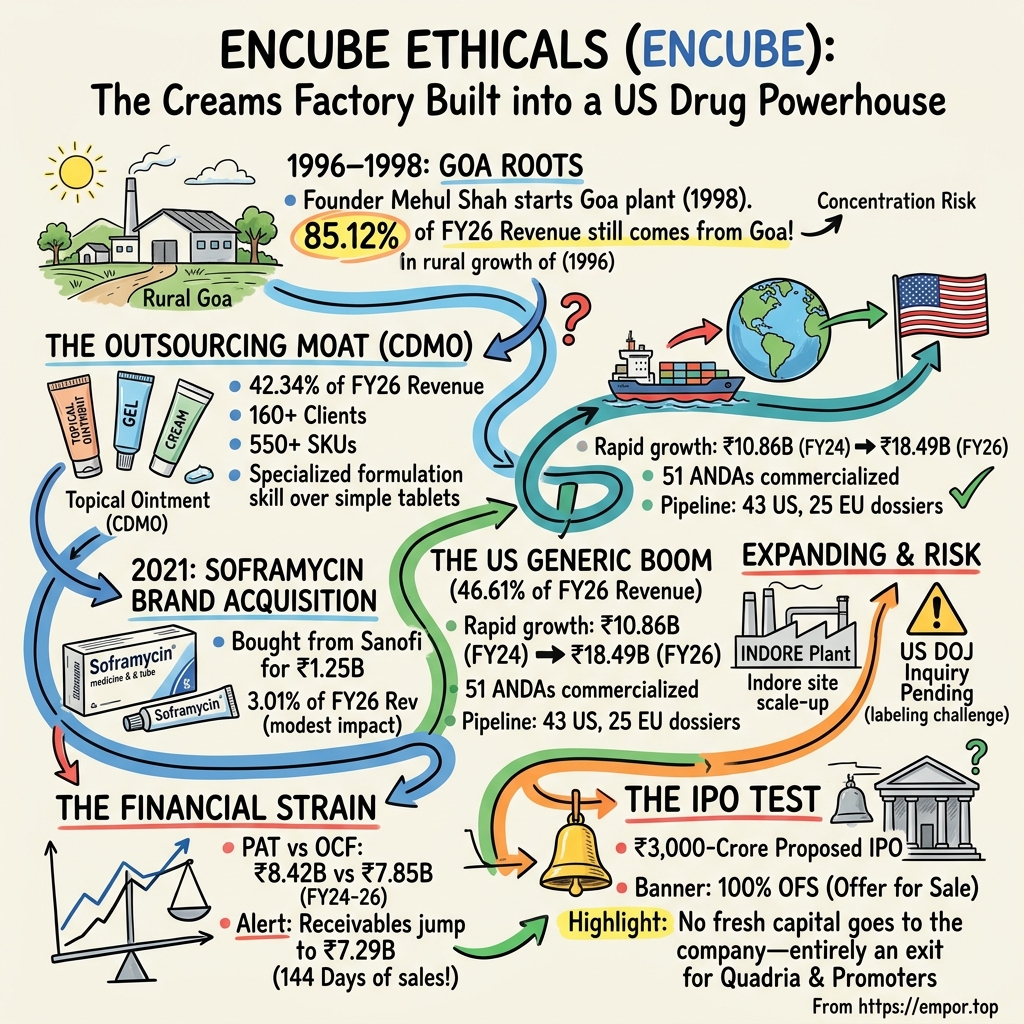
Encube Ethicals: The Creams Factory That Built a US Drug Business
I. The ₹3,000-Crore IPO With No Money for the Company
In early August 2026 a thick document went up on the websites of India's stock exchanges and its securities regulator. Encube Ethicals, a Mumbai company that most Indian investors had never heard of, had filed its draft red herring prospectus, the opening move in a public listing.1 It proposed to sell up to ₹30 billion of shares, about ₹3,000 crore, which would put it among the larger pharmaceutical listings India had seen in recent years.2 And yet, when a reader turned to the page explaining where the money would go, the answer was simple: none of it would go to Encube.
Every share on offer was an existing share. Founder and managing director Mehul Shah planned to sell up to ₹20 billion of his own holding, and Frontier Investment Holdings, the vehicle through which the Singapore-based healthcare investor Quadria Capital owns its stake, planned to sell up to ₹10 billion.3 There was no fresh issue. The company would not raise a rupee for a new plant, a new product or debt repayment. In the language of Indian capital markets, this was a pure offer for sale, an OFS, and the buyers of the shares would be paying the sellers, not the business.
That is not unusual and it is not, by itself, a warning sign. Founders who have spent three decades building a company are entitled to diversify, and private-equity funds have fixed lives and must return capital to their own investors. But it changes the question a public investor has to ask. When a company raises money in its IPO, the investor is partly buying a plan: a factory that will be built, a debt that will be retired. When the IPO is entirely secondary, the investor is buying only what already exists, at a price that the people who know the business best have decided is attractive enough to sell into. The plan has to be paid for out of the company's own cash.
What exists is substantial. Encube describes itself as an integrated topical-pharmaceuticals business: it makes the creams, ointments, gels and lotions that people rub onto their skin, rather than the tablets they swallow.4 Revenue from operations rose from about ₹10.9 billion in the year to March 2024 to about ₹18.5 billion in the year to March 2026, and profit after tax nearly tripled over the same stretch, to about ₹4.4 billion.4 Promoter Mehul Shah and his family held about 81% of the company before the offer, with Quadria's vehicle holding about 15%.3
The draft prospectus contains no price band. That will come only in the final red herring prospectus, and until it arrives no one outside the company and its bankers can say what Encube will be valued at. This story therefore cannot end on a valuation verdict, and it will not pretend to. What it can do is work through the evidence a long-term investor would need before that price appears, and ask four questions of it. Is the growth in US generic drugs durable, or the high point of a cycle? Has a specialist manufacturer turned its regulatory know-how into genuine pricing power with the drug companies it serves? Is cash keeping up with reported profit? And what does a sale with no primary capital say about the price at which the insiders are willing to let go?
The boundaries matter before the story starts. The company that would list is Encube Ethicals Limited in India, together with its wholly owned US subsidiary Encube Ethicals Inc., two US step-down companies called Tioga Research and EnZen Therapeutics, and a minority stake in a US associate, Intact Therapeutics.4 The family's cosmeceutical business, skin products sold on cosmetic rather than medical claims, was split off into a promoter-owned company named Confira Laboratories with effect from April 2020 and sits outside the listed perimeter.5 Anyone buying Encube shares would get the drug business, not the beauty business, and would be a minority partner to a family that still controls it.
 Subscribe on LinkedIn
II. A Goa Plant Becomes the Company
The company was incorporated in Mumbai in September 1995.4 What came next was not a laboratory breakthrough but a real-estate decision. In 1996 Mehul Shah bought land in Goa, and the plant there began production in 1998, at a time when, as Shah later recalled, the site lacked basic roads, reliable utilities and even phone connections.6 It is an origin story about plumbing and power lines, and it fits the company: Encube was built as a factory first.
Shah's choice was to specialize. Rather than assemble a broad portfolio of tablets, capsules and injectables, as many Indian pharmaceutical companies of that era did, he built a plant designed for topical formulations.6 Topicals are a niche with peculiar physics. A cream is an emulsion, oil and water held together in a stable suspension, and getting the active ingredient to stay evenly distributed, to penetrate the skin at the right rate and to remain stable on a pharmacy shelf for two years is a different engineering problem from compressing powder into a pill. That difference would eventually become the core of Encube's pitch to customers and investors.
For most of its life the plant worked for other people. Multinational and Indian drug companies brought their products to Goa to be manufactured, and Encube earned its living on volume, quality and reliability. One telling example: Encube manufactured Soframycin, the antibiotic cream long sold in India by Sanofi, for years before it eventually bought the brand.7 The factory knew the product before the company owned it.
The business that exists today also reflects a decision about what to leave out. The scheme demerging the cosmeceutical operations into promoter-owned Confira Laboratories was sanctioned in October 2021.5 The split left the listed company focused on regulated medicines, where approvals, inspections and drug-regulatory dossiers create barriers, and left consumer cosmetics, with its marketing-driven economics, with the family. It also created a related party: Encube still sells to Confira, as the story will return to.
The next turning point was capital. In June 2021 a consortium led by Quadria Capital acquired a stake in Encube, describing it as an investment in a leading global topical-drugs manufacturer and an integrated topicals platform.8 That deal followed an earlier private-equity partnership, and it arrived just as the company was setting up its own US commercial presence: the Delaware subsidiary had been incorporated in 2019 and Tioga Research acquired in 2020.4 Quadria's vehicle paid an average of ₹199.31 a share for its holding, measured on the shares as they stood before a later 10-for-1 split and 2-for-1 bonus issue.9 Adjusting for both, which multiply the share count by thirty, that works out to roughly ₹6.6 per current share. The prospectus does not disclose the total valuation of the 2021 round in a form that allows a clean whole-company mark, so it is better treated as evidence of Quadria's entry cost than as a pricing anchor for public buyers.
Five years later, the plant at the centre of the story is still the plant at the centre of the company. The Goa facility generated about 87% of Encube's revenue in fiscal 2024, falling to about 82% in fiscal 2025 before recovering to about 85% in fiscal 2026.10 Shah's long tenure is a real asset: he has led the company since incorporation, and a manufacturing culture that passes repeated foreign regulatory inspections is not built quickly.11 But the record that makes the IPO interesting is much shorter than the record that built the plant. Revenue in fiscal 2022 was about ₹6.7 billion.4 It took more than a quarter-century to reach that point, and only four more years to nearly triple it. The founding story explains the capability. It does not, on its own, explain the acceleration, and it leaves the company with a single site carrying more than four-fifths of the economics.
III. The Outsourcing Business That Built the Moat
Picture the job from the customer's side. A drug company has a topical product, perhaps a corticosteroid cream or an antifungal gel, that it wants to sell in the United States or Europe. It needs someone to work out the formulation at commercial scale, to generate the stability and analytical data that regulators demand, to qualify a plant that inspectors will accept, and then to make millions of tubes a year without a batch failure. That is what a contract development and manufacturing organization, a CDMO, does. Encube's Global CDMO vertical earned about ₹7.8 billion in fiscal 2026, about 42% of revenue, from more than 160 clients across more than 550 product SKUs.4
The money comes in two shapes. Development work, which takes a product from the bench toward approval, is usually billed as fee-for-service. Commercial supply, which is the larger prize, is paid per unit under supply agreements.4 The second shape is where a CDMO's fortunes are made, and it is also where it has the least control. Volumes depend on whether the customer's product is approved, whether it wins share in pharmacies, and whether the customer keeps ordering from Encube rather than from a second source.
Why a cream is harder to move than a tablet
The case for Encube's edge rests on the stickiness of that work. Moving a simple tablet from one manufacturer to another is not trivial, but the process is well understood. Moving a topical product is harder. The physical properties of an emulsion can change with the mixing equipment, the order in which ingredients are added and the temperature profile of a batch. Regulators in the US expect a generic or transferred topical product to be shown equivalent to the reference, which for many creams means more than a simple blood-level test. A customer that switches manufacturer must repeat development work, file changes with regulators and risk a supply gap. Those are switching costs in the sense Hamilton Helmer uses the term: costs a customer bears to leave, which give the incumbent some room on price.
There is evidence that Encube has earned a seat at that table. Its Goa plant holds approvals from the US Food and Drug Administration, European regulators, the World Health Organization, Brazil's ANVISA and Australia's TGA.10 It serves a long list of customers across hundreds of SKUs, which suggests a broad technical base rather than a single anchor contract.4 And the CDMO business grew about 22% in fiscal 2026, which is respectable for an outsourcing operation of its size.4
What the moat does not yet prove
The weakness of the argument is that technical capability is not the same as bargaining power. The best test of pricing power in an outsourcing business is customer behaviour: retention rates, price increases that stick, margins by customer. Encube does not disclose customer-level retention or margins, and it does not report profit by vertical.4 What it does disclose cuts the other way. Its top five customers produced about 43% of fiscal 2026 revenue and its top ten nearly 60%, and both shares have barely moved over three years.10 A company with 160 clients that still earns three-fifths of its revenue from ten of them has a long tail and a heavy head. The heavy head is where buyer power lives: a large pharmaceutical customer that knows it represents a tenth of a supplier's sales can multi-source, extract price concessions, or simply move volume when its own product loses share.
The competitive field reinforces the caution. The prospectus's industry report, prepared by Frost & Sullivan, positions Encube in a global topical market that includes far larger players: diversified generic giants such as Teva and Sun Pharma, which owns the US topical specialist Taro, along with Indian formulation companies such as Glenmark that have long-standing dermatology franchises.12 Those companies dwarf Encube by total revenue. The fair comparison is narrower. In topicals specifically, Encube is a meaningful specialist; the industry report places it among the larger Indian topical manufacturers, but Encube's own scale in the global topical market is modest, and the share figures it cites describe a fragmented field rather than one Encube dominates.12 Scale in pharmaceuticals overall is a poor proxy for topical share, and the right conclusion is the modest one: Encube competes credibly in a specialized corner, alongside companies that could out-spend it if they chose to.
A long record of disconfirming events would weaken the moat claim further. The public record does not show one. There is no disclosed loss of a flagship CDMO customer, no warning letter at the Goa plant, and no abandoned manufacturing line in the prospectus.1013 The absence is meaningful because the record is long: Goa has been running for nearly three decades. But concentration figures that have not improved in three years of rapid growth also mean the business has not yet demonstrated that it can broaden its customer base as fast as it adds revenue.
So the moat argument, made once and carefully, comes out as follows. Encube has evidence of technical capability, regulatory standing and an established manufacturing base that customers would find costly to replace. It does not have evidence of a cornered market or of superior customer economics, because the company does not publish the numbers that would show it. The claim survives intact but unproven. The operating test is visible in a number the company already reports: if the share of revenue from the top ten customers falls meaningfully as capacity expands, the platform is deepening; if it stays near 60%, Encube remains a strong supplier to a small group of powerful buyers. And the bigger reason the revenue curve bent upward in the last three years lies not in the CDMO book at all, but in a business where Encube sells its own products.
IV. The US Generic That Changed the Growth Rate
To understand why Encube's growth accelerated, follow a single product. Encube's scientists develop a generic version of a topical drug whose patent protection has ended. The company files an Abbreviated New Drug Application, an ANDA, with the US FDA, showing that its version matches the reference product. If the FDA approves, Encube can sell it. But approval is only a licence to compete. To make money, the product has to win placement with the handful of buyers who control America's generic drug flows: wholesalers, pharmacy chains and the group purchasing organizations that negotiate on behalf of hospitals and pharmacies.4 An award from one of them can deliver large volumes overnight. A rival's lower bid can take them away just as quickly.
This is the business that changed Encube's trajectory. In fiscal 2026 its Global Generics vertical, which sells Encube-owned products mainly in the US, produced about ₹8.6 billion of revenue, up about 58% from the year before, and became the company's largest line at about 47% of the total.4 The CDMO line, by contrast, grew about 22% to ₹7.8 billion. India Branded Formulations, home of Soframycin, contributed about ₹1.7 billion, and other operating revenue about ₹0.4 billion.4 Generics did not merely grow; they overtook the outsourcing business that built the company.
The scale of the change shows up against the longer baseline. Revenue was about ₹6.7 billion in fiscal 2022 and ₹10.9 billion in fiscal 2024, before reaching ₹18.5 billion in fiscal 2026, a compound growth rate of about 30% a year over the last two years.4 Profit grew much faster than revenue, nearly tripling from about ₹1.6 billion to about ₹4.4 billion.4 Whatever happened between fiscal 2024 and 2026 was not a continuation of the company's earlier pace. It was a step change, and the generics line drove most of it.
The capability behind it is real and measurable. By March 2026 Encube had 51 commercialized ANDAs in the US, 43 more in the pipeline and 25 dossiers filed in Europe.4 In fiscal 2026 alone it filed 13 new ANDAs and received 14 approvals.14 The commercialized count is the number that matters most, because it is one step closer to revenue than an approval: it says the product is actually being sold. And the count rose fast, from 28 commercialized ANDAs in fiscal 2024 to 51 two years later.4 That is evidence of a working machine: development, regulatory filing, approval and launch, repeated at a pace that most specialist generic companies of Encube's size would envy.
Approvals are not sales
Yet the count tells less than it seems to. Encube does not disclose revenue by product, launch dates for individual products, or how many of the 51 commercialized ANDAs are material sellers.4 In US generics, revenue is typically concentrated: a few products with limited competition earn most of the profit, while the rest sit in a tail of low-priced commodities. A generic launched when only one or two rivals are in the market can be lucrative; the same product with eight competitors may barely cover its costs. Without product-level disclosure, the investor cannot tell whether Encube's surge came from a broad portfolio rising together or from a small number of products enjoying an unusually favourable competitive window. The second would be far less durable.
The prospectus also does not give segment profit.4 It is tempting to assume that the fastest-growing line is the most profitable, because owning the product means capturing the full margin rather than a manufacturing fee. That is plausible, but generic products sold through powerful US buyers also bear price erosion, rebates and chargebacks that a CDMO supply contract does not. The company's overall material margin, which held in a band of roughly 67% to 70% over three years, suggests that the mix shift has not hurt gross profitability.4 It cannot prove that generics are the higher-margin business.
The disconfirming history that matters most here comes not from Encube's own record, which has been one of rising approvals, but from the base rate for the industry it entered. US generic pricing went through a severe deflation in the second half of the last decade as wholesalers and pharmacy chains consolidated into a few buying groups and the FDA accelerated approvals, and many Indian generic companies saw a period of rapid US growth followed by years of erosion. That pattern does not reject Encube's growth thesis, but it narrows it. The question is not whether Encube can win approvals; it plainly can. It is whether it has chosen niches where competition stays thin long enough for the economics to hold.
Currency adds a second layer. Because US sales are booked in dollars and costs are largely in rupees, a weaker rupee lifts reported revenue and margin without any change in the business, and the company's US revenue was about 65% of the fiscal 2026 total.15 Part of the generics surge, measured in rupees, is the rupee itself.
So the verdict on the growth engine is clear in one direction and open in the other. Encube has converted a development pipeline into commercial products at an accelerating pace, which is more than a list of certifications. It has not shown that the growth rate or its margins will persist once competitors enter its products and buyers rebid them. Each new generic adds volume; each rival entrant can subtract price. The company now has a third engine as well, a branded business in India, and the way that one was assembled says a great deal about how much a famous name is worth.
V. The Soframycin Deal: A Brand With a Small Footprint
For generations of Indian households, Soframycin was the tube in the first-aid box: an antibiotic cream for cuts and burns, sold under the Sanofi name. Encube had made it for years. In late 2021 it agreed to buy the brand outright, along with associated brands, from Sanofi India for India and Sri Lanka, at a reported price of ₹125 crore, or about ₹1.25 billion.7 Sanofi's own annual report for that year recorded the sale of the Soframycin brands.16
The strategic logic was clean. A contract manufacturer earns a fee on every tube it makes, but the brand owner earns the margin on every tube sold, and controls the shelf, the doctor relationships and the price. Buying Soframycin let Encube step from the factory floor into the pharmacy, with a product it already knew how to make. It also gave the company an India Branded Formulations vertical with a recognizable anchor, distribution relationships and a sales force.4 The transaction included the related brands Sofradex, Sofracort and Sofra-Tulle.7
Four years on, the numbers show a brand that is useful but small. Soframycin produced about ₹557 million of revenue in fiscal 2026, about 3% of Encube's total.4 The reported purchase price was therefore roughly 2.2 times Soframycin's current annual sales. That is a scale clue, not a deal multiple: the price bought several brands, trademarks and associated rights, not just one product's revenue, and the company does not publish the brand's profit. The prospectus's own accounting of the acquisition records consideration in more than one component, which makes the headline press figure a guide to scale rather than the complete accounting cost.4 What can be said is that Encube did not pay an extravagant multiple of sales for a famous name, and that its return depends on profits the company does not disclose.
The harder evidence is the trend. Soframycin's revenue was about ₹586 million in fiscal 2024, slipped to about ₹528 million in fiscal 2025 and recovered to about ₹557 million in fiscal 2026.4 Over a period in which the company as a whole grew by roughly 70%, its most famous brand shrank slightly. The wider India Branded Formulations vertical did grow, by about 26% in fiscal 2026 to about ₹1.7 billion, so the other brands and products in that portfolio are carrying the growth.4 Sofradex, Sofracort and Sofra-Tulle are optionality: the company has the rights, but the disclosed figures do not show them as material revenue.
That record tests one of the classic claims of brand acquirers: that a legacy brand, freed from a multinational that no longer prioritized it, will flourish under an owner that cares. For Soframycin, so far, the claim has not been borne out. The flagship has held its ground, which in a crowded antiseptic market is something, but it has not become a growth engine. The fair verdict is that the acquisition was strategically adjacent, reasonably priced on the evidence available and too small to define the company. The investor test is simple: whether Soframycin's revenue rises in a way that justifies the sales force built around it.
Set against the rest of Encube's capital spending, the deal also looks modest. The ₹1.25 billion price was less than half of what the company spent on capital expenditure in fiscal 2024 alone.14 The real bets were on plants and pipelines, and those bets produced the growth. They also produced a bill, and the place it shows up is not on the income statement but on the balance sheet, in the money customers owe.
VI. The Growth Bill Comes Due in Receivables
Every fast-growing manufacturer faces the same trade-off. To win business from large buyers, it ships product and extends credit. Sales are booked when the goods leave; cash arrives later. If customers pay on time, the gap is a timing difference. If they stretch, the company ends up funding its customers' working capital, and reported profit runs ahead of cash. Encube's fiscal 2026 accounts show that tension clearly.
Start with the reassuring part. Across the three years from fiscal 2024 to fiscal 2026, Encube reported about ₹8.4 billion of profit after tax and generated about ₹7.8 billion of cash from operations.17 That is a conversion rate of about 93%, which is solid for a business growing 30% a year, and the gap of about ₹576 million is small relative to the profits earned. Over the whole period, the company has turned most of what it reported into cash.
The warning sits in the most recent year. In fiscal 2026 profit rose by 75% to about ₹4.4 billion, but operating cash flow barely moved, rising to about ₹3.0 billion from ₹3.0 billion the year before.17 The difference was almost entirely receivables. Trade receivables absorbed about ₹1.9 billion of cash in that year alone, and taxes paid reached about ₹1.5 billion; non-cash depreciation and amortization of about ₹1.2 billion added back, but could not close the gap.18 Put simply, in the year Encube's profit jumped most, roughly 70 paise of each rupee of profit came back as operating cash.
The balance sheet tells the same story in a single figure. Trade receivables rose from about ₹4.3 billion in March 2024 to about ₹7.3 billion in March 2026, an increase of more than 70% while revenue grew about 70%.19 At the end of fiscal 2026, receivables equalled about 39% of the year's revenue, or roughly 144 days of sales. For a business whose largest customers are US wholesalers and pharmacy chains, payment terms can be long, and chargebacks and rebates complicate the timing. But the jump in fiscal 2026, when receivables grew almost 49% against revenue growth of 37%, says something changed in the year.19
Where the overdue money sits
The ageing schedule shows what. Of the ₹7.3 billion owed in March 2026, about ₹4.7 billion was current and not yet due.19 The rest was overdue. About ₹2.4 billion was overdue by less than six months, up from about ₹662 million a year earlier, nearly a fourfold increase.19 About ₹180 million was overdue by six months to a year, and about ₹39 million by more than a year.19 The long-dated balances are small; the short-dated overdue balance is the story.
It is also concentrated. Two customers accounted for about ₹2.7 billion, or 37.1%, of receivables at the end of March 2026, and each of them contributed more than 10% of the year's revenue.19 Encube does not name them, and it does not say which customers account for the overdue balance. It would be wrong to assume they are the same; it would also be wrong to ignore the possibility. A company that depends on two customers for more than a third of what it is owed has a negotiating relationship, not just a ledger entry, and a large customer that delays payment is exercising power.
Against this, the company's allowance for expected credit losses was just ₹18 million in March 2026, up from ₹4 million a year earlier.19 That is a small provision against a large balance. It is not evidence of impairment: overdue by a few weeks is not the same as uncollectable, and large US pharmaceutical distributors rarely default. The auditor signed the accounts. But the size of the provision does mean the reported profit assumes nearly all of the overdue money will arrive.
The liquidity picture adds a qualification. At the end of March 2026 Encube held about ₹541 million in cash and about ₹3.0 billion in arbitrage mutual funds, together about ₹3.5 billion.18 That looks like a comfortable cushion. But the mutual-fund units are under lien, pledged to secure a standby letter of credit that backs the US subsidiary's dollar borrowings.20 The money exists, but it is working as collateral, and it cannot be spent without first unwinding the debt it secures.
The verdict follows from the timing. Cumulative cash conversion is good, so the record does not show a company whose profits are imaginary. The latest year does show a company lending more to its customers as it grows, with a sharp rise in recently overdue balances concentrated in a small number of large accounts. The settling evidence is close at hand. Interim financial statements for fiscal 2027, which will accompany the final offer document, should show whether the ₹2.4 billion short-dated overdue balance was collected, rolled into longer ageing buckets, or provided for. If it is collected, fiscal 2026 was a timing blip during a launch surge. If it ages, it becomes a question about the quality of the generic sales that drove the growth. And the receivables are not the only concentration in this story; the factory that produces most of the goods is another.
VII. A Second Plant, One Inspection, and the DOJ Inquiry
Every regulated manufacturer has a nightmare scenario, and for Encube it can be described in a sentence. If US regulators found serious problems at the Goa plant and issued a warning letter or import alert, the shipments that produce more than four-fifths of the company's revenue could stop crossing the Pacific. In fiscal 2026 Goa accounted for about 85% of revenue.10 There is no other site carrying anything close to that share.
Encube has invested in a second site at Indore in central India, and the company's facility disclosures present it as part of a broader manufacturing network.21 That is real capital in the ground and it deserves credit: a company content to rely on one plant would not have built another. But the existence of a facility is not the same as diversification. To take meaningful volume from Goa, Indore must have products transferred to it, customers must qualify it, and regulators in the US and Europe must approve it for those products. The revenue concentration figure, which went from about 82% in fiscal 2025 back up to 85% in fiscal 2026, shows that this transfer had not yet happened at scale.10 Indore is a capability; it is not yet a hedge.
Goa's inspection record is, for now, reassuring. The US FDA inspected the Goa plant in June 2024, and Encube received the Establishment Inspection Report in September 2024, the document that formally closes an inspection.10 Independent inspection-history records show the facility's FDA inspections ending in observations classified as voluntary action indicated, which means the inspectors found issues the company was expected to correct on its own, not violations serious enough to trigger a warning letter.13 The FDA itself explains that inspection observations recorded on Form 483 are not final determinations of compliance.22 A long record of passing inspections at a single site is evidence of a working quality system, and it is part of why the moat argument earlier in the story survives.
The letter from Washington
The other risk came in the mail. On May 9, 2023, the US Department of Justice issued a Civil Investigative Demand to Encube Ethicals Inc., the US subsidiary that sells the company's generics.23 A civil investigative demand is a formal request for documents and information, typically the opening stage of an inquiry under the False Claims Act, the law that lets the US government recover money paid out on improper claims.
The question at issue is specific. The investigation concerns whether the subsidiary caused false claims to be submitted to Medicare by distributing a product with prescription labelling after the reference drug it copied had switched to over-the-counter status.23 The point of the distinction is reimbursement: Medicare's drug benefit generally covers prescription products, not over-the-counter ones, so a product sold as prescription-only when its reference had become a non-prescription item could, in principle, have been reimbursed when it should not have been. The company says that, as of the prospectus, the DOJ had taken no further action and had not quantified any claim, and it has made no provision for the matter.23
The two kinds of risk are on different scales. Encube's quantified contingent liabilities were about ₹81 million in March 2026, mostly sales tax, income tax and customs disputes, alongside about ₹164 million of performance bank guarantees.23 Those are small numbers for a company of this size. The DOJ matter is unquantified. False Claims Act cases can carry treble damages and per-claim penalties, but they also frequently end without any action, or in settlements proportionate to the revenue involved. Without a quantum from the government or the company, the honest statement is that the risk is real, pending and of unknown size, and that the small contingency figure does not capture it. More than three years of silence since the demand is mildly reassuring, but it is not a closure letter.
One governance detail sits alongside these. Encube's statutory auditor, Walker Chandiok & Co, reported in each of the three years from fiscal 2024 to fiscal 2026 that the company's accounting software did not have the audit-trail, or edit-log, feature continuously enabled at the database level for all users.23 The gap narrowed over time and, in fiscal 2026, persisted for one system user.23 An edit log records who changed an accounting entry and when; Indian rules now require it. The observation is not a finding of misstatement and is common among companies preparing for listing. But it is a control weakness in a company about to ask public investors to rely on its numbers.
So the facility question and the regulatory question resolve into two observable tests. The first is whether Indore begins to carry a meaningful share of revenue, measured by a falling Goa percentage, and passes its own regulatory inspections. The second is whether the DOJ issues a formal closure or a settlement. Until then, the company remains concentrated in one site and exposed to one unresolved inquiry, both of which sit within the same US commercial business that produced most of the recent growth. That makes the decisions of the people running the company, and how they are paid and what they are selling, the next thing to examine.
VIII. The Founder's Growth Plan Meets Its First Public Test
In April 2026, a few months before the prospectus was filed, Mehul Shah made a decision that founders often avoid. Pratik Kamani, who had been Encube's Chief Business Officer, was elevated to Executive Director and Chief Executive Officer with effect from April 29, 2026, and C. S. Muralidharan was appointed Chief Financial Officer the same day.11 Shah remains Chairman and Managing Director.11 The board was reconstituted between May and July with three independent directors and a nominee from Quadria.11
An internal succession of this kind is a credible continuity signal. Kamani knows the customers and the products; the company is not handing itself to an outsider at the moment of listing. It is also the kind of professionalization that public markets expect. But it happened in the months before the filing, which means the new structure has no public track record yet.
The incentives are concrete. Shah received about ₹24 million in fiscal 2026, modest relative to a company earning over ₹4 billion.11 Kamani received about ₹23 million as Chief Business Officer that year, and his new package was set at about ₹32 million a year plus performance incentives and stock options.11 The founder's real economics lie in his shareholding, not his salary: before the offer, Shah owned about 61% of the company, his family a further 19%, and Quadria about 15%.3 Shah's promoter shares are unpledged.9
Where the cash went
The record of capital allocation is mostly a record of building. Encube spent about ₹2.9 billion on capital expenditure in fiscal 2024, about ₹1.6 billion in fiscal 2025 and about ₹2.3 billion in fiscal 2026, roughly ₹6.8 billion over three years.14 That is more than three-quarters of the three-year profit, which means the company has been reinvesting most of what it earned in plants, equipment and intangible assets, rather than harvesting the business ahead of a sale.
Research spending tells a more ambiguous story. Expensed R&D was about ₹1.2 billion in fiscal 2024, about 11% of revenue, and about ₹1.4 billion in fiscal 2026, about 7% of revenue.14 The absolute spend rose, the pipeline expanded and approvals accelerated, so one reading is that the research machine became more productive. The other reading is that research intensity fell as revenue rose, and that part of the margin expansion came from spending proportionally less on the future. The difference of more than three percentage points of revenue is large relative to the company's margin gains. Both readings may be partly true; the test will be whether approvals and launches keep pace if research intensity stays near its current level.
The smaller research bets carry a clearer cautionary record. Tioga Research, acquired in 2020, and EnZen Therapeutics, formed in 2021 and about 93% owned through the US subsidiary, support development work in the United States.4 Encube recorded impairments around them: impaired loans and interest to Tioga, an investment impairment of about ₹281 million in fiscal 2024 and another of about ₹209 million in fiscal 2025.5 These were not ruinous sums against the company's profits, but they are write-downs of research ventures that management had backed, and they are the closest thing in the record to a failed bet. They do not prove that the current pipeline will disappoint; they do argue for treating technical milestones from these entities as options rather than as business lines.
Related-party dealings are modest but recurring. Encube sold about ₹76 million of goods to Confira, the demerged cosmeceutical company in which Shah is a director and shareholder, in fiscal 2026, about 0.4% of revenue, up from ₹8 million two years earlier.5 The company also leases property from Shah and his wife, Niti Shah, with payments of about ₹29 million and ₹24 million respectively in fiscal 2026.5 None of these sums is large, but the rising sales to Confira and the shift in lease payments within the family are the kind of arrangements a public shareholder will want to see priced and disclosed every year.
The balance sheet behind the plan
The balance sheet is conservative on paper. Borrowings were about ₹2.2 billion in March 2026, almost all of it short-term dollar working-capital debt held by the US subsidiary at a floating rate of one-month SOFR plus about 105 to 140 basis points.20 Including lease liabilities, total debt was about ₹2.5 billion, against cash and mutual funds of about ₹3.5 billion.20 On that arithmetic Encube has net cash of about ₹1 billion and debt of about a tenth of its equity. The qualification on liquidity applies again: the mutual funds securing the US borrowings through the standby letter of credit are not freely available, so the net-cash figure overstates the company's flexibility.20 The company's facilities carry no public credit rating; they are bilateral bank loans.24
That brings the story back to the opening. With no primary proceeds, the IPO funds none of the next phase. If Encube wants to build out Indore, accelerate its pipeline or buy another brand, it will do so from its own cash flows and borrowing capacity. Founder and private-equity liquidity is a rational reason to list, and the history suggests it was considered carefully: reports in 2025 said Quadria was weighing a sale of its stake while keeping a public listing open as an option, and reports in March 2026 said a stake sale was on hold with an IPO likely by 2027.2526 The timetable then moved forward to a filing in August 2026. That sequence matters to a public buyer. A private-equity seller that explored a private sale before choosing the public market has already tested what a strategic or financial buyer would pay. The public market is the route it took.
IX. Analysis & Bear vs. Bull Case
Two numbers now sit at the centre of the prospectus. The first is the about 58% growth rate of the generics business in fiscal 2026.4 The second is a ₹427 million foreign-exchange gain in the same year.15 The first is the bull case's best evidence. The second is a reminder that part of fiscal 2026's profit had nothing to do with making medicine.
The margin on trial
Encube's EBITDA margin rose from about 27% in fiscal 2024 to about 36% in fiscal 2026, an expansion of about 8.5 percentage points in two years.4 Three forces could explain it, and the evidence lets them be weighed.
The first is currency. Other income jumped to about ₹631 million in fiscal 2026, of which ₹427 million was a net gain on foreign-currency transactions.18 Whether the FX gain sits inside EBITDA depends on how the company defines it; most Indian issuers exclude other income from EBITDA, which would mean the FX gain flatters profit before tax rather than the reported EBITDA margin. Either way, the gain was about 7% of fiscal 2026 pre-tax profit, and it arose because the company held large dollar receivables without hedging: it had no forward contracts outstanding.15 A stable or strengthening rupee would remove it.
The second is research intensity. R&D fell from about 11% of revenue to about 7% between fiscal 2024 and fiscal 2026, worth more than three percentage points of margin.14 That accounts for perhaps two-fifths of the EBITDA expansion. It is a real saving, but it is a choice that can be reversed, and the company's own pipeline ambitions may require reversing it.
The third, the remainder, is operating leverage from scaling generics: more revenue through the same plant and overheads, with material margins holding near 70%.4 This is the durable part, if the products hold their prices. Currency, then, does not explain the whole margin leap; perhaps half or more of it is the business getting bigger. But a careful investor would not underwrite the fiscal 2026 margin as the base case without first adjusting for both the FX gain and the lower research spend.
The forces around the business
The industry structure can be stated in Porter's terms without a checklist. Buyer power is high: the top ten customers take about 60% of revenue, and the US generic market is dominated by a small number of purchasing groups.10 Rivalry is intense and the threat of entry is constant, because any company with an approved ANDA can bid for the same award. Supplier power is moderate: the top ten raw-material suppliers account for about 35% of purchases.10 Substitutes, in the sense of a different therapy, are less of a threat for established topical treatments. Against that, Encube's sources of power, in Helmer's vocabulary, are switching costs on the CDMO side and a form of process power in topical formulation: know-how embedded in people and procedures that competitors cannot copy quickly. Neither is a cornered resource, and neither protects a generic product from a rival's lower bid.
The competitive comparison must stay grounded. Diversified giants like Sun Pharma and Teva have topical businesses that are a fraction of their total revenue but still large next to Encube's, and specialist US topical generics makers compete on the same products. The right scale is Encube's share of specific topical markets, which the prospectus's industry report presents in a fragmented field, not its share of global pharmaceuticals.12 Broader Indian dermatology demand is growing, which supports the branded business, but that market is a small part of Encube's economics.27
The case for and the case against
The bull case rests on operating evidence. Encube has turned a pipeline into 51 commercialized US generics, grown the line by more than half in a year, held material margins near 70%, converted about 93% of three years' profit into operating cash, and reinvested heavily while keeping net cash on the balance sheet.417 If it keeps launching products into thinly contested niches, keeps its CDMO customers and gets Indore qualified, it could compound earnings for years.
The bear case is equally concrete. US generic prices erode as competitors arrive. Ten customers take 60% of revenue and two of them account for more than a third of receivables, while the recently overdue balance nearly quadrupled.19 One plant produces 85% of revenue. Currency gains, unhedged, flattered fiscal 2026. And an unquantified DOJ inquiry hangs over the US subsidiary that sells the growth products.23
Currency deserves its own sentence because it cuts both ways. About 74% of fiscal 2026 revenue came from outside India, 64.7% from the US.15 The company's net unhedged foreign-currency position was long, about ₹2.8 billion, and it estimated that a 5% move in the rupee against the dollar would change net profit by about ₹131 million.15 A weaker rupee helps; a stronger one hurts, with no hedges in between.
What the price would have to assume
Without a price band, the honest approach is to lay out what a range of prices would imply rather than to name one. Encube's fiscal 2026 diluted earnings per share were ₹14.36 on about 304 million shares after the July 2026 split and bonus.289 The DRHP's listed peers traded at price-to-earnings multiples ranging from about 21 times for Lupin to about 46 times for Glenmark among diversified formulation companies, and from about 40 times for Gland Pharma to about 98 times for the recently listed Rubicon Research among dosage-form specialists.28 Those are equity-value multiples on trailing earnings, measured at the end of July 2026.
The direct peers are not obvious. The diversified majors are larger, more mature and less concentrated, which argues for Encube trading at or above them on growth but below them on risk. Rubicon, a recent IPO with a US-focused specialty generics model, is the closest in structure, but its multiple reflects a scarcity premium for newly listed specialty names that may not persist. Applying, say, 22 to 40 times trailing earnings to ₹14.36 per share would put the equity value roughly between ₹96 billion and ₹175 billion. On that range, the ₹30 billion offer would represent somewhere between a sixth and a third of the company. The arithmetic is not a valuation; it is a measure of how wide the uncertainty is.
Two adjustments make the earnings base smaller than it looks. Stripping out the ₹427 million FX gain after tax would reduce fiscal 2026 profit by perhaps 7%, and restoring R&D to its fiscal 2024 intensity would reduce it by considerably more. A normalized earnings base might be a fifth below reported. In intrinsic terms, a buyer at the upper end of that range would be assuming that generics keep growing faster than the industry for several more years, that margins hold in the mid-thirties without FX help, and that receivables normalize. A buyer at the lower end would be assuming that fiscal 2026 was near a cyclical peak. Enterprise value, the equity value plus net debt, would be only slightly below equity value, given net cash of about ₹1 billion, but the liens over the mutual funds make even that small adjustment softer than it appears.20
The market may price above any such central range, because specialty pharmaceutical IPOs in India have attracted strong demand and the free float will be small, with promoters retaining most of the shares. It may price below it if public investors focus on the receivables and the DOJ. Neither outcome would say much about the business's underlying value.
There is also no public earnings-call record to test management's messaging, because Encube has never been listed. The available comparison is between Shah's account in a 2026 interview of a long-built manufacturing culture and Quadria's description of an integrated global topicals platform, on one side, and the prospectus's evidence on the other.68 The prospectus broadly supports the platform claim on the manufacturing and generics sides; it shows the branded business and the US research ventures falling short of what such language implies.
The stress test for an investor is simple to state. If generics growth slows to the CDMO rate, the FX gain disappears and the overdue receivables persist, what margin and cash-flow base would remain at the eventual IPO price? The three numbers that will answer it are already in the company's reporting: the count and revenue of commercialized ANDAs, the overdue receivables and operating cash conversion, and Goa's share of revenue as Indore scales.
X. Business & Investing Lessons
The first lesson goes back to a plot of land in Goa without roads or telephones. Mehul Shah built a single specialized factory and, over nearly thirty years, turned its know-how into the foundation of a business that now spans contract manufacturing, US generics and Indian brands. That is the case for focus: a capability narrow enough to be truly deep can later be stretched into adjacent businesses. But the same plant still produces 85% of revenue.10 A plant can become a moat; a moat concentrated in one plant is also a single point of failure.
The second lesson comes from the ANDA count. Fifty-one commercialized generics is an achievement that took real scientific and regulatory skill.4 But in the US generic market the approval is only a ticket to an auction, and the profit depends on how many others hold tickets to the same auction. An approval opens the door; the customer award and the reorder pay the bills. Investors who count approvals as revenue in specialty pharma are making the same mistake as those who count design wins as sales in semiconductors.
The third lesson belongs to Soframycin. Encube bought a brand that every Indian pharmacist knows, at a price that does not look extravagant, and four years later the brand's sales are roughly where they started.4 Familiarity is not growth. A famous brand is only as valuable as the sales and profits it brings under its new owner. Founders acquiring legacy brands from multinationals should expect to earn the growth, not inherit it.
The fourth lesson is written in the receivables ledger. In the year Encube's profit jumped 75%, its operating cash barely moved, and the money owed by customers overdue by less than six months nearly quadrupled.1719 Growth booked is not cash collected. In businesses that sell to powerful buyers, the faster the top line grows, the more carefully one should read the ageing schedule.
The fifth lesson is about the IPO itself. When every share on offer is sold by an existing holder, the company gets nothing and the buyer gets only what already exists. A pure offer for sale is not a red flag, but it reverses the usual question: not what the money will build, but why the people who built it are choosing this moment to sell. Underlying all five lessons is one discipline. Every capability, whether a plant, a pipeline, a brand or a customer list, has to be judged by its conversion into repeat revenue, margins and cash.
XI. Epilogue
Tonight, in October 2026, Encube is a company in between. Its draft prospectus has been filed with SEBI and the exchanges.1 It has no price band, no final offer document and no listing date. Its latest audited year closed in March, so the next disclosures, interim results for the first part of fiscal 2027, will arrive with the final red herring prospectus and will be the first fresh look at the business since the filing.
Three tests will decide which version of the story is true. The first is the factory. If Indore begins carrying commercial volume, passes regulatory inspections and pulls Goa's share of revenue meaningfully below 85%, the single-site risk will have started to shrink.10 If Goa's share stays where it is, the company's fate remains tied to one plant and one inspection cycle.
The second is the cash. The ₹2.4 billion of receivables overdue by less than six months in March 2026 will either have been collected, aged into longer buckets or been provided for.19 Collection would make fiscal 2026 look like a launch-year timing gap. Ageing would raise questions about the terms on which the generic growth was won.
The third is the growth engine itself. If generics keep growing well ahead of the CDMO line, and the EBITDA margin holds in the mid-thirties after stripping out currency gains and adjusting for research intensity, the bull case will have earned another year of evidence. If growth slows sharply as competitors enter Encube's products, fiscal 2026 will look like a peak.
Hanging over all three is a letter dated May 9, 2023.23 A formal closure from the Department of Justice would remove the largest unquantified risk in the prospectus. A demand or a settlement would quantify it. Either would be more useful to a public investor than the silence that has prevailed.
Only when the final prospectus sets a price, and the earnings base can be normalized for currency and research spending, will it be possible to judge whether the price asked of public shareholders rewards the growth already delivered or charges for growth not yet earned. Until then, the story of Encube is still being written, and the founder and his private-equity partner have chosen to write the next chapter with other people's money at risk alongside their own.
XII. Outro
Follow one tube of cream. It is filled on a line in Goa, sealed and boxed, loaded into a container at a port on India's west coast, and shipped across the world to a distribution centre in the United States. Weeks later it sits on a pharmacy shelf with a generic label, sold to a patient who has never heard of Encube, at a price set by a purchasing group that knows exactly how many rivals could replace it. The money for that tube, if the customer pays on time, returns to a company whose founder bought land in Goa in 1996, when there were no roads to the site.6
That is Encube's particular bet: that a manufacturing specialty can travel farther than the factory gate, into its own products, its own brands and now public ownership. The IPO will give investors a stake in that platform while the company itself receives nothing. Fifty-one commercialized US generics show how far the specialty has already travelled.4 The 85% of revenue still flowing from one plant in Goa shows how much it still depends on where it began.10 The next chapter will be decided by whether that success can spread, across customers, across sites and into cash.
References
-
Encube Ethicals files DRHP with SEBI for ₹3,000 crore IPO — Upstox, 2026-08-03 ↩
-
Draft Red Herring Prospectus, Encube Ethicals Limited, p. 82 (capital structure and offer for sale) — NSE, 2026-08-02 ↩↩↩
-
Draft Red Herring Prospectus, Encube Ethicals Limited, p. 6 (summary of financial information and business) — NSE, 2026-08-02 ↩↩↩↩↩↩↩↩↩↩↩↩↩↩↩↩↩↩↩↩↩↩↩↩↩↩↩↩↩↩↩↩↩↩
-
Draft Red Herring Prospectus, Encube Ethicals Limited, p. 94 (related-party transactions and subsidiary impairments) — NSE, 2026-08-02 ↩↩↩↩↩
-
Mehul Shah on Encube Ethicals’ history and leadership — PharmaNow, 2026-06-17 ↩↩↩↩
-
Encube Ethicals to buy Soframycin for Rs 125 crore — The Economic Times, 2021-11-26 ↩↩↩
-
Quadria Capital-led consortium acquires stake in Encube Ethicals — Quadria Capital, 2021-06-28 ↩↩
-
Draft Red Herring Prospectus, Encube Ethicals Limited, p. 105 (share capital history) — NSE, 2026-08-02 ↩↩↩
-
Draft Red Herring Prospectus, Encube Ethicals Limited, p. 30 (risk factors: customer, supplier and facility concentration) — NSE, 2026-08-02 ↩↩↩↩↩↩↩↩↩↩↩↩
-
Draft Red Herring Prospectus, Encube Ethicals Limited, p. 285 (management and remuneration) — NSE, 2026-08-02 ↩↩↩↩↩↩
-
Independent Market Assessment of the Global Topical Pharma Market and Contract Services, in the DRHP — Frost & Sullivan, 2026-08-01 ↩↩↩
-
Encube Goa facility FDA inspection history — ProPublica Rx Inspector ↩↩
-
Draft Red Herring Prospectus, Encube Ethicals Limited, p. 139 (R&D and capital expenditure) — NSE, 2026-08-02 ↩↩↩↩↩
-
Draft Red Herring Prospectus, Encube Ethicals Limited, p. 348 (foreign currency exposure) — NSE, 2026-08-02 ↩↩↩↩↩
-
Draft Red Herring Prospectus, Encube Ethicals Limited, p. 91 (cash flows) — NSE, 2026-08-02 ↩↩↩↩
-
Draft Red Herring Prospectus, Encube Ethicals Limited, p. 345 (other income, investments and cash flow items) — NSE, 2026-08-02 ↩↩↩
-
Draft Red Herring Prospectus, Encube Ethicals Limited, p. 337 (trade receivables and ageing) — NSE, 2026-08-02 ↩↩↩↩↩↩↩↩↩↩
-
Draft Red Herring Prospectus, Encube Ethicals Limited, p. 400 (borrowings and security) — NSE, 2026-08-02 ↩↩↩↩↩
-
Manufacturing capabilities and facilities — Encube Ethicals ↩
-
FDA inspection observations and Form 483 information — U.S. Food and Drug Administration ↩
-
Draft Red Herring Prospectus, Encube Ethicals Limited, p. 71 (risk factors: litigation, DOJ demand and contingent liabilities) — NSE, 2026-08-02 ↩↩↩↩↩↩↩↩
-
Draft Red Herring Prospectus, Encube Ethicals Limited, p. 405 (credit ratings and indebtedness) — NSE, 2026-08-02 ↩
-
Quadria Capital weighs Encube sale, keeps public float option alive — The Economic Times, 2025 ↩
-
Encube Ethicals stake sale on hold, IPO likely by 2027 — The Economic Times, 2026-03-20 ↩
-
Draft Red Herring Prospectus, Encube Ethicals Limited, p. 134 (basis for offer price and peer comparison) — NSE, 2026-08-02 ↩↩
 LinkedIn
 WhatsApp
 Reddit
 Hacker News
 Email
 Kindle
 RSS Feed
 Spotify
 Apple Podcasts
 Amazon Music
 Audible
 YouTube