Emmvee Photovoltaic Power: The Sun in a Steel Cage
I. Introduction & The Solar Sovereign Arbitrage
On the morning of November 18, 2025, the opening bell rang at the National Stock Exchange in Mumbai, and a company most global investors had never heard of became a public market fixture. Emmvee Photovoltaic Power Limited had sold its shares at ₹217 apiece a few days earlier, and the founder watching the ticker light up, Manjunatha Donthi Venkatarathnaiah, known across Karnataka's solar trade as D.V. Manjunatha, had started the group thirty-three years before by building solar water heaters for Bengaluru rooftops.12 There were no cleanrooms in that first workshop, no robotic stringers, no n-type silicon. There was sheet metal, glass, copper tubing, and a city whose electricity supply could not be trusted to heat a bucket of bathwater.
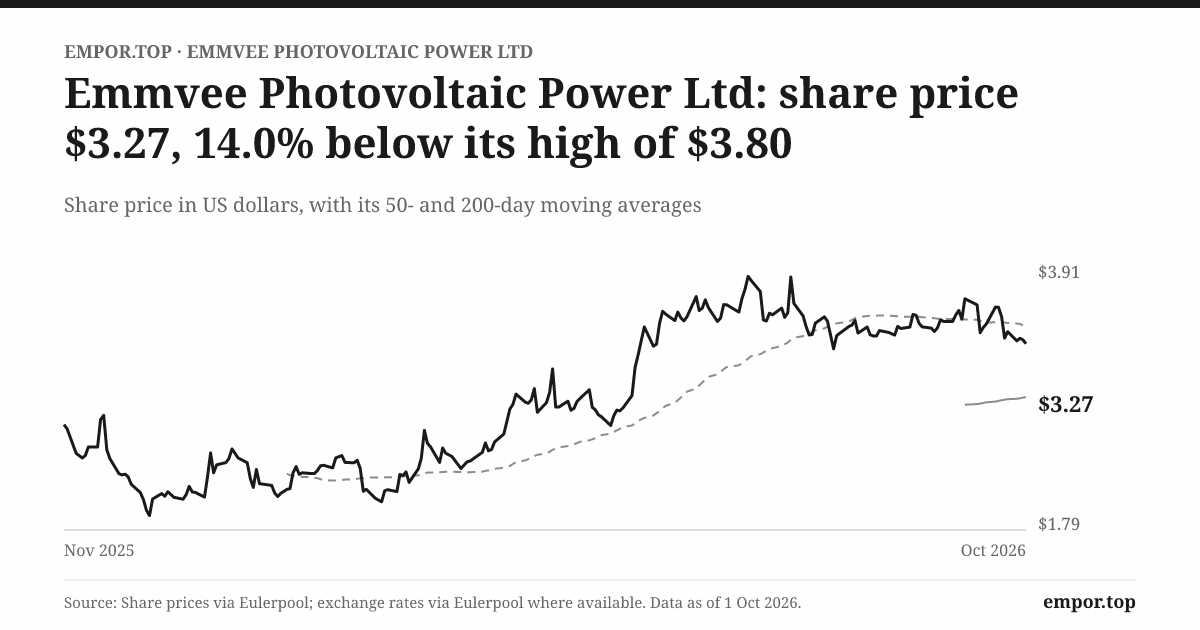
Less than a year later, on October 1, 2026, the market valued that company at about $2.3 billion, or roughly ₹21,800 crore, with the stock at ₹314.55.3 The headline numbers explain why. In the fiscal year to March 2026, Emmvee earned an operating margin of about 30%, up from under 3% just three years earlier.113 For a solar module maker, that figure is almost absurd. This is an industry where the world's largest producers spent much of the last decade selling at or below cost.
The cleanest way to feel the speed of the change is to look at net profit. In FY2024, Emmvee earned about $3.5 million. In FY2026, it earned about $123 million, and in the twelve months to June 2026, about $140 million.113 That is roughly a 35-fold jump in two years. Revenue roughly quintupled over the same stretch, which means margins, not just volumes, did most of the work.
Here is the puzzle this story sets out to solve. The global solar supply chain has been one of the great capital-destruction machines of the twenty-first century. Chinese industrial planning drove module prices down by most of their value in a decade, bankrupting manufacturers in Germany, the United States, and India along the way. So how does a mid-sized Indian assembler, buying most of its silicon from the very country that crushed its rivals, suddenly earn margins that look like enterprise software?
The answer is that Emmvee did not out-invent the world. It found itself inside a fortress. India built two walls around its domestic solar market: a 40% Basic Customs Duty on imported modules and a registry called the Approved List of Models and Manufacturers, or ALMM, that decides who is allowed to supply government-linked projects.4[^6] Inside those walls, Indian developers had to buy Indian modules, and for a few years there were not enough of them. Emmvee had the factories, the certifications, and the timing.
That makes this a story about sovereign policy arbitrage: profits created by the gap between the price inside a protected market and the price outside it. Arbitrage can be extremely lucrative. It is also, by nature, temporary. Gaps close.
And this gap is closing from the inside. Indian module manufacturing capacity has raced far past what the country installs each year. Industry trackers describe a domestic nameplate base that has pushed beyond 150 GW and, by many counts, toward 200 GW, set against annual installations in the range of roughly 55 to 60 GW.1011 The walls still keep out Chinese modules. They do nothing about the Indian factory down the highway.
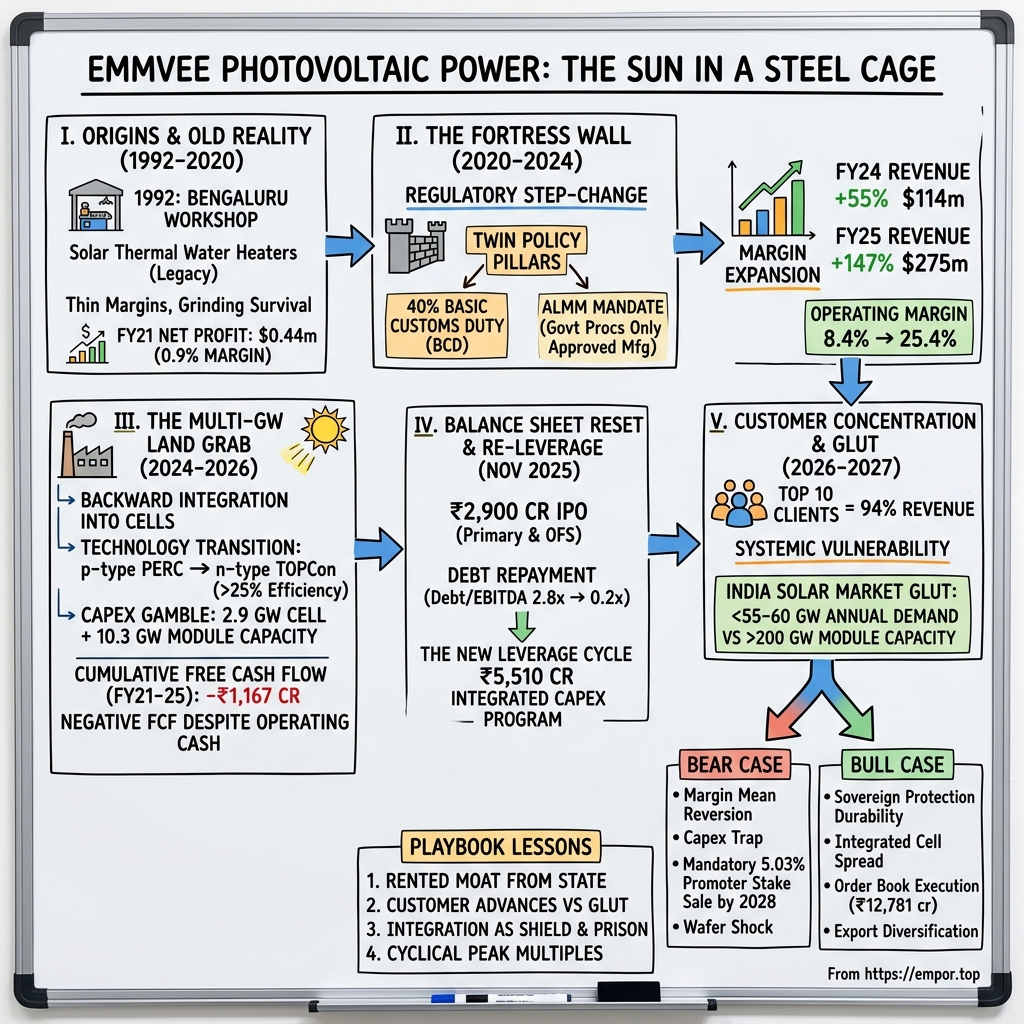
So the central question is blunt: can Emmvee sustain margins near 30% as Indian capacity outstrips Indian demand? Behind it sit three more. Does its push into making solar cells, now about 2.9 GW alongside 10.3 GW of module capacity, give it a real cost edge, or just a bigger capital bill?2 Will a planned ₹5,510 crore expansion re-lever a balance sheet the IPO just cleaned up?2 And how will the market absorb the stock the promoter family must sell by late 2028 to meet India's public-float rules?18
The market's answer, for now, is skeptical. At about 17 times trailing earnings, Emmvee trades roughly in line with its larger rival Waaree Energies and well below Premier Energies.3 A 17 multiple on profits that grew several-fold a year is not what investors pay for a durable franchise. It is what they pay for earnings they suspect sit near a peak.
The road map runs from solar water tanks in Karnataka to robotic lines at Dobbspet; through the mechanics of tariff walls; into the forensic reality of customer advances against negative free cash flow; and on to the capex gamble and the public-float clock. It starts, as most Indian manufacturing stories do, with a founder and a very small shop.
 Subscribe on LinkedIn
II. The Bengaluru Workshop to Cleanrooms: Origins & The Old Solar Reality (1992–2020)
Bengaluru in 1992 was not yet the city of glass towers and software campuses. Power cuts were routine, and a hot-water geyser running on grid electricity was both a luxury and a gamble. D.V. Manjunatha saw a simpler answer on the roofs above him: let the sun do the heating. He set up what became Emmvee Solar Systems to build solar water heaters, flat-plate collectors that warm water as it circulates through tubes under glass, and sold them one household, one hostel, one hotel at a time.112
The business was physical, local, and unglamorous. A solar water heater has no software, no network, and almost no ongoing revenue once installed. What it built for the Manjunatha family was something less visible: a dealer network across southern India, a brand name in renewable hardware, and three decades of experience running a factory on thin margins.
In 2007, the group made a bolder bet. It incorporated Emmvee Photovoltaic Power Limited to make solar photovoltaic modules, the panels that turn sunlight directly into electricity.1 The timing looked visionary on paper. In practice, it was brutal. Solar power in India was still far from cheaper than coal, and global module pricing was about to be rewritten by China.
An entity boundary that matters. Before going further, it is worth drawing a clear line. The listed company is Emmvee Photovoltaic Power Limited, which makes PV modules and cells, and it consolidates its key operating subsidiary, Emmvee Energy Private Limited, through which project debt and newer lines were set up.12 The original solar water-heater business, Emmvee Solar Systems Private Limited, remains a promoter-owned company outside the listed perimeter.1 Its revenue, assets, and history of rooftop tanks are not the shareholder's to claim. When this story uses the word "Emmvee" for financial figures, it means the listed PV business only.
That separation is more than housekeeping. The two companies share a founder, a family, a name, and some administrative infrastructure, and they transact with each other. Investors in the listed entity need to know which profits are theirs and which belong to the family's private balance sheet. Section V returns to how those dealings are policed.
The decade of being crushed. Through the 2010s, Chinese giants such as 隆基绿能 LONGi, 晶科能源 JinkoSolar, 天合光能 Trina Solar, and 晶澳科技 JA Solar built factories at a scale no Indian company could match, backed by cheap credit and provincial support. Module prices collapsed by well over three-quarters during that decade, and the pain landed on every manufacturer that lacked Chinese scale.11
For Indian assemblers, the playbook became survival. Import cheap Chinese cells, laminate them between glass and a backsheet, add an aluminium frame and a junction box, and sell into whatever domestic demand existed. The value added was thin. A module maker that did only that was essentially a contract packager for someone else's silicon.
What the numbers say about the old Emmvee. The earliest figures available tell the story plainly. In FY2021, Emmvee booked about $49 million of revenue and earned net profit of about $443,000, a net margin under 1%.113 Operating margins drifted from close to 9% in FY2021 down to under 3% in FY2023.113
That trajectory is the most important piece of historical evidence in the whole story. It tells investors what this business earns when the policy environment is ordinary and input prices move against it.
Historical falsification: was there an early manufacturing moat? A flattering version of the origin story would say Emmvee survived because it was simply better: better engineering, tighter operations, superior quality. The company's own record does not support that. Over FY2021 to FY2023, revenue grew, but operating profit fell from about $4.3 million to about $2.1 million.113 A manufacturer with real pricing power does not see margins shrink by two-thirds while volumes rise.
The more likely explanation is that Emmvee, like most Indian assemblers, was a price-taker. When global cell and wafer prices spiked in 2021 and 2022 amid polysilicon shortages, Emmvee could not pass the full cost through to customers who had alternatives. The history therefore narrows the moat claim sharply. Emmvee proved it could endure. It did not prove it could command a premium.
The family at the helm. The leadership that endured those years is the leadership running the company today. Manjunatha serves as Chairman and Managing Director, with promoter-directors Shubha Manjunatha Donthi, Suhas Donthi Manjunatha, and Sumanth Manjunatha Donthi alongside him.1 This is a tightly held, family-run hierarchy. Its strength is continuity and long memory of hard cycles. Its risk is the usual one for promoter-run Indian manufacturers: decision-making concentrated in a few people, with independent directors only recently added to the board.
The founder's defining trait, judging by the record, is patience bordering on stubbornness. Many Indian module makers of the 2010s vanished or shrank to irrelevance. Emmvee kept its lines running through years when they earned almost nothing. That persistence matters because it left the company standing, with certified capacity, at exactly the moment New Delhi decided to change the rules.
For long-term investors, the lesson of the first three decades is uncomfortable but necessary. The baseline profitability of Emmvee's core activity, absent protection, is low single digits. Everything that follows has to be read against that floor, and against what lifted the business off it.
III. The Fortress Wall: ALMM, BCD, and the Regulatory Step-Change (2020–2024)
In April 2022, a customs notification out of New Delhi changed the economics of every solar factory in India. From that month, imported solar modules carried a Basic Customs Duty of 40%, and imported solar cells carried 25%.[^6] Developers who had planned projects around cheap Chinese panels suddenly faced a landed price that was far higher. Overnight, an Indian-made module did not have to be cheaper than a Chinese one. It just had to be cheaper than a Chinese one plus a 40% toll.
The duty was the visible wall. The second wall was quieter and, in many ways, more powerful. The Ministry of New and Renewable Energy maintains the Approved List of Models and Manufacturers, a registry of factories inspected and approved to supply modules for government-linked projects.4 If a project was tied to central or state tenders, net-metering schemes, or programs such as the farm-solar PM-KUSUM scheme, the modules had to come from a factory on that list.49 Chinese factories were not on it.
Why India built the walls. The motive was strategic as much as commercial. After the 2020 border clashes in the Galwan Valley, dependence on Chinese supply chains for critical infrastructure became a national security question in New Delhi. India had set a target of 500 GW of non-fossil capacity by 2030, and policymakers did not want that build-out to run entirely through Chinese factories.9 The duties, the ALMM, and a production-linked incentive scheme for high-efficiency modules were designed as a package to grow domestic manufacturing.9
What it did to pricing. The effect was a classic captive market. Indian developers bidding for protected projects had to buy domestic modules, and for several years domestic supply lagged demand. Trade press through this period regularly reported domestic module prices sitting well above landed international spot prices, a spread often described in the range of 30% to 50%.11 For an Indian assembler with ALMM-listed lines, that spread was pure oxygen.
Emmvee's financials show exactly when the oxygen arrived. Revenue rose by more than half in FY2024, to about $114 million, and then roughly two-and-a-half-fold in FY2025, to about $275 million.113 Operating margin jumped from about 8% to about 25% in a single year.113
A quick lesson in module economics. To understand why margins exploded, it helps to see what a solar module actually is. Think of it as a sandwich. At the heart are silicon cells, each a thin wafer treated to turn light into current. Those cells are strung together, laid between sheets of encapsulant film called EVA or POE, covered by tempered glass on the front, backed by glass or a polymer sheet, framed in aluminium, and fitted with a junction box. The whole thing is priced per watt-peak, the power the panel produces under standard test conditions.
Most of the cost sits in the cells and the silicon wafers underneath them. During 2023 and 2024, Chinese polysilicon and wafer prices collapsed as China's own overcapacity hit. That meant Emmvee's input costs fell sharply while the price Indian developers paid for a domestic module, propped up by the walls, fell much more slowly. The spread between those two prices is where the 25% to 30% margins came from.
That analysis matters for how investors should read Emmvee's margin expansion. It was not primarily a story of factory productivity or a new technology. It was the arithmetic of buying inputs in a deflating world market and selling outputs in a protected domestic one.
Historical falsification: is the wall permanent? The bull case often treats the ALMM as an unbreachable moat. The record says otherwise. In March 2023, under pressure from developers who warned that domestic supply could not meet project timelines, MNRE put the ALMM requirement in abeyance for the 2023–24 fiscal year.4 For a full year, projects could again use non-listed modules, and developers with imported stock leaned on it.
That episode is the single most important piece of disconfirming evidence for the regulatory moat. It shows the state will loosen the rules when domestic supply becomes a bottleneck for its own installation targets. MNRE did restore the list and has since extended it toward cells.4 But the lesson stands. The wall belongs to the government, not to Emmvee, and the government's priority is cheap, fast solar deployment as much as domestic manufacturing.
The calibrated conclusion: the regulatory protection is real and currently strengthening, but it is a lease, not an asset. The history narrows the moat claim to "durable while domestic supply is short or politically favored." The indicator to watch is any MNRE order that relaxes, defers, or carves out exemptions from ALMM or the cell-level domestic content rules.
Why Emmvee, specifically. If the walls lifted all Indian manufacturers, why did Emmvee benefit so dramatically? Partly timing. It had ALMM-listed module capacity in place when the shortage hit, and it was expanding just as developers were scrambling. Emmvee shifted toward larger, more efficient module formats and a customer base concentrated in large developers.1 Being ready when the window opened was worth more than any patent.
For investors, the take-away from this period is that Emmvee's profit inflection came from policy and input-price deflation working together. Both forces can reverse. The next chapter asks whether management used the windfall to build something more durable, or simply to bet bigger on the same window.
IV. The Multi-Gigawatt Land Grab: Cells, Modules, and the Reinvestment Cycle (2024–2026)
Dobbspet sits on the highway north of Bengaluru, a belt of industrial sheds and warehouses that most travellers pass without noticing. Inside Emmvee's newer facilities there, the work no longer looks like the old assembly business. Automated lines move glass, cells, and film through stringers and laminators, producing large bifacial, glass-to-glass modules built on n-type TOPCon cells.112 By December 2025, the company's module capacity had reached 10.3 GW and its cell capacity 2.9 GW.2
To put 10.3 GW in perspective: that is roughly a sixth of what India installs in a strong year. A family company that earned a few hundred thousand dollars in FY2021 had built factories able to supply a meaningful slice of national demand within five years.
The technology leap, explained simply. A solar cell's job is to catch sunlight and push the freed electrons out as current. The older mainstream design, called mono-PERC, loses a fair share of those electrons at the cell's surfaces, which caps practical efficiency in the low twenties. TOPCon, short for Tunnel Oxide Passivated Contact, adds an ultra-thin oxide layer and a doped silicon layer that act like a better seal, letting more electrons reach the contacts. Commercial TOPCon cells reach mid-twenties efficiency. A couple of percentage points sounds small, but across a solar park it means fewer panels, less land, and less steel for the same power.
Making cells is a different trade from making modules. Module assembly is lamination and framing; it is precision manufacturing, but forgiving. Cell manufacturing is chemistry: texturing wafers in acid baths, diffusing dopants at high temperatures in furnaces, depositing layers in vacuum chambers, printing silver contacts. It runs in cleanrooms, consumes far more capital per gigawatt, and lives or dies by yield. A cell line that breaks or rejects a few extra percent of wafers can turn a profitable plant into a loss-maker.
Why Emmvee had to move up the stack. The strategic logic was not optional. India's rules increasingly require domestically made cells, not just modules, for key segments, through the domestic content requirement and the extension of the ALMM to cells.49 A module-only assembler buying imported cells would eventually find itself locked out of the most protected projects. Integration was how Emmvee kept its seat inside the inner fortress.
There is a second motive. A module maker that buys cells hands part of its margin to the cell supplier. Making cells in-house captures that slice. In a market where domestic cells were scarcer than domestic modules, that slice was large.
The cash paradox. Here the financial story gets interesting, and a little misleading if read quickly. From FY2021 to FY2025, Emmvee reported cumulative net profit of about ₹418 crore and cumulative cash from operations of about ₹1,060 crore.113 Operating cash was roughly two-and-a-half times accounting profit. For most companies, that would signal superb earnings quality.
Where did the extra cash come from? Mostly from customers. Developers racing to secure scarce domestic modules paid advances against long-lead supply contracts, and depreciation on the new lines added non-cash charges that pushed reported profit below cash generated.12 Extended credit from wafer suppliers helped too.
Where did it go? Into concrete, clean air, and equipment. Investing outflows ran at roughly $120 million in each of FY2024 and FY2025.13 Over the five years, free cash flow, meaning operating cash minus capital spending, came to about minus ₹1,167 crore, with no dividends paid.113 Every rupee the customers advanced, and more, went into new lines. The gap was bridged by borrowing, with net financing inflows of about $108 million in FY2024 alone.13
The analytical verdict is that Emmvee's high cash conversion is real but borrowed in a specific sense: it depends on customers being willing to pay early. That willingness exists in a shortage. In a glut, developers pay on delivery, or later, and the advance cushion shrinks. The cash flow statement in these years describes a seller's market, not a permanent feature of the business.
Historical falsification: is TOPCon a moat? The bull version says Emmvee's TOPCon cell lines give it a three-to-five-year technology lead over domestic module-only rivals. The weight of evidence narrows that sharply. TOPCon is not proprietary to Emmvee. The production equipment is supplied largely by Chinese toolmakers such as 迈为股份 Maxwell Technologies and 捷佳伟创 S.C New Energy, who sell turnkey lines to any buyer with capital. Rivals including Waaree and Premier are building the same kind of capacity.1011 What Emmvee has is a head start in ramping and yield learning, which is worth something, but it is measured in quarters and perhaps a couple of years, not half a decade.
And the technology does not stand still. The global industry is already piloting next-generation designs, including heterojunction, back-contact cells, and perovskite-on-silicon tandems aimed at efficiencies near or beyond 30%.11 If one of these reaches mass production cost-competitively, today's TOPCon lines become what PERC lines became after 2023: functional, but obsolete before they are fully depreciated. Equipment bought in 2024 and 2025 must earn its return within that window.
The silicon tether. One more fact deserves emphasis. Emmvee makes cells, but it does not make polysilicon, ingots, or wafers. Those inputs remain heavily dependent on suppliers in China and Southeast Asia, along with specialized glass, encapsulant films, and silver paste.1 Integration, in other words, stops one floor above the foundation. A Chinese export restriction on wafers, a currency shock, or a trade dispute would reach straight into Emmvee's cell lines.
For investors, the reinvestment cycle reveals a business that has chosen growth and integration over cash returns, financed by customer urgency and debt. That choice made sense while the window was wide open. The question it leaves is how the balance sheet would hold up if the window narrowed, which is exactly what the IPO was designed to answer.
V. The Balance-Sheet Reset: The ₹2,900 Crore IPO and Corporate Architecture (November 2025)
The paperwork began in July 2025, when Emmvee filed its draft red herring prospectus with SEBI, seeking to raise about ₹3,000 crore.15 SEBI cleared the offer in September.6 By November, the deal was priced: ₹2,900 crore in total at ₹217 a share, split between a fresh issue of about ₹2,144 crore and an offer for sale of about ₹756 crore by the two promoters, Manjunatha and Shubha Manjunatha Donthi.17
The money did not linger. Of the fresh proceeds, about ₹1,621 crore went straight to repaying term loans, including project borrowings from IREDA, the state-owned Indian Renewable Energy Development Agency, and from commercial lenders.2 It was a single transfer that rewrote the capital structure.
Why the deleveraging mattered. Before the IPO, Emmvee's debt was about 2.8 times its operating profit before depreciation, interest, and amortization, the credit measure ICRA uses.2 That is not reckless for a manufacturer, but it is heavy for one selling a commodity into a cyclical market. ICRA expected the ratio to fall to about 0.2 times in FY2026, with interest coverage rising to roughly 8 to 9 times.2 In plain terms, the company went from owing nearly three years of operating profit to owing a few months of it.
The rating agency rewarded it. In January 2026, ICRA upgraded Emmvee's long-term rating to A (Stable) from A-, assessing the parent and EEPL together.2 An upgrade does not make a stock, but it lowers borrowing costs and widens access to bank lines, both of which will matter given what came next.
Reading the OFS. The offer for sale deserves a clear-eyed note. About a quarter of the IPO went to the promoters, not the company. That is common in Indian listings and not a red flag on its own; founders who spent thirty years building a business are entitled to take some money off the table. But it means public investors bought partly from insiders who chose to sell at ₹217, close to the earnings peak. The stock's later climb toward ₹315 makes that look like generous pricing in hindsight, yet the sale still tells investors something about how the family values a share of their own company.37
Corporate architecture and related parties. Emmvee's structure is simple on paper: the listed parent, EPPL, and its operating subsidiary EEPL, which carried project debt and new manufacturing lines.12 Intercompany balances between the two were reorganized before listing to ring-fence IREDA borrowings.1
The more sensitive relationship runs to the promoter-owned Emmvee Solar Systems. The listed company buys from and sells to it, shares administrative premises with it, and draws some executive time across the group.1 The prospectus states that these transactions are approved by the board at arm's length and that no side agreements restrict management.1 The prospectus does not suggest that related-party flows are large relative to revenue, but the arrangement is one that shareholders should keep an eye on. Shared facilities and cross-entity executive pay are the places where value can quietly migrate from a listed company to a private one.
Governance signals so far are clean. The statutory auditor, M S K C & Associates, issued no adverse qualification or going-concern doubt, and contingent liabilities consist mainly of performance and advance bank guarantees to customers and routine disputed customs and tax demands.1 Independent directors joined the board, and secretarial leadership changed when Murugesh C took over as Company Secretary from Shailesha Barve in September 2026.13 CFO Pawan Kumar Jain has remained in place through the transition.1 There are no promoter pledges and no convertible instruments outstanding.1
Historical falsification: has capital discipline become permanent? The IPO invites a neat narrative: a founder family that learned the dangers of leverage and now runs a conservative balance sheet. The company's own next move tests that. ICRA's rationale noted a planned capex program of about ₹5,510 crore for an integrated 6 GW cell-and-module facility.2 That is roughly two-and-a-half times the fresh money raised in the IPO.
Simple arithmetic shows the tension. If FY2026 operating profit is about ₹1,500 crore and much of it goes to tax, working capital, and maintenance, internal accruals can fund only part of ₹5,510 crore over two or three years. The remainder will likely come from new debt. ICRA itself listed execution and stabilization risks of this capex as a key rating constraint, alongside raw material volatility and intensifying competition.2
The verdict: the IPO was a genuine balance-sheet repair, and it bought Emmvee real headroom. But the record so far does not show a shift to conservatism. It shows a company that used equity to clear the decks so it could borrow again for the next, larger build. Whether that is bold or reckless depends entirely on margins two years from now. The event that will settle it is the financial closure of the 6 GW project: how much debt, at what rate, and with what covenants.
That matters because the customers who will pay for those new gigawatts are few, large, and increasingly well-supplied.
VI. Customer Concentration & The 200-Gigawatt Glut (2026–2027)
Picture a procurement meeting at a large Indian renewable developer in 2026. On the table are quotes from Waaree, Premier, Vikram, Adani, and Emmvee, all ALMM-listed, all offering TOPCon modules, many offering domestic cells. Three years earlier, the procurement team's problem was finding enough domestic supply. Now their problem is choosing among suppliers eager to fill their lines. Industry coverage through 2025 and 2026 tracked domestic module capacity rising past 150 GW and toward 200 GW, against installations of roughly 55 to 60 GW a year.1011
That shift in the room is the single biggest risk to Emmvee's economics. And Emmvee walks into that room with an unusually short customer list.
How concentrated? Emmvee's top ten customers accounted for about 81% of revenue in FY2023. By the quarter ended June 2025, that figure was about 94%.1 The top five customers made up roughly 86% of an order book of about ₹12,781 crore as of mid-2025.12 Named customers include CleanMax Enviro Energy Solutions, KPI Green Energy, Solarcraft Power India 2, Hero Rooftop Energy, and Ayana Renewable Power.1
Concentration moved in the wrong direction as the company grew. A maturing manufacturer usually broadens its book. Emmvee deepened its reliance on a handful of developers, likely because those developers were the ones committing large volumes and advances during the shortage.
How the money moves. Supply contracts are typically milestone-based. Developers pay advances, then pay on delivery, often backed by letters of credit, with a portion of contract value held back until a project is commissioned and passes performance testing.1 Letters of credit have kept write-offs contained historically.1 But an LC protects against default, not delay. If a developer's solar park waits on a transmission line, its module deliveries can be rescheduled, leaving Emmvee holding finished goods or work-in-progress it cannot invoice.
Transmission delays are not hypothetical in India. Large solar zones in Rajasthan and Gujarat have faced evacuation bottlenecks, including constraints tied to court-ordered protection of the Great Indian Bustard's habitat, which restricted overhead lines in parts of those states.10 With nearly all revenue sitting with ten counterparties, one or two of them slowing down can freeze hundreds of crores of working capital.
The supply avalanche. Behind the procurement desk sits the macro picture. Waaree Energies has been scaling to well over 10 GW of modules. Premier Energies is building integrated cell and module lines. Adani, Tata Power Solar, ReNew, and Vikram Solar are all adding capacity, much of it supported by the production-linked incentive scheme.91011 Each of these companies faces the same incentive: fill the line, because idle cleanrooms are ruinously expensive.
Not all nameplate capacity is real or competitive. Some of it is older, smaller, PERC-based, or poorly utilized. The relevant contest is among a dozen or so large integrated players with modern lines. But even that tier is growing faster than the market, and module prices inside India have already started to drift down from their shortage highs.1011
Historical falsification: does the order book protect pricing? The bull claim says a ₹12,781 crore order book insulates Emmvee from price competition for the next 18 to 24 months. The history of the solar industry narrows this considerably. Supply contracts in this sector often include price-variation clauses tied to input costs, and when spot prices fall sharply, developers have a long record, in India and abroad, of deferring offtake or renegotiating price rather than paying above-market rates for modules they could buy cheaper elsewhere.11 Emmvee does not publish how much of its order book is fixed-price versus indexed.
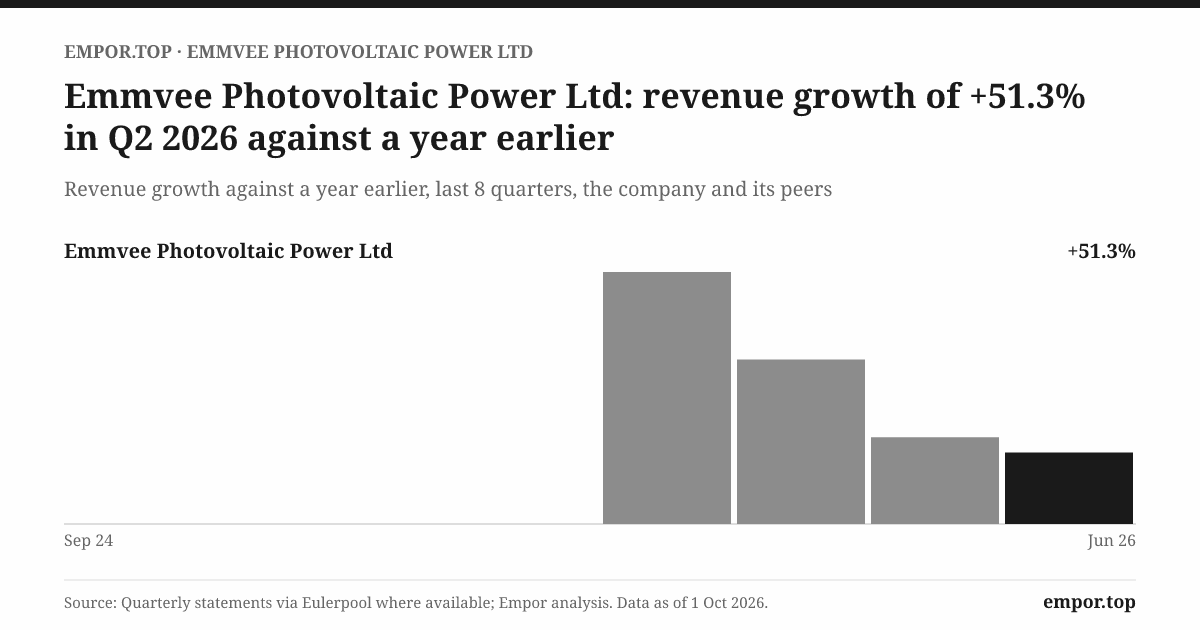
The better reading is that the order book protects volumes more than margins. It guarantees that Emmvee's lines will run, but it does not guarantee the per-watt spread of 2024 and 2025. The quarterly figures give one early comfort: operating margin held at about 30% in the quarter to June 2026, with revenue up about half on a year earlier.13 So far, the glut has not shown up in Emmvee's reported margin. The indicator that will reveal whether it does is gross margin per watt across FY2027, alongside the top-five customer share in the annual report.
For investors, concentration converts an industry-wide price war into a company-specific cash risk. If the glut arrives, it will arrive through a few phone calls from a few procurement heads. The next question is whether Emmvee has anything that survives those calls.
VII. Strategic Analysis: Helmer's 7 Powers & Porter's 5 Forces
On an institutional sales desk in Mumbai in late 2026, the Emmvee pitch writes itself in one line: a 30% operating margin business trading at about 17 times earnings. Waaree sits at about the same multiple, Premier at nearly 24 times.3 The buy-side pushback writes itself too: if these margins are permanent, why is everyone priced like a cyclical? The way to answer that is to ask what, exactly, Emmvee owns that a well-funded rival cannot copy.
Hamilton Helmer's 7 Powers. Helmer's framework asks whether a business has a structural reason to earn more than its cost of capital that competitors cannot arbitrage away. Run Emmvee through it.
Scale economies: moderate at best. At 10.3 GW of modules, Emmvee is a credible domestic player but not the largest; Waaree's capacity is larger.210 Against Chinese giants buying wafers in vast quantities, Emmvee's procurement leverage is small.
Network effects: none. A solar module does not become more valuable because other people use the same brand.
Counter-positioning: none. Emmvee's model is the same as its competitors'. Incumbents have no business model they are afraid to cannibalize by copying it.
Switching costs: very low. Modules are standardized and certified to common specifications. A developer can swap suppliers between projects with little friction.
Branding: weak. Utility-scale buyers procure through competitive bids. There may be some recognition in commercial rooftop channels, helped by the group's long history, but price per watt dominates.
Cornered resource: moderate and eroding. ALMM listing and cell-level approval have functioned as a cornered resource, but only while few companies held them. As the list lengthens, the resource becomes shared.4
Process power: moderate and temporary. Running TOPCon lines at high yield is hard, and companies that learn faster earn a real cost edge. But equipment vendors transfer much of that know-how with the tools.
The verdict: Emmvee has two partial powers, both depreciating. Neither looks strong enough to hold margins near 30% once domestic supply clearly exceeds demand.
Porter's Five Forces. Porter's lens asks how profit in an industry gets divided among its participants.
Buyer power: extremely high. Ten customers account for nearly all revenue, and they run professional procurement teams with no loyalty beyond the cost per watt.1
Supplier power: high. Wafers, much of the glass, silver paste, and key equipment come from abroad, mainly China, a supply base Emmvee cannot discipline.1
Threat of new entrants: high. Turnkey module lines can be bought and commissioned in under a year, and the production-linked incentive scheme subsidizes entry.9 Cell lines take longer and cost more, but they too are being built across the industry.10
Threat of substitutes: moderate. Other power sources compete for the same developer capital, and next-generation cell designs threaten the economic life of current lines.
Rivalry: intensifying. The largest Indian players are all expanding into the same integrated segments and chasing the same tenders.
What the multiple appears to assume. Seen against this analysis, the 17 times P/E makes sense. Emmvee's price-to-sales ratio is about 3.9 and its free cash flow yield only about 0.6%, because capital spending continues to absorb cash.3 The market is not paying for a fortress. It is paying for a few more strong years, discounted for the expectation that margins revert. A PEG ratio of 0.04 looks extraordinarily cheap only if one believes several-fold annual earnings growth can repeat. No one does.
The power analysis matters because it defines what investors are really buying: not a moat, but a well-run position inside a policy-made market, priced roughly in line with peers in the same position. The open question is how that position is likely to play out over the next two years.
VIII. Bear vs. Bull Case & The 2028 Shareholding Overhang
At some point before November 2028, bankers will sit down with the Manjunatha family and work out how to sell several percent of the company without crushing its share price. The family's stake stood at about 80% after the IPO and was unchanged at June 2026.8 India's minimum public shareholding rules require listed companies to have at least 25% public ownership within three years of listing.1 That means the promoters must sell down at least about 5 percentage points, roughly ₹1,100 crore of stock at today's price.38
The buyers are not yet in place at scale. Foreign institutional investors held about 3% at June 2026, up from about 2.5% in March, spread across a little over a hundred accounts; domestic mutual funds held about 6%.8 Public non-institutional holders accounted for about 7%.8 Absorbing another 5% will require institutional demand that, for now, is still building.
The bull case. Four arguments carry it.
First, protection may tighten rather than loosen. India's government has strong strategic reasons not to let its new domestic manufacturing base collapse, and the extension of the ALMM to cells shows a direction of travel toward more protection, not less.49
Second, integration can matter in a squeeze. If module prices fall, module-only competitors buying external cells may be hit first. A producer with its own 2.9 GW of cells keeps the cell margin that others pay away.2
Third, the order book offers near-term visibility. With about ₹12,781 crore of orders at the end of November 2025, Emmvee's lines appear well filled through much of FY2027.2
Fourth, exports. Buyers in the United States and Europe are looking for non-Chinese supply chains. Indian manufacturers that can prove traceable inputs may find a new outlet for surplus capacity, though Emmvee's dependence on Chinese wafers complicates that story for strict traceability regimes.1
The bear case. Four arguments carry it too.
First, margin mean reversion. Emmvee's own history shows single-digit margins in an ordinary environment. Even a partial reversion, toward the low teens, would cut operating profit by more than half on the same revenue.113
Second, the capex trap. Committing ₹5,510 crore into a downcycle, financed partly with new debt, could turn a 30%-margin, low-debt company into a lower-margin, leveraged one within two years.2
Third, the float overhang. A known secondary sale of about ₹1,100 crore hangs over the stock until it is done.8
Fourth, wafer shock. A Chinese export restriction on wafers or key equipment could idle cell lines quickly, since Emmvee has no upstream alternative of its own.1
The skeptical investor's stress test. An activist short-seller would boil all of this down to one calculation. Suppose domestic module prices fall by ₹3 per watt-peak more than input costs fall. At about 6 GW of annual shipments, that is 6 billion watts multiplied by ₹3, or about ₹1,800 crore of lost operating profit. FY2026 operating profit was roughly ₹1,500 crore.13 The full-year profit cushion is, in this scenario, gone.
That example is deliberately harsh; a price fall of that size would need input costs to stay flat while selling prices tumble. But it shows how thin the margin of safety really is. In commodity manufacturing, a 30% margin is not a buffer; it is the thing being contested.
The KPIs that matter. Of all the figures available, three deserve investors' attention. The first is operating margin, last reading about 30% in the June 2026 quarter and broadly stable for six quarters.13 The second is top-ten customer concentration, last reported at about 94% and rising.1 The third is net debt relative to operating profit, last guided by ICRA at about 0.2 times for FY2026 and likely to climb once the 6 GW project is financed.2 If margin holds, concentration falls, and leverage stays modest through the build, the bull case is earning its keep. If the reverse, the bears are.
These scenarios, and the evidence behind them, point to a few lessons that reach beyond Emmvee itself.
IX. Playbook: Business & Investing Lessons
Lesson 1: You cannot own a moat you rent from the state.
In March 2023, with one order, MNRE suspended the ALMM for an entire fiscal year because developers complained they could not get enough domestic modules.4 The protection that made Emmvee's margins possible was, for twelve months, simply switched off. It came back, and it may get stronger. But the episode reveals who holds the key. Any business whose profits depend on a tariff schedule or an approved list is running on a lease, and the landlord has its own priorities: cheap power, fast installation, political balance between developers and manufacturers. Founders building inside policy-made markets should spend the windfall years preparing for the day the lease is renegotiated.
"When your gross margin is created by a government circular, your true chief risk officer is the joint secretary in the ministry, not your head of manufacturing."
Lesson 2: Customer advances make commodity cyclicals look like software businesses, until the order book turns.
Over five years, Emmvee generated about two-and-a-half rupees of operating cash for every rupee of profit, because developers desperate for scarce domestic modules paid ahead to secure delivery slots.113 That cash was real, but it was a property of the shortage, not of the business. When supply exceeds demand, buyers stop pre-paying, start delaying, and begin negotiating. The same working capital line that once flattered cash flow becomes a drain. Investors who read high cash conversion as a sign of quality need to ask whether it comes from the product or from the buyer's panic.
"Working capital in a shortage is a gift from your customers; working capital in a glut is a noose around your factory floor."
Lesson 3: In hardware, vertical integration is both a shield and a capital prison.
Emmvee moved into TOPCon cells to protect its margin and keep access to the most protected projects, and that move was probably necessary.24 But integration in a fast-moving technology locks capital into a specific generation of equipment. The moment the industry shifts to the next cell architecture, the integrated producer has more stranded assets to write off than the assembler who simply buys whatever cell is best. Emmvee's answer has been to integrate further with a ₹5,510 crore project.2 That is a bet that being bigger and deeper will matter more than being nimble.
"Backward integration protects your unit margins right up until the technology shifts, at which point it simply guarantees you write off twice as much equipment."
Lesson 4: Beware the base-rate delusion of peak-cycle multiples.
At about 17 times earnings and a PEG near zero, Emmvee looks, on a screen, like one of the cheapest growth stocks in India.3 But the growth came from a policy inflection and a collapse in Chinese wafer prices, not from a compounding advantage. The relevant base rate is Emmvee's own history of low-single-digit margins and the global solar industry's long record of cyclical busts. Seen against that, the multiple is not a bargain signal. It is the market's estimate of how long the window will stay open.
"A cyclical manufacturer trading at seventeen times peak earnings is never cheap; it is merely waiting for the supply curve to catch up with its income statement."
X. Epilogue
Tonight, Emmvee Photovoltaic Power is a freshly listed, roughly $2.3 billion company with a clean balance sheet, margins near 30%, a family firmly in control, and an order book that should keep its Karnataka lines running well into 2027.238 By most measures it is the best moment in the company's thirty-four-year family history. It is also, plausibly, the most dangerous one.
Four moments over the next two years will decide which story Emmvee turns out to be.
The first is the per-watt margin across FY2027. Each quarterly result will show whether the domestic glut is reaching Emmvee's income statement. If operating margins hold in the high twenties while Waaree and Premier bring new lines online, the case that integration and execution give Emmvee a lasting edge gains real support. If margins slide into the teens, the story becomes the one its own history already told: a capable manufacturer whose profitability tracks policy and input prices.13
The second is the financial closure of the 6 GW project. The terms will reveal management's appetite for risk more clearly than any statement. A modest debt package, phased construction, and willingness to slow down if prices fall would suggest the lesson of leverage was learned. A large, front-loaded borrowing against peak-cycle earnings would suggest the opposite.2
The third is customer concentration in the annual reports. If the top five customers still dominate revenue, the company stays exposed to a few procurement heads. If commercial rooftop, distributed, and export accounts start to show up meaningfully, Emmvee will have built something it has never had before: a diversified book.1
The fourth is the promoter sell-down. Its timing, discount, and structure, whether a block, an offer for sale, or a qualified institutional placement, will show how much institutional demand exists for the stock without the shortage narrative behind it.8
Behind all four sits the one tension this story cannot resolve: can D.V. Manjunatha turn a protected national champion into a globally competitive integrated manufacturer before the protection is overwhelmed by the oversupply it helped create? The walls are still standing. The question is whether anything inside them can stand on its own.
XI. Outro
In 1992, the first Emmvee products were solar water heaters bolted to Bengaluru terraces: glass, copper, and steel that sat in the sun for decades without needing a software update, an import quota, or a ministry's approval.12 They worked because the physics worked.
Thirty-four years later, the founder's family controls about 80% of a robotic cleanroom business whose fortunes swing on wafer prices in Wuxi and tariff notifications in New Delhi.8 The physics still works. The economics depend on the cage.
Picture the rows of blue TOPCon panels leaving Dobbspet for solar parks across India: catching the harsh Indian sun, turning it into power, sealed inside an airtight steel cage of duties and approved lists. They capture immense energy. They depend on that cage staying locked.
Emmvee is a thirty-year survivor that built a multi-gigawatt fortune inside a fortress the state built, now standing on the ramparts as two hundred gigawatts of friendly fire approaches.
References
-
Draft Red Herring Prospectus — Emmvee Photovoltaic Power Limited — Securities and Exchange Board of India, 2025-07-10 ↩↩↩↩↩↩↩↩↩↩↩↩↩↩↩↩↩↩↩↩↩↩↩↩↩↩↩↩↩↩↩↩↩↩↩↩↩↩↩↩↩↩↩
-
Rating Rationale: Emmvee Photovoltaic Power Limited — ICRA Limited, 2026-01-27 ↩↩↩↩↩↩↩↩↩↩↩↩↩↩↩↩↩↩↩↩↩↩↩
-
Company Profile & Stock Data: EMMVEE — National Stock Exchange of India ↩↩↩↩↩↩↩↩
-
Approved List of Models and Manufacturers (ALMM) Orders — Ministry of New and Renewable Energy ↩↩↩↩↩↩↩↩↩↩
-
Solar Module Maker Emmvee Photovoltaic Power Files DRHP for ₹3,000 Crore IPO — Business Standard, 2025-07-11 ↩
-
Emmvee Photovoltaic Power Gets SEBI Nod to Raise Funds via IPO — The Economic Times, 2025-09-18 ↩
-
Emmvee Photovoltaic Power IPO Listing: Shares Debut on NSE, BSE — Mint, 2025-11-18 ↩↩
-
Shareholding Pattern, Quarter Ended June 30, 2026: EMMVEE — NSE Corporate Filings ↩↩↩↩↩↩↩↩↩
-
Production Linked Incentive Scheme for High Efficiency Solar PV Modules — Ministry of New and Renewable Energy ↩↩↩↩↩↩↩
-
India Solar Market Quarterly Overview & Capacity Additions — Mercom India Research ↩↩↩↩↩↩↩↩
-
Indian Solar Sector and Module Oversupply Coverage — PV Magazine India ↩↩↩↩↩↩↩↩↩
-
Emmvee Group Official Portal — Emmvee Photovoltaic Power Limited ↩↩↩
-
Investor Relations & Corporate Disclosures — Emmvee Photovoltaic Power Limited ↩↩↩↩↩↩↩↩↩↩↩↩↩↩↩↩↩↩
 LinkedIn
 WhatsApp
 Reddit
 Hacker News
 Email
Email Kindle
 RSS Feed
 Spotify
 Apple Podcasts
 Amazon Music
 Audible
 YouTube