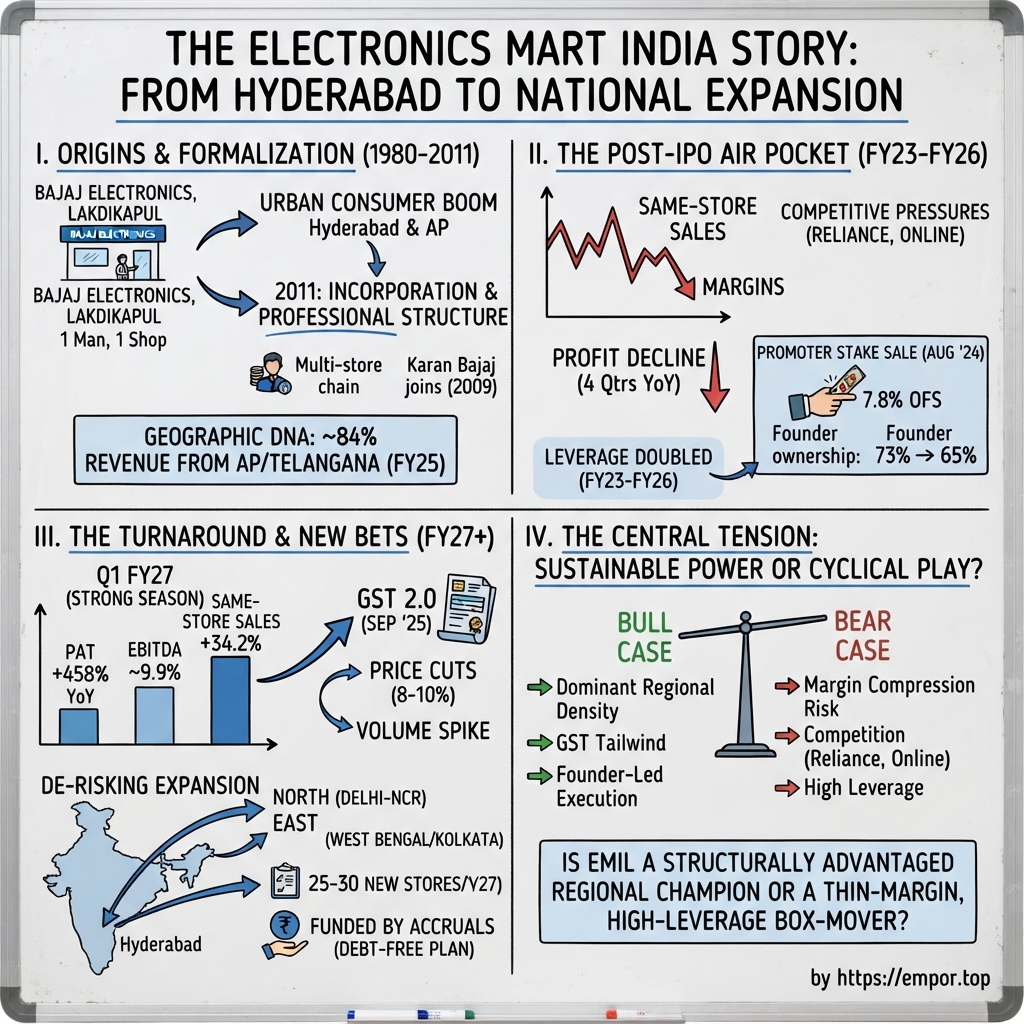
Electronics Mart India: The Bajaj Electronics Story
I. Introduction & Episode Roadmap
There is a shop on Lakdi-ka-Pul in Hyderabad — a narrow strip of retail on the road that runs toward the old Secretariat — where in 1980 a young man named Pavan Kumar Bajaj began selling consumer electronics under a signboard that read "Bajaj Electronics."1 India at that time had no organized electronics retail worth the name. There was no GST, no e-commerce, no EMI-on-checkout, no Reliance Digital. There was a licence-permit economy in which a colour television was a luxury item and a refrigerator was a wedding-scale purchase. A shop that could reliably get you the model you wanted, at a price you could live with, and then send someone to install it, was not a commodity. It was a relationship.
Forty-six years later, that single shop has become 227 stores across more than 100 cities and six states, roughly two million square feet of retail floor, and a listed company on the National Stock Exchange with a market capitalisation of about ₹7,157 crore.23 The signboard still says Bajaj Electronics across Telangana and Andhra Pradesh. The listed entity is called Electronics Mart India Limited — EMIL.
And here is where the story gets interesting, because the company's own recent record refuses to settle into a clean arc.
Between the September 2024 quarter and the December 2025 quarter, EMIL posted six consecutive quarters of year-on-year decline in net profit. Full-year net profit fell from ₹184 crore in FY24 to ₹160 crore in FY25 to ₹107 crore in FY26 — a 42% erosion in two years on a revenue base that grew the entire time.4 Over the nine months to December 2025, same-store sales growth across the network was 0.2%.5 Essentially zero. A retailer with 200-plus stores in its home markets was, for three quarters, selling nothing more per store than it had the year before.
Then in the quarter ended June 2026, the company reported revenue of ₹2,419 crore, up 39% year on year; EBITDA of ₹239 crore, up 118%; profit after tax of ₹121 crore, up 458%; and same-store sales growth of 34.2%.6 CEO Karan Bajaj called it "our strongest quarter to date."7 The stock, which had traded as low as ₹84.90 in the previous twelve months, closed near ₹186 — more than double off the bottom.3
So which company is this? The one that could not grow a single store's sales for nine months, or the one that just posted its best quarter in four decades?
The honest answer is that the second quarter did not happen because EMIL solved the problem that produced the first. On September 22, 2025, the Government of India cut the GST rate on air conditioners, large televisions, monitors, projectors and dishwashers from 28% to 18%.8 EMIL's blowout quarter was the April–June cooling season — peak AC demand — running for the first time on post-cut prices, against a base quarter in which revenue had actually fallen 12% year on year.4 A tax cut and an easy comparison are not the same thing as a moat.
That is the tension this piece will work through. EMIL is, on one reading, a genuine regional champion: the largest organized consumer-durables retailer in South India, with dominant share in its home states, founder-operators who still own two-thirds of the company, and a store network deep enough to make sourcing, warehousing, delivery and after-sales service structurally cheaper per rupee of sales than a thin national network can manage in the same geography. On another reading, it is a low-margin box-mover — net profit margin of 1.5% in FY264 — carrying about ₹2,000 crore of total debt including leases, fighting Reliance, Tata, Amazon and Flipkart for a customer who can price-check on a phone while standing in the aisle, and depending on one city, Hyderabad, for roughly 60% of its revenue.9
Both readings are supported by real evidence. The work is figuring out which one the numbers actually favour, and what would settle it.
The route from here: the origin story and the long informal decades; the 2022 IPO and what the company promised to do with the money; the industry structure and the mechanics of how a regional retailer actually earns a margin; the financial reality check; the post-listing air pocket and what specifically broke; the GST windfall and the June-quarter snapback; the bet on Delhi and Kolkata; management, ownership and capital allocation under a sceptical lens; a formal power analysis; the risk radar; and finally the bull and bear cases, the durable lessons, and the two or three numbers worth watching.
 Subscribe on LinkedIn
II. Origins: One Man, One Shop, and Hyderabad's Consumer Boom (1980–2011)
To understand why a family electronics shop in Hyderabad became a listed company while thousands of similar shops across India did not, you have to understand what Hyderabad was in 1980 and what it became.
It was, then, a second-tier city — administratively important as the capital of Andhra Pradesh, historically significant, commercially modest. The consumer durables market was small, heavily taxed, and supply-constrained. The dominant retail form was the independent dealer: one proprietor, one shop, a handful of brands, credit extended on the basis of knowing the customer's family. Pavan Kumar Bajaj's Bajaj Electronics started life as exactly that — a sole proprietorship, a single store, no institutional capital, no ambition of scale that anyone recorded at the time.10
What the business built over the following three decades was not a technology or a format. It was a reputation. The company's own account of that period describes a focus on reliability and competitive pricing within the local community.1 That sounds like boilerplate until you consider what it meant operationally in pre-liberalisation India: getting stock when stock was scarce, honouring warranty commitments when manufacturers were slow, and being the shop a Hyderabadi family returned to for the second television because the first one had been delivered when promised. In a market where the product is identical everywhere — a Sony TV is a Sony TV — trust in the seller is one of the few variables a retailer controls.
Then Hyderabad changed underneath the business. Through the 1990s and 2000s, the city became one of India's two or three primary IT-services hubs. HITEC City rose out of what had been scrub land. Infosys, Wipro, Microsoft, Google, and later JPMorgan Chase and Eli Lilly, put large offices there.9 The effect on consumer durables demand was mechanical and enormous: hundreds of thousands of salaried households, formed young, with rising disposable incomes, moving into new apartments that needed a refrigerator, a washing machine, an air conditioner and a television — all at once, and then replaced and upgraded on a cycle.
Bajaj Electronics happened to be sitting in the middle of that. This is worth stating plainly rather than dressing up: a meaningful part of the company's early scale advantage was locational luck compounded by execution. The luck was being an established, trusted electronics name in a city that turned into a consumption engine. The execution was converting that into stores fast enough to capture it.
The conversion took a formal legal step in 2011. On March 25 of that year, the sole proprietorship was converted into a partnership firm, still trading as M/s Bajaj Electronics, registered with the Registrar of Firms, Hyderabad (South), on April 13, 2011.10 This is a small piece of paperwork with a large meaning. A proprietorship cannot easily admit partners, cannot cleanly raise institutional debt, and cannot separate family wealth from business capital. A partnership can. In 2017 the constitution was modified again to admit new partners, and on September 10, 2018, the firm was converted into a public limited company under the name Electronics Mart India Limited.10 The corporate identity number issued that year — U52605TG2018PLC126593 — is the company that trades today.
Running alongside this legal formalisation was a succession that most Indian family businesses handle far worse. Karan Bajaj, Pavan Kumar Bajaj's son, joined the business in 2009 and took responsibility over time for marketing, operations and expansion. He is today the CEO and a Whole-time Director; his father remains Chairman and Managing Director.11 The point is not the family tie. The point is the sequencing: the son was inside the business for roughly a decade of operating work before the company listed, and roughly thirteen years before he was fronting quarterly earnings calls. Succession happened gradually and internally rather than as an abrupt handover to an heir with no operating scar tissue — which is a genuine, if modest, governance positive, and one that will matter later when the question becomes whether this management team's explanations of a bad year can be trusted.
The store network built in this period established something that has never gone away: geographic concentration. EMIL's density is in Telangana and Andhra Pradesh — undivided Andhra Pradesh, before the 2014 bifurcation — and it remains there. Roughly 84% of revenue still comes from those two states, and roughly 60% from Hyderabad alone.9 Everything the rest of this story is about, in one way or another, follows from that single fact. It is simultaneously the source of whatever competitive advantage EMIL possesses and the single largest risk in the equity.
One event in this period deserves a mention because it turned a single-market retailer into a two-market one without the company doing anything. On June 2, 2014, Andhra Pradesh was bifurcated, and Telangana became India's twenty-ninth state with Hyderabad as its capital. EMIL's store network, built across undivided Andhra Pradesh, woke up spanning two states. In practice this changed less than it sounds — the consumer, the language, the brands and the supply chain were unchanged — but it did create two separate state tax and regulatory regimes to manage, and it eventually produced two distinct growth stories. In the June 2026 quarter, the Andhra Pradesh sub-cluster grew revenue 62% year on year with same-store sales up 49.1%, against Hyderabad's 34% and 32.3%.6 Andhra, the less-saturated of the two, has become the faster-growing half of the home market — a useful reminder that "home market" is not a single, uniform block, and that EMIL still has runway inside its own backyard before the North and East bets need to work.
By 2014, net sales had crossed ₹500 crore.1 The shop had become a chain. The chain was about to try to become a company.
III. Building a Multi-Format Retailer & the Road to Listing (2011–2022)
The decade from 2011 to 2022 is where EMIL acquired the architecture it still runs on: a two-brand strategy, a set of specialist formats, a wholesale side-business, and eventually public shareholders.
Start with the brand decision, because it is more considered than it looks. In Telangana and Andhra Pradesh, the stores are called Bajaj Electronics. Everywhere else — beginning with the National Capital Region — they are called Electronics Mart.1 A less disciplined operator would have unified the brand at listing, on the theory that one national name is worth more than two regional ones. EMIL did the opposite, and the logic is sound: in Hyderabad, "Bajaj Electronics" carries four decades of accumulated trust and is worth more than any new name could be; in Delhi, that same name means nothing to a consumer and risks confusion with the unrelated Bajaj industrial group. Brand equity in retail is local and non-portable. Recognising that is a small sign of a management team that thinks about what it actually owns.
Then the formats. In 2017 the company opened iQ, an Apple authorised reseller store, and struck e-commerce partnerships to sell on Amazon and Flipkart.1 In 2020 it launched Kitchen Stories, a premium built-in kitchen appliance format. In 2022 came Easy Kitchens, a budget modular kitchen concept, and Audio & Beyond, a high-end audio, video, automation and security format.1 In 2023 it entered Kerala and began doing solar panel installations.
It is tempting to build a growth thesis on these. Resist it. As of the June 2026 quarter, EMIL operated 227 stores of which 220 were multi-brand outlets and only 7 were exclusive-brand outlets.6 The premium and specialist formats are, in revenue terms, a rounding error against an assortment of more than 8,000 SKUs across roughly 70 brands, dominated by mobiles, large appliances and televisions.5 They are worth knowing about as evidence that management experiments at the edges. They are not, on current disclosure, a growth engine, and any narrative that leans on them is leaning on air.
The wholesale distribution business deserves the same treatment, in the other direction. Alongside direct retail, EMIL has historically distributed to independent retailers. This is a lower-margin, receivables-heavy channel, and it dilutes the headline economics of the retail business. Its visible footprint has shrunk materially: trade receivables on the balance sheet collapsed from ₹177 crore at March 2025 to ₹57 crore at March 2026, and the June 2026 quarter reported receivable days of four.46 A retailer that collects in four days is, functionally, a cash business. That is a real improvement in balance-sheet quality, and it is also a clue that the wholesale tail has been deliberately pruned.
There is one more piece of this decade worth pausing on, because it complicates the neat "physical retail versus online" framing that dominates discussion of Indian consumer durables. In 2017, EMIL both opened its Apple authorised reseller format and struck e-commerce partnerships to sell through Amazon and Flipkart.1 The company that is routinely described as being under existential threat from marketplaces has, for nearly a decade, also been a seller on them. That is not hypocrisy; it is an accurate reading of how Indian consumers actually shop, which is channel-agnostic and price-first. It also quietly undercuts the cleanest version of the bull narrative, in which physical stores hold a category that online cannot touch. The truth is messier: EMIL competes with the marketplaces on large appliances and simultaneously uses them as a distribution channel for the categories where it cannot win on service.
By 2018 the company had crossed fifty stores and ₹2,000 crore in net sales, and had become a public limited company.1 It had, in other words, reached the scale at which the next constraint was no longer demand or capability. It was capital. A retailer that must fund inventory for every new store out of retained earnings and bank working-capital lines grows at the speed its balance sheet allows, and EMIL's balance sheet by FY22 carried ₹1,143 crore of total debt against just ₹597 crore of shareholders' funds — a debt-to-equity ratio of 1.92 times.4 That is the specific pressure that produces an IPO.
Which brings us to October 2022.
The initial public offering was a pure fresh issue: up to ₹500 crore of new equity, at a price band of ₹56 to ₹59 per share of ₹10 face value, with no offer-for-sale component.10 That last detail matters and is easy to skip past. In an Indian IPO market where promoters routinely use listing as an exit, the Bajajs sold nothing. Every rupee raised went into the company. The red herring prospectus also disclosed, with unusual bluntness, that the promoters' average cost of acquisition of their shares was ₹10 — against an issue price of ₹59.10
The book opened on October 4 and closed on October 7, 2022, and was subscribed 71.93 times.12 For a regional consumer-durables retailer with no marquee private-equity pedigree and no technology story, that is extraordinary demand — the kind of number that tells you more about the 2022 Indian primary market than about EMIL's fundamentals. The shares listed on October 17, 2022.13
The use of proceeds is the piece to hold onto, because it is the baseline against which everything management later did should be measured. Of the net proceeds, approximately ₹111.4 crore was earmarked for capital expenditure — largely new stores and warehouses; ₹220 crore for incremental working capital; and ₹55 crore for repayment or prepayment of borrowings, with the balance for general corporate purposes.13
Read that allocation carefully. Only about a fifth was going into physical expansion. Nearly half was going into working capital — funding the inventory that sits in 200-plus stores and a dozen warehouses. That is not a criticism; it is an accurate description of what this business consumes. Electronics retail at these margins is, structurally, a working-capital machine. Every incremental store requires stock before it produces a rupee of profit, and every festive season requires a build-up that has to be financed. The IPO was, in substance, a balance-sheet repair and inventory-funding exercise with an expansion kicker attached.
The implicit promise to the new shareholders was straightforward: growth from here would be funded by IPO cash and internal generation, not by piling on new debt. Whether that promise held is the subject of the next several sections — and the short answer is that it held for about a year.
IV. The Core Business: Industry Structure & How EMIL Actually Wins
Walk into a Bajaj Electronics store in Hyderabad on a Sunday in May and the business model explains itself. It is loud. There is a family standing in front of a wall of split air conditioners while a salesperson explains the difference between a three-star and a five-star inverter unit — which is really a conversation about the electricity bill over the next eight years. There is a finance desk where someone is being walked through a no-cost EMI on a ₹70,000 refrigerator. There is a delivery-and-installation counter. Somewhere behind all of it is a warehouse that has to get a 300-kilogram appliance up three flights of stairs in a building without a service lift, on the day promised.
None of that is glamorous. All of it is the actual product.
The market EMIL competes in
India's consumer durables and electronics retail market remains dominated by the unorganized sector — independent dealers, single-store proprietors, regional two- and three-store operators. Organized chains are a growing but still-minority share. This is the structural foundation of the entire bull case: if organized retail's share rises, the incumbents with scale capture the shift, and there is a great deal of share to shift.
The organized field, by store count as of mid-2026, looked like this: Reliance Digital with more than 695 outlets; Tata Group's Croma with roughly 540; Vijay Sales with more than 170; and EMIL with over 220.9 Alongside them sit strong regional specialists — Poorvika and Sathya in Tamil Nadu, Girias in Karnataka, Aditya Vision in Bihar — each doing in its own geography roughly what EMIL does in the Telugu states.
That last observation is the most important structural fact about this industry, and it cuts both ways. The pattern across India is not national winner-take-all. It is regional champions holding home turf against national chains. That is evidence the density strategy works. It is equally evidence that density does not travel — because if it did, one of these regional champions would already have rolled up the others.
Then there is online. Amazon and Flipkart have national reach, structurally lower fixed cost per transaction, and the ability to run brutal promotional events during the festive season. And there is quick commerce — Blinkit, Swiggy Instamart, Zepto, Flipkart Minutes, Amazon Now — which has expanded well beyond groceries into electronics and accessories. On the June 2026 call, Karan Bajaj addressed this directly, and his framing was more precise than defensive: lower-value accessories remain online-strong, but core categories — large appliances, premium televisions, soundbars — significantly outperform offline.7 That is a claim worth taking seriously, because it is falsifiable and because the physics support it. Ten-minute delivery of a phone charger is a solved problem. Ten-minute delivery, hoisting and installation of a 1.5-tonne split air conditioner is not.
The mechanism EMIL claims
The stated advantage is density. Cluster enough stores in one geography and several things compound: you buy in larger volumes from the same brands and get better terms; you run fewer, fuller warehouses; your delivery vans cover shorter routes with higher drop density; your service technicians are never more than a short drive from a customer; and your advertising spend hits a market where you already have the most doors, so the cost per incremental customer falls. A national chain with three stores in Hyderabad cannot match any of that locally, no matter how large its parent's balance sheet.
There is a second, less-discussed mechanism worth explaining in plain terms, because it is where a large share of Indian durables retail economics actually lives. When a customer buys a ₹70,000 refrigerator on a no-cost EMI, someone is paying the interest. Typically it is the brand, through a subvention arrangement negotiated between manufacturer, retailer and financier. The retailer that can move volume for a brand negotiates better subvention, better display allowances, better in-store promoter support and better stock allocation during a shortage. None of this shows in a price tag. All of it shows in gross margin. This is why scale within a geography matters more than scale across geographies for a retailer of this kind: the negotiation is conducted brand by brand, region by region, on the basis of what you can actually sell in that region.
That is a coherent mechanism, not marketing. The question is whether it produces durable pricing power — and here the evidence is genuinely mixed, in a way that should temper the story considerably.
Testing the claim against the company's own record
The strongest disconfirming evidence comes from EMIL's own disclosures, not from outside critics.
First, margin. In the December 2023 quarter, EBITDA margin was 6.5%. One year later, in the December 2024 quarter, it was 5.2% — EBITDA fell 14% year on year on revenue that grew 6.2%.14 Management's own explanation was higher operating expenses and tighter margins in a competitive organized-retail environment. Whatever the density advantage does, it did not stop a 130-basis-point margin decline in the company's own core market during a period of revenue growth. A business with real pricing power passes cost inflation through. EMIL, on its own account, could not.
Second, same-store sales. For the nine months to December 2025, network-wide same-store sales growth was 0.2%.5 For the December 2025 quarter alone it was 2.5%, with Hyderabad — the fortress — at 3.3%.5 A dominant local retailer in a growing market managing 3.3% like-for-like growth in its stronghold is not evidence of a widening moat. It is evidence of a company holding position while the market grows around it.
Third, and most revealing, the cohort data. In the June 2026 quarter EMIL disclosed store-level economics split by maturity: 96 stores older than four years generated ₹1,628 crore of revenue at an 11.2% EBITDA margin, while 131 stores younger than four years (average age 1.9 years) generated ₹676 crore at 8.1%.6 Management reads this as latent upside — as more stores mature, blended margin rises. That reading is reasonable. But look at the same cohort split nine months earlier, in the December 2025 quarter: 83 mature stores at a 6.9% nine-month EBITDA margin, and 136 immature stores at 2.7%.5 The gap is not a fixed maturity premium. It moves violently with the demand cycle, and immature stores are far more operationally geared to it. Roughly 58% of EMIL's store base was immature as of mid-2026. That is a network whose reported profitability will swing hard with the cycle regardless of how good the underlying playbook is.
Fourth, mix. This is the least-discussed and possibly most important structural pressure on EMIL's margins. Mobile phones were 29% of revenue in FY19. By FY25 they were 44%.6 In the December 2025 quarter they were 42%; in the June 2026 quarter, 39%.56 Mobiles are the lowest-margin, most price-transparent, most online-contested category in the store. A customer buying an iPhone knows the price to the rupee before entering. A customer buying a built-in kitchen does not. A fifteen-point mix shift toward the commodity end of the assortment over six years is a structural gross-margin headwind that no amount of store density offsets — and it goes a long way toward explaining the FY24–FY26 compression that management attributed to "competitive intensity."
Fifth, working capital. Even after the FY26 clean-up, this remains an inventory-heavy model. Inventory turnover fell from about 6.1 times in FY22 and FY23 to 4.8 times in FY25, recovering to 5.2 times in FY26.15 Inventory days stood at 73 at March 2026 before dropping to 44 in the seasonally strong June quarter.6 The favourable interpretation is that management has genuinely tightened. The cautious one is that a June quarter with 34% like-for-like growth flatters every inventory metric, and the March figure is the honest steady-state.
The verdict
Weighing it: EMIL's local density advantage is real, and the cluster data proves it. In the June 2026 quarter the South cluster — 185 multi-brand outlets and 6 exclusive outlets across 95 cities — produced ₹2,095 crore of revenue at a 10.9% store-level EBITDA margin, while the North cluster produced ₹209 crore at 4.9%.6 That is a better-than-two-to-one margin gap between the geography where EMIL is dominant and the geography where it is a challenger, in the same quarter, selling the same products from the same vendors. Density is doing something.
But the claim does not survive intact in its strong form. Over FY24 to FY26, that density did not deliver pricing power: margins compressed, like-for-like growth went to zero, and the company could not pass through cost inflation. The honest, narrowed version is this — local density gives EMIL a structural cost and service advantage that shows up as a superior store-level margin in its home cluster, but it has not, on the evidence of the last three years, protected that margin against category mix shift and competitive intensity. It is a cost moat, not a pricing moat.
The KPI that would confirm or falsify the revised claim is not revenue growth. It is whether South-cluster store-level EBITDA margin holds in double digits through a normal quarter — one without an AC boom and without a tax cut. That test arrives with the September and December 2026 quarters.
V. Segment & Financial Reality Check
If you plotted EMIL's revenue and its profit on the same chart since FY21, you would think you were looking at two different companies.
Revenue: ₹3,029 crore in FY21, ₹4,349 crore in FY22, ₹5,446 crore in FY23, ₹6,285 crore in FY24, ₹6,965 crore in FY25, ₹7,183 crore in FY26.4 Six straight years of growth, never a down year, a 2.4x expansion over five years.
Profit: ₹59 crore in FY21, ₹104 crore in FY22, ₹123 crore in FY23, ₹184 crore in FY24 — and then ₹160 crore in FY25 and ₹107 crore in FY26.4 Up two and a half times to a peak, then down 42% over two years.
The divergence is the story. Between FY24 and FY26 EMIL added ₹898 crore of revenue and lost ₹77 crore of net profit. Net profit margin fell from 2.9% to 1.5%.15 The company got bigger and materially less profitable at the same time.
Look closer at FY26 and the picture darkens further. Revenue grew just 3.1% for the full year — the weakest growth in the company's listed life — and in the June 2025 quarter revenue actually declined 11.9% year on year, from ₹1,975 crore to ₹1,739 crore.4 A cold, wet summer in South India crushed air-conditioner demand. For a retailer with EMIL's category mix, one bad summer is a bad year.
The quarterly profit sequence is worth laying out because the headline annual numbers understate the duration of the problem. From the September 2024 quarter through the December 2025 quarter, EMIL reported six consecutive quarters of year-on-year decline in consolidated net profit.4 Two of the sharper prints drew market reactions: net profit fell 31% to ₹31.6 crore in the December 2024 quarter, and 22.4% in the March 2025 quarter.1416 The streak broke in the March 2026 quarter, when profit rose to ₹39.7 crore from ₹31.5 crore.4
On segments, the framing is simple and should stay simple. Retail — the multi-brand outlets under the Bajaj Electronics and Electronics Mart banners — is overwhelmingly the revenue and profit engine. Wholesale distribution to independent retailers is the lower-margin, receivables-heavy tail, and it has visibly contracted. The premium formats are immaterial to consolidated results. Anyone modelling EMIL is modelling one business: multi-brand consumer-durables retail in India, roughly 87% of it in the South cluster as of the June 2026 quarter.6
Now the balance sheet, where the post-IPO period is most exposed.
Total debt including lease liabilities stood at ₹1,997 crore at March 2026, against shareholders' funds of ₹1,626 crore — a debt-to-equity ratio of 1.23 times.415 Strip out the lease obligations, which are an accounting recognition of store rentals rather than borrowed money, and the actual borrowings were about ₹891 crore. The trajectory is what matters: total debt was ₹1,143 crore at March 2022, the last pre-IPO balance sheet date, and ₹1,432 crore at March 2023.4 So debt rose roughly 75% from the pre-listing level, and about 39% from the first post-listing year — this after raising ₹500 crore of fresh equity, ₹55 crore of which was explicitly earmarked for debt repayment.
At the FY26 trough, net debt of ₹1,947 crore sat against EBITDA of ₹453 crore — a ratio above four times — and interest cover, measured as EBIT over interest expense, was about 1.8 times.15 That is thin. On December 11, 2025, India Ratings and Research affirmed EMIL's long-term rating at IND A but revised the outlook to Stable from Positive, covering bank facilities of ₹803.1 crore with a further ₹110 crore assigned.17 An outlook revision downward is not a downgrade. It is the rating agency saying the improvement it had been anticipating stopped arriving.
The cash flow statement tells the most useful version of the last four years. In FY23, the IPO year, operating cash flow was essentially nil — negative ₹0.6 crore — because ₹287 crore was absorbed by working capital.4 FY24: operating cash flow ₹160 crore, capex ₹174 crore, free cash flow negative. FY25: operating cash flow ₹176 crore, capex ₹324 crore, free cash flow negative ₹148 crore, funded by ₹271 crore of net new borrowing.4 For three consecutive years after listing, EMIL did not generate enough cash to fund its own expansion.
FY26 broke the pattern: operating cash flow ₹288 crore, capex cut to ₹124 crore, free cash flow positive ₹164 crore, net debt repayment of ₹93 crore.4 This is genuinely better. But it is important to be precise about why it is better. Operating cash flow improved because inventory stopped building and receivables were collected, and free cash flow turned positive primarily because capex was cut by 62%. EMIL deleveraged in FY26 by slowing down, not by earning more. Net profit in FY26 was the lowest since FY22.
A note on how to read this balance sheet, because lease accounting distorts it badly for a retailer. Under Ind AS 116, every store lease is capitalised: the right to occupy the premises appears as an asset, and the future rent appears as a liability. At March 2026, lease obligations were ₹1,106 crore of EMIL's ₹1,997 crore of total debt.4 That is not borrowed money in any conventional sense — it is the present value of rent on 223 stores. It also means that headline debt rises automatically every time the company opens a store, regardless of whether it borrows a rupee. Management is alive to this: on the June 2026 call it explicitly guided EBITDA margin on a post-Ind AS 116 basis, which is the honest way to present it.7 The practical implication for an investor is that the leverage worth watching is the ₹891 crore of actual borrowings and the interest cost line, not the ₹1,997 crore aggregate — but also that the lease liability is a genuine fixed obligation that does not shrink when sales fall.
Finally, dividends: none. EMIL has paid no dividend in any year from FY21 through FY26.15 For a company that has been consistently profitable throughout, that is a deliberate capital-allocation choice — every rupee retained and reinvested. It is defensible if the reinvestment earns its cost of capital. Return on equity, measured on closing shareholders' funds, was 13.4% in FY24, 10.5% in FY25 and 6.6% in FY26.4 Over the period in which EMIL retained all of its earnings and increased its debt, the return on the capital employed fell by half. That is the single hardest fact in this story for the bull case to absorb, and no amount of June-quarter momentum retroactively changes it.
VI. The Post-IPO Air Pocket: What Actually Broke (2023–2025)
There is a specific kind of failure that afflicts retailers after a successful IPO, and it is almost never a failure of ambition. It is a failure of sequencing: building the next hundred stores before proving the economics of the last hundred.
The store count tells it cleanly. EMIL had 71 stores in FY19.6 It opened 34 in FY24, 44 in FY25, and 29 in FY26, reaching 223 by March 2026 and 227 by June.6 The FY25 cohort is the one to look at hardest: 44 new stores — the largest single-year expansion in company history — opened into a year in which network same-store sales growth was collapsing toward zero and EBITDA margin was compressing quarter after quarter.
The arithmetic of that decision is unforgiving. A new store carries full rent, full staffing and full inventory from day one and reaches maturity in roughly four years. When 136 of your 219 stores are immature and running a 2.7% EBITDA margin against 6.9% for the mature cohort, the mix drags consolidated profitability down mechanically, even if every individual store is performing exactly to plan.5 Add a weak summer, a mix shift toward low-margin mobiles, and rising interest costs on a growing debt load, and you get the FY26 result: revenue up 3%, profit down 33%.
It is worth being fair about what management could and could not have known. Store-opening decisions in retail are committed twelve to eighteen months before the doors open: leases are signed, fit-outs commissioned, staff hired. The 44 stores of FY25 were largely decided in FY24, a year in which EMIL earned its highest-ever profit of ₹184 crore and the December quarter EBITDA margin was still 6.5%.414 Extrapolating from that into an aggressive rollout was not obviously reckless at the time. What is fairly criticised is what happened next: FY26 still saw 29 net store additions, decided in FY25, by which point the margin deterioration and the same-store stagnation were both visible in the company's own quarterly reporting. The brakes went on a year later than the data warranted.
The market's reaction was not subtle. Shares fell sharply after the September 2024 quarter results in November 2024,18 and again after the December 2024 quarter in February 2025.14 Using the price-to-earnings ratios implied by year-end financials, EMIL's shares stood at roughly ₹193 at March 2024, about ₹126 at March 2025 and about ₹88 at March 2026 — a decline of more than half over two years, during which revenue grew 14%.15
Which brings us to August 2024, and the piece of this history that requires the most care to write fairly.
In mid-August 2024, Pavan Kumar Bajaj and Karan Bajaj each sold 1.50 crore shares — 7.8% of the company between them — in open-market transactions at ₹229.75 to ₹229.77 per share, realising ₹689.28 crore.19 The buyers were serious institutions: SBI Mutual Fund took 3.92%, and Norges Bank's Government Pension Fund Global together with Franklin Templeton picked up 99.41 lakh shares. Combined promoter and promoter-group holding fell from 72.97% to 65.17%.19
Set out the facts in sequence without editorialising. The promoters' average cost of acquisition was ₹10 a share.10 They sold at roughly ₹230 — close to the highest level the stock has traded in its listed life, and roughly 19% above the March 2024 mark. They sold nothing at the IPO two years earlier, so this was their first realisation of value from a business built over four decades. In the six quarters immediately following, the company reported year-on-year profit declines in every one, and the share price fell by more than 60% from the sale level to its March 2026 low.
There is a benign reading and a sceptical one, and intellectual honesty requires holding both. The benign reading: founders who took nothing off the table at listing diversified a portion of a highly concentrated family net worth after the lock-up expired, at a market-determined price, to sophisticated institutional buyers who did their own diligence, while retaining a controlling 65% stake. That is normal, and arguably prudent. The sceptical reading: the sale occurred at the peak of the post-IPO re-rating, immediately before a two-year earnings decline that management, running the business day to day, was better positioned than anyone to anticipate.
The available evidence does not resolve this. No stated rationale for the sale was disclosed beyond the transaction itself, and no subsequent promoter purchases have been reported after results improved. What can be said with confidence is narrower and more useful: the timing was, in hindsight, excellent, and the promoters have not since used their improved balance sheet to add to their stake. An investor tracking management alignment should watch whether that changes as the stock re-rates — a promoter who buys back into strength sends a very different signal than one who does not.
The composite picture a sceptical long-short investor would assemble from FY24 to FY26 is uncomfortable and should be stated plainly: leverage rising after an equity raise partly earmarked for debt repayment; return on equity halving; zero dividends; the most aggressive store-opening year in company history executed into deteriorating same-store economics; and promoters monetising 7.8% near the high. None of those individually is damning. Together they describe a company that grew for the sake of growing, and only discovered discipline after the market had already punished it.
That discipline, when it arrived in FY26, was real — the capex cut, the working-capital squeeze, the debt repayment. But it arrived reactively. And then, before its effects could be properly tested, the Government of India handed EMIL something no operating discipline could have produced.
VII. GST 2.0 and the Q1 FY27 Turnaround — Structural or Cyclical?
On September 3, 2025, the GST Council met and approved the largest simplification of India's indirect tax structure since GST's introduction. The four-tier structure of 5%, 12%, 18% and 28% was collapsed into two principal slabs of 5% and 18%, with a 40% rate reserved for luxury and sin goods. Finance Minister Nirmala Sitharaman framed the reform as focused on "the common man."8
For EMIL, the relevant lines were narrow and enormously consequential. Air conditioners moved from 28% to 18%. Televisions above 32 inches — which had been penalised relative to smaller sets — moved from 28% to 18%, removing the size distinction entirely. Monitors, projectors and dishwashing machines made the same move. The changes took effect on September 22, 2025.8
The demand response across the industry was immediate and well documented. Retailers reported a sharp step-up in volumes in the days following implementation, and the consumer durables sector, which had endured a slow year, saw the rate cuts become the defining demand event of 2025.23 For a category where the purchase decision is frequently deferred rather than abandoned — a household that wants an air conditioner but is waiting for a reason — a visible, government-announced 8% price reduction is close to the ideal trigger.
It is worth being precise about what was not cut, because the popular framing of GST 2.0 as a blanket consumer-durables stimulus overstates it. Refrigerators and washing machines were already in the 18% slab and did not benefit. Mobile phones, EMIL's single largest category, were already at 18%. The tax cut was, for this company, overwhelmingly an air-conditioner and large-television event.
Which is precisely why the June 2026 quarter looks the way it does. The April-to-June quarter is the Indian cooling season — the single highest-volume, highest-margin period for air-conditioner sales. It was the first full summer to run on post-cut prices. And it ran against a base quarter, June 2025, in which revenue had fallen nearly 12% because the previous summer had been washed out.
The result: revenue of ₹2,419 crore, up 39%; gross profit of ₹417 crore at a 17.2% margin, up 260 basis points; EBITDA of ₹239 crore at 9.9%, up 360 basis points; EBIT up 169%; profit before tax up 461%; and profit after tax of ₹121 crore at a 5.0% net margin, up 380 basis points.6 Same-store sales grew 34.2%. Transactions — "bill cuts," in the company's language — rose 36% to 982,000, while average ticket size rose only 2% to ₹23,474.6
That last pairing is the most informative number in the release, and it deserves unpacking. Growth came almost entirely from more customers, not from each customer spending more. That is exactly the signature of a price-elasticity event: cut the tax on an air conditioner by ten percentage points during a hot summer, and people who were deferring the purchase buy now. It is not the signature of a retailer winning share through superior merchandising or extracting more from each relationship.
Management, to its credit, did not pretend otherwise. On the earnings call following the results, Karan Bajaj framed the AC surge as bringing "a wave of new customers into our ecosystem" who would return later for other appliances — a plausible flywheel claim, and an explicitly unproven one.7 More importantly, management guided FY27 EBITDA margin to 7.5%–8% against the quarter's 9.9%, and gross margin to 15%–15.5% against the quarter's 17.2%.7 Asked directly by analysts whether 17.2% gross margins were sustainable, management attributed the expansion to seasonal AC mix, temporary pricing gains in laptops and mobiles, and favourable inventory positioning, and described the inventory benefits as "periodic" — "not across all brands, not across all SKUs."7
Read that again, because it is the single most important sentence in this section: management itself told investors not to extrapolate the quarter. A company guiding its own full-year margin nearly two full percentage points below its just-reported quarterly margin is not selling a structural turnaround. It is telling you the quarter was a peak.
The two-year arithmetic makes the same point without any interpretation. June 2026 revenue of ₹2,419 crore compares with ₹1,975 crore in June 2024 — growth of about 22.5% over two years, or roughly 11% annualised.4 That is a decent number for a retailer. It is nothing like 39%, and it is the number that survives once the washed-out summer of 2025 is taken out of the base.
Full-year guidance was set at 18%–20% revenue growth, which management described as conservative.7 It is worth noting how that number moved. In mid-June 2026, before the quarter closed, the company was publicly guiding to roughly 15% revenue growth for the year and about ₹120 crore of investment for 20 new stores.9 By the August call, guidance had been raised to 18%–20% growth, 25–30 stores and ₹150 crore of capex.7 Raising guidance after a strong quarter is normal and defensible. It is also the behaviour that, in FY25, preceded a sequence of misses — and the reason the next two quarters matter more than this one.
So: structural or cyclical? On the available evidence, overwhelmingly cyclical, with a genuine structural component underneath. The structural component is real — working capital days at 42 versus 73 in March 2026, short-term borrowings cut from ₹658 crore to ₹97 crore within the quarter, interest costs guided down to ₹140–150 crore, and a store base whose immature cohort is genuinely maturing.67 The cyclical component is the tax cut and the weather, and it is much the larger of the two. The test is the September and December 2026 quarters, when the GST base effect is still present but the AC season is not.
VIII. Betting North and East: The De-Risking Expansion (2025–2027)
In June 2026, EMIL's chief financial officer said something to Reuters that most Indian consumer companies would take considerable care never to say out loud.
Asked about the company's dependence on Hyderabad, Premchand Devarakonda noted that roughly 60% of revenue comes from that one city, that about 20% of Hyderabad's stores sit in neighbourhoods populated by software employees, and that growing adoption of artificial intelligence has raised concerns about job losses in the technology sector. His words: "If there is any disturbance in the IT industry, definitely there is going to be an impact on our business."9
That is a chief financial officer publicly naming the largest single risk in his own equity story, and identifying AI-driven displacement in IT services as a specific mechanism. It is disarmingly candid, and it reframes the expansion plan from a growth story into what it actually is: a de-risking exercise. EMIL is not expanding north and east primarily because those markets are more attractive than Hyderabad. It is expanding because Hyderabad is 60% of the business and one industry's fortunes drive a large share of the city's discretionary spending.
The plan for FY27, as laid out on the August call: 25 to 30 new stores, funded entirely from internal accruals with no new borrowing. Roughly 5 in the South cluster. Eight to ten in the North, deepening the existing Delhi-NCR presence. And a new-state entry in West Bengal — five stores in Kolkata by Diwali 2026, 10 to 12 by the end of the fiscal year, and approximately 30 within 24 months. Total capex of about ₹150 crore, split ₹100 crore for stores and ₹50 crore for Kolkata property purchases.7
The strategic logic is sound. The execution evidence is thinner than the framing suggests, and the company's own cluster disclosures are the reason.
EMIL entered the National Capital Region in 2022, opening twelve stores that year.19 Four years on, the North cluster comprises 35 multi-brand outlets and one exclusive outlet. In the June 2026 quarter — the best quarter in company history — the North cluster generated ₹209 crore of revenue at a 4.9% EBITDA margin, against the South cluster's ₹2,095 crore at 10.9%.6 Delhi-NCR specifically delivered same-store sales growth of 14.6%, against 32.3% in Hyderabad and 49.1% in Andhra Pradesh.6
Now look at the same cluster in a normal quarter rather than a peak one. Over the nine months to December 2025, the North cluster's EBITDA margin was 0.5%.5 Not 4.9%. Half a percentage point. A cluster of 35-plus stores, four years into the market, running at approximately breakeven at the store-EBITDA level through three quarters — before central overhead, before interest, before depreciation.
This is the most important evidence in the entire investment case, and it needs to be held directly against the claim it tests. Management describes NCR as profitable and as the credible precedent for the West Bengal entry. The company's own segment disclosure shows a cluster that, outside a tax-cut-boosted AC quarter, was barely above water. The density playbook has not yet travelled. It has travelled somewhat — North revenue grew 29% year on year in the June quarter and 30% in the December quarter, so the stores are ramping — but four years is a long apprenticeship for a format management describes as proven.
Management's own store-economics disclosure quantifies the difference honestly. Payback periods run under 10 to 11 months in the South and 16 to 18 months in the North.7 A store that takes half again as long to pay back is a store earning a materially lower return on the capital deployed into it. That is the price of entering a market where you are not the incumbent, do not have the brand, do not have the warehouse density, and do not have the service network — which is, precisely, the mirror image of the advantage EMIL enjoys at home.
The mechanics of how EMIL executes this are visible in its own disclosure cadence: the company announces individual store openings to the exchanges, as it did in June 2026 for a new Bajaj Electronics store in Andhra Pradesh.24 That granularity is useful for investors tracking the FY27 commitment, because it converts a management promise of 25 to 30 stores into something countable in real time rather than a number reconciled once a year.
West Bengal will be harder still on at least one dimension: it is a fresh state entry with no existing infrastructure, and ₹50 crore of the FY27 capex is going into buying property there rather than leasing. Buying real estate in a market you have not yet proven is a capital allocation choice worth flagging. It reduces long-term rental cost if the market works. It converts a reversible operating commitment into an irreversible capital one if it does not.
So how should the expansion bet be characterised? Not as a growth engine that has been demonstrated and merely needs replicating. The accurate framing is that EMIL has demonstrated it can open stores outside its home region and grow their revenue, and has not yet demonstrated it can make them earn home-market returns. The NCR cluster is the four-year experiment, and its verdict is still pending. West Bengal is a second, larger bet placed before the first one has reported.
There is one meaningful difference between this expansion and the FY25 one that preceded the air pocket: the funding. FY25's 44 stores were opened alongside ₹271 crore of net new borrowing.4 FY27's 25 to 30 are pledged entirely to internal accruals. That is a real change in method, and it is the promise most worth holding management to. The KPI is not store count. It is the North and West Bengal cluster EBITDA margins, disclosed separately, through a quarter that is not a peak.
IX. Current Management, Ownership & Capital Allocation Under the Microscope
Pavan Kumar Bajaj has been in the consumer electronics business for forty-six years. He remains Chairman and Managing Director of the company he founded as a single shop. Karan Bajaj joined in 2009, spent roughly thirteen years in operating roles before the company listed, and is now Chief Executive Officer and a Whole-time Director.11 Together with the promoter group they held 65.17% of the equity following the August 2024 sell-down.19
That structure has two consequences worth separating. The first is alignment: a family with two-thirds of its wealth in one listed stock has a powerful interest in the long-term compounding of that stock, and a strong disincentive to swing for short-term reported earnings. The second is control: at 65%, minority shareholders have essentially no ability to force a change in strategy, capital allocation or board composition. Whatever governance comfort exists here comes from the promoters' own incentives, not from the ability of outsiders to hold them to account.
On the record of promises versus outcomes, the evidence is genuinely mixed and should be assessed item by item rather than summarised into a verdict.
Where management delivered. The IPO proceeds of ₹500 crore were, by the company's own account, fully utilised by 2025 — deployed as stated on store rollout and working capital.1 Given how often Indian IPO proceeds sit idle or migrate to unstated purposes, following through on the stated objects is a real, if minimum, standard met. Management has also consistently maintained a company-owned, company-operated model with no franchising, which keeps unit economics visible and controllable — on the June 2026 call, management explicitly ruled out near-term franchise plans.7 And the FY26 deleveraging was executed: capex cut, working capital squeezed, ₹93 crore of net debt repaid, short-term borrowings brought down from ₹658 crore to ₹97 crore within a single quarter.47
Where the record is weaker. Total debt rose roughly 75% from the pre-IPO balance sheet despite a ₹500 crore equity raise that included an explicit debt-repayment allocation. Return on equity fell from 13.4% to 6.6% over two years while all earnings were retained. No dividend has been paid in any year since listing. And the FY25 expansion — 44 stores, the most ever — was executed into visibly deteriorating same-store economics, then followed by a sharp reversal to capital discipline once results and the share price had already deteriorated. That sequence describes a management team that responds to evidence rather than anticipating it.
A note on disclosure quality, which is a governance signal in its own right. EMIL's prospectus was filed with SEBI in October 2022 and remains publicly available, as do its integrated annual reports and quarterly investor presentations.2521 The quarterly decks disclose cluster-level revenue and store-level EBITDA margin, store-maturity cohort economics, same-store sales by sub-geography, bill cuts, average ticket size and working-capital days. That is a materially higher standard of disclosure than most Indian small- and mid-cap retailers provide, and it is the reason a sceptical analysis of this company is possible at all. The uncomfortable facts marshalled throughout this piece — the 0.5% North cluster margin, the 0.2% nine-month same-store sales figure, the 2.7% immature-cohort margin — came from EMIL's own slides, not from a critic. A management team that publishes the numbers that make its story harder to tell is behaving well, whatever else the numbers say.
On guidance discipline, the picture improves. Management explained the FY25 margin compression with a specific, checkable cause — competitive intensity in organized retail and rising operating costs it could not pass through14 — rather than vague macro attribution. It has since issued precise, falsifiable forward guidance: 18%–20% revenue growth, 7.5%–8% EBITDA margin, 15%–15.5% gross margin, ₹140–150 crore of finance costs, 25–30 store openings, ₹150 crore capex, internal funding.7 Specific guidance is a gift to investors because it can be scored. It is also a liability for management for the same reason. The most credible thing management did in the June quarter was guide below its own reported margin — a company managing the narrative would have anchored on 9.9%.
The credit market's read is a useful third-party check. India Ratings affirmed IND A on December 11, 2025, but moved the outlook from Positive to Stable.17 Interpreted plainly: the agency had expected improvement, the improvement did not materialise on schedule, and the upgrade path was withdrawn without the rating itself being cut. That is a neutral-to-negative signal delivered by a party with no equity stake.
On accounting and audit, a bounded observation rather than a general assurance. The statutory auditors issued an unmodified opinion on the financial statements for the year ended March 31, 2026 — no qualification.20 The FY26 results also disclosed exceptional items: a settlement relating to a fire incident at a warehouse, a ₹7.67 crore gain on the divestment of four retail locations, and benefits from employee compensation restructuring.20 These are individually small, appropriately disclosed, and worth noting only because non-recurring items inflate or deflate a low-margin retailer's reported profit disproportionately — at a 1.5% net margin, a few crore of one-offs moves the percentage.
Two things this piece cannot verify from the sources reviewed and therefore will not assert either way: the detailed contents of the FY2024-25 and FY2025-26 auditor's reports including the CARO annexure, and the related-party transaction notes. Nothing in the news, analyst or ratings coverage reviewed for this piece flagged a related-party controversy, an auditor qualification or an adverse CARO remark specific to EMIL. That is a bounded negative result across those specific sources, over that period — not a clean bill of health, and not a substitute for reading the annual report notes directly.21
The fair overall assessment: this is a competent, candid, family-controlled operating team that has been better at running stores than at allocating capital, and that has improved its capital discipline recently and reactively. Their credibility over the next four quarters rests on one thing — whether the numbers they just publicly committed to are the numbers they deliver.
X. Porter's Five Forces & the Power Analysis
Strip away the narrative and run the structural analysis, because for a business like this the industry structure explains more of the outcome than the management does.
Rivalry: intense, and the binding constraint. This is not a theoretical force for EMIL — it is the force that took 130 basis points off EBITDA margin between the December 2023 and December 2024 quarters. The field includes Reliance Digital with 695-plus outlets backed by India's largest retail balance sheet, Croma with roughly 540 stores and Tata's brand, Vijay Sales with 170-plus and a comparable family-scaled model in the west, and a set of regional specialists each defending home turf.9 Add Amazon and Flipkart, which compete on a structurally different cost base. In a category where the product is manufacturer-branded and physically identical across every retailer, differentiation collapses to price, availability, financing and service. Three of those four are replicable by a larger competitor. Only local service density is not, and only locally.
Buyer power: high and rising. The single most corrosive development for physical electronics retail over the past decade is not e-commerce logistics — it is price transparency. A customer standing in a Bajaj Electronics store can check the same SKU on two apps in eight seconds. The GST reform sharpened this further by publicising exactly how much prices should have fallen. Consumer financing, once a differentiator, is now universally available. The consequence shows in EMIL's own numbers: average ticket size rose 2% year on year in the June 2026 quarter, in the middle of a 34% same-store sales surge.6 Volume was available. Price was not.
Supplier power: moderate, and asymmetric in an unhelpful direction. EMIL is a distributor of other companies' products across roughly 70 brands and 8,000-plus SKUs — Samsung, LG, Sony, Apple, Bosch, Whirlpool, Blue Star, Xiaomi, OnePlus and others.56 It has no proprietary product, no private label of consequence, and therefore no structural insulation from a brand's decision to change trade terms, allocate stock differently, or push its own exclusive channels. The offsetting factor is that EMIL is a large customer within its geography, which earns it better terms than a single-store dealer in Hyderabad — but not better terms than Reliance Retail gets nationally. On vendor economics, EMIL is a mid-sized buyer in a market with two much larger ones.
Threat of substitutes: category-specific and asymmetric. For accessories, chargers, small appliances and standardised low-value electronics, quick commerce and marketplaces are substituting away the footfall that used to drive cross-sell. India's quick-commerce market has scaled rapidly and platforms are actively widening into electronics.22 For a 1.5-tonne split air conditioner requiring site assessment, installation, drilling, gas charging and warranty service, the substitution threat today is low. The risk is not that quick commerce takes EMIL's ACs. It is that it takes the small-ticket traffic that brings customers into stores in the first place.
Threat of new entrants: moderate. Capital, real estate and vendor relationships create a genuine barrier to a standing start. But the low differentiation between organized retailers means any well-funded player can contest any given city — as EMIL is itself demonstrating in Delhi and Kolkata. Entry barriers here are local and gradual, not structural.
A useful way to sanity-check all five forces at once is to ask what happens to EMIL's economics if a competitor decides it wants Hyderabad. Reliance Retail could open thirty stores in the city inside eighteen months and fund the losses indefinitely. It has not, and the reason is instructive rather than reassuring: the returns available from contesting a market where an entrenched incumbent has four decades of brand and the deepest service network are worse than the returns from expanding where nobody is entrenched. EMIL's protection is not that it cannot be attacked. It is that attacking it is a poor use of a national competitor's capital — which is a real and durable form of deterrence, and also one that evaporates the moment a competitor's strategic priorities change. This is the correct frame for the Delhi and Kolkata expansion too, in reverse: EMIL is the attacker there, spending capital to contest markets where someone else holds the incumbency, which is precisely why the payback periods are longer.
The 7 Powers reading. Applying Hamilton Helmer's framework, EMIL's honest inventory is short. There are no network effects — one more Bajaj Electronics customer does not make the store more valuable to the next customer. There are no switching costs — a household that bought a refrigerator here in 2023 faces zero friction buying a TV from Croma in 2026. There is no counter-positioning — EMIL's model is not something Reliance or Amazon are structurally unable to copy; it is something they have chosen not to prioritise in the Telugu states. There is no cornered resource in the classic sense — no exclusive supply, no unique real estate portfolio, no proprietary technology.
What EMIL does have is scale economies, realised at the regional rather than national level, and a modest amount of branding in its home markets where "Bajaj Electronics" carries four decades of accumulated trust. The June 2026 cluster data quantifies exactly what that is worth: a 600-basis-point store-level EBITDA margin advantage in the South versus the North, in the same quarter with the same products.6
That is a real power. It is also a geographically bounded one, and it is not the same as the kind of power that lets a company raise prices. EMIL's entire equity story therefore reduces to a single question: can regional scale economies be reproduced — not merely repeated — in geographies where the brand is unknown and the incumbent is someone else? The NCR cluster, at a 0.5% nine-month EBITDA margin four years after entry, is the only completed data point available, and it argues that reproduction is slow, expensive and unfinished.
XI. Risk Radar
Risks worth naming are the ones with a mechanism. Here are the ones that have one.
Concentration in a single city and a single industry. Around 60% of revenue comes from Hyderabad, and about a fifth of Hyderabad's stores sit in software-employee neighbourhoods.9 The mechanism is direct: IT-services employment drives discretionary durable purchases, discretionary durable purchases drive EMIL's footfall, and a hiring freeze or headcount reduction across Indian IT services would show up in EMIL's like-for-like sales within two quarters. That AI-driven displacement is the specific version of this risk management itself named makes it more credible, not less. This risk cannot be hedged, only diluted — which is exactly what the North and East expansion is for, and that expansion is years from mattering at scale.
Weather and seasonality. This is not a soft risk for this company; it is the demonstrated cause of a full-year earnings miss. A weak summer in FY26 produced a 12% year-on-year revenue decline in the June 2025 quarter and set up the entire poor year.4 With air conditioners a large share of the highest-margin quarter, EMIL's annual profit is meaningfully exposed to South Indian temperatures.
Margin compression from mix and competition. Not hypothetical — it already happened, over FY24 to FY26, and it has a structural driver in the mobile phone mix shift from 29% of revenue in FY19 to the low-to-mid 40s.6 Every point of mix moving toward mobiles is a point moving toward the most price-transparent, lowest-margin, most online-contested part of the store.
Leverage and refinancing cost. Net debt above four times EBITDA at the FY26 trough with interest cover under two times is a balance sheet with limited absorptive capacity.15 The rating outlook has already been revised down once.17 A repeat of FY26 conditions would pressure the rating and the cost of capital simultaneously — and would do so at exactly the moment when new-market stores need funding.
Execution risk in unproven geographies. Quantified above: 16-to-18-month paybacks in the North versus under 11 in the South, and a North cluster at 0.5% nine-month EBITDA margin in FY26.57 Extending that experiment to West Bengal, including ₹50 crore of property purchases, before the NCR result is in, is a compounding of the same bet.
Working capital intensity. With inventory days at 73 as of March 2026 and inventory the largest single asset on the balance sheet at ₹1,241 crore, any demand air pocket converts immediately into a liquidity problem, not just a margin one.46 Unsold stock in 227 stores has to be financed while it sits.
Quick commerce widening. Low today for EMIL's core categories, and the near-term threat is to the accessory tail and to footfall rather than to appliance revenue.22 The mechanism to watch is not appliance share loss; it is store traffic.
Vendor and channel risk. Two mechanisms sit here that are easy to miss. First, brands increasingly run their own direct-to-consumer channels and exclusive-brand outlets, which compete with the multi-brand retailer for the same premium customer while simultaneously supplying it. Second, EMIL's own use of Amazon and Flipkart as sales channels means part of its revenue is intermediated by companies that are also among its largest competitors — a structurally awkward position that limits how hard it can push back on marketplace pricing.
Key-person concentration. The Chairman and Managing Director founded the business forty-six years ago and the Chief Executive is his son. Vendor relationships, real-estate relationships and local reputation in a business like this are substantially personal. No succession plan beyond the existing father-son structure has been publicly disclosed. This is a low-probability, high-consequence risk of the kind that rarely appears in a risk section until it materialises.
What is not on this list matters too. There is no disclosed litigation overhang, no auditor qualification on the FY26 accounts, no going-concern flag, and no evidence in the sources reviewed of a governance controversy. EMIL's risks are almost entirely operating and structural, not legal or accounting.
XII. Bull vs. Bear — The Investment Case
The bull case. EMIL is the largest organized consumer-durables retailer in India's southern region, sitting on a demonstrated regional cost advantage that shows up as a double-digit store-level EBITDA margin in its home cluster.6 It operates in a market where organized retail is still a minority of consumer-durables sales, meaning the formalisation runway is long and the incumbents with density capture it. Roughly 58% of its store base is under four years old and running well below mature-cohort margins — a mechanical, non-speculative source of margin expansion as those stores age, provided demand cooperates. Management is founder-led with 65% ownership, deployed its IPO proceeds as promised, has cut leverage and working capital, and has committed to funding the next 25 to 30 stores entirely from internal accruals.17 GST 2.0 permanently lowered the shelf price of air conditioners and large televisions by roughly eight percentage points, which structurally widens the addressable buyer base for the two categories where physical retail's service advantage is greatest.8 And the June 2026 quarter demonstrated that when demand shows up, this operating model converts it to profit with real leverage — EBITDA rose 118% on 39% revenue growth.6
The bear case. For six consecutive quarters ending December 2025, profit fell year on year while revenue grew, which is the clearest possible evidence that the density advantage is a cost advantage and not a pricing one.4 Nine-month same-store sales growth of 0.2% in FY26 shows a dominant regional player unable to grow its existing stores in its stronghold.5 Return on equity halved from 13.4% to 6.6% in two years while every rupee of profit was retained and total debt rose 75% from pre-IPO levels.4 No dividend has ever been paid. The promoters sold 7.8% at close to the all-time high, immediately before that earnings decline, and have not bought back in.19 The category mix keeps drifting toward the lowest-margin, most online-exposed products in the store. The expansion that is supposed to de-risk Hyderabad concentration has, after four years in NCR, produced a 0.5% nine-month cluster EBITDA margin and 16-to-18-month paybacks — and the company is now placing a second, larger bet in West Bengal before the first has reported.57 And the quarter that turned the narrative was driven by a government tax cut and a hot summer against a washed-out base, which management itself declined to extrapolate by guiding full-year margin nearly two points below the quarterly print.7
Weighing them. The historical record does not reject EMIL's core claim, but it narrows it substantially. The strong version — that regional density constitutes a durable competitive moat producing superior and defensible economics — is not supported by FY24 to FY26, a period in which competitive intensity, cost inflation and adverse mix compressed margins that a moated business should have protected. The narrow version that survives is that EMIL possesses a genuine, quantified, geographically bounded cost-and-service advantage in Telangana and Andhra Pradesh, worth roughly 600 basis points of store-level EBITDA margin relative to markets where it is a challenger, which has proven vulnerable to mix and cycle but has not disappeared. That is a real asset. It is a smaller asset than the narrative implies, and it is not currently reproducing itself in new geographies at anything like the rate management's expansion pace assumes.
The optionality claim — that the North and East expansion opens a second and third growth leg — is left intact but unproven, and the base rate is not encouraging. The company's own conversion record from market entry to home-market economics is one attempt, four years in, still below breakeven outside a peak quarter.
The capital allocation claim — that management is disciplined — is best described as recently established rather than demonstrated over a cycle. The FY26 deleveraging was real and was achieved partly by cutting capex 62%, which is discipline of a reactive kind. The FY27 pledge to fund expansion from internal accruals is the first prospective test.
What would resolve it. Three things, in order of importance. First, whether FY27 EBITDA margin lands in the guided 7.5%–8% range once the AC season and the tax-cut base effect are behind the company, rather than reverting toward the roughly 5.9% the company managed over nine months of FY26. Second, whether the North and West Bengal clusters' separately disclosed store-level EBITDA margins begin to converge toward the South's, or stay stuck in low single digits. Third, whether the debt-free-expansion promise survives the store count moving past 250.
XIII. Playbook: Durable Lessons for Investors
Regional density is a real advantage, and it must be tested in a downturn rather than asserted in an upcycle. EMIL's own FY24-to-FY26 record is the highest-quality evidence available on this question anywhere in Indian retail, precisely because it covers a genuine stress period. The verdict was that density held the cost advantage and did not hold the margin. Any investor evaluating a "regional champion" thesis in any industry should ask for the equivalent stress-period data before crediting the moat.
Revenue growth through store expansion is not value creation, and the two can move in opposite directions for years. EMIL added ₹898 crore of revenue between FY24 and FY26 and lost ₹77 crore of net profit. The top line said one thing; leverage, return on equity and free cash flow said another. In retail specifically, the store-opening number is the metric management controls most directly and the one that correlates least reliably with shareholder returns.
Separate the government from the operator. A tax cut can manufacture a demand and margin spike that is visually indistinguishable from a company-specific turnaround. GST 2.0 was worth roughly eight percentage points off the shelf price of EMIL's highest-margin category, arriving just before its highest-volume season. Before crediting management for the June 2026 quarter, the analytical work is to ask what the quarter would have looked like at 28% GST and a normal summer.
Management's guidance that a hot quarter will normalise is more informative than the hot quarter. When a management team with every incentive to anchor expectations on a 9.9% margin instead guides to 7.5%–8%, that guidance carries more information content than the reported number. Investors should weight self-limiting guidance heavily, in both directions — a team that guides below its own print is telling you something true, and a team that extrapolates a peak is telling you something else.
Promoter share sales are ambiguous in isolation and informative in sequence. The August 2024 sale was, on its own, a normal post-lock-up diversification by founders with a ₹10 cost base and a controlling stake retained. What gives it meaning is what came next: six quarters of declining profit and a share price that more than halved. The generalisable rule is not "promoter selling is bad." It is that the timing of insider transactions relative to subsequent operating performance is a data series worth building, and that the absence of subsequent insider buying during a recovery is itself a data point.
Distinguish deleveraging that comes from earning more from deleveraging that comes from spending less. EMIL's free cash flow turned positive in FY26 for the first time since FY22, and the headline reads like a business finding its financial footing. The mechanism was a 62% cut in capital expenditure and a working-capital release, in the company's least profitable year since FY22. Both routes improve the balance sheet; only one of them is evidence that the business got better. The test is what happens to cash generation when spending resumes — which, on the FY27 plan, it is about to.
Read the cluster and cohort disclosures, not the consolidated ones. EMIL's consolidated June-quarter numbers were spectacular. Its separately disclosed North cluster margin, nine-month same-store sales figure and immature-store cohort margin told a materially more sober story from the same set of investor slides. Companies that disclose segment detail this granular are doing investors a service; investors who read only the headline are declining it.
XIV. Epilogue & What to Watch
The Lakdi-ka-Pul shop is still there in the corporate history, and the registered office is still on Secretariat Road in Saifabad, a few minutes' walk from where the whole thing started.10 Forty-six years on, the question facing Electronics Mart India is not whether it can run a good electronics store. That has been settled since roughly 1990. It is whether the thing that makes a Bajaj Electronics store good in Hyderabad can be manufactured from scratch in Gurgaon and Kolkata, at a return that justifies the capital.
Three numbers will answer it, and none of them requires a spreadsheet to track. They are deliberately few, because a retailer of this kind publishes dozens of metrics and most of them are noise around the same two underlying questions: is each existing store selling more than it did last year, and is each new store earning enough to have justified building it.
Same-store sales growth, disclosed by cluster. Not the blended figure. The South number tells you whether the fortress is compounding or merely holding — 0.2% over nine months of FY26 versus 34.2% in a tax-cut quarter is the range this metric can occupy, and the truth lies somewhere in between during a normal year. The North and West Bengal numbers tell you whether the playbook is portable.
EBITDA margin against the 7.5%–8% guide. This is the single cleanest test of everything argued above. If FY27 lands in the guided range, the FY24–FY26 compression was cyclical and management's read on its own business is trustworthy. If it drifts back toward FY26's 5.9%, the margin problem is structural, driven by mix and competition, and the June quarter was a tax rebate that briefly wore a turnaround's clothes.
New-cluster store-level EBITDA margin. The company discloses North cluster economics separately, and will presumably do the same for West Bengal. Watch whether the North closes the gap to the South's double digits, or settles into a permanently lower-return band. That number, more than any other, determines whether EMIL is a regional business with a long runway or a national aspirant paying to learn.
The episode ends where the tension started, and it does not resolve neatly. In the space of a single fiscal year, Electronics Mart India posted the worst same-store sales performance of its listed life and the best quarter of its four-decade history. The open question is the one the June 2026 numbers cannot yet answer: has this company proved it can export a regional moat, or has it only proved that Indian consumers buy air conditioners when the government makes them cheaper?
References
-
Electronics Mart India Limited Q1 FY27 Earnings Call Transcript — MarketScreener, 2026-08-07 ↩
-
Integrated Annual Report and financial statements — Electronics Mart India Investor Relations ↩↩↩↩↩↩↩↩↩↩↩↩↩↩↩↩↩↩↩↩↩↩↩↩↩
-
Electronics Mart India Limited Investor Presentation — Q3 & 9M FY26 highlights — InvestyWise ↩↩↩↩↩↩↩↩↩↩↩↩
-
Electronics Mart Q1 FY27 slides: PAT surges 458%, margins expand sharply — Investing.com, 2026-08-07 ↩↩↩↩↩↩↩↩↩↩↩↩↩↩↩↩↩↩↩↩↩↩↩↩
-
Earnings call transcript: Electronics Mart India posts record quarter — Investing.com, 2026-08-07 ↩↩↩↩↩↩↩↩↩↩↩↩↩↩↩↩↩↩
-
GST Council approves major tax cuts on consumer electronics — News on AIR, 2025-09-05 ↩↩↩↩
-
India's Electronics Mart eyes new markets as tech hubs fear job losses — Reuters via Yahoo Finance, 2026-06-15 ↩↩↩↩↩↩↩↩↩
-
Electronics Mart India Limited — Red Herring Prospectus public announcement, September 2022 ↩↩↩↩↩↩↩
-
Electronics Mart India IPO subscribed 71.93 times — Business Standard, 2022-10-07 ↩
-
Electronics Mart India IPO — Details, Dates, Price, Subscription — Chittorgarh ↩↩
-
Electronics Mart tanks after Q3 PAT decline 31% YoY to Rs 32 cr — Business Standard, 2025-02-10 ↩↩↩↩↩
-
Electronics Mart India Ltd — Screener.in financials, ratios, shareholding ↩↩↩↩↩↩↩
-
Electronics Mart India consolidated net profit declines 22.42% in the March 2025 quarter — Business Standard, 2025-05-21 ↩
-
Electronics Mart India Limited Receives Credit Rating Revision from India Ratings — ScanX, 2025-12-11 ↩↩↩
-
Electronics Mart slumps after dismal quarterly performance — Business Standard, 2024-11-12 ↩
-
Promoters of Electronics Mart India divest 7.8% stake for Rs 689 cr — Business Standard, 2024-08-16 ↩↩↩↩
-
Electronics Mart India Limited Reports Audited Financial Results for Year Ended March 31, 2026 — InvestyWise ↩↩
-
Integrated Annual Report FY2024-25 — Electronics Mart India ↩↩
-
After muted start, GST cuts boost consumer durables demand in 2025 — Business Standard, 2025-12-29 ↩
-
Electronics Mart India gains on opening new Bajaj Electronics store in Andhra Pradesh — Business Standard, 2026-06-12 ↩
-
SEBI Prospectus Filing — Electronics Mart India Limited, October 2022 ↩
 LinkedIn
 WhatsApp
 Reddit
 Hacker News
 Email
Email Kindle
 RSS Feed
 Spotify
 Apple Podcasts
 Amazon Music
 Audible
 YouTube