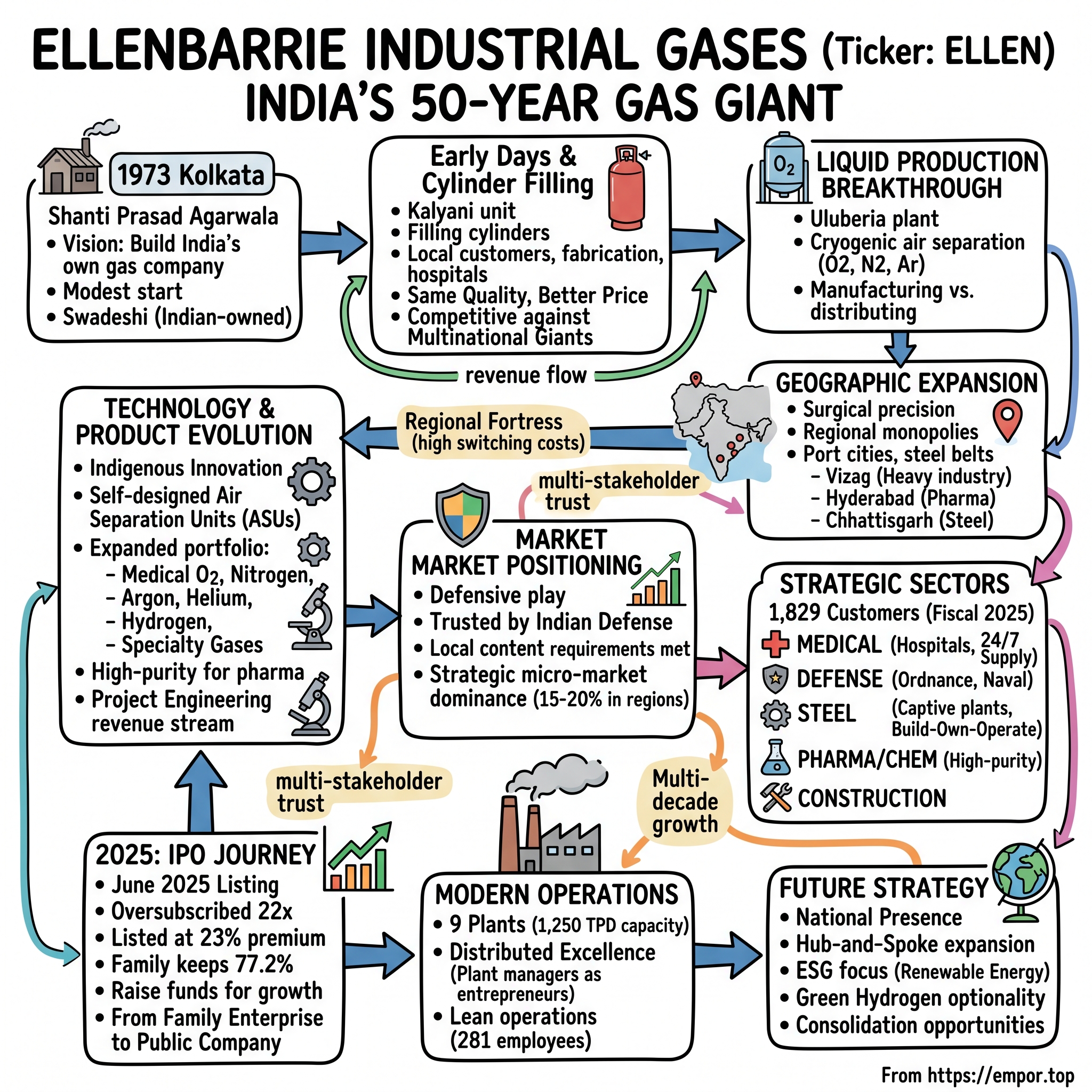
Ellenbarrie Industrial Gases: The Regional Champion's IPO Test
I. Introduction & Episode Setup
On the morning of July 1, 2025, a company that had spent nearly half a century as one of the most obscure industrial businesses in eastern India walked onto the National Stock Exchange and was immediately worth more than anyone in Kolkata had ever imagined. Ellenbarrie Industrial Gases had priced its shares at ₹400. They opened at ₹486 — a listing gain of roughly 21.5%.1 Within weeks the stock traded above ₹570. Within six months it had lost more than half of that.
That round trip is the most honest introduction to this company you can get. Not because the price action tells you much about the business — it rarely does — but because it captures the central question. Ellenbarrie is a real operating business with real assets, real contracts, and a genuinely defensible position in three Indian states. It is also, by the standards of the industry it competes in, tiny. The gap between those two facts is where the entire investment debate lives.
Here is the company as it stands in September 2026. Market capitalisation of roughly ₹4,500 crore. FY26 revenue of about ₹342 crore, up 9.3% on the prior year. Net profit of ₹104.4 crore, up 25.4%. Promoter holding of 77.15%. Return on equity of 14.2%, return on capital employed of 15.2%. No dividend has ever been paid.23 Those are the numbers of a small-cap industrial company that earns a very good margin on a very small revenue base.
Now place it against the field. In fiscal 2025, Linde India booked revenue of about ₹2,485 crore. INOX Air Products, the joint venture with Air Products & Chemicals of the United States, booked roughly ₹2,590 crore in fiscal 2024. Ellenbarrie booked ₹312 crore.4 Its own Joint Managing Director told analysts on the first post-listing earnings call that the company held "about 4 odd percent" of the Indian market, against roughly 25% each for Linde and INOX.5 Frost & Sullivan, commissioned for the IPO, put the figure more precisely at 2.85% for fiscal 2025.4
So this is a story about a company holding somewhere between two and four percent of its market, trading at a multiple that assumes it will take considerably more.
The history is stranger than the financials suggest. Ellenbarrie was incorporated in 1973 and listed on the Calcutta Stock Exchange in 1976 — a listing it voluntarily abandoned in 2018.4 For eight of the years in between, from October 2013 to July 2021, the "largest Indian-owned industrial gas producer" was not Indian-owned at all: 51% of it belonged to Air Water Inc. of Japan. The promoters bought that stake back at ₹317.17 per share, having sold it at ₹316.90 per share eight years earlier — a difference of 27 paise.4 Neither the prospectus nor management has ever explained why a strategic partner would exit a compounding business at effectively the price it paid.
And there is the competitive context, which changed materially in the twelve months after listing. In October 2024, Linde signed agreements to take over two of Tata Steel's captive air separation units in India and expand supply to the steelmaker — buying network density rather than building it.6 In October 2025, Air Liquide announced the acquisition of NovaAir, a company founded in 2019 that supplies bulk and specialty gases across East and South India.7 That is precisely Ellenbarrie's home ground. The regional moat that nobody had bothered to contest is now being contested — not by construction, but by chequebook.
What follows is an attempt to work out what a regional near-monopoly in industrial gases is actually worth once public markets, and much larger foreign-owned rivals, start paying attention to it.
 Subscribe on LinkedIn
II. Origins: From a Kalyani Cylinder Shed to a Bengal Gas Major (1973–2000s)
Kalyani, in the Nadia district of West Bengal, was one of independent India's planned industrial towns — laid out in the 1950s on the site of a wartime American airbase, meant to become a satellite manufacturing hub for Calcutta. It never quite became what the planners intended. But it did have factories, and factories needed gas.
In 1973, Shanti Prasad Agarwala incorporated Ellenbarrie Industrial Gases as a public limited company under the Companies Act, 1956. Three years later, in 1976, two things happened at once: the company's shares were listed on the Calcutta Stock Exchange, and it set up its first oxygen plant in Kalyani.4 The sequence matters. This was a business that went to public markets essentially at inception — small, local, and with the modest ambitions of a cylinder-filling operation serving the fabricators, foundries and engineering shops of Bengal.
The customer base was determined by geography and by the industrial policy of post-independence India. Eastern India was steel country. It was also home to a heavy engineering base built around public sector undertakings and the railway workshops. All of those consumed oxygen for cutting and welding, nitrogen for inerting and purging, and acetylene for flame work. Industrial gas is not a product anyone gets excited about; it is closer to a utility. What made it a business rather than a commodity trade was the physical difficulty of moving it. Oxygen and nitrogen have to be either compressed into heavy steel cylinders or liquefied at cryogenic temperatures — around minus 183°C for liquid oxygen — and kept that cold in transit. Every kilometre of truck journey burns some of the product through boil-off. That single physical fact is the reason this industry organises itself into local clusters rather than national networks, and it is the reason a Kalyani cylinder shed could survive against much larger companies for decades.
What is striking about the first thirty years is how little capital moved through the business. Ellenbarrie did not build its first air separation unit — the plant that actually pulls air apart into its constituent gases — until 2004, in Uluberia, West Bengal.4 Three decades of operation before the company owned the core piece of equipment that defines a modern industrial gas producer. Until then it had been buying gas and filling cylinders, capturing the distribution margin rather than the manufacturing one.
An air separation unit is conceptually simple and industrially demanding. You take in ordinary atmospheric air, compress it, cool it until it liquefies, and then distil it — exactly like a refinery distils crude oil, only at cryogenic temperature rather than heat. Nitrogen boils off first, oxygen next, argon last and in tiny quantities, because argon is only about 0.9% of the air you are starting with. The plant runs continuously; the main input cost is not raw material, because air is free, but the electricity to run the compressors. Varun Agarwal, the founder's grandson, described the economics to analysts in plain terms: power is "the largest cost line item for us," followed by transportation.8 That is the entire business in one sentence. Buy electricity, sell separated air, and truck it as far as the arithmetic allows.
Once the first ASU was running, expansion followed the customers rather than a map. In 2009 came a second unit in Parawada, near Visakhapatnam in Andhra Pradesh. In 2012, a third in Jadcherla, Telangana.4 Those two southern plants, plus the Bengal cluster, still define the company's footprint fourteen years later.
There is a detail in the expansion sequence that repays attention. The Andhra Pradesh plant came five years after the first Bengal ASU, and the Telangana plant three years after that — each roughly a thousand kilometres from head office, and well outside any conceivable trucking radius from Uluberia. Ellenbarrie was not extending a network. It was building a second, separate business in the south, with its own customers, its own logistics and its own local competitive dynamics. That is why the company today reads as two regional operators sharing a balance sheet rather than one national one, and it is why the southern and eastern operations are still split between two members of the family at the top.
It is worth being clear about how this was funded, because it shapes everything that comes after. There were no equity raises of consequence, no rights issues, no acquisitions. Growth came out of retained earnings and bank debt, at the pace those two sources allowed. The company crossed ₹100 crore of turnover only in 2017 — forty-four years after incorporation — and ₹200 crore in 2022.4 For a business whose end markets were growing steadily throughout, that is a slow compounding rate, and it tells you the constraint was capital rather than demand.
Two structural consequences follow, and both are still visible in the 2026 accounts. First, the company never developed the habit of large-project execution, because it never had the balance sheet to attempt one; its largest operating plant even today is 600 TPD, commissioned only around 2024. Second, it entered the on-site business — the segment with the most durable economics in this industry — only in 2019, forty-six years after incorporation, when it signed a fifteen-year leasing and operations agreement for an ASU at a major steel producer's Kharagpur facility.4 The most defensible revenue Ellenbarrie owns is barely seven years old.
Which sets up the decision that arrives next, and which the company's marketing has never been entirely comfortable discussing.
III. Sovereignty for Sale and Sovereignty Bought Back: The Air Water Detour (2013–2021)
On October 18, 2013, Padam Kumar Agarwala transferred 791,259 equity shares to Air Water Inc. at ₹316.90 each. Varun Agarwal transferred a further 3,625 at the same price.4 Across the family, the transaction handed Air Water up to 51% of Ellenbarrie's subscribed and fully paid-up equity — control of the company.4 The consideration across the promoter group was on the order of ₹100 crore. It was Air Water's first acquisition in India.
Consider what that meant for a family business. The Agarwalas had spent forty years building a company that had just crossed a few hundred crore of turnover. They sold majority control of it and, in exchange, got capital and a strategic partner with deep cryogenic engineering experience. Air Water is not a marginal player; in 2019 it paid US$194 million to acquire Linde India's south Indian business, a transaction the IPO industry report cites as one of the defining consolidation events in the Indian market.4 This was a serious partner making a serious commitment.
Then, in July 2021, it unwound. Under a share purchase agreement dated July 9, 2021, the promoters reacquired the entire 51% stake held by Air Water for total consideration of ₹105.8 crore, completed on July 28, 2021. The price per share was ₹317.17 — against ₹316.90 paid eight years earlier. The consideration was supported by a valuation report from V. Khandelwal & Associates dated June 10, 2021, which arrived at a fair value of ₹327 per equity share.4
This deserves to be sat with rather than skipped past. Over those eight years, Ellenbarrie's revenue grew several-fold. Its plant base expanded. It entered the on-site business in 2019 with a fifteen-year contract to lease and operate an ASU at a major steel producer's Kharagpur facility.4 By any operating measure, the business at exit was materially larger and better positioned than the business at entry. Yet the exiting shareholder took out, in nominal rupees, essentially what it had put in — before accounting for eight years of Indian inflation, which would have made the real return meaningfully negative.
There are benign readings. Strategic corporate investors sometimes exit at agreed contractual formulas rather than market value. Joint ventures fail for reasons of governance, not economics. Air Water may have concluded that the acquired Linde south India business gave it a better platform than a minority-controlled Bengal operation.
But none of those readings is on the record. Asked directly on the Q4 FY26 earnings call by an analyst from Niveshaay why Air Water had invested and then sold, Varun Agarwal said only that "it was mutually agreed between the partners," that Air Water continues to operate in India as Air Water India, and that it was "a mutually agreed decision for various strategic reasons of both the sides."8 That is a courteous non-answer, and it is the fullest public explanation available. The prospectus does not explain the rationale either. Investors should treat Air Water's exit motive as an unresolved information gap, not as evidence of promoter shrewdness.
There is a second episode in the same window that deserves more attention than it usually gets. In 2018, Ellenbarrie voluntarily delisted from the Calcutta Stock Exchange.4 The delisting was executed through an open offer, and the prospectus records the price: shares credited to Padam Kumar Agarwala through that process — 978,903 in April 2018 and a further 400,000 in July 2019 — were transferred at ₹62.00 per share.4
Set that beside ₹316.90. In 2013, a Japanese strategic buyer paid ₹316.90 per share for control. Five years later, minority shareholders on the Calcutta exchange exited at ₹62.00. Nothing in the prospectus reconciles those two numbers. There are plausible explanations — the Calcutta Stock Exchange was by then a moribund venue where Ellenbarrie's shares barely traded, and delisting prices in illiquid counters are set by reverse book-building mechanics rather than by fundamental value. But it is a fact pattern that a sceptical investor should note: when the family bought, it bought at ₹62; when a foreign partner bought, it paid ₹316.90; when the family bought the foreign partner out, it paid ₹317.17.
The composite picture is not one of malfeasance. It is one of a controlling family that has been consistently effective at transacting in its own shares, in a company where public price discovery was, for most of its history, absent. What it should do is puncture the marketing. "100% Indian-owned since 1973" is a positioning line, not a historical fact. The company was majority Japanese-owned for eight of the last thirteen years, went dark on public markets for seven, and only re-emerged as a listed entity in 2025.
That re-emergence happened into an industry structure worth understanding properly, because almost everything about Ellenbarrie's prospects turns on it.
IV. How the Industrial Gases Business Actually Works: Industry Structure & Competition
Start with a trucking problem.
You run an air separation unit outside Visakhapatnam. It produces liquid oxygen at minus 183°C. A customer 200 kilometres away wants it. You load a cryogenic tanker, drive it there, and along the way a small percentage of your product boils off into the atmosphere. At 400 kilometres, more. At 800 kilometres, the economics stop working — you are burning diesel to deliver a product that is evaporating, into a market where a local producer has no such penalty.
Varun Agarwal put the operational number on the record when an analyst from Aditya Birla Sun Life Pension Fund asked about transport radius: "generally we prefer to deliver within a radius of about, let's say, 300 to 400 kilometers from our plant," with some customers further out at higher cost, and mitigation coming from larger tankers that lower per-unit haulage.8
That radius is the single most important structural fact in this industry. It means the Indian industrial gas market is not one market. It is dozens of overlapping regional markets, each defined by a circle drawn around a plant. Within the circle, the local producer has a real cost advantage. Outside it, they have none. National market share is therefore a much weaker predictor of competitive outcome than it would be in almost any other industry.
On top of that geography sit three quite different businesses, which happen to share a plant.
On-site, or piped supply. You build a plant inside or adjacent to a customer's factory and pipe gas directly to their process. Contracts run long — Ellenbarrie's on-site agreements range from five to fifteen years, extending to twenty in certain cases — and are structured as take-or-pay: the customer pays a fixed monthly amount whether or not they lift the volume.4 Varun Agarwal explained the consequence bluntly on the first post-IPO call: for an on-site plant "the capacity utilization becomes irrelevant because the revenues of the company are guaranteed from that plant."5 The margin on revenue is high because the customer bears the power cost, but absolute revenue per tonne of capacity is low. He gave a live example: a 300-tonne-per-day on-site plant carries revenue potential of only about ₹25 crore a year, versus roughly ₹100–120 crore for a 220 TPD merchant plant costing about ₹160 crore to build.5
Merchant, or bulk liquid. You build a plant on your own land, and truck liquefied gas to a few hundred customers within the radius. This is where volume growth and pricing risk both live. New merchant plants are not pre-contracted. Asked directly by Singularity AMC in August 2026 how much of the forthcoming North India plant was backed by identified demand, Varun Agarwal was refreshingly candid: "there are no contracts which are tied up in advance, but we have a sense of our target customers in that region." The company surveys a micro-market, identifies a demand-supply gap, builds, and only starts contracting "maybe 3-4 months before the plant actually gets commissioned."9 Ramp-up to 80–90% utilisation then takes 18 to 24 months.
Packaged, or cylinder gas. Compressed gas in steel cylinders, delivered locally, sold to small industrial users, hospitals and workshops. Highest margin per unit, most fragmented, and — importantly — the segment with the least contractual protection. The prospectus is explicit: for package customers "we do not enter into long-term contracts and supply products to them on the basis of purchase orders."4
In fiscal 2025, Ellenbarrie's mix across those three was 66.75% bulk, 17.61% package and 15.64% on-site.4 The on-site share had grown sharply from 2.71% two years earlier, which is the single most important structural improvement in the company's recent history: take-or-pay revenue is the most defensible revenue in this industry.
Now the competitive map. Linde India, formerly BOC India, is the market leader and the only listed comparable, backed by a global parent with its own ASU engineering arm. INOX Air Products has the largest plant count in the country. Air Liquide India and Air Water India occupy the next tier. Frost & Sullivan's assessment for the prospectus described a market "characterized by the dominance of a few key players such as Linde, Inox Air Products, and Air Water," with the top players accounting for over 60% of Indian oxygen demand by value in 2024, and a long tail of small companies below them that leaves the sector "ripe for consolidation."4 Ellenbarrie sits in that consolidation-target tier by size, while being, per the same report, the market leader by installed manufacturing capacity in each of West Bengal, Andhra Pradesh and Telangana.4
Run this through Porter's framework and the picture is genuinely unusual. Rivalry is structurally muted, because the trucking radius partitions the market into local oligopolies rather than a national price war. Supplier power is concentrated in a single input — electricity — where the supplier is often a state distribution company with tariff-setting power. Buyer power varies enormously by segment: an on-site steel customer on a fifteen-year contract has almost none during the term and enormous power at renewal; a cylinder customer on a purchase order has power every single month. Substitutes barely exist; you cannot weld without oxygen. New entrants face high capital costs, which is why the real competitive threat is not entry but acquisition.
Which brings us to Hamilton Helmer. Of the seven powers, the one Ellenbarrie can most plausibly claim is switching costs, and only in a specific place: once an on-site plant is built on a customer's land and piped into their process, displacing it is close to impossible for the contract's duration. That is genuine, contractual, and durable — for fifteen years at a time. Cornered resource is a weaker claim. Local scale within a trucking radius is real, but it is not proprietary; anyone with capital can build inside the same circle, or buy someone who already has. Counter-positioning and process power are absent. And on scale economies, Ellenbarrie is on the wrong side: Linde's in-house ASU engineering capability lets it bid the largest on-site contracts on terms Ellenbarrie cannot match. Varun Agarwal acknowledged the gap and its trajectory — the company's largest operating plant is 600 TPD, it claims capability up to 1,000-plus TPD, and it is "actively working on inquiries which are above 600 tons," but it has not yet executed one.9
The most instructive competitive comment came not from a strategy slide but from an analyst pressing on the first post-IPO call. Parikshit Kabra asked directly where Ellenbarrie's technology comes from and what its right to win is against Linde and INOX with their global technology stacks. Padam Kumar Agarwala's answer was notably unspun: "I wouldn't say that we still beat them. We are generally, I would say it's a situation of coexistence." On price, "generally everybody stays as per the market, the competition is on service and customer connect."5
That is an honest description of a business with a service advantage in defined geographies, not a differentiated-technology story. It should be read as a boundary on the moat claim, not a marketing point.
There is one more angle the company's positioning invites: the claim that being the largest wholly Indian-owned producer creates an edge in defence, ordnance and strategic-sector contracts where foreign-controlled suppliers may face constraints. The company holds letters of appreciation from the Indian Air Force for liquid oxygen supply to Air Force Station Kalaikunda and for support during the pan-India Gagan Shakti 2024 exercise, and counts Hindustan Shipyard among its defence customers.4 But test it against disclosed revenue. In the only end-use breakdown the prospectus provides — for project engineering services — defence accounted for ₹0.25 million of ₹200.28 million in fiscal 2025. That is 0.12%.4 The company discloses no separate defence line within its far larger gases segment. On the evidence available, domestic ownership is option value with an established customer relationship behind it, not a demonstrated revenue driver.
So what does the business actually look like today, once you strip the positioning away?
V. Ellenbarrie Today: Plants, Products, and Customers
Nine facilities. Five in West Bengal, two in Andhra Pradesh, one in Telangana, one in Chhattisgarh. Three of them are standalone bulk manufacturing plants with cylinder filling attached; two are standalone cylinder filling stations; four sit inside customers' factory gates.4 Roughly 39,560 cylinders in circulation. 281 on-roll employees as of March 31, 2025.4 That is the physical company — a mid-sized regional industrial operator, not a conglomerate.
The revenue splits into two reported segments. Sale of gases contributed ₹2,924.55 million of fiscal 2025 revenue; project engineering services — designing, engineering, supplying and commissioning air separation units and medical gas pipeline systems for third parties — contributed ₹200.28 million, or about 6.4% of the ₹3,124.83 million total.4
That small engineering line matters more for what it proves than what it earns. Asked on the Q4 FY26 call whether Ellenbarrie licenses Air Water's technology, Varun Agarwal explained the model: the company designs the plants itself, buys machinery from suppliers around the world, and its internal team integrates and commissions on site. He framed it as "one of our main strengths as an independent gas company which is not linked to one of the larger multinational groups."8 An analyst from Aditya Birla Sun Life Pension Fund pushed on whether real scientific expertise was required and who owns it; the answer was that expertise spans "almost all engineering disciplines," under a dedicated projects head, with design, procurement and execution all in-house.8
That is a credible capability claim, and it is externally corroborated by the fact that third parties have paid for it. But note the trajectory management itself gave: asked whether project engineering would grow, Varun Agarwal said no — the team is "fully engaged in execution of our internal projects," internal work generates no billing, and there is no spare bandwidth for external jobs.8 This is a capability that validates the company's independence while shrinking as a revenue line. Investors should model it down, not up.
The gas mix is where the interesting economics live. In fiscal 2025, nitrogen was the largest single product at 47.36% of gases revenue, oxygen 40.10%, argon 8.34%, with acetylene, hydrogen, carbon dioxide and others making up the remainder.4 Argon is the swing factor. It comes out of the same distillation column as oxygen and nitrogen, at roughly 5% of a typical plant's configured output, and it commands a very different price. Varun Agarwal quantified it for an analyst from VT Capital: the cost to make all three gases is more or less the same, but argon realisation is "three to four x, at least or maybe even higher than oxygen and nitrogen," giving argon a margin "one and a half to two times the margin of the blended EBITDA margin of the company."5
Management has guided argon toward 15% of gas revenue over the longer term, from roughly 8–10% currently.58 The structural argument for argon is genuinely good and worth stating properly, because it is the strongest microeconomic claim in the story: argon can only be produced as a by-product of oxygen production, so supply growth is mechanically chained to oxygen capacity growth, while demand comes from specialty steels, high-end fabrication and increasingly solar cell manufacturing.8 Supply that cannot respond independently to demand is the textbook setup for pricing power.
It is also, as fiscal 2026 demonstrated, the textbook setup for violent short-term swings — a point taken up in Section VIII.
Capacity is where the published figures conflict, and the conflict is worth resolving because aggregators get it wrong. The Frost & Sullivan report and the prospectus state 1,250 TPD of oxygen plant capacity as of March 31, 2025.4 Varun Agarwal gave analysts a different and more useful number: 1,370 TPD across liquid oxygen, liquid nitrogen, liquid argon and gaseous oxygen for owned on-site plants, "which is owned and operated by us."5 And when an analyst noticed a 3,800 TPD figure in the investor presentation, he explained the gap directly: a 2,500 TPD plant that Ellenbarrie operates under contract at a government-owned steel producer's site in Nagarnar, Chhattisgarh, sits on someone else's balance sheet. Ellenbarrie earns "a fixed fee every month" from it; the revenue is not proportionate to the capacity, and he called the larger number "a bit misleading in that sense."5
That is a management team correcting its own headline metric downward under questioning, which is a mildly positive governance signal. It is also a warning: any third-party capacity figure for this company needs to be checked for whether it counts operated-but-not-owned assets. By May 2026, the owned base stood at roughly 900 TPD of merchant capacity and about 700 TPD of on-site, guided to roughly 1,130 and 1,000 respectively within twelve months.8
Then there is the diversification claim, and here the company's own prospectus is the best sceptic. Ellenbarrie sold to 1,829 customers in fiscal 2025 — genuinely one of the broadest customer bases in Indian industrial gases.4 The headline invites you to conclude that concentration risk is low.
The disclosed numbers say the opposite is happening. Top-10 customers were 37.56% of gases revenue in fiscal 2023, 40.95% in fiscal 2024, and 47.09% in fiscal 2025. The top five went from 26.26% to 34.25% over the same period.4 The direction is unambiguous: as the on-site business has grown, revenue has concentrated into fewer, larger, contractually locked relationships.
That is not automatically bad. On-site take-or-pay revenue is higher quality than spot cylinder sales, and the prospectus notes the top five and top ten customers have averaged 8.4 and 7.7 years of association respectively.4 Concentration into fifteen-year contracts is a different animal from concentration into purchase orders. But the prospectus adds a sentence that ties the risk to geography: "all of our top 10 customers are located in East and South India."4
Hold that thought. East and South India is exactly the territory Air Liquide bought its way into a few months after listing.
One minor legal item, included for completeness rather than significance. In February 2011, Indian Oil Corporation sued Ellenbarrie before the Civil Judge Senior Division at Nashik over a cancelled order: the company had placed a purchase order in July 2008 for thirteen transport tankers, accepted three, and cancelled the remaining ten. IOC seeks ₹34.06 million plus interest; Ellenbarrie has denied liability and counter-claimed ₹1.39 million. The matter remains pending.4 It is fifteen years old, immaterial in size, and not indicative of a pattern.
A more consequential dispute sits in the same section and speaks directly to the cost structure: in December 2023 Ellenbarrie filed a writ petition in the Andhra Pradesh High Court challenging an Energy Department order that increased electricity duty, under which the company says it paid ₹50.87 million in excess.4 For a business where power is the dominant cost, litigation against a state energy department is not a footnote — it is a live illustration of where the margin risk actually comes from.
Which raises the question of who is making these decisions.
VI. The Agarwala Family at the Wheel: Management, Ownership, and Capital Allocation
There is a small biographical detail that captures the generational shift at Ellenbarrie better than any org chart.
Padam Kumar Agarwala, born November 14, 1960, holds a bachelor's degree in commerce from St. Xavier's College in Kolkata. He worked inside Ellenbarrie as a business head for more than twelve years before joining the board on March 13, 1995. He oversees the eastern region.4 His is a career built entirely inside one company, in one city, in one industry.
Varun Agarwal, born April 6, 1984, holds a bachelor's degree in economics from the London School of Economics and a master's in philosophy from Cambridge. Before joining the family business in August 2008, he worked at Lehman Brothers.4 He oversees the southern region and, on the evidence of four earnings calls, does essentially all of the investor-facing analytical work. He is a member of the Hyderabad chapter of the Entrepreneurs' Organisation.
So the company is run by a father who learned the business from the plant floor and a son who arrived from an investment bank in the year it collapsed, and who now handles the capacity tables, the unit economics and the margin bridges on every call. That division of labour shows up in the transcripts. Padam Agarwala's opening remarks are about the macro environment and the philosophy of disciplined capital allocation. Varun Agarwal's answers are quantitative, specific, and — a point in his favour — willing to give unhelpful numbers when asked.
The board comprises six directors: two executive and four non-executive independent, including one woman.4 All four independents are Kolkata-based. Their backgrounds are respectable — Soumitra Bose is a chartered and cost accountant formerly with the Unilever group; Ajit Khandelwal has over 36 years in capital markets and investment banking; Pawan Marda is a company secretary who was previously director of corporate affairs and company secretary at Linde India; Seema Sapru is a school principal.4 The prospectus itself flags the governance limitation candidly: "Many of our Independent Directors do not have any prior experience of holding directorship in a Company listed on the Stock Exchanges."4 For a company entering public markets with 77% promoter control, that is a real, disclosed constraint on board oversight, not a formality.
On ownership, the numbers correct a common misreading. Promoters and promoter group held 96.46% of the equity as of the prospectus date.4 The offer for sale comprised 5,656,565 shares each from Padam Kumar Agarwala and Varun Agarwal.4 Post-listing, promoter holding settled at 77.16% in June 2025, and has been 77.15% or 77.16% in every quarter since — through June 2026.2 That is a verifiable fact worth stating precisely: there has been no promoter selling in the fourteen months since listing. Domestic institutions have moved around considerably, from 10.57% at listing to a peak of 15.42% in December 2025 and back to 11.63% by June 2026 — institutional conviction has wobbled where promoter holding has not.2
On incentives, the outline for this piece flagged an open question about whether any management incentive scheme exists. The prospectus answers it precisely, and the precise answer is more interesting than either "yes" or "no." Ellenbarrie adopted the Stock Option Plan 2024 by board resolution on July 8, 2024 and shareholder resolution on August 1, 2024, compliant with SEBI's share-based employee benefit regulations. But as of the prospectus date, "no options have been granted." Separately: "None of our Directors hold any employee stock options."4 So the machinery exists and has never been used. For a company that describes its 281 employees as "the backbone" of the business and says the scheme is intended to "attract, incentivize and retain senior management," an unused plan is a gap between stated intent and action worth tracking. Whether grants have been made in the fourteen months since is not disclosed in the materials reviewed here.
Now the capital allocation record since listing, which is short but not empty.
Debt repayment. In the first week of July 2025, immediately on receipt of IPO proceeds, the company repaid about ₹210 crore of borrowings, mostly long-term.5 CRISIL recorded debt falling to around ₹51 crore by July 31, 2025, and net worth rising from ₹470 crore at March 2025 to an estimated ₹888 crore post-issue.10 By Q3 FY26, management reported a net cash position of ₹355 crore.11 This was done exactly as promised, immediately, with no repurposing. It is the cleanest promise-to-outcome match in the company's short public record.
One bolt-on acquisition. On August 5, 2025 the board approved the acquisition of Truair Industrial Gases, a Bengaluru partnership firm running a cylinder filling station, as a going concern on a slump sale basis.12 It completed on September 7, 2025 for ₹54.09 million — about ₹5.4 crore.3 The strategic logic Varun Agarwal gave was specific and checkable: the Kurnool plant sits roughly halfway between Hyderabad and Bangalore and must sell into both; a local cylinder presence in Bangalore allows value-added sales and, critically, access to medical customers who "don't want to take supplies from someone who's located 200-300 kilometers away."5 That is a coherent, in-adjacency, distribution-extending deal at 0.1% of market capitalisation. It is evidence of restraint. It is far too small to constitute an M&A track record.
One impairment. This is the item that complicates the discipline narrative, and it belongs here rather than in a risks appendix. Q4 FY26 reported EBITDA of ₹260 million at a 30% margin, against ₹304 million and roughly 35% adjusted for three one-offs totalling about ₹46 million. Two were operational: an ₹11 million provision for employee leave encashment and a ₹15 million commercial settlement with an on-site customer over a plant start-up date dispute. The third was "an impairment relating to a legacy non-core investment," which Varun Agarwal described as "not connected to the operating gases business" and relating "to an older investment on the balance sheet," written down on an assessment of recoverability and fair value.8
Neither the amount nor the identity of that investment was disclosed on the call. It is small in the context of a ₹4,500 crore company. But it is a documented instance of capital previously deployed outside the core business being marked down — and the promoter group's other directorships include tea plantations, agro products, and share trading companies.4 Anyone tempted to describe this management as having a clean record of surgical capital allocation should note that the record is fourteen months long as a public company and already contains one write-off of a legacy non-core position. The honest characterisation is that capital allocation since listing has been modest, in-adjacency and promise-consistent, on a sample far too small to extrapolate.
Zero dividends. No dividend has ever been paid.2 For a founder-led, capacity-hungry business generating ROCE in the mid-teens and committing roughly ₹450 crore to new plants, retention is defensible. It also means shareholders have realised nothing outside the share price, which has been an unreliable source of returns.
The rating. CRISIL migrated Ellenbarrie's long-term rating to 'Crisil A/Stable' and short-term to 'Crisil A1' on August 25, 2025, citing improved scale and financial flexibility, an operating margin rising to 35.8% in fiscal 2025 from 23.2%, and ROCE of 18% against 13%.10 This is frequently cited as an upgrade validating post-IPO execution. Read the rating action line carefully and it is more complicated than that. The migration was from 'Crisil A-/Stable/Crisil A2+ Issuer Not Cooperating'. CRISIL's own text explains why: "Citing inadequate information, Crisil Ratings... had migrated its ratings... to Issuer Not Cooperating. However, the company's management has subsequently started sharing the information necessary for a comprehensive rating review."10
In other words, before the IPO, Ellenbarrie was not supplying its rating agency with adequate information. The "upgrade" is partly a genuine reflection of better fundamentals and partly the mechanical result of a company that had stopped cooperating starting to cooperate once it needed public-market credibility. Both readings are true. The unqualified version — "CRISIL upgraded them, therefore management executes" — is not supported by the document it rests on.
Which is a useful frame for the listing itself.
VII. Going Public: The 2025 IPO
The paperwork took nine months. Ellenbarrie filed its draft prospectus in September 2024; the red herring prospectus is dated June 2025. The board authorised the fresh issue on July 8, 2024 and shareholders approved it on August 1, 2024 — the same two dates on which the unused stock option plan was adopted, and on which both executives' current terms of appointment began.4 July 2024 was, evidently, the month the company decided what it was going to become.
The offer was priced at ₹380–400 per share, with subscription open June 24–26, 2025.13 Structurally it was close to a balanced deal: a fresh issue of ₹400 crore alongside an offer for sale of 11,313,130 shares split precisely evenly between the two promoter-executives.4 At the top of the band that OFS was worth roughly ₹452.5 crore, taking the total issue to about ₹852.5 crore. Ahead of the opening, the company raised approximately ₹256 crore from anchor investors including mutual funds managed by HDFC, Axis, Bandhan and Tata.14
The use of fresh proceeds was specified with unusual precision: repayment of borrowings, ₹1,045.00 million toward a 220 TPD air separation unit at Uluberia-II in Howrah district, and general corporate purposes.4 Naming a single plant, at a single location, with a single capacity, as an object of the offer is a commitment that can be checked later. It duly was — see Section VIII.
The subscription pattern is the part worth dwelling on, because it separated two kinds of investor. The issue was subscribed 22.19 times overall. Qualified institutional buyers came in at 64.23 times. Non-institutional investors at 15.21 times. Retail: 2.14 times.1
That is a striking spread. Institutions, who had read the prospectus and modelled the capacity pipeline, wanted roughly thirty times as much of this deal proportionally as retail investors did. Retail barely covered its book. In hindsight the retail hesitancy looks less like inattention and more like an accurate read on valuation — because what happened next was a study in a small-cap being repriced by its own shareholder register.
The stock listed on July 1, 2025 at ₹486, a gain of 21.5% on the ₹400 issue price.1 It kept going. On July 3, 2025, with the stock at ₹576.30, InvestingPro's fair value model published an estimate of ₹301.86 — flagging the shares as roughly 48% above intrinsic value.15
That call proved directionally correct, and painfully so. By January 14, 2026 the stock had fallen 52.32%, to ₹274.80.15 It has since partially recovered; as of early September 2026 it trades around ₹322, against a 52-week range of ₹560 to ₹175.2
Sell-side coverage arrived in the middle of the descent and did not, in aggregate, help. Motilal Oswal initiated with a Buy in September 2025, flagging substantial upside.16 JM Financial followed with a Buy in October 2025.17 Both initiations landed while the stock was well above where it trades today.
For a long-term investor, the instructive part of this episode is not the listing pop. It is the amplitude. Between July 2025 and September 2026, Ellenbarrie's underlying business did roughly what management said it would: revenue grew 9.3% in a year when its single largest capacity addition was delayed, margins wobbled and recovered, debt was repaid on schedule, and one small acquisition closed. The business moved by single-digit and low-double-digit percentages. The stock moved by more than 200% peak to trough and back.
That gap is what a thin float, a 77% promoter block, an institutional register that swung from 10.6% to 15.4% and back, and no established earnings history produce when combined. It is a structural feature of this security, not a one-off. Any investor in Ellenbarrie should expect the share price to be a far noisier instrument than the business it represents.
And the first full year of operating results gave the market plenty to be noisy about.
VIII. The First Year as a Public Company: Guidance, a Margin Wobble, and a Plant Delay
The most useful way to read Ellenbarrie's first year as a listed company is as a sequence of four calls in which a single number — the EBITDA margin target — quietly moved, and a single project timeline visibly slipped.
Start with the target, because its history matters more than its current level.
On the first post-IPO call in August 2025, with Q1 FY26 margins at 37%, Varun Agarwal was asked what the company was targeting over three to four years. His answer: "We don't expect these margins to go down. In fact, as we sort of build up more capacities, have higher argon production, more onsite plants, we would expect to at least maintain these margins with a sort of potential upside." Pressed again by another analyst on peak margins if argon reached 15% of revenue, he declined to give a number and repeated that 37% was "a sustainable margin with some upside."5
On the Q3 FY26 call in February 2026 — after the margin had fallen to 31% — an analyst asked whether the company still held to "the 40% margin aspiration." The answer: "Yes, we do hold on to EBITDA margins of around 40%."11 By the Q4 FY26 call in May 2026 the formulation was "our long-term EBITDA margin aspiration is 40%," achieved "in the medium term."8 By the Q1 FY27 call in August 2026: "we expect this business to stabilize at 40% or higher EBITDA margins."9
So a target that began as "maintain 37% with potential upside" and was never publicly quantified as 40% by management on the first call had, by the fourth call, become a firm 40%-or-higher aspiration — and it hardened in the quarter when margins missed most badly. That is worth noticing. Companies more often soften targets after misses. Ellenbarrie raised the stated ambition while under-delivering against the prior one, which is either genuine confidence in the capacity pipeline or an unhelpful ratchet. The evidence will decide, and the evidence is not in yet.
Now the actual margin path, which is the more important story.
Q1 FY26 came in at 37%. Q2 at 38%. Q3 collapsed to 31% — revenue of ₹813 million, EBITDA of ₹253 million, a 9% sequential revenue decline and a 25% sequential EBITDA decline. Padam Agarwala named the causes without hedging: low argon realisations from "a softer environment in steel and an oversupply of argon into the market from captive gas plants operated by steel manufacturers," plus elevated other expenses from one-off costs.11 Argon prices fell more than 25% in the quarter.11
That mechanism deserves a moment of explanation, because it is the structural vulnerability inside the otherwise attractive argon story. India's large steelmakers run their own captive air separation units to supply their own oxygen. When steel output softens, those captive plants keep producing — the ASU cannot easily be turned down — and their surplus argon gets dumped into the merchant market. So argon supply rises precisely when argon demand falls. The same by-product economics that make argon supply inelastic on the way up make it perversely counter-cyclical on the way down. Management's medium-term argon thesis is sound; the quarterly volatility is not a bug that will be engineered away.
Q4 FY26 then delivered a reported EBITDA margin of about 30% — worse than Q3 on the headline — but for different reasons. Adjusting for the three one-offs described earlier, the underlying margin was around 35%. On a segment basis, the gases business delivered a 40% margin in Q4 and 38.4% for FY26 as a whole, up 500 basis points on FY25.8
Note the definitional shift, because it is easy to miss. The headline 40% that management now points to is a gases segment result margin, not a company-level reported EBITDA margin. Company-level reported EBITDA margin in Q4 FY26 was 30%. Both figures are legitimate; they measure different things. An investor tracking "the 40% target" needs to be clear about which line is being tracked, and management has not always drawn the distinction sharply in its framing.
Q1 FY27, reported in August 2026, was genuinely strong on any definition. Revenue of ₹987 million, up 18% year-on-year and 13% sequentially. EBITDA of ₹387 million, up 21% and 50%. Reported EBITDA margin of 39%. Profit after tax of ₹350 million, up 87% year-on-year, helped by lower finance costs and a lower effective tax rate. Core gases segment margin: 38%.9
Importantly, Varun Agarwal explicitly declined to attribute that improvement to argon prices — which remain below H1 FY26 levels — saying argon "has had a very limited impact this quarter" and that the improvement came from newer, more power-efficient capacity, higher volumes and cost control: "strong operational performance rather than a price movement driven margin expansion."9 That is a falsifiable, non-flattering claim (it would have been easier to credit argon), and it is consistent with the physical explanation that new ASUs consume less electricity per tonne.
Now the historical falsification test on the 40% claim, which is the one that matters. On the first post-IPO call, an analyst from Ambit Investment Advisors laid out the actual margin record: FY21 26%, FY22 33%, FY23 16%, FY24 23%, FY25 34%.5 That is not a business that has ever sustained 40%. It is a business whose margin has swung by 17 percentage points in a single year. Varun Agarwal's explanation attributed the FY21–22 distortion to COVID pushing margins up and the post-COVID normalisation pushing them down, and characterised FY25's 34% as "the steady state margin."5
The COVID explanation is partly right and does not fully cover FY23's 16%. When another analyst probed the FY23 power cost line — which had jumped from 26% of revenue in FY22 to 36% in FY23 before falling back to 28% in FY24 — management's answer was a mix of a southern tariff increase, an acknowledgement that FY22 realisations were abnormally high (making the percentage a "misnomer"), and an offer to revert after the call.5 Directionally that is reasonable; it is not a complete account.
Verdict on the 40% claim: not rejected, but materially narrowed and still unproven. The mechanism management gives is real and specific — more power-efficient plants, a rising renewable share, a higher argon and on-site mix, operating leverage on ramping merchant capacity. Two consecutive quarters (Q4 segment and Q1 FY27) are consistent with it. But the company has never delivered 40% at the consolidated level for a full year, has a documented history of double-digit margin swings, and the target has been restated upward under pressure rather than tested through a full cycle. The KPI that would confirm or falsify it is precise: consolidated EBITDA margin at or above 40% for four consecutive quarters, spanning at least one weak argon quarter.
Then the execution question, where the disconfirming evidence is stronger.
Management's own framing has been consistent and reasonable-sounding. On the Q3 FY26 call, asked why the East India on-site plant had moved from Q4 FY26 to Q1 FY27, Varun Agarwal said project execution timing is "the key kind of risk," that greenfield projects each bring their own challenges, and that "a couple of months movement in the commissioning of a plant is I won't call that abnormal" for a fifteen-month build.11 On the Q4 call, the full-year miss was attributed to "timing issues which was mainly the delayed start of our Ulluberia 2 plant."8
That is a good-faith, specific, controllable explanation, and it is markedly better than blaming macro conditions. It is also, when checked against the prospectus, an understatement.
The prospectus, dated June 2025, set out three expansion projects with explicit target dates: the new Uluberia plant, "proposed to be commissioned in October 2025"; a liquid ASU and cylinder filling station in North India, "proposed to be commissioned in December 2025"; and a new plant in West Bengal, "proposed to be commissioned in October 2025."4
Against that schedule: Uluberia-2 was commissioned in Q4 FY26 — January to March 2026, roughly five months late.8 The North India merchant plant, promised for December 2025, was guided on the Q3 FY26 call to H2 FY27, and reconfirmed as not yet operational in August 2026.911 That is a slip of roughly eighteen months against a prospectus that investors priced. The East India on-site plant moved from Q4 FY26 to Q1 FY27 to, ultimately, revenue contribution in Q2 FY27 — it was still "under commissioning as we speak" on August 10, 2026.9
The IPO fund utilisation statement tells the same story in money. Of net proceeds of ₹3,731.36 million as of March 31, 2026, ₹2,100 million had gone to debt repayment as promised, but only ₹567.45 million of the ₹1,045.00 million earmarked for the Uluberia-II ASU had been spent, with ₹477.55 million still unutilised. General corporate purposes were also behind schedule. Total unutilised: ₹653.56 million.18 Critically, the total budget was unchanged — this reads as a timing delay, not a cost overrun. The prospectus itself had stated there had been "no time and cost over-runs in respect of our business operations" as of its date.4
Verdict on execution: the "couple of months" characterisation does not survive contact with the prospectus. One project ran roughly five months late; another has slipped by around eighteen months against its stated date. Neither involved a cost overrun, both were disclosed rather than buried, and management explained them specifically rather than blaming demand — which is genuinely better conduct than the alternative. But an investor should calibrate to the observed slippage rate, not to management's framing of it. The forward capex commitment is roughly ₹250 crore in FY27 and ₹200 crore in FY28, directed at two merchant plants — one in North India, one in West-Central India — totalling approximately 450 to 500 TPD.9 Construction on both has started.9 That is the same execution challenge, at larger scale, across two unfamiliar geographies simultaneously.
Which brings the moat question into focus.
IX. The Moat Question: Regional Density vs. the Majors Moving In
The thesis, stated as plainly as possible: Ellenbarrie is the largest producer by installed capacity in West Bengal, Andhra Pradesh and Telangana; the trucking radius means whoever owns local density owns the local market; therefore Ellenbarrie earns above-average margins in its home states and can compound by replicating the model elsewhere.
Every clause in that sentence is defensible on the evidence. The question is whether the advantage is durable or merely uncontested.
Two transactions, both completed or announced within eighteen months of the IPO, argue for "uncontested."
In October 2024, Linde signed agreements to de-captivate two of Tata Steel's air separation units in India and expand industrial gas supply to the steelmaker. Moloy Banerjee, Linde's President for ASEAN and South Asia, framed the rationale in exactly the language of this analysis: the project would enhance "our network density in one of India's most important and fast-growing industrial gas clusters."6 De-captivation means Linde takes ownership of plants a customer previously ran itself, supplying the customer under long-term contract and selling the surplus into the merchant market. Linde described the acquired capacity as more than doubling its existing on-site base in India.6 The cluster in question is eastern India.
Then, on October 27, 2025, Air Liquide announced the acquisition of NovaAir — a 2019-founded company supplying bulk industrial gases, specialty gases, on-site services and EPC support to steel, automotive, fabrication, electronics, photovoltaic and healthcare customers. The stated geography: East and South India. Air Liquide, which has operated in India since 1992, described the deal as complementing its existing North and West India operations and expanding its industrial merchant footprint. Emilie Mouren-Renouard, the executive committee member overseeing India, called it "a new step in our development in India."7
Set that against the prospectus sentence quoted earlier — that all ten of Ellenbarrie's top customers sit in East and South India — and the collision is direct. A company with roughly eight times Ellenbarrie's revenue in India has just bought a local platform in the exact two regions where Ellenbarrie earns 47% of its gases revenue.
Neither transaction is hypothetical. Both closed or were announced. Both used acquisition rather than greenfield construction, which is the specific manoeuvre that defeats a build-cost-and-time moat. Ellenbarrie's own experience proves the point: it takes the company roughly eighteen months to build a plant and eighteen to twenty-four months to ramp it, followed by about a three-year payback — call it five years from decision to return, on Varun Agarwal's own arithmetic.9 Buying an existing operator compresses that to a quarter.
So does the history reject the regional-density thesis? No — but it narrows it substantially, and the narrowing is specific.
What survives intact is the switching-cost claim on existing on-site relationships. A plant built inside a customer's factory, piped into their process, under a fifteen-year take-or-pay contract, is genuinely hard to displace. That is contractual, verifiable, and Ellenbarrie has been growing it: on-site went from 2.71% of gases revenue in FY23 to 15.64% in FY25.4 Q3 FY26 provided a live stress test, and it passed: when steel customers reduced their actual offtake during the sector's soft patch, Varun Agarwal confirmed the volumes fell but the revenue did not, "because these contracts are of a take or pay nature."11 That is the moat doing exactly what it is supposed to do, observed under adverse conditions.
What does not survive is the broader claim that the region is protected. It is not. New entrants can now buy in. And the evidence that Ellenbarrie wins competitive contests on merit is thin: there is no disclosed instance of the company displacing an incumbent multinational's contract, its largest operating plant is 600 TPD against inquiries above that level it has not yet converted, and management's own description of the competitive dynamic is "coexistence," fought on "service and customer connect" rather than price or technology.5
Ellenbarrie's own strategy for entering new territory illuminates the limits from the other direction. Asked how it would break into North India where competitors already serve the market, Varun Agarwal described a two-part approach: capture the growth in demand, where "we would stand as good of a chance as anyone else," and target existing customers located close to the new plant, where "we would automatically have a cost advantage."9 That is a coherent plan, and it is also an admission that the moat is a proximity advantage available to whoever builds nearest — not a proprietary asset. What protects Ellenbarrie in Bengal protects Air Liquide's NovaAir assets in the same way, in the same places.
The KPI that will settle this is specific and observable: Ellenbarrie's win rate on new on-site and merchant contracts in West Bengal, Andhra Pradesh and Telangana over the next two to three years, as NovaAir under Air Liquide and Linde's expanded on-site base compete for the same accounts. A secondary, easier-to-observe proxy: whether top-10 customer concentration stabilises or keeps climbing. If it keeps climbing while the customer count stagnates, the company is being squeezed into fewer, larger, contract-protected relationships — safe for their duration, but a narrowing base.
There is one genuine positive signal on the demand side worth weighing against all this. On the most recent call, Varun Agarwal reported "multiple inquiries which are above 600 tons per day capacity" and described the on-site pipeline as "very, very robust," with steel the largest single source but by no means the only one — steel is about one-third of company revenue, non-steel two-thirds.9 Inquiries are not contracts. But an inquiry pipeline above the company's largest-ever executed plant size is the leading indicator that would, if converted, materially change the scale argument. That conversion is the thing to watch.
X. Playbook: Lessons for Founders & Investors
Patience is a strategy in capital-intensive industries, but it has a price. Thirty-one years passed between Ellenbarrie's incorporation and its first air separation unit. The company reached ₹100 crore of turnover forty-four years after founding.4 Funding growth purely from retained earnings and bank debt meant the family never diluted and never over-extended — but it also meant the business stayed sub-scale for decades in a market that was growing throughout. The IPO was, in effect, the moment the company chose to stop being capital-constrained. Whether that was patience or under-ambition is a judgement each investor makes, but the trade-off is the lesson: self-funding preserves ownership and forfeits compounding.
Giving up control is reversible; the reasons for it deserve scrutiny that "we're Indian-owned again" narratives rarely invite. The Air Water round trip is a genuinely unusual corporate event — majority control sold and reacquired at a nominally identical price after eight years of growth. The buyback looks good for the promoters on price. It looks unexplained from the seller's side. When a company's marketing rests on a sovereignty claim, check the share registry history rather than the brochure.
A small acquisition that fits is worth more evidence than a large one that dazzles. Truair cost ₹5.4 crore and did one identifiable thing: gave a plant in Kurnool a distribution endpoint in Bangalore, including access to medical customers who need local supply.53 There is no story in it, which is the point. But discipline demonstrated once is not discipline proven, and the same fourteen months contain an undisclosed-quantum impairment of a legacy non-core investment.8 Judge capital allocators on a full cycle, not a first year.
Explaining a miss specifically beats explaining it vaguely — and both should be checked against the original commitment. Management attributed FY26's slower growth to a named plant's delayed start rather than to demand or macro conditions, which is the more accountable framing.8 But the prospectus's own project schedule shows slippage larger than the "couple of months" characterisation.411 The lesson for investors is procedural: when management explains a delay, go back to the document where the original date was published. Do not accept the delay measured from the most recently revised guidance.
Regional density is a real advantage right up until someone with more capital decides your region is worth entering by acquisition rather than by build. The trucking radius protects you from distant competitors. It does not protect you from a competitor who buys a local operator. Air Liquide needed one announcement to acquire a position in East and South India that Ellenbarrie spent five decades assembling.7
And an aspiration restated upward after a miss should be tracked, not credited. The 40% margin target hardened over four calls while actual delivery was inconsistent. That is not dishonesty; it is the ordinary optimism of operators who can see their own capacity pipeline. It is the investor's job, not management's, to hold the target constant and measure against it.
Read a ratings action's first line, not its summary. The most-cited external validation of Ellenbarrie's post-IPO execution is a CRISIL upgrade. The rating action line records that it was a migration out of 'Issuer Not Cooperating' — a category a company enters by not supplying information.10 The fundamentals genuinely improved; the rating movement partly measures something else entirely. This is a general lesson about third-party validation: the headline and the mechanism are frequently different facts.
Cost leadership in a utility-like business is bought, not invented. Ellenbarrie's clearest path to better margins is not commercial cleverness; it is buying electricity more cheaply and consuming less of it per tonne. A 25-year renewable power purchase agreement priced 50–60% below grid tariff, exchange purchases covering roughly half of southern demand in a good month, and newer plants with materially lower specific power consumption together do more for margins than any pricing strategy available in this industry.8 Founders in commoditised, energy-intensive businesses should recognise that their most consequential strategic decisions are procurement decisions.
Finally, disclose the denominator. The single most useful thing this management did in its first year as a public company was to correct its own headline capacity figure downward under analyst questioning — explaining that a 2,500 TPD plant sitting in the operated-but-not-owned column was inflating the number, and calling the larger figure "a bit misleading."5 Volunteering that distinction cost the company a bigger-sounding statistic and bought it credibility that will matter considerably more when the numbers are less flattering.
XI. Bull vs. Bear Case
The bull case, stated at its strongest.
Ellenbarrie sells an input that industrial India cannot substitute, into end markets — steel, chemicals, pharmaceuticals, healthcare, engineering, and increasingly solar cell manufacturing — that are structurally growing. Frost & Sullivan sized the addressable market at roughly ₹15,000 crore growing around 10% annually.411 Against that, the company holds under 5%. The top two players cannot serve the whole country, and the trucking radius guarantees they never will.
Within its footprint, the company holds the leading installed-capacity position in three states, with a growing base of fifteen-year take-or-pay on-site contracts whose revenue proved insensitive to a genuine steel downturn in Q3 FY26.411 It delivered on its most checkable IPO promise — ₹210 crore of debt repaid within a week of receiving proceeds — moved to a net cash position of ₹355 crore, and had its credit rating restored to 'Crisil A/Stable/Crisil A1'.51011 Promoter holding has not moved a basis point since listing.2
The margin mechanism is specific and physical rather than aspirational: newer ASUs consume materially less power per tonne; a 25-year renewable PPA is already signed covering 55–60% of one facility's demand, with grid pricing running 50–60% above PPA pricing; and roughly 50% of southern requirements can be sourced from the power exchange at below grid rates.8 Argon, structurally supply-constrained because it can only be made as an oxygen by-product, is guided toward 15% of gas revenue at one-and-a-half to two times blended margin.58 Q1 FY27's 39% margin was delivered with argon prices still below H1 FY26 levels — evidence the mechanism works without a price tailwind.9
The bear case, stated at its strongest.
Valuation has repeatedly outrun fundamentals. A fair-value model flagged the stock as roughly 48% overvalued at ₹576.30 in July 2025; it fell 52.32% within six months.15 It currently trades at a P/E of 37.6 against a return on equity of 14.2% and ROCE of 15.2% — returns that are respectable for a capital-intensive industrial but do not obviously justify a multiple of that order.2 Two brokerages initiated with Buy ratings in September and October 2025, both well above current levels.1617
Margins are genuinely volatile, with a documented range from 16% in FY23 to the high-30s in FY26, and the 40% target has never been achieved at the consolidated level for a full year.58 The headline 40% that management cites is a gases-segment margin; consolidated reported EBITDA margin in Q4 FY26 was 30%.8
Customer concentration is rising, not falling — top-10 from 37.56% to 47.09% in two years — and the prospectus confirms every one of those top-10 customers is in East and South India, the exact geography Air Liquide entered by acquiring NovaAir and where Linde is expanding its on-site base through Tata Steel de-captivation.467 Cylinder customers, at 17.6% of gases revenue, have no long-term contracts at all.4
Capex execution has already slipped against the prospectus schedule by roughly five months on one project and roughly eighteen on another, and the forward pipeline is a larger, multi-site version of the same risk across two regions where the company has never operated.49 The stock option plan adopted in 2024 has issued no options and no director holds any.4 And the family's 2013–2021 Air Water episode remains publicly unexplained.
The frameworks, applied.
Through Porter, the structure is more attractive than the company's position within it. Rivalry is geographically muted; substitutes are essentially nil; entry barriers are high in capital terms. But supplier power is concentrated in electricity — 50 to 70% of ASU operating cost industry-wide, and the subject of active litigation against a state energy department over ₹50.87 million in excess duty.4 Buyer power is bifurcated: near-zero for on-site customers mid-contract, high at renewal, and high continuously for the cylinder book. And the threat of new entry, conventionally the weakest force here, has been reactivated by M&A — the one route that bypasses the capital and time barrier entirely.
Through Helmer's 7 Powers, Ellenbarrie has one power clearly and one partially. Switching costs on live on-site contracts are real, contractual, and were observed working under stress. Cornered resource in the form of local scale is partial: real economically, but replicable by anyone who builds or buys nearby. Scale economies run against the company — Linde India's revenue is roughly eight times larger and it possesses in-house ASU engineering at a scale Ellenbarrie has not matched.4 Process power, counter-positioning, branding and network economies are not present in any material form. Management's own "coexistence" and "service and customer connect" description is consistent with a company holding one real power and competing on execution for everything else.5
The activist stress test. A sceptical investor would press on five things. First, the 96.46%-to-77.15% ownership structure with four Kolkata-based independent directors whom the prospectus itself notes largely lack listed-company experience — thin oversight for a promoter block this large.4 Second, the unused option plan: a scheme adopted, publicised as a retention tool, and never activated.4 Third, the CRISIL history — a rating that spent time in 'Issuer Not Cooperating' before the IPO, which is a disclosure-culture fact as much as a credit fact.10 Fourth, the undisclosed-quantum impairment of a legacy non-core investment, in a promoter group that also holds tea, agro and share-trading entities.48 Fifth, the absence of any dividend policy in a business now generating net cash, which concentrates all shareholder return in a share price that has proven capable of halving.
None of these individually is disqualifying. Collectively they describe a company that is early in its life as a public issuer, with governance infrastructure that has been assembled but not yet exercised.
XII. Risk Radar
Execution risk is the dominant near-term variable. Roughly ₹450 crore is committed across two greenfield merchant plants totalling 450–500 TPD, one in North India and one in West-Central India, both under construction.9 Neither region is one where Ellenbarrie has ever operated. Neither plant has pre-contracted demand, by management's own account, and each requires 18–24 months of ramp after commissioning.9 The company has already missed its published dates on the two projects that preceded these. The next six to eight quarters are the test, and the specific thing to watch is whether commissioning happens in the quarters currently guided — H2 FY27 for North India, FY28 for West-Central — rather than in the quarters after.
Competitive entry via acquisition is the dominant medium-term variable, and it has already occurred rather than merely being foreseeable. The mechanism by which it bites is not a price war — Varun Agarwal argued reasonably that long-term contracts make destructive pricing unlikely, and that new supply is matched by new demand.8 It bites at renewal and at new-contract bidding, where a locally-present Air Liquide or a network-denser Linde can now compete for accounts that previously had few alternatives within trucking range.
Input-cost exposure runs straight through the P&L. Electricity is the single largest cost. The FY23 experience — power rising from 26% to 36% of revenue, coinciding with margins falling to 16% — shows what tariff movements do to this business.5 Mitigation is underway and is real: one 25-year wind-solar hybrid PPA covering 55–60% of one plant's demand, exchange purchases covering roughly half of southern requirements on a good month, and more efficient new plants.8 But renewable coverage today is only around 18% of merchant output, constrained in West Bengal by difficulty securing open access and in one southern state by pending government policy.8 Management explicitly declined to promise power costs could fall to 10% of revenue from around 22%.8
Customer concentration risk has a specific shape. The 47% top-10 figure is less alarming than it appears where it reflects long-dated take-or-pay contracts, and more alarming than it appears because it is entirely in two regions now being contested. The genuinely uncontracted exposure is the package business — 17.61% of gases revenue supplied on purchase orders with no long-term agreement.4
Demand-cycle risk is concentrated in steel, which is about one-third of revenue directly and more than that indirectly, since captive steel ASUs drive the merchant argon price.911 Q3 FY26 demonstrated the transmission mechanism precisely: steel softness produced captive argon oversupply, argon prices fell more than 25%, and consolidated margins dropped seven percentage points in a quarter.11
Valuation and re-rating risk remains live. A stock that has already travelled from a 48%-overvalued assessment to a 52% decline and back to roughly ₹322 has demonstrated that its multiple is not anchored.215 Further compression is available if margin or growth guidance disappoints again.
Governance and disclosure risk is modest but non-zero: high promoter control, independent directors without listed-company experience by the company's own disclosure, an unexercised incentive plan, and a pre-IPO period of non-cooperation with the credit rating agency.410
Notably absent from this list: technology disruption, cybersecurity, and foreign-currency exposure of consequence. Industrial gas is not a business AI disrupts. Some equipment is sourced internationally and some specialty gases are imported from China for the planned debulking operation, but the core product is made from local air using local power and sold to local customers within 400 kilometres.11 That parochialism is the business's defining weakness and its defining protection at the same time.
XIII. Epilogue & What to Watch
Ellenbarrie's fate is chained to things it does not control. If India builds more steel capacity, more chemical plants, more pharmaceutical formulation units, more hospitals and more solar cell factories, demand for separated air rises with them. Padam Agarwala's framing on the FY26 call was the correct one, if self-serving: "the gases business remains a proxy for the growth of manufacturing in India."8 That is true of every industrial gas company; it is not a differentiator. But it does mean the sector-level question — will Indian manufacturing capex sustain — sits upstream of every company-specific question in this piece.
On the newer demand pools, the appropriate posture is interest without credit. Management has signed up "a couple of" solar customers, is actively working with more, and has not signed anything on the semiconductor side, which it describes as "a more nascent stage."11 The specialty gas plan is explicitly a trading-and-debulking business — importing gases largely from China, transferring them into smaller containers, and delivering locally — with margins management itself said would be "in the teens," well below ASU economics.11 It is a customer-retention play, not a margin story, and it should be modelled that way.
Green hydrogen belongs even further out. Ellenbarrie was the first company to set up a hydrogen electrolyser in eastern India, which is a genuine technical first.4 But Padam Agarwala's characterisation was unusually restrained for a management team discussing a fashionable technology: current customers are power plants and vanaspati units rather than green-hydrogen buyers, "this plant capacity is small and we are just testing the waters," and it is "more of a pilot project" pending better understanding of the business.5 Given that this company converted its first ASU into meaningful scale only over decades, and that its most recent capacity additions ran months to a year-and-a-half late, a pilot electrolyser should be treated as an option with an unproven conversion rate — not as part of the current investment case.
Three KPIs deserve to be tracked above all others.
First, consolidated EBITDA margin sustained at or above 40% across four consecutive quarters, including at least one weak-argon quarter. This is the claim management has made most loudly and hardened most under pressure. The company has never delivered it at the consolidated level for a full year, and the segment-level version is not the same thing. Sustained delivery would confirm the power-efficiency and mix-shift mechanism; another single-quarter drop into the low 30s on argon weakness would confirm that the margin remains cyclical rather than structural.
Second, on-time commissioning of the North India and West-Central India merchant plants against currently guided dates. This is the cleanest available test of whether the prospectus-schedule slippage was project-specific bad luck or a systematic optimism bias. Two plants, two regions, two guided windows, roughly ₹450 crore. There is no ambiguity in the answer when it arrives.
Third, top-10 customer concentration alongside total customer count. Rising concentration into long-dated on-site contracts is a quality improvement. Rising concentration alongside a flat or falling customer count, in the two regions Air Liquide and Linde are now contesting, is share loss wearing a mix-shift costume. The disclosure exists annually; the distinction is decisive.
What Ellenbarrie is, on the evidence available in September 2026, is a real fifty-year-old regional operator with one durable competitive power, a genuine cost-improvement mechanism in front of it, a credible if unspectacular capital allocation record fourteen months long, and an execution history that runs later than management describes it. What it is not, yet, is a proven compounder, a national player, or a company whose stated margin target has survived a full cycle.
Both of those sentences will be tested by the same events over the next eight quarters — and unusually for a small-cap story, the tests are specific enough that anyone can score them.
References
-
Ellenbarrie Industrial Gases IPO Subscription Status — Chittorgarh ↩↩↩
-
Ellenbarrie Industrial Gases Ltd — financials, ratios and shareholding, Screener.in ↩↩↩↩↩↩↩↩
-
Ellenbarrie Industrial Gases posts ₹104.4 crore profit for FY26 after Truair acquisition — Whalesbook ↩↩↩
-
Ellenbarrie Industrial Gases Limited — Red Herring Prospectus, June 2025 ↩↩↩↩↩↩↩↩↩↩↩↩↩↩↩↩↩↩↩↩↩↩↩↩↩↩↩↩↩↩↩↩↩↩↩↩↩↩↩↩↩↩↩↩↩↩↩↩↩↩↩↩↩↩↩↩↩↩↩↩↩↩↩↩↩
-
Ellenbarrie Industrial Gases — Q1 FY26 Earnings Conference Call Transcript, August 7, 2025 ↩↩↩↩↩↩↩↩↩↩↩↩↩↩↩↩↩↩↩↩↩↩↩
-
Linde signs agreements to de-captivate two air separation units and expand supply of industrial gases to Tata Steel Limited in India — Linde, 2024-10-24 ↩↩↩↩
-
Air Liquide expands its presence in India with the acquisition of NovaAir — Air Liquide, 2025-10-27 ↩↩↩↩
-
Ellenbarrie Industrial Gases — Q4 and FY26 Earnings Conference Call Transcript, May 25, 2026 ↩↩↩↩↩↩↩↩↩↩↩↩↩↩↩↩↩↩↩↩↩↩↩↩↩↩↩
-
Ellenbarrie Industrial Gases — Q1 FY27 Earnings Conference Call Transcript, August 10, 2026 ↩↩↩↩↩↩↩↩↩↩↩↩↩↩↩↩↩
-
Ellenbarrie Industrial Gases Limited — Rating Rationale, CRISIL Ratings, 2025-08-25 ↩↩↩↩↩↩↩
-
Ellenbarrie Industrial Gases — Q3 FY26 Earnings Conference Call Transcript, February 3, 2026 ↩↩↩↩↩↩↩↩↩↩↩↩↩↩↩↩
-
Acquisition of Truair Industrial Gases — Regulation 30 disclosure, Ellenbarrie Industrial Gases, 2025-08-05 ↩
-
Ellenbarrie Industrial sets IPO price band at ₹380-400 — Business Standard, 2025-06-19 ↩
-
Ellenbarrie Industrial raises ₹256 crore from anchor investors before IPO — Business Standard, 2025-06-23 ↩
-
Ellenbarrie Industrial Gases plummets 52% after InvestingPro's overvaluation call — Investing.com, 2026-01-14 ↩↩↩↩
-
Motilal Oswal bullish on Ellenbarrie Industrial Gases, initiates with Buy — Business Standard, 2025-09-09 ↩↩
-
Ellenbarrie Industrial newly rated Buy at JM Financial — Business Standard, 2025-10-14 ↩↩
-
Ellenbarrie IPO Funds: ₹373 Cr Used for Debt, ASU; Delays Noted — Whalesbook ↩
 LinkedIn
 WhatsApp
 Reddit
 Hacker News
 Email
Email Kindle
 RSS Feed
 Spotify
 Apple Podcasts
 Amazon Music
 Audible
 YouTube