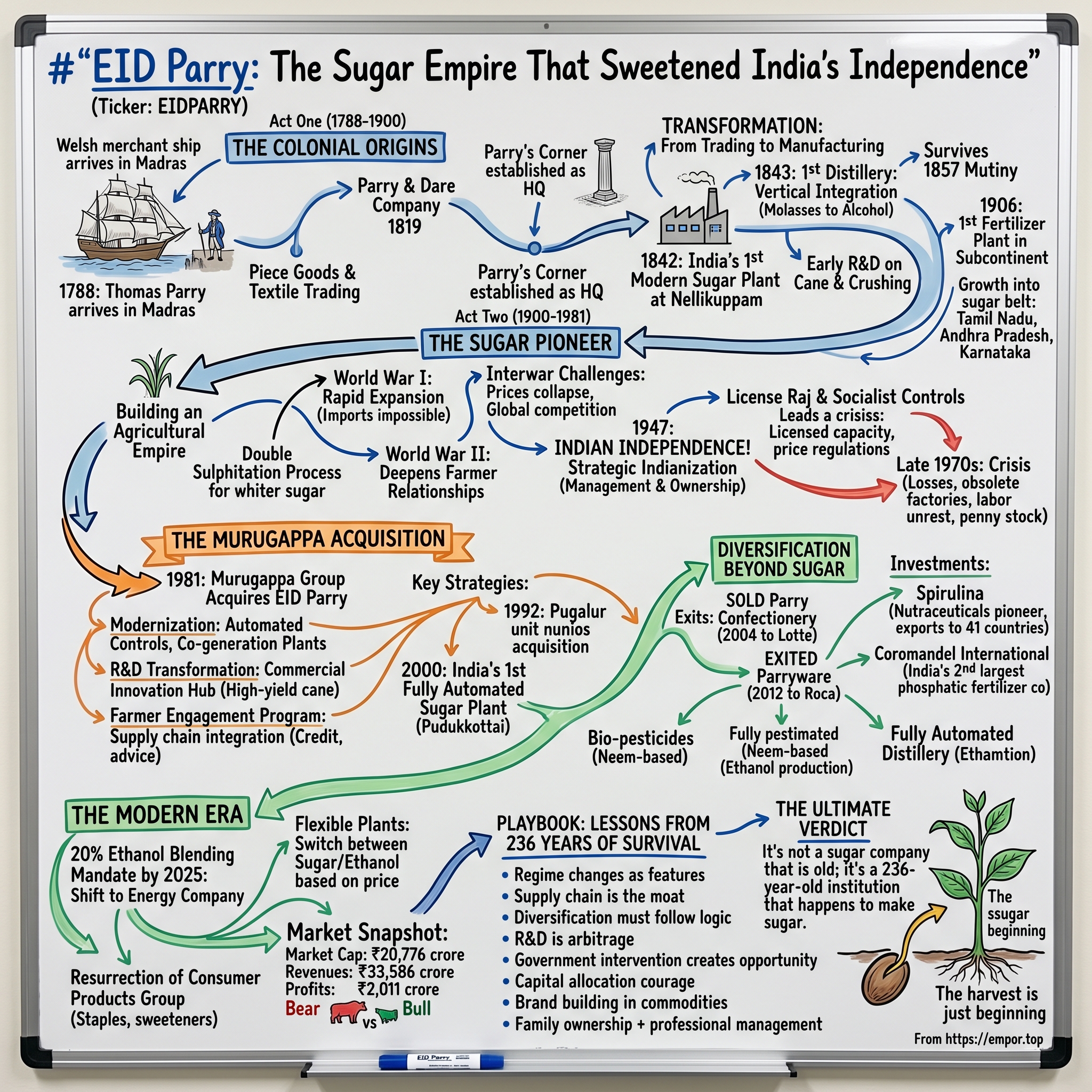
EID Parry (EIDPARRY, NSE): The 236-Year-Old Sugar House Trading Below the Value of Its Own Subsidiary
I. Introduction & Episode Roadmap
Pull up two tickers on the National Stock Exchange this September and a puzzle assembles itself in front of you.
The first is Coromandel International, one of India's largest private fertiliser and crop-protection companies, trading around ₹1,975 a share for a market capitalisation of roughly ₹58,250 crore.2 The second is E.I.D.-Parry (India) Limited, trading around ₹778 for a market capitalisation of roughly ₹13,840 crore.1 Now the detail that makes the arithmetic strange: EID Parry owns 56.35% of Coromandel.2
Run the multiplication. That controlling stake was worth something on the order of ₹32,800 crore in early September 2026. EID Parry's entire equity — every sugar mill, every distillery, every brand, every acre of land, every rupee of cash, minus every rupee of debt — was quoted at less than half of it.
There is no accounting trick here, no hidden liability that explains the gap in a single sentence, no restatement. The market is simply saying two things at once: that it will pay less than fifty paise for a rupee of a listed, liquid, majority-owned subsidiary held inside a parent company, and that the rest of EID Parry — the sugar, the ethanol, the branded foods, the nutraceuticals — is worth less than nothing.
That is the story. Everything else is an attempt to work out whether the market is being lazy or being right.
Two businesses, one ticker. EID Parry's consolidated financial statements look enormous. Revenue for the financial year ended March 2026 was ₹38,534 crore, up from ₹31,609 crore the prior year.1 But roughly ₹31,480 crore of that came from Coromandel, which EID Parry consolidates line by line because it controls it.2 Strip Coromandel out and what remains is a mid-sized South Indian agri-industrial company: the company's own investor presentation put consolidated revenue excluding Coromandel at ₹7,523 crore for FY25, against EBITDA of ₹257 crore.3 That is an EBITDA margin of roughly three and a half percent — the economics of a commodity processor, not a branded consumer company.
And the consolidated profit line flatters even more than the revenue line. Consolidated net profit fell from ₹1,773 crore in FY25 to ₹1,380 crore in FY26.1 But because roughly 44% of Coromandel belongs to shareholders other than EID Parry, a large share of that profit was never EID Parry's to keep. The profit genuinely attributable to an EID Parry shareholder is a fraction of the headline — which is precisely why a sum-of-the-parts lens fits this company better than any consolidated multiple.
The year that broke the headline. In the March 2026 quarter, EID Parry reported a consolidated net loss of ₹287 crore.1 Operationally the quarter was fine — revenue rose to ₹7,882 crore from ₹6,811 crore, EBITDA improved to about ₹610 crore, and profit before exceptional items was around ₹320 crore.4 What turned it negative was a single line: an exceptional charge of ₹478 crore tied to the closure of a sugar refinery the company had been operating, in one form or another, since the last decade.4 The stock has since traded well off its highs, with a 52-week range of ₹1,141 to ₹698 against a book value of about ₹493 per share.1
What this episode covers. The road from here runs: a Welsh trader's counting house in colonial Madras; a string of technological "firsts" that never converted into commercial dominance; a 1981 takeover by the Murugappa family that came with an almost incidental stake in a fertiliser joint venture; the slow inversion in which that side bet grew larger than the parent; two decades of scattered bolt-on acquisitions in sugar; the refinery bet that consumed a fortune before being buried in March 2026; and a live, unfinished strategic reset in branded foods that management is running right now, in public, quarter by quarter.
The recurring question, stated plainly: is the discount an opportunity, or is it the market's verdict on the half of the company that isn't Coromandel?
Start where the company started — with a young man stepping off a ship.
 Subscribe on LinkedIn
II. Colonial Origins to Independence: The Short Version (1788–1981)
In 1788, a Welshman named Thomas Parry arrived in Madras and set up shop as a trader and banker. The business he founded has outlived the East India Company, the British Raj, the princely states, and every competitor that existed at its birth. In Chennai, the junction where the firm's offices stood is still called Parry's Corner — one of the few instances in India where a colonial merchant's name survives not as a monument but as a working address, on bus route boards and in autorickshaw directions.
The company itself tells its history as a chain of firsts, and the chain is genuinely impressive. It was the first company in India to manufacture sugar, in 1842, and among the earliest sugar manufacturers anywhere in the world.6 It was the first Indian sugar manufacturer to start a distillery, in 1843 — meaning that the combination of sugar and alcohol that dominates the industry's economics today was pioneered here, more than 180 years ago.6 It was the first to build a farmer-centric procurement model, in 1845, extending inputs and advice to cane growers rather than simply buying at the gate.6 And in 1906, the parent company built India's first single super phosphate plant at Ranipet in what is now Tamil Nadu — the first fertiliser manufacturing in the subcontinent.7
Hold that pattern in mind, because it recurs with unnerving regularity across the next two centuries: this company has repeatedly been first at a technology and rarely been biggest at commercialising it.
Why the firsts matter, and why they don't. Being first at cane crushing in 1842 did not make EID Parry the largest sugar producer in India. Being first at distillation in 1843 did not make it the largest ethanol producer. Being first at fertiliser in 1906 did produce something enormous — but, as the next section shows, only after the asset was spun into a separate joint venture with foreign partners, and only after a different family took control of the parent. The 19th-century story is not really a story about competitive advantage. It is a story about a firm with unusual technical curiosity and an unusually poor record of converting that curiosity into durable scale.
There is a directly relevant modern echo. In its nutraceuticals business, the company describes itself as a global leader in microalgal technology, having commercialised three major microalgae sources of nutraceutical ingredients.29 The claim appears to be technically accurate. The commercial outcome, as Section VI details, has been modest for well over a decade. Investors evaluating any "we got there first" claim from this company should weight the 236-year base rate accordingly.
The Indian chapter opens. The colonial-era corporate structure was wound down over the post-independence decades, and the current legal entity dates from 1975 — its corporate identity number, L24211TN1975PLC006989, still carries the year.6 By then the company was a South Indian sugar and agri-inputs business with a Chennai head office, a portfolio of plants, and a shareholder register dominated by Indian financial institutions rather than any single controlling family.
That last detail is the hinge. A company controlled by state-owned insurers and mutual funds is a company that can be bought. In 1953 the firm had also become one of the early promoters of India's fertiliser industry — a thread that, eight years later, would be spun out into a separate joint venture company.6 Nobody buying EID Parry in the 1970s was buying it for that joint venture. Within a generation, the joint venture would be the only reason to buy EID Parry at all.
III. The Murugappa Takeover and the Accidental Birth of a Fertilizer Giant (1961–2009)
The Murugappa family did not start in sugar, or fertiliser, or anything resembling agriculture. The group was founded in 1900 by A.M.M. Murugappa Chettiar as a financing business operating across Southeast Asia, part of the Nattukottai Chettiar merchant-banking network that ran credit operations from Burma to Malaya.8 Anti-Indian riots in the 1920s pushed the family to relocate its operations back to South India, where it rebuilt as an industrial house.8 Today the group describes itself as a 125-year-old conglomerate with ten listed companies spanning abrasives, auto components, financial services and agriculture.9
In 1981, the family acquired EID Parry from a clutch of institutional investors and set about turning it around.8 From the outside, it looked like the purchase of a tired old sugar company. What the buyers also acquired, without much fanfare, was a controlling interest in a two-decade-old fertiliser joint venture.
The side bet. Coromandel Fertilisers Limited had been incorporated in 1961, formed through the combined efforts of EID Parry and American partners including Chevron Chemical Company.7 The logic was straightforward for its time: India needed phosphatic fertiliser, the technology and the rock phosphate supply chains sat with the Americans, and EID Parry brought the Indian franchise and the 1906 Ranipet heritage. The joint venture built at Kakinada on the Andhra coast, close to imported rock phosphate and ammonia.
For decades this was a subsidiary, not a strategy. The parent's identity was sugar. Then, over the 1990s and 2000s, three things happened in sequence. The American partners exited. Murugappa consolidated majority control. And in 2003, EID Parry demerged its own Farm Inputs Division into the fertiliser company with effect from April 1, 2003 — deliberately concentrating all the group's agri-input assets into the subsidiary rather than the parent.117 The company later dropped "Fertilisers" from its name in favour of Coromandel International, reflecting a widening ambition beyond straight fertiliser into crop protection and specialty nutrients.
That 2003 demerger is the single most consequential corporate action in this entire history, and it is almost never discussed as such. It moved the growth engine one level down the ownership chain. Everything that engine has earned since accrues to EID Parry only through a consolidation line and a dividend cheque — and only 56% of it at that.
The subsidiary that ate the parent. Look at Coromandel today. Revenue for FY26 was ₹31,480 crore, up from ₹24,085 crore the year before — growth of roughly 31%, extraordinary for a fertiliser business.2 Net profit was ₹1,898 crore against ₹2,055 crore the prior year, with return on equity of 16.4%.2 Compare that ROE to the parent's, which screens at roughly 12% for the latest year and under 10% on a three-year average.1 The subsidiary earns better returns on capital than the entity that controls it.
Coromandel has also kept moving. In August 2025 it completed the acquisition of a 53% controlling stake in NACL Industries, a crop-protection company with branded formulations, technical exports and contract manufacturing for global agrochemical majors, followed by an open offer for up to a further 26% from public shareholders.10 Screener data puts the acquired stake at 53.13% for ₹820 crore.2 Executive Chairman Arun Alagappan framed it as consistent with a long-term roadmap to deepen the group's presence in agri solutions.10 The company has continued to build hard assets too, commissioning phosphoric acid and sulphuric acid capacity at Kakinada in 2026 and a nano-fertiliser plant there in 2024.7
What this means for an EID Parry investor. Two things, pulling in opposite directions.
The first is genuinely favourable. An EID Parry shareholder owns a proportionate claim on a business with real scale, mid-teens returns on equity, an integrated backward position in phosphoric acid, a national fertiliser distribution network, and a live diversification into crop protection. Whatever happens to sugar prices in Tamil Nadu, that engine keeps running.
The second is the catch, and it is structural. EID Parry's shareholders do not own Coromandel. They own a company that owns Coromandel — and one that has, over the years, sold pieces of it. Every future rupee of Coromandel's compounding reaches an EID Parry shareholder through a holding structure that the market has consistently refused to value at par, and through a management team whose stated strategic priority is the other half of the business.
Which brings the story to that other half — the mills, the cane, and the peculiar economics of an industry where the government sets both the price you pay and the price you receive.
IV. The Sugar & Ethanol Business Today: Industry Structure and Competition
Every year around November, a specific kind of anxiety settles over sugar mill managers in Karnataka and Tamil Nadu. The cane is in the fields. The crushing season is about to start. The price they must pay the farmer for that cane has already been fixed by the central government — and revised upward, as it is nearly every year. The price they will receive for the sugar they make from it is capped at the bottom by a government floor that has not moved since 2019, and capped at the top by the government's control over how much sugar can be released into the domestic market each month.
That is not a market. That is a spread administered by the state, and it explains almost everything about how this industry behaves.
The vice, explained simply. Think of a sugar mill as a machine that converts one regulated price into another. On the input side sits the Fair and Remunerative Price — the FRP — the minimum a mill must pay per quintal of cane, set centrally, with several states layering their own higher State Advised Price on top. For the 2025-26 season the FRP was ₹355 per quintal, and by industry association ISMA's reckoning it has risen roughly 29% since 2018-19.12 On the output side sits the Minimum Selling Price, or MSP — a floor below which mills may not sell sugar. That floor has stood at ₹31 per kilogram since February 2019.12
Now hold those two facts against each other. The input price has climbed nearly a third in seven years; the output floor has not moved at all. ISMA has told the government that the cost of producing a kilogram of sugar had reached about ₹40.2 — which is to say the regulated floor price now sits roughly nine rupees below the industry's own estimate of cash cost.12 The floor has become theoretical: mills survive on market prices above it, not on it.
EID Parry's management has made this point repeatedly and without much diplomatic softening. On the February 2026 earnings call, CEO Muthiah Murugappan noted that better sugar pricing had been offset because costs rose with the annual FRP increase, and that there was "still really no clarity on any upward revision of the MSP."13 Asked what would change the trajectory, his answer was blunt: the company would keep working on efficiency and cane planting, but to move the needle it would need support from policy.13 That is an unusual admission from a chief executive — an acknowledgement that the largest single variable in the business is not within management's control.
The physical footprint. EID Parry operates six sugar plants and one standalone distillery across three southern states, with total crushing capacity of 40,800 tonnes of cane per day, co-generation capacity of 140 MW, and distillery capacity of 582 kilolitres per day.3 The individual sites tell you where the value sits: Haliyal in Karnataka at 12,000 TCD with 49 MW and 170 KLPD is the largest, followed by Nellikuppam in Tamil Nadu at 7,500 TCD, Bagalkot in Karnataka at 6,500, Sankili in Andhra Pradesh at 5,000 with the largest single distillery at 168 KLPD, Ramdurg in Karnataka at 5,000, Pugalur in Tamil Nadu at 4,800, and a standalone 64 KLPD distillery at Sivagangai.3
Two structural facts follow from that list. First, Karnataka carries the business. Management has said so directly: on the Q4 FY26 call, the CEO described Karnataka operations as very positive EBITDA generators with metrics comparable to best in class, while Tamil Nadu and Andhra Pradesh were a drag where cane availability had been dwindling.14 On the Q1 FY27 call he repeated that Karnataka has "industry leading metrics" while the other states "do lag us."5 Second, the cane problem in Tamil Nadu is not cyclical weather — it is crop substitution. Chief Operating Officer Abdul Hakeem Ashiq explained that farmers have shifted "rampantly" toward paddy over six to seven years because paddy is fully mechanised and allows three planting cycles.5 A cane farmer who switches to rice does not switch back because one season's sugar price improved.
The consequence shows up in the numbers. In the June 2026 quarter, Tamil Nadu units ran 54 days against 37 a year earlier, yet total cane crushed fell to 1.47 lakh tonnes from 2.12 lakh tonnes, with gross recovery slipping to 7.95% from 8.02%.5 More days, less cane. Asked whether the coming season would be lower, Abdul Hakeem Ashiq guided to flat-to-5%-down in those two geographies, with any make-up coming only from Karnataka.5 When an analyst asked the harder question — whether it still makes sense to be in the Tamil Nadu sugar business at all — the CEO did not defend the footprint. He said discussions on various measures continued and that the company would "have to fall in line here in the coming quarters."5 That is an unusually candid non-answer, and it is worth tracking.
Where the money actually comes from. For an integrated mill, sugar is often the least attractive of the three products it makes. In the June 2026 quarter, sugar revenue was ₹410 crore on sales of 0.89 lakh tonnes at an average realisation of ₹40.02 per kilogram, with closing inventory of 1.16 lakh tonnes carried at ₹41.50.522 Power co-generation contributed ₹6.6 crore. The distillery sold 380 lakh litres — 242 lakh litres of ethanol and 138 of extra neutral alcohol — at an average ₹63.49 per litre.5 Distillery revenue, in other words, runs at a scale comparable to sugar itself off far less tonnage.
That is the ethanol story in miniature, and it is the reason sugar stocks were re-rated across India in the early 2020s. The pitch was straightforward: the government mandates 20% ethanol blending in petrol, oil marketing companies must buy the ethanol, mills can divert cane juice or molasses to a distillery instead of making sugar, and a commodity business becomes a quasi-energy business with contracted offtake.
Now stress-test it. The single most important disconfirming fact about the ethanol thesis is not a forecast — it is a policy record, and it is recent.
In December 2023, with a general election approaching and domestic sugar prices politically sensitive, the central government abruptly restricted the use of sugarcane juice and syrup for ethanol production, citing the need to protect sugar availability.15 Mills that had built distilleries specifically to divert cane found the diversion route closed. A revised order followed within weeks allowing limited use under a capped allocation.15 The full reversal came only on August 29, 2024, when the government lifted the cap and permitted ethanol from cane juice, syrup and molasses without limitation for the 2024-25 supply year.16 Quantitative restrictions were subsequently removed entirely, and the government has continued to lift production restrictions into the 2025-26 supply year.17
So the same state that mandates blending also demonstrated, within the last three years, that it will suspend the diversion route when sugar politics require it. Any framing of ethanol as a one-way structural tailwind has to survive that fact. It does not survive intact; it survives narrowed. Ethanol is a real and valuable second revenue stream with contracted buyers, and it is subject to discretionary policy reversal on weeks of notice.
There is a second, quieter constraint that management raised on the August 2026 call and that rarely appears in sell-side ethanol models. Sugar prices had moved north of ₹45-46 per kilogram, and an analyst asked the obvious question: with ethanol prices flat, why not just make more sugar? Abdul Hakeem Ashiq agreed it makes sense at those prices. Then CFO Y. Venkateshwarlu added the constraint: the company has committed volumes to the oil marketing companies, and failure to supply carries a per-litre penalty.5 The flexibility runs one way more easily than the other. And on ethanol pricing itself, the CEO observed in February 2026 that offtake prices had been unchanged for almost three years while cane costs rose annually, with the industry's incremental ethanol growth shifting toward grain-based feedstock rather than cane.13 EID Parry has only 120 KLPD of grain capacity out of 582; the remaining 400-odd KLPD runs on the molasses route.13
The peer war-game. Against listed peers, EID Parry's sugar business is mid-sized and its recent profitability is unremarkable, but the comparison also reveals how brutal this industry has been to everyone.
Balrampur Chini Mills is the closest thing to a well-run pure-play: FY26 revenue of ₹6,271 crore, net profit of ₹378 crore, return on equity around 10%, and borrowings of ₹3,170 crore against a market capitalisation of roughly ₹15,050 crore.18 It earns more than EID Parry's entire standalone business does, and the market values it above EID Parry's whole equity.
Triveni Engineering, at ₹6,290 crore of FY26 revenue and ₹269 crore of net profit, grew profit despite the cycle — helped by a diversified engineering business and by feedstock flexibility in ethanol that a cane-only southern footprint does not have.19 Its five-year average ROE of 14% against 9% last year is a fair picture of the sector: decent through a cycle, poor at the trough.19
Then the cautionary tales. Shree Renuka Sugars, majority-owned within the Wilmar International group, reported FY26 revenue of ₹9,160 crore and a net loss of ₹792 crore, following a ₹300 crore loss the year before, with borrowings of ₹7,174 crore and negative net worth of about ₹2,890 crore.20 Bajaj Hindusthan Sugar swung from a ₹780 crore loss in FY25 to a ₹126 crore profit in FY26, but only alongside a bank resolution plan under which equity and preference shares were allotted to Bank of India, with promoter holding falling to 13.33% and effectively all of it pledged.21
Read that peer set as a whole and a conclusion emerges that is more useful than any single comparison. Indian sugar is an industry where scale has not protected anyone — the largest crushers in the country have produced the worst equity outcomes — and where balance sheet structure has mattered more than operating skill. On that measure EID Parry sits in reasonable shape: standalone short-term debt of about ₹980 crore at end-June 2026, down from ₹1,250 crore at March, plus about ₹150 crore of long-term debt.5 No resolution plan, no negative net worth, no pledged promoter stock.
The cycle turning against volume. One more piece of timing, and it is unhelpful. Global sugar has flipped. On the August 2026 call, management cited International Sugar Organization estimates of a 2.24 million tonne global surplus for 2025-26 against a 3.2 million tonne deficit the prior year, driven by world production of 182 million tonnes.5 London white sugar had fallen to about $404 per tonne in early 2026 before recovering to roughly $471 by July.5 Domestically, exports were limited to about 0.8 million tonnes and further exports were banned until September 30, 2026.14 EID Parry's own volumes are recovering just as the global backdrop deteriorates and the export valve is shut.
Net assessment: this is a genuine commodity business with a demonstrated regulatory whipsaw risk, a structurally shrinking cane base in two of its three states, one genuinely strong operating region, and an ethanol option that is real, valuable, contractually sticky in both directions, and revocable by notification. It is not a moat. It is a spread business with a policy overlay — and for two decades, management tried to escape it with a very expensive idea.
V. Two Decades, One Bad Bet: The Kakinada Refinery and EID Parry's Capital Allocation Record
In the 2010-11 annual report, buried among the routine updates, EID Parry described a new joint venture with something close to pride. A port-based standalone sugar refinery at Kakinada, built with Cargill International, had commenced operations. Capacity of 2,000 tonnes per day of refined sugar with a 35 MW co-generation plant. "This refinery," the report stated, "will be the largest in the South Asian region."11
In the very same paragraph, one sentence later, came the qualifier: "supply of gas is an area of concern and maximum efforts are put in for ensuring continuous supply of gas."11
Fifteen years later, that sentence reads like a warning label nobody removed. The venture closed on March 31, 2026, having accumulated roughly ₹1,406 crore of losses and requiring a support package from its parent of about ₹740 crore.2324 The gas problem never went away — the model was ultimately described as having deteriorated because of natural gas unavailability, forcing costly investment in coal boilers instead.23
What the refinery was supposed to be. The concept was elegant on paper. Set up an export-oriented unit inside a special economic zone on the coast. Import raw sugar duty-free from Brazil or Thailand. Refine it into white sugar. Re-export into world markets where white sugar commands a premium over raw. The mill never touches an Indian cane farmer, never pays FRP, never waits for a release quota. It is a tolling business that monetises the "white premium" — the spread between raw and refined sugar prices — using cheap coastal energy and port logistics.
The vulnerability is equally clear in hindsight. The entire economics rest on two things the operator does not control: the white premium, and the cost of energy. Both went the wrong way. By February 2026, the refinery's own chief executive, Suresh Kannan, was explaining to analysts that white premiums had been under pressure for six months as surplus refined sugar accumulated at origins in Brazil, Thailand and India, and that he expected the low-premium environment to continue for at least two more quarters.13 On the same call, he noted that costs had come down through energy efficiency projects and expressed confidence they were sustainable — a genuine operational improvement arriving many years too late to matter.13
The revenue was never the problem. In FY25 the refinery generated ₹4,262.45 crore of revenue, about 13.48% of the parent's turnover.23 It was a large business that did not make money. In the December 2025 quarter it turned over ₹714 crore for a loss of ₹4.53 crore; in the March 2026 quarter it turned over ₹1,006 crore and lost ₹293 crore.1314 By March 2025 its net worth was negative ₹672.17 crore.23
The burial, and what it cost. The board approved closure effective March 31, 2026, with a support package of roughly ₹740 crore comprising up to ₹610 crore of equity infusion and up to ₹130 crore of loan, against estimated liabilities of ₹998 crore including ₹877 crore of bank borrowings guaranteed by the parent, with asset sales projected to recover around ₹137 crore.2324
To its credit, the company then executed the wind-down on a visible timetable rather than letting it drift. Bank payments of $49 million, about ₹460 crore, went out on April 24, 2026, funded by ₹338 crore of equity infusion plus the subsidiary's own cash; a further $29 million, about ₹272 crore, followed on May 15.14 Labour settlements for management staff completed April 1 and for contractors by April 15.14 An in-principle exit letter from the SEZ authorities arrived on April 20, with full debonding expected by September 30, 2026.145 By the August 2026 call the CFO could state flatly that there were no bank dues remaining, with ₹610 crore of equity and ₹55 crore of the ₹130 crore loan facility actually deployed, and the balance to be drawn only as required.5
The accounting is worth understanding because the headline numbers move in confusing directions. The FY26 exceptional charge of ₹478 crore was a net figure: roughly ₹591 crore of financial guarantee provisions and impairment, partially offset by a ₹298 crore gain on selling a 0.51% stake in Coromandel International.25 In the June 2026 quarter, a ₹610 crore impairment was recognised against a ₹591 crore reversal of the previously created guarantee liability, leaving about ₹18 crore of fresh impairment for the quarter.5 The cash cost, as CFO Venkateshwarlu confirmed under direct questioning from an analyst at 360 ONE, was the real ₹610 crore infusion plus the loan drawdowns.5 The AGM notice for the August 12, 2026 meeting also disclosed an impairment charge of ₹400.60 crore recognised on the investment in FY26, and carried a special resolution authorising the sale or disposal of PSRIPL assets where the aggregate value may exceed 20% of the subsidiary's total assets.27
Now the part that matters: what does this say about capital allocation?
Start with the honest indictment. This was a roughly two-decade commitment. The venture traces to a Kakinada refinery project dating from the middle of the last decade, structured first as the Cargill joint venture and later taken to full ownership by EID Parry. The accumulated loss of ₹1,406 crore is roughly a tenth of the company's entire market capitalisation today. And the fatal flaw — energy supply — was identified in the company's own annual report in its first year of operation.11 This is not a case of an unforeseeable shock. It is a case of a known structural problem being funded through multiple management regimes.
Now the mitigation, stated at its correct weight and no higher. The current management team did close it, did disclose the numbers in granular fashion on consecutive calls, did give a dated timetable, and did take the charge in one visible year rather than dribbling it out. That is meaningfully better behaviour than the alternative of another five years of "turnaround." But it should be graded against how long it took to get there, not against a counterfactual where the loss continued. And the closure is not yet fully complete: asset liquidation remains subject to statutory clearances, management declined to put a number on likely recovery beyond saying value would be realised, and period costs continue to be incurred.5 The ₹137 crore asset recovery assumption remains an assumption.24
The rest of the record, for calibration. A single failure proves less than a pattern, so it is worth looking at what else this company has done with capital.
The sugar bolt-ons were small and regional. Around 2009 EID Parry acquired a majority stake in Karnataka-based Sadashiva Sugars; the FY11 annual report shows an investment of about ₹49.6 crore, against subsidiary revenue of ₹70.6 crore for that year.11 In August 2010 it acquired 65% of GMR Industries after completing an open offer under the takeover regulations, renaming it Parrys Sugar Industries.11 These deals lifted the group's combined crushing capacity to 32,500 TCD, co-generation to 146 MW and distillery capacity to 230 KLPD across nine plants at the time.11 The GMR entity was not immediately accretive — it recorded revenue of ₹298.5 crore for the twelve months to March 2011 and a loss after tax of ₹67.6 crore.11 Judged against the current footprint, these were modest deals that built the Karnataka position that today generates most of the standalone profit. Judged as investments, the evidence that they created value is thin; sixteen years later the standalone business earns a mid-single-digit EBITDA margin.
The exits look better than the entries. In March 2011, Roca exercised a call option to purchase EID Parry's remaining 64,045 shares in Roca Bathroom Products — formerly the Parryware sanitaryware business — for ₹22.20 crore, completing a full divestment of the category.11 Earlier, in January 2004, the group sold its 60.39% stake in Parry's Confectionery to Lotte for ₹64.47 crore at ₹283.12 per share, with an open offer for a further 20% at ₹283.25, retaining royalty rights for five years on brands including Coffee Bite and Lacto King.26 Then-chairman M V Subbiah framed it as consolidating the group's business portfolio, with continuous brand investment in confectionery judged unsustainable in a changed market.26 The business survives today as an independently listed company.
Two observations follow. First, this management culture has demonstrated, across more than twenty years, that it will exit non-core categories rather than hoard them — the confectionery and sanitaryware exits were clean and were not forced. Second, and less flattering, the pattern is that EID Parry exits businesses well and enters them poorly. The two largest capital deployments of the modern era — the refinery and the regional sugar consolidation — have not produced returns commensurate with their cost.
On the financing side, one characterisation can be made with reasonable confidence based on the records reviewed here: across the FY2011 annual report and the FY26 results and call disclosures, the equity actions that appear are employee stock option allotments and a share subdivision from ₹2 to ₹1 face value in December 2010, not rights issues or institutional placements.11 The refinery closure was funded from the balance sheet and from a Coromandel stake sale, not from new shareholder money.25 That is a genuine and unusual discipline in a sector where peers have diluted heavily or restructured under bank pressure. It is a bounded observation drawn from those specific records rather than an exhaustive audit of every corporate action since 2011.
The calibrated verdict: the "disciplined capital allocator" claim does not survive intact. It survives narrowed — to "disciplined about exits, disciplined about dilution, and demonstrably poor at large greenfield bets outside the core." The KPI that would confirm or falsify the revised version is specific and near-term: whether FY27 and FY28 pass without further material exceptional items from the refinery wind-down, and what the asset sale actually realises against the ₹137 crore assumption.
And it matters because management is, right now, running another attempt to build something outside the core.
VI. Beyond Sugar: Nutraceuticals, CPG, and the Search for a Second Engine
There is a stretch of coastline in Tamil Nadu where EID Parry grows algae. Not sugarcane — algae, in shallow ponds, harvested and dried into a green powder sold to nutritional supplement makers across the world. The company was an early mover in this: it describes itself as a leading manufacturer and exporter of certified organic spirulina and carotenoids including natural beta carotene, astaxanthin and tomato lycopene, and as a global leader in microalgal technology that has commercialised three major microalgae sources.29
It is a genuinely interesting business. It is also, after roughly two decades, very small.
The nutraceuticals record. The build-out was international and deliberate. In FY2010-11 EID Parry raised its stake in US Nutraceuticals LLC — which trades as Valensa International, based in Orlando, Florida — from 48% to 51%, making it a subsidiary.11 In 2014 it acquired 100% of Alimtec S.A. in Chile from subsidiaries of Bayer AG, securing captive supply of haematococcus pluvialis biomass, the natural source of astaxanthin, for Valensa's formulations; the consideration was not disclosed in the company's announcement.29 Both moves were sensible vertical integration: own the algae, own the formulation science, sell into US and European supplement markets.
Now the commercial outcome. In FY11, the nutraceuticals division turned over ₹43.68 crore, about 3% of the company's revenue at the time, roughly 82% of it exports.11 In the June 2026 quarter — fifteen years and two cross-border acquisitions later — consolidated nutraceuticals turnover was ₹61 crore for the quarter against ₹27 crore a year earlier, with the Indian operations contributing just ₹6.22 crore.5 The segment remains a rounding error against ₹38,534 crore of consolidated revenue.
Worse, market access itself proved fragile. In October 2022 the European Commission delisted India's organic certification bodies after ethylene oxide, a pesticide banned in the EU, was detected in organic sesame — a decision that had nothing to do with algae but that swept up India's sole certification body for organic microalgae, halting spirulina exports to Europe entirely.30 Parry Nutraceuticals regained an EU import licence for organic spirulina only in October 2024, becoming the first Indian company to do so since the delisting, after a hiatus its own executives described as taking longer than anticipated.30 Management characterised the episode on the August 2026 call as certification issues "not entirely our fault."5 That is fair as far as it goes, and it is also precisely the point: a business this small has no ability to absorb or influence a regulatory shock two supply-chain steps removed from itself.
There is a live improvement worth recording accurately. Growth is currently coming from Valensa, driven by an organisational and management restructuring over two or three years plus new product launches in dermatological health, hair and skin.5 The CEO said the company would likely post its highest-ever nutraceuticals revenue this year, while explicitly declining to give numerical guidance, and put steady-state EBITDA margins at 12-15% contingent on building more scale.5 India capacity is not being expanded.5
Assessment: the "world leader" framing is a technical claim, not a commercial one. Fifteen years of ownership, two acquisitions and a two-year loss of an entire continent's market access have not produced scale. The claim is not rejected — the technology position appears real — but it should be narrowed to a small, improving, US-driven specialty ingredients business that has not yet earned a place in the investment case. The falsifiable marker is simple: sustained quarterly consolidated nutraceuticals revenue materially above the current ₹60 crore run rate, at the promised 12-15% EBITDA margin, for four consecutive quarters.
The live experiment: shrinking a business on purpose. The more consequential story is happening in the Consumer Products Group, and it is happening right now.
CPG is branded sweeteners — the Parry's brand in retail packs — plus a staples business the company entered a few years ago selling rice and pulses, plus a growing range of value-added products including jaggery and brown sugar. In the southern sweetener segment the company claims a dominant position: on the February 2026 call, the CEO put its market share at around 55%, with distribution coverage of roughly 1 to 1.2 lakh outlets of which about 70,000 purchase in any given quarter.13
Then management did something that looks alarming until you understand it. It cut the business roughly in half.
CPG turnover fell to ₹143 crore in the December 2025 quarter from ₹236 crore a year earlier, to ₹115 crore in the March 2026 quarter from ₹195 crore — a 48% decline — and to ₹94 crore in the June 2026 quarter from ₹188 crore.13145 Over a longer arc, the CEO put the segment at roughly ₹600-650 crore of revenue last year against about ₹800 crore the year before.5 The stated reason is deliberate: exiting low-margin commodity SKUs, restructuring the distribution channel, and refocusing on margin-accretive products. The absolute contribution margin pool, management says, has grown even as revenue halved.531 The target is quarterly breakeven in another four or five quarters.5
The strategic logic is defensible. Rice and pulses are a trading business dressed as branding — Balaji Prakash, who heads CPG, explained that pulse prices had fallen 35-40% year on year, mechanically deflating revenue, and that the company had backward-integrated into its own dal processing plant to control conversion cost.13 Value-added sweeteners are different: the CEO said jaggery and brown sugar carry gross margins more akin to food products than commodities, and that the target portfolio moves the business above 30% gross margin.14 A new Karnataka jaggery plant, expected to commission within about six months from August 2026, will more than double jaggery capacity, with combined turnover from both plants approaching ₹100 crore.5
But here is where the narrative-consistency test bites, and it is not favourable.
On February 13, 2026, the CEO told analysts that the CPG decline reflected a "conscious correction which will last 2 quarters," that the correction would "conclude in Q4," and that "we should be back at a better clip in Q1 with a more efficient operating model." He added: "In terms of the CPG segment, I think the growth story will continue."13 He also promised that in the May call the company would name the new food FMCG categories it intended to enter, based on work being completed with external industry experts within six weeks.13
Measured against that: Q4 revenue fell 48%. Q1 revenue halved again. And rather than being "back at a better clip," the guidance in August 2026 was that revenues should be expected to remain lower while margins improve, with breakeven pushed out four to five more quarters.5 The category announcement did arrive on schedule — ethnic snacking and culinary convenience, disclosed in the May 2026 investor presentation and confirmed on that call — but with no decision on organic versus inorganic entry, a position still unresolved three months later.145
That is a two-quarter correction that became a multi-year reset, described each time as intentional. Both things can be true: the strategy shift may be right, and the guidance around it was optimistic. Investors should weight the second fact when assessing the four-to-five-quarter breakeven promise, because it is the same management team, the same segment, and a very recent miss on the same metric.
An individual shareholder put the discomfort directly to the board on the May 2026 call: the company has a grand vision of becoming a food company, but other than sugar, "I don't see any growth anywhere."14 The CEO's answer conceded the premise — revenues are focused on sweeteners for now, and the company is consciously doubling down there to strengthen the model and, in his phrase, "attract that capital to grow the business out further."14
The KPI here is unambiguous and requires no calculation: the CPG segment's quarterly profit or loss, tracked against the stated breakeven timeline. It is the cleanest available read on whether this management team converts strategy statements into outcomes.
VII. Current Management, Ownership, and Capital Allocation
Muthiah Murugappan's career began, at 22, selling shampoo.
In August 2004 he joined CavinKare — a Chennai FMCG company known for pioneering sachet-sized personal care products for low-income consumers — as an area sales manager, later moving into product management covering international markets across the Gulf and Southeast Asia.32 From 2007 to 2010 he worked in exports and North American trading operations at Carborundum Universal, the Murugappa group's abrasives company, then ran its Wear Ceramics business from 2010 to 2013.32 He took a sabbatical for an MBA at London Business School, then joined the group's nutraceuticals business as its head in September 2015, added the strategy role in November 2018, and was appointed Whole-Time Director and Chief Executive Officer of EID Parry in May 2022.32
He is a fifth-generation member of the founding family, one of a small number of that generation active in the business.8 The chairman of the board is M M Venkatachalam, with a board that also includes Ajay B Baliga, Ramesh K B Menon, T. Krishnakumar, Sridharan Rangarajan, S. Durgashankar and Meghna Apparao.32
Two things stand out about that biography. The first is that it is unusually operational for a family successor — eleven years in sales, exports and a business unit P&L before any executive role at the parent. The second is more pointed: the executive who ran nutraceuticals for three years, and strategy for four, now runs the company whose nutraceuticals business still contributes a rounding error to revenue and whose strategy is being visibly rewritten. That is not a disqualification. It does mean the current CPG and nutraceuticals plans are being executed by the person who authored the previous versions, which is relevant when assessing whether a change of direction represents new thinking or a renamed continuation.
How he communicates. Across three consecutive earnings calls the pattern is consistent and, in fairness, better than the sector norm: specific operating numbers are given without prompting, misses are attributed to identifiable causes rather than "market conditions," and the CEO repeatedly declines to give numerical guidance when asked. On nutraceuticals scale-up he said explicitly that he wanted to refrain from giving any number guidance.5 On the refinery asset sale he declined to put a figure on recovery.5 Asked for the financial KPIs by which management would judge itself by March 2027, the CFO named working capital efficiency, debt cost, monetisation of non-performing assets, current ratio improvement, and cost reduction programmes — concrete, if unquantified — and the CEO added the CPG margin KPIs.5
The counterweight is the record described in the previous section: a two-quarter CPG correction that became a multi-year reset. Candour about the present has not yet been matched by accuracy about the future.
Ownership. Promoter and promoter group holding stands at 41.28%, held principally through the Murugappa family's investment vehicle, with foreign institutional investors at 11.21%, domestic institutions at 16.67% and public shareholders at 30.84%.1 Promoter holding has drifted down about 3.24 percentage points over three years.1 The company's own company secretary, Biswa Mohan Rath, summarised the structure on the May 2026 call in response to a shareholder worry about takeover vulnerability: roughly 40% promoter, 60% public at EID Parry, and 56% of Coromandel held by EID Parry.14
That exchange is worth dwelling on, because it captures the governance reality from both directions. A shareholder named Vardharajan argued that with 60% of EID Parry in public hands, a determined acquirer could accumulate a position and swing institutional votes. Management declined to engage, saying the forum was for discussing operations, and the CEO added only that the promoter group has owned and run these businesses for a very long time, has seen multiple cycles, and is not concerned.14 The same shareholder then asked when dividends would resume. The CEO would not commit to a timeline, saying only that it was the company's endeavour to strengthen business operations.14 The AGM agenda for August 12, 2026 contained no dividend proposal.27 Screener data shows a dividend payout ratio of about 2.63% over three years.1
For a shareholder, then: no controlling-family exit risk, no pledged promoter stock of the kind that has destabilised peers, and also no meaningful cash return and no obligation on the promoter to respond to minority pressure. Control is stable and one-directional.
The lever management actually uses. The most important capital allocation tool at EID Parry is not capex. It is the ability to sell slices of Coromandel.
The mechanics were on full display over the last two quarters of FY26. On the February 2026 call, an analyst from 360 ONE asked about a disclosed plan to sell 15 lakh Coromandel shares, about 0.51% of the subsidiary's paid-up capital, and asked for a timeline. The CEO's answer: it was "an enabling resolution" and the company would determine execution "at the right time basis any appropriate use of funds."13 Pressed again on timing, he repeated that it was an enabling resolution for now.13
The sale was completed within that same fiscal year. EID Parry's March 2026 quarter results included a gain of ₹298 crore from selling a 0.51% stake in Coromandel International, booked within the same exceptional-items line that carried the refinery closure charge.25 The proceeds and the wind-down cost sat side by side in one number.
Nothing about this appears improper — an enabling resolution exists precisely to permit action without further notice, and the transaction and its gain were disclosed. But the sequence deserves recording for what it shows about disclosure posture: a question about timing answered with "we will determine at the right time," followed within weeks by execution. Investors reading future enabling resolutions from this company should treat them as live intentions rather than theoretical authorisations.
The economics of the lever are worth stating plainly, because the trade is real. Selling Coromandel shares converts an illiquid, discounted claim on a good business into cash that funds the weaker business — and it works. It is repeatable; the stake has been trimmed over time and still sits at 56.35%.2 But every tranche permanently reduces the share of Coromandel's future compounding that reaches EID Parry's own shareholders, and it does so at whatever price the market offers on the day. Funding a loss-making refinery's burial by selling down the crown jewel is a defensible emergency measure. As a habit, it is value transfer from the future to the present.
A note on the audit and the accounting judgments. Given the scale of the FY26 exceptional item, the audit signal matters. The company's FY26 audited standalone and consolidated results were approved with an unmodified opinion from statutory auditors Price Waterhouse Chartered Accountants LLP — that is, no qualification.28 The judgments embedded in the numbers are nevertheless significant and should be watched: the impairment of the investment in the refinery subsidiary, the remeasurement and reversal of the financial guarantee liability, and the assumed recoverable value of plant and machinery still awaiting SEZ debonding and statutory clearance.527 These are estimates, not settled facts. This is a bounded observation about the FY26 audit opinion and the disclosures on the FY26 and Q1 FY27 calls, not a general assurance about governance across all periods.
None of which addresses the question every EID Parry shareholder actually wants answered: why does the market refuse to pay for the stake?
VIII. The Sum-of-the-Parts Puzzle: A Company Worth Less Than Its Own Stake in Its Subsidiary
The arithmetic is not complicated, which is exactly what makes it uncomfortable.
EID Parry's 56.35% of Coromandel was worth roughly ₹32,800 crore at early-September 2026 prices.2 EID Parry's own market capitalisation was roughly ₹13,840 crore.1 The parent trades at approximately 42 paise for each rupee of its subsidiary stake — before assigning any value at all to six sugar mills, five distilleries, a 3,000 tonnes-per-day refinery site under liquidation, a branded sweetener business with a claimed 55% southern share, a nutraceuticals business with US and Chilean operations, or the land parcels management has said it is trying to sell.3135
Put differently: the market is not merely discounting the standalone business to zero. It is assigning it a substantially negative value.
Why holding-company discounts exist at all. The standard explanations apply here and are worth separating, because they have different implications.
The first is tax and friction. If EID Parry sold Coromandel shares, it would pay capital gains tax; the cash arriving at the parent is less than the market value of the stake. That justifies a discount of some size — but not one of this magnitude.
The second is control without access. An EID Parry shareholder cannot compel a distribution of Coromandel's value. Coromandel's dividends flow to EID Parry, and EID Parry's board decides what to do with them — which, most recently, meant funding a refinery closure rather than paying dividends to its own shareholders.2527 The discount is, in part, the market pricing the risk that the subsidiary's cash gets recycled into the parent's problems.
The third is the standalone drag. A negative implied value is not irrational if the market expects the standalone business to consume cash. Over the last two fiscal years it has done exactly that.
The persistence question. The discount is not a recent artefact of the refinery charge, and management is asked about it repeatedly. In May 2026, a shareholder laid out the arithmetic on the call almost exactly as an analyst would: Coromandel's market cap, EID Parry's 56% of it, EID Parry's own market cap, and the conclusion that something is wrong with the structure.14 In August 2026, an investor from RK Investments asked directly whether there were any plans to rework the corporate structure given Coromandel is held as a subsidiary. The CEO's full answer: "At this point in time, there is no such discussion."5 He gave a near-identical response on the prior call.514
That consistency is itself the most important data point in this section. Management is not signalling a demerger, a scheme of arrangement, or a holding-company restructuring. It is signalling continuity. Any investment case that depends on a structural unlock is depending on something the controlling family has declined to discuss on consecutive public calls — and the family's 41% stake means no external party can force the conversation.1
The two halves have opposite competitive structures. This is the analytical reason a sum-of-the-parts frame fits better than a single consolidated multiple, and it is worth working through properly.
Run Porter's five forces on the standalone sugar business and every force reads badly. Supplier power is extreme and legally enforced: cane farmers are paid a price set by the central and state governments, rising annually, with mills legally obliged to pay it on a timeline — EID Parry notes on each call that all FRP was paid as per schedule.5 Buyer power is capped in a peculiar way: the government sets a floor price mills may not undercut, but also controls monthly release quotas and export permissions, so the seller cannot freely chase price. Substitutes cut both ways: ethanol is the relief valve that lets a mill escape the sugar market entirely, but only when policy permits, and only up to committed volumes carrying penalties for non-delivery.5 Rivalry is fragmented and brutal, with the largest peers by capacity having produced negative net worth or bank resolution plans.2021 Barriers to entry are moderate — a mill is capital-intensive but the binding constraint is cane catchment, and EID Parry's own catchment in two states is shrinking as farmers switch to paddy.5
Now apply Hamilton Helmer's Seven Powers to Coromandel and the picture inverts. Scale economies are genuine in phosphatic fertiliser, where backward integration into phosphoric and sulphuric acid at Kakinada lowers unit cost against importers.7 Cornered resource has partial application in long-term rock phosphate and raw material relationships, and in the manufacturing licences and subsidy registrations that gate the industry. Switching costs are weak at the farmer level but real at the dealer level, where a distribution network built over decades determines which brand sits in the village shop. Branding exists in a modest form — Gromor and Paramfos are recognised names in Indian farming. Process power is the least proven. And the crop-protection push, including NACL, is an attempt to add a higher-margin, less subsidy-dependent leg.10
One structure has no pricing power and administered inputs. The other has scale, distribution and integration. Averaging them into a single earnings multiple destroys information, which is why the market prices the parent as a discounted claim on the subsidiary rather than as an operating company.
What would actually close the gap. Three mechanisms exist, in descending order of impact and ascending order of likelihood.
A formal demerger or scheme separating the Coromandel holding from the sugar operations would close most of it immediately. Management has said there is no such discussion.5
A large buyback funded by further Coromandel monetisation would close part of it by shrinking the parent's share count at a discount to intrinsic value. Nothing of the kind has been announced; capital is currently directed at debt reduction, working capital and asset monetisation.5
Sustained standalone profitability would close part of it simply by removing the negative-value anomaly. This is the only path management is actually pursuing, and it is the slowest. The CEO's own articulation of the three-to-four-year plan was consistent EBITDA generation from sugar and biofuels as the core, growth in CPG, and better value creation in nutraceuticals.5
For an investor, the practical conclusion is that the discount should be treated as a structural feature of this security rather than a catalyst waiting to fire. Owning EID Parry means owning the discount, possibly indefinitely. The return, if it comes, comes from Coromandel compounding and from the standalone business ceasing to lose money — not from the gap closing on a corporate action.
IX. Bear vs. Bull Case
Any honest version of this debate has to start by conceding that both sides are arguing about the same set of facts. There is no informational asymmetry here. There is a genuine disagreement about what the facts mean.
The bear case.
Start with the year just completed. The standalone business required a ₹610 crore cash infusion plus loan support to bury a venture that had accumulated ₹1,406 crore of losses — roughly a tenth of the company's market capitalisation destroyed in one project.523 The charge turned a profitable operating quarter into a reported loss.4 That is not ancient history to be discounted; it was booked in the fiscal year that ended six months ago.
Second, returns on capital have compressed. EID Parry's return on equity screens at about 12% for the latest year against a three-year average under 10%, while the subsidiary that generates most of the consolidated profit earns 16.4%.12 Consolidated revenue growth of 22% in FY26 looks impressive until you note it is largely Coromandel's growth flowing through the consolidation.12
Third, the regulated squeeze shows no sign of relief. A ₹31 floor price against a ₹40 cost of production is not an anomaly the industry can grow through, and management itself has said policy support is required to move the needle.1213 The cane base in Tamil Nadu and Andhra Pradesh is contracting for structural reasons — farmer crop substitution toward mechanised paddy — which no amount of mill efficiency reverses.5
Fourth, the ethanol optionality has already been interrupted once by government action within three years, and the offtake price has been static for roughly three years while cane costs rose annually.1513 A growth story whose price is set administratively and whose volume can be capped by notification is an option, not a moat.
Fifth, the second-engine record is weak. Fifteen years and two cross-border acquisitions have not scaled nutraceuticals past a rounding error, and the segment lost European market access entirely for two years.11530 The CPG reset, meanwhile, has already slipped from a promised two-quarter correction to a four-to-five-quarter breakeven target.135
Sixth, the discount has no visible catalyst, and management has explicitly declined to discuss restructuring on consecutive calls while the promoter's 41% stake insulates it from external pressure.5141
Seventh — and this is the activist's sharpest line — every Coromandel stake sale that funds the parent's problems permanently reduces minority shareholders' claim on the only asset in the group that reliably earns its cost of capital.25
The bull case.
The starting point is the price itself. At roughly 42 paise per rupee of the Coromandel stake, an investor acquires the sugar, ethanol, co-generation, branded foods and nutraceuticals businesses for a negative implied price, along with land parcels management is actively working to monetise in FY27.125 The bull does not need the standalone business to be good. The bull needs it to stop being a cash sink.
Second, the compounding asset is real and independent of sugar. Coromandel grew revenue 31% in FY26, earns mid-teens returns on equity, is integrating backward into acid capacity, and has bought control of a crop-protection platform with an open offer for more.2710 Whatever happens to cane in Tamil Nadu, that engine runs.
Third, the recent behavioural evidence favours the bull marginally. The refinery was closed rather than refinanced, on a dated timetable, with granular disclosure of every tranche.145 The CPG business was cut in half on purpose rather than defended for optics. Employee costs rose because of voluntary separation schemes at legacy plants, which the CEO explicitly said would continue in the interest of bringing fixed costs down.5 These are the actions of a management team optimising for structural cost position rather than reported revenue — and, notably, they are being taken in the face of shareholder complaints on public calls.
Fourth, the balance sheet is not the problem. Short-term debt fell from ₹1,250 crore at March 2026 to ₹980 crore at June, long-term debt is about ₹150 crore, and management has said there are no imminent large capex plans.5 Set against peers carrying ₹6,000-7,000 crore of borrowings, negative net worth, or bank resolution plans, that is a meaningful relative advantage.2021 No promoter pledging, and no equity dilution beyond ESOPs in the records reviewed here.111
Fifth, the standalone swing factor is arithmetically small. The standalone business generated ₹257 crore of EBITDA on ₹7,523 crore of revenue in FY25.3 Removing a refinery that lost ₹293 crore in a single quarter, plus a CPG segment moving toward breakeven, plus a nutraceuticals business turning modestly profitable, does not require heroics to change the sign on the standalone P&L.145
Weighing it. The bear case is about proven history; the bull case is about a plausible near-term inflection. History has the stronger evidentiary base — the failures are documented, sized and recent, while the recovery is guided but not delivered. That asymmetry should not be waved away by pointing at the discount, because a discount that has survived multiple cycles is information, not just opportunity.
But the bear case is also, in an important sense, backward-looking about a drag that has now been physically removed. The refinery is closed, its bank debt settled, its staff paid out.5 Whether the bear case remains correct depends entirely on whether something else takes its place.
The KPIs that decide it. Three, and only three, are worth tracking closely.
First: the CPG segment's quarterly profit or loss against the stated breakeven timeline. This is the cleanest available test of whether this management team converts strategy into outcomes, on a metric it chose itself and on a deadline it set publicly.
Second: standalone EBITDA excluding Coromandel, tracked quarter by quarter through a full crushing cycle. This is the number that determines whether the implied negative valuation of the standalone business is a mispricing or an accurate forecast. Management publishes ex-Coromandel figures in its investor presentations.3
Third: EID Parry's percentage holding in Coromandel. Every reduction is a permanent transfer of future compounding away from EID Parry shareholders, and it is disclosed in Coromandel's shareholding pattern each quarter.2 If the standalone business is genuinely fixed, this number should stop falling.
X. Risk Radar
Policy reversal risk is the defining exposure, and it is proven rather than theoretical. The December 2023 restriction on diverting cane juice and syrup to ethanol demonstrated that when domestic sugar availability becomes politically sensitive, the state will act against producers' interests with immediate effect, and unwind it only when convenient.1516 The mechanism matters: a mill that has built a distillery has sunk capital that only earns a return if diversion is permitted. Policy does not merely change revenue; it can strand assets. The same discretionary authority controls monthly sugar release quotas, export permissions — currently suspended until September 30, 2026 — and the MSP that has now been frozen for over seven years.1412
Commodity and monsoon risk operates on both price and volume simultaneously, which is what makes it dangerous. The global market has swung from a 3.2 million tonne deficit to a projected 2.24 million tonne surplus, pressuring realisations.5 Domestically, El Nino conditions have supported prices by tightening supply — but the same weather determines cane yields. Management flagged that rainfall in the back half of August and September 2026 would be critical to Karnataka yields, the one region carrying the standalone business.5 A bad monsoon in Karnataka hits the profitable half of the footprint, not the marginal half.
Execution risk in the CPG reset is entirely management's own. The four-to-five-quarter breakeven target is guidance, not achievement, and it follows a prior guidance miss on the same segment. The mechanism of failure is specific: the strategy requires simultaneously growing value-added volumes, expanding general trade distribution beyond the existing organised-trade strength, commissioning the new Karnataka jaggery plant on time, and holding the margin gains achieved by exiting commodity SKUs.5 Any one of those slipping pushes breakeven further out.
Stake-sale overhang works in two directions at once. Further Coromandel sales fund the parent but dilute EID Parry shareholders' claim on the compounding asset, and large block sales can pressure Coromandel's own share price — which mechanically reduces the value of the remaining stake. The February 2026 enabling resolution and the ₹298 crore gain booked within the same fiscal year illustrate how quickly authorisation converts to execution.1325
Subsidy-timing risk sits one level down but shows up in consolidated numbers. A meaningful share of consolidated earnings originates in Coromandel's fertiliser business, where selling prices are subsidised and the government reimburses the subsidy with variable timing. When reimbursements slow, working capital absorbs the gap. An EID Parry shareholder carries that receivable risk indirectly, through a business they do not control, and it can move consolidated cash flow independently of anything happening in sugar.
Geographic concentration compounds every other risk. Crushing operations sit entirely in Tamil Nadu, Karnataka and Andhra Pradesh.3 That means exposure to a single monsoon system, to three state governments' cane pricing politics, and to state-level electricity tariff decisions that determine co-generation realisations. Tamil Nadu recently announced additional state support to expand cane cultivation, which management described as a direct benefit transfer to farmers with no working capital impact on the company, and about which the chief operating officer was, in his own word, "cautiously optimistic."5 Cautious optimism from an operating executive about his own state's support package is a fair summary of the risk profile.
One accounting overhang deserves explicit flagging. The refinery's plant and machinery await liquidation subject to SEZ debonding and statutory clearances, with an assumed recovery of about ₹137 crore and management declining to commit to a realisable figure.245 The special resolution at the August 2026 AGM authorising disposal above the 20% threshold indicates the process is live.27 Until it concludes, the possibility of further impairment cannot be excluded on the disclosed information.
XI. Playbook: Lessons from Running a Commodity Business Under a Crown Jewel
Capital allocated before anyone can see its value can become the whole company. In 1961, a fertiliser joint venture was a sensible diversification for a sugar company with a 1906 heritage in phosphates.7 Nobody involved was building the asset that would eventually be worth four times the parent. Sixty-five years later, that side bet is the reason the stock exists as an investable idea. The lesson is not that diversification works — most of EID Parry's diversifications have not. It is that the distribution of outcomes from long-horizon capital allocation is extremely skewed, and that a single decision compounding for six decades can dominate every decision made since.
Closing a losing venture is a competence, and it is separable from the competence of not starting one. This management team demonstrated the first without having demonstrated the second. The refinery was shut down cleanly, on a published timetable, with the cash cost disclosed tranche by tranche.145 It also ran for the better part of two decades with a structural flaw its own annual report identified in year one.11 Both facts belong in the same assessment. An investor evaluating any management team should ask which of the two competences the record actually evidences, because they are frequently mistaken for each other.
Technical firsts are not commercial positions. First sugar plant in India, first distillery, first fertiliser manufacturer, global leader in microalgal technology — a remarkable list across 236 years, and not one of those firsts translated into durable market leadership in its category.6729 The nutraceuticals business makes this concrete: technically differentiated, internationally acquired, and still generating a fraction of a percent of consolidated revenue after fifteen years of ownership.5 When any company points to a technical first as evidence of future commercial success, the relevant question is its own historical conversion rate from milestone to revenue. Here, that rate has been low.
Harvesting a strong subsidiary to fund a weak parent is a real tool with a hard ceiling. It works — the refinery closure was substantially financed this way.25 It is repeatable while the stake remains large. And every use of it permanently reduces the parent's participation in the only asset generating the surplus. The tool is best understood as a bridge, not a strategy. Whether it is being used as a bridge is testable: if the standalone business reaches sustained profitability, stake sales should stop.
Sum-of-the-parts discounts in promoter-controlled structures can persist for a very long time, and patience is not a catalyst. The gap here has been visible enough that retail shareholders raise it unprompted on earnings calls, and management has answered with the same sentence twice.145 An investment thesis that requires someone else to act — a promoter to restructure, a regulator to intervene, an acquirer to appear — in a structure where the promoter has both the votes and the stated intention to maintain continuity, is a thesis with no forcing mechanism. The returns must come from operations, or they must come from waiting without a deadline.
One final lesson, specific to reading Indian agri-industrials. When both the input price and the output price floor are set by government, the operating skill that matters is not pricing — it is cost, yield and working capital. That is precisely where EID Parry's management has focused its stated KPIs: efficiency, recovery rates, working capital, debt cost, and voluntary separation schemes at legacy plants.5 It is the right list for the industry it is in. Whether it is sufficient to earn an adequate return on capital in that industry is a separate question, and the peer group's record suggests the answer is frequently no.
XII. Power & Conclusion: Is the Discount the Opportunity or the Verdict?
Most investment cases are about a business. This one is mostly about a stake.
Strip away 236 years of history and what remains is unusual even by the standards of Indian conglomerates: a listed company whose dominant asset is a controlling interest in a different, larger, better-performing listed company, wrapped inside an operating business that has spent the last two years consuming cash rather than generating it. An EID Parry share is, in practice, a discounted and operationally leveraged claim on Coromandel International — with the leverage running the wrong way, because the standalone business subtracts from the claim rather than adding to it.
That framing clarifies the central tension. The discount is either a mispricing that a patient investor is paid to accept, or it is the market's correct assessment of an entity that has demonstrated — as recently as the fiscal year that ended in March 2026 — that it can destroy hundreds of crores on a single legacy commitment while the good business compounds one level below.423
The evidence does not resolve cleanly in either direction, and it would be dishonest to pretend otherwise. What it does support is a narrower and more useful statement: the case for EID Parry does not rest on the discount closing. It rests on the standalone business ceasing to be a cash sink, and on Coromandel continuing to compound. If both happen, the discount may narrow as a side effect. If only the second happens, an investor still owns a shrinking share of a good business. If neither happens, the discount was the verdict.
There are three specific, observable things that would confirm or falsify that revised thesis, and none of them require waiting for a corporate action.
The first is whether the Consumer Products Group reaches quarterly breakeven on management's own stated four-to-five-quarter timeline from August 2026.5 This is a promise made publicly, on a metric management selected, by a team that recently missed a shorter promise on the same segment.13 It is the highest-signal test of execution credibility available.
The second is whether the refinery closure proves to be a genuinely terminal item. The physical assets remain unsold pending clearances, the recovery assumption is disclosed but unrealised, and the AGM authorised disposals above the 20% threshold.24527 Two clean fiscal years without further material exceptional items would substantially rehabilitate the capital allocation assessment. Another tranche would confirm the bear reading.
The third is the trajectory of EID Parry's holding in Coromandel.2 It is the cleanest available signal of whether management believes the standalone business can fund itself.
And on the policy layer that sits above everything: whether ethanol diversion stays liberalised through the next electoral cycle, and whether the sugar MSP is finally revised toward the industry's cost of production.1217 Neither is within the company's control, both are within the government's, and either could change the standalone earnings power more than anything management does.
The most accurate final framing is not really about sugar at all. It is about what happens when a centuries-old commodity business becomes, through a series of decisions made decades before anyone could evaluate them, the wrapper around one of India's better-run agri-input companies — and then spends the modern era trying, with mixed success, to justify the wrapper.
XIII. Recent News
The FY26 audited results and the 51st AGM (May–August 2026). The board approved audited standalone and consolidated financial results for the year ended March 31, 2026, with an unmodified audit opinion from Price Waterhouse Chartered Accountants LLP.28 The 51st Annual General Meeting was scheduled for Wednesday, August 12, 2026 at 3:00 pm via video conferencing, with remote e-voting open from August 8 to August 11.27 The agenda covered adoption of the FY26 financial statements, re-appointment of chairman M M Venkatachalam by rotation, ratification of ₹10,00,000 plus taxes in cost auditor remuneration for Narasimha Murthy & Co. for FY27, and — most notably — a special resolution authorising the sale, disposal or leasing of PSRIPL assets where the aggregate value may exceed 20% of that subsidiary's total assets.27 The notice disclosed an impairment charge of ₹400.60 crore recognised on the investment in FY26.27 No dividend proposal appeared on the agenda.27
Q1 FY27 results and the August 13, 2026 earnings call. Sugar revenue rose 18% to ₹410 crore on sales volumes of 0.89 lakh tonnes, against ₹347 crore a year earlier, even as total cane crushed fell and realisations eased slightly to ₹40.02 per kilogram.225 Consumer Products Group turnover halved to ₹94 crore by design, and consolidated nutraceuticals turnover more than doubled to ₹61 crore.5 Management confirmed all PSRIPL bank dues were settled, with ₹610 crore of equity and ₹55 crore of loan deployed, and SEZ debonding expected to complete by September 30, 2026.5 Standalone short-term debt stood at about ₹980 crore, down from ₹1,250 crore at March.5 The CEO reiterated a four-to-five-quarter path to CPG quarterly breakeven and confirmed a new Karnataka jaggery plant would commission within about six months, more than doubling jaggery capacity.5
Coromandel stake activity. A 0.51% stake in Coromandel International was sold during FY26, generating a ₹298 crore gain recorded within the same exceptional-items line as the refinery closure charge.25 EID Parry's holding stood at 56.35% as of June 2026.2 Asked about restructuring the Coromandel holding, the CEO stated there was no such discussion at this point in time.5
Sugar policy and season 2025-26. India's sugar exports for the season were limited to about 0.8 million tonnes with further exports banned until September 30, 2026.14 The industry association has continued to press for a revision of the ₹31 per kilogram MSP, unchanged since February 2019, toward an estimated cost of production of about ₹40.2 per kilogram.12 Ethanol production restrictions have been lifted for the 2025-26 supply year.17 Tamil Nadu announced additional state support for sugarcane cultivation in its budget, delivered as a direct benefit transfer to farmers.5
Portfolio and cost actions. Management disclosed that it is working to monetise non-core land parcels unrelated to operations during FY27, without specifying quantum or timelines, and that voluntary separation schemes at legacy plants — which raised employee costs to about ₹59 crore in the June quarter from ₹51 crore — would continue as part of reducing the fixed cost base.5
XIV. Links & References
The primary sources for this story sit in four places, and any investor tracking EID Parry should go to them directly rather than to secondary coverage.
First, the company's own investor relations materials at eidparry.com carry quarterly earnings call transcripts and investor presentations. The transcripts are unusually informative: management gives segment-level operating detail in prepared remarks, and the analyst and retail shareholder questions in the Q&A frequently probe exactly the issues discussed here — the holding structure, dividends, Tamil Nadu viability, and CPG breakeven.13145 The investor presentations carry the ex-Coromandel financials that are essential to any standalone assessment.3
Second, Coromandel International's own disclosures at coromandel.biz, including its press releases and company history, cover the subsidiary that accounts for most of EID Parry's consolidated numbers and most of its market value.710
Third, sugar and ethanol policy flows from the central government's food and public distribution machinery and is tracked closely by the Indian Sugar and Bio-energy Manufacturers Association, whose public representations on MSP and cost of production are the clearest statement of the industry's economics.12
Fourth, peer disclosures matter more than usual in this sector, because the comparison reveals how differently balance sheets have fared through the same cycle.18192021
Historical corporate actions — the Parryware exit to Roca, the confectionery sale to Lotte, the GMR Industries and Sadashiva Sugars acquisitions, and the original Cargill refinery joint venture — are documented in the company's older annual reports and contemporaneous deal coverage.1126
References
-
E.I.D.-Parry (India) Ltd — consolidated financials, Screener.in ↩↩↩↩↩↩↩↩↩↩↩↩↩↩↩↩
-
Coromandel International Ltd — consolidated financials, Screener.in ↩↩↩↩↩↩↩↩↩↩↩↩↩↩↩
-
Investor Presentation for Q3 FY'2026 — E.I.D.-Parry (India) Limited, 2026-02 ↩↩↩↩↩↩↩↩
-
EID Parry Q4 consolidated revenue rises to Rs 7,882 crore; exceptional charge dents profit — ChiniMandi, 2026-05 ↩↩↩↩
-
E.I.D.-Parry (India) Limited Q1 FY'27 Earnings Conference Call transcript — 2026-08-13 ↩↩↩↩↩↩↩↩↩↩↩↩↩↩↩↩↩↩↩↩↩↩↩↩↩↩↩↩↩↩↩↩↩↩↩↩↩↩↩↩↩↩↩↩↩↩↩↩↩↩↩↩↩↩↩↩↩↩↩↩↩↩↩↩↩↩↩↩↩↩↩↩
-
About Coromandel International Ltd. — company history and milestones ↩↩↩↩↩↩↩↩↩
-
How Gen 5 is reimagining the 117-year-old Murugappa Group — Business Today, 2017-05-27 ↩↩↩↩
-
Coromandel International completes acquisition of 53% controlling stake in NACL Industries Ltd — Coromandel International, 2025-08-08 ↩↩↩↩↩
-
E.I.D.-Parry (India) Limited Annual Report 2010-11 ↩↩↩↩↩↩↩↩↩↩↩↩↩↩↩↩
-
ISMA urges Centre for revision of sugar MSP to Rs 40.2/kg to support mills, farmers — The Tribune, 2025-09-25 ↩↩↩↩↩↩↩↩
-
E.I.D.-Parry (India) Limited Q3 FY'26 Earnings Conference Call transcript — 2026-02-13 ↩↩↩↩↩↩↩↩↩↩↩↩↩↩↩↩↩↩↩↩↩
-
E.I.D.-Parry (India) Ltd. Q4 FY26 Earnings Conference Call transcript — 2026-05-27 ↩↩↩↩↩↩↩↩↩↩↩↩↩↩↩↩↩↩↩↩↩↩↩↩
-
Government allows cane juice, B-heavy molasses to make ethanol in 2023-24 — Business Standard, 2023-12 ↩↩↩↩
-
India lifts ban on ethanol production from sugarcane and paddy after 8 months — Down To Earth, 2024-08-30 ↩↩
-
India lifts ethanol production restrictions for 2025/26 — Advanced BioFuels USA ↩↩↩
-
Balrampur Chini Mills Ltd — consolidated financials, Screener.in ↩↩
-
Triveni Engineering and Industries Ltd — consolidated financials, Screener.in ↩↩↩
-
Shree Renuka Sugars Ltd — consolidated financials, Screener.in ↩↩↩↩
-
Bajaj Hindusthan Sugar Ltd — consolidated financials, Screener.in ↩↩↩↩
-
EID Parry sugar revenue rises 18% in Q1FY27 on higher volumes, CPG turnover falls by design — ChiniMandi, 2026-08 ↩↩
-
E.I.D.-Parry (India) Limited: closure of sugar refinery operations and financial support plan — InvestyWise, 2026-04 ↩↩↩↩↩↩↩
-
EID Parry shuts loss-making sugar refinery, takes ₹740 crore hit — Whalesbook, 2026-04-01 ↩↩↩↩↩
-
E.I.D.-Parry reports Q4 FY26 loss; exceptional charges from sugar refinery closure weigh on profit — Free Press Journal, 2026-05 ↩↩↩↩↩↩↩↩
-
Murugappa Group's sweet exit — Parry's Confectionery to Lotte — Domain-b, 2004-01-16 ↩↩↩
-
E.I.D.-Parry (India) Limited schedules 51st Annual General Meeting on August 12, 2026 — ScanX ↩↩↩↩↩↩↩↩↩↩
-
E.I.D.-Parry (India) Limited board approves audited financial results for FY26 — InvestyWise, 2026-05 ↩↩
-
Press release: E.I.D.-Parry acquires 100% stake in Alimtec S.A., Chile — E.I.D.-Parry (India) Limited, 2014 ↩↩↩↩
-
Parry Nutraceuticals re-enters EU market with organic spirulina import licence, concluding two-year hiatus for Indian suppliers — Protein Production Technology, 2024-10-09 ↩↩↩
-
Earnings call transcript: E.I. Parry India lifts Q1 FY27 revenue as sugar volumes jump — Investing.com, 2026-08 ↩
 LinkedIn
 WhatsApp
 Reddit
 Hacker News
 Email
Email Kindle
 RSS Feed
 Spotify
 Apple Podcasts
 Amazon Music
 Audible
 YouTube