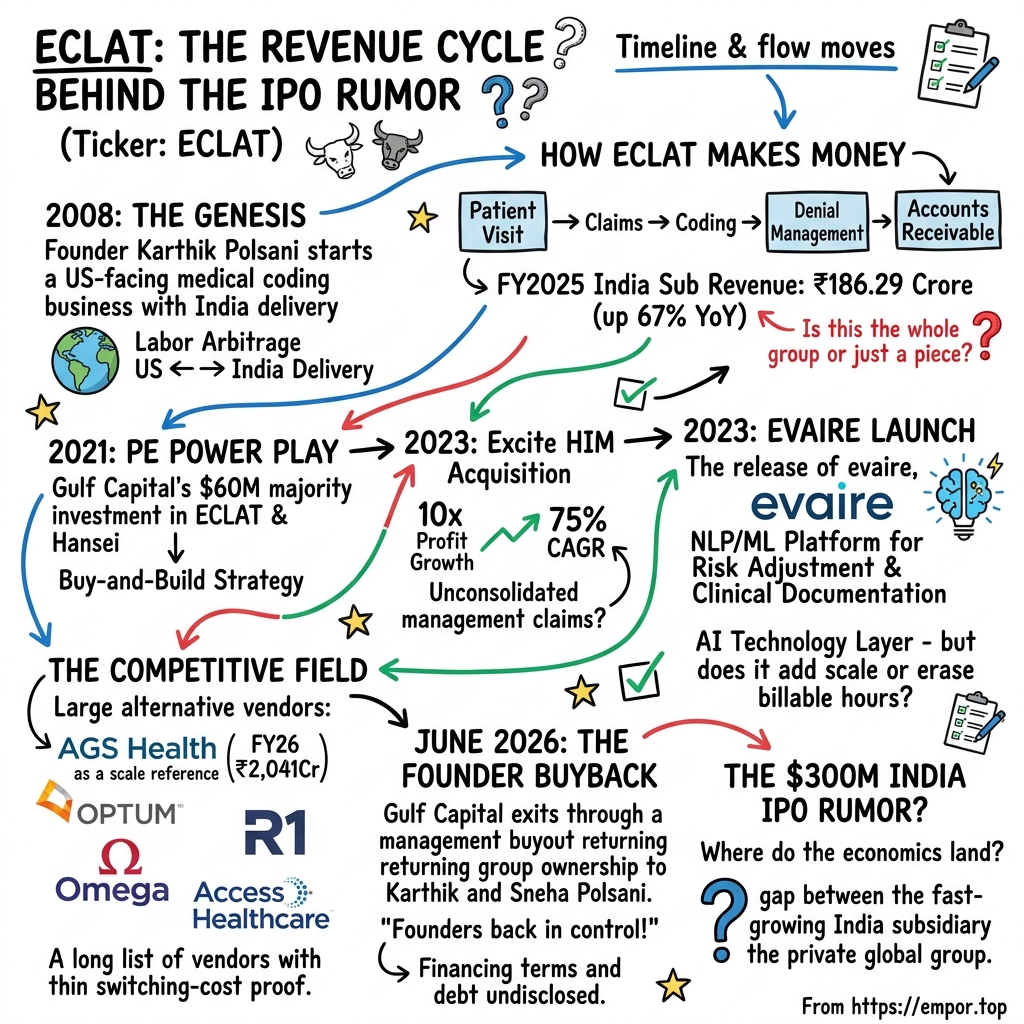
ECLAT: The Revenue Cycle Behind the IPO Rumor
I. Four Thousand People, One Unanswered Listing Question
On September 15, 2026, a short report moved across India's financial wires. ECLAT Health Solutions, a privately held American medical coding and billing company, was weighing an Indian initial public offering that could raise up to $300 million.1 The report rested on people familiar with the matter who asked not to be named. It said talks with investment banks were under way, that advisers had not yet been picked but might be soon, and that the deal under discussion could mix newly issued shares with shares sold by existing holders. It also said the process was early enough that the size and shape could still change. ECLAT did not respond to requests for comment.12
That is the whole of the public record on the listing. As of November 16, 2026, no draft red herring prospectus, updated draft, red herring prospectus or foreign registration statement in ECLAT's name appears among the offer documents that India's securities regulator publishes, and no ECLAT issue appears on the National Stock Exchange's tracker of upcoming offerings.34 The $300 million is a number someone said to a reporter. It is not an offer size, a price band or a valuation, and it carries no statement of who would receive the money.
Even so, the number deserves attention, because of what sits next to it. Three months before the IPO report, the Abu Dhabi private-equity firm Gulf Capital had announced that it was selling ECLAT back to its founders and management after five years of ownership. In the announcement, Gulf Capital said ECLAT's revenue and EBITDA had each grown tenfold over the partnership, that profitability had risen more than ten times in five years at a 75% compound annual EBITDA growth rate, and that the workforce had grown from 450 people to more than 4,000 across the United States, India and the Philippines.5 Those are extraordinary claims. If they were true of a company with a durable revenue base, ECLAT would be one of the fastest-scaling businesses in a crowded industry.
The only audited financial trace that the public can follow, however, belongs to a much smaller and narrower thing. ECLAT Health Solutions (India) Private Limited, an unlisted company incorporated in Telangana in 2020, files its accounts with India's Ministry of Corporate Affairs. A registry compilation of those filings puts its revenue for the year to March 2025 at ₹186.29 crore, up 67% from the year before, with a three-year compound growth rate of about 71%.6 At around ₹85 to the dollar, that is a little over $20 million of revenue. A raise of $300 million, by the same arithmetic, would be roughly ₹2,500 crore: more than thirteen years of the Indian subsidiary's latest revenue.
That gap is the story. The listing being discussed is an Indian one, and the Indian entity that the public can see is growing fast. Yet the claims that make ECLAT sound like an IPO candidate, the tenfold growth, the 4,000 employees and the AI platform, describe a group. That group is privately held, its parent sits outside India, and it has never published consolidated accounts. A prospective investor would not be buying the press release. They would be buying whatever legal entity ends up at the top of the offer document, together with whatever share of the group's contracts, intellectual property, cash and debt it holds.
So three questions sit underneath the rumor. How much of the growth was organic, and how much came from acquisitions and a moving group perimeter? How much of the value, as opposed to the labor, sits in India? And can a business that earns money by employing thousands of coders and billers keep growing when its customers are being sold software that promises to do part of that work?
None of these questions can be answered by the IPO report, and none of them is answered by Gulf Capital's exit release, which describes a successful investment in the language a seller uses. The right way to approach ECLAT, then, is the way a public-market investor would have to approach it if a draft prospectus landed tomorrow. Start with what the company does and for whom. Trace how private-equity ownership changed it. Weigh what the Indian subsidiary's numbers can and cannot carry. Then name the specific disclosures that would turn a rumor into an underwriting.
The boundary needs to be fixed early, because everything later depends on it. ECLAT Health Solutions, the group, is a US-led private company. ECLAT Health Solutions (India) Private Limited is one of its subsidiaries, and the registry still names an offshore holding company, RMBUS2 Holding Limited, as its parent.6 The subsidiary's ₹186 crore cannot stand in for the group's revenue, and the group's tenfold claim cannot fill in the subsidiary's missing history. Each figure answers a different question.
To see why the distinction matters so much, start where the company did: with one founder in 2008, a hospital chart, and the slow, error-prone path that chart takes before a provider is paid.
 Subscribe on LinkedIn
II. A Coding Business Built Across Two Continents
Karthik Polsani founded ECLAT Health Solutions in 2008.7 His background was technical rather than clinical: a bachelor's degree from Osmania University in Hyderabad and a master's from Carnegie Mellon.7 The company's name, it explains, is the French word for brilliance.8 The business he built had nothing to do with glamour. It sat in one of the least visible and most consequential corners of American medicine, the stretch of paperwork between a patient's visit and the money that pays for it.
That stretch is called the revenue cycle, and it is long. Before a patient is seen, someone has to confirm insurance eligibility and, for many procedures, obtain prior authorization. After the visit, a coder reads the physician's notes and translates diagnoses and procedures into the standardized codes that insurers use to decide what to pay. A biller turns those codes into a claim and submits it. Payments come back and must be posted against what was billed.
Claims that are rejected or underpaid go into a queue for denial management, where someone works out whether the coding was wrong, the documentation was thin or the payer was mistaken, and then corrects, appeals or resubmits. Unpaid balances age into accounts receivable that someone has to chase. Underneath all of it sits credentialing, the enrollment work that lets a physician bill a given insurer at all, and clinical documentation improvement, which pushes physicians to write notes that support the codes they deserve.
ECLAT sells nearly every piece of that chain. Its billing pages list provider enrollment and credentialing, prior authorization and eligibility checks, patient demographic entry, coding, charge entry, claim submission, payment posting, accounts-receivable follow-up, denial management and patient collections, across some thirty specialties from ambulance services to workers' compensation.9 Its customers, it says, include hospitals and hospital systems, ambulatory surgery centers, physician groups, hospital-owned practices, independent practice associations, management services organizations and health plans.8
Why would a hospital send this work to an outside company, and why would that company put its people in India? The answer is the arbitrage on which the entire offshore revenue-cycle industry was built. American coding requires trained, certified staff who understand complicated and constantly changing payer rules, and those staff are scarce and expensive in the United States. India has a large pool of graduates who can be trained and certified in American coding systems, at a fraction of the cost.
A company that holds the US client relationship, the compliance controls and the quality assurance, while doing most of the volume work in India, can charge a hospital less than its own staff would cost and still earn a margin. When Gulf Capital invested in 2021, it described ECLAT in exactly these terms: a company offering US onshore and Indian offshore delivery, claiming more than 95% accuracy in coding and billing.10 The Philippines came later, as a second delivery base.5
This is a service platform, not a software company, and the difference governs everything about how it should be valued. A software company writes code once and sells it many times, so each new customer adds revenue at very little extra cost. A service platform like ECLAT adds revenue mainly by adding people. Technology can make each person more productive, through workflow tools, automated checks and better routing of work, but the product the hospital buys is still largely human judgment applied to charts and claims. ECLAT's own descriptions emphasize process: a three-tier quality assurance system, ISO 9001 quality certification, ISO 27001 information-security certification and a SOC 2 compliant partner.8 Those certifications matter because a coding vendor handles protected health information and its errors become a client's compliance exposure. They are the price of admission, though, not a source of advantage, because every serious competitor holds the same badges.
The company built a leadership bench that reflects this operating DNA. Sneha Polsani, a co-founder who joined as chief operating officer, had worked as a management consultant at Accenture. Marie Thomas, who runs US revenue-cycle operations, has been with ECLAT since its founding year and holds the coding credentials of the trade. Mohit Srivastava, who leads India delivery, previously ran operations in India for MModal, the medical transcription and documentation company, where he oversaw some 1,500 people.7 Hiring from MModal is a telling detail. Transcription was the earlier wave of offshore healthcare work, and much of it was eventually absorbed by speech recognition and software. ECLAT's leaders have watched a labor-intensive healthcare service get automated before.
What the early record does not show is just as important. ECLAT has never published its revenue for the years before private equity arrived, its early customers, its margins or how concentrated its business was. The company says it serves large health systems and government payers, and Gulf Capital later called its customers blue-chip, but neither has quantified how much revenue comes from the largest accounts, how long contracts run or how many customers renew.105 The Indian subsidiary, the one entity with audited accounts in a public registry, was incorporated only in 2020, so there is no ten-year audited history for any part of ECLAT that an outsider can read.6 Before 2020, the Indian delivery work presumably ran through some other vehicle; the public record does not say which.
That missing record makes a clean long-run growth comparison impossible. Investors who want to know whether ECLAT is a business that compounds steadily, or one that grew in a burst when a financial sponsor arrived with capital and an acquisition strategy, cannot answer from the founder's first twelve years. They have to start where the public story starts, with the Gulf investor that tried to turn this coding company into the core of something bigger.
III. Gulf Capital Turned ECLAT Into a Buy-and-Build Bet
On March 23, 2021, Gulf Capital announced that it had bought majority stakes in two American revenue-cycle companies, ECLAT and Hansei Solutions, for a total transaction value of $60 million.10 Hansei, a Los Angeles company launched in 2016, focused on non-hospital facilities, particularly behavioral and mental health, where it handled benefits verification, utilization review, billing, receivables management and financial reporting.10 ECLAT, then described as based in the Washington, D.C. area, brought coding, auditing, denial management, clinical documentation improvement and billing, with an Indian delivery base.10
The strategic logic was explicit. Gulf Capital already owned a majority of Accumed, which it called the leading revenue-cycle provider in the United Arab Emirates and Saudi Arabia, having bought into it in 2018.10 The firm described its approach as buy-and-build in growing sectors, and it framed the 2021 deals as the foundation of a revenue-cycle platform spanning Asia, the Middle East and the United States. It cited a forecast that the revenue-cycle market would grow at 14% a year through 2025. Karthik Polsani, then ECLAT's chief executive, said the partnership would let the company expand into the Middle East and other fast-growing markets.10
The first thing to fix about that $60 million is what it was not. It was not the price of ECLAT. It covered two majority stakes in two companies, and the split between them has never been disclosed.10 It was also not a valuation of the whole of either company, since majority stakes leave minority holders, presumably including the founders, with the rest. So the figure cannot be turned into an ECLAT enterprise value, a revenue multiple or an EBITDA multiple, and it cannot support a judgment about whether Gulf Capital paid too much or too little against comparable revenue-cycle acquisitions. Any listener who hears "$60 million" and divides it into anything should stop.
The deal's advisers hint at the cross-border structure that would matter later. Gulf Capital used an American law firm and an Indian one, with PwC conducting financial due diligence; ECLAT used a US firm and an Indian firm for legal work and EY on the financial side.10 Indian counsel on both sides of a deal for a Virginia-based coding company is a reminder that, even in 2021, the transaction reached into Indian entities and Indian shareholdings. The Indian subsidiary that now files public accounts had been incorporated only the year before, and the registry later recorded a transfer of its shares to an offshore holding company in March 2022.6 Whatever structure Gulf Capital built to hold ECLAT, the Indian delivery arm was placed inside it.
The second thing to notice is a small inconsistency in dates. Gulf Capital announced the investment in March 2021. When the firm announced its exit five years later, Karthik Polsani was quoted recalling the moment "when we partnered with Gulf Capital in 2020."510 Both can be true, since deals are often agreed months before they close and are announced later still. But the starting year matters a great deal to a growth claim, because a tenfold rise measured from a 2020 base is a different statement from a tenfold rise measured from 2021. The exit release does not say which year's figures it compares, which accounting standard it uses, whether the figures are in dollars or rupees, or what perimeter of companies they cover.
What Gulf Capital did say is striking. Under its ownership, it said, ECLAT's revenue and EBITDA grew tenfold, profitability rose more than ten times in five years and EBITDA compounded at 75% a year. The workforce rose from 450 to more than 4,000, and the delivery and back-office footprint grew from two offices to six across India and the Philippines. ECLAT expanded nationally in the United States and added revenue-cycle and risk-adjustment capabilities, becoming in Gulf Capital's words a scaled, diversified healthcare services platform serving providers and payers. Mohammad Madani, a managing director at the firm, called ECLAT one of the standout successes of its third fund.5
It helps to work through what those numbers imply when taken together. A ninefold rise in headcount and a tenfold rise in revenue mean that revenue per employee barely changed over five years. That is consistent with a business that grew by hiring and acquiring people rather than by making each person dramatically more productive. A tenfold rise in EBITDA alongside a tenfold rise in revenue means margins were roughly the same at the end as at the start. Neither point is a criticism, since holding margins steady through a ninefold expansion of headcount is a real operating achievement. But it frames ECLAT as a labor platform that scaled its labor, which is a different investment proposition from a technology company that broke the link between people and revenue.
The harder question is how much of the scale was bought. ECLAT disclosed one acquisition during the Gulf period: the health information management division of Excite Health Partners, a managed-services provider in revenue cycle, health information management and clinical documentation improvement. The deal closed on July 21, 2023, and was announced nearly three months later, on October 9, 2023.11 ECLAT did not disclose the price, the revenue the division brought, the number of people transferred or the customers it added. Both brands, the release said, would continue operating.11 The acquisition is evidence of inorganic expansion. It is not proof of value creation, because value creation requires knowing what was paid and what was earned.
The Excite deal also illustrates the shape of the strategy. Health information management is the department that owns the medical record itself: its completeness, its release to insurers and auditors, and the coding that turns it into a bill. Clinical documentation improvement sits right next to it. By buying a team that did this work for American hospitals, ECLAT pushed further upstream into the chart, closer to the physician's documentation and further from pure back-office billing. Strategically, that is coherent, because the closer a vendor sits to the record, the harder it is to replace. Commercially, the record shows only that the purchase happened, not that it paid.
There is also the matter of the platform that was supposed to be built. In 2021, the story was a three-continent revenue-cycle group combining ECLAT, Hansei and Accumed. By 2026, Gulf Capital exited ECLAT on its own, and the exit release made no mention of either Hansei or Accumed. It described ECLAT as serving providers and payers across the United States.5 Whatever happened to the Middle East expansion that Karthik Polsani spoke of in 2021 is not described. The record therefore narrows the original thesis. The cross-border buy-and-build platform did not emerge as one combined company. What emerged instead was a larger ECLAT, and the claim that survives is the narrower one: that ECLAT itself grew very fast under sponsor ownership.
Even that claim remains unproven in the way an investor would need. Gulf Capital's figures come from a seller announcing a successful exit, without audited consolidated accounts, an organic-versus-acquired bridge or currency effects. They are not false for that reason, but they are not yet evidence either. The test a prospectus would have to pass is simple to state: show consolidated revenue and EBITDA for each year from the start of the partnership, separate the Excite contribution and any other acquisitions, and separate the effect of exchange rates on costs incurred in rupees and pesos.
That leaves the question of what the new people and new capabilities actually did. If ECLAT added coders, auditors and billers at a ninefold pace, the economics of the business still depend on how each of those people earns money for the company. That is where the story has to go next: into the denial queue.
IV. The Denial Queue: How ECLAT Makes Money
Picture a claim from a community hospital in the American Midwest. A patient came in with chest pain, was admitted for observation and went home two days later. The hospital billed the stay. Weeks later, the insurer denied part of it: the documentation, it said, did not support an inpatient admission, and one of the secondary diagnoses was coded at a level of specificity the payer would not accept. The claim lands in a work queue. Someone has to pull the chart, read the physician's notes, compare them with the payer's rules, decide whether the denial is right, and then either correct and resubmit the claim, write an appeal or accept the loss. Multiply that by thousands of claims a week across hundreds of payers, each with its own rules, and the work becomes a factory.
ECLAT's business is to run that factory, or parts of it, on the hospital's behalf. Its people sit in Herndon, Virginia, and in delivery centers in Hyderabad, Navi Mumbai, Karimnagar, Vijayawada and Lucknow, according to the company's platform site, with additional delivery in the Philippines.125 A chart flows from a hospital's systems into an ECLAT queue, a coder or denial specialist in India works it during the American night, an auditor checks a sample, and the result flows back before the hospital's own staff arrive in the morning.
ECLAT says its billing teams resubmit rejected claims on the same day, and it has advertised a case study in which a behavioral health center recovered $200,000 in six months.9 More recently it said its staff resolve 90% of claims within 90 days.13 These are the company's own descriptions of its service levels. ECLAT does not publish an audited track record against them, and a single case study cannot establish what happens across its book.
Why does a hospital need help at all? The forces are well known across the industry. American hospitals face chronic shortages of trained coders and billing staff, payer rules grow more complex every year, and denials have become a routine part of the claims process rather than an exception. A provider that cannot work its denial queue quickly loses money, because unworked denials age past appeal deadlines. Those pressures are why outsourcing has grown. They are industry mechanisms, though, not evidence that ECLAT's own customers collect more because of ECLAT. The company has not published client-level outcomes beyond its marketing material.
The numbers that the public can see come from the Indian subsidiary, and they are impressive on their own terms. ECLAT Health Solutions (India) Private Limited reported ₹186.29 crore of revenue in the year to March 2025, up 67% from the year before, with a three-year compound growth rate of about 71%.6 Run that growth rate backward and the subsidiary was a business of roughly ₹37 crore three years earlier. It grew about fivefold in three years. Whatever else is uncertain, an Indian entity that quintuples its revenue in three years is hiring people, filling seats and billing for their work at a rapid pace.
The question is who it bills. An Indian delivery subsidiary of an American services group usually earns most of its revenue from its own parent or sister companies. The US entity signs the hospital contract and invoices the hospital in dollars. The Indian entity does the work and invoices the US entity, often at its costs plus a modest markup that Indian and American tax authorities will accept as an arm's-length price. Under that structure, the Indian company's revenue is really a measure of its cost base, and the profit that the hospital contract generates largely stays wherever the contract sits. ECLAT has not disclosed how much of the subsidiary's revenue comes from related parties, what markup it earns or which entity holds the customer contracts.6
A rough calculation shows why this matters. The company's platform site advertises more than 3,000 domestic and global coders.12 If even two-thirds of them worked for the Indian subsidiary, ₹186 crore of revenue would come to under ₹10 lakh per person a year, roughly $11,000. That is a plausible fully loaded cost for an Indian coder plus a margin. It is a long way below what an American hospital would pay for the same work done by an American coder, and it is likely below what ECLAT's US entity charges the hospital. The inference cannot be confirmed without the subsidiary's related-party notes, but it suggests that the Indian revenue line measures the size of the delivery engine rather than the value of the customer franchise. The ₹186 crore is evidence of a growing subsidiary. It is not a proxy for the group's revenue, EBITDA or cash.
The commercial terms that would tell investors how good ECLAT's revenue is are not public at the group level either. The company does not say whether it prices per chart coded, per claim worked, per full-time-equivalent seat, as a percentage of collections or on a project basis. It does not disclose contract lengths, minimum volumes, renewal rates or termination rights. Each of those choices produces a different kind of business. Per-seat pricing is predictable but caps upside and leaves ECLAT exposed if the client cuts seats. Per-chart pricing rewards productivity: if a coder works more charts an hour with better tools, ECLAT keeps the gain. Percentage-of-collections pricing ties revenue to the client's cash, which aligns incentives but adds volatility. Risk-adjustment work for health plans tends to be seasonal and project-based, concentrated around the deadlines by which plans submit diagnosis data to the government's Medicare Advantage program.
There is also the matter of how sticky a coding vendor really is. The usual argument for outsourcing stickiness is that once a vendor knows a hospital's systems, payer mix and documentation habits, switching becomes costly and risky. That argument has force. But the counter-argument is just as familiar to hospital finance leaders. Large health systems routinely multi-source coding work across two or three vendors, precisely so they can compare quality and price and move volume without disruption. Some bring work back in-house when staffing improves. Others consolidate onto one large end-to-end vendor. ECLAT has published no customer retention series, no record of lost bids and no account-level history that would show which of these patterns describes its customers.
So the denial queue explains how ECLAT makes money, and the Indian subsidiary's growth shows that the queue is getting longer. Revenue growth on its own cannot show whether productivity improved, whether margins widened or whether cash collection kept pace. The measurable promise of the work is fewer errors and faster reimbursement for the client. ECLAT's next task, if it wants public investors to pay for that promise, is to demonstrate it consistently and in numbers. And the company's own answer to how it will do so is a piece of software.
V. Evaire Has to Become Revenue, Not Just a Product Launch
On August 28, 2023, at a risk-adjustment industry conference in Dallas, ECLAT unveiled evaire. The company called it a comprehensive software-as-a-service platform, enabled by natural language processing and machine learning, designed to "revolutionize" risk adjustment.14 Gabe Stein, then ECLAT's chief executive, presented it as a unified approach to prospective, concurrent and retrospective chart review.14 Stein had joined ECLAT in 2021 from the outside; he had been an executive vice president at GeBBS Healthcare Solutions, one of ECLAT's competitors, and earlier founded and ran Peak Health Solutions.715
To understand why the product matters, it helps to understand risk adjustment. Medicare Advantage plans and some other insurers are paid more for members who are sicker, as measured by the diagnoses documented in their medical records. A plan that fails to capture a member's chronic conditions is underpaid. A plan that captures diagnoses the records do not support faces clawbacks and, increasingly, government audits and fraud allegations. Risk-adjustment coding is therefore high-stakes reading: someone has to go through millions of charts, identify diagnoses that are documented and supported, and flag those that are not. Retrospective review happens after the visit. Prospective review tries to prompt the physician before or during the visit so that documentation is complete in the first place.
Evaire's intended job is to make that reading faster and more accurate. The platform's site today describes chart retrieval, AI-driven chart review, risk-adjustment coding, a "confidence scoring" feature that tells coders which charts they can safely skip, and payer analytics.12 Gulf Capital's exit release named the same functions and called evaire ECLAT's proprietary AI and analytics platform.5 In June 2026, ECLAT said evaire and its healthcare performance solutions had received HITRUST r2 certification, a demanding security standard that many large health plans require of vendors handling their data.16 Later in 2026 the company added evaire Recover, which it described as an agentic AI platform for accounts receivable and denials, using machine learning to prioritize claims, route denials automatically, reconcile payments and analyze root causes. Karthik Polsani said it would replace fragmented, reactive workflows.13
The claims on the platform's site are confident. It says the confidence score flags which charts to skip with 99.7% accuracy, that coding accuracy is 97%, that the platform has processed more than 40 million retrospective records and 20 million encounters, and that clients see a return of 15% to 40% on their investment.12 None of these figures is accompanied by a methodology, an independent audit or a named customer. They describe what ECLAT says the product can do. They do not show how much anyone pays for it.
That distinction is the whole issue. A product launch, a security certification and a list of features establish technical capability. They do not establish commercial scale. ECLAT has never disclosed how much of its revenue comes from evaire as software rather than as a tool inside its own coding service, how many clients license it, what they pay, how many renew, how much the company spends on research and development or how many engineers it employs. Its leadership page lists a vice president of product and a vice president of engineering, so there is a product organization.12 Its size and cost are not disclosed.
The way ECLAT talks about evaire also hints at how the product is actually sold. Its own site presents evaire as a risk-adjustment platform alongside accounts-receivable services, documentation improvement, medical coding and chart retrieval, and it pairs the software claims with a figure for its human workforce: more than 3,000 experienced coders.12 The Recover announcement described the product as combining agentic AI with highly skilled execution.13 That is the language of technology-enabled services, in which the software makes ECLAT's own people faster and the client buys an outcome. It is a sensible model. But it is valued by public markets as a services business, at services multiples, unless the software can be shown to earn its own recurring revenue.
Here the automation equation cuts both ways. If evaire lets one coder review twice as many charts, and ECLAT prices per chart, the company keeps the productivity gain and its margins widen. If ECLAT prices per seat or per hour, the same gain lets the client buy fewer seats, and revenue falls unless volume rises to compensate. And if the tools become good enough, some clients may decide to license software directly, from ECLAT or a competitor, and run a smaller in-house team. The history of medical transcription, the business that ECLAT's India operations head once helped run at M*Modal, shows how this can go: speech recognition first made transcriptionists more productive and then made many of them unnecessary.7 Coding is harder to automate than transcription, because it requires clinical judgment and regulatory interpretation. But the direction of travel is the same.
What would settle the question? Revenue and gross margin by service line, showing whether risk adjustment and software-assisted work earn better margins than traditional coding and billing. Revenue per employee over time, showing whether the group is decoupling revenue from headcount. Coder throughput before and after evaire deployment. The number of paying evaire customers and their renewal rate. None of these is public.
There is one internal comparison that the company's own words make possible, and it is instructive. In 2021, before evaire existed, Gulf Capital described ECLAT's coding and billing as more than 95% accurate.10 In 2026, the evaire site advertises coding accuracy of 97% and quality review of 95% or better.12 Measured by the company's own marketing, the software era has moved headline accuracy by a couple of percentage points. That may matter a great deal in practice, since every avoided error is a claim that does not come back as a denial, but it is not the step change that "revolutionize" implies. The same site still leads with more than 3,000 human coders. The honest reading is that evaire is improving a people business at the margin, which is valuable, while the people remain the business.
Karthik Polsani's own 2026 statements frame AI as the way ECLAT will deliver better operational outcomes for clients, and that is a coherent strategy.513 But those comments come in prepared press releases. ECLAT has never held an earnings call or investor day at which analysts could press management on what share of revenue evaire produces or how pricing is changing. Until it does, evaire is best understood as an important bet on the company's future and a strategic necessity in its present, not yet as a moat. Whether it is a moat depends on a broader question: what, in this crowded market, makes a customer stay with any one vendor?
VI. The Vendor List Is Long, and the Switching-Cost Proof Is Thin
Imagine the chief financial officer of a regional health system in the autumn of 2026. The denial rate is rising, the coding backlog is growing, and the board wants costs down. There are choices, and the length of that list is ECLAT's central competitive problem. It could hand the entire revenue cycle to one of the giants: Optum, owned by UnitedHealth Group, or R1 RCM, which runs end-to-end revenue cycles for large systems.
The system could hire one of the big offshore specialists, such as Access Healthcare, AGS Health, IKS Health or Omega Healthcare, each of which employs many thousands of people in India and the Philippines. It could pick a focused firm such as GeBBS or ECLAT for particular functions. It could rebuild its in-house team. Or it could buy one of a growing list of automation products that promise to code charts or work denials with less human effort.
One of those competitors has recently put its numbers in public, which makes it a useful measuring stick. AGS Health, owned by Blackstone, filed an updated draft prospectus in August 2026 for an Indian IPO of up to ₹4,800 crore, of which ₹3,000 crore would be shares sold by a Blackstone holding entity and ₹1,800 crore new shares, most of the proceeds earmarked to repay debt at its US subsidiaries.17 AGS reported consolidated revenue of about ₹2,041 crore in the year to March 2026. It served 149 customers, including 82 health systems and hospitals and, it said, 11 of the 20 largest US hospitals.1817 On a pro forma basis, its ten largest customers accounted for about 60% of revenue.18
The comparison with ECLAT has to be handled with care. AGS's figure is consolidated group revenue for the year to March 2026. ECLAT's ₹186 crore is one subsidiary's revenue for the year to March 2025, and that subsidiary probably bills its own parent rather than American hospitals. The two numbers are not like-for-like, and ECLAT's group revenue is not disclosed. What the comparison does establish is scale of ambition: AGS is a business with more than ₹2,000 crore of reported revenue raising ₹4,800 crore, and ECLAT is reported to be considering a raise of a similar order of magnitude. For that to make sense, ECLAT's group would need to be far larger than its Indian subsidiary's accounts suggest, which is plausible if most of the customer revenue sits in the US entity, or the raise would need to be large relative to the business.
AGS also shows what a revenue-cycle prospectus reveals once it exists, and the revelations are sobering. Its reported revenue growth of about 71% in its latest year was heavily flattered by an acquired US business. On a pro forma basis, as if the acquisition had been owned throughout, growth was about 22%, and the pro forma result was a net loss of about ₹141 crore.18 Operating cash flow was negative in the latest year, and consolidated borrowings were about ₹4,239 crore.18 AGS is not ECLAT, and none of these figures transfers. But AGS is the clearest public example of a sponsor-built revenue-cycle platform in which the headline growth rate and the underlying organic growth rate were very different numbers. It tells a listener what kind of gap to look for.
Michael Porter's competitive forces help explain why margins in this industry are contested. Buyers are powerful, because large health systems can qualify several vendors and shift volume among them. Suppliers of the core input, trained coders, are in short supply, and every vendor competes for the same Indian talent pool in the same cities, so wage inflation is a persistent pressure. Substitutes are multiplying, as AI tools take over tasks that once required people. New entrants face real barriers in compliance, security certification and client references, but those barriers are surmountable, as ECLAT's own rise from a small firm demonstrates. And rivalry is intense, with dozens of credible offshore vendors.
Against that backdrop, what could give ECLAT durable power? Hamilton Helmer's framework names seven sources: scale economies, network effects, counter-positioning, switching costs, branding, cornered resources and process power. Network effects do not apply to a coding vendor; one hospital's use of ECLAT does not make ECLAT more valuable to another. Scale economies exist in the industry, in recruitment, training and compliance overhead, but they favor the larger players over ECLAT. Brand matters in procurement, but there is no evidence that ECLAT's brand commands a price premium. That leaves switching costs and process power: the accumulated know-how of running specific clients' workflows accurately, and the institutional knowledge embedded in coding quality systems. Those may be real. But they are the hardest powers to prove without retention data, and ECLAT has never published any.
The most independent view of ECLAT's customer experience is a 2023 "First Look" report from KLAS Research, the healthcare IT and services rating firm, which described ECLAT as offering flexible, wide-ranging revenue-cycle services to accommodate various outsourcing needs, spanning facility and professional coding, risk-adjustment coding, receivables and denials management and patient-access call centers.19 A First Look is a preliminary profile, built on a limited number of client interviews. It is a useful signal that the customers KLAS spoke with were broadly satisfied with ECLAT's flexibility. It is not a market-share measure, a broad customer ranking or proof that ECLAT wins against larger vendors.
The defensible claim, therefore, is narrower than the company's marketing. ECLAT combines domain expertise, flexible offshore delivery and quality controls in a way some customers value. That is plausible and consistent with its growth. Whether it adds up to superior retention, pricing power or better unit economics than AGS, IKS or Omega is unproven. The next test is whether management can show, in a filing, that the breadth it has built translates into contract wins, renewals and better economics. And the management that would have to show it changed hands in June 2026.
VII. The Founders Buy Back the Company
On June 9, 2026, Gulf Capital announced from Abu Dhabi that it had completed its exit from ECLAT through a management buyout, returning full ownership to the company's founders and management team.520 The firm called it one of the most successful realizations in its history. Karthik Polsani, now styled founder and group chief executive, and Sneha Polsani, founder and chief operating officer, were quoted thanking their partner and describing the next chapter of growth.5 The founders who had sold control in 2021 had bought it back.
A management buyout is a statement of conviction, and that deserves weight. Founders who buy their company back from a financial sponsor are betting their own money, or money borrowed against the company's future cash flows, that the business is worth more than they are paying. In ECLAT's case the bet also changed who would decide whether and how to go public. Under Gulf Capital, any listing would have been a sponsor's exit route. Under the founders, it becomes a decision about how much of their own company to sell, and to whom.
The trouble is that conviction is all the public can see. ECLAT and Gulf Capital did not disclose the price of the buyout, how it was financed, how much debt was raised against the company to pay for it, which outside investors, if any, provided equity or loans, how much of the company the Polsanis now own personally, how much sits with other managers, or what incentive plans were put in place.5 Each of those details matters a great deal to a future public shareholder.
If the buyout was financed largely with debt placed on the company, the first call on ECLAT's cash for years may be interest and principal. If an outside lender or preferred investor provided the money, it may hold rights, such as a liquidation preference or a share of any IPO proceeds, that rank ahead of ordinary shares. And if the IPO under discussion includes shares sold by existing holders, as the September report suggested it might, then some of the public's money could go to refinancing the buyout rather than to growing the business.1
The leadership arrangement itself has layers that a filing would need to clarify. Since 2021 ECLAT has had both a founder in the role of group chief executive and a hired chief executive running the operating business. Gabe Stein, the former GeBBS executive, held the operating chief executive title when evaire launched in 2023 and was still quoted as chief executive in the HITRUST announcement of June 2026.1416 The current leadership roster also includes a chief financial officer, Afzal Momin, and a layer of product, engineering, payer and analytics vice presidents.12 Which of these executives own equity after the buyout, and on what terms, is not disclosed.
Judging management by its behavior across the observable period gives a mixed but mostly positive picture. In 2021 the founders sold control to a sponsor with a grand cross-border plan. That plan, a combined platform with Hansei and Accumed reaching into the Middle East, did not materialize in any public form, and the company that emerged was a larger, US-focused ECLAT.105 The founders hired an experienced outside chief executive from a competitor, made one disclosed acquisition, launched a software platform, earned demanding security certification and, if the sponsor's figures are right, grew revenue tenfold while holding margins. They then bought the company back. There is no public evidence of a failed product, a lost flagship customer, a lawsuit, a regulatory action or a senior departure in disgrace. There is also little public evidence of anything at all, because ECLAT has disclosed so little.
That opacity extends to every governance question a public investor would ask. ECLAT has never published executive pay, a comparison of pay with profit over several years, the composition and independence of its board, the results of shareholder votes, any auditor observations or any history of guidance against results. The Indian subsidiary's board records show that Karthik Polsani was appointed as an additional director in February 2026, months before the buyout, but they do not show independent oversight.6
There is one concrete mismatch that a prospectus will have to resolve. The buyout announcement says full ownership returned to the founders and management. Yet the Indian subsidiary's registry profile still names RMBUS2 Holding Limited as its parent, recording a secondary transfer of shares to that company in March 2022.6 The name and timing suggest a holding vehicle set up during the Gulf Capital era. It may now be owned by the founders, it may have been renamed or replaced, or the registry may simply not yet reflect the new structure.
But a public investor buying into an Indian listed company would need to know which entity owns which. An Indian IPO would require an Indian issuer. If the Indian subsidiary is that issuer, investors would own a delivery business that bills its parent. If the group restructures so that an Indian company sits at the top and owns the US contracts, investors would own the whole franchise, and the restructuring itself would need scrutiny.
The 2021 transaction and the Excite acquisition provide no basis for judging the founders as acquirers either. The $60 million covered two companies, and Excite's price was never disclosed, so there is no ECLAT-specific deal multiple against which to measure whether the founders, or Gulf Capital, bought well.1011
The critical credibility test is therefore not a speech or a product launch. It is the next set of audited accounts: the group's consolidated statements and the Indian subsidiary's notes on related-party dealings, together with a post-buyout legal chart showing who owns what. A management team that bought back its company has every reason to believe in it. Public investors will need to see why.
VIII. What the Evidence Can and Cannot Say
When a private company proposes to list, the question changes. Until now, ECLAT's growth story has been told to customers, employees and a single private-equity owner, each of whom had their own information. A listing turns that story into a public-market question: what exactly would investors own, how much cash does it generate and how reliable are the numbers? It is worth laying out what can be said with confidence, and what cannot.
Two growth claims can be stated plainly. The Indian subsidiary's revenue grew about 67% in the year to March 2025 and roughly fivefold over three years, reaching ₹186.29 crore.6 The group, according to its former owner, grew revenue and EBITDA tenfold over the five years of partnership.5 These claims are consistent with each other, in the sense that a group growing that fast would need a delivery engine growing at a similar pace. But neither fills the other's gaps. The Indian figure has no ten-year history and probably measures cost-plus billing to the parent. The group figure has no audited series, no organic-versus-acquired bridge and no stated base year.
The reason cash matters so much in this kind of business is mechanical. A staffing-led service company pays its people every month, in rupees and pesos, before it is paid by its clients in dollars. When it grows fast, it hires ahead of revenue, trains people who are not yet billable, and carries a rising balance of receivables from clients who pay on thirty-, sixty- or ninety-day terms. Revenue can therefore grow strongly while cash lags, sometimes for years. AGS Health, the most comparable business with public numbers, reported negative operating cash flow in its latest year despite strong reported EBITDA, partly because of acquisition-related effects and working capital.18 ECLAT's cumulative operating cash flow relative to its profit has never been published at the group level, and the public summaries of the Indian subsidiary's accounts mask the cash-flow statement.6
The missing pieces are specific, and each matters for a reason. Receivables ageing and write-offs would show whether ECLAT is collecting what it bills. Top-customer revenue shares would show whether one or two health systems or payers could cripple the business by leaving; AGS's top ten customers account for about 60% of its revenue, which suggests the concentration in this industry can be high.18 Related-party sales and fees would show where profit is booked.
Borrowings and lease liabilities would show how much of the company's future cash is already spoken for, especially after a buyout. The Indian subsidiary's audited statements for the year to March 2025 were filed with the registry on December 29, 2025, according to a registry aggregator, and its filing history lists the annual returns and financial statements for each year since incorporation.2122 Those filings, and the group accounts that sit above them, are the primary documents that would settle most of these questions.
It would be a mistake to treat the absence of bad news as good news. A registry profile reports no court or tribunal cases against the Indian subsidiary in its records.6 No credit rating rationale from an Indian rating agency for any ECLAT entity is publicly available, so there is no independent analyst view of its debt or liquidity. Neither fact means the company is clean or debt-free. ECLAT is private, cross-border and has never published group accounts. Its litigation exposure in the United States, where coding vendors can face disputes over billing errors, data breaches and employment, has never been described in a document that would carry legal liability for omissions. Only a prospectus would do that.
If ECLAT lists, three measures would tell investors most of what they need to know. The first is organic revenue growth by service line, separating coding, billing and receivables work from risk adjustment and software, and separating acquisitions and currency. That figure tests whether the tenfold story describes a compounding franchise or a sponsor-funded expansion. The second is revenue per employee, or an equivalent productivity measure such as charts coded per coder per day. That tests whether evaire is changing the economics or merely adding features. The third is operating cash flow relative to net profit, over several years. That tests whether growth is turning into cash or into receivables.
Held at the confidence the evidence supports, the conclusion is this. High growth is reported, from two independent angles. Durability, cash quality, customer concentration and the split of economics between the Indian entity and the group remain unproven. That is not a discovered failure. It is a gap in disclosure that only the company can close, and a public offering would be the moment it must.
IX. Analysis & Bear vs. Bull Case
Imagine a prospective investor in late 2026 setting two documents side by side. On one side is the September report that ECLAT is weighing a $300 million Indian IPO, a few paragraphs long, sourced to anonymous people.1 On the other is AGS Health's updated draft prospectus, hundreds of pages long, with three years of audited accounts, customer concentration, debt schedules, risk factors and a detailed account of who receives the money.17 Both are American hospital revenue-cycle businesses doing much of their work in India. Only one of them can be analysed.
Start with what price can and cannot tell an investor here. There is no ECLAT share price, no announced valuation, no price band and no disclosed transaction value. The $300 million is a possible raise, not a valuation, and it says nothing about how much of the company it would buy.1 It is still possible to show the arithmetic it implies. If $300 million bought a fifth of ECLAT, the implied equity value would be about $1.5 billion. If it bought a tenth, the implied value would be about $3 billion.
For either figure to be justified by a services business, ECLAT's group would need to generate earnings of a scale that is many times larger than anything its Indian subsidiary's revenue suggests, and that only the US entity's books could show. Those are not estimates of what ECLAT is worth. They are a demonstration that the rumored raise only makes sense if the group is very much larger than the visible subsidiary, and that an investor cannot know whether it is until the group's accounts appear.
The same caution applies to enterprise value. Enterprise value adds debt and subtracts cash from equity value, so that businesses with different financing can be compared. ECLAT's cash, its borrowings, its lease liabilities and the debt, if any, raised to fund the June buyout are all undisclosed, as is any planned use of new money. An enterprise value cannot be reliably calculated, so no enterprise-value multiple can be built. Nor can a fully diluted share count, because ECLAT has disclosed no share classes, option pools, warrants, convertible instruments or preference rights. If the buyout was partly financed by preferred equity or structured debt, those instruments would rank ahead of public shareholders, and their terms would shape what an ordinary share is worth.
Intrinsic value could be framed as a set of scenarios, but only once the inputs exist. A credible model would start with group revenue and its organic growth, apply a margin path that reflects wage inflation in India against pricing pressure from US clients, subtract taxes in at least three jurisdictions, subtract the capital needed for new delivery centers and software, and discount the result at a rate that reflects concentration and automation risk. ECLAT has published none of those starting figures. The responsible answer is that its intrinsic value cannot be estimated from public evidence, and that any figure circulating before a filing is a guess.
What can be built is the peer frame. ECLAT's direct operating peers are the offshore revenue-cycle specialists that sell coding, billing and receivables work to US providers and payers: AGS Health, IKS Health, Access Healthcare, Omega Healthcare and GeBBS. They share ECLAT's customer type, its labor model and its exposure to rupee wages and dollar revenue. Optum and R1 are better thought of as aspirational category leaders, larger and more integrated, with technology and capital that ECLAT cannot match.
AGS is also the recent IPO comparable, and its prospectus is the most useful document an ECLAT investor can read today. It shows a sponsor-owned company whose reported growth of about 71% shrank to about 22% on a pro forma basis, whose pro forma bottom line was a loss, whose operating cash flow was negative and whose IPO money would largely repay debt and pay its owner.1817 None of that is ECLAT's history. All of it is a list of what to check.
There is also a reason the market might, for a while, price an ECLAT listing above whatever its business turns out to be worth, and it has nothing to do with coding accuracy. India's IPO market had raised nearly $10 billion in 2026 by the time of the September report, and the same report noted that AGS Health and another revenue-cycle firm, Knack RCM, were also preparing share sales.1 When a category becomes fashionable, investors who want exposure to it compete for a handful of offerings, and scarcity, a small free float and early momentum can carry a new listing well above a sober estimate of value.
The reverse is also possible: if two or three revenue-cycle companies list within months of each other, the later ones may face buyers who already own the theme and can choose among peers with longer disclosed records. Either way, those forces describe demand for shares, not the cash a business will produce. A public price set in that environment would be an observation about mood, and ECLAT's value would still depend on the same retention, productivity and cash questions.
The bull case is real. Providers need help with complex coding, billing and denials, because payer rules keep multiplying and qualified American staff remain scarce. ECLAT has a cross-border delivery footprint across several Indian cities and the Philippines, a broad service range that lets it sell more to each client, a risk-adjustment practice that ties it to the large Medicare Advantage market, demanding security certification and a software platform that, if it works as claimed, could raise productivity.51216 Its Indian subsidiary grew fivefold in three years. And its founders backed the business with their own control.
The bear case is about what investors cannot see. ECLAT has never disclosed customer concentration, contract renewals, pricing structure, margins, cash conversion or software revenue. It has never disclosed what share of group profit sits in the Indian entity that might list. The original 2021 platform strategy was quietly narrowed. The buyout's financing is unknown. And the broader industry faces a structural question: whether AI will make coding vendors more productive or less necessary.
A skeptical public-market investor would ask a short list of questions, and each answer would move the case. What share of group revenue and EBITDA would the listed company own? How much of the Indian subsidiary's revenue comes from its own parent, and at what markup? What did the founders pay for the buyout, and who lent them the money? What are the receivables ageing and the top-ten customer shares? How much of the IPO, if any, would be shares sold by existing holders rather than new money for the company?
Competitive pressure will test the answers. Larger vendors can bid on scale and breadth for the biggest systems, while focused automation companies can target specific tasks, such as denial prediction or chart abstraction, that once required people. ECLAT sits between them, and its answer to "why win from here" is credible only if it can show retention, rising productivity and cash conversion.
The investment case would be falsified by declining customer retention, falling revenue per employee, rising overdue receivables, a persistent gap between reported profit and operating cash, or evaire failing to produce measurable paid adoption. It would be confirmed by filed consolidated and subsidiary accounts showing organic growth, by disclosed customer concentration and retention, by service-line economics that show software-assisted work earning better margins, by transparent buyout financing and by a clean ownership chart. Until then, the case is neither bull nor bear. It is unpriced.
X. Playbook: Business & Investing Lessons
Go back to June 2026, to the moment the founders bought back their company. ECLAT had been founded in 2008, sold to a sponsor in 2021, expanded through an acquisition and a software launch in 2023, and was returned to its builders in 2026, just as an IPO became a possibility. The story so far teaches more about reading a high-growth private company than about ECLAT's eventual value, and the lessons belong to this company in particular.
A growing subsidiary is not the same thing as a growing group. ECLAT's Indian entity grew fivefold in three years to ₹186 crore, and the group claims to have grown tenfold in five. Those numbers sound like they confirm each other. In fact they answer different questions: one measures the size of a delivery engine billing its parent, and the other measures a franchise whose contracts sit elsewhere. Investors who hear an Indian IPO and look up an Indian company's accounts should first ask what that company sells, and to whom. A delivery center's revenue is a payroll with a markup.
A launch is a beginning, not a moat. Evaire arrived at a Dallas conference in 2023 with a promise to revolutionize risk adjustment, and by 2026 it had acquired security certification, a sister product for denials and a website full of accuracy percentages. None of that tells an investor whether a single client pays for it as software. In a services company, a platform is valuable if it raises productivity, protects pricing or keeps customers. Until it is measured by one of those, it is a brochure.
In a buy-and-build, ask where the growth happened. Gulf Capital's story began as a three-continent platform built from three companies for $60 million plus an earlier deal, and ended with one company exiting alone. The tenfold claim spans an acquisition whose price was never disclosed, a perimeter that changed, and costs in three currencies. AGS Health's own filing, in which reported growth of about 71% became about 22% once the acquisition was stripped out, shows exactly why the bridge matters.18 A sponsor's exit release reports the size of the success. Only the bridge shows where it came from.
The legal chart is part of the business model. The buyout announcement says the founders own everything; the Indian registry still names an offshore holding company as the parent. In a cross-border services group, the entity chart decides who owns the contracts, the software, the cash and the debt, and therefore who captures the profit. For ECLAT, the organization chart is not a footnote to the investment case. It is the investment case.
XI. Epilogue
Tonight, ECLAT stands at the threshold of a decision it has not formally announced. Its founders own the company again. Its Indian delivery engine is growing quickly. Its software is being marketed with new features. And a $300 million listing has been reported, with no advisers publicly named, no offer document on file with India's regulator and no issue on the exchange's calendar.134 Everything the market says about ECLAT's value until that changes is talk.
The next decisive moment will be a draft red herring prospectus, if ECLAT files one. The first thing to read in it will not be the growth rate. It will be the corporate structure section, because that is where the company must say which entity is offering shares, which subsidiaries it owns, and whether the US contracts, the evaire intellectual property and the Philippine operations sit inside the listed company or outside it. If the Indian subsidiary is the issuer and the customer franchise stays in America, investors would be buying a delivery center. If the group restructures so that the listed company owns everything, investors would be buying the whole franchise, and the restructuring itself will reveal what the founders think each piece is worth.
The second thing to read will be the offer structure. A fresh issue puts money into the company for growth or to repay debt. An offer for sale puts money into the pockets of selling shareholders. The September report said both were under consideration.1 If the founders sell, or if the proceeds repay buyout debt, investors will learn how the June transaction was financed and how much of their money would flow back to it.
The third will be the restated financial statements. A prospectus would have to present audited consolidated accounts for several years, separating acquisitions from organic growth and showing cash flow alongside profit. That is where the tenfold claim would be either confirmed, narrowed or reframed. If organic growth turns out to be strong, margins steady and cash conversion healthy, ECLAT's story becomes one of the more impressive in its industry. If growth leans on acquisitions, margins depend on cost-plus arrangements between related entities, or cash trails profit by a wide margin, the story becomes one of a sponsor-era expansion that public investors would be asked to fund.
Before any filing, there is a quieter checkpoint. The Indian subsidiary's accounts for the year to March 2026 should reach the registry by the end of 2026, if it follows the timing of the previous year's filing.21 Those accounts would show whether the fivefold growth continued, and their notes would describe related-party dealings and any change in the parent company after the buyout. Watch, too, whether evaire disclosures move from product descriptions to customer counts, revenue and measured outcomes.
The founders have bought back the platform. What public investors still do not know is how much of that platform sits in India, and what share of its economics they would ever be allowed to own.
XII. Outro
Somewhere in the United States tonight, a patient is being discharged, and a chart is being closed. By morning in Hyderabad or Lucknow, a coder will have read it, translated it into codes, checked it against the payer's rules and sent it back across the world as a claim. If the insurer pays, the hospital is paid. If it denies, the chart comes back, and someone thousands of miles away starts again.
That is ECLAT's business: the distance between care delivered and care reimbursed, crossed thousands of times a day by people the patient will never meet. In September, someone said that distance might be worth a $300 million listing. The question that will decide whether it is has nothing to do with the rumor. It is whether ECLAT can make the same journey visible in its own accounts, following its own revenue from the hospital to the coder and back, and showing investors exactly where the money finally lands.
References
-
Eclat Health Weighs India IPO Targeting Up to $300 Million — Briefs, 2026-09-15 ↩↩↩↩↩↩↩↩
-
Eclat Health Is Said to Consider $300 Million India IPO — Moneycontrol, 2026-09-15 ↩
-
Gulf Capital Announces Successful Exit from ECLAT Health Solutions — Gulf Capital, 2026-06-09 ↩↩↩↩↩↩↩↩↩↩↩↩↩↩↩
-
Eclat Health Solutions (India) Private Limited — The Company Check ↩↩↩↩↩↩↩↩↩↩↩
-
Gulf Capital Acquires Two US Healthtech Companies for US$60 Million to Build a Global Leader in Healthcare Revenue Cycle Management — Gulf Capital, 2021-03-23 ↩↩↩↩↩↩↩↩↩↩↩↩↩
-
ECLAT Health Solutions Acquires Excite Health Partners HIM Division — ECLAT Health Solutions, 2023-10-09 ↩↩↩
-
ECLAT Health Solutions Launches evaire Recover, an Agentic AI Platform for AR and Denials Management — ECLAT Health Solutions, 2026 ↩↩↩↩
-
ECLAT Health Solutions Introduces evaire — ECLAT Health Solutions, 2023-08-28 ↩↩↩
-
ECLAT Health Achieves HITRUST r2 Certification — ECLAT Health Solutions, 2026-06-11 ↩↩↩
-
AGS Health Files Updated DRHP for ₹4,800 Cr IPO; Blackstone to Sell Stake — Outlook Business, 2026-08-08 ↩↩↩↩
-
AGS Health IPO: Blackstone Stake Sale and Financials — INDmoney, 2026-11-11 ↩↩↩↩↩↩↩↩
-
ECLAT Health Solutions 2023: Flexible, Wide-Ranging Revenue Cycle Services to Accommodate Various Outsourcing Needs — KLAS Research, 2023-08-23 ↩
-
ECLAT Health Solutions Completes Management Buyout from Gulf Capital — Business Wire, 2026-06-09 ↩
-
Eclat Health Solutions (India) Private Limited Filing History — MyCorporateInfo ↩
 LinkedIn
 WhatsApp
 Reddit
 Hacker News
 Email
 Kindle
 RSS Feed
 Spotify
 Apple Podcasts
 Amazon Music
 Audible
 YouTube