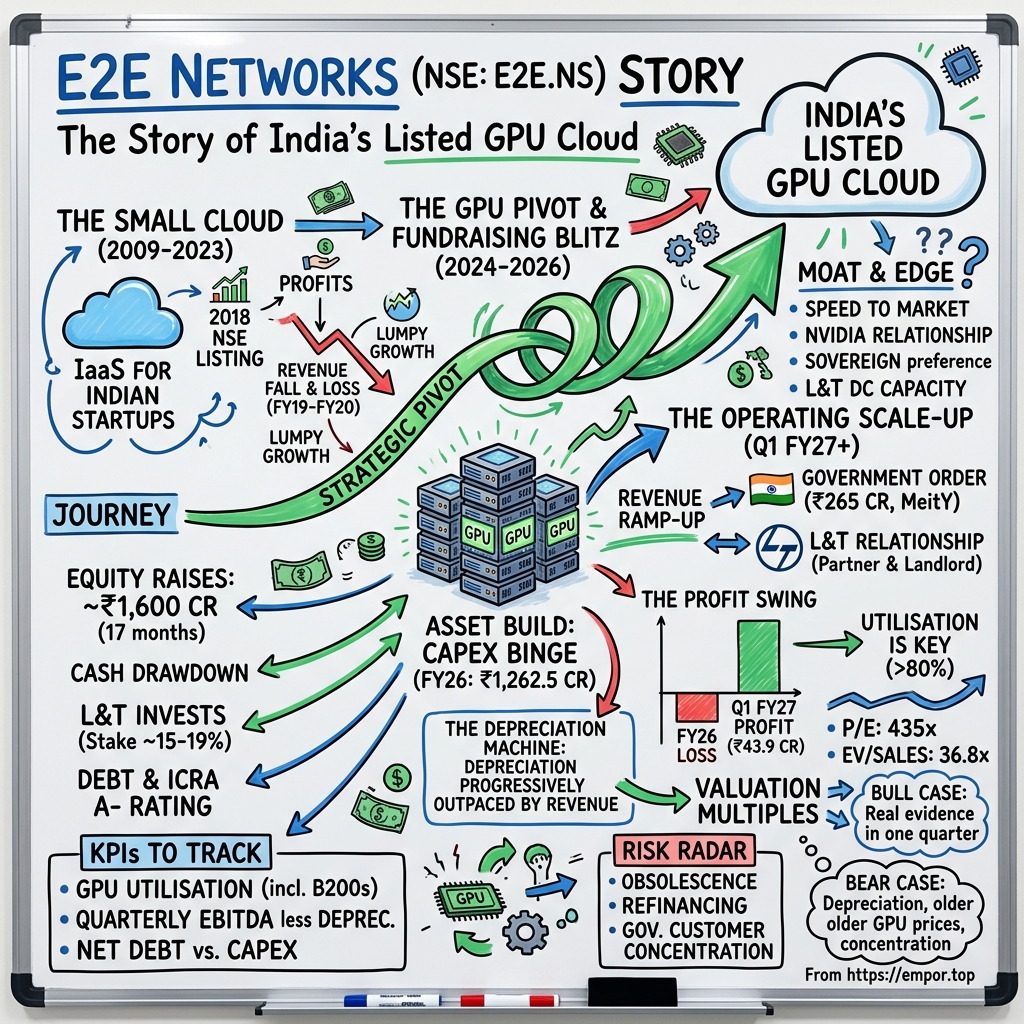
E2E Networks: The Story of India's Listed GPU Cloud
I. Introduction & Episode Roadmap (5 min)
Picture a server hall in Chennai. Row after row of racks hum at a pitch the ear stops hearing after a few minutes. Every rack holds NVIDIA graphics processors that cost more than most Indian homes, and every hour that one of them sits idle, a little of the owner's value quietly leaks out. That owner is not Amazon, Microsoft or Google. It is E2E Networks, a cloud company from Noida that ten years ago was renting ordinary virtual servers to Indian start-ups and making a few crore rupees of profit a year.
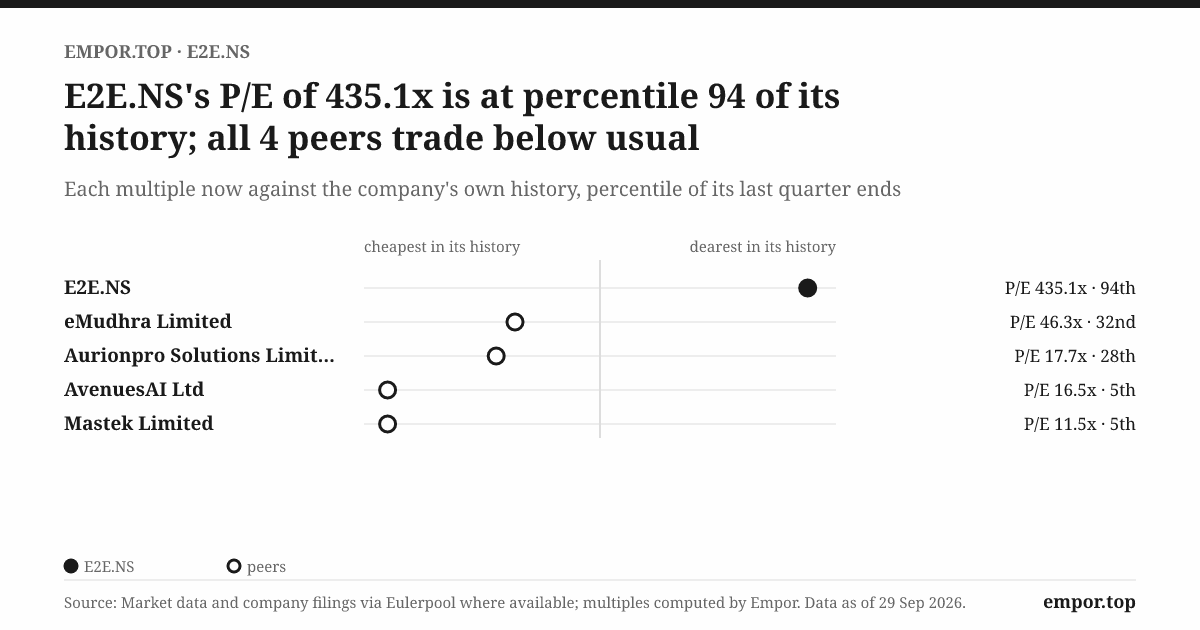
Today the stock market values E2E at about ₹13,500 crore, roughly $1.4 billion. Its revenue for the year to March 2026 was ₹245.6 crore.1 That puts the company at nearly 37 times its annual sales and about 435 times its trailing earnings. Over the past five years the market has typically paid about 56 times earnings for this stock. Something changed, and the market has decided the change is large.
Three numbers frame the story. First, in the year to March 2026, E2E spent ₹1,262 crore on fixed assets, more than five times its revenue.1 Second, it lost ₹15.6 crore for that year, then earned ₹43.9 crore in the single quarter that followed, the April-to-June 2026 quarter the company calls Q1 FY27.14 Third, its quarterly revenue went from shrinking 12.6% on a year earlier in June 2025 to growing 334% in June 2026.4
Those numbers are not the output of a normal software company. They are the output of a capital machine: raise money, buy chips, fill them, depreciate them, and try to earn back the cost before the next generation of chips makes them look old. The story of E2E is the story of whether that machine works in India, run by a founder-led company that went from small to very large capital in about eighteen months.
Four questions carry the episode.
- Is the Q1 FY27 profit a lasting change, or the peak of a fast ramp-up?
- How much of the growth rests on one government buyer and one shareholder-partner?
- Can E2E fund the next round of GPU spending without diluting shareholders again or leaning on debt?
- Does the balance sheet hide credit or supplier exposure behind its low trade receivables?
One boundary matters from the start. Through March 2026 E2E was a single standalone company, with no subsidiary, associate or joint venture.1 Its first subsidiary, Sovcloud Technologies, was incorporated on 17 June 2026.4 Larsen & Toubro, the engineering giant, is a large shareholder and partner, but L&T's own economics are not E2E's, and nothing in this story borrows them. To understand why the market now cares so much, it helps to see how unremarkable this company looked before anyone said the letters GPU.
 Subscribe on LinkedIn
II. The Small Cloud That Waited Its Turn (2009–2023) (10 min)
A cloud without a hyperscaler's wallet
For most of its life E2E Networks was the kind of company only a specialist would notice. It rented computing capacity, meaning virtual servers, storage and networking, to Indian developers and small businesses that wanted something cheaper and closer to home than the American clouds. ICRA, the rating agency, describes a track record of more than a decade in this business, led by promoters with long experience in it.2 The company listed on the National Stock Exchange in May 2018, first on the exchange's small-company platform.2
The model was simple, and it was profitable in a modest way. E2E bought servers, placed them in rented data-centre space, and charged customers by the hour or month. There was no inventory and no factory, just equipment and the skill to keep it running cheaply. In the three years to March 2024 operating margins ran between roughly a fifth and a third of revenue, and in FY24 return on equity reached about 31%.[^3] Those are good returns, but they were earned on a tiny base: shareholders' equity at March 2024 was under $9 million.
The dip nobody talks about
Every growth story has a year it would rather forget. For E2E it was two years. Revenue fell 6.3% in FY19 and then 25.7% in FY20, and in FY20 the company made an operating loss.[^3] That happened before AI, before GPUs, before anyone in India was talking about "sovereign compute". A small cloud company competing against global giants found that customers could leave, prices could fall, and a year of growth could reverse.
This matters more than it appears. The bull narrative today speaks of structural growth, of India's AI moment, of demand that only goes up. E2E's own history says something humbler: its revenue is lumpy. Over ten years revenue has compounded at about 28% a year; over the last three, at about 55% a year. The gap between those two rates is the recent capacity jump, not proof of a new steady compounding rate. The dip of FY19–FY20 is the base rate that any forecast of smooth growth has to beat.
Modest, even at its best
By FY25 revenue had reached about ₹164 crore.1 ICRA called E2E's scale "modest in relation to the size of the industry".2 That is a polite way of saying that, against Amazon Web Services or Microsoft Azure, E2E is a rounding error. It is also a reminder that the company's very recent growth rates are being computed from a small starting point, where one large order can move the percentages dramatically.
Margins tell the same story in reverse. Operating margin was about 22% in FY25 and minus 17.5% in FY26. That drop is not because the business got worse at running servers. It is because the company bought an enormous amount of equipment at once, and the accounting charge for that equipment arrived before most of its revenue. The FY22–FY24 margin structure, 20% to 34%, is the level the company is trying to climb back to at a vastly larger scale.
The founder at the centre
Tarun Dua is the managing director and the largest individual shareholder. The business is family-led: the Whole-Time Director, Srishti Baweja, is his spouse.[^3] That structure matters mostly because of what happened to control over the next two years, which Section VI returns to. For now, the relevant fact is that the same leadership team that ran a small, frugal cloud business is the team that decided to spend more than ₹1,000 crore in one year on chips.
So the verdict for this era is clear. E2E was a real, profitable, small business with a history of occasional sharp falls. The recent jump is capacity-driven on a small base, and it does not by itself prove a steady compounding rate. What turned this small company into a ₹13,500 crore stock was not organic growth. It was capital, and a lot of it, arriving in a very short time.
III. The Pivot to GPUs and the Fundraising Blitz (2024–2026) (18 min)
December 2024: the price that reset the story
In December 2024, Larsen & Toubro agreed to buy about 29.8 lakh E2E shares at ₹3,622.25 each, putting in roughly ₹1,079 crore.[^3] Only three months earlier, in September 2024, E2E had sold about 23.9 lakh shares to promoter-group and public investors at ₹1,694.50 each, raising about ₹406 crore.[^3] In one quarter, the price at which the company sold new stock more than doubled.
The effect on the balance sheet was dramatic. Shareholders' equity went from under $9 million at March 2024 to about $188 million at March 2025.[^3] A company that had lived on a few crore of annual profit suddenly had more than ₹1,300 crore of cash and bank balances.1 It was, for a moment, one of the best-funded small tech companies in India.
Why would L&T pay so much more than the September investors? The public documents describe a strategic partnership: L&T gained the right to nominate up to two directors while it holds at least 10%, and E2E gained prioritised access to L&T's data-centre capacity, including a facility in Chennai where new GPUs would be housed.[^3]2 L&T was not buying a cheap stock. It was buying a seat at India's GPU table, and E2E was buying a large anchor investor with physical infrastructure.
The third raise, at a lower price
Then came the third raise. In February 2026 E2E allotted 4.28 lakh shares through a qualified institutional placement (QIP) at ₹2,500 a share, raising about ₹107 crore.1 The board had approved it in September 2025 and shareholders in October 2025. The price was about 31% below what L&T had paid fourteen months earlier.
Put the three prices side by side and a pattern appears: ₹1,694, then ₹3,622, then ₹2,500. That is not a company selling stock only when it is expensive. It is a company raising whenever it needs money, at whatever the market will bear. Across roughly 17 months it raised about ₹1,600 crore of equity.[^3]1 L&T's investment, marked at the QIP price, was underwater at the time of that placement. None of this is scandalous, but it does undercut any claim of valuation discipline. The better description is urgency: GPU supply was scarce and the company chose to buy it while it could.
Where the money went
The spending was just as fast as the raising. Purchases of fixed assets, including work in progress, were ₹1,262.5 crore in FY26, against ₹125.9 crore the year before.1 Net property, plant and equipment rose from about ₹311 crore to ₹963 crore, and capital work in progress, equipment bought but not yet in service, was ₹533 crore at March 2026.1 Back in March 2025 the company had already committed ₹904 crore to future capital spending.[^3]
Think of it like a new hotel. The owner has paid for the building, the furniture and the linens, but half the rooms are still being fitted out, and the guests arriving now pay for only the finished rooms. That is why revenue divided by total assets, a measure called asset turnover, fell to about 0.11 in FY26, against about 1 before the build. The business now owns about nine rupees of assets for every rupee of annual sales.
Cash shows the other side. Cash and bank balances fell from about ₹1,357 crore to ₹366 crore during FY26.1 Borrowings, meanwhile, rose from about ₹11 crore to about ₹103 crore, not counting about ₹56 crore of lease liabilities.1 The war chest of 2025 was mostly spent within a year.
The interest-income cushion
There is a subtle accounting consequence. While the raised money sat in bank deposits, it earned interest. In FY26 interest income was about ₹26.5 crore, part of ₹34 crore of other income.1 The pre-tax loss that year was ₹21.2 crore.1 Strip the interest out and the loss would have been closer to ₹55 crore. In FY25 the effect was even larger: other income was about 63% of pre-tax profit.1
This is not hidden. It is simply easy to miss. As the cash is spent, that cushion shrinks, and the reported profit has to come from renting GPUs rather than from a savings account.
Debt enters the picture
In November 2025 ICRA rated ₹1,000 crore of E2E's bank facilities at A- with a stable outlook: ₹450 crore of term loans at 8% to 8.5% maturing by FY2029, and ₹550 crore of limits still only proposed.2 ICRA liked the company's low leverage: total debt was only 0.8 times operating profit before depreciation in FY25, down from 3.0 times in FY24.2 It also named what would trigger a downgrade: a considerable fall in revenue or profit, more debt-funded capex than planned, or a stretched working-capital cycle.2 ICRA's own view was that about ₹1,500 crore of near-term capex would be funded by debt and cash.2
The timing matters. That rating was set on FY25 numbers, before the FY26 loss was reported and before the Q1 FY27 profit. On the Q4 call management spoke of debt and "private credit" asset-light models to fund the next leg.3 The shape of those deals is not public yet.
One acquisition belongs here only in passing. E2E bought assets of Jarvis Labs AI under an agreement signed in August 2025 and completed in December 2025, and accounted for it as a business acquisition.1 The company has not disclosed the price in its results filing. The capital story is organic: it is the chips.
Verdict on funding
The historical record gives a clear answer to the third central question. The equity funded a real asset build, and the balance sheet is still lightly geared, with debt at under a tenth of equity. But the pattern is continuous dilution at swinging prices, the cash is mostly gone, and the next ₹1,500 crore has to come from lenders or structured partners. "Financially strong" is true today and narrowing fast. The key test is simple: after Q2 FY27, how much cash remains against remaining capex, and on what terms is new debt priced?
That capex also created the strangest income statement in the company's history, one that swung from profit to loss to profit in the span of five quarters.
IV. The Depreciation Machine: Why Profit Swung from +₹47 cr to -₹16 cr to +₹44 cr in a Quarter (20 min)
20 April 2026: the call about a single line
On 20 April 2026 E2E's management took questions on its FY26 results. The headline was a loss, the company's first annual loss since the FY20–FY21 slump. Management's argument was about one line on the income statement: depreciation. Quarterly depreciation had reached about ₹51 crore, and management said revenue would "progressively" outpace it.3 Meanwhile a new cluster of NVIDIA B200 chips sat in capital work in progress, not yet depreciating, waiting to go live.3
To see why one line decided the year, it helps to understand what depreciation means for a GPU cloud.
Depreciation, explained with a taxi
Imagine buying a taxi for ₹10 lakh that you expect to drive for five years. An accountant will not charge you ₹10 lakh in year one. They spread it, ₹2 lakh a year, as depreciation. Cash left your pocket on day one, but profit is charged gradually. Now imagine buying a hundred taxis in one year while only forty are on the road with drivers. You pay depreciation on the ones that are running, earn fares on those same ones, and the rest sit in the garage.
E2E bought its taxis in FY26. Depreciation and amortisation rose to ₹169.2 crore from ₹60.1 crore in FY25.1 That increase, about ₹109 crore, is far bigger than the swing from a ₹47.5 crore profit in FY25 to a ₹15.6 crore loss in FY26.1 In other words, the entire loss came from depreciation. Before depreciation, the business was more profitable in FY26 than in FY25: EBITDA, earnings before interest, tax, depreciation and amortisation, rose from about $16 million to about $18 million.
Profit into cash
The cash flow confirms that. In FY26 the pre-tax loss of ₹21.2 crore became, after adding back ₹169.2 crore of depreciation, about ₹137 crore of operating profit before working-capital changes, and eventually about ₹122 crore of cash from operations.1 That is about 89% of EBITDA arriving as cash. Over twelve years, cumulative net profit was about ₹75 crore while cash from operations was about ₹426 crore, more than five times as much.
In many companies a gap that large would be a warning sign of aggressive accounting. Here it is the opposite: a business whose reported profit is suppressed by a large non-cash charge. No exceptional items were reported in FY25 or FY26, and employee stock compensation was a modest ₹2.8 crore.1 The cash problem is not in operations. It is in investing: operating cash of ₹122 crore against ₹1,262 crore of capex left free cash flow of roughly minus ₹1,140 crore for the year.
The gap in the middle
The quarterly path is less tidy than the annual one. Revenue fell against the prior year in the June 2025 quarter, down 12.6%, and in the September 2025 quarter, down 7.9%. Operating margins in those two quarters were deeply negative. Then came the turn: growth of 68% in December 2025, 186% in March 2026 and 334% in June 2026.4
What happened in between? The earlier boom in FY25 had been driven by the first wave of AI demand for H100-class chips. By mid-2025 new capacity was being installed but was not yet billing, while older contracts rolled off. The India AI Mission order from the Ministry of Electronics and Information Technology, won in the first half of FY26, and new clusters coming online, then took over.2 The dip is a reminder that a GPU cloud's revenue does not rise smoothly with capacity. It moves in steps, and sometimes backwards, when contracts end before new ones start.
Q1 FY27: the model at work
In the April-to-June 2026 quarter, revenue was ₹156.8 crore, up about 64% on the March quarter's ₹95.6 crore, and net profit was ₹43.9 crore.4 One quarter's profit was almost three times the entire FY26 loss. Operating margin, after depreciation, was about 37%.
Management had talked about a target EBITDA margin of around 70%.3 The June quarter suggests that at high utilisation the target is reachable. It also shows how powerful operating leverage is in this business. Once depreciation and staff costs are covered, most of every extra rupee of rental revenue falls to profit. The same leverage works in reverse: a few points of lost utilisation or price can erase a quarter's profit.
What analysts pressed on
The Q4 call's Q&A is revealing in where answers were concrete and where they were not. On utilisation, management was precise: GPU capacity was running at "80% plus" but "certainly less than 85%", and that figure excluded the new B200 cluster.3 On pricing, management said Hopper-generation (H100 and H200) rental prices were "slowly inching up".3 On customer concentration, the answer was vaguer: there were "enough customers across multiple segments" to avoid dependence on any one.3 Management also said the depreciable block was about ₹1,500 crore, the useful life was six years, and 2,048 more B200 GPUs were planned for FY27.3
That pattern, precise on operating metrics management controls and general on customer mix, is common in small companies. It is also the pattern that leaves outside investors unable to test the most important risk.
Six years in a three-year world
Here is the mechanism that could break the economics. E2E depreciates its GPUs over six years.3 NVIDIA, meanwhile, has moved from Hopper to Blackwell and is already talking about Rubin, with a new generation arriving roughly every year or two. If a customer can rent a newer chip that does the same AI training job in half the time, the older chip's hourly rate has to fall.
If rental rates on a four-year-old chip drop sharply, two things happen. Revenue from the older fleet falls, and the accounting assumption of a six-year useful life comes under pressure. A shorter life would mean higher annual depreciation, lower profit, and possibly write-downs. ICRA names technological obsolescence as a rating constraint.2 Management's comment that Hopper prices are rising is its own view; the company does not publish price lists or realised rates.
Nor does E2E disclose its pricing unit in any detail, whether most revenue is per GPU-hour on demand or reserved capacity on contract, or how long its contracts run. That matters. A reserved one-year contract protects revenue in a price fall; hourly rentals do not.
Verdict on the first central question
The FY26 loss was a depreciation event, not an operating failure, and the operating cash was real. Q1 FY27 shows the model works at high utilisation. But one strong quarter after two quarters of falling revenue is not a trend, and the B200 cluster will add depreciation before it adds full revenue. The claim that profit has turned for good is intact but unproven. The settling numbers are Q2 FY27 revenue, EBITDA and depreciation against Q1, and utilisation including the B200s.
Who is filling those racks? That turns out to be the hardest question of all to answer.
V. The Government Order and the Partner Who Is Also the Landlord (15 min)
An order bigger than a year's revenue
In the first half of FY26, E2E won an order from the Ministry of Electronics and Information Technology under the India AI Mission: about ₹265 crore for 2,524 GPUs over roughly a year.2 For perspective, E2E's revenue for the whole of FY26 was ₹245.6 crore.1 A single government contract was worth more than a year of the company's sales.
The India AI Mission is the government's programme to give Indian researchers, start-ups and institutions access to subsidised compute.5 Instead of building its own data centres, the government empanels private providers and buys capacity from them. For a company like E2E, that is a large, creditworthy buyer showing up at exactly the moment the company had racks to fill.
The buyer holds the pen
But a government order is not a moat. The India AI Mission is a multi-vendor programme. Other Indian providers, including the unlisted Yotta, compete for the same compute tenders. The buyer sets the size of orders, the specifications and, through competitive bidding, the price. Future rounds can go to rivals, and specifications can change as new chip generations appear.
Government buyers also pay on their own schedule. ICRA warned that the order would lengthen E2E's receivable cycle.2 The company does not disclose what share of Q1 FY27 revenue came from MeitY. Without that number, an outside investor cannot tell whether the 334% growth is broad demand or one ministry's budget cycle.
International customers
Management offered one counterweight: international customers made up 35–37% of Q4 FY26 revenue.3 That suggests E2E is not selling only to Indian government programmes. It also raises a currency question. The FY25 annual report described foreign-currency exposure as "not material".[^3] That year the company earned about ₹45 crore in foreign exchange, up from about ₹11 crore the year before.[^3] The statement predates the recent jump in export revenue, and the company does not say in which currency it pays for its GPUs. If it earns rupees at home, dollars abroad, and pays for chips in dollars, the net exposure could be a natural hedge or an added risk. E2E does not report a hedging policy.
L&T: three relationships in one
Now to the partner. L&T is a shareholder, with board nomination rights. It is a customer: in FY25 E2E provided services worth about ₹9.5 lakh to L&T and had about ₹11 lakh of unbilled revenue from it at year-end.[^3] And it is a supplier of data-centre space: ICRA says E2E has prioritised access to L&T's capacity and will place new GPUs in L&T's Chennai facility.2
The FY25 numbers are tiny against ₹164 crore of revenue, and the board described all related-party transactions as ordinary-course and at arm's length.[^3] But the commercial weight of the relationship has grown since then. How E2E pays L&T for space and power, and whether L&T becomes a larger customer, are the disclosures that matter. A landlord that owns a big stake in you and also buys your service can be the best partner in the world. It can also make it hard to judge whether each transaction reflects the market.
How much does L&T actually own?
Even the size of the stake is unclear in public sources. The FY25 annual report gives L&T 14.92% at March 2025.[^3] ICRA puts it at 19% at September 2025.2 The QIP of February 2026 should have diluted L&T slightly, not raised its stake, so the two figures do not reconcile on the public record of share issues. Investors should rely on the exchange-filed shareholding pattern rather than any secondary figure.6
NVIDIA, the supplier with the most power
The last key counterparty sells the chips. ICRA refers to E2E's "established relationships with a large global chip maker".2 That relationship is valuable when chips are scarce. It is also a dependency: allocation of new Blackwell parts depends on NVIDIA's priorities, and E2E does not disclose supply terms.
The verdict on the second central question is that concentration cannot be sized from what E2E publishes. The company is diversified in intent: it has international customers and says it has many segments. It is unproven in numbers. The settling figures are the share of revenue from MeitY and L&T, and receivable days including government balances, in the FY26 annual report and later results.
Those relationships were negotiated by a small leadership team whose own position changed dramatically along the way.
VI. The People in Charge: Founders, Pay and Governance (10 min)
Diluted without selling
Between March 2024 and March 2025, Tarun Dua's personal shareholding fell from 55.69% to 40.37%.[^3] He did not sell a share. The two preferential issues simply added so many new shares that his slice shrank. The promoter group as a whole held 43.6% at March 2025.[^3]
That is a founder choosing growth over control. Dua gave up majority ownership to fund a bet that required far more capital than the old business could generate. It is a meaningful signal: the founder is still the largest holder, and his wealth is tied to the same share price as everyone else's.
Modest pay
E2E does not overpay its leaders. Total remuneration for key managerial personnel was about ₹3.3 crore in FY25, in a year when revenue rose 74% and profit 117%.[^3] The managing director earned 13.5 times the median employee. Pay rises for the top team ranged from about 14% to 18%, below the 25% increase for the median employee.[^3] Those are unusually restrained numbers for a company that tripled its market value.
The flip side is that there is little disclosure of how incentives are structured beyond the employee stock-option cost. Investors cannot see what metrics, if any, determine senior pay: utilisation, return on capital, or simply growth.
The board
At March 2025 the board had eight directors, three of them independent, and the chairman, Gaurav Munjal, is independent.[^3] Two independent directors left during FY25, one in December 2024 and one in March 2025, both citing personal and professional commitments, and a new one joined in March 2025.[^3] Those departures are not in themselves evidence of disagreement, but two exits in a year of rapid transformation are worth watching.
The auditor, GSA & Associates, gave an unmodified opinion on the FY26 results.1 For FY25 the statutory auditor's CARO report showed no disputed statutory dues, no default on borrowings and no fraud, and noted about ₹1,268 crore of preferential-issue funds still unused at year-end.[^3] There were no contingent liabilities at March 2025.[^3] That is a clean record for the periods covered.
Retail money, institutional silence
E2E had about 45,800 shareholders at March 2025.[^3] Foreign and domestic institutions held small stakes; alternative investment funds and foreign portfolio investors together held about 6.8%.[^3] For a company now valued at about ₹13,500 crore, that is a thin institutional presence. A retail-heavy register can support a high multiple for a long time. It can also make the stock more volatile when sentiment turns, because there are fewer long-term holders anchoring the price.
Credibility, tested only in good times
On capital allocation, management raised money at three very different prices in 17 months and spent most of it on one asset class within a year. Whether that was conviction or a race for scarce supply, it has not yet been tested through a down-cycle. The guidance record is short: management's current targets date from the last year or so. The verdict is that pay and related-party flows are reassuringly small, governance is family-led with an independent chair, and management's credibility on the new business is plausible but not yet earned.
The bigger question is whether any of this adds up to a durable edge against far larger rivals.
VII. Who Wins in GPU Cloud? Industry, Competitors and the Moat (18 min)
The battlefield
Imagine a customer, an Indian AI start-up, with a model to train. It has several options. It can rent GPUs from Amazon, Microsoft or Google, which all run cloud regions in India. It can rent from an Indian provider such as E2E or Yotta. It can rent from a global specialist GPU cloud. Or, if large enough, it can buy its own cluster. The customer's choice is mostly about price, availability of the chip it wants, and where the data can legally or comfortably sit.
That is the war game. E2E is a small player in a market where the largest rivals have balance sheets hundreds of times its size. ICRA explicitly names competition from hyperscalers as a constraint.2 Listed Indian comparisons are imperfect: Netweb Technologies builds servers, Tata Communications runs data centres and networks, and Anant Raj is building data-centre capacity, but none is a pure GPU cloud like E2E. Yotta, the closest rival, is unlisted and does not publish comparable financials. Peer margin and utilisation data for Indian GPU clouds is thin.
Porter's five forces
Buyer power is high. The largest customer class includes a government programme that sets volume and price through tenders, and AI start-ups that can move workloads between clouds. Switching a training job from one GPU provider to another is a matter of weeks, not years.
Supplier power is very high. NVIDIA dominates the market for AI training chips, and allocation of its newest parts is a strategic decision on its side.
Threat of new entrants is real. E2E's own history shows that capital for GPU clouds is available: it raised ₹1,600 crore in 17 months. Others can do the same, and the Indian government's programme is explicitly designed to widen the vendor base.
Substitutes include hyperscaler GPU instances and customer-built clusters.
Rivalry is intense and driven by rental price per chip generation. Each new generation resets the price of the previous one.
The five forces point to an industry where suppliers and buyers hold much of the power, and where returns depend on buying chips at the right moment and filling them fast.
Helmer's seven powers
Hamilton Helmer's framework asks what could give a company persistent excess returns. Test each power against E2E's evidence.
Scale economies: E2E would benefit only if unit costs fall as the fleet grows, for example through better purchase terms or lower power and space costs per GPU. There is no disclosure showing that yet, and the hyperscalers are far larger.
Network effects: none apparent. One more E2E customer does not make the service more valuable to another.
Counter-positioning: the argument would be that hyperscalers cannot match a low-cost, India-focused GPU offer without cannibalising their own pricing. That is plausible, but unproven.
Switching costs: low for raw GPU rental. Higher only where customers use E2E's software platform, and no retention metrics are disclosed.
Branding: modest, mostly among Indian developers.
Cornered resource: the L&T data-centre capacity and a relationship with NVIDIA could be scarce assets. But L&T could supply others, and NVIDIA allocates to rivals too.
Process power: E2E's decade of running a lean cloud may give it operating know-how, but that is hard to measure from outside.
The honest conclusion is that the evidence shows access and speed, not a moat. E2E got chips when they were scarce, raised money when investors were eager, and filled capacity fast. Those are real achievements. They are also the kind that can be copied. The advantages worth testing over the next few years are cost of capital, sovereign or data-locality preferences for Indian providers, and the L&T capacity.
What the returns say
History offers a sobering test. E2E earned a return on equity of about 34% in FY18 and 31% in FY24, but on a tiny capital base.[^3] As capital grew about twentyfold, return on equity fell to about 2% for the twelve months to June 2026, and return on capital employed was slightly negative for FY26. A moat would show up as high returns persisting at scale. The test is whether returns recover at the new base once the fleet is full.
The valuation already assumes they will. EV/EBITDA is about 50 times, and the P/E is about 435 times. Before weighing that, there is one more corner of the balance sheet to inspect.
VIII. The Hidden Assets on the Balance Sheet (5 min)
Open the FY26 balance sheet and trade receivables look almost trivial: ₹17.1 crore owed by customers at March 2026, against ₹9.7 crore a year earlier.1 On revenue of ₹245.6 crore that is about 25 days of sales, a clean number for a cloud company. At March 2025 almost all receivables were under six months old, and the impairment charge in FY26 was only about ₹54 lakh.1[^3]
But look a few lines further. Other current assets were ₹210.3 crore, up from ₹178.4 crore, and other non-current assets were ₹101.4 crore, from nil a year earlier.1 On the liability side, other financial liabilities fell from ₹875.7 crore to ₹434.2 crore.1 The company does not break down these lines in its results filing.
Where would things sit? Advances to equipment suppliers, recoverable tax credits such as GST paid on imported GPUs, and possibly balances owed under government contracts would typically land in "other assets". Money owed to suppliers for capital equipment would typically sit in "other financial liabilities", and its fall is consistent with E2E paying for chips it had already received. None of this is confirmed until the FY26 annual report's notes are published.
One widely circulated figure should be set aside. Some data services show E2E's debtor days at 323 for FY26. That figure does not match the company's reported trade receivables, which work out to about 25 days. It likely reflects a broader definition of receivables that sweeps in other assets. This story uses the 25-day figure for trade receivables and treats the other assets as a separate open question.
The verdict on the fourth central question is that trade receivables are clean, and the larger other-asset balances are unexplained rather than alarming. The FY26 annual report's notes on other assets, other liabilities and receivable ageing, and its CARO annexure, will settle it. With the evidence laid out, the story's lessons come into focus.
IX. Playbook: Business & Investing Lessons (6 min)
Depreciation is the price of the ticket, and utilisation is the ticket. E2E lost money in FY26 not because customers left but because it bought a fleet of chips that started charging depreciation before they started earning. Then one quarter at 80%-plus utilisation produced almost three times the year's loss in profit. For anyone owning a capital-heavy AI infrastructure business, the only number that matters in the short run is how full the racks are. Every other metric follows from it.
Raise in the boom, spend before the cash cools. E2E raised about ₹1,600 crore in 17 months at three prices that swung from ₹1,694 to ₹3,622 and back to ₹2,500, and it spent most of it within a year. Founders often think of fundraising as timing the top. E2E's lesson is different: in a supply-constrained market, the prize is not the best price for your stock but the chips you can buy with whatever you raise. That works only as long as the chips earn back their cost before the next generation arrives.
A shareholder who is also your customer and landlord is three relationships in one. L&T owns a large stake, buys a little of E2E's service and supplies the building its newest chips live in. Each role can be healthy. Together they make it hard for an outside shareholder to price any single transaction. The investor lesson: when a strategic partner wears three hats, ask for disclosure of each hat separately.
A one-quarter profit is a data point, not a trend. Revenue shrank in two quarters of 2025, then rose 334% in the June 2026 quarter. The market has priced the latest quarter as the new normal. The lesson from E2E's own record, from the slump of FY19–FY20 to the dip of mid-2025, is that growth in this company comes in steps and sometimes goes backwards.
Cheap-looking debt on expensive-looking assets still has to be repaid in a down-cycle. Borrowings went from ₹11 crore to ₹103 crore in one year, with up to ₹1,000 crore of facilities rated and more capex planned. Loans at 8% look cheap next to a 70% EBITDA margin. They look very different if rental rates on a three-year-old GPU fall by half.
X. Analysis, KPIs & Bull vs. Bear (10 min)
The price and what it assumes
At about ₹13,500 crore of market value and a trailing EPS of ₹1.47 after the 1:10 share split, E2E trades at about 435 times earnings against a five-year median near 56 times.4 Enterprise value is about 420 times operating profit, and free cash flow is negative because of capex. Return on equity is under 2%.
What does that price assume? It assumes the Q1 FY27 profit rate holds and grows, that the B200 cluster fills as fast as the Hopper fleet did, and that the next round of capex is funded without heavy dilution. Annualise the June quarter's ₹43.9 crore of profit and the P/E falls to about 77 times. That is still well above the stock's own historical median, so the market is paying for growth beyond one excellent quarter.
The bull case
The bull case has real evidence. Utilisation was above 80% before the newest chips went live.3 Management says older-generation rental prices are rising, not falling.3 The balance sheet is lightly geared and carries an A- rating.2 L&T is an anchor shareholder with data-centre capacity. India's sovereign-AI programme is a policy tailwind for local providers. And the June quarter delivered an operating margin of about 37% after depreciation, showing that the machine works when full.
The bear case
The bear case rests on mechanism, not sentiment. Chips depreciated over six years face a commercial cycle that may be three. About ₹1,500 crore of further capex needs funding, with cash already down to ₹366 crore. The shareholder register is retail-heavy and thin on institutions. One government buyer and one partner could explain a large share of growth that the company does not break down. And revenue fell in two quarters only last year.
A short-seller's stress test
A sceptical long/short investor would press on three things. First, the multiple: 435 times trailing earnings for a business whose returns on capital are near zero today. Second, interest income: in FY25 it made up most of pre-tax profit, and in FY26 it covered the operating loss, flattering the reported numbers while cash lasted. Third, the useful life: if the company shortened depreciation to four years, annual depreciation on a ₹1,500 crore block would rise by about half, and much of the Q1 profit would vanish. None of these points is proof that the bull case is wrong. Each is a specific place where the bull case could fail.
Three KPIs to track
- GPU utilisation including the B200s. Latest reading: "80% plus", below 85%, before the B200 cluster.3 Direction: up through FY26.
- Quarterly EBITDA less depreciation. Latest reading: sharply positive in Q1 FY27 after being negative for most of FY26. This single number captures whether revenue is outrunning the cost of the fleet.
- Net cash against remaining capex. Latest reading: ₹366 crore of cash and about ₹103 crore of borrowings at March 2026, against roughly ₹1,500 crore of planned capex.12 Direction: falling.
Risk radar
Technological obsolescence is the main risk, through the depreciation mechanism above. Refinancing and cost of capital come next, because the next leg is debt-funded. Government-customer concentration and receivable stretch follow from the India AI Mission order. Supply depends on NVIDIA. And export revenue brings a currency exposure the company still describes as immaterial.
The picture that emerges is of a business whose bull case has one quarter of hard proof, and whose bear case rests on forces that play out over years.
XI. Epilogue (2 min)
Tonight E2E stands on a single great quarter, a nearly spent war chest and a warehouse of new chips waiting to earn their keep.
The next moments will decide the story. Q2 FY27 results will show whether revenue held above Q1 with the B200 depreciation now switched on, and whether utilisation stayed above 80% with the new fleet included. If it did, the first central question tilts decisively toward a lasting change. If revenue slips while depreciation rises, the Q1 profit will look like the peak of a ramp.
The FY26 annual report will open the notes that matter: related-party dealings with L&T, the composition of those other assets and liabilities, receivable ageing, and the CARO annexure. Clean answers would narrow the second and fourth questions. A large share of revenue from MeitY, or long-dated government balances hidden in other assets, would reopen them.
Sovcloud Technologies, the new subsidiary, will sign its first contracts, and the first private-credit or debt package for the next ₹1,500 crore will set the price of E2E's capital. Cheap, long-dated funding would answer the third question in the company's favour. Expensive or dilutive funding would confirm the record of continuous capital raising. And the next round of India AI Mission tenders will show whether the government remains a buyer at similar prices or spreads its orders across rivals.
The tension is simple to state and hard to resolve. E2E has proved it can fill a GPU rack faster than it can prove it can keep it full.
XII. Outro (1 min)
Go back to that Chennai server hall. Five years ago the company that owns those racks was renting ordinary servers to Indian start-ups, and it had just come through a year in which a quarter of its revenue vanished. In FY26 it lost ₹15.6 crore. In the three months that followed, it made almost three times that.
Every GPU in that hall is on a clock. It started ticking the day the chip was switched on, and it stops when a newer chip makes its hourly rate uncompetitive. E2E is a bet that in AI, the rented chip pays back before the next chip arrives.
References
-
Outcome of Board Meeting and audited results for the year ended 31 March 2026 — E2E Networks, 2026-04-20 ↩↩↩↩↩↩↩↩↩↩↩↩↩↩↩↩↩↩↩↩↩↩↩↩↩↩↩
-
E2E Networks Limited: [ICRA]A- (Stable); assigned — ICRA, 2025-11-27 ↩↩↩↩↩↩↩↩↩↩↩↩↩↩↩↩↩↩
-
Transcript of Q4 FY26 earnings call — E2E Networks, 2026-04-20 ↩↩↩↩↩↩↩↩↩↩↩↩↩
-
E2E Networks Net Profit Jumps To ₹43.88 Crore In Q1 FY27, Revenue Up 334% — Free Press Journal ↩↩↩↩↩↩
-
India AI Mission — Ministry of Electronics and Information Technology / IndiaAI ↩
-
E2E Networks corporate filings, shareholding pattern and voting results — BSE India ↩
 LinkedIn
 WhatsApp
 Reddit
 Hacker News
 Email
Email Kindle
 RSS Feed
 Spotify
 Apple Podcasts
 Amazon Music
 Audible
 YouTube