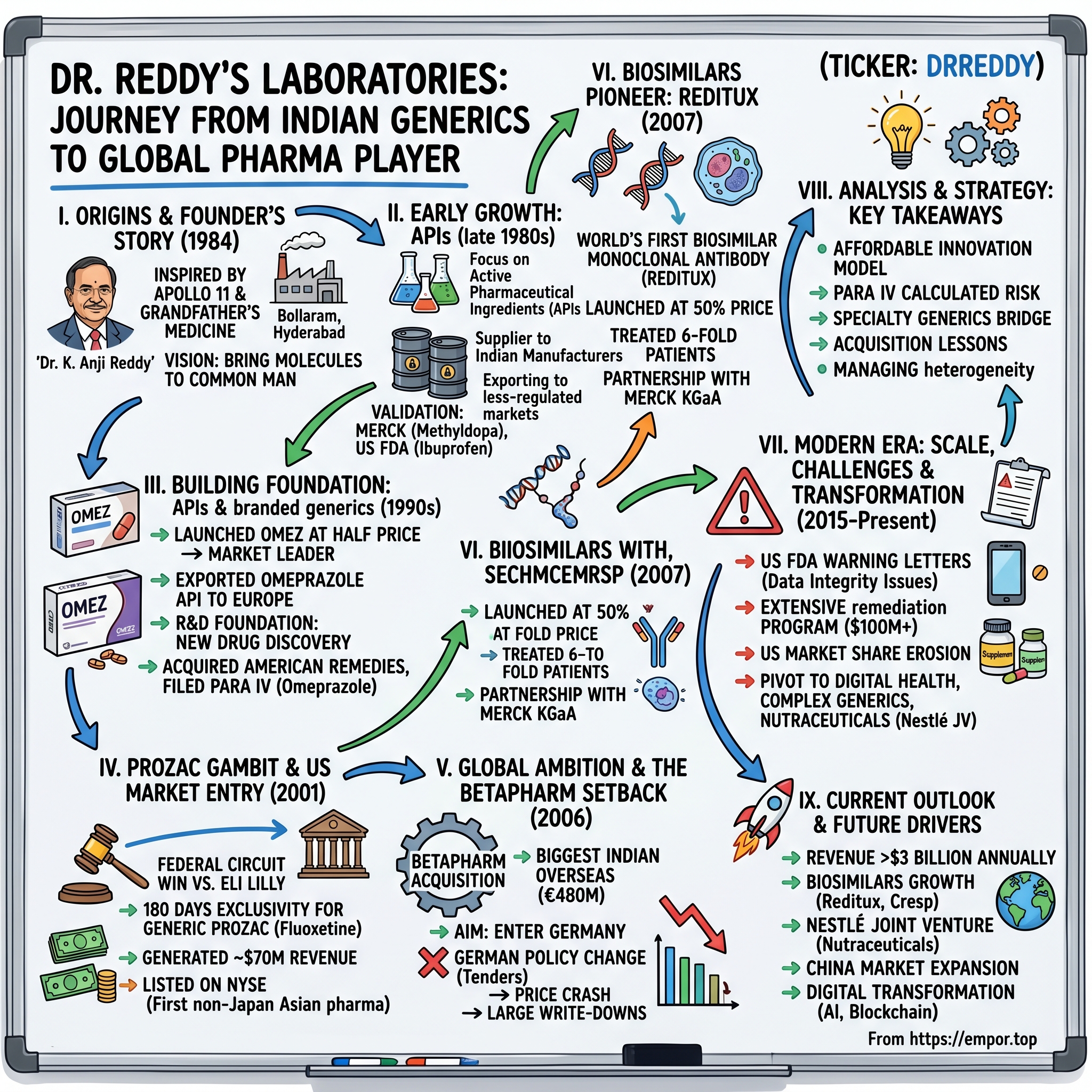
Dr. Reddy's Laboratories: The Para IV Playbook Runs Out
I. Introduction & Episode Setup
On the evening of July 22, 2026, a Zoom call convened for Dr. Reddy's Laboratories' first-quarter results. The format was routine — a lead of investor relations, a chief financial officer, a chief executive, the ritual invitation to use the "raise hand" button. What followed was not routine at all.
The company reported that its North America generics business, for two decades the engine of its profits, had shrunk by 41% year over year.1 It disclosed a ₹240 crore provision against inventory and rejected batches of semaglutide — the active ingredient in the world's most sought-after class of weight-loss and diabetes drugs, and the single product Dr. Reddy's had spent three years telling investors would replace what it was about to lose.1 Profit for the quarter fell to ₹443 crore, roughly a third of what it had been a year earlier.1 In New York, the American depositary shares fell 9.4% to close at $11.38.2
Six weeks later, on September 1, 2026, the New York plaintiffs' firm Pomerantz LLP announced it was investigating whether Dr. Reddy's and certain of its officers and directors had engaged in securities fraud, pointing directly at that quarter's disclosures and the semaglutide provision.3 An investigation is not a charge, and a plaintiffs' firm press release is not a finding of fact. But it is a marker of where the story now sits.
This is not the familiar narrative of a scrappy Hyderabad chemist who took on Big Pharma's patents and won. That story is real, and it happened, and it is worth telling properly. But it belongs to a company that no longer exists in quite that form. The Dr. Reddy's of September 2026 is a roughly $3.6 billion-revenue, NYSE- and NSE-listed generics and active-ingredient manufacturer whose two largest growth bets — a patent-cliff windfall that ran out on schedule, and a GLP-1 manufacturing push that broke on a quality failure — both came apart inside the same twelve months.41
The question this piece will test is deceptively simple: does Dr. Reddy's have a credible case for winning from here?
The bull answer runs roughly like this. The company owns its own active-ingredient plants, which gives it a real cost position in an industry where price only ever goes one direction. It has a two-decade record of occasionally hitting spectacular patent-challenge jackpots. It carries almost no net debt. And the market has already priced in most of the visible bad news, which means the bar for a positive surprise is lower than it was a year ago.
The bear answer is that two consecutive quarters of management's own confidently-stated forward guidance broke on execution rather than on macro conditions; that the biosimilars business the company has been building since 2007 still generates about $100 million of annual sales while a Korean competitor that started later now runs a biosimilar franchise nearly thirty times that size;5[^6] and that the manufacturing facility meant to deliver the next growth story is the same one drawing the most regulatory scrutiny.16
Both readings are defensible on the evidence. Sorting them requires going back to where the playbook came from — because the thing that is breaking in 2026 is not a new strategy. It is the oldest one Dr. Reddy's has.
 Subscribe on LinkedIn
II. Origins: The Affordable-Medicine Playbook (1984–2001)
Kallam Anji Reddy was the son of a turmeric farmer in the Guntur district of Andhra Pradesh — a detail that matters, because turmeric farming in mid-century coastal Andhra was not a business that produced pharmaceutical entrepreneurs.7 He took a doctorate in chemical engineering, joined the state-owned Indian Drugs and Pharmaceuticals Limited in 1969, and left in 1975, apparently convinced that a public-sector chemist's career was too small a container for what he wanted to do.7
After a stretch running partnership firms, he incorporated Dr. Reddy's Laboratories as a private limited company on February 24, 1984, with initial capital of ₹25 lakh — roughly $20,000 at the time.87 The stated objective, written into the founding documents and repeated in every annual report since, was "developing and supplying high-quality pharmaceutical products at affordable prices."8
That phrasing is worth pausing on. India in 1984 operated under the Patents Act of 1970, which recognised patents on the process of making a drug but not on the drug molecule itself. For an Indian chemist, this was an extraordinary arbitrage: if you could invent a new route to a molecule Pfizer or Eli Lilly had spent a decade discovering, you could sell that molecule in India legally, at a fraction of the price. The entire Indian generics industry was built in that gap. Anji Reddy's particular insight was that the arbitrage was fundamentally a chemistry problem, not a marketing problem — and that whoever built the best process chemistry would own the cost curve.
So he started with the hardest, least glamorous part of the business. The first factory was an active pharmaceutical ingredient plant at Bollaram, outside Hyderabad.9 APIs are the actual drug substance — the molecule itself, before it is pressed into a tablet or filled into a vial. The finished-dose business is where the brand and the margin live; the API business is where the manufacturing skill lives. Most Indian pharma founders started with formulations and bought their APIs. Reddy started with the API and worked forward, which is why, four decades later, vertical integration into its own ingredient supply remains one of the few genuinely structural advantages the company has.
The equity shares listed on the Bombay and National stock exchanges from December 6, 1985.8 API exports to the United States began the following year.9 In 1991 came Omez, a generic omeprazole for acid reflux, which became the company's first genuine blockbuster brand in India and demonstrated that the process-chemistry advantage could be translated into consumer-facing branded generics.9 A Russian branch opened in 1992 — an early bet on a market that, three decades on, still contributes a meaningful slice of emerging-markets revenue.9
Then came the moment that defined everything after.
The Prozac trade
By the late 1990s the Indian patent regime was on borrowed time; India had signed the WTO's TRIPS agreement and product patents were coming. The process-chemistry arbitrage at home was closing. The only way to keep the model alive was to export it — to go into the United States and attack innovator patents directly.
The mechanism was a provision of the Hatch-Waxman Act called a Paragraph IV certification. In plain terms: a generic company files an application to sell a copy of a still-patented drug, asserting that the innovator's patent is either invalid or not infringed by its version. This is a legal declaration of war. The innovator sues, almost automatically. But the reward for the first filer who wins — or settles favourably — is 180 days of exclusivity as the only generic on the market. For six months, one generic company competes against one branded product, and prices stay high. It is the closest thing the generics industry has to a lottery ticket, except that the ticket costs millions in litigation and takes years to scratch.
Dr. Reddy's filed against Eli Lilly's Prozac — fluoxetine, then one of the most prescribed drugs in the world. In 2001, the company obtained 180-day marketing exclusivity for fluoxetine, becoming the first Indian company ever to secure such a window in the United States.9 Over the exclusivity period, Dr. Reddy's took in roughly $56 million, or about ₹258 crore.7 Against a company of that size in 2001, that was transformational money — and more importantly, it was proof.
The same year, the company listed American depositary shares on the New York Stock Exchange on April 11, 2001, becoming the first pharmaceutical company from Asia outside Japan to do so.89 Read together, the two events tell you exactly how the founder saw his company: not as an Indian firm that exported, but as a global generics company that happened to be headquartered in Hyderabad.
What the playbook actually was
Strip out the romance and the DNA is three things. First, own the chemistry — make the ingredient yourself, cheaper than anyone. Second, litigate. Be willing to spend years and millions attacking patents held by companies fifty times your size, because the payoff on a win is enormous and the losses are survivable. Third, treat the resulting windfall as capital to be redeployed into the next windfall, because exclusivity income is by construction temporary.
That third element is the one that carries the most weight for what follows. A Para IV win is not a moat. It is an event. It generates a large, dated, and fully anticipated cash flow, and then it stops. A company built on this model must be permanently in the business of manufacturing its own replacement earnings. Everything that happens to Dr. Reddy's between 2006 and 2026 — the German acquisition, the biosimilars programme, the GLP-1 build-out — is an attempt to answer the same recurring question: what replaces the last windfall?
The first attempt at that answer cost the company more than any Para IV loss ever did.
III. The Betapharm Lesson: What Capital-Allocation Discipline Actually Cost to Learn
Picture a boardroom in Hyderabad in early 2006. Dr. Reddy's had just become the fastest Indian pharmaceutical company to reach $1 billion in revenue.9 The Prozac trade had proved the model worked. Cash was available, credit was cheap, and the private-equity firm 3i Group was running an auction for a German generics business.
Germany was, on paper, the perfect target. It was Europe's largest generics market, structured around branded generics — meaning German doctors and patients chose specific generic brands, which meant margins looked more like consumer products than commodities. And betapharm was the fourth-largest generics company in Germany by sales, with about 3.5% market share and gross revenues of €164 million for the year to November 2005.10
In March 2006, Dr. Reddy's bought it for €482.6 million in cash, funded through a combination of internal reserves and committed term loans.10 At roughly three times the target's revenue, it was the largest overseas acquisition an Indian pharmaceutical company had ever made.
The thesis broke within months. In 2007, the German government reformed how statutory health insurers procured generics, shifting to a tender system — competitive bidding, where insurance funds award a molecule to whichever supplier bids lowest, and pharmacies then dispense that winner. Dr. Reddy's own recent filings describe the aftermath plainly: more than 90% of generic products sold in German retail outlets now move through such rebate contracts.8 The brand equity that justified the €482.6 million price tag was, functionally, legislated out of existence.
The damage is disclosed in black and white in the company's own accounts. Of a cumulative impairment loss of ₹16,948 million recorded across the periods presented, ₹16,003 million relates to betapharm Arzneimittel GmbH — booked across the years ended March 31, 2009 and 2010.8 In other words, roughly ₹16 billion of the purchase price was written off within four years of the deal closing. Contemporary reporting described a business whose headcount fell from around 400 to about 80, with manufacturing shifted to India.7
The post-mortem, and why it counts
What happened next is genuinely unusual, and it is the reason this deal is worth thirty paragraphs rather than three.
Indian promoters — and, to be fair, promoters everywhere — do not typically narrate their own acquisition failures. Dr. Reddy's leadership did. Satish Reddy, the founder's son, told Forbes India that the experience "made us realise that we were cost competitive but not cost conscious."11 G V Prasad, the founder's son-in-law and the company's managing director, framed it as a lesson about proximity: "It is a lesson that we should be present in the market when we are committing such a large investment."11 Satish Reddy went further, describing how "the lessons from the wrong acquisition forced us to re-think everything we knew about running the business."11
Note what is absent. There is no blaming of German politicians, no invocation of the financial crisis, no framing of the write-off as a non-cash accounting artefact. For an investor assessing management credibility, undeflected accountability on a nine-figure mistake is a genuine data point — and it is worth holding onto, because the more recent record on promise-versus-outcome is considerably less flattering.
Myth versus reality: the divestment that never happened
The widely-repeated version of this story ends with Dr. Reddy's selling betapharm and moving on. It did not.
betapharm Arzneimittel GmbH still appears as a consolidated subsidiary in Dr. Reddy's FY2026 Form 20-F, four decades into the company's life and two decades after the deal.8 The company continues to sell "a broad range of generic pharmaceutical products under the 'betapharm' brand" in Germany.8 It absorbed the loss and kept the asset.
This cuts in two directions, and honest analysis should hold both. On one hand, the mistake was never paved over by an exit — the carrying value was written down, the business was restructured, and it continues to contribute to a European segment that has since been rebuilt around a different strategy. On the other hand, "we kept it" is not the same as "we fixed it," and there is no disclosed evidence that betapharm ever earned back anything close to the capital originally committed.
Did the lesson hold?
The stated strategy shift after Betapharm was to avoid large, competitive-bid acquisitions in favour of smaller, capability-complementary deals. Judged on its own terms, over twenty years, that discipline broadly held: no second Betapharm-scale disaster occurred, and the deal that finally exceeded it in size — the 2024 nicotine-replacement acquisition covered in Section V — was funded without straining the balance sheet.
But the claim narrows rather than survives intact, and the narrowing is recent. In the year ended March 31, 2026, Dr. Reddy's discontinued its CAR-T cell therapy research programmes "in light of the current development status and recent clinical trial outcomes," recognising an impairment of ₹1,291 million.8 In the same year it wrote off ₹914 million against eftilagimod alfa, an oncology asset in-licensed from Immutep, after a Phase III study in first-line non-small-cell lung cancer was discontinued following a futility analysis.8 Dr. Reddy's had paid $20 million upfront for those rights, of which $10 million was refundable precisely if the futility analysis came back badly — meaning the company had priced the risk, and the risk happened.8 A smaller cannabis-distribution acquisition, Nimbus Health, carries its own ₹272 million impairment recorded in FY2023.8
The honest conclusion: the Betapharm lesson was learned for one failure mode — writing a very large cheque into a market the company did not understand — and not for another. Capital destruction in speculative pipeline and licensing bets has continued, at a scale that is individually immaterial but collectively persistent. That is a different and more forgivable failure than Betapharm, but it is not the same as discipline restored. The test to watch is whether the FY2026 write-offs prove to be a cluster or the start of a pattern.
To understand why any of this matters at the scale it does, you have to look at where the money in this company actually comes from.
IV. The Business Today: Segments, Geography, and Who Actually Drives the P&L
If you wanted to build a mental model of Dr. Reddy's from scratch, start with a simple picture: a very large, globally-certified factory system that makes chemical molecules and turns them into pills, injections and pens, attached to sales organisations in about half a dozen markets that sell those products under either a generic label or a brand name.
Formally, the company reports two segments. Global Generics — finished-dose products sold in North America, Europe, India and emerging markets — accounts for roughly nine-tenths of revenue. Pharmaceutical Services and Active Ingredients, or PSAI, is the other tenth: selling APIs to other drugmakers and running contract development and manufacturing for third parties. In FY2026, PSAI booked ₹34,774 million of revenue against total company revenue of ₹335,933 million.4
The economics of those two segments are not remotely similar, and the gap explains a great deal. In the June 2026 quarter, Dr. Reddy's reported a gross margin of 51.6% in Global Generics against 4.5% in PSAI — and even stripping out the semaglutide provision that crushed the ingredient business that quarter, the adjusted comparison was 53.8% against 12.9%.1 Making the molecule is a low-margin industrial business. Selling the finished product to a patient or a pharmacy chain is where the money is. This is worth remembering whenever PSAI is presented as a growth story: the segment can grow its top line handsomely without moving group profit very much.
The geography that mattered, and the geography that now does
For most of the last fifteen years, the answer to "where does Dr. Reddy's make its money?" was North America. In FY2026 it was still the largest single geography at ₹113,737 million — but that figure was down 22% year over year.4 Emerging markets grew 23% to ₹67,608 million; India grew 16% to ₹62,186 million; Europe grew 55% to ₹55,501 million, though most of that came from an acquisition rather than organic momentum, with underlying growth nearer 14%.4
By the June 2026 quarter, the rebalancing had gone further. North America contributed 27% of revenue.1 Management pointed out on that call that the branded franchises — India, emerging markets and the nicotine-replacement consumer business — together accounted for 52% of revenue and described them as "an important source of stable margins."1
That framing is doing real work, and it deserves scrutiny rather than acceptance. It is true that branded and consumer-health revenue tends to erode less brutally than US generics. It is also true that these businesses are structurally smaller-ticket and more selling-and-marketing intensive. Selling, general and administrative expense ran at 36% of revenue in the June quarter — up from 30% a year earlier — driven partly by "targeted investments in the branded businesses."112 A mix shift toward branded markets is not free margin; it is a trade of gross margin volatility for higher fixed selling costs. Whether it is a good trade depends entirely on whether those markets keep compounding at the mid-teens rates management described.1
Why US generics is a hard place to have a moat
Here is the part that most matters for anyone modelling this business, explained without jargon.
In the United States, generic drugs are not really sold to patients or even to pharmacies. They are sold to a small number of enormous purchasing organisations — group purchasing organisations and pharmacy benefit managers — that have consolidated over the past fifteen years into a handful of buying groups controlling the overwhelming majority of volume. When a dozen qualified manufacturers can each make the same off-patent molecule to the same FDA standard, and three buyers control access to the shelf, the outcome is arithmetically predictable: prices fall every year, forever, and the buyer captures the surplus.
Dr. Reddy's own management has described this without euphemism. Asked on the June 2026 call why the US base business had failed to grow despite roughly 90 to 100 product launches over four years and an acquired portfolio, chief executive Erez Israeli acknowledged "a significant price erosion that was through this period of time. In some of the years, it was even in double" digits, and — notably — conceded, "we absolutely had productivity issues, and I believe that we took the right measures to correct it."1
That exchange, initiated by IIFL's Rahul Jeewani, is the single most useful three minutes on any recent Dr. Reddy's call. The analyst's framing was that North America revenue had been close to a billion dollars in FY2022 and was annualising near $950 million four years later, despite roughly a hundred launches in between.1 The CEO's answer combined an external explanation (price erosion) with an internal one (productivity), and then offered a defence worth weighing: that products developed for the US were subsequently launched across Europe and emerging markets, so the return on that development spend showed up elsewhere on the geographic map.1
That is a reasonable argument, and the emerging-markets and Europe growth rates lend it some support. It is also, structurally, an admission: the US portfolio is now valuable partly as a development engine for other geographies rather than as a profit pool in its own right. That is a materially less attractive business than the one the market paid a premium for a decade ago.
Applying Porter's framework to this market gives a coherent picture. Buyer power is extreme and still rising. Rivalry is intense, with many qualified suppliers per molecule. Barriers to entry are moderate — FDA approval and manufacturing scale are real hurdles, but not high enough to keep Chinese and other Indian suppliers out. The threat of substitutes is low, but only in the trivial sense that generics are the substitute. Supplier power is the one force where Dr. Reddy's holds an advantage, because it makes its own ingredients rather than buying them. That vertical integration is genuine and quantifiable in cost terms. It is not, however, a growth engine, and it does not stop prices falling.
The strategic conclusion follows directly: for a company like this, competitive advantage in commodity generics is temporary by construction — it lives inside exclusivity windows, not inside the base business. Which brings us to the people responsible for deciding what to do about that, and how they have spent the shareholders' money.
V. Current Management: Succession, Ownership, and the Capital-Allocation Record
Dr. Reddy's has run an unusual governance structure for over a decade: the founding family holds the chairman and co-chairman seats, and a professional outsider runs the company.
K. Satish Reddy, the founder's son, has served as chairman since 2015; he joined the company in January 1993 and holds a B.Tech and a master's in medicinal chemistry.8 G V Prasad, his brother-in-law, has been co-chairman and managing director; he joined in June 1990 and trained as a chemical engineer before taking a master's in industrial administration.8 Between them they carry more than seventy years inside the business.8
The operating job belongs to Erez Israeli, who joined on April 2, 2018 and became chief executive the following year.8 His background is the most important fact about the company's current strategy. Israeli spent more than two decades at Teva Pharmaceutical Industries, including running its API business — the same vertically-integrated model Dr. Reddy's is built on — and leading a multi-year, multi-billion-dollar cost transformation there. He came to Hyderabad from Enzymotec, an Israeli nutrition-ingredients company.8
You can read his Teva formation directly in how he talks to analysts. On the July 2025 call, asked how the company would protect margins through the coming revenue cliff, he described a specific, quantified lever: "there are discretionary costs between R&D, SG&A that can be 500 basis points, 600 basis points that we are planning to adjust in according to the motion."12 That is a cost-transformation executive's answer — the margin is defended by pulling spending, not by hoping demand improves. It is also, in fairness, an honest one.
The same call contained the clearest statement of the company's actual capital strategy that management has given. Explaining why research spending would fall, Israeli said: "We used the time in which we enjoyed the backing, the tailwind that came with lenalidomide, and we boosted some investments for the future, including abatacept; including the creation of the franchise of the GLP-1; including the build-up of the facilities for that; including the acquisition of the NRT Business."12
That is the whole thesis in one sentence: convert a temporary windfall into permanent assets before the windfall ends. Whether it worked is the subject of the next three sections.
The deals
Under Israeli, capital allocation has been deliberately bolt-on and licensing-heavy. The company acquired a US generics portfolio from Mayne Pharma in 2023, which management has said contributed about $100 million of incremental revenue.1 It picked up trademarks and assets for the women's-health brands Progynova and Cyclo-Progynova in India for ₹3,014 million.8 It formed a nutraceuticals joint venture with Nestlé Health Science India to commercialise nutrition and wellness products domestically.8 And it signed a string of biosimilar in-licensing agreements — daratumumab rights from Henlius for the US and Europe at ₹5,025 million upfront and milestones, ustekinumab and golimumab from Bio-Thera with a Southeast Asia focus, denosumab and a pembrolizumab candidate with Alvotech.81312
The largest and most scrutinised deal of the era was the nicotine-replacement acquisition. In June 2024 Dr. Reddy's agreed to buy Haleon's global nicotine-replacement therapy portfolio outside the United States — Nicotinell, Nicabate and related brands — through the purchase of Northstar Switzerland SARL, for total consideration of up to £500 million: an upfront cash payment of £458 million and earn-out consideration of up to £42 million.8 The transaction completed in September 2024.8 Brokerage reaction at signing was mixed, with some houses flagging the entry multiple as demanding.14
Two years on, the assessment is genuinely unresolved. Integration reached about 95% completion by March 2026 and drove European revenue up 55% for the year.154 But the June 2026 quarter showed nicotine-replacement revenue declining because of a change in operating model post-integration — rebates and discounts now flow to distributors and are recognised differently. Management called the change "profit neutral."1 That may well be true, and it is the kind of technical accounting explanation that is usually accurate. It is also the kind that makes the underlying commercial trajectory harder for an outsider to read, which is worth flagging rather than waving through.
Ownership, succession, and a governance event to track
On September 17, 2025, Satish Reddy transferred 75,630,620 equity shares to the VSD Family Trust, and G V Prasad transferred 96,095,920 shares to the GVP Family Trust — disclosed to regulators the following day and executed under an exemption granted by a SEBI order dated December 31, 2024.816 The effect was that Satish Reddy's directly-held stake fell to about 1.21% while his beneficial interest, counting the trust, stayed near 10.27%; the aggregate promoter-group holding was essentially unchanged at 26.63%.8
This is textbook third-generation succession planning at a founder-family company, and there is no evidence in the filings of an exit or a reduction in family control. It is nonetheless worth tracking, because trust structures change who makes decisions over long horizons even when they do not change the percentages.
On compensation: for the year ended March 31, 2026, Israeli's disclosed compensation was ₹230.33 million, alongside a grant of 259,793 options at an exercise price of ₹1,162.8 Satish Reddy received ₹100.66 million and G V Prasad ₹158.17 million, in each case dominated by a commission capped at 0.75% of net profit as defined under the Indian Companies Act.8 That commission structure has an underappreciated feature: because it is levied on profit, the family's pay fell mechanically alongside the FY2026 earnings collapse. Alignment is imperfect but real.
The balance sheet, tested properly
Dr. Reddy's is frequently described as a company that has never diluted its shareholders. The precise version is better than the loose one, and the loose one is wrong.
The company raised equity capital in the United States: its ADSs listed on the NYSE on April 11, 2001, in a public offering.8 What is verifiable in the recent record is that ordinary share count has been effectively static — 834,455,365 shares outstanding at March 31, 2025 against 834,656,970 a year later, a change consistent with employee stock option exercises and nothing more.8 Betapharm, the largest acquisition of its first two decades, was funded with internal reserves and term loans rather than an equity issue.10
The contrast with peers is instructive rather than flattering to anyone in particular. Biocon raised close to $1 billion through qualified institutional placements in FY2026 to buy out its biosimilars business and reduce structured debt.17 Dr. Reddy's, over the same period, funded a £500 million acquisition and a peptide-manufacturing build-out without going to the equity market, and still ended the June 2026 quarter with a net cash surplus of ₹3,057 million — about $323 million.1 That is a real difference in financing philosophy, and in a downturn it matters: a company with net cash does not have to raise equity at the bottom.
The caveat is that this strength has never been tested by genuine distress. The FY2026 profit collapse was severe but the company remained solidly profitable and cash-generative throughout. Financial resilience is a claim about behaviour in bad states of the world, and Dr. Reddy's has not recently visited one bad enough to prove it.
Which brings us to the event that made FY2026 the year it was.
VI. The gRevlimid Cliff: The Para IV Playbook's Biggest Win, and Its Predictable End
Revlimid — lenalidomide — is a treatment for multiple myeloma and related blood cancers, and for years it was one of the largest-selling drugs on earth, generating well over $7 billion annually for Celgene and later Bristol Myers Squibb. It was also, from a generic manufacturer's perspective, the single richest target in the industry.
Rather than fight to a verdict, the innovator settled with a group of generic challengers under a structure that is unusual and worth understanding, because it explains both the size of the windfall and the precision of its ending. Dr. Reddy's — alongside Teva, Natco, Sun Pharma, Cipla and Zydus — received a licence to sell generic lenalidomide in the United States under volume caps that rose gradually over several years before expiring entirely.
Think of it as a metered faucet. Each licensee could sell a defined and slowly-increasing quantity, which meant that unlike a normal generic launch — where six entrants immediately compete the price to the floor — supply stayed artificially constrained and prices stayed artificially high for years. It was, in effect, a much larger and longer-dated version of the Prozac trade: negotiate your way into a structurally protected slice of a blockbuster's exclusivity, and harvest it.
And harvest it Dr. Reddy's did. The caps expired on January 31, 2026 — a date fixed by contract and known to management, to competitors, and to every analyst covering the stock, for years in advance.
The decline, and what it actually cost
The unwinding is visible quarter by quarter in North America revenue. From $418 million in the March 2025 quarter, the business fell through the FY2026 year — and then, in the June 2026 quarter, printed $236 million, a 41% year-over-year decline.1 For the full FY2026 year, the geography fell 22% to ₹113,737 million.4
The fourth quarter of FY2026 was where it became visible in the profit line. Revenue for the quarter fell 11.6% to ₹75,162 million. Gross margin collapsed to 44.8% from 55.6% a year earlier. Reported EBITDA margin fell to 13.0%. Net profit came in at ₹2,201 million — down 86% year over year.418 For the full year, revenue still grew 3.2% to ₹335,933 million, but net profit fell 24% to ₹42,850 million.4
An 86% profit decline in a quarter where revenue fell 11.6% tells you something important about operating leverage in this business. When a company's highest-margin product disappears, the fixed cost base — plants, salespeople, regulatory affairs, research — does not disappear with it. Roughly ₹2,277 million of one-off impairments for the discontinued CAR-T programmes and eftilagimod alfa, plus ₹1,141 million of value-added tax provisions, landed in the same quarter.4 Some of that clustering may be coincidence; some of it is the familiar pattern of a management team clearing the decks in a quarter that was already going to be ugly. Investors should treat a quarter with that many simultaneous one-offs with appropriate scepticism about how "one-off" they collectively are.
The promise, and the miss
Here is the part that matters most for judging this management team, and it requires precise dating.
On the May 9, 2025 earnings call, an analyst asked how Dr. Reddy's would manage the wind-down as the caps approached expiry. Israeli's answer was specific and falsifiable: "it's in accordance to the demand of the customers, but likely that we will finish what we can sell a few months before January, in order to make sure that our customers will not be with the goods on the shelf, in order to avoid the shelf stock adjustments. So, likely that we will stop few months before that."13
A shelf stock adjustment is a credit a manufacturer owes its distributors when the market price of a product drops while they are still holding inventory bought at the old price. It is entirely avoidable if you stop shipping early enough. Israeli said, a full year ahead, that the company would do exactly that.
In the fourth quarter of FY2026 — reported on May 12, 2026, almost exactly twelve months later — Dr. Reddy's booked a ₹4,530 million shelf stock adjustment on lenalidomide.4 Roughly $50 million, against a specific operational commitment made about a product transition the company had years of contractual visibility into.
It is worth being fair about what this does and does not prove. Distributors control their own ordering; a manufacturer can decline to ship but cannot force a customer to run inventory down. Management characterised the issue as customer-side planning. That explanation is plausible. But it is also precisely the risk Israeli had identified a year earlier and specifically said the company would manage — and the mitigation he described, stopping shipments early, was entirely within Dr. Reddy's control.
The analytical conclusion is narrow and worth stating carefully. The strategic call on lenalidomide was correct and lucrative; the company executed a multi-year plan to capture a large, contractually-protected income stream, exactly as designed. What the shelf-stock miss falsifies is not the strategy but a specific claim about operational control over its ending. That distinction matters, because it recurs.
How the market read it
The de-rating that followed was significant, and the sell-side split along an unusually wide spread. Following the June-quarter results, Goldman Sachs held a Sell rating; Nuvama retained Buy on the view that margin recovery depended on new launches, a semaglutide relaunch and abatacept clearance; Motilal Oswal and Macquarie sat at Neutral, with Motilal expecting an earnings decline in FY2027 and a revival only from FY2028.2 Emkay Global noted that the quarter's EBITDA margin came in 350 basis points below its estimate — the second consecutive quarterly miss — and said it did not expect the downgrade cycle to ebb in the near term.2
The most telling comment came from Nomura, which retained a constructive stance while conceding that the ex-gRevlimid annualised US base had "settled at figure closer to bear case."2 When the bulls are anchoring to the bear case on the most important line in the model, the debate has moved from whether the base shrank to what replaces it.
The company's answer to that question was supposed to be a molecule that had become the most talked-about drug in the world.
VII. The Semaglutide Crisis: Betting Big on GLP-1s, Then a Quality Failure
Semaglutide is the active ingredient in Ozempic and Wegovy — the GLP-1 receptor agonists that have reshaped diabetes and obesity treatment and, in the process, become the largest commercial opportunity in modern pharmaceuticals.
Making a generic version is much harder than making a generic tablet, and the difficulty is the whole story here. Ordinary small-molecule drugs are relatively simple chemical structures; a competent API plant can synthesise them reproducibly. Semaglutide is a peptide — a chain of amino acids, closer to a very small protein than to a conventional drug. Manufacturing it means assembling that chain link by link, at scale, with essentially no room for error, and then filling it into an injector pen that a patient uses at home. Each additional step is an opportunity for something to go slightly wrong in a way that regulators will not accept.
Dr. Reddy's decided that this difficulty was the opportunity. Peptide manufacturing was a chance to reintroduce a genuine barrier to entry into a business that had lost most of its barriers — to be first, and to be one of a small number of companies that could actually supply.
Building it
The company invested through the lenalidomide windfall years: peptide API capacity, fill-finish arrangements with partners, regulatory filings across more than 80 countries. On the July 2025 call, Israeli quantified the ambition. Asked about supply, he said the company was "likely to have, in the beginning, with our partner, about 12 million pens in FY27," with roughly 10 million pens available for calendar 2026 — relevant because Canada, where the intellectual-property position allowed early entry, was the near-term prize.12 Pressed on whether that entire volume could actually be sold, he was emphatic: "I believe so, for two reasons. One, in all of these markets, we are aiming to be first, or among the first. Second, the demand for this product looks crazy."12
The early proof points were real. Dr. Reddy's became the first company to receive marketing authorisation for a generic semaglutide injection in Canada, covering 2 mg and 4 mg pen strengths, launching there in May 2026.8 In India, it launched an injectable version under the brand Obeda on March 21, 2026, following the expiry of the innovator's local protection, and in May 2026 added an oral semaglutide tablet at ₹99, ₹135 and ₹225 for the 3 mg, 7 mg and 14 mg strengths respectively — approved by India's drug regulator after a domestic Phase III study in 288 patients with type 2 diabetes.19
Those are genuine regulatory firsts, and they should be credited as such. They are also exactly the kind of milestone that this article's framework insists on treating carefully: an approval is not a revenue stream.
The failure
In mid-2026, during scale-up validation of its own synthetic semaglutide API process, Dr. Reddy's identified an out-of-specification degradation impurity and halted commercial shipments.20
The scale of what had actually been sold before the stop is the number that reframes the entire narrative. Asked directly on the July 2026 call how many pens had gone out, Israeli answered: "we sold 180,000 pens before we stopped. We were supposed to sell more, by the way, but obviously, that's also part of the reason why there is relatively high level of provision that we had to do on material and batches that we could not use."1
One hundred eighty thousand pens, against a stated capacity plan of twelve million.
The financial consequence flowed through immediately. The ₹240 crore provision covered inventory and associated costs. Group EBITDA margin printed 12.5% for the quarter; excluding the semaglutide items and elevated solvent and freight costs from Middle East supply disruption, Israeli estimated it "would have been in the high-teens" and, pressed by Bank of America's Neha Manpuria, put a number on it: "it's actually around 18%."1 PSAI's gross margin — the segment supposedly benefiting most from peptide demand — collapsed to 4.5%.1 The company also lost production-linked incentive benefits tied to the halted output.1
It is worth stating clearly what kind of failure this was. It was not an FDA citation or a warning letter. Dr. Reddy's found the problem itself, during validation, and stopped shipping. Management emphasised on the call that "there is no risk to any patient who has consumed the product."1 By the standards of pharmaceutical quality events, self-identification and voluntary halt is the good version.
But that framing cannot fully absolve the episode, because the entire strategic rationale for the GLP-1 bet was manufacturing capability. The pitch was that peptides are hard, and Dr. Reddy's can do hard things. The company failed its own validation on the flagship product of that thesis. Difficulty is only a moat if you are reliably on the right side of it.
The guidance sequence, and what it says
Now put the dates in order, because the sequence is the analysis.
On the May 2026 fourth-quarter call — after the fiscal year had closed, and with the semaglutide programme already in scale-up — management maintained its FY2027 target of roughly 12 million units, attributing a delay in Brazil to timing and shifting some sales into early FY2028.5 Ten weeks later, on July 22, 2026, the plan had become "6 to 7 million pens between November and March."1 Israeli did not disguise the arithmetic: "obviously, it's a bummer. We cannot deny it. The consequence is we lost the 4 months of sales. So, obviously, from the 10-11 to the 6-7, this is the impact on us."1
That is the second time in two consecutive quarters that a specific, dated, publicly-stated forward commitment from this management team broke on execution rather than on external conditions. The shelf-stock adjustment and the pen-volume cut are different in kind — one an inventory-management failure, the other a manufacturing quality failure — but they share a structure: a confident, quantified promise, and then a miss the company did not see coming a quarter earlier.
What credit management does deserve is candour about the odds. Asked by Nomura's Saion Mukherjee about the probability of resolution, Israeli declined to give a clean answer and then gave a real one: "The success rate is high, I don't know exactly the percentage. If I need to throw a number, it's somewhere between 80% to 90%. But there is a chance that it will fail, I just want to make sure, it's not 100%, but we feel relatively confident."1 A chief executive volunteering a one-in-five to one-in-ten chance of failure on the company's flagship programme is doing something unusual and, on balance, creditable. Investors should still note that an 80-to-90% self-assessment, offered by the person with the strongest incentive to be optimistic, is a management estimate rather than a fact.
The plan itself was specific: complete API testing around the third week of September 2026, supply the partner OneSource under an existing slotting agreement, and resume commercial supply by November.1 Israeli also argued the demand side was intact, claiming the 6-to-7 million pen volume was "even backed with orders."1
That claim is testable within one quarter, which makes it the most useful near-term signal this company offers. If semaglutide supply resumes on schedule at the revised volume, the "GLP-1 as growth engine" thesis survives with a scar. If November passes without commercial supply, or if a further quality finding emerges, the thesis stops being a delayed opportunity and starts being a capability question.
That capability question is not confined to peptides. It also runs directly through the other business Dr. Reddy's has been building for nearly two decades.
VIII. Biosimilars: First Mover in 2007, Still Chasing Commercial Scale
In 2007, Dr. Reddy's launched Reditux in India — by the company's own account, "the world's then first monoclonal antibody biosimilar of rituximab."9
To appreciate why that was a genuinely remarkable achievement, you need to understand what a biosimilar is. Ordinary generic drugs are chemically identical copies — same molecule, provably. Biologic drugs are proteins produced inside living cells, and living cells do not produce identical outputs. A biosimilar is therefore not a copy but a highly similar version, requiring its own manufacturing process, its own analytical characterisation, and often its own clinical trials. It is closer to reverse-engineering a soufflé than to photocopying a recipe. In 2007, before the United States even had a legal pathway for biosimilars, an Indian company built one and put it on the market at roughly half the reference price.
Nearly two decades later, this is the claim that requires the most careful handling — because it is where the gap between technical credential and commercial outcome is widest.
Testing the first-mover claim
Start with what happened to the partnership that was meant to industrialise Reditux into a global business. In 2012, Merck KGaA struck a deal with Dr. Reddy's to co-develop biosimilars — the German group's first move into the category. Merck KGaA subsequently decided to exit, selling the entire biosimilars unit to Fresenius Kabi in a transaction that closed on September 1, 2017 for €156 million at completion plus up to €500 million in development milestones.21 Whatever the alliance was meant to become, it did not survive to deliver the portfolio of commercial products originally envisaged.
Now the number that settles the question. Dr. Reddy's does not disclose biosimilars as a separate reported revenue line. What management has communicated is that global biologics sales run at approximately $100 million, that the biosimilars business is expected to break even only after the abatacept launch, and that the aspiration is around $500–700 million of biosimilar revenue by FY2029.5
Read that again. Nineteen years after the world's first biosimilar monoclonal antibody, the business generates roughly $100 million and is not yet profitable on a standalone basis. Break-even is a future event contingent on a product not yet approved. The $500–700 million figure is an aspiration for a fiscal year three years away, not an achievement.
The peer comparison is where the claim breaks decisively. Celltrion — 셀트리온 Celltrion, the Korean biosimilars specialist founded in 2002 that entered the category years after Reditux — reported 2025 revenue of ₩4.16 trillion, its first year above ₩4 trillion, with global biosimilar sales alone up 24% to ₩3.86 trillion and operating profit of ₩1.17 trillion, roughly $880 million.[^6] Its biosimilar franchise is therefore on the order of thirty times Dr. Reddy's biologics revenue. Closer to home, Biocon's biosimilars business grew 16% in FY2026 with EBITDA up 40%, funded in part by the roughly $1 billion equity raise noted earlier.17
The conclusion the evidence supports is unambiguous, and it is not that Dr. Reddy's biosimilars business is worthless. It is that being first was worth a credential and not a franchise. The 2007 achievement should be read by investors as a scientific and regulatory competency marker — evidence that the company can do difficult biologics work — rather than as evidence of durable commercial leadership. On every commercial metric that matters, followers scaled past it.
Applying the same standard to what comes next is the discipline this record demands.
The current pipeline, and the plant it runs through
As of March 31, 2026, Dr. Reddy's had three biologics licence applications pending with the US FDA: abatacept for intravenous use, rituximab, and denosumab.8 Each carries a distinct problem.
Abatacept is the flagship — the treatment for rheumatoid arthritis whose originator, Orencia, is a multi-billion-dollar product. Dr. Reddy's Phase III readout came in November 2025 as scheduled, the FDA accepted the intravenous BLA, and on the July 2026 call Israeli confirmed the goal date as mid-December 2026, with launch upon approval.121
Rituximab has been approved in the European Union since September 2024, in the United Kingdom since 2024, in Switzerland from January 2026, and in Canada from February 13, 2026 — where it was that market's first rituximab biosimilar approval.8 In the United States it has not been approved. The FDA issued a complete response letter in November 2024 citing both unresolved observations from an October 2023 inspection of the Hyderabad biologics facility and aspects of the application itself. Dr. Reddy's responded in April 2025 and again in February 2026; the application remains under review with no certainty as to timing.8
Denosumab received a complete response from the FDA in December 2025, and the response is gated on the partner rather than on Dr. Reddy's own site.85 Tocilizumab, meanwhile, has been confirmed by management as an India-focused product rather than a global one — a useful corrective to any framing that counts every pipeline molecule as a worldwide opportunity.
The thread that connects everything
Now the part that ties this section to the last two, and it is uncomfortable.
Abatacept — the product on which biosimilar break-even depends — is manufactured entirely at Bachupally. Asked whether a contract manufacturer provided a backup route, Israeli was unambiguous: "Abatacept is not out of a CMO. Abatacept is made by our own facility in Bachupally, and that's the facility that underwent the FDA inspection."1 Adding a contract site later would require a post-approval supplement and, in his words, "relatively high cost, because, as you know, CMO of a biologics product is not cheap."1 There is no dual-sourcing fallback.
And Bachupally's inspection record is going the wrong way. The FDA inspected the site in October 2023, generating observations that contributed to the rituximab complete response letter.8 It returned in September 2025 and issued five observations. It came back for a pre-licence inspection between June 16 and 25, 2026 — the inspection directly gating the abatacept approval — and issued a Form 483 with seven observations.622
Management's response was to differentiate rather than minimise. Asked by Macquarie's Kunal Dhamesha how the seven compared with the prior five, Israeli said "the 7 observations were very different, than those we got," described them as addressable, and noted the response had been filed within the deadline.1 That may be accurate — a Form 483 lists observations, not violations, and different observations can genuinely indicate that prior issues were resolved rather than that new systemic problems exist.
But the count rose, at the site that matters most, on the inspection that matters most, on a trend line stretching back to 2023. Anyone tempted to write that Dr. Reddy's has built a strengthened quality culture should sit with that sequence first. The affirmative evidence does not support the characterisation. What it supports is narrower: the company has repeatedly satisfied regulators eventually, in multiple jurisdictions, and its 2015 US warning letter — issued after the FDA found the company had concealed the existence of a testing laboratory — was formally closed out by the agency in August 2020, which is real evidence that remediation happens.2324 It just takes years, and it is currently costing the company approvals.
The single cleanest test available is whether the FDA acts on abatacept by its December 2026 goal date, and whether Bachupally's next inspection shows fewer observations rather than more. Those are checkable events on a short horizon, which is more than most pipeline debates offer.
IX. Risk Radar: Regulatory, Legal, and Structural Overhangs
Some overhangs at Dr. Reddy's have recently lifted. Others have not, and one is only weeks old.
The corruption investigation that closed
In September 2020, Dr. Reddy's received an anonymous complaint alleging that healthcare professionals in Ukraine and potentially other countries had received improper payments in violation of the US Foreign Corrupt Practices Act.8 What the company did next is the part worth noting: it disclosed the matter to the US Department of Justice, the SEC and the Securities and Exchange Board of India, and a committee of the board engaged an American law firm to run the investigation.8 The SEC issued a document subpoena in July 2021; the company engaged with both agencies on the original complaint, on additional complaints relating to other markets, and on its compliance framework.8
On February 23, 2026, the SEC informed the company it had concluded its investigation and did not intend to recommend enforcement action. On March 5, 2026, the DOJ sent a corresponding letter.825
Five and a half years, no charges. That is a meaningful governance outcome, and self-disclosure to three regulators rather than quiet internal handling is the behaviour investors should want. It is not, however, a clean bill of health in the strong sense: regulators declining to bring a case establishes that they chose not to charge, not that nothing occurred.
Litigation still live
Dr. Reddy's US subsidiary is a defendant in the sprawling American generic-drug price-fixing litigation. In the state attorneys-general case covering fifteen drugs it is named as to two — meprobamate and zoledronic acid — and in a Humana action covering fifteen drugs it is named as to one, divalproex. In both, plaintiffs seek joint and several liability, including treble damages and civil penalties, extending to all drugs in those cases on an "industry-wide overarching conspiracy" theory.8 That theory is what makes the exposure hard to bound: a defendant named on two molecules can, if the conspiracy allegation succeeds, face liability across the whole case. Dr. Reddy's was not among the companies that faced criminal charges or deferred-prosecution agreements in the parallel DOJ criminal probe — a genuine, if modest, point in its favour.
Separately, and with a certain irony, Dr. Reddy's has been drawn into antitrust litigation over the structure of the lenalidomide settlement that generated its windfall. From 2023 onward, hospital and retailer plaintiffs, along with United Healthcare, Cigna, Humana, Blue Cross entities and Molina, sought to add Dr. Reddy's to consolidated New Jersey proceedings pending since at least 2019 against Celgene, Bristol Myers Squibb, Natco and Teva.8 The allegation is that the volume-cap arrangement described earlier constituted an unlawful restraint of trade. The company has made no provision, stating that the outcome is unascertainable — a standard and defensible accounting judgment, but one investors should recognise as an unquantified contingent liability rather than an absent one.8
The securities-fraud investigation
The Pomerantz investigation announced on September 1, 2026 centres on the July 22 disclosures — the $0.06 earnings per share, the statement that EBITDA margin was adversely affected by semaglutide challenges including batch rejections, and the ₹2.4 billion provision — and on whether the underlying manufacturing risk had been adequately disclosed beforehand.3
Calibration matters here. A plaintiffs' firm announcing an investigation is a routine consequence of a large single-day share price decline in a US-listed security; it is not a complaint, a certified class, or a finding. It becomes material if a complaint is filed and survives a motion to dismiss. What it does establish is that the timing of the semaglutide disclosure is now a live legal question rather than purely a commercial one.
Structural pressures that no execution can fix
Beyond company-specific matters sit forces Dr. Reddy's does not control. US drug-pricing policy remains volatile, and tariff threats against pharmaceutical imports have been a recurring feature. Israeli's response on the July 2026 call was notably unbothered: "Obviously, it's a tweet. And between a Tweet and the reality, a lot of things likely to happen. As we speak, I don't see any reason to be concerned. Even according to the Tweet, we are supposed to have two years without tariff. It's not practical to move any facility in two years."1 That is a defensible read of manufacturing physics. It is also a bet that policy noise stays noise, and a reader is entitled to weigh whether a chief executive is the right person to be sanguine on the company's behalf.
More immediately, the June 2026 quarter absorbed roughly one percentage point of EBITDA margin from elevated solvent and freight costs attributable to Middle East conflict disruption, according to chief financial officer M.V. Narasimham.1 Asked whether relief was in sight, his answer was appropriately conditional — the impact persists as long as the conflict does.1 For a business that imports chemical inputs and ships physical product globally, geopolitics is an input cost, not an abstraction.
Finally, the execution risk that ties the whole picture together. Dr. Reddy's is running three capital- and attention-intensive transitions simultaneously: a peptide manufacturing build-out, a biosimilars regulatory campaign, and the reconstruction of a North American base business. It is possible that the shelf-stock miss and the semaglutide validation failure were unrelated bad luck concentrated in one year. It is also possible that they are what stretched management bandwidth looks like from the outside. The evidence does not currently distinguish between those explanations, and the next several quarters should.
Two risks are conspicuously absent from the current picture, and honesty requires noting them. Balance-sheet and refinancing risk is not a live concern given the net cash position. And in the FY2026 Form 20-F, cybersecurity appears as a described risk factor rather than as a disclosed material incident — a bounded observation about one filing, not a general assurance.8
X. Bull vs. Bear: The Investment Case
Set the narrative aside and war-game the position.
The bull case, stated at its strongest
Dr. Reddy's owns its ingredient supply. In an industry where buyers extract price relentlessly, the manufacturer with the lowest cost position survives molecules that force others to exit — and exits are what eventually stabilise prices. That advantage is real, measurable, and does not depend on any management promise.
The Para IV playbook has a genuine two-decade record of paying off spectacularly. Prozac in 2001 and lenalidomide through FY2026 were not accidents; they were the output of a deliberate, repeatable capability in patent litigation and regulatory filing. That capability still exists.
The balance sheet gives time. Net cash at the June 2026 quarter end, share count essentially unchanged, and a funding history that has absorbed a £500 million acquisition and a peptide build-out without an equity raise — that combination means the biosimilars and GLP-1 programmes can be funded to completion without financial distress. Management confirmed on the July call that it was engaged in business development across generics, innovation and biosimilars, and that the cash would be deployed inorganically.1
And the base business, stripped of the two broken products, has actually been growing. Management stated that the underlying base excluding lenalidomide delivered double-digit growth across all key geographies including North America, aided by six new US launches in the quarter including complex generics such as bosutinib and nintedanib.1 Emerging markets grew 31% and India outgrew the domestic market at 13.5% against 11.1%.1 Those are not the numbers of a company in structural decline.
Finally, expectations have reset. The bar for a positive surprise — semaglutide resupply in November, abatacept approval in December — is lower than it was a year ago.
The bear case, stated at its strongest
Two consecutive quarters of specific, dated, management-authored forward guidance broke on execution rather than on macro conditions. That is not a valuation question; it is a credibility question, and credibility is what allows a market to underwrite a multi-year turnaround.
The biosimilars leadership claim does not survive contact with the peer data. A business that was first to market in 2007 and generates roughly $100 million today, while a later entrant runs a franchise thirty times larger, has not converted its head start.5[^6]
The manufacturing-quality concern is no longer hypothetical or merely reputational — it is actively delaying the exact pipeline meant to replace declining revenue. Rituximab has been approved in four other jurisdictions and not in the United States, for reasons traceable to a plant inspection.8 Abatacept has no second manufacturing site.1
And North America has structurally shrunk. Its replacement has already demonstrated that it can fail in a way that costs a nine-figure provision and a guidance halving inside a single quarter.
Through Helmer's Seven Powers
Running Dr. Reddy's against Hamilton Helmer's framework is clarifying, mostly because of how few boxes it fills.
Scale economies: partially present. The company is large enough to spread regulatory and manufacturing overheads, but at roughly $3.6 billion of revenue it is a fraction of Teva or Sandoz, and generics scale advantages are weaker than in most industries because each molecule is its own market.
Network economies: absent. There is no mechanism by which one customer's use of a Dr. Reddy's generic makes the product more valuable to another.
Counter-positioning: this was the original power, and it is spent. The Indian process-chemistry arbitrage was a genuine counter-position that incumbents could not answer without cannibalising themselves. TRIPS closed it, and every Indian competitor adopted the same model.
Switching costs: minimal in US generics — the entire point of substitutable generics is that switching is frictionless. Somewhat higher in branded India and emerging markets, where prescriber habit matters, which is part of why that mix shift has value.
Branding: real but geographically confined. Omez in India and Nicotinell in consumer health are genuine brands. In US generics, branding is worth nothing.
Cornered resource: the vertically-integrated API base is the closest thing Dr. Reddy's has, and the peptide capability was intended to be a new one. The 2026 validation failure is direct evidence against treating peptide manufacturing as cornered.
Process power: this is the contested one. Process power would mean an accumulated manufacturing capability rivals cannot replicate. The 2015 warning letter, the recurring Form 483s, and the semaglutide out-of-specification finding cut against it. The vertical integration and four decades of API chemistry cut for it. On the current evidence, Dr. Reddy's has process competence — it makes complex products and eventually satisfies regulators — without process power, because the record does not show it doing so more reliably than peers.
Two to three genuine powers, both partial, in an industry where the buyer holds most of the leverage. That is a business that must earn its returns through execution rather than structure.
Where the evidence leaves each claim
Stating these plainly, because this is the takeaway rather than the accumulation of facts.
The Para IV and exclusivity playbook: intact but correctly reclassified. It works, it has worked twice at scale, and it will likely work again. But it produces episodic income, not durable earnings power, and it should be valued as a series of options rather than as an annuity. What would falsify it: several years passing with no first-to-file win of consequence.
The API integration and cost-position claim: intact for cost, rejected for quality. Vertical integration is a real structural advantage in a price-eroding industry. The "quality culture" framing that has sometimes been layered onto it is not supported by the Bachupally observation trend. Confirmation or falsification arrives with the next inspection outcome at that site.
The biosimilars first-mover claim: narrowed to credentialing. The evidence rejects commercial leadership. What would revise it upward: abatacept approval on the December goal date followed by disclosed biosimilar revenue moving materially toward the FY2029 aspiration.
The capital-discipline claim: holds for large M&A, unproven for pipeline bets. Twenty years without a second Betapharm is real evidence. Three impairments in a single fiscal year across CAR-T, an in-licensed oncology asset and a small cannabis distributor is real counterevidence at smaller scale. The Nicotinell acquisition remains too recent to judge, and the post-integration revenue optics deserve continued attention.
Management credibility: damaged rather than destroyed. The Betapharm post-mortem showed a leadership willing to own a failure without deflection. The 80-to-90% probability disclosure showed a chief executive willing to quantify his own downside risk in public. Against that: two consecutive quarters where specific promises did not hold. The pattern to watch is whether the November semaglutide commitment is met — a third consecutive miss would move this from execution stumbles to a systematic guidance problem.
The activist lens
No activist campaign has been publicly launched at Dr. Reddy's. But the setup is recognisable to anyone who has watched sector activism: a de-rated multiple relative to domestic peers, a founder-family succession restructuring in progress, consecutive guidance misses, and a portfolio containing several assets whose contribution is hard for outsiders to isolate.
A skeptical investor would press on four things. First, disclosure: why is biosimilars revenue — the business management describes as central to long-term value creation — not reported as a separate line after nineteen years? Second, portfolio coherence: does a company simultaneously running US generics, German tender generics, Indian branded pharma, Russian and emerging-market distribution, a nutraceuticals joint venture, a European nicotine-replacement consumer business, a peptide API operation and a biosimilars pipeline have too many things to be excellent at any of them? Third, research allocation: Israeli disclosed on the July call that most current research spending targets products for the 2034-to-2040 window.1 That may be correct long-horizon investment, or it may be spending shareholders' money nine to fourteen years out while the near-term pipeline underdelivers — a question worth asking rather than assuming. Fourth, accountability: what specifically changed in how forward guidance is set after two consecutive misses?
None of these is a scandal. All of them are the kind of question that, at a de-rated multiple, tends eventually to get asked out loud.
The KPIs that actually matter
Three, and only three, are worth tracking closely.
One: quarterly US revenue excluding lenalidomide and semaglutide, against new-launch contribution. This is management's own preferred framing, and it is the honest read on whether the base business is genuinely replacing the cliff or whether growth is being flattered by product mix and currency. The analyst challenge on the July call — a US business annualising near where it stood four years earlier despite roughly a hundred launches — is the standard this metric should be held to.1
Two: semaglutide commercial resupply volume against the revised 6-to-7 million pen guidance for the November 2026 to March 2027 window. This is binary, near-term and checkable, and it tests both the manufacturing capability and the guidance discipline in a single number.
Three: Bachupally inspection outcomes and the abatacept regulatory action date. Whether observation counts finally decline, and whether the FDA acts on the December 2026 goal date, is the cleanest available read on whether the quality concerns are being resolved or are structural — and, by extension, on whether the biosimilars business reaches break-even on the stated FY2028 path.
XI. Playbook: Durable Lessons for Builders and Investors
Strip Dr. Reddy's down to transferable lessons and five hold up.
A known risk can still produce a surprise-scale miss. The lenalidomide volume caps expired on a contractually-fixed date that every participant knew years ahead. The strategy around that expiry was sound and the windfall was captured as designed. The transition still generated a ₹4,530 million shelf-stock charge because operational execution around inventory did not match the quality of the strategic foresight.4 Strategy and execution are separately falsifiable, and markets punish the second failure as hard as the first.
Regulatory and scientific firsts are credentials, not moats. Reditux in 2007 was a genuine world first. Nineteen years later the biologics business it launched generates roughly $100 million while later entrants run franchises many times larger.5[^6] Being first buys the right to compete. Nothing more.
Capital-allocation discipline does not transfer across failure modes. The Betapharm lesson — do not write enormous cheques into markets you have not operated in — was genuinely learned and genuinely held. It did not prevent capital destruction in a different form: speculative research programmes and in-licensed clinical assets, three of which were written down in a single fiscal year.8 Each mechanism of capital deployment has to be disciplined on its own terms.
Vertical integration into a commodity input is a cost advantage, not a growth engine. Owning API manufacturing is genuinely valuable when prices erode structurally — but the margin gap between formulations and ingredients is a permanent feature of the industry, not a temporary condition awaiting a mix shift.1 Companies should be honest about which kind of advantage they have.
Specific, falsifiable guidance is the sharpest lens on management. A team that says "we will stop shipping a few months early to avoid shelf-stock adjustments" and then books one, or that maintains a 12-million-unit target ten weeks before halving it, has generated more usable information about itself than years of directional strategy commentary.13451 The corollary for management teams: precision in public commitments is a form of accountability, and it is checkable. The corollary for investors: weight what is checkable over what is merely asserted.
XII. Epilogue & What to Watch
As of early September 2026, Dr. Reddy's Laboratories is a founder-family-led, effectively non-diluting, net-cash generics and active-ingredient manufacturer caught mid-transition between a profit pool that has structurally shrunk and two replacement bets that both stumbled in the same fiscal year.
That sentence is deliberately unglamorous, because the situation is genuinely unresolved and the honest posture is neither dismissal nor faith. This is not a company in crisis. It grew revenue in FY2026, remained profitable through the worst quarter of the cycle, ended June 2026 with a net cash surplus, and continues to launch products at a steady clip across a broad geographic footprint.41 Nor is it a company whose thesis is intact. The two things management spent the lenalidomide windfall building — a peptide franchise and a biosimilars portfolio — have each hit a manufacturing obstacle at the precise moment they were meant to start contributing.
The most important open questions for the next four quarters are unusually concrete, which is the one gift this situation offers investors. Does semaglutide commercial supply resume by November 2026 at the guided 6-to-7 million pens? Does the FDA act on the abatacept application by its mid-December goal date? Does the next inspection at the Bachupally biologics facility show observation counts falling rather than climbing? None of these requires forecasting a decade of industry structure. All three resolve inside a year.
The deeper question sits underneath them. For four decades, Dr. Reddy's has run a coherent and occasionally brilliant playbook: litigate or license your way into a time-limited exclusivity window, manufacture more cheaply than anyone else, harvest the windfall, and use the proceeds to build the next one. That playbook has produced two spectacular wins, one catastrophic acquisition, and an unbroken record of eventually satisfying the world's toughest regulators — if rarely on the first attempt.
In FY2026 and the first quarter of FY2027, for the first time in this cycle, the model produced two execution failures back to back rather than one clean handoff. Whether that is bad luck concentrated in a single year, or the visible cost of running three simultaneous transformations with one management team, is the question the next several earnings calls will answer. The company has told investors exactly what to check, and when. That is more than most companies offer, and it is the fairest possible basis on which to judge what happens next.
XIII. Recent News
September 1, 2026 — Pomerantz LLP announced an investigation into whether Dr. Reddy's and certain officers and directors engaged in securities fraud, focused on the July 22 quarterly disclosures, the ₹2.4 billion semaglutide provision, and the statement that EBITDA margin was adversely affected by semaglutide-related challenges including batch rejections. The announcement cited the 9.4% single-day decline in the company's ADRs to $11.38.3
July 22, 2026 — First-quarter FY2027 results: consolidated revenue of ₹8,071 crore, down 5.6% year over year; EBITDA margin of 12.5%; profit after tax of ₹443 crore; North America generics revenue of $236 million, down 41%. The company took a ₹240 crore provision on semaglutide inventory and rejected batches, cut its near-term pen supply plan to 6–7 million units for November 2026 to March 2027, and targeted a November restart of commercial supply.1
June 16–25, 2026 — The FDA conducted a pre-licence inspection of the Bachupally biologics facility in Hyderabad and issued a Form 483 with seven observations, up from five at the September 2025 inspection of the same site. The company responded within the stipulated timeline.61
May 20, 2026 — Launch of oral semaglutide tablets in India under the Obeda brand at ₹99, ₹135 and ₹225 per tablet for the 3 mg, 7 mg and 14 mg strengths, following approval by the Central Drugs Standard Control Organisation on the basis of a 288-patient domestic Phase III study.19
May 2026 — Commercial launch of generic semaglutide injection in Canada, where Dr. Reddy's was the first company to receive marketing authorisation.8
May 12, 2026 — Fourth-quarter and full-year FY2026 results: full-year revenue of ₹335,933 million, up 3.2%, with net profit down 24% to ₹42,850 million; fourth-quarter net profit down 86% to ₹2,201 million, including a ₹4,530 million lenalidomide shelf-stock adjustment, ₹2,277 million of impairments for discontinued CAR-T programmes and eftilagimod alfa, and ₹1,141 million of VAT provisions. A dividend of ₹8 per share was recommended.418
March 5, 2026 — The US Department of Justice informed the company it had concluded its inquiry, following a February 23, 2026 letter from the SEC stating it had concluded its investigation and did not intend to recommend enforcement action. Both related to the September 2020 anonymous complaint concerning payments to healthcare professionals in Ukraine.825
February 13, 2026 — Health Canada approved Dr. Reddy's rituximab biosimilar, the first rituximab biosimilar submission approved in that market. The corresponding US application remained under review following a November 2024 complete response letter.8
January 31, 2026 — Expiry of the volume caps governing generic lenalidomide sales in the United States under the settlement with the innovator, opening the market to unrestricted competition among licensed generic makers.
December 2025 — The FDA issued a complete response letter on the partnered denosumab biosimilar application.8
September 17, 2025 — Promoter share transfers into family trusts: 75,630,620 shares from K. Satish Reddy to the VSD Family Trust and 96,095,920 shares from G V Prasad to the GVP Family Trust, executed under a SEBI exemption order dated December 31, 2024, leaving aggregate promoter holding at approximately 26.63%.816
XIV. Links & Resources
Primary company filings and investor materials
- Dr. Reddy's Laboratories Form 20-F for the year ended March 31, 2026 — the single most complete source on segments, litigation, facilities, ownership and compensation.8
- Form 20-F for the year ended March 31, 2025.26
- Q4 and full-year FY2026 financial results release, May 12, 2026.4
- Q4 and full-year FY2025 financial results release, May 9, 2025.27
- Q1 FY2027 earnings call transcript, July 22, 2026 — the semaglutide root-cause discussion, the abatacept single-site disclosure, and the US base-business challenge from IIFL.1
- Q4 FY2025 earnings call transcript, May 9, 2025 — contains the shelf-stock commitment.13
- Q1 FY2026 earnings call transcript, July 23, 2025 — the 12-million-pen plan and the 500–600 basis point discretionary cost lever.12
- Form 20-F for the year ended March 31, 2006 — the contemporaneous Betapharm transaction description.10
- AGM and postal ballot voting results.28
Regulatory and credit
- FDA warning letter close-out for Dr. Reddy's Laboratories Limited, August 27, 2020.24
- ICRA rating rationale for Dr. Reddy's Laboratories, December 27, 2024.29
Reporting and analysis
- Forbes India on the Betapharm post-mortem, including the Satish Reddy and G V Prasad quotes.11
- Business Standard on Betapharm.30
- Outlook Business on the founder's background and the fluoxetine exclusivity.7
- Dr. Reddy's own milestone timeline.9
- FiercePharma on the 2015 warning letter, the 2026 semaglutide supply halt, and the Bachupally Form 483.232022
- Business Today on the post-results brokerage split and on the strategy shift after lenalidomide.215
- Business Standard on brokerage reaction to the Nicotinell acquisition.14
- Global Investigations Review on the conclusion of the DOJ inquiry.25
- KED Global on Celltrion's 2025 results, for the biosimilars peer comparison.[^6]
- Business News Today on whether Dr. Reddy's can build a biosimilars portfolio rivalling Biocon and global multinationals.31
References
-
Dr. Reddy's Q1 FY2027 Earnings Call Transcript, July 22, 2026 (Form 6-K exhibit) — SEC EDGAR, 2026-07-28 ↩↩↩↩↩↩↩↩↩↩↩↩↩↩↩↩↩↩↩↩↩↩↩↩↩↩↩↩↩↩↩↩↩↩↩↩↩↩↩↩↩↩↩↩↩↩
-
Dr Reddy's Labs share: ADR falls 9%; targets by CLSA, Nomura, Goldman Sachs, Citi, others — Business Today, 2026-07-23 ↩↩↩↩↩
-
Investor Alert: Pomerantz Law Firm Investigates Claims on Behalf of Investors of Dr. Reddy's Laboratories Limited (RDY) — GlobeNewswire, 2026-09-01 ↩↩↩
-
Dr. Reddy's Q4 & Full Year FY2026 Financial Results (Form 6-K exhibit) — SEC EDGAR, 2026-05-12 ↩↩↩↩↩↩↩↩↩↩↩↩↩↩↩
-
Dr. Reddy's Laboratories — Q4FY26 result update, PL Capital (Prabhudas Lilladher), 2026-05-13 ↩↩↩↩↩↩↩
-
Dr. Reddy's Gets Seven USFDA Observations After Biologics Plant Inspection — The Globe and Mail / TipRanks, 2026-06-26 ↩↩↩
-
Inside Dr Reddy's — Outlook Business, 2013-08-17 (updated 2026-05-28) ↩↩↩↩↩↩
-
Dr. Reddy's Laboratories Form 20-F for the year ended March 31, 2026 — SEC EDGAR, 2026 ↩↩↩↩↩↩↩↩↩↩↩↩↩↩↩↩↩↩↩↩↩↩↩↩↩↩↩↩↩↩↩↩↩↩↩↩↩↩↩↩↩↩↩↩↩↩↩↩↩↩
-
Dr. Reddy's Laboratories Form 20-F for the year ended March 31, 2006 — SEC EDGAR, 2006 ↩↩↩↩
-
Dr. Reddy's Q1 FY2026 Earnings Call Transcript — Dr. Reddy's Laboratories, 2025-07-23 ↩↩↩↩↩↩↩↩
-
Dr. Reddy's Q4 FY2025 Earnings Call Transcript — Dr. Reddy's Laboratories, 2025-05-09 ↩↩↩↩
-
Dr Reddy's shares zoom post-Nicotinell acquisition, brokerages unimpressed — Business Standard, 2024-06-27 ↩↩
-
After Lenalidomide, Dr Reddy's turns to obesity drugs, biosimilars and consumer health — Business Today, 2026-05-12 ↩↩
-
Dr Reddy's promoters transfer 20.58% shares to family trusts — Moneycontrol via TradingView, 2025-09 ↩↩
-
Biocon Ltd posts 13% revenue growth in FY26, raises US$1 billion via QIPs — Whalesbook, 2026-08-06 ↩↩
-
Dr Reddy's Q4 PAT crashes 86% on generic Revlimid shock in US market — Business Standard, 2026-05-12 ↩↩
-
Dr Reddy's launches oral semaglutide tablets at ₹99 per pill in India — Business Today, 2026-05-20 ↩↩
-
Dr. Reddy's presses pause on generic semaglutide supply after flagging API issue — FiercePharma, 2026-07 ↩↩
-
Fresenius Kabi acquires Merck KGaA's biosimilars business — GaBI Online, 2017-09-15 ↩
-
FDA slaps Dr. Reddy's Hyderabad biologics plant with seven observations in new Form 483 — FiercePharma, 2026 ↩↩
-
Dr. Reddy's blasted in warning letter for hiding existence of testing lab from FDA — FiercePharma, 2015 ↩↩
-
FDA Warning Letter Close-Out — Dr. Reddy's Laboratories Limited — U.S. Food and Drug Administration, 2020-08-27 ↩↩
-
Years-long DOJ inquiry ends: no charges for Dr Reddy's — Global Investigations Review, 2026 ↩↩↩
-
Dr. Reddy's Laboratories Form 20-F for the year ended March 31, 2025 — SEC EDGAR, 2025 ↩
-
Dr. Reddy's Q4 & Full Year FY2025 Financial Results (Form 6-K exhibit) — SEC EDGAR, 2025-05-09 ↩
-
Dr. Reddy's AGM / Postal Ballot Voting Results (Form 6-K exhibit) — SEC EDGAR ↩
-
ICRA Rating Rationale for Dr. Reddy's Laboratories Limited — ICRA, 2024-12-27 ↩
-
Betapharm: A pill Dr Reddy's could do without — Business Standard, 2012-11-30 ↩
-
Can Dr Reddy's build a biosimilars portfolio that rivals Biocon and global MNCs in regulated markets? — Business News Today ↩
 LinkedIn
 WhatsApp
 Reddit
 Hacker News
 Email
Email Kindle
 RSS Feed
 Spotify
 Apple Podcasts
 Amazon Music
 Audible
 YouTube