Droom: The Ride of India's Most Volatile Autotech Unicorn
I. Introduction: The $1.2 Billion Mirage and the $360 Million Reality Check
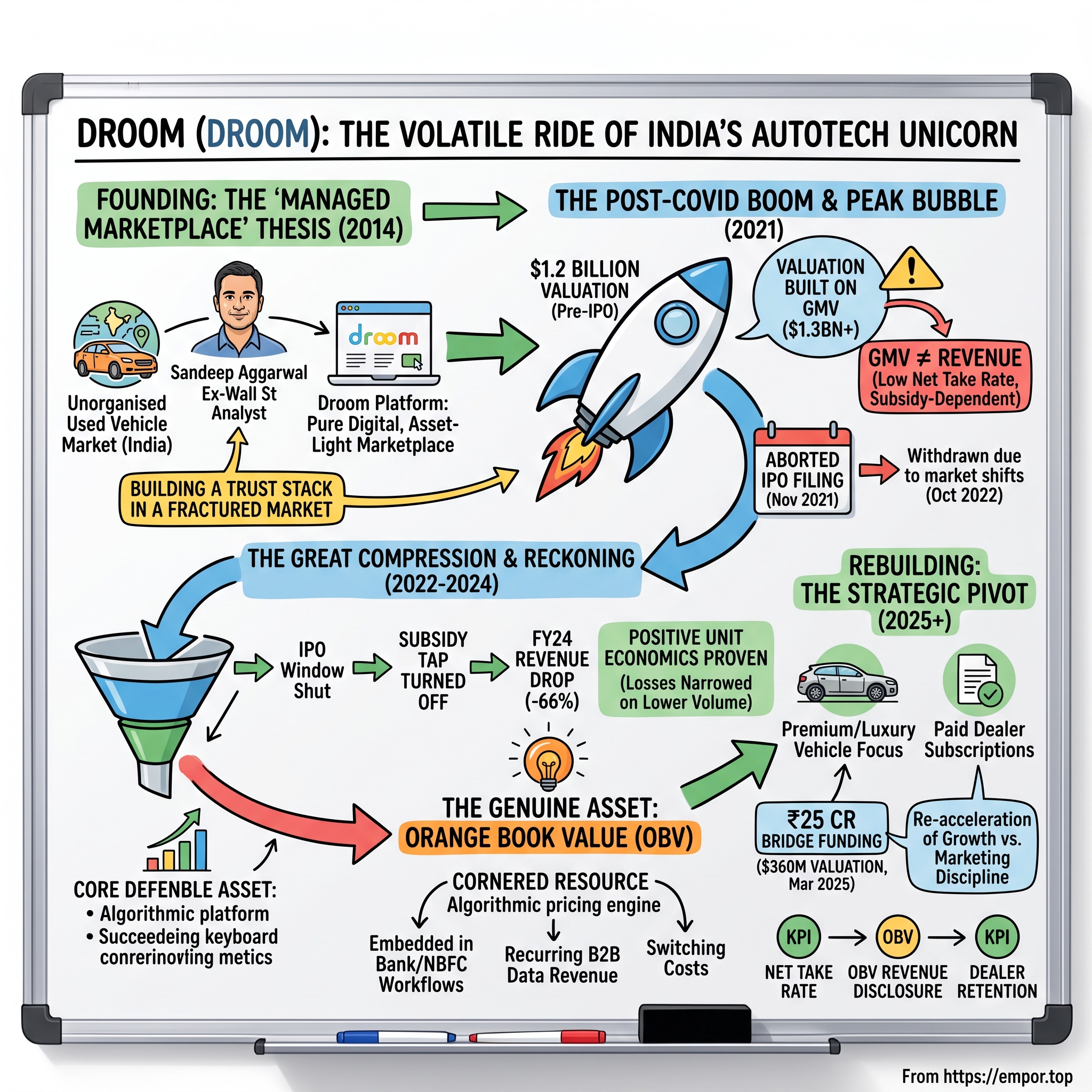
In July 2021, at the top of the cheapest-capital cycle the technology industry has ever seen, Droom raised up to $200 million in a pre-IPO round that valued the used-vehicle marketplace at $1.2 billion — up from roughly $500 million less than three years earlier.1 The round was led by new investors including 57 Stars and Seven Train Ventures alongside existing backers, and it did two things at once for its founder, Sandeep Aggarwal. It crowned Droom a unicorn, the second in India's used-car segment after CARS24, and it cemented Aggarwal's singular claim to fame: the only Indian founder to have built two back-to-back technology unicorns, ShopClues and Droom.16 The company told the market it would list by 2022, on Nasdaq or in India.1
Four years later, the reality check arrived not with a bang but with a quiet regulatory filing. In March 2025, Droom's Indian entity raised ₹25 crore — about $2.9 million — from a small syndicate of domestic investors, at a post-allotment valuation of roughly ₹3,097 crore, or about $360 million.2 That is a 70% contraction from the 2021 peak. The founder framed it as generosity rather than distress, saying the low mark was "a strategic move to give material upside to Indians who did not have opportunity to participate in the making of Droom in the past one decade."2 An independent underwriter should hear that sentence for what it is: a narrative wrapped around a down round of the smallest possible size, a ₹5-crore-a-ticket raise from a handful of individuals, extrapolated to imply a valuation for the whole enterprise.
The thesis of this story is that Droom is the cleanest available case study of the Indian venture model's forced transition — from "growth at all costs," financed by patient global capital and measured in Gross Merchandise Value, to the unforgiving discipline of unit economics in a market that never rewarded the subsidies in the first place. The evidence is in the collapse itself. Droom's operating revenue fell 66% in FY24, to ₹85.3 crore from ₹262 crore in FY23, when the company stopped paying for the transactions it had been booking as growth.3 Meanwhile its listed competitor, CarTrade Tech, did the opposite of collapse: it earned ₹641 crore of operating revenue and ₹145 crore of net profit in FY25, and trades on the public markets at a capitalisation above ₹13,000 crore.45 One company found a business model that compounds; the other is still trying to prove it has one.
The rest of this episode traces how a Wall Street analyst turned two unorganised Indian markets into unicorns, why one imploded in a boardroom war and the other in a funding drought, what the five-product "trust stack" is actually worth, and whether the OBV pricing engine — the one genuinely defensible asset in the portfolio — can carry a company toward the durable profitability that a public listing will demand. Along the way we will separate the prices Droom has been marked at from the value the operating record can support, because with this company the two have rarely been the same number.
A word on method before the story, because it governs everything after, and because a pre-filing company forces the point to the surface with unusual clarity. Price and value are different questions. The marks quoted around Droom — the $500 million of 2018, the $1.2 billion of 2021, the $360 million of 2025 — are prices at which specific parcels of preferred stock changed hands under specific terms, in specific capital environments, not appraisals of the whole enterprise as a public common shareholder would eventually own it. They are pricing signals, useful for reading sentiment and negotiating leverage, and they are not proof of intrinsic worth. Where a figure is a market price, this analysis treats it as one and reasons toward value from the operating evidence instead — revenue quality, take rate, contribution margin, retention, the margin structure of the data business, reinvestment needs and the credibility of the path to profit. Where the public record does not contain something an investor would want to compute — a fully diluted common-equivalent share count, the terms attached to the preferred stack, an enterprise-value bridge, a segment breakout of OBV — this analysis says so plainly rather than manufacture false precision. There is no DRHP in force, no RHP, no S-1 or F-1; the 2021 draft prospectus was withdrawn. What exists is a diligence record assembled from funding announcements, credible reporting, registry data and the company's own product disclosures, and it is read here as a diligence record, not as marketing.
 Subscribe on LinkedIn
II. The Wall Street Analyst and India's First Managed Marketplace
Before he was a founder, Sandeep Aggarwal spent roughly fourteen years as a sell-side internet equity research analyst in the United States, covering the first generation of consumer-internet giants at firms including Collins Stewart, Caris & Company and, earlier, larger houses — a career that put him inside the mechanics of eBay, Amazon and OpenTable at the moment those business models were being invented.7 This is not incidental colour; it is the intellectual origin of everything Droom later did well and badly. An equity analyst's job is to reduce a company to its drivers — take rate, gross merchandise value, cohort retention, contribution margin — and Aggarwal built both his companies as an analyst would, around a thesis about market structure rather than around a product he personally wanted to use. The strength of that approach is pattern recognition: he saw, before most, that the marketplace models minting fortunes in the US mapped onto categories in India that were large, fragmented and starved of trust. The weakness, which surfaces repeatedly in this story, is that an analyst prizes the headline metric — GMV — and the headline metric is precisely what a marketplace can most easily manufacture with subsidy.
The first application of the thesis was ShopClues, which Aggarwal founded in 2011 after moving back to India. He built it deliberately against the grain of the venture consensus. Where Flipkart and the incoming Amazon chased premium urban consumers and branded goods, ShopClues aimed at the long tail — unbranded, low-cost merchandise sold by small merchants to price-sensitive buyers in Tier-2 and Tier-3 towns.11 Aggarwal called it India's first "managed marketplace," and the adjective carried the whole strategy: the platform did not merely list sellers, it vetted and curated them, because in an unorganised retail market where buyers had no way to distinguish a real merchant from a fraud, credibility was the scarce input the platform could supply.
It is worth being concrete about how a managed marketplace differs economically from a plain one, because the difference is the whole business. A plain marketplace — an unmanaged bulletin board — earns a listing fee or a thin transaction cut and takes no responsibility for what is sold; its costs are low and so is its pricing power, because it adds little that buyers could not get elsewhere. A managed marketplace inserts itself into the transaction: it vets sellers, standardises the product description, guarantees some floor of quality, and arbitrates disputes. That costs real money and real operational effort, which is why unmanaged marketplaces are more capital-efficient on paper. But management is what lets the platform charge a higher take rate and, crucially, what makes buyers trust the platform rather than the individual seller — and in a market where the individual seller is unknown and possibly fraudulent, that trust is the entire value proposition. The strategic bet Aggarwal made twice is that in India's unorganised sectors buyers would pay a premium for a managed experience, and that the platform's investment in trust infrastructure would compound into a defensible position. The bet was directionally right and operationally punishing, because the cost of manufacturing trust is continuous and the willingness to pay for it, as Droom would learn, is bounded.
That single insight — that in an unorganised Indian market the platform's core product is manufactured trust — is the through-line from ShopClues to Droom. It is worth pausing on why it was a real insight and not just a slogan. In a mature market like the US, trust is ambient: rating systems, consumer-protection law, established brands and reliable logistics already exist, so a marketplace can be a thin matching layer. In India's unorganised sectors, none of that infrastructure existed, which meant a marketplace that could build the trust layer itself — merchant verification, standardised pricing, quality inspection, dispute resolution — would own something structural rather than just a website. ShopClues reached unicorn status on that playbook, peaking at a reported $1.1 billion valuation around 2016.11 The playbook was sound. What Aggarwal had not yet learned — and what ShopClues would teach him in the cruellest way — is that building the trust layer is a governance problem as much as a technology problem, and that a marketplace's most fragile component is not its code but its cap table.
III. The Fall, the Feud, and the Forced Resignation
The unravelling began with a wiretap. In July 2013, Aggarwal was arrested by the FBI in San Jose, California, and charged by federal prosecutors in Manhattan with securities fraud tied to his analyst days.89 The government's account was specific: in July 2009, while covering both Microsoft and Yahoo at Collins Stewart, Aggarwal learned from a friend at Microsoft that the two companies had resumed talks over an internet-search partnership, and — in a conversation captured on a government wiretap — passed that non-public information to Richard Lee, a portfolio manager at SAC Capital, whose trading on it reportedly generated more than $1.5 million.8 Aggarwal initially pleaded guilty, saying he had leaked the tip to raise his standing as an analyst and drive business to his firm.10
Here the public record diverges sharply from the "conviction overhang" framing that shadows Aggarwal to this day, and the distinction matters for any assessment of his suitability as a public-company promoter. The criminal case did not end in a standing conviction. In 2016 the US Department of Justice moved to drop the charges against him — part of the broader collapse of several insider-trading prosecutions after the appellate ruling in United States v. Newman narrowed what counted as illegal tipping — and he ultimately resolved the matter civilly with the SEC, paying a penalty of roughly $32,429 without the criminal guilty plea surviving.10 An underwriter should hold both facts in view simultaneously: the conduct alleged was serious and Aggarwal admitted it under oath at the time, but there is no final criminal conviction on the record. Describing it loosely as a "conviction" overstates the legal outcome; describing it as exoneration would understate the reputational reality. It is an unresolved integrity question, not a settled one, and that ambiguity is itself the governance issue.
The legal cloud did what legal clouds do to a growth company: it forced the founder out of operations. To insulate ShopClues from the fallout, Aggarwal stepped away from active management, leaving the company in the hands of his co-founders — his wife Radhika Aggarwal and Sanjay Sethi.11 What followed was worse than the arrest. As the marriage broke down, the boardroom broke down with it. By 2017 the estranged founders were locked in a public, bitter feud — Aggarwal accusing his partners of thwarting his attempt to return to the company he had started, the dispute spilling into criminal defamation litigation, and the board siding with the operating co-founders.11 The distraction landed at the worst possible moment. ShopClues had already lost its structural edge as Amazon and Flipkart pushed superior logistics and deeper discounts into the same Tier-2 and Tier-3 towns that were its beachhead; then, attempting to dress up unit economics for a possible IPO, it cut marketing and watched GMV crater; then fresh funding dried up as even existing investors declined to re-up.11 In 2019, the one-time $1.1 billion unicorn was sold to Singapore's Qoo10 in an all-stock deal valued at roughly $70–100 million — a wipeout of more than 90% of its peak paper worth.1112
There is a second, subtler lesson in the ShopClues collapse that bears directly on how to underwrite Droom, and it concerns the interaction between a legal cloud and a growth company's fragility. A profitable, self-funding business can absorb a founder's absence and a reputational shock; a cash-burning growth company financed by rolling venture rounds cannot, because its survival depends on the continuous confidence of investors, and confidence is exactly what a boardroom war and a criminal indictment destroy. ShopClues did not die of a bad product; it died because a distracted, divided leadership could not raise the next round when the market turned, and the same structural vulnerability — dependence on the next cheque — is present at Droom today, now compounded by a balance sheet rebuilt with a ₹25 crore bridge rather than earnings. The diligence implication is that Droom's greatest risk is not competitive so much as financial-and-governance: a company that needs external capital to survive is only ever as stable as its worst governance headline, and this founder has produced governance headlines before.
The lesson Empor draws from ShopClues is not the one the founder tells. His version is a story of persecution and comeback. The diligence version is more useful: when founders turn on each other, the cap table becomes a casualty, and no amount of product-market fit survives a board at war with itself. That lesson recurs at Droom in a different form — not a founder feud this time, but a controlling shareholder structure that concentrates all the power, and therefore all the governance risk, in one person whose track record on exactly this dimension is mixed.
IV. Rebirth: Founding Droom and the Asset-Light Epiphany
Aggarwal did not wait for ShopClues to finish falling before starting again. In 2014, out of active management and with the trust-layer thesis freshly validated (and freshly scarred), he founded Droom around the single largest unorganised transactional market he could find in India: used vehicles.7 The choice was analytically clean. Used cars and two-wheelers in India traded through an opaque web of local dealers and informal brokers, plagued by the three defects a marketplace is built to cure — information asymmetry (no buyer knew a car's true condition), price opacity (no standard existed for what a used vehicle was worth), and rampant fraud. It was ShopClues' unorganised-market problem with a bigger ticket size and a more acute trust deficit.
The design decision that defined Droom was to stay asset-light. Unlike the inventory-led models that CARS24 and later Spinny would build — buying cars onto their own balance sheet, refurbishing them in physical yards, and reselling them — Droom would be a pure digital marketplace, matching buyers and sellers and taking a fee, never owning the metal.13 On paper this is the higher-return model: no working capital tied up in depreciating inventory, no refurbishment capex, no yards. The theoretical elegance, however, contained the flaw that would later define the company. A pure marketplace controls neither the quality of what is sold nor the certainty of the transaction, which means it must manufacture trust through adjacent products rather than by owning the process — and manufacturing trust at arm's length is far harder than owning it end to end.
Droom's answer was to wrap the thin matching layer in a stack of proprietary, transaction-adjacent products, each meant to solve one facet of the trust deficit. Orange Book Value (OBV), launched in 2017, is the crown jewel: an algorithmic pricing engine that estimates the fair market value of any used vehicle in seconds, positioned as India's first standardised used-vehicle price benchmark.13 ECO is a technician-led physical inspection service that scores a vehicle's condition against a multi-point checklist, importing the one thing a digital listing cannot convey — verified condition. Droom History aggregates registration and vehicle records so a buyer can check a car's provenance. Droom Credit is a loan-facilitation marketplace, materially strengthened by the 2019 all-cash acquisition of the NBFC Xeraphin Finvest for a reported $3–3.5 million, which gave Droom a lending licence to sit alongside its bank and NBFC partners.15 Droom Velocity handles transport and fulfilment logistics. The strategic intent is coherent: turn each friction point in a used-car transaction into a monetisable, higher-margin product, so the marketplace earns not one thin take-rate but several layered fees.
Look closely at the five-pillar stack, though, and a public-market investor should separate the products by economic character rather than accept them as an undifferentiated "ecosystem," because they do not carry equal weight. Four of the five are, in effect, features that support the marketplace transaction: ECO's inspections, Droom History's records, Droom Credit's loan facilitation and Droom Velocity's logistics all exist to reduce friction in a buy-sell that Droom hopes to intermediate, and their revenue is therefore tethered to marketplace volume and to the same subsidy dynamics that plague it. Droom Credit is the partial exception — an NBFC licence via Xeraphin lets Droom earn on financing spreads and referral fees rather than pure transaction cuts — but a sub-scale lending book carries its own credit risk and capital requirements and is not, on the evidence available, a large or independently disclosed profit centre. The genuinely distinct asset is OBV, and it is distinct precisely because it is not tethered to Droom's own transactions: banks, insurers and NBFCs pay to use the pricing engine on vehicles that never touch Droom's marketplace at all. That decoupling — data revenue that grows with the entire used-vehicle economy rather than with Droom's slice of it — is the one place in the portfolio where the unit of value is a recurring enterprise contract rather than a one-off, subsidised consumer deal. An underwriter should weight the stack accordingly: OBV is the potential business; the rest is the marketplace's cost of trust dressed up as product lines.
Funding the technology layer required patient, strategic capital, and Droom attracted a distinctive investor base — early-stage backer Lightbox alongside Japanese strategics BEENOS株式会社 (Beenos) and 豊田通商 (Toyota Tsusho), the latter a member of the Toyota group, whose presence signalled that at least some sophisticated automotive money believed the pricing-and-inspection stack had standalone value.16 The strategic-investor motive is worth flagging for what it does and does not prove: a Toyota-affiliated trading house investing in an Indian used-car data platform is buying optionality on a category and a data asset, not necessarily endorsing the marketplace's unit economics. The distinction between a strategic's category bet and a financial investor's return underwriting is one an IPO buyer will have to make for themselves.
V. The Peak of the Bubble: The Unicorn Hype and the Aborted IPO
Everything about Droom's 2021 was a product of its moment. The post-COVID digitalisation surge had convinced global capital that every offline Indian transaction was about to move online, and interest rates near zero made growth cheap to finance and expensive to sit out. Into that window Droom raised its $200 million round at $1.2 billion, and it justified the mark with the metric an ex-analyst knew the market wanted: Gross Merchandise Value, which the company reported running above $1.3 billion.1 It is essential to be precise about what GMV is and is not. GMV is the total transaction value flowing across the platform; it is not revenue, and it is emphatically not profit. A marketplace's actual revenue is GMV multiplied by its net take rate — the slice it keeps after subsidies — and for Droom that slice was thin and, as we will see, partly negative once cash-backs and incentives were netted out. A $1.3 billion GMV number attached to a company whose operating revenue would soon be measured in tens of crores is the single clearest illustration in this story of why an investor must never mistake a gross flow for a business.
On that GMV, in November 2021, Droom filed its Draft Red Herring Prospectus with SEBI, seeking to raise ₹3,000 crore.1718 The structure repays close reading. The offer comprised a fresh issue of up to ₹2,000 crore — new capital into the company — and an Offer for Sale of up to ₹1,000 crore, under which the Singapore parent, Droom Pte. Ltd., would sell existing shares.17 An OFS is not growth capital; it is liquidity for selling holders, and the fact that a third of the intended raise was earmarked to cash out the parent tells you the round was as much about crystallising private gains as funding the business. The DRHP also laid out a use-of-proceeds plan weighted toward brand promotion, inorganic acquisitions and international expansion into Southeast Asia and the Middle East — that is, toward buying more growth and more geography rather than toward proving the core model could stand on its own economics. For a company whose central unanswered question was unit economics, allocating fresh capital to marketing and M&A rather than to margin was a revealing choice of priorities.
The DRHP era offers one durable, verifiable fact about the capital structure that still governs the company today: Droom's Indian operating entity is a near-wholly-owned subsidiary of the Singapore holding company, Droom Pte. Ltd., which as of early 2025 held about 99.19% of the shares, with the founder controlling the parent.27 This is the structural spine of every governance question in the story, and we return to it in Section IX. For now, note only what it means mechanically: public shareholders, whether via the aborted 2021 IPO or a future one, would sit beneath a controlling foreign parent that owns essentially the entire company, a configuration that concentrates control and complicates the "reverse flip" of domicile that Indian tech companies are increasingly expected to complete before listing at home.
It is worth doing the take-rate arithmetic that the 2021 story was built to obscure, because it exposes the gap between the mark and the machine. If Droom reported GMV above $1.3 billion — call it roughly ₹10,000 crore at the exchange rates of the time — and FY23 operating revenue of ₹262 crore, the implied gross take rate is on the order of 2.5–3%. That figure is low for a managed marketplace claiming to add trust, inspection and financing to each deal, and it is a gross take rate: net of the cash-backs and dealer incentives that were themselves the largest expense line, the take rate that Droom actually kept was thinner still, and at the margin negative. A marketplace that must hand back much of its take rate as subsidy to generate the transaction is not monetising a network; it is renting volume. The $1.2 billion valuation implied a revenue multiple in the region of forty-plus times FY23 operating revenue — a software multiple applied to a low-take-rate, subsidy-dependent transaction business. That mismatch between the multiple paid and the economics underneath is the definition of a bubble mark, and it is the reason the subsequent 70% write-down was less a repricing than a correction of a category error.
The window slammed shut before Droom could jump through it. Through 2022, the global tech sell-off, a sharp rise in the cost of capital, and — most damaging locally — the brutal post-listing performance of Indian tech IPOs including Paytm and CarTrade itself drained demand for exactly the kind of unprofitable-growth story Droom was selling.19 In October 2022, nearly a year after filing, Droom formally withdrew its DRHP.19 The withdrawal was the correct decision and also an admission: the company had no realistic path to the public markets at anything resembling its private mark, and the private mark had been a function of the window, not the business.
VI. The Reckoning: The Great Compression and the 66% Revenue Drop
With the IPO withdrawn and the funding window shut, the subsidies that had manufactured Droom's scale became unaffordable, and the reckoning that followed is the most instructive passage in the company's financial history — because it revealed, in the plainest possible terms, what the growth had actually cost. In FY23, the company's total expenditure peaked at roughly ₹325 crore against operating revenue of ₹262 crore, producing a net loss of about ₹62 crore.3 Read those numbers together: Droom was spending ₹1.24 for every ₹1 of revenue it booked, and the largest expense line was promotions and incentives — the cash-backs, dealer incentives and marketing that were, in effect, buying the transactions the platform reported as GMV.
Facing a closed capital market, management did the only thing available: it turned off the subsidy tap. In FY24, total expenditure was slashed roughly 60%, from ₹325 crore to about ₹130 crore.3 The cuts fell hardest where the growth had been bought — promotions and incentives, the single biggest cost head, were reduced by 67.3%, and employee-benefit expenses came down by about 39.5%.3 The consequence was immediate and severe: operating revenue collapsed 66%, to ₹85.3 crore, and total income fell to about ₹90 crore from ₹262 crore.3 A two-thirds revenue decline in a single year is the kind of number that would ordinarily signal a business in terminal decline.
But the same episode produced the one genuinely encouraging data point in Droom's financial record, and it is a subtle one. Despite the top-line implosion, net losses did not widen — they narrowed by about 34.8%, to ₹40.4 crore.3 This is the tell. When you cut spending by ₹195 crore and lose only ₹177 crore of revenue while your losses shrink, the arithmetic proves that a large chunk of the revenue you gave up was being purchased at a loss — that the marginal transaction was contribution-negative, funded by subsidy rather than earned by the platform. In other words, FY24 was not just a contraction; it was a controlled demolition of unprofitable volume, and it demonstrated that the underlying engine, run without cash-backs, loses far less money than the headline suggested. That is a meaningfully better outcome than a business that simply shrinks and bleeds proportionally.
Before turning to FY25, it is worth naming what the restructuring did and did not tell us about revenue quality, because quality — not just quantity — is what a public-market buyer underwrites. Droom's revenue is overwhelmingly transactional: commissions on vehicle sales, service fees on inspections and related products, and pro-seller subscription income.3 Transactional revenue is inherently lower-quality than recurring revenue for a simple reason — it must be re-earned every period from a largely fresh set of customers, because a consumer who buys a car does not return for five or six years. That structural non-recurrence is why Droom's top line is so violently sensitive to marketing spend: turn off the acquisition engine and the revenue does not merely slow, it falls, because there is little installed base generating repeat purchases to cushion the decline. The two pieces of the mix that could be higher-quality are dealer subscriptions (recurring, contracted, sticky if the dealer stays) and OBV enterprise licensing (recurring, embedded in bank workflows) — and it is precisely these two lines that Droom does not break out, leaving an outsider unable to verify what share of the ₹169 crore is durable versus transactional. The single most important disclosure a future prospectus could make is exactly this split; its current absence is the reason the revenue rebound cannot yet be assigned a quality grade.
The FY25 numbers, however, should temper any celebration, and here the independent record diverges from a purely triumphant reading of the restructuring. Operating revenue did rebound strongly — up about 88% to roughly ₹169 crore in FY25 — as the company refocused on higher-value premium and luxury vehicle transactions and on paid dealer subscriptions.20 But the rebound was bought, again, with marketing: advertising and promotion expense ballooned back to about ₹162.5 crore, nearly 75% of total spend, and losses did not narrow — they widened by roughly 14%, to about ₹46.3 crore.20 The company's own efficiency metric improved only modestly, to ₹1.28 spent per rupee earned from ₹1.53 the year before.20 The honest read is that FY24 proved Droom could survive without subsidy at low volume, and FY25 proved it still cannot grow without leaning on marketing spend that pushes losses back up. The restructuring bought time and revealed the cost structure; it has not yet produced a self-sustaining engine. That gap — between a business that can shrink profitably and one that can grow profitably — is the crux of the entire underwriting.
The path to durable profitability, as opposed to a one-year adjusted flourish, can be reconstructed from these numbers, and it is demanding. For Droom to reach sustainable free cash flow, three things must move together, not in sequence. First, the marketing-to-revenue ratio must fall structurally — advertising and promotion running near 75% of total spend in FY25 is the signature of a business buying its growth, and no consumer marketplace produces free cash flow while that ratio persists; it must drop toward a level where organic and repeat demand, plus recurring dealer and enterprise revenue, carry the top line. Second, the revenue mix must shift toward the recurring lines, because transactional revenue at Droom's scale cannot cover a fixed corporate cost base without perpetual reacquisition spend. Third, gross contribution per transaction must turn reliably positive after all incentives — the FY24 loss narrowing suggests it can, but FY25's widening losses suggest the company sacrificed that discipline the moment it chose to chase growth again. What would falsify the profitability thesis is straightforward and observable: another year in which revenue growth and loss reduction cannot occur simultaneously, or a marketing ratio that refuses to fall as revenue scales. On the current two-year record, the evidence for a self-funding model is a promise, not yet a demonstration, and the balance sheet — rebuilt with a ₹25 crore bridge rather than a war chest — leaves little room to fund many more years of the experiment.
VII. The Competitive Battleground: Why CarTrade Won Where Droom Stalled
India's used-car market is enormous and stubbornly fragmented, and both facts shape the competition. The market was valued around $40 billion in 2025 and is growing at a low-double-digit annual rate, but of roughly six million transactions a year, only about 1.2 million — around 20% — flow through organised platforms; the rest still move through traditional dealers and informal networks.24 The organised share has climbed steadily, from the high teens in FY17 toward a quarter of the market now, and is projected to keep taking share.24 That is genuine tailwind. But it also means the digital players are not fighting over a settled market; they are fighting over the thin, contested slice that has organised so far, and their business models — not the tailwind — decide who captures the value.
Restraint is required in translating that $40 billion category figure into anything Droom can actually reach, because the gap between a category TAM and a company's serviceable market is where most startup valuations go to die. The $40 billion is the total value of used-vehicles changing hands, the overwhelming majority of it in unorganised, cash-in-hand deals a digital marketplace never touches. The organised slice — roughly 1.2 million of six million annual transactions — is the real contestable pool, and even within it, the revenue available to a platform is not the transaction value but the thin take rate on it plus whatever adjacent services (financing, inspection, data) it can attach. Droom's reachable market, at its present product, price point and distribution, is a fraction of a fraction: the paid-dealer subscriptions it can sell, the premium and luxury transactions where its take rate holds up, and the enterprise seats for OBV. Any bull case that multiplies a market-share assumption against the full $40 billion is committing the paper-unicorn error a second time. The disciplined framing is that Droom competes for a slice of the ~₹ few-thousand-crore revenue pool that the organised segment can actually generate today, against four better-capitalised rivals, and its share of that is what matters — not a share of the category.
The most important comparison is CarTrade Tech, because it is the one direct-ish peer with audited public financials and it has done precisely what Droom could not: made money. CarTrade runs an asset-light, lead-generation and classifieds model through CarWale, BikeWale and its acquired properties, sitting at the top of the funnel where buyers research vehicles. In August 2023 it acquired OLX India's business — the Sobek Auto entity — from Prosus for about ₹535 crore, and then shut OLX's loss-making auto-transaction arm while keeping the high-traffic classifieds platform, whose largely fixed cost base turned incremental revenue almost directly into profit.21 The results validate the model emphatically: CarTrade's operating revenue rose about 31% to ₹641 crore in FY25, and net profit soared to roughly ₹145 crore from under ₹20 crore a year earlier — and the momentum continued, with FY26 profit reported climbing a further two-thirds to around ₹244 crore.422 The lesson embedded in CarTrade's numbers is the one that most indicts Droom's strategy: the profitable place to stand in Indian autotech is at the top of the funnel, monetising organic traffic and leads with a fixed cost base, not in the transaction subsidising each deal.
The other players occupy different, more capital-intensive positions. CARS24 runs the high-volume, inventory-heavy transaction model — buying, refurbishing and reselling cars, backed by its own financing arm — which drives large volumes but carries heavy structural losses and enormous working-capital needs. Spinny is the premium, vertically integrated refurbisher, with a hub-and-spoke network of physical yards, higher average selling prices and a quality guarantee; it reported roughly ₹4,657 crore of revenue in FY25 while narrowing losses to about ₹424 crore, and raised $170 million in March 2025 at a $1.7–1.8 billion valuation.23 CarDekho leverages a dominant new-car research portal to cross-sell higher-margin adjacencies — insurance through InsuranceDekho and financing through Rupyy — building a financial-services engine on top of research traffic.
A rigorous comparable set has to separate the direct peers from the aspirational ones, and be honest about which is which. The most genuinely comparable listed peer is CarTrade Tech, because it shares the asset-light, non-inventory model and reports on Indian exchanges in rupees — but even it is an imperfect match, because its revenue is dominated by high-traffic classifieds and lead generation rather than by Droom's subsidised transaction fees, and it is profitable where Droom is not, so its multiple reflects a quality Droom has not earned. CarTrade traded in FY25 at a market capitalisation above ₹13,000 crore on ₹641 crore of operating revenue and ₹145 crore of net profit — roughly a 20x price-to-sales and a high-double-digit price-to-earnings multiple — but that is the multiple of a profitable company compounding earnings, and it would be an analytical error to apply CarTrade's revenue multiple to Droom's ₹169 crore of loss-making revenue and call the product a valuation.45 CARS24 and Spinny are inventory-heavy and structurally different in capital intensity and gross-margin shape; they are useful for reading the market's direction but are not clean multiple comparables, and both remain private and loss-making, so their own marks (Spinny's $1.7–1.8 billion, for instance) are themselves private prices, not validated values.23 The category leaders a promoter would like to invoke — global autotech platforms, or India's profitable internet franchises — are aspirational, not comparable, and should be excluded from any multiple exercise. A further caution governs every one of these numbers: the listed comparables are quoted on an equity-value basis (market capitalisation), and Droom's own implied figures are private post-money equity marks; because no reliable cash, debt and lease position is public for Droom, an enterprise-value bridge cannot be constructed, and it would be wrong to compare an EV multiple for one company with an equity multiple for another. The comparables tell us the market pays a premium for profitable asset-light autotech and discounts loss-making transaction models — which is less a valuation for Droom than a description of the gap it must close.
Droom's problem is positional, and it is severe. Its asset-light pure marketplace sits in an exposed middle ground with no defensible flank. It lacks the transaction control and physical quality assurance that let Spinny and CARS24 guarantee the product and capture the full deal; and it lacks the massive organic search traffic that lets CarTrade and CarDekho monetise leads at near-zero marginal cost. In a market where the profitable strategies are either "own the transaction" or "own the traffic," Droom owns neither at the required scale — which is precisely why its growth has repeatedly required paid marketing that competitors get for free or capture as margin. The one asset that could give Droom a genuinely differentiated flank is not the marketplace at all; it is the OBV data engine, and whether that is enough is the question the next section takes up.
VIII. The Tech Engine & Hamilton Helmer's 7 Powers Analysis
Helmer's framework asks a disciplined question — does the company have a persistent barrier that lets it earn returns above its cost of capital, and if so, which kind — and applying it honestly to Droom separates the one real power from a lot of rhetoric.
Counter-Positioning (weak, and weakening). Droom's asset-light marketplace was genuinely counter-positioned against the early inventory-led models: while CARS24 tied up capital in cars, Droom promised the same category with none of the balance-sheet drag, a position incumbents could not copy without cannibalising their own model. But counter-positioning is only a power while the incumbent refuses to respond, and the industry moved the other way. As every player scaled back inventory intensity and chased unit economics after 2022, the asset-light stance stopped being distinctive — and worse, the market discovered that owning the transaction (Spinny) or owning the traffic (CarTrade) was where the profit actually lived. The counter-position dissolved into a disadvantage.
Network Effects (moderate at best). Droom operates a classic two-sided marketplace, and it cites a large listed-dealer base — on the order of 350,000 sellers — which in principle should attract buyers, which should attract more sellers.13 The problem is multi-homing. Dealers face near-zero cost to list the same inventory on CarTrade, CarDekho and OLX simultaneously, and they do, which means Droom's network is wide but not exclusive, and a network that every participant also belongs to on three other platforms confers little pricing power. Buyers, for their part, have no loyalty at all. The network exists; the effect — the self-reinforcing advantage that keeps participants from leaving — is thin.
Cornered Resource (strong, and the real story). This is where Droom has something. OBV, the algorithmic pricing engine, has been built into the workflows of Indian banks, NBFCs and insurers as a used-vehicle valuation standard: lenders use OBV certificates before writing off or underwriting auto loans, and insurers use it to compute Insured Declared Value.25 Independent reporting confirmed OBV had crossed 500 million pricing queries at an earlier milestone, and the company now claims figures around a billion.14 The economic significance is that OBV is a high-margin, sticky, B2B SaaS-like asset embedded in enterprise processes — once a bank's loan-origination system references OBV as its valuation source, switching means re-engineering a workflow and re-training staff, which is exactly the kind of switching cost the consumer marketplace lacks. If any part of Droom deserves a software-style multiple, it is this. The caveat an underwriter must attach is that OBV's actual standalone revenue is not separately disclosed, so its contribution to the ₹169 crore top line is unproven from the outside — the power is real in kind; its magnitude is unverified.
Switching Costs (low on the consumer side). A person buys a car once every five or six years. There is no habit to build, no data lock-in, no recurring relationship — the consumer switching cost is effectively zero, which is why Droom must re-acquire buyers with marketing every cycle rather than retaining them. The switching costs that matter are entirely on the OBV enterprise side, not the marketplace side.
Scale Economies (weak). Without inspection hubs, refurbishment yards or proprietary logistics fleets, Droom has little fixed cost to spread and therefore little scale advantage over the local dealer clusters it competes with. Its costs are largely variable — marketing and personnel — which is the opposite of the fixed-cost-leverage structure that made CarTrade's classifieds so profitable. Paradoxically, the asset-light model that was meant to be capital-efficient denies Droom the operating leverage that turns scale into margin.
The Helmer read, then, is unambiguous and narrow: Droom has one power, OBV's cornered enterprise position, and it is buried inside a marketplace that has none. The entire bull case rests on whether the company can grow the powerful part faster than the powerless part drains it.
This is the point at which the analysis keeps colliding with a single missing number, and it is worth stating plainly how much rides on it. Nearly every constructive thing that can be said about Droom routes through OBV: it is the cornered resource, the one force in the industry structure working in the company's favour, the only plausible source of a software-like margin, and the sole path on which the founder's billion-dollar-plus listing ambition is defensible. And yet Droom has never disclosed OBV's standalone revenue, its growth rate, its enterprise customer count, its retention, or its contribution margin. An investor is therefore asked to underwrite the crown jewel on the company's assertion of its importance and on circumstantial evidence — the query counts, the bank and insurer integrations — rather than on financials. That is not a reason to dismiss OBV; the integrations are real and the switching costs are genuine. It is a reason to insist that any valuation premium Droom seeks be conditioned on disclosing the OBV economics, because a premium paid for an undisclosed asset is a premium paid on faith. The company that finally files to list will, in effect, be judged on whether it is willing to show the one set of numbers that could justify the story it has been telling for a decade.
IX. Playbook: Business, Investing, and Corporate Governance Lessons
The first lesson is the "paper unicorn" trap, and Droom is its textbook illustration. A company that optimises for GMV over net take rate builds a valuation on a number it can inflate at will with subsidy, and a valuation built on an inflatable number is inherently fragile. The 2021 mark of $1.2 billion rested on $1.3 billion of GMV; when the subsidy stopped, the GMV and the revenue behind it fell by two-thirds, and the mark followed — to $360 million by 2025, a 70% write-down.123 The general principle for underwriting any marketplace is to ignore gross flow and interrogate the net take rate and contribution margin, because those are the numbers that cannot be faked with a marketing budget. Droom's history is a four-year demonstration of what happens when private markets price the flow instead of the margin.
The second lesson concerns how to read the funding rounds themselves, because Droom's are a catalogue of the ways a headline valuation can mislead. The 2021 round was a large primary raise but at the peak of a bubble; the 2025 round was the opposite in every respect — ₹25 crore, roughly $2.9 million, from a handful of individual investors putting in ₹3–5 crore each, explicitly structured at a deliberately low mark on the Indian subsidiary while the founder signalled intent to raise "at a much higher valuation in both Singapore and India soon."2 Extrapolating a $360 million enterprise value from a $2.9 million ticket is exactly the small-transaction-to-whole-company inference the discipline warns against, and the founder's own framing concedes the mark was set by strategy, not by arm's-length price discovery. Crucially, none of the material terms that would let an outsider value the preferred stack — liquidation preferences, participation rights, anti-dilution or ratchet protections, conversion mechanics, side letters — are public. That absence is itself the point: private preferred shares carrying downside protection are not economically equivalent to the common stock a public investor would buy, and until a real filing discloses the terms, any implied market capitalisation derived from a private round is a rough signal, not a valuation.
It is worth attempting a transparent, scenario-based intrinsic-value sketch, not to produce a target — there is no basis for one — but to expose what a given valuation would require the business to become, and to show how wide the range of defensible outcomes is. Take FY25 operating revenue of about ₹169 crore as the base. In a bear scenario, the marketplace stays subsidy-dependent, growth reverts toward the low double digits as marketing is disciplined, losses persist, OBV never gets separately scaled, and the business settles as a subscale platform worth perhaps a low single-digit revenue multiple on modest, still-unprofitable revenue — an equity value materially below the $360 million private mark, because loss-making transaction businesses do not command growth multiples in a post-2022 public market. In a base scenario, Droom compounds revenue in the 25–40% range for several years on the premium-vehicle and dealer-subscription mix, gradually lifts the recurring share, and reaches operating break-even late in the decade at, say, ₹600–800 crore of revenue with high-single-digit to low-teens operating margins at maturity; discounting those distant, uncertain cash flows at a cost of capital appropriate to a sub-scale Indian consumer-tech company — realistically in the mid-to-high teens — supports an equity value in a broad band that could plausibly bracket the $360 million mark rather than the $1.2 billion one. In a bull scenario, OBV becomes a genuinely scaled, separately disclosed enterprise-data business earning software-like margins, the marketplace runs at break-even as its distribution front-end, and the blended entity earns a premium multiple on faster-growing, higher-quality revenue — the only path on which the founder's $1.2–1.5 billion listing ambition is defensible. The point of the exercise is not the midpoint; it is the spread. The range is enormous because it hinges on one unverified variable — the size and margin of OBV — which the company has never disclosed. Until it does, intrinsic value is a distribution with most of its mass well below the peak mark, and the burden of proof sits entirely with management.
Reconciling that intrinsic sketch with the comparable view sharpens the question the market will ask. The prospective $1.2–1.5 billion ambition embeds assumptions that the operating record does not yet support: sustained high growth, a decisive shift to recurring revenue, positive contribution margins after incentives, meaningful market share against four better-funded rivals, and an OBV business large enough to earn a software multiple on the blend. A public market could still, in a favourable window, price Droom above a sober central range for reasons that have nothing to do with business value — IPO scarcity in a hot autotech cohort, a compelling founder-comeback narrative, a deliberately constrained free float that manufactures scarcity, and momentum. Those forces are real and can move an opening price; they are not the same as value, and a disciplined investor separates the two by asking what the price implies the business must achieve, then judging that requirement against the evidence. On today's evidence, the peak mark implies achievements the company has not demonstrated, while a valuation nearer the recent private mark implies a business it plausibly could become if OBV scales and marketing discipline holds.
The third and heaviest lesson is governance, and it starts with the ownership structure. Droom's Indian operating entity is roughly 99.19% owned by the Singapore parent Droom Pte. Ltd., which Aggarwal controls.27 This concentrates essentially all economic and voting power in one individual, atop a cross-border structure that will need to be "reverse-flipped" onshore to list in India — an increasingly standard but non-trivial exercise. Layered on top is a pattern of capital-allocation volatility that a public-market investor should weigh honestly: hyper-growth marketing in 2021, a violent 60% scale-down in 2024, a marketing-fuelled re-acceleration in 2025 that pushed losses back up, and an emergency down round in between. This is not the profile of a management team executing a stable plan; it is a founder repeatedly reversing course in response to the capital environment. Some of that is prudent adaptation to a brutal funding market; some of it reads as a company still searching for a model. And behind all of it sits the unresolved US securities matter — conduct Aggarwal admitted to at the time, charges the DOJ later dropped, a civil settlement paid — which SEBI, with its stringent focus on promoter integrity in offer documents, will scrutinise closely.10 The trust deficit that Droom's products were built to solve for used-car buyers is, ironically, a live question about the promoter himself.
X. Strategic Position, Bull vs. Bear, and Risk Radar
A Porter's Five Forces read of the used-car marketplace explains why the economics are so unforgiving and frames the bull and bear cases that follow. Rivalry is intense and well-capitalised: four serious competitors — CarTrade, CarDekho, CARS24 and Spinny — each with a defensible position and deeper pockets than Droom, fight over the same organised slice, and the presence of a profitable incumbent (CarTrade) means price competition is a war Droom cannot win on subsidy. Buyer power is high and structural: consumers buy infrequently, compare across every platform in minutes, and feel no loyalty, so they extract the full benefit of any subsidy and leave. Supplier power — here the dealers — is also high, because dealers multi-home across all platforms at zero cost and can withdraw inventory or listings without penalty, capping the take rate any single platform can charge. Threat of substitutes is ever-present in the form of the unorganised dealer network that still handles 80% of transactions and imposes a ceiling on what buyers will pay for a "managed" experience. Only the threat of new entrants is moderate-to-low, and only in the data layer: building a credible, bank-integrated pricing standard like OBV is genuinely hard and slow, which is exactly why OBV, not the marketplace, is the defensible corner. The Five Forces verdict mirrors the Helmer one — the marketplace sits in a structurally poor industry position, and the only force working in Droom's favour operates on the data business.
The "Why Win" (Bull) Case. The bull case does not run through the marketplace; it runs through OBV. If Droom can convert its cornered enterprise position — the pricing engine already embedded in banks', NBFCs' and insurers' workflows — into a growing, disclosed, recurring B2B revenue stream, it would own a high-margin asset that does not depend on expensive consumer acquisition, and it could then run the consumer marketplace as a low-cost, self-sustaining lead-generation front end rather than a subsidy sink.25 In that scenario the FY24 restructuring is the foundation of a leaner company, the FY25 revenue rebound proves demand exists, and the premium/luxury and dealer-subscription pivot supplies recurring, higher-quality revenue while the data business compounds underneath. A company earning enterprise SaaS margins on OBV, with a break-even marketplace attached, would deserve a materially higher multiple than a subsidised transaction platform — and would have a credible, differentiated equity story for a 2026–2027 listing.
The "Why Lose" (Bear) Case. The bear case is that Droom is squeezed from both ends and the middle collapses. From the top, CarTrade's and CarDekho's organic search dominance and fixed-cost classifieds economics let them capture leads at near-zero marginal cost that Droom must pay for; from the bottom, Spinny's and CARS24's physical yards and quality guarantees win the buyers who want certainty. Droom's pure marketplace, owning neither traffic nor transaction, cannot grow volume without marketing that reopens the losses, dealers keep multi-homing and churn out of paid subscriptions, and OBV — genuinely valuable but small and undisclosed — is not big enough to carry the whole enterprise before the ₹25-crore-thin balance sheet runs dry. In this scenario the company does not fail dramatically; it slides slowly into irrelevance as a subscale platform in a market consolidating around larger, better-capitalised, profitable rivals.
The three KPIs that matter most. First, the net take rate — the percentage of transaction value Droom actually keeps after all subsidies and incentives — because that single number distinguishes a real marketplace from a subsidised one and is the metric the 2021 story hid. Second, the B2B SaaS revenue contribution from OBV, ECO and History licensing, disclosed separately, because that is the only line that can justify a premium valuation and it is currently invisible from outside. Third, dealer-subscription retention and churn on the paid accounts reportedly priced at roughly ₹45,000–₹1,00,000 a year, because recurring, sticky dealer revenue is the difference between a durable platform and one renting its growth from a marketing budget.
The Risk Radar. Capital risk is acute and immediate: a ₹25-crore extension is not a runway, it is a bridge, and the company must reach cash-flow break-even or raise materially more — at a real, price-discovered valuation — before reserves exhaust; FY25's widening losses make the timing tighter, not looser.20 Regulatory risk is structural: SEBI's promoter-integrity scrutiny and the required onshoring of the Singapore parent could delay or complicate a domestic listing, and the founder's US securities history is exactly the kind of item that draws regulatory attention in a draft offer document. Competitive risk is the slow-burn one already described — a consolidating market where the profitable models are owned by others. Public-market readiness is its own diligence agenda, and most of it is simply not yet visible — which is a fact to flag, not to interpret as safety. On founder control and board independence: the near-total ownership by the founder-controlled Singapore parent means minority public shareholders would have limited practical ability to check the promoter, and there is no public evidence of an independent-majority board, related-party-transaction framework, or the audit and nomination committees a listed company requires; these will have to be built and disclosed. On related parties: the cross-border structure — a Singapore parent, an Indian operating subsidiary, an in-house NBFC — is exactly the configuration where inter-company flows, licensing arrangements and management fees warrant scrutiny, none of which is currently public. On executive pay, equity incentives and insider selling: the 2021 draft contemplated a ₹1,000 crore Offer for Sale by the parent, i.e. the controlling holder cashing out a third of a raise, and any future filing's OFS component, lock-up terms and ESOP pool will reveal how much of the deal is primary growth capital versus promoter liquidity — a distinction that materially affects what a public buyer is actually funding. On regulatory and legal exposure: beyond SEBI's promoter-integrity review and the founder's US securities history, there is no disclosed litigation, contingent-liability or tax position an outsider can assess. The honest summary is that the governance scaffolding a public company needs has, on the public record, not yet been erected — and a future prospectus is where it must appear.
Against all of this, the diligence items that do not yet exist must be named as gaps, not comforts: there is no current prospectus, no disclosed cap table with the preferred terms, no audited segment breakout of OBV, no lock-up or use-of-proceeds detail, and no formal risk-factor section. Their absence is not evidence of safety; it is the list of things a future filing will finally have to answer.
XI. Epilogue: What to Watch
The open question is whether Sandeep Aggarwal can engineer a third act — whether the founder who built ShopClues into a unicorn and watched it burn, who built Droom into a unicorn and watched it deflate by 70%, can now build the disciplined, profitable version that the public markets will actually pay for. His pattern is resurrection; his unresolved weakness is durability, and a listing tests durability, not resurrection.
The milestones over the next twelve to eighteen months are concrete and falsifiable. First, break-even: FY24 showed Droom can lose less at low volume, but FY25 showed it still cannot grow without marketing that reopens the losses, so the number to watch is whether revenue growth and loss reduction can finally happen in the same year rather than trading off against each other. Second, OBV: whether the company begins disclosing enterprise-data revenue as a distinct, growing line, which is the single piece of evidence that would move Droom from "subsidised marketplace" toward "data business with a marketplace attached." Third, the capital and structural path — a genuine, price-discovered up round to replace the ₹25-crore bridge, and progress on onshoring the Singapore parent — because the company has told the market it intends to re-file for a listing and has begun engaging bankers again.2628 The company that eventually walks into SEBI's offer-document process will be judged not on the GMV that made it a unicorn, nor on the private marks that made it a mirage, but on the net take rate, the OBV margin and the runway — the three things the last four years were spent learning it had to prove. Whether it can is the ride still to be taken.
Two events, more than any others, would force the market's eventual reckoning with these questions. The first is a real, price-discovered financing — not another sub-₹50 crore extension marked at a "strategically low" valuation, but an arm's-length round large enough to fund the path to break-even, whose price would be the first honest external opinion on the business in years; if that round prices near the recent private mark it confirms the compression is structural, and if it prices materially higher it will have to be justified by disclosed OBV economics rather than narrative. The second is the prospectus itself, whenever the company follows through on its renewed intent to re-file and its engagement of bankers.28 A prospectus is where the diligence gaps catalogued throughout this story — the preferred terms, the OBV segment, the related-party flows, the governance scaffolding, the use of proceeds and the split between primary capital and promoter liquidity — must finally be answered on the record, under signature and audit. Until then, the honest posture is the one this analysis has tried to hold throughout: to treat the marks as prices rather than proof, to weight the founder's behaviour over his narrative, and to reserve judgement on the one asset that could change everything until the company is willing to show its numbers. The ride has been volatile enough to justify the caution, and consequential enough to justify watching closely.
References
-
Indian automobile marketplace Droom valued at $1.2 billion in $200 million pre-IPO funding — TechCrunch, 2021-07-27 ↩↩↩↩↩
-
Exclusive: Droom India raises funds at $360 Mn valuation — Entrackr, 2025-03-03 ↩↩↩↩
-
Droom's revenue plummets 66% to Rs 85 Cr in FY24 — Entrackr, 2025-02-18 ↩↩↩↩↩↩↩↩
-
CarTrade Tech profit jumps 85% to Rs 46 crore in Q4FY25; full year profit soars 627% to Rs 145 crore — Indian Startup News, 2025-05-07 ↩↩↩
-
CarTrade Tech Limited (CARTRADE) Stock Price & Filings — Moneycontrol ↩↩
-
Sandeep Aggarwal: Rising from the ashes — Forbes India, 2020-03-24 ↩
-
Manhattan U.S. Attorney and FBI Announce Insider Trading Charges Against Former Equity Research Analyst — FBI (archives), 2013-07-30 ↩↩
-
ShopClues founder Sandeep Aggarwal arrested on insider trading charges — Moneylife, 2013-07-31 ↩
-
US Dept Of Justice Drops Insider Trading Charges Against Sandeep Aggarwal — Inc42 ↩↩↩
-
How ShopClues collapsed from a $1.1 billion unicorn to a distress sale — The Hans India, 2025 ↩↩↩↩↩↩
-
E-commerce Unicorn ShopClues finally sold to Qoo10 in a fire sale — Entrackr, 2019-10 ↩
-
Droom Launches Orange Book Value — An Algorithmic Pricing Engine For Used Vehicles — Inc42 ↩↩↩
-
Droom's Orange Book Value crosses 500 million pricing queries for used vehicles in India — The Tech Panda ↩
-
Droom Acquires NBFC Xeraphin To Boost Credit, Auto Loans Vertical — Inc42, 2019 ↩
-
Droom, a Subsidiary of DG Ventures' Investee, Applies for Listing to SEBI — Digital Garage, Inc., 2021-11-16 ↩
-
Auto e-commerce platform Droom files DRHP to raise Rs 3,000 crore in IPO — Business Standard, 2021-11-12 ↩↩
-
Droom Technology Limited — Draft Red Herring Prospectus (DRHP) — SEBI, 2021-11 ↩
-
Amid Market Volatility, Droom Withdraws INR 3000 Cr IPO Bid — Inc42, 2022-10 ↩↩
-
Auto-Tech Platform Droom Posts 88% Jump in FY25 Revenue to Rs 169 Cr; Losses Expand — Startuppedia ↩↩↩↩
-
CarTrade Acquires OLX's India Business For INR 535.54 Cr — Inc42, 2023-08-13 ↩
-
CarTrade Tech Profit Jumps 68% to ₹244 Cr in FY26 as EBITDA Swells for 12th Straight Quarter — Trade Brains ↩
-
Spinny's Pre-IPO Makeover & India's Used Car Market Conundrum — Inc42 ↩↩
-
India Used Car Market Share, Size & Trends Overview — Mordor Intelligence, 2025 ↩↩
-
OBV Enterprise — Used Vehicle Valuation Tool for Banks, NBFCs, OEMs — Droom / Orange Book Value ↩↩
-
Droom Secures Rs 25 Cr In Pre-IPO Funding Round At $360 Mn Valuation — BW Disrupt, 2025-03 ↩
-
Droom IPO News: Reignites Listing Plans, Engages Top Banks & Prepares Re-Filing For IPO — IPO Central ↩↩
 LinkedIn
 WhatsApp
 Reddit
 Hacker News
 Email
Email Kindle
 RSS Feed
 Spotify
 Apple Podcasts
 Amazon Music
 Audible
 YouTube