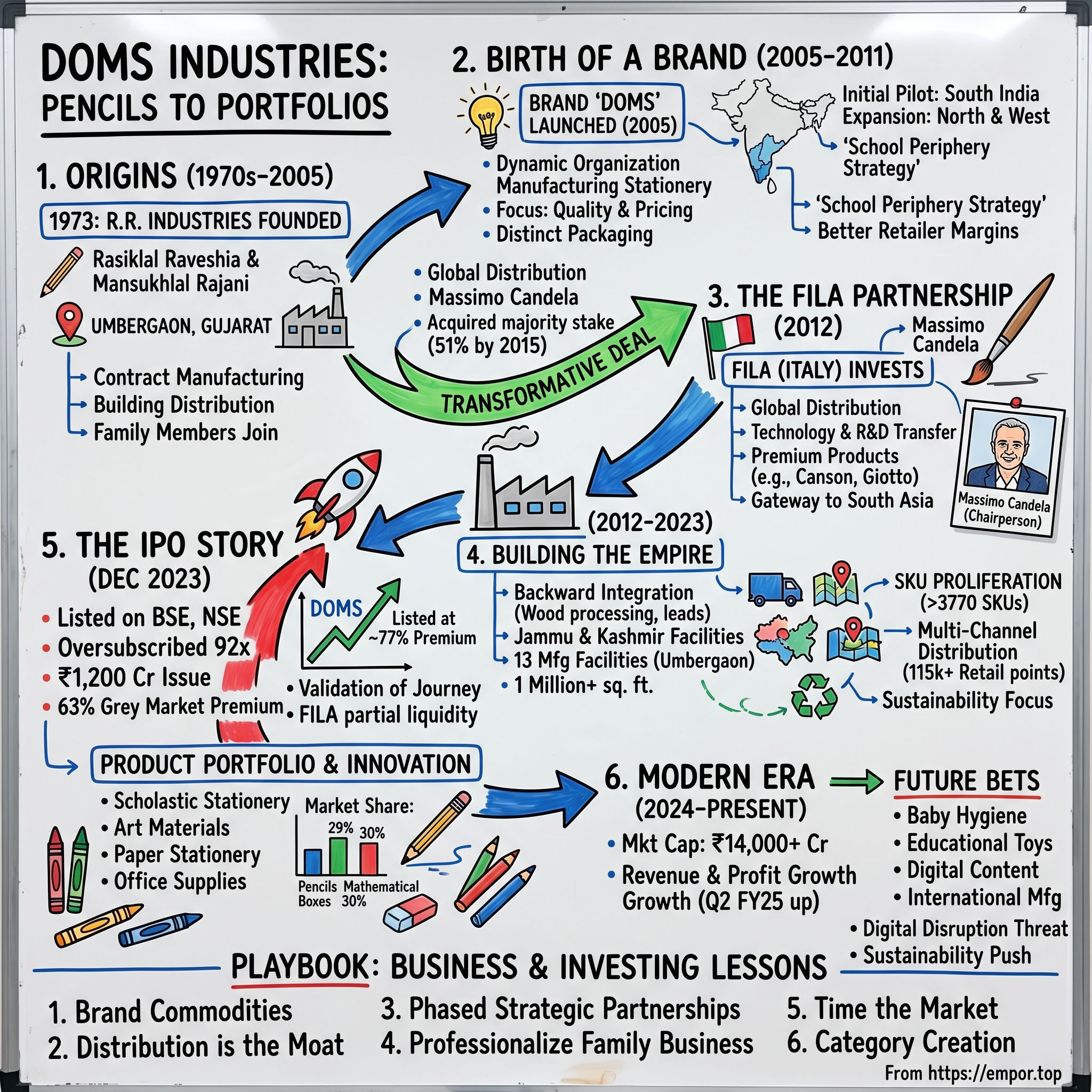
DOMS Industries: From Pencils to Portfolios — The Story of India's Stationery Giant
I. Introduction & Episode Roadmap
Drive north out of Mumbai along the coastal highway, cross into Gujarat, and after about three hours you reach Umbergaon — a town most Indians have never heard of, sitting on the Arabian Sea just past the Maharashtra border. It is not a glamorous place. It is a place where things get made. And behind a set of gates there, across roughly two million square feet of factory floor spread over eighteen facilities, sits an industrial complex that produces something like a billion pencils a year, plus erasers, sharpeners, wax crayons, oil pastels, geometry boxes, notebooks, sketch pens, school bags, and — since 2024 — baby diapers.12
This is DOMS Industries. In FY2026, the company reported consolidated revenue of ₹2,326.4 crore, up 21.6% year on year, with EBITDA of ₹402.6 crore and net profit of ₹239.6 crore.3 As of early September 2026 the stock traded around ₹2,202, giving a market capitalisation near ₹13,400 crore against a trailing price-to-earnings multiple above 60 times and price-to-book above 10 times.4 Those are software-company multiples attached to a business that grinds poplar wood into slats and extrudes graphite cores.
That is the paradox worth an entire episode. Stationery in India is supposed to be a bad business. It is low-ticket, it is seasonal, it is dominated by unbranded local manufacturers who pay no tax and cut every corner, and it sits directly in the path of the most obvious secular headwind imaginable — children who will do their homework on tablets. Yet DOMS has compounded revenue at roughly 42% a year over five years, has run return on capital employed near 24% and return on equity above 20%, and carries almost no net debt, with borrowings of ₹141 crore against reserves of ₹1,159 crore at the end of FY2026.4 CRISIL upgraded the company's long-term rating to AA-/Stable in August 2025, citing "continuous and significant improvement in business and financial risk profiles."5
And then, in the June 2026 quarter, the machine stalled. Revenue still grew 19.2% to ₹670.5 crore — right inside guidance. But EBITDA margin collapsed 530 basis points to 12.3%, from 17.6% a year earlier, and profit after tax fell 23.4%.6 Raw material costs rose roughly 20%; management pushed through price increases of only 4–5%, deliberately eating the difference.7 That single quarter is the best stress test this company has faced as a public entity, and it tells you more about the real shape of the moat than five years of clean compounding did.
Here is how the story unfolds. Act I covers the family partnership firms of Umbergaon — R.R. Industries and later S. Tech — and the long, unglamorous decades as a contract manufacturer with no brand of its own. Act II is the arrival of Italy's F.I.L.A. Group in 2012, the capital and technology that came with it, and the more complicated truth about what that partnership did and did not deliver. Act III is the industrial build-out: the obsessive backward integration that turned Umbergaon into one of the largest single-location stationery complexes in Asia, and the distribution machine that now reaches 145,000-plus retail outlets. Act IV is the December 2023 IPO, F.I.L.A.'s steady retreat from 51% ownership down to 19%, and the acquisition spree that followed — Uniclan, Super Treads, Pioneer, Reynolds. Act V is the analytical spine: Porter, Helmer, the governance record, the falsification pass, and what a sceptic would attack.
Because the interesting question about DOMS is not whether it has grown. It obviously has. The question is whether what looks like a moat is actually a moat — or whether it is a very well-run manufacturer enjoying a category that is formalising around it, priced as though the advantage is permanent.
 Subscribe on LinkedIn
II. The Origins: Partnership Firms, OEM Beginnings, & Family Foundations (1973–2004)
Start with a discrepancy, because it is a useful one. The company's own corporate-history page dates the founding of R.R. Industries to 1973, established by the late Rasikbhai A. Raveshia and the late Mansukhlal Rajani to manufacture pencils and crayons.1 The company's overview page, on the same website, says DOMS Industries was "established in 1975."2 Neither is wrong, exactly — Indian family businesses of that era were built from overlapping partnership firms rather than a single incorporated entity, and the "founding date" depends on which firm you count. But it is a small reminder that the pre-IPO history of this business is a story assembled from partnership deeds rather than audited filings, and should be read with that in mind.
What is not in dispute is the setting. Two families — the Raveshias and the Rajanis — set up shop in Umbergaon in the 1970s, in a corner of Gujarat chosen for the practical reasons that industrial India is usually built on: proximity to the Mumbai market, cheap land, and access to port infrastructure. They made pencils and crayons. They did not make a brand.
That distinction is the whole first act. In post-Independence India, branded stationery meant Hindustan Pencils, whose Nataraj and Apsara pencils were as culturally fixed in the Indian classroom as chalk dust. Later came ITC's Classmate in notebooks and Camlin in colours and fine art. Below that tier sat hundreds of small manufacturers who made product to other people's specifications, stamped other people's names on it, and took whatever margin the wholesaler left behind.
That was R.R. Industries. It was, in the language of modern strategy, a capacity business rather than a demand business. It owned machines and workers and know-how; it did not own the customer. And the economics of that position are brutally simple to describe: when timber prices rose, the contract manufacturer absorbed it, because the brand owner had alternatives and the manufacturer had payroll. When demand softened, utilisation fell and fixed costs did not. Working capital was perpetually tight because distributors paid late and suppliers wanted cash.
There is a temptation, writing origin stories, to claim that the founders had some secret technical edge from the beginning — a better lead formulation, a superior wood treatment — that made everything afterwards inevitable. The record does not support that. The Umbergaon firms were competent, not exceptional, and the proof is in the outcome: three decades of manufacturing did not produce a nationally recognised brand, a dominant market share, or the kind of capital base that would have let the family expand aggressively. If proprietary technology had been the differentiator, it would have shown up in pricing power, and pricing power would have shown up in retained earnings. It did not. What the first thirty years produced was manufacturing capability and family patience — genuinely valuable assets, but ones that generate poor returns on invested capital until someone attaches them to a brand.
The generational handover is where that changed. Santosh Raveshia, son of Rasiklal, took over the commercial side — product development, packaging, go-to-market. He is not a credentialed technocrat; his disclosed education is the Maharashtra state secondary school certificate, and his value to the business has always been merchandising instinct rather than a management degree.8 Ketan Rajani took the operational side, and specifically the wood: seasoning and treatment, the least visible and most cost-critical process in a pencil factory.9 The division of labour — one brother-in-arms selling, one making — has held for two decades and remains the organising logic of the executive team today.
In 2005, the group formed S. Tech Industries to manufacture polymer-based scholastic stationery — plastic sharpeners, rulers, geometry-box components.1 Read narrowly, it was a capacity addition. Read properly, it was the first move away from wood-only contract manufacturing toward a portfolio of materials, which is precisely what you need if your ambition is to sell a kit rather than a component. The family was, quietly, assembling the pieces of a branded product before it had a brand.
It is worth being precise about what those first three decades were worth, because the temptation in a company profile is to treat every early year as foundation-laying. Most of it was not. Most of it was survival in a category with no pricing power, and the evidence that it was survival rather than accumulation is the size of the business when the story actually starts: the entity that F.I.L.A. would buy into in 2012 was valued at well under ₹300 crore in total.10 Thirty-five years of manufacturing had produced a competent mid-sized factory and very little else.
What those decades did produce, though, is the thing that cannot be bought: process knowledge in a category where the processes are unglamorous and undocumented. How long poplar needs to season in Gujarat humidity before it will take a lacquer without warping. Which graphite-to-clay ratio survives a seven-year-old's grip. How to run a plant through a demand curve that puts sixty percent of the year's volume into four months. None of that appears on a balance sheet. All of it is why, when the family finally decided to attach a brand to the machinery, the product worked from the first year rather than the third.
The next decision was the one that mattered.
III. Birth of a Brand: The DOMS Launch & Backward Integration Blueprint (2005–2011)
Picture the shelf of an Indian stationery shop in 2006. It is a narrow shop, maybe eighty square feet, packed floor to ceiling, run by a man who knows every child in the neighbourhood by name. On the pencil rack: the red-and-black striped Nataraj, the black-and-silver Apsara. They cost two or three rupees. They have looked the same for forty years. They are excellent pencils and utterly interchangeable in the mind of the buyer.
Into that shelf, the Umbergaon families launched DOMS — the flagship brand, introduced in 2006 under the corporate entity Writefine Products Private Limited, which had absorbed the businesses of both R.R. Industries and S. Tech Industries and would later be renamed DOMS Industries Limited.12
The strategic insight was not technological. It was that the buyer of a pencil is not the user of a pencil. A seven-year-old uses it; a parent pays for it. And the parent's decision at the counter is not a rational cost-per-word calculation — it is a small act of affection, made in thirty seconds, on the basis of what looks nicer. That is the seam DOMS attacked: bright neon barrels, triangular ergonomic grips that stop small fingers slipping, rubberised coatings, and packaging designed to be picked up rather than merely stocked.
The pricing move followed from the design move. Rather than fight for the ₹2–3 commodity slot, where the incumbents had four decades of scale advantage and the unbranded sector had zero tax compliance, DOMS built products at ₹5 and ₹10 — often bundling a sharpener and eraser into the pack so the parent felt they were buying a small gift rather than a consumable. In Helmer's vocabulary this is counter-positioning: a new business model that the incumbent could copy only by cannibalising its own volume base. Hindustan Pencils could match the design; it could not easily tell its own distribution network that the two-rupee pencil that built the franchise was now the low-tier offering.
But aesthetics alone would have been a two-year advantage. What made it durable was what happened behind the factory gate.
The core insight of the Umbergaon build-out is that a pencil is not one product; it is roughly eight products assembled. There is the wood slat. The graphite-and-clay core. The lacquer. The ferrule. The eraser plug. The printing. The tin or plastic box it ships in. The corrugated carton. A typical regional assembler buys six of those eight from third parties, adds labour, and prays that none of the six suppliers raises prices in the same quarter.
DOMS went the other way, and kept going. Wood seasoning and slat processing in-house. Lead extrusion in-house. Injection moulding for polymer items in-house. Lacquering, printing, packaging, and even the construction of automated assembly machinery — increasingly in-house. In August 2023 the company took a 75% stake in Micro Wood Private Limited, a manufacturer of tin and paper-based packing material, explicitly described as furthering backward integration.9 The logic compounds: every process brought inside converts a supplier's margin into your own, removes a coordination failure, and — crucially for a seasonal business — lets you flex output for the March-to-June back-to-school peak without begging a vendor for priority.
The reason this matters more in India than in, say, Germany is scale of variance. Indian input markets are volatile, fragmented, and prone to sudden shortage. Vertical integration is not primarily a margin play there; it is a reliability play. And reliability is what a distributor pays for.
A useful way to think about it for a non-industrial reader: imagine a restaurant that grows its own vegetables, mills its own flour, and builds its own ovens. The obvious benefit is cost. The less obvious and more valuable benefit is that when the vegetable market has a bad week, the restaurant does not have to change its menu, raise its prices, or apologise to a customer. It keeps serving. In a category where a distributor's loyalty is earned by never running out during the four-month school season, that reliability is the product differentiation.
The less obvious cost is that the restaurant now carries the risk of a bad harvest on its own books, and cannot walk away from its farm when input prices fall. Integration converts a variable cost into a fixed asset, and fixed assets do not care about the cycle. This is exactly the trade that would be tested in 2026.
Now the falsification pass, because the integration story is the single most-repeated claim in the DOMS narrative and it deserves testing rather than repeating.
The claim, in its strong form, is that backward integration insulates DOMS from input-cost shocks. The company's own reported numbers reject that strong form outright. Raw material consumption ran at 56.4% of operating revenue in FY2026 and rose to 61.8% in the June 2026 quarter — a swing of more than 500 basis points in a single year.6 CRISIL, in its August 2025 rationale, listed "susceptibility of operating margin to fluctuations in raw material prices," specifically polymer and graphite, as a key rating weakness even while upgrading the credit.5 Integration moves the exposure upstream; it does not eliminate it. If you own the slat plant, you now own timber-price risk directly instead of buying it embedded in a slat price. If you mould your own polymer parts, you own crude-linked resin risk.
What integration does buy is relative advantage and timing. DOMS absorbs the same shock as an unintegrated assembler but from a lower cost base, and can decide when to pass it on rather than being forced to by a supplier's invoice. That is a real and defensible edge — it is simply a narrower claim than "insulated." The honest version is: backward integration lowers the cost floor and widens the window for pricing decisions; it does not flatten the cycle. Hold that thought, because in 2026 the company chose to use that window in a way that cost it a great deal of reported profit.
By 2011, DOMS had a brand, a widening product set, and a factory that made most of what it sold. What it did not have was capital, global standards, or an export channel. An Italian pencil company was about to supply all three.
IV. The FILA Partnership: Strategic Capital, Technology Transfer, & Global Expansion (2012–2017)
F.I.L.A. — Fabbrica Italiana Lapis ed Affini — was founded in Florence in 1920 and has been controlled by the Candela family since the 1950s.1 By the 2010s it had assembled one of the great collections of Western art-materials brands: Giotto and Tratto in Italy, LYRA in Germany, Canson in France (a paper house tracing its origins to 1557), and Dixon Ticonderoga in the United States — the company whose yellow pencil is to American schoolrooms what Nataraj is to Indian ones.1 F.I.L.A. listed on the Milan exchange in 2015.[^10]
For a European art-materials group in 2011, the strategic problem was straightforward and existential: Chinese manufacturers were undercutting European cost bases in every commodity category, and the growth was all in emerging markets where European price points did not clear. F.I.L.A. needed an Asian manufacturing base that was not China, and it needed exposure to the single largest population of school-age children on earth.
For the Umbergaon families, the problem was the mirror image. They had a growing brand and a factory that needed continuous capital, and they were competing against ITC — a conglomerate with effectively unlimited balance sheet — and against a heritage incumbent with four decades of distribution.
The deal that resulted came in two steps. In 2012, F.I.L.A. acquired an 18.5% stake for €5.4 million. In 2015 it increased its holding to 51%, taking majority control while leaving the Raveshia and Rajani families running the operating business day to day.10 It is worth pausing on that valuation: €5.4 million for 18.5% implies an enterprise value under €30 million for the whole company in 2012 — roughly ₹200 crore at the exchange rates of the day. Against a market capitalisation above ₹13,000 crore in 2026, that is one of the more remarkable minority investments made in Indian consumer manufacturing in the last fifteen years.4
What DOMS got was more than money. It got European process standards in an industry where "non-toxic" is a regulatory claim rather than a marketing one, pigment and formulation chemistry from a group that had been making art materials for ninety years, and — importantly — a template for what a premium stationery brand looks like when it is designed rather than merely manufactured. It also got a distribution ramp into export markets it could never have opened alone.
What F.I.L.A. got was a low-cost, high-quality manufacturing platform and a claim on Indian demographics.
Now the falsification pass, and it is a significant one, because the standard telling of this story overstates the outcome.
The claim to test: the F.I.L.A. partnership turned DOMS into a global brand. The record does not support it. Exports have remained persistently range-bound as a share of the business — 12% of gross product sales in the June 2026 quarter, against full-year guidance of 13–15%, and management has been explicit that the constraint is capacity rather than demand.67 The company sells into more than 55 countries across six continents, but the composition matters: in Q1 FY27, F.I.L.A.-routed sales accounted for roughly 7% of exports and third-party channels about 5%.6 In other words, a decade and a half after the partnership began, a meaningful slice of DOMS's international business still travels under someone else's brand and through someone else's shelf space.
That is the low-margin sourcing pattern in plain sight. F.I.L.A. used DOMS primarily as an efficient manufacturing base for its own global portfolio; it did not build "DOMS" as a consumer brand in Western retail. The verdict is not that the partnership failed — the technology transfer, the credibility, and the export beachhead were all real, and the capital arrived at the moment it was most useful. The verdict is that the global brand version of the claim should be rejected and replaced with a narrower one: F.I.L.A. made DOMS a better and more credible manufacturer with an export channel, not a Western consumer brand. The KPI that would falsify the narrow version and revive the broad one is simple and public — exports rising sustainably above the mid-teens as a share of sales, with the DOMS-branded share of those exports climbing rather than the contract-manufactured share.
There is a further complication a minority investor should keep in view. A structure in which a controlling shareholder is also a customer, a supplier of technology, and a distribution counterparty creates transfer-pricing and royalty questions by construction. That is not an allegation of wrongdoing; it is a description of the geometry. And as we will see, the governance implications of the F.I.L.A. relationship did not end when F.I.L.A. stopped being the majority owner — in some ways they became sharper.
For the moment, though, the partnership did what partnerships are supposed to do. It bought time and capital. DOMS used both to build something physical.
V. Building the Empire: Umbergaon Scale, Multi-Category SKUs, & Distribution Mastery (2018–2023)
Here is the single most useful mental image for understanding DOMS: not a factory, but a campus.
As of the June 2026 quarter the group operated eighteen manufacturing facilities across five locations, occupying more than two million square feet on over 55 acres, employing more than 14,000 people, with a further 61-plus acres of land banked for future projects.6 The anchor is Umbergaon; there is a dedicated pencil facility in Jammu; and the acquired subsidiaries add sites in Rajasthan and eastern India. CRISIL has described the current expansion as creating "one of the largest single-location manufacturing facilities in the stationery industry in the Asia Pacific region."5
Why does concentration matter? Because in a business where the finished product sells for five rupees, logistics between processes is a real cost. Every time a semi-finished good has to travel between plants, you pay for handling, transport, breakage, and working capital tied up in transit. Putting slat cutting, lead extrusion, moulding, lacquering, printing, and packing on one campus turns what would be an inter-firm supply chain into an intra-plant conveyor. This is Process Power in the Helmer sense — an advantage embedded in accumulated operational routine that a competitor cannot buy off the shelf, only build over years.
The portfolio that campus feeds has expanded well past pencils. As of Q1 FY27 the company listed more than 4,800 SKUs across nine product categories.6 The mix has been shifting in an informative direction: scholastic stationery — the pencils, erasers, sharpeners, rulers and geometry boxes that built the company — fell to 31% of gross product sales from 34% a year earlier, while scholastic art materials rose to 21% from 20% and kits and combination packs jumped to 16% from 14%.6
That drift deserves interpretation rather than just reporting. Scholastic stationery is the volume anchor and the shelf-space claim; it is also the most price-sensitive and the most exposed to any long-run decline in handwriting. Art materials carry structurally better realisations and are pulled by a genuinely different demand driver — hobbyist and creative spending, which is discretionary and rising with income rather than tied to school enrolment. Kits and combos are the highest-realisation transaction in the store, because a parent buying a back-to-school bundle is making one decision rather than eight. The mix shift toward art and kits is therefore the most economically meaningful trend in the P&L, and it is doing more work in defending margins than any single manufacturing efficiency.
It should not, however, be described as irreversible. Kits and combos are a seasonal, gifting-adjacent category; their share swells around admissions season and can just as easily compress. The company itself reports the mix quarterly precisely because it moves.
Then there is the distribution machine, which is the part outsiders consistently underestimate.
By Q1 FY27, DOMS's own stationery network comprised more than 130 super-stockists, over 6,250 distributors, more than 145,000 retail outlets, and a field sales force exceeding 1,100 people, covering 28 states and 8 union territories.6 Separately, the acquired hygiene subsidiary Uniclan ran its own parallel network of 95-plus super-stockists, 1,300-plus distributors, 55,000-plus outlets and 210-plus sales staff.6 General trade — the neighbourhood shops — still accounted for 77% of gross product sales, with modern trade at 8%, exports at 12%, and other channels including e-commerce and quick commerce at 3%.6
To calibrate how fast that has been built: CRISIL's August 2025 rationale cited 125-plus super-stockists, 4,750-plus distributors and over 135,000 retailers.5 So in roughly a year, the distributor count expanded by around a third. That is not passive coverage growth; it is a deliberate, funded push, and it is the single clearest evidence that the company is prioritising shelf presence over near-term profitability.
It is also worth understanding what those five layers physically do, because "distribution network" is one of those phrases that gets used as though it explains itself. A super-stockist is a regional warehouse operator who takes bulk consignment and carries the inventory risk for a state or a large cluster of districts. Beneath them, distributors break bulk down to town level and extend credit to shops. Beneath them sit the shops themselves. The company's own field force does not sell to consumers at all; it services the middle of that chain — checking stock, placing displays, pushing new SKUs, and collecting the intelligence that tells head office which neon colour is moving in Coimbatore and which is dying in Kanpur. Adding 1,500 distributors in a year is not a spreadsheet exercise; it means recruiting, financing and training small businesses in towns where the company previously had no presence.
What makes general trade a genuine barrier rather than just an expense is the physics of the Indian shop. Eighty square feet of retail space cannot stock four brands of pencil. The shopkeeper stocks what turns, what the distributor services reliably, and what the sales rep visits often enough to keep replenished. Winning that slot requires feet on the ground in tens of thousands of towns — a cost structure that only makes sense if it is amortised across many products. This is the real strategic function of running 4,800 SKUs: it is not a merchandising vanity, it is what makes the sales force economically viable per visit. Scale economies and distribution reinforce each other.
But SKU proliferation has a cost, and the falsification pass belongs right here. The claim that a wide catalogue creates a costless moat is wrong on the evidence. Working capital days stood at 65 in the FY2026 disclosure, and free cash flow for FY2026 was negative ₹38 crore despite operating cash flow of ₹254 crore, because capital expenditure of ₹292.8 crore consumed all of it and more.46 A wide catalogue means inventory in nine categories at every tier of a five-layer channel, and every incremental SKU adds obsolescence risk in a business where designs are refreshed for fashion reasons. The correct conclusion is not that the catalogue is a liability — it plainly drives the route economics — but that the moat it creates is funded, not free, and it shows up as a permanent claim on cash rather than as a one-time investment.
By late 2023, the family that had spent thirty years making other people's pencils was ready to sell shares to the public.
VI. The IPO Story: Public Listing & Capital Structure Anatomy (December 2023)
The Indian primary market in December 2023 was in the middle of one of its periodic fevers, and DOMS walked straight into it.
The offer opened on 13 December and closed on 15 December 2023, at a price band of ₹750–790 per share for a total issue size of ₹1,200 crore — split between a fresh issue of about ₹350 crore and an offer for sale of about ₹850 crore.11 The response was extraordinary even by the standards of that market: the book was subscribed roughly 93 times overall by the final day.1112 On 20 December the shares listed at ₹1,400 on both the NSE and BSE, a premium of 77.2% over the issue price, taking market capitalisation to roughly ₹8,500 crore on debut.12
Two things are worth extracting from that, and neither is the headline pop.
The first is the split between fresh issue and offer for sale. Roughly seventy paise of every rupee raised went to selling shareholders rather than into the company. The largest seller was F.I.L.A., which had committed shares worth around ₹800 crore to the OFS.13 That is not a criticism — an OFS is a legitimate liquidity event and the primary purpose of many Indian IPOs — but it does frame what the listing actually was. This was not principally a capital-raising for growth. It was principally a monetisation, with a modest growth component attached.
The second is what the fresh money was for. The ₹350 crore of primary proceeds was earmarked chiefly for a greenfield manufacturing expansion at Umbergaon, plus general corporate purposes.11 Read against the subsequent capex record — ₹292.8 crore spent in FY2026 alone, with FY2027 planned at ₹250–275 crore and a total programme for the new facility guided at ₹850–1,000 crore over three years — the IPO proceeds turn out to have been a down payment rather than the funding envelope.614 The expansion is being financed overwhelmingly from operating cash flow. For a company with a debt-to-equity ratio of 0.02x and net cash, that is a coherent choice; it is also why free cash flow has been negative even as reported profits rose.6
There is a third point buried in the listing-day arithmetic that is easy to miss and worth stating plainly. The company listed at roughly ₹8,500 crore of market capitalisation in December 2023.12 By September 2026 that figure was near ₹13,400 crore.4 Over the same window, revenue went from an FY2023 base of ₹1,211.89 crore to ₹2,326.4 crore in FY2026 — a near-doubling.113 In other words, the great majority of the shareholder return since listing has come from earnings growth rather than from further multiple expansion. That is a more comfortable composition than the raw price chart suggests, and it is a useful anchor when assessing the valuation argument later: the market has not been re-rating this stock so much as tracking a business that has been compounding fast.
The more consequential story is what happened to the register afterwards.
F.I.L.A. began its retreat almost immediately. In December 2024 it placed a further tranche via an accelerated book-build, announcing the placement of up to a 4.57% stake — a transaction that knocked the shares down sharply on the day and put the phrase "promoter overhang" permanently into the DOMS conversation.[^10]15 By March 2026 F.I.L.A.'s holding was 26.01%. On 17 June 2026 it sold 4,248,184 shares — 7.00% of equity — in an on-market block, reducing its stake to 19.01%.16 The block was priced at ₹2,200.34 per share for gross proceeds of roughly ₹9.35 billion, at a discount of around 9% to the previous close, with the shares falling about 5% on the news.17
The register tells the rest. Promoter holding, which stood at 74.95% in March 2024, was 70.38% in March 2026 and 63.38% by June 2026 — a seven-point drop in a single quarter. Domestic institutional holding rose over the same period from 16.63% to 25.91%.4 So the sell-down has been absorbed, and absorbed by domestic funds rather than by retail buyers or foreign institutions, whose share has been broadly flat around 7.5%.4
What should an investor take from that? Two things, pointing in opposite directions. Positively, a seven-percent block clearing at a single-digit discount and being taken up by domestic institutions is evidence of genuine institutional conviction rather than a distressed exit. Negatively, F.I.L.A. still holds roughly 19% and retains promoter status, of which a portion remains locked in under SEBI regulations.16 Every subsequent tranche is a known, telegraphed supply event. That is not a business risk — it does not touch a single pencil — but it is a real feature of the equity, and it has repeatedly produced sharp single-day drawdowns.
Which raises the obvious question: if the Italian parent has been steadily heading for the exit, who is actually driving this company now, and what have they been doing with the money?
VII. Competitive Crucible, Industry Structure, & Economic Moats
To understand the competitive board, start with the size and shape of the prize.
The Indian stationery and art-materials market is large but structurally strange. It splits roughly evenly between paper stationery and non-paper products, and it remains majority unbranded — the DRHP-era framing put the unorganised share around 63–64% of the total, with branded players steadily taking share.18 Within that, writing instruments are a notable exception: a market of roughly ₹80 billion where branded products already account for close to four-fifths of sales, reflecting higher technical entry barriers than notebooks, where anyone with a folding machine can compete.
So there are really two games being played. In paper stationery, the enemy is the informal sector and the weapon is price and tax compliance. In writing instruments and art materials, the enemy is other brands and the weapon is product and shelf.
The competitive set, in order of how seriously DOMS has to take them:
ITC is the structural heavyweight. Through Classmate it leads Indian branded stationery, anchored in notebooks, and it runs an asset-light model that outsources most manufacturing. ITC can fund a price war out of petty cash. What it has historically not done is match DOMS in the non-paper categories — pencils, geometry boxes, art materials — where manufacturing depth matters more than distribution muscle.
Hindustan Pencils, with Nataraj and Apsara, remains the heritage pencil leader and is the specific incumbent DOMS has been taking share from. The trajectory here is the most important competitive fact in the entire story. DOMS reported a 29% share of the Indian pencil market in FY2023 at the time of the IPO;12 on the Q3 FY26 call in early 2026, management estimated current pencil share at around 35%, with an aspiration toward 45% once the new capacity comes online.14 Note that the 35% figure is management's own estimate rather than an independently audited number, and should be treated accordingly — but the direction is corroborated by the revenue trajectory.
Flair Writing Industries is the pure-play writing-instruments competitor. Flair reported FY2026 revenue of about ₹12.5 billion, up 16%, with net income up 17% and net margin steady around 11%.19 It is a real business growing at a real rate — and notably, it grew slightly slower than DOMS while running comparable profitability, which tells you the category tailwind is shared rather than DOMS-specific.
コクヨ Kokuyo Camlin is the cautionary tale. A heritage Indian art-materials pioneer acquired by Japan's Kokuyo, it has struggled to convert brand heritage into profitability: in the March 2026 quarter it reported net profit of ₹2.88 crore with operating margin compressing to 4.8% from 6.62% a year earlier.20 Camlin owns some of the most emotionally resonant brands in Indian art supplies and earns single-digit operating margins on them. That is the clearest available evidence that in this category brand heritage alone is not a moat — cost position and distribution are.
Linc and Navneet Education occupy adjacent niches — Linc in value pens with a premiumisation push under the Pentonic brand, Navneet in publishing and workbooks.
One more competitor deserves naming even though it does not appear on any market-share list: the unbranded workshop. In a typical stationery cluster, a small operator buys slats, buys leads, glues, cuts, prints, packs, sells locally for cash, and pays a fraction of the tax a listed company pays. That operator has no brand, no R&D and no field force — and structurally lower costs. For twenty years this was the ceiling on branded penetration in Indian paper stationery. The formalisation of the economy through GST, e-way bills and digital payments has been steadily raising that operator's effective cost base, and it is the single largest reason branded share has been rising without anyone having to out-innovate anyone. Investors should be clear-eyed that a meaningful share of DOMS's growth has come from a policy tailwind rather than from a competitive victory.
Now run the Helmer frameworks honestly, distinguishing what is proven from what is asserted.
Process Power — the strongest claim, and largely supported. The Umbergaon complex, with custom-built automation and near-complete in-house conversion, is genuinely hard to replicate. A new entrant would need multi-year capex cycles and would still lack the accumulated tooling knowledge. The evidence is in the gross fixed asset turnover of 2.7x and the historically superior margin structure versus every listed peer.620
Scale economies in distribution — strong and improving. 145,000 outlets serviced by 1,100 field staff, with fixed selling costs spread across 4,800 SKUs, produces a cost-per-outlet that a single-category competitor structurally cannot match.6
Brand power — moderate and, importantly, unproven at the price point that matters. DOMS has genuine recall with children and parents. But the June 2026 quarter is the test case: when input costs rose 20%, the company chose to raise prices only 4–5% and absorb the rest.7 A business with strong brand pricing power does not usually make that choice. Management framed it as a deliberate share-capture decision — CFO Rahul Shah told analysts that "our priority was very much clear that we wanted to focus on volume-led growth, ensure that the market share growth trajectory is retained"7 — and that framing may well be correct strategy. But strategy and pricing power are different things, and the observable behaviour is consistent with a brand that is strong on preference and weaker on price inelasticity.
Counter-positioning — historical, and now largely spent. The ₹5–10 aesthetic pencil against the ₹3 commodity pencil was a genuine counter-position in 2006. Twenty years on, every serious competitor sells premium pencils. This power should be understood as the origin of the franchise, not as a current source of defence.
On Porter's five forces, the picture is mixed rather than uniformly favourable, and the mix has been shifting. Supplier power is materially higher than the integration narrative implies, because the ultimate suppliers are crude oil and timber, and neither negotiates. Buyer power at the consumer level is low; at the channel level, in modern trade and quick commerce, it is meaningfully higher than in general trade, which is one reason the company has been in no hurry to shift mix. Threat of substitutes is the long-horizon question and we address it below. Rivalry is intense but fragmented. New entrant threat in branded, integrated manufacturing is genuinely low; in unbranded assembly it is essentially zero-barrier, which is exactly why the formalisation of the market is the central bull argument.
Which brings us to what the company has been doing with its cash.
VIII. The Growth Frontier: M&A Strategy, Pioneer Integration, & Optionality Bets (2024–Present)
Since listing, DOMS has been shopping — and the shopping list is broader than a stationery investor would have predicted from the prospectus.
Uniclan Healthcare (September 2024). DOMS acquired a 51.77% stake for ₹54.88 crore, of which ₹28.88 crore was a primary infusion for capacity expansion, debt repayment and working capital at the target.21 Uniclan makes pull-up pant-style baby diapers and wipes under the Wowper brand from a facility in Jaipur with capacity of roughly 400 million diapers a year.21 Managing Director Santosh Raveshia described it as "a crucial step in our long-term strategy to explore new sectors that enhance our business portfolio."21
This is the most debatable capital allocation decision the company has made, and it deserves a hard look rather than a strategic-fit platitude. The bull argument is real: the diaper category is large and fast-growing, the target had underutilised capacity, and DOMS's distribution — the same kirana shops, the same super-stockists — could carry the product at near-zero incremental cost. The evidence supports that part. Uniclan delivered revenue of ₹203 crore in FY2026, up 23%.22 Wowper reached 6.7% of gross product sales in Q1 FY27, up from 5.3% a year earlier, and the subsidiary now runs its own 55,000-outlet network.6
The bear argument is equally real, and it is about margin structure. On the Q3 FY26 call management indicated Uniclan's EBITDA margin reached 12% in its strongest quarter but should normalise to 8–9% annually; the Q4 FY26 commentary put the long-term expectation around 10%.1422 Against a core stationery business that has historically run 16–18%, that is dilutive by construction. Diapers are a scale-and-commodity business dominated globally by companies with vastly larger R&D and media budgets; the differentiation is thinner than in art materials, and the raw materials are crude-linked. The correct framing is not that Uniclan was a mistake — it has grown and it uses spare distribution capacity — but that it is a lower-quality earnings stream bolted onto a higher-quality one, and that every rupee of Wowper growth mechanically pulls the consolidated margin down. Anyone modelling DOMS margins must model the mix, not the trend.
Pioneer Stationery. DOMS built its position in this paper-stationery manufacturer in stages, moving from 51% to 57.5%, and then on 31 March 2026 acquiring a further 3,900 shares for ₹5.54 crore to reach 64.0%.23 Small cheques, incrementally deployed — a pattern that is characteristic of this management and, on the evidence so far, sensible.
Super Treads (2025). Here the common telling of the DOMS story is simply wrong, and it is worth correcting. Super Treads is frequently described as a rubber and eraser-compound backward-integration play. It is not. Board approval came on 19 May 2025 for a 51% stake at a maximum consideration of ₹6.12 crore, and Super Treads is an OEM supplier with more than two decades of experience manufacturing notebooks and paper stationery; the stated rationale was to expand manufacturing capacity and geographic reach in eastern India.24 Raveshia framed it as diversifying "our paper stationery infrastructure."24 It closed on 1 June 2025.
SKIDO Industries. A 51% stake, effective from 1 April 2024, taking DOMS into bag manufacturing.25 The scale so far is small — approximately ₹9.5 crore of revenue over the first nine months of FY26 on a total investment of about ₹2 crore, per the Q3 call.14 That is early-stage traction, not a business line.
ClapJoy Innovations. A minority stake taken in 2023 in toys and wooden educational kits — sized as an option rather than a bet.2
Reynolds (June 2026). The most attention-grabbing deal. On 10 June 2026 DOMS signed an asset purchase agreement to acquire the worldwide rights to the Reynolds brand and identified assets, contracts, employees and liabilities, for US$3.7 million — about ₹30.71 crore — from six entities including Reynolds Pens India, Luxembourg Brands (trademarks and domains) and Sanford L.P. (patents and designs), all within the Newell Brands orbit.26 Completion followed on 1 July 2026.27 The shares rose 6% on announcement.26
For anyone who went to school in India after 1985, Reynolds is the ball pen. Acquiring an 81-year-old global brand with deep Indian recall for roughly ₹31 crore looks, on its face, like a spectacular price. But the Q1 FY27 call substantially bounded what was actually bought, and management deserves credit for saying so plainly rather than letting the narrative run. Shah told analysts that DOMS did not acquire manufacturing operations — Newell retained tip manufacturing globally — and that "capacity to manufacture and sell Reynolds product will be coming from our existing planned expansion only."7 Reynolds carried prior revenue of roughly ₹130–140 crore and is targeted to reach around 10% of DOMS revenue by FY2029, but in the near term it primarily substitutes existing volumes rather than adding them, because DOMS is capacity-constrained.28 Asked by Jinesh Joshi of PL Capital why DOMS did not buy the nib business, Shah noted the company is building that capability itself: "we've already got the first tip manufacturing plant in India."7
Read as a whole, the M&A record has a consistent signature: small cheques, majority rather than full control, adjacent rather than transformative, and funded from cash flow. Total disclosed consideration across Uniclan, Pioneer's top-ups, Super Treads, SKIDO and Reynolds is well under ₹150 crore — a rounding error against a ₹13,000 crore market capitalisation. That is genuinely disciplined sizing, and it means no single deal can break the company.
But note what the sizing also implies: none of these can carry the growth story either. The 18–20% revenue growth guidance is overwhelmingly organic. The acquisitions are options, and the honest way to hold them is as options — cheap, numerous, and mostly unproven. The one that has actually converted so far is Uniclan, and it converted into lower-margin revenue.
IX. The Falsification Pass & Risk Radar: Testing the Thesis Against Disconfirming Evidence
Now the discipline. Four claims sit at the centre of the DOMS investment case. Each gets tested against the company's own record, and each gets a verdict rather than a shrug.
Claim 1: Backward integration protects gross margins through the cycle.
Verdict: rejected in its strong form; survives in a narrow form. The June 2026 quarter settles this. Raw material costs rose roughly 20%; consumption jumped to 61.8% of revenue; gross margin compressed by around 400 basis points and EBITDA margin by 530.628 The core stationery business alone took roughly 600 basis points of compression from crude-linked materials.28 This was not a one-off: CRISIL flagged raw-material sensitivity as a rating weakness even while upgrading, and management's guided FY26 margin of 17–17.5% was already below FY25's 18.2%.5 Integration lowers the cost floor and gives management timing discretion. It does not decouple the P&L from crude and timber. The KPI that tests the narrow claim going forward is blended gross margin recovering toward the 40%-plus zone as pricing catches up — and Shah's own statement that Q1 "was probably the bottom" is the specific, falsifiable prediction to hold management to.7
Claim 2: Paper and adjacent expansion will replicate core economics.
Verdict: rejected on the evidence available. Paper conversion is a lower-margin, lower-differentiation business than pencils and art materials, and DOMS's own disclosures show it. The Q3 FY26 commentary reported paper stationery growth of only about 8.7–8.9% over eight months, with the third quarter actually declining year on year — well below the group's high-teens growth.14 Uniclan's guided 8–10% EBITDA margin sits roughly half the core.1422 The claim that adjacency expansion is margin-neutral is not supported; the defensible version is that adjacency buys addressable market and distribution leverage at the cost of blended margin. The KPI to watch is the paper and hygiene segments' contribution to consolidated EBITDA margin — if group margin recovers to 16–17% in FY28 while those segments grow, the dilution is being outrun; if it does not, the mix is the explanation.
Claim 3: Management runs clean, uncontested governance.
Verdict: rejected as stated; the record shows a live, unresolved dispute with institutional opinion. In 2025–26, DOMS proposed resolutions that would embed a pre-IPO shareholders' agreement between its two promoter blocks into the articles of association — arrangements covering board appointments, information sharing, market exclusivity and veto rights over key decisions. Under the proposed structure the Indian promoters would have the right to appoint the managing director and F.I.L.A. the right to appoint the chairman, with board committee appointments divided between them. F.I.L.A. would also gain exclusive rights to distribute in export markets where it already operates, DOMS would hold exclusive rights to F.I.L.A. products in India and neighbouring markets, and F.I.L.A. would receive monthly access to DOMS's financial and non-financial information. All three major Indian proxy advisers — InGovern, Institutional Investor Advisory Services and Stakeholder Empowerment Services — recommended shareholders vote against. InGovern specifically objected to clauses allowing a promoter to nominate the chair, arguing the position should be independent.29
Set aside whether the resolutions ultimately carried — the voting outcome is not disclosed in the materials reviewed here, and the company's 20th AGM was held on 3 September 2026 with the scrutinizer's report filed the same day.30 The analytically important facts are that management sought to restore promoter veto architecture after taking public money, and that the entire domestic proxy-advisory establishment lined up against it. There is a genuine business logic to the F.I.L.A. arrangements — mutual distribution exclusivity is normal between manufacturing partners. But the monthly information flow to a 19% shareholder who is also a commercial counterparty, and the promoter-nominated chair, are the kind of arrangements minority investors are entitled to price. Related-party dynamics have been part of this structure since before the IPO, and the correct posture is continuing surveillance of the annual RPT disclosures rather than a conclusion that the issue has been cleaned up.
Claim 4: Digital learning will hollow out the category.
Verdict: real but slow, and partially hedged — not currently visible in the numbers. The mechanism is straightforward: as urban private schools adopt tablets and smartboards, per-child consumption of pencils and notebooks falls. The offsets are equally real. India's school-age cohort remains enormous; formalisation is still transferring volume from unbranded to branded players; and DOMS's mix is already drifting toward art materials, which are pulled by creative and hobbyist demand rather than by curriculum. Nothing in the reported numbers yet shows scholastic volume decline — growth remains high-teens. The honest statement is that this is a decade-horizon risk with no current evidence, which is precisely why it should be monitored through the art-and-craft revenue growth rate rather than argued about in the abstract.
A fifth claim worth testing, because it underpins the growth guidance: that capacity converts reliably into sales.
Verdict: intact but not yet proven at the new scale. Management's stated capex productivity target is roughly ₹3 of revenue per ₹1 of capital deployed, with full utilisation reached within 18 to 24 months — and it explicitly benchmarks that against a historical achievement of 2.7x, which is the gross fixed asset turnover the company actually runs.286 So the target is an improvement on the record rather than a restatement of it, which is the mildly aggressive assumption sitting inside the guidance. More importantly, the historical 2.7x was earned adding capacity to a proven, demand-constrained pencil and art-materials business. The new programme adds capacity partly for products with no track record at DOMS — Reynolds ball pens, premium bags, expanded paper. Those are different conversion problems. The falsifying observation would be a decline in gross fixed asset turnover through FY28 as the greenfield buildings come online faster than the volumes fill them.
Additional risk radar, kept to what is material. Input-cost and crude exposure is the dominant near-term risk and is already realised. Tariffs are live: management cited U.S. tariff headwinds on wooden pencil exports on the Q3 FY26 call, and flagged tariffs as the principal external shock that could invalidate the "Q1 was the bottom" call.1428 Geographic concentration is a quiet exposure — a very large share of value creation happens on one campus in Umbergaon, and a fire, flood or labour event there would be difficult to route around, which is the flip side of the process-power advantage. Capital expenditure execution risk is meaningful given an ₹850–1,000 crore programme over three years against an annual EBITDA base near ₹400 crore.14 And the GST reform of September 2025, discussed below, cuts both ways.
X. Current Management Assessment & Capital Allocation Track Record
DOMS is run by a promoter group of four individuals plus a corporate promoter: Santosh Rasiklal Raveshia, Sanjay Mansukhlal Rajani, Ketan Mansukhlal Rajani, Chandni Vijay Somaiya, and F.I.L.A.9
Raveshia, the Managing Director, is the merchandising brain — new product development, packaging, go-to-market, the instinct for what a nine-year-old will point at. His disclosed remuneration is approximately ₹1.9 crore, a modest figure against a company earning ₹240 crore of net profit and one of the cleaner signals in the file: this is not a promoter extracting value through pay.8 Ketan Rajani runs manufacturing operations and, specifically, wood seasoning and treatment — the process that most directly determines pencil cost and quality.9 Sanjay Rajani serves as Whole-time Director. In June 2026 the company put the re-appointment of Raveshia as MD and Sanjay Rajani as Whole-time Director to a postal ballot, for five-year terms beginning 1 January 2027, with e-voting running from 16 June to 15 July 2026.31 The board comprises twelve directors, four of them independent, chaired by Gianmatteo Terruzzi, who joined in 2023; three directors are women, one of them independent.32
Now assess the behaviour rather than the biographies, because credibility is a track record, not a résumé.
On guidance discipline, the record is good and specific. Management has consistently guided to 18–20% revenue growth and consistently delivered inside or above it. FY2026 came in at 21.6% — above the range.22 On the Q3 FY26 call, with nine-month growth at 22.7%, Shah told analysts the company would "close the fiscal year at the upper end" of the range, and it did.14 Q1 FY27 grew 19.2%, again inside the range.6 Setting a range and hitting it repeatedly across a listed history is the most basic test of management credibility, and DOMS has passed it.
On margins, the record is weaker and more instructive. CRISIL's August 2025 note recorded FY25 EBITDA margin of 18.2% and management guidance of 17–17.5% for FY26; the outcome was 17.3% — inside the guided range, but a step down.522 Then Q1 FY27 came in at 12.3%.6 What matters is not the miss but the explanation. Management did not blame the weather or promise a mysterious recovery; it stated the mechanism (roughly 20% input inflation), stated its own choice (4–5% pricing, volume over margin), quantified the residual gap (roughly 500 basis points unrecovered), and gave a dated recovery target (16–17% by FY2028, contingent on commodity stabilisation, with possibly another 4–5% price increase required if spot prices persist).728 That is a specific, testable plan rather than reassurance, and it is the version of a miss that an investor can actually use.
Two smaller notes on how management talks. Asked what happens if raw material costs fall and margins overshoot, Shah said the company would reinvest rather than bank the windfall — "we will add some value to the product… we will definitely not want to sit and eat on these margins."7 That is either admirable long-termism or a soft pre-commitment to margin caps, depending on your priors; it is at least consistent with the volume-first behaviour actually observed. And on Reynolds, management publicly reduced its own earlier revenue expectations once capacity constraints became clear.28 Downward revision of one's own acquisition narrative within a quarter of closing is not common, and it is a point in favour.
On capital allocation, the pattern is coherent. The priority order is unambiguous: organic capacity first, bolt-on acquisitions second, dividends a distant third. FY2026 capex was ₹292.8 crore against operating cash flow of ₹254 crore — the company reinvested more than it generated.6 The final FY26 dividend was ₹3.65 per share, a yield of roughly 0.17%.433 Total acquisition spend since listing is small relative to capex. Return on capital employed of 23.9% and return on equity of 20.1% in FY2026 suggest the reinvestment has been earning well above cost of capital so far.6
The caveat that keeps this from being an unqualified endorsement is the one raised above: the newest capital deployment — diapers, bags, paper — is going into structurally lower-return categories than the one that generated the returns being praised. A company that earns 24% ROCE in pencils and reinvests into 8–10% margin diapers is, at the margin, diluting the very quality that justifies its multiple. That is not diworsification in the classic destroy-value sense; the deals are small, cash-funded and distribution-synergistic. But the direction of travel is toward a more ordinary business, and the reported group ROCE will eventually reflect that if the mix keeps shifting.
One further observation on narrative consistency, which is the least glamorous and most reliable test of a management team. Across the Q3 FY26, Q4 FY26 and Q1 FY27 calls, the story has not changed shape. The growth number has stayed 18–20%. The margin aspiration has stayed 16–17%. The capex programme has stayed an ₹850–1,000 crore, three-year, nine-building sequence. The explanation for margin pressure has stayed "crude-linked input inflation running ahead of price actions." Nothing has been quietly redefined, no new metric has been introduced to flatter a deteriorating one, and the guidance range was not widened after the June quarter miss.14227 That consistency is not proof the plan will work. It is evidence that the plan is a plan rather than a narrative being adjusted to fit results — which is a materially different thing, and rarer than it should be.
Where the management assessment is genuinely unresolved is governance, and it would be dishonest to praise the operating discipline without weighting that against the attempt to restore promoter veto architecture after listing. Good operators and good stewards of minority capital are overlapping populations, not identical ones. The evidence here is strong on the first and contested on the second.
The place to watch this argument play out is the earnings call.
XI. Earnings Transcripts & Primary Evidence Guide for Article Writer
For anyone doing their own work on DOMS, the primary evidence base is unusually accessible. The company publishes investor presentations, full conference call transcripts and audio recordings for every quarter from FY2023-24 onward on its investor relations site.34 Five documents carry most of the information.
The RHP and DRHP (August–December 2023). The prospectus is the only place with the full pre-IPO picture: facility-level detail, machine capacities, the FY23 market share figures of 29% in pencils and 30% in mathematical instrument boxes that anchor every subsequent comparison, and — most usefully for a sceptic — the complete historical related-party transaction schedule with promoter-affiliated entities.183512 Anyone forming a view on governance should read that schedule directly rather than relying on summaries.
The Q3 FY26 call (early February 2026). The most informative call of the recent cycle for understanding the growth architecture. Management laid out the greenfield programme in physical terms — nine production buildings of roughly 150,000 square feet each, delivering capacity sequentially about every three months — disclosed a wooden pencil capacity expansion path from 5.53 million to 8 million units, described the ₹16 crore Jammu acquisition supporting wooden slat processing, and gave the 35%-going-to-45% pencil share estimate.14 It also contained the export nuance that matters: double-digit export growth over nine months despite U.S. tariff pressure on wooden pencils, and new market entry across Chile, Mexico, Canada, Europe and Australia through distribution agreements within the F.I.L.A. group.14 On commodity inflation, management's answer was "waiting and watching" — an answer that, with hindsight, marks the beginning of the margin problem.14
The Q4 FY26 call (19 May 2026). The full-year review, with FY26 revenue of ₹2,326.4 crore, Q4 revenue of ₹604 crore, and the first explicit warning of "near-term margin pressure due to the gap between cost inflation and pricing actions taken so far."22 Also the source for Uniclan's ₹203 crore FY26 revenue and the FY27 capex plan of ₹250–275 crore.22
The Q1 FY27 call (4 August 2026). The most important single document for a current investor, because it is where the thesis got tested. Read the Q&A rather than the prepared remarks. Kunal Vora of BNP Paribas pressed directly on why price increases were not larger. Sneha of Nuvama extracted the one-off cost bridge — ESOP costs at 0.2% of margin, a channel partner event and facility ceremony at 0.4%. Aradhana Jain of 361 Capital drew out the differential crude exposure between stationery and diapers and the fact that Uniclan's margin hit was delayed by pre-agreed import contracts. Anshul Jalan of Goldman Sachs Asset Management got the "this was probably the bottom" statement on record. Nihal Shah of Prudent Corporate Advisory established that the 4–5% price increases were industry-wide rather than DOMS-specific — a materially important fact, because it means competitors face the same squeeze and the relative position is unchanged.7
The investor presentation deck, any quarter. This is where the operating KPIs live in comparable form: brand-wise sales split (DOMS at 83.1% of gross product sales in Q1 FY27, Wowper at 6.7%, C3 at 1.6%), channel mix, regional mix (North 30%, South 28%, East 22%, West 20%), the distribution counts, and the SKU and facility totals.6 The regional line is worth watching: West India revenue fell from around ₹185–186 crore to ₹140 crore in Q1 FY27, which management attributed partly to lower merchant-export routing rather than domestic weakness — an explanation that is plausible and should be checked against the following quarter.28
Two supporting documents round out the file. The CRISIL rating rationales are the best available third-party audit of the balance sheet, and reading them in sequence — A/Stable, then A+/Positive in May 2024, then AA-/Stable in August 2025 — gives an independent, dated view of how quickly the credit profile improved, along with a rating agency's own list of what could go wrong.5 And the shareholding pattern filings, quarter by quarter, are the cleanest way to track the F.I.L.A. sell-down and, more usefully, who is buying on the other side.4
What is conspicuously absent from the disclosure set is worth naming too, because it shapes what an outside analyst can and cannot verify. DOMS reports revenue by product category and by brand, but does not publish segment-level EBITDA. That means the central bear argument of this piece — that adjacent categories are structurally diluting group margin — can be inferred from management commentary about Uniclan's 8–10% margin band but cannot be measured directly from the financial statements.1422 Anyone who tells you they have precisely quantified the mix effect is estimating, not reading.
XII. Bear vs. Bull Case & Valuation Thesis
Set the two cases against each other properly, because both are built from the same facts.
The bull case rests on four legs.
The first is formalisation. With the unorganised sector still holding a majority of the Indian stationery market, DOMS does not need the category to grow to grow itself — it needs share to transfer from unbranded to branded.18 The September 2025 GST reform accelerated exactly that. Effective 22 September 2025, notebooks, exercise books, graph books, pencils, crayons, pastels, erasers, sharpeners, maps, atlases and globes moved to nil GST, while mathematical boxes, geometry sets and colour boxes fell from 12% to 5%.36 Lower shelf prices in tier-2 and tier-3 towns compress the price gap that is the unbranded sector's only weapon.
The second is category mix. Art materials and kits carry better realisations than commodity scholastic items and are growing faster, and they are pulled by discretionary creative spending rather than school enrolment.6
The third is capacity. The company has been demand-constrained rather than demand-short — management has repeatedly said exports are limited by capacity, not orders.7 The greenfield programme, targeting a first 300,000 square feet operational by the end of the September 2026 quarter, is designed to relieve that.28 Management's stated capex productivity target is roughly ₹3 of sales per ₹1 of capex with full utilisation in 18–24 months, against a historical achievement of 2.7x.28 That historical figure is the honest benchmark, and it is a good one.
The fourth is optionality: Reynolds at 10% of revenue by FY2029, the 50:50 joint venture with Seven S.p.A. — a F.I.L.A. group company — for premium backpacks, bags and pencil cases, with initial investment capped at ₹15 crore and India positioned as a manufacturing hub for F.I.L.A.'s global requirements.3738 Each is cheap. None is proven.
The bear case rests on four legs of its own, and three of them are already visible in the numbers.
The first is valuation. At roughly 61 times trailing earnings and 11 times book, the stock prices in continued high-teens growth and margin recovery and successful capacity absorption.4 There is no cushion for a second consecutive year of input inflation. The June 2026 quarter demonstrated the mechanism: revenue met guidance and profit still fell 23%, because at these multiples the margin line does the work.6
The second is input-cost sensitivity, addressed at length above, and now demonstrated rather than theoretical.
The third is mix dilution. Every growth vector management is currently funding — diapers, paper, bags, mass-market pens — carries structurally lower margins than the pencil and art-materials core. If group EBITDA margin settles at 14–15% rather than recovering to the guided 16–17%, the mix is the reason, and the earnings power the market is capitalising will have been overstated.
The fourth is the F.I.L.A. overhang. Roughly 19% of the equity sits with a shareholder who has sold down from 51% in under three years and whose parent-level capital needs, not DOMS's prospects, drive the timing.16 Each tranche has been absorbed; each has also produced a sharp single-day fall.1517
There is one more bear point that is under-discussed, and it is a genuine second-order catch in the GST story. Making notebooks nil-rated does not simply lower costs — it breaks the input tax credit chain. Paper and paperboard moved from 12% to 18%, and because the finished good is nil-rated, manufacturers cannot recover input taxes paid on materials and conversion services. Those taxes get embedded in production cost and passed to the consumer.39 So the reform is unambiguously positive for the non-paper categories that went to nil or 5% while retaining recoverable input positions, and considerably more ambiguous for the paper stationery segment DOMS has been acquiring into via Pioneer and Super Treads. That is a real, specific, mechanical headwind sitting inside the most-cited bull argument.
An activist's angle. A sceptical investor writing a letter to this board would press on four things. Portfolio coherence: what is the strategic logic that connects graphite pencils to baby diapers beyond shared trucks, and what return threshold must Uniclan clear to justify further capital? Governance: why, after taking public money, seek to restore promoter veto rights and a promoter-nominated chair against the unanimous advice of three proxy advisers? Disclosure: with nine categories and six-plus subsidiaries, why is there no published segment-level EBITDA, which would let investors verify the mix-dilution argument rather than infer it? And capital intensity: an ₹850–1,000 crore facility programme against a ₹400 crore EBITDA base is a large bet on demand that has not yet been contracted — what is the trigger for slowing it?
The KPIs that actually matter. Three, and only three.
Blended gross margin, and its recovery path. This is the single number that adjudicates the central dispute between the integration claim and the input-cost reality. Management has committed to Q1 FY27 being the trough and to 16–17% EBITDA margin by FY2028.728 That is a dated, falsifiable promise.
Art and craft category revenue growth. This is the proxy for whether DOMS is becoming a premium creative-products company or remaining a scholastic-volume company. It is also the hedge against the digital-learning risk. Growth here materially faster than group growth confirms the premiumisation thesis; convergence falsifies it.
Retail outlet reach and distributor count. The distribution build is the moat that is actually being funded right now — from roughly 4,750 distributors in mid-2025 to over 6,250 a year later.56 If that expansion stalls while margins are under pressure, it means the company blinked, and the volume-over-margin strategy that justified the Q1 FY27 profit hit will have bought nothing.
XIII. Epilogue & What to Watch
There is a version of this story that ends with DOMS as the Faber-Castell of the emerging world — an Indian creative-products house selling art materials in fifty countries under its own name, with the pencil business as a cash-generating base rather than the identity. F.I.L.A. built exactly that trajectory over a century, buying Canson and LYRA and Dixon Ticonderoga and turning a Florentine pencil maker into a global portfolio.
The comparison is instructive precisely because it flatters no one. F.I.L.A. took roughly a century to assemble that portfolio, and it arrived at 2026 having sold down most of its stake in the fastest-growing asset it ever bought in order to manage its own affairs. That is what the aspiration actually looks like from the inside: slow, acquisitive, capital-hungry, and vulnerable to the parent's own balance sheet. It is not obvious that it is the right ambition for a company currently earning 24% on capital employed in a single geography.
DOMS is not there. It is a company whose exports remain around 12% of sales, a meaningful portion of which travel under other people's brands, and whose most successful recent diversification was into disposable diapers.6 The ten-year question is whether the Umbergaon campus becomes a global manufacturing hub for premium creative products — the Seven joint venture and the Reynolds tip plant are early evidence in that direction — or whether it becomes a very large, very efficient, and increasingly ordinary Indian consumer manufacturer with a widening catalogue and a narrowing margin.
The near-term signposts are unusually clear. The new 300,000 square feet should be producing by the end of the September 2026 quarter; whether the second half of FY27 shows the volume acceleration management has promised is checkable within two quarterly results.28 Whether Q1 FY27 was in fact the margin bottom is checkable in November. Whether Reynolds converts from a brand acquisition into incremental revenue rather than substituted volume is checkable across FY28 and FY29. Whether the Seven joint venture, extended to 30 September 2026 for documentation reasons, actually closes and produces anything is checkable this month.37 And whether F.I.L.A.'s remaining stake is placed in an orderly fashion is checkable every time the stock gaps down on a Wednesday morning.
One structural item belongs in the watch list too, because it will shape the register rather than the P&L. F.I.L.A. retains promoter status at roughly 19%, and a portion of its holding remains locked in under SEBI rules.16 At some point the Italian parent either stops selling and settles into a long-term strategic minority — in which case the overhang converts into a stable, aligned anchor holder and the Seven joint venture becomes the template for an ongoing commercial relationship — or it continues down, at which point the question of who the promoter of DOMS Industries actually is becomes a live governance matter rather than a technicality. The proxy-adviser dispute over the shareholders' agreement was, in effect, an early argument about that endgame. It has not been settled.
What the DOMS story genuinely demonstrates — and this is the durable lesson, independent of how the stock performs — is narrower and more interesting than the usual "boring business, great returns" formulation. It is that in a formalising emerging market, the returns do not come from the product. Pencils are pencils. They come from occupying the position that the informal sector cannot occupy: paying tax, running an integrated cost base low enough to price near the unbranded product, and funding a field force that visits 145,000 shops. That position is expensive to build, takes twenty years, and is genuinely hard to copy.
But it is a cost-and-distribution position, not a brand-and-pricing position. And the June 2026 quarter is the evidence: when the input market turned, DOMS defended volume and gave up margin, because that is what a company holding a cost-and-distribution position rationally does. Whether the market has been paying sixty times earnings for the right kind of moat is the question the next four quarters will answer.
References
-
DOMS Industries beats guidance as FY26 revenue crosses ₹2,326 crore — Adgully, 2026-05 ↩↩
-
DOMS Industries Consolidated Financials & Ratio Analysis — Screener.in ↩↩↩↩↩↩↩↩↩↩
-
DOMS Industries Limited — Rating Rationale, CRISIL Ratings, 2025-08-06 ↩↩↩↩↩↩↩↩
-
DOMS Q1 FY27 slides: 19% revenue growth masks margin pressure — Investing.com, 2026-08 ↩↩↩↩↩↩↩↩↩↩↩↩↩↩↩↩↩↩↩↩↩↩↩↩↩↩↩
-
Earnings call transcript: DOMS Q1 2027 revenue rises 19% as margins slide — Investing.com, 2026-08-04 ↩↩↩↩↩↩↩↩↩↩↩↩↩
-
Santosh Rasiklal Raveshia — Director salary history, Trendlyne ↩↩
-
DOMS Industries Limited — Draft Red Herring Prospectus, SEBI, 2023-08-22 ↩↩↩↩
-
Firms sketch Italian stationery giant FILA's DOMS stake sale — Law.asia ↩↩
-
DOMS Industries Ltd IPO — Date, Price, Details, Value Research Online ↩↩↩↩
-
DOMS Industries shares list at 77% premium over issue price; m-cap at Rs 8,500 crore — Business Today, 2023-12-20 ↩↩↩↩↩
-
DOMS Receives Board Approval for IPO as Parent Company Fila Commits Rs 800 Crore Worth of Shares for Sale — Startup Story ↩
-
Earnings call transcript: Doms Industries Q3 FY26 shows robust growth — Investing.com, 2026-02 ↩↩↩↩↩↩↩↩↩↩↩↩↩↩
-
F.I.L.A. S.p.A. launches the placement of up to 4.57% stake of DOMS — FILA S.p.A., 2024-12-18 ↩↩
-
FILA reduces stake in DOMS to 19.01% via on-market sale — ScanX, 2026-06 ↩↩↩↩
-
Block deal today: DOMS Industries shares in focus as FILA may sell stake at 9% discount — Business Today, 2026-06-17 ↩↩
-
DOMS Industries Limited — Draft Red Herring Prospectus (full document), BSE India, 2023-08-25 ↩↩↩
-
Flair Writing Industries (NSEI:FLAIR) — Stock Analysis, Simply Wall St ↩
-
Kokuyo Camlin Q4 FY26: Margin Compression Clouds Revenue Growth Story — MarketsMojo, 2026 ↩↩
-
DOMS Industries Acquires 51.77 Percent Stake In Uniclan Healthcare For Rs 54.88 Crore — Outlook Business, 2024-09-23 ↩↩↩
-
DOMS Industries Limited Q4 FY26 Earnings Conference Call — InvestyWise, 2026-05 ↩↩↩↩↩↩↩↩↩
-
DOMS Industries acquires additional 6.5% stake in Pioneer Stationery for Rs 5.54 crore — Business Upturn, 2026-03-31 ↩
-
DOMS Industries acquires 51% stake in Super Treads — afaqs, 2025-05 ↩↩
-
DOMS Industries Acquires SKIDO to Expand into Bag Manufacturing — Indian Retailer ↩
-
Reynolds Pens India: DOMS Industries acquires 'Iconic' brand's assets — Business Today, 2026-06-11 ↩↩
-
DOMS Industries completes Reynolds brand assets acquisition for US$3.7M — ScanX, 2026-07 ↩
-
DOMS Industries Ltd Q1 FY27 Earnings Call: Reiterates 18-20% Revenue Growth, Q1 EBITDA Margin Marks Bottom — Cofacto, 2026-08 ↩↩↩↩↩↩↩↩↩↩↩↩
-
Proxy advisors rule against pact between DOMS promoters — Mint ↩
-
DOMS Industries schedules 20th AGM for September 3, 2026 — ScanX, 2026 ↩
-
Doms Industries publishes postal ballot notice for director re-appointment — ScanX, 2026-06-16 ↩
-
DOMS Industries Limited — Governance, Directors and Executives, MarketScreener ↩
-
DOMS Industries sets ₹3.65 dividend record date Aug 27 — ScanX, 2026-08 ↩
-
Investor Presentation & Transcript — DOMS Industries Limited ↩
-
DOMS Industries Limited — Red Herring Prospectus, SEBI, December 2023 ↩
-
GST Rate Cuts on Stationery: Notebooks, Pencils, Erasers Exempt; Impact on Listed Players — PL Capital, 2025-09 ↩
-
DOMS Industries extends joint venture timeline with Seven SpA to Sep 30, 2026 — ScanX, 2026 ↩↩
-
DOMS Board Approves Q3 FY26 Results, Forms JV for Backpacks & Bags — Prysm, 2026-02 ↩
-
GST reduces on notebooks but expect no relief on prices — A2Z Taxcorp LLP, 2025 ↩
 LinkedIn
 WhatsApp
 Reddit
 Hacker News
 Email
Email Kindle
 RSS Feed
 Spotify
 Apple Podcasts
 Amazon Music
 Audible
 YouTube