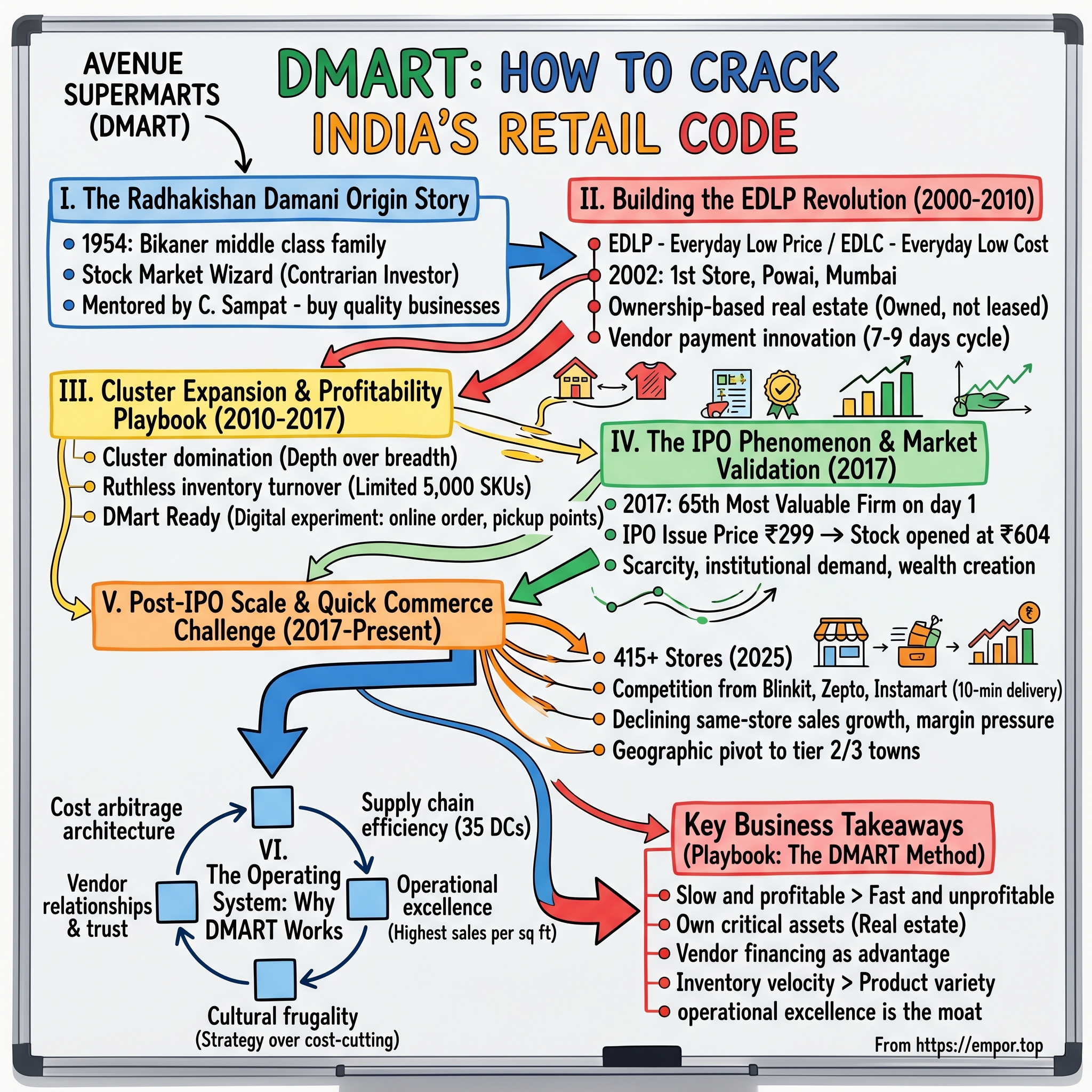
Avenue Supermarts: How DMart Cracked India's Retail Code — And the Quick Commerce Battle Ahead
I. Opening & Episode Thesis
There is a distinct atmosphere inside a DMart store on a Sunday evening in suburban Mumbai. There is no background music. Instead, the floor fills with the steady clatter of steel trolleys against concrete, the continuous beeping of busy checkout counters, and the low hum of thousands of shoppers moving through an air-conditioned space designed like a clean, utilitarian warehouse. The lighting is fluorescent, the shelving is unadorned metal, and the overall design avoids decorative flair. The operational focus is singular: move customers through efficiently while offering prices six to seven percent lower than competing neighbourhood shops.
That operational environment captures the company's core strategy and highlights the central paradox of its business model.
Standard retail orthodoxy suggests that selling staple commodities at permanently low prices in a market with fragmented supply chains, high real estate costs, and a consumer base accustomed to buying on credit from neighbourhood stores should produce razor-thin or negative returns. Grocery retail typically carries low gross margins, high shrinkage, complex logistics, and minimal consumer brand switching costs. Operating at deeper discounts would ordinarily undermine profitability. Yet Avenue Supermarts Limited, the parent company of DMart, maintained net margins in the high-three to low-four percent range while expanding revenue at a compound annual rate over two decades — achieving this performance while purchasing the real estate beneath its stores, among the most capital-intensive choices a retailer can make.[^1]
The public equity market responded sharply to this financial profile. When Avenue Supermarts listed on March 21, 2017, its stock opened at a premium of more than 100% over its ₹299 issue price, trading between ₹604 and ₹632 on debut and valuing the company at over ₹39,000 crore.[^2][^3] The debut represented one of the largest listing-day valuation adjustments in modern Indian market history, achieved not by a high-growth technology platform but by a brick-and-mortar grocery chain concentrated in Maharashtra and Gujarat. In subsequent years, the company's market capitalisation surpassed ₹3,00,000 crore, placing a physical store retailer alongside India's largest financial institutions and industrial conglomerates.[^4]
The key analytical question is how a veteran stock market investor — who built early wealth shorting Indian equities — studied Sam Walton's model, rejected the asset-light strategy favored by corporate advisers, acquired store properties directly, and developed a durable compounding retail model. A related and urgent question for investors is whether a physical ecosystem built on real estate ownership, distribution hubs, and a 30-day inventory cycle can withstand shifting consumer behavior as 10-minute quick-commerce delivery gains market share in urban centers.
Understanding DMart requires examining its product architecture across three primary categories, each fulfilling a distinct economic function. Foods — including staple grains, edible oil, sugar, dairy, packaged goods, and beverages — accounts for roughly 57–58% of revenue and generates minimal gross margins, operating primarily to drive high visit frequency and customer traffic.[^1] Non-Food FMCG — encompassing soaps, detergents, personal care, and home cleaning products — contributes about 19–20% of revenue at moderate margins, forming a stable mid-basket core. General Merchandise & Apparel — spanning cookware, household plastics, luggage, garments, footwear, and toys — represents roughly 22–23% of revenue but carries significantly higher margins, generating the bulk of the company's gross profit pool.[^1] Food sales drive footfall, while general merchandise monetises that volume. If discretionary merchandise sales soften, the core economics of DMart's discount model face structural pressure.
The analysis that follows details the founder's transition from trading to retail operations, the adaptation of Everyday Low Pricing to Indian retail, the capital strategy of real estate ownership, the regional cluster logic that optimized logistics, and the company's 2017 public listing. It then assesses current structural challenges: quick-commerce competition, rising property acquisition costs, a shift in product mix, and executive leadership transitions after two decades of growth.
 Subscribe on LinkedIn
II. The Radhakishan Damani Origin Story & Stock Market Roots
The foundation of DMart rests on the early background of its founder, Radhakishan Damani, who grew up in Mumbai's Marwari trading quarter during the 1970s in a cash-conscious commercial environment where practical financial discipline mattered far more than formal academic credentials.
Damani dropped out of a bachelor of commerce program at the University of Mumbai after his first year to manage a small ball-bearings trading business. Following the death of his father, a stockbroker, Damani entered equities trading on Dalal Street to support his family's income.[^5]
His market reputation was largely established through short positions during the 1991–92 market expansion, when speculator Harshad Mehta drove up specific stock valuations using capital siphoned from the banking system. Damani bet against those inflated valuations. Although he initially faced mounting losses as share prices continued to rise, his thesis was validated when the banking scam was exposed and stock prices collapsed.[^5]
That experience highlighted two principles that shaped his retail strategy. First, it demonstrated a willingness to maintain a high-conviction position despite prevailing market sentiment — an approach reflected years later when DMart opened only 29 stores in its first decade while competitors expanded rapidly. Second, Damani drew on the value-investing philosophy of investor Chandrakant Sampat, who advocated for capital-efficient consumer franchises with high returns on equity, encouraging Damani to shift his focus from short-term trading to long-term ownership.[^5]
Applying that approach, Damani became one of the largest individual shareholders in HDFC Bank following its 1995 public listing.[^5] Holding that stake through the late 1990s offered him a quantitative view of expanding middle-class household spending, convincing him of the long-term opportunity in organized grocery retail.
His initial entry into retail began in 1999, when he acquired a franchise of Apna Bazaar, a cooperative retail chain, in Nerul, Navi Mumbai.[^6] Managing day-to-day operations exposed him to challenges with inventory shrinkage, stockouts, and consumer purchasing habits. The experience led Damani to conclude that cooperative franchise models could not scale effectively because sustainable retail margins required end-to-end control over purchasing, pricing, and inventory management.
To study established models, Damani made several trips to the United States in the late 1990s to examine Walmart's Everyday Low Price framework, distribution network, rapid inventory turnover, and supplier cash-discount structure that converted fast supplier payments into lower purchase prices.[^6] The central mechanic of Sam Walton's model was straightforward: rapid inventory turns combined with prompt supplier payments reduced the cost of goods below competitors' levels, enabling permanent price discounts while maintaining capital efficiency.
In 2000, at the height of his career as a stock trader, Damani stepped back from active equity trading to commit his own capital to founding a physical retail enterprise.[^5] Rather than investing through a fund or acquiring minority stakes, he chose to directly operate store properties.
Avenue Supermarts opened the first DMart store in Powai, Mumbai, in 2002.[^6] Launched without public marketing campaigns, the single-store opening represented a deliberate move into a capital-intensive and illiquid asset class. This commitment to long-term physical asset ownership formed the structural foundation of the business model, beginning with how the company structured its pricing strategy.
III. The EDLP Engine & Anti-Consensus Operating Model (2000–2010)
In 2003, Indian organized retail was largely defined by promotional spectacle. Chains like Big Bazaar imported Western mall formats, relying on crowded aisles, promotional events such as "Sabse Sasta Din" sales, festival discounts, and buy-one-get-one offers. This high-low pricing strategy kept everyday prices elevated while using intermittent promotional spikes to drive customer traffic. While effective at generating short-term surges, it trained consumers to wait for sales, leaving retailers in a state of continuous promotional discounting.
Damani rejected that approach. DMart established consistently low prices without temporary sales, festival campaigns, or loyalty programs. The standard discount—typically 6–7% below maximum retail price on staple goods—functioned as a permanent pricing structure rather than a seasonal promotion.[^1]
This pricing strategy was fundamentally an operational architecture rather than a marketing campaign.
The real estate decision. Prevailing industry consensus, supported by corporate advisory firms, favored an asset-light expansion model: leasing store space, deploying capital into inventory, scaling rapidly, and leaving property risk with landlords. That approach offered higher reported returns on capital and faster initial expansion while allowing retailers to exit underperforming locations.
Damani chose direct ownership instead. DMart constructed large-format stores spanning roughly 30,000 to 50,000 square feet on self-owned land or under long-term leases extending 30 years or more.[^1][^6] Locations were selected in suburban areas near dense middle-income residential catchments rather than high-cost commercial corridors. Competitors, by contrast, signed shorter mall leases for 4,000 to 10,000 square feet with annual rent escalations. By the time of its initial public offering, the overwhelming majority of DMart's retail floor space was owned outright rather than conventionally leased.[^1]
In Indian retail, rent acts as a structural cost vulnerability. Landlords frequently increase lease rates at renewal upon seeing strong store sales, capturing a portion of the value generated by the retailer. Mall operators can also reposition properties, while contractual lease escalations often exceed gross margin expansion in grocery retail. By purchasing real estate, DMart turned an escalating operational expense into a fixed, upfront capital investment. Furthermore, as suburban land along urban growth corridors appreciated, DMart's cost structure remained anchored to original purchase prices while competitors faced rising rental inflation. Over a decade, this divergence created a permanent cost advantage that supported net margins.
This capital strategy involved a clear trade-off. Allocating capital to property acquisition reduced funds available for rapid store expansion, resulting in a slower rollout than leased competitors. The model relied on long-term capital compounding prioritizing cost durability over expansion velocity—a strategy dependent on maintaining unit-level profitability.
The inventory and vendor engine. The operational engine supporting this pricing model rested on rapid inventory turnover. DMart turned its inventory approximately every 30 days, compared to an industry benchmark of 70 to 90 days.[^1] Faster turnover reduced working capital requirements, enabling each rupee invested in inventory to generate two to three times the sales volume of traditional competitors. It also minimized inventory shrinkage, spoilage, and write-downs, which present ongoing challenges in climate-sensitive food supply chains.
Vendor management further reinforced this advantage. While standard practice involved delaying supplier payments 30 to 60 days to generate working capital float, DMart settled vendor invoices within seven to ten days. In exchange for rapid payment terms, suppliers provided cash discounts of 2–3%.[^1]
Crucially, DMart passed these vendor discounts directly into shelf prices rather than retaining them as gross profit. The cash discount directly funded everyday low prices, creating a self-sustaining customer acquisition mechanism that required no advertising expenditure and proved difficult for competitors to replicate.
Replicating this flywheel required competitors to forego vendor float. Highly leveraged retailers encumbered by lease payments and debt service could not shorten supplier payment terms without straining liquidity. DMart's balance sheet structure created a distinct counter-positioning advantage against indebted industry peers.
Frugality as architecture. Operational frugality extended across all cost structures. DMart avoided national television and print advertising campaigns, relying instead on local word-of-mouth in high-density residential areas.[^1] Store interiors remained strictly functional, omitting decorative displays, visual merchandising budgets, ambient lighting, or in-store food service. With net profit margins averaging around four rupees per hundred rupees of sales, eliminating unnecessary overhead was essential to preserving operating margins.
And then — patience. Between 2000 and 2010, DMart opened 29 stores.[^6] During a decade when venture capital and corporate conglomerates launched hundreds of retail outlets across India, DMart restricted its footprint to Maharashtra and Gujarat. Damani used those ten years to refine store operations, product assortment, staffing ratios, checkout throughput, distribution routing, and catchment size requirements.
For investors, this decade demonstrated that DMart's eventual compounding was built on a model thoroughly tested for unit-level profitability before accelerating store expansion. That regional footprint provided the foundation for geographical expansion in the subsequent decade.
IV. The Cluster-Based Expansion & Post-IPO Dominance (2010–2020)
While DMart spent its first decade testing unit-level economics across 29 stores, its strategy in the 2010s focused on scaling through geographic density.
The company adopted a cluster-based expansion method: fully saturating a contiguous region before entering a new territory. Rather than establishing isolated flagship stores in distant metropolitan markets like Delhi, Chennai, or Kolkata to build a national presence, DMart deepened its footprint in Mumbai, Thane, Pune, and the rest of Maharashtra, before expanding sequentially into Gujarat, Telangana, Andhra Pradesh, and Karnataka.[^6] Each new location was opened within an established distribution network and local brand footprint.
This cluster model delivered direct logistical efficiencies. A regional distribution center serving stores within a 200-kilometer radius can run delivery vehicles at high capacity over short routes with multiple daily turns. Conversely, a facility serving scattered locations 500 kilometers apart operates underutilized vehicles over long distances. Per-unit transport costs decline through store density rather than aggregate national store count, turning geographic clustering into a fundamental cost discipline.
Clustering also generated organic marketing advantages. High store density built local brand awareness through consumer word-of-mouth, eliminating the need for traditional advertising expenditures. In contrast, entering distant, non-contiguous states required either paid marketing—which DMart avoided—or extended gestation periods for organic adoption, highlighting the hidden operational costs of geographic dispersion.
Between 2013 and 2016, DMart accelerated store rollouts while preserving unit economics. The chain expanded from 65 stores in 2013 to 112 stores across seven states by late 2016.[^6] Revenue grew from ₹2,222 crore in fiscal year 2012 to ₹8,606 crore in fiscal year 2016—nearly a fourfold increase in four years—while maintaining consistent profitability, a trajectory that set DMart apart from competing Indian retailers scaling during the same period.[^6]
The listing. Avenue Supermarts' initial public offering in March 2017 reflected this conservative capital structure.
The company raised ₹1,870 crore—approximately $280 million—entirely through primary capital issuance, with no secondary offer for sale by the promoter group.[^2] Unlike many contemporary Indian listings designed for founder or private equity liquidity, Damani retained his full equity position. The net proceeds were allocated to debt repayment and property acquisition, reinvesting capital into physical real estate assets.[^2]
Public markets responded immediately, with the stock more than doubling on its listing day.[^2][^3] At its issue price, Avenue Supermarts was valued at roughly 40 times fiscal year 2017 earnings and approximately 20 times enterprise value to EBITDA—a premium valuation for a grocery retailer that expanded further upon debut.[^4]
This valuation re-rating reflected a combination of operational attributes: high revenue growth, consistent profitability, and minimal net debt in an industry where competitors struggled with leverage or capital efficiency. Competing retail chains such as Future Group expanded through heavy debt, while Reliance Retail operated as part of a broader conglomerate. With foreign multi-brand retailers restricted by FDI regulations, DMart stood out as the sole listed, self-funding pure-play grocery compounder in India.
By 2020, the company's network had expanded past 200 stores, its post-IPO long-term debt was substantially eliminated, and its return on equity stabilized in the high-teens to 20% range.[^1][^6] DMart's capital allocation remained disciplined: operating cash flow was reinvested directly into real estate acquisition and store development, avoiding major acquisitions, non-core diversification, or dividend payouts.
This strategy allowed DMart to capitalize on a fragmented retail landscape during the 2010s. However, sustaining this asset-heavy compounding model depends on managing rising commercial land costs and adapting to emerging digital distribution formats in urban markets.
V. The DMart Operating System: Segment Economics & Unit Physics
The layout of a mature DMart store reflects its underlying financial statement.
The front two-thirds of the store drives sales volume. Staples such as rice, wheat flour, pulses, edible oil, sugar, tea, dairy, and packaged snacks move in large quantities at a gross margin of roughly 10% to 11%, which yields minimal net profit after store operating expenses.[^1] Because households purchase these staples multiple times a month, the Foods aisle functions not as a standalone profit center, but as a driver of visit frequency. Essentially, the company funds customer traffic through foregone gross margin rather than traditional advertising budgets, redirecting potential marketing spend into visible price discounts on essential household goods.
The middle section—encompassing soaps, detergents, shampoo, cleaning products, and personal care—operates at a moderate gross margin in the mid-teens.[^1] This segment serves as economic ballast: non-discretionary, brand-led products with steady repeat-purchase patterns across economic cycles. Notably, this standardized product category also represents the primary basket targeted by fast-growing ten-minute delivery services.
Toward the rear and side aisles, the product mix shifts to discretionary categories: steel cookware, plastic containers, cleaning hardware, luggage, bedsheets, garments, and footwear, predominantly sourced from unbranded or regional suppliers. This General Merchandise and Apparel category operates at gross margins in the low-to-high 20% range.[^1] While accounting for a smaller portion of total revenue, it generates the majority of the company's gross profit pool.
This structural cross-subsidization defines the store's unit economics: cheap food buys the traffic; the household picks up a set of steel vessels on the way out; the vessels pay for the discount on the food. The company's real estate strategy, supplier terms, and cluster logistics function to maintain this economic loop. However, the model contains a key vulnerability: if foot traffic drops or consumers bypass discretionary merchandise aisles, funding deeper discounts on staple foods becomes difficult to sustain.
Unit physics. While the original DMart store format averaged roughly 30,000 square feet, newer locations have expanded to between 50,000 and 60,000 square feet, accommodating pharmacy counters, expanded apparel sections, and dedicated space for e-commerce fulfillment inside the store footprint.[^1] Larger store formats allow fixed operating costs—including property overhead, climate control, and store management—to be distributed across higher sales volumes.
Sales density serves as the key operational metric. Mature DMart stores generate revenue per square foot that has historically run at roughly two to three times the level achieved by typical Indian hypermarket competitors.[^1][^7] High sales density determines whether fixed operating overhead remains manageable within low gross margins. A store generating ₹30,000 per square foot can comfortably absorb utility, labor, and maintenance expenses, whereas a store operating at ₹15,000 per square foot on an equivalent cost base struggles to maintain profitability.
When combined with property ownership, high sales density reduces store-level operating expenses—such as labor, utilities, and routine maintenance—to a mid-single-digit percentage of sales, compared to low-to-mid double digits for retail competitors paying commercial mall rents.[^1] This cost differential of five to eight percentage points of revenue accounts for much of the profitability gap between DMart and rival grocery retailers, making it difficult for competitors with higher overhead to match DMart's shelf pricing.
The labour model. DMart operates a two-tier staffing structure, maintaining a core permanent workforce in the low tens of thousands for management, category planning, and logistics, alongside a significantly larger contractual workforce handling shelf restocking, checkout support, and security.[^1] This flexible labor structure aligns wage expenses with weekend and seasonal demand surges while containing fixed personnel costs.
However, relying heavily on contractual labor creates operational and regulatory exposure. As the company scales, wage inflation, stricter labor-code enforcement, and potential regulatory oversight present ongoing cost risks. While not currently a disclosed material liability, this reliance represents a structural dependency within the company's cost architecture.
To manage peak customer traffic, store operations rely on cross-training floor staff to support checkout counters during peak hours. In high-density stores, checkout throughput functions as a primary constraint on revenue, as extended wait times risk transaction abandonment. Reallocating personnel to billing counters during peak periods serves as a direct operational measure to protect sales throughput.
Together, these elements form an integrated operating framework: property ownership caps fixed overhead, rapid inventory turnover improves capital efficiency, prompt vendor settlements lower procurement costs, low shelf pricing drives sales density, and higher-margin general merchandise subsidizes staple foods. Each component depends on the stability of the overall system.
VI. Competitive Landscape & Helmer's 7 Powers Analysis
For much of DMart's operational history, its primary offline competitors struggled to sustain long-term profitability.
The trajectories of rival chains highlight the structural pressures across the sector. Future Group's Big Bazaar—for a decade a prominent face of modern Indian retail under founder Kishore Biyani—collapsed under heavy debt and expanding lease obligations, resulting in the eventual liquidation of its retail assets. Other chains, including Spencer's Retail and More, similarly struggled to achieve store-level profitability over extended periods. The common vulnerability across these peers was not merchandising strategy, but balance sheet architecture: escalating lease commitments and debt service requirements prevented them from matching DMart's rapid supplier payment terms, making their cost of goods structurally higher.
Foreign competition was similarly constrained by regulatory barriers. India's restrictions on foreign direct investment in multi-brand retail prevented global operators like Walmart and Carrefour from building front-end physical supermarket networks for years. Walmart ultimately pursued its Indian strategy through the 2018 acquisition of e-commerce platform Flipkart rather than brick-and-mortar stores, while Amazon's physical retail presence remained minimal.[^8] Consequently, major global discounters did not compete directly against DMart during its formative growth phase, providing regulatory insulation alongside its internal operational model.
The current competitive environment, however, presents distinct structural challenges.
Reliance Retail represents DMart's primary structural competitor. Operating a nationwide store network numbering in the tens of thousands across multiple formats—including Smart Bazaar and Smart Superstore in the value-grocery category—Reliance possesses capital resources far exceeding DMart's earlier rivals.[^8] Backed by conglomerate cash flows, Reliance can expand aggressively into tier-two, tier-three, and tier-four towns, match DMart's staple pricing within contested clusters, and absorb localized operating losses over extended periods. Against a competitor capable of sustained cross-subsidization, DMart's unit-cost advantage remains intact—it still costs Reliance more per rupee of sales to match shelf prices—but the operational consequences of that cost gap are effectively deferred. Cost advantages force discipline on profit-constrained competitors, but they carry less immediate leverage against well-capitalized strategic rivals.
Trent, the Tata Group's retail arm, presents a different competitive challenge. While its Star hypermarket format competes directly in grocery retail, a broader threat emerges from Zudio, Trent's fast-fashion chain. Zudio targets the same price-conscious apparel shoppers that DMart relies on to populate its high-margin general merchandise aisles. If consumer footfall for value apparel shifts from hypermarkets to dedicated fashion formats, DMart risks losing high-margin discretionary purchases while retaining lower-margin staple food volume. This potential mix shift threatens the cross-subsidization model that supports DMart's overall gross margin profile.
An evaluation using Hamilton Helmer's 7 Powers framework helps clarify where DMart holds structural advantages and where its positioning remains vulnerable:
Counter-Positioning represents DMart's most historically validated power against traditional store incumbents. Legacy retailers could not adopt DMart's everyday low pricing or rapid vendor settlement terms without undermining their own financial models, as their leverage and lease commitments required cash float and their promotional calendars depended on higher everyday gross margins. However, counter-positioning primarily deters legacy competitors bound by existing operational commitments; it offers limited protection against digital-native business models unencumbered by physical store infrastructure, such as quick commerce.
Scale Economies exist primarily at the regional cluster level rather than nationally. DMart's high inventory turnover and localized store density secure favorable terms from consumer goods manufacturers and reduce regional distribution costs per unit. However, because Reliance Retail operates at a larger overall aggregate purchasing scale, DMart's scale advantage remains relative—providing cost leverage against smaller or fragmented retailers, but not over the industry's largest market participant.
Process Power is frequently cited but difficult to isolate. The argument holds that DMart's disciplined vendor payment schedules, inventory logistics, and operational frugality are deeply embedded in corporate culture and execution systems. Proponents point to two decades of consistent execution despite public disclosure of the model's core components. Conversely, competitor non-replication may stem from financial constraints rather than operational complexity—a limitation that does not apply to capital-rich entrants. Consequently, process power remains plausible but unproven as a standalone defensible barrier against well-funded competitors.
Cornered Resource represents the least applicable of the standard competitive powers. While promoter ownership in the mid-seventy percent range provides significant strategic latitude—insulating management from short-term public market pressures and enabling long-term capital allocation—concentrated ownership functions as a governance structure rather than a cornered operational asset.[^9] High promoter concentration limits minority shareholder influence over corporate disclosure, capital allocation, and leadership succession, permitting the company to maintain minimal financial guidance and restricted segmental reporting.
This structural framework leads to the evaluation of how these competitive dynamics intersect with recent operational data and emerging distribution formats.
VII. The Historical Falsification Pass: Disconfirming Evidence & Moat Stress Test
Evaluating Avenue Supermarts requires testing its core strategic assumptions against operational data and emerging market realities. Four central claims underpin the bull thesis for DMart, but each faces structural friction.
Claim 1: "DMart's low-price offline density is impervious to e-commerce"
For more than a decade, that premise held. While Indian e-commerce expanded rapidly in consumer electronics, fashion, and general merchandise, it made little headway in grocery. The unit economics of delivering low-margin staple items—such as a five-kilogram bag of flour carrying a ₹40 order margin—proved difficult to monetize at scale through traditional e-commerce logistics. DMart management repeatedly highlighted those structural constraints.
The emergence of quick commerce altered that dynamic—not by offering lower prices, but by addressing a distinct consumer use case. Platforms such as Blinkit, Zepto, and Swiggy Instamart established dense networks of dark stores across metropolitan and tier-one cities, offering delivery within ten to fifteen minutes.[^10] Rather than competing for the monthly stock-up trip, where DMart maintains a pricing advantage, quick-commerce operators targeted the high-frequency top-up trip for items such as dairy, snacks, personal care, and packaged foods. Historically, these routine top-up purchases provided incidental foot traffic that supported higher-margin sales during store visits.
The financial impact of this shift is reflected in recent operational metrics. Same-store sales growth for mature locations, which averaged in the high teens during earlier expansion phases, decelerated into single digits.[^11][^10] Simultaneously, the product mix shifted toward lower-margin items: General Merchandise & Apparel declined from the high-twenties percentage of revenue recorded prior to the pandemic to roughly 22 to 23 percent, contributing to a compression in consolidated EBITDA margins from a peak above 9 percent to the high 7 percent range by fiscal year 2025.[^1][^11]
This mix shift illustrates the underlying mechanic: fewer total store visits reduce opportunities for impulse purchases of higher-margin merchandise. Quick commerce did not need to replace the primary grocery shop; it only needed to reduce the frequency of intermediate visits where discretionary merchandise is typically added to the basket.
Verdict: The claim that DMart is impervious to e-commerce is inaccurate in its strong form. While DMart retains a cost advantage for planned, large-basket staple shopping where quick-commerce economics cannot support deep discounting, the urban top-up trip has been significantly disrupted. The revised thesis is narrower: DMart maintains a durable cost advantage for planned stock-up shopping and in geographic markets where delivery density remains uneconomic. Key indicators to monitor include whether the General Merchandise & Apparel segment stabilizes toward 25 percent of revenue and whether same-store sales growth in non-metropolitan clusters remains resilient as quick commerce expands into tier-two markets.
Claim 2: "Owning real estate is always superior to leasing"
Direct real estate ownership was a foundational pillar of DMart's strategy, protecting the company from rental inflation while competitors struggled with lease obligations.
However, the economic advantage of property ownership depends heavily on land acquisition costs. During DMart's initial expansion across Maharashtra in the 2000s, suburban land values were modest relative to projected store revenues, resulting in short payback periods. As urban real estate prices appreciated and municipal approval timelines expanded, capital requirements per store increased significantly. Per-store capital expenditures for large owned formats in prime catchments rose from the ₹25–30 crore range during earlier cycles toward ₹45–50 crore and above in recent years.[^7][^11]
Higher upfront capital outlay lowers return on invested capital per store if store-level profitability remains constant. This effect is pronounced as expansion extends into northern and eastern states where brand recognition is lower and store sales ramp up more gradually, lengthening payback periods from the two-to-three-year range typical of mature clusters to four to five years in newer geographies.[^7][^11]
Verdict: Real estate ownership provided a clear advantage during periods of low land costs and high rental inflation, but it is not a universally superior model under all market conditions. Marginal new stores earn a lower return on capital than mature legacy locations, gradually diluting blended return on capital employed. For investors, future performance depends on returns on incremental capital rather than historical returns. Critical metrics to track include capital expenditure per square foot of newly added space and the annual pace of store additions.
A key strategic question is why the company has not tested a hybrid model in high-cost metropolitan areas—leasing space where land prices are restrictive while maintaining ownership elsewhere. Management has adhered consistently to property ownership, though public disclosures provide limited visibility into whether alternative leasing formats are formally evaluated.
Claim 3: "DMart Ready can defend the online channel"
DMart Ready launched in late 2016 as an order-online, pick-up, or scheduled-delivery service, initially in Mumbai.[^13] Conceptually, it aligned with the company's core operating philosophy by leveraging existing store and distribution infrastructure, avoiding dedicated online inventory, and utilizing customer pick-up points.
According to company disclosures, after nearly a decade of operation, DMart Ready accounts for a low single-digit percentage of consolidated revenue and continues to run at an operating loss.[^1][^11] Meanwhile, urban e-commerce expectations shifted from scheduled, next-day delivery toward rapid ten-minute fulfillment. DMart Ready's store-picked, scheduled delivery architecture cannot support ten-minute delivery without investing in dedicated dark-store networks, an operating approach management has declined to fund.
DMart Ready serves as an indicator of the company's capacity to convert strategic digital initiatives into profitable revenue. To date, execution has progressed slowly and at an operating loss amid evolving consumer preferences, suggesting that digital operations represent a limited immediate growth buffer rather than a readily scalable digital channel.
Verdict: The claim that DMart Ready effectively defends the online channel is not supported by current performance metrics. DMart Ready functions primarily as an extension of the value-focused stock-up proposition for planned online orders. Evaluating its long-term viability requires monitoring whether e-commerce revenue share increases beyond low single digits while operating losses narrow.
Claim 4: "Promoter-led culture guarantees execution consistency"
In January 2025, Avenue Supermarts announced that Neville Noronha, chief executive officer since 2004 who oversaw the company's expansion from its early store footprint to a national network, will step down in January 2026, with external appointee Anshul Asawa named as successor.[^9]
Noronha's tenure spanned key operational phases, including cluster expansion, the 2017 public listing, pandemic disruption, and the rise of quick commerce. Holding an approximate 2 percent equity stake, Noronha represented an exceptionally well-aligned professional executive in Indian corporate retail.[^9] The upcoming leadership change marks a significant transition in institutional management.
Verdict: The assertion that executive culture guarantees operational continuity remains unproven as leadership transitions. Because Noronha led executive operations for over two decades, the organizational model has not previously undergone a chief executive transition. The leadership change coincides with margin compression, quick-commerce competition, and store expansion into newer geographic markets. Indicators of operational continuity include retention of senior management following the transition, stability in the store expansion cadence, and maintenance of the company's disciplined cost structure.
These evaluations highlight the divergence between consensus expectations and operational realities. Assessing whether management's strategic response aligns with these pressures requires examining recent executive communications and financial disclosures.
VIII. Earnings Call Forensic Audit & Management Evaluation
By the standards of major Indian publicly traded companies, Avenue Supermarts maintains an atypical approach to quarterly earnings calls. Management provides no forward earnings guidance, issues no long-range financial targets, and delivers brief opening remarks. For years, executive commentary reflected an operating thesis that the core model required little strategic modification.
Between fiscal years 2024 and 2026, however, that communication strategy faced sustained scrutiny from market analysts, making earnings call transcripts notable for both executive admissions and topics management declined to address directly.
The pressure points. Analyst questioning centered on three main operational challenges. First, same-store sales growth moderation—specifically, whether the deceleration in mature urban stores reflected cyclical post-pandemic discretionary weakness or a structural shift as quick commerce permanently absorbed top-up shopping trips.[^11][^10] Second, gross margin compression, as consolidated margins drifted down from the high-fourteen percent range toward the low-fourteen percent level while product mix tilted toward staple foods.[^1][^11] Third, whether the company intended to launch a direct competing service against ten-minute quick-commerce delivery platforms.
What management actually said. Across earnings calls, management maintained a consistent stance against subsidizing instant delivery, arguing that quick-commerce unit economics at prevailing average order values cannot operate profitably without burning capital—a practice at odds with DMart's low-cost operating model.[^11] Executive commentary also acknowledged that post-pandemic demand recovery in General Merchandise & Apparel remained sluggish, and confirmed that stores in metropolitan markets with high quick-commerce penetration experienced slower growth than the rest of the retail network.[^11][^10]
This geographic specificity provided important empirical context. Rather than attributing network-wide performance deceleration solely to broader discretionary headwinds, management identified urban markets as the primary locus of weakness, allowing analysts to isolate the impact of digital quick-commerce competition from general consumer spending trends.
Where the narrative is weaker. Two aspects of executive communication reveal internal tensions within the company's positioning.
First, the refusal to subsidize instant delivery functions both as a disciplined capital-allocation strategy and as a constraint preventing a direct operational response to quick commerce. The validity of this stance depends on whether urban store metrics stabilize over time. If metropolitan same-store sales growth recovers without a digital delivery response, the policy demonstrates disciplined capital allocation; if growth continues to lag, the refusal risks masking a strategic blind spot. Current operational data remains inconclusive on this outcome.
Second, a tension exists between management's emphasis on model consistency and its ongoing operational adjustments. The company has transitioned to larger store footprints, added pharmacy counters, allocated more floor space to apparel, and incorporated dedicated in-store e-commerce fulfillment areas.[^1] While these modifications represent logical operational adaptations, they reflect ongoing changes to store design aimed at counteracting pressure on higher-margin discretionary merchandise.
Credibility and alignment. From a corporate governance perspective, ownership alignment remains high. The promoter group retains roughly 75% equity ownership, directly aligning controlling shareholder incentives with minority investor outcomes.[^9] Furthermore, withholding quarterly financial guidance removes incentives for store managers to shift sales or defer maintenance costs to meet short-term market expectations, protecting long-term operating discipline.
However, the absence of forward guidance also limits formal management accountability. While avoiding quarterly targets prevents short-term operational distortion, it also shields management from public evaluation against explicit benchmarks. In practice, executive disclosures provide candid reporting on past performance trends but offer limited details regarding forward strategic adjustments.
Additional analytical considerations. Several disclosure practices warrant scrutiny from investors. Segment reporting remains limited by international retail standards; Avenue Supermarts does not publish store-level or cluster-level profitability metrics, preventing independent verification of incremental return on capital employed across newer geographies. Given the controlling shareholder's approximate 75% equity stake, related-party transactions and promoter-entity dealings require careful examination of annual report disclosures. Additionally, appointing a chief executive from outside the firm into an established operating culture introduces execution risks that will require monitoring during the leadership transition.
These reporting constraints highlight areas where public disclosures offer limited visibility into operational physics. Evaluating how Avenue Supermarts navigates these combined structural and competitive dynamics requires examining its current strategic priorities.
IX. Current Strategy & Risk Radar
By the end of fiscal year 2025, the store network reached roughly 415 locations as Avenue Supermarts expanded toward the 500-store threshold, with new store openings increasingly focused beyond its historical western and southern strongholds into Punjab, Rajasthan, Madhya Pradesh, and Uttar Pradesh.[^7][^11] This geographic shift represents a pivotal strategic transition for the business. Northern and central states offer large population bases with expanding organized-retail penetration and quick-commerce delivery formats that remain largely economically unviable outside major metropolitan centers. However, entering these non-contiguous markets presents distinct operational friction: Avenue Supermarts lacks established brand equity in these regions, regional food preferences require localized inventory assortments, state-level regulatory frameworks differ, and the company's reliance on word-of-mouth customer acquisition rather than paid advertising results in a slower sales ramp for new store additions.
The primary operational and market risks confronting the enterprise, ranked by their direct impact on unit economics:
1. Urban quick-commerce cannibalisation. As established in the analysis of consumer purchasing habits, rapid ten-minute delivery platforms threaten high-frequency top-up visits and spontaneous discretionary purchases in major metropolitan centers. This risk carries primary weight because these urban hubs host DMart's oldest, most concentrated, and highest-sales-density stores—the locations generating the network's strongest unit profitability. Consequently, sales deceleration in these key outlets exerts a disproportionate drag on overall company performance relative to store count.
2. Mix-driven gross margin drag. If lower-margin staple foods continue to expand as a proportion of total sales while higher-margin general merchandise and apparel categories remain sluggish, overall gross margin compresses automatically regardless of operational execution. This margin pressure stems directly from shifting consumer basket composition rather than competitor pricing actions. Management can partially offset this shift through store format modifications and refined apparel assortments, making the push into larger store footprints a key defensive measure for preserving gross margin structure.
3. Land inflation and approval bottlenecks. Escalating commercial real estate acquisition costs in prime residential catchments, combined with lengthy municipal permitting processes beyond management's control, are driving up the upfront capital intensity of new store development while diminishing returns on invested capital. While physical retail models can navigate slower store rollout schedules, sustained capital deployment into lower-return store sites risks eroding long-term compounding efficiency.
4. Competitive price pressure from conglomerate rivals. Reliance Retail's Smart Bazaar competes directly on staple grocery items within overlapping geographic clusters, supported by parent-company cash flows capable of sustaining localized operating losses over extended periods.[^8] While DMart's lean operational structure enables it to maintain lower shelf prices profitably, a well-capitalized competitor unconstrained by short-term store-level profitability can narrow pricing differentials and depress regional operating margins over prolonged competitive cycles.
5. Leadership transition execution. The executive transition from long-serving chief executive officer Neville Noronha to Anshul Asawa, completed in January 2026, occurred alongside these combined operational pressures.[^9] Executive handovers in established firms are often routine, but navigating a leadership transition during simultaneous gross margin compression, quick-commerce disruption, and expansion into unproven geographic markets presents heightened execution risks.
Several conventional financial risks are notably absent from this profile. Avenue Supermarts carries minimal refinancing risk, having operated with negligible net long-term debt since its public listing while financing network expansion entirely through internal cash generation.[^1] Foreign exchange exposure remains negligible for a domestic retail business, while software automation presents potential operational efficiencies rather than existential threats. The primary risks facing the enterprise remain commercial and physical rather than structural balance-sheet liabilities.
The company's strategic posture remains focused and unhedged: continue expanding the owned-property store network, maintain capital discipline by avoiding subsidized digital delivery networks, push into regions where physical store economics retain structural advantages, and monitor whether quick-commerce platforms encounter economic limits within their own operating models. This strategy rests on the premise that DMart's physical compounding framework will outlast alternative distribution formats. Evaluating whether this stance reflects disciplined conviction or strategic inertia depends on how effectively the model adapts to evolving consumer behaviors.
X. Playbook: The DMart Method
Stripped of narrative flourish, DMart offers five transferable operating principles, along with clear operational limits for each.
Lesson 1: Convert your balance sheet into your customer's discount. The vendor payment model sits at the center of DMart's pricing advantage. While traditional retailers treat supplier credit as free working capital and retain the float, DMart inverted the practice by settling invoices within seven to ten days to secure cash discounts of 2–3%. Passing those savings directly onto store shelves converted working capital discipline into lower consumer prices, driving sales volume and securing better procurement terms. However, this mechanism requires substantial liquidity; it remains accessible to debt-free operators while remaining closed to leveraged competitors dependent on vendor float to fund operations.
Lesson 2: Own the land under your store when the land is cheap. Industry narrative often presents real estate ownership as an absolute rule, but rising capital intensity demonstrates its structural boundary conditions. Direct ownership transforms compounding rental inflation into a fixed upfront capital expenditure—a trade that delivers strong returns when land acquisition costs are low relative to store sales density, but becomes progressively less compelling as property prices rise. DMart acquired assets early in suburban growth corridors. The lesson centers on entry valuation and timing rather than unyielding principle.
Lesson 3: Frugality is arithmetic, not virtue. With net profit margins averaging roughly 4%, managing discretionary overhead determines overall profitability. Eliminating national advertising campaigns, decorative store interiors, and high-rent mall locations makes a permanent 6–7% price discount economically viable. The operational limit is clear: frugality preserves a cost advantage, but it does not generate consumer demand. A company operating without established marketing capabilities has limited tools to defend its brand position if consumer preferences pivot toward alternative formats.
Lesson 4: Density beats dispersion. Cluster-based expansion operates primarily as a logistical discipline. Operating multiple stores within a tight geographic radius keeps distribution vehicles on short, fully loaded routes, lowering per-unit transport costs while building brand awareness through local word-of-mouth. Retailers that scatter outlets across distant markets to build an early national footprint often discover that geographical dispersion creates a costly logistics network before achieving local operational scale.
Lesson 5: Slow growth on proven economics beats fast growth on hypothesis. Opening 29 stores in its first decade allowed DMart to validate store-level unit economics before scaling network rollout. Consequently, subsequent expansion replicated an established operational model tested for unit profitability rather than scaling unproven assumptions with external capital. Competitors that expanded rapidly across disparate regions scaled operational complexities before securing store-level returns.
The overarching principle connecting the founder's background in equity trading to physical retail is capital allocation. Spending fifteen years in public markets—where asset prices update continuously and flawed assumptions face rapid market feedback—taught Radhakishan Damani to evaluate physical retail through the lens of capital efficiency, applying those principles to an asset class where operational feedback unfolds over years. Whether that capital discipline can remain fully institutionalized through an executive leadership transition and amidst evolving digital distribution formats defines the long-term investment case for Avenue Supermarts.
XI. Bear vs. Bull: The Investment Case
The bull case
The broadest opportunity for Avenue Supermarts lies beyond its internal financial metrics. Organised retail still represents a small fraction of India's overall grocery spending, with the vast majority of household food purchases flowing through millions of unorganised neighbourhood kirana stores.[^7][^8] Even if DMart gains no further market share from organised competitors, the structural shift from unorganised to organised retail provides a growth tailwind spanning decades rather than quarters.
Second is the cost floor provided by property ownership. Owning the real estate beneath most of its network fixes DMart's store-level occupancy costs in a market where commercial rents inflate continuously.[^1] During a consumer spending downturn—a scenario where leveraged, lease-dependent retailers face margin pressure—DMart's operating costs remain stable while its discount value proposition grows more attractive to price-sensitive shoppers. For a value discounter, economic downturns function as market-share acquisition opportunities.
Third is geographic positioning relative to digital disruption. Ten-minute quick-commerce delivery relies on dense dark-store networks supported by order volumes and basket sizes that operate viably primarily in major metropolitan centers. Across tier-two, tier-three, and tier-four markets—where DMart is focusing its incremental store additions—rapid delivery economics face ongoing operational limits. If the growth runway for physical value retail lies largely outside the top fifteen cities, quick commerce captures a portion of DMart's current urban volume while impacting little of its long-term expansion potential.
Fourth is self-funding capability. Operating with negligible long-term net debt and generating internal cash flow sufficient to fund dozens of new store openings annually means DMart does not depend on access to cheap equity or debt capital.[^1] That financial independence provides a structural advantage over competitors reliant on external funding during periods of elevated capital costs.
The bear case
The bear case does not require DMart's business model to fail; it requires only that the market expectations embedded in its valuation prove overly optimistic. The company's shares have historically traded at price-to-earnings multiples far above those of conventional global retailers, pricing in long-duration high growth.[^4] At those valuation levels, the market mathematics are demanding: a company priced for decades of high-teens revenue growth does not require an operational collapse to disappoint investors—a sustained growth deceleration is sufficient.
That deceleration is evident in recent financial reporting. Same-store sales growth moderating into single digits, EBITDA margins declining from above 9% to the high-7% range, and a discretionary product mix that has not returned to pre-pandemic levels represent recorded operational metrics rather than speculative forecasts.[^1][^11][^10] If general merchandise sales fail to recover above a quarter of total revenue, margin compression becomes structural rather than cyclical, making the cross-subsidisation model that funds staple food discounts increasingly difficult to maintain.
Compounding this margin pressure is rising capital intensity, marked by higher capital expenditure per store and longer payback periods in newer geographic markets. This dynamic illustrates the core bear thesis: DMart may be transitioning from a high-return compounder into a stable, moderate-return retailer with an extended growth runway. While representing a solid operating business, that financial profile differs significantly from the trajectory reflected at peak market valuations.
Porter's Five Forces, applied honestly
Rivalry: Intensifying and asymmetric. Reliance Retail can absorb localized operating losses over extended periods, while quick-commerce platforms have operated on strategic capital with explicit tolerance for negative unit economics. DMart remains an efficient physical operator, yet it is constrained by the operational requirement to maintain ongoing profitability.
Buyer power: Low individually, but decisive collectively. While individual shoppers do not negotiate shelf prices, Indian grocery consumers face zero switching costs and readily shift purchasing channels when delivery convenience improves, as demonstrated by the rapid adoption of quick commerce in urban markets.
Supplier power: Low and favorable. FMCG manufacturers require broad physical distribution networks, making DMart a preferred retail partner due to its high sales volumes and prompt supplier payment terms. A key variable to monitor is whether major FMCG manufacturers begin granting quick-commerce platforms comparable or superior procurement terms as digital volumes scale, which could erode DMart's historical cost-of-goods advantage.
Threat of substitutes: High and expanding. Both neighbourhood kirana stores and mobile delivery applications function as direct substitutes for physical store visits at opposite ends of the convenience spectrum. DMart maintains a strong position on shelf pricing, but price represents only one dimension of evolving consumer preferences.
Threat of new entrants: Low for the large-format physical model, but high for the core fulfillment function. Developing an owned-real-estate hypermarket network requires substantial upfront capital and decades of execution, creating high barriers to entry for identical physical formats. However, digital competitors do not need to replicate physical store infrastructure; they target the underlying consumer purchasing need through alternative logistics formats.
This distinction highlights the central competitive question facing the enterprise: DMart built a dominant position within a physical hypermarket format, precisely as digital channels altered how urban consumers access staple goods.
The three KPIs that matter
Evaluating DMart's forward performance depends primarily on tracking three core operational metrics:
1. Same-store sales growth, disaggregated. Rather than relying on blended metrics, performance evaluation requires tracking the split between mature stores operating over five years—where quick commerce and market saturation exert pressure—and newer store additions where growth is mechanical. Blended same-store growth can appear stable while the high-density urban core decelerates, as rapid store additions mask underlying trends. Disaggregated data reveals the true operational health of mature outlets.
2. General Merchandise & Apparel as a share of revenue. This metric captures the health of the company's gross margin structure. Having declined from the high-20% range toward the low-20% level, the recovery of this segment determines whether recent margin compression is temporary or permanent. Rebounding above the mid-20% threshold would indicate that store format modifications are succeeding in driving discretionary sales to fund staple food discounts, whereas continued weakness signals structural pressure on the cross-subsidy model.
3. Store additions and capital expenditure per square foot. This metric reflects incremental returns on invested capital. While the company can expand reported revenue by increasing capital deployment per store, value creation depends on whether new store productivity offsets higher land acquisition and construction costs. Rising capex per square foot combined with slowing store productivity would indicate that the historical financial advantage of real estate ownership is diminishing.
XII. Epilogue & What Would Damani Do?
There is an occasional photograph of Radhakishan Damani wearing a plain white shirt and white trousers — a consistent wardrobe choice that has earned him the moniker "Mr. White and White" among Dalal Street traders. He rarely grants interviews, avoids business television appearances, and has never held a formal press conference to defend his company's strategy.
That public profile reflects an operational philosophy consistent with the utilitarian store layout, the retained promoter equity, and the absence of quarterly financial guidance: a strict refusal to allocate management attention or capital toward activities that do not directly lower shelf prices for consumers.
India's retail market over the next decade will likely be defined by two distinct consumer realities operating in parallel. In the top fifteen metropolitan centers, affluent and time-constrained households increasingly treat routine grocery purchases as an instant utility — prioritizing ten-minute delivery over a six percent price savings on a two-hundred-rupee order. Conversely, across the hundreds of tier-two, tier-three, and tier-four towns where the majority of the population resides, that six percent price differential remains a primary driver of store choice, while the unit economics of rapid ten-minute delivery remain unviable under current operating models.
Avenue Supermarts has committed its capital — locked into real estate and physical store development — to the premise that the second market represents a larger, longer-duration, and ultimately more valuable opportunity than the first. While logically grounded, recent operational metrics indicate that this strategy incurs short-term performance costs in metropolitan markets while awaiting long-term validation in regional expansion zones.
The central strategic question facing the enterprise is not how executive leadership will react to quick-commerce competition in the short term, but how it applies the founder's historical capital-allocation pattern: maintaining a high-conviction position against market consensus so long as underlying unit economics hold. That approach produced favorable results during the market volatility of 1992, the founding of Avenue Supermarts in 2000, and the deliberate ten-year testing of its initial 29 stores. However, an investment thesis built on enduring temporary market skepticism remains operationally indistinguishable from an outdated strategy until long-term financial results are delivered.
For long-term investors, Avenue Supermarts presents a clear, empirically testable framework. The ultimate trajectory of the business depends on three primary operational metrics established in recent disclosures: same-store sales growth in mature locations, the revenue share of higher-margin general merchandise and apparel, and incremental capital expenditure per square foot. How these three metrics evolve will determine whether the physical discount model maintains its compounding trajectory or faces structural limits as retail formats evolve.
References
- [^1]: Avenue Supermarts Investor Relations & Financial Disclosures — Avenue Supermarts Ltd.
- [^2]: Avenue Supermarts Ltd. Corporate Shareholding & Announcements — Bombay Stock Exchange (BSE)
- [^3]: DMart Stock Price & Listing Info — National Stock Exchange of India (NSE)
- [^4]: DMart Financial Ratios, Balance Sheet & Peer Comparison — Moneycontrol
- [^5]: DMart Corporate Profile & Financial Overview — Bloomberg
- [^6]: DMart Company History, Milestones & Store Count Breakdown — Business Standard
- [^7]: Avenue Supermarts Annual Report Analysis & Store Economics — Tijori Finance
- [^8]: Quick Commerce Impact on Indian Retail & Grocery Sector Analysis — Financial Express, 2024-11-20
- [^10]: DMart Q3 Profit Rises on Strong Store Additions Amid Quick Commerce Pressure — Reuters, 2025-01-11
- DMart Q3 Profit Rises on Strong Store Additions Amid Quick Commerce Pressure — Reuters, 2025-01-11
 LinkedIn
 WhatsApp
 Reddit
 Hacker News
 Email
Email Kindle
 RSS Feed
 Spotify
 Apple Podcasts
 Amazon Music
 Audible
 YouTube