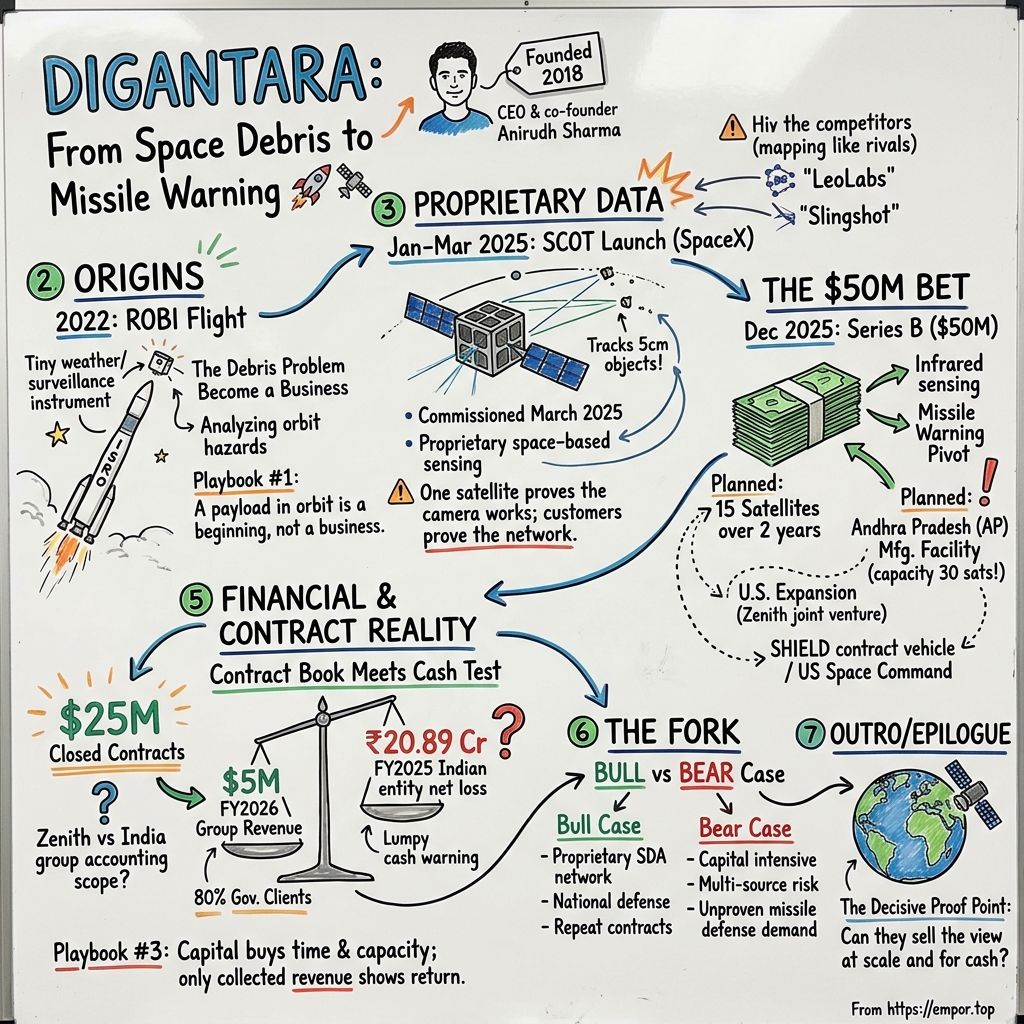
Digantara: From Space Debris to Missile Warning
I. One Satellite, Two Very Different Promises
On Saturday, 8 March 2025, a small satellite called SCOT sent back its first picture from orbit. It showed the curve of the Earth over South America, with Buenos Aires visible below, and the Bengaluru company that built it declared the spacecraft commissioned.1 The picture was not the point. SCOT, short for Space Camera for Object Tracking, was designed to look outward rather than down, tracking objects in orbit as small as five centimetres across.1 The company called it the world's first commercial space surveillance satellite, and its social-media post put the ambition in five words: "Space just ran out of hiding spots."1
Nine months later the same company was telling a much bigger story. In December 2025 Digantara announced a $50 million all-equity Series B round and said it would extend the infrared sensors it had built for tracking satellites and debris into missile detection and tracking from space.2 Its chief executive said the company had closed contracts worth about $25 million in combined value, and that it aimed to reach $25 million to $30 million in annual revenue within 18 months.2
Those two moments are the whole investment question in miniature. The first is a technical fact: a young Indian company designed a surveillance payload, got it launched, and made it work. The second is a commercial promise: that the same sensing stack can become a defence business selling early warning to governments on several continents. A satellite that works is evidence. A satellite network that customers pay for, year after year, is a business. Digantara has delivered the first and is still asking investors to fund the second.
A word on names before going further. The company is Digantara, and "Digiantra" is a misspelling. It is an unlisted Indian private company, now operating as Digantara Industries Private Limited after a name change from Digantara Research and Technologies.3 It carries no exchange ticker. "Startup" describes where it sits in its life, not where its shares trade.
Nor is it on its way to a listing in any formal sense. Digantara does not appear among the draft offer documents that India's securities regulator listed as filed or in process as of 9 November 2026.[^4] There is no draft red herring prospectus, no price band and no audited, regulator-reviewed account of its finances. Everything a future public investor would want to know has to be pieced together from funding announcements, registry filings summarised by data providers, interviews and the company's own claims.
That makes the evidence uneven in a specific way. The technology story is well documented, with launch dates, mission names and photographs. The money story is not. The most important financial numbers come in three different scopes that do not reconcile: tiny revenue figures for the Indian legal entity, a group-revenue estimate given to Forbes, and a growth claim made in an interview. Much of this story is about how far apart those three numbers sit, and what would have to be true for all of them to be right.
The same caution applies to price. The last private round valued Digantara at roughly $200 million, a figure that will be quoted whenever the company's name comes up.4 That number is an observation of what a group of investors, one of them a strategic giant, paid for a particular class of shares at a particular moment. It is not a measure of what the business is worth to someone buying ordinary shares on an exchange. The work of this story is to separate the two: to ask what the operating evidence supports, and what the price assumes on top of it.
The stakes therefore come in three parts. The first is scope: how much of the growth management describes belongs to the Indian company that files accounts, and how much sits in a separate American company built to win United States defence work. The second is conversion: whether government contracts, which make up most of the reported revenue, become recurring cash rather than one-off projects paid late. The third is return on capital: whether a fleet of new satellites earns more than it costs to build, launch and replace.
At the centre of the expansion is Anirudh Sharma, co-founder and chief executive, who has become the public voice of every step from debris tracking to missile warning. He told NDTV at Davos in January 2025 that the company tracks adversary satellites, an early sign of where the pitch was heading.5 He gave the December 2025 interview with its revenue target and satellite plan.2 What the public record does not show is how his own economic interest is structured. Registry filings, summarised after the Series B, show the three co-founders together holding about 27% of the company, but neither Sharma's individual stake nor his pay, options or performance terms have been published.4
The verdict on the opening scene is already clear, and it frames everything that follows. SCOT proves Digantara can put a surveillance payload to work in orbit. It does not yet prove recurring revenue, a durable data advantage, or a missile-warning business. To see why a company would bet on turning a camera into a defence franchise, the story has to go back to the problem that started it: the junk circling the planet.
 Subscribe on LinkedIn
II. The Debris Problem Becomes a Business
Low Earth orbit is getting crowded. Every launch leaves behind something: spent rocket stages, dead satellites, shards from collisions and weapons tests. At orbital speeds a fragment the size of a marble carries the energy of a much larger object on the ground, and most of the small ones are too faint to track reliably. Satellite operators need to know what is near their spacecraft and whether they should spend precious fuel to move. Governments want to know something else: what other countries' satellites are doing.
That is the world Digantara was born into. Anirudh Sharma, Rahul Rawat and Tanveer Ahmed founded the company in Bengaluru in December 2018.6 The founders were young engineers betting that India's slow opening of its space sector to private companies would leave room for a firm that did not build rockets or Earth-imaging satellites, but sold awareness of space itself.
The term of art is space situational awareness, or space domain awareness when the customer wears a uniform. Strip away the jargon and the offer is simple. Collect observations of objects in orbit from as many sensors as possible, on the ground and in space. Process those observations into a catalogue that says where each object is, where it is going and how it is behaving. Then sell that intelligence, as alerts, analysis or raw data, to the governments and satellite operators who need it.
Timing mattered as much as the idea. For most of its history, Indian spaceflight meant ISRO, and private companies were suppliers of parts rather than owners of missions. That began to change in 2020, when the government created a new authorisation body, IN-SPACe, to let private firms launch and operate their own payloads. Digantara was among the early beneficiaries: it received IN-SPACe approval for its first launch in June 2022.7 A startup founded on the bet that the door would open found itself walking through it within four years.
Sharma reached for a familiar comparison in 2023. "We do something similar to what Google does with Google Maps," he said, "which is crowdsourcing the data."6 The analogy is useful, and it also reveals the commercial difficulty. Google Maps became a business because hundreds of millions of people used it every day and advertisers paid to reach them. A map of orbit has far fewer users, and the most important ones are defence ministries with their own procurement rules, their own sensors and their own reasons for distrusting a foreign supplier.
The company's first hardware was not a debris tracker at all. On 30 June 2022, ISRO's PSLV-C53 rocket lifted off from Sriharikota carrying ROBI, Digantara's ROBust Integrating proton fluence meter, an instrument for measuring space weather.8 It rode on the PSLV Orbital Experimental Module, which turns the rocket's spent upper stage into a short-lived platform for experiments. Tanveer Ahmed, the chief technology officer, described an instrument under a centimetre in size that drew less than 20 milliwatts of power.8 The company said it had established communication and was receiving data as expected, and that the data would feed its Space-MAP analytics platform.8
Six months later, in January 2023, a second space-weather testbed called Pushan-Alpha flew on SpaceX's Transporter-6 rideshare, launched to calibrate the company's space data.9 By mid-2023 Digantara had also set up what it described as India's first commercial space situational awareness optical observatory, in Uttarakhand, and expanded into Singapore.6 The pattern was clear: small, cheap demonstrations that proved each piece of the stack, flown on whichever rocket had a spare seat.
The money came in modest instalments to match. Kalaari Capital led a $2.5 million seed round in 2021.6 In June 2023, Peak XV Partners, the firm formerly known as Sequoia Capital India and Southeast Asia, led a $10 million all-equity round, its first space-technology investment, with Kalaari, Japan's Global Brain and others joining.6 A further close of about $2 million in February 2024 brought in Aditya Birla Ventures among others.10 At the time of the Peak XV round, Digantara had 30 people.6
The 2023 pitch is worth reading closely, because it sets a baseline against which later claims can be measured. Digantara said it would take Space-MAP to market in the second quarter of 2024 as a software-as-a-service product, starting with beta access for government agencies in India and Singapore, with modules for defence, commercial mission design and insurance risk reports.6 It also said it planned a commercial batch of eight satellites in low Earth orbit.6 A year later, opening a new facility, it spoke of plans to launch 40 satellites.7
Those were the right products for the problem the founders had identified. A subscription data service sold to many operators would, in principle, be a high-margin, recurring business. The commercial test was whether buyers would pay repeatedly for that information, or whether each sale would stay tied to a bespoke mission, a pilot or a government contract negotiated one at a time.
The record on that test is thin, and the thinness is itself informative. The Indian company's revenue for the year to March 2023 was about ₹2.4 lakh, a few thousand dollars, according to a summary of its registry filings.11 Digantara has never published its subscription revenue, the number of paying Space-MAP customers, prices, renewal rates or what share of income recurs. By the time of its 2025 funding round, coverage still described a company organised around a product suite rather than a reported subscription base.12 The software platform the company promised in 2023 exists in name on the company's website today, as one of several analytics products, but how much it earns has never been said.13
None of this means the early years failed. ROBI flew and worked. Pushan-Alpha flew. The observatory went up. In April 2024 the company opened a 25,000-square-foot satellite assembly, integration and testing facility in Bengaluru's Hebbal neighbourhood, complete with a clean room and a command-and-control centre, and by then it had 45 staff, two clients outside India and Indian defence agencies as customers.7 Each step was a genuine capability gain.
But the distinction that will matter for the rest of this story is already visible. A payload in orbit and a working data service are milestones. Neither alone establishes a repeatable business. The early missions taught Digantara how to build instruments and process their data, and they helped define the problem it wanted to solve. The public record does not show how much durable commercial revenue those first products produced, and the tiny revenue line in the Indian accounts suggests the honest answer for the early years is: very little.
What the early missions could not do was close the gap between interpreting other people's data and owning the observations. For a company selling awareness of space, the most valuable asset is not the analytics layer that anyone with good engineers can build. It is the raw view of the sky. That is the gap SCOT was built to close.
III. The First Satellite Changes the Question
On 14 January 2025, SpaceX's Transporter-12 rideshare mission lifted off with SCOT aboard.1 Seven weeks later, on 8 March, it achieved first light and was declared commissioned in a sun-synchronous orbit.1 Sharma said the first image was "more than a technical milestone".1
He was right, though perhaps not in the way the press release intended. Before SCOT, Digantara was mostly an analytics company with a few experimental instruments and ground telescopes. After SCOT, it was a company with its own eye in orbit, looking at other objects from space rather than through the atmosphere. That is a different business. It has different costs, different risks and, if it works, a different kind of advantage.
To see why, think about how space surveillance is usually done. Most tracking of objects in low orbit relies on ground-based radar and telescopes. Radar works day and night but is expensive to build and sees only what passes overhead. Telescopes are cheaper but depend on darkness, weather and the angle of sunlight. A camera in orbit escapes the weather and can watch objects from closer range and from more angles. Done at scale, a constellation of such cameras can revisit the same patch of sky often, which is what operators and militaries really want: not a snapshot, but a continuous record of what changed.
The company's headline specification for SCOT, the ability to track objects as small as five centimetres, matters for exactly this reason.1 Objects that small are numerous and hard to follow from the ground, and any company that can catalogue them reliably is offering something the existing public catalogues struggle to provide. The specification is a design claim, though, not a published performance record. Digantara has not released independent measurements of how many objects SCOT tracks, how often it revisits them or how accurate its orbit estimates are compared with other sources.
Hardware also changed the company's manufacturing footprint. Digantara described its Indian facility as able to build up to five satellites at once.2 That is meaningful capacity for a company of its size, and it means the cost of the next satellites will be partly in-house rather than entirely bought from suppliers. It also means the company now carries fixed costs whether or not the satellites it builds find paying users.
It helps to think of each satellite as a small factory with a fixed life. It costs money to build, to launch and to operate, and it wears out or drifts after a number of years. Its output is observations, which become valuable only when processed into products that someone buys. A network earns its keep if the revenue generated by the data from each satellite, over its life, exceeds what that satellite cost to put in place and run, with something left over to pay for the analysts and software that turn pixels into intelligence. Digantara has disclosed neither the cost of a SCOT satellite nor the revenue attributable to its data, so the most important unit of economics in the business is, for now, unknown outside the company.
That unknown is not unusual for a company at this stage, but it shapes how its growth should be read. A software business can add customers at almost no extra cost. A satellite business has to spend before it can sell, and it has to keep spending, because satellites need replacing. If revenue per satellite is high, the network becomes a compounding asset. If it is low, each new launch adds to the cost base faster than to the revenue line, and the company has built an expensive hobby with a defence customer.
The strategic logic is straightforward. Proprietary observations could improve coverage, give Digantara control of its own data pipeline and let it sell a product that a pure software competitor cannot copy simply by licensing someone else's feed. If customers come to rely on Digantara's catalogue, and if its catalogue is better because its satellites see things others do not, the company would have the beginnings of what Hamilton Helmer calls a cornered resource: a unique asset that competitors cannot easily obtain.
Every part of that sentence is conditional, and the conditions are where the investment case lives. The advantage depends on sensor reliability over years, not weeks. It depends on revisit frequency, which requires many satellites rather than one. It depends on sensor performance that customers can verify. Most of all, it depends on customers choosing Digantara's data over alternatives that already exist and are, in several cases, larger and better funded.
Two of those alternatives deserve names. LeoLabs, based in California, built a business on a network of ground-based radars and sells tracking data and collision warnings to operators and governments. Slingshot Aerospace, based in Texas, combines its own telescope network with software and simulation tools and sells heavily to the United States military. Slingshot had revenue of about $13 million in 2024, by CB Insights' estimate, and has raised more than $120 million over its life.14 LeoLabs has raised roughly $115 million and said it booked more than $60 million of contracts in 2025, much of it with the United States government, although booked contracts are not recognised revenue.1516
Those figures put Digantara in proportion. Its total funding of $64.5 million is roughly half of what either rival has raised, and its reported group revenue is far smaller than Slingshot's 2024 figure.2 There is no basis in the public record for describing Digantara as a leader in space surveillance by scale. What it can plausibly claim is a different architecture, satellites in orbit rather than sensors on the ground, and a different home market, India and its regional partners, where the large American providers face political limits.
That home-market argument is real but needs careful handling. Governments that buy space surveillance can, and usually do, draw on several sources. The United States military runs its own network and buys commercial data from multiple vendors. India's defence establishment has its own programmes. A buyer with many options and its own sensors has strong bargaining power, which is the Porter's Five Forces way of saying the customer, not the supplier, sets the terms. Government procurement adds another layer: tenders, approvals and budget cycles that a supplier cannot hurry.
So the "first of its kind" label, which Digantara uses often, does not establish a locked-in customer. Being first to put what the company calls a commercial surveillance camera in orbit is a real achievement. It is not the same as being indispensable. Switching costs in this market come from integration: once a ministry's operations centre is built around a vendor's data formats, alerts and analysts, changing supplier is painful. Digantara has not disclosed whether any customer has reached that depth of dependence on its data.
There is a further wrinkle that cuts both ways. Sharma's description of the work at Davos, tracking adversary satellites, makes the product sound less like a commercial data feed and more like a national-security capability.5 For an Indian or allied government, that is a reason to prefer a domestic or friendly supplier over an American one, which is a genuine source of advantage at home and in the Asia-Pacific. It is also a reason for those same governments to want to own the capability outright in the long run, rather than rent it from a private firm. Sovereign customers that see a technology as strategic tend to end up either buying the supplier, building their own version or imposing terms that make the supplier look more like a contractor than a platform. Which path India's defence establishment takes with Digantara will shape the company's margins more than any specification sheet.
The historical record offers a further caution. In 2023 the company planned a commercial batch of eight satellites.6 In 2024 it spoke of 40.7 By the end of 2025 it had one SCOT satellite in orbit and was planning 15 more over 2026 and 2027.17 Targets that reset upward while delivery lags are common in young space companies, and none of this suggests bad faith. Satellites are hard, launches slip and money arrives in steps. But it does mean the most recent satellite count should be read as a plan with a history of being optimistic, not as a schedule.
It is also worth noticing what SCOT made possible beyond debris. A camera designed to detect small, fast-moving objects against the black of space is, with the right sensors, a step toward detecting other fast-moving, hot objects. Sharma said as much: "Given we've already built IR sensors, we are now extending our IR capabilities to other domains like mid- and long-wave infrared."2 Infrared sensors in those bands are what missile-warning satellites use to spot the heat of a rocket plume.
Those applications, missile warning and support for interceptors, are options on SCOT's success, not consequences of it. They are potentially material, because defence budgets for missile warning dwarf the market for debris alerts. But in March 2025 they were ideas. SCOT moved Digantara from ground sensing and analytics toward proprietary space-based observations. One commissioned satellite is a technical proof point, not yet evidence of a high-revisit network, customer dependence or attractive unit economics.
The question SCOT left behind was how fast the company would try to turn one satellite into a network, and what it would chase with it. The answer came in December, with the largest cheque in the company's history.
IV. The $50 Million Bet on Missile Warning
On 16 December 2025 Digantara announced a $50 million Series B, all of it equity, bringing its total funding to $64.5 million.2 New investors included the wealth manager 360 ONE Asset, Japan's SBI Investment and the entrepreneur Ronnie Screwvala, while Peak XV and Kalaari came back for more.2 The announcement did not name a lead. When the share allotment reached India's company registrar, it did: Reliance, through Reliance Business Ventures, had put in about ₹261 crore, roughly $30 million, or three-fifths of the round.418
That detail changes how the round should be read. A round led by financial investors is a bet on returns. A round led by the investment arm of India's largest conglomerate, one with growing ambitions in defence and telecommunications, is also a strategic choice. Reliance may value access to space surveillance technology for reasons that go beyond the price it paid. Strategic investors often pay more than a financial buyer would, because they are buying optionality for themselves. That makes the round a less clean signal of what a disinterested public investor would pay.
The public story shifted with the money. Coverage of the round led with missile defence, and Sharma explained that the architecture built for tracking fast-moving space objects would be reused for "missile tracking and detection from space."17 The company laid out a plan for 15 surveillance satellites and two missile-warning satellites, called Albatross, over 2026 and 2027, plus a ground-sensor network called Skygate.1217
Is missile tracking a natural extension of what Digantara has built? Technically, partly. Detecting a small object against the dark background of space and detecting the infrared flare of a missile launch against the Earth below share sensor physics, onboard processing and data pipelines. The company has built infrared sensors, and it has a team, by December 2025 about 125 people including roughly 80 to 85 engineers, that knows how to fly and operate them.2
Economically, it is a much bigger and more demanding business. Missile warning requires persistent coverage, because a launch that happens while no satellite is watching is a launch missed. It requires extreme reliability, secure communications and, for any national customer, clearances and trust that take years to earn. The incumbents are national programmes and large defence contractors with budgets in billions. A startup's role in that market is usually as a supplier of a component, a sensor or a data feed inside someone else's architecture, not as the owner of the system.
The capital plan reflected that ambition. Sharma said roughly $7 million to $10 million of the new money would go to expansion in the United States and about $2 million to $3 million to Europe, where a local entity could be set up as early as 2026, with the balance funding manufacturing and operations in India.2 The American team was to build larger satellites in the 100-kilogram class, aimed at American defence needs, while India would handle analytics and space situational awareness.2 Sharma explained that a United States office and team were needed to be eligible for Department of Defense contracts.17
No acquisition has been reported, and nothing in the plan implies one. The growth is organic: more satellites, more factories, more offices. That simplifies the analysis in one way, since there is no purchase price to judge, and complicates it in another, because organic expansion across three continents spreads a small management team thin.
The contract news that accompanied the round needs to be separated into what is money and what is access. Digantara's United States entity was selected for the Missile Defense Agency's SHIELD contract vehicle.2 A contract vehicle is a pre-approved list of suppliers that the agency can later hire through individual task orders. Selection is a door opening, not revenue. Vehicles of this kind typically admit a large field of vendors who then compete for funded work. One report goes further and says Digantara was selected to participate in the Golden Dome missile-defence programme, but that claim rests on a single account and describes participation, not a funded order.18
The other items are more concrete. TechCrunch reported that the company had contracts with U.S. Space Command for analytics as a service, and that it had been selected as the winning bidder in Indian government defence tenders, with administrative formalities still to be completed.2 It had opened an office in Colorado Springs, home to U.S. Space Command, about a month after SCOT's launch.2 These are real commercial relationships. Their size, duration and payment terms are not disclosed.
The capacity plan was even more ambitious. Beyond the five-satellite Bengaluru facility, Digantara signed a memorandum of understanding with the Andhra Pradesh government for a larger plant that could build as many as 30 satellites at once.2 A memorandum of understanding is a statement of intent, often accompanied by state incentives, not a building. The facility should be treated as planned capacity until the company shows it has been built and staffed.
Then there were the revenue numbers. Sharma declined to give current revenue but said it had grown more than tenfold over the previous two years, and set the target of $25 million to $30 million in annual revenue over the next 18 months.2 The tenfold claim is striking and, on the right base, easy to meet: a company starting from a few thousand dollars of revenue can grow tenfold with a single modest contract. The target is more demanding, because it implies a business several times larger than any revenue figure Digantara has disclosed.
The connection between the two numbers is the roughly $25 million of closed contracts.2 If those contracts deliver over 18 months to two years, they alone could carry most of the way toward the target. That is the bullish reading, and it is not unreasonable. The sceptical reading is that contract value is not annual revenue: a $25 million book delivered over three or four years is a much smaller yearly number, and it does not renew automatically.
How expensive was this new money? Registry filings show the board allotted 8,451 Series B preference shares at about ₹5.15 lakh each, raising about ₹435 crore.4 The round valued the company at about ₹1,740 crore after the money went in, roughly $200 million, nearly three times the ₹590 crore valuation of the February 2024 round, which was then worth roughly $70 million.4 That step-up came in less than two years, in a period when the company's main new achievement was one commissioned satellite and a contract book that had not yet shown up in filed accounts.
There is a simple way to see how much of the company changed hands. Reliance's ₹261 crore bought 15%, which matches the ₹1,740 crore post-money figure exactly.4 The Series B as a whole therefore bought about a quarter of the company. Those were preference shares, a class of stock that in Indian venture deals usually carries a liquidation preference, the right to get money back before common shareholders in a sale or wind-up, along with anti-dilution protection and veto rights. Digantara has not published the terms attached to its preference shares, so the extent of those protections is unknown. What is known is that a $200 million price paid for protected preferred shares is not the same thing as a $200 million value for the common stock a future public investor would buy.
The shape of the investor base after the round tells its own story. Kalaari, the seed investor, remained the largest single holder at about 22%, with Reliance newly at 15% and Peak XV at about 12%.4 The employee option pool stood at about 6.6% of the company, worth roughly ₹115 crore at the Series B price.4 That pool matters for two reasons. It is the main tool Digantara has for keeping engineers in a market where defence contractors and global space firms compete for the same talent, and it is a slice of the company that future public shareholders would share with employees as options are exercised. Digantara has not disclosed how much of the pool has been granted, at what exercise prices or on what vesting terms, so the true fully diluted share count, the number a public investor would need to turn any price into a market value, cannot yet be built.
Infrared sensing and analytics give the expansion a genuine technical connection to the existing business, and the investor list and reported contracts provide meaningful support. The revenue target, the satellite cadence and the economics of missile warning all still require delivery evidence. The obvious place to look for that evidence is the company's own accounts. That is where the story gets difficult.
V. The Contract Book Meets the Cash Test
The contract figure Sharma used to anchor the Series B is the place to start.2 Then open the accounts that Digantara's Indian company files with the registrar, and the contrast is startling.
For the year to March 2025, the most recent year for which filed figures have been summarised, Digantara's Indian company reported operating revenue of about ₹50 lakh, roughly $60,000, and a net loss of about ₹20.9 crore, roughly $2.4 million.4 Entrackr, which reported those figures from the filings, described the company as pre-revenue.4 A second data provider gives total revenue of ₹4.1 crore alongside a loss of about ₹20.9 crore for the same year.3 For the year before, Mint reported revenue of ₹3.2 crore, also drawn from company filings.19
Those figures look contradictory, but they probably are not. Indian company accounts report "revenue from operations" and "total income" separately, and total income includes other income, chiefly interest earned on cash in the bank. A company that had raised roughly $12 million in 2023 and early 2024 would have been earning interest on the unspent balance. The most plausible reading is that the ₹4.1 crore and ₹3.2 crore figures are mostly treasury income, and that the business itself earned something closer to ₹50 lakh in the year SCOT was launched. That reading cannot be confirmed without the full filed statements, which Digantara does not publish, but it is the only one that fits all the numbers.
If it is right, the picture is stark. A business that earned about ₹2.4 lakh from operations in the year to March 2023 and about ₹50 lakh two years later had grown roughly twentyfold.114 That is "more than tenfold growth over two years", exactly as Sharma said.2 It is also growth from almost nothing to very little. The claim was true, and it told a listener almost nothing about scale.
Then comes the group figure. Management told Forbes in July 2026 that group revenue for the year to March 2026 was about $5 million, with about 80% from government clients, the Indian government the largest, and the remaining 20% from commercial satellite operators.20 Five million dollars is roughly ₹43 crore. If that figure and the filed ₹50 lakh are both right, revenue rose something like eightyfold in a single year.
That is possible. A company that wins a large government contract can see revenue jump from nothing to millions in a year, and Digantara was announcing contract wins through 2025. But it raises an unavoidable question about where the revenue sits. Forbes describes Digantara's United States operation, Zenith Space Technologies, as a separate company formed with an American partner in 2024, with Sharma on its board.20 Structures like this are common for foreign-founded defence suppliers, because the Pentagon often requires that sensitive work be done by an American-controlled entity. They also mean that revenue won in the United States may never pass through the Indian company's accounts, or may pass through only partly, as licence fees or service charges.
So the scope discrepancy is not a footnote. It is the central fact about Digantara's finances. The Indian company's filed revenue cannot be casually added to management's group claims, and neither can be compared with the $25 million contract book without knowing which entity signed which contract. Digantara has not published consolidated accounts that bridge the Indian company and Zenith, nor said what share of Zenith it owns, whether Zenith is consolidated, or how money flows between them. Forbes's group number is management-sourced context, not an audited figure.
What can be said about the customers? Government dominance is clear. Beyond India, Digantara signed an agreement in February 2026 with Singapore's Defence Science and Technology Agency to co-develop space situational awareness tools, including flight-dynamics and collision-screening alerts, and said it was the first time the agency had signed with an Indian space-technology company.21 Singapore is also to take part in assembling and testing one of Digantara's space-based sensors.21
A month later came Thailand. In March 2026 Digantara won a contract from GISTDA, Thailand's geo-informatics and space agency, to strengthen the country's space situational awareness.22 The context had an awkward twist: Thailand had just lost its THEOS-2A Earth-observation satellite in the failure of ISRO's PSLV-C62 launch.22 An Indian launch failure helped create demand that an Indian surveillance company then filled. Neither the Singapore nor the Thai deal has a published value or duration.
Set those deals against the contract book and the arithmetic becomes revealing. If the group earned about $5 million in the year to March 2026 and had about $25 million of closed contracts at the end of 2025, then the book represented roughly five years of revenue at that run rate.202 A five-year backlog would be a comfortable position for a mature defence contractor. For a company targeting $25 million to $30 million of annual revenue within 18 months, it means the existing book cannot get there on its own. To hit the target, Digantara needs both faster delivery on what it has signed and a steady flow of new, larger contracts, each of which must pass through a government procurement process it does not control.
The geography of those contracts adds a quieter risk. Digantara's customers now sit in India, Singapore, Thailand and the United States, while most of its engineers and its factory are in India.22122 Revenue in dollars or Singapore dollars against costs in rupees is, on balance, a favourable mix for an Indian exporter, because a weaker rupee raises the value of foreign income. But the company has not disclosed how much revenue it earns in each currency, whether it hedges, or how the money moves between its Indian and American entities. For a business whose largest contracts may be priced in foreign currency and paid on milestones, those details will matter to future margins.
Government customers can be excellent. They rarely go bankrupt, they sign multi-year agreements and, once integrated, they tend to stay. They also bring three problems that matter a great deal for a small company. Procurement is slow, so revenue arrives when a ministry's paperwork clears, not when the engineering is finished; the Indian tenders Digantara had won by December 2025 were still waiting on administrative formalities.2 Payment is often tied to milestones, so cash can lag recognised revenue by months. And a single customer can be a large share of the business, which gives that customer power over price and terms.
An 80% government share, with one national government the largest client, sharpens that last risk.20 If the Indian defence establishment is the anchor customer, Digantara's growth depends on Indian defence budgets, procurement priorities and approval timelines that it cannot control. The 20% commercial share is the part of the business that most resembles the subscription data service the company described in 2023, and it is the smaller part.
There is one small clue about working capital. A March 2024 filing records four overdue payments to two micro and small suppliers.3 Indian companies must report payments to small suppliers that run past the statutory deadline. Four late payments is a modest number, and the amounts are not public. It says something narrow about how the company managed its own bills at a time when it had cash from the Series A in the bank. It says nothing about whether customers pay Digantara on time.
The losses frame the investment burden. The ₹20.9 crore loss in the year to March 2025 was incurred with a far smaller team than the 125 people the company had by December 2025.42 Headcount roughly quadrupled from 30 in mid-2023, so the cost base the new revenue has to cover has grown sharply.6 A net loss is not the same as cash burn, because it includes depreciation and excludes satellite purchases recorded as assets, and Digantara has not published its cash-flow statement. But the direction is plain: costs are rising ahead of revenue, deliberately, funded by equity.
The measures that would settle the economics are specific, and all of them are missing from the public record. Audited consolidated revenue, split by legal entity. Contract backlog, and how much of it has turned into recognised revenue. Customer concentration, at least the share of the largest client. Receivables and their ageing, which would show whether government customers pay on schedule. Operating cash flow. And research and development spending and capital expenditure, which would show how much each satellite and each new product costs.
There is evidence of real government demand, from Singapore, Thailand, India and the United States. But the growth rate and scale cannot be reliably compared across legal entities and periods, and the conversion of contracts into collected cash is invisible. That puts unusual weight on the people making the claims. If the numbers cannot yet speak for themselves, the record of the managers who produce them has to.
VI. One CEO, Several Unproven Leaps
In December 2025 Anirudh Sharma laid out an ambitious expansion plan, including a division of labour between the American and Indian teams.212 The American team was to build larger defence satellites, while the Indian team ran analytics and space situational awareness.2
How should a future public investor judge the person making these promises? Not by founder charisma or investor names, but by the record of past promises against results. Digantara's record is short, but it is long enough to read.
On the technical side, the company has mostly done what it said: ROBI and Pushan-Alpha flew, the Bengaluru facility opened, and SCOT was commissioned within seven weeks.8971 For a startup building its first hardware, that is a creditable sequence, and it is the strongest evidence that the team can execute.
On the commercial side, the record is weaker. Space-MAP's planned 2024 launch has produced no disclosed subscription revenue, while filed operating revenue for the year to March 2025 was about ₹50 lakh.64 The satellite plan has repeatedly been reset and remains unmet.6717
There are counter-examples where Sharma's words turned into results quickly. At the Singapore Space Summit in February 2026 he described the DSTA agreement as a "toehold" to expand across the Asia-Pacific, naming South Korea, Malaysia and Thailand.21 Thailand signed within weeks.22 That is exactly the kind of follow-through that builds credibility, and it deserves weight alongside the missed satellite counts.
The near-term test is the launch schedule. In December 2025 the company said it planned another SpaceX launch in March 2026, followed by launches in June and October.2 By November 2026 every one of those dates has passed. Digantara has not published a fleet tally that confirms how many SCOT satellites are now operating, and a February 2026 report that it had three satellites in orbit appears to count its early space-weather experiments alongside SCOT.18 Until the company publishes a clear count, the 15-satellite plan cannot be marked as on schedule.
Even the founding date wobbles across the record. Early coverage gives December 2018, consistent with the company's registration; later reports say 2020.6218 It is a trivial discrepancy in itself, but it shows how much of the public picture of Digantara is assembled by journalists from interviews rather than from documents the company stands behind.
Governance is where the public record is thinnest. After the Series B, institutional investors together held more than the founders, but no single investor controlled the company.4 The institutions' preference shares almost certainly carry protective rights over major decisions.
What the record does not show is just as important. Digantara has not published its board composition, whether any director is independent, the chief executive's pay or equity grants, or the terms of the option pool. Its annual general meeting resolutions and minutes are not public. Founder status and blue-chip investors are not evidence of alignment with future public shareholders. They are reasons to ask the questions, not answers to them.
The Zenith structure raises the most consequential governance questions. The separate American company is a sensible way to compete for Pentagon work.20 It is also an arrangement in which the economic interests of Digantara's Indian shareholders and the American company's other owners may diverge. Who owns the intellectual property used by Zenith? Who earns the margin on American defence contracts? Does Digantara lend Zenith money, guarantee its obligations or charge it for services? Digantara has not answered any of these questions publicly, and a future offer document would have to.
The legal and credit record adds little either way. A company-records provider shows one court case against the company, pending, with no detail on the claim or its size.3 There are no registered charges over the company's assets, which suggests it has no secured borrowing, though it does not rule out other liabilities.23 Digantara has no public credit rating. None of this is evidence of trouble; none of it is evidence of safety either.
There is no earnings-call history to compare, because Digantara is private. The available management record is a series of interviews: with NDTV at Davos, where the emphasis was on tracking adversary satellites; with TechCrunch, where the numbers came out; with the wire services, where the missile pivot was explained.5217 Across them, the messaging is consistent in direction, with each interview pushing further toward defence. The answers to harder questions, such as current revenue, are where the pattern breaks: Sharma declined to give the number in December 2025, offering a growth multiple instead.2 Declining to disclose is a founder's right in a private company. It is a habit a public company cannot keep.
Growth in the team is another test of management, and here the record is one of rapid scaling. Digantara grew from 30 people in mid-2023 to about 125 by December 2025, roughly 80 to 85 of them engineers.672 Quadrupling a team in two and a half years while launching a satellite, opening a facility and raising a large round is a real management achievement. It is also when young companies are most likely to lose control of costs and culture. Digantara has not disclosed senior departures, and none has been publicly reported, which is consistent with a stable founding team but is not proof of one.
If Digantara ever files a draft prospectus, a long list of items that are private today would have to become public. The structure of any offer, how much would be new money for the company and how much a sale by existing investors, would show who is cashing out and when. The use of proceeds would show how much more the satellite plan needs. Lock-up terms would show how long Kalaari, Reliance and Peak XV are committed. The risk factors would have to address the Zenith relationship, government concentration and export controls. None of these is disclosed now, and their absence is not evidence of safety. It is a list of diligence questions waiting for a document.
The record therefore shows fundraising, a commissioned satellite and reported contract wins. It is too short and too opaque to establish guidance discipline, the return on capital already spent, founder incentives or the economics between related companies. The $200 million valuation and the pending case, in particular, should not be turned into conclusions in either direction. That leaves the investor with the hardest question: what the business could be worth if it works, and what happens if it does not.
VII. Bull, Bear, and the Next Proof Point
Put the pieces side by side and they do not measure the same thing. A satellite in orbit measures technical capability. A $50 million round measures what sophisticated investors, one of them strategic, were willing to pay. A government-heavy customer base measures who is buying. A revenue target measures ambition. All four point toward scale, and none of them yet measures the thing a public-market investor ultimately buys: cash flow.
The bull case starts with SCOT. A company that owns its observations has something a pure analytics shop does not, and if Digantara deploys a network of SCOT satellites and combines their data with ground sensors and its software, it could offer a catalogue of small objects in low orbit that is hard to replicate. Add a credible role in missile warning for India and its regional partners, a defence market that has grown far more urgent since 2022, and a foothold in the United States through Zenith, and the business could plausibly reach the $25 million to $30 million revenue target and keep going. In that world, the government contracts that dominate today become multi-year relationships with renewal rates close to 100%, the commercial share grows as operators pay for collision alerts, and the $200 million valuation looks cheap in hindsight.
The bear case starts with the same satellite. One satellite does not create coverage, and coverage is what customers buy. Governments can and do buy from several sources, and the largest buyers run their own networks. A contract vehicle like SHIELD is a ticket to compete, not a guaranteed order. The reported group revenue of about $5 million is small relative to the $64.5 million raised and the cost of 15 satellites and three continents of offices.202 In that world, satellites are launched, but revenue per satellite stays low, contracts stay lumpy, the company needs another large round before it is profitable, and that round comes at a valuation that dilutes everyone who came before.
The "more than tenfold" growth claim is the hinge between the two cases, and it does not settle the question. On the Indian entity's figures it is true but trivial, a move from about ₹2 lakh to about ₹50 lakh of operating revenue.114 On management's group figures, the jump from ₹50 lakh to about $5 million in a single year would be far more than tenfold, and impressive if it holds, but it rests on a group number that has not been audited and on an entity boundary that has not been drawn.20 A consolidated, audited bridge across legal entities is the single document that would resolve the dispute.
Porter's Five Forces sharpen the bear case more than the bull. Buyer power is high: governments dominate demand, can multi-source and control the timing of tenders. Rivalry is real, with LeoLabs and Slingshot each having raised roughly twice Digantara's total funding.1514 Barriers to entry are meaningful, because sensors, a data catalogue and security clearances take years to build, and that protects Digantara from new startups more than it protects it from established rivals. The threat of substitutes comes from governments' own sensor programmes. Supplier power is moderate, with launch access concentrated in a few providers, SpaceX above all.
The addressable market deserves the same restraint. The broad category, space surveillance and missile warning across the world's militaries, is measured in billions of dollars a year, and it is the number that makes the pitch exciting. The market Digantara can actually reach today is far narrower. Its realistic buyers are India's defence and space establishment, a handful of friendly governments in the Asia-Pacific that cannot build their own networks, commercial satellite operators willing to pay for collision alerts, and, through Zenith, a slice of American defence work for which it must compete with domestic suppliers. Sharma himself framed missile-related work as also serving smaller markets such as Singapore, Thailand and Australia, a candid acknowledgement that much of the opportunity outside India is in countries with modest budgets.17 A market share of a few percent of the global category would be transformative; the evidence so far supports a strong position in a regional niche.
Helmer's 7 Powers offer a narrower lens. The candidate power is a cornered resource: proprietary observations from a satellite network no one else has. A second candidate is switching costs, if customers integrate Digantara's data deeply into their operations. Neither power has been demonstrated, because the network does not yet exist at scale and no customer's dependence has been documented. Digantara has not disclosed customer switching costs or its cost position relative to rivals, so both remain hypotheses.
Now the price. The Series B valued the company at about $200 million after the new money.4 Against management's roughly $5 million of group revenue for the year to March 2026, that is about 40 times trailing revenue.20 Against the $25 million to $30 million revenue target, it is about seven or eight times forward revenue. Neither ratio is a public-market multiple. The first uses a revenue figure that is unaudited and of uncertain scope. The second uses a target, not a result. And the $200 million was paid for preference shares whose terms have not been disclosed.
The enterprise value cannot be calculated either. Digantara has not disclosed its cash balance, so the share of the $200 million that represents cash in the bank, rather than the operating business, is unknown. If most of the $50 million were still on hand at the time of the round, the market was effectively paying around $150 million for the operations. If it has since been spent on satellites and offices, the enterprise value moves up as cash turns into assets. Either way, the gap between equity value and enterprise value is large relative to the business, and it changes fast.
A scenario framework gives a better sense of what the price implies than any single multiple. Imagine Digantara five years out, around the year to March 2031, and three outcomes. In the weaker case, the satellite plan slips, government revenue stays lumpy, and annual revenue settles at $15 million to $20 million with continued losses; the company needs more capital on tough terms and its equity is worth well below the Series B price. In the central case, the network reaches a dozen or more satellites, government contracts renew, and revenue reaches roughly $60 million to $80 million with operating margins around 15% to 20% as the fixed cost of the fleet is spread; a buyer might pay three to five times revenue for such a defence-data business, implying an equity value of perhaps $200 million to $400 million before further dilution. In the stronger case, missile warning becomes a real product line, revenue passes $150 million and margins reach 25% or more, supporting an equity value of $750 million or above.
Those are not forecasts. They are a way of asking what the $200 million price embeds. An investor who requires around 25% a year for a pre-profit company with this much execution risk needs the equity to be worth about three times as much in five years, roughly $600 million. Only the stronger case clears that hurdle comfortably, and the central case barely reaches the starting price. Further dilution makes the arithmetic harder: 15 satellites, an American subsidiary and a 30-satellite factory are unlikely to be fully funded by one $50 million round, and every new round shrinks the share of future value owned by today's holders. The founders' stake has already been diluted to about 27%.4
The private operating peers offer no public multiples; as their figures show, both are larger and better capitalised than Digantara.1416 Listed satellite-imaging and defence-electronics companies are aspirational comparisons, larger and more diversified, and their multiples should not be applied to a company with Digantara's revenue and risk. A future Digantara listing would also face the scarcity premium that Indian investors have paid for defence and space stories, which could lift the price above any central estimate of value. That premium would be a market mood, not a business result.
The material risks all touch the economics. Procurement delays would push revenue to the right while the cost base keeps growing. A sensor failure or launch loss would set back the network and the credibility of the data. The Zenith boundary matters more in defence than in almost any other market, because export controls and security rules can limit how technology and money move between an Indian parent and an American affiliate. And the capital required before the network generates recurring sales means dilution is a near certainty.
The path to durable profitability follows from all this, and it is narrow but visible. For Digantara to generate free cash flow, three things have to happen together. Revenue per satellite has to rise as each new spacecraft adds coverage that customers pay for, rather than duplicating what earlier ones see. The share of revenue that recurs, through multi-year data subscriptions and analytics services, has to grow relative to one-off hardware and integration projects, because recurring data revenue carries far higher margins than building sensors for a client. And the cost base, now around 125 people across three countries, has to grow more slowly than revenue once the network is in place. If the company reaches its $25 million to $30 million target with most of it recurring, the model could approach break-even at the operating level within a few years. If it reaches the target through large, one-off defence projects, it may report impressive revenue while still consuming cash to replace satellites and chase the next tender. The evidence that would falsify the path is simple to state: revenue that grows while losses grow as fast, or a new funding round raised mainly to keep the existing plan alive.
Three measures would confirm or falsify the underwriting. The first is group revenue reconciled across legal entities, so that the Indian filings, Zenith and management's claims finally add up. The second is the conversion of contracts into recognised revenue and collected cash, starting with the $25 million book announced in December 2025. The third is satellites launched and operating against the 15-satellite plan, with evidence that customers use the data repeatedly rather than buying it once.
The bull case has a credible technical and strategic path, and the reported customer wins are real. The bear case is that planned capacity and access to defence markets outrun recurring revenue and cash. The decisive evidence is the conversion of contracts and the performance of each deployed asset. Neither has been shown in public yet.
VIII. Playbook: Business & Investing Lessons
Digantara's short history has already produced lessons that apply well beyond space surveillance. They come from specific moments, and each one carries a warning for founders and investors in any company where the first product is a piece of hardware and the real product is someone else's decision.
ROBI's flight in June 20228 and the Indian business's low-lakh operating revenue the following year11 make the lesson plain: technical success can disguise commercial absence. A payload in orbit is a beginning, not a business model.
SCOT's first image in March 20251 proved the camera worked; only repeat customers can prove the network matters. For any company building a data network, the first node is the proof of engineering and the hundredth is the proof of value.
The December 2025 round24 shows why a private valuation is not proof of operating value. Capital buys time and capacity; only collected revenue shows whether it bought a return.
Digantara's shifting satellite targets6717 show why investors should judge delivery, not the manifest. A plan that is restated with every funding round is a pitch, not a schedule.
The Zenith structure20 is a reminder that investors must ask which legal entity earned any growth figure. In a group with walls between its parts, the revenue you are buying is only the revenue on your side of the wall.
IX. Epilogue
Tonight, in mid-November 2026, Digantara stands at an uncomfortable midpoint. The Series B is eleven months old. The contracts announced alongside it are, by now, either producing invoices or not. The dates promised for launches in March, June and October have all passed. The Andhra Pradesh factory has had eleven months to move from memorandum toward construction. And the company's Indian accounts for the year to March 2026, the year Forbes says the group made about $5 million, are due at the registrar.20
That filing is the first moment that will decide the story. If the Indian company's operating revenue for the year to March 2026 shows a jump from ₹50 lakh toward tens of crores, management's group figure gains a foundation, and the growth claim stops being a multiple of almost nothing.4 If the Indian company's revenue remains small, then most of the group's income sits in Zenith or elsewhere, and the questions about ownership, consolidation and intercompany flows become the central diligence task for any future investor.
The second moment is the fleet. Each SCOT satellite that reaches orbit and is declared operational moves the company closer to the revisit rates that would make its data hard to replace. Each slip pushes the moment of a proper network further out while the costs of the team keep running. The company owes its investors, and eventually the public, a clear count of satellites launched, operating and earning, against the 15 promised for 2026 and 2027.12
The third is the factory. A plant able to build 30 satellites at once makes sense only if there is demand for them.2 If the Andhra Pradesh facility rises and runs well below capacity, it will be a monument to optimism and a drag on returns. If it is deferred until orders justify it, that would be a sign of discipline worth more than any press release.
The fourth is the contract book. The $25 million announced in December 2025 is the best single test of whether government demand becomes recurring cash.2 What matters is not whether new contracts are announced but whether the old ones renew, whether the Singapore and Thai agreements grow into multi-year programmes, and whether payment arrives in time to fund the next satellite rather than forcing the next round.2122
Each of those moments maps onto one of the questions the story began with. The filed accounts answer whether the growth belongs to the Indian company or the wider group. The contract renewals and collections answer whether government demand becomes recurring cash. The fleet and the factory answer whether a satellite network earns more than it costs. A good result on all three would make Digantara one of the few private space companies in India with a credible route to a public listing on its own merits. A poor result on any one of them would push that day further out and make the next round of funding the real verdict on the last.
There is still no listed valuation history or exchange shareholding pattern to read, and when Digantara eventually prepares an offer document, those gaps will start to close. That document would have to disclose the group's accounts, share structure, relationship with Zenith and governance.
The story will turn on delivered satellites, converted contracts and reconciled group accounts, not on capacity announcements. Digantara has promised a network. It has shown one camera. The distance between those two things is where its value will be made or lost.
X. Outro
Go back to that first picture. In March 2025 a camera looking for objects as small as a hen's egg moving at several kilometres a second sent home an image of the Earth's curve and a city far below.1 It was a remarkable thing for a six-year-old Indian company to have built, and for a moment it made the whole idea feel solved: here was proof that a private company could watch the sky from the sky.
But watching was never the business. The test is whether Digantara can sell the view, at scale and for cash.
References
-
Digantara commissions world's first commercial space surveillance satellite — The Week (PTI), 2025-03-08 ↩↩↩↩↩↩↩↩↩↩
-
India's Digantara raises $50M for space-based missile defense tech — TechCrunch, 2025-12-16 ↩↩↩↩↩↩↩↩↩↩↩↩↩↩↩↩↩↩↩↩↩↩↩↩↩↩↩↩↩↩↩↩↩↩
-
Digantara Industries Private Limited — The Company Check ↩↩↩↩
-
Spacetech startup Digantara hits $200 Mn valuation after Series B funding — Entrackr, 2026-01-30 ↩↩↩↩↩↩↩↩↩↩↩↩↩↩↩↩↩↩↩
-
"We Track Adversary Satellites": India's Space Firm Digantara CEO To NDTV At Davos — NDTV, 2025-01-20 ↩↩↩
-
Peak XV Partners backs India's Digantara to propel space situational awareness — TechCrunch, 2023-06-20 ↩↩↩↩↩↩↩↩↩↩↩↩↩↩↩
-
Peak XV-Backed Digantara Inaugurates 25,000-sq ft Satellite Assembly Facility In Bengaluru — Inc42, 2024-04-20 ↩↩↩↩↩↩↩↩
-
Digantara successfully launches their space-based weather monitoring system — SatNews, 2022-07-07 ↩↩↩↩↩
-
Digantara launches second satellite to monitor space weather — ThePrint, 2023-01 ↩↩
-
Spacetech startup Digantara raises $2 million from Aditya Birla Ventures, others — The Economic Times, 2024-02-29 ↩
-
Spacetech startup Digantara raises $50 Mn in Series B round — Entrackr, 2025-12-16 ↩↩↩↩
-
LeoLabs Records $60M+ Bookings in 2025 with 186% USG Contract Growth — Robotics Press ↩↩
-
Indigenous startup Digantara ventures into tracking missiles from space — The Week (PTI), 2025-12-21 ↩↩↩↩↩↩↩↩
-
Reliance Leads USD 50 Mn Investment in Spacetech Firm Digantara — Entrepreneur India, 2026-02-02 ↩↩↩↩
-
Military surveillance—the new lucrative front for India's space startups — Mint ↩
-
Meet The Small Indian Firm Building A Missile-Tracking System For Space — Forbes, 2026-07-09 ↩↩↩↩↩↩↩↩↩↩
-
Digantara, Singapore's defence arm ink pact on situational space awareness — ThePrint (PTI), 2026-02-02 ↩↩↩↩↩
-
Digantara Wins Thailand Contract to Strengthen Space Situational Awareness After THEOS-2A Loss — IDRW, 2026-03-13 ↩↩↩↩↩
-
Digantara Research and Technologies company profile — Tofler ↩
 LinkedIn
 WhatsApp
 Reddit
 Hacker News
 Email
 Kindle
 RSS Feed
 Spotify
 Apple Podcasts
 Amazon Music
 Audible
 YouTube