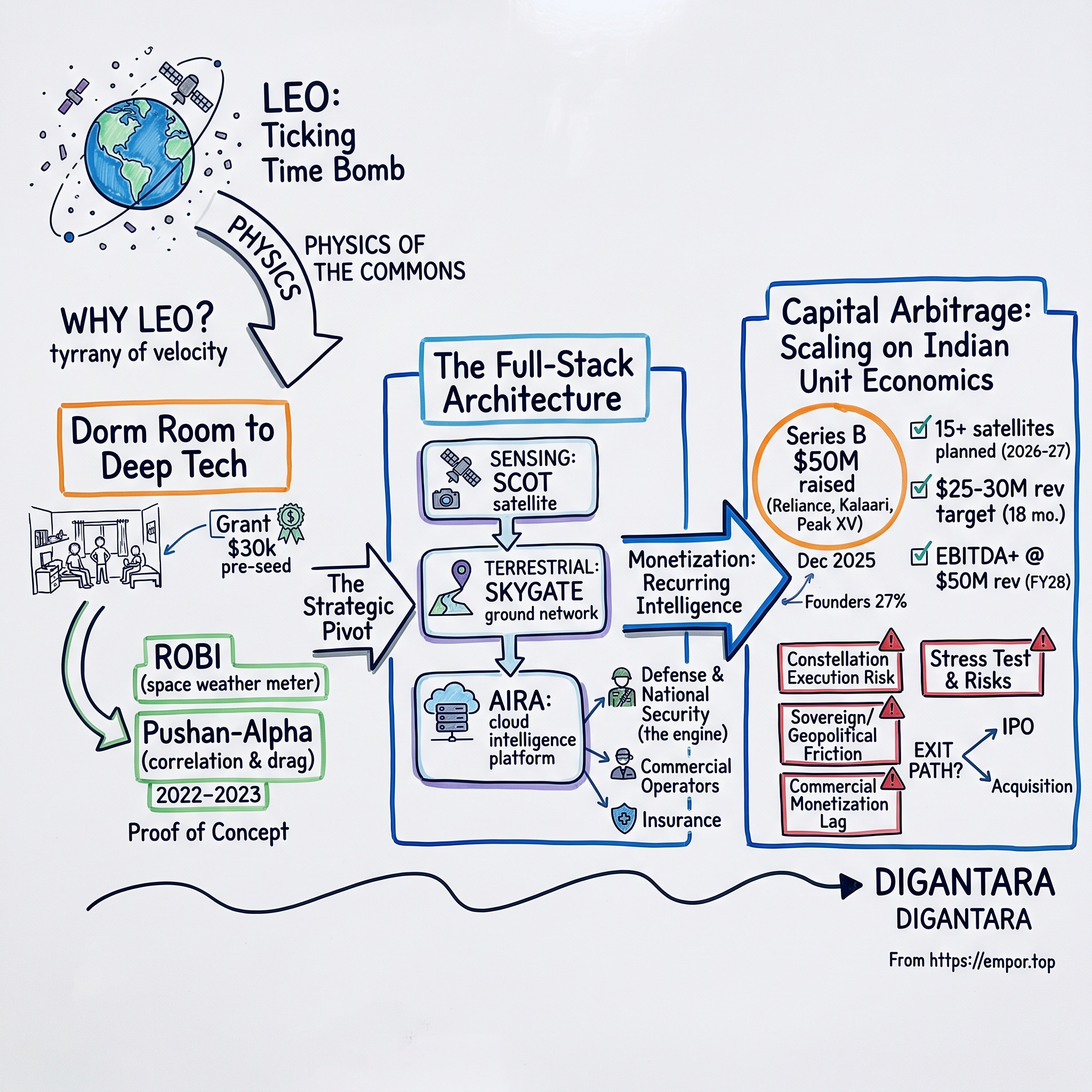
Digantara: Mapping the Wilderness of Earth's Orbit
I. Episode Prologue: The Sovereign Race for High-Altitude Truth
Four hundred kilometres above your head, a war of attrition is already underway, and almost no one can see it. In the shell of space that engineers call low Earth orbit — the band from roughly 200 to 2,000 kilometres up — the European Space Agency's debris office counts about 15,900 still-functioning satellites and some 45,700 objects large enough to be tracked and catalogued from the ground. Below that catalogue threshold the numbers become genuinely frightening: statistical models estimate roughly 1.2 million fragments between one and ten centimetres across, and around 140 million between a millimetre and a centimetre, all of them circling the planet at close to eight kilometres per second.1 At that velocity, a fleck of aluminium the size of a marble carries the kinetic punch of a hand grenade, and a bolt the size of your thumb can vaporise a communications satellite worth tens of millions of dollars. The US and other space powers can only routinely track objects larger than about ten centimetres; everything smaller is a blind spot, a bullet you never see coming.2
The nightmare that hangs over this entire domain has a name — the Kessler Syndrome, after the NASA scientist who described it in 1978. The logic is a chain reaction: one collision creates thousands of new fragments, each of which can cause the next collision, until a self-sustaining cascade of orbital shrapnel makes whole altitude bands unusable for generations.2 The commercial stakes have never been higher, because the orbit has never been more crowded. SpaceX's Starlink alone has more than 10,700 satellites working in orbit as of mid-2026, and has already filed to expand toward a constellation numbered in the tens of thousands.3 Amazon's Kuiper — now branded Amazon Leo — is climbing toward a licensed 3,232-satellite fleet.4 Analysts at Novaspace expect more than 43,000 new satellites to launch in the decade to 2034.5 Someone, in other words, is going to have to keep the map of this wilderness. The question is who — and whether the mapmaker can build a durable business out of it.
Into that question walks one of the most improbable candidates imaginable. Digantara is a space-surveillance company that three engineering students began sketching out of a university dormitory in Punjab, India, and that in December 2025 raised a $50 million Series B round at a post-money valuation of roughly $200 million.67 It now operates a surveillance satellite in orbit, runs an analytics platform sold to governments, keeps an office in Colorado Springs across the road from America's military space establishment, and holds contracts with the US Space Command and a coveted slot on the Missile Defense Agency's next-generation "SHIELD" vehicle.78 Its founders — three men still in their late twenties — collectively own about 27% of the company, and count India, Singapore, Thailand and the United States among their government customers.9
That is the seduction of the story, and it is also where a disciplined investor has to slow down. A $200 million private mark is a price, negotiated between a handful of investors and a company that wanted their money; it is not a verdict on value. Behind the headline sits a company that, by the most current reporting, generated only around $5 million of revenue in the fiscal year ended March 2026, roughly 80% of it from governments, and that does not expect to turn even EBITDA-positive until it reaches something like $50 million of revenue around fiscal 2028.9 The Series B shares are preferred stock, carrying rights that ordinary public shareholders will never see, and the round's single largest cheque came not from the marquee names the company chose to publicise but from Reliance Industries' venture arm.6 There is, as of this writing, no DRHP, no S-1, no prospectus, and no announced intention to list. This is an underwriting of a company that has told the market a compelling story and delivered a genuine first product, but which has not yet proven it can become a profitable public company.
This is the roadmap. First, the physics — why orbital congestion is a real and worsening problem, and why the ground-based systems that superpowers built in the twentieth century have hit a hard ceiling. Then the human story: three founders, a microscopic budget, and a pivot from building satellites to mapping the space they fly through. The account ahead takes apart the "full-stack" architecture that fuses hardware in orbit with software on the ground, and then does the thing the pitch decks skip — sizing the revenue engine, dissecting the capital structure round by round, building a peer set from the battered public space-tech comparables, and stress-testing the whole edifice against the skeptical questions a public market will eventually ask. Digantara is a genuinely interesting business. Whether it is a good one, at this price, is the question worth 180 minutes.
 Subscribe on LinkedIn
II. The Physics of the Commons: Why LEO Is a Ticking Time Bomb
Every good deep-tech thesis rests on a physical truth that does not care about anyone's business plan, and Digantara's is the tyranny of orbital velocity. To stay in low Earth orbit, an object must travel at roughly 28,000 kilometres per hour; that is not a design choice but a consequence of gravity, and it applies equally to a billion-dollar spy satellite and to a flake of frozen coolant. Relative closing speeds between two objects in crossing orbits can exceed ten kilometres per second, which means the energy released in a collision scales with the square of a very large number. This is why the intuition of everyday life fails here. On the ground, a lost bolt is litter; in orbit, a lost bolt is ordnance. NASA's orbital-debris specialists put it plainly: even objects too small to track can carry enough energy to end a mission, and the population of those objects is now measured in the hundreds of millions.2
The problem is not static — it is compounding, and it is compounding because the economics of getting to orbit collapsed. When a Falcon 9 rideshare can loft a satellite for a fraction of what a launch cost fifteen years ago, the natural result is a stampede. Starlink's working fleet crossed 10,700 satellites in mid-2026, a single operator accounting for well over half of everything functional in orbit, and SpaceX has filed to push toward figures an order of magnitude larger.3 Amazon's Leo constellation is authorised for 3,232 spacecraft and racing, behind schedule, to deploy them.4 The European debris office already logs more than 660 break-ups, explosions and collisions in the historical record, and each such event seeds the environment with thousands of new untrackable fragments.1 The more satellites you add, the more collisions you risk; the more collisions, the more debris; the more debris, the more collisions. That feedback loop is the commercial case for surveillance in a single sentence.
Here is the paradox the incumbents cannot easily escape: the systems humanity built to watch this environment were designed for a sparser, slower era, and they are anchored to the ground. Traditional space situational awareness leans on two instruments — giant phased-array radars and optical telescopes — and both inherit the limitations of where they sit. Optical telescopes are blinded by daylight, defeated by cloud cover, degraded by atmospheric turbulence that smears the image of a fast-moving object, and washed out by the light pollution of a warming, urbanising planet. A telescope in New Mexico simply cannot see through a storm, and it cannot see at all for half of every day.
Radar solves the weather and daylight problem but inherits a geographic one, and it is a brutal constraint. A ground radar can only watch the patch of sky above it, which means that to build continuous global coverage you must physically plant expensive installations around the entire planet — including across oceans where there is no land, and across the territory of nations that may not want a foreign superpower's tracking radar on their soil. The best-funded commercial radar network in the world, LeoLabs, has spent the better part of a decade building to roughly eleven radars across seven sites and still has visible gaps over the Pacific and the southern oceans.10 Coverage of an orbit, in the ground-based paradigm, is a function of diplomacy and civil engineering as much as of physics, and both are slow.
This is the wedge Digantara's thesis drives into. If the fundamental limits of terrestrial sensing are weather, daylight and geography, then the way around all three is to stop looking up from the ground and start looking around from orbit. A sensor placed in space sees no clouds, suffers no atmosphere between it and its target, works through the local night, and — because it is itself moving at orbital velocity — can be positioned to stare down the exact orbital planes that matter, unconstrained by where a country will let you pour concrete. A satellite watching other satellites is, in principle, the only architecture that can deliver weather-independent, geography-independent, continuous custody of a fast-moving object. That "space-to-space" insight is elegant, and it is real physics. The hard part — and the whole rest of this story — is that being right about the physics is necessary but nowhere near sufficient to build a durable company. NorthStar Earth & Space believed exactly the same thing, launched four space-based optical satellites in early 2024, and has spent the time since in litigation and a recapitalisation after most of that fleet underperformed.1112 Space is unforgiving of good theses executed badly.
III. Dorm Room to Deep Tech: Bootstrapping a Starship-Era Map Maker
The origin story is almost too neat, which is usually a sign it has been sanded smooth in the retelling, so it is worth recovering the texture. In 2018, Anirudh Sharma and Rahul Rawat were engineering undergraduates at Lovely Professional University in Punjab, an ambitious private institution far from India's established aerospace centres. They had heard about a student satellite club run under the guidance of the Indian Space Research Organisation at RV College of Engineering in Bengaluru, and it inspired them to start their own club and try to build a nano-satellite.913 Through that world they met Tanveer Ahmed, who had been running the very ISRO-mentored satellite team at RV College that sparked the idea, and who would become the third co-founder and chief technology officer.13 Three students, two campuses, no money, and a plan to build spacecraft — the phrase "dorm-room startup" is doing a great deal of work here, but in this case it is roughly accurate.
The pivot that defines the company did not come from a market-sizing exercise; it came from a failure. The founders' early work involved building satellite hardware and components, and the story they tell is that a satellite they had supplied went dormant — knocked out or endangered in the increasingly cluttered orbital environment — and they found there was no good commercial way to know what was happening around it.9 The gap they stumbled into was not "we should build another Earth-imaging cubesat," a market already ferociously crowded; it was "nobody has a good, independent, commercial map of what is actually up there." Sharma's framing became the company's north star and its favourite soundbite: build "Google Maps for space."14 By 2019 they were presenting a lidar-based space-object-tracking concept at the International Astronautical Congress, and by 2020 they had pivoted the company decisively toward space traffic management, sustained by a pre-seed grant of about ₹25 lakh — roughly $30,000 — from the Indian Institute of Science, which incubated them.15 It is worth dwelling on that number, because it frames everything the capital-efficiency argument later rests on: this company began its real work on a grant that would not cover a single month of a senior engineer's salary in Silicon Valley.
The timing was fortunate in a way the founders could not have engineered. For decades, space in India meant ISRO, a government monopoly, and private "space startups" were close to a contradiction in terms. Then in 2020, as part of the pandemic-era Atmanirbhar Bharat reforms, the Indian government created IN-SPACe as a single-window authorisation and promotion body for private space activity, and in 2023 it followed with a formal Indian Space Policy that explicitly allowed private firms to conduct end-to-end space activities.16 More than 190 space startups would emerge between 2023 and 2025.16 Digantara was early enough to catch that wave rather than fight against the old monopoly, and it built relationships with the state apparatus — flying its first payload on an ISRO rocket, incubating at a premier government science institute — that would prove central to its identity as a sovereign capability rather than just another vendor.
That sovereign identity is worth pausing on, because it is both the company's deepest structural advantage and, later, one of its thorniest risks. From the beginning Digantara positioned itself less as a commercial vendor than as an instrument of Indian space capability — a framing that opened doors a pure startup could not have knocked on. It became one of the early recipients of IN-SPACe authorisation for private space activity, flew on ISRO's own launch vehicle, and incubated inside the Indian Institute of Science; New Delhi's broader push for indigenous space-based surveillance, embodied in the government's multi-satellite Space Based Surveillance programme and reported engagements to supply defence monitoring, gives a company like Digantara a natural anchor customer that no Western rival can access.1617 The outline's suggestion that the founders also courted the Defence Research and Development Organisation fits that pattern, though a specific DRDO contract is not confirmed in the public record and should be treated as a diligence item rather than an established fact; what is documented is the ISRO relationship and the government-science incubation. The strategic point is that being a sovereign asset is a genuine, hard-to-replicate distribution advantage at home — and the same quality that makes India trust it is exactly what will later make Washington scrutinise it.
Money followed, though slowly and in the modest increments that characterise deep tech in an emerging ecosystem. Kalaari Capital, a Bengaluru venture firm, put in a roughly $2.5 million seed round in 2021, an unusually early bet on a hardware-heavy space company at a time when Indian VC overwhelmingly preferred asset-light consumer apps.1819 The Series A was where the strategic character of the cap table began to form. In June 2023 the company announced a $10 million Series A1 led by Peak XV Partners — the firm formerly known as Sequoia Capital India — with Kalaari following on and participation from Japan's Global Brain, Campus Fund, and the founders of IIFL Wealth.1819 Then, in February 2024, came a strategically revealing extension: Naman Finance and Investment, the investment arm of the Aditya Birla Group, one of India's largest industrial conglomerates, and SIDBI Venture Capital, a state-backed fund, together put in roughly ₹15.5 crore — about $1.9 million — for minority stakes, at a post-money valuation reported around ₹590 crore, or roughly $71 million.2021 The outline's framing of a "$12 million Series A" is the sum of these pieces, and the composition matters more than the total: an industrial house and a government-linked fund taking positions in a space-surveillance startup is not a normal financial trade. It is a bet on sovereign strategic value — exactly the kind of investor whose motivations diverge from a pure return-maximiser's, a distinction that will matter in assessing what these private marks actually mean.
IV. First Fire in Orbit: ROBI, Pushan-Alpha, and Proof of Concept
Talk is cheap in deep tech; orbit is expensive, and the only real currency of credibility is hardware that survives the launch and phones home. Digantara's first deposit in that account came on 30 June 2022, when a payload it called ROBI — a "Robust Integrating proton fluence meter" — rode ISRO's PSLV-C53 rocket and was hosted on POEM, the PSLV Orbital Experimental Module, a clever ISRO innovation that turns the spent fourth stage of the rocket into a stabilised, short-lived orbital platform.20 ROBI was not a surveillance instrument; it was a space-weather sensor, an ultra-miniaturised device the company billed as the world's first commercial space-based space-weather monitoring system and among the smallest such instruments in existence, drawing well under a tenth of a watt.20 Space weather — the flux of high-energy particles that degrades satellite electronics — is a genuine input to any serious model of the orbital environment, and ROBI let the company plant a flag: a student-founded Indian startup had put commercial hardware into space and made it work.
It is worth being precise about what this milestone did and did not prove, because a company's early demonstrations are easy to over-read. ROBI proved that the team could design, qualify and fly space-grade electronics on a compressed timeline and a tiny budget, and that ISRO would trust them with a slot. It did not, by itself, prove the surveillance thesis. That is the correct way to read most first missions: they are evidence of engineering competence and institutional access, not of product-market fit.
The second deposit came six months later. On 3 January 2023, a payload named Pushan-Alpha — after the Hindu solar deity Pushan — launched aboard SpaceX's Transporter-6 rideshare into a sun-synchronous orbit.22 Pushan-Alpha was a testbed, and its objectives are more revealing than the launch itself: it was designed to extend radiation measurements into new orbital regimes, to characterise the high-energy particle environment of the South Atlantic Anomaly, and — the strategically important part — to correlate the particle environment with atmospheric drag, which is one of the central variables in predicting how objects and debris actually move over time.22 In other words, Pushan-Alpha was quietly building the physical models that a surveillance-and-conjunction business would eventually need to sell. Two launches on two different launch providers, one Indian and one American, in under seven months, is a real signal of executional tempo for a company this young and this thinly capitalised.
What these two missions established, taken together, is a specific and unusually credible kind of competence: the ability to conceive, build, qualify and fly space-grade instruments on timelines and budgets that would be considered impossible in the traditional aerospace world. Legacy space programmes measure development in years and hundreds of millions of dollars; a company that reached orbit twice inside seven months, on the strength of a few million dollars of seed and grant money, is demonstrating the very cost structure that the later capital-arbitrage argument will lean on. This is the part of the origin story that actually matters to an underwriter, as opposed to the dorm-room colour: not that three students had a good idea, but that they proved, with hardware in orbit, that a lean Indian team could execute the physical engineering at a fraction of Western cost and time. That is a repeatable capability, and it is the foundation on which everything after 2023 is built. It is also, notably, the one part of the thesis that has already been demonstrated rather than merely promised — which is why the analysis weights it, while refusing to let it stand in for commercial proof.
But tempo is not the same as a business, and here the disciplined reading has to interrupt the momentum. ROBI and Pushan-Alpha were experimental payloads, not revenue-generating assets, and neither was the actual product Digantara intends to sell — a constellation of dedicated object-tracking satellites feeding a paid intelligence platform. They are best understood the way an investor should understand a biotech's successful phase-one safety trial: necessary evidence that the team can execute, and encouraging, but a long way from proof that the eventual commercial product works at scale and that customers will pay recurring money for it. The company had shown it could get to orbit. It had not yet shown it could turn orbit into a durable P&L. That distinction is the entire pre-IPO question, and the next chapters are where it gets tested.
V. The Strategic Pivot: Fusing Optical Hardware with SaaS Intelligence (AIRA)
The most important thing Digantara did was not a launch; it was a decision about what kind of company to be. A pure hardware business — building and selling satellites — earns commodity margins and lives or dies on manufacturing cost, a game an Indian firm can play well but that ultimately rewards whoever is cheapest. A pure software business — aggregating other people's tracking data and selling analytics — is asset-light and high-margin but structurally fragile, because it is only as good as data inputs it does not control, and a supplier can raise prices, degrade quality, or cut it off. Digantara's strategic bet is that in space surveillance the durable position is to own both ends: to generate proprietary data from its own sensors and to sell the refined intelligence as software. The architecture it built to express that bet is branded AIRA, and understanding its three layers is understanding the company's economic engine.
The first layer is the sensing hardware, and its centrepiece arrived on 14 January 2025, when Digantara's SCOT satellite — Space Camera for Object Tracking — launched on SpaceX's Transporter-12 mission into sun-synchronous orbit.23 SCOT is the asset that turns the thesis into a product: an in-orbit optical sensor billed as one of the world's first commercial space-based surveillance satellites, designed to detect and track resident space objects as small as five centimetres in low Earth orbit — well below the roughly ten-centimetre floor of most ground catalogues.23 The company commissioned it and declared "first light" in March 2025.24 SCOT is the proof-of-concept for the space-to-space argument made in physics back in Section II; it is one satellite, not the fifteen-plus surveillance craft and two dedicated missile-warning satellites the company says it intends to deploy across 2026 and 2027, but it is a working demonstration that Indian-built optical sensors can do the job from orbit.79 The forthcoming ALBATROSS series, purpose-built for detecting the heat plumes of ballistic and cruise missiles in their boost phase, is the more geopolitically charged extension of the same sensing layer, and the reason the December 2025 raise was framed around "missile defence" rather than mere debris-tracking.78
The second layer is terrestrial, and it is a pragmatic acknowledgement that space-only sensing is not yet enough. Digantara operates and plans a network of ground-based optical sensors — the outline's SKYGATE — to fill gaps and cross-calibrate. The company's own stated target data mix is telling: roughly 70% of its data from satellites and 30% from ground stations spread across Chile, New Mexico, India, Kazakhstan, Mongolia and Namibia.9 That geographic spread is a smaller, cheaper echo of the very ground-network approach whose limits justified going to space in the first place — a reminder that in practice this is a hybrid architecture, not a pure space play, and that the ground segment carries its own capital and coordination costs.
The third layer, and the one that actually determines whether this is a good business, is the software: the cloud platform, historically branded Space-MAP and now folded into the AIRA infrastructure, that ingests data from SCOT, from the ground network, and from public tracking catalogues, cleans and fuses it, and outputs a usable picture of the orbital environment — object catalogues, collision-risk warnings, conjunction assessments, and threat characterisation.187 This is where recurring revenue is supposed to live, and where the economics could become genuinely attractive if it works, because once the fixed cost of the sensors is sunk, the marginal cost of serving one more subscriber a data feed is close to zero.
That is the theory of monetisation; the practice is where a neutral analyst has to separate the three customer segments by their real, present economic weight rather than their slide-deck symmetry. Defence and national security is, unambiguously, the engine: it is where the willingness-to-pay is highest, the contracts are largest and multi-year, and the sovereign motive means a customer will pay a premium for an independent, non-US-controlled source of truth. Roughly 80% of the company's revenue already comes from governments, which tells you the commercial flywheel has not yet spun up.9 Commercial satellite operators are the second segment and the one the SaaS dream depends on, but their willingness to pay is far lower — many rely on free, if lower-accuracy, conjunction warnings from the US government's own systems, a point the stress-test section returns to as the central bear risk. And space insurance — underwriting orbital risk with real-time telemetry — is real in concept but pre-scale in practice, an option on the future rather than a line on today's revenue. The architecture is coherent and, in defence, already earning money. The open question is whether the high-margin, high-volume commercial subscription business the valuation implicitly leans on will ever materialise at the scale required.
VI. Capital Arbitrage: Scaling a Global Space Giant on Indian Unit Economics
The December 2025 Series B is the pricing event around which this entire underwriting orbits, so it deserves to be taken apart with care rather than accepted as a headline. The round was $50 million of new equity, and the company and its backers publicised a syndicate built to signal exactly the right things: 360 ONE Asset for domestic financial weight, the entrepreneur Ronnie Screwvala for founder-friendly scaling capital, Japan's SBI Investment for a bridge into the Japanese defence and aerospace market, and the continued participation of existing backers Peak XV Partners and Kalaari Capital.72526 The post-money valuation came in around $200 million.6 Total capital raised across the company's life reached roughly $64.5 million.7
But the most important fact about this round is one the company's own press release did not lead with, and it is exactly the kind of detail a public-market investor must dig out of the registry rather than the press kit. According to filings decoded by Entrackr, the single largest cheque in the Series B did not come from any of the marquee names above — it came from Reliance Business Ventures, the venture arm of Reliance Industries, which put in roughly ₹261 crore, on the order of $30 million, or something close to 60% of the entire round.6 Forbes likewise reported the round as "led by Reliance Industries' VC arm."9 That the company chose to foreground 360 ONE, SBI and a celebrity entrepreneur while a Reliance entity quietly wrote the majority cheque is not a scandal, but it is a lesson in reading these announcements skeptically: the publicised "lead" and the economic lead can be different parties, and the presence of India's largest conglomerate as the dominant new investor materially changes the strategic and governance picture — Reliance has its own telecom, defence and satellite ambitions, and a strategic investor of that size is never a passive one.
The capital structure that emerges from the filings is unusually visible for a private company, and worth stating precisely because it anchors everything downstream. Post-Series B, the three co-founders collectively hold about 27% of the company; Kalaari, the earliest believer, is the largest single shareholder at roughly 22%; Peak XV holds around 12%; Reliance about 15%; 360 ONE about 5%; and SBI around 1.5%.69 Two features of this deserve emphasis. First, the founders — as a trio — already own less than a third of their company at Series B, which is early to be this diluted and which foreshadows meaningful further dilution before any public listing; there is no disclosed dual-class structure or super-voting arrangement to preserve their control, so control is, on the visible evidence, a function of the ordinary share math and the board. Second, and this is the crux the marquee valuation obscures: the Series B shares are preference shares, not common stock.6 Preferred securities in a venture round typically carry liquidation preferences, anti-dilution protection, and other downside rights that ordinary common shares — the kind a public investor would eventually buy — do not. The specific terms have not been disclosed, and their absence from the public record is itself a diligence item. But the general principle is non-negotiable: a $200 million valuation struck on protected preferred stock is not the same as a $200 million valuation of the common equity, and carrying the private mark forward unchanged as if it valued the whole business at par would be the single most common error in reading a company like this.
What the $200 Million Actually Prices
Before treating that $200 million as anything more than a negotiated number, it is worth doing the arithmetic the headline invites and then explaining why the arithmetic cannot be trusted very far. Against roughly $5 million of revenue in the fiscal year ended March 2026, a $200 million equity mark is about forty times trailing revenue; against the company's own stated near-term target of $25–30 million of annual revenue within about eighteen months, it is closer to seven or eight times forward revenue.9 Those two numbers frame the entire debate: the private round is priced not on what the business earns today but on the assumption that the eighteen-month plan is substantially delivered. And a crucial technical caution applies before any of these multiples is compared to a listed peer — the $200 million is an equity value struck on preferred stock, while the public multiples that follow are enterprise-value multiples on common equity. The company has not disclosed the cash, debt or lease-like obligations that would let an outside analyst build a clean enterprise-value bridge, so a like-for-like comparison cannot be constructed from the public record; the honest position is that Digantara's enterprise value cannot currently be calculated, and that the equity mark and any EV/revenue peer figure are on different bases and must not be set equal.
With that caveat, the disciplined way to think about intrinsic value here is not a single number but a set of scenarios, because a company with one satellite and a ten-fold revenue ramp ahead of it has an unusually wide distribution of outcomes. In a bear case, the constellation slips or underperforms — the NorthStar failure mode — the commercial subscription business never scales beyond pilots, and revenue stalls somewhere in the mid-teens of millions, still mostly lumpy government project work; the company returns to the market for dilutive capital, and because the Series B preferred sits ahead of common in any downside, the common equity could be worth materially less than the headline $200 million implies. In a base case, most of the planned satellites reach orbit and work, the defence backlog converts into multi-year contracts, revenue approaches the guided ~$50 million around fiscal 2028 at roughly EBITDA breakeven, and gross margins climb toward software-like levels as the fixed sensor base is spread over more customers; at $50 million of revenue and a defensible high-single-digit forward multiple in line with surviving listed peers, the equity might be worth something in the low-hundreds-of-millions to perhaps $400–500 million — modestly above today's mark, but only if execution is close to flawless and dilution is contained. In a bull case, Digantara becomes the default non-US sovereign source of space-domain and missile-warning intelligence, the commercial and insurance layers finally scale, revenue compounds past $100–150 million with expanding margins, and a growth multiple could justify several times the current mark. The swing variables are few and they are known: whether the constellation actually gets on orbit and performs, whether commercial revenue ever becomes a meaningful share of the mix, the gross-margin trajectory, and how much further dilution the journey requires. Small changes in any one move the answer across a wide band, which is precisely why a single "target" would be false precision. What the $200 million mark clearly does embed is the base-to-bull path; it is not a price consistent with the bear.
A related discipline is to be honest about the size of the pond. The directly addressable space-situational-awareness market is not enormous: third-party estimates cluster around $2–3 billion of annual spend by 2030, growing at roughly ten percent a year.27 Even a commanding share of pure SSA is therefore a few hundred million dollars of revenue at most — which is one reason the December 2025 story reached past debris-tracking toward missile defence, a far larger budget line that multiplies the addressable market but also drops the company into the ring with Lockheed Martin and Northrop Grumman. And the reachable market at Digantara's present product — one satellite, mostly government pilots, four national customers — is a small slice of even that $2–3 billion. The category TAM is real and growing; the served market today is a rounding error against it, and the valuation is a bet on closing that gap.
Now the argument the whole story is really selling: capital arbitrage. The claim is that Digantara can build a global space-surveillance company for a fraction of what its Western rivals spend, because it develops payloads, optical systems and software with India's deep, comparatively low-cost engineering talent. There is real substance here. The company reached a working in-orbit surveillance satellite and roughly $25 million in closed contracts having raised, in total, about $64.5 million — where American peers have consumed far more capital for comparable or lesser hardware footprints.7 LeoLabs has raised on the order of $129 million over its life to build its radar network; NorthStar burned through a comparable sum and most of a satellite fleet.1011 True Anomaly, an American space-defence startup, raised $650 million at a $2.2 billion valuation in a single 2026 round — more than thirty times Digantara's entire lifetime funding.9 Digantara runs on roughly 125 employees, of whom 80 to 85 are engineers, out of a Bengaluru facility that can assemble five satellites at once, with a larger Andhra Pradesh plant planned.79 The arbitrage is not a fiction.
But the capital-efficiency argument has to be held to its own logic, and there are two honest caveats. First, cheap engineering is a genuine and durable structural advantage for the manufacturing and software-development layers — but launch costs, which are a large share of deploying any constellation, are set on the global market by SpaceX and are the same dollar figure for a Bengaluru startup as for a Boulder one. Arbitrage compresses part of the cost base, not all of it. Second, low cost is an advantage only if it does not come at the price of reliability; a constellation deployed cheaply that then underperforms in orbit — precisely NorthStar's fate — converts a cost advantage into a capital incineration. The arbitrage thesis is credible, and the early evidence supports it, but it is a thesis about relative burn, and it will be validated or falsified by whether the planned 2026–27 constellation actually reaches orbit and works.
VII. The Strategic Arena: Competitive Playbook & The 7 Powers of Space Data
To ask whether Digantara can build a moat, it helps to borrow Hamilton Helmer's discipline of naming the specific power at work rather than gesturing at "network effects," because in this business some of the claimed advantages are real and others are, for now, rhetoric. Three of Helmer's seven powers are plausibly in play, and each deserves an honest grade.
The strongest candidate is cornered resource: proprietary, space-generated data that no competitor can replicate. A working space-based optical sensor staring down specific orbital planes produces observations that are weather-independent and geographically unconstrained, and there is genuinely no substitute for a data stream you own outright. But the grade here is "early," not "established," because the resource is currently one satellite. A single SCOT does not corner a global data resource; a functioning fifteen-satellite constellation with high revisit rates might begin to. The power is potential, and it is contingent entirely on execution of the deployment schedule.
The second candidate is scale economies, and it cuts in the classic infrastructure way. The upfront cost of building and launching a surveillance constellation is a real barrier to entry, and once those sensors are sunk cost, the marginal cost of serving an additional customer a data feed is close to zero, so gross margins should expand with scale. This is the same structure that makes a satellite-imaging or ground-radar network attractive at scale — but it is a double-edged power, because it is equally available to every well-capitalised competitor, and the barrier it erects protects the incumbent only after the incumbent has itself paid the entry cost. Digantara has paid a small fraction of that cost so far.
The third candidate is switching costs, and this is the one most likely to become the durable moat if the business matures. Once the AIRA platform is wired directly into a satellite operator's automated collision-avoidance workflow, or into a nation's space-command console, ripping it out to swap in an unproven alternative is operationally risky and expensive — no operator wants to change the system that tells it whether its satellite is about to be hit. But switching costs only exist once you have deeply embedded customers, and with roughly $5 million of revenue and a customer base still dominated by a handful of governments, this power is aspirational rather than actual today.9 The intellectually honest summary is that Digantara has the architecture to build three of Helmer's powers, and has begun to, but that none of them is yet locked in; they are all downstream of a constellation that mostly does not exist yet.
The competitive set clarifies both the opportunity and the danger. The nearest analogue by business model is NorthStar Earth & Space, the Canadian firm that shares Digantara's exact space-based-optical thesis — and NorthStar is a cautionary tale, not a comfort. It launched four SSA satellites in early 2024, lost one and saw the other three underperform, fell into litigation with its satellite supplier Spire, and by April 2026 was going public via a SPAC at a roughly $300 million valuation largely to raise the capital to rebuild its constellation.1112 That a direct peer with the same strategy nearly destroyed itself on execution is the single most instructive fact in this section. LeoLabs, the American ground-radar leader, is the incumbent to beat on precision and pedigree: roughly eleven radars across seven sites, tracking down to about two centimetres, more than $60 million in 2025 contract awards with triple-digit growth in US government business, and a coveted position on the same MDA SHIELD vehicle Digantara sits on.1028 LeoLabs is capital-intensive and geographically constrained, exactly as the space-to-space thesis argues — but it is also years ahead, deeply embedded in the US defence apparatus, and not going away. Slingshot Aerospace and ExoAnalytic Solutions, the software-aggregator and optical-telescope-network players Digantara itself named as competitors in 2023, occupy the data-fusion and ground-optical niches respectively.18 And in the missile-defence framing of its latest raise, Digantara now finds itself notionally adjacent to giants — Lockheed Martin, Northrop Grumman — and to lavishly funded upstarts like True Anomaly.9
What the Public Market Pays for Space Data
Because there is no prospectus, the listed peers are the best available discipline on the private mark — provided one is careful about which companies are genuine operating peers and which are aspirational category leaders whose multiples should never be borrowed. The honest direct-ish peer set is the cohort of space-data and Earth-observation businesses that went public via SPAC in 2021 and now trade on real, audited revenue. Spire Global, a space-data and radio-frequency-sensing company, carried a market capitalisation of roughly $480 million in mid-2026 on around $64 million of trailing revenue — an enterprise-value-to-revenue multiple of about seven and a half times.29 BlackSky, an imaging-and-intelligence operator, was valued near $0.9 billion on roughly $100 million of revenue, and infrastructure names such as Redwire and lunar-services company Intuitive Machines cluster in a similar high-single-digit-to-low-double-digit range.17 These are the relevant comparables for a government-heavy space-data business, and they sit at roughly seven to ten times revenue on an enterprise-value basis.
The category leaders are a different animal and a trap for the careless. Planet Labs traded around twenty-six times revenue and Rocket Lab at something like sixty-plus times, but those multiples are paid for scale, growth and narrative that a $5-million-revenue SSA startup does not have, and applying them to Digantara would be exactly the "take the highest available multiple" error a disciplined underwriting avoids.3031 The single closest listed reference point is not a triumph but a cautionary one: NorthStar's April 2026 SPAC valued it at roughly $300 million pre-money against about $30 million of projected 2026 revenue — call it ten times forward revenue — and that was a distressed vehicle raising money to rebuild a fleet that had underperformed.11 Read against that peer set, Digantara's ~$200 million equity mark is being paid for a business whose near-term target is $25–30 million of revenue at a peer-like forward multiple — which is to say the private round already prices the base case as delivered, leaving little margin for the execution risk that dominates this company's future. (The reminder from the previous section bears repeating: those peer figures are EV/revenue on common equity, and the $200 million is an equity mark on preferred, so the comparison is directional, not exact.)
There is a further reason to treat space-tech forward projections with suspicion, and it comes from the graveyard of the 2021 SPAC class. SpaceNews, reviewing how those deals aged, documented companies that delivered a small fraction of what they had promised investors — in one notorious case under one percent of a projected revenue figure.32 Satellite manufacturer Terran Orbital, which went public at around $10 a share, was ultimately bought by Lockheed Martin for twenty-five cents a share; the optical-telescope network ExoAnalytic — one of Digantara's own named competitors — was absorbed by defence software firm Anduril in March 2026.3233 Two lessons fall out of that history. The first is that space-tech revenue forecasts carry a systematic optimism bias that the public market eventually punishes without mercy, which is the right lens through which to read Digantara's own $25–30 million and $50 million targets. The second is that the industry is consolidating: defence primes and well-funded platforms are buying independent SSA capability rather than competing with it forever, which is simultaneously a strategic risk (a prime could vertically integrate and squeeze independents out of contracts) and a potential exit path (Digantara could itself become an acquisition target long before any IPO). Neither outcome is the durable-public-company story the private mark implies.
The winning strategy Digantara articulates — owning the data-generation layer rather than reselling third-party feeds — is strategically sound, and it is the correct answer to the fragility of a pure-software aggregator. But the competitive reality that a public-market investor must weigh is that Digantara is not competing in an empty field against slow incumbents; it is a sub-scale challenger with one satellite and $5 million of revenue, entering a domain that contains a years-ahead radar leader, a cautionary-tale space-optical peer, defence primes, and billion-dollar-funded rivals — and doing so on a fraction of their capital. The capital-efficiency edge is what makes that fight winnable; it is not what makes it won.
VIII. Stress Test: The Skeptical Investor & Geopolitical Risk Radar
Start with the question that should discipline any excitement about this category: if space situational awareness is as vital as everyone says, why has no private competitor yet scaled into hundreds of millions of dollars of durable profit? LeoLabs, with a nearly decade head start and the deepest ground network in the commercial world, was still counting 2025 contract awards in the tens of millions.28 NorthStar chased the same space-based thesis and nearly collapsed.11 The uncomfortable answer is that this is a hard, capital-hungry, government-dependent market where the largest and most reliable buyer — the United States government — has historically given a great deal of the underlying data away for free, and where converting strategic importance into recurring commercial revenue has defeated better-funded companies. That is the backdrop against which Digantara's three principal risks must be read.
The first is constellation execution and capital risk, and it is the one most likely to determine the outcome. Digantara's plan calls for deploying on the order of fifteen surveillance satellites and two dedicated missile-warning craft across 2026 and 2027 — an extraordinarily aggressive tempo for a company that has one satellite in orbit today and roughly $50 million of fresh capital to fund it.7 A single launch failure, a sensor-calibration error, a micro-meteoroid strike on the company's own hardware, or a manufacturing delay could push the network out and consume the Series B in the process. This is not a hypothetical; it is precisely what happened to NorthStar, whose fleet underperformed and forced a distress recapitalisation.11 The whole cornered-resource and scale-economies case depends on this constellation reaching orbit and working, on schedule, on this budget — and deep-tech schedules almost never survive contact with reality. This is the falsifiable core of the underwriting.
The second is the monetisation lag, and it is the structural weakness the SaaS narrative papers over. Defence budgets are deep, but they are also lumpy, procurement-driven, slow, and — for a foreign supplier — politically contingent. The commercial satellite-operator market that is supposed to supply high-volume subscription revenue is the harder sell, because those operators run on thin margins and can often obtain adequate collision warnings for free. The US Office of Space Commerce has spent 2024–2026 standing up TraCSS, a government system that already provides conjunction warnings for around a thousand objects multiple times a day to dozens of pilot users and now covers more than 11,000 satellites.34 When the reference product is free and government-backed, a commercial provider has to be dramatically better to command a subscription — and Digantara's roughly 80%-government revenue mix suggests the commercial flywheel has not yet started to turn.9 The path from safety alerts to durable, high-margin recurring revenue is asserted more than it is proven.
The third is geopolitical and sovereign friction, and it is the risk unique to this company's peculiar geometry. Digantara's business is dual-use almost by definition — the same sensor that spots a piece of debris can characterise a foreign military satellite — and the company straddles jurisdictions in a way that multiplies its compliance exposure. Its R&D and manufacturing sit in Bengaluru; it operates a US subsidiary, reported as Zenith Space Technologies, out of Colorado to serve the Pentagon; it maintains operations in Singapore; and it counts India, Singapore, Thailand and the US among its government customers.935 Selling space-domain data to the US Space Command and the Missile Defense Agency while doing core engineering in India, and simultaneously serving as an Indian sovereign capability, means threading US ITAR export controls, Indian defence-export clearances, and a thicket of cross-border data-sharing rules — any one of which could restrict what the company can build where and sell to whom.78 The Indian government's own ambitions add a further complication: New Delhi is standing up a 52-satellite Space Based Surveillance programme and has reportedly engaged Digantara for defence work worth around ₹150 crore a year, which is a powerful anchor customer but also ties the company's fortunes to state procurement and to being seen, in Washington, as an arm of a foreign government.[^36][^37] The outline's premise that this is "a constant compliance minefield" is, if anything, understated.
Beyond those three headline risks sits a quieter category that a public-market investor logs not as red flags but as diligence items — questions whose answers do not yet exist in the public record and whose absence should never be mistaken for a clean bill of health. The precise terms of the Series B preferred — liquidation preference multiple, participation, anti-dilution ratchets, board and veto rights, any side letters granted to Reliance or the strategic investors — have not been disclosed, and they materially affect what the common equity is worth in anything but the bull case. The composition and independence of the board, the size of the employee option pool and therefore the true fully diluted share count, the founders' individual holdings and vesting, related-party arrangements between Digantara and its now-dominant strategic backer Reliance, and the governance rights attached to a Singapore or US entity in the group structure are all unknown from outside. So too are the eventual accounting choices, the use of any IPO proceeds, lock-up arrangements, and the formal risk factors — none of which exist because no filing exists. The correct posture is not to assume the worst but to insist these become visible before, not after, a listing; a company that has been unusually transparent through registry filings so far has cleared a low bar, and the real test of governance comes with the disclosure a prospectus would force.
Layer these against Porter's forces and the picture is sobering but not fatal. The threat of new entrants is high, because the thesis is public and capital is flowing into space defence. Buyer power is high and concentrated, because a handful of governments dominate demand. The threat of substitutes — free government data, ground-based incumbents — is real. What is genuinely favourable is the direction of the tide: the US Space Force has been explicitly reorganising to buy more commercial SDA data and analysis, running short, fast contracts with commercial firms and standing up accelerators to pull startups in, and the broader Indian space economy is projected to reach roughly $44 billion by 2033.[^38]1636 The demand is real and growing. The question the stress test leaves open is whether this sub-scale, jurisdictionally complex challenger converts that demand into profit before its capital or its schedule runs out.
IX. The Long-Term Horizon: 3 Critical KPIs for the Next Era
If an investor could monitor only a handful of numbers to know whether this underwriting is being confirmed or falsified, three stand out, and they map directly onto the three risks just laid out. Everything else is commentary.
The first is active satellites in orbit and revisit performance. The entire cornered-resource thesis rests on Digantara actually deploying its planned constellation — on the order of fifteen surveillance satellites and two missile-warning craft through 2026–27 — and having them work.7 Today there is one, SCOT.23 The single most important thing to watch is the cadence of successful launches and commissionings against that schedule, because every slipped launch window directly degrades data-revisit frequency, which is the product's core quality metric, and every in-orbit failure both delays revenue and burns capital the company cannot easily replace. A year from now, the number of healthy, operational Digantara satellites in orbit will tell you more about the business than any pitch deck. The related technical KPI — how frequently the network can re-acquire a specific small object, and how far below five centimetres it can reliably size debris — is the physical measure of whether the space-to-space advantage is being realised or merely claimed.23
The second is contracted revenue and the defence backlog conversion. The company has closed roughly $25 million of contracts and set itself a target of $25–30 million of annual revenue within about eighteen months, against roughly $5 million realised in fiscal 2026.79 The number to track is the conversion of pilot engagements into multi-year, recurring sovereign contracts — and, critically, whether any meaningful commercial (non-government) recurring revenue appears alongside the defence base, because that is the signal that the SaaS flywheel has finally engaged rather than remaining a slide. Watch the mix as closely as the total: $30 million of revenue that is still 80% lumpy government project work is a very different, and less valuable, business than $30 million with a growing, sticky commercial subscription layer.
The third is the path to durable profitability, which is where price and value will eventually be reconciled. Management's own stated marker is EBITDA-positive status at roughly $50 million of revenue around fiscal 2028 — a target that requires revenue to grow roughly tenfold from the fiscal 2026 base in about two years while the company is simultaneously spending heavily to build a constellation.9 EBITDA-positive is not the same as free-cash-flow-positive, and for a capital-intensive satellite operator the gap between the two is enormous: it must be reconciled against ongoing satellite capex, launch costs, stock-based compensation, and working capital before anyone should speak of sustainable free cash flow. The honest way to watch this is to ask, each period, whether gross margin is expanding toward software-like levels as the fixed sensor base scales, whether operating leverage is appearing, and how much additional external capital — and therefore how much further dilution of that already sub-one-third founder stake — the journey to $50 million and beyond will require. The falsifying evidence would be revenue that stalls in the low double digits, a constellation that slips, and a return to the market for dilutive capital at a flat or lower valuation.
Around those three gauges sit the catalysts that will move the story in either direction, and it is worth naming them because a private company's value re-rates on events, not on calendar quarters. The near-term positive catalysts are concrete: each successful 2026 launch and commissioning, the conversion of the Missile Defense Agency SHIELD slot or US Space Command pilots into funded multi-year contracts, a first named commercial subscription of size, and a fresh sovereign customer beyond the current four countries. The negative catalysts are their mirror image: a launch failure or an in-orbit sensor anomaly, a slip to the deployment schedule, an ITAR or export-clearance restriction that walls the company out of the US market, or a down or flat financing round that would expose the gap between the private mark and what new money will actually pay. The event that would force the eventual profitability reckoning is the one every capital-intensive space-data company has faced: the moment the growth capital gets more expensive or scarcer, and the business has to show it can fund its own constellation from its own cash flows rather than from the next round. For a company still burning toward a fiscal-2028 breakeven target, that reckoning is years away — but it is the fixed point on the horizon toward which every one of these KPIs is really pointing, and it is why a listing, if one ever comes, would be less an endpoint than the start of a far more demanding scoreboard. A price can rise after a listing on scarcity, narrative and a thin free float long before the fundamentals justify it; the discipline is to keep watching the constellation, the contracted revenue and the margin path, and to let those — not the tape — settle whether the mapmaker was ever worth its map.
X. Epilogue: Business and Investing Lessons from Digantara
Three lessons survive the noise, and they are the ones worth carrying to the next company that looks like this one.
The first is pivot hard, pivot early. Digantara's defining act was not a technology or a contract; it was the founders' willingness to abandon the crowded business of building satellites and reposition around the unglamorous, unsolved problem of mapping the space those satellites fly through. The move from looking down at Earth to looking out at orbit was a reframing of the entire question, and it is the origin of whatever durable advantage the company may build. The investing lesson is the mirror image: the pivot is celebrated in hindsight because it worked so far, but the same reflex that redirects a company toward a better problem can, in a different season, scatter it across too many — and a company now stretching from debris-tracking to missile warning, from Bengaluru to Colorado to Singapore, will have to prove that its breadth is focus and not drift.
The second is geographic capital arbitrage as a genuine, but partial, edge. Reaching a working orbital surveillance satellite and $25 million of contracts on roughly $64 million of lifetime capital, in a field where rivals raise hundreds of millions, is a real demonstration that India's engineering-cost base can disrupt a capital-intensive Western industry.79 But the arbitrage compresses the manufacturing and software layers, not the globally-priced cost of launch, and it is only an advantage if the cheaply-built hardware proves reliable in the one environment that punishes shortcuts without mercy. Cheap is a moat only when it is also good.
The third is the full-stack moat is a promise, not yet a possession. The strategic logic — that pure software is hostage to data inputs it does not control, and pure hardware earns commodity margins, so owning both the sensors in orbit and the intelligence platform on the ground is the durable position — is genuinely sound, and it is the right architecture for this business. But architecture is not achievement. As of mid-2026, Digantara owns one satellite, earns most of its money from a handful of governments, sits on preferred shares priced at a $200 million private mark that is a negotiated price rather than a proven value, and has not yet earned an operating profit.69 The company has told a coherent and, in places, genuinely impressive story, and it has delivered real hardware to back the first chapter of it. Whether it becomes the map-maker of the orbital commons — and a profitable public company worth anything like its private mark — depends on a constellation that mostly does not exist yet, a commercial market that has not yet paid, and an execution record that its closest strategic peer failed to achieve. The map of that future is not yet drawn. Digantara has, at least, secured a place in orbit from which to try to draw it.
References
-
Space debris by the numbers / DISCOSweb statistics — ESA Space Debris Office, updated 2026-06-25 ↩↩
-
Orbital Debris Frequently Asked Questions — NASA Orbital Debris Program Office ↩↩↩
-
Starlink Statistics — Jonathan's Space Report (Jonathan McDowell), updated 2026-07-09 ↩↩
-
FCC lets Amazon Leo miss deployment deadline with temporary spectrum penalty — SpaceNews, 2026-06-08 ↩↩
-
Novaspace predicts 43,000 new satellites to launch by 2034 — Payload, 2025-10-08 ↩
-
Spacetech startup Digantara hits $200 Mn valuation after Series B funding — Entrackr, 2026-01 ↩↩↩↩↩↩↩
-
India's Digantara raises $50M for space-based missile defence tech — TechCrunch, 2025-12-16 ↩↩↩↩↩↩↩↩↩↩↩↩↩↩
-
Digantara raises $50 million to expand from space surveillance to missile defense — SpaceNews, 2025-12-16 ↩↩↩
-
Meet The Small Indian Firm Building A Missile-Tracking System For Space — Forbes (Megha Mandavia), 2026-07-09 ↩↩↩↩↩↩↩↩↩↩↩↩↩↩↩↩↩↩↩↩
-
NorthStar Earth & Space to go public in SPAC deal at $300M valuation — Via Satellite, 2026-04-17 ↩↩↩↩↩↩
-
Rocket Lab kicks off 2024 with mission for Spire and NorthStar — Via Satellite, 2024-01-31 ↩↩
-
This startup set up by 21-year-olds tracks dead satellites and space junk — Business Standard, 2021-01-05 ↩↩
-
Digantara: Building a Google Maps for space — Forbes India ↩
-
Indian Space Policy Review: Entrepreneurship and Innovation Ecosystem — Carnegie Endowment, 2026-05 ↩↩↩↩
-
BlackSky Technology (BKSY) Market Cap — CompaniesMarketCap, 2026 ↩↩
-
Spacetech startup Digantara raises $10M Series A1 from Peak XV Partners, others — TechCrunch, 2023-06-20 ↩↩↩↩
-
Spacetech startup Digantara raises $10 Mn from Peak XV Partners, others — Inc42, 2023-06-20 ↩↩
-
Digantara Successfully Launches the World's First Commercial Space-Based Space Weather Monitoring System (ROBI) — GlobeNewswire, 2022-07-06 ↩↩↩
-
Exclusive: Naman Finance, SIDBI invest in spacetech startup Digantara — Entrackr, 2024-02 ↩
-
Indian spacetech startup Digantara's space-mapping testbed (Pushan-Alpha) successfully launched by SpaceX — Business Today, 2023-01-04 ↩↩
-
Digantara launches India's first homegrown space-surveillance mission (SCOT) via SpaceX's Transporter-12 — SatNews, 2025-01-14 ↩↩↩↩
-
Digantara commissions world's first commercial space surveillance satellite — Business Standard, 2025-03-08 ↩
-
Digantara raises $50M in Series B — Kalaari Capital, 2025-12-17 ↩
-
Trilegal advises Digantara on its Series B fundraise of USD 50 million — Trilegal, 2025-12 ↩
-
Space Situational Awareness Market — MarketsandMarkets, 2025 ↩
-
LeoLabs Achieves Record Bookings in 2025 Fueled by Triple-Digit Growth in U.S. Government Contracts — PR Newswire, 2026-01-27 ↩↩
-
Spire Global (SPIR) Enterprise Value to Revenue — GuruFocus, 2026 ↩
-
Planet Labs PBC (PL) Stock Price, Quote & History — Yahoo Finance ↩
-
Anduril snaps up space surveillance firm ExoAnalytic Solutions — TechCrunch, 2026-03-11 ↩
-
Commerce Department's new Traffic Coordination System for Space (TraCSS) initial capabilities — Office of Space Commerce, 2024-09-30 ↩
-
India's Digantara enters US, inks deal with ArianeGroup — Orbital Today, 2025-02-25 ↩
-
India's space economy set to touch $44 billion by 2033 — DD News, 2025 ↩
 LinkedIn
 WhatsApp
 Reddit
 Hacker News
 Email
Email Kindle
 RSS Feed
 Spotify
 Apple Podcasts
 Amazon Music
 Audible
 YouTube