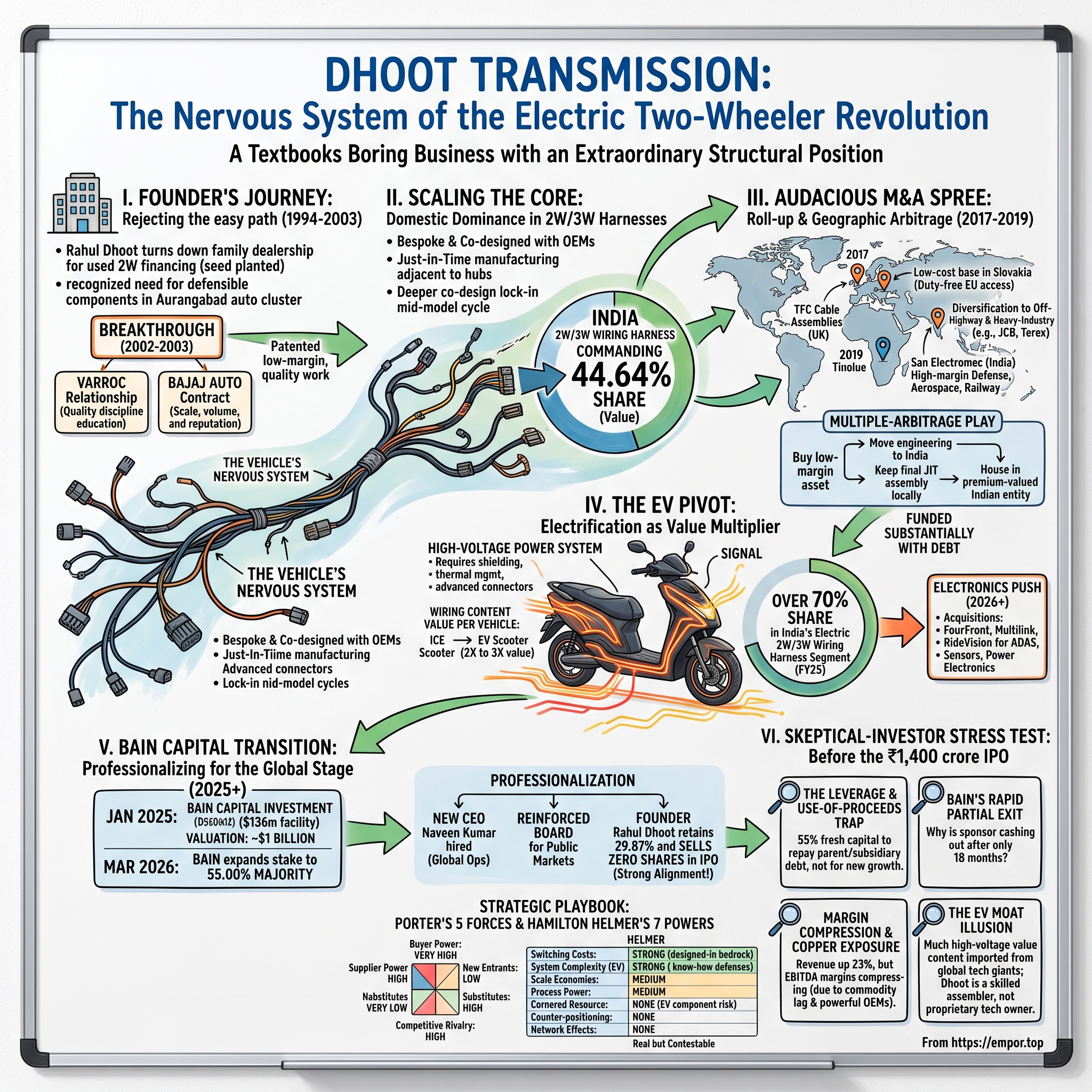
Dhoot Transmission: The Nervous System of the Electric Two-Wheeler Revolution
I. Introduction & Episode Roadmap
Picture the industrial sprawl on the edge of Aurangabad — a city in central Maharashtra better known to most Indians for the Ajanta and Ellora caves than for anything that moves the country's economy. It is the kind of place where, if you know what you are looking for, you can drive past a low-slung factory shed, hear the rhythmic snip of wire-cutting machines, and have no idea that inside, thousands of workers are hand-weaving the literal nervous system of nearly every electric scooter sold in India.
That is the strange, almost invisible heart of this story. Ask a hundred Indian investors to name the most important supplier in the country's electric two-wheeler boom, and most will reach for the obvious: the battery makers, the cell importers, the marquee names like Ather or Ola. Almost none will say "the wiring." And yet, by fiscal year 2025, a company that barely anyone outside the auto-component trade had heard of — Dhoot Transmission Limited — commanded more than a 70% share of the wiring harnesses that route high-voltage power through India's electric two- and three-wheelers.1 Behind it stood not a sprawling family conglomerate but a single first-generation engineer, Rahul Dhoot, and, since early 2025, one of the most aggressive private equity firms on the planet: Bain Capital.[^2]
So here is the hook. How does an unknown, garage-born outfit from the plains of Aurangabad end up controlling the electrical bloodstream of an entire mobility revolution — and convince Bain Capital to write a check that valued it at roughly a billion dollars before it had even gone public?[^2]
The premise of this episode is that Dhoot Transmission is a textbook example of a "boring" business hiding an extraordinary structural position. While the glamour of automotive wiring — to the extent any glamour exists — flows to passenger-vehicle giants like Motherson, Dhoot did something cleverer. It planted itself in the less-fashionable, lower-volume-per-unit but higher-customization world of two-wheelers and three-wheelers, the vehicles that actually move the Indian masses. It is a critical Tier-1 supplier: the company that sits one rung below the automaker and ships parts straight onto the assembly line. And it found that this unglamorous niche, when electrification arrived, suddenly became one of the most strategically valuable seats in the entire industry.
Here is the roadmap for where we are going. First, the origin story — a young engineer rejecting the comfortable inheritance of his family's automotive dealership to build something with his own hands. Second, the patient construction of a domestic wiring-harness fortress, contract by contract, plant by plant. Third, the audacious cross-border M&A spree of 2017–2019, when Dhoot started buying distressed European harness makers and arbitraging the gap between cheap UK valuations and rich Indian listing multiples. Fourth, the electrification pivot that transformed a copper-bending commodity shop into something investors are now willing to call a technology supplier. Fifth, the Bain Capital transition, and what it means when a founder hands operational control to professional managers and global financiers. Sixth, a hard-nosed skeptical-investor stress test as the company headed toward its ₹1,400 crore IPO. And finally, the frameworks — Porter's Five Forces and Hamilton Helmer's Seven Powers — that let us judge whether this moat is real or merely a coat of private-equity paint.
Let us begin where every good origin story begins: with a young man turning down the easy money.
 Subscribe on LinkedIn
II. The Founder's Journey: From Aurangabad Dealerships to Wiring Harnesses (1994–2003)
It is 1994. A fresh electronics-engineering graduate from the Jawaharlal Nehru Engineering College in Aurangabad is standing at the kind of fork in the road that, in the Indian business context, usually resolves itself in about thirty seconds. On one side: the family business — a comfortable, cash-generating automotive dealership, the sort of trading operation that has minted quiet fortunes across small-town India for generations. On the other: nothing in particular. Just a vague, stubborn conviction that selling other people's vehicles for a margin was not the life he wanted.
Rahul Dhoot chose nothing in particular.2
This is worth pausing on, because it cuts against the deepest grain of Indian family business culture. The dealership was the golden cage — profitable, low-risk, already built. To walk away from it was, in the eyes of most of his community, faintly insane. But Rahul, by his own later account, found the trading and retail side of the auto world fundamentally unfulfilling. There was no making in it, only moving. He was an engineer who wanted to build, and a showroom floor offered nothing to build.2
His first attempt at independence was not, in fact, manufacturing. He tried his hand at a used two-wheeler financing business — a small detour into the world of credit and resale that, however briefly, taught him the economics of the two-wheeler at the customer's eye level: what people could afford, how they financed it, why the cheapest reliable mobility always won in India. It did not become his life's work, but it planted a seed. When it fizzled, he did not retreat to the dealership. He went back to his engineering roots and asked a more fundamental question: what does every one of these vehicles actually need, that someone has to make, that is hard enough to be defensible?
The answer, it turned out, was hiding in plain sight inside Aurangabad itself. By the late 1990s, the city was quietly transforming into one of India's auto-ancillary clusters, and the gravitational center of that cluster was Bajaj Auto, the motorcycle-and-three-wheeler colossus whose Waluj plant had turned the region into a magnet for component suppliers. Where a giant OEM sets up, a constellation of Tier-1 and Tier-2 suppliers must follow — the parts ecosystem clusters physically around the assembly line, because that is how just-in-time manufacturing works. Aurangabad was becoming a place where, if you could make a competent automotive component, there was a buyer down the road.
In 1999, with limited capital and a technical understanding of how electrical power and signal move through a vehicle, Rahul founded Dhoot Transmission Private Limited.2 The name itself — "Transmission" — signaled the ambition: not transmission in the gearbox sense, but the transmission of electricity, the routing of current. He had decided that the thing he would make was the wiring harness: the bundled architecture of cables, terminals, and connectors that carries both power and information through a machine. It was unglamorous. It was labor-intensive. And, crucially, it was something that could not simply be bought off a shelf, because every vehicle needs a different one.
The breakthrough did not come overnight. The defining stretch ran from 2002 to 2003, and it came in two contracts that, in retrospect, set the entire trajectory of the company.
The first, in 2002, was a manufacturing relationship with the Varroc Group — itself an Aurangabad success story and one of the dominant Tier-1 component players in the region. For a young Dhoot Transmission, the Varroc relationship was less about volume than about education. Supplying a sophisticated Tier-1 meant absorbing the rigorous, unforgiving quality discipline of the global automotive supply chain: the part-per-million defect tolerances, the traceability requirements, the audits. A wiring fault is not a cosmetic blemish; in a vehicle, it can mean a fire. Learning to operate at automotive-grade quality is the price of admission to the entire industry, and Varroc taught Dhoot that lesson early.
The second contract, in 2003, was the one that changed the company's scale forever: a deal to supply wiring harnesses directly to Bajaj Auto for motorcycles and three-wheelers.2 This was the giant down the road finally buying. Winning Bajaj did two things at once. It handed Dhoot genuine volume manufacturing for the first time — the kind of scale that lets a young company invest in equipment, hire engineers, and build process discipline. And it conferred something less tangible but more valuable: reputation. Once you are a reliable harness partner to Bajaj, every other two-wheeler OEM in the country knows your name. In a business built on trust and qualification, the Bajaj stamp was a credential that opened doors.
What does this founding chapter tell an investor? Two things. First, that Dhoot's edge was never financial muscle — he started under-capitalized and stayed that way for years; it was a willingness to do the patient, low-margin, quality-obsessed work that flashier entrepreneurs avoided. Second, that the company's deepest moat was laid down in these earliest years, when it learned to embed itself inside an OEM's volume production. That embedding — that proximity — would become the entire strategic logic of the business. To understand why, we have to understand the product itself.
III. Scaling the Core: The Domestic 2W & 3W Wiring Harness Dominance
Open up any motorcycle, peel back the bodywork, and you will find it: a sprawling, branching web of color-coded wires snaking from the battery to the headlamp, from the ignition to the tail light, from every sensor to every switch. It looks like chaos. It is, in fact, one of the most precisely engineered objects on the vehicle. This is the wiring harness — and the best way to understand it is as the vehicle's nervous system.2
The analogy is not decorative. A nervous system carries two things: power, to make muscles move, and signal, to tell them when. A wiring harness does exactly that — it transmits electrical power to run the motor, lights, and pumps, and it carries the low-current signals that let the brain of the vehicle talk to its limbs. And like a nervous system, it cannot be generic. You cannot buy a "standard" harness and bolt it onto any bike, because every vehicle has a different geometry, a different placement of components, a different length of run from point A to point B. The harness must be designed for one specific model, co-developed alongside the OEM's own vehicle-development team, and threaded through the precise contours of that machine. This single fact — that the product is bespoke and co-designed — is the source of nearly everything that makes this business defensible.
By FY25, this core domestic harness business was the engine of Dhoot Transmission, contributing roughly 78% of revenue — on the order of ₹2,687 crore.1 To understand the company's position, you have to understand the shape of the Indian wiring-harness market, which is best described as a consolidated playground worth somewhere in the region of $1.8 to $1.9 billion. It is not a fragmented free-for-all; it is an oligopoly, and the players know each other well.
At the top sits Motherson Sumi Wiring India Limited — MSWIL — the undisputed heavyweight, holding around 40% of the overall market and well over 60% dominance in passenger vehicles specifically.[^8] If you are riding in a car in India, the odds are very good that a Motherson harness is buried in its doors and dashboard. Second is Yazaki India, the local arm of Japan's Yazaki Corporation, with roughly a 19% overall share, again concentrated in the passenger-vehicle world — supplying the likes of Tata and Toyota.[^8] These two giants together own the car.
But here is the strategic insight that defines Dhoot's entire existence: it did not try to fight Motherson and Yazaki for the car. It went where they were weaker and the work was fiddlier — the two-wheeler and three-wheeler segment, contesting that space against Spark Minda (the electrical-distribution arm of the Minda Corporation group) and others.[^9] And in that specific arena — the overall Indian two-wheeler and three-wheeler wiring-harness segment — Dhoot held a commanding 44.64% share by value as of FY25.1 In the vehicles that actually carry the bulk of India's population, Dhoot was not a niche player. It was the leader.
How does a company win and hold that kind of position? The economics come down to two reinforcing mechanisms, and both are about proximity.
The first is just-in-time manufacturing, dictated by an awkward physical reality: wiring harnesses are bulky, oddly shaped, and easily damaged in transit. You cannot efficiently warehouse them or ship them across the country, because they tangle, chafe, and crush. The only sensible way to supply them is to make them right next to where the vehicle is being assembled and feed them onto the line in sequence, as needed. So Dhoot built out roughly 17 manufacturing facilities across India, deliberately planted adjacent to OEM manufacturing hubs in places like Pune, Chennai, and Haryana.1 Each plant is, in effect, a captive extension of a customer's assembly line. This geographic lock-in is mundane but powerful — once your plant is physically married to a customer's factory, a competitor cannot easily insert itself.
The second mechanism is co-design lock-in, and it is the deeper of the two. Dhoot's engineers embed themselves inside the design teams of customers like Bajaj Auto, TVS Motor, Suzuki, and Royal Enfield, typically 12 to 24 months before a new bike ever reaches the market.1 They are in the room as the vehicle's electrical architecture is being drawn, shaping where every wire runs. By the time the bike launches, the harness is not a part that was selected — it is a part that was grown into the vehicle's anatomy. And that creates ferocious stickiness. To replace Dhoot mid-cycle, an OEM would have to re-engineer the entire electrical routing of the vehicle, re-validate it for safety, and re-tool the line. The switching cost is not a price; it is a project.
So what should an investor take from the core business? That Dhoot's dominance in two- and three-wheeler harnesses is not an accident of cheap labor — plenty of workshops have cheap labor. It is the product of two structural advantages, physical proximity and design entanglement, that compound over time and are genuinely hard to dislodge mid-model-cycle. The honest caveat is that these advantages protect existing model wins; they do not guarantee future ones. Every new vehicle program is a fresh competition, and that is exactly the door through which a determined Motherson or Yazaki could one day walk. But for now, in its chosen arena, Dhoot held the seat. The question that consumed Rahul Dhoot by the middle of the last decade was a different one: having conquered the domestic two-wheeler harness, where do you go next?
IV. The International Roll-up: M&A, Multiples, and Geographic Arbitrage (2017–2019)
By 2016, Rahul Dhoot had a problem that many entrepreneurs would kill for: he had won. His company dominated its domestic niche so thoroughly that the obvious next moves — squeezing a few more points of share out of Bajaj or TVS — offered diminishing returns. But dominance of a single market is also a concentration risk. Dhoot's entire fortune was bet on the Indian two- and three-wheeler cycle, with all the seasonality, commodity swings, and OEM pricing power that implied. To build something larger and more durable, he needed to diversify — into different vehicle types, different geographies, and different, higher-margin corners of the harness world.
His answer was an aggressive cross-border M&A strategy, and the way he ran it tells you a great deal about how he thinks. The targets were not trophy assets in the glamorous parts of Europe. They were specialized, often unloved, sometimes distressed harness makers in the United Kingdom and Eastern Europe — companies with genuine engineering pedigree but mediocre economics, available at modest prices.
The first move came in 2017, with the acquisition of TFC Cable Assemblies, a UK-rooted business with operations extending into Slovakia, for an estimated ₹100 crore — roughly $15 million. The headline asset was not the UK entity but the factory in Námestovo, in northern Slovakia. That facility handed Dhoot a low-cost Eastern European manufacturing base sitting inside the European Union's customs union — which meant duty-free access to the Western European OEMs that are the richest harness customers on earth.[^12] In one stroke, Dhoot acquired a credible European footprint and a manufacturing cost base far below Germany or France, with none of the trade friction.
The second move, in 2018, was the acquisition of Parkinson Harness Technology, based in Boston, Lincolnshire, in the UK, for an estimated ₹150–200 crore, or roughly $23–30 million. Parkinson was a different kind of prize: it made complex, heavy-duty harnesses for the off-highway and heavy-industry world, supplying global giants such as JCB and Terex.[^11] This pulled Dhoot out of the two-wheeler world entirely and into the rugged, high-value segment of construction and earth-moving equipment — vehicles where the harness is larger, more complex, and far better-paid per unit. It diversified the customer base across an entirely different industrial cycle.
The third move, in 2019, came back home: the acquisition of San Electromec in India, aimed at unlocking the high-margin domestic defense, aerospace, and railway harness segments. These are slow-moving, qualification-heavy markets with brutal entry barriers — and correspondingly fat margins for those who get in. Buying a qualified incumbent was a shortcut into an arena that would have taken a decade to enter organically.
Now, the question that any serious investor asks of a roll-up: did they overpay? Roll-ups are where ambitious companies go to destroy value, paying rich multiples for acquisitions that never integrate. The cleanest benchmark in this very industry is Motherson's own landmark 2017 acquisition of Finland's PKC Group, struck at roughly 11.5 times EV/EBITDA and about 0.6 times EV/Sales — figures that became a kind of industry reference point for what a large harness business is worth.
Against that yardstick, Dhoot appears to have shown real discipline. The European acquisitions were done at estimated multiples in the range of 0.8 to 1.0 times sales and roughly 8 to 10 times EBITDA — modest prices for specialized engineering assets, reflecting that these were lower-margin or distressed businesses rather than crown jewels. Dhoot was not paying up for growth stories; it was buying competent, under-earning assets cheaply.
And this is where the real cleverness sits — what we might call the multiple-arbitrage play. The logic runs in four steps. Buy a low-margin UK or European harness maker at a single-digit EBITDA multiple. Move the labor-intensive engineering and wire work to India, where it can be done at a fraction of the cost. Keep the final just-in-time assembly in Slovakia and the UK, close to the European customers who demand local supply. And then house the whole combined entity inside an Indian-listed company — a market where auto-ancillary businesses have historically traded at premium multiples, sometimes 20 to 40 times earnings. The same stream of profits, simply by virtue of where it is engineered and where it is valued, is worth dramatically more inside the Indian structure than it was as a standalone British business. That is value created not by operations alone but by geographic and capital-markets arbitrage — a genuinely sophisticated piece of financial engineering for a company this size.
But every arbitrage has a cost, and here is the catch that would echo for years: this acquisition spree was funded substantially with debt. Buying companies across two continents, integrating them, and shifting production is capital-hungry work, and Dhoot loaded its balance sheet to pay for it. The leverage that powered the global expansion would, by the time of the IPO, become the single most scrutinized number on the company's books. We will return to that debt with a skeptic's eye. But first, the development that turned this diversified-but-leveraged components roll-up into something investors were suddenly willing to call a growth story: electrification.
V. The EV Pivot: Electrification & The Nervous System Transformation
For a hundred years, the wiring harness in a vehicle has been, electrically speaking, a low-voltage afterthought. Twelve volts, routed to spark plugs, lights, and a horn. It was copper plumbing — necessary, but dumb. Then the electric vehicle arrived, and the humble harness was handed a vastly more demanding job, and with it, a vastly larger paycheck.
To understand why electrification was such a gift to a company like Dhoot, you have to understand what changes inside the wiring when you rip out the engine and drop in a battery. An internal-combustion two-wheeler routes modest current to a handful of components. An electric two-wheeler must route the full force of the battery pack — high-voltage power, in advanced systems running far above the gentle 12 volts of the old world — from the pack to the motor controller to the motor itself. That high-voltage power demands a completely different and more difficult architecture: heavy electromagnetic shielding to stop the system from interfering with itself, sophisticated thermal management because high current generates heat, and advanced connectors engineered to handle voltages that would arc and burn a conventional terminal. The harness stops being dumb copper plumbing and becomes a safety-critical, precision-engineered power system.
This is why the EV segment matters so much to the investment case, even though it was still the smaller part of the business. By FY25, EV systems contributed roughly 25.22% of revenue — on the order of ₹868 crore.1 The core internal-combustion two-wheeler business still drove the volume, but the EV segment was the growth-and-margin driver, for one simple, powerful reason: the content value per vehicle. An EV wiring harness is worth roughly two to three times as much as its internal-combustion equivalent, because it does so much more and requires so much more engineering.1 Electrification, in other words, did not just give Dhoot a new market — it multiplied the value of the very part it already dominated. Every scooter that flipped from petrol to electric was, for Dhoot, the same customer paying two or three times as much.
And Dhoot saw it coming. The company pivoted into high-voltage architectures starting around 2021, ahead of the volume wave. By FY25 it commanded an outstanding share of more than 70% of India's electric two- and three-wheeler wiring-harness segment — supplying both the legacy players adapting to electric, like the TVS iQube and the Bajaj Chetak, and the new-wave EV startups such as Hero Electric and Ather.1 In the segment that everyone agrees represents the future of Indian mobility, Dhoot was not a participant; it was the near-monopolist.
Layered on top of this, in early 2026, came a flurry of moves into automotive electronics — a small but strategically pointed expansion. Sized to its weight, it is worth a passing mention rather than a deep dive, because it sat under the roughly 22% "other products" bucket and was more novelty than needle-mover in revenue terms. But the direction was telling. In February 2026, Dhoot merged with the Pune-based FourFront, a power-electronics and ADAS (advanced driver-assistance systems) player.[^6] In April 2026, it acquired Bengaluru-based Multilink to deepen its position in sensors and relays and strengthen its EV footprint.[^4] And in June 2026, it announced a partnership with Israel's RideVision, bringing AI-driven collision-avoidance technology for two-wheelers into the fold.[^7]
The strategic logic of this electronics push is more interesting than its current financial weight. Dhoot's entire historical business has been making the wires that connect a vehicle's components. The risk on the horizon is that, as electronics integrate, the value migrates from the "dumb copper" of the harness toward the smart modules at its ends — the sensors, the controllers, the chips. By acquiring power-electronics, sensor, and ADAS capabilities, Dhoot positioned itself to supply complete electronic modules — sensors plus switches plus harness — rather than just the connecting cable. It is a hedge against being commoditized into the low-value middle while the value pools at the smart endpoints.
So what does the EV pivot mean for an investor weighing the company? The bullish read is straightforward and genuinely strong: Dhoot rode a structural tailwind into a dominant position in the fastest-growing, highest-content-value version of its own product, and is now reaching upmarket into the electronics that surround it. The skeptical read — which we will sharpen later — is that 70% share in a young, fast-moving segment is exactly the kind of position that invites attack from larger, better-capitalized rivals once volumes become worth their attention, and that "assembling high-voltage connectors imported from global tech giants" may be a thinner moat than the headline share implies. Both readings can be true at once. What is not in dispute is that the EV pivot is what transformed Dhoot from a regional component shop into a company that could attract the attention of global private equity — which brings us to the moment Bain Capital walked through the door.
VI. The Bain Capital Transition: From Promoter-Led to Sponsor-Backed Powerhouse
There is a particular moment in the life of a successful founder-led business when the company outgrows the founder's personal balance sheet and personal bandwidth at the same time. The factories multiply across continents, the debt taken on to build them looms larger, and the next chapter clearly requires both more capital and a different kind of management. For Rahul Dhoot, that moment arrived in January 2025, and the answer that walked through the door was Bain Capital.
On January 16, 2025, Bain Capital announced a growth investment in the Dhoot Transmission Group, in a transaction that valued the company at approximately $1 billion — roughly ₹8,300 crore.[^2] For a business born in an Aurangabad shed, crossing the billion-dollar private valuation line was a genuine milestone, and it was structured with the firepower to match: Bain backed the investment with a financing package reported at around $136 million.3 The deal was not merely a check; it was a partnership designed to professionalize the company and carry it toward the public markets.
Bain did not stop at a passive minority. By March 2026, it had scaled its position decisively, expanding its stake to 55.00% through its entities BC Asia Investments XV and XVI — converting Dhoot from a founder-controlled company into a sponsor-backed one, with private equity holding the majority.1 This is a consequential shift in the character of the business. A promoter-led company answers, ultimately, to one person's judgment and risk appetite. A sponsor-backed company answers to an institutional owner with a defined holding period, a return target, and a playbook for exit. That change of ownership DNA shapes everything that follows — including, as we will see, the design of the IPO itself.
With control came the professionalization, and Bain moved quickly to install a new operating spine. In October 2025, the company hired Naveen Kumar as Group CEO, recruited from Napino Auto & Electronics.1 Kumar was brought in specifically to run global operations and steer the company through the delicate transition to public ownership. He is the non-founder executive charged with the unglamorous but essential work of integrating the company's 22 global plants into a single, coherent operating machine — the kind of operational integration that founders, brilliant at building, are often less suited to grinding through. Around him, the board was reinforced for the scrutiny of public markets, with Bain Capital Managing Director Rishi Mandawat joining and Ajay Seth installed as Independent Chairman — both signals aimed at demonstrating the global corporate-governance standards that institutional investors demand before they will buy a newly public Indian company.1
But the most revealing detail in this whole transition is not about who came in. It is about what the founder did with his own shares. Rahul Dhoot retained a 29.87% pre-IPO stake — and, in a move that speaks louder than any management presentation, he chose not to sell a single share in the upcoming IPO's Offer for Sale.1 In an Indian IPO landscape where promoter cash-outs are routine and often the entire point, a founder declining to take any money off the table is a meaningful signal of alignment. It says, in effect: I still believe the most valuable years are ahead, and I am keeping my chips on the table. An investor should weigh that against the contrasting behavior of the new majority owner — Bain, as we will see, was selling — but on its own, the founder's decision is a credible vote of confidence.
To bind the new professional managers to the company's fortunes, Dhoot also adopted the "DTPL-Employee Stock Option Plan 2025," a standard but important tool for attracting and aligning key executives like Naveen Kumar in the run-up to a listing.1 And in a nod to governance discipline, the founder's own remuneration was structured conservatively — Rahul Dhoot's commission is governed under the Companies Act and capped at 5% of net profits, the kind of guardrail that institutional owners insist upon to prevent the related-party excesses that have plagued other founder-led Indian firms.
The net analytical read on this transition is mixed in an instructive way. On the positive side, Bain's involvement brought capital, a professional CEO, a credible board, and governance rigor — exactly what a leveraged, fast-globalizing company needed. On the cautionary side, a 55% private equity owner with a fresh entry in early 2025 already moving to sell shares in a mid-2026 IPO raises an obvious question about time horizon and motive. The founder is locking in; the sponsor is partially cashing out. Holding those two facts together is the beginning of a more skeptical examination — which is exactly where we turn next.
VII. The Activist / Skeptical-Investor Stress Test
Every compelling growth story deserves a hostile cross-examination, and Dhoot Transmission, heading into its IPO, offered plenty for a short-seller or activist to work with. Let us put on the skeptic's coat and ask the uncomfortable question directly: Is Dhoot a genuine high-tech EV leader, or is it a heavily leveraged, low-margin assembly shop wearing a fresh coat of private-equity paint? Here are the four stress tests that a sharp sell-side bear would run.
Stress Test 1: The leverage and use-of-proceeds trap. When a company goes public, the most revealing document is not the growth chart — it is the use-of-proceeds table, because it tells you what the money is actually for. Dhoot's IPO sought to raise ₹1,400 crore in fresh capital.[^3] But look at where that fresh money was earmarked to go. Nearly ₹766 crore — roughly 55% of the fresh issue — was set aside strictly for debt repayment: about ₹493.9 crore to pay down parent-company debt and ₹272.58 crore for subsidiary debt at entities like Dhoot Autocomponents and Dhoot Electricals.1 This is the bill from the international acquisition spree coming due. The skeptic's concern is pointed: if more than half the fresh capital is going to repair a balance sheet stretched by past M&A, how much is actually flowing into the R&D and EV-specific machinery that the growth story is supposed to be about? A company that raises money primarily to deleverage is, by definition, paying for its past rather than funding its future — and that is a very different proposition from the one the EV-leadership narrative implies.
Stress Test 2: Bain Capital's rapid partial exit. Follow the smart money — especially when it is heading for the door. Bain acquired its stake in January 2025, and by the mid-2026 IPO it was already offloading 1.32 crore shares through the Offer for Sale.1 An eighteen-month round-trip to a partial cash-out invites the sharpest question of all: why is the most sophisticated owner on the cap table selling so soon? One benign explanation is portfolio management and the natural monetization that an IPO provides. The less comfortable interpretation is that Bain may believe the company has reached its peak valuation multiple in the private market, and that selling into public-market enthusiasm is simply the better trade. When the insider who knows the numbers best starts trimming barely a year after buying, a prudent investor at least pauses. The contrast with the founder's zero-share sale is the most interesting tension in the entire deal.
Stress Test 3: Margin compression and copper exposure. Growth that comes at the expense of margins is a warning, not a triumph. Dhoot's consolidated revenues surged about 23% to ₹3,444.86 crore in FY25 — an impressive top-line number.1 But underneath it, EBITDA margins were moving the wrong way, compressing from 18.31% in FY24 to 16.38% in the first nine months of FY26.1 Roughly two points of margin erosion while revenue is booming is precisely the kind of divergence a bear loves to find. The underlying mechanism is twofold. First, copper: the harness business is enormously exposed to copper prices, and while supply contracts typically contain pass-through clauses that let Dhoot recover rising input costs, those clauses operate with a lag of three to six months — meaning that in a rising-copper environment, the company eats the increase before it can pass it on. Second, and more structurally, the customers are powerful. Automotive OEMs like Bajaj and TVS wield enormous bargaining power and apply relentless, year-over-year cost-down pressure on their Tier-1 suppliers. A harness maker is structurally caught between volatile commodity inputs it cannot fully control and giant customers who continuously squeeze its prices. Margin compression, in that light, is not an anomaly to be explained away; it is the gravitational field the business operates in.
Stress Test 4: The EV moat illusion. This is the most fundamental challenge, because it goes to the heart of the bull case. Dhoot claims more than 70% share of the electric two- and three-wheeler harness market — but a skeptic would ask what that share is actually built on. The uncomfortable answer is that much of the high-voltage value content — the sophisticated terminals and connectors that make an EV harness special — is imported from global technology giants like TE Connectivity and Sumitomo, with Dhoot performing the local assembly and integration.1 If that is broadly the shape of the business, then Dhoot's role in the EV harness is closer to a high-skill assembler than a proprietary technology owner. And that matters enormously for durability, because it means the moat rests on integration know-how and customer relationships rather than on owned, patent-protected technology. Should the legacy harness giants — a Motherson or a Yazaki — decide to aggressively target the two-wheeler EV market once its volumes become large enough to be worth the effort, they would arrive with deeper pockets, larger procurement scale, and decades of harness expertise. Dhoot's 70% share, impressive as it is today, could prove to be the high-water mark of an early mover rather than the entrenched fortress the headline number suggests.
What should an investor do with these four stress tests? Not dismiss them, and not be paralyzed by them. Each is a real, evidence-based concern: the deleveraging use of proceeds, the sponsor's quick partial exit, the margin compression under commodity and customer pressure, and the question of how proprietary the EV moat truly is. None of them is fatal on its own, but together they form the bear case that any buyer of this story must be able to answer. To weigh that bear case against the genuine strengths, we need a structured framework — which is exactly what Porter and Helmer provide.
VIII. Playbook: Porter's 5 Forces, Hamilton's 7 Powers & Strategic Moats
Having heard the prosecution, let us now war-game the competitive position formally. Two frameworks earn their keep here: Michael Porter's Five Forces, which maps the structural attractiveness of the industry Dhoot operates in, and Hamilton Helmer's Seven Powers, which isolates the specific, durable advantages — if any — that Dhoot actually possesses. Used together, they let us separate "Dhoot benefits from a decent industry" from "Dhoot has a real moat."
Porter's Five Forces applied to Dhoot Transmission.
Bargaining power of buyers — very high. This is the dominant force shaping Dhoot's economics, and it is unfavorable. A handful of large auto OEMs — Bajaj, TVS, and their peers — account for the bulk of volume, and they know it. They dictate pricing, demand annual cost-down efficiency sharing, and can credibly threaten to dual-source. As we saw in the margin discussion, this buyer power is the single biggest reason Tier-1 harness margins stay structurally capped. It is the hard ceiling over the whole business.
Bargaining power of suppliers — high. Dhoot is squeezed from the other side too. Its primary raw material, copper, is a globally traded commodity whose price it cannot influence, and its most sophisticated components — the high-voltage connectors and terminals at the heart of the EV story — are bought from powerful global Tier-1s like TE Connectivity and Sumitomo. Caught between commodity inputs and proprietary imported components, Dhoot has limited supplier leverage.
Threat of new entrants — low. Here the structure finally favors Dhoot. The model-specific co-design process, the deep and lengthy testing and qualification cycles, and the 12-to-24-month capital-intensive integration required to win a single vehicle program form a formidable barrier. A new local workshop cannot simply undercut on price and walk in; it would have to earn its way through years of qualification before an OEM would trust it with a safety-critical part. This is the moat in industry-structure terms.
Threat of substitutes — very low. This is the most comforting force in the whole analysis. There is, quite simply, no substitute for a wiring harness. Every motorized vehicle — internal-combustion or electric — absolutely requires one to move power and signal through itself. Wireless power transmission does not exist at vehicle scale. As long as vehicles have electricity, they have harnesses, and the electrification wave, far from threatening the product, makes it more valuable.
Competitive rivalry — high. Within the protected industry, the incumbents fight hard. Dhoot contends in intense bidding wars against MSWIL, Yazaki, and Spark Minda for every new program. Rivalry among the qualified few is fierce, which is part of what keeps margins disciplined even as entry barriers keep newcomers out.
The Porter read, then, is a paradox: Dhoot sits in an industry that is hard to enter and impossible to substitute, but is squeezed on both sides by powerful buyers and powerful suppliers, and contested fiercely by a few capable rivals. It is a defensible position, not a comfortable one.
Hamilton Helmer's Seven Powers applied to Dhoot. Now to the deeper question: which durable powers does Dhoot actually own?
1. Switching costs — strong. This is Dhoot's primary source of power, and it is genuine. Because the harness is co-designed into the vehicle's geometry, switching suppliers mid-model-cycle is not a procurement decision but a re-engineering project, complete with re-tooling, fresh compliance testing, and the very real specter of vehicle fire hazards if the electrical system is not perfectly validated. Once Dhoot is designed in, it is exceptionally hard to remove for the life of that model. This is the bedrock of the moat.
2. Scale economies — medium. Dhoot's 22 global plants enable localized just-in-time logistics, and its large procurement volumes of wire and copper confer a slight purchasing advantage. But scale here is real without being decisive — Motherson operates at far greater scale, so this is a power Dhoot possesses modestly rather than dominantly.
3. Process power — medium. Decades spent optimizing the ergonomics and flow of complex harness assembly — the human choreography of weaving hundreds of wires correctly, at speed, with near-zero defects — constitute a genuine, if hard-to-quantify, operational advantage that a newcomer cannot replicate overnight.
4. Counter-positioning — none. Dhoot is a traditional, high-quality incumbent Tier-1. It is not employing a new business model that established players cannot copy without harming themselves. There is no counter-positioning power here.
5. Network effects — none. The business has no network-effect dynamic; an additional customer does not make the product more valuable to other customers.
6. Cornered resource — none. This is the honest weak point and ties directly to the bear case. Dhoot owns no proprietary raw material, no patent-locked connector, no irreplaceable input. Its key high-voltage components are bought from others. It has no cornered resource, which is precisely why the "EV moat illusion" critique has teeth.
7. System complexity — strong, specifically in EV. This is the power that the electrification wave handed Dhoot. Moving from low-voltage 12V systems to high-voltage architectures — running, in advanced systems, up to the 400V–800V range — demands sophisticated insulation, thermal management, and electromagnetic shielding. That complexity is exactly what keeps low-cost assembly workshops out of the EV harness space and gives Dhoot's accumulated high-voltage know-how real defensive value, at least for now.
Pulling the frameworks together, the picture sharpens into something an investor can actually use. Dhoot's durable advantages cluster around switching costs and EV system complexity — both real, both meaningful, both rooted in the co-design lock-in that has defined the company since the Bajaj contract of 2003. Its vulnerabilities cluster around the absence of any cornered resource and its exposure to powerful buyers and suppliers — the structural reasons margins are capped and the EV moat is contestable. This is not the profile of an unassailable monopoly. It is the profile of a well-defended incumbent whose moat is strong against new entrants and mid-cycle defections, but porous against a determined, deep-pocketed established rival who decides to compete program-by-program for the next generation of vehicles. Whether that rival shows up is the central uncertainty in the entire investment case.
IX. Epilogue & Outlook
Step back from the spreadsheets and the frameworks, and what remains is a remarkable arc. A young engineer in Aurangabad turned his back on a comfortable family dealership, spent years doing the patient, unglamorous work of bending copper to automotive-grade quality, and built — contract by contract, plant by plant, acquisition by acquisition — a company that now routes the electrical lifeblood of India's electric two-wheeler revolution and carries the backing of one of the world's most formidable private-equity firms. As Dhoot Transmission entered the public market with a ₹1,400 crore war chest aimed largely at deleveraging its balance sheet, the narrative pivoted from "founder's scrappy build" to "institutional company under public scrutiny" — and the questions changed accordingly.
For the long-term fundamental investor, the noise of the IPO will fade, and what will matter is execution against a small number of things that genuinely determine whether this company compounds value or merely treads water. Three KPIs deserve to be watched above all others.
First, EBITDA margin stability. The whole bear case on profitability rests on whether Dhoot can defend its margins against volatile copper and relentless OEM cost-down pressure. The line in the sand is whether management can hold margins above roughly 17% through the commodity cycle, or whether the slide from 18.31% toward the 16% handle continues. Margin direction, more than revenue growth, will reveal whether Dhoot has any real pricing power or is simply a price-taker between commodities and customers.
Second, EV segment share retention. The 70%-plus share of the electric two- and three-wheeler harness market is the crown jewel of the bull case — and the single most contestable claim in it. The question is not whether Dhoot leads today; it does. The question is whether it still leads in three to five years, once the legacy giants and scaling rivals decide the segment is large enough to fight for in earnest. Watching that share number hold, erode, or grow is watching the moat itself being tested in real time.
Third, the debt-to-equity ratio after the IPO. The company is using public money to clean up a balance sheet stretched by its global acquisition spree. The real test of management's credibility is what happens next. Does the leadership maintain genuine capital discipline and let the balance sheet heal — or does it, having promised prudence, immediately embark on another debt-fueled acquisition campaign? The post-IPO trajectory of leverage will be the clearest behavioral evidence of whether this management can be trusted with capital over the long run.
None of these questions has a settled answer yet, and that is precisely the point. Dhoot Transmission is neither the unassailable EV-technology champion its boosters might paint nor merely a leveraged assembly shop in private-equity costume. It is something more interesting and more honest than either caricature: a genuinely well-positioned incumbent with a real but contestable moat, riding a powerful structural tailwind, carrying real leverage and real margin pressure, now stepping onto the public stage with all its strengths and vulnerabilities exposed at once.
What is beyond dispute is the human achievement underneath it all. Rahul Dhoot's journey — from rejecting an Aurangabad dealership in 1994 to building a sponsor-backed, globally integrated, billion-dollar auto-tech supplier three decades later — stands as one of the most quietly extraordinary, and almost entirely unheralded, stories of Indian manufacturing excellence. The wires he chose to make, all those years ago, turned out to be the nervous system of a revolution he could not yet have imagined.
References
-
Dhoot Transmission Limited — Draft Red Herring Prospectus (DRHP), SEBI, 2026-05-24 ↩↩↩↩↩↩↩↩↩↩↩↩↩↩↩↩↩↩
-
Rahul Dhoot: The first-generation entrepreneur transforming DTL — Autocar Professional, 2023-11-15 ↩↩↩↩↩
-
Bain Capital backs Dhoot Transmission with $136 million financing package — Private Equity Wire, 2025-01-20 ↩
 LinkedIn
 WhatsApp
 Reddit
 Hacker News
 Email
Email Kindle
 RSS Feed
 Spotify
 Apple Podcasts
 Amazon Music
 Audible
 YouTube