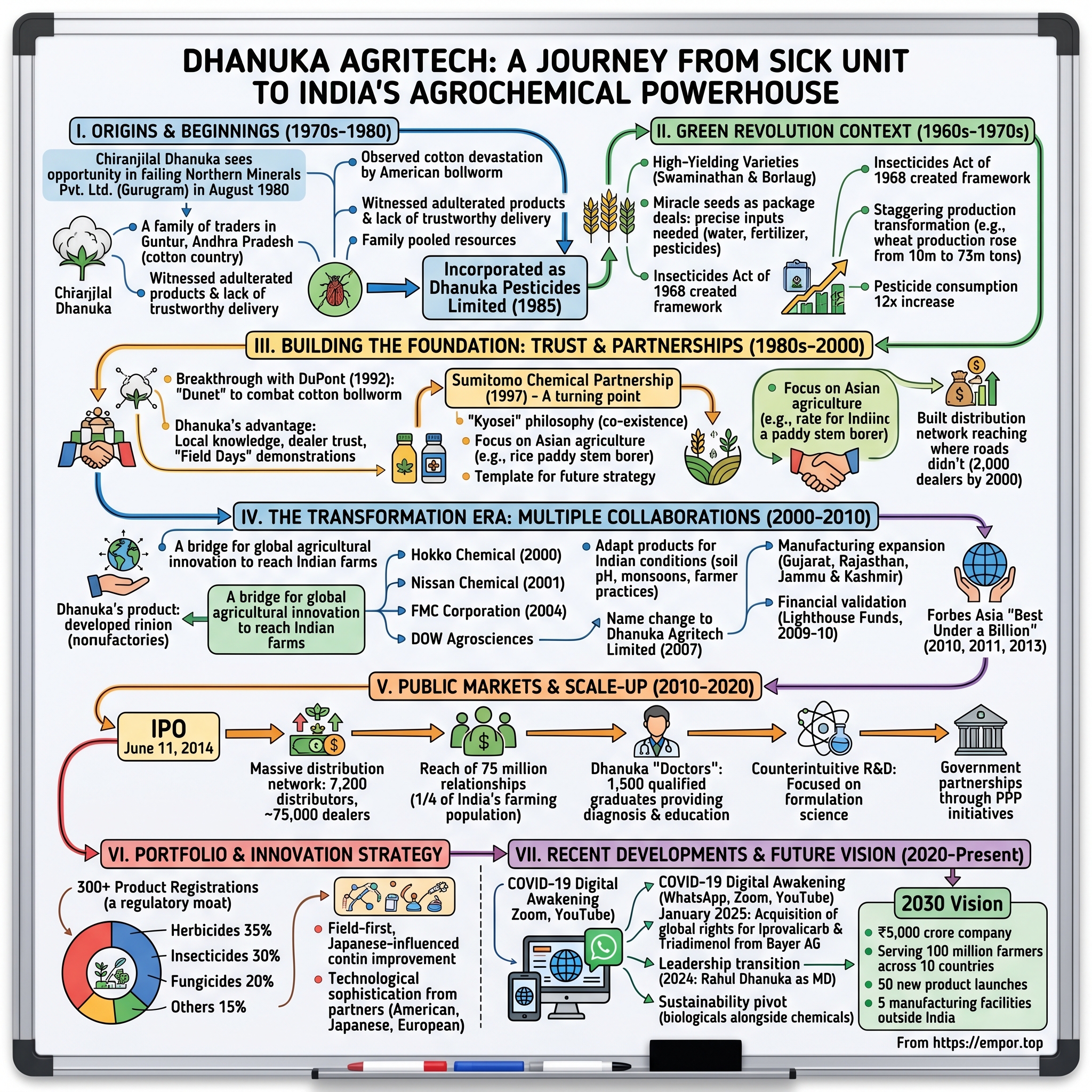
Dhanuka Agritech: From a Sick Unit to India's Agrochemical Powerhouse
I. Introduction & The Agrochemical Conundrum
There is a particular kind of Indian business story that gets told the same way every time. A family of traders. A distressed factory bought for scrap value. Decades of patient compounding. A distribution network so deep that no one can dislodge it. Rising returns on capital, no debt, dividends every year. The arc bends upward, and the narrator lands on a satisfying conclusion about the durability of unglamorous businesses.
Dhanuka Agritech has been told that way for the better part of fifteen years. And for most of that period, the telling was accurate.
Then the last twenty-four months happened.
In the financial year ended March 2025, Dhanuka did everything the story required. Revenue rose roughly 16% to ₹2,035 crore, operating margins crossed 20%, and profit after tax reached about ₹297 crore. Return on capital employed sat near 28%, return on equity near 22%, and borrowings were so trivial that the company's interest coverage ratio was above 81 times.12 Credit rating agency CareEdge reaffirmed its long-term rating at CARE AA with a stable outlook.2 The stock was priced for a company that had figured something out.
In the financial year ended March 2026, the machine stopped. Revenue came in at ₹2,019.8 crore — a decline of about 0.75%. Profit after tax fell roughly 3% to ₹287.2 crore.3 Then the first quarter of FY27, the June 2026 quarter, was worse: revenue down 12.6% to ₹461.9 crore, profit down about 35% to ₹36.3 crore, and operating EBITDA margin compressed by 380 basis points to 11.9%.45 As of early September 2026, the shares traded around ₹1,014, giving the company a market capitalisation near ₹4,500 crore — well below the 52-week high of ₹1,620 and, notably, well below the ₹1,400 per share the company itself paid to buy back stock in June 2026.[^6]6
So the honest version of the question is not the triumphant one. It is this: Dhanuka spent four decades building one of the most efficient asset-light distribution franchises in Indian agrochemicals. It is now spending shareholder capital to become something else — a technical manufacturer and a global brand owner. Is that a natural extension of the moat, or an admission that the moat has stopped compounding?
The bull framing writes itself. India's crop-protection consumption per hectare remains far below Japanese, American, and Chinese levels — a point management has made on call after call, most recently framing it as the basis for "healthy double-digit growth" over a three-to-five year horizon.7 Dhanuka sits on a rural network of roughly 6,500 distributors and 80,000 retailers reaching approximately ten million farmers, with a portfolio of over 300 registrations and more than 90 products.28 Alliances with multinational innovators — Nissan Chemical, Hokko, Sumitomo, FMC — contributed roughly half of revenue as of the FY25 assessment, and they are the source of the specialty molecules that carry the company's best margins.2
The bear framing is equally available, and it is grounded in the same record. Those MNC partnerships are not owned assets; they are leases, and one of them — DuPont — was terminated in 1997 precisely because Dhanuka had made it valuable. The original blockbuster that built the company, methomyl, was banned outright in India in October 2023.9 The ₹225-crore-class technical manufacturing bet at Dahej has run at a loss for three years. The ₹165 crore Bayer molecule acquisition, pitched as the entry into international markets, delivered a fraction of its first-year revenue guidance. And the company is now carrying a GST demand order of ₹121.32 crore — a number equal to roughly 42% of a full year's profit — arising from a dispute about how it classified certain products.10
None of this makes Dhanuka a bad business. It makes it a business at a genuine hinge point, where the thing that worked is delivering less and the thing meant to replace it has not yet delivered at all.
Here is the route through it. First, the peculiar economics of selling chemicals to Indian smallholders, and why the regulatory architecture — a distinction between two subsections of a 1968 law — determines who earns a margin and who does not. Second, the origin story: two brothers, a fertiliser trading shortage, and a dead factory in Gurgaon. Third, the DuPont breakthrough and the 1997 betrayal that taught the family everything it knows about partner risk, and the Japanese counter-play that followed. Fourth, the construction of the distribution moat and the decade in which it produced remarkable returns. Fifth, the current segment economics and where the growth actually came from and stopped. Sixth, the two pivots — backward integration at Dahej and IP ownership via Bayer — examined against what they promised and what they delivered. Then the strategic frameworks, an unsentimental audit of management's promises versus outcomes, and the investment spine.
 Subscribe on LinkedIn
II. Indian Agriculture & The Pre-History Context
To understand why anyone would build a business selling pesticides to Indian farmers, start with the arithmetic of a smallholding.
A farmer in Guntur district works perhaps two hectares of cotton over a six-month crop cycle, financed largely with borrowed money — often from the same dealer who sells the inputs. In a good year, the margin over cash costs is thin. In a bad year, dictated by a monsoon no one controls, there is no margin at all, only debt rolled into the next season. Into that fragile equation walks the American bollworm, a fungal blight after unseasonal rain, or a mat of weeds in a field where hired labor has become too scarce and expensive for hand-weeding.
Estimates of what India loses annually to pests, weeds, and disease cluster between 15% and 25% of potential production. While the precise figure is debated, the economic direction is clear. For a farmer, a chemical that costs a few hundred rupees per acre to preserve a crop worth tens of thousands of rupees is not a discretionary purchase. It is risk insurance with a high expected payoff — provided it works.
That single conditional shapes the entire industry. It explains why a sector that looks superficially like a commodity chemical trade behaves nothing like one at the retail end.
The Green Revolution and the input habit
India's post-independence food insecurity ended, in the standard account, with the Green Revolution of the 1960s and 1970s: high-yielding dwarf wheat and rice varieties, expanded irrigation, and a critical package of commercial inputs. The new seeds were productive but demanding. They required chemical fertilizers to express their yield potential and crop protection to survive the pest pressure inherent in dense monoculture. Within a generation, a farming system once reliant on saved seed and organic matter shifted to annual retail purchases from a local dealer.
This transition built the customer base and established the industry's defining structural feature: the market is not a consolidated group of buyers, but roughly one hundred million operational holdings spread across more than six hundred thousand villages. Most are far too small and remote to be reached by a centralized sales organization. Whoever controls last-mile distribution owns the customer relationship.
The registration divide: why Section 9(3) is the whole game
The regulatory architecture rests on the Insecticides Act of 1968 and its administering body, the Central Insecticides Board and Registration Committee. Every product sold must be registered, but how it is registered dictates whether the seller commands a premium or competes on a commodity spread.
The distinction is equivalent to being first through the door versus being twentieth.
A Section 9(3) registration covers a molecule or formulation introduced to India for the first time. The applicant must generate original bio-efficacy and toxicology data across multiple locations and seasons — a process that typically takes three to five years of capital and field testing that cannot be shortcut. In return, the registrant receives an exclusive period during which no other company can legally sell that product in India. This exclusivity is where pricing power lives.
A Section 9(4) registration is the "me-too" route. Once a molecule is established under Section 9(3), any competent formulator can register a copy by referencing the original data package. Approval is fast, inexpensive, and open to all. The product becomes a commodity almost instantly, leaving price and dealer credit as the primary competitive levers.
Much of Dhanuka's historical profitability stems from this distinction. CareEdge's rating assessment made the link explicit: the company's multinational alliances provide access to specialty molecules registered under Section 9(3), and those partnerships "support the company's operating margins to a large extent."2 The strategic risk is equally clear: if the Section 9(3) pipeline thins, what remains is a broad distribution network selling generic formulations against more than a thousand competing formulators.
The shape of the market
Two additional structural factors govern the sector.
The first is seasonality bordering on binary risk. Indian agriculture revolves around two primary cropping seasons: kharif, sown with the southwest monsoon in June and harvested in autumn, and rabi, sown in winter. Agrochemical demand depends heavily on the timing of rainfall rather than aggregate volume alone. A monsoon that arrives three weeks late does not merely defer sales; it can eliminate an entire spray window. Herbicides are especially vulnerable because weeds germinate on a timeline set by the first rains. CareEdge documented this vulnerability in fiscal 2026, noting that a delayed and prolonged monsoon in August and September 2025 suppressed weedicide consumption and drove sales returns up by more than 40%, with returns exceeding ₹100 crore in a single quarter.2
In this industry, inventory ships to distributors on the expectation of a favorable season. If the season fails to materialize, the product is returned. Revenue recognized in one quarter can be reversed in the next, creating a substantial right-of-return risk that standard chemical manufacturers rarely face.
The second factor is the credit chain. Dealers typically buy on 60- to 90-day terms and extend credit to farmers. Consequently, working capital accumulates in the channel rather than on the balance sheet of the end consumer. Dhanuka's working capital cycle spanned roughly 140 days in fiscal 2024 before improving to about 121 days in fiscal 2025 — an operational gain, but one that still leaves well over a third of a full year's sales financed by the manufacturer.1
Fragmented customer holdings, weather-dependent demand windows, a credit-heavy distribution channel, and a regulatory system that allocates pricing power to whoever completes the initial registration process first: this is the structural landscape of the industry. In 1980, two brothers from a Rajasthani trading family acquired an entry point into this market for almost nothing.
III. Origins & The Turnaround of Northern Minerals (1980–1992)
The Dhanuka family did not begin in chemicals; they began in textiles.
The lineage traces back to Ratangarh, in the arid Shekhawati region of Rajasthan—an area known for exporting traders across India when local droughts made staying untenable. Following droughts in the region, Shri Durga Prasad Dhanuka established a cloth trading business in Delhi in 1920, which the late Shri Chiranjilal Dhanuka later carried forward.8 It was a respectable trading enterprise, but it remained modest in scale.
Ram Gopal Agarwal shifted the family enterprise onto a new path. After graduating from Shri Ram College of Commerce at Delhi University, he opted against entering the textile trade and instead moved into fertiliser in 1968.11
The business he built relied on an arbitrage opportunity created by distribution bottlenecks. Fertiliser was abundant in northern states but scarce in the south, allowing Agarwal to profit by moving inventory between regions. The trade required no proprietary technology—just working capital and an understanding of regional supply disparities.
When the Indian government restricted inter-state fertiliser movement in 1974, that regulatory shift eliminated the arbitrage business overnight.
Rather than winding down, Agarwal and his younger brother Mahendra Kumar Dhanuka pivoted into pesticides, an adjacent product category free from inter-state movement restrictions. Seeking regions with acute crop-protection demand, they opened an office in Guntur, Andhra Pradesh.11
The education at Guntur
Guntur was—and remains—a major centre for cotton and chilli cultivation, representing one of the most intensively sprayed agricultural regions in India. Cotton crops in particular faced severe pest pressure, with the American bollworm causing recurring destruction.
The brothers' experience in Guntur taught them the commercial structure of the trade rather than chemical formulation. They recognized that local dealers, rather than manufacturers, held primary relationships with farmers. Credit terms served as the principal currency of those distributor relationships, meaning manufacturers who restricted credit during difficult seasons risked losing dealer loyalty permanently. Furthermore, purchasing decisions were driven less by brand marketing than by peer recommendations and visible field efficacy. The trade was also subject to extreme seasonal cash-flow volatility, where an entire year's financial outcome depended on weather conditions during a narrow multi-week window.
This ground-level commercial perspective established the foundation of Dhanuka's operating model. It prioritized a deep field force and distribution network over proprietary chemical research.
Buying a dead factory
By 1980, trading operations had accumulated sufficient capital to expand into manufacturing, though initial resources remained modest.
The brothers acquired Northern Minerals Pvt. Ltd., an unprofitable pesticide unit in Gurgaon that had previously performed contract work for ICI and had lost money since 1977. At the time of acquisition, the facility was generating roughly ₹7 lakh a year—a negligible revenue base.11 The acquisition essentially provided a manufacturing licence, a plant site, depreciated equipment, and legacy liabilities.
In 1981, its first full year of operation under new management, the plant produced about ₹17 lakh of revenue.11 While the percentage growth was notable, the absolute figures remained small. The primary shift was structural: Dhanuka transitioned from a pure trader relying on external product allocations to a formulator capable of selling under its own brand.
Corporate restructuring followed over subsequent years. Dhanuka Pesticides was incorporated in 1985, and a synthetic pyrethroid plant was opened at Sohna, Haryana.11 Northern Minerals itself continued as a separate entity until 2007, when it was merged into the parent company and the consolidated business was renamed Dhanuka Agritech.11
What the turnaround actually was
Standard accounts often describe the 1980s as a textbook corporate turnaround marked by debt clearance, working capital discipline, and a shift from bulk fertiliser to branded formulations. While those operational improvements occurred, examining what the company chose not to build reveals its long-term strategic posture.
Dhanuka did not invest in basic research capabilities, synthesize novel chemical molecules, or compete directly with global multinationals on chemistry. Instead, it focused on securing active ingredients from third parties, formulating them efficiently, packaging them for retail distribution, and placing them into rural dealer channels. Manufacturing served to manage unit costs and quality control rather than provide technical differentiation.
That capital-allocation strategy suited a modest balance sheet targeting a fragmented domestic market. However, it also established structural boundaries that capped the business's long-term technical depth—a limitation the company has spent recent years trying to reverse through its Dahej plant investment and the Bayer molecule acquisition.
During its first twelve years of manufacturing, those constraints proved secondary. Dhanuka operated as a regional formulator selling generic chemistry through a growing distribution network. That trajectory shifted in 1992, when economic liberalization prompted global agrochemical companies to seek domestic partners with established rural reach.
IV. The Partner-Or-Perish Strategy: From DuPont to Japan Inc. (1992–2010)
DuPont faced a challenge in India that capital alone could not solve immediately.
Following India's 1991 economic liberalisation, global chemical companies possessed advanced portfolios of chemistry that Indian farmers had never encountered. What they lacked was immediate access to the ground. Building a rural sales network across India's varied agricultural belts requires a decade of effort: thousands of field representatives, distributor credit relationships built over years, and warehousing in remote rural hubs. For a foreign company assessing an emerging market in 1992, establishing that fixed-cost infrastructure directly was a high-risk commitment against uncertain returns.
DuPont chose to seek a local partner instead, selecting Dhanuka in 1992.11
Dunet, and what a blockbuster looks like
The partnership launched with Dunet, a formulation of methomyl 40% targeting the American bollworm in cotton and pulses.11 The timing coincided with growing pest resistance: through the late 1980s, bollworms had developed resistance to synthetic pyrethroids, leaving cotton farmers across major belts like Guntur facing crop failures. Dunet offered an effective alternative where older chemistries no longer worked.
The commercial impact transformed Dhanuka's trajectory: sales grew from zero to more than one million litres annually within five years.11 For a business that entered the decade as a regional formulator, the molecule established national brand presence, generated cash flow to expand its field force, and demonstrated to multinational innovators that Dhanuka could turn complex molecules into volume sales in rural India.
Dunet served as a real-world proof of capability for the rest of the global industry.
1997: the lesson
In 1997, DuPont elected to establish a direct presence in India. The partnership with Dhanuka concluded, although DuPont continued contract manufacturing at Dhanuka's facility for three additional years while constructing its own operations.11
The underlying commercial dynamic was straightforward: Dhanuka absorbed early market-development risks—field trials, dealer education, farmer demonstrations, and initial loss-making years—to prove the molecule's Indian market viability. Once validated, the long-term economics of that effort accrued to the molecule owner.
This trajectory highlights a structural vulnerability common to licensing-based distribution models: a distributor's success can create the incentive for its own disintermediation. Strong commercial execution strengthens the partner's rationale to internalise domestic margins.
A subsequent regulatory shift underlined the inherent fragility of relying on third-party registrations. In October 2023, under notification S.O. 4294(E), methomyl was banned outright in India—prohibiting its manufacture, import, and use.9 The single molecule that established Dhanuka's national scale was ultimately removed from the domestic market by regulatory mandate, reinforcing that registration rights remain subject to policy decisions.
The Japanese counter-play
Following the end of the DuPont agreement in 1997, Dhanuka adapted its alliance strategy.
Rather than abandoning multinational partnerships, management identified a structural difference between Western and Japanese chemical conglomerates of that era. While large American firms sought global scale through direct market ownership, Japanese firms—such as Sumitomo Chemical, Hokko Chemical, Nissan Chemical, and Otsuka Chemical—focused on discovery chemistry and remained cautious regarding international retail infrastructure. They preferred licensing fees and royalty models over managing extensive overseas sales forces, viewing a local distributor as a long-term commercial vehicle rather than a temporary arrangement.
Dhanuka systematically built a portfolio around Japanese partners. Sumitomo partnered with Dhanuka in 1997, introducing Caldan 4G, Caldan SP, and Seathmar. Hokko followed in 2001 with Kasu B and Conica. Nissan Chemical arrived that same year with a product line that became central to Dhanuka's portfolio: Targa Super, Sempra, Sakura, and Chempa. FMC joined in 2004 with Aaatank, Nabood, and Cover; Dow AgroSciences and Otsuka Chemical in 2008; and Oro Agri in 2011 with Wetcit and Suelo.11
The relationship with Nissan Chemical proved particularly durable. Targa Super (quizalofop-ethyl) and Sempra (halosulfuron-methyl) became major herbicide brands in India, with Sempra addressing sedge control in sugarcane and paddy crops where farmers had limited effective remedies. CareEdge's fiscal 2025 assessment identified Nissan Chemical as a key technical partner driving Dhanuka's Section 9(3) registration pipeline.2
Distributing across multiple partners provided broader commercial insulation than a single alliance. Carrying products from multiple Japanese, American, and European firms reduced reliance on any single supplier. However, the model retains structural limits: roughly half of Dhanuka's revenue remains tied to these alliances, each governed by contracts with fixed renewal terms.2 Furthermore, partner strategies can evolve over time; Sumitomo, for example, eventually built a substantial direct presence in India, shifting from a pure licensing counterparty to an active domestic competitor.
Capital, and the outside validation
The company rebranded to Dhanuka Agritech in 2007, reflecting broader ambitions across crop protection. Institutional private equity arrived shortly after: Lighthouse Funds, through its India 2020 vehicle, acquired an approximate 8.25% stake in the BSE-listed company via a preferential allotment in late 2010 for about ₹34 crore.1213
That investment provided an external test of the company's capital efficiency. Lighthouse eventually completed a partial exit yielding roughly eight times its initial investment.13 While private equity returns depend heavily on entry valuations and market timing, an eightfold return over that period highlighted the cash-generation capacity of an asset-light formulation and distribution model during its primary expansion phase.
However, the success of that formulation-led phase set up a deeper strategic question: if an asset-light distribution model delivered high returns on capital for decades, why did management subsequently choose to commit capital toward backward integration and proprietary chemical manufacturing?
V. Modern Scale-Up & Building the Distribution Moat (2010–2020)
The core value of Dhanuka's distribution engine sits in the field, far beyond standard balance sheet metrics.
Consider the last-mile delivery mechanism: an agronomy or plant pathology graduate from a rural agricultural university is assigned to a cluster of villages. Rather than acting as a traditional salesperson carrying a dealer order quota, the representative walks farming plots, diagnoses crop issues, and demonstrates solutions on marked demonstration fields visible to neighbouring farmers. Dhanuka labels these field agronomists Dhanuka Doctors, employing roughly 1,500 of them alongside more than 1,000 techno-commercial staff.11
Why the field force is the actual asset
In traditional consumer markets, manufacturers generate brand awareness through mass media advertising, leaving retailers to close the transaction. In rural Indian agrochemicals, that framework falls short. Mass advertising rarely drives specific chemical purchase choices, and dealer recommendations are often skewed by inventory clearance needs or higher distributor margins. Left unguided, dealers tend to push whichever products yield them the highest profit.
The field agronomist re-orients this sales process. When a demonstration plot proves a product's efficacy against a specific pest, farmers enter retail outlets requesting that item by name. This transforms channel push into authentic pull demand, creating durable pricing power. A farmer requesting a specific formulation by name exhibits far lower price sensitivity than one accepting an off-the-shelf dealer recommendation.
This field force supports an expansive commercial footprint: approximately 6,500 distributors and 80,000 retailers reaching roughly ten million farmers, backed by 40 warehouses and regional branch offices.2811 To support this infrastructure, the company established the Dhanuka Agritech Research and Technology Centre in Palwal, Haryana, featuring eleven laboratories, a research farm, and farmer training facilities.2
Crucially, the Palwal facility focuses on applied field testing rather than basic molecule discovery. It evaluates how third-party licensed chemistry adapts to Indian soil and climatic conditions—an operational capability that licensing partners value, even if it generates no proprietary patents.
What the numbers said
Throughout the 2010s and early 2020s, this asset-light formulation model generated high returns on capital. Revenue increased from ₹1,006 crore in fiscal 2019 to ₹1,120 crore in fiscal 2020, before climbing to ₹1,387 crore in fiscal 2021 and ₹1,478 crore in fiscal 2022.1 Operating margins expanded from around 15% in fiscals 2019 and 2020 to nearly 19% in fiscal 2021.1 Net profit roughly doubled over this period, rising from ₹113 crore to ₹211 crore, while debt levels remained negligible.1
The underlying driver was capital efficiency. Formulators can introduce new licensed products without constructing new manufacturing facilities, relying instead on existing distribution reach and registrations. Because incremental capital requirements were modest, return on capital employed consistently reached the mid-to-high twenties, with return on equity exceeding 20%.1
Management routinely distributed excess cash flow to shareholders. Dividend payments remained consistent, with CareEdge citing the company's established dividend track record as a factor moderating retained cash flows.2 Share buybacks further supplemented capital returns, including a ₹100 crore buyback in fiscal 2025 and a ₹70 crore buyback completed in June 2026.26
Whether the valuation at which those buybacks occurred represented sound capital allocation remains a separate analytical question.
The honest caveats on the 2010–2020 record
Three structural factors contextualise this decade of growth.
First, performance was not uniformly volume-driven. Revenue growth slowed to 6.5% in fiscal 2022, and while fiscal 2023 revenue reached ₹1,700 crore, operating margins fell by 200 basis points—from 18% down to 16%—reflecting broader global technical price cycles.1 The asset-light formulation model does not insulate a company from raw material price volatility, as input costs are set by technical manufacturers.
Second, while the distribution network is substantial, it is not irreplicable. Competitors such as Rallis India, Sumitomo Chemical India, Bayer CropScience India, and UPL maintain rural distribution footprints of comparable scale. Dhanuka's network is deep and established, but it does not constitute a unique monopoly.
Third, the model relied on a steady pipeline of newly registered molecules. CareEdge noted that products introduced within the preceding five years contributed 14.93% of revenue in fiscal 2025, up from 13.29% in fiscal 2024.2 While expanding, this metric underscores that roughly 85% of sales still relied on mature, highly competitive chemical formulations.
By 2020, management faced a strategic inflection point. The core formulation franchise delivered high returns on modest capital, but growth remained constrained by partner licensing pipelines, while partners were expanding their own direct capabilities in India. The choice was whether to remain an efficient, moderate-growth formulator or reallocate capital toward proprietary chemical manufacturing. Management chose to transform the business—and the subsequent sections examine the cost of that transition.
VI. Current State & Segment Economics (2020–Present)
Examining the breakdown of a single quarter illustrates the company's operational dynamics more clearly than annual averages.
In the June 2026 quarter (Q1 FY27), Dhanuka's revenue by product category was led by herbicides at 42%, followed by insecticides at 25%, other products at 19%, and fungicides at 14%. Geographically, western India generated 37% of revenue and northern India 36%, while southern and eastern markets contributed 18% and 9%, respectively.4
Two operational patterns emerge from these figures.
Herbicides are the portfolio's core driver. This position reflects a long-term economic shift in rural India: as agricultural wages have increased and workers have migrated to construction and service jobs, the cost of manual hand-weeding has outpaced chemical application costs. Because rural wage trends rarely reverse, this demand shift remains structural. Dhanuka's herbicide franchise—comprising licensed molecules from Nissan Chemical such as Targa Super, Sempra, and Sakura—targets this market directly.
However, herbicides are highly vulnerable to weather conditions, as weed germination and application timing depend heavily on rainfall. This weather sensitivity contributed significantly to performance declines in FY26 and Q1 FY27. A delayed and extended monsoon in August and September 2025 curtailed herbicide usage and triggered a sales return surge exceeding 40%.2 The June 2026 quarter experienced similar headwinds, with Chairman M.K. Dhanuka noting that delayed monsoon onset and deferred sowing created substantial operational challenges across key western and northern states, including Rajasthan, Gujarat, Madhya Pradesh, and Maharashtra.4
Geographic concentration amplifies this exposure. Northern and western regions together generated approximately 73% of Q1 FY27 revenue.4 Because these core markets faced severe weather disruptions, the portfolio's heavy weighting toward rain-sensitive herbicides resulted in correlated regional risk rather than effective diversification.
Fungicides provided a clear exception to broader volume declines. While overall sales volumes contracted by 12.75% year-on-year in Q1 FY27, fungicide revenue expanded by approximately 11%, driven by strong demand in horticulture crops such as tomatoes and cucurbits treated with Japanese-licensed chemistry.4 This performance demonstrates that specialty, high-value crop segments display different demand dynamics than commoditised field-crop protection—a segment characteristic the Bayer molecule acquisition was intended to reinforce.
The B2C core and the B2B experiment
Dhanuka remains primarily a branded formulation business selling directly to agricultural retail channels. CareEdge estimated that finished formulations represented roughly 99% of total revenue in fiscal 2025, with technical chemical manufacturing accounting for the remainder.2 The gross margin profile explains this commercial focus: gross margins reached 39.34% in FY25, up from 38.13% in FY24, while operating PBILDT margins expanded to 20.47% from 18.62%.2
By contrast, the technical B2B manufacturing business operating from the Dahej facility carries lower gross margins. Designed to supply external formulators and export markets, Dahej serves primarily to secure active ingredient supply and improve plant capacity utilisation rather than drive near-term profit margins. Management guided full-year FY27 gross margins into the 25% to 26% range on its Q4 FY26 earnings call, a target that reflects a shifting product mix alongside raw material price dynamics.14
The FY26 stall, quarter by quarter
Fiscal 2026 was marked by distinct operational hurdles across each sequential quarter.
The June 2025 quarter (Q1 FY26) recorded revenue of ₹528.3 crore and profit after tax of ₹55.5 crore.4 The September 2025 quarter (Q2 FY26)—typically the peak seasonal window—saw revenue fall 8% year-on-year to ₹598.2 crore from ₹654.3 crore. EBITDA declined 14.3% to ₹136.7 crore, while net profit dropped 20% to ₹94.0 crore as erratic rainfall distribution caused widespread crop damage.15 Performance weakened further in the December 2025 quarter (Q3 FY26): revenue fell to ₹409.9 crore from ₹445.3 crore, EBITDA contracted to ₹58.7 crore from ₹75.6 crore, and net profit fell to ₹40.0 crore from ₹55.0 crore.7 On the Q3 earnings call, M.K. Dhanuka described the middle quarters of the fiscal year as an operational blemish while expressing expectation of a recovery.7
The March 2026 quarter (Q4 FY26) did rebound, posting revenue of ₹483.3 crore (up 9% year-on-year), EBITDA of ₹124.9 crore, and profit after tax of ₹97.8 crore.14 However, full-year results were supported by ₹29 crore in non-operating GST tax refunds, which elevated reported profitability.14
For the full fiscal year 2026, total revenue reached ₹2,019.8 crore—a 0.75% decline—while profit after tax dropped 3.3% to ₹287.2 crore.3 For a company that began the fiscal year targeting double-digit top-line growth, these figures represented a clear operational shortfall.
The competitive set, honestly assessed
Evaluating Dhanuka alongside its primary domestic peers highlights distinct strategic models across the Indian crop-protection sector.
PI Industries is frequently cited as a peer, but operates a fundamentally different business model centered on custom synthesis and manufacturing for global life-science innovators. PI's contract-backed export model relies on advanced synthesis capabilities that Dhanuka does not possess.
UPL commands global scale in generic formulations, but carries substantial debt that limits its balance-sheet flexibility during industry downturns. In contrast, Dhanuka's near-zero gearing ratio of 0.06x as of March 2025 is a genuine and meaningful contrast.2
Sumitomo Chemical India presents the most direct strategic risk to Dhanuka's distribution-led model. As a subsidiary of a Japanese innovator, Sumitomo demonstrates that global molecule owners can build direct Indian distribution and manufacturing, reducing their reliance on third-party licensing partners.
Bayer CropScience India and BASF India compete aggressively in high-value horticulture markets—the primary segment driving Dhanuka's fungicide growth.
Rallis India and Sharda Cropchem compete in generic formulations where price competition and distributor credit terms dictate market share across the 85% of Dhanuka's portfolio outside recent molecule introductions.
This competitive landscape aligns with CareEdge's structural assessment of the sector: a highly fragmented market with no dominant player, intense price competition from both organized and unorganized formulators, multinational dominance in patented molecules, and domestic firms concentrated primarily in lower-margin generics.2 In this environment, an established distribution network secures retail availability, but proprietary chemistry determines margin retention.
That economic reality underpins management's strategic push to develop in-house manufacturing and own proprietary chemical assets.
VII. Strategic Pivots & M&A: The Dahej Capex & Bayer Acquisition
There is a moment in the life of many successful asset-light businesses when management looks at the return on capital, looks at the growth rate, and decides that the first number is high because the second is constrained. Dhanuka reached that moment around 2020.
The company made two bets in response. Both are still unresolved. Both have, so far, cost more and delivered less than the initial framing implied.
Pivot one: Dahej, and the long wait for breakeven
The rationale for backward integration was sound and was sharpened by circumstance. Dhanuka imports roughly 25% to 35% of its raw material requirements, sourced from the USA, Japan, and China.2 The COVID-era disruption of Chinese supply chains demonstrated what that dependency meant when ports closed and freight rates multiplied. Owning technical synthesis of key active ingredients would secure supply, capture the technical margin currently paid away, and — the ambitious version — create an export platform.
The company built a technical-grade pesticide facility at Dahej, Gujarat, on a site of roughly 35 to 40 acres, starting with bifenthrin and later adding difenoconazole.1116 It went operational in FY23.
The operating record since then is the part that matters.
CareEdge noted in September 2025 that FY25 profitability was "partly moderated by underutilisation at the newly commissioned Dahej plant," and explicitly flagged improvement in capacity utilisation as "a key monitorable."2 In other words, a plant that had been running for two years was still diluting group margins.
FY26 quantified it. Dahej generated revenue of approximately ₹50 crore against an EBITDA loss of about ₹13 crore, with full-year capacity utilisation close to 60%.16 Management targeted 80% utilisation and EBITDA breakeven in FY27.716
Here is the pattern worth noticing: the EBITDA breakeven target has moved. It was expected during FY26 on earlier calls; by the Q3 FY26 call it was FY27; the FY27 guidance now sets Dahej revenue at roughly ₹65 crore for the year.47 Some of this is honest recalibration in a genuinely difficult demand environment. But a three-year-old plant still working toward breakeven is a materially different asset from the one that was described at sanction.
The June 2026 quarter did show real improvement. Dahej revenue rose to ₹26 crore from ₹16 crore a year earlier — 63% growth — and the EBITDA outcome improved from a loss of about ₹3 crore to roughly breakeven.4 That is genuine operating progress and deserves to be recorded as such. It is also, in absolute terms, a business generating about ₹100 crore annualised revenue at zero profit, inside a group doing ₹2,000 crore.
The calibrated verdict on Dahej: the claim that backward integration secures raw materials is intact but narrow — the plant does reduce import dependence on two molecules. The larger claim, that it transforms Dhanuka into an export engine, remains unproven and behind schedule. Technical synthesis is a scale-and-cost business, and Dhanuka is a small entrant competing against Chinese producers with structurally lower costs. The forward test is specific and observable: does Dahej reach the ₹65 crore FY27 revenue target at positive EBITDA, and does utilisation actually reach 80%? Two consecutive quarters of positive Dahej EBITDA would confirm the revised, smaller claim. Another deferral would falsify it.
Pivot two: buying intellectual property from Bayer
The second bet was more interesting, because it addressed the structural weakness rather than a supply chain one.
In January 2025, Dhanuka acquired international rights to two fungicide active ingredients from Bayer AG — iprovalicarb and triadimenol — for ₹165 crore.17 The deal covered manufacturing and sale rights across more than 20 countries spanning Latin America, Europe, the Middle East, Africa, and Asia, including India, and brought with it the Melody brand family — Melody Duo, Melody Compact, Melodika — attached to iprovalicarb.1718
The logic was elegant. Iprovalicarb is a carboxylic acid amide fungicide used against oomycete diseases in horticulture — late blight in potato and tomato, downy mildew in grapes and cucurbits — which is exactly the high-value crop segment where Dhanuka's fungicide business was already growing. Triadimenol is a triazole used in cereal and cotton seed treatment and in coffee programmes.18 Both were mature, off-patent assets that Bayer was pruning in a portfolio rationalisation. And the intended endgame was to shift manufacturing of at least one of them to Dahej, converting an underutilised domestic plant into a global supply base.18
On price, the deal looked disciplined. R.G. Agarwal disclosed that the two products had generated approximately ₹220 crore of revenue in 2023, against a purchase price of ₹165 crore — roughly 0.75 times sales.19 He framed it as "a turning point for Dhanuka as we enter the international markets with Bayer AG's trusted brands," targeting double-digit revenue CAGR over five years at EBITDA margins of 12% to 15% post-integration.19
Note that margin target. Twelve to fifteen percent is well below the roughly 20% the domestic formulation business was earning at the time.2 Management was explicit that this was a scale-and-reach acquisition, not a margin-accretive one — which is a point in favour of the disclosure, and a caution against reading the deal as straightforwardly value-enhancing.
What actually happened
The integration has been slower and messier than the announcement implied, and the transcripts document it.
The original expectation was for the acquired Bayer products to contribute approximately ₹100 crore of revenue in FY26. By the third quarter of FY26, that had been cut to ₹40 crore — a 60% reduction — because most export markets had not yet transferred the product registrations to Dhanuka.7
This is the crux, and it is a knowable risk that was underweighted. When a company acquires "rights in more than 20 countries," what it is actually acquiring is a set of national regulatory registrations, each of which must be transferred through a separate national process on that regulator's timetable. There is no mechanism to accelerate this. Revenue cannot be recognised in a market until the registration is in Dhanuka's name and a distributor is appointed.
The economics of the interim period were disclosed with reasonable transparency. Because Bayer continued operating the products during the transition, Dhanuka received a net economic benefit rather than direct sales — ₹19.5 crore across the first nine months of FY26, including ₹6 crore in the third quarter — and management confirmed this benefit would cease entirely from FY27 as Dhanuka assumed full control.7 Royalty income ran ahead of initial guidance precisely because Bayer kept selling longer than planned.
By the June 2026 quarter — eighteen months after the deal — management was describing distribution expansion as ongoing with "minimal FY27 contribution expected" from the Bayer molecules.4 The infrastructure is being built: the company has moved to establish wholly-owned subsidiaries in Brazil and Europe, with an initial allocation of ₹1 crore per entity for brand registration transfers and product expansion.14 Indian manufacturing of iprovalicarb was planned for FY27.7
The calibrated verdict on Bayer: the strategic direction is correct and the entry price was reasonable against disclosed historical revenue. But the claim that this acquisition delivers near-term international growth has been falsified by the company's own guidance revisions — from ₹100 crore to ₹40 crore in FY26, and now to "minimal" in FY27. What survives is a smaller, longer claim: Dhanuka bought a real global asset cheaply and will need three to five years to extract value from it, at margins management itself says will be lower than its domestic business. The forward test is whether FY28 shows meaningful revenue from the Melody family in Brazil and Europe. Registration transfer completion, disclosed by market, is the leading indicator.
An activist would push harder on one point: Dhanuka has no prior track record of operating in international markets. It has never run a Brazilian distribution business or navigated European re-registration. The acquisition assumes a capability the company has not previously demonstrated, and ₹1 crore per subsidiary is a modest commitment against that ambition.
And now, a third plant
In August 2026, alongside a quarter in which profit fell 35%, the board approved an investment of up to ₹200 crore to establish a new pesticide manufacturing unit at Nagpur, Maharashtra, with capacity of 23,000 metric tonnes per annum, expected operational by around April 2028. Total capex planned across FY27 and FY28 exceeds ₹100 crore.45
On the call, an analyst questioned whether ₹200 crore was high for the capacity; management responded that the facility would be "significantly automated" and built to global safety standards, justifying the premium.4
That answer is reasonable on its own terms. But the sequencing deserves scrutiny. Dhanuka is committing to a third manufacturing site before the second has reached breakeven, in a year of declining revenue, having guided to only small single-digit growth.4 CareEdge's stated downgrade triggers include "significant debt-funded capex leading to moderating liquidity profile" — though with gearing at 0.06x and gross cash accruals around ₹350 crore, the balance sheet can absorb this comfortably without debt.2
The risk is not solvency. It is the return on incremental capital. Dhanuka's historical ROCE in the high twenties was a product of not owning much fixed capital. Every rupee of plant added dilutes that ratio unless it earns a comparable return — and the one plant with an operating record has not yet earned any return at all.
VIII. Strategic Frameworks: 7 Powers & Porter's 5 Forces
Frameworks are only useful when applied rigorously, which requires assessing structural limits alongside operational strengths.
Hamilton Helmer's 7 Powers
Scale Economies in distribution — the primary power, real but bounded. Dhanuka's network of roughly 6,500 distributors and 80,000 retailers reaching ten million farmers represents a fixed-cost distribution engine that amortizes across a broad product portfolio.28 A new entrant with a single molecule cannot support a field organization of that scale. The structural limit, however, is that Dhanuka is not unique in maintaining this reach; peers such as Rallis India, UPL, Bayer CropScience India, and Sumitomo Chemical India operate networks of comparable scale. Distribution reach thus confers parity with incumbents and superiority over new entrants, rather than market dominance. Score: moderate.
Process Power — the Dhanuka Doctor model. The demand-generation model is a genuine organizational capability. It requires recruiting, training, and retaining 1,500 agriculture graduates willing to operate directly in rural villages—a capability built over decades.11 Process Power in Helmer's framework requires operational practices that remain difficult to replicate even when transparently understood. Dhanuka qualifies here because the primary bottleneck is organizational culture and field-level talent retention rather than proprietary knowledge. Score: moderate, and likely the most durable element of the franchise.
Cornered Resource — partial and decaying. Exclusive Section 9(3) co-marketing registrations for specialty molecules provide temporary legal exclusivity, which CareEdge identifies as the primary driver of the company's superior operating margins.2 However, a cornered resource that is licensed rather than owned remains a contract rather than a permanent asset. The 1997 DuPont exit serves as historical evidence of this vulnerability, while Sumitomo's build-out of its owned Indian distribution represents the contemporary equivalent. Score: weak and structurally eroding. The Bayer acquisition represents an attempt to convert leased exclusivity into owned intellectual property—a logical strategic shift, though still in its early stages.
Counter-Positioning — largely absent. Dhanuka has historically presented itself as a neutral domestic aggregator whose distribution capabilities partners cannot easily replicate. While this offers a practical commercial advantage, it does not constitute counter-positioning under Helmer's definition, which requires a business model that incumbents cannot adopt without damaging their legacy business. Sumitomo successfully transitioned to a direct domestic distribution model without structural damage. Score: none.
Branding — low to moderate. Individual product lines such as Targa Super and Sempra command genuine recognition at retail counters, established through demonstrated field efficacy rather than consumer advertising. However, the corporate umbrella brand commands minimal pricing power; farmers purchase specific chemical formulations rather than corporate reputation. Score: low to moderate.
Switching Costs — low. A farmer selecting crop-protection products for an upcoming season faces negligible switching friction between competing formulations. Score: low.
Network Effects — none. As a physical products business, adoption by one farmer creates no direct network utility for another. Score: none.
Porter's Five Forces
Threat of New Entrants: low to moderate. The Section 9(3) registration process requires three to five years of multi-location field trials, establishing a significant regulatory barrier for novel molecules. Conversely, the Section 9(4) generic pathway requires minimal time and capital, allowing over a thousand small formulators to compete. Entry into the premium specialty segment remains difficult, whereas entry into generic formulations is easy.
Bargaining Power of Suppliers: high, representing the primary structural constraint. Two separate supply dependencies compound this vulnerability. Upstream innovator partners control the specialty chemistry that accounts for roughly half of overall revenue and the majority of operating margin.2 In addition, 25% to 35% of raw materials are imported, primarily from China. CareEdge specifically highlighted that Dhanuka operates without a formal hedging policy, exposing earnings to foreign exchange volatility alongside raw material price fluctuations.2 For an enterprise of this scale with substantial import exposure, the absence of formal currency hedging remains a notable risk-management gap.
Bargaining Power of Buyers: moderate to high. Individual smallholders possess no pricing leverage, but they exhibit extreme price sensitivity during adverse weather conditions, frequently deferring or canceling spray applications entirely. Channel dealers exercise substantial leverage through extended credit terms and product return privileges—an operational vulnerability demonstrated when sales returns exceeded ₹100 crore in a single quarter of fiscal 2026.2
Threat of Substitutes: moderate and rising. Biological inputs, biostimulants, integrated pest management, and evolving environmental regulations exert long-term pressure on traditional synthetic chemistry. However, alternative products carry regulatory risks of their own. Dhanuka's biological expansion experienced disruption when the Indian government canceled all 9,352 provisional biostimulant registrations effective June 17, 2025, leaving only 146 fully approved products under the Fertiliser Control Order, prior to the Delhi High Court granting interim relief in August 2025.2021 CareEdge noted the court stay but characterized the financial impact as limited given the segment's small contribution to overall revenue.2 The episode illustrates that diversifying into biological alternatives introduces fresh regulatory exposure rather than absolute insulation.
Competitive Rivalry: high. The domestic crop-protection sector remains highly fragmented with no dominant player, characterized by intense price competition across organized and unorganized formulators, alongside periodic inventory dumping from Chinese technical producers.2
The overall structural assessment reveals a business with genuine execution advantages in last-mile distribution, operating within an industry framework that transfers most economic surplus upstream to molecule owners. This is not a failure of execution, but rather the underlying economic reality driving management's current push to own technical synthesis and international brand assets.
IX. Governance, Management Credibility & Falsification Layer
The Dhanuka board remains a family-led board with exceptionally long executive tenure at the top, and it is now visibly navigating a generational transition.
Ram Gopal Agarwal serves as Chairman Emeritus and Founder, while his brother Mahendra Kumar Dhanuka serves as Chairman and Executive Director.2 Operational responsibilities are divided among the next generation: Rahul Dhanuka leads marketing, digital strategy, and market expansion, while Harsh Dhanuka — appointed as a director in May 2019 — oversees international relationships and patented product acquisitions.11 The Bayer transaction sits directly within Harsh's portfolio, marking the first major test of the succeeding generation's strategic execution.
The ten-member board includes five independent directors and maintains 10% female representation.2 Promoter shareholding stood at approximately 69.8% as of June 2026, down from 75.3% in FY19 as institutional ownership expanded; domestic institutions held roughly 18.7% and foreign institutions 1.6%.1
CSR expenditure in FY25 reached ₹56.24 crore, directed toward rural education and healthcare initiatives. That spending drew a tax consequence in March 2026, when the company received an income tax assessment order for AY 2018-19 demanding ₹83.71 lakh after tax authorities disallowed certain CSR expense deductions claimed under Section 80G.22 While that specific demand is financially minor, it highlights an ongoing pattern of contested tax positions.
The material overhang: ₹121 crore and a classification question
The far more significant contingent exposure is a pending GST demand order.
Dhanuka received a demand order from the Central GST office in Ahmedabad for ₹121.32 crore. The dispute turns on product classification: Dhanuka classified and supplied certain items as fertilisers or biostimulants under HSN 3101, attracting a 5% GST rate, whereas adjudicating authorities contend these are plant growth regulators under HSN 3808, subject to an 18% tax rate.10 The company is contesting the assessment and maintains that the dispute will have no impact on its financial condition or operations.10 Separately, in February 2026, it received a GST demand of ₹1.64 crore from Rajasthan along with entry tax demands totalling ₹14.96 crore.22
To put the ₹121.32 crore figure in perspective, it represents roughly 42% of Dhanuka's FY26 profit after tax and nearly one-fifth of the ₹576 crore in net worth accumulated between FY19 and FY25.13 Management's assertion of zero financial impact reflects its position on the legal merits of the dispute rather than a guaranteed outcome. The case also reflects broader regulatory ambiguity in India's agricultural sector over the dividing line between plant nutrition and plant growth regulators. It stands as the single largest identified contingent liability on Dhanuka's balance sheet.
On credit standing, the picture remains solid. CareEdge reaffirmed its CARE AA (Stable) and CARE A1+ ratings in September 2025, citing strong liquidity backed by annual gross cash accruals near ₹350 crore, surplus investments above ₹200 crore, and average working capital utilization of just 24% over the twelve months ended June 2025.2 ICRA withdrew its rating in September 2024 following the company's decision to terminate that rating engagement — a routine corporate move, though one that reduces the number of independent credit evaluations.
Testing the four claims
Claim 1: The MNC partnership network is a durable moat.
Historical evidence presents clear counter-examples to this claim. DuPont ended its alliance in 1997 after Dhanuka had established the domestic market for its lead molecule.11 Sumitomo, which partnered with Dhanuka that same year, subsequently built its own manufacturing and distribution infrastructure in India, shifting from a pure licensing partner to a direct market participant.
However, the counter-evidence supporting durability is also substantial. The relationship with Nissan Chemical has spanned twenty-five years and remains the primary engine driving Dhanuka's Section 9(3) registration pipeline.2 A diversified portfolio covering five Japanese, two American, and one European partner provides broader operational insulation than relying on any single innovator.11
Verdict: the claim is narrowed rather than rejected. The aggregate partner network is durable, but individual licensing relationships carry natural lifespans that shorten as India becomes a more attractive market for direct multinational entry. The key tracking metric is the revenue share from Dhanuka-owned IP versus third-party licensed chemistry. Given that finished formulations generate roughly 99% of total revenue and recent molecule introductions contribute under 15%, the owned IP share remains small.2 If that proportion does not expand significantly by FY29, the Bayer acquisition strategy will have failed to alter the company's reliance on licensed chemistry.
Claim 2: Management sets and meets credible targets.
Here, the track record has weakened noticeably.
Entering FY26, management guided to double-digit top-line growth and reiterated that outlook early in the year.16 Following the September 2025 quarter, guidance was lowered to flat revenue growth, with full-year EBITDA margins expected to contract by approximately 100 basis points.15 Actual FY26 results saw revenue decline 0.75% and net profit fall 3.3%.3
Projections for the acquired Bayer portfolio followed a similar trajectory: initial FY26 revenue guidance of roughly ₹100 crore was reduced to ₹40 crore, before management indicated that FY27 contributions would be minimal.47 Similarly, Dahej's EBITDA breakeven timeline was pushed back from FY26 to FY27.716
There are two ways to evaluate this pattern. The defensive view notes that FY26 suffered from severe, independently documented monsoon disruptions and high product returns, while international regulatory transfer timelines remain outside management's control.2 The critical view notes that weather volatility is a structural feature of Indian agriculture and international registration delays are foreseeable risks that should have been factored into initial guidance.
Positively, disclosure quality during these guidance reductions remained transparent. The Bayer revenue shortfall was explicitly quantified, the temporary ₹19.5 crore net economic benefit over nine months was detailed alongside confirmation of its FY27 expiry, and plant-level operating metrics for Dahej continue to be broken out quarterly.47 Furthermore, management's FY27 guidance of "small single-digit growth" reflects a more conservative forecasting approach.4
Verdict: the claim is rejected in its strong form. Forecasting discipline has fallen short, resulting in repeated downward revisions across consecutive years and major strategic projects, even though disclosure transparency remains good. The confirming test will be whether FY27 delivers at or above its target of small single-digit growth, marking the first initial annual target in three years to survive full-year operational realities.
Claim 3: The asset-light model insulates Dhanuka from input cost swings.
The financial record disproves this thesis. In FY23, revenue rose to ₹1,700 crore while operating margins compressed from 18% to 16%, tracking global downturns in technical chemical prices.1 With 25% to 35% of raw materials imported and no formal currency or commodity hedging program, Dhanuka acts as a price-taker on raw inputs.2 Management explicitly acknowledged this limitation during the Q1 FY27 earnings call, noting that rising raw material and freight costs could not be passed on due to weak retail demand, forcing the company to roll back price increases attempted in April and May 2026.45
An asset-light model reduces fixed overhead; it does not confer pricing power in generic product categories.
Verdict: rejected. Asset-light operations deliver capital efficiency, not margin insulation. The primary monitoring metric is sustaining gross margins above the FY25 benchmark of roughly 39%, which requires continuous growth in high-margin Section 9(3) products.2 Management's FY27 gross margin guidance of 25% to 26% reflects an expanding share of lower-margin technical manufacturing sales and confirms this underlying cost dynamic.14
Claim 4: A broad portfolio of 300+ registrations insulates against regulatory bans.
Partially supported. Portfolio breadth provides operational diversification, which CareEdge notes helps cushion the financial shock of single-product phaseouts.2 However, regulatory bans can still eliminate key profit drivers: methomyl, the core molecule that funded Dhanuka's initial national expansion, was banned outright in India in 2023.9 CareEdge explicitly highlights potential government bans on core molecules as a key credit risk factor.2 Recent regulatory cancellations affecting provisional biostimulant registrations further demonstrate that newer product lines face similar regulatory risks.20
Verdict: valid, but limited in scope. Portfolio breadth transforms catastrophic single-product risk into manageable operational attrition. The critical performance indicator is the portfolio replacement rate — measured by the revenue contribution from recently launched molecules, which moved from 13.29% in FY24 to 14.93% in FY25, and stood at 11.56% for three-year-old launches as of Q1 FY27.24 To offset ongoing product attrition, this replacement rate must trend steadily upward.
The buyback question
Capital allocation choices over the past year warrant close evaluation.
In June 2026, Dhanuka completed a ₹70 crore buyback, repurchasing 500,000 shares at ₹1,400 apiece. The offer was oversubscribed 6.39 times, and the shares were canceled in late June, bringing total paid-up capital to 44,578,324 shares.6 This transaction followed a ₹100 crore buyback completed in FY25.2
By early September 2026, Dhanuka's share price traded around ₹1,014 — roughly 28% below the buyback execution price.[^6] Short-term stock movements do not fully capture the strategic value of share repurchases. However, the 6.39x subscription ratio indicates that shareholders were eager to tender shares at ₹1,400, reflecting market skepticism regarding that valuation. Allocating ₹170 crore to share buybacks while simultaneously funding an unproven ₹200 crore manufacturing expansion during a period of earnings contraction represents a high-stakes capital allocation strategy — one that raises valid questions regarding investment sequencing and timing.
X. The Investment Spine: Bull vs. Bear Case & Writer's Transcripts Guide
What the calls actually reveal
Examining Dhanuka's earnings transcripts in sequence from fiscal 2026 into fiscal 2027 reveals a clear pattern: a steady narrowing of operational ambition presented in consistently measured language.
The Q3 FY26 call marked the key narrative pivot. Chairman M.K. Dhanuka characterized two weak quarters as a temporary "blemish" rather than a structural shift, even as management disclosed a 60% cut in expected first-year Bayer portfolio revenue and deferred the Dahej plant's breakeven timeline to FY27.7 The optimistic tone conflicted with the operational concessions. On the same call, executive leadership emphasized long-term prospects, forecasting "healthy double-digit growth" over a three-to-five-year horizon based on India's low per-hectare agrochemical consumption.7 While extending the performance timeframe is a common corporate response to near-term pressure, the underlying structural argument regarding low domestic application rates remains valid.
The Q4 FY26 call presented an operational rebound, featuring a 9% year-on-year revenue increase and restored profitability. However, reported results were bolstered by ₹29 crore in non-operating tax refunds, while management guided full-year FY27 gross margins down to 25%–26%—well below the 39.34% achieved in FY25—reflecting an expanding share of lower-margin technical manufacturing sales.142
The Q1 FY27 call offered the most candid operational assessment. Management guided to small single-digit revenue growth for full-year FY27, admitted that price increases attempted in April and May could not be sustained, confirmed that the Bayer acquisition would yield minimal revenue during the fiscal year, and defended the ₹200 crore Nagpur capital expenditure under direct analyst questioning.4 Addressing the pending tax demand, the chief financial officer expressed firm confidence in a favorable legal resolution, asserting that the disputed items were correctly classified as fertilizers subject to a 5% GST rate.4 This represents a definitive management stance on a contested ₹121.32 crore adjudication that remains subject to final regulatory and judicial determination.
Another disclosure from that call warrants attention because it counterbalances the cautious outlook: management indicated that stricter regulation of biological inputs favors established corporate players over smaller formulators, noting that three biostimulant products had already secured state-level approvals for market launch.4 If this regulatory shift holds, the cleanup of unorganized biostimulant registrations could drive industry consolidation in Dhanuka's favor rather than remaining solely an operational headwind.
The bull case
Dhanuka's core franchise assets remain structurally sound despite two sluggish fiscal years. The distribution footprint, the 1,500-strong field sales organization, and the multi-partner licensing pipeline remain operational, while the balance sheet stays virtually unlevered with robust annual cash generation.2 Furthermore, the structural demand driver—rising farm wages accelerating the adoption of chemical herbicides over manual weeding, alongside low per-hectare input consumption relative to global peers—provides a durable long-term growth tailwind.
The performance contractions in FY26 and Q1 FY27 stemmed primarily from documented climate disruptions, including delayed monsoon arrivals, compressed application windows, and a sharp rise in channel sales returns.24 Because agricultural weather patterns historically revert to seasonal means, a return to normal monsoon conditions could restore lost sales volumes without requiring fundamental strategic changes.
Additionally, the company's two strategic pivots remain work in progress rather than failed initiatives. The Dahej synthesis plant achieved approximate plant-level EBITDA breakeven in the June 2026 quarter supported by 63% year-on-year top-line growth.4 Meanwhile, the Bayer molecule portfolio was acquired at roughly 0.75 times historical sales across more than 20 international markets, where regulatory registration transfer timelines—rather than product quality—have dictated the pace of monetization.1719 Should both investments reach operational scale, Dhanuka by FY29 would possess proprietary global intellectual property and backward-integrated chemical manufacturing alongside its established domestic distribution network.
Emerging operational initiatives offer modest upside optionality: agricultural drone deployment and precision application target the same labor availability constraints that support herbicide demand, while the biostimulant segment may consolidate toward compliant corporate suppliers under revised regulatory frameworks.4 However, neither segment currently generates material earnings.
The bear case
The core formulation business has stagnated over a two-year period, marked by a slight revenue contraction in FY26 and a sharp 12.6% top-line decline in Q1 FY27.34 While adverse weather contributed to this shortfall, performance also reflects structural maturity in the domestic formulation market, where approximately 85% of Dhanuka's sales derive from mature chemistries competing against more than a thousand formulators.
Capital intensity is escalating alongside declining returns on capital. A company that historically generated return on capital employed near 28% through an asset-light distribution model has committed up to ₹200 crore to a third manufacturing site at Nagpur before its second facility at Dahej has generated positive cumulative net profit.24 If these manufacturing assets yield sub-par returns, the consolidated group's return on capital will structurally re-rate lower regardless of formulation franchise profitability.
Evidence regarding pricing power points downward: product price increases attempted in April and May 2026 had to be rolled back due to sluggish retail demand.4 This inability to pass on rising raw material costs highlights the company's limited pricing leverage in commoditized product lines.
The pending ₹121.32 crore tax demand remains an active contingent liability equal to over 40% of FY26 net profit, where management confidence reflects legal advocacy rather than a finalized legal ruling.10 Simultaneously, operating EBITDA margins compressed to 11.9% in Q1 FY27, touching the upper boundary of the 10% to 12% margin band identified by CareEdge as a key credit downgrade trigger.52 While a single off-peak quarter does not establish a permanent trend, it marks the first instance where operating margins have dropped into that risk threshold.
Finally, structural partner dependency remains unmitigated. Roughly half of total revenue continues to rely on third-party licensing alliances, operating in an industry where historical precedents—such as DuPont's partnership exit in 1997 and Sumitomo's expansion of direct Indian operations—demonstrate that successful innovators often internalize domestic distribution once market scale is established.211
The three KPIs that matter
The investment thesis ultimately resolves into three key operational metrics.
One: revenue share from newly launched Section 9(3) specialty molecules. This metric indicates whether Dhanuka functions as a specialty formulator commanding pricing power or as a generic distributor competing on price. Products launched within the preceding five years contributed 13.29% of revenue in FY24 and 14.93% in FY25, while three-year-old launches accounted for 11.56% of Q1 FY27 sales.24 Gross margin performance correlates directly with the expansion of this premium portfolio.
Two: Dahej plant revenue and EBITDA performance. Management has targeted approximately ₹65 crore in FY27 revenue from the Dahej facility at positive EBITDA, alongside capacity utilization approaching 80%.47 This provides a clear, measurable benchmark to evaluate whether backward integration generates economic value prior to deploying substantial additional capital toward the planned Nagpur facility.
Three: working capital cycle duration. Working capital requirements spanned 140 days in FY24 before improving to 121 days in FY25.1 In an industry characterized by dealer return privileges and seasonal inventory accumulation, the working capital cycle serves as an early indicator of genuine retail sell-through versus channel overstocking, typically deteriorating well before reported profitability contracts.
XI. The Playbook: Lessons for Founders & Investors
Lesson one: in fragmented markets, the last mile is the business — but it determines your share of the surplus, not the size of it.
Dhanuka's field organisation represents a substantial operational asset. Deploying 1,500 agriculture graduates into villages to run demonstration plots, and sustaining that model over decades, requires significant organizational discipline and created last-mile demand pull that dealers could not easily override. But last-mile control only determines how much value a company captures at the point of sale; it does not determine the total economic surplus available in the value chain. In agrochemicals, economic rent is set by the active molecule, which is typically owned upstream. A distributor with an extensive network selling commoditised products ultimately earns commodity returns.
Lesson two: a distribution partnership is a lease with an unstated expiry, and commercial success accelerates that expiry.
The DuPont relationship provides a clear case study: a foreign innovator enters, the local partner builds the domestic market, the market reaches critical mass, and the innovator internalises distribution. Dhanuka's strategic counter-play — diversifying across eight partners from three regions and prioritizing counterparties institutionally disinclined toward direct market entry — served as an effective commercial buffer. It preserved the licensing model for twenty-five years. Yet it could not alter the underlying market structure, which is why management is now allocating capital to acquire proprietary molecules outright.
Lesson three: acquiring off-patent assets from restructuring multinationals can be attractively priced, but execution remains constrained by regulatory timelines.
The Bayer transaction was well-sourced and reasonably priced against disclosed historical revenue.1719 What the initial eighteen months demonstrated is that in regulated sectors, acquiring product rights across more than twenty countries requires navigating a sequence of national registration transfers, each proceeding on a local regulator's schedule that capital cannot accelerate. The sequential reduction in revenue guidance — from ₹100 crore down to ₹40 crore, and ultimately to a minimal expectation — illustrates the cost of underweighting regulatory approval timelines in initial projections.47 Executives acquiring regulated assets across international borders must model registration transfers as the critical path rather than an administrative routine.
Lesson four: balance-sheet discipline does not guarantee effective capital allocation.
Dhanuka's balance-sheet conservatism is clearly documented: gearing of 0.06x, interest coverage exceeding 80 times, working capital credit lines utilised at roughly a quarter of sanctioned limits, a multi-decade dividend record, and two share buybacks within two years.26 This financial discipline enabled the company to fund the Dahej facility and the Bayer asset purchase entirely through internal cash generation without balance-sheet strain.
However, avoiding financial leverage is distinct from allocating capital efficiently. The strategic question is not whether Dhanuka can finance the planned facility at Nagpur, but whether an enterprise built on asset-light distribution should construct a third manufacturing plant before its second facility has proven it can earn its cost of capital. Operating results from Dahej in FY27 will provide a clearer test of this transition than management statements of intent.
Dhanuka's trajectory has shifted from a straightforward asset-light compounding story into a more complex strategic transition. Management is deliberately trading a portion of historical capital efficiency for the opportunity to transition from renting third-party chemistry to owning proprietary assets — a shift taking place during two challenging agricultural seasons, with the ultimate financial outcome still pending.
References
-
Dhanuka Agritech Ltd — Consolidated Financials, Ratios and Shareholding — Screener.in ↩↩↩↩↩↩↩↩↩↩↩
-
Dhanuka Agritech Limited (Revised) — Rating Press Release — CARE Ratings Ltd., 2025-09-05 ↩↩↩↩↩↩↩↩↩↩↩↩↩↩↩↩↩↩↩↩↩↩↩↩↩↩↩↩↩↩↩↩↩↩↩↩↩↩↩↩↩↩↩↩↩↩↩↩↩
-
Dhanuka Agritech Limited Q4 & FY26 Results, Buyback Approval, and Global Expansion — InvestyWise, 2026-05 ↩↩↩↩↩
-
Earnings call transcript: Dhanuka Agritech Q1 FY2027 results and management commentary — Investing.com, 2026-08 ↩↩↩↩↩↩↩↩↩↩↩↩↩↩↩↩↩↩↩↩↩↩↩↩↩↩↩↩↩
-
Dhanuka Agritech Q1 FY27 Revenue Down 13%, Profit Drops 35%; Approves ₹200 Cr Nagpur Plant — Whalesbook, 2026-08 ↩↩↩↩
-
Dhanuka Agritech completes ₹70 crore share buyback — ScanX, 2026-06 ↩↩↩↩
-
Dhanuka Agritech Limited Q3 FY26 Post-Results Conference Call Transcript — InvestyWise, 2026-02 ↩↩↩↩↩↩↩↩↩↩↩↩↩↩↩
-
India Pesticide Ban List 2025: Complete Details of Banned, Restricted and Refused Agrochemicals — Global Agriculture ↩↩↩
-
Dhanuka Agritech Challenges GST Demand Order — TipRanks, 2026 ↩↩↩↩
-
Dhanuka's vision for transforming India through agriculture — Business India ↩↩↩↩↩↩↩↩↩↩↩↩↩↩↩↩↩↩↩
-
Lighthouse part-exits Dhanuka Agritech with a multi-bagger — Lighthouse Funds ↩↩
-
Dhanuka Agritech Limited Q4 FY26 Results and Strategic Growth Outlook — InvestyWise, 2026-05 ↩↩↩↩↩↩
-
Dhanuka Agritech Q2 results: Profit falls 20% YoY to ₹93.96 crore, revenue drops 8% to ₹598.24 crore — Business Upturn, 2025-10-31 ↩↩
-
Dhanuka Agritech Share: Why its Dahej Plant Could Matter More to Investors Going Ahead — Trade Brains ↩↩↩↩↩
-
Strategic Acquisition of Bayer's Fungicides — Dhanuka Agritech Limited, 2025-01 ↩↩↩↩
-
Dhanuka Agritech Acquires Bayer's Key Fungicides for ₹165 Crore, Eyes Global Expansion — Global Agriculture, 2025-01 ↩↩↩
-
Exclusive: The Strategy Behind Dhanuka's ₹165 Crore Bayer AG Acquisition – R.G. Agarwal — Global Agriculture, 2025-01 ↩↩↩↩
-
India Ends Provisional Registration of Biostimulants: Only 146 Products Now Approved Under FCO, 9,352 Products Cancelled — Global Agriculture, 2025 ↩↩
-
Delhi High Court Eases Rules for Biostimulant Companies, Ensures Supply for Farmers — Global Agriculture, 2025-08-18 ↩
-
Dhanuka Agritech Receives Income Tax Demand of Rs. 83.71 Lakhs for Assessment Year 2018-19 — ScanX, 2026-03-10 ↩↩
 LinkedIn
 WhatsApp
 Reddit
 Hacker News
 Email
Email Kindle
 RSS Feed
 Spotify
 Apple Podcasts
 Amazon Music
 Audible
 YouTube