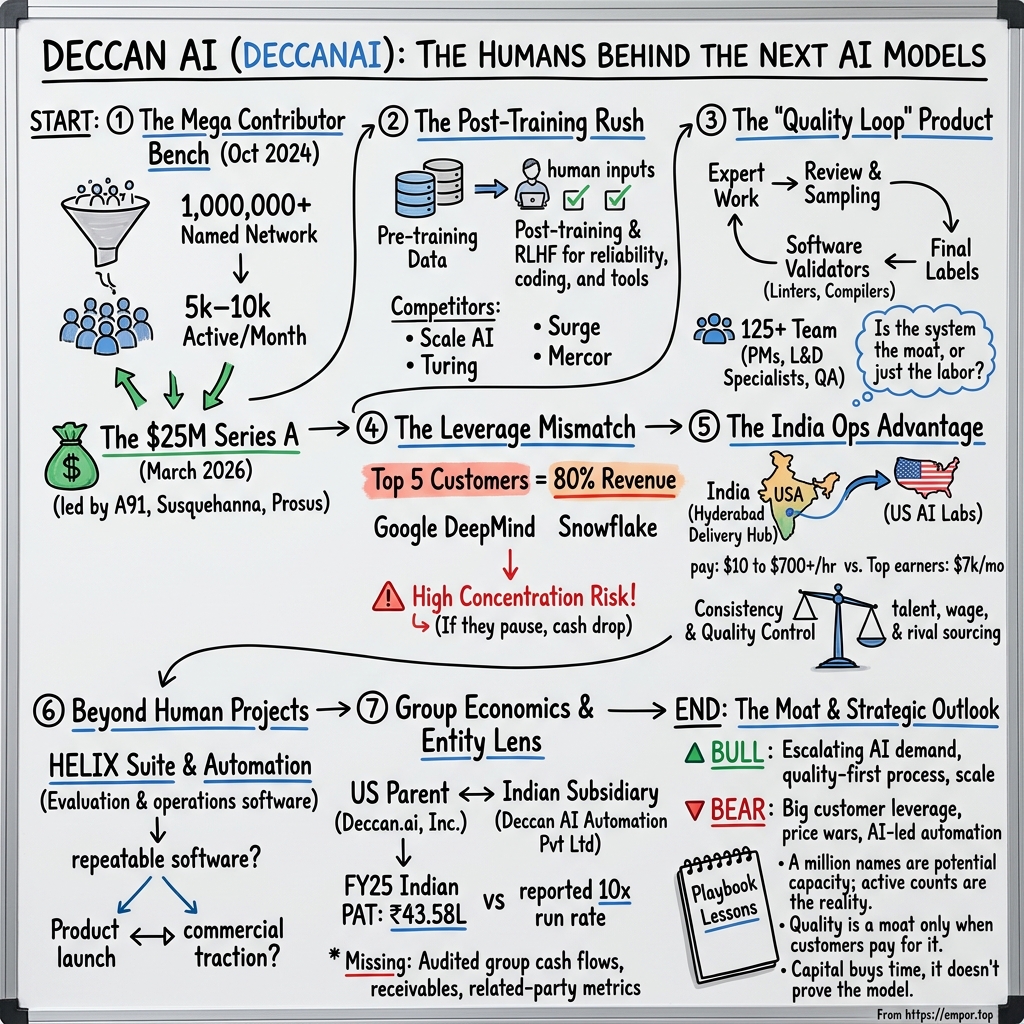
Deccan AI: The Humans Behind the Next AI Models
I. The Million-Person Bench
In late March 2026, Rukesh Reddy sat down with TechCrunch to explain a company that had existed for less than eighteen months. He described Deccan AI as a supplier of the expert human work that frontier AI labs use to sharpen their models after the big initial training run, and he offered a set of numbers that would make most founders envious.
The company had just closed a $25 million all-equity Series A. Revenue, he said, had grown roughly tenfold over the previous year and had reached a double-digit-million-dollar annual run rate. Deccan could draw on a network of more than a million contributors, from students to domain experts to PhDs.1
Then came the number that changes how the rest should be heard. In a typical month, Reddy said, somewhere between 5,000 and 10,000 of those contributors are actually working.1 That is between half a percent and one percent of the network. The bench is enormous; the team on the field is a small fraction of it.
Nothing about that ratio is scandalous. Freelance platforms always carry far more sign-ups than active workers, and a supplier of specialised AI training data needs a deep reserve so it can find, at short notice, the right person who knows semiconductor design or Telugu legal language or tax law.
But the gap between the size of the reserve and the size of the working team is the first clue that this is a business about selection, coordination and quality control, not about headcount. A million names do not make a company. What turns them into revenue is the machinery that decides which few thousand to put to work, checks what they produce and gets it past a demanding customer.
The second clue came in the same interview, and it matters more. Reddy said that Deccan's five largest customers accounted for about 80% of its revenue.1 He also said the company had onboarded about ten customers in total and was running a couple of dozen active projects at any given time.1 Put those figures side by side and the shape of the business comes into focus.
This is not a broad marketplace with thousands of buyers. It is a specialist contractor serving a handful of very large, very sophisticated clients, most of them building frontier AI systems, each of whom can move a lot of work in or out in a short time.
That leaves four questions this story has to answer. The first is what, exactly, Deccan sells: expert labour by the hour, finished datasets, evaluation services, software, or some mix of them. The second is whether its claimed quality system, the reviews and validators and specialist managers it describes, is strong enough to withstand larger and better-funded competitors.
The third is how much of the growth depends on a few buyers who could pause, renegotiate or bring the work in-house. The fourth is the least glamorous and in some ways the most important: where the economics of the group actually sit, across a private U.S. parent and an operating company in India.
That last question needs to be set out carefully, because the legal structure shapes everything that can and cannot be known. Deccan's contractor terms describe Deccan.ai, Inc. as a Delaware corporation and refer to its affiliates and subsidiaries, "including Deccan AI Automation Private Limited where applicable."2 The Indian company was incorporated in October 2024 and files statutory accounts with India's Ministry of Corporate Affairs.3
For the financial year that ended in March 2025, its first and short one, it reported total income of about ₹4.67 crore and profit after tax of about ₹43.58 lakh.34 At the exchange rates of the period, that is roughly $550,000 of income and about $50,000 of profit.
Those are real, filed numbers, but they belong to the Indian entity alone. The $25 million round, the tenfold growth and the run rate are claims about the group, made in an interview. The public record does not establish who owns the Indian company, whether its accounts are consolidated into the American parent, where the intellectual property sits or how work and cash move between the two. The reader should hold the two sets of numbers in separate hands.
The ticker DECCANAI is a placeholder, not a quote. Deccan is private. It has filed no registration statement or other document with the U.S. Securities and Exchange Commission, and it has no draft or final offer document on record with India's Securities and Exchange Board or the National Stock Exchange.567 There is no share price, no trading history, no market capitalisation and no listed multiple to analyse. Whatever value Deccan has is set in private negotiations, and the price of the Series A has not been disclosed.
So this is a story about a very young company that is growing fast in one of the most contested corners of the AI supply chain, and whose core product, unusually for an AI company, is still human judgment. Its most striking figures come from its founder rather than from audited group accounts.
That does not make them wrong. It makes them claims, and the job of a long-term investor is to ask what would have to be true for them to add up to a durable business, and what evidence would show that it is.
 Subscribe on LinkedIn
II. A Company Built for the Post-Training Rush
Deccan was founded in October 2024.1 The timing was not an accident. By then, the race to build ever-larger AI models had produced systems that could write, summarise and reason in impressive bursts, yet still made confident mistakes, wrote code that did not compile and fumbled the multi-step tasks that businesses actually wanted them to do. The frontier labs' attention was moving from making models capable to making them reliable, and that shift created demand for a particular kind of human work.
The distinction matters to understanding what Deccan sells. Training a large language model happens in two broad stages. The first, pre-training, feeds a model an enormous quantity of text and code so that it learns the statistical patterns of language and knowledge. That stage is mostly about compute and raw data. The second stage, post-training, is where the model is taught to behave: to follow instructions, to reason carefully, to use tools, to write code that runs, to refuse harmful requests and to prefer good answers over plausible ones.
Post-training leans on smaller but far more precise inputs. Experts write model answers that show the right way to solve a problem. They rank competing answers so the model can learn which is better. They build test suites, called evaluations, that measure whether a model has improved. And increasingly they build what the industry calls reinforcement-learning environments: simulated tasks, such as a software repository with a bug to fix or a business workflow to complete, in which a model can try, fail, be scored and try again.
Deccan sells all of these. TechCrunch described its work for labs as expert feedback, evaluations, building reinforcement-learning environments and training on tool use and APIs.1 The company's own website pitches post-training data across coding, multimodal and physical AI, alongside its reinforcement-learning environments and evaluation products.8
A simple analogy helps. If pre-training is a student reading every book in a library, post-training is the tutoring, the marked homework and the exams. The library is vast and cheap per page. The tutoring is expensive per hour, and its value depends entirely on whether the tutor actually knows the subject and marks accurately. Reddy put the point bluntly: in post-training, he said, the tolerance for errors is close to zero, and quality remains an unsolved problem.1
A labelled cat photograph that is slightly wrong costs little. A flawed proof or a subtly broken piece of code, fed into a frontier model as an example of excellence, teaches the model the wrong lesson at scale.
That is why the work is hard to deliver. It requires real domain expertise, not general crowd labour. It requires accuracy that can be checked. It often has to be done fast; TechCrunch reported that labs sometimes need large volumes within days.1 And the specifications change constantly, because the model being trained changes, and the research team's idea of what it needs next changes with it.
Reddy described Deccan as a "born GenAI" company, contrasting it with older data-labelling businesses that grew up drawing boxes around objects in images for computer-vision systems.1 The claim is about mindset and tooling: a company that began with code, reasoning and language tasks rather than retrofitting an image-labelling operation.
Deccan did not walk into an empty market. It is one of a group of companies competing for overlapping contracts from the same small set of buyers, and the others are much larger. Scale AI was the category's best-known name until June 2025, when Meta agreed to invest $14.3 billion in it and hired its chief executive, Alexandr Wang, to lead a new superintelligence effort.9
Surge AI, founded in 2020 and bootstrapped by its founder Edwin Chen, reportedly took in more than $1 billion of revenue in 2024, more than Scale's $870 million, and was described by Reuters as profitable when it began seeking its first outside capital in mid-2025.10
Turing, which supplies coding and reasoning work to labs including OpenAI, raised $111 million at a $2.2 billion valuation in March 2025 and said it had been profitable for about a year.11 Mercor, the company TechCrunch's headline used to introduce Deccan, raised $350 million at a $10 billion valuation in October 2025, with its lead investor saying it had crossed a $500 million revenue run rate and was profitable.12
Those figures are useful as a sense of scale, not as a league table. They are private-company numbers, mostly reported by investors or through sources, and they are not measured the same way. Mercor's chief executive, for example, has counted the amounts customers pay before contractor payouts, which makes revenue look larger than a net-of-labour measure would.13 What the figures do establish is that, at that scale, Deccan is perhaps one to three percent of the size of the category's leaders. It is a challenger, not a contender for the crown.
Its stated strategy is to be different in one specific way. Reddy told TechCrunch that many competitors "go to 100-plus countries to find the experts," whereas Deccan concentrates most of its contributors in India, with a large operations team in Hyderabad, and argued that "if you have operations in just one country, it becomes far easier to maintain quality."1
TechCrunch noted that Turing and Mercor also source contractors from India but operate across a broader set of emerging markets.1 Deccan, in other words, is betting that depth in one talent pool, managed closely, beats breadth across many.
The founder's March interview gave a snapshot of the commercial footprint at that point: about ten customers and a couple of dozen live projects.1 Deccan says its clients include Google DeepMind and Snowflake, and its funding announcement claimed it works with a majority of the so-called "Magnificent 7" technology companies, without naming them.114 That is a strong customer list for a company barely a year and a half old, and it reflects the tailwind. The labs were spending heavily on post-training, and they wanted more than one supplier, especially after the upheaval at Scale. A capable new vendor with expert supply and good references could win work quickly.
But a tailwind is not a moat. A fast-growing market can lift every vendor that can deliver, and the question for an investor is not whether demand for post-training work exists, which it plainly does, but whether any single vendor can hold its share and its price as the buyers learn, the tools improve and the competitors scale. Deccan entered at a useful moment. Whether it built something that lasts depends on the thing it says it does best.
III. The Quality Problem Becomes the Product
Deccan's own origin story does not begin with a technology breakthrough. It begins with frustration. On its About page, the company tells a three-part tale. First comes a customer's lament, "This isn't working," over inconsistent, error-prone annotations, endless spot-checks and rework, and vendors who overpromised and underdelivered. Then comes the consequence: "Poor data breaks everything," with the training pipelines that teach models to follow instructions and to prefer good answers named as the casualties. Then comes the turning point: "There has to be a better way," and the observation that "the fix wasn't more oversight."15
That is a revealing way for a company to describe itself. It is saying that the scarce thing in this market is not raw expertise, of which there is plenty, but reliable expertise: work that arrives right the first time, at volume, on deadline. If that is true, Deccan is not really selling hours of expert labour.
It is selling a production system that turns variable human input into consistent output. The difference between those two descriptions is the difference between a staffing agency and an infrastructure company, and much of the valuation question turns on which one Deccan becomes.
The company describes the system in some detail. Work is calibrated against "gold labels," pre-verified answers against which contributors' output can be scored. It uses overlaps, in which more than one contributor does the same item so disagreements surface, and random sampling of finished work for review. Projects are run by dedicated in-house project managers rather than handed to a crowd and forgotten.15
Around this process sits a set of software tools the company says it built for the purpose: "linters, code compilers, LaTeX editors, and LLM-based validators," alongside "custom-built infra to track, score, and elevate label quality."15
Those tools are worth understanding in plain terms. A linter is a program that checks code for errors and style violations before anyone runs it; a compiler turns code into a working program and fails loudly if the code is broken. Building them into the workflow means a contributor's coding answer can be checked automatically before a human reviewer ever looks at it. A LaTeX editor is the standard tool for writing mathematical notation, which matters when experts are producing worked solutions to hard maths problems.
A model-based validator uses an AI system to flag likely errors in human work, so the humans can spend their review time where it is most needed. On its homepage, Deccan describes similar machinery for its reinforcement-learning environments, including what it calls "five-step verifiers" with trace-level path checks and state verification grounded in database queries.8
None of this is exotic. These are the sensible tools any serious vendor in the category would build, and the larger competitors have their own versions. That is not a criticism; it is a calibration. The tooling is operational infrastructure that lets Deccan do the work better and faster. It is not, on present evidence, a standalone moat that a rival could not replicate, and the company does not sell it as a separate product.
The people around the tools tell a similar story. Deccan says it has an in-house team of "100+ quality associates, 15+ learning & development specialists, and dozens of project managers."15 TechCrunch put total employees at about 125 in March 2026.1 If both are roughly right, quality assurance is a major job in the building, which fits the pitch. A small in-house staff sets standards, trains contributors, reviews samples and manages customers; a much larger flexible pool does the bulk of the expert work.
Here the numbers start to need reconciling. TechCrunch reported a network of more than a million contributors, with about 10% holding advanced degrees such as master's degrees and PhDs.1 The company's own Series A post repeats the "1M+" figure.16 Yet Deccan's contact page, in its frequently asked questions, describes "a network of 300,000+ experts" who have done "over 400,000 hours of annotation work," and says that 10% of its raters hold PhDs.17 These counts may simply measure different things: everyone who has registered versus everyone who has passed a qualification test, or an older figure that was never updated.
The company does not define them or explain how one became the other. For a business whose pitch rests on knowing exactly who is doing its work, that is a small but telling gap. The meaningful number, again, is the small monthly active group.
The 400,000-hour figure is worth a moment, because it is one of the few hints at volume. If it is a cumulative count, it is modest against a double-digit-million-dollar run rate, which would imply an average of tens of dollars per hour of work billed, consistent with the lower end of the pay range Reddy described. But the company does not say when the figure was counted, what it includes or whether it is still current, so it cannot be used to build a revenue model. It is a marketing line, not a metric.
What would convert the quality claim into evidence? The answer is not mysterious, and the company could publish some of it without giving away secrets. The first measure is the share of delivered work that customers accept on first submission. The second is the rework rate, how often items come back.
The third is delivery time against the deadline the customer set. Then come repeat business, meaning how many customers who ran one project ran another, and gross margin by project, which shows whether all that review is being paid for or is eating the profit.
Deccan publishes none of these. It has published research, including benchmarks of deep-research agents and a study arguing that the choice of constraint predicts model failure better than the choice of model.8 Research of that kind shows technical seriousness, and it can win the attention of research teams. It is not the same as showing that the customer's acceptance rate is higher at Deccan than at Surge or Turing.
And that leads to the tension at the centre of the quality story. If Deccan's platform and processes are as strong as it says, the company should, over time, become less dependent on any single customer's goodwill, because the quality would speak for itself and new buyers would follow. Yet the two facts the founder disclosed in March point the other way.
That customer concentration, and the fact that payment for project work hangs on customer acceptance, point the other way. A quality system earns its keep at the moment a customer decides whether to accept the work and whether to send the next project. That moment belongs to the customer.
IV. When the Customer Can Say No
That concentration is the single most consequential fact about Deccan's economics.1 Concentration is not a defect in itself; it is the natural state of a young supplier to a market with very few buyers. There are only a handful of organisations in the world training frontier models, and they spend the most.
A post-training vendor that did not depend on them would be a vendor that was not winning the most valuable work. But concentration changes who holds the power in every negotiation, and it changes what the growth figures mean.
Start with the customers Deccan names. Google DeepMind and Snowflake appear in its own accounts of its business and in coverage of the round, and the company's website displays logos under the heading "Trusted by top frontier labs and enterprises."18 Those are serious names. DeepMind is one of the most demanding model builders in the world, and Snowflake is a large enterprise software company building AI into its data platform.
Their presence says Deccan passed some vendor qualification and delivered something those organisations were willing to pay for. What the names do not say is how large each relationship is, how long it has run, whether it is one project or many, or whether it makes money. A logo is a proof of entry, not a proof of economics.
A little arithmetic shows how concentrated the business probably is. Take a double-digit-million run rate at, say, $10 million to $20 million a year. Eighty percent of that is $8 million to $16 million spread across five customers, an average of roughly $1.6 million to $3.2 million each. The remaining handful of customers, about five of them if the total is near ten, would share only $2 million to $4 million between them. These are illustrations, not disclosures; Deccan has not said which customers are in the top five or how large each is.
But the shape is clear enough. One or two customers are almost certainly carrying a large share of the company, and the loss of either would be felt immediately. Deccan's own contact form hints at deal sizes, offering prospective clients budget bands from under $50,000 up to more than $1 million.17 A top-five customer is in the top band.
Concentration magnifies both sides of the growth story. On the way up, a few large buyers can fill the pipeline faster than any sales team could, which is likely part of how Deccan grew tenfold in a year. One frontier lab deciding to diversify its suppliers can, in a single quarter, double a small vendor's revenue. On the way down, the same mechanics run in reverse. A paused project leaves contributors idle and in-house quality staff under-used, so the cost base is suddenly too big for the revenue.
A customer that slows payment or disputes delivery can tie up cash that a young company needs to pay its contractors. And a customer that decides to build the capability itself, or to give the next project to a rival, can remove a fifth of the business with a single email.
That last scenario is not hypothetical in this industry. It has happened, repeatedly, to companies much larger than Deccan. In January 2024, Google told Appen, the Australian-listed data-annotation firm, that it was ending a global services contract as part of a strategic review. Appen said it had no prior knowledge of the decision. The contract had generated about $82.8 million of Appen's revenue in 2023, roughly a third of the total, at a gross margin of about 26%, and Appen's shares fell 37% on the morning of the announcement.18 In June 2025, after Meta agreed to invest $14.3 billion in Scale AI, OpenAI and Google halted work with Scale, which Business Insider reported had counted Google as its largest customer.
Within weeks Scale let go of 14% of its roughly 1,400 full-time staff, and contractors reported effective pay on some projects falling from about $50 an hour to about $20.19 And in April 2026, only days after Deccan's round was announced, Meta paused its contracts with Mercor indefinitely after Mercor disclosed a data breach traced to a compromised open-source tool; contractors filed lawsuits, and OpenAI said it was investigating its own exposure.20
Those three episodes involve different triggers: a customer's strategic review, a competitor's ownership change and a security failure. What they share is that in each case the buyer's decision, made for its own reasons, removed a large slice of a vendor's business almost overnight, and that the vendor's quality reputation did not prevent it.
Appen had worked with Google for years. Scale was the category leader. Mercor was valued at $10 billion. The lesson for Deccan is not that it will lose a customer, but that the history of this industry does not support the idea that good work alone keeps a concentrated customer base in place.
Deccan's own legal documents show how project acceptance turns delivery problems into economic ones. Its contractor terms state that payments to contributors are subject to "project completion; quality review; fraud and trust-and-safety verification; customer acceptance; tax documentation compliance; invoice submission requirements." They go further, reserving Deccan's right to "withhold, reverse, offset, delay, deny, or recover payments," including where "customer rejection occurs."2 Its data processing addendum, which governs its handling of customer data, describes the commercial relationship as running through agreements, order forms and statements of work.21
The customer contracts themselves are not public, so their acceptance windows and payment terms are unknown. But the contractor terms reveal the mechanism. When a customer rejects work, the rejection flows downstream, and Deccan's terms let it pass part of the cost to the contributors who did the work.
That clause is a two-edged tool. It protects Deccan's margin, because the company is not left paying for work its customer refused. It is also a statement about where the risk sits: acceptance is uncertain enough that the company needed a contractual way to absorb it. And it carries its own long-run cost. A contributor network is only as good as the experts willing to work in it, and the best experts have choices. A vendor that reverses payments too often will find its best people working for a rival.
The terms, last updated in May 2026, also cap Deccan's liability to a contributor at the greater of $100 or what it paid that person in the preceding three months, and send disputes to individual arbitration in Delaware.2 Those are common provisions for contractor platforms, but they underline that the flexible pool is held together by pay and opportunity, not by employment.
The ways a moat like Deccan's could fail are therefore visible from the inside. Customers can multi-source, splitting each project across three vendors and paying the best price. They can stop sending repeat work, quietly, without any formal termination. They can renegotiate prices as they learn what the work actually costs. They can qualify new vendors, of which there is no shortage.
Or they can do more of it internally, as labs build their own expert teams and their own automated graders. Each of these would show up first in the numbers the company does not publish: repeat-project rates, revenue per customer, price per task and the share of each customer's spending that goes to Deccan.
Deccan has customer proof points that matter. What it does not have, on the public record, is the evidence that those customers stay, spend more and pay well. Contract-level concentration, renewal rates, pricing and any customer exits are not disclosed. Until they are, the most accurate description is that Deccan's growth has been built on a few very large relationships, and that the customers hold the stronger hand in each of them.
V. The India Cost Advantage Meets the Quality Test
Deccan's headquarters sit in the San Francisco Bay Area, but its engine room is in Hyderabad. TechCrunch described a large operations team there and a contributor base concentrated in India, serving buyers who are predominantly American AI labs and enterprises.1 The company lists offices in the Bay Area, Hyderabad and Bengaluru, and said at the time of its funding that it planned a new Bengaluru office focused on enterprise operations, with a team expected to grow to 20 to 30 people over the following year.1722 Even the company's name points south: the Deccan is the plateau on which Hyderabad stands.
The labour model is simple to describe and hard to run. A relatively small in-house team, perhaps 125 people in March, coordinates a much larger flexible pool of contributors who are paid by the task or the hour.1 Reddy said earnings on the platform range from about $10 an hour to $700 an hour, with top contributors earning as much as $7,000 a month.1 That range is itself a description of the product mix. At the bottom are tasks where a capable graduate can contribute, such as writing and reviewing conversational examples or checking straightforward code.
At the top are tasks where only a rare specialist will do, the kind of semiconductor-design or geospatial expertise Reddy said Deccan had started sourcing from other markets, including the United States.1 A $7,000 month is a strong professional income in India, which is part of how Deccan can attract real experts; it is also a reminder that the best contributors are not cheap, and that the cost of the work rises sharply with its difficulty.
The cost argument is obvious. Expert labour in India costs less than the same expertise in California, and frontier labs are paying in dollars. That gap is the economic foundation of India's entire IT-services industry. But it is not a Deccan-specific advantage. Every competitor knows it, and TechCrunch noted that Turing and Mercor also source contractors from India.1 Innodata, a listed data-engineering company that also serves large American technology firms, runs much of its delivery from India, Sri Lanka and the Philippines.23 Cheap expertise is an industry input, not a moat.
Deccan's argument is subtler. Reddy's claim was that concentrating in one country makes quality "far easier to maintain."1 There is logic to it. A single country means a single time zone for training sessions, a shared professional and educational background, one set of labour and tax rules, one payments system and a recruiting machine that can be tuned to one set of universities and professional networks.
Deccan's learning-and-development specialists can build training once and use it at scale. Its quality associates can compare contributors who were trained the same way. The contractor terms reflect this focus, referring to Indian tax identification alongside American tax forms, and the company's data processing addendum lists its sub-processors, from cloud hosting to payment processing, with India as their location.221
Still, this is management's hypothesis, not a demonstrated advantage. The claim would be proven if Deccan's acceptance rates, delivery times or rework rates were measurably better than those of a multi-country rival on comparable work, and the company has published no such comparison. The counter-argument is just as logical. Surge AI, reportedly the largest firm in the category by revenue, built its business with a broad, premium, globally sourced workforce.10
Mercor and Turing chose breadth deliberately, because some of the work labs want, such as fluency in dozens of languages or knowledge of specific national legal systems, cannot be found in one country. Deccan itself advertises datasets in more than 40 languages, which suggests that even a focused model must reach beyond its home market for some tasks.8
Centralisation also carries the risks of any concentration. Dependence on one labour market exposes Deccan to that market's wages, which rise as more AI-training firms compete for the same graduates. It exposes the company to local disruption, whether a regulatory change in how platform workers are treated, a tax dispute or simply competition for project managers from India's large technology-services firms.
And it exposes the business to a reputational question that the whole industry faces: whether the experts training the world's most valuable AI systems are fairly paid and fairly treated. The payment-reversal clause is lawful and common, but it is the kind of term that becomes a story if it is used often.
Finally, there is the question of automation. Deccan describes its validators and model-based checks as a way to make each human hour more productive. If they work, the company should, over time, do more work per contributor and per in-house quality associate, and its gross margin should rise. But automation can also be a cost layer: engineers to build it, compute to run it and, if customers capture the efficiency through lower prices, no margin gain at all. The way to tell the difference is to watch headcount and contributor hours against revenue over several years, alongside project margins.
Deccan publishes none of those series. Its in-house headcount, utilisation of the contributor pool, payroll and margin trends are not disclosed. India gives Deccan access to a deep pool of talent and an operational focus that may help with consistency. Whether it gives the company a cost position or a quality level that rivals cannot match is, on public evidence, unproven.
VI. Helix and the Promise of More Than Projects
Every services business that grows quickly eventually faces the same question from investors: is there a product in here? Projects end. Products renew. A company that sells only projects has to win its revenue again every few months; a company that sells software or ongoing services can carry revenue from one year to the next. Deccan's answer, so far, has two names.
The first is Helix, which the company calls "The Enterprise Eval Suite." TechCrunch described it as an evaluation suite, and the company's announcement framed it as a hybrid of human and automated testing.114 On its website, Deccan says Helix provides continuous monitoring of AI agents, drift detection and alerts that trigger "before failures reach users," and that its subject-matter experts turn every failure pattern Helix detects into new evaluation scenarios.8
The second product is EnterpriseOS, which the company pitches as bespoke agent systems to automate back-office work and says "runs in your infra and learns from every case it handles."8 Alongside these, Deccan markets reinforcement-learning environments under the name STARK, with the tagline "Where your models learn by failing."8
The logic of these products is sound. A one-off dataset is consumed and forgotten. An evaluation suite, by contrast, is run every time a customer updates a model or changes an AI agent, which happens constantly. If Deccan becomes part of a customer's testing routine, it has a reason to be called every week, not every quarter. The human-plus-machine design also makes strategic sense. The software catches regressions automatically, and the experts write new tests where the software finds gaps, which ties Deccan's core labour pool to a recurring revenue stream.
EnterpriseOS points at a different buyer altogether: the ordinary enterprise that wants AI to process invoices or handle customer cases and needs someone to build, monitor and correct the system. The new Bengaluru office was described as focused on enterprise operations, and the company's leadership page lists senior hires with backgrounds in enterprise selling at Amazon Web Services, Intuit, Google and Amazon.2215 Kaushik Anand of A91 Partners, the Series A lead, framed the investment in exactly these terms, saying Deccan was "building the essential infrastructure for the next decade of software."14
But the distinction between launch and traction is the whole question here, and the company has given no basis for judging it. Deccan has not disclosed any product-level revenue, customer count, retention rate or margin for Helix, EnterpriseOS or STARK. It has published no audited split of revenue between project services and products. The testimonial on its homepage comes from a principal software engineer with no employer named.8 The founder's own March description of the business, about ten customers and two dozen active projects, is a description of a project business.1
What evidence would establish that the products matter? The tests are straightforward. Recurring product revenue, reported separately, would show that customers pay for the software, not just the services wrapped around it. Paid deployments and their renewal rates would show whether customers keep using it after the first contract. Software gross margins, which should be much higher than labour margins, would show up as a rising company-wide margin.
And the clearest sign would be a falling ratio of contributor hours to revenue, which would mean Deccan was earning more from what it built and less from what it staffed. Until those appear, no segment can be identified as the primary driver of revenue, profit or value, and the products are best treated as options: valuable if they work, and currently of unknown weight.
The same caution applies to the newest frontier on Deccan's map. The company's site lists physical intelligence among its dataset categories, its Series A post says it works with "some of the leading robotics companies" on evaluation pipelines, and its leadership page names a robotics lead.81615 Robotics, multimodal data and "physical AI," which means training AI systems to understand and act in the physical world, are where many investors expect the next wave of training demand.
They are natural extensions of what Deccan does: experts recording, labelling and judging how a task should be done. But the company has not named its robotics customers or disclosed any revenue from the work. A slide that mentions robotics is not a robotics business. For now, it is a reasonable place for a post-training vendor to look for its next customers, and nothing more.
There is a quieter reason to be careful. In this industry, the line between a product and a feature is thin. The largest labs have their own evaluation teams and their own testing platforms. Enterprise software giants, including some of Deccan's prospective customers, sell AI-monitoring tools. A small company's evaluation suite will be compared, every renewal, with what the customer could build or buy elsewhere.
Helix may become a reason customers stay. It may also remain what it most visibly is today: a well-designed wrapper that helps sell more expert hours. Either outcome is possible, and the difference between them will be found in numbers Deccan has not yet released. Which brings the story to the money that is supposed to pay for finding out.
VII. The $25 Million Bet—and the Missing Cap Table
On March 25, 2026, TechCrunch reported that Deccan had raised $25 million in an all-equity Series A, its first major funding round. A91 Partners led it, with Susquehanna International Group and Prosus Ventures participating.1 A press release followed two days later, and the company published its own account in April.1416 Each investor brings a different kind of signal. A91 is an Indian growth-equity fund whose earlier bets include consumer and financial-services companies such as Blue Tokai Coffee, HealthKart and Aye Finance; Indian Startup News reported that this was its first investment in an AI business.22
Susquehanna is a large trading and investment firm. Prosus Ventures, the venture arm of the Naspers-controlled internet investor, was already an investor; Deccan had announced funding from it in May 2025, without disclosing the amount.24
The capital history before the Series A is thin but instructive. Bar & Bench, reporting on the law firm that advised A91, said the deal involved "cross-border structuring complexities" and the integration of "multiple existing SAFE investors" into the capitalisation table alongside the new institutions.25 A SAFE, a simple agreement for future equity, is a common early-stage instrument in which an investor hands over cash now in exchange for shares later, usually at a discount to the next round's price or subject to a valuation cap.
So Deccan's early backers, Prosus among them on this account, appear to have funded the company through instruments that converted into equity at or around the Series A. Data aggregators list two rounds and about $25 million or more in total, which suggests the earlier money was modest relative to the March round.26 The cross-border element fits everything else: a Delaware parent raising money from international investors while running much of its work through an Indian company.
What the money is for is described in general terms. Coverage of the round said Deccan would use it to scale its tools for deploying, evaluating and improving AI systems in business settings, and the company's announcement pointed to foundation-model work, enterprise data and robotics.2214 The concrete plan visible in public was the new Bengaluru office.22
The likely uses are the obvious ones for a business of this kind: hiring engineers for the platform, building out the products, funding the working capital that grows when projects grow, and expanding delivery capacity so the company can take on larger contracts.
Deccan has published no budget, no hiring targets and no capital-allocation goals against which to measure it later. No acquisition has been announced, so there is no deal premium to test management's judgment on prices paid.
The more important point is what cannot be known about the round. Deccan has not disclosed its valuation, before or after the money. It has not disclosed how many shares exist, how much of the company the new investors own, how much the founder retains, how large the employee option pool is or how the SAFE holders converted. It has not disclosed the terms of the preferred shares that Series A investors typically receive: whether they carry a liquidation preference, meaning the right to get their money back first in a sale; whether that preference participates in further gains; what anti-dilution protection they hold if a future round is priced lower; and what board seats and veto rights came with the cheque.
Those terms are not legal trivia. They decide who gets paid what if the company is sold for less than hoped, and they decide whether the price of the Series A is a fair guide to the value of an ordinary share. A simple illustration shows how wide the uncertainty is. If A91 and its partners bought 10% of Deccan for $25 million, the round valued the company at $250 million after the investment. If they bought 25%, it valued Deccan at $100 million. Both are entirely plausible outcomes for a Series A, and the two answers are two and a half times apart.
Nobody outside the cap table knows which is closer, and so there is no basis on which to call the round cheap or expensive, or to say what return its investors need. Even if the price were known, it would be the price of a preferred security with protections that a future public shareholder would not enjoy, so it would overstate the value of a common share by some amount.
The peers offer a reference point, but it is a treacherous one. Mercor raised at $10 billion on a reported run rate above $500 million, about twenty times.12 Turing was valued at $2.2 billion when its annualised revenue was $167 million, about thirteen times, though that revenue soon reached about $300 million.11 Surge was reported to be seeking a valuation above $15 billion on 2024 revenue above $1 billion, which is fifteen times or less.10 Meta's deal valued Scale at $29 billion, roughly thirty-three times its 2024 revenue, but that was a strategic purchase with a hiring attached, and later secondary-market marks were far lower.19
Those multiples belong to profitable leaders, some of them counting revenue before contractor payouts, at the top of an investment frenzy. Applying them to a company with a tenth to a hundredth of their scale and an undisclosed margin would not be valuation. It would be borrowing someone else's story.
The person at the centre of the round deserves a closer look too. Rukesh Reddy is the founder and the source of nearly every number in this story. His company biography describes more than fifteen years across Citi, the consulting firm Monitor and JPMorgan, with degrees from IIT Bombay and IIM Ahmedabad.15 That is a finance-and-strategy career rather than a machine-learning one, which may explain why the company leads with process and quality rather than with research breakthroughs.
Around him, the leadership page lists people with deeper technical and operating backgrounds: a platforms lead from HackerRank, an applied-AI lead who co-founded and served as chief technology officer of Zapr, which was acquired by Samsung, and revenue leaders from AWS, Intuit, Google and Amazon.15
What the public record does not provide is a history of Reddy's prior ventures or a track record of guidance compared with results. Deccan is too young for that. The tenfold growth claim is the first public promise, and it has not yet been tested against audited group figures.
An investor considering the business today cannot evaluate the founder's shareholding, the incentive structure, the option pool, board composition or the rights attached to each class of share. These are the first things a future offer document would have to disclose. The next proof point is concrete: audited group statements and a disclosed ownership structure would show where the money went and where the value sits. Until then, the only audited window into Deccan is a small one, and it opens onto the Indian company.
VIII. The Indian Subsidiary’s Small Window into a Bigger Group
Deccan AI Automation Private Limited, the Indian operating company, appointed its two directors on October 21, 2024.43 Indian private companies must file audited annual accounts with the Ministry of Corporate Affairs.
For the year to March 31, 2025, the Indian company reported total income of about ₹4.67 crore and profit after tax of about ₹43.58 lakh.34 Inc42's company profile puts FY25 revenue at about ₹4.7 crore and identifies this entity as the Indian legal vehicle.26
Those numbers need context before they mean anything. The financial year covered only about five and a half months of the Indian company's life, from its October incorporation to the end of March. Annualised crudely, ₹4.67 crore over five and a half months is a pace of roughly ₹10 crore a year, a little over $1 million at the exchange rates of the time. Profit after tax was about 9% of total income. That was a small company earning a thin, positive margin in its first months of operation.
Now set that pace against the founder's claim. In March 2026, Reddy said the group had grown about tenfold over the previous year and reached a double-digit-million-dollar run rate.1 A year earlier would be roughly the spring of 2025, when the Indian company's pace had been about $1 million a year. Ten times that is about $10 million or more, which is, in fact, a double-digit-million run rate.
The arithmetic is tantalisingly consistent. It is also not evidence. The Indian company's income may not be the group's revenue at all, and the founder's figures were never tied to a specific entity or accounting basis.
The reason is the structure. In a typical arrangement for a U.S.-headquartered start-up with an Indian operating team, the American parent signs the contracts with customers, bills them in dollars and pays the Indian subsidiary a service fee for the work done there, usually calculated as the subsidiary's costs plus a markup that Indian tax authorities will accept as being at arm's length.
Under that arrangement, the Indian company's income is mostly an intercompany charge, not customer revenue, and its profit is a markup, not a measure of the group's real margin. A profit of about 9% of income is the kind of figure such an arrangement would produce.
But Deccan has not disclosed that this is how it works, and the Indian company's revenue could equally include contracts signed directly with customers. The public materials do not establish who owns the Indian company, whether its results are consolidated into the American parent's accounts, where the intellectual property sits or how intercompany work is priced.
The group's legal terms name both entities, the American parent and its Indian affiliate, but say nothing more about the relationship.2 That is why the Indian numbers cannot verify the group's growth story in either direction. They are consistent with it; they cannot confirm it.
The bigger missing piece is cash. A profit figure is an accounting opinion; cash is a fact. For a project business serving large customers, the gap between the two lives in working capital. Deccan pays its contributors when work passes review, often weekly or monthly. It bills customers when they accept the work, and then waits for them to pay, which large companies can stretch for two or three months.
In between, the company finances the gap. The faster it grows, the larger the gap becomes, so a fast-growing project business can report rising profits while its bank balance shrinks. Without an operating cash-flow figure and an ageing schedule for receivables, showing how much customers owe and for how long, reported profit cannot establish whether the business converts its earnings into cash.
Innodata, the listed data-engineering company, shows what that risk looks like at scale. Its largest customer, a single American technology company, accounted for about 58% of its 2025 revenue, up from 48% a year earlier, and at year-end 63% of everything it was owed, about $29 million, was due from that one customer.23 Innodata discloses those facts because it must. Given Deccan's disclosed customer concentration, it almost certainly carries a similarly concentrated receivables book, but it has published nothing about it.
A set of disclosures matters most to the story, and none of them is in the public profile. They are the related-party balances and charges between the American and Indian companies, including any service fees, loans or guarantees; accrued revenue for work done but not yet billed; customer receivables and their ageing; cash and investment balances, and where they are held; lease obligations for the Hyderabad and Bengaluru offices; and contingent liabilities such as tax disputes.
Public company profiles show no registered charges against the Indian company, which means no lender has registered security over its assets.3 That is a useful sign that the subsidiary has not borrowed against its assets, but it does not prove the absence of other borrowings or lease commitments, and it says nothing about the parent. No credit rating has been issued for either company, so there is no independent view of financial strength.
None of these gaps implies distress or misconduct. They are what private, early-stage companies normally keep private, and the Indian company has filed what the law requires. But they mean that liquidity, working-capital needs and related-party economics cannot be assessed from outside. What would settle them is equally clear. The first item would be the Indian company's full statutory filings for FY25 and FY26, including the cash-flow statement and the notes on receivables and related parties, which should show how much of the subsidiary's income came from its parent.
The second, and more important, would be audited consolidated accounts for the group, with entity-level schedules showing where revenue is booked, where costs are incurred and where profit is left. A company that one day asks public investors for money will have to produce exactly those documents. Until then, the Indian accounts are a keyhole: real, verified and far too narrow to see the whole room.
IX. The Moat Has to Survive the Next Model Cycle
Reddy's claim that "quality remains an unsolved problem" is, in one sense, the most important sentence in Deccan's story.1 If it stays true, the company has a lasting reason to exist. If AI labs solve it, by building models good enough to check other models, or by assembling their own expert teams with better tools, then the demand for Deccan's particular service shrinks or changes shape. The moat, if there is one, has to survive not just competitors but the technology the company is helping to build.
The forces acting on Deccan's economics are easiest to see one at a time. The buyers are few, large, technically sophisticated and able to compare vendors closely, which gives them strong bargaining power; customer concentration compounds it.1 The rivals are numerous, well-funded and in some cases much larger. Surge, Mercor, Turing and Scale compete for the same contracts, and new entrants keep arriving because the barriers to starting a contributor network are low. The suppliers, in this case the experts who do the work, are not individually powerful, but the best of them are scarce and mobile, and their pay rises when competition for them intensifies.
Substitutes are the most uncertain force of all. Customers can build in-house teams, and the models themselves are becoming capable of generating and grading some of the training data that humans used to produce. Put together, the picture is one of an attractive market with structurally weak pricing power for any individual vendor. That does not mean vendors cannot earn good returns, and Surge, Turing and Mercor were all described as profitable.101112 It means those returns depend on something specific to the vendor, not on the market alone.
The strategist Hamilton Helmer's framework of seven sources of durable advantage is a useful way to ask what that something could be. Scale economies, where unit costs fall as volume rises, are possible but unproven for Deccan; its fixed platform and quality costs would spread over more work as it grows, but it is far smaller than its rivals, so any scale advantage today lies with them. Network effects, where each new user makes the product more valuable for others, are weak in this market; more contributors do not make the service better for customers unless they are the right contributors.
Switching costs are low for project work; a lab can move its next project to another vendor without much pain, though an evaluation suite embedded in a customer's daily testing could, in time, change that. Counter-positioning, a business model incumbents cannot copy without harming themselves, does not obviously apply, because single-country sourcing is something a rival could imitate if it worked. Deccan has no proprietary resource that others cannot obtain, no brand that commands a premium price and no evidence of the patented or exclusive know-how that would amount to a cornered resource.
That leaves process power, the advantage that comes from an organisation's accumulated ways of working, which are hard to copy because they are embedded in people and routines rather than written down. This is the advantage Deccan's pitch most closely describes: its gold-label calibration, overlapping review, specialist project managers, tooling and training. If those processes deliver measurably better work, faster, and if they improve with every project, Deccan could build something rivals cannot easily match.
Process power is real and durable in some industries. Toyota's production system is the classic example. But it is visible only in outcomes, and Deccan publishes no outcome measures. The moat is plausible and unproven.
Recent episodes at Scale, Appen and Mercor show the limits of process advantages when buyer priorities shift.19182012 In each case, the buyer's priorities, whether neutrality, cost or security, outweighed the vendor's accumulated competence. These are cases from the same business, the same customer type and the recent past, and they narrow Deccan's claim considerably. Quality may win the first project. It has not, historically, been enough to protect the relationship from decisions the vendor does not control.
Security belongs in that list for a specific reason. The labs' training data is among their most valuable secrets, and a vendor that holds it is a target. Deccan says it does not use customer data, lets customers keep raw data in their own cloud storage and holds ISO 27001 and SOC 2 certifications.17 Its data processing addendum commits to notifying customers of a breach within 48 hours and to not using customer personal data for model training or benchmarking.21 Those are the right commitments.
The same published addendum, however, includes a sub-processor list annotated as one that "should be completed before publication or customer execution," and a security annex that refers in one item to another company's controls and data protection officer, apparently left over from a template.21 Neither implies a security weakness. Both are small signs that a fast-growing company's documentation has not kept pace with its sales, and in a market where Mercor's breach showed how quickly a customer can pause, sophisticated buyers notice such things.
It is worth separating the market's growth from the company's advantage, because they are easily confused. The post-training market has expanded enormously; the revenue of the leaders alone runs into the billions.1012 That growth has lifted many vendors, including Deccan. But a rising tide is not a moat. If the market keeps growing, Deccan can grow with it even without any special advantage. If it slows, or if the labs consolidate their spending with fewer suppliers, the vendors without a real edge will be the first to feel it.
The next model cycle is the real test. Each new generation of models changes what post-training work is needed. Tasks that needed human experts a year ago may now be done by an AI grader, with humans checking the grader. That could hurt a labour-based vendor, or it could help a vendor whose tools and processes already combine humans and models, as Deccan says its own do. Deccan's evaluation and environment products are its bet on the second outcome.
The confirmation tests are measurable: retention of customers across model generations, the share of each customer's post-training budget that Deccan wins, acceptance and rework rates, the price per unit of work over time and, above all, how the business performs through its first serious customer pause or model transition. A quality system that keeps its customers through a cycle that destroys someone else's has proven itself. One that has never been tested has not.
X. Analysis & Bear vs. Bull Case
The same handful of facts can be read in two quite different ways. On one reading, Deccan is a fast-rising challenger with marquee customers, a sharp quality pitch and fresh capital, moving into the most valuable part of the AI supply chain at exactly the right time. On the other, it is a young project-services firm whose revenue depends on five customers who hold all the leverage, whose financial results are almost entirely unverified and whose most valuable products are still promises. Both readings use the same evidence. The question is which one the evidence better supports today, and what would change the answer.
The bull case starts with demand. Every frontier lab is now spending heavily on post-training, and the move toward AI agents, systems that take actions over many steps rather than answering a single question, increases the need for expert demonstrations, carefully designed test environments and evaluations that catch failure before it reaches users.
If that demand keeps compounding, the market for what Deccan sells will keep growing for years. The company says it grew tenfold over the previous year and names DeepMind and Snowflake among its customers; it also raised from a respected growth fund.1
Its focus on India gives it access to a large pool of technically trained people at costs well below American rates. Its quality system, if it works as described, could win more projects within each customer, and its evaluation and enterprise products could turn project relationships into recurring ones. On this reading, the concentration is a phase: early-stage suppliers to a concentrated market always start concentrated, and the money from the Series A will fund the diversification.
Innodata shows that a data-engineering supplier serving the same type of customer can earn real margins. In 2025 it grew revenue by about 48% to $251.7 million, with gross margin of about 40% and adjusted EBITDA of about $57.9 million.23
The bear case starts with the same customer concentration and buyer leverage, illustrated by the exits and pauses at Appen, Scale and Mercor.1181920 Payment for work depends on customer acceptance, which means that delivery problems quickly become cash problems.2 The cost advantage of Indian talent is available to every competitor, and the largest of them have more money, more customers and more data.
The products that might make revenue recurring have no disclosed revenue. And as models improve, the labs may need less human work per unit of training, or may need a different kind that favours whoever has the best automated graders rather than the largest bench of people. On this reading, Deccan is a capable contractor in a boom market, and its economics will look much less impressive the first time a top customer steps back.
Management's record remains too short to judge against outcomes. Its documents also show small inconsistencies in contributor counts, office addresses and legal templates, which is common in fast-growing private firms but the kind of thing a public company cannot afford.117221 None of this counts against management; it means the management case rests on credentials and early execution rather than on a performance record.
An outside investor can still frame what Deccan might be worth, if not what it is worth today. Imagine three paths over the next five years. On a stall path, the company holds its customers but cannot diversify, revenue settles in the tens of millions, and margins look like those of a labour-based services firm. Appen's lost Google contract, for example, carried a gross margin of about 26%.18 In that world, Deccan is a modest, cyclical business worth a modest multiple of its earnings.
On a services path, Deccan grows into a focused, well-run data-engineering firm, perhaps reaching revenue of $100 million with Innodata-like economics. Applying Innodata's 2025 ratios, that would mean roughly $40 million of gross profit and perhaps $20 million of adjusted EBITDA, a solid business that public markets would value like an IT-services company. On a platform path, the evaluation and enterprise products become a large share of revenue, gross margins rise toward software levels, concentration falls and the company commands a premium as AI infrastructure.
The value of the company differs by an order of magnitude between those paths, and the evidence available today does not allow anyone to assign meaningful probabilities to them. It does allow one judgment: the platform path requires disclosed product traction that does not yet exist.
For the same reason, conventional valuation tools do not apply. There is no share price, no market capitalisation and no disclosed round valuation, so no multiple can be calculated. Enterprise value cannot be bridged, because the group's cash, debt and lease obligations are not public. Peer multiples would compare the price of a profitable category leader's preferred shares, often measured on gross revenue, with a company whose revenue basis, margin and capital structure are unknown. Any number derived that way would look precise and mean nothing.
Three measures would change the view most. The first is the share of revenue from the top five customers, and whether those customers stay; a fall from 80% while total revenue keeps growing would be the clearest sign of a real business. The second is project gross margin and the share of revenue that comes from repeat work, which would show whether the quality system earns a premium or is simply a cost. The third is cash conversion: operating cash flow against reported profit, and the ageing of receivables, which would show whether growth is being paid for by customers or by the investors' money.
On the evidence available today, the bull case has a credible demand backdrop and an operating thesis worth testing, while the bear case is better supported on durability and financial visibility. That balance is not a verdict on the company's future; it reflects what can be shown today. A skeptical investor would ask one question above all: what published evidence shows that the quality system, not merely the labour pool or a hot market, is what keeps customers coming back at attractive economics? Deccan has not yet answered it.
XI. Playbook: Business & Investing Lessons
Deccan's story is short, but it already carries lessons that reach beyond one company, about building a business inside a technology supply chain that changes faster than any contract can.
Start with the million-name network and the few thousand people who actually work in a given month. Every platform business wants to advertise the size of its supply, because a large number reassures customers and investors that capacity will never run out. But the number that pays the bills is not how many people signed up.
It is how many came back, did good work and were paid for it. Deccan's figures illustrate how wide the gap can be between its reported network and the people who work in a given month.
For founders, the lesson is to measure and publish the active number, because that is the one customers will eventually ask for. For investors, it is to discount the bench and count the players. A million names on the bench are potential capacity; the hard number is how many come back to work.
The second lesson comes from the quality system. Deccan built its identity on the frustration of customers buried in error-prone data, and it has built machinery to address that problem. Yet a quality advantage that a customer cannot measure is an advantage the customer will not pay extra for, and one that a cheaper rival can claim just as loudly.
The vendors that have built durable positions in other industries made their quality legible, through acceptance rates, defect counts and audited performance, so the buyer could see what it was getting. Quality becomes a moat only when customers can measure it, and keep paying for it.
The third lesson is about concentration, and it is the one Deccan's history so far most clearly teaches. A small company selling into a market with a few giant buyers will grow fastest by winning those buyers. That is exactly what Deccan appears to have done, and it is a real achievement. But each new dollar from a large customer also increases that customer's share of the business, and with it the customer's power over price, terms and the company's fate. Appen, Scale and Mercor learned, in different ways, how quickly that power can be used. Fast growth can make a young company bigger before it makes the company less dependent.
The last lesson is about the $25 million. A Series A is a vote of confidence, and the round drew serious investors. But its price and terms remain private, and the business it funds has yet to show audited group results. A fundraising headline tells you that someone believed in the story enough to pay for it.
It does not tell you that the story is true, or what it is worth. That is something only the business, over time, can establish. Capital buys time to prove the model; it does not prove the model.
XII. Epilogue
Tonight, in mid-November 2026, Deccan is roughly two years old, and its scale and cross-border structure remain only partly visible in public records.11722
Its named products still have no disclosed revenue,8 while the founder said in March that five customers accounted for four-fifths of group revenue.1 It has not filed for a public listing anywhere. Whatever investors eventually conclude about the company, they will conclude it from documents that do not yet exist.
The next decisive moments are mostly scheduled by accountants rather than by markets. The Indian company's accounts for the year to March 2026 were due at the registry this autumn. They cover the first full year of operations and should include a cash-flow statement, receivables, related-party transactions with the American parent and the auditor's view. Those figures would not settle the group's economics, but they would show whether the Indian operation is a cost centre paid a markup by its parent or a business with its own customers, and whether profit there turns into cash.
Further out, any future funding round will have to put a price on the company. If that price or its terms become public, investors will at last see what the March round was worth and whether the next one was priced higher, flat or lower, and with what protections. And at some point, if Deccan ever pursues the public market, a prospectus will have to disclose everything that is private today: the consolidated accounts, the cap table, the preferences, the customer concentration and the risk factors.
What those documents show will decide which story Deccan is. If group revenue keeps growing while the share from the top five customers falls and repeat work rises, the business case strengthens decisively; that would be the first evidence that quality, rather than a single lab's spending spree, is driving the company. If growth instead depends on a few large projects while receivables climb or rework rises, then the double-digit-million run rate of March 2026 will turn out to have overstated the underlying strength of the business, and the company will look more like a talented contractor riding a wave. If Helix or EnterpriseOS begin to show recurring revenue of their own, they will deserve to be judged as businesses rather than as options, and the company's valuation logic would change with them.
The Indian accounts remain only a narrow window onto the unaudited group, and good news from Hyderabad cannot by itself prove what is happening in the Delaware parent's contracts with the world's biggest AI labs.
The tension that remains is simple to state. Deccan has grown fast by serving a few buyers who need what it does today. Whether they need it tomorrow, and whether they will need Deccan rather than a rival or their own tools, is the question every new disclosure will help answer.
XIII. Outro
Go back to the image Reddy offered in March: a network of more than a million people, with between five and ten thousand working in any given month.1 It captures Deccan's challenge: turning a vast pool of expertise into reliable work for a handful of powerful customers.
That is Deccan's bet: that it can make expert judgment reliable enough to become a lasting layer of the AI stack.
It may remain a well-run pool of skilled labour, valuable while the boom lasts and replaceable when it turns. When the next model cycle arrives, the test will be whether Deccan's customers come back for its system, or simply for the next batch of workers.
References
-
Mercor competitor Deccan AI raises $25M, sources experts from India — TechCrunch, 2026-03-25 ↩↩↩↩↩↩↩↩↩↩↩↩↩↩↩↩↩↩↩↩↩↩↩↩↩↩↩↩↩↩↩↩↩↩↩
-
Deccan AI Automation Private Limited — Company Profile — The Company Check ↩↩↩↩↩
-
Deccan AI Automation — Financials & Director Contacts — SensiBook ↩↩↩
-
EDGAR Full Text Search — U.S. Securities and Exchange Commission ↩
-
Meta invests $14.3B in AI firm Scale and recruits its CEO for "superintelligence" team — AP News, 2025-06-13 ↩
-
Exclusive: Scale AI's bigger rival Surge AI seeks up to $1 billion capital raise, sources say — Reuters via The Star, 2025-07-01 ↩↩↩↩↩
-
Turing, a key coding provider for OpenAI and other LLM producers, raises $111M at a $2.2B valuation — TechCrunch, 2025-03-06 ↩↩↩
-
AI domain expert provider Mercor lands $350M funding round — Staffing Industry Analysts, 2025-11-03 ↩↩↩↩↩
-
Sources: AI training startup Mercor eyes $10B+ valuation on $450M run rate — TechCrunch, 2025-09-09 ↩
-
Deccan AI Raises $25 Million to Build "Super Accurate AI" — PR Newswire, 2026-03-27 ↩↩↩↩↩
-
$25M in Series A: Building Superaccurate AI — Deccan AI, 2026-04-14 ↩↩↩
-
Appen shares crash 37% on huge Google blow — The Motley Fool Australia, 2024-01-22 ↩↩↩↩
-
Pay cuts, poaching, pivoting: Inside the fallout from Mark Zuckerberg's chaotic $14 billion AI deal — Business Insider via AOL, 2025-12-10 ↩↩↩↩
-
After data breach, $10B-valued startup Mercor is having a month — TechCrunch, 2026-04-09 ↩↩↩
-
Data Processing Addendum — Deccan.ai, Inc., 2026-05-18 ↩↩↩↩↩
-
Indian AI startup Deccan AI raises $25 million to scale enterprise AI platforms — Indian Startup News, 2026-03-26 ↩↩↩↩↩↩
-
Innodata Inc. Annual Report on Form 10-K for fiscal year 2025 — U.S. Securities and Exchange Commission, 2026-02-26 ↩↩↩
-
Deccan AI Announces Funding From Prosus Ventures to Accelerate Growth — Business Wire, 2025-05-27 ↩
-
JSA acts on Deccan AI $25 million Series A fundraise — Bar & Bench, 2026-04-09 ↩
 LinkedIn
 WhatsApp
 Reddit
 Hacker News
 Email
 Kindle
 RSS Feed
 Spotify
 Apple Podcasts
 Amazon Music
 Audible
 YouTube