DCX Systems: The Offset Merchant's Squeeze
I. Prologue: The Defence Boom and the Treasury Mirage
In November 2022, a Bengaluru company most Indian investors had never heard of rang its way onto the National Stock Exchange. DCX Systems Limited sold new shares at ₹207 apiece to raise ₹400 crore, while its two biggest owners sold another ₹100 crore of their own stock into the same offer.1 The timing was perfect. "Make in India" had moved from slogan to procurement policy, defence budgets were rising, and Indian fund managers were paying almost any price for a defence electronics name. DCX looked like the purest version of that trade: a private company that assembled radar and electronic-warfare hardware for one of the world's most respected defence exporters, Israel Aerospace Industries.
Fourteen months later it went back for more. In January 2024, DCX placed about 14.7 million new shares with institutions at ₹341 each in a ₹500 crore Qualified Institutions Placement.2 Two raises in under fifteen months brought in ₹900 crore of fresh equity. The listing had come at the peak of the defence rally, and so had the follow-on.
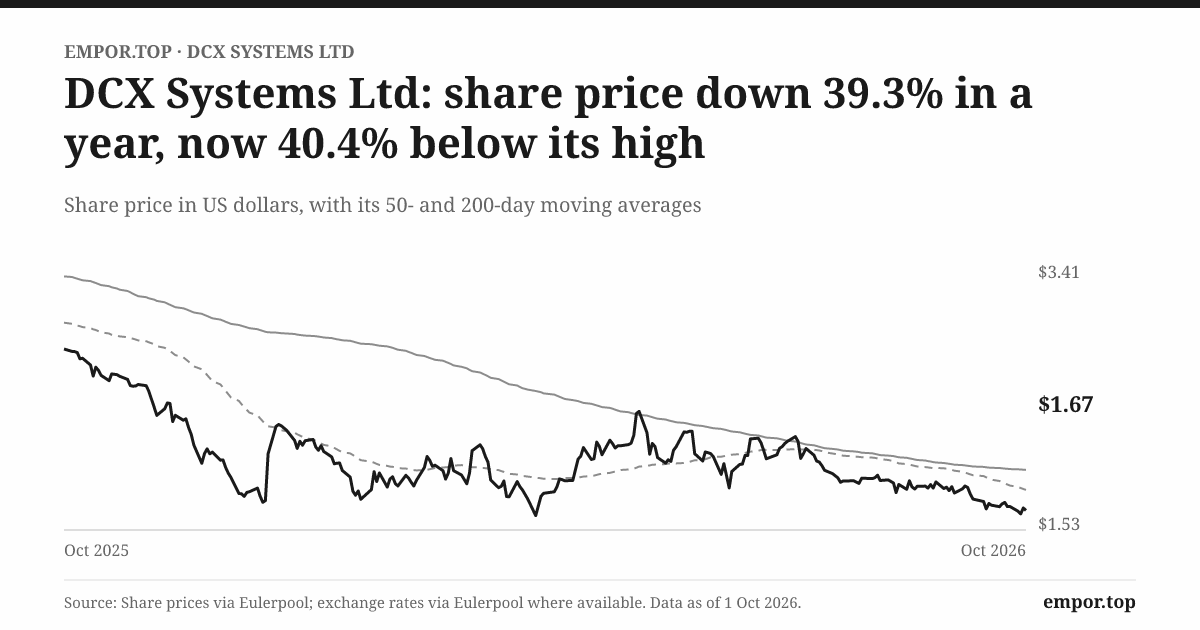
Now look at the same company on October 1, 2026. The fiscal year to March 2026 closed with an operating loss of about ₹36 crore before other income.3 What kept the bottom line close to breakeven was about ₹45 crore of interest on bank fixed deposits, almost all of it earned on cash raised from public shareholders.3 Cash and bank balances stood at roughly ₹765 crore.3 The shares traded at about ₹160, near their 52-week low and about 35% below their 52-week high, giving the company a market value of about ₹1,787 crore.4 Strip out the cash and the market values the operating business at roughly ₹1,022 crore.
That leads to the question this story is built around. Can DCX earn an operating profit without its treasury subsidy, or has it become a bank-deposit trust with a defence factory attached?
The short answer, which the rest of this piece earns, is uncomfortable. DCX read the market brilliantly. It raised a fortress of equity at peak multiples, and that equity is the only reason a revenue collapse of more than 50% from the FY24 peak has not become a solvency crisis. Underneath the fortress, though, the assembly business has slipped into losses. In the June 2026 quarter, revenue fell about 54% from a year earlier to ₹103 crore, and the operating margin was close to minus 14%.5
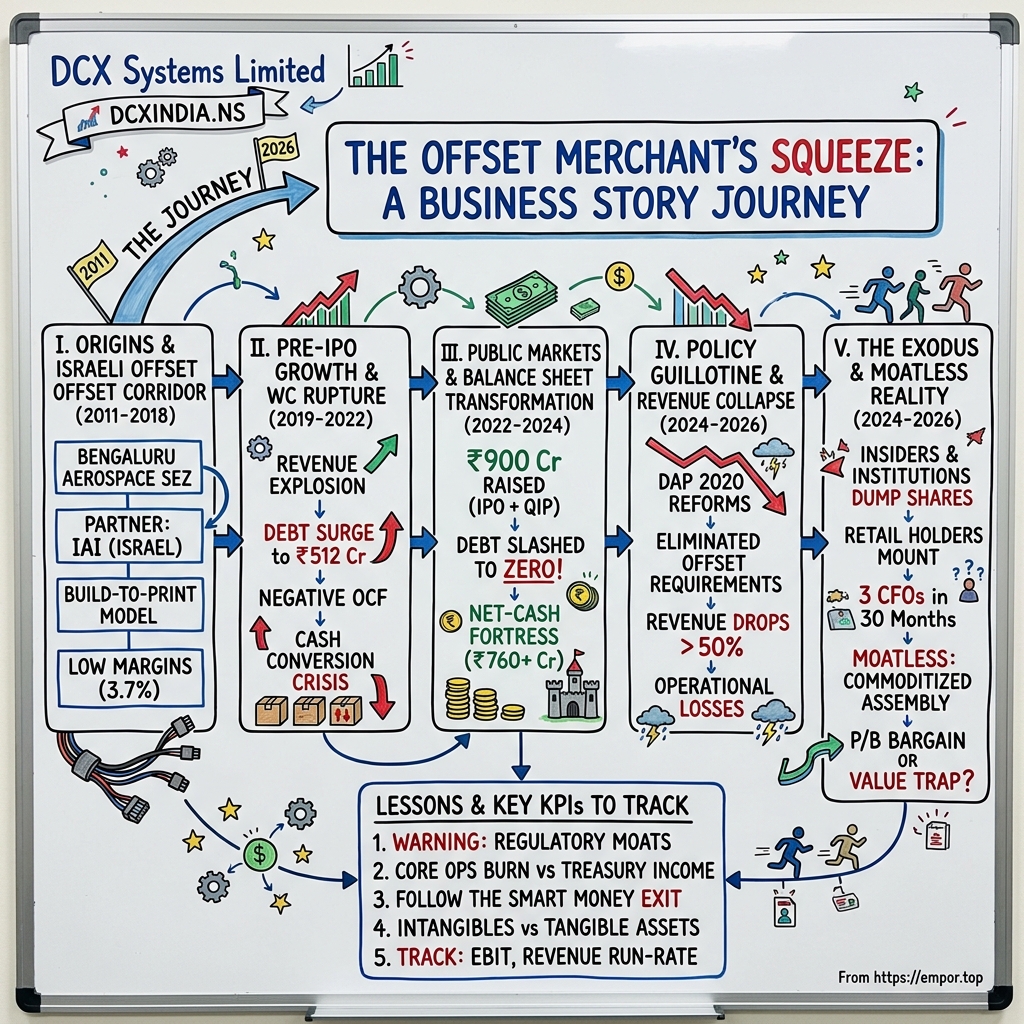
Here is the route the story takes. A cable-harness assembler founded in 2011 grew to about ₹1,424 crore of revenue by FY24, almost entirely by doing offset work for Israeli defence companies selling into India.3 It raised ₹900 crore from public markets. Then its revenue more than halved as offset demand dried up and its anchor customer delayed shipments.
The thesis comes from the way markets price this kind of business. Investors often treat defence electronics as a high-margin, sticky, intellectual-property business. Build-to-print offset manufacturing is something else: a low-margin, working-capital-heavy subcontracting trade in which the prime contractor holds the pricing power. A change in policy can shut off the revenue overnight.
That leaves a mystery. At listing, institutions held about a fifth of the company: domestic institutions about 15% and foreign portfolio investors about 4%.6 By June 2026, domestic institutions held about 2.7% and foreign investors about 1.7%, about 4.4% combined, even though management was pointing to a record order book of ₹3,269 crore.75 Meanwhile the number of public shareholders went from 37,329 to 160,723.67 Someone sold and someone bought. Working out why is most of the story.
To understand how a company could have a record order book and shrinking revenue at the same time, the story has to start where DCX did: in the peculiar market created by India's defence offset rules.
 Subscribe on LinkedIn
II. Origins in the Offset Corridor: Dr. Rao and the Israeli Connection (2011–2018)
Picture Bengaluru in 2011. India was in the middle of one of the largest defence import cycles in its history, and every big foreign contract carried a condition that most of the public never noticed. Under the Defence Procurement Procedure, a foreign vendor that won a large Ministry of Defence contract had to spend a share of the contract value, usually 30% or more, back in India. That obligation is called an "offset."2 For an Israeli radar maker selling into the Barak-8 and air-defence programmes, the offset was a liability on its books. It could only be discharged by buying from approved Indian partners.
DCX was incorporated in Bengaluru that year to be one of those partners.3 Dr. H.S. Raghavendra Rao ran the company and its factory floor. Abroad, the venture had US-based co-promoter NCBG Holdings Inc, associated with Neal Jeremy Castleman, and a related trading entity, DCX Chol Enterprises Inc.3 At listing, the two sides owned matching blocks: VNG Technology, Rao's Indian holding vehicle, held about 33%, and NCBG held about 33%.6 One side was the Bengaluru operator who ran the factory. The other was the international partner who brought the procurement network.
What an offset partner actually does
The model is easiest to understand as a tailor working to someone else's pattern. Under "build-to-print," the foreign original equipment manufacturer (the OEM) sends drawings, specifies the approved components, and inspects the finished work. DCX imported mil-spec connectors, wires and sub-components from approved foreign suppliers, assembled cable harnesses and electronic sub-assemblies to the OEM's blueprints, and shipped the results back, either as direct exports or as "deemed exports" that counted toward the OEM's offset credits.2 The cheapest component in a radar is often its wiring. In an offset regime, though, where that wiring is assembled can be worth a great deal.
What DCX was paid for was mostly compliance. An Israeli prime that bought ₹100 of harnesses from Bengaluru was buying the harnesses and, more importantly, buying down its offset liability to the Indian government. That makes DCX's customer relationship very different from a normal supplier relationship, and Section V shows why.
The concentration by design
By FY21, the year before the IPO filing, a single customer group, Israel Aerospace Industries together with its radar subsidiary ELTA Systems, accounted for about 94% of DCX's revenue.2 Offset contracts made up about 94% of total sales.2 The top three customers accounted for about 99%.2 It is hard to find a more concentrated customer base anywhere in Indian listed manufacturing.
That was no accident and no failure of the sales team. It was the business model. DCX was not set up to commercialise Indian defence technology. It was built as a captive execution partner whose job was to absorb foreign OEMs' offset liabilities.
The economics of the early years show what that meant. In FY18 DCX booked about ₹95 crore of revenue at an operating margin of 3.7%.3 The company carried no proprietary technology. Contracts were fixed-price purchase orders with delivery cycles of three to twelve months.2 Most raw material was imported. Even in FY26, after a decade of "indigenisation," imports still made up about 81% of material purchases.3
Myth vs reality
Myth: DCX was an Indian defence technology company that happened to work with Israeli partners. Reality: DCX was a high-trust contract assembler whose order flow depended on the Israeli partners' regulatory obligations. Its value came from its approvals, its relationships and its working capital, not from engineering it owned.
None of this made DCX a bad business in its early years. Contract assemblers can earn good returns on small equity, and DCX's return on equity ran above 55% between FY18 and FY22, because it had very little equity to begin with.3 What the model could not do was set its own prices, choose its own customers or set its own timeline. The next phase showed what happens when a business like that grows faster than its balance sheet.
III. The Pre-IPO Growth Spurt and Working Capital Rupture (2019–2022)
March 2022 was the end of DCX's last fiscal year as a private company, and the draft prospectus was nearly ready. On the income statement, the year looked spectacular. Revenue had risen about 72% to roughly ₹1,102 crore ($147m).3 Net profit had doubled to about ₹66 crore.3 For a company that had reported less than ₹100 crore of revenue four years earlier, it looked like a defence growth story worth listing.
The cash flow statement told a different story. Cash from operations was negative ₹134 crore in FY22.3 Borrowings had climbed to about ₹512 crore, roughly 4.3 times shareholders' equity.3 And the next year, FY23, which was the IPO year, was worse. Operating cash flow fell to about negative ₹602 crore even as reported profit held at about ₹73 crore.3 Free cash flow was close to negative $75m.3
The three engines and their weight
DCX described three lines of business. System integration meant assembling and integrating radar and electronic-warfare systems and sub-systems. Cable and wire harness assemblies were the original craft. Kitting meant procuring and packaging mil-spec hardware for a prime contractor.2 System integration drove most of the volume, but it was also the heaviest line in cash terms. A radar sub-system has to be built, tested and inspected before the customer accepts it, and every component in it is paid for long before it is billed.
Why profit did not become cash
A comparison helps. Imagine a builder paid only when the buyer's inspector signs off on each floor, who must still pay for the steel and concrete months earlier. Defence subcontracting works much the same way. DCX's receivables rose from about 9 days of revenue in FY21 to 93 days in FY23 and peaked at 171 days in FY24.3 At the FY24 peak, trade receivables reached about ₹1,253 crore, close to a full year of revenue sitting uncollected on the balance sheet.3 Every new rupee of offset revenue needed more than a rupee of working capital to deliver.
The banks provided it, through packing credit and other short-term facilities. Borrowings peaked at about ₹522 crore in FY23.3 If shipments had slipped while that debt was outstanding, interest costs could have consumed the slim margins.
Disconfirming evidence on scale
The pre-IPO pitch implied operating leverage: once revenue crossed ₹1,000 crore, margins would expand. The record does not support that. The operating margin peaked at about 8.8% in FY23 and was 5.3% in FY24, the year of peak revenue.3 Scale brought volume but no pricing power. That is the strongest evidence against the idea that DCX was a scale business: at nearly fifteen times its FY18 revenue, it earned roughly the same thin margin per rupee.
The growth before the IPO was real, but in cash terms it was ruinous. The company needed outside capital to survive its own order flow, and the public market was about to provide it.
IV. Public Markets, the QIP, and the Great Balance Sheet Transformation (2022–2024)
January 19, 2024 is the date on the Placement Document.2 Indian mid-caps were in a strong bull market, and defence stocks were leading it. DCX priced its QIP at ₹341 a share, a discount of about ₹18 to the floor price set by the SEBI formula, and sold close to 14.7 million new shares for ₹500 crore.2 Share capital rose to about 111.4 million shares of ₹2 face value.2 The stock had listed at ₹207 only fourteen months earlier.
Now combine the two raises. The IPO brought ₹400 crore of fresh money, along with a ₹100 crore offer for sale in which Dr. Rao and NCBG Holdings each sold ₹50 crore of shares.1 The QIP brought ₹500 crore more. Warrants issued later added roughly ₹202 crore in FY25 and ₹26 crore in FY26.3
What the money did
The clearest result is on the balance sheet. Debt to equity fell from about 4.3 in FY22 to effectively zero by FY25.3 By March 2026, long-term and short-term bank borrowings were both nil. The only "debt" left was about ₹2.9 crore of lease liabilities under Ind AS 116.3 Equity had grown to about ₹1,513 crore.3 The company that had needed bank lines to fund its own growth now had no bank debt and about ₹765 crore of cash and deposits.3
On this one measure, timing the equity market, management did exceptionally well. A skeptic would put it more bluntly: public shareholders paid down the debt that the working-capital model had piled up, at valuations the business has not been able to support since.
The prospectus promises
The QIP was presented as fuel for building capability rather than for repairing the balance sheet. The plan included backward integration through a new wholly owned subsidiary, Raneal Advanced Systems, set up in 2022 for printed circuit board assembly, and an expansion into indigenous defence sub-assemblies.2 As of March 2026, about ₹277 crore of QIP money and about ₹37 crore of IPO money were still sitting unused in deposits.3 More than two years after the placement, a large share of the "growth capital" was still in the bank. Investors should note that before crediting the deployment plan.
The margin money reality
Not all of the cash is free to use. About ₹124 crore of term deposits is pledged as margin money for bank guarantees.3 Those guarantees, issued to defence customers and government bodies, amounted to about ₹535 crore by March 2026.3 In defence contracting, a guarantee is effectively a security deposit. The customer can call it if delivery or performance falls short, and the cash behind it is locked up until then. The headline net cash figure overstates how much DCX can actually deploy.
The governance stress test
Look at who sold, and when. The two founding shareholder groups each took ₹50 crore off the table in the IPO.1 That is common in Indian listings and not sinister in itself. Taken together with what came later, though, it is the first entry in a pattern: insiders reduced their exposure while the operating business was at its peak.
The balance sheet was now strong. The income statement was about to show what happens to an offset business when the offsets stop coming.
V. The Policy Guillotine and the Revenue Collapse (2024–2026)
The quarterly results tell the story most clearly. In the March 2024 quarter, DCX reported about $90m of revenue, its biggest quarter ever.3 Over the following two years, revenue never reached $30m in any single quarter except one seasonal year-end spike.3 FY25 revenue fell about 24% to roughly ₹1,084 crore. FY26 fell another 31% to about ₹743 crore.3 Then the June 2026 quarter brought in about ₹103 crore, down 54% from a year earlier, at an operating margin of almost minus 14%.5
Two things caused this, and they compounded each other.
The first blade: policy
India's procurement rules had been moving away from offsets for years. Under the Defence Acquisition Procedure 2020, offset requirements were removed from inter-governmental agreements and from single-vendor capital contracts, which are exactly the kinds of large foreign purchases that generated work for Indian offset partners.2 The policy also favoured "Indigenously Designed, Developed and Manufactured" procurement categories.
Offset obligations run off slowly because they are tied to contracts signed years earlier. That explains how DCX could grow through FY24 even after the rules changed: it was still working through older obligations. Once the old offsets were discharged, the regulatory pressure that had pushed foreign OEMs to buy from DCX was gone. If an OEM no longer needs offset credits, it no longer has a policy reason to buy a harness in Bengaluru instead of in Israel or anywhere else.
The second blade: geopolitics
The second cause was the Middle East. Management and the rating agency both point to longer customer approval cycles and delays in testing and shipment clearances tied to Israeli defence schedules.8 For a company whose largest customer historically supplied between 56% and 94% of revenue, a delay at the customer flows straight through to revenue.2 DCX had no alternative customers to fill the gap. In FY26, domestic revenue was only about ₹8 crore, about 1% of sales.3
The forex trap
The decline also exposed a currency weakness. DCX does not use derivative hedges. It relies on a partial natural hedge between dollar import payables and dollar export receivables.3 In FY25, rupee moves produced a gain of about ₹15 crore. In FY26, they produced a loss of about ₹18 crore, charged to other expenses.3 Those swings were large relative to a business whose entire FY26 operating loss was about ₹36 crore. The currency movements were big enough to change the direction of the operating result.
The order book paradox
Throughout the decline, management pointed to the order book: about ₹2,984 crore at March 2026 and about ₹3,269 crore by June 2026, more than four times FY26 revenue.35 So why was the order book rising while revenue kept falling?
The answer is in what an "order" means here. A framework offset agreement is not the same as a funded purchase order with a confirmed delivery slot and an inspection date. A large order book that has stopped converting into revenue is a statement of intent from the customer. It is not yet a cash-flow forecast. History is the test. In FY24, DCX converted orders at roughly ₹1,400 crore a year. Two years later, with a larger reported order book, it converted about half that. Unless conversion recovers, the order book is a weaker signal than the headline number suggests.
What does it all mean? The offset regime made DCX, and its unwinding is now shrinking DCX. The bull case needs evidence that something else, such as Raneal, the joint ventures or new non-offset customers, can replace that demand. So far there is little to show: domestic revenue is a rounding error, and the largest customer group still dominates. Management has said where it wants to go. The filings do not yet show it getting there.
DCX did spend heavily over these two years. The money mostly went into assets nobody can touch.
VI. The Paper Citadel: Intangibles, Related Parties, and the Subsidiary Pivot
Read the March 2026 balance sheet line by line and one entry stands out. Net property, plant and equipment, meaning the actual factory, machines and test benches, was about ₹64 crore, little changed in dollar terms over several years.3 "Other intangible assets," which had been under ₹10 lakh in FY24, now had a net block of about ₹414 crore.3 Most of it was described as computer software and technology rights.3 In two years, DCX's intangibles had grown to more than six times the value of its physical plant.
The R&D vacuum
In the statutory disclosure on technology absorption, DCX reported research and development expenditure of nil in FY24, nil in FY25 and nil in FY26.9103 It does not develop its technology. It licenses or buys it. Indian peers such as Data Patterns have built their market value on in-house design. DCX has gone the other way and capitalised purchased rights onto its balance sheet.
How the intangibles were built
DCX added software and technology rights of about ₹277 crore in FY25 and ₹30 crore in FY26.3 On top of that, about ₹106 crore was added to the gross block in FY26 through foreign-exchange capitalisation under Ind AS 21. Because the rights are denominated in foreign currency, the rupee's fall against the dollar increased their recorded value.3
In plain terms, about a quarter of the intangible asset base on the balance sheet comes from currency translation rather than from any new technology acquired. The accounting treatment is permitted. Economically, though, a weaker rupee makes DCX's book value look larger without improving the business. It also raises the impairment risk: if these rights do not lead to products that win orders, an Ind AS 36 impairment test could write them down.
The related-party plumbing
The second notable feature is where DCX now buys its materials. In FY26 the parent bought about ₹375 crore of raw materials and capital goods from Raneal Advanced Systems, its 100% subsidiary.3 That equals about half of consolidated revenue. In FY25, the flow ran in both directions: DCX sold about ₹416 crore to Raneal and bought about ₹230 crore from it.103 Within a consolidated group these flows eliminate. Even so, round-trips of this size between a parent and a new subsidiary deserve scrutiny of where margin and inventory end up.
The parent has also guaranteed about ₹131 crore of Raneal's bank facilities.3 So although DCX itself has no bank debt, it carries contingent credit risk for its subsidiary.
The third flow involves promoter relatives. Purchases from RNSE-TRONICS Private Limited, an entity in which relatives of the promoter hold an interest, almost quadrupled, from about ₹7.9 crore in FY25 to about ₹30.7 crore in FY26.3 The company states that all of these transactions were conducted at arm's length in the ordinary course of business, and no royalties or brand fees go to the promoters.3 The amounts are small relative to the group. What matters is the direction: related-party purchases grew fourfold in the same year that revenue fell by almost a third.
The joint ventures
Two Israeli-partnered joint ventures, both formed with ELTA Systems and accounted for under the equity method, are presented as DCX's route out of offset dependence. NIART Systems was set up in 2023 to develop railway obstacle-detection systems. ELTX Systems was formed in FY26 to work on airborne and tactical radar.3 DCX invested about ₹126 crore in NIART in FY25 and about ₹84 crore more in FY26. ELTX has received only a token amount so far.3
Neither joint venture has reported material revenue in the consolidated accounts. They are, in effect, investments made in anticipation of future orders. The company's own history is a reason for caution: DCX has never turned an approval or a partnership into its own product franchise. Until NIART wins an actual Indian Railways contract, these ventures are options, not businesses.
The verdict on the asset pivot
DCX has no internal R&D, so it bought technology rights and booked them on its balance sheet. At the same time, a growing share of its purchases now passes through its subsidiary and promoter-linked suppliers. Neither move is improper on its own terms. Together they mean that a large part of the ₹900 crore raised from public markets now sits either in bank deposits or in intangible assets that have not yet produced revenue.
While the assets were changing, so were the people around the company.
VII. The Great Exodus: Insiders, Institutions, and Three CFOs
On September 26, 2024, shareholders at DCX's annual general meeting reappointed co-founder Neal Jeremy Castleman to the board. Twelve days later, on October 8, he resigned.3 The company did not explain the gap between the two events in a way that changes how it reads. A director re-elected by shareholders left within two weeks.
The co-promoter's exit
The shareholding record shows what happened around that resignation. Between March 2024 and June 2026, NCBG Holdings, the foreign promoter entity associated with Castleman, sold about 9.5 million shares, cutting its stake from about 33% to about 20%.117 Total promoter holding fell from about 72% at listing to about 52%.67 Promoters have no shares pledged.7 This was an outright sale, not a loan against shares.
The CFO revolving door
The finance function has been unstable through the same period. Ranga K.S. served as CFO and whole-time director for about seven months before resigning on March 31, 2024. His successor, Diwakaraiah N.J., resigned on August 31, 2025. CA Prasanna Kumar T.S. was appointed on September 2, 2025.310 The company secretary also changed in early 2024.9 That is three CFOs in about thirty months, during which the company raised a QIP, deployed hundreds of crores into intangibles and joint ventures, and swung from profit to loss. No single resignation proves a problem. Repeated turnover in the finance chair during a period of heavy capital deployment is still a signal investors should weigh.
Dr. Rao's own pay stayed at about ₹2.4 crore in FY26, unchanged from the year before, even though consolidated profit went from about ₹39 crore to a loss of about ₹8 crore.3 Fairly, he took no bonus or commission. His pay was flat in a year when shareholders' earnings disappeared.
The institutional retreat and the retail swell
At listing, institutions held about a fifth of DCX. The QIP added further large institutional allocations.62 By June 2026, mutual funds held about 2.6%, all domestic institutions about 2.7% and foreign investors about 1.7%.7 Non-institutional public shareholders held about 43%.7 The number of shareholders had already reached about 86,700 by March 2024, and it climbed to about 160,700 by June 2026.117
That is how risk changed hands. The QIP gave institutions liquidity to exit. Retail buyers took the shares, many of them perhaps drawn by a price-to-book ratio that looked cheap and by the defence theme. They bought into a company whose operating margins were turning negative.
The rating agency speaks
On May 8, 2026, CRISIL downgraded DCX's long-term bank facilities from A-/Stable to BBB+/Stable and its short-term rating from A2+ to A2, on ₹1,000 crore of facilities that are mostly guarantee and packing-credit lines.8 CRISIL cited the sharp contraction in scale, negative operating profitability, prolonged customer approval cycles and dependence on Israeli procurement schedules. It also credited the absence of debt and the cash pile.8 Earlier, in September 2025, Infomerics had moved its rating to the "Issuer Not Cooperating" category, citing a lack of information from the company.12 An independent credit analyst's downgrade tells you more than any slide in an investor presentation.
What the auditors say
To be fair, the statutory auditor, NBS & Co., issued clean reports with no adverse CARO remarks.3 The auditor did list about ₹12 crore of transfer-pricing income-tax demands for assessment year 2021-22, pending before the Dispute Resolution Panel, along with smaller income-tax and GST disputes.3 Transfer-pricing cases concern the prices charged in dealings with related parties abroad. That is relevant for a company with foreign promoters and foreign customers, although the amount is small.
The verdict is clear. The auditors found nothing wrong with the books. The people closest to the business, including a co-founder, three CFOs and the institutions that bought into the QIP, have mostly reduced their exposure. Investors should give more weight to what insiders did with their shares than to what the presentations say.
Is there a moat worth staying for? That question deserves a full test.
VIII. Moat Analysis: 5 Forces & 7 Powers Stress Test
Imagine a Ministry of Defence tender for a radar sub-assembly. Bharat Electronics, the state-owned giant, bids with high indigenous content and the advantage of being the government's own company. Private specialists such as Data Patterns and Astra Microwave bid with designs they own. Under DAP 2020, procurement categories favour indigenous design.2 DCX bids too, built around imported Israeli sub-systems and with about 81% of its material imported.3 Which bid does the procurement committee favour?
That scene sums up the competitive position. The moat question can be argued in full here, once.
Hamilton Helmer's 7 Powers
- Cornered Resource: not present. DCX has no patents of its own and spends nothing on R&D.3 Its export-house status, vendor codes and IAI qualification are administrative credentials. They take time to earn, but a well-capitalised rival can earn them too. The licensed technology rights are the closest thing to a cornered resource, and they belong to the licensor in Israel.
- Switching Costs: weak. Customer behaviour is the strongest test. In FY21, IAI/ELTA was 94% of revenue. By FY23 it was about 56%, as the top customer spread its work across other suppliers.2 OEMs do qualify other suppliers. In aerospace, re-qualification costs are real but not prohibitive, and DCX's own falling revenue shows customers can reduce volumes without a fight.
- Scale Economies: none. Margins stayed in the single digits at peak revenue and turned negative as volume fell.3 A business with real scale economies would show margins widening with volume. DCX's margins did not.
- Network Effects, Branding, Counter-Positioning, Process Power: not present. Build-to-print harness assembly is a well-established process. DCX sells to procurement departments, not to consumers, so brand counts for little.
Porter's Five Forces
- Buyer power: extreme. One customer group has supplied most of revenue every year, the top ten consistently more than 99%, and the customer controls inspection and acceptance.2
- Supplier power: high. The OEM specifies the mil-spec components, so DCX cannot switch to cheaper local parts. It mostly passes imported costs through.
- Threat of substitutes: meaningful. As prime contractors move to more integrated, modular electronics, discrete wiring work can be engineered out or taken back in-house.
- Threat of new entrants: rising. Well-funded Indian electronics manufacturers such as Kaynes Technology, Syrma SGS and Cyient DLM are expanding in defence box-build and cable assembly. That category is no longer protected.
- Rivalry: high, against state-owned companies favoured under indigenous-design procurement and private peers that own their designs.
Myth vs reality
Myth: Defence qualification is a moat. Reality: For DCX, the qualification was valuable because offset rules made it valuable. The real advantage was a regulatory condition, not a durable economic power, and that condition is now being withdrawn. History rejects the claim of a moat at the scale DCX once operated. A smaller version may still be true: as a trusted Indian supplier to ELTA, DCX can likely keep some work. The test is whether revenue from non-offset customers becomes significant. In FY26, purely domestic revenue was about 1%.3
Return on capital employed tells the same story. It peaked above 160% in FY20, when equity was tiny, and was 0.8% in FY26.3 The past returns came from a small capital base and from regulation. Neither can be rebuilt.
If DCX has no moat, the remaining question is the price, and what that price already assumes.
IX. Bull vs. Bear Case & Valuation Realities
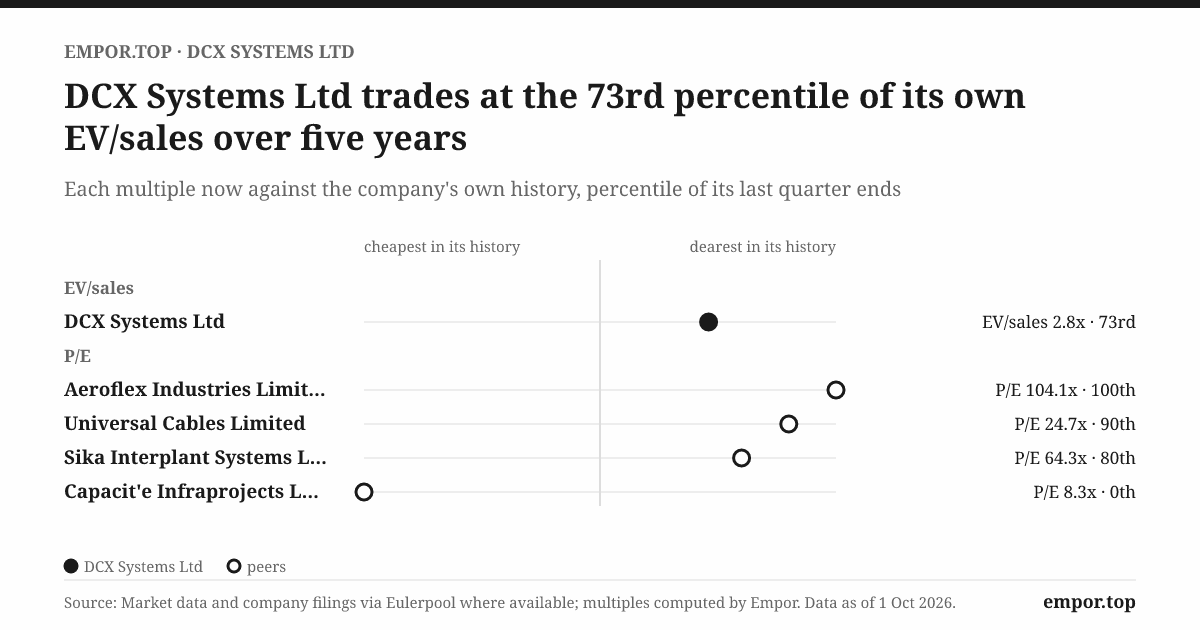
On October 1, 2026, the market's view of DCX was precise: about 1.2 times book value, about 2.8 times EV to sales, and trailing twelve-month earnings per share of about minus ₹1.83.43 Profitable Indian defence electronics peers such as Data Patterns, Astra Microwave and Bharat Electronics trade at much higher earnings multiples, because they earn operating profits from designs they own. DCX's headline P/E of about 162 times is meaningless: it rests on 2025 earnings that came mostly from deposit interest.4
One figure deserves attention. Net current assets per share and book value per share are both about ₹136.4 The stock at ₹160 trades at a modest premium to the cash, receivables and inventory on the balance sheet, net of current liabilities. The market is assigning very little value to the operating business. Whether that is too little depends on a single question: will the balance sheet keep its value, or will losses wear it down?
The bear case
- The core business burns cash. In FY26, excluding treasury income, the pre-tax result was about minus ₹36 crore.3 As unused QIP cash is spent, interest income will fall, and losses that are currently hidden will show up on the bottom line.
- The intangibles could be impaired. About ₹414 crore of capitalised rights has not yet produced product revenue, and a quarter of the recent increase came from currency translation.3 If the joint-venture products do not win tenders, Ind AS 36 impairment charges could follow.
- The offset business is shrinking. Policy has removed the demand mechanism that built the company, and there is no sign yet of something replacing it.
- The guarantees carry risk. About ₹535 crore of bank guarantees plus a ₹131 crore guarantee for the subsidiary add up to about ₹680 crore of contingent liabilities.3 A performance dispute on old contracts could tie up cash.
- Working capital is heavy again. Inventory days rose to about 267 in FY26, as about ₹248 crore of inventory piled up.3 That is cash sitting on the shelves.
The bull case
- The net cash floor. About ₹765 crore of cash and deposits and no bank debt mean the market values the operating business at roughly ₹1,022 crore, set against a reported order book of ₹3,269 crore.45 This floor is real but smaller than it looks once guarantee margin money and committed QIP spending are excluded.
- Backward integration. If Raneal's PCB assembly lets DCX keep margin it used to pay to outside suppliers, gross margins could improve. So far there is no consolidated evidence that this is happening, since operating margins worsened in the year Raneal's volumes grew.
- Joint-venture options. NIART's railway safety system and ELTX's radar work could give DCX build-to-specification work in which it shares the design, a better position than build-to-print. These remain unproven options until there are contracts.
- Geopolitical normalisation. If Israeli testing and shipment backlogs clear, the order book could convert quickly into billing. The FY24 surge, when the March 2024 quarter alone brought in about $90m, shows how lumpy the catch-up can be.3
The activist's stress test
A skeptical activist would ask four things. Why is about ₹277 crore of QIP money still in deposits two years later? Why have purchases from promoter-linked suppliers quadrupled while revenue fell? Why has the finance chief changed three times? And why should shareholders accept intangible additions on this scale from a company that does no R&D, rather than a return of surplus cash? DCX has never paid a dividend.3 Management's filings answer none of these directly.
The KPIs that matter
Three measures will decide which case wins: - Operating EBIT excluding other income. It was about minus ₹36 crore in FY26, and the operating margin was close to minus 14% in Q1 FY27.35 The trend is deteriorating. - Quarterly revenue run-rate. About ₹103 crore in Q1 FY27.5 Covering fixed costs probably needs something closer to ₹250 crore a quarter. The trend is still falling. - Tangible capex compared with intangible capitalisation. In FY26, the net factory base stayed around ₹64 crore while intangibles rose to about ₹414 crore.3 Watch which one grows from here.
X. Playbook: Business & Investing Lessons
1. A regulatory moat lasts only as long as the regulation. DCX's biggest customer did not buy from it because Bengaluru made the best harnesses. It bought because India's Ministry of Defence required it to spend offset money in India. When DAP 2020 began removing that requirement, DCX's revenue more than halved. When the government makes a customer buy from you, what you have is a compliance arrangement, and it ends when the rules change.
2. Net cash can hide a loss-making core. In FY26 the factory lost money and the deposit interest made up the difference. A manufacturer whose profit comes from interest on unused IPO money is a money-market fund with a factory attached. Look at operating profit excluding other income first.
3. Watch what insiders do with their shares. A co-founder resigned twelve days after re-election. The foreign promoter sold almost ten million shares. Institutions went from about a fifth of the company to about four percent while the retail shareholder count quadrupled. The order book slides said one thing. The shareholding register said another, and the register was right.
4. Check where the capital actually went. The factory stayed flat at about ₹64 crore. Intangibles grew to more than six times that, a quarter of the increase came from currency translation, and the company reported no R&D spending. Manufacturing capability shows up in plant and equipment, not in capitalised licence rights.
5. Working capital is a form of leverage. DCX has no bank debt. But it carries more than ₹500 crore of guarantees, and its cash conversion cycle stretched to about 229 days in FY26.3 In FY23, the year of the IPO, the company consumed about ₹600 crore of cash while reporting a profit. A long working-capital cycle can tie up equity as effectively as debt covenants can.
XI. Epilogue & Outro
Tonight DCX sits close to its net current asset value. The shares trade at ₹160 against about ₹136 of book value per share, and the reported order book is more than seven times the latest quarterly revenue run-rate annualised.45 The company has cash, no bank debt, a downgraded credit rating, a new CFO and two joint ventures that have not yet earned revenue.
The next four quarterly reports will settle the central questions. If quarterly revenue starts climbing toward ₹250–300 crore and operating EBIT turns positive without help from deposit interest, the order book will have proved real, and the market's pricing at book value will look too pessimistic. If revenue stays around ₹100 crore, other outcomes follow: treasury income falls as cash is spent, losses appear on the bottom line, auditors look harder at the ₹414 crore of intangibles, and shareholding filings show whether NCBG keeps selling and whether promoter holding falls below 50%. NIART's first commercial contract with Indian Railways, if it comes, would be the first evidence that DCX can sell something it co-designed rather than something built to another company's drawings.
Return to the scene where the story began: the listing in November 2022, a defence boom, and a company that seemed to stand where Indian policy and Israeli technology met. Now picture its factory: braided mil-spec harnesses, built to someone else's drawings, packed in crates and waiting for acceptance tests and cargo slots that keep slipping. DCX timed the equity market almost perfectly and built a ₹765 crore cash reserve. What it has not yet shown is that anyone will buy its products once the government stops requiring them to.
DCX was the master of the offset mandate. In manufacturing, when the regulation expires, only the product remains.
References
-
Placement Document QIP — DCX Systems Limited, 2024-01-19 ↩↩↩↩↩↩↩↩↩↩↩↩↩↩↩↩↩↩
-
Annual Report FY 2025-26 — DCX Systems Limited, 2026-09-01 ↩↩↩↩↩↩↩↩↩↩↩↩↩↩↩↩↩↩↩↩↩↩↩↩↩↩↩↩↩↩↩↩↩↩↩↩↩↩↩↩↩↩↩↩↩↩↩↩↩↩↩↩↩↩↩↩↩↩↩↩↩↩↩↩↩↩↩
-
BSE India DCX Systems Limited Company Page — BSE India, 2026-10-01 ↩↩↩↩↩↩
-
Investor Presentation Q1 FY 2026-27 — DCX Systems Limited, 2026-08-01 ↩↩↩↩↩↩↩↩
-
Shareholding Pattern Reg 31 Listing — DCX Systems Limited, 2022-11-11 ↩↩↩↩↩
-
Shareholding Pattern June 2026 — DCX Systems Limited, 2026-07-15 ↩↩↩↩↩↩↩↩
-
Credit Rating Revision Intimation — DCX Systems Limited, 2026-05-08 ↩↩↩
-
Annual Report FY 2023-24 — DCX Systems Limited, 2024-09-01 ↩↩
-
Annual Report FY 2024-25 — DCX Systems Limited, 2025-09-01 ↩↩↩
-
Shareholding Pattern March 2024 — DCX Systems Limited, 2024-04-15 ↩↩
-
Credit Ratings Repository — DCX Systems Limited, 2026-10-01 ↩
 LinkedIn
 WhatsApp
 Reddit
 Hacker News
 Email
Email Kindle
 RSS Feed
 Spotify
 Apple Podcasts
 Amazon Music
 Audible
 YouTube