DCM Shriram: From Colonial Mills to Chemical Conglomerate
I. Introduction & Cold Open
In July 2026, on a humid stretch of the Gujarat coast about 200 kilometres south of Ahmedabad, a chemical complex in Bharuch received a rare industrial distinction. The World Economic Forum added the facility to its "Lighthouse" network—a group of roughly 239 global factories recognized for digital manufacturing leadership, of which only nine are chemical plants.1 The facility is the largest single-location caustic soda plant in India.2 It belongs to a company whose corporate origins date back to an 1889 cotton spinning mill in colonial Delhi.3
That trajectory—from a Victorian-era textile mill in Old Delhi to an automated electrolysis complex on the Narmada estuary—defines the evolution of DCM Shriram Limited. Rather than a technology-style pivot, the company's expansion reflects a multi-decade strategy of acquiring unglamorous industrial assets—chlorine, caustic soda, urea, sugarcane, and PVC—and systematically reducing operating costs across economic cycles.
For financial year 2026, which ended March 31, 2026, DCM Shriram reported consolidated net revenue of ₹13,538 crore, up 12% year-on-year. Profit before depreciation, interest, and tax rose 15% to ₹1,694 crore, while reported net profit grew 42% to ₹856 crore. A primary driver of that net profit increase was a one-time deferred tax credit of ₹239 crore, recognized when the company adopted India's lower corporate tax regime under Section 115BAA.4 Net debt at financial year-end was ₹1,767 crore against a net worth of approximately ₹7,660 crore.4 Public markets valued the company at roughly ₹15,900 crore, representing about 11.6 times trailing earnings.5
That valuation multiple presents a central analytical question. DCM Shriram is the second-largest caustic soda producer in India, operates the country's leading uPVC window brand, runs four integrated sugar-and-ethanol complexes, and has maintained net debt near one times EBITDA during an annual capital expenditure cycle exceeding ₹1,000 crore. Yet it trades at a low-teens earnings multiple, whereas Indian specialty chemical and building-products peers routinely command higher valuations. The market pricing suggests structural discounts that headline operating metrics do not fully reveal.
The primary debate centers on whether that market discount is justified.
The bull thesis holds that DCM Shriram has spent five years integrating its commodity chlor-alkali footprint into higher-margin advanced materials—converting glycerine into epichlorohydrin and epoxy resins—while its consumer window brand expands and conglomerate cash flows fund capital expenditure without equity dilution. The bear thesis maintains that the group remains bound to price-taking commodity markets, where earnings depend heavily on export pricing from China, domestic policy decisions by the Ministry of Consumer Affairs, and state-fixed sugarcane prices set by the Uttar Pradesh government.
The operational record offers support for both perspectives. In FY24, a sharp downturn in chlor-alkali prices reduced chemical segment earnings by more than 80% in a single year.6 Management recently restructured an international PVC compounding joint venture and continues to hold a small overseas seed business acquired two decades ago. Furthermore, after announcing in March 2025 that it was evaluating a corporate demerger, management had not filed a formal scheme of arrangement as of its July 2026 earnings call.1
The following analysis traces the company's corporate development: from its colonial founding and the 1990 family partition, through the current leadership structure of the Shriram family, to the core chloro-vinyl business and power cost structures. It examines the circular economics of the sugar-ethanol division, the growth profile of the Fenesta building-products unit, and the strategic rationale behind a ₹375 crore epoxy acquisition. Finally, it evaluates these divisions through competitive strategy frameworks to test management claims against primary corporate disclosures.
 Subscribe on LinkedIn
II. Heritage & The 1990 Split (Succinct Context)
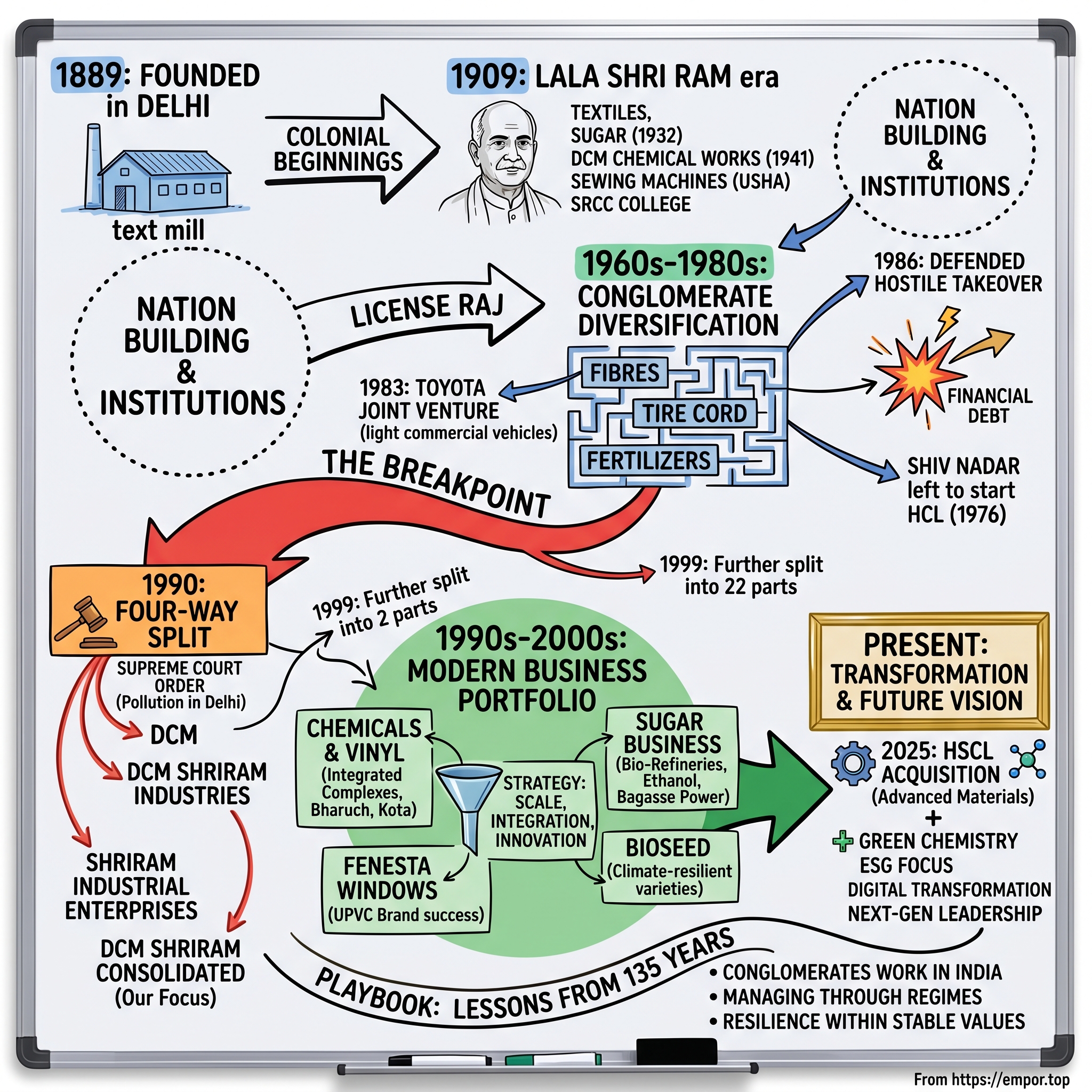
In 1888, a group of Delhi businessmen assembled at the residence of Rai Bahadur Lala Ram Kishan Das to discuss a proposal from Lala Gopal Rai, an accountant at a local banking and real estate firm who possessed, according to corporate history, "neither money nor knowledge of machines, but a big dream for a cotton mill in his city of Delhi."7 The enterprise registered as the Delhi Cloth & General Mills Company in 1889, issuing its first share certificate that year before opening its initial factory in 1891.3
Following Gopal Rai's death in 1906, his 25-year-old nephew, Shri Ram, joined the company in 1909.7 Shri Ram had matriculated in 1900 and briefly attended Hindu College.8 Within several years, he assumed control of northern India's first textile mill, renamed it Delhi Cloth Mills, and initiated an industrial diversification strategy that shaped the group's development for decades.
Over the following four decades, the company expanded into diverse industrial segments: sugar units at Daurala and Mawana in 1933, Lyallpur Textile Mills and Bengal Pottery in 1934, the Usha sewing machine business in 1938, DCM Chemical Works in 1941, Rath Vanaspati in 1946, Swatantra Bharat Mills in 1948, and DCM Silk Mills in 1956.3 By 1970, DCM ranked among the top five private business groups in India.7
During this growth period, Shri Ram established an influential presence in India's economic governance. He served as President of the Federation of Indian Chambers of Commerce and Industry in 1930, succeeding G.D. Birla, and was appointed to the inaugural Central Board of Directors of the Reserve Bank of India on 1 January 1935.8 He received a knighthood in 1941.7 Beyond commercial operations, he founded major civic and educational institutions, establishing the Commercial Education Trust in 1920 (which later became Shri Ram College of Commerce), the Shri Ram Institute for Industrial Research in 1950, Lady Shri Ram College in 1956, and the Shri Ram Centre for Performing Arts.78 Shri Ram died in January 1963.8
For contemporary investors, this history established organizational patterns that continue to dictate capital allocation: a structural preference for vertical integration, high capital intensity in physical plant assets, and active engagement with state policy.
Governance challenges emerged in the second generation between Shri Ram's sons, Bharat Ram and Charat Ram. This internal friction exposed DCM in 1986 to a pioneer hostile takeover attempt in Indian corporate history by London-based industrialist Lord Swraj Paul, who eventually withdrew following reported intervention by Prime Minister Rajiv Gandhi.7
The family division was formally resolved on 1 April 1990 through a court-approved Scheme of Arrangement. DCM Limited split into four separate corporate entities: DCM Limited, DCM Shriram Industries Limited, DCM Shriram Consolidated Limited, and Shriram Industrial Enterprises Limited. Shareholders received one share in each new entity for every four DCM shares held as of 21 September 1990.7 At the time of the split, the consolidated group generated ₹774 crore in revenue and ₹50 crore in PBDIT, reflecting a slim 6% operating margin.7
Shri Ram's great-grandsons—Ajay, Vikram, and Ajit Shriram—assumed control of DCM Shriram Consolidated Limited. Their inherited asset portfolio comprised Shriram Fertilisers & Chemicals in Kota, Rajasthan (producing urea, PVC plastics, chlor-alkali, and captive power), Shriram Cement Works in Kota, Swatantra Bharat Mills in Tonk, Rajasthan, and DCM Silk Mills in New Delhi.7 Corporate history notes that external observers viewed this asset allocation as disadvantageous, as it contained struggling legacy operations and textiles facing structural decline.7 In FY1991, its first full year of independent operation, DCM Shriram Consolidated recorded revenue of ₹360 crore.7
Management subsequently executed two strategic shifts that established the company's modern trajectory. First, management monetized legacy urban land holdings: the 38-acre DCM Silk Mills site in New Delhi was sold to DLF in 2007 for ₹1,675 crore—with DCM Shriram receiving half the proceeds—and Swatantra Bharat Mills was sold in 2014 for ₹17.12 crore.7 Second, capital was reallocated from textiles into chemical and agricultural infrastructure. The company established Shriram Alkali & Chemicals at Bharuch in FY1996, commissioned its first sugar unit at Ajbapur in FY1998, and entered a hybrid seed joint venture with Bioseed Genetics International in FY1993.9 The company adopted its current name, DCM Shriram Limited, in 2014.7
This history reinforced a conservative financial ethos that management frequently emphasizes to investors: maintaining strong liquidity and limiting leverage. As Chairman Ajay Shriram remarked in 2016, "It is easy to secure loans, but the interest meter never stops ticking."7 How that balance sheet discipline balances growth against capital efficiency across its core divisions is examined in the following sections.
III. Current Management, Ownership & Governance
DCM Shriram remains a quintessential family-managed enterprise, with four executive directors sharing a surname. For outside investors, the central question is whether this concentration of family leadership delivers long-term alignment or corporate entrenchment. The governance record displays elements of both.
Ajay S. Shriram, Chairman & Senior Managing Director, has served on the board since 24 July 1989, prior to the group's formal partition. A Commerce graduate from Sydenham College at the University of Mumbai, he completed the Programme for Management Development at Harvard Business School. He served as President of the Confederation of Indian Industry (CII) in 2014–15 and President and Chairman of the International Fertilizer Industry Association in Paris from 2009 to 2011. He currently chairs the Governing Body of Shri Ram College of Commerce, the Board of Governors of IIM Sirmaur, and the CII Task Force on Ease of Doing Business.4 On investor calls, he leads discussions on macroeconomic conditions and policy frameworks, including monsoon patterns, urea subsidy mechanisms, and regulatory policy from the Fertilizer Industry Coordination Committee.
Vikram S. Shriram, Vice Chairman & Managing Director, joined the board on 22 May 1990. He holds a Bachelor of Commerce (Honours) from St. Xavier's College, Kolkata, and is a Fellow of the Institute of Chartered Accountants of India.4 Serving as the group's chief financial steward, he co-signs the annual chairman's letter.
Ajit S. Shriram, Joint Managing Director, joined the company in 1991 as an executive after graduating from Osmania University. He subsequently earned an MBA from IMD Lausanne and completed the Owner/President Management Program at Harvard. A past President of the Indian Sugar Mills Association and former Chairman of the Indian Sugar Exim Corporation,4 he oversees the agri-rural portfolio and presents the financial results on quarterly earnings calls.
Aditya A. Shriram, Deputy Managing Director, represents the fourth generation of family leadership. Appointed to the board on 2 July 2023, he holds a degree in Industrial Engineering from Cornell University and an MBA from London Business School, and serves as President of the Alkali Manufacturers Association of India.4 He leads the chemicals vertical, overseeing the company's multi-year pivot into advanced materials. On the Q1 FY27 earnings call in July 2026, responding to analyst inquiries regarding caustic soda pricing, he noted that forecasting remained difficult, pointing out that the current electrochemical unit realization stood "just below ₹30,000," while chlorine prices ranged between negative ₹7,000 and ₹8,000 per tonne.1
Ownership. The promoter group held 10,37,36,934 shares, representing 66.52% of total equity, as of 31 March 2026—unchanged from the prior year.4 Institutional ownership remains modest, with foreign institutional investors holding approximately 3.9% and domestic institutions holding 8.5% as of June 2026.5 This concentrated structure ensures that major strategic initiatives, including potential corporate restructurings, remain under family control while limiting public float and potential market liquidity.
Compensation. Executive pay disclosures for FY26 reflect a wide gap relative to the broader workforce. Remuneration for Ajay and Vikram Shriram stood at a ratio of 235:1 compared to the median employee, while Ajit Shriram's ratio was 214:1 and Aditya Shriram's was 62:1. During the year, Ajay's compensation rose 10.84%, Vikram's increased 9.95%, Ajit's grew 10.34%, and Aditya's rose 48.51%, reflecting his promotion. By comparison, median employee remuneration grew 5.36%. Non-managerial salaries increased by an average of 11.05%, while overall managerial remuneration rose 15.28%, a figure that included performance commissions approved by the Nomination, Remuneration and Compensation Committee.4 Group Chief Financial Officer Amit Agarwal received a 33.02% pay increase.4
While performance-linked commissions align executive pay with profitability, managerial compensation grew at nearly triple the rate of median employee pay in a year when reported net profit was bolstered by a ₹239 crore non-cash tax credit.
Board composition has expanded to include broader independent oversight. Eight of the fourteen board seats are held by non-executive independent directors, with recent appointments adding senior industry and administrative experience. Vipin Sondhi, former Managing Director and CEO of Ashok Leyland and JCB India, chairs the Audit Committee. The board also includes Pranam Wahi, a career banker who retired from DBS in 2023 and serves on the Axis Bank board; Seema Bahuguna, a retired IAS officer and former Secretary of the Department of Public Enterprises; and Tejpreet Singh Chopra, founder and CEO of Bharat Light & Power, who joined in January 2025.4 Pradeep Dinodia, a director since 1994, transitioned from independent to non-executive non-independent status, resulting in a corresponding reduction in remuneration—a disclosure the company made explicitly.4
The board has established a Reorganisation Committee, whose members include Dinodia and independent director Pravesh Sharma.4 In March 2025, the board announced that it was evaluating plans to restructure its operating businesses into distinct standalone units. On the Q4 FY25 earnings call in May 2025, CFO Amit Agarwal outlined the rationale, explaining that consumer-facing businesses—Bioseed, Shriram Farm Solutions, and Fenesta—required "a very different mindset within the management," justifying independent boards and opening avenues for "partnerships, joint ventures, larger acquisitions," noting that "the child has grown up, now it needs to fly on its own."10
By July 2026, progress had slowed. In response to shareholder inquiries on the Q1 FY27 call, Ajay Shriram reiterated that the company remained committed to the demerger and was "moving on it quite aggressively," but stated that "it is difficult to give a time frame right now because of the internal work which is going on." Pressed on execution timelines, management narrowed its commitment to filing a formal application within FY27.1 Nearly a year and a half after the initial announcement, no formal scheme of arrangement has been filed, marking a notable gap between strategic guidance and execution.
Despite delays in corporate restructuring, capital allocation has adhered to conservative balance sheet guidelines. CFO Agarwal reaffirmed on the Q1 FY27 call that management's primary financial constraint is ensuring "that our debt to EBITDA does not breach 1.5." As of 30 June 2026, net debt stood at ₹1,649 crore, compared to ₹1,481 crore a year earlier, driven by approximately ₹450 crore in acquisitions and ₹1,000 crore in annual capital expenditure. Debt-to-EBITDA remained at roughly 1.1 times, supporting an ICRA credit rating of AA+/Stable.111 Agarwal defended the use of moderate leverage, arguing that "having suboptimal debt also means that we are not growing in the right direction."1 Rather than diluting equity, the company has historically funded expansion through internal cash flows and selective capital returns, including a repurchase of 34,87,183 shares completed by September 2014 under a program approved that February, rather than repeatedly tapping equity markets.12
The ultimate test of this financial discipline lies in the chemicals division, which accounts for the vast majority of capital deployed.
IV. Core Vertical 1: The Chloro-Vinyl Engine & Chemical Transformation
Understanding why DCM Shriram manages power with the intensity of an airline tracking jet fuel requires examining the mechanics of chlor-alkali manufacturing.
Running a large electric current through brine, or salt water, splits the sodium chloride molecule. Chlorine gas emerges at one pole, while caustic soda—sodium hydroxide—and hydrogen collect at the other. The process requires no proprietary catalyst or patented formulation; it essentially converts electrical energy into molecular form.
This chemistry yields two economic realities. First, electricity functions as the primary raw material; salt is inexpensive and abundant, whereas power is costly. Second, the co-products emerge in a fixed structural ratio of roughly 1.0 tonne of chlorine for every 1.1 tonnes of caustic soda. Because neither can be produced independently, the industry measures pricing through the electrochemical unit (ECU)—the combined realization from selling one unit of caustic soda together with its co-produced chlorine. When regional market demand for caustic soda outstrips that for chlorine—a frequent condition in India due to chlorine's hazardous nature, transport restrictions, and reliance on localized downstream consumption—chlorine realisations drop below zero. Producers must pay customers to take the gas off their hands. That dynamic played out in July 2026, when Aditya Shriram disclosed that chlorine realisations ranged from negative ₹7,000 to negative ₹8,000 per tonne.1
The strategic history of DCM Shriram's chemicals division stems from that structural constraint: when chlorine acts as a financial liability, long-term profitability requires building downstream operations that consume it.
The scale position. As India's second-largest caustic soda producer, DCM Shriram operates an installed capacity of 2,749 tonnes per day (TPD)—comprising 2,225 TPD at Bharuch and 524 TPD at Kota—supported by daily flaking capacity of 900 tonnes and 230 tonnes, respectively.2 The Bharuch facility stands as the largest single-location caustic soda manufacturing plant in India.2 Nationwide, installed capacity totals approximately 6.4 million tonnes per annum, representing 5.9% of global capacity, with the four leading producers—Grasim, DCM Shriram, Gujarat Alkalies and Chemicals Limited (GACL), and Epigral—controlling roughly 54% of domestic output.2 Domestic demand for caustic soda has compounded at approximately 5% annually over the past decade.2
The power matrix. The chemical and vinyl operations rely on 345 megawatts (MW) of captive coal-based power generation across Bharuch and Kota, alongside 50 MW peak of captive renewable capacity at Bharuch. Across all divisions, the group operates 383 MW of coal-fired generation and 166 MW of sugar-based co-generation.1 Energy cost optimization has centered on renewable installations. A 68 MW peak hybrid power project for Kota, structured as a group captive joint venture with JSW Renewables, began injecting power in May 2026 and reached an average injection rate of 25 MW by July.14 In the quarter ended June 2026, the company signed a definitive agreement with Serentica Renewables for up to 58 MW peak at Bharuch at an investment of about ₹235 crore, expanding Bharuch's renewable capacity to 108 MW and bringing the group total to roughly 176 MW peak.1
Chief Financial Officer Amit Agarwal characterized this strategy as an ongoing progression rather than a sudden transformation—pointing to a new power plant in 2019, a 120 MW coal plant commissioned in June 2024 that retired inefficient units, and the current 176 MW renewable rollout as "a continuous journey where we keep making our power cost more and more efficient."1 However, Agarwal twice declined during investor calls to disclose specific per-kilowatt-hour generation costs, stating that costs vary by energy source and site location.1 While commercially defensible, this lack of disclosure leaves management's assertion of being a lowest-cost producer unverified by detailed financial data.
The downstream pivot. To mitigate market volatility in electrochemical units, DCM Shriram directed capital over the past five years toward building an integrated chemical value chain designed to absorb captive chlorine and hydrogen streams.
In August 2024, the company commissioned a 52,500 tonne-per-annum (TPA) hydrogen peroxide plant at Bharuch to consume captive hydrogen.1 To utilize captive chlorine, management constructed a 52,000 TPA epichlorohydrin (ECH) facility—bringing 35,000 TPA online in October 2025 and the final 17,000 TPA in April 2026—backed by 368 TPD of refined glycerine capacity.12 Synthesized from glycerine and chlorine, ECH serves as the core intermediate for epoxy resins. In August 2025, DCM Shriram completed this integration chain by acquiring Hindusthan Speciality Chemicals, adding 33,551 TPA of epoxy resin capacity.12 Additionally, a 100 TPD aluminium chloride expansion and a 225 TPD calcium chloride plant at Bharuch entered pre-commissioning trials during the quarter ended June 2026.1
During the July 2026 earnings call, Aditya Shriram projected that upon completion of the aluminium chloride and calcium chloride projects, "almost 50% of our chlorine will be captively consumed," and including pipeline supply agreements with neighboring industrial customers at Bharuch, "almost 85% of our chlorine will be tied up."1 If fully realized, this captive arrangement reshapes the segment's financial profile—not by removing market cyclicality entirely, but by transforming a negatively priced by-product into a raw material for downstream chemical products subject to distinct demand dynamics.
Now the stress test. Management's contention that scale at Bharuch and captive power provide a durable cost moat faces clear counter-evidence in the company's recent operational results.
In FY23, DCM Shriram realized ₹43,629 per tonne on caustic soda sales of 5,96,769 MT, generating chemical segment PBDIT of ₹1,010 crore on revenue of ₹3,184 crore.6 Just one year later, in FY24, average ECU realisations dropped 38.3% to ₹26,928 per tonne; despite sales volumes remaining steady with a modest 2.8% decline, chemical segment revenue dropped to ₹2,119 crore and PBDIT collapsed over 81% to ₹187 crore.6 The vinyl business contracted in tandem, with PVC realisations down 21.7%, calcium carbide down 22.9%, and vinyl PBDIT dropping approximately 84%.6 Consolidated net profit for the group fell from ₹911 crore in FY23 to ₹447 crore in FY24.5 The company's annual report acknowledged the cost lag: "Manufacturing costs have declined but has not kept pace with decline in product prices."6
This downturn demonstrated that low operating costs protect business survival during industry downcycles, but cannot shield earnings levels when global commodity prices fall. In undifferentiated commodity markets, internal cost controls govern relative producer positioning, while global supply-demand balances determine realized revenues.
Market recovery has proceeded gradually. ECU realisations averaged ₹28,476 per tonne in FY25 and ₹28,924 in FY26—an improvement of 1.6%—leaving pricing roughly 34% below FY23 peak levels.2 Consequently, the chemical segment's FY26 recovery—with revenue rising 38% to ₹3,832 crore and PBDIT growing 50% to ₹750 crore—was driven primarily by volume growth and new product lines: caustic volumes rose 12% to 7,85,914 MT following the 850 TPD Bharuch expansion, while hydrogen peroxide, refined glycerine, ECH, and epoxy resin streams added new revenue.24 The quarter ended June 2026 provided pricing relief, with ECU realisations increasing 7% year-on-year to ₹35,761 per tonne on a comparable basis and caustic plant utilization reaching 82%.13
DCM Shriram's captive power infrastructure and cost position allow its plants to maintain high utilization rates and remain profitable when higher-cost competitors suffer operating losses. However, these factors do not stabilize nominal earnings, as demonstrated by the 81% segment profit decline in FY24. Structural improvements to profitability depend instead on chlorine integration and downstream product diversification—initiatives that remain partially commissioned. The key analytical test is whether chemical segment PBDIT margins remain in the mid-teens during quarters when ECU realisations fall below ₹30,000 per tonne, which would indicate a higher trough margin than the low single digits logged in FY24.
An additional non-operational factor affecting segment profitability involves state subsidies. During the first nine months of FY26, the chemical business recorded a ₹69 crore positive impact from a Gujarat state government incentive related to projects commissioned in FY2017, compared to ₹20 crore in the prior year.11 While representing actual cash inflows, these legacy incentives reflect state policy reimbursements rather than recurring operational leverage and temporarily elevate reported segment margins.
The vinyl division demonstrates the limits of vertical integration. DCM Shriram is India's sole producer manufacturing PVC resin via the calcium carbide route rather than ethylene, and stands as the country's oldest operational PVC manufacturer.2 In FY26, vinyl segment PBDIT declined to ₹93 crore from ₹115 crore despite higher sales volumes, an outcome the annual report attributed to the "dumping of surplus supply from China."2
Subsequent trade policy shifts underscored the segment's vulnerability to regulatory interventions. In the quarter ended June 2026, PVC volumes fell 25% year-on-year even as prices rose 22%, following a policy shift: the Indian government had temporarily waived basic customs duty on PVC to protect downstream users from Middle East-driven cost inflation, leading to an import surge. The duty was subsequently reinstated, and the DGFT notified a minimum import price of $766 per tonne on suspension-grade PVC for six months.1 Driven by these higher realisations, vinyl PBDIT rose 88% year-on-year to ₹43 crore.13
For a domestic producer operating in a globally traded polymer sector, trade policy interventions remain a primary determinant of earnings volatility.
While chlorine and PVC economics depend heavily on Chinese export pricing and Indian trade policy, the company's agricultural operations are tied directly to state regulatory frameworks in Uttar Pradesh.
V. Core Vertical 2: The Integrated Sugar & Ethanol Complex
Every October in central Uttar Pradesh, the crushing season begins as roughly 150,000 farmers start delivering cane to DCM Shriram's four mills. What follows is one of the most operationally integrated manufacturing processes in Indian industry—and also one of the most strictly regulated.
As sugarcane moves through the plant, sugar is extracted alongside every major by-product. Bagasse, the fibrous residue, fuels 166 megawatts of co-generation power capacity, of which 86 megawatts can be exported to the grid.2 Molasses feeds the company's distilleries. Press mud and spent wash supply a 12-tonne-per-day compressed biogas plant at Ajbapur, commissioned in March 2025, and a potash recovery unit added in financial year 2026.12 Almost every stream is monetized. Well before environmental management frameworks became standard corporate practice, DCM Shriram operated a closed-loop system across Hardoi and Lakhimpur Kheri districts—driven by commercial incentives to eliminate waste disposal costs.
The footprint. The division comprises four integrated complexes in central Uttar Pradesh: Ajbapur (13,500 tonnes of cane crushed per day), Hariawan (13,000 TCD), Loni (9,400 TCD), and Rupapur (6,500 TCD), representing total daily crushing capacity of 42,400 tonnes and refined sugar capacity of 26,500 TCD.2 Downstream, three distilleries provide processing capability: molasses-based units at Ajbapur (120 kilolitres per day) and Hariawan (190 KLD), and a multi-feedstock unit at Ajbapur (250 KLD) capable of running on grain.2 For FY26, the segment generated revenue of ₹3,770 crore and profit before depreciation, interest, and tax (PBDIT) of ₹438 crore, a 6% profit increase despite a 2% top-line decline.4
The constraint. Underlying this operational efficiency is a tightly administered pricing framework. In Uttar Pradesh, the state government fixes the State Advised Price (SAP) for sugarcane, which mills are legally mandated to pay. The central government sets the Minimum Selling Price (MSP) for sugar, establishes export quotas, and dictates the volume, price, and raw material source for ethanol procurement by state-owned oil marketing companies. Consequently, a sugar producer in Uttar Pradesh controls neither its primary raw material cost nor the selling prices of its two main outputs.
This regulatory reality challenges the thesis that ethanol expansion converts cyclical sugar operations into stable, quasi-utility earnings.
In December 2023, the Ministry of Consumer Affairs abruptly restricted the use of sugarcane juice and B-heavy molasses for ethanol production to preserve domestic sugar supplies. The decision stranded newly built distillery capacity across the industry. For DCM Shriram, sugar and ethanol segment profit before interest and tax (PBIT) dropped 28% from ₹424 crore in FY24 to ₹304 crore in FY25, even as the company's other major divisions expanded.14
Rather than disappearing, regulatory challenges have evolved into structural overcapacity. India achieved its 20% ethanol blending target by November 2025.11 However, nationwide installed distillery capacity of approximately 2,000 crore litres far exceeds oil marketing company allocations of about 1,058 to 1,060 crore litres, with grain-based feedstocks capturing 72% of allocations compared to 28% for sugarcane-based processors.12 DCM Shriram's annual report framed the issue directly, noting that "countrywide distillery capacity is outstripping demand and ethanol disposal surfaces as a major challenge for the industry," requiring "proactive policy support from the government."2 On the July 2026 earnings call, analysts highlighted that procurement prices had remained unchanged for nearly four years. Chairman Ajay Shriram acknowledged the policy gap, stating that while long-term blending signals remain positive, execution requires "a clear implementation roadmap, balanced allocation across feedstocks, and periodic alignment of ethanol procurement prices with sugarcane cost."1
Concurrently, raw material costs have risen. State Advised Price increases in FY26 elevated operating cost pressures, prompting industry calls for higher sugar MSPs.11 In FY26, DCM Shriram's ethanol realisations fell 4.8% to ₹59.5 per litre as sales volumes contracted 1.7% to 15.15 crore litres.2
Ethanol integration has provided valuable operational diversification, converting a seasonal single-product business into a multi-product model that improves cash conversion and inventory management. However, its earnings remain subject to government procurement pricing and feedstock policy decisions.
Management's capital allocation reflects this regulatory boundary. Asked on the July 2026 call whether the company would expand distillery capacity to capture grain-based margins, CFO Amit Agarwal stated that while the company will optimize its 260 KLD grain capability, "we do not plan to grow our capacity in any case."1 The decision to pause capacity expansion aligns with an environment of industry oversupply.
The operational record. Investment arguments sometimes attribute DCM Shriram's performance in Uttar Pradesh to superior agronomic cane recovery. Disclosed data does not support a recovery advantage over market leaders. In FY26, DCM Shriram achieved a recovery rate of 10.8%, up from 10.5% in FY25, crushing 472.8 lakh quintals of cane (down from 565.4 lakh quintals) to produce 51.0 lakh quintals of sugar.211 By comparison, Balrampur Chini Mills, the state's largest producer with 80,000 TCD of crushing capacity and 1,050 KLPD of distillery capacity, reported a gross recovery rate of 11.24% before diversion for the same crushing season.15 DCM Shriram's competitive position stems from by-product integration and scale relative to its own plant footprint rather than structural recovery advantages.
The segment's FY26 financial performance was driven primarily by higher sugar realisations, which rose 4.1% to ₹4,071 per quintal, alongside initial contributions from the compressed biogas and potash units and higher power tariffs.2 Reported results were also supported by two non-recurring items: a ₹36 crore provision reversal in Q3 FY26 regarding retrospective export duties on ethanol, and a ₹15.5 crore power tariff adjustment from UPPCL in Q2 FY26.11 Excluding these non-operational benefits, underlying earnings growth was more modest than the reported 6% PBDIT increase.
Looking ahead to FY27, external supply-demand dynamics have turned more favorable. Global sugar balances are projected to shift into a deficit of approximately 0.7 million tonnes for the 2026–27 season, compared to a 2.5 million tonne surplus in the prior period, driven by lower output in Thailand and Europe. In India, ending stocks for the 2025–26 season are projected at roughly 3.75 million tonnes—down from a 6.2 million tonne forecast in January 2026—supporting domestic sugar prices near ₹4,450 per quintal.111 While these dynamics provide a constructive backdrop for FY27 earnings, they reflect exogenous commodity cycles rather than structural margin expansion.
The third vertical represents the first division in which DCM Shriram exercises direct pricing power.
VI. High-Growth & Speciality SBUs: Fenesta, Farm Solutions & Bioseed
In 2003, a company whose core competence was electrolysis and urea decided to sell windows to homeowners.
The logic was industrial rather than consumer-facing. DCM Shriram already produced PVC resin at Kota, and uPVC—unplasticised polyvinyl chloride—window and door profiles represented a direct downstream application for that resin. It was chlorine integration by another name. Yet between 2003 and 2026, Fenesta evolved from a captive consumption outlet into a structurally distinct business: a branded, made-to-order consumer product supported by an extensive dealer network, exclusive showrooms, and pricing power derived from consumer brand equity rather than commodity exchanges.9
The scale today. Fenesta generated ₹1,112 crore in revenue in FY26, up 28% year-on-year, on sales volumes of 5,03,385 windows and doors, a 20.6% increase.416 The unit operates eight fabrication facilities—four for uPVC, two for aluminium, and two for façades—alongside one ten-line extrusion plant and a hardware manufacturing unit. Its distribution footprint spans 421 dealers across 268 cities, nine company-owned and company-operated showrooms, service coverage across 976 Indian cities, and an international presence in seven countries.2 As of 31 March 2026, the unit's order book stood at ₹1,498 crore, up 23.6% year-on-year.17 Management characterizes Fenesta as India's largest and most preferred windows and doors brand.2
The competitive landscape remains fragmented but active. International system suppliers—including VEKA, Rehau, Deceuninck, and Kömmerling—compete on premium technical specifications, while domestic challengers such as Encraft, Prominance, and Aparna Venster compete on pricing and local service responsiveness.18 In April 2022, Asian Paints acquired a 51% stake in Weatherseal Fenestration for ₹19 crore, with an agreement to acquire an additional 23.9% over three years—bringing India's largest paint distribution network directly into the category.19 This well-capitalized entrant presents a formidable medium-term challenge to Fenesta's distribution advantage and brand premium.
Capital intensity and margin dynamics. While market commentary frequently frames Fenesta as a high-margin, capital-light consumer asset deserving a premium valuation multiple, financial results for FY26 present a more complex picture.
Fenesta's PBDIT in FY26 fell 2.6% to ₹150 crore from ₹154 crore in FY25, despite a 28% top-line expansion, causing operating margins to contract from 17.7% to 13.5%.17 Concurrently, segment capital employed surged over 500%, rising from ₹36.5 crore to ₹223.3 crore.17 Consequently, during its fastest growth year, the segment deployed more than six times its previous capital base while generating slightly lower operating profit, significantly depressing return on capital.
Management attributes this profitability lag to upfront investments in new growth platforms—including façades, wooden doors, and hardware—alongside higher promotional expenditures, capability building, and integration costs for DNV Global, a hardware manufacturer in which DCM Shriram acquired a 53% stake in May 2025.217 Vice Chairman Vikram Shriram had flagged this trajectory on the May 2025 earnings call, explaining that capital employed "would go up during the course of this year. But then it would be followed by an increase in topline and bottom-line in the following years."10 Early FY27 results provided partial support: Q1 FY27 revenue rose 22% year-on-year to ₹303 crore with PBDIT up 13% to ₹40 crore, though operating margins remained under pressure.1 Order booking growth slowed to 4% in the quarter, which CFO Amit Agarwal attributed to West Asia-related decision delays while acknowledging it was "a little on the lower side, lower than what we would have expected."1
The empirical record shows that Fenesta's brand equity and dealer network are genuine commercial assets, and vertical integration into extrusion and hardware could yield cost efficiencies over time. However, the premise that Fenesta operates as a high-return compounder remains unproven at current scale, as the division traded over four percentage points of margin and a sixfold capital expansion for revenue growth. A key analytical test lies in future margin performance: if platform investments bear fruit, Fenesta's PBDIT margin should recover toward the high teens by FY28 alongside 20%-plus revenue growth. Conversely, sustained revenue growth accompanied by low-teens margins would indicate that capital has purchased scale rather than an economic moat.
Shriram Farm Solutions has delivered consistent financial performance. Revenue expanded 18% to ₹1,689 crore in FY26, generating PBDIT of ₹296 crore—representing a 17.5% margin on capital employed of ₹64 crore.2 This reflects a capital-efficient distribution and formulation model selling crop protection products, specialty plant nutrition, water-soluble fertilizers, and proprietary research wheat seed through an extensive farm-facing network. Top-line growth was led by research wheat, where the company holds a leading position, supported by thirteen new product launches across crop protection and specialty nutrition in the first nine months of FY26.11 During the drought-impacted June 2026 quarter, segment revenue rose 2%, while PBDIT increased 22% to ₹30 crore on improved realisations and product mix—demonstrating pricing power built on brand trust rather than basic commodity distribution.1
Bioseed remains an unresolved strategic asset within the portfolio. In FY26, the division generated revenue of ₹666 crore, compared to ₹648 crore in FY25, and PBDIT of ₹57 crore, down from ₹66 crore, while utilizing capital employed of ₹696 crore.2 Crucially, Bioseed absorbs more capital than Fenesta and Shriram Farm Solutions combined, yet generated an 8% return on capital in FY26.
The international expansion strategy has yielded muted returns over three decades. After entering hybrid seeds via a joint venture with Bioseed Genetics International in 1992–93, DCM Shriram increased its stake from 51% to 100% in 2007–08 and established research and commercial operations across the Philippines, Vietnam, Indonesia, and Thailand.79 In FY26, the Philippines operation contributed ₹148 crore in revenue, up from ₹141 crore in FY25, though operating margins contracted due to adverse weather.2 Domestic Indian operations generated ₹518 crore in revenue with PBDIT roughly flat year-on-year.2 In Q1 FY27, segment performance deteriorated further: revenue declined 26% and PBDIT fell to negative ₹9 crore from positive ₹42 crore in the prior-year period, as delayed monsoons reduced national sowing acreage by 15% to 20%, with larger declines in core Bioseed regions. CFO Agarwal acknowledged the impact directly, stating that a "large part of it is lost."1
Over a thirty-year operating history, Bioseed has developed genuine germplasm capabilities without translating that research into scale or durable high returns in domestic or international markets. While the business remains profitable in most years—and posted a 194% PBIT increase off a low base in FY25—it has not generated substantial option value.14 Accounting for roughly 5% of group revenue and 3% of PBDIT while tying up nearly 15% of segment capital employed, Bioseed represents a clear candidate for portfolio optimization.
This raises the broader question of how management deploys capital when facing discretionary allocation decisions.
VII. Capital Allocation, M&A & Downstream Specialty Pivot
Between financial years 2024 and 2026, DCM Shriram deployed approximately ₹1,000 crore annually in capital expenditure without equity dilution. The sequence of project commissions demonstrates a systematic strategy: expanding chlor-alkali scale at Bharuch with an 850 tonne-per-day caustic expansion in May 2024; securing lower captive energy costs through a 120-megawatt power plant in June 2024; absorbing captive hydrogen via a 52,500 tonne-per-annum hydrogen peroxide plant in August 2024; expanding sugar capacity by 2,100 tonnes of cane per day at Loni in November 2024; adding a 12 tonne-per-day compressed biogas unit at Ajbapur in March 2025; securing window hardware supply through a 53% stake in DNV Global in May 2025; acquiring Hindusthan Speciality Chemicals in August 2025; and completing a 52,000 tonne-per-annum epichlorohydrin facility at Bharuch with 35,000 tonnes commissioned in October 2025 and the remaining 17,000 tonnes brought online in April 2026.1 In financial year 2026 alone, the company commissioned ₹1,106 crore worth of projects.4
Viewed as a multi-year sequence, these investments reflect a deliberate vertical integration plan: establishing chlor-alkali scale, lowering captive power costs, and constructing downstream value chains to absorb co-produced chlorine and hydrogen rather than selling them into volatile merchant markets.
The HSCL acquisition. On 12 June 2025, the board approved the 100% acquisition of Hindusthan Speciality Chemicals Limited for ₹375 crore.2021 Operating from Jhagadia in Gujarat's Bharuch district—roughly 3.5 kilometres from DCM Shriram's primary complex—HSCL produces liquid epoxy resins, reactive diluents, hardeners, solvent cuts, and formulated resins.20 The company reported unaudited revenue of ₹274.7 crore in FY25.21 The transaction closed in August 2025,1 fulfilling a February 2024 commitment to allocate ₹1,000 crore toward epoxy and advanced materials.21
The transaction establishes a direct integration link: DCM Shriram combines co-produced chlorine with purchased glycerine—a biodiesel by-product—to manufacture epichlorohydrin, which HSCL then processes into epoxy resins used in wind turbine blades, industrial coatings, and electronic laminates. Moving up this value chain shifts output from basic commodities toward formulated products requiring customer qualification. The ₹375 crore valuation represents approximately 1.4 times trailing sales, below the historical range of 2 to 2.5 times revenue typical for Indian specialty chemical transactions—a discount that reflected underlying operational turnaround requirements at the acquired business.
Integration execution and trade policy dependency. Early operational results present a mixed picture. On the January 2026 earnings call, management noted that newly announced anti-dumping duties on liquid epoxy resins were "expected to accelerate the turnaround of our acquisition," acknowledging that the asset required operational restructuring.11 By July 2026, capacity utilization at both the epichlorohydrin and epoxy resin plants hovered near 70%, with management citing "volatility owing to feedstock movements and geopolitical developments."1 Nevertheless, the company committed an additional ₹101 crore to expand formulated resin capacity by 36,000 tonnes per annum—bringing total capacity to 50,000 tonnes by the second quarter of FY28.1
This specialty chemical transition carries two main analytical caveats. First, economics depend heavily on regulatory protection, as the Indian government maintains anti-dumping duties on both epichlorohydrin and epoxy resins.2 While providing immediate margin support, trade protection remains a policy variable subject to revision or removal. Second, operating at 70% utilization eighteen months after commissioning indicates developing market adoption rather than full demand pull. A key test of management's integration strategy will be whether epichlorohydrin and epoxy utilization exceeds 85% by the end of FY27 while driving chemical segment margin expansion. If utilization remains near 70% while formulated resin capacity expands, capital deployment will have added volume without pricing power.
International joint ventures and raw material integration. Management's track record in international technology partnerships invites greater scrutiny. In April 2014, DCM Shriram formed a 50:50 joint venture with U.S.-based Axiall Corporation, named Shriram Axiall Private Limited, to acquire advanced polymer compounding technology.922 Following Westlake Chemical's acquisition of Axiall in August 2016, DCM Shriram's partner changed without its input.23 The entity was subsequently restructured, with the compounding operations absorbed into wholly-owned subsidiary Shriram Polytech Limited within the vinyl segment.11
In FY26, management revisited this strategy with a new international partner. Effective 17 April 2026, the company sold a 50% stake in Shriram Polytech to Teknor Apex B.V. of the United States, creating a joint venture to combine domestic manufacturing capacity with Teknor Apex's specialized compounding technology.24 The sale contributed to a ₹79.4 crore exceptional gain in the quarter ended June 2026, alongside gains from land monetization.1
Over twelve years, DCM Shriram has repeatedly sought foreign joint venture partners to upgrade its compounding technologies, yet management has not disclosed financial metrics demonstrating that prior partnership structures met their target return on capital. Combined with Bioseed's modest international returns, this history suggests that management's operational execution is strongest in domestic brownfield expansions tied to core industrial complexes, while international technology partnerships remain unproven as profit drivers.
Conversely, capital allocation aligns closely with core operational strengths in domestic raw material integration. DCM Shriram has proposed acquiring salt works in Gujarat with an installed capacity of 208,000 tonnes per annum for approximately ₹175 crore, which would supply roughly 13% of its total salt requirements. The transaction remains subject to regulatory approvals, with expected completion rescheduled from the first quarter to the third quarter of FY27.111 This backward integration secures a critical raw material for chlor-alkali manufacturing alongside captive power generation.
The broader analytical question remains whether DCM Shriram's conglomerate structure enhances capital efficiency across these diverse operations or dilutes overall equity returns.
VIII. Competitive Dynamics, Industry Structure & Helmer's 7 Powers / Porter's 5 Forces
An evaluation of DCM Shriram's competitive positioning requires examining where peer competitors—such as Grasim Industries in chemicals, Balrampur Chini Mills in sugar, or Asian Paints' Weatherseal in fenestration—might target strategic vulnerabilities.
Hamilton Helmer's 7 Powers, applied honestly.
Scale Economies — real but bounded. Bharuch is the largest single-location caustic soda plant in India, and 2,749 tonnes per day of total capacity places DCM Shriram second nationally.2 That scale lowers fixed costs per tonne and supported the 82% capacity utilization achieved in the first quarter of FY27 against an industry average of roughly 80%.113 However, market leader Grasim Industries operates at a significantly larger scale, while conglomerate peers Reliance Industries and the Adani Group have signaled interest in entering the caustic soda and PVC markets—a point raised directly by a shareholder during the July 2026 earnings call.1 In sugar, DCM Shriram's 42,400 tonnes of cane crushed per day represents roughly half of Balrampur Chini's 80,000 tonnes capacity, accompanied by a lower sugar recovery rate.215 Scale economies in this portfolio serve primarily as a defensive shield rather than an offensive weapon.
Process Power — moderate and improving. Decades of linking captive power generation directly to electrolysis, combined with World Economic Forum Lighthouse recognition for digital manufacturing at Bharuch, represent accumulated operational know-how that competitors cannot easily duplicate.1 The sugar-to-ethanol, compressed biogas, and potash circular manufacturing chain is similarly the product of two decades of incremental engineering. This operational integration represents the company's most credible structural advantage outside its consumer brand.
Branding — strong in exactly one place. Fenesta commands genuine consumer brand recall and a price premium in a building-products category where most competitors remain unbranded fabricators.218 Shriram Farm Solutions maintains established farmer trust, demonstrated by its ability to expand realizations during a drought-impacted quarter.1 Conversely, in commodity caustic soda, PVC resin, urea, and refined sugar, brand equity is non-existent, as these are standardized industrial inputs purchased strictly on price.
Cornered Resource — weak, despite the location story. The Bharuch complex's proximity to chemical supply pipelines, port infrastructure, and Gujarat's salt corridor provides operational efficiency, which the pending acquisition of local salt works is designed to deepen.1 However, Gujarat's chemical industrial corridor hosts multiple competitors with comparable geographic access, making location a favorable operational asset rather than a cornered resource.
Counter-Positioning — absent. Major industry competitors operate under similar integrated asset models. The company does not possess a disruptive business model that established incumbents are deterred from copying due to revenue cannibalization.
Switching Costs — low, with one exception. Caustic soda remains a fully fungible commodity. The exception is chlorine: DCM Shriram supplies neighboring industrial customers at Bharuch via dedicated pipelines, creating physical lock-in that a truck-delivered competitor cannot replicate.1 Deputy Managing Director Aditya Shriram's disclosure that pipeline and regional supply agreements will cover approximately 85% of total chlorine placement once current projects complete represents the company's most economically meaningful switching-cost statement.1 In Fenesta's commercial division, architectural specification lock-in provides moderate customer stickiness once property developers design projects around specific system profiles.
Network Effects — none.
The structural verdict indicates a cost-optimized, vertically integrated industrial enterprise anchored by a single consumer brand. The company's durable moat rests primarily on its physical chlorine integration at Bharuch—infrastructure that rivals would require substantial capital and time to duplicate.
Porter's Five Forces.
Threat of new entrants — low but rising. Constructing a modern chlor-alkali facility with captive power requires capital investment exceeding ₹1,500 crore, along with complex environmental clearances and pipeline access, which has historically deterred entry. However, India's largest industrial groups are not capital-constrained, and a shareholder question on the July 2026 earnings call regarding potential entry by Reliance and Adani highlighted this risk.1 Chief Financial Officer Amit Agarwal addressed the threat by emphasizing cost leadership, noting, "we are amongst the lowest cost producers and we continue to work on seeing that how do we further reduce costs"—a response highlighting internal cost efficiency as the primary defense.
Bargaining power of suppliers — high, and structurally so. Thermal coal is sourced under Coal India allocations or imported at global market prices. Sugarcane acquisition costs are fixed by the Uttar Pradesh state government through mandatory State Advised Prices, which have steadily increased.11 Natural gas for urea manufacturing remains subject to international liquefied natural gas supply disruptions, which Chairman Ajay Shriram flagged directly in July 2026.1 Consequently, input pricing across key operational divisions remains governed by external authorities and global energy markets.
Bargaining power of buyers — high in chemicals, low in Fenesta retail. Industrial caustic soda customers—including alumina refiners, textile manufacturers, and detergent producers—are large, sophisticated buyers purchasing against import parity benchmarks. Fenesta's retail homeowners exercise minimal pricing leverage, though large real estate developers in its project division command greater bargaining power.
Threat of substitutes — genuinely low. There is no chemical substitute for caustic soda in alumina refining or textile processing, while uPVC continues to capture market share from traditional wood and aluminum frames. This low substitution risk underpins the 5% structural annual demand growth in domestic caustic soda.2
Competitive rivalry — high and intensifying. The company faces established rivals across its divisions: Grasim Industries, Gujarat Alkalies and Chemicals, and Epigral in chlor-alkali; Balrampur Chini, Triveni Engineering, and Dhampur Sugar Mills in Uttar Pradesh sugar; and a fragmented but increasingly well-capitalized field in fenestration.218 Crucially, competitive intensity in caustic soda and PVC is driven heavily by Chinese export overcapacity, which corporate filings cite as the cause of both vinyl margin compression and persistent softness in international caustic pricing.12
This structural environment combines low substitution risk and high capital entry barriers with high supplier bargaining power, strong industrial buyer leverage, and intense competition from domestic peers and foreign producers. Consequently, DCM Shriram grows steadily and survives downcycles, but earns a return on capital that has hovered around 13% to 14% rather than the 20%-plus threshold required to command a premium valuation multiple.1
The financials bear that out.
IX. Financial Performance, Segment Economics & Historical Falsification Stress Test
Over a ten-year horizon, DCM Shriram expanded revenue from ₹5,788 crore in FY17 to ₹13,538 crore in FY26—a compound annual growth rate of roughly 9%.5 Over the same period, net profit rose from ₹552 crore to ₹856 crore, representing a slower compound growth rate of approximately 5%. Between FY23 and FY26, net profit contracted slightly on a three-year compound basis.5 Return on capital employed stood at 13.6% as of June 2026, compared to 13.2% a year earlier, while the full-year FY26 return on capital declined to roughly 13% from 14% in FY25.117
That long-term profile defines the financial signature of the enterprise: mid-single-digit profit growth and low-teens returns on capital, punctuated by sharp cyclical swings in both directions. The headline net profit growth of 42% in FY26 is not representative of core operations; excluding a ₹239 crore deferred tax credit leaves underlying profit growth at roughly 2%.4 Similarly, the reported net profit of ₹693 crore in Q1 FY27, compared to ₹114 crore in the prior-year period, was driven almost entirely by non-operating factors: a ₹474.3 crore tax adjustment following a favorable Income Tax Appellate Tribunal (ITAT) order regarding Section 80-IA claims for prior years, alongside ₹79.4 crore in exceptional gains from land monetization and the Teknor Apex joint venture transaction. Normalized net profit for Q1 FY27 stood at ₹147 crore, representing a 28% year-on-year increase.113
The tax adjustment reflects substantial recurring cash flow value that is often misconstrued in headline figures. Chief Financial Officer Amit Agarwal explained on the earnings call that the company had historically filed tax returns recognizing deductions not claimed in its audit accounts; upon receiving the favorable ITAT order, six years of accumulated benefits were recognized on the balance sheet as ₹376 crore in Minimum Alternate Tax (MAT) credit. Combined with the transition from a 35% to a 25% corporate tax bracket, effective cash tax outflows will remain at approximately 19% for at least five years, even as the income statement reflects a standard 25% tax provision.1 This tax structure generates real free cash flow—worth roughly ₹75 crore to ₹80 crore annually at current profitability—that headline earnings numbers obscure.
Segment shape as of FY26. Chemicals and Vinyl generated ₹4,651 crore in revenue, accounting for roughly 34% of group net revenue, with chemicals alone contributing ₹3,832 crore and profit before depreciation, interest, and tax (PBDIT) of ₹750 crore.24 Sugar and Ethanol generated ₹3,770 crore in revenue and ₹438 crore in PBDIT.4 Agri Inputs—comprising Shriram Farm Solutions, Fertiliser, and Bioseed—contributed ₹3,800 crore in revenue and ₹459 crore in PBDIT.2 Fenesta generated ₹1,112 crore in revenue and ₹150 crore in PBDIT.17 The revenue mix shifted over the year: Chemicals and Vinyl expanded from 29% of net revenue in FY25 to 34% in FY26, while the agri-rural cluster declined from 61% to 56%.111
Myth versus reality, briefly. Three consensus descriptions of the company conflict directly with its corporate disclosures.
Myth: DCM Shriram is primarily a chemical producer. Reality: Chemicals and Vinyl accounted for 34% of FY26 net revenue, while the agri-rural cluster—sugar, ethanol, farm solutions, fertilizer, and seeds—represented 56%.1 Although the chemical segment's contribution has increased, the group remains majority-agri by revenue, which explains why monsoon distribution and sugarcane pricing remain central to management's operational outlook.
Myth: Fenesta is the high-return core asset. Reality: In FY26, Fenesta generated ₹150 crore in PBDIT on ₹223 crore of capital employed, following a year in which capital employed expanded more than fivefold while PBDIT contracted slightly.17 While the division may achieve high returns as new platforms mature, Shriram Farm Solutions delivered superior return metrics in FY26, generating ₹296 crore in PBDIT on ₹64 crore of capital employed.2
Myth: Earnings are experiencing a strong operational recovery. Reality: Headline profit figures in FY26 and Q1 FY27 were heavily influenced by non-cash tax credits and one-time exceptional gains. Underlying operational profit growth was in the low single digits in FY26, while Q1 FY27's 28% normalized expansion reflected recovery from a depressed prior-year base.14
On cash returns. The company distributed total dividends of 560% of face value in FY26, amounting to ₹176.6 crore, or ₹11.20 per share, compared to ₹9.00 per share in FY25.417 This represents a dividend payout ratio of approximately 21% against reported net profit and 29% against normalized earnings. Concurrently, the company expanded its debt financing through sustainability-linked non-convertible debentures, with outstanding NCDs increasing from ₹105 crore to ₹517 crore.417 The dividend policy reflects a stable distribution strategy maintained across commodity downturns and recoveries, consistent with family governance guidelines and balance sheet leverage targets.
The operational record allows a systematic stress test of the three primary investment claims.
Claim one: The chlor-alkali low-cost structure provides a defensive moat. Tested against global price volatility, the claim is disproven by the operational record. During FY24, chemical segment PBDIT fell 81% in a single year despite full captive power coverage and high plant utilization, while ECU realizations three years later remained roughly one-third below their FY23 peak.26
Verdict: Rejected as originally framed. Low operating costs provide a survival advantage rather than profit protection, allowing the company to maintain positive cash margins while higher-cost producers incur operating losses. Structural expansion of trough margins depends on physical chlorine downstream integration rather than power cost efficiency alone. Forward test: Chemical segment PBDIT margin performance during quarters when ECU realizations fall below ₹30,000 per tonne. Given that segment margins dropped below 9% in FY24, successful downstream integration should establish a higher trough margin.
Claim two: Ethanol integration guarantees non-cyclical earnings growth. Tested against regulatory changes, this claim is contradicted by historical policy shifts. The December 2023 restriction on sugarcane feedstock caused a 28% drop in segment profit before interest and tax (PBIT), an impact compounded by a four-year freeze on ethanol procurement prices and an allocation structure favoring grain-based feedstocks over sugarcane at a 72:28 ratio.114
Verdict: Rejected as framed, but valid in a narrower operational scope. Ethanol provides a secondary monetization channel for sugarcane, improving asset utilization and cash conversion without functioning as an independent growth driver. Management's explicit decision to pause distillery capacity expansion confirms these structural limits.1 Forward test: Alignment between State Advised Price increases exceeding 5% and matching ethanol procurement price adjustments within the same crushing season.
Claim three: Capital allocation is consistently disciplined and value-accretive. Tested against historical capital deployment outcomes, the record shows clear divergence. Domestic brownfield expansions adjacent to existing complexes have generated measurable returns: the caustic expansion, 120 MW power unit, and hydrogen peroxide plant collectively supported a 12% volume increase and a 50% PBDIT expansion in the chemical division during FY26.2 Conversely, international partnerships and overseas ventures have yielded weak results: the Axiall joint venture ended without disclosed evidence of meeting target returns, while Bioseed's Philippines operations—held for over two decades—remain within a segment earning approximately 8% on capital employed.22223 Fenesta's recent capital expansion alongside flat operating profit remains value-dilutive in the short term.17
Verdict: Confirmed in a narrowed form. Balance sheet discipline remains intact through leverage caps, share buybacks, and internal cash flow funding, with strong execution in domestic industrial expansions. However, value creation in foreign joint ventures and overseas operations remains unproven. Forward test: Achieving Hindusthan Speciality Chemicals epoxy utilization above 85% by the end of FY27, alongside a recovery in Fenesta's PBDIT margin above 16% by FY28.
An additional accounting factor affects earnings quality: reported net profit for FY26 included a ₹55 crore exceptional charge recorded in Q3 FY26 for statutory obligations under India's updated labor codes, while annual tax payments reflected Minimum Alternate Tax adjustments.11 While these items represent standard accounting compliance, they create a divergence between reported net income and cash flow, making FY26 a complex base for straightforward earnings extrapolation.
These operational and accounting dynamics establish the framework for evaluating the company's valuation and strategic outlook.
X. Skeptical Investor & Activist Stress Test
Imagine an activist fund building a position. The pitch deck writes itself, and management has already conceded most of its first slide.
The conglomerate discount. DCM Shriram trades around 11.6 times trailing earnings with a market capitalisation near ₹15,900 crore.5 Within that corporate entity sits Fenesta—a branded consumer building-products business growing at 28% with a ₹1,498 crore order book—and Shriram Farm Solutions, a 17.5%-margin agri-input business earning roughly 4.6 times its capital employed in revenue.217 Indian listed building-products and specialty agri-input peers routinely trade at valuation multiples several times higher. The activist case is pure arithmetic: public markets apply a low commodity multiple to non-commodity consumer and specialty assets simply because they remain housed within an entity whose largest earnings driver is chlor-alkali.
Management has already agreed. This is the unusual feature of this restructuring case: management announced in March 2025 that it was evaluating corporate separation, constituted a board Reorganisation Committee, and articulated the strategic rationale in terms an activist would endorse—establishing independent boards, distinct management mindsets, and dedicated vehicles for partnerships and acquisitions.410 The activist critique is therefore not about strategy, but execution latency. Seventeen months elapsed between the initial announcement and the July 2026 earnings call, where management's commitment had softened to filing an application "in this financial year."1 For a promoter family controlling 66.52% of the equity and facing no governance obstacles, that delay is significant.4
The capital drag argument. The legacy urea business at Kota represents a prime target for capital rationalisation. It operates one of India's oldest urea plants, with a reassessed capacity of 379,500 tonnes per annum, entirely within a state price-and-subsidy framework administered by the Fertilizer Industry Coordination Committee.2 Outstanding subsidy receivables reached ₹292 crore as of 30 June 2026, up from ₹236 crore a year earlier.1 On the July 2026 earnings call, Chairman Ajay Shriram defended the segment, stating that the government had been "quite up to date" on subsidy payments and noting that sharp international urea price spikes—from $450–$500 per tonne up to $900 per tonne within two months—do not affect domestic producers because costs pass through under formula pricing.1 While operationally accurate, that explanation underscores the activist point: urea functions as a low-margin regulated utility that ties up working capital inside a group seeking a growth valuation. Ajay Shriram himself listed urea and cement as the only two businesses where the group has not invested for growth.1
Bioseed represents a second target for capital optimization, having deployed ₹696 crore of capital employed to generate just ₹57 crore of PBDIT.2 Cement is the third and smallest drag—a 400,000 tonne-per-annum plant at Kota that exists largely because calcium hydroxide sludge from the carbide-route PVC process requires disposal, and processing it into Pozzolana Portland cement is cheaper than discarding it.2 That reflects practical waste engineering. It is also a sub-scale cement operation whose PBDIT contracted by ₹6 crore in FY26 on higher input costs, competing across Delhi-NCR and Rajasthan against national producers operating with a fraction of its cost per tonne.2 A skeptical investor would question why this asset remains consolidated rather than sold to a regional cement producer capable of extracting higher value from the clinker capacity.
On disclosure quality. A further investor critique focuses on reporting gaps. While DCM Shriram reports seven operational segments—offering more granularity than many Indian conglomerates—it omits key operating metrics. Management twice declined to disclose per-unit power generation costs on the July 2026 call, does not break out Fenesta's revenue split between retail homeowners and institutional project developers, and omits segment-level return on capital metrics that reconcile cleanly to consolidated figures.1 For an enterprise whose primary strategic claim is cost leadership in an electricity-intensive process, the absence of explicit energy cost data leaves management's cost-leadership thesis to be inferred from margin trends rather than verified directly.
The management defence, and its limits. The primary counter-argument for maintaining the conglomerate structure is portfolio counter-cyclicality. In FY24, when chemical segment PBDIT collapsed 81%, the sugar and ethanol division delivered ₹424 crore in PBIT, enabling the group to post ₹447 crore in consolidated net profit, maintain its dividend payout, and preserve its credit rating.614 In FY26, that pattern inverted: chemical PBDIT rose 50%, while Fenesta's operating profit fell slightly and Bioseed's declined 13%.2 The asset portfolio successfully dampens earnings volatility across cycles. However, whether earnings smoothing justifies a 30%-plus valuation discount remains questionable, as public equity investors can typically achieve portfolio diversification at lower cost than a corporate holding structure.
Where the sceptic is weakest. The bear case faces two clear limitations. First, financial leverage remains conservative: net debt-to-EBITDA stands at approximately 1.1 times against a self-imposed ceiling of 1.5 times, supported by an ICRA AA+/Stable rating and zero equity dilution.111 There is no balance sheet distress. Second, operational execution across the capital expenditure program has been consistent. Every major chemical project planned for FY25 and FY26 was commissioned within a quarter of its targeted timeline; even the final 17,000 tonne-per-annum epichlorohydrin line moved only from a projected January 2026 completion to April 2026.111 Management has demonstrated a consistent record of completing industrial plant expansions on schedule.
What a short-seller would actually watch. Downside risks stem neither from financial leverage nor accounting integrity. Instead, three operational developments represent the primary bear catalysts: a renewed export surge of Chinese caustic soda and PVC that pushes electrochemical unit realisations back below ₹28,000 per tonne while downstream assets are still ramping up; an increase in Uttar Pradesh State Advised Prices for sugarcane unmatched by sugar minimum selling prices or ethanol procurement rates; and a failure of Fenesta's margins to recover as capital deployment rises, which would convert the group's highest-valued consumer asset into an ordinary one. All three metrics remain directly trackable through quarterly corporate disclosures.
XI. Bull vs. Bear Case Analysis
The bull case, stated at its strongest.
The central investment thesis holds that DCM Shriram is executing a structural transformation of its primary chemical vertical, while public markets continue to apply a legacy commodity valuation. Five years ago, the chemicals business functioned primarily as a merchant caustic soda producer burdened by negatively priced co-produced chlorine. Today, the business operates a hydrogen peroxide plant consuming captive hydrogen, an epichlorohydrin facility absorbing captive chlorine and purchased glycerine, an epoxy resin unit using captive intermediate streams, and aluminium chloride and calcium chloride facilities in pre-commissioning that will raise captive chlorine consumption to roughly 50%, with pipeline and regional supply agreements lifting total placement to about 85%.1 Each integration step reduces the division's exposure to single-commodity price volatility.
Empirical performance provides early validation for this downstream strategy. Chemical segment operating profit rose 50% to ₹750 crore in financial year 2026 despite essentially flat electrochemical unit realisations, as earnings expansion was driven by sales volumes and new downstream product lines.2 In the first quarter of financial year 2027, chemical operating profit grew 24% to ₹274 crore while caustic soda volumes remained flat, demonstrating that earnings growth stemmed from advanced materials and higher realizations.1 Anti-dumping duties on both epichlorohydrin and epoxy resins provide near-term domestic pricing support.2
Concurrently, Fenesta continues its growth trajectory: revenue expanded from ₹868 crore in financial year 2025 to ₹1,112 crore in financial year 2026 alongside a ₹1,498 crore order book, as the business integrates into extrusion and hardware while adding product lines in façades and wooden doors.17 If operating margins recover toward historical levels as these new platforms mature, Fenesta represents a potential ₹2,000 crore revenue business with high-teens margins inside an enterprise that public markets value at roughly 11.6 times earnings.5
The cost structure of the core business continues to improve through energy transitions, supported by 176 megawatts peak of captive renewable capacity under contract to replace grid supply and older thermal units in the group's most power-intensive manufacturing process.1 Structural tax cash flows have also improved following statutory updates, with effective cash tax outflows expected to remain near 19% for at least five years.1 Furthermore, conservative balance sheet leverage allows management to fund capital projects through market downcycles—evidenced by the commissioning of the 850 tonne-per-day Bharuch caustic expansion in May 2024 during a severe cyclical trough in chlor-alkali pricing.16
Finally, sugar market conditions have turned more favorable, as a projected global deficit of 0.7 million tonnes for the 2026–27 season and declining domestic closing stocks of 3.75 million tonnes support Indian sugar prices near ₹4,450 per quintal.1
The bear case, stated at its strongest.
Skeptics contend that the growth thesis relies on cyclical recoveries, regulatory protections, and unproven business transitions.
Primary chlor-alkali realizations remain depressed, with average electrochemical unit realisations remaining below ₹30,000 per tonne for three consecutive financial years.26 India's caustic soda market remains oversupplied, operating at 75% to 80% capacity utilisation across roughly 6.5 million tonnes of national capacity, turning the country into a net exporter with 5.02 lakh metric tonnes of net exports in the first nine months of financial year 2026 compared to 3.12 lakh metric tonnes in the prior-year period.11 Industry reliance on exports to clear domestic production underscores diminished pricing leverage at home, while Chinese industrial overcapacity—cited in company filings as a key factor in vinyl margin compression and international price softness—remains unresolved.12
The downstream pivot competes against global scale incumbents in epoxy resins, and segment profitability remains dependent on temporary anti-dumping protections. Operating near 70% capacity utilisation eighteen months after commissioning, the epichlorohydrin and epoxy facilities have yet to demonstrate strong market demand pull.1 Management is nevertheless committing an additional ₹101 crore to expand formulated resin capacity.1
In sugar, national ethanol distillery capacity is roughly double the allocation volume of oil marketing companies—with grain-based processors receiving 72% of allocations—while rising State Advised Prices compress margins, supporting management's decision to pause distillery expansion.12
Fenesta's financial performance reflects declining operating margins and higher capital intensity, while quarterly order booking growth slowed to 4% in June 2026 as Asian Paints enters the category with an extensive national distribution network.11719 Meanwhile, Bioseed and the legacy urea unit collectively tie up nearly ₹1,000 crore in capital employed and subsidy receivables while generating sub-par returns on capital.12
Finally, the corporate restructuring announced in March 2025 has experienced execution delays, with no formal scheme of arrangement filed as of July 2026.110
Resolving the two. The bear case provides a stronger description of current operational realities and structural market constraints. Conversely, the bull case rests on the successful execution of a multi-year downstream transition. Market pricing at 11.6 times trailing earnings reflects a conservative valuation anchored in the bear case, placing the burden of proof on management to demonstrate sustained margin expansion and execution on promised corporate restructuring.
XII. Strategy Roadmap, Essential KPIs & Future Outlook
Three primary operational metrics offer the clearest signal of whether DCM Shriram is executing its strategic pivot.
1. Chemical segment PBDIT margin relative to ECU realizations. Tracking electrochemical unit (ECU) realizations in isolation reflects broader commodity cycles rather than company performance. The key analytical metric is the margin spread: the operational profitability the segment generates at a given ECU pricing level. In FY24, at an average ECU realization of ₹26,928 per tonne, chemical segment profit before depreciation, interest, and tax (PBDIT) fell below 9%.6 In the first nine months of FY26, with average ECU realizations at ₹29,027 per tonne, the segment margin reached 21.3%.11 While state government incentives and volume gains contributed to that margin expansion, the critical test is the extent to which downstream chlorine integration and lower captive energy costs provide durable margin support. Evaluating performance during cyclical troughs rather than peak realization periods will determine progress: if upcoming quarters with ECU realizations below ₹30,000 per tonne yield chemical margins in the mid-teens or higher, the downstream integration thesis will be validated, whereas a return to single-digit margins would indicate unresolved commodity exposure.
2. Fenesta PBDIT margin relative to capital employed. While Fenesta has maintained strong top-line momentum across varied macroeconomic conditions, recent results highlight the need to monitor capital efficiency. In FY26, a 28% revenue expansion coincided with a 2.6% contraction in PBDIT, as capital employed increased from ₹36.5 crore to ₹223.3 crore.17 The key operational indicator is the ratio of segment PBDIT to capital deployed over upcoming quarters. If segment returns recover toward historical levels as new product platforms in façades, hardware, and wooden doors mature, Fenesta can justify premium consumer-brand valuation multiples. Conversely, if returns stabilize near group averages, the division operates as a solid growth unit rather than a high-return consumer franchise, weakening the rationale for a valuation re-rating via corporate demerger.
3. Ethanol volume and realizations evaluated against sugarcane input costs. Profitability in the sugar and ethanol division is governed by three administered prices: mandatory sugarcane purchase rates, minimum sugar selling prices, and state-allocated ethanol procurement rates. While gross sugar recovery improved from 10.5% to 10.8% in FY26, overall segment earnings were driven primarily by product realizations and non-recurring provision adjustments.211 Evaluating ethanol sales volumes, which reached 15.15 crore litres in FY26, alongside average realizations of ₹59.5 per litre—down 4.8% year-on-year—and setting both against State Advised Price (SAP) increases provides a clear measure of operating efficiency.2 Expanding ethanol volumes amid declining realizations and rising sugarcane costs would indicate that distillery assets are being operated to maintain plant utilization rather than maximize economic returns.
Management execution roadmap. DCM Shriram has outlined a series of specific operational targets for FY27 and FY28:
- Complete the commissioning of aluminium chloride and calcium chloride facilities in the second quarter of FY27, raising captive chlorine consumption to approximately 50%.1
- Increase epichlorohydrin (ECH) and epoxy resin plant utilization from 70% toward full capacity, while adding 36,000 tonnes per annum of formulated resin capacity by the second quarter of FY28.1
- Complete the 68-megawatt Kota renewable power project and commission 58 megawatts at Bharuch by the first quarter of FY28, expanding group renewable capacity to 176 megawatts peak.1
- Bring the Fenesta aluminium extrusion facility at Kota online in phases beginning in the second quarter of FY27.1
- Finalize the acquisition of Gujarat salt works in the third quarter of FY27, subject to regulatory approvals.1
- Execute an annual capital expenditure plan of approximately ₹1,000 crore in FY27, while maintaining net debt at broadly flat levels, with potential net debt reduction of up to ₹200 crore.1
- Submit a formal scheme of arrangement for corporate demerger to regulatory authorities within FY27.1
This detailed timeline provides clear benchmarks for assessing executive performance over the next eighteen months. While management has maintained a consistent record of completing industrial plant expansions on schedule, corporate restructuring milestones have experienced execution delays.
Primary risk exposures. Four key operational risks directly influence the group's financial trajectory:
- Geopolitical energy and freight volatility. Geopolitical tensions in West Asia throughout 2026 have increased energy and freight costs, driving up natural gas prices for the urea business and potentially reducing liquefied natural gas availability while elevating subsidy receivables.1 Because electricity represents the primary cost component in chlor-alkali manufacturing and natural gas serves as the main feedstock for urea production, global energy market fluctuations affect operating margins directly.
- Trade policy interventions. Regulatory decisions by India's Directorate General of Foreign Trade exert significant influence over chemical and vinyl earnings. Anti-dumping duties on epichlorohydrin and epoxy resins currently support advanced materials margins, whereas the temporary waiver of basic customs duty on PVC in mid-2026 led to a 25% drop in vinyl sales volumes before duty reinstatement and the imposition of a minimum import price restored pricing stability.12
- Monsoon patterns and agricultural demand. Weather conditions represent a direct operational variable for the agri-rural divisions, which generate over half of consolidated revenue. In mid-2026, a delayed and uneven southwest monsoon reduced nationwide sowing acreage by 15% to 20%, resulting in an operating loss for Bioseed during its primary quarterly sales period.1
- Multi-project execution complexity. Management is tasked with executing five major capital projects between the second quarter of FY27 and the second quarter of FY28 while simultaneously preparing a formal corporate demerger scheme.1 Managing multiple commissioning schedules alongside structural reorganization demands focused managerial bandwidth from the executive leadership team.
Conversely, traditional credit and market risks remain limited: balance sheet leverage remains low with an ICRA AA+/Stable credit rating, core manufacturing processes in electrolysis and sugar refining face low risk of technology disruption, and the customer base is broadly diversified across industrial, wholesale, and retail channels.
XIII. Epilogue & Playbook Lessons
A recurring photograph in corporate history shows a water reservoir at Kota, built by the group in an arid region of Rajasthan.7 It is not a factory, nor does it appear in any segment disclosure. It exists because an enterprise operating an energy- and water-intensive chemical complex in a water-scarce state recognized that securing its own supply was cheaper than competing for public resources. That instinct—securing key inputs, integrating the supply chain, and focusing on unglamorous industrial assets—provides a clear line from 1889 to the present.
Five broader lessons emerge from the company's evolution:
Energy self-sufficiency is a strategy, not a line item. In an industrial business where power accounts for 50% to 60% of operating costs, building captive generation in 2019, adding capacity in 2024, and contracting 176 megawatts peak of renewables compounds across decades in ways a single annual report cannot reflect. Yet management remains reluctant to quantify this specific edge, having twice declined on the July 2026 earnings call to disclose per-kilowatt-hour generation costs.1 Investors should evaluate management's claim of being a lowest-cost producer based on empirical evidence: maintaining positive cash margins during severe industry downturns demonstrates operational resilience, even if specific unit cost advantages remain undisclosed.
Institutional longevity is built during downturns, not expansions. The modern group was formed from the legacy assets assigned during the 1990 court-supervised partition of a conglomerate that was generating a slim 6% operating margin.7 Subsequent strategic moves—monetizing urban land holdings in Delhi, funding expansion into Bharuch chlor-alkali and Uttar Pradesh sugar, and maintaining net debt near one times EBITDA—reflect an organizational culture shaped by avoiding financial overextension.
Moving downstream provides a hedge rather than an escape from cyclicality. Converting chlorine from a costly disposal liability into higher-value epichlorohydrin and epoxy resins alters the segment's earnings profile. However, this transformation does not eliminate commodity risk; it replaces chlorine market dynamics with epoxy demand cycles, introduces customer-qualification requirements, and relies partly on temporary domestic anti-dumping duties. Downstream integration offers a higher trough margin rather than cycle immunity—a structural shift that remains to be tested through a full industry downcycle, given that key facilities were commissioned between late 2025 and mid-2026.
Conglomerate diversification dampens earnings volatility at the cost of market valuation. The multi-segment structure provides real cash flow smoothing, as evidenced in FY24 and FY26 when earnings weakness in one vertical was offset by strength in another. The trade-off is a persistent market discount and potential operational delays from managing seven distinct business units under a single board. Management has acknowledged this valuation discount and initiated a restructuring evaluation. Executing a formal corporate separation remains a central catalyst for closing the valuation gap with standalone peers.
By-product monetization functions as an operating strategy. Across every division, industrial waste streams have been systematically converted into commercial product lines. Co-produced chlorine yields hydrogen peroxide, epichlorohydrin, and epoxy resins, while hydrogen feeds peroxide production. Sugarcane bagasse powers 166 megawatts of co-generation capacity, molasses is distilled into ethanol, press mud generates compressed biogas and potash, and calcium hydroxide carbide sludge is processed into Pozzolana Portland cement.12 Each stream originated as an expense or disposal burden. Decades of converting waste products into revenue streams have established a lower cost structure than single-product competitors can achieve, explaining why management's most effective capital deployment has consistently occurred adjacent to existing manufacturing complexes.
XIV. Earnings Calls & Primary Evidence Guide
For investors performing primary research on DCM Shriram, five core corporate documents provide essential analytical clarity. Two features of the company's investor communications make its earnings calls unusually informative. First, retail shareholders ask questions as frequently as sell-side analysts, often raising the most direct operational issues. During the July 2026 call, individual investors—rather than institutional analysts—pressed management on unit power generation costs, prospective competition from Reliance and Adani in chlor-alkali, and the execution timeline for the proposed corporate demerger.1 Second, management's prepared remarks and Q&A sessions diverge significantly: while prepared scripts remain strictly measured, the Q&A exchanges reveal operational constraints and management's actual policy boundaries.
The Q4 FY25 call of 8 May 2025 serves as the foundational document for the corporate reorganization. It features Chief Financial Officer Amit Agarwal's most detailed explanation of the demerger rationale, including the strategic separation of consumer-facing units under the perspective that mature divisions need operational independence. In that call, management explicitly confirmed that fertilizer would be excluded from the split, that the agricultural entity would combine Bioseed and Shriram Farm Solutions, and that the building-materials business would comprise only Fenesta.10 Subsequent management commentary on corporate restructuring must be evaluated against this baseline commitment.
The Q3 FY26 presentation of 20 January 2026 provides the clearest snapshot of the chemicals division under cyclical pressure. The disclosure details the electrochemical unit realization series alongside caustic soda import pricing, reveals that Indian industry capacity was operating at approximately 75% across 6.5 million metric tonnes of national capacity, presents net export volumes, and outlines a ₹69 crore Gujarat state incentive that temporarily elevated nine-month operating margins.11 Additionally, management acknowledged in this presentation that the newly acquired Hindusthan Speciality Chemicals asset required an operational turnaround.
The Q1 FY27 call of 30 July 2026 contains the highest concentration of operational disclosures. During the call, Deputy Managing Director Aditya Shriram revealed that co-produced chlorine prices had fallen to negative ₹7,000 to negative ₹8,000 per tonne, while outlining long-term targets to tie up 50% of chlorine in captive downstream production and 85% through regional customer supply agreements. Concurrently, CFO Amit Agarwal detailed the recognition of a ₹376 crore Minimum Alternate Tax credit that lowers the effective cash tax rate to roughly 19%, reaffirmed the company's leverage ceiling of 1.5 times net debt to EBITDA, and acknowledged that Fenesta's order booking growth had fallen below expectations. Finally, Chairman Ajay Shriram softened the timeline for the proposed demerger.1 As is typical for DCM Shriram's management, the Q&A session provided substantially more analytical depth than the prepared remarks.
The FY26 annual report provides the detailed balance sheet and governance data omitted from quarterly calls. It discloses segment-level capital employed figures, historical sugar recovery rates alongside cane crushing volumes, and the geographical performance split for Bioseed between Indian and Philippine operations. The report also details executive compensation metrics—showing a 15.28% increase in managerial remuneration compared to an 11.05% rise for non-managerial staff—and documents the formal composition of the board Reorganisation Committee alongside the promoter group's unchanged 66.52% equity holding.24
The FY24 annual report functions as an essential historical benchmark, documenting the chlor-alkali segment during a severe downcycle. It records the collapse in average electrochemical unit realizations from ₹43,629 to ₹26,928 per tonne, which reduced chemical segment operating profit from ₹1,010 crore to ₹187 crore, alongside management's explicit acknowledgment that manufacturing cost reductions "have not kept pace with decline in product prices."6 Financial models based solely on FY26 and FY27 performance risk underestimating the potential downside volatility of the core commodity operations. Comparing FY24 trough metrics with current disclosures illustrates the precise margin resilience that the downstream integration strategy is designed to achieve.
A final methodological note concerns management's disclosure style. Executive commentary in prepared remarks is consistently measured and avoids promotional claims. Across FY25, FY26, and Q1 FY27 disclosures, reporting language remains objective, acknowledging operational setbacks—such as Fenesta margin compression and lower Bioseed earnings—without euphemism.24 The primary divergence between executive narrative and commercial outcome lies not in how operating performance is reported, but in the execution schedule for the announced corporate restructuring.
References
-
DCM Shriram Limited Q1 FY27 Earnings Conference Call Transcript — DCM Shriram, 2026-07-30 ↩↩↩↩↩↩↩↩↩↩↩↩↩↩↩↩↩↩↩↩↩↩↩↩↩↩↩↩↩↩↩↩↩↩↩↩↩↩↩↩↩↩↩↩↩↩↩↩↩↩↩↩↩↩↩↩↩↩↩↩↩↩↩↩↩↩↩↩↩↩↩↩↩↩↩↩↩↩↩↩↩↩↩↩↩↩↩
-
DCM Shriram Ltd. Annual Report 2025-26, Management Discussion & Analysis — DCM Shriram, 2026-06-17 ↩↩↩↩↩↩↩↩↩↩↩↩↩↩↩↩↩↩↩↩↩↩↩↩↩↩↩↩↩↩↩↩↩↩↩↩↩↩↩↩↩↩↩↩↩↩↩↩↩↩↩↩↩↩↩↩↩↩↩
-
DCM Shriram Ltd. Annual Report 2025-26, Chairman & Vice Chairman's Message and Governance Disclosures — DCM Shriram, 2026 ↩↩↩↩↩↩↩↩↩↩↩↩↩↩↩↩↩↩↩↩↩↩↩↩↩↩↩↩
-
DCM Shriram Ltd share price, financials and shareholding — Screener.in ↩↩↩↩↩↩↩
-
DCM Shriram Ltd. Annual Report 2023-24 — DCM Shriram, 2024 ↩↩↩↩↩↩↩↩↩↩↩
-
Blazing its own trail — Business India, 2016-06-20 (reproduced by DCM Shriram) ↩↩↩↩↩↩↩↩↩↩↩↩↩↩↩↩↩
-
DCM Shriram Limited Q4 FY25 Earnings Conference Call Transcript — DCM Shriram, 2025-05-08 ↩↩↩↩↩
-
DCM Shriram Limited Q3 FY26 Results Presentation — DCM Shriram, 2026-01-20 ↩↩↩↩↩↩↩↩↩↩↩↩↩↩↩↩↩↩↩↩
-
DCM Shriram buys back 34 lakh shares for Rs 30 crore — Business Standard, 2014-09-04 ↩
-
DCM Shriram Limited Q1 FY27 Results Presentation — DCM Shriram, 2026-07-28 ↩↩↩↩
-
DCM Shriram FY25 Results Press Release — DCM Shriram, 2025-05 ↩↩↩↩
-
Balrampur Chini Mills revenue rises 15.8% in FY26 as margins face cane cost pressure — ChiniMandi, 2026 ↩↩
-
DCM Shriram Limited Annual Report FY 2025-26: Consolidated Net Revenue Rises to Rs. 13,538 Crore, PAT Up 42% — ScanX, 2026 ↩
-
DCM Shriram Limited Q4 FY26 Results Presentation — DCM Shriram, 2026-05 ↩↩↩↩↩↩↩↩↩↩↩↩↩↩
-
India UPVC Doors and Windows Market — Industry Share and Manufacturers — Mordor Intelligence ↩↩↩
-
Asian Paints to acquire stake in White Teak, Weatherseal Fenestration — Business Standard, 2022-04-01 ↩↩
-
DCM Shriram to acquire Hindusthan Speciality Chemicals for Rs 375 crore — Business Standard, 2025-06-12 ↩↩
-
DCM Shriram approves acquisition of Hindusthan Speciality Chemicals — Indian Chemical News, 2025-06-12 ↩↩↩
-
Shriram Axiall Joint Venture is to Avail World-Class Technology — IPF Online ↩↩
-
Shriram Axiall: When Technology Meets Trust — Wire & Cable India ↩↩
 LinkedIn
 WhatsApp
 Reddit
 Hacker News
 Email
Email Kindle
 RSS Feed
 Spotify
 Apple Podcasts
 Amazon Music
 Audible
 YouTube