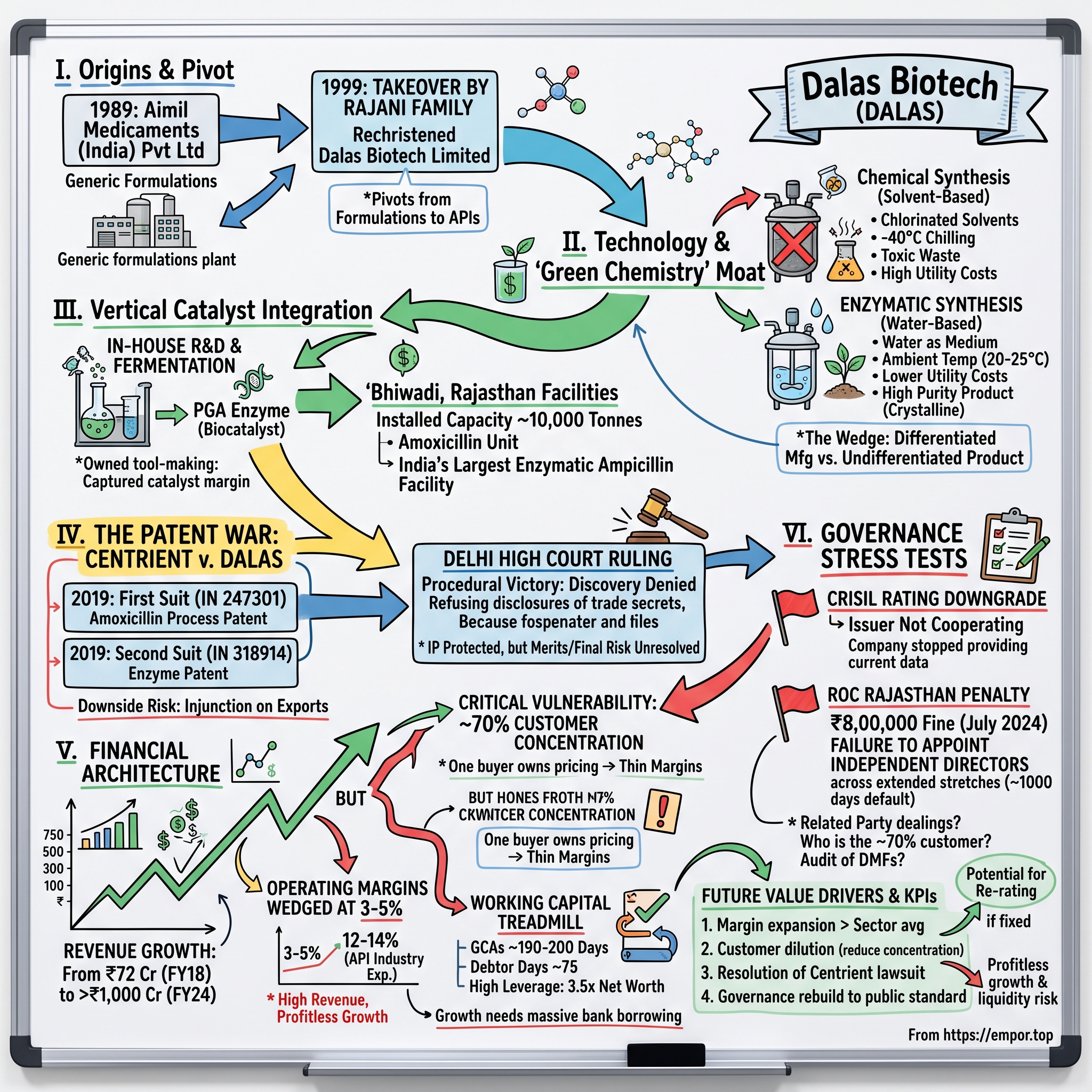
Dalas Biotech: The Story of India's Enzymatic Antibiotic Engine
I. Introduction & Episode Roadmap (0:00–0:10)
Almost everyone reading this has, at some point, swallowed a capsule of amoxicillin. It is one of the most-prescribed medicines on Earth, a first-line antibiotic on the World Health Organization's essential-medicines list, and for most patients it is utterly unremarkable — a few rupees or cents per dose, taken for a week, forgotten. What almost no one thinks about is where the actual drug molecule inside that capsule comes from. The answer, more often than the branded packaging would suggest, is a cluster of reactors and fermenters in Bhiwadi, an industrial town on the Rajasthan–Haryana border about fifty kilometres south-west of Delhi. One of the companies operating there is Dalas Biotech Limited, an unlisted public company that has quietly scaled to revenue exceeding ₹1,000 crore — roughly $120 million — by manufacturing active pharmaceutical ingredients, the bulk-drug molecules that formulation companies press into pills.12
The label attached to this story is "Startup," but that word needs immediate qualification, because Dalas is not a startup in the venture-capital sense at all. It has no disclosed institutional funding round, no unicorn mark, no lead investor, no preferred stock with liquidation preferences to unpack. It is a thirty-seven-year-old, family-controlled bulk-drug manufacturer that has never sold equity to an outside financial investor of record.2 "Startup" here is a lifecycle marker — a company that might, someday, seek a public listing — rather than a description of its financing history. That distinction matters enormously for how the company gets underwritten, because the usual pre-IPO exercise of decoding a private valuation is not available. There is no private price to interrogate. There is only the operating record, the registry filings, the credit reports, and the court documents. That is both a limitation and, in a sense, a gift: the analysis is forced to reason from evidence a long-term owner would actually need, rather than from a headline someone else negotiated.
The paradox that makes the company interesting is the gap between the size of its output and the fragility of its economics. Global antibiotic supply chains are startlingly consolidated and startlingly cheap. The molecules are decades off patent, the buyers are ruthless on price, and the raw-material chain runs disproportionately through Chinese fermentation hubs. Into that hyper-competitive commodity arena Dalas carved a specific wedge: it bet on "green chemistry," pivoting from legacy solvent-based chemical synthesis to enzyme-driven biocatalysis — a water-based, ambient-temperature process that is cleaner, cheaper on utilities, and yields the high-purity crystalline product that regulated-market buyers demand.3 It is a genuinely differentiated manufacturing story wrapped around a genuinely undifferentiated product.
The roadmap for what follows: first, the takeover of a sleepy 1989 formulations business, Aimil Medicaments, and its reinvention as an API specialist. Second, the scientific shift from toxic solvent chemistry to fermentation-engineered enzymes, and why it matters commercially rather than merely environmentally. Third, the high-stakes patent war with the global enzymatic-antibiotic pioneer Centrient Pharmaceuticals, fought in the Delhi High Court. Fourth, and most important for anyone underwriting the business, the financial and governance stress tests — customer concentration reported at around 70%, operating margins wedged between roughly 3% and 5%, a credit rating parked in "issuer not cooperating," and an ₹8 lakh regulatory penalty for a board that failed for years to appoint the independent directors the law required.45 Scale without margin, and capability without governance: that is the tension the whole episode turns on.
There is one more framing to establish before the story, because it shapes what "pre-IPO" even means here. A conventional venture-backed company approaching a listing arrives with a thick paper trail: a series of priced rounds, a cap table full of preferred stock and option pools, investor rights agreements, and a most-recent mark that the whole market treats as a reference point. Dalas has none of that. It is a company that could theoretically list — Indian bulk-drug and specialty-chemical firms have gone public in waves over the past few years — but it has not filed a draft red herring prospectus, has not appointed bankers of record, and has not, on the public record, taken a rupee of outside equity. Everything an investor would want to see in a filing — the audited three-year financials, the promoter shareholding schedule, the related-party transaction register, the litigation risk factors, the use-of-proceeds plan, the lock-up terms — does not yet exist in public form. The correct way to treat that absence is not as reassurance ("nothing bad has been disclosed") but as a list of diligence items still owed. Where a question a filing would answer meets a record that does not, the honest move is to flag it as exactly that: a thing to be checked, not a thing that is fine.
A note on method before the narrative, because it governs everything after. Price and value are separate questions, and in Dalas's case there is not even a price to start from — no round, no mark, no range. So value gets built from the operating evidence outward: revenue and its quality, the margin structure, the working-capital drag, the leverage, the reinvestment the model demands, and the maturation path that would have to hold for the business to throw off durable free cash flow. Where a number is knowable, this account states it and cites it; where it is not — the exact net profit, the fully diluted equity picture a filing would carry, the terms of any future issuance — the right answer is "not disclosed" rather than an invented one. That posture is not scepticism for its own sake. It is the only honest way to underwrite a company whose most-cited figure, "₹1,000 crore of revenue," describes the top of the income statement and tells you almost nothing about what the equity beneath it is worth.
 Subscribe on LinkedIn
II. Company Origins: From Aimil Medicaments to Dalas Biotech (0:10–0:25)
The corporate entity that is now Dalas Biotech was born in 1989, and not as a biotechnology company at all. It was incorporated in July 1989 as Aimil Medicaments (India) Private Limited, a conventional pharmaceutical formulations business in Bhiwadi, carrying a corporate identity number — U24232RJ1989PLC005056 — that still anchors its registry file today.2 Bhiwadi was, and remains, a sprawling industrial estate: cheap land, proximity to Delhi's logistics, a state government eager for manufacturing investment, and the kind of anonymity that suits a business making chemical intermediates rather than consumer brands. For its first decade the company was unremarkable, one of thousands of small pharma outfits in northern India.
The pivot came in 1999. Mr. Atul Rajani and his late co-promoter Anil Rajani — identified in CRISIL's rating rationale as his father — took over the company, and with the takeover came a change of direction and, eventually, of name.5 The business was rechristened Dalas Biotech Limited, and the new label was a statement of intent: away from standard formulations, toward capital-intensive, biotechnology-driven bulk-drug manufacturing. It is worth being precise about the founder framing here, because the company's own website today presents Atul Rajani as "Founder & CEO."6 In the literal corporate sense he is not the founder — the entity predates him by a decade — but he is unambiguously the founder of the modern Dalas, the operator who converted a formulations shell into an antibiotic-API engine. Investors should simply hold both facts at once: the marketing narrative compresses a 1999 acquisition into a founding myth, and the compression, while common, is worth noticing.
To understand why the Rajanis made the bet they made, you have to picture the Indian pharmaceutical industry at the turn of the millennium. This was the period in which India earned its reputation as "the pharmacy of the world" — a generics powerhouse built on process-chemistry ingenuity and low-cost skilled labour. But the API layer beneath the branded generics was already under siege. Chinese chemical-synthesis hubs, backed by scale, subsidised utilities, and integrated raw-material supply, were driving the price of commodity antibiotic ingredients relentlessly downward. An Indian API maker competing head-on with China on conventional chemistry was competing on a battlefield tilted against it. The strategic question the Rajanis faced was the one every commodity manufacturer eventually faces: if you cannot win on price using the same process as everyone else, you need a different process. That search for a manufacturing moat — a way to make the same molecule more cheaply and more cleanly than the Chinese incumbents — is the thread that runs through the entire subsequent history, and it led them, unusually for a small Bhiwadi firm, toward enzymes.
It helps to sit for a moment with the specific structure of that battlefield, because it explains the shape of every decision that followed. Antibiotics are among the oldest and most commoditised drug classes in the world. Penicillin chemistry is nearly a century old; amoxicillin and ampicillin have been off patent for decades; and the molecules are so standardised that a buyer treats one qualified supplier's amoxicillin as functionally interchangeable with another's. When a product is a true commodity, there are only two ways to make money: be the lowest-cost producer, or find a defensible reason a buyer will pay you a premium — usually quality, reliability, or regulatory access. China had seized the lowest-cost position through the 2000s by integrating backward into fermentation, subsidising power and land, and running at a scale no individual Indian firm could match. That left Indian API makers to fight for the second lever: a process that was either cheaper on a specific cost line the Chinese could not easily replicate, or cleaner in a way that regulated Western buyers would reward. Enzymatic synthesis, as the next section shows, promised both at once — which is why a small, capital-constrained family firm was willing to make an unusually science-heavy bet on it.
There is also a supply-chain dependency baked into this origin that will matter later. Even an enzymatic amoxicillin process starts from the penicillin core, 6-APA, and 6-APA itself is made by fermentation at massive scale — a step dominated globally by Chinese producers and, in India, by the largest integrated players. A firm that makes finished antibiotic APIs but buys its 6-APA is, by construction, exposed to the price and availability of an input controlled by the very competitors it is trying to undercut. The Rajanis' enzyme integration addressed one link in the chain — the catalyst — but not this one, and the un-integrated 6-APA link remains a structural feature of the business three decades on. Understanding the origin as a search for a manufacturing moat also means understanding which parts of the moat the company built and which it left open.
The human texture of the early years is thin in the public record, which is itself informative. This was never a company that courted attention. There are no glossy founder interviews from the 2000s, no venture blog posts, no conference keynotes. What exists instead is a registry trail and, later, a credit trail: a business that grew by reinvesting cash and borrowing from banks, run tightly within a family, disclosing the minimum the law demanded. For an underwriter, the absence of a promotional paper trail is a double-edged signal. It suggests operators focused on the plant rather than the pitch — a point in their favour on execution. It also means the institutional habits a public company needs — independent oversight, proactive disclosure, engagement with rating agencies — were never built, because the business never needed them to raise the capital it used. That gap becomes the story's central governance problem, and its roots are right here, in a company that spent its formative decades answering to no one but its bankers and its founding family.
III. The Technology Shift: Moving from Chemical to Enzymatic Synthesis (0:25–0:45)
To grasp why Dalas's manufacturing bet is genuinely differentiated rather than merely marketed as such, you have to understand what making a beta-lactam antibiotic the old way actually involves. Amoxicillin and ampicillin belong to the penicillin family, and the traditional route to them is a feat of brute-force chemistry. It begins with the penicillin nucleus — 6-aminopenicillanic acid, or 6-APA — and attaches a specific side chain to it. Doing that chemically requires protecting the reactive parts of the molecule with silylating agents, running the coupling reaction at deeply sub-zero temperatures (the industry works down toward -40°C to keep the fragile intermediates from degrading), and using hazardous chlorinated solvents such as dichloromethane as the reaction medium.3 The process is multi-step, energy-hungry, and dirty: it consumes enormous refrigeration power, generates streams of toxic solvent waste, and can leave chemical trace impurities in the final product. It works, and it has made antibiotics abundant, but it is expensive to run cleanly and increasingly awkward to run at all in jurisdictions tightening their environmental screws.
The enzymatic route replaces this chemical violence with biology. At its centre is a single biocatalyst — an enzyme called penicillin G amidase, or PGA — which does in one gentle step what the chemical process does in several harsh ones. PGA catalyses the condensation of the 6-APA core with the side-chain precursor directly, in water, at ambient temperature. Think of the difference as the gap between forcing two puzzle pieces together with a hammer in a freezer and having a specialised robotic hand click them together at room temperature on a workbench. The enzyme is exquisitely specific: it joins exactly the right pieces in exactly the right orientation and largely ignores everything else, which is why the reaction produces fewer side products and a cleaner crystalline output.3
The commercial logic follows directly from the chemistry, and it is worth separating the three distinct advantages because they compound. The first is solvent elimination: replacing volatile chlorinated organics with water removes both a raw-material cost and a waste-disposal liability, and it neatly sidesteps the regulatory risk that hangs over solvent-heavy plants. The second is utility cost: running a reaction at 20–25°C instead of chilling it toward -40°C strips out a large slice of the electricity and refrigeration bill, which in a thin-margin commodity business is not a rounding error but the difference between a viable and an unviable unit. The third is purity: enzymatic specificity yields high-quality crystalline APIs with fewer impurities, and purity is precisely what buyers in regulated markets — the United States, Europe — will pay a small premium for and, more importantly, will refuse to buy without.3
It is worth dwelling on why purity, in particular, is not a soft "nice to have" but a hard commercial gate, because this is where the enzymatic advantage translates most directly into access to the markets worth selling into. Regulated jurisdictions — the United States under the FDA, Europe under the EMA — do not merely want an API that is amoxicillin; they want an amoxicillin with a fully characterised impurity profile, because every trace side-product is a potential safety and stability question the buyer's own regulatory filing must answer. A chemical process that drags along solvent residues and reaction by-products forces the downstream formulator to purify further, to file more data, and to defend more unknowns. An enzymatic process that produces a cleaner crystal shortens that burden. In practice this means the enzymatic route does not just lower cost; it widens the set of customers a producer can credibly serve, because it clears the impurity bar that the most demanding — and best-paying — buyers impose. For an exporter, that is the difference between selling into low-margin unregulated markets and selling into the regulated ones where quality commands a premium.
The energy dimension deserves a plain-language emphasis too, because it is the part of the cost advantage least visible from the outside and most durable. Chilling a large industrial reactor toward -40°C and holding it there is one of the most energy-intensive things a chemical plant does; refrigeration at that scale is a continuous, brutal draw on electricity. Running the same transformation at 20–25°C does not merely trim the power bill — it removes an entire category of capital equipment and operating cost. In a business where the finished product sells for a few dollars a kilogram and the margin is a few percent, a structural reduction in the single largest utility line is not a footnote; it is potentially the whole difference between a plant that covers its cost of capital and one that does not. That is the theory. Whether Dalas actually banks that difference, or hands it to its dominant customer, is the question Section VI returns to.
Here, though, the disciplined reader has to draw a line between the claim and the proof. That enzymatic synthesis is cleaner and structurally cheaper on utilities is not really contestable — it is chemistry, and the global pioneer of the technology, Centrient, built an entire franchise on exactly this thesis. What is not established from the public record is how much of that theoretical cost advantage Dalas actually captures and retains at the bottom line. A process can be genuinely superior in the beaker and still lose the gain to scale disadvantages, raw-material pricing, or a customer powerful enough to extract the savings for itself. And that is exactly what the financials appear to show: a company running a demonstrably efficient process at operating margins of only 3–5%, far below the 12–14% the broader Indian API industry was expected to earn.57 The green-chemistry wedge is real as engineering. Whether it is real as durable economics is the question the margin line keeps answering "not yet."
IV. Building the Enzymatic Moat: Fermentation-Based Biocatalysis & Scale (0:45–1:05)
The deepest version of Dalas's manufacturing bet is not simply that it uses enzymes — plenty of API makers now do — but that it makes its own. The enzyme, PGA, is itself a manufactured biological product, and most API players who run enzymatic processes buy it from a small number of specialist global producers, paying a recurring toll to a supplier who sits upstream of their core reaction. Dalas's structural choice was to build in-house R&D and fermentation capacity to produce its own PGA, integrating backward into the very catalyst that defines its cost advantage.6 If the enzyme is the tool that makes the cheaper antibiotic possible, then owning the tool-making means owning the moat rather than renting it.
The enzyme is grown, not synthesised. Through fed-batch fermentation — the same broad technique used to brew industrial quantities of everything from insulin to citric acid — genetically optimised microbial strains are cultured in large bioreactors, fed nutrients on a controlled schedule, and induced to express high-activity PGA, which is then harvested and immobilised for use in the antibiotic reactors. Dalas's facility is built around this: the company describes four dedicated manufacturing units in Bhiwadi, including a fermentation unit running bio-fermenters spanning from 20 litres up to 20,000 litres, alongside a dedicated amoxicillin unit with fifteen reactors and precision temperature control, an ampicillin unit it bills as India's largest enzymatic ampicillin facility, and an intermediates unit.3 The plants are WHO-GMP certified, and the company states its products meet IP, BP, EP and USP pharmacopoeial specifications — the quality passports required to sell into regulated jurisdictions.3
The scale is substantial for a non-conglomerate. The company reports headline annual capacities in the range of 6,000 tonnes-plus of amoxicillin, roughly 1,200 tonnes each of ampicillin and cloxacillin, and several hundred to around a thousand tonnes each of cephalexin and cefadroxil, for a combined installed capacity it puts at around 10,000 tonnes and delivered volume of some 20,000 tonnes over the last five years.1 It claims an average annual growth rate above 35% over the last decade — a figure consistent with the revenue trajectory the credit record independently shows, from around ₹72 crore in FY2018 to over ₹1,000 crore by FY2024.51 Capacity numbers from a company's own marketing should always be read as nameplate rather than utilised, and the split across products is not independently audited, but the order of magnitude is corroborated by the revenue and by an environmental-clearance trail for bulk-drug and intermediate expansion at the Bhiwadi site.[^8]
There is a subtle but important economic point buried in the enzyme-integration decision, and it is worth making explicit because it is the strongest single argument for the business. An immobilised enzyme is not consumed in a single reaction the way a chemical reagent is; it is a reusable catalyst that can drive many cycles before it loses activity and must be replaced. A producer who buys PGA from a global specialist pays a per-batch toll and depends on that supplier's pricing, availability, and — in a competitive twist — that supplier's willingness to keep selling to a customer who is also a downstream rival. A producer who makes its own enzyme converts that variable external cost into a fixed internal capability, captures the specialist's margin for itself, and removes a point of leverage a competitor could otherwise pull. In a commodity where every fraction of a percentage point of cost matters, owning the catalyst is the kind of quiet, compounding advantage that does not show up in a product brochure but does show up, over years, in the ability to survive price wars that kill less-integrated rivals. This is the genuine core of the Dalas thesis, and it is real.
The honest counterweight is that "makes its own enzyme" is a claim the public record cannot fully verify as a sustained cost advantage. The public record confirms the company operates fermentation capacity and markets in-house biocatalysis; it does not confirm the yield, the activity, the cost per cycle, or how those compare with buying from Centrient or a Chinese enzyme house. The proof that would settle it — a gross-margin line materially above un-integrated peers — is precisely what the thin overall margin fails to show. It is entirely possible that the enzyme integration is a real advantage that is being entirely absorbed by the customer-concentration disadvantage downstream, leaving the two to net out near breakeven. That is a coherent reading of the evidence, and it is why the moat, though real, cannot yet be called value-creating on the numbers.
Now the moat has to be sized honestly against the competition, because scale in absolute terms and scale relative to rivals are different things. Dalas competes in a field that includes Aurobindo Pharma — a multi-billion-dollar, vertically integrated giant that makes its own 6-APA, the very penicillin core Dalas must buy — as well as specialised listed players such as Kopran, Aarti Drugs, and Nectar Lifesciences.1 Against Aurobindo, Dalas is a minnow: it lacks the balance-sheet depth, the backward integration into 6-APA, and the regulated-market registration breadth of a company an order of magnitude larger. Its edge is narrower and more specific — cost and purity on particular beta-lactam niches, enabled by in-house enzyme production. In Hamilton Helmer's vocabulary this is Process Power: a way of doing the work that is embedded in the organisation, hard to replicate quickly, and expressed as a superior cost-and-quality position. But Process Power in a commodity is a defence, not a fortress. It protects the niche; it does not confer pricing power, as the 3–5% margins make plain. The company that makes its own catalyst still sells a molecule the whole world can make, to a customer base concentrated enough to capture most of the surplus. The moat is real. It is also shallow, and its shallowness is measured precisely by the margin the process fails to convert into profit.
V. The Patent War: Centrient vs. Dalas Biotech in the Delhi High Court (1:05–1:25)
Nothing validates a small company's threat to an incumbent quite like the incumbent's lawyers. In 2019, Dalas's growing enzymatic-amoxicillin export footprint drew the attention of Centrient Pharmaceuticals — the Netherlands-headquartered business formerly known as DSM Sinochem, and the original global pioneer of enzymatic antibiotic manufacturing. Centrient had built its franchise on precisely the clean, solvent-free chemistry Dalas was now deploying, and it moved to defend that turf in India's courts.
The first strike came on 25 April 2019, when Centrient filed a patent-infringement suit in the High Court of Delhi. It alleged that Dalas's process for producing amoxicillin trihydrate infringed Indian Patent No. 247301, which covers an enzymatic process for preparing amoxicillin trihydrate with a low free-water content, and it sought damages and a permanent injunction against Dalas's manufacture, use, sale in India, and — critically for an exporter — export from India.8 Centrient's chief executive at the time, Karl Rotthier, framed it as a matter of principle and deterrence, saying the company would "continue to rigorously enforce its IP assets worldwide against any additional potential infringers in India or abroad."8 Six months later, on 14 October 2019, Centrient escalated with a second suit, this one targeting Indian Patent No. 318914 — an innovative enzyme used in the amoxicillin manufacturing process. Where the first suit went after the product-by-process, the second went after the biocatalyst itself.910 Read together, the two suits were an attempt to attack Dalas at both ends of its moat: the antibiotic it sold and the enzyme it made to produce it.
To understand why Centrient bothered — why a global manufacturer would spend years litigating against a Bhiwadi firm a fraction of its size — you have to see the enzymatic-antibiotic business from the incumbent's chair. Centrient, as DSM Sinochem, had effectively invented the commercial enzymatic route to beta-lactam antibiotics and had spent heavily building both the patent estate and the manufacturing know-how around it. Its entire premium over commodity chemical producers rested on the argument that its clean, green process was proprietary. If a low-cost Indian challenger could deploy substantially the same enzymatic advantage and undercut it on price into the same regulated export markets, the premium erodes and the patent estate starts to look like a paper asset rather than a real barrier. Litigation, in that light, is not merely about one infringement; it is about signalling to every potential imitator that the technology is defended. Rotthier's own framing — enforcing "worldwide against any additional potential infringers" — is the language of deterrence, not of a narrow commercial dispute.8
That context also sizes the stakes correctly for Dalas. The remedy Centrient sought was not only damages but an injunction reaching Dalas's export from India, and export to regulated markets is exactly where the enzymatic process pays off. A firm selling commodity amoxicillin into unregulated markets barely needs the clean process; a firm selling into the US and Europe needs it and monetises it. An injunction against export would therefore not trim a peripheral revenue line — it would strike at the specific, higher-value channel the entire enzymatic strategy exists to reach. This is why the litigation belongs in an underwriting rather than a footnote: its downside is not proportional to its probability, and a low-probability event that could disable the crown-jewel channel is precisely the kind of asymmetric risk a public-market investor is paid to price.
The decisive battle, though, was not over infringement in the abstract — it was procedural, and it turned on discovery. To prove infringement of a process patent, a plaintiff must show what process the defendant actually uses, and that process is exactly the trade secret a manufacturer will fight hardest to protect. Centrient pressed the court to compel Dalas, through interrogatories, to hand over its most sensitive technical documents: its Drug Master Files, its common technical documents, its master formula records — in effect, the complete recipe for how Dalas makes its antibiotics.11 For Dalas, complying would have meant surrendering the operational core of its business to a direct competitor under the cover of litigation.
The Delhi High Court declined to order it. In a ruling that Indian intellectual-property commentators treated as significant, the court characterised Centrient's demand as a "fishing and roving inquiry" — an attempt to extract proprietary trade secrets rather than a targeted request for facts genuinely necessary to the case.11[^13] The reasoning leaned on Section 104A of the Indian Patents Act, which governs the burden of proof in process-patent disputes: the court's logic was that the plaintiff must first establish, through its own evidence, that the defendant's product is identical or substantially identical before it can demand that the defendant disclose its entire process. Centrient could not shortcut that sequence by using interrogatories to obtain the very information its own case had not yet earned the right to see.[^13] The application was dismissed, and Dalas's core operational IP stayed inside the company.
For an underwriter, the right way to weigh this is with care about what it did and did not settle. It was a procedural victory, and a meaningful one: it preserved Dalas's trade secrets and signalled that a well-lawyered small Indian firm can resist aggressive discovery by a global patentee using local procedural law. That is a genuine, repeatable playbook, and it is a point of real credit to management's willingness to fight. But it decided nothing about whether Dalas's process ultimately infringes Centrient's patents. The underlying question — does the Dalas route fall inside the claims of IN 247301 or IN 318914 — remained live, and the public record does not establish a final, merits adjudication in Dalas's favour. That unresolved tail is exactly the kind of contingent liability a prospectus would have to disclose as a risk factor, and its shadow falls most heavily on the export engine, because an injunction against export is the specific remedy Centrient sought. A litigation loss would not dent Dalas at the margin; it could halt the amoxicillin export business that the whole enzymatic bet was built to serve. The procedural win bought time and protected the recipe. It did not retire the risk.
VI. The Financial Architecture & The 70% Customer Concentration Dilemma (1:25–1:45)
Strip away the green-chemistry narrative and the patent drama, and the financial architecture of Dalas is the plain, unforgiving arithmetic of bulk drugs: enormous volume, razor-thin margin, and a balance sheet that has to swell with every rupee of growth. The revenue trajectory is genuinely impressive on its face. The credit record shows the company at roughly ₹72 crore of revenue in FY2018, ₹158 crore in FY2019, an estimated ₹186 crore in FY2020, and a projection to cross ₹250 crore in FY2021; registry-sourced figures then put FY2024 revenue at about ₹1,050 crore, up roughly 43% year-on-year.52 Compounding from ₹72 crore to over ₹1,000 crore in six years is a real operational achievement. The problem is what that revenue converts into.
Operating margins have historically sat in a band of about 3–5%, and CRISIL pegged them at 4–5% in the periods it rated.5 To feel how thin that is, hold it against the industry: ICRA expected Indian API companies to earn operating margins of 12–14% in FY2025.7 Dalas, running a process it markets as structurally cheaper, earns roughly a third of the industry-expected margin. A 4% operating margin means that for every ₹100 of antibiotic Dalas ships, ₹96 is cost, and after interest on its borrowings and tax, the sliver that reaches net profit is thinner still. Registry data indicated net profit rose sharply — up more than 200% year-on-year into FY2024 — but off a very low base and without a disclosed absolute figure, so the correct reading is "improving, small, and volatile," not "robust."2 The single most important consequence of a 3–5% margin is fragility: a 15–20% surge in the price of a key input such as 6-APA or a side-chain precursor, of the kind the sector saw in early 2025, can wipe out operating profit entirely, because there is almost no cushion between cost and price to absorb it.7
The reason the margin is so thin is not primarily the process — it is the customer. CRISIL disclosed that roughly 70% of Dalas's revenue came from a single customer.5 This is the central vulnerability of the entire business, and it deserves to be seen from both sides. On the benign reading, a decade-long relationship with one large buyer — most plausibly a major domestic formulations aggregator or a global generics brand — delivers predictable off-take, order-backed production planning, and the volume that justifies building 10,000 tonnes of capacity in the first place. Concentration and scale are, to a degree, the same coin. On the malign reading, a buyer supplying 70% of your revenue owns your pricing. It knows it is your survival, and it prices accordingly, which is a large part of why the structurally cheaper process still yields a 4% margin: the cost saving the enzyme creates is captured by the customer, not retained by Dalas. In Porter's terms, the bargaining power of buyers here is not merely high; it is close to absolute. And the tail risk is stark — if that customer dual-sources, in-sources, or simply leaves, the volume that keeps the plant near breakeven evaporates, and a capital-intensive facility running below its utilisation threshold turns cash-negative fast.
Then there is the working capital, which is where thin margins become a liquidity problem. Bulk-drug manufacturing of this kind carries heavy inventory of intermediates and extends long credit to buyers, and CRISIL described gross current assets running at roughly 190–200 days — well above the 150 days it flagged as the threshold for comfort.5 Debtor days ran around 75, with a striking detail: about a quarter of receivables were outstanding beyond six months, a sign of just how much financing power the dominant customer holds.5 Inventory ran 120–130 days. The upshot is that every incremental rupee of revenue growth demands a further chunk of working-capital funding, which the company has met with bank borrowing — CRISIL noted bank-limit utilisation averaging around 90%, and a capital structure it called highly leveraged, with total outside liabilities at 3.5 times net worth and heading higher.5 This is the treadmill of profitless growth: the faster Dalas grows, the more cash it must sink into inventory and receivables, and the more it must borrow to do so, which is why a company with over ₹1,000 crore of revenue carried a net worth of only about ₹31 crore at the FY2020 rating and an interest-coverage ratio around 2.2 times.5 The revenue chart points up and to the right. The balance sheet explains why that chart has not made anyone rich.
The quality of the revenue. Before valuing anything, an investor has to ask what kind of revenue this is, because a rupee of durable, high-retention revenue is worth far more than a rupee of contestable, low-switching-cost revenue — and Dalas's is decidedly the latter in structure. This is transactional, commodity revenue: bulk shipments of off-patent molecules, priced against a global spot market, sold predominantly to a concentrated buyer base under commercial terms the public record does not disclose. There is no recurring subscription, no contracted multi-year minimum that has been made public, no proprietary formulation that locks the customer in. What retention exists is relationship-based and volume-based — a long-standing supply relationship with the dominant buyer — rather than structural. The durability of the growth spike from ₹72 crore to ₹1,000-plus crore is therefore genuinely uncertain: it could reflect a widening, diversified customer base (good), or deepening dependence on a single relationship scaling its own demand (fragile). The 70% concentration figure strongly suggests the second. In plain terms, this is revenue that must be re-won, batch by batch, on price — which is exactly the profile that markets assign a low multiple, because the visibility into next year's cash flow is weak and the pricing power protecting this year's is weaker still.
The reachable market versus the category. It is easy to wrap Dalas in a large number — the global antibiotics API market runs into many billions of dollars and grows with population, access, and antimicrobial demand. But category TAM is not reachable market. Dalas's reachable market is defined by the specific beta-lactam molecules it makes, the specific geographies its registrations and relationships let it serve, and the specific price point at which its cost structure is competitive. Within that reachable frame, it is a niche cost-and-purity player competing against integrated giants above and Chinese overcapacity below, and its share of the molecules it does make is constrained less by demand than by capital — every additional tonne of share requires more working capital the balance sheet strains to fund. Growth from here is therefore not a matter of a vast TAM waiting to be captured; it is a matter of whether the company can add capacity and customers faster than the working-capital treadmill and the concentration risk allow. That is a much narrower, much more capital-bound growth story than the category headline implies.
A pre-listing read on value. Because there is no funding round and no private mark, valuation has to be reasoned rather than quoted, and it should be expressed as a wide range hedged with caveats rather than a number. The company's authorised capital is ₹10 crore and its paid-up capital about ₹4.48 crore, held almost entirely within the Rajani family; there is no disclosed option pool, no preferred stock, no convertible, and no free float, so any "market capitalisation" is a hypothetical, not an observable.2 Work it from the operating base instead. On roughly ₹1,050 crore of revenue at a ~5% operating margin, operating profit is on the order of ₹50 crore and EBITDA perhaps ₹65–75 crore before the heavy interest burden. Listed Indian API peers have traded across a wide band — Aarti Drugs around 13 times EV/EBITDA, Kopran around 15 times, and the more troubled Nectar Lifesciences down near 6 times.12 Even generously applying a mid-single-digit-to-low-teens EV/EBITDA multiple to Dalas would imply an enterprise value in the ballpark of a few hundred crore to perhaps ₹900 crore, from which a leveraged balance sheet's net debt — implied at somewhere around ₹150–170 crore — must be subtracted to reach equity value.2 But a mechanical peer multiple overstates the case, because Dalas should trade at a discount, not parity: its margin is a third of the sector's, its revenue depends 70% on one buyer, its balance sheet is stretched, and its governance and disclosure record (below) is exactly the sort that institutional buyers penalise. The honest conclusion is not a target price but a shape: this is a large-revenue, low-quality-of-earnings business whose intrinsic equity value is modest relative to its top line and highly sensitive to two variables — whether margins can rise toward the industry's 12–14%, and whether the customer concentration can be diluted. Absent progress on both, the enterprise is worth a low multiple of a small profit, not a high multiple of a large revenue.
A scenario frame, not a point estimate. The most useful way to hold the value is as three coherent futures rather than one number. In a bear case, margins stay stuck at 3–4%, an input-cost shock or a customer renegotiation compresses them further, and the leverage that was tolerable while rates and utilisation cooperated becomes a liquidity problem; here the equity is worth little more than its stretched book value, and possibly less, because a forced deleveraging would come at the worst price. In a base case, the business holds its ground — mid-single-digit margins, revenue growing with the dominant customer, working capital funded but never comfortable — and the equity is worth a modest multiple of a modest profit, the kind of number that makes Dalas a viable private business but an unexciting public one. In a bull case, product diversification and the regulatory tailwind toward clean processes lift operating margins toward the sector's 12–14%, the customer mix broadens, and the same ₹1,000-plus crore of revenue suddenly drops several times more profit to the bottom line; on that arithmetic the equity could be worth a large multiple of today's, because the operating leverage on a thin-margin business is enormous — doubling the margin far more than doubles the profit. The gap between these cases is not a rounding error; it is the difference between a distressed deleveraging and a re-rating, and which one obtains depends almost entirely on the margin line and the concentration line, not on revenue growth. That is the single most important thing to understand about valuing Dalas: at this margin, more revenue is not the lever. Margin is.
Why the peer multiples must be handled with care. It is tempting to grab a listed comparable — Aarti Drugs at roughly 13 times EV/EBITDA, Kopran near 15 — and apply it to Dalas's EBITDA to manufacture an equity value.12 That would be a category error for several reasons, and naming them is more useful than the number it would produce. First, those peers earn double-digit operating margins and Dalas earns 3–5%, so Dalas's EBITDA is not just smaller but lower-quality and more volatile, warranting a lower multiple, not the same one. Second, those peers are listed, liquid, and audited to public standard, with independent boards and rating-agency cooperation; Dalas is none of those, and each gap is a discount. Third, an EV/EBITDA multiple produces an enterprise value, from which Dalas's meaningful net debt must be subtracted to reach equity — and comparing Dalas's implied equity value against a peer's EV multiple, or vice versa, would mix the two bases and mislead. The correct use of the peers is directional: they establish that clean, well-governed Indian API businesses with double-digit margins earn low-to-mid-teens EV/EBITDA multiples, which tells you the ceiling Dalas could approach if it fixed its margin, governance, and concentration — and, by the size of the gap, how far it currently sits below that ceiling. Nectar Lifesciences, trading down near 6 times EV/EBITDA amid its own troubles, is the more apt reference for a stressed API name, and even it is a public, listed company Dalas has not yet become.12
The enterprise-value bridge, honestly incomplete. A rigorous underwriting wants to move from equity value to enterprise value and back through cash, debt, and lease-like obligations. Here the record only half-permits it. The company is visibly highly leveraged — CRISIL's total-outside-liabilities-to-net-worth of 3.5 times and rising, near-90% bank-limit utilisation, and registry data implying total debt on the order of ₹150–170 crore against FY2024 revenue — but the public record does not show a clean, current cash balance, the full maturity schedule, or any off-balance-sheet or lease financing a filing would itemise.52 The consequence is that a precise EV bridge cannot be built from the public record, and any headline "market capitalisation" someone might quote at a hypothetical listing would be an implied figure resting on undisclosed inputs. This is not a defect to paper over with an assumption; it is one of the concrete diligence items a real prospectus would have to supply, and until it does, the enterprise value can only be bracketed, not calculated.
The path to durable free cash flow — and what must change. The ultimate test of any business is not accounting profit but the cash it can distribute after funding everything it needs to keep running and growing, and on that test Dalas has a structural problem that the revenue chart hides. Consider the mechanics. Operating profit is thin, at 4–5% of sales. Out of that must come interest on a heavily leveraged balance sheet, which at 2.2 times interest coverage consumes a large share of operating profit before a rupee reaches equity.5 Then growth demands more working capital — with gross current assets at 190–200 days, every incremental ₹100 of revenue ties up a substantial slug of cash in inventory and receivables before it is collected — and capacity expansion demands capex on top of that.5 Stack these and the picture is a company whose operating cash generation is largely re-consumed by interest, working capital, and reinvestment, leaving little genuine free cash flow despite a large and growing top line. This is the definition of profitless growth, and it is why net worth stayed small even as revenue multiplied.52 For the model to produce sustainable free cash flow, several things must improve in a specific order: the operating margin must rise (so there is surplus after interest), the working-capital cycle must shorten below the ~150-day comfort threshold (so growth stops consuming all the surplus), and the leverage must come down (so interest stops eating what is left). None of these is impossible, but they are interdependent — margin funds deleveraging, deleveraging cuts interest, lower interest frees cash for working capital — and the evidence that would falsify the optimistic path is simple to state: another year of flat 4–5% margins with gross current assets above 150 days would demonstrate that the model, at scale, still cannot convert revenue into distributable cash. That is the number to watch, and so far the record has not cleared it.
VII. Governance and the Credit Rating Downgrade: ROC Penalties and CRISIL Non-Cooperation (1:45–2:05)
If Section VI is about the arithmetic of the business, this section is about the trust deficit around it — and for a company that might one day ask the public to buy its shares, the trust deficit may matter more than the arithmetic. Two threads run through it: what the company has told its lenders, and what it has told its regulator. Neither reflects well.
Start with the credit rating. CRISIL, one of India's principal rating agencies, moved Dalas into the "issuer not cooperating" category, meaning it continues to publish a rating on the company's bank facilities but does so on the basis of best-available information because the company stopped providing the current data the agency needs to conduct a proper review.134 The bare fact — an issuer declining to cooperate with its rating agency — is one of the more reliable red flags in Indian credit analysis, and it is worth being clear about why, without over-reading it. Companies go non-cooperative for a range of reasons, some innocuous: a firm with no new borrowing to raise sees little point in paying for and servicing a rating process. But in an unlisted, family-managed company that is simultaneously highly leveraged and running at 90% bank-limit utilisation, the more concerning interpretations are hard to dismiss — tight liquidity a fresh review might expose, informal debt re-arrangements the family would rather not detail, or a general reluctance to submit closely-held financial transactions to outside professional scrutiny. The signal is not proof of distress. It is a refusal to let anyone check, and in credit, a refusal to be checked is itself information.
The second thread is sharper because it produced a formal legal finding. On 31 July 2024, the Registrar of Companies for Rajasthan, at Jaipur, passed an adjudication order imposing a total penalty of ₹8,00,000 on Dalas Biotech and its officer in default for failing to appoint independent directors as required by Section 149(4) of the Companies Act, 2013, read with Rule 4 of the associated rules.1415 The order is worth reading closely, because its details are more damning than the headline. The penalty was split ₹6,00,000 on the company and ₹2,00,000 on the Whole-Time Director — and here the public record corrects a common misstatement: the officer penalised was Sangita Rajani, the Whole-Time Director, not Atul Rajani, and she was ordered to pay from her personal sources.14 More telling still is the duration of the default. The ROC found Dalas non-compliant across two extended stretches — from 23 February 2018 to 14 March 2021, and again from 30 June 2021 to 5 January 2023 — together well over a thousand days without the independent board members the law mandates for a company of its size.14 This was not an oversight of a few weeks. It was a multi-year, repeated failure to build the most basic instrument of external oversight, cured only after the regulator moved.
These two facts also frame the specific diligence a public-market investor would demand before touching the equity, and it is worth listing them as the open questions they are rather than assuming their answers. Who is the ~70% customer, and are there written, enforceable minimum-offtake commitments, or is the relationship terminable at will? What are the terms of the intercompany and promoter dealings that a wholly family-owned, thinly-boarded company is structurally prone to — loans to or from related entities, guarantees, property or licensing arrangements, remuneration to family directors? What does the current, audited balance sheet actually show for cash, the full debt maturity profile, and contingent liabilities including the Centrient litigation? None of these has a public answer today, and in a family-controlled company that has resisted external scrutiny on two fronts, the absence of answers is not neutral. A future filing would be forced to disclose them; until it does, an investor should treat each as an unpriced risk rather than assume it is benign.
Put the two threads together and a pattern emerges that any public-market investor should weigh heavily. Here is a company that withheld current information from its rating agency and, for years, declined to seat the independent directors who might have asked uncomfortable questions from inside the boardroom. Both are choices, and both point the same way: toward a governance culture optimised for family control and minimal external accountability. The equity is held almost entirely by the Rajani family, which is genuine alignment — the promoters have real skin in the game, and their personal wealth rises and falls with the business.2 But concentrated ownership without independent oversight is a double-edged instrument. It aligns incentives on value creation while removing the checks that protect minority holders from the controlling family's discretion over related-party dealings, capital allocation, and disclosure. The aggressive capital expenditure into ever-more capacity despite persistently low margins is defensible as a growth strategy and worrying as an unchecked one; without an independent board and full rating-agency engagement, an outside investor simply cannot tell which it is. This is the "governance debt" the company has accumulated, and unlike financial debt, it does not appear on the balance sheet until it comes due — as a regulatory penalty, a rating downgrade, or, most consequentially, an inability to clear the diligence bar that public equity markets impose before they will fund you.
VIII. Playbook: Strategic Lessons for Founders, Biotech Innovators, and Investors (2:05–2:20)
Every good company story leaves behind transferable lessons, and Dalas offers four that are unusually clean precisely because the company embodies both the upside and the cost of each.
1. Vertical catalyst integration as a cost moat. If you run a process-driven chemical or biological business, control the thing that does the work. Dalas's decision to manufacture its own PGA enzyme rather than buy it from global specialists is the purest expression of a general principle: in a commodity, the durable advantage lives in owning the highest-leverage input in your cost stack, not in the finished product everyone can make. Making your own catalyst converts a recurring external toll into an internal capability that competitors cannot easily price-match. The caveat, which Dalas also demonstrates, is that a cost moat only creates value if you can keep the savings — and a buyer powerful enough can take them from you regardless of how clever your chemistry is.
2. IP asymmetric warfare. Emerging-market challengers can defend themselves against global patent-holding incumbents by fighting on home procedural ground rather than on the incumbent's terms. Dalas's win in the Delhi High Court came not from proving non-infringement but from refusing to be forced into disclosing its trade secrets, using Section 104A of the Patents Act and the doctrine against "fishing and roving" inquiries to shift the burden back onto the plaintiff.11[^13] The lesson for founders is that procedural resilience — good local counsel, a willingness to litigate, and knowledge of the burden-of-proof architecture — can be as protective as a patent portfolio. The caveat is that a procedural win preserves the fight; it does not end the war, and the merits question can still turn against you later.
3. The danger of scale without margin. Revenue is vanity when the margin is thin. Dalas generating over ₹1,000 crore at a 3–5% operating margin is a standing reminder that top-line scale can coexist with financial fragility, because at that margin a modest swing in raw-material cost or a single lost customer can erase profitability outright.57 Founders chasing a revenue milestone should ask what fraction of each incremental rupee actually reaches the owners, and investors should treat "₹1,000 crore business" as a description of activity, not of value.
4. The governance-debt trap. Deferring the unglamorous machinery of compliance — independent directors, rating-agency cooperation, proactive disclosure — to preserve control or save cost is a loan against the future that compounds silently and comes due at the worst moment.1413 Dalas's multi-year failure to seat independent directors cost it a regulatory penalty and a "not cooperating" rating flag, but the larger cost is optionality: a company carrying that governance debt cannot credibly approach public equity markets until it is repaid, and repaying it late is far more expensive than building it in early.
IX. Bull vs. Bear Case & Strategic Frameworks (2:20–2:40)
The most useful way to hold Dalas in mind is as a genuine capability wrapped in a fragile financial and governance shell, and the strategic frameworks earn their place only to the extent they sharpen that tension rather than decorate it.
Hamilton Helmer's 7 Powers. Dalas's strongest claim is Process Power — the in-house enzymatic production of PGA and the solvent-free, water-based manufacturing route that together yield a high-quality product at an optimised cost structure. This is real and defensible as engineering, because it is embedded in the organisation's people, strains, and plant, and cannot be copied by a rival overnight. But Process Power that fails to reach the bottom line is a strange kind of power, and the 3–5% margin is the evidence that whatever surplus the process generates is being competed or bargained away. Its Cornered Resource claim — a proprietary R&D team and engineered yeast strains — is moderate at best: talented teams and optimised strains are advantages, but they are not unique in an industry where enzymatic technology is now widespread, and they are not protected by anything as durable as a controlling patent (Centrient, notably, is the one holding those). Counter-Positioning is the weakest leg. The theory is that legacy chemical players cannot switch to enzymatic without scrapping their plant, which is true, but it does not help Dalas, because the players who actually threaten it — Aurobindo above, Chinese fermentation hubs below — are not the trapped chemical incumbents; they are integrated or scaled competitors that Dalas cannot counter-position against at all. Dalas is not the disruptor with an unassailable new model; it is a capable niche operator squeezed from both directions.
Porter's Five Forces tells the same story in the language of industry structure. The bargaining power of buyers is extreme, driven directly by the 70% single-customer concentration, and it is the single force most responsible for the thin margin.5 The threat of substitutes is genuinely low: amoxicillin is a first-line WHO essential medicine with no imminent biological replacement, so demand for the molecule is durable even if demand for Dalas specifically is not. The intensity of rivalry is high, with price pressure from domestic peers and persistent Chinese overcapacity in commodity beta-lactams. The bargaining power of suppliers matters more than the outline implies, because Dalas buys the 6-APA core that Aurobindo makes itself, leaving it exposed to input-price swings it cannot fully control. And the threat of new entry is moderated by the capital intensity and regulatory approvals required, which is one of the few forces working in Dalas's favour.
The bull case is not fanciful. The global regulatory and ESG tide is running against solvent-heavy chemical API plants, and a company already operating a clean, enzymatic, water-based process is positioned to benefit as buyers and regulators penalise the dirty alternative — a structural tailwind that could, over time, let Dalas convert its process advantage into pricing power it does not currently enjoy. Successful diversification into higher-value, non-penicillin bulk drugs would loosen the grip of the dominant customer and lift the blended margin. And at over ₹1,000 crore of revenue with a differentiated green-manufacturing base, Dalas is a plausible acquisition target — for a private-equity buyer willing to professionalise the governance and refinance the balance sheet, or for a strategic competitor seeking clean antibiotic capacity — should the family ever choose to sell. In that scenario the very governance gaps that depress the standalone value become the improvement thesis a disciplined acquirer would underwrite.
The bear case is equally concrete, and it is really three tail risks that share a common feature: each is individually survivable-sounding and collectively existential. A final loss to Centrient on the merits could bring an injunction against amoxicillin export, halting the engine the whole enzymatic strategy was built to power. The loss of the ~70% customer would leave a capital-intensive plant stranded far below the utilisation it needs to cover its fixed costs and debt service. And the working-capital treadmill — 190–200 day gross current assets funded by bank lines already running near 90% utilisation — combined with a "not cooperating" posture toward lenders, is exactly the configuration in which a liquidity shock becomes a default rather than an inconvenience.513 None of these is a base case. All three are live, and their common root is the same concentration-and-leverage fragility that a single good year of revenue growth does nothing to cure.
Reconciling the two: what would a prospective public valuation have to embed to be justified? It would have to assume that margins climb materially toward the industry's 12–14%, that customer concentration falls to something a public investor can tolerate, that the Centrient litigation resolves without an export injunction, and that governance is rebuilt to institutional standard. Each is possible; none is evidenced yet. A market might still price the company richly at listing on the strength of the green-chemistry narrative, the scarcity of a clean-antibiotic pure-play, and a tightly held float that manufactures scarcity — but those are forces of sentiment and supply, not of business value, and an underwriter should name them as such rather than mistake them for the thing itself.
X. Epilogue & Closing Reflections (2:40–2:50)
Dalas Biotech is, in the end, a study in the two halves of a company coming apart at different speeds. One half is a genuine industrial achievement: a family that took over a nondescript formulations shell in 1999 and, over two decades in an unglamorous corner of Rajasthan, built real, differentiated biological-manufacturing capability — its own enzymes, its own clean process, thousands of tonnes of a life-saving antibiotic shipped to dozens of countries.61 That is not a paper story or a pitch-deck fiction; it is reactors and fermenters and product that meets regulated-market specifications. The hidden-champion narrative is earned on the factory floor.
The other half is everything the factory floor cannot fix: a 3–5% margin that turns a billion rupees of revenue into a sliver of profit, a single customer holding 70% of the top line and most of the pricing power, a balance sheet stretched taut by the working-capital demands of profitless growth, a rating agency kept at arm's length, and a board that took a regulator's penalty to seat the independent directors the law had required for years.51413 These are not the problems of a company that failed to build something; they are the classic bottlenecks of an unlisted, family-controlled business that built something real without ever building the institutional scaffolding a public company needs to stand on.
The road ahead is genuinely open, and the honest posture is to name the KPIs that will resolve it rather than to predict. Three things would confirm or falsify the underwriting fastest: the operating margin — does it climb off 3–5% toward the sector's double digits, or does the customer keep the surplus; the customer concentration — does the ~70% dependence fall as the company diversifies its product mix and buyer base, or does it harden; and the Centrient litigation — does it resolve without an export injunction, or does the export engine stall. Around those sit the governance milestones a real filing would demand: a professionalised, independent board; restored cooperation with rating agencies; and clean disclosure of related-party dealings and the true shape of the balance sheet. Whether Dalas becomes a company the public markets can own, an acquisition a disciplined buyer professionalises, or simply a highly specialised, family-run contract manufacturer operating in the shadows of Indian pharma, is not yet decided. What the evidence decides is only this: the capability is real, the value is modest and fragile, and the distance between the two is measured entirely in margin, concentration, and trust — the three things this company has yet to prove it can fix.
References
-
Dalas Biotech Limited — Financials, Incorporation and Directors — The Company Check / Tofler (CIN U24232RJ1989PLC005056) ↩↩↩↩↩↩↩↩↩↩
-
Manufacturing Facility, Enzymatic Process and Capacities — Dalas Biotech Limited ↩↩↩↩↩↩
-
Credit Rating Directory and Rating Lists — CRISIL Ratings ↩↩
-
Dalas Biotech Limited — Rating Rationale (CRISIL BB-/Stable/A4+) — CRISIL Ratings, 2020-05-29 ↩↩↩↩↩↩↩↩↩↩↩↩↩↩↩↩↩↩↩
-
Indian API companies to grow 7–8% and operating margin to improve to 12–14% in FY2025: ICRA — Indian Pharma Post, 2024-03-16 ↩↩↩↩
-
Centrient Pharmaceuticals Initiates Patent Litigation in India Against Dalas Biotech Limited — Centrient Pharmaceuticals, 2019-05-01 ↩↩↩
-
Centrient Pharmaceuticals Initiates a Second Patent Litigation in India Against Dalas Biotech Limited — Centrient Pharmaceuticals, 2019-10 ↩
-
Centrient Pharmaceuticals Files Second Lawsuit Against Dalas Biotech — Pharmaceutical Technology, 2019-10 ↩
-
Centrient Pharmaceuticals v. Dalas Biotech Limited — Delhi High Court Judgment on Discovery by Interrogatories — Indian Kanoon, 2021 ↩↩↩
-
Aarti Drugs, Kopran and Nectar Lifesciences — Valuation Ratios (EV/EBITDA, P/E) — Screener.in ↩↩↩
-
Dalas Biotech Limited — Rating Update (Issuer Not Cooperating) — CRISIL Ratings, 2022-08-30 ↩↩↩↩
-
ROC Jaipur Adjudication Order — ₹8,00,000 Penalty on Dalas Biotech and Whole-Time Director Sangita Rajani under Section 149(4) — Ministry of Corporate Affairs, 2024-07-31 (as reported by Taxguru) ↩↩↩↩↩
-
ROC Jaipur Imposes ₹8 Lakh Penalty on Dalas Biotech for Non-Compliance with Section 149(4) — Taxmann ↩
 LinkedIn
 WhatsApp
 Reddit
 Hacker News
 Email
Email Kindle
 RSS Feed
 Spotify
 Apple Podcasts
 Amazon Music
 Audible
 YouTube