City Union Bank: The Regional Lender Betting on a Bigger Map
I. Can a Kumbakonam Bank Outgrow Its Map?
On the evening of 28 October 2026, the managing director of a 122-year-old bank from a temple town in the Cauvery delta sat down with a roomful of analysts on a conference line and read out a set of numbers that most Indian banks would have been happy to own. City Union Bank's loans had grown 26% in a year. Its deposits had grown 21%. Profit for the quarter was up 27%. Bad loans, the number that had haunted this bank for half a decade, had fallen to 1.44% of the book, and after provisions they were less than half a percent.1 R. Vijay Anandh, who had been in the chief executive's chair for barely six months, called it the tenth straight quarter in which gross and net bad loans had come down.2
Then an analyst from Macquarie asked the question that hangs over every fast-growing regional bank in India. Could the bank keep raising deposits at 20% a year? Vijay Anandh did not reach for the usual reassurance. Over the next two years, he said, he would be "doubtful," and keeping that pace was "going to be a challenge for sure."2
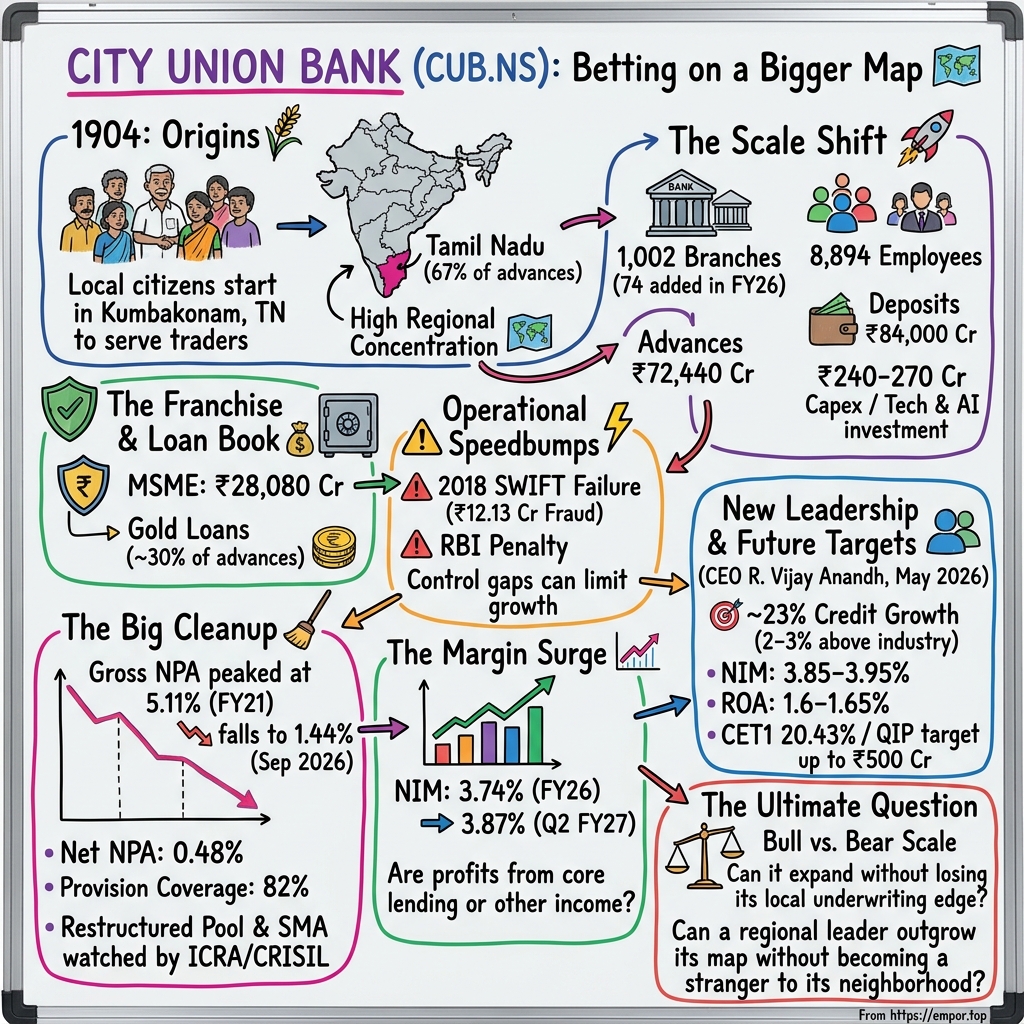
That exchange is the whole story in miniature. City Union Bank, known on the exchanges by its ticker CUB, has done two hard things at once over the past few years: it has cleaned up a loan book that was badly bruised by the pandemic, and it has pushed its lending growth well above the pace of the Indian banking system. The third hard thing, finding enough cheap and stable money to keep funding that growth, is the one its own chief executive will not promise.
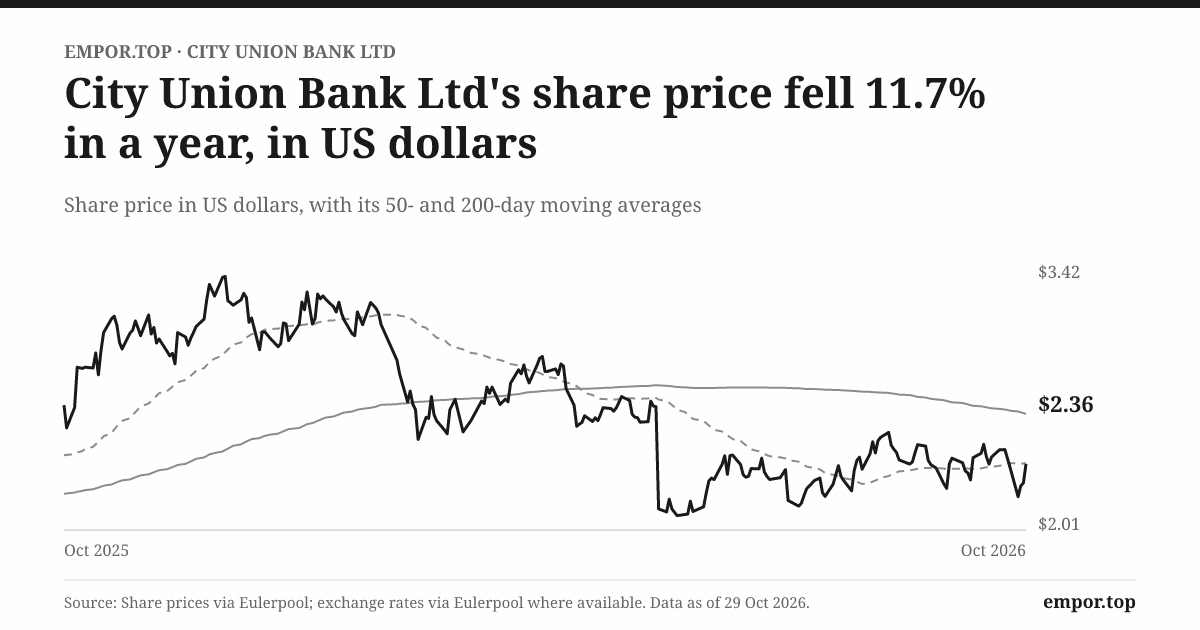
The scale matters for understanding the stakes. In September 2026, CUB held about ₹84,000 crore of deposits and had lent out about ₹72,000 crore.1 Those are serious sums for a bank that still keeps its registered office on a street in Kumbakonam, but they are small on a national map. CUB is not trying to beat the giants. It is trying to grow faster than the system from a regional base, and the market's verdict on whether it can is written into a share price that, at ₹225 on 29 October, sat about a quarter below its 52-week high and valued the whole bank at roughly ₹15,900 crore.1
Three questions run through this story. The first is whether CUB's regional franchise, built over a century around small businesses and gold-backed loans in Tamil Nadu, is a durable advantage or simply a concentration that has not yet been punished. The second is whether loans can keep outrunning deposits without the bank quietly relaxing the underwriting that made the cleanup possible. The third is the most technical and perhaps the most important: whether the better profits of the last two years come from the core business of lending money at a sensible spread, or from favourable margins, a large and loosely explained block of other income, and recoveries on loans written off long ago.
None of those questions has a clean answer yet. The growth is real and the cleanup is visible in every reported ratio. But a bank's history is a long argument with its own past mistakes, and CUB's past includes a pandemic-era bad-loan peak above 5%, a pair of operational losses in 2018 that drew a regulator's penalty, and rating agencies that still single out its home-state concentration and its low share of cheap current and savings deposits.34 The next phase depends on whether the bank can fund a faster-growing loan book while keeping that book clean. To see why the bank thinks it can, and why the market is not yet sure, the story has to start in Kumbakonam, more than a century ago.
 Subscribe on LinkedIn
II. Twenty Citizens Start a Bank
Kumbakonam at the turn of the twentieth century was a market town of temples, silk weavers, brass workers and rice traders, sitting in the fertile heart of the Cauvery delta. Money moved through it with the harvests. What the town lacked was a local institution that understood those rhythms and would lend against them. On 31 October 1904, twenty of its prominent citizens signed the memorandum of association for a new company called The Kumbakonam Bank Limited.5 Among the names on the founding record were R. Santhanam Iyer, S. Krishna Iyer and V. Krishnaswami Iyengar, with T.S. Raghavachariar serving as the bank's first agent.5
It was a community bank in the most literal sense. It took deposits from people who knew the founders, and it lent to traders and farmers whose businesses the founders could see from their own verandas. The first branch outside the town did not open until 1930, in nearby Mannargudi, a quarter-century after incorporation.5 The Reserve Bank of India added the bank to the second schedule of its act in 1945, which made it a "scheduled" bank with access to the central bank's facilities and obligations to match.5
The bank grew the way small Indian banks of that era usually grew: slowly, and occasionally by absorbing neighbours that were too small to survive alone. In 1957 it took over the assets and liabilities of Common Wealth Bank, gaining five branches in delta towns.5 In 1965, two more local lenders, City Forward Bank and Union Bank, were amalgamated into it, adding six branches, and the merged institution took a name that carried all three identities: The Kumbakonam City Union Bank.5 The same year it opened its first branch in Madras, in the busy commercial district of Thiyagaraya Nagar.5 Not until 1980 did it cross the state line, with a branch in Bangalore.5 In December 1987 the bank dropped the town from its name and became simply City Union Bank Limited.5
Those early consolidations are worth remembering, because they are the last time acquisitions shaped this bank. Everything that followed, including the climb past a thousand branches, has been organic. That makes CUB a simpler story than many Indian financial companies: there is no acquired subsidiary to unwind, no group company to separate, no deal premium to justify. CUB had no parent, subsidiary or associate in FY2026.6 What investors are buying is one bank, built branch by branch.
The bank's own self-portrait leans heavily on this history. Its investor presentation describes a lender that began by "empowering the farmers and traders of the cauvery delta region," that has stayed profitable through world wars, the Great Depression, the subprime crisis and the pandemic, and that has had only eight chief executives in 122 years.7 Leadership has indeed been unusually stable. After the chairman, V. Narayanan, died in a car accident near Chennai in November 2004, S. Balasubramanian led the bank as chairman and chief executive from early 2005, and N. Kamakodi took over as managing director on 1 May 2011.5 Kamakodi stayed for fifteen years, the maximum the regulator permits, and told shareholders at his farewell that the bank had grown seven to eight times on most business measures during his tenure.8
It is tempting to turn longevity into a moat. A bank that has lent to the same families and trading houses for generations, the argument goes, must know its borrowers better than a newcomer could, and its customers must be loyal. The bank does not publish the evidence that would prove it. There is no disclosed customer retention rate, no data on how CUB's loan pricing compares with rivals in the same towns, no measure of how many borrowers stay when a larger bank offers a cheaper rate. Age proves survival. It does not, on its own, prove pricing power.
What the origin story does explain is the bank's operating DNA. CUB grew up gathering deposits and lending in markets it knew well, against collateral it could see and value, to borrowers whose businesses were small enough to be understood by a branch manager. That habit, more than any slogan, is what the bank is now trying to carry into Kashmir, Delhi and the semi-urban towns of states its founders never visited. The question the twenty citizens never had to answer is whether local knowledge travels.
III. The Branch Network Becomes the Bet
Picture the branch map at the end of FY2026. During the year CUB opened 74 new branches, taking the network to 949 by 31 March.6 By the time the bank's shareholders gathered for the annual meeting in August, the count had passed a thousand, and the managing director told them with evident pride that the bank now stretched "from the valleys of Kashmir to the shores of Kanyakumari."8 By the end of September there were 1,002 branches.7 Roughly 590 of them were still in Tamil Nadu, and the network was spread almost evenly across metro, urban, semi-urban and rural centres.7
That mix is the quiet signature of the strategy. Of the 1,002 branches, about 250 sat in metros and about 240 in urban centres, while roughly 300 were in semi-urban towns and about 200 in villages.7 About half the network, in other words, still serves places where a bank branch is a fixture of the main street rather than one option among a dozen. The bank's own description of its aim is to "augment the business potential of semi-urban, urban and unbanked rural areas."7 That is where deposits are sticky and competition thinner, but it is also where tickets are small, costs per rupee of business are high, and growth depends on the local economy rather than on a national tailwind. The march into new states is real, but the centre of gravity has not moved far from where the twenty citizens started.
To understand why branches are the bet, it helps to understand the machine they feed. A bank like CUB is, at its core, a spread business. It borrows money from depositors and pays them interest. It lends that money, along with its own capital, to businesses and households, and invests the rest in government bonds. Its main income is the difference between what it earns on loans and bonds and what it pays on deposits and borrowings. Four levers decide how much of that spread survives to the bottom line: how fast the loan book grows, how cheaply the bank can fund it, what mix of loans it holds, and how much of the money lent never comes back.
Branches touch all four. In India's smaller towns, a branch is still where a trader opens a current account, where a family deposits savings, where a farmer pledges gold, and where a manager sizes up a borrower face to face. More branches mean more deposits and more loan origination, but each new branch also brings rent, staff, technology and security costs long before it earns its keep. That is the trade CUB has chosen to make.
The spending shows up clearly. Purchases of fixed assets nearly doubled in FY2026, from about ₹20 crore to about ₹35 crore.6 The workforce grew from 7,605 to 8,894 people during the year, a 17% jump in a year when total income grew 17.5%.6 At the August meeting, Vijay Anandh told shareholders that capital spending would rise to between ₹240 crore and ₹270 crore a year over the next three years, "predominantly" on IT infrastructure, and that headcount would grow another 10% to 15% as branches opened in FY2027 and FY2028.8 Against a bank that earned about ₹1,326 crore of net profit in FY2026, that capex plan is meaningful but not reckless: it is roughly a fifth of a year's earnings, every year, for three years.8
What does all this investment buy? Management's own productivity measure, annualised profit per employee, rose to about ₹1.8 million in the September quarter from about ₹1.7 million a year earlier.7 That is a real improvement, and it came in a period of heavy hiring, which is the right direction. But it is also a number flattered by a quarter of unusually strong recoveries and negative credit costs, which is a subject for later. And it says nothing directly about the thing that most matters for a branch-led strategy: how long a new branch takes to break even, and what it earns when it matures. CUB does not publish branch vintage economics. A shareholder at the August meeting asked exactly that question, how many branches were profitable and whether loss-making ones would be closed, and the answer he received was general: the bank checks the liabilities and assets of each branch and looks at "what we invest, how we invest, how much profit we get from it" before opening.8
The same answer contained a revealing wobble. In one passage, Vijay Anandh promised "50 to 60 branches in a year"; a few sentences later, "as usual," it was "40 to 50 branches in a year," and he explained that branch openings planned for the year had been brought forward to April because of the change in chief executive.8 That is a small inconsistency, not a scandal. But a strategy built on branches deserves a single, measurable branch target, because it is the only way outsiders can test whether the expansion is disciplined.
Technology is the other half of the investment story, and the bank talks about it with enthusiasm. It says it has deployed robotic process automation to generate periodic reports without manual intervention, and an AI-based system "from credit assessment to approval of credit facilities."8 It collected 29 industry awards in the year, many for digital banking and cybersecurity.8 The board includes Professor V. Kamakoti, the director of IIT Madras, whose expertise is secure systems engineering.7 All of that is plausible operating improvement. None of it is a revenue line. CUB does not quantify what AI-led underwriting has done to approval times, loss rates or staff costs, so for now the technology spend should be judged the way a branch is judged: by whether it eventually shows up as lower cost per rupee lent or fewer loans going bad.
The competitive frame matters too. CUB is one of four old-generation private banks with deep roots in South India, alongside Karur Vysya Bank, South Indian Bank and Tamilnad Mercantile Bank.9 On loan-book size, Karur Vysya and South Indian Bank are larger, while Tamilnad Mercantile is smaller. These banks report on slightly different dates and use different segment definitions, so comparisons need care. The point is not that CUB is the biggest. It is that the branch race in the delta and beyond is a contest among peers with similar histories, similar customers and similar ambitions, which is exactly why a branch network alone cannot be a moat.
There is one thing CUB is not doing, and it is worth naming. There has been no recent acquisition, no bolt-on lender, no subsidiary bought to accelerate growth. The capital is going into branches, people and software. That makes the eventual test cleaner: if returns hold up as the network grows, the strategy worked; if they sag, there is no acquired business to blame. And the test will be settled by the loan book those branches originate, which is where the bank's real identity lives.
IV. The Loan Book Is the Franchise
Walk into a CUB branch in a delta town on a weekday morning and the most common transaction at the loan counter is not a mortgage or a car loan. It is a customer sliding a small cloth pouch of gold jewellery across the desk. The branch staff weigh it, test its purity, and lend a fraction of its value, usually for a few months, with the gold held in the vault until the loan is repaid. At the end of September 2026, gold loans made up about 30% of everything CUB had lent, roughly ₹21,700 crore spread across farmers and non-farm borrowers.7
Gold is half of the bank's identity. The other half is small business. MSME lending, to micro, small and medium enterprises, was the largest single segment in the bank's own breakdown, at about ₹28,100 crore of ₹72,400 crore in total advances, close to two-fifths of the book.7 The bank describes these loans as "fully collateralized" and "granular," meaning small tickets backed by property, machinery or other security.7 Agricultural loans, much of them gold-backed, and retail lending make up most of the rest.7
Why does this mix matter? Because collateral changes the economics of a bad loan. When an unsecured borrower defaults, a bank may recover little. When a gold-loan borrower defaults, the bank sells the gold. CUB told analysts in October that it typically lends at 60% to 65% of the gold's value on consumption loans, well inside the regulatory caps of 75% to 85% that took effect in April 2026.2 Of a gold book of more than ₹21,000 crore, only about ₹9.5 crore was classified as non-performing, and only ₹20 lakh of jewellery had actually gone to auction; the rest of the troubled borrowers repaid.2 That is an extraordinarily low loss rate, and it is the strongest evidence for the bank's claim that it knows how to run this business.
But collateral reduces how much a bank loses; it does not remove the need to lend sensibly. Gold loans carry two specific risks. The first is price: if gold falls sharply, the cushion between the loan and the value of the jewellery shrinks. The second is purpose: the same pouch of jewellery can secure a farmer's seed money or a household's consumption, and the riskier the use, the more likely the borrower is to walk away if the cushion disappears. Suresh Ganapathy of Macquarie pressed exactly this point on the October call, asking how the bank verifies the end use of gold loans and whether the sector faces systemic stress.2 Vijay Anandh's answer was candid: branches assess end use and check credit bureau data, renewals are allowed only within loan-to-value headroom, and top-ups are not offered, but his "personal view" was that the bank is in "a much safer spot" when it can tie the loan to its use.2 He also said the bank does not want gold to exceed 31% to 32% of advances.2 That ceiling is important, because it means one of the fastest-growing lanes in the book is close to the limit management itself has set.
The structure of these loans also deserves a plain explanation, because it shapes how risk shows up. Nearly all of CUB's consumption gold loans, and all of its agricultural gold loans, are bullet loans: the borrower pays nothing, or only interest, during the term and repays the principal in one go at maturity.2 Average tickets are small, about ₹1.9 lakh for agricultural loans and about ₹3 lakh for others, though one customer can hold many accounts.2 Bullet structures are convenient for farmers whose income arrives at harvest, but they also mean that trouble stays invisible until the due date. A loan that looks perfectly current for eleven months can become a problem in the twelfth. That is why the cushion between the loan and the gold's value, and the discipline of not rolling loans over without headroom, matter more here than in a loan that is repaid monthly. Gold lending is also concentrated within the network: management said the product is offered from about 250 to 260 branches, roughly a quarter of the total, which gives the bank room to extend it but also means a newer set of branch staff will be learning the craft.2
The rest of the book has been moving too. In the year to September 2026, gold lending to non-farm borrowers grew by about two-fifths, while loans to large industries and services rose sharply from a small base and commercial real estate shrank after a jump earlier in the year.7 None of these shifts is alarming on its own. Together they show a bank whose mix is changing quickly as it grows, which is exactly when historical loss rates become a less reliable guide to future ones.
The second risk is concentration, and here the evidence is less forgiving. About 96% of CUB's gold loans are in South India.2 CARE Ratings found that Tamil Nadu accounted for 67% of advances in its March 2025 analysis, and CRISIL cited the same figure.104 All three rating agencies flagged the regional concentration; ICRA added low current and savings deposits and depositor concentration to the list.3 A bank whose loans are two-thirds in one state is exposed to that state's economy in a way that a national lender is not: a regional drought, a slump in textile exports or a political shock to a key industry can hit many borrowers at once.
It is important to separate two kinds of concentration that are easily confused. Borrower concentration is low. In March 2026, CUB's 20 largest borrowers accounted for about 7% of advances; by September the bank put its top 20 borrower groups at about 7% and top 20 individual borrowers at about 6%.67 No single corporate default can sink this bank. Franchise concentration is high. By geography and by product, CUB is a bet on small businesses and gold-backed lending in one corner of India, and the risks in such a book tend to be correlated rather than independent.
So does CUB win because it understands local borrowers, or because it takes more risk in a concentrated region? The forces acting on the bank sharpen the question. Depositors have real bargaining power: they can move money to a large bank or a small finance bank offering a better rate, and the fight for deposits across Indian banking has intensified as loan growth outpaced deposit growth at mid-sized private lenders in FY2026.11 Borrowers can compare offers, especially for gold loans, where specialist non-bank lenders and larger banks compete hard. Regulators shape the product directly, as the new gold-loan rules showed. Larger banks enjoy cheaper funding and bigger technology budgets. Against all that, local relationships genuinely help with two things: finding good borrowers and watching them closely once the money is lent.
The fair verdict is that CUB has a meaningful secured-lending franchise with an exceptionally clean gold book and a long record in small-business credit, but that the public evidence stops short of proving a durable moat. The bank does not publish data on loan pricing relative to competitors, on how long customers stay, or on what share of its MSME borrowers would leave for a cheaper offer. What would strengthen the claim is a record of sustained growth with low fresh slippages, stable funding costs while competitors pay up, and productive new branches outside Tamil Nadu. What would weaken it is the bank's own history repeating: the last time CUB's growth met a shock, the loan book suffered badly.
Before that test, though, there was a different kind of failure, one that had nothing to do with credit. It came through the wires.
V. The SWIFT Loss That Exposed a Control Gap
SWIFT is the messaging network that banks use to instruct one another to move money across borders. A message sent through it is treated as the bank's own word, which is why the most important question any bank can ask about it is a simple one: who, exactly, can send a payment instruction in our name?
At City Union Bank, the answer turned out to be: someone who should not have been able to. On 17 February 2018, the bank told the stock exchanges that three fraudulent remittances, totalling ₹12.13 crore, had gone out through its SWIFT system without being initiated by the bank.12 In plain terms, criminals had got into the plumbing that connected CUB to the world's banks and used it to send money abroad. The bank managed to claw back ₹3.25 crore and provided for the full amount across FY2018 and FY2019, absorbing the loss through its profit and loss account.12
It was not the only incident that year. A few weeks before the SWIFT disclosure, in December 2017, CUB had reported improper transactions of ₹31.55 crore that ran through the Visa, Mastercard and NPCI card networks via its ATM switch, approved outside the bank's own network.12 That is, the bank's card-processing link had been used to authorise transactions that its own systems had not properly approved. The bank held cyber insurance cover of ₹25 crore and lodged a claim, and again provided fully for the loss over the two years.12
Taken together, these two episodes cost the bank around ₹44 crore of exposure, at a time when its annual net profit was in the region of ₹600 crore.12 They were not existential. But they were not technology trivia either, and they belong in a story about a regional bank's franchise for a simple reason. A small-town depositor trusts CUB with savings because he trusts the people at the counter. That trust ultimately rests on systems the depositor never sees. When those systems fail, the relationship is only as good as the bank's controls.
The regulator agreed. After the PNB fraud, the Reserve Bank of India issued a circular on 20 February 2018 requiring banks to implement and strengthen SWIFT-related operational controls on a strict timeline.12 In early 2019 it fined 36 banks for falling short. City Union Bank's penalty was ₹30 million, or ₹3 crore, which put it in the middle tier of the list, alongside lenders such as Indian Overseas Bank and Union Bank of India.13 Its neighbours Karur Vysya Bank and Tamilnad Mercantile Bank were each fined ₹1 crore.13 CUB's directors wrote in the next annual report that the bank had complied with the directions "in true letter and spirit," but that the RBI was not convinced a few controls had been implemented within the prescribed time; they added that the controls were by then fully in place.12 The secretarial auditor recorded the penalty as the one exception in an otherwise clean report.12
The response, then, followed a familiar arc: provisioning, system changes, recovery efforts, a regulatory fine and a statement that the gap had been closed. That arc is mostly reassuring. The bank took the loss upfront rather than carrying it as a hopeful receivable, and the RBI's penalty was about delayed implementation rather than a finding that the bank had concealed anything.
What remains uncomfortable is the accounting trail eight years later. At the August 2026 annual meeting, a shareholder asked about the SWIFT loss and any recovery. Vijay Anandh's answer was brief: "we have made around 12 Crores recovery and 3 Crores spending is with the court."8 That does not reconcile neatly with the bank's earlier disclosure. If the original loss was ₹12.13 crore and ₹3.25 crore had been recovered by 2019, a recovery of "around ₹12 crore" would mean almost the entire amount came back, in which case it is unclear what the ₹3 crore before the court represents. Alternatively, the chief executive may have been describing the size of the loss rather than the amount recovered. Either reading is possible from the transcript. Neither is confirmed by a filed reconciliation.
This matters in proportion. The sums are small relative to a bank that now earns more than ₹1,300 crore a year, and the events are old. The point is not the money. It is that a bank whose chief strategic bet is to grow faster than its peers, opening dozens of branches a year and putting AI into credit approvals, needs controls that grow at least as fast as its footprint. CARE Ratings still lists cybersecurity among the constraints on CUB's rating.10 The same August meeting also raised mule accounts, bank accounts opened to launder the proceeds of fraud, which have become a regulatory priority across Indian banking; management said a new monitoring system was in user testing and was due to go live in September.8
A simple, filed reconciliation of the 2018 SWIFT loss, its recoveries and any amount still in litigation would close an old question cleanly. Until then it remains a small, open loose end in a bank that otherwise prides itself on tidiness. And in the years after 2018, CUB faced a far larger test of whether its systems and its judgment could hold, one that arrived not through the wires but through the economy itself.
VI. The Cleanup Was Long, Then the Growth Came Back
When India locked down in March 2020, the businesses that CUB lends to were among the first to feel it. Small textile units in Tiruppur, traders in Madurai, workshops in Coimbatore, transport operators and hotel owners across the delta: their cash flows stopped almost overnight. A bank with two-fifths of its loans to small and medium businesses had no place to hide.
The damage showed up in two phases. First came the provisioning. In FY2020, as the bank set aside money for the losses it expected, net profit fell by about 30%, the first serious break in a long run of steady profit growth.14 Then came the bad loans themselves. By March 2021 gross non-performing assets had climbed to 5.11% of advances.14 For a bank that liked to describe itself as conservative, that was a humbling number. One in every twenty rupees it had lent was no longer being serviced.
The longer shadow of that period shows up in returns. In the five years before the pandemic, CUB earned a return on equity of about 14% year after year, a steady, unflashy record. In FY2020 that return fell to about 9%.14 It climbed back each year since, but even after the strong FY2026 it stood at roughly 12.6% on year-end equity, still below the pre-pandemic norm.6 That is the most sobering number in the bank's recent history, because it says the cleanup restored the bank's health without yet restoring its old earning power. Part of the gap is the bank's own choice to hold far more capital than it needs, which mechanically depresses returns on equity. Part of it is the cost of the bad loans themselves. Either way, the shareholder who complained at the 2026 meeting that CUB had not compounded wealth like other private banks was describing something real.
The recovery that followed was neither quick nor dramatic. It was a grind. Gross bad loans came down year by year as the economy reopened, as restructured borrowers either recovered or were recognised as losses, and as the bank collected what it could. By March 2026 the ratio stood at 1.91%, and by September it had fallen further, with net non-performing assets, after provisions, at just 0.48%.16 On the October call, management pointed out that both ratios had now fallen for ten consecutive quarters.2 Loans in the earliest stage of trouble, classified as SMA-2 because they are 61 to 90 days overdue, fell to 0.67% of advances from 1.34% a year earlier.2
That is a genuine turnaround, and the headline deserves credit. But headline bad-loan ratios can be lowered in several ways, and only one of them is better lending. A bank can collect from borrowers. It can sell bad loans to an asset reconstruction company. Or it can write them off its books, which removes them from the ratio even though the bank keeps trying to recover the money. Understanding which of these drove the cleanup is the difference between a bank that has learned to lend better and one that has merely tidied its shelves.
CUB has used all three. Technical write-offs, which remove fully provided bad loans from the balance sheet while the bank continues to pursue the borrower, amounted to about ₹190 crore in the first half of FY2027 alone.7 In the September quarter the bank also sold ₹803 crore of bad loans, some still on the books and some already written off, to an asset reconstruction company for ₹131 crore in cash, a recovery of roughly 16 paise on the rupee.2 When an analyst from Equirus asked why the bank had sold at that price, the answer was that the accounts were old, heavily provided, and the bank held ₹792 crore of provisions against them.2 That is a rational way to clear old problems, but it is also a reminder of how little some of the pandemic-era loans were ultimately worth.
The quality beneath the headline also shows up in how provisions are counted. Including technical write-offs, the bank's provision coverage was 82% in September; excluding them, it was 67%.1 Both numbers are reasonable, and the second has been rising. The gap between them is a reminder that the most flattering ratio is not the only one. A further ₹344 crore of loans, or about 0.47% of advances, remained restructured but classified as standard, most of them small-business loans that were given easier terms during the pandemic.7 These are borrowers who are paying, but who needed help to keep paying.
The rating agencies have read the same evidence more cautiously than the bank's own presentation. ICRA, reaffirming CUB's AA rating with a stable outlook in March 2026, credited improving profitability and asset quality but identified a sizeable vulnerable book.3 CRISIL, in December 2025, described asset quality as modest and put the bank's SMA 0, 1 and 2 exposures, loans showing any sign of delay, at 5.6% of advances.4 CARE, which moved its outlook to positive in April 2026, praised the improving asset quality while still naming regional and sector concentration as constraints.10 At the August meeting, Vijay Anandh told shareholders that the bank's combined SMA ratio had fallen below 3.8%, which he called the lowest in a decade.8 Those numbers are from different dates, so the direction is the useful signal: the pool of troubled and nearly troubled loans has been shrinking.
What can be settled? The improvement is visible and real in every reported ratio, and the gold book in particular has been remarkably clean. What cannot yet be settled is whether the cleaner book reflects a durable improvement in underwriting or a favourable point in the credit cycle. The FY2021 peak is a reminder that this bank's loan book is cyclical: it tracks the health of small businesses in a handful of states, and those businesses do not have a rainy-day fund that can survive many months without revenue. Underwriting quality is proven across a cycle, not in the good years of one.
The test will come from three numbers as the book grows: fresh slippages, the rate at which new loans turn bad; the migration of loans through the SMA buckets; and credit costs. In the September quarter, slippages were about ₹175 crore while recoveries reached ₹317 crore, so the bank's net credit cost was negative.2 That is a wonderful quarter. It is not a sustainable rate. And because the fastest-growing parts of the book, gold and secured retail, are also the ones with the shortest track record at this size, a cleanup can make rapid growth look safer than it really is. Which brings the story to the part of the income statement where that tension is hardest to read.
VII. The Margin Rebound Has More Than One Cause
For a bank, the single most important number is the net interest margin, or NIM. Think of it as the toll the bank collects on every rupee it puts to work: interest earned on loans and investments, minus interest paid to depositors and lenders, divided by the money earning interest. A NIM of 3% means that for every ₹100 of earning assets, the bank keeps ₹3 a year before paying staff, rent and bad-loan costs.
CUB's toll has risen sharply. Its NIM was 3.06% in FY2025 and 3.74% in FY2026, then reached 3.87% in the September 2026 quarter.61 Net interest income grew 22% in FY2026 to about ₹2,830 crore, and 31% year on year in the September quarter.81 For a bank of this size, an increase of nearly 0.7 percentage points in margin in a single year is large. It is the main reason profit growth has accelerated above the bank's long-run pace: over ten years, net profit has compounded at about 11.5% a year, while in FY2026 it grew 18%, and in the September quarter 27%.61
Why did margins rise? On the October call, management offered a three-part explanation. The first was the cost of deposits, which held steady at about 5.56% even as the bank grew, while its overall cost of funds edged down to 4.74%.2 The second was investments: the bank had exited around ₹850 crore of mutual fund holdings, and the income from that money now showed up as interest income on bonds rather than as gains in other income; the yield on investments rose to 6.56%.2 The third was the structure of the loan book. About 55% of CUB's loans are priced off an external benchmark, usually the RBI's repo rate, about a third are fixed-rate, and the rest are linked to the bank's own lending rate.2 Gold loans, which are fully fixed-rate, earned a blended yield of about 10.8%.2
That second explanation deserves a pause. Moving money from mutual funds into bonds does not change how much the bank earns overall; it changes the line on which the income is reported. Some of the margin improvement, therefore, is a reclassification of income that would previously have been counted as other income. It is a legitimate accounting choice, and the amount is not large relative to a balance sheet approaching ₹1 lakh crore. But it is a reason to read a jump in NIM alongside the movement in other income rather than separately.
The guidance history is the other thing worth watching. On the call for the June quarter, management had guided to a margin of around 3.70% to 3.75% for the year.2 By October, with the quarter's margin at 3.87%, it raised the range to 3.85% to 3.95% for the second half.2 In one sense that is a good problem: the bank beat its own guidance and raised it. In another sense it shows how quickly the range can move. Two pressures sit underneath the new figure. The chief financial officer, J. Sadagopan, told analysts he expects deposit costs to rise by about ten basis points next quarter.2 And when the RBI cuts rates, the repo-linked half of the loan book reprices downward within weeks, while deposits reprice only as they mature. A new range is a target, not yet a track record.
Then there is other income, which is the part of CUB's earnings most worth investigating. In FY2026 the bank booked about ₹1,039 crore of non-interest income, equivalent to roughly 62% of its profit before tax.6 Some of that is straightforward: about ₹195 crore of commissions, exchange and brokerage, about ₹97 crore of gains from selling investments, and about ₹61 crore from foreign exchange transactions.6 The rest, about ₹704 crore, sat in a single line labelled miscellaneous income.6 That one line is larger than half of the bank's net profit for the year, and the annual report does not break it down.
What goes into a miscellaneous line at an Indian bank? Commonly it includes recoveries from loans that were previously written off, along with processing charges and other fees. CUB's own disclosures in the September quarter illustrate the mechanism: of ₹317 crore recovered, about ₹137 crore came from accounts already technically written off, and roughly ₹107 crore of other income in the quarter was linked to recoveries tied to the asset reconstruction sale.2 Money recovered on old written-off loans is real cash, and recovering it is a sign of competent collections. But it is finite. A bank cannot recover the same pandemic-era loans twice, and as the pool of written-off accounts shrinks, now about ₹900 crore after the September sale according to management, that source of income will fade.2
The September quarter contained one more example. The bank also set aside a ₹50 crore contingent provision and saw its tax rate rise to 23% to 24%.2 So the 27% profit growth of the quarter came from a mix of strong core interest income, unusually generous recoveries, and some prudence on provisions. That is not a criticism. It is a description, and it is why the quality of earnings question does not go away.
The honest verdict is that the core lending engine is growing strongly. Net interest income rising 31% on loans rising 26% is the sign of a bank that is both growing and earning a better spread. But the improved profit profile also rests on margin conditions that management itself expects to tighten, and on an other-income line whose largest component is not explained in the audited accounts. The way to settle the question is not to wait for management commentary but to read the audited full-year income bridge: how much of FY2027 profit came from core interest income, how much from fees, how much from treasury gains, and how much from recoveries on old loans.
One more point, about cash. For most companies, investors check whether profit turns into cash. For a bank, that test does not work. Lending money to customers and taking in deposits both run through the operating cash flow, so a bank growing its loan book by 26% will show operating cash flows that swing with balance-sheet growth rather than with earnings quality. In FY2026, CUB lent about ₹14,000 crore of new money and raised a little more than that in deposits, and the resulting cash-flow figure says more about that balance than about profit.6 The real earnings test for CUB is the composition of income, not conversion to cash, and that test sits squarely with the man who now runs the bank.
VIII. A New CEO Inherits the Growth Targets
On 30 April 2026, N. Kamakodi handed over the keys after the maximum permitted tenure. At the August annual meeting, he thanked everyone from the board to the "sub-staff members" and invoked the temple deities of Kumbakonam, in the ceremonial style the bank has always favoured.8 The next day, R. Vijay Anandh became managing director and chief executive, with the RBI's approval.15
Vijay Anandh is a different kind of leader for this bank, and the difference is worth understanding. Kamakodi was a CUB lifer in spirit, the steward of a conservative family-style institution. Vijay Anandh built his career in retail lending and collections, with about 28 years in banking. Before CUB, he was group executive vice president and business head for retail assets and collections at RBL Bank, and before that the chief credit officer for RBL's retail businesses, covering MSME, cards, rural lending, agriculture and financial inclusion, as well as fraud risk on the liabilities side.7 He joined CUB as an executive director and sat through the 2025 annual meeting in that role, where he says he was struck by "the personal contact, connect and trust" shareholders and customers still had with the bank in a digital era.8
That background matters for two reasons. A career in retail credit and collections is exactly the experience a bank needs when its fastest-growing lanes are gold loans and secured retail, and when the cleanup of its past depends on collecting what is owed. But a retail-credit specialist arriving at a bank built on small-business relationships is also a change of temperament, and whether it shows up as sharper risk control or as a stronger appetite for growth is something only his record at CUB will reveal. That record is still too short to judge.
What can be judged is how he has set targets. On the October call, he gave analysts a full dashboard. CUB would aim for credit growth two to three percentage points above the industry. It expected a net interest margin of 3.85% to 3.95% for the rest of the year, a return on assets of 1.6% to 1.65%, and a cost-to-income ratio of 45% to 47%.2 Those are concrete, trackable numbers, and that is to his credit. A bank that publishes specific ranges invites investors to measure it.
The same numbers also show how fast the story has moved. At the August meeting, he told shareholders the bank was confident of "maintaining the 1.5 ROA which we have been maintaining for last couple of last decade."8 Ten weeks later, the guidance was 1.6% to 1.65%, up from an earlier "1.55% plus."2 A raised target after a strong quarter is better than a cut. But targets that rise with each good quarter are not yet proof of disciplined forecasting, and the second half of FY2027 will show whether the new ranges were set conservatively or optimistically.
On costs, the call was more illuminating. Operating expenses rose 24% year on year in the September quarter to about ₹562 crore.2 Vijay Anandh and his finance chief explained why: the bank's annual wage revision takes effect each July, so it lands in the second quarter, and the quarter also carried about ₹32 crore of actuarial provisioning for leave encashment, against a usual ₹3 crore to ₹5 crore.2 They then gave a forward run-rate for staff costs of around ₹275 crore a quarter.2 That is the kind of specific, falsifiable explanation that builds credibility if it holds. Despite the higher costs, the cost-to-income ratio improved to about 46% from 49% a year earlier, because income grew even faster.2
Above the chief executive sits a board with an unusually regulatory flavour. The non-executive chairman, G. Mahalingam, spent 34 years at the Reserve Bank of India, retiring as an executive director, and then five years as a whole-time member of the Securities and Exchange Board of India.7 Six of the bank's nine directors are independent.10 A former regulator in the chair does not guarantee good decisions, but it does mean the board understands, better than most, how supervisors read a bank's numbers, and it makes the board a natural check on a new chief executive eager to grow.
The incentives question needs care. CUB has no promoter. There is no founding family, no group company and no controlling shareholder; the largest holders are Indian mutual funds, with HDFC Asset Management at about 9% and SBI Funds Management at about 8% as of September 2026.7 Domestic institutions together owned about 38% of the bank and foreign portfolio investors about 17%, down from much higher levels a few years earlier, while the number of individual shareholders had fallen to about 204,000 from roughly 249,000 in March 2024.716 Without a promoter, management's own stake is small and its alignment with shareholders runs mainly through pay and employee stock options. In FY2026 the bank allotted about 20.6 lakh shares under ESOPs, a negligible dilution.6 Kamakodi's remuneration rose to about ₹4.28 crore in FY2026 from ₹3.67 crore a year earlier, an increase broadly in line with the bank's profit growth.6
The annual meeting was the closest thing CUB has to a public stress test, and it was revealing. Shareholders asked about dilution from a proposed qualified institutional placement, about non-performing loans, about the old SWIFT loss and about mule accounts.8 One long-time investor, Jasmeet Singh, said plainly that he had expected his CUB shares to create the wealth other private banks had created for their owners, "but it has not happened so," which he blamed on slow profit growth.8 A former employee raised complaints about post-retirement benefits and stock options granted to S. Balasubramanian, the former chairman and chief executive, and about certain one-time settlements and write-offs. Vijay Anandh responded that all of it had been approved by the board under the bank's policies and regulatory norms, and that regulators had raised no adverse remarks.8 Those are assertions, not independent findings, but the bank did answer on the record rather than deflecting.
The question that went least well answered was the most important one for capital allocation. Shareholders approved an enabling resolution in August 2026 to raise up to ₹500 crore through a QIP, a placement of new shares with institutional investors.17 Pramod Kumar Jain asked directly where the money would go, whether it was for growth or a cushion against future bad loans, and how much dilution existing holders should expect.8 In the consolidated answers, management did not give a use of proceeds or a return target.8 The bank has taken similar enabling authority before without using it.8 That history suggests the resolution may simply be an option kept open, which is common practice. But a bank sitting on a common equity tier one ratio of about 20.4%, and total capital adequacy of about 21.3%, does not obviously need new equity.7 If the bank does eventually raise money, the right question will be what return the new capital earns on the additional loans it supports.
What the bank has done with capital so far is return a modest slice of it. The board recommended a dividend of 200% of the ₹1 face value for FY2026, or ₹2 a share, and in 2026 the bank also issued one bonus share for every three held.8 The bonus lifted paid-up capital from about ₹74 crore in March to about ₹99 crore by September, but it was a reshuffling of the bank's own reserves into share capital, not a rupee of new money in or out.1 Shareholders at the meeting applauded both. The dividend, at roughly a tenth of profit, is deliberately small, because a bank growing its loans at a quarter a year needs to retain almost everything it earns to keep its capital ratios steady.6 That is the real capital-allocation trade at CUB: every rupee paid out is a rupee that cannot support new loans, and every rupee retained must eventually earn its keep in a bigger book.
Two things are notably absent from the capital story, and both are reassuring. There is no acquisition programme, and there is no subsidiary empire. The capital is going into branches, IT and people, which means the test of this new chief executive is unusually clean: deliver the targets, show that the new branches pay, and explain any miss with the same specificity he used to explain the wage bill. The market, for now, is withholding judgment, and its price reveals how much.
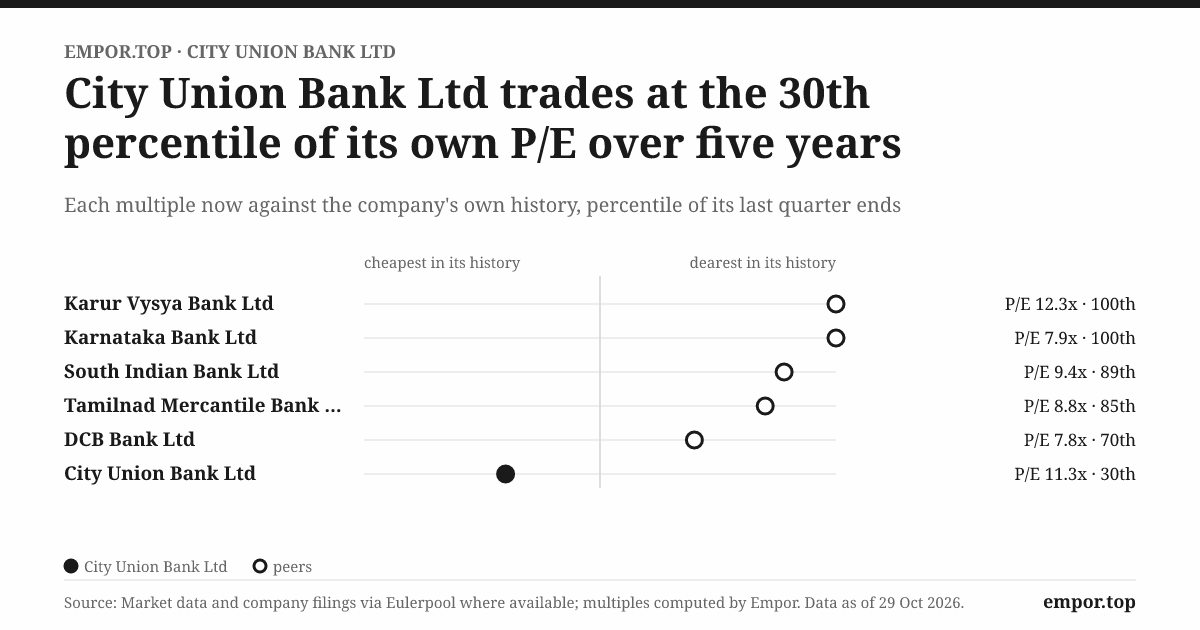
IX. Analysis & Bear vs. Bull Case
At ₹225 a share on 29 October 2026, investors were paying about 11.3 times City Union Bank's last twelve months of earnings and about 1.6 times its book value.1 Put differently, every ₹100 invested in the stock bought about ₹8.80 of annual profit, an earnings yield of 8.8%. That multiple was below the bank's own five-year median of about 12.1 times, even though profit growth had accelerated and bad loans had fallen to decade lows.1 The share price had dropped about a quarter from its 52-week high.
What does a price like that assume? A bank earning a return on equity of about 13% and trading at 1.6 times book is being priced as a solid but unspectacular compounder: the market is paying a premium to the value of the net assets, so it expects the bank to keep earning above its cost of capital, but it is not paying for an acceleration to the kind of returns that top-tier private banks earn.1 In plain terms, the market seems to be saying that it believes in the cleanup, but not yet in the growth.
A cross-check with a different provider shows how sensitive such comparisons are. A screen of small-cap private banks published in mid-October 2026 put CUB at about 16.5 times earnings and 2.1 times book, against Karur Vysya Bank at about 12.4 times and 2.2 times, Tamilnad Mercantile at 9.6 times and 1.3 times, and South Indian Bank at 8.4 times and 1.1 times.9 Those figures use different earnings periods and share counts, and CUB's 1:3 bonus issue in 2026 complicates per-share comparisons, so they should not be compared directly with the 11.3 times figure. What the screen does show is the shape of the peer group: on price to book, the market rates CUB and Karur Vysya well above Tamilnad Mercantile and South Indian Bank.
The case for and the case against
The bull case starts with momentum. Loans are growing at 26%, net interest income at 31%, and profits at 27%, while the share of bad loans keeps falling.1 Capital is abundant, with a core capital ratio above 20%, which means the bank can fund years of growth without raising money.7 Margins are rising rather than falling, and the gold and small-business books, backed by collateral, have shown in the past two years that they can grow without generating large losses. A new chief executive with a retail-credit background has set measurable targets and, so far, beaten them. If the bank can sustain growth in the low twenties with credit costs near current levels, the bull argues, today's multiple is too low for a bank whose return on assets is heading toward 1.6%.
The bear case starts with funding. Deposits grew five percentage points more slowly than loans in the September quarter, and the chief executive himself doubts the bank can keep raising deposits at 20%.12 Only about 27% of deposits are in low-cost current and savings accounts, and the average ratio of loans to deposits was about 86%, leaving less room to lend without paying up for money.2 Borrowings more than doubled in FY2026 to about ₹5,300 crore, which helped fund the book but is costlier and less sticky than retail deposits.6 On assets, the bear points to concentration: two-thirds of advances in one state, nearly all gold loans in the South, and a small-business book that suffered badly in the last downturn.102 And on earnings, the bear notes that a large share of profit comes from other income, including a miscellaneous line the bank does not explain, and from recoveries that cannot recur indefinitely.6
The bank's answer to the funding worry is worth hearing in full, because it is more specific than a promise. Management argues that about three-quarters of its deposit base is granular, with term deposits under ₹3 crore making up nearly half of all deposits and very large deposits above ₹50 crore only about 8%.2 It has set up dedicated teams for current and savings accounts, trusts, government business, non-resident Indians and salary accounts, has hired bankers from other lenders to run them, and now pays branch managers incentives on average balances rather than on balances at the end of a quarter, which removes the temptation to dress up the books on the last day.2 It also raised about $69 million of foreign-currency deposits under a central-bank swap window, including from customers new to the bank, and converted them into rupees for domestic lending.2 These are sensible moves. They are also the moves every bank in India is making, which is why the bear's point survives them: when everyone fishes in the same pond, the price of the fish goes up.
The forces of competition help weigh the two. Rivalry is intense: the four old South Indian private banks fight over the same towns and the same borrowers, and larger private banks, public sector banks, small finance banks and specialist gold lenders all compete for the same customers. The bargaining power of depositors is high and rising, because money moves easily and deposit rates are visible online. The bargaining power of borrowers is moderate: a small business with property to pledge can shop for a loan, but switching banks takes time, paperwork and a new relationship, which gives an incumbent lender some stickiness. The threat of substitutes is real in gold loans, where non-bank financiers compete aggressively, and growing in small-business credit, where digital lenders use data to underwrite. Barriers to entry are high in the sense that a banking licence is hard to obtain, but low in the sense that many licensed competitors already operate in CUB's markets. Regulation, meanwhile, acts as a powerful outside force, setting gold-loan ratios, capital requirements and, from April 2027, a new expected-credit-loss provisioning framework that management estimated would require an additional ₹299 crore of provisions, of which only about ₹30 crore had been set aside by September.2
Hamilton Helmer's framework of seven sources of lasting advantage asks a stricter question: what does CUB have that a rival cannot easily copy? Scale economies are absent; CUB is small, and larger banks have lower costs per rupee of deposit and larger technology budgets. Network effects do not apply in any meaningful way. Switching costs exist but are modest: a borrower with a long relationship and pledged collateral faces some friction in moving, but the bank does not publish retention data to show how strong that friction is. Brand matters locally, especially in the delta, where a 122-year-old name carries weight, but there is no evidence that it allows CUB to charge more. Counter-positioning is weak, because the larger banks are not prevented by their own business models from competing in gold and small-business lending. A cornered resource does not exist. The strongest candidate is process power: the accumulated skill of valuing gold, assessing small businesses and collecting from them, embedded in branch staff and credit systems. The cleanliness of the gold book is genuine evidence of that skill. But process power must be proven across a cycle, and the FY2021 bad-loan peak is the most recent reminder that the small-business half of that skill has failed before.
The verdict on the moat, then, is that CUB has a real but narrow advantage: a well-run secured lending process with deep local relationships, concentrated in one region and one set of products. That advantage is plausible and partly proven in gold loans, unproven in pricing or retention, and constrained by funding costs, regulation and the scale of larger rivals.
What could break, and what to watch
The risks matter only through their effects on funding, losses and capital. Deposit competition raises the cost of funds and squeezes the margin. Regional and small-business concentration exposes the bank to correlated losses if Tamil Nadu's economy stumbles. A sharp fall in gold prices would test the gap between loans and collateral, although the bank's practice of lending at 60% to 65% of value leaves a meaningful cushion.2 Cyber and operational failures, as 2018 showed, can cost money and draw regulatory penalties. Two legal and accounting items also deserve attention. The bank faces disputed tax claims, including income-tax demands under appeal of about ₹731 crore and a state GST demand for FY2022 that was reduced on remand in October 2026 from about ₹338 crore to ₹209 crore, which the bank continues to contest.618 And outstanding forward foreign-exchange contracts rose to about ₹13,300 crore at March 2026 from about ₹7,400 crore a year earlier; that is a gross contract value rather than a loss, and the bank says it uses only forwards, but the annual report does not show a single net open currency position.6
An activist with a skeptical eye would press management on four points: why a bank with 20% core capital needs authority for a QIP and what it would earn on the money; what exactly is in the ₹704 crore miscellaneous income line; what new branches earn by vintage; and how the bank will fund 20%-plus loan growth if deposits cannot keep up.
Of all the numbers in this bank's reports, three matter most. The first is deposit growth relative to loan growth: in September, deposits grew 21% against advances at 26%, and the gap is widening.1 The second is fresh slippages and SMA migration, segment by segment: slippages were about ₹175 crore in the September quarter, and SMA-2 loans had fallen to 0.67% of advances.2 The third is the net interest margin read together with the audited composition of other income: the margin is at 3.87% and rising, but its quality depends on how much of the bank's profit comes from sources outside the core spread.1 If all three move the right way, the market's caution will look excessive. If funding costs rise while slippages turn up, the multiple may prove generous rather than cheap.
X. Playbook: Business & Investing Lessons
The first lesson is that a home-market advantage is only a moat if it survives a cycle. CUB's pandemic-era losses showed that local knowledge did not prevent damage; it helped the bank recover from it.14 For founders building on a regional edge, the lesson is to measure it where it matters most, in the bad years. For investors, a familiarity advantage should be priced at the trough, not the peak.
The second lesson is that growth is a funding promise as much as a lending promise. Every rupee a bank lends must be borrowed from someone first. CUB's loans grew 26% in FY2026 while deposits grew 23%, and the gap widened in September.81 When the new chief executive told analysts that he doubted 20% deposit growth could last, he was admitting that the bank's growth ambition runs into the patience of its depositors. Lending is the visible half of banking. Gathering deposits is the half that decides how long the visible half can continue.
The third lesson is that a clean headline ratio is the start of the investigation, not its end. CUB's 1.44% bad-loan ratio followed a cleanup that included collections, asset reconstruction sales and technical write-offs, as well as better lending.21 A bank can tidy its shelves faster than it can change how it stocks them. The questions that matter are what is still restructured, what is sliding through the early-warning buckets, and what the rating agencies call vulnerable.
The fourth lesson is that technology earns its keep only when it changes the cost or quality of decisions. CUB is spending heavily on IT and talking about AI in credit approvals.8 Those words will mean something when the bank can show that AI-approved loans default less, or that automation lowers the cost of serving a branch. Until then, a technology budget is an expense with a hope attached.
The fifth lesson is that the best capital allocation is the kind you can measure. CUB has invested in branches, staff and software and avoided expensive acquisitions. But a bank that asks shareholders for authority to raise up to ₹500 crore without saying what it would fund leaves its owners guessing.178 The discipline is not in avoiding deals. It is in stating, in advance, what a rupee of new capital is expected to earn.
XI. Epilogue
Tonight, City Union Bank stands at the most promising moment it has seen in years, and at its most exposed. The loan book is growing at its fastest pace in a decade, bad loans are at decade lows, margins are rising and the new chief executive has raised every target he set. And yet the bank's own leadership is telling investors that the raw material for further growth, deposits, will be harder to find.
The next few quarters will write the next chapter. In January 2027, the December-quarter results will show whether margins held in the guided range of 3.85% to 3.95% as deposit costs rose by the ten basis points the finance chief expected.2 If they did, the bank's claim to a structurally better margin will gain weight; if they slip, the jump of FY2026 will look more like a favourable window. By May 2027, the full-year results will reveal whether credit growth stayed two to three points above the industry and whether return on assets reached the 1.6% to 1.65% range.2 The audited annual report that follows will be the moment to test the profit quality question, because it will show, or fail to show, what lay inside the miscellaneous income line.
Beneath those milestones run quieter tests. The bank will need to show that fresh slippages in gold and small-business loans stay low as both books grow, and that Tamil Nadu exposures do not surprise. It will need to show that new branches pay their way, that headcount growth of 10% to 15% translates into higher profit per employee, and that the ₹240 crore to ₹270 crore a year of planned capex shows up in costs or credit quality. It will need to decide whether to launch the QIP it has authority for, and explain what the money would earn. And it would do well to put on record a clean reconciliation of the 2018 SWIFT loss, the status of its GST appeal, and a clear figure for its net currency exposure.
If deposits keep pace, slippages stay low and margins hold without leaning on recoveries, CUB will have shown that a regional bank can grow faster than the system without paying for it later. If funding costs rise while the book is still racing, it will rediscover the oldest lesson in banking: growth that outruns funding has to be paid for, either in margin or in risk. The story remains open, and the next quarter begins the reckoning.
XII. Outro
Founded in Kumbakonam in 1904, the bank took a quarter-century to open beyond its home town.5 By 2026, it had grown into a national network, as its new chief executive aimed to outgrow Indian banking.78
The distance between those two moments is the whole tension of City Union Bank. Its roots still tie two-thirds of its loans to one state. City Union Bank has spent a century learning its neighborhood. Its next test is whether it can grow without becoming a stranger to it.
References
-
Unaudited Results Q2 and H1 FY2027 — City Union Bank Limited, 2026-10-28 ↩↩↩↩↩↩↩↩↩↩↩↩↩↩↩↩↩↩
-
Q2 FY2027 Earnings Call Transcript — City Union Bank Limited, 2026-10-28 ↩↩↩↩↩↩↩↩↩↩↩↩↩↩↩↩↩↩↩↩↩↩↩↩↩↩↩↩↩↩↩↩↩↩↩↩↩↩↩↩↩↩↩↩
-
Annual Report 2025–26 — City Union Bank Limited, 2026 ↩↩↩↩↩↩↩↩↩↩↩↩↩↩↩↩↩↩↩↩
-
Investor Presentation September 2026 — City Union Bank Limited, 2026-10 ↩↩↩↩↩↩↩↩↩↩↩↩↩↩↩↩↩↩↩↩↩↩
-
AGM Transcript FY2026 — City Union Bank Limited, 2026-08-14 ↩↩↩↩↩↩↩↩↩↩↩↩↩↩↩↩↩↩↩↩↩↩↩↩↩↩
-
Small-Cap Private Bank Valuation Screen — Equitymaster, 2026-10-13 ↩↩
-
Mid and Small Private Banks' Credit Growth in FY2026 — Business Standard, 2026-04-01 ↩
-
RBI Penalty on Banks for SWIFT Control Non-compliance — Reserve Bank of India, 2019-03-08 ↩↩
-
Shareholding Pattern Q2 FY2027 — City Union Bank Limited, 2026-10-15 ↩
 LinkedIn
 WhatsApp
 Reddit
 Hacker News
 Email
 Kindle
 RSS Feed
 Spotify
 Apple Podcasts
 Amazon Music
 Audible
 YouTube