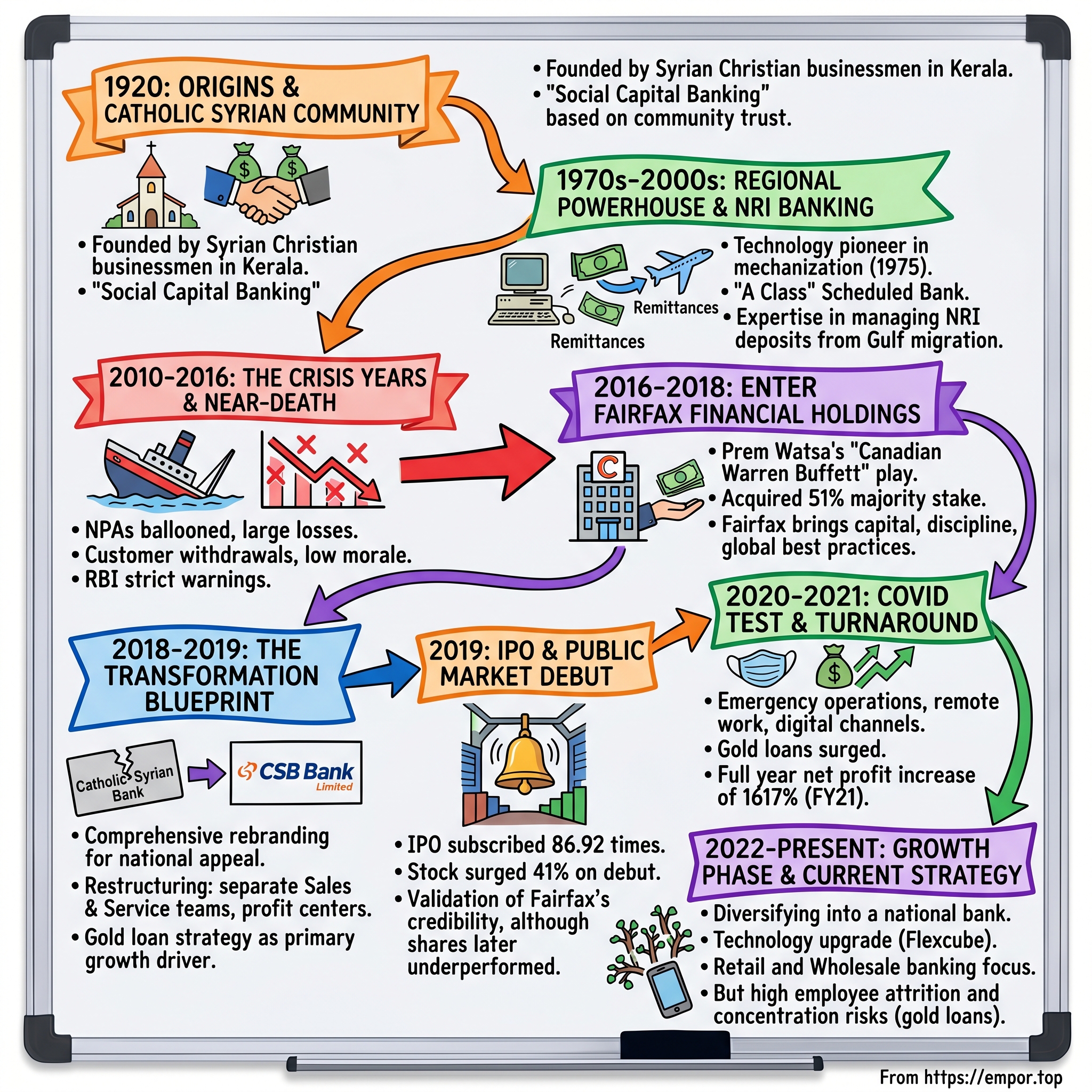
CSB Bank: From Century-Old Catholic Institution to Fairfax-Led Digital Transformation
I. Introduction & The Turnaround Story (15-20 min)
On the evening of July 22, 2026, Pralay Mondal dialed into an investor call hosted by Yes Securities and presented financial results that initially resembled a triumph. CSB Bank's deposits had expanded 26% year on year to ₹45,415 crore, while advances rose 24% and net profit increased 27% to ₹150 crore. Both growth rates comfortably outpaced the broader Indian banking system, which posted 13.4% deposit growth and 18.6% loan growth.1
Investors responded by sending the stock down 6.7%.
That contrast—between a bank outgrowing most of its peers and a share price that spent the summer of 2026 sliding toward a 52-week low of ₹312.95—captures the central market puzzle. As of September 3, 2026, CSB Bank carried a market capitalization of roughly ₹5,637 crore against a reported June-quarter book value of ₹289 per share, valuing the business at barely more than one times book.21 For a lender expanding its balance sheet by a quarter each year, that valuation reflects investor skepticism rather than confidence in the underlying franchise.
The Kerala Banking Anomaly
CSB Bank was established on November 26, 1920, in Thrissur—the commercial and temple town in central Kerala—and commenced operations the following year.34 It spent its first century as The Catholic Syrian Bank, an institution whose name signaled precisely whom it served: the Syrian Christian merchant and planter families of central Kerala, a community with its own liturgy, schools, and, from 1921, its own bank. Founding capital details were not disclosed in regulatory filings from that period.
A century later, that former parish bank operates 868 branches and 835 ATMs across India, manages a balance sheet of ₹57,727 crore, and is 40% owned by a Canadian holding company controlled by Prem Watsa.15 The institution became a primary test case for whether foreign private capital could restructure a traditional Indian commercial bank.
The Core Hook
In December 2016, the Reserve Bank of India granted in-principle approval for Fairfax India Holdings, operating through its Mauritius subsidiary FIH Mauritius Investments, to acquire a 51% stake in Catholic Syrian Bank.6 Indian banking regulations traditionally enforce strict ownership limits to prevent concentrated bank holdings. Permitting a foreign non-bank financial entity to acquire majority control of a licensed commercial bank was unprecedented.
The regulator relented not out of enthusiasm for foreign private equity, but because Catholic Syrian Bank faced severe operational constraints. By 2016, the institution suffered from an absence of committed promoters, inadequate capital, a fragmented retail shareholder base unable to supply fresh equity, and gross non-performing assets reaching 7.25% of total advances by March 2017.3
The Scale Today
CSB concluded FY2026 with a net profit of ₹633 crore—up 7% year on year—on operating profit of ₹1,085 crore, which grew 19%.4 Gross NPAs stood at 1.66% and net NPAs at 0.40% as of March 2026, representing an asset quality recovery that would have seemed unattainable a decade earlier.4 Capital adequacy reached 19.96% as of June 2026, roughly double the regulatory floor.1
Yet operational expansion has muted underlying profitability. In FY2023, on a loan book less than half its current scale, CSB generated ₹547 crore in net profit, delivering a return on assets of 2.06%, a cost-to-income ratio of 57.12%, and a current account-savings account (CASA) ratio of 32.18%.7 Three years later, even as total loans nearly doubled, net profit grew by just 16%, return on assets fell to 1.29%, cost-to-income rose to 62.53%, and low-cost CASA deposits collapsed to 20%.47 The balance sheet expanded significantly, but core efficiency deteriorated.
This structural divergence defines the company's current stage. CSB is not a completed turnaround story, but a lender attempting a complex transition: converting a high-margin, single-product, regionally concentrated gold lender into a diversified commercial bank—using the cash flows of gold loans to finance broader expansion while navigating potential promoter ownership constraints.
Episode Roadmap
The bank's trajectory spans six distinct phases: the community-focused era from 1920 to 2009, when local trust and Gulf remittance inflows sustained growth; the crisis period, when out-of-region expansion strained balance sheet quality; the Fairfax acquisition and regulatory approval process; the subsequent rebranding, gold-lending strategy, and 2019 initial public offering; the Pralay Mondal management era and the SBS 2030 strategic framework; and current operational pressures, including margin contraction, an annual employee attrition rate near 40%, reliance on high-cost bulk deposits, and a promoter whose ₹53,000 crore acquisition offer for another Indian lender could trigger regulatory divestment mandates inside two years.8
 Subscribe on LinkedIn
II. Origins & The Catholic Syrian Heritage (1920–1969) (25-35 min)
In the winter of 1920, the economic aftershocks of the First World War reverberated across Malabar. Commodity prices fluctuated sharply, credit remained scarce, and the Imperial Bank of India catered primarily to the colonial administration and coastal port cities rather than the agricultural interior. In central Kerala's trading towns, planters seeking working capital for pepper crops or goldsmiths financing inventory ahead of the wedding season relied heavily on local moneylenders operating at high interest rates.
Against this backdrop, the Syrian Christian community of Thrissur—a trading and landowning group with deep parish networks and a culture of thrift—established its own financial institution. The Catholic Syrian Bank was formed on November 26, 1920, with its registered office in Thrissur, and began banking operations the following year.34
The Community Banking Blueprint
The initial operating model was straightforward. Deposits were mobilized in modest amounts from local households who trusted the board members. Loans were extended to merchants, agriculturalists, and artisans, secured—then as now—primarily against gold jewelry, the principal liquid asset held by regional households. The bank's underwriting advantage was social rather than analytical: default carried a severe reputational cost within close-knit parish networks that no credit bureau could replicate.
This origin highlights a core operational trait that persists: the bank's century-old core strength lies in gold lending, while broader commercial banking capabilities had to be developed gradually over time.
Consolidation arrived in the 1960s. Across 1964 and 1965, Catholic Syrian took over the assets and liabilities of six small and medium-sized Kerala banks—Ollur Bank, Puthenpeedika Bank, Kottapadi Bank, Oriental Christian Bank, Indian Insurance & Banking Corporation, and Mar Appraem Bank.3 This expansion mirrored the path of other surviving old private-sector lenders in India, which absorbed weaker regional peers during the Reserve Bank of India's post-Independence efforts to consolidate a fragmented banking sector.
Regulatory Milestones
In August 1969—the same year the Indian government nationalized 14 major private banks—Catholic Syrian was included in the Second Schedule to the Reserve Bank of India Act, 1934, becoming a scheduled bank with access to the RBI's liquidity window and refinance facilities.3 In 1975, it attained 'A' class scheduled bank status and received its license to deal in foreign exchange, along with mechanized reconciliation of inter-branch transactions.3 Having avoided nationalization due to its modest size, the bank secured the basic infrastructure of a commercial lender.
Testing the Community Moat
While narrative accounts often suggest that deep community ties created an unassailable deposit franchise, historical performance presents a more nuanced reality.
Despite the stability provided by local trust, geographic expansion proceeded slowly. The bank's first branch outside Kerala did not open until 1972, in Mumbai, followed by Bengaluru in 1973.3 Through the 1950s and 1960s—decades when future leaders of Indian private banking built national networks—Catholic Syrian remained confined to central Kerala. Total business, defined as combined deposits and advances, did not cross ₹5,000 crore until 2004 and reached ₹10,000 crore only in 2009.3 It took eighty-nine years to build a balance sheet that a mid-tier private bank in the 2000s could add in a single year.
The historical record indicates that community trust yielded a stable, low-cost deposit base, but generated limited asset growth. Heavy geographic concentration in one state's agrarian economy also exposed the balance sheet to localized risks: weak monsoons, drops in rubber or spice prices, and regional economic downturns affected both deposit inflows and loan recoveries simultaneously. The bank survived these cycles, but its scale remained constrained.
Geographic metrics illustrate the persistence of this footprint today. As of the June 2026 quarter, Kerala accounted for 31% of CSB's branches and roughly 37% of its total deposits.59 The regional deposit base remains stable, but geographic concentration persists.
What fundamentally altered the bank's financial trajectory was not strategy, but the economic impact of Gulf oil expansion.
III. Building a Regional Powerhouse & NRI Deposit Boom (1970–2009) (35-45 min)
In October 1973, OPEC's oil embargo quadrupled crude prices, triggering a rapid infrastructure expansion across the Gulf states that drew hundreds of thousands of workers from Kerala. For Catholic Syrian Bank, this mass migration generated the most powerful financial tailwind of its second half-century. Non-resident Indian (NRI) remittances flowed into the bank as stable deposits, providing a funding base anchored by family relationships in Kerala rather than aggressive rate competition.
The Slow Technology Catch-Up
By the standards of Kerala's private banking sector, Catholic Syrian was an early modernizer, adopting mechanized inter-branch reconciliation in 1975.3 However, broader technological modernization lagged behind national peers. The bank did not complete the migration of all branches to a single core banking platform—an internal system named Maarvel—until June 2009.10 While core banking software had enabled major competitors to centralize ledgers and offer seamless cross-branch services around the turn of the millennium, Catholic Syrian operated with fragmented systems for another decade.
That delayed transition created lasting operational constraints. On a July 2026 investor call, Chief Executive Officer Pralay Mondal addressed the legacy platform's limitations directly: "When you look at Maarvel, our old software, it cannot do much and I also realized over a period of time that due to the short comings of Maarvel, you really cannot launch new products or have the required functionalities."11 A technology platform implemented in 2009 continued to restrict product development and functional agility seventeen years later.
The Structural Bottleneck
By the mid-2000s, Catholic Syrian possessed core institutional assets—community trust, remittance inflows, and specialized gold-lending expertise—yet lacked the modern operating structure required to capitalize on them fully. The workforce remained heavily unionized under centralized wage structures. In FY2025 disclosures, the bank still reported 552 officers in Scales I through III covered by the Indian Banks' Association pay structure, represented by two officers' associations alongside three trade unions representing award staff.10 Centralized, industry-wide wage negotiations kept labor costs rigid and largely detached from branch-level productivity.
During the same era, new private-sector competitors such as HDFC Bank, ICICI Bank, and Axis Bank established technology-driven national branch networks staffed by performance-incentivized personnel. These institutions built low-cost funding bases by capturing corporate current accounts, while state-owned lenders relied on public trust and vast scale. Lacking both technological scale and sovereign backing, Catholic Syrian saw its relative market position narrow.
Testing the NRI Moat
Although market commentary often treats Kerala's NRI deposit pool as a permanent structural advantage, Catholic Syrian's actual market share tells a more complex story.
During a May 2026 investor call, Mondal acknowledged that NRI deposits represented "around 13% of our deposits at this point of time," describing the figure as insufficient and setting a long-term target of at least 20%.4 He noted that the bank had applied to open a representative office in Dubai, though the launch remained delayed by regional geopolitical conflict.4 Decades after the initial Gulf boom, the bank was still working to build a dedicated international distribution network for Kerala's diaspora.
In the intervening decades, regional peers such as Federal Bank and South Indian Bank, alongside national private lenders, captured market share by building formal exchange-house partnerships and digital remittance infrastructure. Without complementary wealth management, home loan products, or modern digital interfaces, passive remittance relationships gradually eroded or shifted toward higher-cost term deposits. As a result, CSB Bank's current-account and savings-account (CASA) ratio stood at 19.41% as of mid-2026—below peer group medians—leading India Ratings & Research (Ind-Ra) to cite weak retail liability franchise strength as a key factor in its August 2026 outlook revision.5
While the NRI franchise remains a valuable foundation, CSB Bank's balance sheet demonstrates that historic diaspora ties no longer guarantee a low-cost funding advantage. Restoring NRI deposits from 13% toward management's 20% target—while stabilizing the overall CASA ratio and establishing operational footholds like the proposed Dubai office—represents an active rebuild project rather than an inherited moat.
By 2009, with a unified core banking system finally installed, a shrinking share of historic NRI deposits, and mounting board pressure to scale, the bank turned to rapid balance-sheet expansion by increasing large corporate lending—a shift that would soon precipitate its severe credit crisis.
IV. The Crisis Years: Bad Loans, Governance Failure & Decay (2010–2016) (40-50 min)
There is a well-worn failure mode in Indian banking, and between roughly 2008 and 2013, Catholic Syrian Bank walked directly into it.
The logic seemed compelling in the boardroom. The bank was heavily concentrated in Kerala retail. Corporate India was expanding rapidly across infrastructure, power, roads, textiles, and real estate. Consortium lending offered a mechanism to deploy capital quickly and at scale alongside major national lenders that had performed the initial credit analysis. By joining syndicated facilities, taking a participation slice, and booking interest income, a regional lender could diversify geographically and by sector without building a single new branch.
What that strategy overlooked was a fundamental reality of syndicated credit: someone must perform rigorous, ongoing underwriting, and minority participants rarely do. Catholic Syrian Bank lacked a specialized corporate credit team, maintained no independent monitoring of funds, and possessed little leverage in debt restructuring negotiations. It provided capital to syndicates without the internal capability to evaluate underlying asset risk.
Financial Haemorrhage
When India's corporate balance-sheet crisis unfolded, the consequences emerged with stark clarity in the bank's financial statements. Gross non-performing assets (NPAs) reached 7.25% of advances by March 2017 and deteriorated to 7.89% by March 2018, before balance-sheet clean-up efforts brought them down to 4.87% by March 2019.3 Net NPAs peaked at 4.12% in FY2017—meaning that even after provisions, more than four rupees out of every hundred lent were impaired and unreserved.3
The income statement reflected similar distress. According to restated financial disclosures in its 2019 initial public offering prospectus, the bank recorded net losses of ₹57.99 crore in FY2017, ₹127.09 crore in FY2018, and ₹65.69 crore in FY2019.3 Audited figures in the same document showed a significantly larger reported loss of ₹197.42 crore for FY2019.3 That gap between audited and restated metrics highlights an important disclosure nuance: financial restatements under Securities and Exchange Board of India rules reallocate provisions and accounting adjustments across fiscal periods. An investor focusing solely on the headline narrative of a single-year turnaround—from a ₹197 crore loss to immediate profitability—is viewing the more dramatic of two defensible financial presentations.
Supervisory audits also revealed regulatory classification gaps. The red herring prospectus disclosed that the Reserve Bank of India's independent assessment of gross NPAs at March 2017 exceeded the bank's reported figure by ₹33.9 crore, alongside a ₹24.8 crore divergence on net NPAs.3 While divergences of that size were not fatal, they reflected the limitations of the bank's internal credit recognition discipline during that era.
Governance Paralysis
The deeper structural issue was governance. Catholic Syrian Bank lacked a controlling promoter. Ownership was fragmented among local families, community institutions, and individual Non-Resident Indian investors—a register with deep institutional loyalty but limited capital-raising capacity. When credit losses eroded capital buffers, a bank had two choices: earn its way back to health, which was impossible when provisions exceeded operating profit, or raise equity, which was equally constrained because no existing shareholder could anchor a major capital call and regulatory limits prevented outside entities from acquiring controlling stakes.
External equity had entered earlier in small increments. In 2007, AIF Capital Development, GPE III Mauritius Direct Investment, and Siguler Guff BRIC Mauritius together invested ₹33.3 crore into the bank.3 In 2015, the bank obtained Foreign Investment Promotion Board approval to raise its foreign investment ceiling to 74% of paid-up capital—a clear indication that it had spent years seeking strategic capital.3 Yet neither minority private equity investments nor higher foreign ownership limits solved the core structural deficit, as neither delivered a controlling promoter with the mandate and resources to anchor a multi-year turnaround.
Reported merger and investment discussions from this period, including potential transactions involving regional peers or development institutions, were never documented in official regulatory filings.
Testing the Diversification Thesis
The strategic thesis under test is common among regional lenders: expanding into wholesale corporate credit offsets geographic and retail concentration risks.
Empirical evidence from the bank's subsequent performance refutes that thesis. Catholic Syrian's core gold loan portfolio—the relationship-driven, socially underwritten business conducted since the 1920s—remained resilient through the crisis. As of the June 2026 quarter, gold loans recorded a gross NPA ratio of just 0.27%.9 In contrast, the corporate lending expansion nearly destabilized the institution.
The key takeaway is not that regional concentration is without risk or that corporate lending is inherently flawed. Rather, it demonstrates that credit underwriting capability is an essential prerequisite before deploying capital, and cannot be outsourced to a consortium leader. Extending a balance sheet into credit segments without independent risk assessment capabilities does not reduce risk; it absorbs external balance-sheet risk without receiving appropriate risk-adjusted pricing.
That principle remains directly relevant to analyzing CSB Bank's position in 2026, when wholesale banking represents 26% of its total loan book—a business segment the lender exited following its credit crisis and subsequently rebuilt with an 80-plus person relationship management team.54
By 2016, Catholic Syrian Bank faced a stark binary outcome: secure a controlling institutional investor with regulatory approval, or risk regulatory resolution as capital buffers depleted. A solution emerged from Toronto.
V. Enter Fairfax: The Landmark Regulatory Buyout (2016–2018) (45-55 min)
Prem Watsa spent four decades building Fairfax Financial Holdings around a value-investing framework supported by insurance underwriting float and a willingness to take contrarian positions. Born in Hyderabad and educated at IIT Madras before emigrating to Canada, Watsa positioned India as a long-term strategic focus. In 2015, he established Fairfax India Holdings as a dedicated investment vehicle, operating on the premise that India's formalizing economy would yield sustained growth and that institutional access was the primary constraint for foreign capital.
A commercial banking license represented a key entry point into the country's financial system, yet direct licenses remained difficult for foreign institutional investors to secure. Rather than applying for a new license, Fairfax sought control of an existing scheduled bank facing severe capital pressures.
The Regulatory Breakthrough
In December 2016, the Reserve Bank of India granted in-principle approval for Fairfax to acquire a 51% stake in Catholic Syrian Bank.6 Formal approval followed in July 2018—marking the first acquisition of a controlling stake in an Indian bank by a foreign non-banking entity after the regulator updated its ownership guidelines in May 2017.12
The RBI's decision reflected pragmatic financial oversight. Rather than signaling a broad endorsement of concentrated foreign ownership, the regulator faced limited options for an undercapitalized scheduled commercial bank with over 400 branches and hundreds of thousands of depositors across Kerala. The primary alternatives were a regulatory resolution involving a forced merger into a state-owned lender—which carried political and taxpayer implications—or allowing a foreign institutional investor to inject fresh capital. The stringent ownership sell-down conditions attached to the approval underscored the regulator's ongoing commitment to dispersed bank ownership over time.
For Fairfax, the transaction offered controlling rights in a licensed lender at a distressed valuation. The asset presented clear structural challenges: an impaired corporate loan portfolio requiring heavy provisions and an uncompetitive cost structure. However, it also contained a resilient, high-margin gold-lending business. The missing elements were core equity capital and modern management oversight—the primary inputs an institutional control investor could provide.
Deal Structuring and Capital Infusion
In February 2018, Fairfax India agreed to acquire a 51% stake in Catholic Syrian Bank for approximately ₹1,200 crore at ₹140 per share.13 Watsa had revised an earlier 2017 proposal upward, citing confidence in the bank's executive management team.13 Financial reporting at the time highlighted that the fresh capital would provide the balance sheet buffer required to support multi-year loan growth.14
The capital infusion resolved the bank's binding capital constraints. By March 2023, Catholic Syrian Bank reported a capital adequacy ratio of 27.10%—nearly triple the regulatory minimum—and maintained a ratio of 19.96% as of June 2026 despite expanding its loan book at over 25% annually.71 The equity injection provided a multi-year growth runway, enabling the institution to expand without immediate equity dilution. The bank has not raised additional equity capital since its 2019 initial public offering, and India Ratings & Research (Ind-Ra) noted in August 2026 that no major equity raises would be required to support its medium-term growth plans.5
The Dilution Clock
The regulator's approval required Fairfax to adhere to a structured ownership sell-down schedule, establishing a long-term governance requirement for the shareholder base.
As Mondal detailed publicly in October 2024, the promoter's 51% stake was required to decline to 40% by August of FY2024 and to 26% by 2034 under a 15-year regulatory timeline.15 Fairfax completed the initial sell-down step in June 2024, divesting a 9.7% equity stake through open-market transactions for gross proceeds of approximately ₹595 crore (roughly $70 million) at an average price of ₹352.75 per share, reducing its holding to 40%.16
That transaction highlighted two key market dynamics. While institutional buyers absorbed the placement without immediate disruption to trading volume, the transaction price of ₹352.75 per share remained above the stock's trading range during the summer of 2026.2 The market subsequently allowed the share price to decline below the initial sell-down valuation.
Cultural Shockwave
The capital injection introduced a modern governance framework to the Thrissur-headquartered lender. The bank instituted quarterly reporting to a Canadian holding company and established expected credit loss (ECL) modeling under International Financial Reporting Standards (IFRS) alongside Indian GAAP requirements—a dual-reporting capability that Chief Financial Officer Satish Gundewar confirmed in May 2026 was fully operational.4
This analytical approach stood in sharp contrast to the bank's traditional operating environment, which was characterized by a workforce organized under two officers' associations and three trade unions, industry-wide wage structures, and branch operations focused on personal relationships rather than performance metrics. Translating institutional capital into operational efficiency required reshaping the daily practices of a century-old regional lender.
VI. Turnaround Blueprint, Restructuring & Rebranding (2018–2019) (40-50 min)
The executive tasked with executing this restructuring was C. VR. Rajendran, a career public-sector banker who previously served as executive director at Bank of Maharashtra and Corporation Bank, and later as chief executive of the Association of Mutual Funds in India. Rather than a growth-oriented expansionist, Rajendran brought the temperament and background of an institutional restructuring specialist focused on identifying bad loans, building provisions, and maintaining regulatory compliance.
His mandate addressed the operational groundwork of a banking turnaround: recognizing impaired assets, provisioning against credit losses, scaling down unviable operations, and identifying sustainable revenue sources while the legacy corporate loan book ran off.
The Rebranding
On June 10, 2019, The Catholic Syrian Bank Limited officially changed its name to CSB Bank Limited. Bank shareholders approved the name change via postal ballot on May 4, 2019, following no-objection approval from the Reserve Bank of India under Section 49B of the Banking Regulation Act on April 1, 2019. A revised certificate of incorporation was issued on June 10, followed by an updated banking license on June 28, 2019.3
The public rationale addressed both community perception and regional expansion. Rajendran told reporters that there was "a misconception among the general public that the bank is owned by a particular community and this is not true."17 For a lender seeking to establish branches in commercial centers across northern and western India, a name tied to a single community created potential marketing hurdles.
An equally critical factor was operational. The word "Syrian"—referring to the historic Syriac liturgical tradition of Kerala's Christian community—triggered automated sanctions screening systems at international financial institutions, occasionally delaying Non-Resident Indian remittance transfers.17 Consequently, global compliance filters disrupted routine transaction flows and impaired core deposit channels.
The Gold Loan Engine
With wholesale corporate lending constrained, management redirected focus toward the bank's historic core capability: gold-backed lending.
The operational mechanics of gold loans differ markedly from standard commercial credit. A borrower pledges gold jewelry as collateral, which a certified appraiser evaluates for weight and purity. The bank then disburses a loan representing a percentage of the collateral's market value—the loan-to-value ratio—within minutes, holding the physical gold in branch vaults. The process requires minimal credit scoring, income documentation, or formal end-use verification. Because the collateral is standardized, liquid, continuously priced on global spot markets, and held directly by the lender, default risks are mitigated by auctioning the underlying asset if required.
This structural framework produces distinct financial characteristics. Credit losses remain low, as reflected in CSB's gold portfolio gross non-performing asset ratio of 0.27% in the June 2026 quarter.9 Portfolio yields reached 11.85% for that quarter, compared with 8.78% on wholesale advances.9 Additionally, low regulatory risk weights allow capital to support larger loan volumes, while short maturities enable rapid portfolio repricing.
However, the model also presents strategic constraints. Gold lending is operationally intensive, relies on local branch footprints and skilled appraisers, and offers limited customer switching costs. Borrowers can easily transfer loans to competing non-banking financial companies or rival lenders offering lower rates. While CSB maintains efficient appraisal, vault infrastructure, and auditing processes, it lacks built-in customer retention mechanisms.
HR Transformation and Labour Friction
The restructuring blueprint also targeted human resources. Management shifted workforce compensation away from industry-wide wage agreements toward individual cost-to-company contracts featuring variable, performance-linked pay. The extent of this transition is evident in FY2025 disclosures, which show that out of 7,616 total employees, 6,708 worked under cost-to-company contracts, while only 906 remained under traditional Indian Banks' Association wage structures.10
This transition represented a major shift in the bank's employment model inside a decade. While it aligned compensation with individual performance, it also introduced workforce friction and operational challenges that affected organizational stability over subsequent years.
Testing the Rebranding Thesis
The hypothesis that rebranding would immediately eliminate operational friction and accelerate national deposit growth yielded mixed results. Addressing the international sanctions filter resolved a tangible operational bottleneck. However, changing a corporate identity does not automatically create a nationwide retail franchise.
Geographic metrics illustrate this ongoing challenge: as of the June 2026 quarter, Kerala still accounted for roughly 37% of total deposits and 31% of branches, leading India Ratings & Research to cite geographic concentration as an ongoing rating weakness in August 2026 while noting that diversification would remain gradual.59
The primary benefit of the rebranding was the removal of an operational and compliance constraint. Establishing a nationally diversified retail liability base requires multi-year distribution efforts beyond initial brand repositioning.
Six months after receiving its updated banking license, CSB Bank initiated its next major capital market milestone.
VII. The IPO Crucible & COVID-19 Stress Test (2019–2021) (35-45 min)
CSB Bank's initial public offering, conducted from November 22 to 26, 2019, proved to be remarkably well-timed for the institution's capital needs—less for its initial valuation than for the financial buffer it provided four months later.
Investors subscribed for 86.92 times the shares on offer.18 Priced at ₹195 per share, the stock listed on the National Stock Exchange on December 4, 2019, at ₹275, representing a 41% premium.19
Market demand was driven less by current earnings—the bank had recently recorded net losses—than by a turnaround proposition. Investors were backing a licensed commercial bank freshly capitalized by an institutional control investor, with legacy non-performing assets largely provisioned or written down, trading on the expectation of structural recovery.
Financial Turnaround Evidence
Financial results for FY2020 offered the first tangible evidence of recovery, with profit before tax reaching ₹134 crore. Net profit stood at approximately ₹13 crore, constrained by a one-time ₹87 crore charge associated with transitioning to India's lower corporate tax regime.20 The pre-tax performance indicated that core operational profitability had returned.
Shortly after the listing, the onset of the COVID-19 pandemic subjected the bank's revised operating strategy to an immediate macro stress test.
COVID-19 Resilience
Economic lockdowns across 2020 and 2021 severely disrupted major growth segments for Indian retail lenders, particularly microfinance, unsecured personal loans, and small-business credit. Cash flows among informal borrowers contracted sharply, triggering collection difficulties and temporary loan moratoria.
CSB Bank's balance sheet was structurally insulated from these pressures. Gold loans rely on physical collateral rather than borrower cash flows for credit recovery. Furthermore, global gold prices appreciated sharply during 2020, expanding the bank's collateral cushion while asset quality deteriorated across other lending categories. Under financial stress, retail households increasingly pledged jewelry for short-term liquidity.
Consequently, net profit expanded to ₹218.4 crore in FY2021, followed by ₹458 crore in FY2022 and ₹547 crore in FY2023.7 By FY2023, the bank generated a return on assets of 2.06% and reduced its cost-to-income ratio to 57.12%, supported by a provision coverage ratio above 92% and a capital adequacy ratio of 27.10%.7
What That Period Actually Proved
While this multi-year earnings expansion formed the core of the ongoing bull thesis for CSB Bank, the underlying drivers warrant careful analytical distinction.
The financial performance from FY2021 through FY2023 demonstrated two clear capabilities: scaling gold lending with tight credit risk controls, and avoiding high-risk unsecured retail credit—a conservative approach validated during the microfinance stress cycle of 2024–2025.
However, these results did not prove that CSB Bank had established a fully diversified commercial banking franchise. A return on assets exceeding 2%, achieved by concentrating a rapidly expanding balance sheet in high-yielding, low-risk-weight, short-duration gold loans during a period of rising commodity prices and abundant liquidity, reflected favorable cyclical conditions. Converting those earnings into a durable national franchise presents different operational requirements: funding lower-margin corporate credit, building a retail deposit network from scratch, and absorbing the costs of a complete technology modernization.
That structural transition began in 2022, creating the operational pressures that shape the bank's present trajectory.
VIII. The Pralay Mondal Era & SBS2030 Transformation (2022–Present) (45-55 min)
In January 2022, CSB Bank's board approved the early retirement of C. VR. Rajendran, who stepped down on medical advice after leading the institution through its post-acquisition cleanup until March 31, 2022.21 His departure marked the end of the initial stabilization phase and shifted leadership to an executive focused on scaling the retail franchise.
Pralay Mondal had joined CSB as President in September 2020, bringing extensive experience from the retail banking divisions of leading Indian private lenders, including senior management roles at HDFC Bank, Axis Bank, Yes Bank, and directorships at non-banking financial companies including HDB Financial Services and Axis Finance.11 During a July 2026 investor call, Mondal emphasized his background in retail credit risk management, noting, "I have done retail all my life. I know too well when to press the pedal, because if you press the pedal too fast, you will meet with an accident."11
Mondal served as interim Managing Director and Chief Executive Officer starting April 1, 2022, with the Reserve Bank of India granting formal approval for his appointment on September 15, 2022.22 In June 2025, the regulator approved his reappointment for an additional three-year term running through September 14, 2028.23
The SBS 2030 Strategy
To reshape the institution, management established a strategic framework designated as SBS 2030—Sustain, Build, Scale—designed to pivot CSB Bank away from its historical reliance on a single asset class toward a full-service banking model.
The Sustain phase focused on maintaining cash flows from the legacy franchise. As Mondal explained during the July 2026 call, "one of the things which was very good is understanding of the gold loan business. We have continued to sustain that. For just doing gold loan you need an NBFC and you do not need a bank and we set out to build a bank."11
The Build phase established five core institutional pillars—governance, human capital, technology, customer service, and compliance—headlined by a comprehensive overhaul of the bank's core IT infrastructure.11
The Scale phase, scheduled to run from FY2027 through FY2030, aims to transform CSB into a diversified mid-sized commercial lender. Management's targeted loan portfolio mix contemplates reducing gold loans from 54% of total advances to approximately 30% by 2030 (with roughly five percentage points allocated to gold-backed small-and-medium enterprise working capital), while expanding wholesale credit to 32%, SME lending to 18%, and retail banking to between 20% and 23%.411
The Technology Rebuild
The technology overhaul represents the operational core of the transformation strategy. In May 2025, the bank completed its migration from its legacy Maarvel software to Oracle's core banking platform, integrated alongside Oracle Financial Services Analytical Applications (OFSAA) for analytics and reporting, a ServiceNow platform, modernized loan origination systems, digital banking channels via OBDX, and more than 50 ancillary support systems, supported by a rebuilt primary data center.4
Replacing a core banking architecture across a live network requires coordinating accounts, regulatory reporting feeds, ATM networks, and payment interfaces simultaneously. Management reported completing the migration with minimal customer-facing operational downtime, with Mondal describing the execution as "a once-in-a-lifetime experience."4
While technical execution proceeded smoothly, its strategic value must be evaluated against the multi-year delay that preceded it. When questioned during the July 2026 investor call regarding the slow initial pace of retail product rollouts, Mondal acknowledged the delay, stating, "only one place we fell short, which is taking the decision on the technology, which got delayed by two-and-a-half years."11 Management attributed this lag to internal vendor selection processes rather than post-selection implementation.
A two-and-a-half-year delay compresses the timeline for an initiative targeted for completion by 2030. Mondal asserted that the bank will compress its execution schedule rather than alter its targets, stating, "if you have lost two years in taking the decision on the core system for whatever internal reasons, we will work harder to make up for that time and by 2030 we will deliver what we had promised."11 Demonstrating that operational compression remains an ongoing milestone for investors.
Distribution Expansion
Parallel to the IT rebuild, CSB expanded its physical footprint, though at a more moderate pace than initial market expectations suggested. The branch network grew from 834 in June 2025 to 868 in June 2026—a net addition of 34 locations, trailing the 100-branch annual expansion pace previously ascribed to the bank.9 Network composition moved gradually toward urban commercial centers, with metropolitan locations rising to 233 branches from 220 a year earlier.9 Geographic concentration eased slightly: Kerala's share of total branches contracted from 32% to 31%, Tamil Nadu maintained a 16% share, and remaining outlets were distributed across Andhra Pradesh, Maharashtra, Karnataka, and expanding markets in Delhi, Telangana, and Gujarat.9
Testing the Expansion Thesis
The core investment thesis hinges on whether geographic branch expansion can generate low-cost retail liabilities similar to those of established private-sector peers. Empirical metrics from FY2023 through mid-2026 indicate that operational scaling has so far increased overhead costs faster than retail deposit mobilization.
Operating efficiency metrics illustrate this structural pressure. The bank's cost-to-income ratio rose from 57.12% in FY2023 to 62.82% in FY2025, before standing at 62.53% in FY2026 and reaching 64.55% in the June 2026 quarter.72441 Management guidance indicates that elevated expenditure will persist, with Mondal confirming during May and July 2026 investor calls that the cost-to-income ratio is expected to remain between 60% and 65% through FY2027, with operating leverage materializing only from FY2028 onward.4 Clarifying the expense trajectory during the May call, Mondal noted, "I never said that cost to income will come down from next quarter."4
This guidance represents a shift in management's cost-reduction timeline. In April 2025, leadership projected that cost-to-income would decline from the 62–65% range down to 50% between FY2027 and FY2030.24 By mid-2026, the onset of that efficiency improvement had been deferred to FY2028, pushing back the expected realization of operating leverage by a full year.
Concurrently, liability mix disclosures reflect an increased dependence on wholesale funding rather than granular retail deposits during this expansion phase. Bulk deposits rose to 52% of total term deposits in the June 2026 quarter, up from 43% in FY2025, according to India Ratings & Research, while retail deposits contracted to 48% of term deposits from 59% over the same period.5 Furthermore, concentration metrics showed that the bank's top 20 depositors accounted for 23% of total deposits as of March 2026.5
These trends demonstrate that recent branch expansion has primarily supported loan growth through high-cost institutional funding rather than establishing a self-sustaining retail deposit base. Management acknowledged this dynamic in its revised guidance, with Mondal stating that CASA deposits are expected to grow only in line with total deposits starting in FY2028, and outpace term deposit growth only from FY2029 onward.11 Consequently, the performance of the CASA ratio and the retail share of term deposits remain the key benchmark metrics for assessing the long-term execution of the SBS 2030 strategy.
IX. Economic Engine & Segment-Level Financial Architecture (45-55 min)
Strip CSB Bank down to its mechanics and it is currently three businesses of very unequal quality sharing one balance sheet and one funding pool.
The Gold Engine
At June 30, 2026, gold loans stood at ₹21,906 crore of ₹40,309 crore in net advances — roughly 54% of the book, up from about 45% a year earlier.15 The portfolio yielded 11.85%, carried a reported loan-to-value of 75.31%, and had a gross NPA ratio of 0.27%.9
Now the number that matters most, and which very few summaries of CSB mention. Gold tonnage pledged with the bank fell from 24.59 tonnes in the June 2025 quarter to 23.99 tonnes in the June 2026 quarter — while the rupee value of the book grew 47%.91
Read that again. The bank's fastest-growing asset class grew almost entirely because gold got more expensive, not because it lent against more gold.
To management's credit, they have never hidden this. Back in October 2024 Mondal was already drawing the distinction himself: value growth of 28% against tonnage growth of 9–10%, so "the real growth is 10 per cent and the rest is because of the price increase happening in the ecosystem and we don't take that as the real growth."15 By 2026 the tonnage growth had gone to zero and turned slightly negative. Mondal explained on the May 2026 call that this is partly deliberate — a shift to larger ticket sizes above ₹10 lakh where borrowers draw only what they need — and that "typically, when prices go down, tonnage will go up and when prices go up, tonnage will go down."4
That explanation is coherent and probably true. It is also an admission that a material part of reported asset growth, net interest income growth and fee income is a function of the gold price rather than franchise expansion. The mechanism runs both ways: on the July 2026 call, Mondal attributed part of the quarter's fee income shortfall to falling gold-loan disbursements, because when prices stop rising, customers stop closing and re-opening loans at higher values — and processing fees are charged on disbursement.11 A bank whose fee line moves with the gold price is carrying a commodity exposure that does not appear anywhere in its credit risk disclosures.
Roughly ₹2,100 crore also moved into the gold line from elsewhere. A "loan against security" product where the collateral was gold — the repledge business — was wound down after RBI guidance, shrinking from over ₹2,100 crore to about ₹60 crore by the June 2026 quarter.11 Mondal was candid that this reclassification inflated the optics: the gold mix rose "from around 44% to around 53%" partly because that book moved across, and excluding it, gold "has remained below 50%."4
Wholesale Banking: The Rebuild
Wholesale is now about 26% of gross advances, up from 23% a year earlier, growing 37% year on year.51 It yields 8.78% — nearly three percentage points below gold.9
This is the business that nearly destroyed the bank a decade ago, and management is explicit that it is being built differently: a relationship team expanded from barely double digits to more than 80 people, a named head in Manish Modi, a deliberate reduction of financial-institution exposure from about 70% of the wholesale book to roughly a third, and targets set on both return on assets and risk-adjusted return on capital rather than volume.411
Mondal's defence of funding lower-yielding corporate loans with higher-cost wholesale deposits is worth quoting because it states the trade openly: "as long as we can keep the NIM within our guidance, which is around 3.75% — we can." He added a boundary condition: "We will be able to manage this till the time our gold mix is somewhere between 45% to 50% or so. As and when the gold mix starts coming below 45%, then each of these businesses has to stand on their own feet."11
That is management describing, in its own words, a cross-subsidy with an expiry date. The gold book's excess margin is currently paying for the construction of a wholesale and transaction banking franchise. When gold falls to the targeted 30% of the book, that subsidy is gone and wholesale must earn its own returns. Whether it can is the central unresolved question of the SBS 2030 plan — and there is no track record to answer it with, because the last time CSB ran a wholesale book at scale, it produced the crisis described in Section IV.
SME and Retail: The Missing Businesses
SME — which CSB calls the Business Lending Group, combining small enterprise and loan-against-property — is about 11% of advances, down from 13% a year earlier.5 It grew 2–3% in FY2026 against a 2030 target of 18%.4 Management deliberately slowed it: Mondal cited tariff disruption and the West Asian conflict squeezing exporters and supply chains, and noted that SMEs lack "the kind of staying power" of larger corporates.4 Yields fell from 9.81% to 9.25% quarter on quarter, partly from slippages.911
Retail excluding gold is smaller still, and shrinking. Unsecured retail — personal loans, credit cards and similar — is about 2% of the total book, and Mondal has said the bank will not focus on it until FY2028 at the earliest, citing job-market stress in the sectors where such borrowers work.11 Meaningful retail asset growth, he told analysts in May 2026, "will start from FY2028 onwards."4
Funding and Treasury
The liability side is where the strain shows. CASA was ₹8,815 crore at June 2026 — up just 4% year on year against 26% deposit growth — pushing the CASA ratio down to 19.41% from 23% a year earlier.1 Cost of funds ran around 6.5%.11 The credit-deposit ratio sat marginally below 90%, and liquidity coverage was comfortable at 123% for the June quarter after a tactical dip to 109% at March.114
Treasury has swung from tailwind to headwind. Net treasury profit fell from ₹53 crore in the June 2025 quarter to ₹12 crore a year later.11 Management chose not to book gains: the bank holds an unusually large available-for-sale book relative to held-to-maturity — investments were split roughly 37% HTM at June 2026 — built when the RBI's revised investment norms allowed a one-time reclassification.9 Mondal expected to harvest gains as yields fell; instead yields rose from 6.6% toward 7.1%.4 That is an unrealised position sitting on the balance sheet awaiting a rate move that has not come.
The honest summary of the economic engine: one excellent, commodity-levered, low-lock-in business is funding the construction of two businesses that do not yet earn their cost of capital, using deposits the bank buys rather than deposits it owns.
X. Industry Structure, 7 Powers & Porter's 5 Forces (35-45 min)
Evaluating CSB Bank against the broader competitive landscape reveals a lender with a single, highly specialized operational strength alongside significant structural exposure.
Hamilton Helmer's 7 Powers
Process Power — genuine, in one product. The ability to test purity, appraise collateral, disburse funds, and vault gold loans in minutes across hundreds of branches—while maintaining a low gross non-performing asset ratio of 0.27%—is difficult to replicate.9 This operational engine requires specialized appraisers, secure vault infrastructure, rigorous audit discipline, and an institutional culture focused on risk controls. Major private sector banks have repeatedly found gold lending harder to scale efficiently than anticipated. This process efficiency represents CSB Bank's primary structural advantage.
However, regulatory mandates limit the durability of this operational moat. The Reserve Bank of India's revised gold loan guidelines, finalized in June 2025 and effective April 2026, introduced tiered loan-to-value caps—capping borrowing at 85% for loans under ₹2.5 lakh, 80% for loans between ₹2.5 lakh and ₹5 lakh, and 75% for amounts exceeding ₹5 lakh—alongside stricter auction protocols, tenure limits on bullet repayments, and mandatory timelines for returning collateral.25 CSB Bank has already absorbed early operational impacts, including the reduction of its ₹2,100 crore gold repledge portfolio to near zero. During the July 2026 investor call, Mondal noted that implementing new end-use monitoring protocols during the quarter contributed directly to slower disbursement volumes.11 An operational advantage subject to regulatory recalibration provides valuable efficiency, but lacks long-term strategic insulation.
Cornered Resource — moderate and eroding. A century-long presence across tier-2 and tier-3 towns in Kerala represents a tangible legacy asset. Historically, such geographic depth yields a low-cost, stable deposit base, but that funding advantage has steadily weakened. In August 2026, India Ratings & Research (Ind-Ra) cited a constrained CASA ratio and a weak retail liability franchise when revising the outlook on CSB's ₹500 crore Tier II bond programme from Positive to Stable, while affirming its rating at IND A.5 The bank's current-account and savings-account ratio of 19.41% lags broader industry medians—which Ind-Ra explicitly characterized as "below its peers"—demonstrating that historic regional trust has not translated into low-cost retail deposit capture.51
Scale Economies — weak, but explicitly acknowledged. As of March 2026, CSB Bank accounted for approximately 0.2% of total advances and deposits within the Indian banking system.5 Despite this modest balance sheet, the institution bears the fixed overhead of a full core banking platform, dedicated data centers, regulatory reporting systems, and enterprise compliance infrastructure. Management's technology modernization strategy represents an attempt to build scale economies over time by absorbing upfront fixed costs ahead of balance-sheet expansion. While recent financial statements reflect elevated operational spending, expected operating leverage remains deferred until FY2028.
Switching Costs — weak. Gold loan borrowers can easily refinance with competing lenders upon maturity, while retail depositors face minimal friction when transferring balances to higher-yielding institutions. CSB Bank's strategic framework implicitly recognizes this vulnerability: the SBS 2030 roadmap prioritizes liability generation because current accounts and primary payroll relationships provide the main source of customer retention for mid-sized lenders—capabilities CSB has not yet established at scale.
Branding, Counter-Positioning, Network Economies. CSB Bank displays no significant competitive advantage across these dimensions.
Porter's Five Forces
Threat of new entrants — moderate, but higher than formal licensing barriers imply. While new universal banking licenses remain scarce, CSB Bank faces low entry barriers in its core product lines. In gold lending, it competes directly against non-banking financial companies such as Muthoot Finance and Manappuram Finance—which operate without banking licenses—as well as small finance banks using gold loans as a primary entry asset. On the liability side, the bank competes for deposits against digital-first lenders offering aggressive savings rates.
Bargaining power of borrowers — high in core lending. Gold loan rates are transparent, enabling borrowers to compare offers across institutions easily. In response, management has focused on larger ticket sizes where, as Mondal observed, refinancing clients migrating from non-banking financial companies "are paying higher than what we are charging."4 While this strategy captures immediate volume, it also reflects market-driven pricing rather than unilateral lender pricing power.
Bargaining power of depositors — high and increasing. Deposit pricing dynamics present an ongoing cost challenge for the institution. With bulk deposits representing 52% of term deposits and the top twenty depositors accounting for 23% of total funding, a significant portion of the bank's liability base is set by institutional treasurers sensitive to minor yield differentials.5 Management has emphasized that these wholesale funds are non-callable with defined maturities—predominantly under six months—rendering liquidity manageable despite funding concentration.411 While this maturity structure mitigates immediate run-off risk, it does not lower overall funding costs.
Threat of substitutes — moderate. Gold-backed loans compete directly with unsecured personal credit, microfinance products, informal credit networks, and direct sales of gold bullion or jewelry.
Rivalry — intense across all segments. CSB Bank operates against three distinct competitor groups simultaneously: traditional private-sector peers with stronger low-cost deposit franchises (such as Federal Bank, South Indian Bank, Karur Vysya Bank, and City Union Bank); major private banks with vastly superior technological scale; and specialized gold-lending NBFCs operating with leaner branch overhead and no regulatory deposit obligations. Across each group, CSB Bank currently operates at a structural scale disadvantage.
Structural Summary. CSB Bank possesses one specialized operational capability in gold lending, limited pricing power across assets and liabilities, and an expansion strategy targeting business lines where it lacks established structural advantages. While strong capital adequacy, low asset quality distress, and rapid loan growth provide an operational foundation, long-term performance remains dependent on execution discipline rather than structural moats.
XI. Skeptical Investor Stress Test & Historical Falsification Pass (35-45 min)
Four central claims underpin the optimistic investment case for CSB Bank. Each requires rigorous testing against the institution's historical track record and disclosed performance metrics.
Falsification Test 1: The Gold Loan Monoculture
Claim: Gold dominance guarantees structural asset quality and a return on assets above 1.5%.
The disconfirming evidence is CSB's own income statement. In FY2023, with gold representing roughly 44% to 45% of total advances, return on assets stood at 2.06%.7 By FY2026, with gold loans expanding to 53% to 54% of the book, return on assets fell to 1.29%.4 Higher gold concentration coincided with materially lower overall profitability. The primary driver of this margin compression was not credit default—asset quality actually improved—but rising liability costs and operating overhead.
Regulatory directives have also constrained this lending engine. The gold repledge portfolio, previously valued at over ₹2,100 crore, was eliminated following Reserve Bank of India guidance.11 Enhanced end-use monitoring requirements slowed disbursement velocity in the June 2026 quarter.11 Loan-to-value (LTV) metrics warrant similar scrutiny: CSB's reported gold LTV of 75.31% stands notably above peer averages, which an analyst on the July 2026 call placed below 65% for regional lenders such as Karur Vysya Bank and City Union Bank.911 Mondal explained that a substantial agricultural gold loan book permits LTVs up to 85%, whereas non-agricultural gold LTVs sit between 50% and 55%, adding that the board has mandated a gradual reduction in agricultural gold exposure.11 Management has maintained that even a 10% decline in gold prices would not impair the portfolio.4
While that risk assessment may prove accurate, it represents a management assertion tested only during an extended bull market in precious metals. CSB expanded its gold concentration while gold prices rose consistently; the portfolio has not yet navigated a prolonged price decline.
Verdict: The claim is rejected in its stated form. Increasing gold concentration delivered low credit defaults but coincided with materially lower return on assets. The surviving reality is that gold lending provides low credit risk and high gross yields, but its net contribution to profitability remains governed by liability costs and operational overhead—neither of which gold collateral controls. The primary metric to track is underlying gold tonnage rather than rupee value expansion.
Falsification Test 2: Employee Attrition and Cultural Renewal
Claim: Moving to performance contracts created an agile, low-cost workforce.
The disconfirming evidence is severe. In FY2025, the bank hired 3,472 new employees, yet total headcount contracted from 7,863 to 7,616.10 CSB recruited nearly 45% of its entire workforce within twelve months only to end the year with fewer staff. In FY2026, according to the bank's Business Responsibility and Sustainability Report, turnover reached 38.8% for male employees and 41.3% for female employees across a workforce of 8,187.26
An annual attrition rate approaching 40% represents a chronic operational condition rather than a temporary transition cost. Rapid turnover erodes institutional memory, elevates training overhead, and disrupts client relationships where frontline personnel serve as the primary customer interface. This high churn offers a compelling explanation for why a network of 868 branches has struggled to grow CASA deposits faster than 4% annually.
Management contends that turnover remains concentrated in junior field roles while senior leadership remains stable. Disclosures in the FY2025 annual report lend partial support to this view: among 437 staff identified as "Emerging Talent," attrition was 12% and 20% received promotions.10 Additionally, average employee age increased from 33.1 years in FY2022 to 34.0 years in FY2025.10
Verdict: The claim is rejected. Although replacing the legacy IBA pay structure lowered average base salary costs, an organization experiencing 40% annual frontline turnover cannot be characterized as agile. Furthermore, the cost-to-income ratio—the primary metric of operational efficiency—has expanded rather than contracted. The valid takeaway is that CSB successfully removed legacy wage rigidities and established a stable executive tier, but did so at the expense of frontline stability. Sustained recovery requires improving CASA growth and lowering operating cost ratios alongside frontline stabilization.
Falsification Test 3: Diversification Without Margin Destruction
Claim: Pivoting into SME and non-gold retail builds a balanced franchise without breaking margins.
The disconfirming evidence is a documented pattern of missed margin guidance. In October 2024, Mondal stated he expected net interest margin (NIM) to remain above 4.5%.15 By April 2025, after FY2025 NIM registered at 4.13% and the fourth-quarter margin touched 3.75%, management assured analysts that margins had bottomed out, guiding to approximately 4% for FY2026.24 Full-year FY2026 NIM subsequently came in at 3.76%, with the June 2026 quarter dropping to 3.66%.41 Management updated guidance to a range of 3.75% to 4%, with Mondal reiterating on the July 2026 call that the June quarter represented the worst-case floor.11
This sequence represents three consecutive downward revisions in margin guidance, each accompanied by management assurances that margins had stabilized. While management pointed to clear external drivers—repo rate transmission on floating-rate corporate and SME loans, higher bulk deposit costs, and interest reversals on non-performing loans—investors must evaluate the persistent trend rather than individual explanations.
Return on assets (ROA) guidance experienced a similar downward drift. In April 2025, medium-term ROA targets were set at 1.5% to 1.8%.24 On the July 2026 call, following a quarterly ROA of 1.09%, Mondal informed analysts that the bank expected to reach 1.3% in FY2027, clarifying that while 1.5% remained the internal target, performance would not drop below 1.3%.11 Notably, India Ratings & Research set its positive rating action trigger at a sustained ROA above 1.3%—establishing management's floor as the rating agency's threshold.5
Verdict: The claim is rejected in its original formulation. Asset diversification has compressed net interest margins more rapidly and for longer than management projected. The surviving thesis is that CSB is intentionally accepting lower loan yields to construct a broader commercial franchise, while low credit costs prevent overall earnings collapse. Rebuilding credibility will require maintaining NIM at or above 3.75% alongside sustained retail CASA expansion over multiple quarters.
Falsification Test 4: The Fairfax Promoter Overhang
Claim: Fairfax is a permanent, patient parent.
The disconfirming evidence emerged in mid-2026, reshaping the bank's strategic outlook.
In October 2024, when asked whether Fairfax would reduce its holding, management noted that the regulatory mandate to reach 26% ownership applied by 2034, adding that no stake reduction would occur over the next five years.15 On the July 2026 investor call, Mondal reiterated that Fairfax had advised the bank to maintain business as usual, affirming that CSB was not involved in discussions regarding IDBI Bank.11
However, external transaction developments altered those expectations. On July 16, 2026, reports surfaced that Fairfax agreed to acquire a 60.72% controlling stake in IDBI Bank from the Government of India and Life Insurance Corporation for ₹81 per share—a transaction valued at approximately ₹52,932 crore (roughly $5.5 billion), subject to approval by the Competition Commission of India and the Reserve Bank of India.8 Indian banking regulations prohibit a single entity from holding controlling stakes in two commercial banks. In August 2026, media reports indicated Indian government officials were inclined to grant Fairfax up to two years to either divest its CSB Bank stake or execute a merger between CSB and IDBI Bank, though officials noted the timeline remained tentative.27 Subsequent reporting indicated Fairfax would likely prefer a divestment, as a structural merger would present union complications and CSB's relative balance sheet scale would add minimal volume to IDBI Bank.28
Verdict: The claim is rejected. The assumption that Fairfax's shareholding would remain untouched for five years was superseded within twenty-one months by the promoter's external acquisition strategy. While CSB management was not a party to the IDBI negotiations, the institution's ownership structure remains directly linked to strategic decisions made by its Canadian parent.
This resolution creates three distinct potential outcomes for shareholders: an open-market placement of Fairfax's 40% stake could create an equity overhang; a structural merger into IDBI Bank would end CSB's status as an independent listed entity; or a transaction bringing in a new long-term strategic investor could eliminate ownership uncertainty. The assumption of a permanent, static promoter base is no longer valid.
The Activist's Case
A critical evaluation highlights stark operational contradictions. CSB Bank nearly doubled its loan book between FY2023 and FY2026 while net profit rose by only 16%, as return on assets contracted by nearly half and the CASA ratio declined by more than a third.74 Balance sheet growth has relied heavily on bulk term deposits costing approximately 6.5%, concentrated among top institutional depositors, and deployed into gold loans driven by commodity pricing alongside corporate credit lines in a business segment that generated severe losses a decade earlier.115 Management repeated margin and profitability floors across three consecutive fiscal years while regulatory oversight resulted in two enforcement actions—a ₹1.868 crore penalty in August 2024 for outsourcing and branch authorization violations, including unauthorized recovery commissions, and a ₹63.6 lakh penalty in February 2026 concerning business correspondent practices and uncommunicated account fees.2930 Additionally, India Ratings & Research revised its outlook on the bank's Tier II bonds from Positive to Stable in August 2026.5
Conversely, the institutional defense rests on solid solvency metrics: a capital adequacy ratio near 20% requiring no near-term equity dilution, gross non-performing assets of 1.75%, net NPAs of 0.39%, provision coverage of 86.83% inclusive of technical write-offs, and a fully deployed core technology platform.15 With the stock trading near book value while delivering mid-teens return on equity, the current valuation reflects significant market skepticism.21
These contrasting perspectives define CSB Bank's fundamental transition. Resolving this valuation discount will depend on execution quality and financial performance over the coming quarters.
XII. Management Credibility, Incentives & Governance (25-35 min)
Evaluating a management team requires comparing past commitments against subsequent execution, and CSB Bank now offers a sufficient track record to assess leadership with analytical precision.
What Mondal Gets Right
Chief Executive Officer Pralay Mondal has maintained consistent specificity regarding operational goals. The SBS 2030 portfolio targets are quantitative, repeatedly communicated across investor calls, and unchanged in destination since their introduction. Management provides quarterly guidance ranges and systematically reports performance against them. Rather than obscuring unfavorable metrics within aggregated results, Mondal has openly discussed operational headwinds, including flat gold tonnage, the ₹2,100 crore reclassification that inflated the gold mix, and the multi-year IT implementation delay.411
He also maintains a documented record of fulfilling short-horizon operational commitments. As Mondal highlighted during a May 2026 investor call: "In Q2, when we spoke about NIM compression and I said that we will improve it in Q3 - we did it. In last quarter, there were significant questions, and rightly so, about the quality of the portfolio in terms of GNPA and NNPA slippages and other things and I gave exact explanation why it happened and how we will ensure that we take care of it and we have done it."4 The fourth quarter of FY2026 marked the bank's most effective period for controlling credit slippages and expanding recoveries, enabling it to conclude the fiscal year with its lowest non-performing asset levels.4 Analysts on that call confirmed that management had delivered on its quarterly guidance of a 1.5% return on assets and a 15% return on equity during a period of market skepticism.4
Leadership has also avoided high-risk lending segments that impaired market peers. CSB Bank remained absent from microfinance and unsecured personal loans during their growth phase, moderated SME expansion during the 2025–2026 export and supply-chain disruptions, and curtailed third-party insurance distribution during the June 2026 quarter amid heightened Reserve Bank of India scrutiny over consumer mis-selling. Mondal noted that the bank instituted stricter distribution controls to eliminate conduct risk, accepting a direct reduction in fee income.11 Forgoing immediate fee revenue to manage regulatory risk represents notable discipline in a retail banking sector where short-term volume often takes priority.
What the Record Also Shows
Conversely, multi-year financial projections have proven consistently optimistic. The net interest margin trajectory—progressively revised from above 4.5% down to a 4.13% low, then re-anchored near 4%, and subsequently reset to a 3.75–4.00% range before landing at 3.66% for the June 2026 quarter—reflects a recurring pattern rather than isolated market shocks.152441 The projected cost-to-income inflection point has similarly deferred by a full year.244 Meanwhile, internal delays in technology vendor selection cost the bank two and a half years, directly pushing the expansion of non-gold retail assets from FY2026 into FY2028.11
This performance divergence establishes a clear operational pattern: management exhibits strong reliability over a two-quarter horizon, but its three-year medium-term forecasts have required repeated downward adjustments. For investors underwriting the SBS 2030 targets, near-term guidance carries significantly higher predictive authority than multi-year strategic projections.
Incentives and Governance
Executive compensation includes equity-based incentives under the CSB Employee Stock Option Scheme 2019, featuring option grants made during FY2027 and shares transferred from the ESOS Trust upon exercise. However, specific performance metrics governing option vesting schedules are not disclosed in public filings.
Governance oversight has involved several routine leadership and audit updates. The bank appointed joint statutory auditors in August 2026, reconstituted board committees during the same month, and saw the tenure of non-executive director Sumit Maheshwari—representing Fairfax—conclude in September 2026. Disclosed financial statements contained no audit qualifications, while management maintained conservative provisioning above regulatory minimums, holding ₹198 crore in excess provisions as of June 2026, including a ₹105 crore contingency buffer established during the pandemic.111
This provisioning buffer provides a financial cushion ahead of India's regulatory transition to expected credit loss (ECL) accounting, scheduled for April 1, 2027, with capital impacts phased over four years.4 Chief Financial Officer Satish Gundewar informed analysts in May 2026 that the bank already operates an ECL model for internal IFRS reporting to Fairfax and is refreshing it against updated guidelines. Based on the December 2025 portfolio, he indicated that the transition impact would not be significant, while explicitly noting that the final model remains unfinalized.4 Mondal added that proposed guidelines introduce stage-wise provisioning floors ranging from 0.40% to 5.00%—including a 1.50% floor for gold loans—which will be partially offset by writing back existing excess provisions.4
The 1.50% minimum provisioning floor on gold loans warrants analytical attention. Imposing a 1.50% reserve requirement on a loan book displaying a 0.27% non-performing asset ratio introduces a mandatory yield drag on the bank's most profitable asset class beginning in FY2028. While disclosed and acknowledged in principle, the total impact in absolute rupee terms has not yet been quantified.
The Trust Test
The evidence demonstrates a technically proficient, transparent management team operating with strong risk controls, combined with a documented history of over-forecasting medium-term financial targets. Evaluating CSB Bank's multi-year performance requires balancing high near-term operational credibility against persistent caution regarding long-term financial guidance.
XIII. Financial Performance Deep Dive & Earnings Call Evidence (30-40 min)
Evaluating CSB Bank's financial trajectory requires comparing two fiscal years side by side.
In FY2023, the bank posted net advances of ₹20,651 crore and net profit of ₹547 crore, with a cost-to-income ratio of 57.12%, a current account-savings account (CASA) ratio of 32.18%, capital adequacy of 27.10%, and a return on assets of 2.06%.7
By FY2026, net advances reached ₹39,848 crore and net profit rose to ₹633 crore, while cost-to-income expanded to 62.53%, CASA contracted to 20%, capital adequacy stood at 20.66%, and return on assets fell to 1.29%.4
While the loan book nearly doubled with 93% growth, net profit increased by only 16% and return on assets dropped by more than a third. Return on equity for FY2026 stood at 14.14%—falling below the 15% threshold that investors frequently describe as management's "Lakshman Rekha," or non-negotiable floor.411
Where the Money Went
Net interest income grew 17% in FY2026 to ₹1,720 crore, supported by 25% growth in the March quarter alone.4 Operating profit expanded 19% to ₹1,085 crore.4 The gap between 19% operating profit growth and 7% net profit growth stemmed from accelerated provisioning, while the divergence between balance sheet expansion and profit growth reflected margin compression.
Yield on advances for FY2026 reached 10.8%, before declining to 10.65% in the June 2026 quarter.41 Meanwhile, the cost of funds hovered around 6.5%.11 This narrowing spread, applied across a rapidly expanding yet expensively funded balance sheet, explains the underlying earnings pressure.
The June 2026 quarter highlighted these structural dynamics. Net interest income rose 26% year on year but grew just 3% sequentially. Other income fell 7% year on year and 25% sequentially, operating profit rose 14% year on year but dropped 15% sequentially, and net profit—despite rising 27% year on year—contracted 26% from the preceding quarter.1 While year-on-year metrics showed strong expansion, sequential comparisons revealed quarterly contraction. Management's explanation—that CSB operates as a seasonal lender with the June quarter historically representing its weakest period—aligns with historical operational patterns.1 However, it also indicates that strong year-on-year headline figures can mask flattening sequential momentum.
The Analyst Q&A
Investor conference calls have highlighted ongoing market concerns regarding liability strategy, asset quality, and technology execution.
On funding dynamics, Suraj Das of Sundaram Mutual Fund questioned management in May 2026 regarding why the liquidity coverage ratio (LCR) had declined for two consecutive quarters into "probably now the lowest quartile in the sector," while deposit expansion relied increasingly on wholesale bulk deposits.4 Mondal offered a tactical response, explaining that the bank targeted a 110% LCR and accepted 109% because raising liquidity to 115% at prevailing March-quarter interest rates was uneconomic compared with acquiring funds in subsequent periods.4 By the June 2026 quarter, the liquidity coverage ratio recovered to 123%.11
Addressing the gold portfolio, Das noted that active gold loan accounts dropped from six-to-seven lakh to roughly four lakh over three years despite minimal tonnage growth, concluding that "the growth is largely driven by the higher gold prices rather than underlying volume expansion."4 Mondal acknowledged the underlying volume trend during the exchange.
Reflecting longer-term investor sentiment during the July 2026 call, Vibhor Talreja of Nest Amplifier raised concerns regarding overall strategic progress: "some of us have invested behind you when you joined Catholic Syrian Bank, but at the end of six years, when I see there has been a growth on the gold loan side, and there it is partly due to the significant increase in gold loan prices. Whether it is the retail assets or retail liabilities, nothing much really happened in a larger six years' time period, at least in line with the expectations or the initial guidance."11 In response, Mondal acknowledged the multi-year IT implementation delay while outlining management's rationale for prioritizing structural liability generation over rapid asset accumulation.
Regarding return profiles and credit quality, Parag Jariwala of White Oak questioned the rationale of financing corporate advances with wholesale term deposits, while citing quarterly slippage volatility—ranging from ₹140 crore to ₹200 crore before dropping to ₹98 crore in the June 2026 quarter—as evidence of uncontained portfolio stress.11 Mondal stated that slippages remained largely confined to the small-and-medium enterprise portfolio, carried collateral backing, and typically resolved within two quarters.11
Cybersecurity compliance emerged as an additional operational consideration during the May 2026 call. In response to questions regarding an RBI advisory dated April 27, 2026 on AI-driven cybersecurity risks, Mondal confirmed that the bank was developing an implementation framework for board review by late June 2026, while declining to estimate potential compliance costs: "we are talking about frameworks and ways to do it because I do not think that there is complete clarity on exactly what is to be done."4 For an institution operating with elevated cost-to-income ratios, unquantified technology compliance mandates represent an ongoing operational expenditure risk.
What the Evidence Means
The financial and transcript evidence demonstrates that CSB Bank is executing a deliberate strategy of financing asset expansion through higher-cost wholesale funding to achieve operational scale ahead of building its retail franchise. While management has remained transparent regarding this trade-off, the strategy has yielded a significantly larger balance sheet operating at reduced return levels. The ultimate success of this transition depends on management's ability to lower funding costs and expand retail deposit granularity—a key metric that has faced headwinds over three consecutive fiscal years.
XIV. Playbook: Business & Investing Lessons (25-35 min)
Four strategic lessons emerge from CSB Bank's trajectory that generalize across commercial banking and corporate turnarounds.
1. Capital alone does not fix a bank; capital plus a business it already knows how to run does. Fairfax's ₹1,200 crore infusion did not save Catholic Syrian Bank on its own. What stabilized the institution was combining that fresh capital with an immediate strategy to concentrate the balance sheet in gold lending—the single asset class where the lender held genuine historical competence.13 Sequencing is critical: recapitalization without an operational earning engine merely buys an undercapitalized bank time to lose money more slowly. However, the resulting trade-off is sharp: the de-risking strategy that rescues an institution creates the concentration risks that later constrain its growth. CSB's gold lending engine remains both the foundation of its turnaround and the main structural hurdle facing its 2030 strategy.
2. A monoculture is an excellent trade and a poor franchise, and the transition between them is where value gets destroyed. Financial performance from FY2021 through FY2023 demonstrated what a focused asset book can earn, generating a return on assets above 2.0%. Performance from FY2024 through FY2026 illustrates the real cost of converting that monoline engine into a broader commercial lender: return on assets contracted to 1.29%, the CASA ratio fell by a third, and the cost-to-income ratio rose by five percentage points.74 Investors underwriting a corporate transformation should expect the transition to take longer and prove more expensive than management projects, as building a broader franchise requires absorbing elevated overhead before new revenue channels reach maturity.
3. In a branch-based business, attrition is a strategy tax that does not appear as a line item. In FY2025, CSB recruited new staff equivalent to roughly 45% of its entire workforce yet ended the year with a smaller overall headcount.10 In FY2026, employee turnover hovered near 40%.26 High workforce churn does not appear as a discrete expense on an income statement; instead, it manifests as sluggish low-cost deposit growth, elevated operating cost ratios, and frontline customer channels that fail to reach steady-state efficiency. When evaluating a legacy institution replacing permanent unionized wage structures with performance-based compensation, analytical models must incorporate a multi-year period where frontline productivity gains are consumed by recruitment and retraining costs.
4. Regulatory ownership schedules are a permanent feature of the equity, not a one-time event. CSB's minority shareholders navigated an initial mandatory promoter sell-down in June 2024 and face potential secondary divestment mandates stemming from the promoter's acquisition activities elsewhere in the banking sector.1627 The core lesson is not that regulatory sell-downs are inherently disruptive—the June 2024 equity placement cleared cleanly at ₹352.75 per share. Rather, when a bank's controlling promoter is subject to regulatory ownership caps while actively pursuing additional banking assets, the underlying equity carries an ongoing governance discount determined by external regulatory timelines.
XV. Bull vs. Bear Case (20-30 min)
The Bull Case
The platform is built and paid for. The core banking migration—the primary driver of earlier strategy delays—was completed in May 2025 and stabilized through FY2026.4 Transaction banking systems for supply chain finance, cash management, and trade were deployed through 2026.4 With major capital expenditures largely completed, future revenue realization forms the core of the operating leverage thesis, reflected in cost-to-income guidance of 60% to 65% through FY2027 before expected efficiency gains take hold from FY2028 onward.4
Capital is not a constraint. Capital adequacy stood at 19.96% as of June 2026, with Tier 1 capital at 18.96%, supported by an average risk-weight density of roughly 42% due to high gold collateralization, leading rating agencies to indicate that no near-term equity capital raises will be required.15 This capital cushion allows the bank to sustain loan growth near 25% annually for several years without diluting existing shareholders.
Asset quality remains strong. Gross non-performing assets stood at 1.75% and net NPAs at 0.39% as of June 2026, supported by a provision coverage ratio of 86.83% inclusive of technical write-offs and ₹198 crore in provisions held above regulatory requirements.1 This provides the balance sheet with substantial credit loss protection.
Valuation reflects market pessimism. With a market capitalization of roughly ₹5,637 crore against a reported June 2026 book value of ₹289 per share, the stock trades near book value while generating a mid-teens return on equity, having declined significantly from its January 2026 peak.2131
Optionality on portfolio diversification. If small and medium enterprise lending recovers toward the 28% to 30% annual growth target management projected over the next two years, if non-gold retail assets compound from FY2028 onward, and if low-cost CASA deposit growth converges with total deposit growth by FY2028, CSB Bank could re-rate from a specialized gold lender into a diversified private commercial bank.411 This potential transition represents an unpriced growth option at current valuation levels.
The Bear Case
Promoter overhang introduces structural uncertainty. Fairfax's reported acquisition of IDBI Bank, combined with potential regulatory mandates requiring a stake reduction or merger within two years, leaves Fairfax's 40% equity holding subject to external strategic decisions.82728 Until resolved, this ownership overhang may limit valuation multiple expansion regardless of operational performance.
Funding mix deterioration. High-cost bulk deposits rose to 52% of total term deposits, top-twenty depositor concentration stood at 23%, retail term deposits declined to 48% of term deposits from 59%, and the CASA ratio fell to 19.41% as CASA deposits grew just 4% against 26% total deposit growth.51 Consequently, incremental asset expansion relies on wholesale funding, while management's operational timeline defers potential CASA ratio recovery until FY2028 at the earliest.11
Asset growth remains tied to gold prices. Gold pledged tonnage contracted year on year during the June 2026 quarter even as the rupee value of the gold portfolio expanded 47%.91 If precious metal prices stabilize or decline, reported asset growth in the bank's primary lending segment would slow, disbursement-linked fee income would contract, and collateral cushions would narrow simultaneously.
Elevated cost structure and persistent workforce turnover. The cost-to-income ratio reached 64.55% in the June 2026 quarter and is projected to remain between 60% and 65% through FY2027, while annual employee attrition hovers near 40%.1426 Furthermore, expected operating leverage gains have been deferred from FY2027 to FY2028.24
Impaired guidance credibility on multi-year targets. Management repeatedly asserted that net interest margins had bottomed before experiencing further margin compression across three consecutive fiscal periods.152411 Reflecting these operational lags, India Ratings & Research revised its rating outlook on the bank's Tier II bonds from Positive to Stable in August 2026, citing slower-than-expected deposit granularity and liability diversification.5
Rebuilt wholesale portfolio carries execution risk. Wholesale advances now represent 26% of total credit—re-entering the segment that caused the bank's credit crisis in the 2010s—managed by a relationship team built over two years, funded in part by bulk deposits, and supported by gold loan margin cross-subsidies that management intends to phase out once gold loans decline below 45% of total advances.511
The KPIs That Matter
Three core operational metrics will determine the long-term execution of the SBS 2030 strategic plan:
CASA ratio and retail share of term deposits. Establishing a granular, low-cost deposit base remains the central operational requirement. Structural margin pressure, funding costs, return on assets, and reliance on wholesale deposits depend directly on liability generation, where management has targeted an operational inflection starting in FY2028.11
Pledged gold tonnage versus rupee portfolio expansion. Tracking pledged gold tonnage isolates physical volume growth from commodity price movements, providing a direct metric of customer acquisition. Tonnage contracted year on year in the June 2026 quarter.91
Fairfax equity stake and the IDBI Bank transaction. Regulatory filings, Reserve Bank of India and Competition Commission of India approvals regarding the IDBI Bank acquisition, and potential secondary market stake sales will determine whether CSB Bank retains a controlling promoter, transitions to a new institutional investor, or undergoes a structural corporate combination.
XVI. Epilogue & What to Watch (10-15 min)
Looking back across 105 years, CSB Bank's trajectory highlights a rare survival story in Indian banking. Established to serve the Syrian Christian merchants of Thrissur, the bank navigated Partition, nationalization, the failure of regional peers, a severe corporate bad-loan crisis, and a decade of chronic losses before emerging as a profitable, well-capitalized lender majority-owned by a Canadian holding company.
While the balance-sheet recovery is documented, the long-term strategic verdict remains open: it is unclear whether this restructuring has built a durable national franchise or merely a successful cyclical trade.
As of September 2026, the financial evidence presents a divided picture. The bank expanded its loan book faster than industry averages for five consecutive quarters, yet generated lower returns on assets than it achieved three years earlier on half the balance sheet. While asset quality remains controlled, funding granularity is weakening. Management exhibits high transparency regarding operational challenges, but has repeatedly revised its medium-term financial guidance downward. Meanwhile, its controlling promoter has provided capital stability for eight years, but faces regulatory timelines that could force a divestment or merger within two.
During the July 2026 investor call, Chief Executive Officer Pralay Mondal characterized leadership's strategy as "a tactical game to build a long-term franchise"—explaining that wholesale lending, bulk deposit reliance, and treasury maneuvers serve as temporary bridges toward a diversified operational structure.11 Financial disclosures support that description, though operational delays have extended the construction phase, and the terminal franchise structure has yet to materialize.
The Forward Horizon
Evaluating the institution's strategic direction requires monitoring three primary catalysts, each tied to empirical benchmarks:
Whether the liability franchise turns. Management has projected that current account and savings account (CASA) balances will grow in line with total deposits starting in FY2028, before outpacing term deposits in FY2029.11 The initial test of this trajectory will emerge in quarterly CASA ratios and the retail-versus-bulk composition of term deposits during FY2028. If wholesale bulk deposits remain above 50% of total term funding by mid-2028, the retail liability expansion will have fallen short of management's target schedule.
Whether non-gold credit scales without increasing credit risk. The SBS 2030 framework requires small-and-medium enterprise (SME) lending to reach 18% of total advances—up from roughly 11%—while reducing gold loans from 54% to 30%.511 The core benchmark is whether SME loan growth can reaccelerate toward management's 28% to 30% annual target while keeping gross non-performing asset ratios near current baseline levels rather than exceeding 2%. Quarterly SME slippage figures will serve as the primary leading indicator of portfolio stress.
Whether Fairfax divests, retains, or merges its holding. Regulatory decisions by the Reserve Bank of India and the Competition Commission of India regarding the promoter's acquisition of IDBI Bank—alongside any subsequent restructuring of Fairfax's 40% stake in CSB—will likely exert greater influence on share price performance over the next 24 months than quarterly operating metrics.827
An additional regulatory milestone occurs on April 1, 2027, with the implementation of expected credit loss (ECL) accounting, which mandates a 1.5% provisioning floor on gold loans phased into regulatory capital across four years.4 While management maintains that the transition impact will not be material based on internal modeling, the finalized impact can be assessed only after the updated accounting metrics are disclosed.4
In late 2026, CSB Bank remains midway through its second major institutional transition. The lender operates with a high capital adequacy buffer and strong asset-quality metrics, alongside contracting net interest margins, elevated wholesale deposit reliance, and a controlling shareholder navigating regulatory mandates driven by external acquisition plans. Each pillar of the bull case relies on forward projections, whereas each component of the bear case rests on reported financial metrics. That structural asymmetry defines the central calculation for investors evaluating the company's valuation.
References
-
Press Release — Unaudited Financial Results for the quarter ended June 30, 2026 — CSB Bank Limited (BSE filing), 2026-07-22 ↩↩↩↩↩↩↩↩↩↩↩↩↩↩↩↩↩↩↩↩↩↩↩↩↩↩
-
CSB Bank (NSE:CSBBANK) Market Cap & Net Worth — StockAnalysis, 2026-09-03 ↩↩↩↩
-
Red Herring Prospectus — corporate history, milestones, asset quality and restated financial information, CSB Bank Limited — SEBI, 2019-08 ↩↩↩↩↩↩↩↩↩↩↩↩↩↩↩↩↩
-
CSB Bank Limited Q4 FY2026 Earnings Conference Call transcript — CSB Bank Limited (BSE filing), 2026-05-04 ↩↩↩↩↩↩↩↩↩↩↩↩↩↩↩↩↩↩↩↩↩↩↩↩↩↩↩↩↩↩↩↩↩↩↩↩↩↩↩↩↩↩↩↩↩↩↩↩↩↩↩↩↩↩↩
-
India Ratings Revises Outlook on CSB Bank's Tier II Bonds to Stable; Affirms at 'IND A' — India Ratings & Research, via CSB Bank BSE filing, 2026-08-13 ↩↩↩↩↩↩↩↩↩↩↩↩↩↩↩↩↩↩↩↩↩↩↩↩
-
Fairfax gets RBI nod to acquire 51% in Catholic Syrian Bank — Business Standard, 2016-12-30 ↩↩
-
Press Release — Financial Results for the Quarter & Year ended March 31, 2023 — CSB Bank Limited, 2023-04-28 ↩↩↩↩↩↩↩↩↩↩
-
Fairfax to acquire IDBI Bank stake in US$5.50 billion deal, biggest foreign investment in Indian bank — India Brand Equity Foundation, 2026-07-16 ↩↩↩↩
-
Presentation to Institutional Investors/Analysts — Unaudited Financial Results for the quarter ended June 30, 2026 — CSB Bank Limited (BSE filing), 2026-07-22 ↩↩↩↩↩↩↩↩↩↩↩↩↩↩↩↩↩
-
Annual Report 2024-25 — CSB Bank Limited, 2025-09-19 ↩↩↩↩↩↩↩
-
CSB Bank Limited Q1 FY2027 Earnings Conference Call transcript — CSB Bank Limited (BSE filing), 2026-07-22 ↩↩↩↩↩↩↩↩↩↩↩↩↩↩↩↩↩↩↩↩↩↩↩↩↩↩↩↩↩↩↩↩↩↩↩↩↩↩↩↩↩↩↩↩↩↩
-
RBI nod for Fairfax's 51% stake acquisition in Catholic Syrian Bank — Business Standard, 2018-07-14 ↩
-
Fairfax India to pick up 51% stake in Catholic Syrian Bank for Rs 1,200 cr — Business Standard, 2018-02-17 ↩↩↩
-
Fairfax capital infusion will add Rs 150-200 bn to Catholic Syrian Bank — Business Standard, 2018-03-21 ↩
-
Fairfax not to cut CSB Bank stake in five years: MD & CEO Pralay Mondal — Business Standard, 2024-10-26 ↩↩↩↩↩↩
-
Fairfax India Sells a 9.7% Equity Interest in CSB Bank — Fairfax India Holdings Corporation, 2024-06-27 ↩↩
-
Catholic Syrian Bank plans to change name to 'CSB Bank Ltd' ahead of IPO — Business Standard, 2019-04-08 ↩↩
-
CSB Bank IPO subscribed over 86 times — Business Standard, 2019-11-26 ↩
-
CSB Bank makes strong debut, lists at 41% premium against issue price — Business Standard, 2019-12-04 ↩
-
CSB Bank turns around with Rs 134 cr PBT in FY20 after years of losses — Business Standard, 2020-06-15 ↩
-
Board of CSB Bank approves early retirement of C. VR. Rajendran MD & CEO — Business Standard, 2022-01-08 ↩
-
Press Release — Appointment of Pralay Mondal as Managing Director & CEO — CSB Bank Limited, 2022-09-15 ↩
-
CSB Bank gets RBI nod to reappoint Pralay Mondal as MD & CEO till 2028 — Business Standard, 2025-06-13 ↩
-
CSB Bank Limited Q4 FY2025 Earnings Conference Call transcript — CSB Bank Limited (BSE filing), 2025-04-28 ↩↩↩↩↩↩↩↩
-
RBI Gold Loan Guidelines 2025: Key changes and impact — EY India, 2025 ↩
-
CSB Bank releases business responsibility and sustainability report for FY 2025-26 — Business Upturn, 2026 ↩↩↩
-
India Eyes Two-Year Grace Period For Fairfax Financial To Buy IDBI Bank Share — FStech, 2026-08 ↩↩↩↩
-
Fairfax may get time to align bank stakes for IDBI bid — Retail Banker International, 2026-08 ↩↩
-
RBI imposes monetary penalty on CSB Bank Limited — Reserve Bank of India, 2024-08 ↩
-
RBI imposes monetary penalty on CSB Bank Limited — Reserve Bank of India, 2026-02 ↩
-
CSB Bank tanks 6%, hits 52-wk low; stock down 44% from Jan high — Business Standard, 2026-06-25 ↩
 LinkedIn
 WhatsApp
 Reddit
 Hacker News
 Email
Email Kindle
 RSS Feed
 Spotify
 Apple Podcasts
 Amazon Music
 Audible
 YouTube