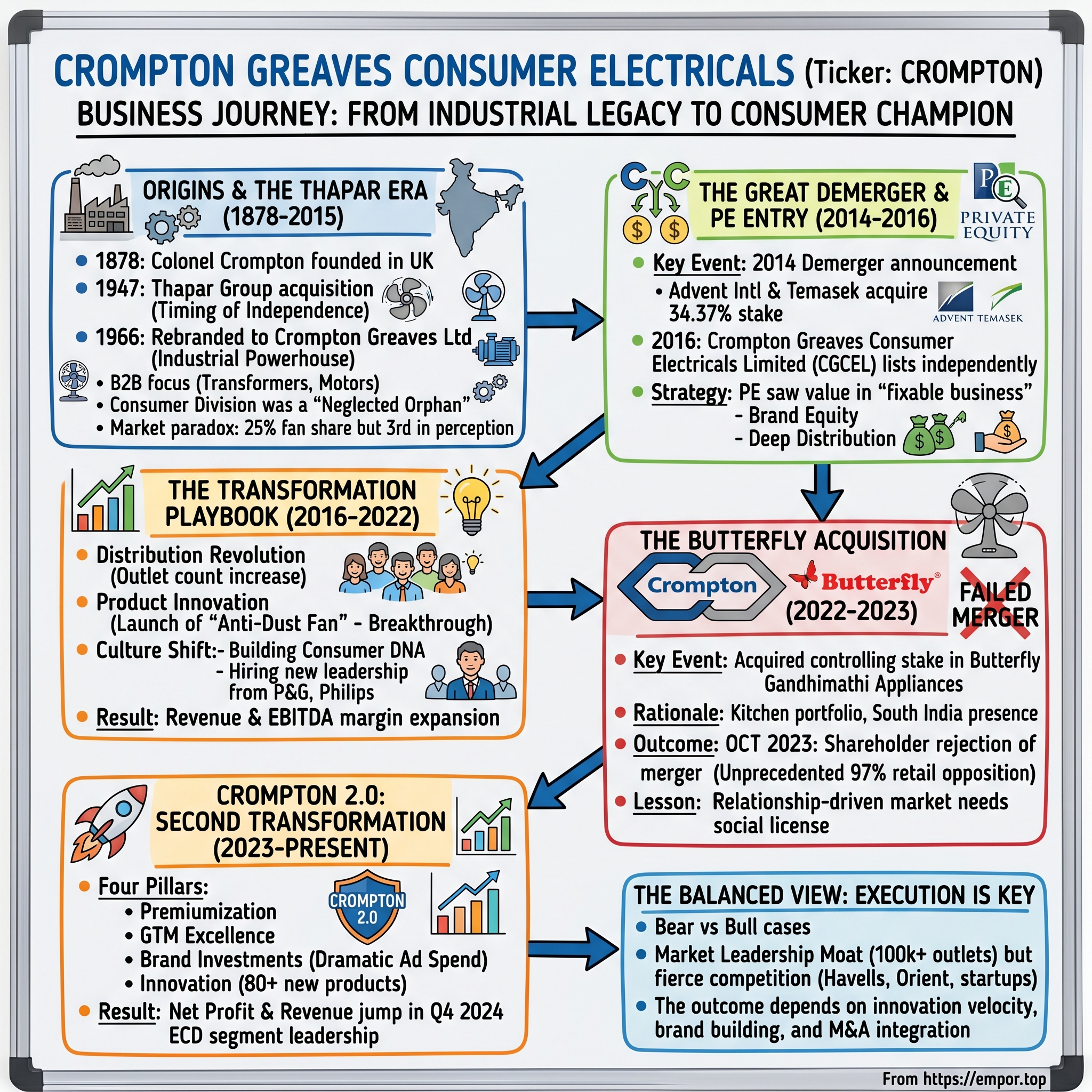
Crompton Greaves Consumer Electricals: From Industrial Legacy to Consumer Champion
I. Cold Open & Hook
On the evening of May 13, 2026, equity analysts dialled into a conference call hosted by Avendus Spark as the executive leadership of Crompton Greaves Consumer Electricals Limited explained how the company had recorded its first net loss as an independent listed entity.
The core operational numbers were not catastrophic. Fourth-quarter revenue grew roughly 11% to ₹2,283 crore, yielding ₹232 crore in profit before exceptional items and tax—a respectable showing in a challenging period for Indian consumer demand.1 The deficit resulted from a single line item: a ₹716 crore exceptional charge for the impairment of goodwill and intangible assets associated with Butterfly Gandhimathi Appliances Limited, the South Indian kitchen appliance maker acquired four years earlier, written down following an independent valuation under Ind AS 36.12 That charge pulled the fourth quarter to a net loss of ₹531 crore. Consequently, Crompton closed FY26 with a consolidated net loss of ₹231 crore on revenue of ₹8,096 crore, compared to a net profit of ₹564 crore in FY25.13
The board recommended a dividend of ₹3 per share.1 Management told analysts the accounting adjustment was "an impairment, not a write-off," involved no cash outlay, and left the company's long-term operations intact.24 While both statements were accurate, they side-stepped the central strategic reality: the company's largest capital allocation decision since its listing had eliminated roughly a third of the capital committed to the deal.
The market share paradox. Crompton's core franchise remains strong. The company commands a 25% to 27% share of the Indian ceiling fan market, holding the leading position in a category reaching most Indian households, with distribution spanning more than 314,000 retail outlets and over 10 crore households.56 The lighting division achieved its highest annual revenue in six years in FY26.3 Financial leverage remains low, with consolidated borrowings declining from approximately ₹683 crore in FY24 to ₹199 crore in FY26.7
Yet equity markets have priced in persistent caution. Trading near ₹227 per share in early September 2026, Crompton's market capitalisation stood at approximately ₹14,600 crore—down roughly 23% over the preceding 12 months and representing less than two times its annual revenue base.78 Peer benchmark Havells India closed FY26 with revenue of about ₹22,466 crore and continues to command a higher valuation multiple.9 This valuation gap reflects public market skepticism toward a legacy leader that has struggled to deliver sustained top-line acceleration.
The central question. Crompton offers a clear case study in private equity ownership and corporate restructuring: a consumer business carved out of a distressed 80-year-old industrial conglomerate, professionalised and margin-optimised under private equity sponsors, exited near a operational peak, and transferred to public market shareholders. Those public shareholders inherited improved operational metrics along with deferred capital requirements. Crompton highlights a recurring question for public market investors: how much of a private-equity-era margin expansion reflects structural operating efficiency, and how much represents deferred reinvestment that subsequent owners must fund?
This trajectory spans four main inflection points: the 2014–2016 demerger from Gautam Thapar's debt-burdened Crompton Greaves Limited alongside the ₹2,000 crore promoter stake purchase by Advent International and Temasek Holdings;10 the operational restructuring under chief executive Shantanu Khosla and managing director Mathew Job, who expanded distribution, launched the anti-dust fan line, and raised operating margins;11 the 2022 acquisition of Butterfly Gandhimathi for up to ₹2,077 crore including the open offer, followed by the October 2023 vote in which 72.61% of Butterfly's public shareholders rejected the proposed merger;[^12]12 and the May 2023 appointment of managing director Promeet Ghosh—a former Temasek India executive—who introduced a capital reinvestment plan structured as "Crompton 2.0."13
A fifth phase began in late 2026 as Crompton sought to expand beyond its core fan business. In August 2026, the company introduced a updated master brand architecture, launched a super-premium sub-brand named Crompton Rhion, and outlined a target to reach approximately ₹15,000 crore in revenue by FY31 with EBITDA margins above 12%—supported by expansion into solar rooftop systems, house wires, and water purification.141516 Results from Q1 FY27 showed steady core performance: consolidated revenue rose 11.8% to ₹2,235 crore, net profit after tax increased 15.2% to ₹143 crore, and brushless direct current (BLDC) fan sales expanded roughly 44% despite supply disruptions that management estimated deferred about ₹200 crore in primary sales.1718
Whether these investments establish a broader consumer electrical platform or result in margin-dilutive diversification remains the core operational debate. Evaluating that outlook requires examining where the company's capital structure and market position originated.
 Subscribe on LinkedIn
II. Origins & The Thapar Era (1878–2014)
In 1878, Rookes Evelyn Bell Crompton, a British army officer, took over a workshop in Chelmsford, Essex, establishing Crompton and Co. His entry into electrical engineering was pragmatic: after installing arc lamps and generators at his family's Derbyshire iron works to keep furnaces running overnight, he found available lamps poorly manufactured and began building better ones.19 Within a few years, his firm became one of Britain's leading producers of generating and lighting systems.
Half a world away and two decades earlier, in 1859, James Greaves and George Cotton founded a trading and engineering house in Bombay.20 These two lineages—one British and electrical, the other Indian and mercantile—eventually fused. Crompton and Co. merged with F. and A. Parkinson in 1927 to become Crompton Parkinson Ltd., which established manufacturing subsidiaries in Bombay and Sydney by the early 1930s.21 In 1937, the Indian operation was formalised as a joint venture with Greaves Cotton to bring electrical products—most consequentially, ceiling fans—to the Indian market.20
That single product decision shaped the modern company. In a country where air conditioning would remain a luxury for decades, the ceiling fan became the default cooling technology across the subcontinent: affordable, durable, and installed in nearly every building. The brand stamped on those fans built generational familiarity.
Independence and the Thapar inheritance. In 1947, as British rule ended, industrialist Lala Karam Chand Thapar acquired the business, converting it into an Indian-owned enterprise.20 In 1966, the manufacturing arm, Crompton Parkinson Works, merged with the Greaves Cotton and Crompton Parkinson sales organization to form Crompton Greaves Limited—the corporate structure that endured for five decades.
For much of the License Raj era, this structure proved highly effective. Crompton Greaves built power transformers, switchgear, industrial motors, and heavy electrical equipment for state electrification projects, while selling fans, pumps, and lighting to the households those projects connected. The industrial side was capital-intensive, technically demanding, and prestigious. The consumer side was simple, steady, and reliable.
The conglomerate trap. Under Gautam Thapar's Avantha Group, Crompton Greaves pursued international expansion in heavy electricals through debt-financed overseas acquisitions. Meanwhile, the consumer division functioned as an internal cash machine. Its steady profits from fans and pumps were systematically redeployed into industrial capital expenditures and broader group ventures, including a large and ultimately troubled paper business.11
The structural consequences were evident on the organization chart. A business selling to hundreds of thousands of small electrical retailers lacked dedicated national consumer sales leadership and a consumer-focused research and development function. Its distribution network was inherited rather than engineered—fragmented, regionally uneven, and dependent on legacy wholesalers who set their own priorities.11 Shantanu Khosla, who later led the operational turnaround, described the challenge as performing "open-heart surgery on a person running a marathon."11
Crompton's core manufacturing capabilities in fan motors and pumps remained strong, backed by decades of cost engineering in a price-sensitive market. What suffered was everything downstream of the factory gate: brand investment, product development, channel design, and category expansion. The business had scale without active marketing, and market share without pricing power—a vulnerable position, as market leadership built on inertia is difficult to distinguish from leadership built on consumer preference until a competitor offers a better product.
A secondary cost of operating as a captive cash generator inside an industrial conglomerate was product positioning. Pumps and fans are bought on reliability; farmers require pumps that endure monsoons, and households expect fans to operate for fifteen years. Crompton developed strong brand equity around dependability—an enduring asset that remains foundational to its pump business today. However, dependability alone rarely commands a price premium when competitors offer similar durability. It secures the sale but limits the margin. A consumer business run primarily for cash generation tends toward this outcome, as investments in design, advertising, and premium features depress short-term cash flow.
By 2013, Avantha Group's debt burden constrained the parent company, while Crompton Greaves' industrial division absorbed mounting losses from overseas acquisitions. As the group's healthiest asset, the consumer business faced creditor scrutiny, making it the primary candidate for divestment.
The eventual separation proved to be a rare case where corporate distress yielded a sound outcome. The demerger, announced in July 2014, freed a viable consumer franchise from a heavy industrial balance sheet. The incoming owners then faced the strategic challenge: whether a business long managed as an industrial cash source could be taught to operate like a modern consumer company.
III. The Great Demerger & The PE Transformation Playbook (2014–2022)
In April 2015, Advent International and Temasek Holdings agreed to acquire the 34.37% promoter stake in the carved-out consumer entity from Avantha Holdings for approximately ₹2,000 crore—roughly $315 million at the time.10 The remaining equity was distributed to existing Crompton Greaves shareholders, and Crompton Greaves Consumer Electricals Limited listed on the NSE and BSE in 2016 as an independent consumer company.11 The industrial business remained with CG Power and Industrial Solutions, which later experienced accounting distortions before its acquisition by the Murugappa Group in 2020.11
The transaction structure proved influential. Advent and Temasek acquired a controlling minority stake rather than taking the company private, leaving a substantial public float from day one. That arrangement imposed public-market accountability: each quarter of the operational turnaround was subject to public reporting, and any eventual exit required public market liquidity rather than a sale to a strategic buyer.
Hiring for the job that did not exist. The initial management decisions established a new operational focus. In June 2015, Shantanu Khosla joined as managing director after nearly three decades at Procter & Gamble, where he had led P&G's Indian operations—bringing expertise in brand architecture, consumer research, media planning, and trade distribution.11 Three months later, Mathew Job arrived as chief executive officer, bringing operational experience from Philips, GROHE, and Racold.11
The executive pairing combined fast-moving consumer goods strategy with consumer durables channel execution. Neither executive came from heavy electrical engineering. The core turnaround thesis assumed that Crompton did not require radical engineering changes so much as modern consumer packaged goods management applied to household hardware.
What changed on the ground. The operational restructuring began with a distribution overhaul designated Project Unnati. India's electrical goods market relies on roughly 250,000 to 300,000 retail outlets, predominantly small independent stores.11 Crompton historically reached these shops through wholesale intermediaries focused on volume discounts and credit terms rather than brand positioning. Project Unnati established direct commercial relationships deeper into the retail channel, expanding direct outlet coverage for fans by about 20% and lighting by about 25%, while giving management direct visibility into secondary retail sales.11
The second initiative focused on product positioning. In 2017, following a year of development in specialized surface coatings, Crompton introduced an anti-dust ceiling fan.11 Technically, the innovation was straightforward—a hydrophobic blade coating that reduced dust accumulation. Commercially, it demonstrated that Indian consumers would pay a price premium for a fan if it offered a visible, practical benefit. Khosla noted that a clear consumer benefit must anchor product marketing, warning that without regular innovation, mature categories risk commoditization.11
The third initiative targeted operational efficiency. A cost-reduction program introduced productivity metrics previously unused at the firm, including revenue per employee, profit per employee, and category-level contribution margins.11 The resulting savings directly expanded operating margins.
The financial metrics responded quickly. Consolidated revenue grew from approximately ₹4,080 crore in FY18 to ₹4,804 crore in FY21, while operating margins expanded from roughly 13% to 15%, and net profit rose from ₹324 crore to ₹617 crore.7 Return on equity consistently exceeded 30%, presenting a clear example of operational improvement under private equity sponsorship.
However, this transformation left core technical capabilities unaddressed. Project Unnati broadened channel access and improved sales tracking, but it did not fundamentally alter core product engineering. The anti-dust fan was an effective commercial success, but it represented a surface-coating enhancement rather than a redesign of motor architecture. Subsequent product releases followed a similar incremental pattern, including anti-bacterial lighting and updated water heaters that elevated Crompton to the second position in that category.11 These product line extensions reflected improved marketing execution rather than breakthroughs from a dedicated research and development division.
The exit and ownership structure. Advent began divesting its holdings in February 2021 and fully exited by June 2021, realizing reported returns exceeding 3.5 times its invested capital.11 Temasek exited on a similar timeline. Their departure left Crompton with an uncommon structure on Indian stock exchanges: a major listed company without an identifiable promoter group. By June 2026, domestic institutional investors held approximately 66% of the equity, foreign institutions held about 20%, and retail investors held the remainder, with promoter ownership remaining at zero.7
This corporate governance structure presents distinct trade-offs. A promoter-free structure eliminates controlling-family governance risks, related-party transactions, and dynastic succession issues, while enhancing board accountability to institutional shareholders. Conversely, it lacks an anchor shareholder willing to commit long-term capital through multi-year reinvestment cycles, a factor that can constrain long-term brand development in consumer markets.
Evaluating the private equity era's primary achievement—operating margin expansion—requires distinguishing structural efficiency from deferred investment. The distribution expansion and cost discipline generated genuine, durable gains reflected in expanded outlet reach and gross margin stability across commodity cycles. However, two essential areas received insufficient capital allocation relative to the size of the franchise.
The first under-funded area was brand investment. While detailed advertising and sales promotion disclosures were limited during the private equity ownership period, subsequent financial filings demonstrate a necessary catch-up: Crompton allocated ₹297 crore to advertising and promotion in FY24 and ₹306 crore in FY25, equal to 3.89% of operational revenue.22 Reaching that level required subsequent management to execute a deliberate reinvestment program, indicating that earlier spending rates had been conservative. Reductions in brand marketing provide an immediate boost to operating margins with minimal short-term impact on revenue, but deferred brand spending can erode consumer brand awareness over longer periods.
The second shortfall was in core product technology. Between 2018 and 2021, the Indian ceiling fan market began shifting from conventional induction motors to brushless direct current (BLDC) technology. Traditional induction motors rely on alternating current to drive a rotating magnetic field, losing energy to heat and friction. BLDC motors use electronic circuitry and permanent magnets to regulate power precisely, reducing electricity consumption by roughly half for equivalent airflow while enabling quiet operation, digital remote controls, and smart features. Although BLDC models carry higher manufacturing costs, they command a 40% to 50% price premium over standard induction fans.[^24]
Crompton introduced BLDC models slowly. In a category where product architecture changes can dictate market leadership for years, this hesitation created an opening for competitors. Atomberg Technologies, a Mumbai-based startup founded in 2012, focused entirely on energy-efficient BLDC fans and distributed them directly to consumers online, bypassing the traditional retail distribution network Crompton had spent years expanding.23
This transition highlighted the limitations of relying solely on distribution reach. The private equity playbook successfully optimized measurable operational variables—such as channel coverage and cost discipline—that improved quarterly financial results within twelve months. However, investments in brand equity and motor engineering require multi-year horizons to yield results, extending beyond the typical private equity exit timeline.
That structural tension set the stage for the major strategic acquisition public shareholders executed shortly after the private equity exit.
IV. The Butterfly Acquisition & M&A Calamity (2022–2023)
Indian consumer electrical companies face a distinct strategic divide between steady legacy categories and high-frequency kitchen appliances. Fans, pumps, and lighting are large, defensible, and slow-growing. Kitchen appliances—mixer grinders, pressure cookers, gas stoves, and wet grinders—are fragmented, faster-growing, and heavily brand-driven. Crompton had attempted to build a domestic appliance business organically for years with limited traction. In early 2022, amid a post-pandemic appliance demand surge and carrying an unlevered balance sheet, the company opted for an acquisition.
On February 22, 2022, Crompton announced the acquisition of up to 55% of Butterfly Gandhimathi Appliances Limited from its promoters at ₹1,403 per share, for ₹1,379.68 crore, plus ₹30.38 crore for associated trademarks held by promoter entities.[^26][^27] Indian takeover regulations required a mandatory open offer to public shareholders for up to a further 26%, at ₹1,433.90 per share, worth up to ₹666.57 crore—bringing the maximum transaction outlay to roughly ₹2,077 crore.[^26] Crompton ultimately acquired approximately a 75% stake in Butterfly.12
The strategic logic, and the price. The rationale was clear on paper. Butterfly was an established South Indian brand with strong regional equity in wet grinders and mixer grinders, supported by an exclusive retail network in Tamil Nadu. Crompton possessed national distribution but lacked a kitchen portfolio, whereas Butterfly held a strong regional kitchen presence without national scale. The plan aimed to distribute Butterfly products through Crompton's network of over 200,000 retail outlets across North and West India, while offering Butterfly's regional channels access to Crompton's broader product lines.
The acquisition price, however, created a high operational hurdle. On trailing financial metrics at announcement, Butterfly generated roughly ₹1,000 crore in revenue and ₹89 crore in EBITDA. The transaction implied an enterprise value of approximately ₹2,500 crore—roughly 2.5 times sales and 28 times EBITDA.[^26] Sell-side analysis supporting the transaction relied on projections of a 15% revenue compound annual growth rate and EBITDA margin expansion from 9% to between 11% and 12% within two to three years.[^26] Consequently, the purchase price already embedded successful operational execution, requiring management to deliver projected synergies to justify the valuation.
Acquisitions completed during demand surges run the risk of mistaking temporary cyclical earnings for permanent baselines. Indian appliance demand in FY21 and FY22 was elevated by pandemic-era consumer spending and channel inventory accumulation. Purchasing a business at 28 times peak EBITDA effectively increased the valuation multiple relative to normalized earnings.
What happened next. Following the transaction, demand conditions softened rapidly. Trade channels in South India slowed, distributors reduced inventory, and Butterfly's operating margins compressed from around 10% in the first nine months of FY23 into low single digits. Within four quarters of completion, the subsidiary shifted from a growth catalyst to a margin drag on consolidated performance.
Consolidated financial performance reflected this compression. Crompton's operating margin declined from 14–15% in FY21 and FY22 to approximately 11% in FY23 and 10% in FY24. Net profit fell from ₹578 crore in FY22 to ₹476 crore in FY23 and ₹442 crore in FY24, despite revenue expanding from ₹5,394 crore to ₹7,313 crore over the same period.7 Top-line growth coincided with lower overall profitability.
The shareholder revolt. In March 2023, Crompton proposed a full scheme of amalgamation to merge Butterfly into Crompton at a swap ratio of 22 Crompton shares for every 5 Butterfly shares. Under the proposed structure, Butterfly's public shareholders would have held approximately 3% of the combined entity.
The proposed merger sought to eliminate duplicate corporate compliance costs, resolve related-party transaction requirements between the parent and its 75%-owned subsidiary, and consolidate minority interest into parent equity. However, these structural benefits offered limited incentive to Butterfly's public shareholders, who were asked to exchange independent equity for minority shares in the parent company.
Under SEBI regulations for schemes of arrangement, a merger scheme requires approval by a majority of public shareholders voting, ensuring controlling shareholders cannot unilaterally determine transaction terms.[^28] Because Crompton held 75% of Butterfly, its majority stake could not be used to pass the vote.
On October 28, 2023, public shareholders rejected the merger proposal. Of the 28.82 lakh public shares voted, 20.93 lakh—or 72.61%—voted against the scheme. Among retail public investors, 97.04% voted against, representing 16.62 lakh of the 17.12 lakh retail votes cast. Institutional public shareholders also opposed the measure, with 37.15% voting against.[^12]12[^29]
The opposition reflected timing and valuation dynamics. Butterfly's earnings had hit a cyclical trough, and Crompton's share price was depressed. Setting a swap ratio under those market conditions effectively locked in a low valuation for Butterfly shareholders relative to the earlier ₹1,433.90 open offer price. Public shareholders consequently rejected the share exchange.
Following the vote, Crompton announced it would not re-initiate the merger, confirming that both entities would operate independently while pursuing commercial collaboration in kitchen appliances.[^12]12 Management accepted the shareholder decision without contesting the outcome or proposing an immediate revised ratio.
Operating separate corporate structures, however, maintained administrative complexity. Maintaining Butterfly as an independent listed entity required separate board oversight, regulatory filings, and arm's-length pricing on inter-company transactions. This structure delayed full integration of supply chains, procurement, back-office administration, and unified distribution, increasing the cost of achieving projected operational synergies.
The reckoning, three years later. By FY26, Butterfly's operational performance had partially recovered. Annual revenue reached ₹943 crore, representing a 9% increase, while profit before tax rose 39% to ₹61 crore, and net profit grew 40% to ₹46 crore.[^30] In Q1 FY27, revenue rose 14.1% year-over-year to ₹214 crore with an EBITDA margin of 7.0%, accompanied by market share gains in mixer grinders, pressure cookers, and glass-top stoves.1718
Despite this operational recovery, Crompton recorded a ₹716 crore impairment charge in FY26. The accounting write-down reflected historical acquisition valuation rather than current operating viability. Four years after the transaction, Butterfly's annual revenue of ₹943 crore remained below its pre-acquisition trailing revenue of approximately ₹1,000 crore, while FY26 net profit of ₹46 crore placed the original ₹2,077 crore purchase price at roughly 45 times earnings.[^26][^30] Under Ind AS 36 rules, an independent valuation required a carrying value adjustment.
The turnaround led by Chief Business Officer Swetha Sagar demonstrated operational recovery, but the initial transaction highlighted the risk of acquiring assets at peak valuation multiples. For equity investors, future capital allocation discipline—specifically transaction pricing and capital deployment multiples on prospective acquisitions—remains a key metric for evaluating management execution.
V. Management Transition & Crompton 2.0 (2023–Present)
On April 24, 2023 — six months before the Butterfly vote, and roughly a year after the acquisition closed — Crompton informed the exchanges that Mathew Job was stepping down as Executive Director, and as CEO effective April 30, to pursue other career opportunities.13 The stock had its worst single-day fall in three years.
The market's reaction was not a referendum on Job personally. It was a reaction to the pattern: a CEO of eight years departing without a stated successor track record, in the middle of an integration that was visibly not working, with margins compressing and no clear narrative about what came next. When a company offers "other career opportunities" as the explanation for the exit of the executive most identified with its operating performance, investors reasonably discount the explanation and price the uncertainty.
The unusual choice. The successor, effective May 1, 2023, was Promeet Ghosh — and the appointment was genuinely unconventional. Ghosh was not a consumer goods operator. He had spent roughly two decades in investment banking, including eighteen years at DSP Merrill Lynch, before joining Temasek, where he served as Deputy Head of the India business and oversaw a period of substantial growth in Temasek's direct India exposure.13[^31] He had been on Crompton's board since 2016 — which is to say, he had sat in the room for the entire private equity transformation, the exit, and the Butterfly decision.13
Shantanu Khosla did not leave. He moved to Executive Vice Chairman for a year, then Non-Executive Vice Chairman through the end of 2025, with an explicit brief to support the Crompton–Butterfly integration.13 Chairman Hemant Nerurkar framed Ghosh's investor perspective as an asset for the company's next phase.13
There are two ways to read the appointment, and both are defensible. The charitable reading: a board with no promoter needed a leader who understood capital allocation, could speak credibly to institutional owners, and had the standing to reverse a strategy the prior management had set. The sceptical reading: the director most closely associated with the ownership structure that produced the under-investment was handed the job of fixing it, which is not obviously an arm's-length outcome. Three years of behaviour is the only useful evidence, and it has been mixed but broadly consistent with the charitable reading.
Crompton 2.0, and what it actually costs. Ghosh's strategic framework, unveiled in mid-2023, explicitly inverted the private equity playbook. Instead of extracting margin, the company would spend it — on brand, on distribution reach, on R&D, and on category expansion. Four pillars: premiumisation, go-to-market expansion, brand investment, and an innovation pipeline.
The brand investment was the most measurable, and the most immediately painful. Advertising and sales promotion reached ₹297 crore in FY24 and ₹306 crore in FY25, the latter at 3.89% of revenue — a level that, for context, sits above Havells' FY26 advertisement and sales promotion spend of roughly ₹607 crore on ₹22,466 crore of revenue, or about 2.7%.229 The comparison is imperfect, because companies classify trade promotion differently, but it does undercut a common lazy assumption that Crompton simply spends less on brand than its premium peer. On a percentage basis, it no longer does.
The innovation pillar produced a physical asset: a 50,000 square foot Crompton Experience and Innovation Centre in Vikhroli, Mumbai, staffed by a research organisation the company scaled up with roughly 200 engineers across mechanical, electronics, software, data, and user-centred design, with laboratory infrastructure sufficient to run about 83% of product application tests in house.24 The company has stated that roughly 15% of annual sales come from products launched in the preceding twelve months.24 In Q1 FY27 alone it launched 57 new products.17
The regulatory shock. Layered on top of the strategy reset was a mandatory technology transition. From January 1, 2023, the Bureau of Energy Efficiency brought ceiling fans under mandatory star labelling, requiring every model sold in India to carry a 1-to-5 star energy rating — with 1-star denoting at least 30% energy savings and 5-star over 50%.25 Industry estimates at the time suggested fans would get 8–20% more expensive as manufacturers re-engineered motors and blades to comply.25
For a market leader, this was a genuinely destabilising event. Every existing model needed recertification or redesign. Channel inventory of non-compliant stock had to be cleared. Consumers faced a step-change in shelf prices in a category where they had been trained for decades to expect stable pricing. And the regulation structurally advantaged exactly the technology Crompton had been slow to embrace, since BLDC motors comfortably achieve 5-star ratings while conventional induction motors struggle.
Crompton's execution through the transition was, on the evidence, adequate rather than exemplary: margin compression during the inventory changeover, followed by volume recovery through FY25 and FY26. The company retained category leadership. It did not gain from the disruption.
The current operating record. Ghosh's tenure has not been a straight line. FY26 was, stripping out the impairment, a mediocre year: consolidated revenue grew only about 3% to ₹8,096 crore, held back by a weak first half in which an unfavourable summer — the single largest swing factor in Indian fan demand — flattened the core business.37 The second quarter of FY26 was the low point: revenue up about 1% to ₹1,916 crore, operating profit down to ₹158 crore at an 8% margin, and net profit falling to ₹75 crore from ₹125 crore a year earlier.7 Operating margins hit their weakest level in eight quarters.
Management's explanation on the calls was weather and market conditions, which is at least partly true and entirely unfalsifiable, and it is the kind of explanation that deserves scepticism when repeated. What makes it more credible in this instance is the recovery pattern: EBIT margins climbed from 6.8% in the first half of FY26 to about 10% in the fourth quarter, driven by two price increases taken ahead of competitors to recover material inflation, along with cost programmes and operating leverage.4 Taking price ahead of the market in a commoditised category is a real, testable signal about brand position — it either sticks or it does not. In Q1 FY27, management reported that pricing in the high-single to low-double digits had been well accepted and covered roughly 80% of input inflation, with no further immediate increases planned.18
Q1 FY27 also produced the most interesting stress test of the new regime. Supply chain disruption — attributed by management on the call not to any single component shortage but to broader input material availability in volatile market conditions, compounded by the company's own lean inventory practices leaving no buffer — cost an estimated ₹200 crore of primary sales, concentrated in fans.18 Despite that, revenue grew 11.8% to ₹2,235 crore, EBITDA grew 14.2% to ₹224 crore with margins up 20 basis points to 10.0%, and PAT grew 15.2% to ₹143 crore.17 The BLDC portfolio grew roughly 44–45% to record quarterly volumes, supported by five new BLDC launches.1718 Lighting grew 15.4% to ₹269 crore, with commercial project wins including Google, NTT, ISRO, Tata Steel, and JSW — though its EBIT margin compressed 70 basis points to 12.0% on pre-contracted B2B rates.17
Two things about that quarter are analytically important. First, the admission that lean inventory left the company exposed is a concrete, non-defensive explanation of a miss — the kind of answer that builds credibility. Second, the company chose to modulate A&P spending downward in the quarter while maintaining that full-year spend as a percentage of sales would be similar to the prior year.18 That is exactly the lever the private equity era over-used, and it is the lever investors should watch most closely, because it is the one that tells you whether "Crompton 2.0" is a conviction or a slogan.
One test of management credibility is narrative consistency, and here the record is better than the operating record. The four pillars articulated in mid-2023 — premiumisation, go-to-market expansion, brand investment, and innovation — have appeared in essentially the same form on every subsequent call and in every investor presentation through Q1 FY27, with the reported actions matching the stated priorities: the R&D centre was built, A&P was raised, alternate channels grew, and the premium portfolio expanded.2617 Companies that change their strategic vocabulary every few quarters are usually improvising; Crompton has not. What the consistency does not prove is that the strategy works, only that it is being pursued rather than announced.
The August 2026 reset. On August 19–20, 2026, Crompton held an investor event and unveiled the most expansive version of its strategy yet. A refreshed master brand identity, built around a new emblem the company calls Cephyr and the positioning line "Amazing, Every Day."16 A super-premium sub-brand, Crompton Rhion, launching in premium water purification with a product called the Rhion Water Biofier and extending into large kitchen appliances, distributed through exclusive brand outlets, modern retail, and e-commerce rather than the traditional electrical channel.162 And a strengthened intelligent energy platform, Energion, spanning generation, conversion, storage, and charging.16
The financial ambition attached to it: revenue roughly doubling to about ₹15,000 crore by FY31, a 13–14% revenue CAGR through FY29, operating EBITDA margins of 11–12% by FY29 and above 12% by FY31, and smart or IoT-enabled products rising to about 15% of sales by FY29 and 20% by FY31.1415 New businesses — solar rooftops, solar pumps, wires, and water purifiers — are expected to contribute roughly a fifth of revenue by FY31, and management describes them as expanding the addressable market from ₹75,000–80,000 crore to ₹1.6–2.0 lakh crore.1715
Some of this is already real revenue rather than a slide. Solar pumps exceeded ₹200 crore in FY26; the solar rooftop order book stood at about ₹500 crore covering roughly 38,000 units, with about ₹450 crore expected to convert to revenue over six to eight months as installations complete.418 Management targets a ₹2,000 crore solar portfolio within three to four years.4 The wires business, launched as Crompton Armor in Tamil Nadu and Karnataka and now in fourteen towns, remains, in management's own words, very small relative to a company of this size.18 A greenfield manufacturing facility is planned at about ₹350 crore of capital expenditure over two to three years.18
The strategic question this raises is uncomfortable and should be named directly. A company that just took a ₹716 crore impairment on its last attempt to enter an adjacent category is now entering four adjacent categories at once. Solar rooftop installation is a project business with government counterparties, working capital intensity, and economics that look nothing like selling fans through electrical retailers. House wires is a category where Havells, Polycab, and RR Kabel already have entrenched positions, dedicated capacity, and electrician-level brand loyalty built over decades. Water purifiers is dominated by Eureka Forbes and Kent with strong service networks. None of these are natural extensions of a fan and pump distribution moat; they share a brand and a retailer, and not much else.
That is not an argument that the strategy is wrong. Crompton's core categories genuinely do not support 13–14% compounding indefinitely, and standing still is also a choice with consequences. It is an argument that the FY31 targets should be treated as an ambition with an execution record attached, and the record on new-category entry is, at present, one large impairment and a handful of businesses too young to judge.
VI. Business Model, Segment Economics & Financial Anatomy
Strip away the brand architecture, and Crompton functions as three distinct businesses with contrasting economic characteristics, all anchored to a single distribution network.
Electrical Consumer Durables serves as the core profit engine, generating ₹1,754 crore of the company's ₹2,235 crore consolidated revenue in the first quarter of FY27—roughly 78% of the total—with an EBIT margin of 13.5%.17 Within this division, ceiling fans remain the dominant product line and primary cash generator, supported by high volumes, market leadership, and a cost structure developed over eight decades of manufacturing. Pumps represent the second-largest line, backed by stable demand dynamics: residential and agricultural pumps are purchased for durability rather than aesthetics, with replacement cycles dictated by mechanical failure rather than consumer trends. Appliances, led by water heaters and air coolers, form the third leg; the company reported achieving volume leadership in water heaters across general trade channels in the first quarter of FY27.18
Historical reporting provides a clearer picture of the segment breakdown. In FY21, prior to consolidating Butterfly, fans generated approximately 44% of revenue, pumps accounted for 25%, lighting represented 21%, and appliances comprised 10%.11 Crompton subsequently consolidated its segment disclosures into broader ECD, Lighting, and Butterfly groupings—a shift that reduced disclosure detail for investors monitoring line-level growth and margin trends. Directionally, fans have likely declined as a percentage of total revenue as appliances and Butterfly expanded and ceiling fan demand faced sector-wide headwinds.
Lighting generated ₹269 crore in the first quarter of FY27, accounting for roughly 12% of consolidated revenue, with an EBIT margin of 12.0%.17 The division highlights a structural tension between volume growth and profitability. Consumer LED products have faced years of persistent price deflation, as manufacturing cost reductions were passed directly to consumers in a highly commoditized market where product differentiation is difficult to establish. Consequently, volume expansion has rarely translated into sustained revenue growth. Crompton's FY26 lighting performance—achieving 14.3% growth and its highest annual revenue in six years—was driven primarily by expansion in institutional and professional B2B segments, including commercial, architectural, and infrastructure projects.3 However, institutional lighting contracts operate on pre-committed pricing structures, which contributed to margin compression in the first quarter of FY27 even as top-line revenue expanded.17
Butterfly contributed ₹214 crore, or approximately 10% of consolidated revenue, in the first quarter of FY27, recording a 7.0% EBITDA margin—remaining the lowest-margin segment in the portfolio while operating as a distinct legal entity.17
Channel dynamics and distribution structure. Traditional electrical distribution in India relies on a multi-tiered wholesale network linking manufacturers, master distributors, sub-stockists, and independent retailers. Each layer absorbs a margin while extending credit and carrying inventory, resulting in a cumulative channel margin stack in the low-to-mid teens as a percentage of retail price. While this structure enables deep reach into smaller regional markets, it limits direct consumer visibility. Reported corporate revenue reflects primary sales into trade channels rather than secondary retail purchases by consumers, creating scenarios where distributor destocking can suppress reported top-line results even during periods of steady end-user demand.
Crompton has gradually diversified its go-to-market channels. Modern trade, e-commerce, and direct-to-consumer channels expanded to 16% of total revenue in the first quarter of FY27, supported by the launch of platform-exclusive products.17 Digital channels play a strategic role beyond their revenue contribution: e-commerce platforms serve as primary channels for premium BLDC fan adoption, transparent product comparisons, and direct consumer engagement, even as they lower distribution barriers for newer market entrants.
Manufacturing and cost structure. Crompton retains internal manufacturing for core engineering components—including motor stators, rotors, and pump castings—where precision manufacturing and raw material efficiency drive cost competitiveness, while outsourcing secondary assembly tasks. This selective vertical integration provides structural margin protection during commodity cycles. When raw material input prices for copper and aluminum fluctuate, internal component production allows the company to preserve gross margins more effectively than competitors reliant on external motor sourcing.
Balance sheet strength. Financial leverage remains low. Consolidated debt decreased from approximately ₹683 crore in FY24 to ₹199 crore in FY26, bringing the company to a near debt-free position, while annual cash flow from operations exceeded ₹500 crore in FY26.74 The debt incurred to finance the Butterfly transaction was largely amortized over four years. Crompton's ability to absorb a ₹716 crore non-cash impairment charge, maintain dividend distributions, and fund planned capital expenditures—including a ₹350 crore greenfield manufacturing facility—demonstrates underlying balance sheet liquidity.
Seasonality and working capital requirements. Demand patterns across Crompton's product portfolio are highly seasonal. The fourth quarter (March) and first quarter (June) generate the largest share of annual revenue and earnings, driven by distributor restocking and consumer demand for cooling products ahead of the summer season. The second quarter (September) historically represents the operational low point. This seasonality requires management to build inventory and extend channel credit prior to peak weather demand. Consequently, single-quarter performance metrics require comparison with historical seasonal benchmarks, while management's lean inventory model—cited during the first quarter of FY27 as a factor in supply chain disruptions—reflects an ongoing trade-off between operational buffer stock and working capital efficiency.1826
Return profile and accounting adjustments. Return metrics remain below historical benchmarks. Reported return on equity reached approximately 10.6% and return on capital employed stood at 18.1% in the latest reported period, compared with return on equity exceeding 30% during the private equity ownership era.7 While the FY26 impairment directly reduced reported net income, return metrics had already moderated following the Butterfly transaction, which added significant goodwill and intangible assets to the balance sheet without generating proportionate operating earnings. The accounting write-down mechanically lowers the equity base, which will modestly elevate future return calculations without altering underlying cash generation.
Under Ind AS 36 standards, the carrying value of Butterfly's remaining intangible assets requires ongoing annual testing. Following the FY26 adjustment, the reduced carrying value aligns more closely with Butterfly's historical operating profit, though future earnings volatility could require minor carrying value revisions.
Crompton thus enters its next growth phase with a high-margin core division, a low-margin lighting segment navigating structural price pressure, a recovering kitchen appliance subsidiary, a clean balance sheet, and capital return ratios that remain below historical peaks. The central question for investors is whether current market conditions provide sufficient runway for management to execute its multi-category expansion plan.
VII. Industry Dynamics & Competitive Stress Test
Indian consumer electricals is one of the more instructive competitive arenas in emerging-market equities because it contains, simultaneously, a slow-consolidating oligopoly and a live technology disruption. The top five players in ceiling fans—Crompton, Orient Electric, Havells, Usha, and Atomberg—together account for roughly three-quarters of the market.5 That looks like a stable structure, but it is not.
Havells India is the benchmark, and the comparison is not flattering to Crompton. Havells ended FY26 with revenue of about ₹22,466 crore across a portfolio spanning wires and cables, switchgear, lighting, fans, and, through Lloyd, air conditioners.9 Its structural advantage is not any single category—it is that a broad portfolio sold through a shared electrician-and-retailer channel amortises brand and distribution investment across far more revenue. Havells built that portfolio patiently over two decades, largely organically, and can therefore afford an absolute brand-spending run rate that Crompton cannot match. Crompton's new-category push into wires is, read charitably, an attempt to build exactly this structure. Read less charitably, it is an attempt to enter Havells' home category twenty years late.
Orient Electric is the closest structural comparable—similar heritage, similar category mix, similar mid-cap scale. It closed FY26 with revenue of about ₹3,326 crore, up roughly 7.5%, and reported that its BLDC portfolio grew over 50% year-on-year to contribute about 25% of domestic ceiling fan revenue.[^24]27 That last figure is the one Crompton investors should sit with. A smaller competitor has converted a quarter of its fan revenue to the premium architecture. Crompton discloses BLDC growth rates—roughly 30% in FY26 and roughly 44% in Q1 FY27—but does not disclose a comparable mix percentage.417 In competitive analysis, the metric a company chooses not to disclose is usually the one where it does not lead.
Atomberg Technologies is the disruption, and its August 2026 draft red herring prospectus finally put hard numbers on a story that had been anecdotal.23 For FY26, Atomberg posted revenue of ₹1,293.77 crore—a gain of roughly 35%—with online sales generating ₹456.45 crore, or more than a third of the total. It allocated ₹86.79 crore, or 6.71% of revenue, to research and development, employing 254 engineers who make up over a quarter of its permanent workforce. Atomberg also claimed a market share of roughly 46% by cumulative sales value in the premium fan segment.23
Set those figures against the incumbent's. Atomberg spends nearly 7% of revenue on R&D in a category where Crompton's entire innovation centre houses around 200 engineers across every product line the company sells.2423 That is not a marginal difference in commitment; it is a different business model. Atomberg was structured from inception as a product-technology company that happens to sell fans, and it has ridden a single architectural transition to a scale that now exceeds a sixth of Crompton's total revenue.
But the DRHP also contains the counter-argument, and it is substantial. Atomberg's FY26 adjusted EBITDA was ₹37.12 crore—a margin of under 3% on ₹1,294 crore of revenue.23 It is buying share at close to breakeven, funded by venture capital and now, prospectively, by public equity including a ₹450 crore fresh issue.23 Crompton, by contrast, earns a 13.5% EBIT margin in the segment Atomberg is attacking.17
That reframes the competitive question usefully. The threat to Crompton is not that Atomberg destroys it. The threat is that Atomberg permanently resets the profit pool of the premium fan category—that the segment which was supposed to rescue fan economics from commoditisation arrives already competed down to low-single-digit margins by a challenger with a lower cost of capital and a longer patience horizon. A market leader can survive losing share. It struggles to survive a category where the premium tier earns less than the mass tier.
Usha International, privately held and therefore less visible in listed-market analysis, rounds out the top tier and matters for a specific reason: it competes hardest in exactly the mass-market general trade channel where Crompton's distribution advantage is supposed to be decisive. Category share in Indian fans is not contested uniformly. It is contested in three separate arenas: the mass general trade channel, where Crompton, Usha, and Orient fight on price, availability, and dealer margin; the premium online channel, where Atomberg has set the terms; and the institutional and builder channel, where relationships and specification matter more than brand. Crompton is strongest in the first, weakest in the second, and improving in the third. Aggregate share numbers obscure all of this.
V-Guard and Polycab complete the picture from a third direction: regional players with strong balance sheets expanding nationally across pumps, fans, wires, and kitchen appliances, adding capacity and advertising pressure without adding much category growth.
The 7 Powers assessment. Applying Hamilton Helmer's framework produces a picture of narrow, real, but eroding advantage.
Process Power is Crompton's strongest claim and is genuinely high. Eight decades of manufacturing fan motors and pump castings at Indian price points is not replicable by a well-funded entrant in a few years, and it shows up concretely: the company took two price increases in FY26 ahead of competitors and recovered roughly 80% of input inflation while expanding margin.418 That is process advantage converting into pricing behaviour.
Scale Economies is medium-high and real in procurement, logistics, and channel servicing across a 314,000-outlet footprint.6 It is weakening at the margin because e-commerce reduces the value of physical reach and because Crompton's scale is a fraction of Havells' across the shared cost base.
Branding is the contested power, and honest assessment places it at medium and category-dependent. In pumps and basic fans, Crompton carries real consumer trust built on utility performance. In premium and aspirational categories, it does not command a price premium—which is the operative definition of branding power. The entire Crompton 2.0 programme, including a new master brand identity and a super-premium sub-brand launched in August 2026, is an explicit acknowledgment that this power needed rebuilding.16
Counter-Positioning runs against Crompton rather than for it. Atomberg's model—direct-to-consumer, technology-first, online-led—was one the incumbent could not adopt without cannibalising the distribution relationships that constitute its own advantage. That is the textbook definition of counter-positioning, and Crompton was on the losing side of it. It has responded, aggressively and with growing effect, but it responded second.
Cornered Resource, Switching Costs, and Network Economies are all essentially absent. A consumer can replace a ceiling fan with a different brand for the cost of an electrician's afternoon.
Porter's five forces, briefly, because it sharpens the same conclusion. Supplier power is moderate and cyclical, concentrated in copper, aluminium, and electronic components. Buyer power at the household level is low individually, but channel power is meaningful because retailers carry multiple brands and respond to margin. Threat of substitutes is real and rising—air conditioners are becoming affordable to upper-middle-class Indian households, and each AC sale reduces the value of the fan in that room. Barriers to entry are low in assembly and high in cost-competitive motor manufacturing, which is why the disruptor entered at the premium end rather than the mass end. And rivalry is intense and intensifying, with five well-capitalised players and one venture-funded challenger competing for a market growing at high single digits.
The competitive verdict: Crompton's moat is narrower than its market share implies, concentrated in manufacturing cost and channel reach, and it faces a challenger whose economics do not require profit. That is a defensible position, not a comfortable one.
VIII. Historical Falsification Layer & Management Credibility Audit
Testing the core arguments of the Crompton investment thesis against disconfirming evidence in the company's operational record clarifies which claims remain robust and which require qualification.
Claim one: an unassailable fan franchise protected by distribution depth.
The primary test of channel protection is product substitution—specifically whether a superior motor architecture can reach consumers independently of traditional retail networks. The evidence demonstrates clear boundaries to channel defense. Founded in 2012, Atomberg generated ₹1,294 crore in FY26 revenue—with more than a third originating online—and captured a claimed 46% share of the premium fan segment despite operating with a physical retail network far smaller than Crompton's.23 Concurrently, Orient Electric converted approximately 25% of its domestic ceiling fan revenue to brushless direct current (BLDC) technology.27 Furthermore, the mandatory Bureau of Energy Efficiency star-labeling standard introduced in January 2023 structurally favored the energy-efficient architecture Crompton was slower to adopt.25
Verdict: The claim is narrowed rather than rejected. Distribution depth failed to prevent market share losses at the premium end and offered limited defense against an online-native entrant. However, it successfully preserved overall volume leadership during a major regulatory transition, enabling Crompton to maintain category leadership through FY25 and FY26 and report continued gains in Q1 FY27.18 Consequently, distribution functions as a strong defense in mass-market categories but a weaker barrier in premium segments. Falsifying KPI: Disclosed BLDC fan revenue mix, benchmarked against Orient's 25% level. Crompton discloses BLDC growth rates but omits overall category mix; until detailed mix disclosures are provided, investors should assume the company trails peer benchmarks.
Claim two: disciplined capital allocation.
The principal test of capital allocation is the return profile of prior major investments. The record on M&A execution is definitive. Crompton committed up to ₹2,077 crore to acquire Butterfly at roughly 28 times trailing EBITDA during a pandemic-era demand peak. Four years later, Butterfly's annual revenue of ₹943 crore remained below pre-acquisition levels, prompting Crompton to record a ₹716 crore impairment charge following an independent valuation.[^26][^30]1 Moreover, 72.61% of Butterfly's public shareholders—and 97.04% of retail voters—rejected the proposed merger scheme, creating a rare level of public shareholder dissent that stalled operational integration.[^12]12
Verdict: The claim of disciplined capital allocation is rejected in its general form, as historical transaction pricing and integration outcomes do not support it. A narrower claim regarding balance sheet management survives: management executed effective debt reduction, lowering total borrowings from ₹683 crore to ₹199 crore over two years while maintaining dividend distributions.7 Conservative balance sheet management, however, represents a distinct operational skill from strategic M&A discipline. Falsifying KPI: The acquisition multiples paid on future transactions, alongside management's ability to fund the planned ₹350 crore greenfield facility and four new category expansions entirely through operating cash flow without adding leverage.
Claim three: sustainable margin expansion.
The test of margin sustainability is whether peak profitability reflected structural efficiencies or deferred reinvestment. Crompton's operating margins peaked near 15% in FY21 before contracting to 11% in FY23, 10% in FY24, 11% in FY25, and 10% in FY26—failing to recover peak levels over a five-year period.7 To stabilize performance, subsequent management was required to elevate advertising and sales promotion spending to ₹297 crore in FY24 and ₹306 crore (3.89% of revenue) in FY25, while constructing a dedicated R&D center staffed by approximately 200 engineers.2224
Verdict: The claim that private-equity-era margins were structurally sustainable is rejected. A portion of that peak margin resulted from deferred brand building and product engineering, creating a multi-year reinvestment burden for successor leadership. The forward-looking claim—that operating EBITDA margins can reach 11% to 12% by FY29 and exceed 12% by FY31—remains unproven, though it is supported by reinvestments already embedded in the current cost base.15 Falsifying KPI: Sustained advertising and promotion spending at or above 3.5% to 4.0% of revenue during periods of weaker market demand. Management reduced marketing expenditure in Q1 FY27 while targeting full-year spending consistency, making annual report disclosures a direct test of spending commitment.18
Claim four: lighting as a growth vector.
The test of category growth is pricing power and margin expansion. Consumer LED lighting has faced structural price deflation for a decade, compressing overall segment margins. Nevertheless, Crompton's lighting division achieved 14.3% revenue growth in FY26—reaching a six-year high—and posted a 15.4% increase in Q1 FY27 behind key commercial project additions.317
Verdict: The claim remains valid but requires important qualification. Revenue expansion has been driven largely by institutional and B2B projects that operate on pre-contracted pricing structures. As a result, Q1 FY27 lighting revenue rose 15.4% while segment EBIT margins contracted by 70 basis points to 12.0%.17 Lighting represents a viable revenue growth driver, but one characterized by structurally lower profitability than consumer lines. Investors should not assume top-line expansion automatically yields proportional earnings growth. Falsifying KPI: Segment EBIT margins holding at or above 12.0% as division revenue compounds at low-to-mid-double-digit rates.
Claim five: management credibility under the current regime.
Evaluating management credibility requires auditing execution across three years of operational reporting. Credibility is supported by several concrete actions: management accepted the Butterfly shareholder vote without contesting the outcome or forcing a revised ratio;[^12] it recognized the ₹716 crore impairment based on an independent valuation rather than delaying accounting adjustments;1 it transparently attributed Q1 FY27 fan supply disruptions to internal lean-inventory practices rather than external conditions;18 it detailed price realization metrics against input cost inflation;18 and it consistently prioritized brand and R&D reinvestment despite short-term margin pressures.
Conversely, several watch-list items require ongoing scrutiny. The long-term FY31 revenue targets depend on entering four new product categories simultaneously without an established operating track record in those segments.15 Describing the impairment charge as having no impact on long-term operations offers a rhetorically convenient distinction.4 Short-term adjustments to marketing expenditure during weaker quarters echo historical margin-preservation tactics. Finally, Butterfly's operational integration remains constrained by its separate corporate listing.
Verdict: Management credibility is improving from a low base and remains provisional. Executive messaging has remained consistent across investor presentations since FY24, with operational resource allocation matching stated strategic priorities. However, management has yet to demonstrate the complete execution of a multi-year financial target set.
Analysis of Crompton's FY24 through FY26 financial filings and recent earnings calls reveals no auditor qualifications, accounting restatements, or going-concern modifications. The ₹716 crore impairment was fully disclosed as a non-cash adjustment derived from an independent valuation under Ind AS 36 standards.12 This observation reflects the audited reporting for the specified periods and does not constitute a broad guarantee of future financial reporting.
IX. Bear vs. Bull Case & Investment Thesis
The bull case rests on a structural thesis: Crompton commands leading positions in categories tied directly to Indian household formation and electrification, has increased reinvestment to defend its moat, and trades at a valuation that treats recent operational missteps as permanent.
The core franchise shows clear signs of operational recovery. First-quarter FY27 performance yielded 11.8% top-line growth and a 15.2% expansion in net profit despite absorbing an estimated ₹200 crore hit to primary sales from supply disruptions, with operating margins expanding.1718 Sales of energy-efficient brushless direct current (BLDC) fans—the category shift initially viewed as a threat to Crompton's core—grew 44% in the quarter across five new product launches to achieve record volumes.17 Water heaters secured volume leadership across general trade channels,18 while price increases taken ahead of competitors held across key markets.4 These results point to operational momentum across core categories.
The supporting divisions have also shown improved metrics. Lighting, often viewed as a margin-dilutive segment, delivered its highest annual revenue in six years during FY26 and expanded 15.4% in Q1 FY27, driven by commercial and infrastructure project wins.317 Butterfly Gandhimathi, after several quarters of margin pressure, grew revenue by roughly 9% and profit before tax by about 40% in FY26, followed by 14% top-line growth in Q1 FY27 with margin expansion and share gains in core categories.[^30]17 The FY26 goodwill impairment removed an inflated carrying value from the balance sheet without impacting cash reserves or production capacity.
Adjacent category expansion offers additional optionality, partly leveraging existing distribution assets. Solar pumps generated over ₹200 crore in FY26 revenue, serving the agricultural customer base already reached through Crompton's established pump channels.4 The solar rooftop order book stood at approximately ₹500 crore in contracted orders, with management reporting timely payments from state counterparties.18 Achieving even half of management's ₹2,000 crore solar revenue target would establish a growth vector larger than the current lighting division.4
The balance sheet provides financial flexibility to fund these initiatives internally. Near-zero net debt, annual operating cash flow exceeding ₹500 crore in FY26, and a maintained dividend during a loss-making year indicate that the FY31 expansion plan does not require external equity financing or shareholder dilution.741
The bear case interprets the same operational history with greater skepticism.
The five-year operating record displays limited top-line compounding for a company valued as a premium consumer franchise. Consolidated revenue grew from ₹4,804 crore in FY21 to ₹8,096 crore in FY26, but a substantial portion resulted from consolidating Butterfly rather than organic expansion, with FY26 organic revenue growth remaining near 3%.73 Over the same five-year period, consolidated net profit declined from ₹617 crore to a net loss of ₹231 crore.7
Market structure dynamics in premium categories also present headwinds. Challenger Atomberg's operating margin of under 3% on ₹1,294 crore of FY26 revenue demonstrates a venture-backed willingness to trade profitability for market share, supported by prospective public equity capital.23 Competitor Orient Electric reported converting 25% of its domestic ceiling fan revenue to BLDC models.27 While Crompton reported high BLDC volume growth, it omits its total category mix percentage. Entering a premium category after pricing has compressed limits the margin expansion typically associated with premium product transitions.
Lighting segment expansion carries margin trade-offs, as recent growth has been driven by lower-margin B2B and institutional projects—reflected in a 70-basis-point EBIT margin contraction to 12.0% in Q1 FY27 despite 15.4% revenue growth.17 Meanwhile, price deflation in retail consumer LED markets remains an ongoing headwind.
Butterfly remains a structural margin drag. With a 7.0% EBITDA margin, it dilutes consolidated profitability, cannot be legally merged without another public shareholder vote that management has opted not to pursue, and generated ₹46 crore in FY26 net profit on roughly ₹2,077 crore in committed acquisition capital.17[^12][^26][^30] Operating a separately listed 75%-owned subsidiary incurs permanent administrative and corporate governance overhead.
Furthermore, the FY31 strategic framework requires executing four simultaneous category entries—solar rooftops, house wires, water purifiers, and solar pumps—where Crompton lacks an established market share, following an acquisition that required a major write-down. Solar rooftops represent a working-capital-intensive project business; house wires is dominated by entrenched leaders like Havells and Polycab; and water purification is led by established brand networks. Concurrently, the gradual adoption of residential air conditioning in urban markets continues to reduce ceiling fan utilization in premium households.
The risk radar. Four specific operational risks bear monitoring. Input cost inflation poses an immediate margin threat: copper and aluminum represent key raw material inputs for fan motors and pump windings, and because Crompton's pricing adjustments historically cover roughly 80% of material cost inflation, sharp commodity price spikes compress operating margins for two to three quarters before price adjustments take effect.18 Supply chain vulnerability was demonstrated in Q1 FY27, when lean inventory buffers contributed to an estimated ₹200 crore in deferred primary sales.18 Seasonality creates earnings volatility, as demonstrated by the flat first-half performance in FY26.7 Finally, execution risk is elevated by managing four category entries alongside core business reinvestment. Conversely, near-zero net leverage mitigates short-term debt refinancing risk.
Key governance and operational questions. Skeptical institutional investors focus on four structural questions: First, why does a professionally managed company with zero promoter holding maintain a separately listed 75%-owned subsidiary rather than acquiring the remaining minority stake through a buyback or open offer? Second, why does management disclose BLDC growth rates while omitting total BLDC revenue mix, unlike key listed peers? Third, what is the stand-alone return on capital for the new category investments funded from core business cash flows? And fourth, what governance accountability applied to the board that approved the Butterfly acquisition, given its overlap with the board setting the FY31 strategic targets?
Addressing these questions provides necessary clarity for evaluating long-term governance alignment.
Key performance indicators. Three metrics provide direct signal regarding operational progress:
BLDC revenue mix. Disclosing BLDC sales as a percentage of total fan revenue will indicate whether Crompton is leading or trailing the industry's architectural transition. Volume growth rates off an undisclosed base offer limited comparative insight.
Annualized advertising and promotion intensity. Full-year advertising and promotion expenditure as a percentage of revenue serves as the primary test of management's reinvestment commitment under "Crompton 2.0." Maintaining marketing spend during cyclical downturns validates strategic execution.
Consolidated EBITDA margin trajectory. Management's target of 11% to 12% consolidated EBITDA margins by FY29 requires narrowing the gap between core Electrical Consumer Durables margins (13.5% EBIT in Q1 FY27) and group profitability (10.0% consolidated EBITDA margin in Q1 FY27).1517 Quarterly margin progression against this benchmark tracks operational execution.
X. Strategic Playbook & Investor Lessons
Lesson one: the arithmetic of borrowed margin. The Crompton case provides a clean study of how private equity ownership transforms a consumer business. A private equity sponsor operating on a five-to-seven-year investment horizon faces a structural asymmetry: distribution expansion and cost-reduction initiatives pay off quickly within the holding period, whereas long-term brand equity and foundational product architecture pay off over a much longer timeline. Rational owners respond to that incentive, producing short-term margin expansion on the income statement that can easily be mistaken for permanent operational efficiency.
The critical test for investors is not the level of peak margin achieved, but whether those margins persist after the sponsor exits. Crompton's operating margin has failed to regain its FY21 peak over the subsequent five years, while successor leadership has been forced to fund a dedicated research and development center alongside a sustained step-up in advertising spending that earlier margins did not accommodate.72422 For public market investors evaluating private-equity-exited assets, the essential diagnostic metric is comparing R&D and marketing expenditures as a percentage of revenue during the holding period against the reinvestment rate required afterward.
Lesson two: minority shareholders possess real veto power. The market regulation requiring schemes of arrangement to secure majority approval from public shareholders functions as a binding governance safeguard.[^28] The Butterfly merger vote—in which 72.61% of public shareholders and 97.04% of retail voters rejected the swap ratio—proved that a controlling 75% owner of a listed subsidiary cannot unilaterally impose transaction terms on minority investors.12
For corporate acquirers, transaction sequencing carries strategic consequences. Buying a controlling stake first and deferring a full merger leaves the buyer exposed to a minority shareholder vote at an unpredictable point in the business cycle. Crompton set its share swap ratio when Butterfly's earnings were at a cyclical trough and its own equity valuation was depressed—the least favorable conditions for securing public shareholder consent. Choosing a comprehensive open offer or delisting at the outset would have required higher initial capital, but it would have eliminated long-term structural administrative friction.
Lesson three: distribution offers time, not immunity. Crompton's network of over 314,000 retail outlets provided a critical buffer during the industry's technology transition, maintaining category leadership while management updated its product line.6 That reach enabled the company to convert energy-efficient brushless direct current fan models into national sales volume once production scaled. However, physical distribution could not prevent an online-native competitor with a specialized motor architecture from capturing market share in the premium segment.23 The broader principle for investors is clear: traditional retail distribution defends against competitors using the same commercial channels, but it offers limited defense against disruptors operating outside them.
Lesson four: corporate carve-outs create value when buyers build lasting capabilities. The corporate separation from Crompton Greaves was fundamentally sound. Carving out a neglected consumer division from a debt-burdened industrial parent created an independent listed business that achieved returns on equity exceeding 30% and delivered more than 3.5 times invested capital for its private equity sponsors.11
The transformation successfully established professional management, deeper retail relationships, and commercial product innovations like the anti-dust ceiling fan. However, the operational overhaul was incomplete. A carve-out acquirer must fund long-term capabilities across research, technology, and brand equity—not merely the short-term operational improvements that boost metrics ahead of an exit.
Lesson five: promoter-free corporate governance brings distinct trade-offs. Crompton stands among a select group of major Indian listed companies operating with zero promoter ownership and predominantly institutional equity holdings.7 This governance structure offers clear benefits: it eliminates family control risks, prevents related-party transactions, mitigates dynastic succession issues, and ensures board accountability to public shareholders.
Yet the absence of an anchor promoter introduces distinct vulnerabilities. The company lacks a controlling shareholder capable of absorbing multi-year earnings volatility to fund decade-long brand development. It also lacks a built-in defense against opportunistic acquisitions, while corporate accountability remains diffuse across an institutional shareholder base. Investors should evaluate promoter-free governance as a positive reduction in family-control risk, balanced against a lower tolerance for long-term patient capital.
Lesson six: write-downs judge purchase price, not operational health. When evaluating impairment charges, investors must distinguish between operational failure and historical overpayment. In FY26, Butterfly was expanding top-line revenue, generating operating profits, gaining category market share, and widening margins—yet Crompton recorded a ₹716 crore write-down on the asset.[^30]1 The impairment was not a verdict on Butterfly's operational viability; it was an accounting correction of the original transaction valuation. Conflating operational health with purchase-price adjustments leads investors either to exit a recovering business or to overlook flawed capital allocation.
XI. Epilogue: The Future of Indian Consumer Electricals
There is a version of the next decade in which Crompton's core categories simply grow. India adds households faster than almost any economy on earth; each one needs fans, lights, a pump, and a water heater. Summers are getting longer and hotter, driving baseline category demand across urban and rural markets. Electrification has reached near-universal household coverage, converting a latent market into an addressable one. Deep penetration in rural, Tier-3, and Tier-4 markets remains the largest untapped growth vector—the segment where a 314,000-outlet distribution channel and eight decades of brand familiarity carry the greatest competitive weight.
There is also a version in which the category itself changes shape underneath the incumbents. Mandatory star labelling for ceiling fans marked the first time an Indian regulator forced a technology transition on this industry, and efficiency standards will continue to ratchet—advantaging whichever players have invested ahead of regulations.25 Air conditioning is becoming affordable to a widening band of Indian households, and every AC installed reduces the economic reliance on the ceiling fan beneath it. Meanwhile, the connected-device layer that Crompton is building toward—targeting smart and IoT-enabled products at roughly 20% of sales by FY31—shifts the competitive basis from motor efficiency to software, app experience, and ecosystem compatibility.15 That is a domain where eight decades of motor-winding expertise confers little edge, and where a technology-first challenger with 254 engineers and 6.71% of revenue allocated to R&D operates from a distinct vantage point.23
The favorable macro backdrop is widely understood, which is precisely why it offers no pricing edge. Every listed competitor pitches the same secular narrative of electrification, housing formation, premiumization, and rising cooling demand to public markets. When an entire industry shares a tailwind, that growth gets capitalized into every valuation multiple, leaving relative investor returns to be determined by operational execution. That is the appropriate frame for evaluating Crompton: its core market will almost certainly expand, but whether Crompton outpaces that growth profitably depends entirely on corporate execution.
It is worth examining what connectivity actually entails in this category, as the concept carries significant weight in the FY31 plan. A connected ceiling fan is fundamentally a BLDC fan equipped with a wireless module and a mobile application. The commercial challenge is not technical feasibility—Crompton can build such products—but whether Indian households will pay a price premium to control a fan via smartphone when a standard ₹200 remote control suffices. Consumer evidence remains limited. Smart-home adoption in India has concentrated primarily in lighting, speakers, and security locks rather than fans or pumps, making connectivity a feature supporting current price points rather than an independent category driver. Targeting a fifth of revenue from smart and connected products by FY31 is therefore a bet on evolving consumer behavior rather than hardware delivery alone.15
This brings the narrative back to Promeet Ghosh and a central strategic question. Having inherited an organization optimized for a private equity exit, Ghosh spent three years shifting strategy—rebuilding brand investment, scaling an internal innovation function, taking price leadership ahead of peers, and absorbing the write-down from the Butterfly transaction. While evidence indicates the core franchise has stabilized, doubling overall revenue by FY31 through four simultaneous category expansions remains an ambitious target backed primarily by initial order books and strategic presentations.
Evaluating this inflection point requires tracking specific operational indicators. If future disclosures reveal BLDC sales mix reaching parity with peer benchmarks, if marketing expenditure holds firm through demand lulls, if the solar order book converts into recurring revenue with healthy capital returns, and if consolidated EBITDA margins progress toward 11% to 12%, the reinvestment strategy will be validated. If instead new categories absorb cash while core sales compound merely at the rate of household formation, Crompton will remain what it has been since its demerger: a cash-generative category leader bounded by mature markets.
Eighty-nine years after Crompton Parkinson introduced its initial ceiling fans to the Indian market, the company remains fundamentally focused on domestic cooling. Whether it successfully transitions into a broader consumer platform remains its defining test.
References
-
Crompton Greaves Consumer swings to Q4 loss of ₹531 crore after impairment charge, revenue rises 11% — Free Press Journal, 2026-05 ↩↩↩↩↩↩↩↩↩
-
Crompton Greaves Consumer Electricals Limited Q4 & FY26 Financial Results and Dividend Declaration — InvestyWise, 2026 ↩↩↩↩
-
Crompton Greaves Consumer Electricals Limited Q4 and Annual Results for FY26 — InvestyWise, 2026 ↩↩↩↩↩↩↩
-
Crompton Greaves Consumer Electricals Q4 FY26 Earnings Call Summary — StocksSena, 2026-05-13 ↩↩↩↩↩↩↩↩↩↩↩↩
-
India Ceiling Fan Market Share, Size & Industry Outlook 2026 — MarkNtel Advisors ↩↩
-
About Us — Crompton Greaves Consumer Electricals Limited ↩↩↩
-
Crompton Greaves Consumer Electricals Ltd — consolidated financials, quarterly results, shareholding and ratios — Screener.in ↩↩↩↩↩↩↩↩↩↩↩↩↩↩↩↩↩
-
Havells India Limited Reports Robust FY26 Results; Annual Revenue Crosses ₹22,500 Crore — EquityBulls, 2026 ↩↩↩
-
Avantha to sell stake in Crompton Greaves Consumer Electricals for Rs 2,000 crore — Business Standard, 2015-04-24 ↩↩
-
How Crompton Greaves Consumer Electricals Got It Right — Business Today, 2022-01-06 ↩↩↩↩↩↩↩↩↩↩↩↩↩↩↩↩↩
-
Shareholders reject Butterfly Gandhimathi Appliances–Crompton Greaves merger — Business Today, 2023-11-01 ↩↩↩↩↩↩
-
Crompton Greaves Consumer Electricals names Promeet Ghosh as new MD & CEO as Mathew Job resigns — People Matters, 2023-04 ↩↩↩↩↩↩
-
Crompton Greaves Targets Revenue Doubling by FY31 via Premiumization — Whalesbook, 2026-08 ↩↩
-
Crompton Greaves Targets 2x Revenue by FY31: What Investors Should Know — Equentis, 2026-08 ↩↩↩↩↩↩↩↩
-
Crompton unveils new brand identity and super-premium platform — Construction World, 2026-08-19 ↩↩↩↩↩
-
Crompton Q1 FY27 slides: profit growth outpaces revenue despite inflation — Investing.com, 2026-08 ↩↩↩↩↩↩↩↩↩↩↩↩↩↩↩↩↩↩↩↩↩↩↩↩
-
Crompton Greaves Consumer Electricals Limited (CROMPTON) Q1 2027 Earnings Call Transcript — AlphaStreet, 2026-08 ↩↩↩↩↩↩↩↩↩↩↩↩↩↩↩↩↩↩↩↩↩
-
Rookes Evelyn Bell Crompton — Grace's Guide to British Industrial History ↩
-
Crompton Parkinson — Grace's Guide to British Industrial History ↩
-
Crompton spends Rs 305.75 crore on advertising in FY25 to enhance brand visibility — Storyboard18, 2025 ↩↩↩↩
-
Atomberg Technologies IPO: premium fan maker files DRHP with SEBI — Business Today, 2026-08-21 ↩↩↩↩↩↩↩↩↩↩
-
Crompton introduces its largest R&D centre in Mumbai to accelerate innovation — Commercial Design India ↩↩↩↩↩
-
BEE star labelling norms for ceiling fans from January 1: what it means for manufacturers and consumers — Financial Express, 2023-01-10 ↩↩↩↩
-
Crompton Greaves Consumer Electricals — Financial Reports and Investor Materials ↩↩
-
Orient Electric Ltd (BOM:541301) Q4 FY26 earnings call highlights — Yahoo Finance, 2026 ↩↩↩
 LinkedIn
 WhatsApp
 Reddit
 Hacker News
 Email
Email Kindle
 RSS Feed
 Spotify
 Apple Podcasts
 Amazon Music
 Audible
 YouTube