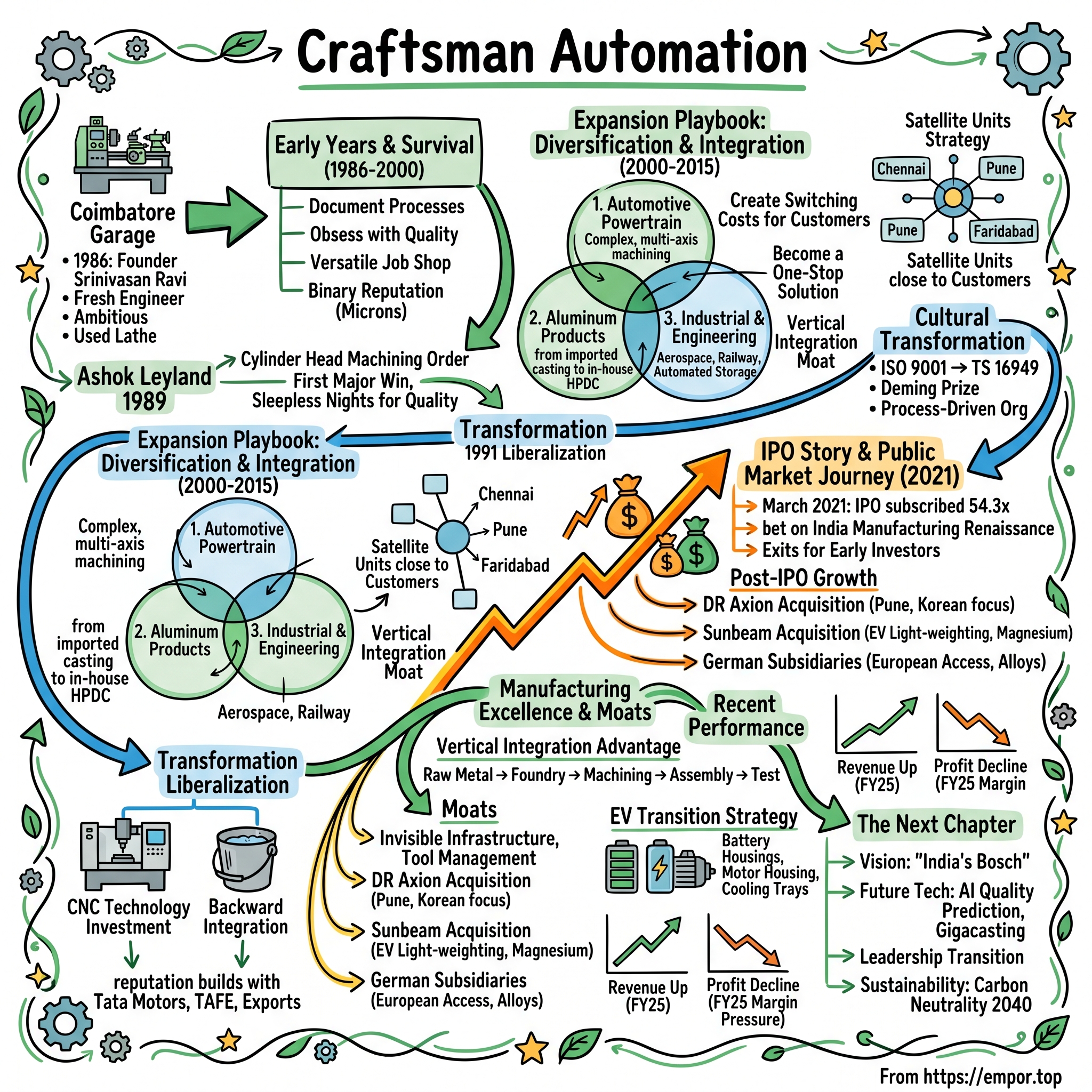
Craftsman Automation: From Coimbatore Job Shop to India's Precision Manufacturing Powerhouse
I. Introduction & Episode Teaser (5–8 min)
There is a particular sound inside a cylinder block machining line that few outside heavy manufacturing ever hear. It is not the scream of a lathe. It is a low, wet, rhythmic thunk-hiss-thunk as a 40-kilogram grey iron casting — a lump of rough metal destined to become the heart of a truck engine — is clamped, flooded with coolant, bored, milled, honed, gauged, and released. Every one of the dozens of holes drilled into that block must land within a few microns of specification. A human hair is roughly seventy microns thick; miss by a fraction of that margin, and the engine will leak, seize, or fail on a highway in Madhya Pradesh two years later. When a truck fleet operator calls Tata Motors about a component failure, Tata Motors calls the supplier.
Craftsman Automation has been on the receiving end of those calls for nearly four decades.
Incorporated as Craftsman Automation Private Limited on July 18, 1986, in Coimbatore, Tamil Nadu, the business was established by Srinivasan Ravi, a mechanical engineer and first-generation entrepreneur who brought more than 34 years of automotive industry experience to the company's 2021 stock market listing.1 What began as a small-scale machining shop now anchors an industrial group that reported consolidated revenue from operations of ₹8,069.27 crore in the financial year ended March 2026, alongside consolidated EBITDA of ₹1,300.07 crore and profit after tax of ₹383.99 crore.5
That scale makes Craftsman a major industrial enterprise, but its growth strategy has also made it a subject of active debate among investors.
The core tension rests on a sharp strategic pivot. For thirty years, Craftsman built a defensible position machining critical engine and transmission components for commercial vehicles, tractors, and off-highway equipment. By placing satellite factories directly adjacent to customer assembly plants, the company generated strong margins and high returns on capital. Beginning in late 2022, however, management pivoted aggressively into lower-margin, highly competitive aluminium die casting for passenger vehicles and two-wheelers, completing two debt-funded acquisitions in under two years. Consequently, consolidated return on capital employed fell from 22.3% in FY24 to 10.8% in FY25.20 Following an operational recovery, the company raised ₹2,000 crore in fresh institutional equity in June 2026,16 shortly before the promoter sold a portion of his stake into the market.10
The central question is not whether Craftsman is a skilled manufacturer. Rather, it is a structural strategic question: when a company deliberately exchanges a high-return niche for a much larger, lower-margin market using debt and equity dilution, what evidence demonstrates whether the trade is succeeding or failing?
The roadmap: the Coimbatore bootstrap years and why progress took decades; the satellite-plant playbook that built the powertrain moat, and the 2019–20 downcycle that exposed its vulnerabilities; the expansion into industrial storage and the operational reality of the German foundry acquisition; the mechanics of the 2021 IPO; the integration of DR Axion and Sunbeam; the FY25 earnings trough and FY26 recovery; an evaluation of the business moat under standard economic frameworks; an assessment of governance and promoter alignment; and the key metrics that will determine the company's trajectory.
Start where the metal does. Start in Coimbatore.
 Subscribe on LinkedIn
II. The Founder's Story & The Coimbatore Roots (1986–2000) (35–45 min)
Understanding Craftsman requires understanding Coimbatore's identity as a machine-tool hub. Through the twentieth century, the region developed a dense industrial cluster around textile machinery, agricultural pumpsets, electric motors, and castings. Thousands of small workshops, foundries, and tool rooms shared suppliers, competed for skilled fitters, and cultivated a workforce disciplined in tight manufacturing tolerances. While Detroit prioritized high-volume assembly and Stuttgart focused on specialized precision, Coimbatore operated on the unvarnished discipline of the job shop: a customer supplied a drawing and a rough casting, and the workshop machined the finished component.
Srinivasan Ravi developed within that ecosystem, studying mechanical engineering at the PSG College of Technology in Coimbatore—an institution with a strong practical workshop culture embedded in the region's industrial base.22 Launching as a first-generation entrepreneur, he operated without a family conglomerate or an inherited order book.1
When Craftsman Automation was incorporated in 1986, India remained under License Raj regulations that restricted manufacturing capacity and production choices. Capital was scarce, interest rates were high, and importing machine tools required strict foreign exchange approvals. Demand for precision machining existed, but acquiring the expensive capital equipment required to execute the work was the primary operational bottleneck.
This capital environment dictated the company's technical direction. Instead of chasing high-volume stamping or forging, Craftsman focused on high-tolerance machining, toolmaking, and in-house fabrication of special-purpose machines (SPMs). Unlike standard equipment, an SPM is custom-built to execute a single manufacturing step rapidly and repeatedly. While most auto-component manufacturers purchased these machines from external suppliers, Craftsman built them internally. Decades later, on the FY26 earnings call, management cited this capability as an ongoing cost advantage, noting that Craftsman relied on "a mixture of our own equipment manufacturing for the special purpose machines" to contain capital expenditure as global machinery costs climbed.3
The uncomfortable part of the origin story
Standard corporate narratives often compress early struggles into rapid success, but Craftsman's timeline demonstrates a longer gestation period.
The pattern challenges the assumption that technical specialization automatically yields swift commercial scaling. Incorporated in 1986, Craftsman did not commission its flagship integrated facility at Arasur, near Coimbatore, until 2003—seventeen years after its founding.1 By fiscal 2018, thirty-two years into operation, the company generated ₹1,511.53 crore in restated consolidated revenue and ₹31.53 crore in net profit—a net margin of roughly 2%—while carrying a gross block of ₹1,628.43 crore.1 At that stage, fixed assets exceeded total annual sales, yielding minimal net profit conversion.
This financial profile reflects the economics of high-precision machining. The business model requires significant upfront capital investment: equipment must be purchased and customer part approvals secured before long production runs generate returns, which materialize only if order volumes remain stable. Historical performance suggests that capacity additions do not convert immediately into operating profit. Management acknowledged this ongoing lag on the FY26 earnings call, explaining that recent aluminium die-casting margins remained flat because heavy capital expenditure "has not been put to use at all" yet, adding that expanding capacity by 20% while revenue grows by 5% creates a temporary margin drag until capacity utilization catches up.3
Post-liberalisation: the pivot that mattered
Economic reforms in 1991 reshaped Craftsman's market as global commercial-vehicle and engine manufacturers expanded their presence in India, alongside growth in domestic tractor and off-highway equipment production. Craftsman transitioned from generic regional job-shop contracts into a direct Tier-1 supplier of critical powertrain components, including cylinder blocks, cylinder heads, camshafts, transmission parts, gearbox housings, turbocharger components, and bearing caps.1
The strategic core of this shift lay in component selection. Craftsman targeted parts with stringent manufacturing specifications where supplier quality directly impacted original equipment manufacturer (OEM) engine warranties and reliability. In its IPO prospectus, the company noted that it had been "instrumental in import substitution for critical powertrain parts."1 This positioning shifted the competitive dynamic away from commodity pricing per kilogram toward technical reliability and customer switching costs, as vehicle manufacturers rarely risk changing suppliers for failure-critical engine parts.
By the late 1990s, Craftsman had established technical capabilities but lacked geographic proximity to key manufacturing hubs. Its primary commercial-vehicle customers operated assembly lines in Jamshedpur, Pune, Pithampur, and Chennai, whereas Craftsman's operations remained centralized in Coimbatore. Transporting heavy iron castings across long distances twice—first as raw castings to Coimbatore, then back as machined blocks—incurred unsustainable freight costs and logistics delays.
Overcoming this geographic mismatch led to the company's next core strategy.
III. The Satellite Plant Playbook & Powertrain Dominance (2000–2015) (45–55 min)
Picture the loading bay of a commercial vehicle assembly plant. A machined cylinder block is not a generic commodity. It is bulky, heavy, and already fully finished. Once machined, every surface demands extreme precision; minor impact damage during transit turns a high-value component into scrap. Multiply that risk by hundreds of thousands of units annually, and add an automotive manufacturer's mandate for just-in-time delivery—where components arrive directly at the assembly line hours before installation—and logistics become a primary operational risk.
The intuitive solution is building a machining facility immediately adjacent to the customer's assembly plant. The strategic challenge is that few suppliers adopt this model, as it requires an irreversible capital commitment tied directly to a single customer's production volume.
Craftsman executed this satellite strategy repeatedly. It commissioned its Pithampur facility near Indore in 2005, followed by Jamshedpur in 2007, Sriperumbudur near Chennai in 2010, and dual facilities at Ballabgarh near Faridabad in 2011 and 2018. It added plants at Sanaswadi near Pune in 2011 and 2014, operating alongside its Coimbatore flagship facility from 2003, an aluminium foundry in Kurichi from 2001, and integrated plants in Bengaluru (2015 and 2019) and Pimple Jagtap near Pune (2018). By the time of its IPO, Craftsman operated 12 manufacturing facilities across seven Indian cities, encompassing over 1.5 million square feet of built-up area.1
This footprint reflected customer locations directly: Jamshedpur served Tata Motors; Pithampur anchored central India's commercial-vehicle hub; Sriperumbudur targeted the Chennai automotive corridor; Pune covered Mahindra, Daimler's local supply chain, and the regional engineering cluster; and Ballabgarh anchored operations in the National Capital Region.
The resulting customer portfolio spanned major industrial manufacturers: Daimler India, Tata Motors, Tata Cummins, Mahindra & Mahindra, Simpson & Co., TAFE Motors and Tractors, Escorts, Ashok Leyland, Perkins, Mitsubishi Heavy Industries, John Deere, and JCB India in the powertrain segment; Daimler India, TVS Motor, Royal Enfield, Perkins, and Mahindra in aluminium products; and Siemens alongside Mitsubishi Heavy Industries in industrial and engineering.1 Craftsman emerged as the largest Indian provider of machined cylinder blocks and heads for intermediate, medium, and heavy commercial vehicles as well as construction equipment, while ranking among the top three or four producers for tractor cylinder blocks.1 Across several of these product lines, Craftsman operated as the sole supplier.1
Two corporate structure details warrant attention. First, customer concentration remained high, with the top ten customers generating between 53% and 59% of revenue from FY18 through the nine months ended December 2020—a typical pattern for a Tier-1 auto component manufacturer.1 Second, at its IPO, Craftsman operated without Indian manufacturing subsidiaries or joint ventures, housing all production directly within the listed parent entity to retain core technical capabilities in-house.1
To access complementary technology, Craftsman established two strategic partnerships. In 2007, it formed a joint venture with Germany's Carl Stahl International GmbH—Carl Stahl Craftsman Enterprises—which began operating in July 2008 to distribute and service chain hoists, rope hoists, and crane kits manufactured by Craftsman.1 The company also acquired a minority stake in MC Craftsman Machinery, majority-owned by the Mitsubishi group, expanding a two-decade commercial relationship with Mitsubishi and providing access to East Asian customer networks.1 While neither venture altered overall consolidated earnings, both offered cost-effective access to foreign manufacturing technology and distribution channels.
Testing the moat: the reality of the 2019–20 downcycle
The strategic value of satellite plants requires scrutiny against cyclical downturns, as dedicated facilities tied to specific assembly plants expose suppliers directly to customer volume shocks.
Because satellite facilities carry fixed operating overhead linked to an anchor customer's production schedule, declining assembly volumes quickly erode profitability. During the fiscal 2020 contraction in India's commercial vehicle sector—exacerbated by the transition to BS-VI emissions standards and early pandemic disruptions—Craftsman's overall powertrain capacity utilization dropped from 93% in FY18 and 89% in FY19 to 71% in FY20.1 At individual satellite locations, the decline was sharper: utilization at the Jamshedpur plant, dedicated to Tata Motors, fell from 91% in FY18 and 89% in FY19 to 59% in FY20.1 Pune fell from 90% to 67%, while Coimbatore dropped from 95% to 72%.1
Financial results mirrored this volume contraction. Revenue from operations fell 17.91% in FY20 to ₹1,492.47 crore, while net profit dropped by more than half, from ₹97.37 crore to ₹41.07 crore. Consolidated return on capital employed fell from 18.66% to 13.80%, before declining further to an annualized 10.55% for the nine months ended December 2020.1
Crucially, gross pricing power remained intact: EBITDA margin rose from 25.12% in FY19 to 27.24% in FY20.1 Pricing on specialized machined components held firm despite lower volume, indicating that net profit compression stemmed from fixed asset depreciation across satellite facilities and debt service costs incurred during initial construction.
This performance highlights a key structural reality: satellite plants offer strong pricing durability but expose the business to high operating leverage. Original equipment manufacturers rarely replace incumbent suppliers during demand contractions, but reduced order volumes leave fixed factory overhead unabsorbed. Consequently, high switching costs stabilize component pricing rather than net income.
This dynamic imposes a permanent ceiling on asset turnover. On the Q1 FY27 earnings call in July 2026, Srinivasan Ravi noted that powertrain capacity utilization stood at roughly 70%, with seasonal peaks potentially reaching 80%, explaining that annualized utilization above 75% remains difficult due to demand seasonality and the operational risk of disrupting customer assembly lines.4 Because just-in-time proximity caps peak utilization below three-quarters of total capacity, asset efficiency remains structurally constrained even during industry upturns.
This structural cyclicality in heavy commercial vehicle powertrain machining prompted management to evaluate diversification options starting around 2012.
IV. Diversification & European Footprint: Industrial Storage & Fronberg Guss (2012–2020) (35–45 min)
The initial answer to automotive cyclicality was storage shelves.
While storage products appeared unglamorous compared with precision engine block machining, Craftsman possessed the requisite capabilities in-house: sheet-metal fabrication capacity, engineering design teams, custom machine-building tools, and exposure to an expanding domestic logistics sector requiring industrial racking, pallets, vertical lift modules, and automated storage and retrieval systems. The company's Industrial and Engineering segment consolidated these capabilities alongside existing product lines—gears and gearboxes, tool rooms, mould bases, hoists, crane kits, marine engines, special-purpose machines such as industrial washing and leak-testing rigs, and storage solutions for FMCG, e-commerce, food and beverage, pharma and electronics customers.1
On paper, expanding into storage offered logical diversification away from heavy commercial vehicle cycles. A CRISIL study cited in Craftsman's IPO prospectus valued India's storage-solutions industry at approximately ₹2,200 crore in fiscal 2020, projecting 15–16% annual growth to reach expected ₹3,600 crore by fiscal 2024.1 To capture national demand, Craftsman commissioned a dedicated storage plant at Pimple Jagtap near Pune in 2019 to serve the national market.1 Storage revenue grew rapidly from a negligible base, accounting for 0.52% of revenue in FY18, 1.45% in FY19, 4.91% in FY20, 5.61% in the nine months to December 2020.1
Testing the "counter-cyclical high-margin hedge" claim
Two operational realities challenge the view of storage as an immediate counter-cyclical cushion.
First, scale and timing limited its effectiveness during downturns. The Pune storage plant operated at 35% capacity utilisation in its first reported year, FY20,1 while the segment's foundry line ran at 28%, down from 54% two years earlier.1 Although storage grew through an automotive contraction, contributing roughly 5% of total revenue rendered it mathematically incapable of offsetting Craftsman's 17.9% consolidated revenue decline in FY20.
Second, segment profitability contradicted the high-margin narrative. In fiscal 2026, the Industrial and Engineering segment earned a standalone EBIT margin of just 4%, against 19% for automotive powertrain and 13% for aluminium products.5 Industrial and Engineering registered as the lowest-margin of Craftsman's three operating segments, rather than a premium earnings driver.
However, the segment operates on low capital intensity, altering how those thin margins translate into returns on capital. On a May 2025 earnings call, Srinivasan Ravi noted that storage requires "negligible CAPEX" compared with the automotive powertrain and aluminium segments, with low working capital and low total capital employed.2 Consequently, a modest EBIT margin on a minimal capital base can still generate an acceptable return on capital. The segment subsequently inflected in the June 2026 quarter (Q1 FY27), delivering ₹330 crore of revenue—up 53% year-over-year—with segment EBIT jumping from ₹5 crore to ₹30 crore.6 Management attributed the performance to domestic material handling and storage demand tied to India's broader capital expenditure cycle, and insisted "this is not one spike."4
Ultimately, storage evolved into a capital-light, steadily expanding business that took nearly a decade to achieve operational scale, rather than serving as an instant high-margin counter-cyclical hedge.
Now, the German foundry — and a correction to the consensus story
A widely circulated market narrative suggests Craftsman acquired German iron foundry Fronberg Guss in 2012 as a technology-transfer initiative that turned into a persistent capital drain. Corporate disclosures reveal a different timeline and strategic rationale.
Craftsman's overseas operations prior to 2024 were limited primarily to commercial distribution units, notably Netherlands-based Craftsman Europe B.V. (formerly Craftsman Marine B.V.), set up in 2008 to market and service marine engines that were manufactured in India and exported under the Craftsman Marine name.1
The German foundry acquisition occurred much later. On July 23, 2024, Craftsman acquired the assets of Fronberg Guss GmbH, an iron-casting foundry at Schwandorf-Fronberg in Bavaria, for €2 million.11 The facility, employing approximately 150 people, was part of the insolvent Gienanth Group, whose subsidiaries were being sold off.11
The transaction targeted specialized industrial capacity. Since 2020, Craftsman had been preparing to enter the market for large stationary engine blocks—multi-cylinder, heavy-horsepower engines used in prime and backup power generation for data centers. Management explained on the May 2025 call that fewer than ten global Tier-1 suppliers produce these heavy engine blocks because OEMs historically cast them in-house. On the foundry side, management estimated fewer than six operational foundries remained in Europe, alongside two or three in North America and two or three in China. Acquiring Fronberg provided immediate European casting capacity at a time when surging data-centre demand had filled competitors' order books for three to four years and was pushing OEMs to outsource.2
Rather than a legacy capital drain, the purchase represented an opportunistic acquisition of scarce capacity in a supply-constrained niche for a nominal purchase price.
The central risk concerns commercialization timelines rather than acquisition cost. Craftsman targets approximately $100 million in revenue from the heavy-horsepower engine business—around ₹800 crore at prevailing exchange rates—in FY29 or FY30.213 As of the July 2026 call, five of six target customers had placed orders, two had begun pilot-lot machining, and casting validation still required about another year.4 Management outlined a gradual ramp-up: roughly 30% productionised by FY28, another 50% in FY29, with FY30 the first full-revenue year.4 On the FY26 earnings call three months earlier, Ravi noted that the new powertrain business "is still not seeing any revenue," pilot lots were being invoiced at "not even 0.5% of our powertrain revenue," and utilisation sat "practically in 10% level."3
While multi-year qualification cycles are standard for heavy engine components, data-center power generation remains a future growth option rather than an active earnings driver.
This combination of organic industrial diversification and targeted asset purchases sets the context for how Craftsman funded its expansion—and its transition to a publicly listed company.
V. The 2021 IPO & Capital Market Entry (30–40 min)
March 2021 presented an unusual window for launching an initial public offering of a cyclical Indian industrial supplier. India was navigating intervals between COVID-19 pandemic waves, and domestic commercial vehicle sales were recovering slowly from their sharpest downcycle in a decade. Craftsman's own trailing financial results reflected that strain, carrying the full impact of the fiscal 2020 earnings drop in its IPO prospectus.
The offering proceeded regardless. Bidding opened from March 15 to March 17, 2021, at a price band of ₹1,488 to ₹1,490 per share of ₹5 face value, raising a total of ₹823.70 crore, with Axis Capital and IIFL Securities serving as book-running lead managers.114 At the upper boundary of the price band, the transaction valued Craftsman at a post-issue market capitalization of approximately ₹3,148 crore.1
The transaction's capital structure reveals its primary strategic purpose. Of the ₹823.70 crore raised, primary proceeds accounted for just ₹150 crore. The remaining ₹673.70 crore constituted an offer for sale comprising up to 4,521,450 existing shares from institutional and individual shareholders.114 Out of the ₹150 crore in fresh capital, management earmarked ₹120 crore to repay or prepay outstanding borrowings, allocating the remainder to general corporate purposes.1
The selling shareholders were led by institutional investors seeking exit liquidity. The International Finance Corporation, the World Bank Group's private-sector investment arm, which had funded Craftsman in 2010 and 2012 and held a 14.06% pre-issue stake, offered up to 1,414,050 shares. Marina III (Singapore) Pte—which inherited Standard Chartered Private Equity's 2012 position in 2017 to hold 15.50%—offered up to 1,559,260 shares. Individual shareholder K. Gomatheswaran offered his entire 7.04% stake, while founder Srinivasan Ravi sold 130,640 shares.1 Combined promoter and promoter-group equity ownership consequently declined from 63.40% before the issue to 59.76% post-issue.1
Viewed structurally, the 2021 IPO served primarily as a liquidity window for decade-old private equity holdings and an early individual investor rather than a corporate recapitalization. Allocating ₹120 crore toward debt retirement against a balance sheet carrying ₹668.28 crore in long-term borrowings and ₹244.27 crore in short-term debt as of March 2020 represented a modest debt reduction rather than a structural balance-sheet overhaul.1
Public equity markets greeted the offer with measured demand. The issue was subscribed 3.81 times overall, led by qualified institutional buyers at 5.21 times.14 On listing day, March 25, 2021, Craftsman shares opened at ₹1,350 on the BSE—a 9.40% discount to the ₹1,490 issue price—and ₹1,359 on the NSE.14 Although the stock recovered toward its issue price during trading hours, the debut delivered a modest listing discount rather than a speculative opening surge.
This initial performance reframes the company's public market history. Contrary to simplified retrospective narratives portraying Craftsman as an instant post-pandemic market darling, the shares initially traded below their offer price. Subsequent valuation creation—culminating in a June 2026 institutional placement priced at ₹8,700 per share16—stemmed from operational performance and asset integration rather than initial market enthusiasm.
Testing the deleveraging claim: three trips to the equity market in five years
This trajectory presents an opportunity to examine a common capital-market assumption: that an initial public offering establishes a permanently deleveraged capital structure.
Craftsman's operational record demonstrates a different dynamic. Rather than stabilizing its capital structure post-listing, the company re-entered equity markets twice over the subsequent five years while expanding total indebtedness to fund major corporate acquisitions.
In June 2024, Craftsman completed a qualified institutional placement (QIP) of ₹1,200 crore, issuing 2,727,272 shares at ₹4,400 per share—a small discount to the floor price of ₹4,426.11—following board and shareholder authorizations on May 27, 2024.15 According to CRISIL's October 2024 rating rationale, proceeds from this QIP funded the ₹250 crore acquisition of the remaining 24% stake in DR Axion.7 In June 2026, following board approval on May 16 and shareholder approval at an extraordinary general meeting on June 13, the company executed another QIP raising ₹2,000 crore at ₹8,700 per share, with approximately ₹1,500 crore designated for debt reduction.816 As a result of these equity issuances, total paid-up share capital expanded from 2,38,55,583 shares of ₹5 face value at the time of its FY26 financial results5 to 2,61,54,433 shares by late June 2026.10
Between these equity raises, overall corporate debt expanded significantly. CRISIL reported a consolidated debt-to-EBITDA ratio of 1.7 times for FY24, projecting leverage to peak between 2.7 and 2.9 times in FY25 as major acquisition payments and capital expenditure outlay materialized.7 On the FY26 earnings call in May 2026, an analyst from Suyash Advisors noted consolidated gross debt of approximately ₹3,300 crore, describing leverage levels as elevated. Srinivasan Ravi responded that consolidated net debt-to-EBITDA stood at 2.43 times, projecting the metric would moderate below 2.0 times during FY27 and approach 1.5 times thereafter, adding that adjusting for pending real estate monetization in Gurgaon reduced effective consolidated debt to ₹2,700 crore rather than ₹3,100 crore.3
These capital market actions do not imply undisclosed leverage risks. Management fully disclosed acquisition terms, secured shareholder approval for each capital raise, and maintained CRISIL ratings of AA-/Stable and A1+ throughout, with CRISIL revising the rating outlook to Positive in June 2026 following the ₹2,000 crore equity placement and planned debt paydown.78 Rather, the financial record highlights a broader structural pattern: Craftsman operates as a serial issuer of equity, meaning per-share valuation models must incorporate potential dilution whenever major growth or acquisition opportunities arise. The company has consistently treated share count expansion as an available financing tool rather than a rigid constraint.
That capital allocation pattern becomes clearer when examining how those acquisition proceeds were deployed.
VI. The Inorganic M&A Blitz: DR Axion, Sunbeam, & Consolidated Scale (2023–2025) (45–55 min)
Every so often a management team looks at its own excellent business and concludes that the thing it is excellent at is not big enough.
That is roughly what happened at Craftsman around 2022. The powertrain business was defensible, high-margin, and structurally capped — capped by Indian commercial vehicle cyclicality, by the utilisation ceiling proximity imposes, and, over a longer horizon, by the fact that battery-electric vehicles do not contain cylinder blocks. Meanwhile, the aluminium opportunity was enormous and Craftsman was sub-scale in it. Aluminium products had been just 21.10% of revenue in the nine months to December 2020, against 51.21% for powertrain.1
Craftsman's aluminium capability had itself been a slow build. It began around 2000 with a small sand-casting foundry, initially machining aluminium parts imported largely from China before backward-integrating into its own foundry. The genuine inflection came in 2014–2016 with investment in high-pressure and low-pressure die casting at Coimbatore, which took the business from roughly 2,500 tonnes a year toward installed capacity of about 140,000 tonnes per annum.12 The company now operates across high-pressure, low-pressure, gravity, counter-pressure and sand casting — a spread that COO Srivardhan Krishnakumar has described as putting Craftsman "among a select group of suppliers offering an end-to-end aluminium solution."12
Organic growth from 21% of revenue to industry-leading scale would have taken a decade. Craftsman bought it instead.
Transaction one: DR Axion India
DR Axion India was the Indian arm of a Korean aluminium casting group, and it occupied an unusually privileged position: it was the sole supplier of cylinder heads to both 현대자동차 Hyundai Motor's Indian operations and 기아 Kia in India, and had begun supplying cylinder blocks and heads to Mahindra & Mahindra.17 Craftsman signed the definitive agreement on December 29, 2022 to acquire 76% of the equity for ₹375 crore, completing the purchase in February 2023.17
The price is the interesting part. The transaction implied an enterprise value of about ₹650 crore, working out to roughly 9 times FY23 earnings and — the number that matters for an asset-heavy casting business — about 4.4 times FY23 EV/EBITDA.17 For context on how cheap that is: DR Axion's production volume had doubled between FY20 and FY23 while its capacity utilisation still sat at only 65%, meaning Craftsman acquired both an installed customer relationship and unused capacity to grow into.17
The strategic fit was also more precise than "more aluminium." Craftsman's own strength was high-pressure die casting — the process used for thin-walled, high-volume structural parts. DR Axion's strength was gravity and low-pressure die casting — the processes used for cylinder heads, where you need dense, defect-free metal in the load-bearing regions.17 The two are genuinely complementary, and together they cover most of what a passenger-vehicle programme needs.
In 2024, Craftsman bought the residual 24% for ₹250 crore, making DR Axion wholly owned.7[^21] That second tranche was expensive relative to the first: roughly ₹10.4 crore per percentage point, against about ₹4.9 crore per point for the opening 76% stake. Buying out a minority always costs a premium, and a year of growth had intervened — but it is worth noting that Craftsman paid more than twice the implied per-unit price to remove a partner from a business it already controlled. By FY26, DR Axion was generating ₹1,619 crore of revenue and ₹186 crore of PAT.8 Against a total equity outlay of ₹625 crore, that is a strong result, and it is the single most defensible piece of capital allocation in the recent Craftsman record.
Transaction two: Sunbeam, and the deal that wasn't really a purchase
Sunbeam is a different kind of story, and the way it is usually described gets the economics backwards.
Sunbeam Auto, founded in 1980 and headquartered in Gurgaon, was a substantial aluminium die-caster supplying Hero MotoCorp, Maruti Suzuki, スズキ Suzuki's Indian powertrain and motorcycle operations, and others, from plants at Gurgaon, Bhiwadi, Ludhiana and Halol. Kedaara Capital invested in 2018.18 By 2024, the business was in trouble.
Craftsman announced the transaction on August 5, 2024 and completed it on October 9, 2024, acquiring 100% of Sunbeam Lightweighting Solutions' securities and subscribing to optionally convertible debentures for a total of ₹376 crore.7 CRISIL described the structure as €10 million of equity plus ₹376 crore of OCDs.7
But here is what Ravi told analysts in May 2025, and it reframes the entire deal: "we never paid anything for the company per se, it was infused into the company, it is not for buying any share. Shares are bought at Re.1." The money went into settling vendor liabilities and residual bank debt — the latter effectively funded against the eventual sale of the Gurgaon land — rather than to the seller.2 Kedaara's position shows as fully exited.18
That is not an acquisition in the ordinary sense. It is a rescue recapitalisation. And the condition of the asset was correspondingly poor. Ravi has been unusually candid about it: "this company was getting into an insolvency situation. In that case, no new orders were given by customers, or new projects were not going on."2 There was, he said, "no order pipeline when we took over Sunbeam totally."2 A ₹160 crore settlement covering roughly 1,000 employees had been provisioned in the opening balance sheet, with about 500 having already left at the time of that call.2 The Gurgaon plant was being physically relocated to Bhiwadi — conveniently about ten minutes from Craftsman's own Bhiwadi facility — with machinery moved in stages, held up in part because North American passenger-car customers required validation of the new site before production could shift.2
The bull framing is that Craftsman acquired real capacity, real customers and a real northern-India footprint for the cost of cleaning up someone else's balance sheet. The bear framing is that it bought a business with negative-margin legacy contracts, an unrehabilitated workforce, no order book, and a two-to-three-year turnaround runway — and then consolidated all of that into its own P&L. Both framings are correct, which is exactly why FY25 looked the way it did.
The March 2026 restructuring — and what it actually does
On March 11, 2026, the board approved a phased composite scheme of arrangement to consolidate the group's aluminium business.9 The structure is worth stating precisely, because it is frequently described backwards. The scheme amalgamates step-down wholly owned subsidiaries — Suprash Developers and Srikara Technologies — into DR Axion India; then amalgamates DR Axion into Sunbeam; then reorganises Sunbeam's equity share capital.9 The entities involved reported combined turnover of roughly ₹2,536 crore as at March 2025, with Sunbeam at ₹1,237.46 crore of turnover against ₹107.43 crore of net worth, and DR Axion at ₹1,298.52 crore against ₹511.34 crore.9 It requires shareholder, creditor, regulatory and National Company Law Tribunal approvals; CRISIL noted an appointed date of April 1, 2026 with completion targeted by the end of FY27.89
Note that this is not a merger of the subsidiaries into the listed parent, and the parent's own aluminium operations are not being folded in at this stage. It is an internal tidying of the subsidiary layer — one that, among other things, allows a profitable entity's earnings to sit alongside a loss-making entity's accumulated position.
Ravi's stated rationale on the FY26 call was commercial rather than fiscal, and reasonably persuasive: the group expects to reach roughly ₹6,500 crore of aluminium revenue in FY27, its global competitors are "$3 billion to $6 billion in revenue," and "when we go with each of the businesses at $200 million, $100 million revenue or $300 million revenue and try to take an order for $100 million, $200 million, it is to share the resources and to grow the business, it is becoming unwieldy."3 He also flagged the specific gap the merged structure fixes: Craftsman has no aluminium plant in the Chennai region while its northern and western peers do, and building separate campuses for the parent and for DR Axion in the same location "doesn't make sense."3
The scheme is a live regulatory overhang until NCLT clears it. Investors should treat the FY27 completion target as a target, not a schedule; NCLT timelines in India routinely slip.
VII. Financial Reality Check: Integration Pain, Margin Dilution, & The FY25 Profits Trough (2024–2025) (40–50 min)
If you had looked only at Craftsman's top line in FY25, you would have concluded the company was compounding beautifully. Consolidated revenue from operations rose 27.8% to ₹5,690.48 crore.5
If you had looked only at the bottom line, you would have concluded something had gone badly wrong. Consolidated profit after tax fell to ₹200.87 crore from ₹337.33 crore in FY24 — a drop of roughly 40%, compressing net margin from about 7.6% to 3.5%.5 In the March 2025 quarter alone, standalone PAT fell 51% year on year to about ₹40 crore.
The return-on-capital picture was worse than the profit picture. Consolidated ROCE fell from roughly 22.3% in FY24 to about 10.8% in FY25, as fixed assets ballooned 41% from ₹2,327.75 crore to ₹3,285.13 crore.20 For a company whose entire historical argument rested on earning premium returns on precision assets, halving ROCE in a single year is the kind of number that either explains itself or destroys a thesis.
Three mechanisms, not one
The decline is often summarised as "acquisition dilution." That is only about a third of it.
Mechanism one — genuine mix dilution. Consolidating DR Axion and a loss-making Sunbeam into a business that had historically run above 20% operating margins mechanically pulled the blended number down. CRISIL had forecast operating margins falling to roughly 14–15% in FY25 specifically because of Sunbeam's losses.7 The outturn was close: FY25 consolidated EBITDA of ₹858.78 crore on ₹5,690.48 crore of revenue works out to about 15%.5
Mechanism two — a self-inflicted, disclosed operational reset in the core. This is the part that gets missed, and it is the most revealing thing management said all year. On the FY26 call, asked why powertrain margins had spiked, Ravi attributed the prior weakness not to demand but to internal work: "the repair and maintenance which went on for almost 4, 5 quarters" had been "depressing the EBIT margins."3 He had said the same in May 2025 — roughly eighteen months of modernisation, repair and maintenance hitting expenses, compounded by weak operating leverage as "capacity utilization was quite less across the old lines" and new lines failed to ramp because customers were slow.2 In other words, a meaningful slice of the FY25 trough was Craftsman rebuilding its own powertrain asset base while volumes were soft. Painful, but a choice — and arguably the right one.
Mechanism three — the capital charges. Depreciation and interest rose hard as debt-funded acquisitions and capex landed. By FY26, standalone finance costs reached ₹247.95 crore and depreciation and amortisation ₹324.52 crore.5 Consolidated depreciation, Ravi noted in July 2026, is now "close to around INR 500 crores."4 Those are structural, not transitory.
Two accounting details deserve a mention because they affect how clean the FY25 numbers are. First, standalone segment reporting carried an "Others" line of about ₹148 crore, which Ravi explained as two one-off intra-group transactions: brand-new equipment bought by Craftsman and transferred to Sunbeam at no profit or loss because "Sunbeam was not ready at that level financially," and aluminium alloy inventory transferred at cost to DR Axion.2 Both were at cost, both were disclosed, and neither was a manufacturing activity — but they did inflate standalone revenue. That "Others" line fell to ₹73 crore in FY26 from ₹167 crore in FY25.5 Second, Sunbeam's ₹160 crore restructuring settlement was provisioned in the opening balance sheet at acquisition rather than expensed through the P&L — normal purchase accounting, but it means the reported turnaround costs less in the income statement than the cash cost of the turnaround.2
The recovery, and how much of it is real
FY26 was a genuine rebound. Consolidated revenue rose 42% to ₹8,069.27 crore, EBITDA rose 51% to ₹1,300.07 crore — a margin of about 16.1% — and PAT rose 91% to ₹383.99 crore, giving earnings per share of ₹160.96 and supporting a final dividend of ₹11.25 per share.5 The March 2026 quarter delivered PAT of ₹116.42 crore, up 74%.5 Standalone results were even more dramatic: PAT more than doubled to ₹221.47 crore on revenue of ₹4,818.08 crore.5
Momentum carried into FY27. The June 2026 quarter produced consolidated revenue of ₹2,432 crore, up 36%, EBITDA of ₹408 crore, up 51%, at a 17% margin, and PAT of ₹150.55 crore — up 116% against ₹70 crore a year earlier, and comfortably ahead of consensus.621
Here is where independence matters. A doubling of profit sounds like synergies arriving. On the evidence, it is mostly something simpler and less durable-sounding: operating leverage on capacity that was already paid for, plus the end of the powertrain maintenance drag, plus price resets. Ravi himself pushed back on the flattering interpretation twice. On the FY26 call: "It's not the scale benefit which has really played out in the last year." On the Q1 FY27 call, when an analyst congratulated him on powertrain strength, he corrected the framing — "It is not really a strong trend. I would say that it was a muted trend earlier. It has come to a normal situation."34 A management team that talks its own good quarter down is providing useful signal.
Two things temper the recovery. Working capital consumed roughly ₹400 crore of cash in FY25 and a further ₹600 crore in FY26; Ravi's explanation was that the aluminium ramp had spiked requirements and that payment cycles had now normalised, with no big change expected — a claim that is testable against the next two cash flow statements.3 And Sunbeam remained unfixed. On the FY26 call, its EBITDA margin was still single-digit; management was exiting unprofitable customers and product lines, had sold one roughly ₹30-crore-a-year business line outright, and expected Sunbeam capacity utilisation to fall from around 70% to 45–50% deliberately.3 By July 2026, Ravi guided to mid-teens EBITDA margin for Sunbeam by the March 2027 quarter, with 90% of the restructuring complete by December, alongside a 10–20% revenue decline as low-value work is shed.4
Which is the correct conclusion on the acquisition thesis. The claim that inorganic scale enhances earnings quickly is rejected by Craftsman's own record — it took roughly eighteen months to two years, and cost a 40% profit decline and a halving of ROCE along the way. The narrower claim that survives is that the acquisitions were bought cheaply enough that the eventual returns can still be good. The specific event that would confirm it: Sunbeam printing a mid-teens EBITDA margin in the March 2027 quarter, on the timeline management has now publicly committed to. Missing that would be a genuine credibility problem, because it is a specific number attached to a specific quarter.
VIII. Segment Economics & Competitive Moat Breakdown (7 Powers & Porter's 5 Forces) (40–50 min)
Craftsman today is not the company that listed in 2021, as its evolving segment mix demonstrates.
In the June 2026 quarter—the first quarter of fiscal 2027—aluminium products generated ₹1,479 crore, accounting for roughly 61% of consolidated revenue, with segment EBIT rising 39% year-over-year to ₹150 crore. Powertrain contributed ₹623 crore, or approximately 26% of revenue, with EBIT up 50% to ₹114 crore. Industrial and engineering brought in ₹330 crore, representing about 13% of revenue, with segment EBIT of ₹30 crore.6
Calculating those operating margins highlights the underlying strategic trade-off. Powertrain converted approximately 18% of its revenue into EBIT, whereas aluminium converted about 10%. On a standalone basis for fiscal 2026, the segment margin gap stood at 19% for powertrain versus 13% for aluminium.5 Management deliberately expanded the business into its lowest-margin major segment because passenger-vehicle growth and high volume rest in aluminium die casting, where scale is essential to compete against international casting groups several times Craftsman's size.
This shift represents an explicit exchange of operating margin for scale—a strategic repositioning rather than an immediate margin upgrade.
What the aluminium business actually does, in plain terms
Die casting is conceptually simple: melt aluminium, force it into a steel mould, let it solidify, open the mould, and repeat. The engineering challenge lies in the process details. High-pressure die casting injects molten metal at high velocity and pressure, making it ideal for thin, complex, high-volume parts like housings and structural brackets; however, minor gas entrapment limits how much structural load those parts can bear in critical areas. Low-pressure and gravity casting fill moulds more gradually to produce denser, defect-free metal, which is why cylinder heads subject to severe combustion pressures and thermal cycling rely on those techniques. Counter-pressure casting occupies the middle ground between them.
Craftsman operates across high-pressure, low-pressure, gravity, counter-pressure, and sand casting, while integrating in-house mould design, fixture building, and precision machining to convert raw castings into finished parts.12 That final machining stage represents the core value addition. Srinivasan Ravi has noted that unmachined castings yield poor financial returns, explaining that with rising costs across aluminium, energy, labour, and consumables, "the margins on basic raw casting is not going to be viable." He stated that 95% of Craftsman's standalone products undergo machining, while DR Axion's critical components require essential machining. By contrast, much of Sunbeam's domestic output lacked machining altogether, prompting its operational restructuring.3
A secondary cost advantage stems from material selection: recycled secondary aluminium accounts for roughly 45% to 50% of total metal consumption, requiring 75% to 80% less energy than primary metal processing.12 Given rising industrial power tariffs in India, this input mix provides a structural energy-cost advantage.
Seven Powers, honestly scored
Process Power — moderate to high, supported by operational evidence. Four decades of machining fixtures, cycle-time optimization, cell layouts, in-house special-purpose machine construction, and internal mould design provide a unit-cost structure that cannot be replicated quickly through capital outlay alone. During the fiscal 2020 contraction, the company maintained EBITDA margins above 25% despite an 17.9% decline in consolidated revenue.1 Furthermore, building a portion of its own manufacturing equipment alters replacement capital expenditure dynamics during periods of sharp inflation; Ravi estimated that replicating Craftsman's 2016 capital expenditure today would cost "5x to 7x more," with industrial land prices up eight-to-nine times and construction costs up three-to-four times.4
Switching Costs — high, due to engineering requalification. Requalifying a cylinder block or cylinder head supplier requires an extensive engineering process involving part approval protocols and engine endurance testing. DR Axion's position as the sole cylinder-head supplier to two major passenger-vehicle original equipment manufacturers (OEMs) in India illustrates this friction.17 However, high switching costs primarily protect component pricing rather than order volume during cyclical downturns.
Cornered Resource — weak. The satellite plant footprint is difficult to duplicate and provides localized delivery advantages, but it does not represent an exclusive resource. On the FY26 earnings call, Ravi observed that "all our peers from the north and west have aluminium component manufacturing like Craftsman. There are quite a few. Some of them are also listed. All of them have got a presence in the Chennai region. But Craftsman per se doesn't have a presence in the Chennai region."3 A company describing geographic gaps relative to listed peers is engaged in competitive expansion rather than maintaining a cornered asset.
Counter-Positioning — low. While pure foundries may lack machining infrastructure and pure machining facilities may lack foundries, this reflects a capital and capability gap rather than a structural business-model asymmetry that established competitors are unwilling to adopt. Major component suppliers—including Bharat Forge, Sansera Engineering, Endurance Technologies, Sundram Fasteners, CIE Automotive India, and Samvardhana Motherson—possess vertical integration capabilities and can pursue similar operational models.
Scale Economies — emerging. The restructuring of the aluminium business aims to build scale. Ravi noted that a $1 billion aluminium supplier can bid for $100 million to $200 million global programs that three separate $100 million to $300 million entities cannot effectively pursue.3 He outlined a two-to-three-year horizon for achieving $1 billion in annual aluminium revenue at prevailing metal prices.3 Whether this scale converts into expanded operating margins remains unproven; on the same call, Ravi cautioned that margins would not expand significantly until capital expenditure slows and installed capacity matures, noting it could take "maybe another two, three years down the line."3
Branding and Network Economies — not applicable to industrial component supply.
Porter, applied to the actual customers
Bargaining power of buyers — high, representing the dominant competitive force. Automotive OEMs exercise strong pricing pressure, particularly regarding raw-material cost pass-through mechanisms. On a July 2026 earnings call, Ravi noted that "some of the customers are fair. Some of the customers are taking their own time to make these adjustments."4 On the prior FY26 call, he stated that where price adjustments are withheld, "we are declining to supply."3 Refusing production volumes to preserve unit pricing reflects supplier discipline, but it also carries an immediate volume cost.
Threat of substitutes — moderate and long-term. Battery-electric vehicles eliminate the need for traditional cylinder blocks and heads, though they require structural die-cast components, electric motor housings, and battery enclosures. According to COO Srivardhan Krishnakumar, Craftsman's product portfolio remains focused primarily on internal combustion engines, with electric vehicle penetration around 5% to 6% in two-wheelers and below 2% in passenger cars, leaving Craftsman's direct EV exposure "marginal."12 While Indian electric vehicle sales reached 2.66 million units in fiscal 2026, up from 2.05 million,19 powertrain substitution represents a long-term transition rather than a near-term disruption.
Rivalry — intense in commodity casting, moderate in critical components. Ravi identified potential pressure in specific categories such as alloy wheels, watching whether import competition increases "after the BIS norms has been more or less settled down now."3 Regulatory protections subject to administrative revisions remain variable competitive shields.
Threat of new entrants — low, constrained by capital inflation. Capital expenditure requirements create high entry barriers. Constructing a new greenfield facility requires ₹100 crore to ₹250 crore for land, industrial buildings, effluent treatment, power connections, and access infrastructure before installing manufacturing equipment.4 On the FY26 earnings call, Ravi argued that earlier capital investments provide an ongoing cost shield, asserting that executing the same capital expenditure today "will be 1.5x more."3 Capital cost inflation serves as a structural barrier for new market entrants.
Supplier power — moderate, focused on raw materials, power, and labor. Craftsman relies partly on external foundry partners and customer-owned foundries for conventional iron powertrain castings rather than full backward integration.2 Transmitted price changes in raw aluminium involve contractual lags, while industrial energy costs continue to rise. Additionally, contract labor costs—currently below $1 per hour—represent a growing cost concern; Ravi indicated he expects labor costs to double or triple over time, adding that these increases will be "very difficult to pass on to customer."3
IX. Governance, Capital Allocation, & The Promoter Alignment Stress Test (25–35 min)
Listen to a Craftsman earnings call, and one characteristic immediately stands out: the conversation is dominated by a single voice.
Founder Srinivasan Ravi opens each call, fields every substantive question, and responds with granular operational detail—from plant-level capacity utilization and exact acreage of land parcels to workforce settlement figures and effluent treatment plant costs. Rather than speaking from prepared scripts, Ravi personally answered virtually every analyst question on the FY26 and Q1 FY27 earnings calls without delegating queries to the chief financial officer or division heads.34 He also routinely volunteers details that temper enthusiasm, pointing out that recent quarterly strength reflected operational normalization rather than an industry boom, noting that Sunbeam's margins remained in single digits, and acknowledging delays in a planned land sale.
For investors, this governance profile presents a dual narrative. Such transparency and willingness to challenge optimistic analyst assumptions provide strong management credibility. Conversely, heavy centralization creates operational risk: relying on a single leader for both corporate strategy and fine-grained plant operations introduces significant key-person risk. Although Craftsman's board has included experienced independent directors with legal and automotive backgrounds since prior to its listing,1 board decision-making has remained centered on the founder in practice.
The shareholding arithmetic, done properly
Promoter and promoter-group equity ownership has declined substantially from the 59.76% level recorded following the 2021 initial public offering.1 However, evaluating promoter alignment requires examining the specific mechanics driving that reduction, which are often misunderstood.
The majority of this ownership reduction resulted from equity dilution rather than secondary share sales. Craftsman issued 2,727,272 new shares in its June 2024 qualified institutional placement (QIP),screened by market demand,15 followed by an additional institutional issuance in June 2026 that expanded total paid-up share capital from 23,855,583 shares to 26,154,433 shares.510 When a company completes primary equity raises without promoter participation, the founder's percentage stake automatically dilutes without any active share disposition—a process Craftsman executed twice within two years.
Separately, direct promoter monetization occurred in mid-2026. On June 23, 2026, Srinivasan Ravi sold 525,000 equity shares in the open market at ₹9,250 per share, representing 2.01% of the company for a total transaction value of ₹485.62 crore. This sale reduced his personal holding from 10,500,000 shares (40.15%) to 9,975,000 shares, or 38.14% of voting capital.10 The transaction disclosure was submitted under SEBI insider trading regulations on June 25, 2026,10 accompanied by a 180-day lock-up agreement on further equity sales.
Evaluating this ownership structure reveals a nuanced picture of alignment. While significant equity ownership does not automatically guarantee alignment, Ravi retains a 38% equity stake in a company valued far above its IPO capitalization—a substantial personal commitment—and the 180-day lock-up provides near-term stability. However, the timing of the transaction warrants scrutiny: the open-market sale took place just days after Craftsman raised ₹2,000 crore in primary equity at ₹8,700 per share, allowing the founder to monetize shares at ₹9,250—a premium over the price paid by institutional investors in the QIP. While fully legal, disclosed, and common in corporate finance, this sequence highlights a classic divergence: a promoter monetizing equity shortly after soliciting institutional capital for corporate balance-sheet needs.
Significantly, market analysts did not press management on this timing. During the July 30, 2026 earnings call—the first held after both equity events—no analyst questioned the block sale or the QIP structure, focusing instead on capital expenditure, alloy wheel manufacturing, Sunbeam's integration, and heavy stationary engines.4 While this oversight reflects sell-side coverage priorities rather than inadequate corporate disclosure, it leaves the specific rationale behind the promoter sale off the public record.
The activist's list
A rigorous analysis of Craftsman's corporate structure highlights five key governance and operational areas that require ongoing scrutiny.
Structural complexity. The corporate organization encompasses the listed parent, a step-down aluminium subsidiary slated for merger into a formerly distressed peer, two property-holding vehicles, a German iron foundry, a Dutch marine marketing unit, a 30% joint venture, and a minority equity stake tied to Mitsubishi. While the March 2026 composite scheme streamlines part of this arrangement, implementation remains subject to NCLT approvals.9
Land-acquisition vehicles. Craftsman acquired approximately 50 acres near Sriperumbudur for roughly ₹150 crore by purchasing two entity structures—Suprash Developers and Srikara Technologies—which had aggregated parcels from roughly 150 individual landowners. Management defended the structure by citing speed, explaining that the state industrial development agency offered only piecemeal plots of eight to ten acres, which would have delayed execution on a time-sensitive customer contract by two years.3 While the operational logic is clear and fully disclosed, acquiring industrial land through external developer-assembled corporate entities requires careful verification of property valuations and transaction counterparties, particularly as the restructuring scheme absorbs these vehicles into the main subsidiary layer.9
Delayed asset monetization. In May 2025, management projected that selling Sunbeam's real estate in Gurgaon would yield over ₹300 crore in net proceeds during the third or fourth quarter of FY26.2 By May 2026, the transaction remained unexecuted, with management noting that potential buyers were demanding discounts as regional property valuations softened by roughly 15%.3 By July 2026, management reported renewed progress and anticipated finalizing a deal soon.4 Although ₹300 crore represents a modest figure relative to Craftsman's ₹3,300 crore gross debt load, management's practice of deducting expected sale proceeds when discussing net leverage metrics makes execution on this sale an important test of corporate guidance accuracy.3
Capex guidance inflation. In May 2025, management provided consolidated annual capital expenditure guidance of ₹750 crore to ₹800 crore.2 By July 2026, FY27 capital expenditure guidance had expanded to approximately ₹1,500 crore—comprising over ₹1,000 crore in standalone expenditure and ₹430 crore at DR Axion—with management noting that board approval for further spending increases remained possible if customer demand held.4 Management attributed this doubling in capex guidance to industrial infrastructure cost inflation and OEM demands for co-located greenfield production lines.4 However, the broader trend shows management consistently expanding capital spending beyond initial guidance, funding growth through a combination of internal accruals, debt, and periodic equity issuances.
Equity market dependency. On the July 2026 call, management asserted regarding future capital requirements that the company had no need to return to public equity markets.4 While internally consistent following the completion of the ₹2,000 crore QIP five weeks earlier, this statement must be weighed against Craftsman's historical capital-raising record, which includes an IPO and two major QIPs within a five-year span. Management has repeatedly treated public equity issuance as an active financing mechanism when expansion opportunities arise.
These observations do not indicate governance breakdowns. Statutory audit reports, related-party transaction disclosures, and credit rating assessments have remained consistent, with CRISIL maintaining its AA-/A1+ rating before upgrading the outlook to Positive in June 2026 following the QIP debt reduction.78 Rather, Craftsman's profile is best understood as a founder-driven manufacturing enterprise featuring high operational transparency, candid executive communication, an aggressive expansion strategy, and an established practice of utilizing equity markets to fund long-term growth.
X. The Bull vs. Bear Case & Forward Investment KPIs (25–35 min)
Why Craftsman wins from here
The bull case rests on three distinct mechanisms, only one of which is currently proven.
The first mechanism is scale in aluminium. For roughly ₹1,000 crore in total outlay across two acquisitions, Craftsman built an enterprise approaching ₹6,500 crore in FY27 revenue, with management targeting $1 billion within two to three years.3 DR Axion alone generated ₹1,619 crore in revenue and ₹186 crore in net profit in FY26 against a ₹625 crore purchase price.8 That reflects tangible value creation. The unproven extension is whether the merged entity can convert revenue into strong returns on capital, given management guidance that margins will remain constrained while heavy capital expenditure continues.
The second mechanism is capital-cost asymmetry. If replacing Craftsman's installed asset base requires five to seven times the capital invested in 2016,4 the balance-sheet gross block carries a higher economic value than its depreciated carrying cost, creating a formidable barrier for potential entrants. This asset-replacement cost advantage represents the most structurally durable pillar of the bullish argument.
The third mechanism is growth optionality in heavy-horsepower engines. This initiative relies on a global scarcity of combined casting and machining capacity, surging data-center backup power demand, orders secured from five of six target customers, and a $100 million revenue target for FY29–30.2413 While backed by committed customer trials, the segment currently contributes less than 0.5% of powertrain revenue,3 making it a prospective growth driver rather than a baseline cash source.
What breaks the case
The primary risk is that the expanded aluminium division fails to earn its cost of capital. With segment EBIT margins hovering around 10%,6 slow price pass-throughs by automotive customers, and management pausing alloy-wheel expansion pending clarity on cost adjustments and import competition,3 Craftsman risks trading high returns for lower-margin scale. The drop in consolidated return on capital employed to 10.8% in FY2520 illustrates the potential financial impact.
The second risk is the long-term transition away from internal combustion engines. Powertrain operations generate Craftsman's highest operating margins but remain centered on traditional engine components, with electric vehicle components accounting for a marginal share of overall revenue.12 While domestic passenger electric-vehicle penetration remains below 2%,12 the traditional powertrain earnings base faces long-term structural displacement.
The third risk involves balance-sheet vulnerability during an industry downturn. Consolidated net debt stood at 2.43 times EBITDA in FY26 prior to equity debt-paydown,3 a manageable ratio during demand expansion. However, applying the historical FY20 downturn template—when revenue contracted 18% and net profit dropped 58%1—to an enterprise carrying nearly ₹500 crore in annual depreciation4 and higher absolute debt presents severe operating leverage challenges.
The fourth risk stems from wage pressure, with management identifying rising labor costs as a major operational concern that cannot easily be passed along to customers.3
The three things worth tracking
Three key performance indicators provide the clearest measure of Craftsman's strategic execution.
1. Consolidated return on capital employed. ROCE measures whether Craftsman's strategy of exchanging high-margin powertrain concentration for lower-margin aluminium scale creates economic value. Management reported a consolidated ROCE of 16% for FY26 and advised tracking the metric alongside net debt to EBITDA.3 Sustained recovery toward pre-acquisition levels while annual capital expenditure reaches ₹1,500 crore will determine whether expansion generates genuine capital efficiency or merely revenue growth.
2. Aluminium segment EBIT margin. Segment profitability indicates whether subsidiary integration, Sunbeam restructuring, and raw-material cost pass-throughs are progressing. Management has established explicit operational benchmarks: reaching mid-teens EBITDA margins at Sunbeam by the March 2027 quarter4 and improving overall aluminium margins as capital investment moderates.3 Performance against these targets will validate or challenge management's turnaround timeline.
3. Commercial revenue from heavy-horsepower engines. Progress depends on booked commercial revenue rather than order inquiries or pilot testing. Performance will be measured against management's multi-year target: achieving roughly 30% production implementation by FY28, an additional 50% in FY29, and full commercial run-rate by FY30.4 Converting initial customer validations into recognized revenue represents the essential proof point for Craftsman's industrial engine strategy.
XI. Epilogue & Strategic Horizon (2026 & Beyond) (15–20 min)
A single line from the July 2026 earnings call captures where Craftsman believes it stands. Closing the session, Srinivasan Ravi told analysts: "The capex cycle has started in India. I think this capex cycle is going to continue quite for a long time, in general, not only the OEMs, but also Tier 1, Tier 2 companies. India is moving towards a manufacturing economy."4
That statement is as much a macro bet as a corporate strategy, and Craftsman has positioned itself as a heavily leveraged play on that thesis. Over the past four years, the company has transformed a defensible, cash-generative, but structurally capped niche into a far larger, lower-margin, capital-intensive platform. Management's underlying premise is that Indian manufacturing scale is arriving, and that suppliers with pre-installed capacity will capture disproportionate market share when it does.
The defining question for the next five years is whether Craftsman can transition from a domestic precision component supplier into a global aluminium and machining group comparable to the competitors it now benchmarks itself against—specifically, the $3 billion to $6 billion international players that Ravi noted are already established in India and expanding.3 Executing that transition depends on three ongoing operational milestones.
First, the National Company Law Tribunal (NCLT) must approve the composite scheme of arrangement to consolidate the group's step-down subsidiaries into DR Axion, merge DR Axion into Sunbeam, and reorganize Sunbeam's share capital—a target set for the end of fiscal 2027 that remains subject to regulatory approval timelines.89 Second, civil construction at the Sriperumbudur greenfield facility—built on land acquired through those two real-estate holding vehicles—remains underway, with commissioning targeted for December 2026.3 Third, the second phase of the Kothavadi foundry, which casts heavy stationary engine blocks for final machining at the Arasur flagship, awaits a board decision targeted for September 2026 based on order intake.34
Underlying these capital investments is an unheralded operational variable: energy costs. Aluminium melting requires significant electrical power, and Indian industrial utility tariffs continue to rise. Craftsman's primary operational cushion is its reliance on secondary recycled aluminium for 45% to 50% of its metal intake, which requires far less power than primary smelting.12 Expanding captive power generation represents a logical long-term mitigation strategy, though management has not yet announced a formal investment program.
The broader industry environment provides structural support without guaranteeing corporate success. India's auto component industry generated ₹3.56 lakh crore ($43 billion) in turnover during the first half of fiscal 2026, representing 6.8% growth, supported by a 7% increase in domestic OEM supply and ₹1.08 lakh crore in exports.19 Long-term trade projections estimate the sector will reach $200 billion by 2030, with annual exports expanding to between $70 billion and $100 billion by fiscal 2030.19 Craftsman's addressable market is undeniably growing, but so is the addressable market for its primary competitors.
Ultimately, the Craftsman narrative offers a more nuanced lesson than standard industry commentary on vertical integration and customer proximity. Dedicated satellite facilities established a durable competitive position, yet that proximity protected component pricing rather than overall earnings, leaving operating leverage tied to customer volume cycles at a 70% peak utilization ceiling. Similarly, acquiring distressed assets at attractive valuations can yield substantial returns—as demonstrated by DR Axion at 4.4 times EBITDA.17 However, applying that same playbook to Sunbeam resulted in two years of margin dilution, workforce restructuring, and an unexecuted real estate sale in Gurgaon.234 Finally, the balance-sheet record offers a clear signal: a business that has completed three primary equity raises in five years, doubled its annual capex guidance within fifteen months, and repeatedly assured investors it will not require further market funding must be evaluated on its historical financing actions rather than its declared intentions.
Four decades after starting as a small job shop in Coimbatore, Craftsman Automation has established a manufacturing footprint that is exceptionally difficult to replicate. Whether that footprint can deliver sustainable returns on capital at its expanded operational scale remains the central test—one that the next three fiscal years, and its key return metrics, will decisively answer.
References
-
Craftsman Automation Limited IPO Note — Axis Capital, 2021-03 ↩↩↩↩↩↩↩↩↩↩↩↩↩↩↩↩↩↩↩↩↩↩↩↩↩↩↩↩↩↩↩↩↩↩↩↩↩↩
-
Transcript of the Earnings Conference Call for the quarter and year ended 31 March 2025 — Craftsman Automation Limited, 2025-05-08 ↩↩↩↩↩↩↩↩↩↩↩↩↩↩↩↩
-
Transcript of the Earnings Conference Call for the quarter and year ended 31 March 2026 — Craftsman Automation Limited, 2026-05-08 ↩↩↩↩↩↩↩↩↩↩↩↩↩↩↩↩↩↩↩↩↩↩↩↩↩↩↩↩↩↩↩↩↩↩
-
Transcript of the Earnings Conference Call for the quarter ended 30 June 2026 — Craftsman Automation Limited, 2026-07-30 ↩↩↩↩↩↩↩↩↩↩↩↩↩↩↩↩↩↩↩↩↩↩↩↩
-
Craftsman Automation Delivers Strong FY 2025-26 Performance; Consolidated Revenue Crosses ₹8,000 Crores — ScanX, 2026 ↩↩↩↩↩↩↩↩↩↩↩↩↩
-
Craftsman Automation Q1 FY27 slides: profit surges 116% YoY — Investing.com, 2026-07 ↩↩↩↩
-
Craftsman Automation Limited — Rating Rationale — CRISIL Ratings, 2024-10-16 ↩↩↩↩↩↩↩↩
-
Craftsman Automation Credit Outlook Revised to Positive by CRISIL — Whalesbook, 2026-06 ↩↩↩↩↩↩↩
-
Craftsman Automation Limited Board Approves Internal Restructuring of Aluminium Business via Composite Scheme — InvestyWise, 2026-03-11 ↩↩↩↩↩↩↩
-
Craftsman Automation promoter reduces stake to 38.14% — ScanX, 2026-06-25 ↩↩↩↩↩
-
Craftsman Automation, India expands into Europe: acquires German foundry for EUR 2 million — MarkLines, 2024-07-23 ↩↩
-
Craftsman's Aluminium Journey – Building Scale, Agility and Future-Ready Capabilities — Motorindia ↩↩↩↩↩↩↩↩
-
How does Craftsman Automation expect to earn ₹900 Cr from data centers? — Trade Brains ↩↩
-
Craftsman Automation IPO: Dates, ₹823.7 cr and 9% debut — Multibagg ↩↩↩↩
-
Craftsman Automation Initiates Rs. 1200 Cr QIP at Rs. 4,400 per Share — Angel One, 2024-06 ↩↩
-
Craftsman Automation Raises ₹2,000 Crore via QIP at ₹8,700 Per Share for Expansion — Sahi, 2026-06-19 ↩↩↩
-
Craftsman Automation acquires 76% of DR Axion to supply India's budding PHEV market — AlCircle, 2023-03-23 ↩↩↩↩↩↩↩
-
Sunbeam Lightweighting Solutions — Kedaara Capital portfolio ↩↩
-
Auto Components, Growth of Automotive Components Industry in India — Indian Brand Equity Foundation (IBEF) ↩↩↩
-
Craftsman Automation FY25 Annual Report Analysis — Equitymaster, 2025-05-20 ↩↩↩
-
Craftsman Automation Ltd (BOM:543276) Q1 2027 Earnings Call Highlights — Yahoo Finance, 2026-07-30 ↩
 LinkedIn
 WhatsApp
 Reddit
 Hacker News
 Email
Email Kindle
 RSS Feed
 Spotify
 Apple Podcasts
 Amazon Music
 Audible
 YouTube