Container Corporation of India: The Network With a Price Tag
I. The Railway Land Beneath the Network
On the second of November 2026, Container Corporation of India published its results for the six months to September. Deep in the notes, under a numbered paragraph most readers would skim past, sat one of the most important sentences the company had written all year. CONCOR said it had booked ₹216.65 crore of licence fees for the railway land under its terminals for those six months, and that it had calculated the figure using its own assessment, because the final terms with Indian Railways were still not settled.1 It added that, for the same reason, it had not recognised the land as a right-of-use asset or recorded a lease liability against it.1
Read that again slowly, because it is strange. Here is a company with more than three decades of history, a nationwide chain of container depots, a market value of about ₹34,000 crore and an AAA credit rating,[^13] and it cannot say with certainty what it owes for the ground its business stands on.1 It is not that the bill is unpaid. It is that nobody has finished writing it.
The size of that uncertainty is easier to feel when the half-year figure is doubled. Something above ₹400 crore a year of land fees, booked on a non-final basis, sits against a company that earned about ₹1,623 crore before tax in the year to March 2026.2 Land is therefore not a footnote expense. It is roughly a quarter of the pre-tax profit pool, and its final level is still a matter of negotiation with the same government system that owns the tracks, sets the haulage tariff, and controls the company itself.
That is the dilemma this story is about. CONCOR is a government company under the Ministry of Railways; the Government of India owned 54.8% of it at the end of September 2026.210 It is listed on the National Stock Exchange and BSE, it pays a dividend, and it reports to minority shareholders like any other public company.2 Yet its most important supplier, its landlord, its regulator in all but name and its controlling shareholder are, in effect, branches of the same state. Every container that rolls into a CONCOR terminal in Tughlakabad or Dadri, every double-stack train that leaves Mundra, every reefer box of fruit, travels on someone else's track and is handled on someone else's land.
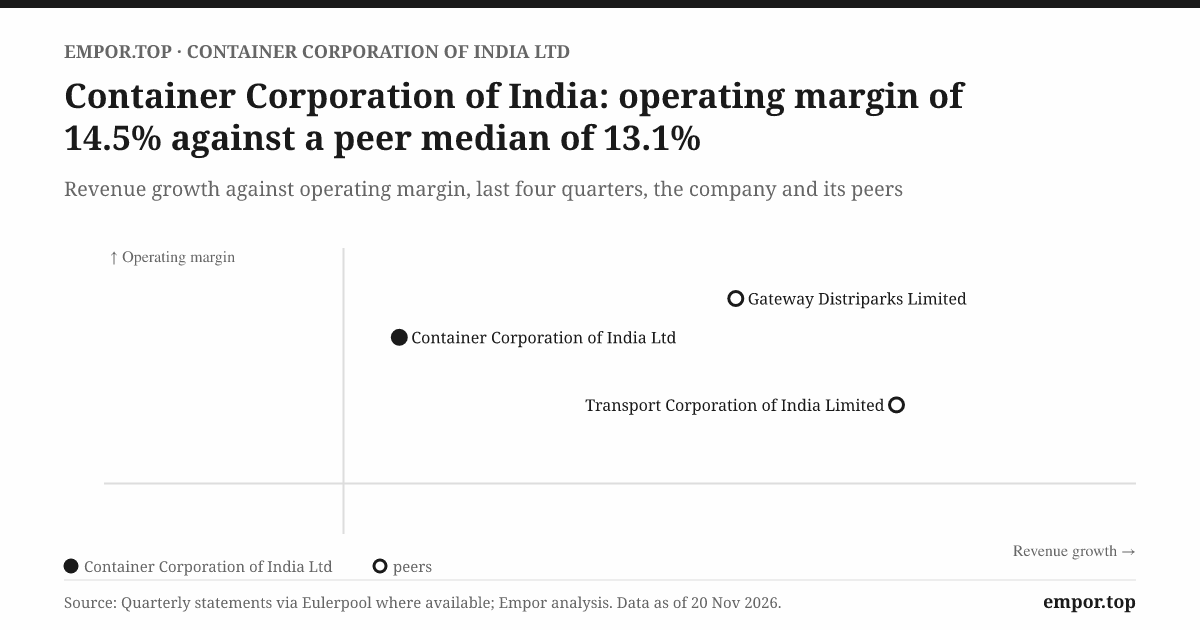
The business that runs on top of that arrangement is large and, by physical measures, growing. In the year to March 2026, CONCOR handled about 42.1 lakh twenty-foot equivalent units of international cargo, the standard measure of container traffic, and about 13.7 lakh of domestic cargo.2 Those are the biggest numbers in its history. But the financial picture moved the other way. Revenue grew just 2.2% that year, and net profit fell 3.6%.2 Measured operating margin dropped to about 14.7%, from roughly 25% a year earlier, a decline that partly reflects how land and other costs are classified but points unmistakably in the wrong direction.2 Return on capital employed fell from about 17% to about 10%.2
And the slice of the market that CONCOR used to own outright has been shrinking. ICRA, the rating agency, estimated CONCOR's share of India's rail-container traffic at 56–58% in FY2024, down from about 74% in FY2019–20.3 In five years, roughly one in every six rail containers that once would have moved on a CONCOR train moved with someone else.
Put those facts side by side and three questions emerge that will steer the rest of this story. The first is whether CONCOR can regain growth while private operators and trucks take share. The second is how much the unsettled railway terms, on land and haulage, will ultimately cost. The third is whether the company's capital spending and its new, lower prices will deliver better returns or simply a larger asset base earning less.
The bull case, at its simplest, says CONCOR owns the best-located inland terminal network in the country, has nearly no debt, holds thousands of crores of liquid assets, and stands to benefit as India pushes more freight onto rail and onto the new dedicated freight corridors. The bear case says those same terminals sit on land whose price is being reset, that the railway's own tariffs eat most of the revenue, and that the market-share chart has been sliding for years regardless of how much CONCOR invests.
Both cases agree on one thing: the network is valuable. They disagree about who captures the value. To understand why, the story has to go back to how CONCOR came to build its network on the railway in the first place, and to the day the railway let other people in.
 Subscribe on LinkedIn
II. The Advantage Built on Indian Railways
CONCOR was born inside the railway. It was incorporated in 1988 as a company under the Ministry of Railways, and it took over the inland container depots that Indian Railways had been running, with a mandate to develop multimodal logistics around the national rail system.[^5] At the time, containers were still a young idea in India. Ports at Mumbai and Chennai handled the boxes, but most of the country's manufacturing and consumption sat hundreds of kilometres inland. Someone had to build the dry ports, the places where a container could be stuffed with cotton yarn in Ludhiana or unloaded with machinery in Bengaluru, cleared by customs, and then sent by train to the coast.
For roughly two decades, that someone was only CONCOR. It built its depots on railway land, beside railway sidings, linked to railway timetables. The geography it assembled during those years is the asset the company still talks about: terminals at the points where freight naturally gathers, often on parcels a newcomer could not easily replicate because the surrounding cities have since grown up around them.
It helps to see the business as three jobs joined together. CONCOR describes itself as a carrier, a terminal operator and a warehouse operator.[^5] As a carrier, it books trains on the Indian Railways network and runs container rakes between ports and inland points, charging the customer for the haul. As a terminal operator, it owns and runs the inland container depots and container freight stations where boxes are lifted, stored, examined and cleared. As a warehouse operator, it stores cargo before or after the journey. An exporter in the National Capital Region might truck goods to a CONCOR depot, have them stuffed and cleared there, ship them by CONCOR train to Mundra or Nhava Sheva, and hand the box to a shipping line. CONCOR earns at several points along that chain, and its domestic tariff schedule shows how much of the pricing is per container and per service: handling, storage, haulage legs and ancillary charges.[^7]
The analogy that fits best is an airline that also owns some airports but has to rent the runways, the sky and the fuel supply from the government. CONCOR owns its containers, many of its wagons, its cranes and handling equipment, and its terminal buildings. It does not own the track. It pays Indian Railways haulage charges to move its trains, and haulage is the largest single element of its cost base.3 Related-party purchases, dominated by the railway, made up 83.63% of everything CONCOR bought in FY2026.2 The company's customers, meanwhile, are shipping lines, importers and exporters, customs agents, freight forwarders and corporate shippers.2
The day the railway let others in
In 2006, the Ministry of Railways opened container train operations to private companies.5 The policy let licensed operators run their own container trains on the national network, paying the railway for haulage just as CONCOR did. More than fifteen private operators entered over the following years, including port and logistics groups with their own terminals and their own customer relationships.5 Overnight, CONCOR's monopoly became a head start.
For a while the head start looked decisive. CONCOR had the terminals, the timetables and the relationships with shipping lines, and its market share stayed high. But a rail-container business has a simple vulnerability: the track is shared. A private operator buying train paths from the same railway, at the same published haulage rates, can match CONCOR on the main leg. Where it cannot match CONCOR is at the terminals, and so competitors set about building their own, often linked to ports they controlled.
The second competitor never needed a licence. Trucks win in India on flexibility. A truck leaves when the cargo is ready, goes door to door, and needs no transfer at either end. Rail wins only when volumes are large enough to fill a train, distances long enough to amortise the cost of lifting the box on and off, connections reliable, and tariffs competitive. Every extra handling charge at a terminal, every surcharge on a commodity, every delay in a rake arriving, nudges a shipper back towards the highway.
This is the context for the market-share decline that ICRA has tracked. From roughly 74% in FY2019–20, CONCOR's share of rail-container traffic fell to 56–58% by FY2024.3 ICRA listed lost share to private train operators and to road carriers among the company's main constraints, alongside its dependence on export-import cargo and its sensitivity to railway haulage charges.3 Part of that is structural: as private operators matured, they were always going to take some business. Part of it is the reality that CONCOR's advantage was never a legal barrier once 2006 passed. It was geography and experience.
That distinction matters for investors, so it is worth stating plainly. CONCOR controls its terminal locations, its fleet, its operating know-how and its customer service. It does not control the haulage tariff, the train-path priority on the network, or the terms on which it occupies railway land. Those are set by its landlord. A moat built from things the company owns can be defended by investment; a moat built from things a counterparty owns can be repriced by that counterparty.
There is also a question CONCOR leaves unanswered in its own disclosures. The company does not publish contract lengths, minimum volume commitments or the share of revenue that recurs under long-term agreements.2 It describes its customer base but does not name its largest customers or their share of revenue.2 So a reader cannot tell how much of the throughput is locked in and how much is won container by container. Access to a strategically placed terminal makes CONCOR a natural choice for many shippers; it does not, on the evidence published, prove that those shippers are bound to stay.
The 2006 decision, then, is where the modern CONCOR story really begins. It turned a state monopoly into a company that has to compete for every box on a network it does not own. The next question is how it has fared in that contest, and the answer depends on whether one looks at the volumes or at the share.
III. A Bigger Network, a Smaller Share
The most flattering chart in CONCOR's annual report is a ten-year series of containers handled. In FY2016–17, the company handled about 26.4 lakh TEUs of international cargo and about 4.6 lakh TEUs of domestic cargo.2 By FY2025–26, international handling had reached 42.1 lakh and domestic 13.7 lakh.2 International volumes grew by roughly 60% over the decade; domestic volumes nearly tripled. On those numbers alone, CONCOR looks like a company riding a great Indian logistics boom.
Now lay the other chart over it. Over roughly the second half of that same decade, CONCOR's share of rail-container traffic fell by around sixteen to eighteen percentage points.3 Both statements are true at the same time, and the reconciliation is simple: India's containerised trade grew fast enough that CONCOR could move more boxes every year while its competitors moved even more. Rising volumes, in other words, are evidence that the market grew. They are not, on their own, evidence that CONCOR is winning it.
That is why the right test for this company is not the handling chart but three lines read together: volume growth, margin, and a consistent market-share series. When all three rise, the network is gaining. When volumes rise but share and margins fall, the company is growing with the tide and paying for it.
Why export-import cargo dominates
About three quarters of CONCOR's volume is export-import cargo.3 The reason is the shape of Indian trade. Factories and consumers are spread across the interior; the big container ports sit on the western and eastern coasts. Imported machinery, electronics and chemicals need to travel inland; exported textiles, auto parts and engineered goods need to travel to the coast. Rail is efficient for that long, steady port-to-hinterland flow, and CONCOR's network of inland depots was built for exactly that purpose.
The dependence cuts both ways. When global trade grows and the ports are busy, CONCOR fills its trains. When shipping lanes are disrupted, freight rates spike, or a geopolitical shock slows trade, the EXIM business feels it immediately. ICRA explicitly identified that concentration as a constraint on the company's rating.3 The company's direct currency exposure is small, with no foreign-exchange earnings reported in FY2026 and minimal foreign-exchange outgo, but its indirect exposure to world trade is very large.2
There is a further subtlety in the EXIM business. Much of the competition there comes from operators linked to ports. A port operator that also runs container trains and inland terminals can offer a shipping line or a large exporter an integrated bundle: berth, train and depot under one contract. CONCOR's answer is its unmatched spread of inland locations, but where a rival controls the coastal end of the journey, that rival has a natural advantage in capturing the rail leg.
Domestic cargo: a different contest
Domestic cargo is the other half of the story and, in management's telling, the bigger opportunity. Here the competitor is not only another container operator but other ways of moving freight altogether. Food grains, tiles, cement, fertiliser and other bulk-ish goods can move in conventional railway wagons, in containers, or by truck. The contest is about which mode gives the shipper the lowest all-in cost with acceptable reliability. Containers offer cleaner handling, fewer losses and door-to-door flexibility when paired with a truck at each end. Conventional wagons are often cheaper for full trainloads of a single commodity. Trucks are fastest and simplest for shorter distances.
That is why domestic growth for CONCOR is less about the state of global trade and more about price and service design. CONCOR's domestic policy lays out per-TEU charges for different services, and changing those charges is one of the main levers the company has to win or lose a traffic stream.[^7] The near-tripling of domestic handling over the decade shows the lever can work. Whether it works profitably is a separate question.
The latest numbers from the call
On its earnings call for the September 2026 quarter, management gave the operating detail. For the first half of FY2027, EXIM throughput grew 4.57%, domestic throughput grew 4.22%, and overall throughput grew 4.48% year over year.4 Management described the quarter as a record for handling.4 Those are respectable growth rates in a difficult geopolitical year, but they are not the double-digit figures of a company retaking lost ground. They are roughly in line with the pace at which the decade-long series grew, which suggests CONCOR is holding its absolute position rather than visibly reclaiming share.
Management also walked through the operating initiatives behind those numbers.4 It described longer leads, meaning trains that carry boxes over greater distances, which spread the fixed cost of lifting each container across more kilometres of revenue. It pointed to double-stack trains, in which containers are stacked two high on special wagons, roughly doubling what a single train path can carry where clearances allow. It spoke of new routes, refrigerated container services for perishables, and the movement of bulk cement in tank containers, a way of pulling a commodity that usually travels in dedicated wagons or trucks into CONCOR's box-based system.4
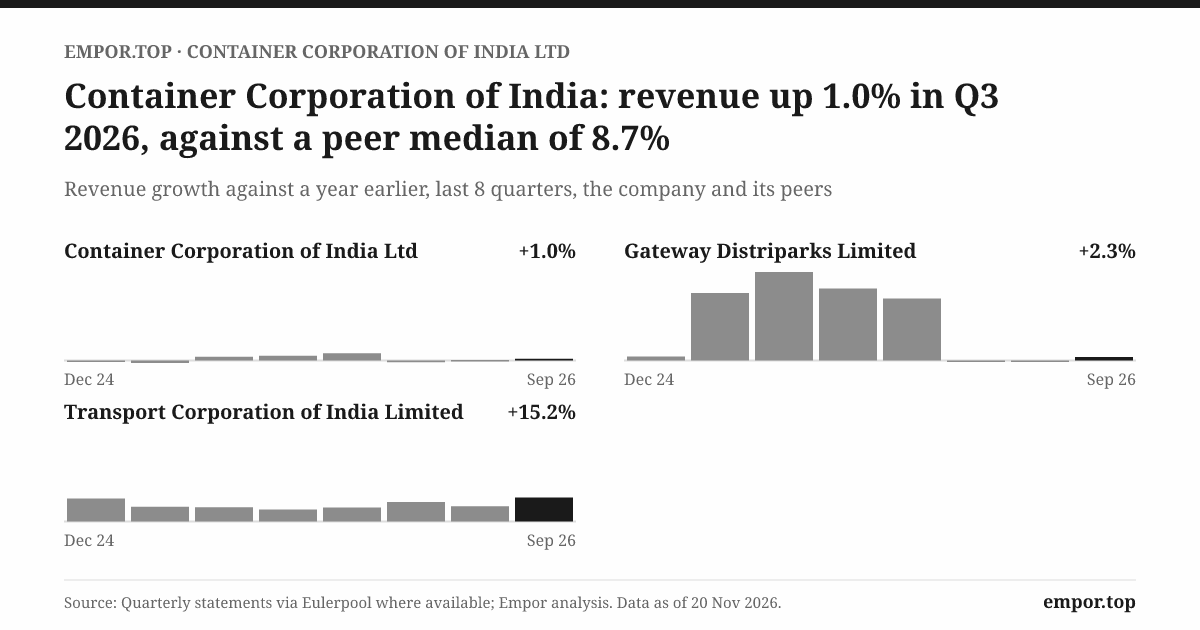
Each of those initiatives makes operating sense. Longer leads improve the economics of rail against road. Double-stacking improves asset productivity. Reefers and cement tanks open new traffic streams. But initiatives are inputs. The economic payoff should show up as revenue growing faster than volume, margins stabilising, and share rising. In the first half of FY2027, throughput grew about 4.5% while quarterly revenue grew only about 1%.14 That gap is the most important clue in the latest results. It means that, on average, CONCOR was earning less per container handled than a year earlier, whether because of shorter leads in some flows, a mix shift, or the price reductions management would explain later on the same call.
There is one more evidence gap that an investor should keep in plain sight. The most recent rail-container market-share figure in the public record for CONCOR is ICRA's FY2024 estimate.3 The company's own reports give handling volumes but not a current, like-for-like market-share series. So the question "is CONCOR regaining share?" cannot yet be answered with a number, and the company has not chosen to publish one. Until it does, the honest reading of the handling records is the narrow one: CONCOR is growing with Indian container trade, at a modest pace, and the evidence that it is outgrowing its rivals is absent.
If volumes alone were enough, the story would end here. They are not, because CONCOR decided in 2026 to make price its growth lever, and that decision put the volume-versus-margin trade-off squarely on the table.
IV. When Lower Tariffs Became the Growth Bet
The conference call on the September 2026 results was Ajit Kumar Panda's first as chairman and managing director, and analysts wasted little time getting to the uncomfortable part. CONCOR had cut prices. How much, they wanted to know, and what would that do to realisations and profit?
Panda's answer was specific about the places and the reasoning. CONCOR had reduced rates at Dadri and Tughlakabad, two of its most important terminals in the National Capital Region, in order to bring traffic back from road and encourage a shift in mode towards rail.4 Some of the reductions, he said, ranged from 10% to 20%.4 That is not a marketing discount. For a business whose largest cost is a haulage fee it does not control, a 10–20% price cut at a major terminal is a deliberate bet that volume will come back fast enough to cover the lost rupees per box.
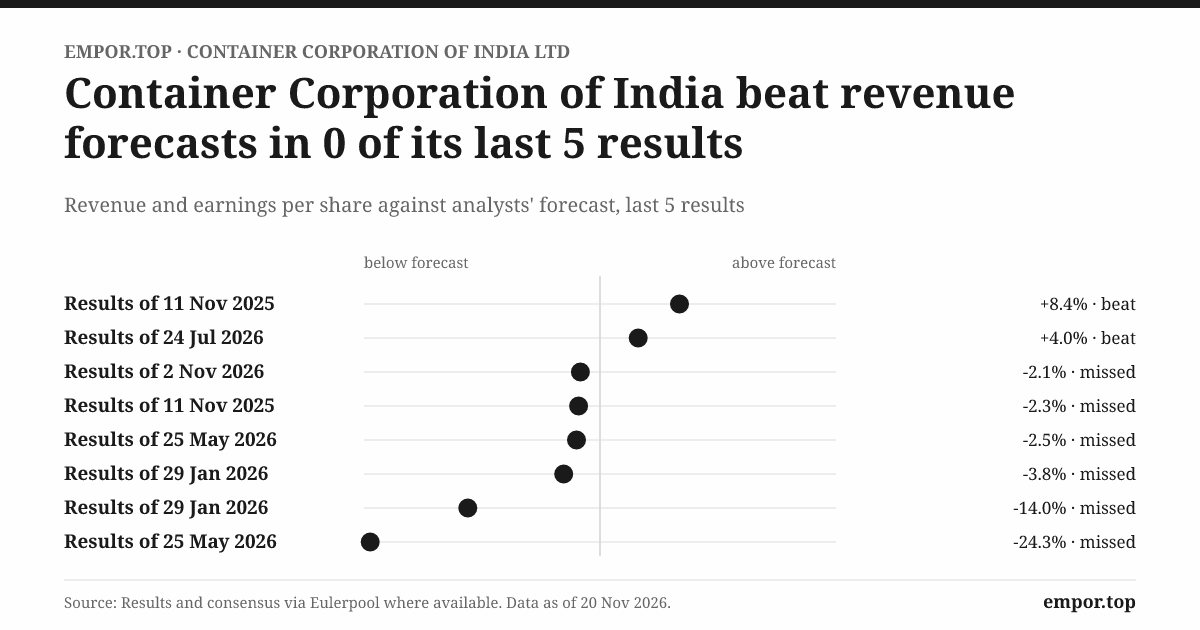
The numbers in the quarter frame the bet. Consolidated revenue in the September 2026 quarter grew only about 1% from a year earlier, while net profit fell about 7%.1 Handling hit a record and throughput grew, yet the revenue line barely moved and earnings went backwards. That is what a price-for-volume trade looks like in its first innings: the price cut shows up immediately, the volume response takes time.
How the traffic slipped away
What made the call more useful than most was that Panda explained the mechanism behind the lost traffic, rather than simply blaming the economy. In one case, food-grain traffic had shifted to conventional railway wagons after a surcharge made container transport less attractive.4 That is a remarkable admission when read carefully. The competitor in that case was the railway itself, offering a different product on the same tracks. A surcharge changed the relative price of a container versus a wagon, and shippers did what shippers do: they moved to the cheaper option.
In the Delhi region, Panda described a different leak. Cargo had been moving by truck when terminal costs were passed on to customers.4 In other words, as the all-in cost of using a CONCOR terminal rose, the economics of trucking the goods directly to or from the port improved, and some customers stopped using rail at all. Delhi is a particularly exposed market because the distance to the western ports is long enough to favour rail in theory but short enough for trucks to compete hard on time and flexibility.
Put those two cases together and a pattern emerges. Costs that sit outside CONCOR's control, a surcharge set within the railway system and terminal costs that rose with land and handling charges, pushed customers away. CONCOR responded with the lever it does control, its own tariff. That is a rational response. It is also an expensive one, because the cut comes out of CONCOR's margin, not out of the costs that caused the problem.
What management would and would not promise
Analysts then asked about domestic growth for the full year. Earlier in the year, CONCOR had expressed expectations for domestic volumes; now they wanted a revised figure. Panda declined to give one.4 He said the geopolitical situation was still evolving and that changing guidance frequently would undermine the company's credibility.4
That answer deserves a fair reading. A new chief executive who refuses to replace one number with another until he has better information is, in one sense, displaying discipline. Guidance that moves every quarter is worth little. Yet the same call ended with management expressing confidence in a "robust performance" ahead.4 Declining to quantify while promising robustness leaves investors with a mood rather than a measure. The credibility Panda says he wants to protect will be earned in exactly the place he declined to commit: the next few quarters of domestic volume, revenue and margin.
Analysts also pressed on the dedicated freight corridors, the new freight-only rail lines on the western and eastern routes that are meant to make container trains faster and more reliable. They asked how quickly the benefits of those corridors were being implemented for CONCOR's traffic.4 The corridors are the most important structural tailwind in the bull case, because faster, more predictable transit narrows the gap between rail and road. But they are public infrastructure, open to every licensed operator. Whatever advantage they confer arrives for CONCOR's competitors too, so the corridors are better understood as a boost to rail's share of freight than as a boost to CONCOR's share of rail.
The arithmetic the bet must clear
Strip the call down and the tariff strategy reduces to one test. Each additional container won by a lower price must contribute enough, after paying the railway's haulage charge and its share of land and terminal costs, to more than offset the lower price now charged on every container that would have come anyway. If CONCOR cuts rates by 15% on a stream of traffic and wins back 15% more boxes, it has not broken even, because the haulage on the new boxes is a real cost. It needs considerably more than that, or it needs the new traffic to ride on longer leads and fuller double-stack trains where its unit costs fall.
CONCOR has not disclosed how much incremental traffic the Dadri and Tughlakabad cuts have secured, nor the contribution per added TEU.4 That is the operating question the next several results must answer. Pricing, in this case, is a concrete response to traffic that had been lost or diverted; it is not proof that CONCOR has regained pricing power. If anything, it is evidence of the opposite: in its own home market around Delhi, the company found that its prices were too high to hold traffic against trucks and wagons.
And the biggest cost pressure on those prices is the one with no final number. Behind the rising terminal costs that Panda said were driving Delhi cargo onto trucks sat the question of what CONCOR must pay the railway for the land under the terminals.
V. The Land Fee That Still Has No Final Number
Two documents, published two months apart, tell the same unfinished story. The first is the auditor's report in CONCOR's FY2026 annual report, published in September 2026. The auditor gave a clean opinion but drew attention to several matters, among them the charges for railway land.2 The second is the results note for the September 2026 half year, published in November. It repeated the essential point: CONCOR's land arrangements with Indian Railways are being revised under a new policy, the company has received demands it disputes, revised agreements have not been signed, and so the final terms and cash flows cannot yet be determined.12
Under accounting standards, a company that occupies land under a long-term arrangement normally recognises two things on its balance sheet: a right-of-use asset, representing the land it gets to use, and a lease liability, representing the payments it is committed to make. CONCOR has done that for leases whose terms are known; its cash-flow statement shows ₹177.18 crore of lease-liability principal repaid in FY2026.2 But for railway land, it has recognised neither, because, it says, it cannot reliably measure what it has agreed to pay.1 Instead, it books the licence fee as an expense each period using its own assessment of what the policy requires. For the first half of FY2027 that came to ₹216.65 crore.1
What changed in the policy
The background is a shift in how the railway charges for its land. Historically, CONCOR occupied railway land on terms negotiated within the railway family. The newer railway land policy sets the licence fee by reference to the land's market value, with escalation over time.2 For terminals in cities such as Delhi, where land values have soared over three decades, a market-linked fee can be far higher than whatever CONCOR used to pay. CONCOR has disputed the demand letters it received, and the revised agreements remain unsigned.2
Land policy has been a contested subject for years. When the government was preparing to privatise CONCOR, private container operators raised concerns about a planned sale of railway land to the company, arguing that favourable terms would entrench CONCOR's advantage at their expense.6 That episode is a reminder that land is not just a cost for CONCOR; it is a competitive variable, watched closely by rivals who would object to any arrangement that looked too generous.
Why this is not just accounting
It is tempting to treat this as an accounting quirk. It is not. Railway land supports the strategically located terminals that are CONCOR's chief competitive asset. If the final fee is high, CONCOR faces three unappealing options. It can absorb the cost and accept lower margins. It can pass it on to customers through terminal charges, which, as the Delhi experience showed, pushes some of them onto trucks. Or it can rationalise its footprint, giving up locations that no longer earn their keep, which shrinks the network that is supposed to be the moat. In each case, the value of the terminal network depends on a price CONCOR does not set.
The scale makes the point. Annualise the half-year booking and the land fee approaches ₹430 crore, or roughly a quarter of FY2026 profit before tax.12 And because the figure rests on CONCOR's own non-final assessment, the true number could be higher if the railway's demand prevails, or lower if CONCOR's interpretation is accepted.
The relationship with the railway gives this context, without resolving it. Related-party purchases, overwhelmingly from the railway system, were 83.63% of CONCOR's total purchases in FY2026, compared with 84.87% a year earlier.2 The annual report says these transactions are in the ordinary course of business and at arm's length, approved under omnibus arrangements by the audit committee.2 That is plausible for haulage, which is charged at published tariffs available to every operator. But concentration of that degree means CONCOR's cost base is largely set by a single counterparty, and the arm's-length description does not answer the land question. A dispute over demand letters is, by definition, a disagreement about what the arm's-length terms are.
Treasury income and the operating picture
There is a second figure that sits next to the land fee in any honest reading of CONCOR's profit. In FY2026, the company earned ₹373.77 crore of other income, down from ₹465.16 crore in FY2025, against profit before tax of ₹1,623.34 crore.2 Much of that other income is interest on the company's substantial treasury holdings: at March 2026 it held about ₹610 crore of cash and cash equivalents and about ₹2,754 crore of other bank balances, and its cash-flow statement shows ₹344 crore of interest received.2
The comparison is revealing. The half-year land-fee booking is in the same order of magnitude as a full year of other income. Put differently, roughly a fifth to a quarter of CONCOR's pre-tax profit comes from money sitting in banks, and a similar slice is being consumed by a land fee whose final level is uncertain. Neither has anything to do with how well CONCOR runs a train. Investors trying to judge whether the core operating business is recovering need to strip out both: the treasury income that flatters profit, and the land fee that may yet rise or fall.
The distinctions deserve to be kept clean. CONCOR's ordinary borrowings are low; the company's debt-to-equity ratio was about 0.07 at March 2026, and ICRA described its debt position as essentially nil and its capital spending as funded from internal cash.23 Lease liabilities do exist for recognised leases. But the disputed railway-land arrangement is not in that lease figure, so CONCOR's reported debt does not capture the full uncertainty of its occupancy costs. A long-term land commitment that may run for decades, at a market-linked fee, has some of the economic character of debt even when the accounts cannot yet measure it.
Two events will settle the question: signed final agreements with the railway, and an audited estimate of the resulting annual fee and any lease liability. Until then, every valuation of CONCOR's network carries an unpriced bill. And that matters all the more because CONCOR is in the middle of spending heavily to expand the network that sits on this land.
VI. The Network Needs Capital—and Must Earn It
Walk through a CONCOR terminal and the money is visible. Reach stackers lift boxes on and off rakes; gantry cranes span the tracks; new wagons wait in sidings; IT systems track each container from the gate to the train. In FY2026, CONCOR spent about ₹1,085 crore on that kind of equipment and infrastructure: terminals, wagons, handling equipment and information technology.2 That is roughly 12% of its operating revenue, a meaningful reinvestment rate for a company whose revenue grew just 2.2% that year.2
It also spent ₹146.93 crore on research and development, almost double the ₹76.73 crore of the year before, mainly for developing indigenous container manufacturing.2 The idea is straightforward. Containers have mostly been manufactured abroad, especially in China, and supply disruptions in recent years showed how exposed Indian logistics could be to a shortage of boxes. Developing a domestic manufacturing capability could strengthen CONCOR's supply security and, possibly, open a new line of business. But expenditure and technical progress are not commercial returns. Until containers are produced at scale and at competitive cost, the R&D line is a cost with optionality, not evidence of a new profit stream.
Spending versus outcomes
Here the record has to be read without sentiment. Over the three years to FY2026, revenue grew about 3.4% a year and net profit about 1.9% a year.2 Over the ten years to FY2026, revenue grew about 3.8% a year and net profit about 2.5% a year.2 So recent growth is slightly below the company's own long-run base rate, not above it. The five-year figures look much stronger, with profit growing about 19.7% a year, but they start from a pandemic-depressed FY2021 and therefore flatter the trend.2
Returns tell the same story. Return on capital employed was 10.1% in FY2026, down from 16.8% in FY2025, and the trailing twelve-month figure to September 2026 was about 9.2%.21 Some of that drop reflects how land fees and other costs are now flowing through operating expenses rather than reflecting a collapse in the business; profit before tax, which captures everything, fell much less sharply than operating profit. But even on the broadest measure, return on equity has drifted from the low teens a decade ago to about 9–10%.2 For a business that has been investing around a thousand crore a year, that is the critical gap. Capacity is being added; returns on that capacity are not visibly rising.
Headcount gives a contrasting signal. The workforce fell from 1,474 in FY2016–17 to 1,238 in FY2025–26, while income per employee rose.2 This is not a business harvesting its assets; it is investing in equipment while running leaner on people. That should, in principle, create operating leverage if volumes accelerate. The problem is that volumes have grown only modestly, and the leverage has not yet appeared in margins.
Which business actually matters
CONCOR reports segments, and the segment data in the annual report shows where the economics sit. Container rail and terminal operations, EXIM and domestic, are the heart of the reported business; adjacent activities are small by comparison and should not be weighted alongside it.2 That focus is helpful for investors. It means the investment case rises or falls on container rail and terminals, not on side bets.
The company's capital deployment follows the same pattern. CONCOR's disclosed strategy is primarily organic: building terminals, buying wagons and equipment, and extending its network through subsidiaries and joint ventures with partners such as port operators and logistics firms.2 It is not an acquisition-led growth story, and no large purchase has reshaped the company. The joint ventures are best understood as operating extensions, ways to secure a foothold at a port or in a specialised service, and they should be judged by whether they feed traffic to the core network rather than as separate growth engines.
The depreciation line deserves a brief aside. In FY2026, CONCOR extended the estimated useful life of its LNG trucks and trailers from eight to fifteen years, which reduced depreciation by ₹8.07 crore.2 The amount is small, and useful-life judgments are routine. But it is a reminder that some of the reported profit stability rests on accounting estimates, and that the auditor took note of the change.2
What would prove the spending wrong
The investment case has a simple falsification test. If CONCOR continues to spend around ₹1,000 crore a year on terminals, wagons and equipment while volumes grow at mid-single digits, revenue grows more slowly than volumes, and return on capital stays near 10%, the network is expanding faster than its earning power. If, on the other hand, the new double-stack capacity, longer leads and terminal upgrades lift revenue per TEU and margins over the next two years, the spending will have created value.
So far, the evidence places the claim in the middle category: plausible, directed at the core, but unproven. That leaves the question of who is making these decisions, and how they are being held to account, because the leadership team that inherits this capital plan is almost entirely new.
VII. The New Team Inherits the Old Bargain
On the first of August 2026, Ajit Kumar Panda became chairman and managing director of CONCOR, succeeding Sanjay Swarup, who had led the company for years.2 A few months earlier, in April 2026, Vivek Gupta had become Director (Finance) and chief financial officer.2 By the time the September quarter's results were discussed on the November call, both of the company's top executive roles had changed hands within the same calendar year.
The cast on that call gives a sense of the current team. Panda led as CMD. Vijoy Kumar Singh spoke for international marketing and operations, the EXIM business that carries three quarters of the volume. Vivek Gupta took the finance questions as Director (Finance). Harish Chandra, Principal Executive Director (Finance) and company secretary, handled the formalities and part of the financial detail.4
Leadership turnover at a government company does not mean what it means at a founder-led business. CONCOR's executives are appointed through the Ministry of Railways, and their remuneration is determined by the Government of India.2 The annual report omits the ratio of director pay to median employee pay because CONCOR is a government company and is exempt from that disclosure.2 There are no large stock awards tying management's wealth to the share price, and no significant management shareholding. The government's 54.8% stake was unchanged through the year.210 The capital-allocation framework, including dividends and capital restructuring, follows government guidelines rather than board discretion alone.2
That structure has consequences an investor should weigh calmly. It removes one kind of risk: a management team chasing a high-priced acquisition to inflate its own bonus is unlikely here. It adds another: the incentives of the controlling shareholder include goals beyond minority-shareholder returns, such as moving freight onto rail, supporting national logistics policy, and collecting dividends for the exchequer. On the land question in particular, CONCOR's controlling shareholder sits on both sides of the negotiation.
Judging behaviour, not biography
Because the incentive structure is set from outside, the best evidence of management quality is behaviour. On Panda's first call, three behaviours stood out. He paired a record quarterly handling figure with an open acknowledgement of modest revenue growth, rather than letting the record speak for itself.4 He described the tariff cuts concretely, with locations and ranges, and explained the competitive mechanisms that had cost CONCOR traffic.4 And he declined to revise domestic guidance until he had more information, explicitly to avoid changing numbers too often.4
That is a reasonable start. It is also only a start. A new leader's first call sets the baseline against which every subsequent call will be measured. The test is whether the next calls show the price cuts producing measurable volume, whether margins stabilise, and whether misses are explained with the same operating specificity.
The governance record
The governance evidence matters to credibility, and some of it is uncomfortable. During part of FY2026, CONCOR's board lacked the required number of independent directors, including a woman independent director.2 Because board appointments are controlled by the Ministry of Railways, the company itself cannot simply fill those seats; it has to wait for the government to make the appointments.2 At the 38th annual general meeting in September 2026, every resolution passed, but two director appointments drew notable dissent: 13.08% against the appointment of one non-official part-time director and 15.49% against the appointment of a government director.8 With the government holding 54.8%, those dissent levels imply that a significant fraction of the non-government shareholders who voted opposed the appointments.
Ownership among minorities shifted too. Foreign portfolio investors held about 12.4% in September 2025 and about 8.1% in September 2026, while domestic institutions rose from about 25.8% to about 30.0%.10 The exchange filings show the category shifts, not the reasons, so the pattern supports only a modest inference: foreign institutions reduced their exposure over a year in which earnings fell and the share price drifted toward its 52-week low, and domestic funds absorbed the supply.10
One capital event needs placing properly. In 2025, shareholders approved a 1:4 bonus issue, one new share for every four held, with dissent of only 2.43%.9 A bonus issue changes the share count and the per-share figures, but it brings in no cash and funds no investment. It is a reshuffling of the equity, not a growth driver.
Then there is privatisation. The government had announced its intention to sell a 30.8% stake with management control; ICRA noted in October 2025 that the proposal had made little progress, and Business Standard had reported in July 2024 that the government had put the privatisation on the back burner.37 For now, the controlling shareholder is staying, and the land question is one reason the sale was always complicated: a buyer would want certainty over the terms of the terminals, and that certainty still does not exist.
The new team, then, inherits the old bargain: a valuable network, a controlling shareholder who is also the landlord and the supplier, and a capital plan that must earn more than it has. Whether the team can deliver will show up first in the cash, which has a better long-term record than the earnings line suggests, and a more complicated one up close.
VIII. The Cash Is Real; Its Timing Is Uneven
If there is one thing the sceptics have to concede about CONCOR, it is that the profits have mostly turned into cash. Over the twelve years from FY2015 to FY2026, the company reported about ₹12,069 crore of net profit and generated about ₹14,810 crore of operating cash flow, or 123% of profit.2 That is what a business with substantial depreciation and modest working capital should look like: cash from operations running ahead of accounting earnings because the depreciation charge is a non-cash expense.
The cumulative figure hides an uneven path, though, and the unevenness is part of the story. In two of those twelve years, FY2016 and FY2019, operating cash flow was negative.2 In FY2020, it was unusually high.2 Those swings were driven largely by the timing of working-capital flows, including balances with the railway. A twelve-year total can make the picture look smoother than any individual year was. The right conclusion is that CONCOR converts profit into cash over time, not that it does so cleanly every year.
Where the cash went
The more pointed observation concerns how that cash was used. Over the same twelve years, free cash flow, meaning operating cash minus capital expenditure, totalled about ₹4,391 crore, while dividends paid came to about ₹5,708 crore.2 Dividends were about 130% of free cash flow. In other words, CONCOR paid out more to shareholders than it generated after investment, and it could do so because it started the period with a large cash pile and earned interest on it. Cash and short-term investments rose by only about ₹743 crore over the period, from about ₹2,698 crore at the end of FY2014 to about ₹3,441 crore at the end of FY2026.2
That pattern has an obvious source. The Government of India, as majority owner, expects public-sector companies to pay meaningful dividends, and CONCOR's payout ratio has typically sat around half of profit, with a peak of 140% in FY2020 and 56% in FY2026.2 The balance sheet, then, combines three uses of cash in tension with each other: steady distributions to the government and minorities, a reinvestment programme of around a thousand crore a year, and a large liquid portfolio kept as a cushion. The cushion has not grown much in a decade, because the other two have absorbed most of what the business produced.
The receivables question
Receivables are the other place where the cash picture needs scrutiny. Trade receivables were ₹479.73 crore at March 2026, up from ₹394.36 crore a year earlier.2 Debtor days, a measure of how long customers take to pay, were about 20 in FY2026, much better than the peak of 39 in FY2020 but well above the single digits of a decade ago.2
Within those receivables sits a stubborn tail. The auditor highlighted ₹29.34 crore of balances outstanding for more than three years.2 Only ₹4.82 crore of that was provided for; the remaining ₹24.52 crore was unprovided, including ₹6.52 crore under litigation.2 These are small numbers relative to CONCOR's revenue. But money owed for more than three years without a full provision is the kind of item that tends to become a write-off eventually, and the auditor chose to draw attention to it.
The auditor also noted that some debtor, creditor and advance balances were unconfirmed or unreconciled, including balances with the railway, and that some had been outstanding for more than three years.2 It is important not to conflate the two observations. The aged receivables are owed by customers of various kinds; the unreconciled balances include railway accounts but are a separate issue. Together, they say that CONCOR's working capital contains old items that have not been fully settled, some of them with its most important counterparty. Reconciling them would make the cash record cleaner and remove a recurring audit observation.
Putting treasury in its place
Finally, the treasury. Interest received was ₹344 crore in FY2026 and other income ₹373.77 crore.2 That income is real and material, and it gives CONCOR resilience. But interest earned on bank deposits says nothing about whether terminals and trains are earning more. An investor who adds treasury income to operating profit and calls the total "the business" is blending a logistics company with a bond fund. The question that matters for the long-term case is whether the operating business, without the deposits, is recovering its returns.
The cash record, then, earns CONCOR genuine credit: profits have become cash over the long run, and the balance sheet is strong. It also carries a qualification: the cash has been distributed slightly faster than the business generates it after investment, and some old balances remain unresolved. That strength is what a credit rating agency sees first, and it is the natural bridge to the question of how the market values the whole package.
IX. A Strong Rating, a Modest Growth Record
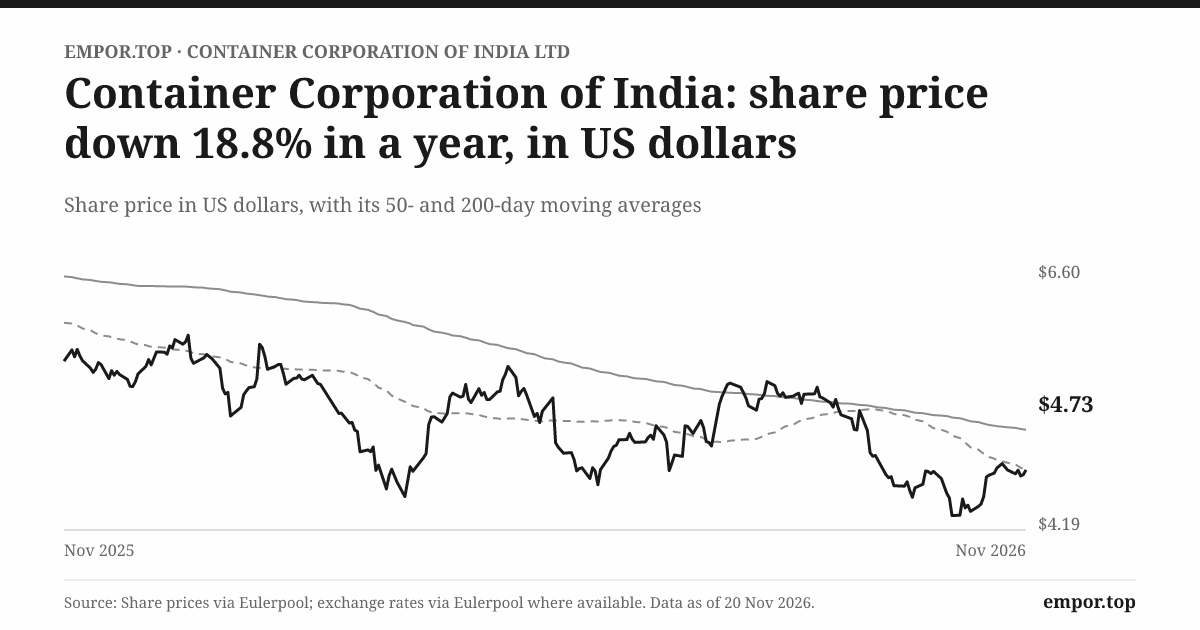
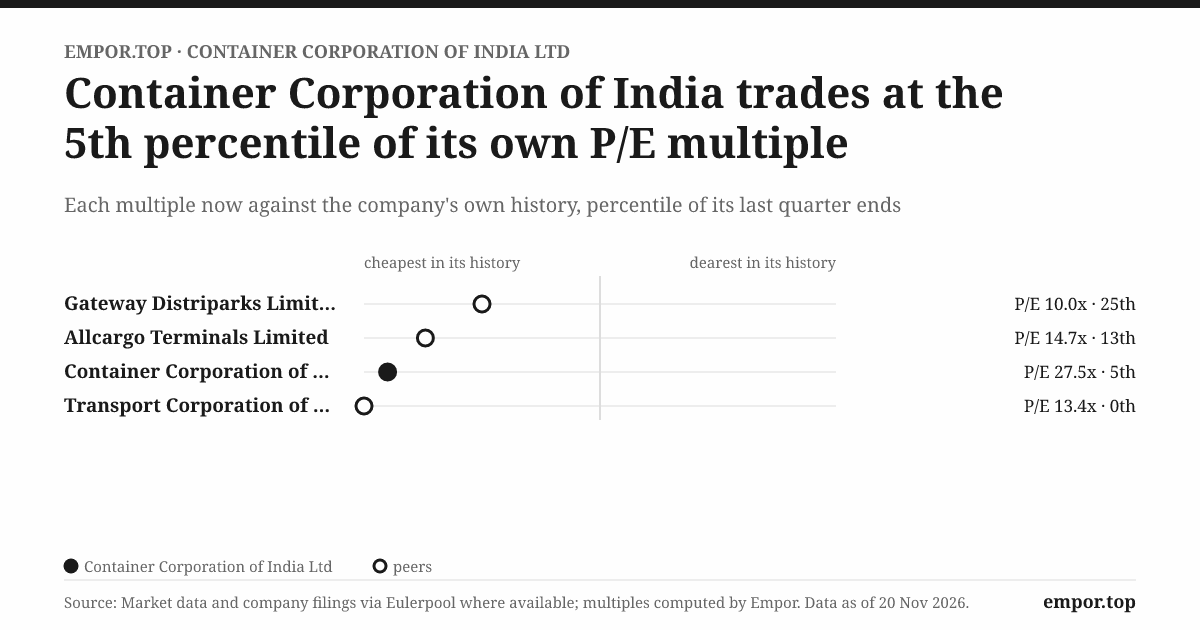
On the twenty-third of November 2026, ICRA reaffirmed its AAA (Stable) rating on CONCOR's long-term non-fund-based limits and its issuer rating.[^13] AAA is the highest grade ICRA awards. It says that CONCOR's ability to meet its financial obligations is about as secure as an Indian corporate's can be. Three days earlier, on the twentieth, the stock had closed at about ₹438, roughly 18% below its 52-week high, valuing the company at about ₹34,159 crore. At that price, CONCOR traded at about 27.5 times trailing earnings, an earnings yield of roughly 3.6%, and a free-cash-flow yield of only about 0.7%.12
Those two facts, the top-tier rating and the modest yields, describe two different questions. The rating answers whether CONCOR will survive and pay its bills. The valuation answers what investors expect it to earn. The first is easy; the second is where the debate lies.
ICRA's reasons for the rating are worth listing in prose, because they are exactly the strengths the bull case relies on. The agency cited CONCOR's extensive network of terminals, its position as the market leader, its strong cash generation and liquidity, and its sovereign ownership.3 It also named the constraints: lost share to private train operators and road carriers, dependence on export-import cargo, sensitivity to railway haulage charges, and the possibility of government divestment.3 A credit rating is built to measure the risk of default, and on that measure CONCOR's cash pile and its owner make it nearly bulletproof. A rating says nothing about whether the company can grow its margins or defend its market share, and ICRA's own list of constraints reads like a summary of the equity bear case.
How the market prices the network
Start with the valuation against CONCOR's own history. The current multiple of about 27.5 times earnings is well below the stock's five-year median of about 36.3 times.2 On that comparison, the market has already marked down its expectations. But a lower multiple is not the same as a cheap one. Earnings have grown about 2% a year over three years, and the price-to-earnings-to-growth ratio, which divides the multiple by the earnings growth rate, comes out above 14, a level that implies investors are paying for growth that has not yet appeared.2 A free-cash-flow yield below 1% means that, at today's price, the business generates very little cash for each rupee of market value after funding its investment. Investors are underwriting a recovery in returns, not paying for the returns CONCOR currently earns.
Peers offer only directional guidance. India's listed logistics companies have very different businesses. On the exchange's comparison page, CONCOR's multiple was about 27.6 times, against about 155 times for Delhivery, about 31 times for Blue Dart and about 14 times for TCI.11 Those figures were captured on a different date from CONCOR's 20 November price, and the companies' earnings bases differ greatly, especially Delhivery, whose profits are still small relative to its scale. The comparison says only that CONCOR sits in the middle of a wide range, priced neither as a high-growth platform nor as a slow-moving freight operator.
The five forces, applied to a railway tenant
Michael Porter's framework of five competitive forces is unusually revealing here, because one force dominates the others. Supplier power is overwhelming. Indian Railways supplies the track, the train paths, the haulage at its own tariffs, and the land under most of CONCOR's terminals. Related-party purchases, dominated by the railway, make up more than four fifths of CONCOR's spending.2 When the railway raises haulage, imposes a surcharge, or resets the land fee, CONCOR has little choice but to absorb the cost or pass it on. That single supplier, which is also the controlling shareholder, holds the strongest hand in CONCOR's economics.
Buyer power is moderate and rising. CONCOR does not disclose customer concentration, but its customers include large shipping lines and freight forwarders who can, and do, choose between operators.2 The Delhi traffic that moved to trucks and the food grain that moved to conventional wagons are direct evidence that customers have alternatives and use them when prices move against them.4
The threat of substitutes is real: trucks offer door-to-door flexibility on medium distances, and conventional wagons compete for bulk commodities. Rivalry among existing competitors has intensified since the 2006 opening, with more than fifteen private operators running container trains and several building their own terminals.5 The threat of new entrants is moderated by the cost and difficulty of assembling a terminal network on well-located land, which is the main barrier CONCOR can claim. But entry has already happened at scale, and the market share figures show its effect.
Put together, the five forces describe an industry in which the most powerful player is not CONCOR but its landlord, and in which customers have enough choice to discipline prices. That is not a recipe for expanding margins.
The seven powers, tested
Hamilton Helmer's seven powers framework asks a sharper question: what lets a company earn persistently higher returns than its rivals? Two of the seven powers are plausible candidates for CONCOR.
The first is scale economies. CONCOR runs the largest network of inland container terminals and the largest container rail operation in India.[^5] In principle, scale lets it fill trains more fully, spread terminal overheads over more boxes, and offer more destinations than any rival. The test of scale economies is whether they protect margins and share against smaller competitors. Here the evidence is unkind. Share fell from about 74% to 56–58% in five years even as CONCOR remained by far the largest operator.3 Scale has kept CONCOR the leader; it has not prevented the erosion.
The second is a cornered resource: the strategically located terminals on railway land. These are genuinely hard to replicate, because the land around many of them has been built up over the decades. But a cornered resource confers power only if the company controls its terms. CONCOR does not own most of that land. It licenses it from the railway, at a fee that is being reset towards market value.12 A resource that the owner can reprice is not fully cornered; it is rented. The railway, not CONCOR, captures a growing share of its value.
The other powers find little support. Switching costs would require evidence of long contracts or high costs for customers who move, and CONCOR does not disclose contract terms; the traffic shifts described on the latest call suggest switching is easy.4 Network economies, where each additional user makes the service more valuable for others, apply weakly to a freight network, where more customers mean fuller trains but not a qualitatively better product for each shipper. Brand, counter-positioning and process power are not evidenced by the record. The honest verdict is that CONCOR has a real but narrowing scale advantage and a valuable but rented set of locations. That is a defensible business, not a widening moat.
Bull and bear, weighed
The bull case rests on four pillars. CONCOR has the best-located terminals in the country, three decades of operating experience, a strong long-run cash record, and room for operating leverage if volumes accelerate, especially as the dedicated freight corridors make rail faster and more reliable. The balance sheet means CONCOR can invest through a downturn and wait out the land negotiation without financial strain.
The bear case is equally concrete. Market share has fallen sharply. Three quarters of volume depends on global trade. More than four fifths of purchases go to one counterparty that also sets land and haulage terms. The land fee is unresolved and already material. Recent revenue and profit growth have been modest, returns on capital have fallen to around 10%, and the latest quarter showed revenue barely growing while the company cut prices.
Weighing them, the history narrows the bull case without rejecting it. CONCOR's network advantages are real, but they have proven insufficient to defend share, and the company's economics are increasingly shaped by terms it does not control. The bull case survives as a smaller claim: that CONCOR can grow with Indian container trade and modestly improve returns if the tariff cuts and new capacity convert into volume. The confirming evidence would be rising revenue per TEU alongside rising volumes and a stable or rising market-share figure. The falsifying evidence would be another year of volume growth with flat revenue and falling margins.
The latest call offers a management stress test that every subsequent call can be measured against. Analysts pressed on the price reductions, the domestic outlook and the dedicated freight corridors.4 Management answered with locations and ranges on prices, declined to give a revised domestic target, and promised robust performance. The next call will show whether the prices bought volume, whether the guidance restraint was prudence or uncertainty, and whether the corridors are visible in CONCOR's numbers. A valuation that already sits below its own history still assumes those answers will be good ones. What, then, should an investor take from all this?
X. Playbook: Business & Investing Lessons
Every great business story leaves behind a few lessons that outlast the numbers. CONCOR's are unusual, because they come from a company whose most important relationship is with the same entity that owns it, supplies it, and rents it the ground beneath its feet.
The first lesson is that a network is only as valuable as the terms on which it can operate. CONCOR spent three decades building terminals at the places where Indian freight gathers, and those terminals are genuinely hard to replicate. Yet the half-year land fee, booked on CONCOR's own non-final assessment, shows that the value of those locations can be claimed by whoever owns the land. The same is true of haulage: CONCOR's trains are only as profitable as the tariff the railway sets. For founders, the lesson is to ask, before building on someone else's platform, who sets the price of access and what stops them from raising it. For investors, it is to value a network net of the rent its owner can extract, not gross of it. On the railway, the land was always the landlord's.
The second lesson is that volume growth is not market-share growth. CONCOR's handling chart rose steadily for a decade, from about 31 lakh TEUs in total to about 56 lakh, and anyone looking only at that chart would conclude the company was winning.2 Over a large part of the same period, its share of rail-container traffic fell by well over a sixth of the market.3 A rising tide made a slipping position look like a gaining one. Investors in any company growing inside a growing market should demand the share series, not just the volume series. Where a company publishes one but not the other, the absence is itself information. The boxes kept coming; the market kept going elsewhere.
The third lesson is that cash returned is cash no longer available to reinvest. Over twelve years, CONCOR paid about 130% of its free cash flow in dividends, funded partly by a cash pile it built in earlier years and by the interest that pile earned.2 At the same time, the company's strategy depends on spending around a thousand crore a year on terminals and wagons, and on the possibility that the land fee will rise. A controlling shareholder that needs dividends and a business that needs capital are not always aligned, and the minority shareholder should know which one is winning in any given year. A generous dividend is a choice about who keeps the cash, not a measure of how much the business makes.
The fourth lesson is that record throughput is a beginning, not a verdict. Panda's first quarter as CMD delivered the highest handling figure in CONCOR's history, and revenue rose by about 1% while profit fell.14 Operating records are easy to celebrate because they are tangible: trains, boxes, cranes. The verdict comes later, in revenue per container, margins and returns on the capital that produced the record. Investors who mistake the physical milestone for the financial one will consistently overrate businesses that buy volume with price. A record is a box ticked; a return is a box paid for.
XI. Epilogue
Tonight, CONCOR stands roughly where it stood at the start of the year, only with new people at the top. The trains are full, the volumes are at a record, the balance sheet is strong and the rating is AAA. The share price is below its 52-week high, the multiple below its own history, and the most important bill in the business still has no final number.
The next moments that will decide the story are easy to name. The first is the December quarter, when the Dadri and Tughlakabad rate cuts will have had a full quarter to work. If the company shows meaningful incremental traffic from those terminals and revenue growth starts to close the gap with throughput, the price-for-volume bet will look like a deliberate and successful reset. If throughput rises but revenue stays flat and margins slip further, it will look like a company paying customers to stay.
The second is the full-year FY2027 result, the first under the new leadership team, and the annual report that accompanies it. That report is where an updated market-share figure could appear, along with any progress on the railway land agreements and the auditor's view of the land charges. A signed agreement, an audited estimate of the annual fee, and any resulting lease liability would turn the largest uncertainty in the story into a known cost. Whether that known cost is above or below the company's current assessment will move the economics either way.
Three measures will tell investors most clearly whether CONCOR is regaining momentum or merely holding its place. The first is rail-container market share, last reported at 56–58% for FY2024 and falling.3 The second is volume growth together with revenue per TEU; the latest reading is throughput up about 4.5% in the first half while quarterly revenue grew only about 1%, meaning revenue per container fell.14 The third is operating margin and return on capital employed, which fell to about 14.7% and about 10% in FY2026.2 Each of these is measurable, and each has been moving the wrong way.
Beyond the numbers lies the question of leadership. Panda asked investors to accept no revised domestic target because frequent guidance changes would undermine credibility.4 The next four quarters will show whether that restraint was a sign of discipline or a postponement of bad news. A new team is judged on whether it delivers against its capital plan and whether, when it misses, it explains why with operating evidence rather than with references to the geopolitical climate.
The thesis, in the end, turns on commercial outcomes and on one negotiation. Capacity announcements and record handling figures will keep coming. What remains unresolved is whether those boxes can be moved at a price that pays both for the network and for the terms of access.
XII. Outro
Somewhere tonight, a container train is easing into a CONCOR terminal on the edge of Delhi. The boxes on it might hold electronics from Mundra or garments bound for Nhava Sheva. The cranes will lift them, the customs officers will clear them, the trucks will carry them the last few kilometres. Every part of that scene works. CONCOR has been making it work for more than three decades, at a scale no rival has matched.
And yet the ground under the cranes belongs to someone else, and the price of standing on it is still being argued over. That is what makes CONCOR unlike almost any other listed logistics company: its defining asset and its defining uncertainty come from the same relationship. CONCOR built its reach on the railway; now the railway's terms will help decide what that reach is worth.
References
-
Unaudited results and notes for quarter and half year ended 30 September 2026 — CONCOR / NSE, 2026-11-02 ↩↩↩↩↩↩↩↩↩↩↩↩↩↩
-
Annual Report 2025–26 — CONCOR / NSE, 2026-09-23 ↩↩↩↩↩↩↩↩↩↩↩↩↩↩↩↩↩↩↩↩↩↩↩↩↩↩↩↩↩↩↩↩↩↩↩↩↩↩↩↩↩↩↩↩↩↩↩↩↩↩↩↩↩↩↩↩↩↩↩↩↩↩↩↩↩↩↩
-
ICRA rating rationale — CONCOR / NSE, 2025-10-09 ↩↩↩↩↩↩↩↩↩↩↩↩↩↩↩
-
Q2 FY2027 earnings-call transcript — CONCOR / NSE, 2026-11-03 ↩↩↩↩↩↩↩↩↩↩↩↩↩↩↩↩↩↩↩↩↩↩↩↩
-
Private container companies raise concerns over planned sale of railway land to CONCOR — The Indian Express, 2020-03-11 ↩
-
Govt puts privatisation of Container Corporation of India on backburner — Business Standard, 2024-07-29 ↩
-
38th AGM voting results and scrutinizer report — CONCOR / NSE, 2026-09-29 ↩
-
Bonus-issue postal-ballot results — CONCOR / NSE, 2025-06-30 ↩
 LinkedIn
 WhatsApp
 Reddit
 Hacker News
 Email
 Kindle
 RSS Feed
 Spotify
 Apple Podcasts
 Amazon Music
 Audible
 YouTube