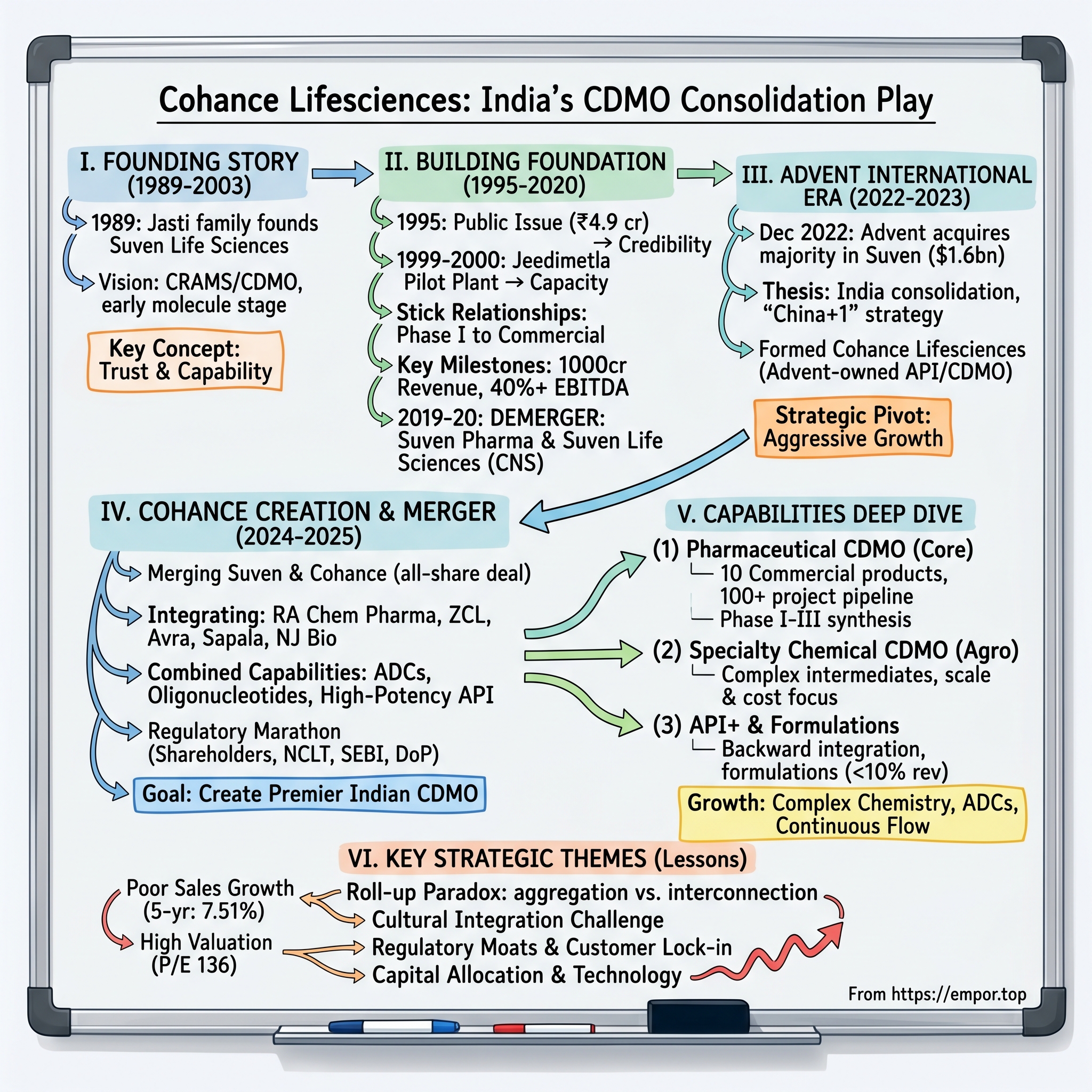
Cohance Lifesciences: Private Equity's Great Indian CDMO Roll-Up
I. Introduction & Episode Roadmap
On the morning of September 3, 2026, Cohance Lifesciences disclosed to Indian stock exchanges that it would commit an additional $18 million to its American antibody-drug conjugate business — allocating $13 million to raise its stake in New Jersey-based NJ Bio from 56.0% to 67.3%, and $5 million to acquire control of Princeton-based Aruka Bio.1 It read like a routine filing. Look closer, however, and it stood out as one of the most striking capital allocation decisions in Indian pharmaceuticals that quarter: just six weeks earlier, the company had reported that NJ Bio alone suffered an EBITDA loss of ₹32.8 crore in a single quarter, compared to group-wide consolidated adjusted EBITDA of just ₹9.2 crore.2 In simple arithmetic terms, the subsidiary accounted for nearly the entire drag on parent company profitability. Yet management elected to deepen its financial commitment to the asset.
That single juxtaposition captures the broader Cohance narrative in miniature — a platform assembled by one of the world's largest private equity firms from six distinct companies, marketed to public investors as an integrated Indian contract development and manufacturing organization (CDMO), and now working to demonstrate that the combined entity creates more value than its standalone components while those components remain operationally distinct.
Consider the platform's valuation and recent market trajectory. Cohance Lifesciences trades on the National Stock Exchange of India under the symbol COHANCE.3 On September 2, 2026, the shares closed at approximately ₹457, giving the company a market capitalization of about ₹17,600 crore, or roughly $2.1 billion.4 That market value reflects a dramatic repricing. Over the preceding twelve months, the stock traded as high as ₹1,038 and as low as ₹267.85, remaining down roughly 49% year-on-year despite a sharp rebound off its lows.4 In mid-2025, market commentators evaluated a ₹36,000 crore platform trading at more than 70 times earnings. Today, the platform commands less than half that valuation, and bridging that discrepancy is central to evaluating the business.
The operating performance underlying the share price reflects recent operational strain. For fiscal year 2026, ended March 31, 2026, Cohance reported consolidated revenue from operations of ₹2,268 crore, representing a 13% year-on-year decline, alongside adjusted EBITDA of ₹480 crore and an EBITDA margin of 21%.5 One year prior, on a pro-forma combined basis, the same asset portfolio generated ₹2,610 crore in revenue with a 33.6% EBITDA margin.6 The physical asset base remained largely unchanged over those twelve months; the shifts stemmed from customer demand phasing, regulatory intervention by the U.S. Food and Drug Administration, and leadership transitions.
The underlying investment thesis advanced by Boston-based private equity firm Advent International has remained consistent since 2020: acquire fragmented Indian active pharmaceutical ingredient (API) and contract manufacturing assets at mid-teens EBITDA multiples, integrate them with a high-margin innovator chemistry franchise, expand into specialized modalities such as bioconjugation and oligonucleotides, and build an integrated supplier that global pharmaceutical companies view as a viable alternative to Chinese CDMOs. The buy-and-build strategy progressed sequentially from RA Chem Pharma in 2020 through ZCL Chemicals, Avra Laboratories, Suven Pharmaceuticals, Sapala Organics, and NJ Bio.7
The central analytical question is not whether this strategic thesis is logically coherent, but whether empirical evidence shows that integration generates measurable customer value beyond what the individual units achieved independently — or whether the roll-up has instead produced a larger entity burdened by compressed returns on capital, expanded regulatory exposure, and an artificial deadline tied to private equity fund lifecycles.
The analysis that follows examines the founder who built and sold the foundation asset, the private equity firm that acquired it near the market peak, the roll-up structure into which it was merged, the segment economics governing the combined entity, the strategic frameworks dictating long-term competitive positioning, management's historical guidance versus actual financial performance, the key vulnerabilities a short-seller analysis would highlight, the evolving geopolitical and competitive landscape, the commercial viability of new modality investments, and the specific operating metrics that will determine financial performance over the next eight quarters.
The story begins with the founding of the original business.
 Subscribe on LinkedIn
II. The Founder Era: Venkateswarlu Jasti & Pioneering Indian CRAMS (1989–2019)
In 1989, Venkateswarlu Jasti abandoned what many Indian emigrants of his generation viewed as an established career endpoint. He was a registered pharmacist in New York and New Jersey, owning and operating a chain of six community pharmacies across both states.8 He held a postgraduate degree in pharmacy from Andhra University in Visakhapatnam and a second master's degree from St. John's University in New York, specializing in industrial pharmacy.8 Rather than maintaining that retail footprint, Jasti sold his pharmacy business and returned to Hyderabad to establish a contract chemistry venture.
The move was strategic. Operating community pharmacies in the American Northeast gave Jasti direct exposure to the retail mechanics of the world's largest pharmaceutical market. He observed firsthand how Western innovator drugs moved from approval to prescription and reimbursement, gaining a practical understanding of U.S. Food and Drug Administration (FDA) regulations. That regulatory and commercial orientation was rare in the Indian pharmaceutical landscape of 1989, shaping the central strategic decision of his enterprise.
Indian pharmaceutical companies in the early 1990s operated largely within a process-patent framework. Prior to 1995, Indian patent law recognized process patents rather than product patents, allowing domestic chemical manufacturers to legally market known molecules if they developed an alternative synthesis route. That environment favored reverse engineering—a business model focused on duplicating established generic drugs and competing primarily on cost.
Jasti took a different approach. Suven Life Sciences, founded in Hyderabad in 1989, chose to supply custom intermediates for new chemical entities (NCEs)—early-stage compounds still in clinical development, unapproved, and owned by global innovator pharmaceutical companies.8 In doing so, Jasti pioneered India's Contract Research and Manufacturing Services (CRAMS) model and later held leadership positions within the Indian Pharmaceutical Alliance.8
The commercial logic of the CRAMS model explains the core asset valuation that Advent International later targeted. Drug innovators require specialized manufacturing for complex chemical building blocks—initially in kilogram quantities for clinical trials, and later at commercial scale if the drug secures regulatory approval. Because these compounds are proprietary and unapproved, no off-the-shelf market exists. Innovators select contract manufacturers based on technical capability and execution trust rather than standardized catalog pricing. These commercial relationships evolve slowly; Cohance management noted on a recent earnings call that innovator relationships typically require seven to ten years to mature.2 Once established, however, early-stage intermediate manufacturing generates higher operating margins than generic API manufacturing, as customers purchase specialized technical capability rather than commoditized volume.
Suven listed on Indian stock exchanges and expanded its contract manufacturing footprint over three decades. By the time its CDMO assets were carved out, the company supplied multiple NCE intermediates to global pharmaceutical firms and had established specialized expertise in complex organic synthesis.
The moat that leaked
Despite the switching costs associated with innovator partnerships, Suven's historical performance revealed persistent revenue vulnerabilities inherent to the early-stage CDMO model.
While NCE intermediate manufacturing is often characterized as highly sticky, customer retention attaches to the specific drug molecule rather than the manufacturing vendor. If a client's Phase II or Phase III clinical trial fails to meet primary endpoints, the drug development program is terminated immediately. In those instances, even a supplier with flawless quality compliance and technical execution loses the associated revenue without contractual recourse. Technical capability provides no hedge against clinical trial failure.
A secondary structural vulnerability involves client-side pipeline rationalization. During industry downturns or corporate restructuring, global pharmaceutical companies regularly prune R&D pipelines to control costs. Even when vendor chemistry remains uncompromised, the underlying drug program can be canceled. Suven's revenue base experienced this volatility throughout its history, prompting management to add specialty chemical manufacturing as a revenue stabilizer—a diversification effort that introduced separate operational complexities.
Consequently, Jasti built an enterprise that offered high margin potential alongside elevated revenue volatility. The business delivered superior gross margins compared to generic pharmaceutical manufacturers, but suffered from limited long-term revenue visibility and modest operational scale. That combination—strong margin potential, low revenue predictability, and fragmented scale—represented the classic profile for private equity roll-up strategies designed to smooth revenue volatility through asset consolidation.
By 2019, Jasti prepared for succession. Suven contained two distinct business segments with diverging risk-return profiles: a cash-generative contract development and manufacturing operation, and an internal neuroscience drug discovery division that required ongoing R&D expenditures with binary clinical risk. Combining both divisions within a single listed entity resulted in a conglomerate discount on the public markets. Decoupling the cash-generative CDMO operations from the speculative drug discovery platform created a targeted, standalone asset for institutional acquisition.
III. The 2020 Demerger & Advent's Takeover (2020–2023)
The corporate demerger executed in 2020 put that structural decoupling into effect. The original company split into two listed entities: Suven Life Sciences retained the high-risk, capital-hungry proprietary neuroscience discovery programs, while Suven Pharmaceuticals took the contract development and manufacturing operations alongside the specialty chemicals franchise.8
The rationale proved sound. By separating binary clinical R&D risk from commercial manufacturing cash flows, Suven Pharmaceuticals emerged as a focused, high-margin, debt-light asset with no research overhang—presenting an ideal profile for institutional private equity buyouts.
December 2022: Advent arrives
Advent International had been assembling Indian active pharmaceutical ingredient and CDMO assets since 2020, seeking to build a platform of significant scale. On December 26, 2022, Advent signed a share purchase agreement to acquire 50.1% of Suven Pharmaceuticals from the founding Jasti family at ₹495 per share, valuing the controlling stake at roughly ₹6,313 crore, or approximately $762 million at the time.910 Under Indian takeover regulations, the acquisition triggered a mandatory open offer to public shareholders for up to an additional 26% stake at the same price.11 The Jasti family agreed to retain roughly 9.9% of the equity.10 The transaction formally closed on September 29, 2023.[^12]
At signing, Advent explicitly outlined its strategy: scale Suven into a leading global CDMO targeting $1 billion in annual revenue, while evaluating an eventual merger with Cohance Lifesciences, Advent's existing Indian CDMO platform.9
The transaction economics highlighted two central valuation risks. First, the acquisition price of ₹495 per share represented a steep multiple. Struck against a business generating high-30s EBITDA margins, contemporaneous market estimates placed the effective valuation near 50 times earnings. Second, the acquisition timing coincided with the peak of the post-pandemic CDMO cycle. Western pharmaceutical clients had spent two years over-ordering chemical intermediates to hedge against supply chain disruptions, temporarily inflating order books across the Indian CDMO sector.
The trough arrives on schedule
In fiscal year 2024—Advent's first full year of operational control—Suven Pharmaceuticals' consolidated revenue fell 21.6% to ₹1,051 crore, down from ₹1,340 crore the prior year.12 The slowdown accelerated in the fourth quarter, with revenue dropping roughly 32% year-on-year to ₹253 crore and net profit falling nearly 58% to ₹62.4 crore.13 The specialty chemicals segment suffered the sharpest decline, leading management to signal continued weakness as global pharmaceutical customers worked off excess inventory.13
The underlying mechanism was straightforward: global pharmaceutical clients paused new orders while consuming excess inventories accumulated during pandemic supply disruptions. While this destocking trend affected CDMOs globally, the timing highlighted an underwriting risk. Advent agreed to a premium valuation in December 2022 based on peak financial results, only to see the top line contract by more than a fifth within eighteen months.
This cyclical correction does not inherently invalidate Advent's value-creation thesis. Buying into a sector correction can be a viable private equity strategy, and customer destocking represents a cyclical shift rather than a permanent structural decline. However, it significantly raises the execution bar. Because the high entry multiple eliminated any valuation cushion, the investment's ultimate returns depend entirely on operational improvements and roll-up synergies rather than market expansion. Furthermore, the sharp downturn revealed a structural reality: Suven's top line proved acutely sensitive to customer inventory adjustments, demonstrating greater cyclicality than typically expected from deeply entrenched CDMO partnerships.
Meanwhile, the Jasti family stepped down from executive leadership, ending thirty-four years of founder-led management. The resulting leadership transition would face immediate operational testing—after examining the broader asset platform into which Suven was being integrated.
IV. The Roll-Up Playbook: Assembling Cohance (2020–2024)
While the Suven transaction was making headlines, Advent had spent the previous two years doing something much quieter and, in aggregate, more consequential. It had been buying Indian API companies one at a time.
The sequence was methodical. Advent took a controlling stake in RA Chem Pharma in October 2020, followed by ZCL Chemicals in March 2021 and Avra Laboratories in April 2022.7 In November 2022 — one month before the Suven agreement — it gave the three companies a single brand identity: Cohance Lifesciences.7 The combined platform recorded pro-forma revenue of roughly ₹1,280 crore in FY2021-22 and had grown organically at better than 21% compounded over the prior two years.7 Advent's stated goal was to build one of India's top three merchant API and CDMO businesses.7
Each acquisition filled a specific hole. RA Chem Pharma brought generic API manufacturing plus forward integration into pellets, finished dosage formulations and clinical research — the "end-to-end" capability that lets a customer hand over a molecule and receive a finished tablet.7 ZCL Chemicals added specialised APIs in niche therapeutic areas. Avra Laboratories, founded by the distinguished Indian process chemist Dr. A. V. Rama Rao, brought advanced process chemistry research and the ability to scale complex intermediates from laboratory to plant — capability that sits much closer to Suven's innovator work than to generic API production.7
What was actually bought, and at what price
Advent has not disclosed transaction values for RA Chem, ZCL or Avra, and the individual purchase multiples are not public. What can be said with confidence is the structural difference between the two halves of the eventual company. Indian generic API and formulation businesses of this vintage and size typically changed hands in the low-to-mid teens of EV/EBITDA during 2020–2022; Suven was bought at a materially higher multiple, reflecting margins roughly double those of a merchant API business. That spread is not incidental — it is the arithmetic engine of the entire strategy.
The private equity logic of a roll-up is that you buy assets at a lower multiple than the multiple the combined entity will command, and the difference accrues to you before you have improved anything operationally. If you can also improve operations, you win twice. If you cannot, you have still captured the arbitrage — provided the public market accepts the blended entity at the higher multiple. That last condition is the load-bearing assumption, and it is testable.
The synergy claim, tested against the hardest available evidence
The stated industrial rationale for combining generic API manufacturing with innovator NCE chemistry was cross-selling: a customer who buys a generic API might buy CDMO services, and vice versa. Advent's platform pitch emphasised end-to-end capability from intermediate through finished dose.
The strongest disconfirming evidence against this thesis did not arrive from a competitor or an analyst. It arrived from the U.S. Food and Drug Administration.
The FDA inspected the company's Nacharam formulations facility in Medchal-Malkajgiri from August 4 to 12, 2025, and issued a warning letter dated January 30, 2026.14 The findings were not procedural trivia. Inspectors found visible stains and residues on shared manufacturing equipment that tested positive for multiple active pharmaceutical ingredients above allowable limits — a direct cross-contamination finding. They found that the cleaning validation study underpinning that equipment dated from 2018 and had not used worst-case scenarios, and had not been re-evaluated when new products were introduced onto the shared equipment. They found that complaints of tablets "crumbling, disintegrating, pitted" had initially been dismissed as unsubstantiated without adequate root-cause investigation.14 The company suspended manufacturing at the site as of August 16, 2025, and the FDA reserved the right to withhold approval of new applications naming the facility and to refuse admission of its products into the United States.14
This is precisely the failure mode that a sceptical investor would have predicted from the roll-up's design. Multi-product plants running many molecules across shared equipment carry cross-contamination risk that a dedicated innovator plant does not. Innovator pharmaceutical customers audit their suppliers relentlessly and are institutionally allergic to quality events anywhere inside a supplier's corporate perimeter — not merely at the specific site that makes their molecule. The generic formulations business, which was supposed to broaden the platform, instead generated a public regulatory record on the same letterhead that the innovator CDMO business trades on.
The financial damage was contained but real: roughly ₹55 crore of shipment deferrals in the December 2025 quarter alone, and approximately ₹61 crore of formulations revenue impact across FY26.155 The strategic damage is harder to quantify and probably larger.
The calibrated conclusion is this: the roll-up's cost synergies and procurement leverage are plausible and partially demonstrable, but the revenue synergy claim — cross-selling innovator services across a generic customer base — remains unproven after four years, while the risk correlation between the two businesses has now been demonstrated in the most concrete way available. What would falsify the sceptical view is straightforward and named: evidence in future disclosures of specific innovator programmes won because of the combined platform's end-to-end capability, rather than won by Suven's legacy chemistry team on its own merits.
All of which set the stage for the transaction that made this argument a public-market problem rather than a private one.
V. The Landmark Suven-Cohance Merger Saga (2024–2025)
By early 2024, Advent controlled two Indian pharmaceutical businesses with divergent financial profiles: one was listed, high-margin, and contracting; the other was private, lower-margin, and expanding. Amalgamating the two solved several operational and financial objectives simultaneously, including providing an eventual liquidity path for the private equity sponsor.
On February 29, 2024, Suven Pharmaceuticals and Cohance Lifesciences announced a scheme of amalgamation.[^17] Suven's shares rose 15% over the following two trading days.16 The structure was an all-stock combination in which Cohance shareholders received 11 fully paid-up equity shares of Suven Pharmaceuticals for every 295 Cohance shares held.17
The swap ratio served as the pivotal mechanism setting the sponsor's underlying transaction economics. Because Advent controlled both sides of the deal—holding a 50.1% controlling stake in public Suven alongside ownership of private Cohance—the exchange ratio dictated how much equity in the combined entity accrued to the private assets relative to the public company. While the transaction followed all required corporate governance steps—including independent valuation reports, audit committee reviews, majority-of-minority shareholder approvals, and sanction by the National Company Law Tribunal (NCLT)—it remained a related-party consolidation where the controlling shareholder established the valuation terms. Following the merger, Advent entities held roughly two-thirds of the combined platform.
The regulatory approval process stretched across 2024 and early 2025. Stock exchanges cleared the scheme, leading to an NCLT application in July 2024.18 The NCLT sanctioned the transaction on March 27, 2025.19 The merger became effective on May 1, 2025, with a record date of May 8, and the combined entity officially adopted the name Cohance Lifesciences Limited on May 19, 2025.206 The name change signaled a broader organizational alignment, placing the public entity under the brand of the private platform folded into it.
The revolving door
Following the merger announcement, the company entered a period of leadership turnover.
Dr. V. Prasada Raju had been appointed Managing Director in September 2023, immediately after Advent closed the initial Suven acquisition, to guide the integration. Executive Chairman Vivek Sharma—a veteran CDMO executive who previously led Piramal Pharma Solutions, Adare Pharma Solutions, Decision Resources Group, and Saama Technologies—joined on September 20, 2024.21 Himanshu Agarwal had assumed the role of Chief Financial Officer on January 2, 2024.22
On October 28, 2025, less than six months after the merger took effect, the board approved Dr. Raju's resignation as Managing Director, effective at the end of that business day.22 Management cited personal priorities and a desire to "continue his learning journey," adding that Dr. Raju would remain available to facilitate the transition.22 Equity markets reacted cautiously, sending the stock down 10.2% the following day to ₹767.10 from ₹854.50, marking a sixteen-month low.23 Concurrently, CFO Agarwal was appointed to the board as an additional director for a five-year term starting October 29, 2025.22
Six months later, on April 27, 2026, Vivek Sharma resigned as Executive Chairman and board member, effective April 30, 2026, citing personal reasons while agreeing to serve as a special advisor for nine months.24 The company announced that Umang Vohra would succeed him as Executive Chairman on May 1, 2026, and assume the role of Group CEO on May 20, 2026.2425
Investors responded positively to Vohra's appointment, driving the stock up by its 20% daily limit on the announcement.26 Vohra had served as Managing Director and Global CEO of Cipla since 2016, overseeing its expansion into regulated global markets, following earlier leadership roles at Dr. Reddy's Laboratories and PepsiCo India.25 Advent partner Pankaj Patwari highlighted Vohra's operational track record and "owner-manager mindset."25 The senior appointment indicated that Advent was recruiting top-tier executive talent to steer the integrated platform.
Nonetheless, executive turnover remained high across the integration window. Between September 2023 and September 2026, the Managing Director departed after twenty-five months, the Executive Chairman after nineteen months, and CFO Himanshu Agarwal was scheduled to step down on September 13, 2026.2 In total, three of the company's top four executive positions turned over within three years.
Frequent executive changes present distinct analytical interpretations. From one perspective, active private equity management involves replacing leadership rapidly when operational targets are missed. From another, managing a complex roll-up of six distinct operating entities becomes more difficult when leadership rotates every eighteen months. Consequently, evaluating Cohance's leadership team requires looking forward to its newly assembled executive suite rather than relying on historical operational continuity.
Assessing the platform's prospects requires examining the commercial performance of its underlying product lines.
VI. Business Model, Segment Economics & Capabilities Deep Dive
Strip away the corporate history and Cohance is three businesses under one roof, and they have almost nothing in common except a shared balance sheet and a shared regulatory reputation.
In FY26, Pharma CDMO accounted for 39% of revenue, API Plus for 48%, and Specialty Chemicals for 13%.5 Those proportions shift meaningfully quarter to quarter, which is itself informative about revenue stability.
Segment one: Pharma CDMO, the reason the stock has a multiple
This is the legacy Suven franchise plus Avra's process chemistry. It does custom synthesis and supplies advanced registered intermediates for innovator drugs across Phase I to commercial.
The mechanics deserve a plain-language explanation, because the moat argument depends entirely on them. When a pharmaceutical company files for approval of a new drug, the regulatory dossier specifies not just the finished molecule but the route by which it is made — which suppliers make which intermediates, at which sites, using which processes. Changing that supplier after approval means re-validating the new route, generating comparative stability data, and filing a variation with every regulator in every market where the drug is sold. It is expensive, slow, and it puts an approved revenue-generating product at risk to save a modest amount on cost of goods. Most innovators simply do not do it. That is the switching cost, and it is genuine.
The economics reflect it. Across FY25, the combined entity ran gross margins around 68% and this segment carried the platform's profitability.6 The trade-off is time: management stated on the August 2026 call that customer relationships in this business typically take seven to ten years to mature.2
The proof points are real and worth stating precisely, because they are the strongest part of the bull case. As of the end of FY25, Cohance was supplying sixteen commercial molecules, up from ten in FY23; its Phase III pipeline had grown to fifteen intermediates across nine molecules, from six intermediates across two molecules in FY23; its client base included fourteen of the top twenty global pharma and biotech innovators, accounting for more than 80% of revenue; and it onboarded three new customers in FY25 including a top-five global pharma company.6 Requests for quotation doubled across the platform during FY25.6 By Q1 FY27, the Phase III pipeline stood at ten molecules with one newly added, two programmes had recently entered commercial supply with two more expected within twelve to fifteen months, and RFQ inflows had roughly doubled again versus FY25.27
Those are the metrics of a business winning work. They are also, critically, metrics that will not show up in reported revenue for years.
Segment two: API Plus, the ballast
This is RA Chem and ZCL — generic APIs across therapeutic areas including central nervous system, women's health and cardiovascular, plus finished dosage formulations. Management describes a genuinely strong position here: Cohance ranks among the top three suppliers in eight of the ten largest molecules in its portfolio.6 In FY25 it completed eight new product validations, filed eight drug master files and launched nine new formulation contract manufacturing projects.6 Segment head Gunjan Singh told analysts in August 2026 that the business had "remained resilient" on favourable pricing and improved mix, targeting seven new API filings in FY27.2
The resilience claim held up under stress. In the June 2026 quarter, when Pharma CDMO revenue fell 38.7% and Specialty Chemicals fell 34.7%, API Plus declined only 10.4% to ₹264.5 crore — roughly three-fifths of total group revenue that quarter.27 For a segment routinely described as the low-quality part of the portfolio, it was the only thing holding the revenue line together.
That is a genuinely important observation and it cuts against the conventional framing. The generic API business dilutes margin, unambiguously. It also dampens volatility, which the innovator business generates in abundance. Whether that trade is worth making depends on whether public investors pay for stability or for margin — and the evidence from the share price over the past year suggests they pay for neither when both are deteriorating.
Segment three: Specialty Chemicals and new modalities
This covers agrochemical, cosmetics, electronic chemicals and photochromic lens intermediates, plus the emerging oligonucleotide and bioconjugation platforms.6 It is the smallest and by far the most volatile segment. It collapsed during the 2023-24 global agrochemical destocking, recovered 74.7% year-on-year in Q4 FY25, and then fell 34.7% again in Q1 FY27.627 Segment CEO Amrit Singh described FY27 as "a year of qualification," with double-digit growth expected only from FY28.2
What the mix actually means
The uncomfortable conclusion from the segment data is that Cohance's profit pool and its revenue base are in different places. The highest-margin business is the smallest and the most volatile. The largest business by revenue is the one that dilutes margins and carries the FDA warning letter. And the fastest-growing pieces — Sapala's oligonucleotides grew 2.5 times year-on-year in Q1 FY27, to about ₹27 crore — are too small to move the consolidated number.27
This is not a criticism of the strategy so much as a description of where it currently sits: the platform has been assembled, but the mix that would justify the platform's valuation has not yet arrived. Whether it arrives depends on whether the Phase III pipeline converts, which brings us to the question of what kind of advantage this business actually has.
VII. Strategic Analysis: Helmer's 7 Powers & Porter's 5 Forces
Evaluating Cohance through established strategic frameworks highlights both its defensive core and its current operational vulnerabilities.
Helmer's 7 Powers
Switching costs — high, but narrower than advertised. The regulatory re-validation burden creates the company's primary structural advantage. However, three key qualifications limit its scope. First, high switching costs apply almost exclusively to commercialized molecules—sixteen as of FY25—rather than early clinical-stage programs, where sponsors can switch suppliers between trial phases. Second, protection lasts only as long as the underlying brand remains on patent; once generic entry occurs, intermediate volume contracts sharply regardless of vendor lock-in. Third, switching costs offer no defense against customer-driven decisions: inventory destocking, pipeline rationalization, and clinical trial failures bypass vendor lock-in entirely. Consequently, the business suffered a 21.6% revenue drop in FY24 and a 13% contraction in FY26 despite these regulatory hurdles.125 A competitive moat that allows back-to-back revenue drops exceeding 10% within three years offers incomplete downside protection.
Scale economies — moderate, and currently negative. While operating eight manufacturing sites theoretically enables flexible batch allocation and procurement leverage, recent financial results show negative operating leverage. As fixed overhead was spread over a shrinking revenue base, consolidated EBITDA margin fell to 2.2% in the June 2026 quarter from 24.4% a year earlier, even as gross margin held relatively steady, slipping just 150 basis points to 71.5%.27 This divergence demonstrates that while product-level gross economics remain intact, facility utilization sits below the threshold needed to generate positive scale economies.
Process power — moderate and real. Decades of proprietary process safety data across hazardous, organometallic, cryogenic, and high-potency chemical reactions represent a genuine barrier to entry. Grounded in Avra's process chemistry expertise and Suven's thirty-year history in new chemical entities, this capability is validated by customer relationships: Cohance serves fourteen of the top twenty global drug innovators, including a client of three decades that submitted a request for proposal for antibody-drug conjugates in FY25.6 This expansion into new modalities demonstrates the practical commercial value of its process heritage.
Counter-positioning — absent. Cohance operates as a traditional contract manufacturer without structural business model innovations that incumbents cannot replicate.
Branding, cornered resource, and network economies — absent. Pharmaceutical innovators evaluate contract partners based on regulatory compliance and chemical execution rather than brand equity. The platform possesses no proprietary raw material access, and contract manufacturing operates without network effects.
In summary, Hamilton Helmer's framework yields a modest assessment: one established power in switching costs, a contingent power in scale, specialized process capability, and four absent attributes.
Porter's Five Forces
Buyer power — high and structural. Innovator pharmaceutical companies dictate stringent quality standards, maintain multi-sourcing strategies to avoid supply disruption, and routinely press for annual price concessions. Client concentration reinforces this imbalance: Cohance's top twenty pharmaceutical customers account for over 85% of its Pharma CDMO segment revenue.27
Rivalry — high and intensifying. Domestic competitors include Divi's Laboratories, Syngene International, Laurus Labs, Piramal Pharma, and Neuland Laboratories, while Western peers include Lonza, Siegfried, and Cambrex. Each is aggressively expanding capacity to capture supply chain diversification demand from global drug sponsors.
Threat of substitutes — moderate and long-term. The primary long-term substitute risk stems from modality shifting. If drug pipelines pivot further from small molecules toward biologics, cell and gene therapies, or mRNA platforms, historical small-molecule synthesis expertise will command lower strategic value. Investments in antibody-drug conjugates and oligonucleotides function as explicit hedges against this structural transition.
Threat of new entrants — moderate. Constructing regulatory-compliant API facilities in India requires capital but remains achievable, leading to ongoing capacity additions across Asia. However, replicating decades of successful regulatory audit history and innovator customer trust poses a steep barrier, explaining why Advent chose an acquisition-led roll-up over greenfield expansion.
Supplier power — moderate. Key starting materials for many active ingredients continue to originate in China. As a result, Cohance's pitch as an alternative to Chinese contract manufacturers coexists with its own operational dependence on Chinese chemical inputs.
Together, these frameworks depict a company with clear regulatory switching costs operating within a concentrated, capital-intensive industry, currently working to rebuild facility utilization to unlock positive scale economics.
VIII. Financial Performance, Management Credibility & Guidance Discipline
On May 29, 2025, four weeks after the merger became effective, Cohance's management held its first earnings call as a combined entity and outlined a series of specific targets. Evaluating those projections against subsequent operational outcomes provides a direct test of corporate guidance discipline.
During the call, management projected double-digit revenue growth for FY26 and guided for an adjusted EBITDA margin in the low 30s for the year, scaling to the mid 30s over the medium term. Leadership flagged that the June 2026 quarter would be muted, with revenue skewed toward the second half, while maintaining a long-term target of reaching $1 billion in annual revenue by 2030. The company also budgeted capital expenditures of ₹350 crore for FY26, primarily to expand capacity at NJ Bio.6
Subsequent financial disclosures presented a starkly different reality. For FY26, revenue fell 13% to ₹2,268 crore.5 Consolidated adjusted EBITDA margin dropped to 21%—ten percentage points below the low end of the guided range.5 Net profit contracted to ₹150 crore, down from ₹484 crore the prior year.4 Meanwhile, Cohance's stock price tumbled from ₹1,108 at the time of the May 2025 call to ₹457 fifteen months later.64
The divergence represented a fundamental shift in trajectory rather than a minor variance, as management had promised double-digit expansion only to deliver a double-digit decline.
Working through what caused it
Three main factors drove the earnings shortfall, each with distinct operational and strategic implications.
First, customer inventory destocking heavily impacted two major CDMO molecules.5 While cyclical destocking remained largely outside management's control, the outsized financial impact highlighted the platform's revenue concentration in key clinical programs.
Second, quality enforcement at the Nacharam facility directly disrupted operations. The FDA warning letter and subsequent plant suspension led to roughly ₹61 crore in lost formulations revenue for FY26 and deferred approximately ₹55 crore of shipments in the December 2025 quarter alone.515 Unlike market destocking, this compliance issue represented an internal execution failure.
Third, financial performance deteriorated at acquired subsidiaries—most notably NJ Bio. In May 2025, management advised investors that NJ Bio operated at roughly a 10% EBITDA margin and would be margin-dilutive.6 By the first quarter of FY27, however, the subsidiary posted a quarterly EBITDA loss of ₹32.8 crore, prompting CFO Himanshu Agarwal to acknowledge that "NJ Bio's current performance is weighing significantly on consolidated profitability."2 While management had signaled margin dilution in advance, it failed to anticipate the severity of the operating losses.
The quarterly sequence reflected continuous margin compression. In the December 2025 quarter, revenue fell 19.5% year-on-year to about ₹545 crore, adjusted EBITDA dropped 67.7% to ₹85 crore with margin narrowing to roughly 16%, and adjusted net profit plunged 87.3% to ₹21 crore.15 In response, management recharacterized FY26 as a "transition year" and lowered its full-year revenue forecast to an early-to-mid double-digit decline.15 Performance deteriorated further in the June 2026 quarter, when revenue dropped 23.1% year-on-year to ₹422.3 crore and adjusted EBITDA shrank to ₹9.2 crore—yielding a 2.2% margin, compared to ₹134 crore in the prior-year period.272
What the calls reveal about how management handles bad news
The August 2026 earnings call highlighted management's evolving communication strategy. Umang Vohra opened by characterizing the period as "our lowest quarter ever"—a direct assessment six weeks into his tenure as chief executive.2 Addressing the inherited $1 billion revenue target for 2030, Vohra reclassified the metric as an "aspiration," conceded the company might fall short, and committed to providing updated operational targets by December 2026.2 The adjustment formally demoted a long-standing public benchmark to an aspirational goal.
Subsequent responses during the analyst Q&A session offered less clarity. Asked by BoB Capital analyst Foram Parekh to quantify the timing of an expected ₹260 crore destocking reversal, the CFO described the inquiry as premature and deferred detailed figures to the next earnings call.2 When Goldman Sachs analyst Shyam Srinivasan pressed on margin recovery timelines, management answered that FY27 margins would approach prior-year levels before accelerating toward 28% and beyond—a projection delivered by an executive whose departure on September 13, 2026, had already been announced.2 Finally, responding to JP Morgan analyst Bansi Desai regarding competitive differentiation, Vohra cited relationship depth, technical capabilities, and specialized manufacturing over price competition.2 While commercially standard, the explanation provided few measurable performance benchmarks.
The credibility verdict
Evaluating Cohance's forecasting record requires distinguishing between leadership tenures. Because the missed targets were set by an executive team that has since largely departed, holding Vohra accountable for prior projections would be misplaced. Nevertheless, the historical record reveals three distinct forecasting vulnerabilities during a single fiscal year: misjudging customer inventory destocking, incurring a regulatory warning letter at a legacy site, and underestimating integration losses at an acquired subsidiary.
The company's commercial narrative also evolved alongside its financial results. Between 2020 and 2022, management presented the enterprise as a high-margin, pure-play innovator NCE partner. From 2024 onward, the narrative shifted to framing Cohance as an integrated, end-to-end CDMO and API platform. While the broader positioning reflects the asset base, the timing of the transition coincided directly with margin contraction across the legacy business.
The key indicator of management credibility will be whether the second half of FY27 delivers the projected year-on-year revenue recovery and whether leadership provides concrete tracking for the expected ₹260 crore destocking reversal.
IX. The Skeptical Investor & Activist Stress Test
Imagine a well-prepared short seller building the bear file on Cohance in September 2026. Here is what would be in it, in descending order of force.
The multiple arbitrage question
The opening argument writes itself. A private equity sponsor bought generic API and formulation businesses at private-market multiples between 2020 and 2022, bought a high-margin listed CDMO at a top-of-cycle multiple in 2022, merged the private assets into the listed vehicle at an exchange ratio the sponsor itself set, and thereby caused the lower-multiple assets to be revalued at the listed entity's higher multiple.7917 No operational improvement is required for this to generate a return. It is financial engineering that happens to be entirely legal, entirely disclosed, and entirely standard in private equity.
The rebuttal is that Advent has done more than financial engineering — it recruited genuinely senior operators, invested in new capabilities, and has held the asset through a severe downturn rather than dumping it. But the burden of proof sits with the company, and the required evidence is specific: consolidated return on capital employed recovering to a level that justifies the assembled cost base. On the current record it has not. Return on capital employed stood at roughly 5.8% and return on equity at roughly 4.9% on the trailing figures, against a business that in FY24 pro-forma terms was earning a 22% return on capital.46 Capital was deployed and returns fell.
Customer and molecule concentration
Top twenty pharma customers represent more than 85% of Pharma CDMO revenue, and in FY25 the top clients accounted for over 80% of total revenue.276 More striking is molecule concentration: the FY26 revenue decline was driven substantially by destocking in two large CDMO molecules.5 A business where two molecules can move consolidated revenue by high single digits is not diversified in any way that matters, regardless of how many customers appear on the client list.
Regulatory surface area
The Nacharam warning letter is a fact, not a risk.14 What a sceptic would press on is whether it is isolated. The FDA inspected the Pashamylaram facility from July 27 to August 5, 2026 and issued a Form 483 with five observations, which management characterised as containing nothing related to data integrity.2 A Form 483 with five observations is not in itself alarming — most inspections generate observations. But a company with an open warning letter at one site receiving five observations at another, within twelve months, is a company whose quality systems will be examined closely by every customer procurement committee it faces.
The financial mechanism is worth being explicit about, because it is asymmetric: a warning letter costs a modest amount of deferred revenue, but an escalation to Official Action Indicated status or an import alert at a site supplying commercial innovator programmes would halt US export from that facility. For a supplier whose entire value proposition to Western innovators is reliability, that is a disproportionate risk.
The leverage sitting above the company
This is the item most retail investors miss, because it does not appear in Cohance's own financial statements. The company itself is net cash — ₹458.9 crore of cash against ₹207.7 crore of gross borrowings at the end of the June 2026 quarter, for net cash of about ₹251 crore.27 The debt is at the promoter level.
Advent's holding vehicles, Berhyanda Limited and Jusmiral Holdings, entered a facility agreement dated June 11, 2026 for a $285 million term loan from a consortium of international banks including Barclays, Deutsche Bank and BNP Paribas, secured by a pledge over 208 million Cohance shares representing 54.36% of total equity — 33.34% from Berhyanda and 21.02% from Jusmiral — with additional covenants restricting disposal of the remaining promoter holdings.28 That facility refinanced an earlier notes purchase agreement dated May 29, 2024, which was repaid on June 16, 2026, releasing the prior encumbrance over the promoters' combined 57.49% stake.29
The implication is straightforward and uncomfortable. The sponsor's stake is financed with debt secured against the shares themselves. Sustained share price weakness pressures loan-to-value covenants. Covenant pressure creates incentives to sell into weakness or refinance on worse terms. It is not a solvency issue for Cohance's operating business, which remains conservatively financed. It is a potential source of forced supply in the stock, and it partially explains behaviour that would otherwise look odd — such as selling a large block near a cyclical high.
The exit clock, already running
Which is exactly what happened. On September 18, 2025, Jusmiral Holdings sold 3,41,48,000 shares — 8.92% of Cohance — at an average price of ₹906, raising ₹3,094 crore, cutting its holding to 24.16% from 33.08%.30 The proceeds were applied primarily to reducing debt under the then-existing notes purchase agreement.30
Note the timing. That sale occurred at ₹906, roughly six weeks before the Managing Director's resignation and four months before the FDA warning letter became public. The share price a year later was half that level. Nothing about the sequence suggests impropriety — the sale was disclosed, the price was a market price, and the warning letter arrived from a January 2026 FDA decision following an August 2025 inspection whose Form 483 findings the company would have known. But a sceptic would note that the sponsor's single largest realisation to date occurred at a price no public shareholder has been able to achieve since.
Promoter holding stood at 57.49% as of June 2026, with domestic institutions at 20.09%, foreign institutions at 6.50% and public shareholders at 15.92%.4 Advent's Suven acquisition closed in September 2023; a typical private equity fund seeks realisation within five to seven years. That points to continued sell-down between 2027 and 2030, in a stock whose free float is currently modest. Every future block will meet the market at whatever price the market offers.
The small things that add up
Debtor days extended from 88 to 110 over the year, and working capital stood at ₹824.8 crore or 141 days of sales at the end of Q1 FY27 — worth watching as a sign of either channel stress or simply the mechanical effect of a collapsed revenue denominator.427 The company pays no dividend.4 And on the day this article was written, a business generating ₹9.2 crore of quarterly consolidated EBITDA committed $18 million of internal accruals to increase its stake in the loss-making subsidiary and to take control of a drug-developing biotech.12 Buying a company that discovers its own antibody-drug conjugates is a different business from providing services to companies that discover them — and a sceptic would file it under diworsification until management explains otherwise.
None of this means the bear case wins. It means the burden of proof is entirely on the company, and the industry backdrop is the strongest argument on the other side.
X. The CDMO Competitive Landscape & Geopolitical Tailwinds
If an observer were to design an ideal decade for Indian contract manufacturers, it would look remarkably like the current environment. That context makes Cohance's performance in fiscal year 2026 all the more striking: industry tailwinds arrived, yet the company contracted.
The policy backdrop, as it actually stands
Two distinct U.S. policy developments are frequently conflated, even though they operate on very different timelines and carry contrasting implications for Indian suppliers.
The BIOSECURE Act was signed into law on December 18, 2025, as part of the FY2026 National Defense Authorization Act.31 Its core objective is to restrict U.S. federal contracting with biotechnology equipment and service providers deemed to be controlled by foreign adversaries. However, implementation is deliberately gradual: the initial official list of designated companies was expected only by December 18, 2026, to be followed by agency guidance and formal updates to federal procurement regulations.31 As of mid-2026, no companies had been formally designated under the statute.31 The commercial impact to date has therefore been anticipatory rather than statutory—driven by Western pharmaceutical innovators dual-sourcing away from Chinese providers such as WuXi AppTec and Pharmaron ahead of mandatory restrictions.
The second trade development is more immediate and structurally complex. On April 2, 2026, a presidential proclamation under Section 232 of the Trade Expansion Act imposed a 100% tariff on imported patented pharmaceutical products, biologics, active pharmaceutical ingredients, and key starting materials, effective July 31, 2026 for major named entities and September 29, 2026 for all remaining importers, while granting preferential 15% rates to the European Union, Japan, South Korea, Switzerland, and Liechtenstein alongside a separate arrangement for the United Kingdom.32 India was omitted from the list of preferential jurisdictions and consequently falls under the default 100% tariff rate.32 Crucially, generic pharmaceutical products were excluded "at this time."33
For Cohance, this tariff structure creates a sharp operational dichotomy. The company's generic API and formulations business—its largest revenue generator—sits safely within the exempted generic category. Conversely, its Pharma CDMO segment manufactures intermediates and APIs for patented innovator drugs, precisely the product tier subject to the full tariff. While the direct tax burden falls on the U.S. importer of record rather than the Indian exporter, the secondary effect exerts strong economic pressure on Western innovators to onshore manufacturing for patented therapies. Whether the commercial tailwind from Western diversification out of China will outweigh this U.S. onshoring pressure remains unresolved, rendering any assessment of the trade policy as an unqualified benefit for Indian CDMOs incomplete.
Where Cohance stands against its peers
The fiscal year 2026 peer benchmark highlights clear operational divergence, indicating that Cohance's revenue contraction stemmed primarily from company-specific execution issues rather than broader sector headwind.
Divi's Laboratories expanded revenue by 13% to ₹10,388 crore in FY26, generating EBITDA of ₹3,920 crore—reflecting an operating margin near 38%—and net profit of ₹2,607 crore, while allocating ₹1,500 crore to new capital projects.34 Operating at roughly four and a half times Cohance's revenue scale, Divi's delivered both accelerating top-line growth and industry-leading profitability.
Laurus Labs grew revenue by 23% to ₹6,813 crore, delivering EBITDA margins of 26.8% and driving net profit up 148% to ₹889 crore.35 Having experienced its own earnings compression between 2022 and 2024, Laurus demonstrated a decisive operational rebound.
Syngene International faced headwind conditions closest to Cohance's, reporting modest revenue growth of 3% to ₹3,739 crore, an operating EBITDA margin of 25%, and pre-exceptional profit of ₹380 crore due to customer-specific biologics cancellations, higher staffing costs, and initial fixed costs from recently added capacity.36 Yet even while navigating these pressures, Syngene expanded its top line.
Piramal Pharma emerged as the sole peer posting an absolute contraction, with revenue dropping 3% to ₹8,869 crore, EBITDA falling 28% to ₹1,135 crore, and a net loss of ₹326 crore that included a ₹176 crore non-cash asset impairment.37
Against this competitive field, Cohance's 13% revenue decline and 21% EBITDA margin placed it at the bottom of its peer group in growth and in the middle on operating profitability.5 The peer data directly challenges management's narrative of macro-driven destocking: two of Cohance's four primary listed competitors achieved double-digit revenue growth in the same fiscal year, serving identical global pharmaceutical end markets under the same trade policy environment. Cohance's underperformance resulted from internal factors—specifically a regulatory warning letter, mounting operating losses at an acquired U.S. subsidiary, senior leadership turnover, and revenue concentration in a small number of customer drug programs.
How this ends well, and how it ends badly
Cohance's operational recovery relies on three sequential developments: its Phase III clinical pipeline successfully converting into commercial supply contracts, with management projecting that more than half of its ten late-stage programs will achieve regulatory approval;2 the API Plus division maintaining pricing and volume stability to preserve baseline cash flows while Pharma CDMO recovers; and regulatory remediation at the Nacharam facility concluding without additional enforcement action. Under this bull-case scenario, expanding revenues against a fixed manufacturing cost base would generate strong positive operating leverage on top of stable gross margins.
Conversely, a bear-case scenario would unfold if customer destocking extends beyond management's revised timelines; if regulatory scrutiny spreads to active manufacturing sites supplying commercial innovator drugs; if operating losses at NJ Bio continue to consume domestic cash flow; or if secondary equity sales by the private equity sponsor coincide with persistent market skepticism. None of these downside risks depend on competitive pressure from industry rivals.
The spread between these two outcomes remains exceptionally wide, with final investment returns depending heavily on execution across a small group of strategic initiatives.
XI. Future Optionality Bets: ADCs & Oligonucleotides (NJ Bio & Sapala)
Antibody-drug conjugates are the closest thing modern oncology has to a guided missile, and the analogy is more precise than it sounds. A conventional chemotherapy drug is a bomb dropped on a city: it kills cancer cells and healthy cells indiscriminately, which is why chemotherapy patients lose their hair and their appetite. An ADC takes a toxin far too poisonous to inject on its own, chemically tethers it to an antibody that recognizes a protein found predominantly on tumor cells, and lets the antibody deliver the payload to the target. The toxin is only released where it is needed.
The hard part is the tether. The chemical linker must be robust enough to survive the bloodstream without releasing its payload — a premature release means poisoning the patient — and labile enough to release cleanly once inside the tumor cell. Linker-payload chemistry is genuinely specialized, and very few contract organizations anywhere can do it well.
Oligonucleotides are a different technology solving a different problem. Rather than blocking a protein after the body makes it, oligonucleotide drugs — antisense molecules and short interfering RNA — intercept the genetic message before the protein is made. Manufacturing them requires assembling long chains from chemical building blocks called phosphoramidites, using equipment and chemistry that a conventional small-molecule API plant simply does not possess.
Both modalities are growing considerably faster than traditional small-molecule chemistry. Both are, for Cohance, hedges against the substitution risk identified earlier. And both were bought.
Sapala Organics
In mid-2024, Suven Pharmaceuticals acquired a 67.5% stake in Hyderabad-based Sapala Organics for ₹229.5 crore in an all-cash deal, effective July 12, 2024.386 Sapala focuses on oligonucleotide drugs and nucleic acid building blocks including phosphoramidites, nucleosides, GalNAc delivery compounds, and pseudouridine.38
Of the two bets, this one is working. Sapala grew roughly 2.5 times year-on-year in the June 2026 quarter, contributing about ₹27 crore of revenue.27 The company's cGMP oligonucleotide block was reported operationally ready, with validation from the oligonucleotide facility having begun in the December 2025 quarter as originally planned.56 Vohra told analysts that customers "would like to engage with us as an integrated nucleic acid offering," and projected that oligonucleotides could nearly double over three to four years.2
That is a modest base growing fast, on a purchase price representing under 4% of the company's current market capitalization. It is proportionate optionality — the kind that costs little if it fails and matters if it works.
NJ Bio, and the harder question
NJ Bio is a different case entirely. Suven Pharmaceuticals announced in December 2024 that it would acquire a majority stake in the Princeton, New Jersey-based contract research, development, and manufacturing organization, and completed the purchase of 56% for $64.4 million including a $15 million primary equity infusion.3940 NJ Bio specializes in antibody-drug conjugates and other advanced conjugates, and the strategic logic is legitimate: it places Cohance inside the American discovery ecosystem where ADC programs originate, then offers Indian manufacturing scale-up as those programs advance.
The execution has been expensive. Management disclosed at acquisition that NJ Bio ran at approximately 10% EBITDA margin and earmarked ₹350 crore of FY26 capital expenditure largely for its capacity expansion.6 By June 2026 it was generating a quarterly adjusted EBITDA loss of ₹32.8 crore on roughly ₹35 crore of revenue — meaning the business was losing close to a rupee for every rupee of revenue.272 Vohra acknowledged directly that the cost base was "challenged" and said the priority was matching costs to revenue generation, while flagging that management remained "watchful of the biotech funding environment" affecting customer renewals.2 That last point is the crux: NJ Bio's customers are largely small American biotechs, whose ability to pay depends on venture funding rather than product revenue.
There is genuine technical progress. Five GMP bioconjugation batches were completed at the New Jersey facility, an additional GMP laboratory in Princeton was operationalized, and the company entered a partnership with Ajinomoto for its AJICAP site-specific conjugation technology.52
And on September 3, 2026, Cohance announced it would invest a further $13 million to lift its NJ Bio stake to 67.3%, buying out other shareholders, alongside $5 million for 65% of Aruka Bio, a Princeton biotech developing next-generation ADCs, with NJ Bio holding 25% and NJ Bio's founder Dr. Jain retaining 10% subject to dilution from a performance-linked equity award.1 Completion is expected by end-September 2026 subject to definitive agreements and regulatory approvals.1
The falsification test
Here is where the company's own history bears directly on how to read these bets.
The relevant historical record is Suven's thirty-plus years of converting technical capability into commercial revenue, and it is a record of long lags rather than failure. Molecules move from Phase III to commercial supply over years; the FY25 disclosure showed the Phase III pipeline expanding from six intermediates across two molecules in FY23 to fifteen intermediates across nine molecules in FY25, with the first NDA filing from that pipeline only occurring in FY25.6 Cohance has demonstrated it can grow a late-stage pipeline. It has not yet demonstrated — because not enough time has passed — that a given cohort of Phase III programs converts to revenue at a predictable rate.
Apply that to ADCs and oligonucleotides and the conclusion is uncomfortable for anyone underwriting these as near-term drivers. Bioconjugation and nucleic acid programs have clinical development cycles measured in years. Technical leadership in linker chemistry produces revenue when the customer's drug is approved, not when the chemistry works. In the meantime the capability consumes capital, which is precisely what NJ Bio has been doing.
The calibrated verdict: the Sapala bet is intact and modestly proving itself, sized appropriately to its uncertainty. The NJ Bio bet has not been falsified as a strategic proposition — the ADC market is real and the capability is genuinely scarce — but it has been falsified as an accretive one over its first twenty months, and the decision to increase exposure while losses are running at this rate is a capital allocation choice that requires justification rather than benefit of the doubt. Certification is not commercialization, and five GMP batches is a technical milestone, not a business.
The KPI that resolves it is specific and disclosed quarterly: NJ Bio's adjusted EBITDA. If it does not narrow materially through FY27, the drag becomes structural and the additional $18 million becomes evidence for the diworsification thesis rather than against it.
XII. Bear vs. Bull Case & Investment Spine
Evaluating Cohance's trajectory requires setting the bull and bear arguments side by side—and directly adjudicating the tension between them.
The bull case, stated at its strongest
The optimistic thesis relies less on heroic growth assumptions than on the durability of core unit economics. Gross margin in the company's lowest quarter held at 71.5%, down just 150 basis points year-on-year.27 What deteriorated was operating leverage rather than product profitability. In custom chemical manufacturing, compressed operating leverage represents a recoverable state that unwinds quickly once order volumes normalize.
Commercial demand indicators support that operational recovery. Request-for-quotation inflows roughly doubled in FY256 and doubled again against that expanded baseline by the first quarter of FY27.27 Two programs recently transitioned into commercial supply, with two more expected over the next twelve to fifteen months, while ten molecules remain in Phase III clinical development—where management expects more than half to secure regulatory approval.272 Commercial on-time-in-full delivery reached 100% year-to-date.2 Meanwhile, the client list includes fourteen of the world's top twenty pharmaceutical innovators, and Cohance maintains a top-three supply position across eight of its ten largest API molecules.6
Financial flexibility provides a key buffer through the cycle. Balance sheet liquidity remains intact, supported by net cash of roughly ₹251 crore, positive free cash flow of ₹106 crore generated during the weakest quarter, and capital expenditures of ₹59.8 crore funded entirely from internal operations.27 That cash position affords management time to navigate the demand trough.
Finally, the platform is now led by a chief executive officer with a ten-year record of steering a major Indian pharmaceutical firm through a complex international transformation—an experienced operator absent during the preceding period of operational missteps.25
The bear case, stated at its strongest
The cautious thesis does not hinge on a single catastrophic failure, but on four distinct structural headwinds operating simultaneously.
First, margin compression contains a permanent structural component. Generic APIs and formulations now constitute nearly half of consolidated revenue and inherently carry lower operating margins than the legacy innovator business. Consequently, even a full volume recovery will not restore the 40%-plus segment margins of Suven's standalone era. Indeed, management's own medium-term guidance targets mid-30s consolidated EBITDA margins rather than historical peaks.6
Second, current market pricing leaves no safety margin. At a market capitalization of roughly ₹17,600 crore against FY26 net profit of ₹150 crore, the stock trades at a triple-digit trailing earnings multiple.4 That valuation presumes a rapid earnings recovery, making every delayed quarter financially costly for investors.
Third, governance and leadership stability remain unproven. Three of the top four executive positions rotated within three years, the Chief Financial Officer who issued the margin recovery guidance leaves in September 2026, and the controlling shareholder's majority stake is pledged under a $285 million credit facility.2224228
Fourth, regulatory risk remains active. Until the U.S. FDA closes out the warning letter at the Nacharam facility, the company's quality record will remain a point of friction in customer procurement audits.14
Adjudicating
The empirical record fails to support claims that Cohance is structurally broken. Core gross margins remained firm, client partnerships remain active, balance sheet debt remains low, and two key drivers of the FY26 downturn—customer inventory destocking and regulatory remediation—are cyclical or addressable issues.
However, the data equally refutes the narrative of Cohance as a deeply moated, integrated platform whose scale provides automatic competitive protection. A moated enterprise does not contract by 13% in a year when peers such as Divi's Laboratories grew 13% and Laurus Labs expanded 23%.53435 Nor does a platform with meaningful scale economies experience an EBITDA margin drop from 24.4% to 2.2% on a 23% revenue decline.27 These facts narrow the realistic assessment: Cohance represents a collection of sound chemical assets anchored by one highly differentiated innovator franchise, currently operating below the volume threshold required to cover its expanded overhead, under leadership appointed within the past four months.
The company presents a classic turnaround scenario rather than a proven compounder, and the burden of execution remains unfulfilled.
The investment argument can be summarized in neutral balance. Why Cohance wins from here: it maintains a rare operational footprint spanning early-stage American conjugate design to commercial Indian manufacturing scale-up, its Phase III pipeline and quoting activity show continued client demand, its strong gross margins demonstrate product-level profitability, and it has secured a chief executive with a proven track record running large-scale pharmaceutical operations. Why it fails: its initial entry valuation left no cushion for error, acquired generic assets permanently dilute overall profit margins while adding regulatory surface area that has already disrupted sales, its American subsidiary incurs operating losses that drain domestic cash flows, and the controlling shareholder's leveraged position and fund lifecycle guarantee ongoing share supply regardless of underlying operational progress.
XIII. Playbook: Key Business & Investing Lessons
The roll-up blueprint, and what it does not include. The private equity sector platform is a genuinely powerful structure: buy fragmented middle-market assets at private multiples, consolidate them under one brand, and list or sell the whole at a public multiple. Advent executed the assembly phase competently and quickly—six businesses in four years.7 What the Cohance record demonstrates is that assembly and integration are entirely different skills with entirely different timelines. Buying six companies takes four years. Making them behave like one company takes longer, and the interval between the two is when investors discover whether they bought a platform or a holding company. For public investors, the practical lesson is to date the investment case from the completion of integration, not from the completion of acquisition.
The high-margin trap. Legacy Suven earned margins that were extraordinary precisely because the business was small, specialized, and selective. Growth requires volume, volume requires broader capability, and broader capability almost always means acquiring businesses with worse economics. There is no version of scaling a 40%-margin niche franchise to $1 billion of revenue that preserves 40% margins, and any management team promising both should be asked which one they intend to abandon. Cohance's mix shift from a pure-play innovator franchise to a business where generic APIs are the largest segment was not an accident or a failure—it was the arithmetic consequence of choosing scale. Investors should price the choice, not be surprised by it.
Founder transition dynamics. Venkateswarlu Jasti ran the business for thirty-four years and possessed all the accumulated judgment about which customers to serve and which chemistry to attempt. Private equity ownership replaces that with process: operating partners, performance targets, and incentive structures. That process is often better at cost discipline and worse at preserving the tacit knowledge that made the business special. Cohance's leadership turnover between 2023 and 2026 illustrates a specific hazard: when a sponsor replaces a founder, it often needs several attempts to find the right operator, and each attempt costs eighteen months at a company that does not have eighteen months to spare.
Decoupling technical milestones from revenue. This is the discipline that would have protected an investor most in this specific case. Between 2024 and 2026, Cohance announced two acquisitions into cutting-edge modalities, completed GMP bioconjugation batches, commissioned an oligonucleotide block, and signed a technology partnership with a Japanese specialist.383952 Every one of those represents a legitimate operational achievement, yet not one produced material profit during the period. The prudent treatment of a technical milestone is to note it, and then wait for the customer's drug to secure regulatory approval before capitalizing anything into the valuation.
Read the promoter's balance sheet, not just the company's. Cohance's own financials are conservative—net cash, alongside positive free cash flow through the weakest quarter in its history.27 The leverage that matters sits one level up, in holding companies secured against the listed shares.28 Minority investors in sponsor-controlled listed companies are exposed to the sponsor's financing structure whether or not it appears in the consolidated accounts, and it is disclosed only in encumbrance filings that most investors never examine.
XIV. Epilogue & Key Forward KPIs
The platform's stated ambition has not formally changed: reaching $1 billion in revenue by 2030, a target Advent International articulated when agreeing to acquire Suven Pharmaceuticals in December 2022 and one that management reiterated through May 2025.96 Measured against fiscal year 2026 revenue of ₹2,268 crore—roughly $260 million—that goal requires nearly quadrupling the top line within four years.5
The most direct assessment of that benchmark came from the chief executive who inherited it. On the August 2026 earnings call, Umang Vohra characterized the figure as "an aspiration," acknowledged the company might fall "a little bit away," and committed to presenting an updated operational target by December 2026.2 That upcoming December update represents the platform's most critical near-term disclosure, marking the first instance where new leadership presents a performance benchmark it explicitly owns rather than defends.
Management's near-term operational narrative is concrete and testable: the June 2026 quarter marked the operational trough, the September quarter will show sequential improvement, and the second half of fiscal year 2027 will return to year-on-year revenue growth, driven by two recently commercialized molecules, customer restocking with visibility extending into fiscal year 2028, and expanding facility utilization.227
Evaluating this recovery trajectory depends on three critical performance indicators.
First, Pharma CDMO segment revenue growth. As the platform's primary earnings driver and the core source of its strategic moat, this segment experienced a 38.7% revenue decline in the June 2026 quarter.27 The core elements of the optimistic investment thesis—product mix recovery, margin expansion, and valuation multiple support—depend on this division. Unless segment revenue turns year-on-year positive in the second half of fiscal year 2027, management's operational recovery timeline will have missed its own stated milestone.
Second, consolidated adjusted EBITDA margin. The spread between a 71.5% gross margin and a 2.2% EBITDA margin illustrates the platform's central operating challenge: low plant utilization combined with subsidiary operating drag.27 Outgoing leadership projected margins would move toward prior-year levels in fiscal year 2027 before expanding past 28%.2 Tracking this metric requires monitoring NJ Bio's standalone EBITDA, as consolidated profitability cannot recover while the subsidiary generates quarterly EBITDA losses near ₹33 crore—particularly after management allocated an additional $18 million to raise its stake in the unit and acquire control of a partner biotech.1
Third, regulatory status across core manufacturing sites. Compliance resolution represents a binary operational hurdle. Resolving the January 2026 FDA warning letter at Nacharam through a successful re-inspection would remove a regulatory overhang affecting client relationships across the platform.14 Conversely, an escalation to Official Action Indicated status or an import alert at facilities supplying commercial innovator drugs would inflict financial damage far exceeding the immediate revenue at risk, directly undermining vendor reliability.
Broader operational factors—the sponsor's fund lifecycle, promoter equity pledges, new modality investments, trade policy developments, and executive turnover—provide the context for interpreting these metrics. However, financial performance across these three benchmarks will ultimately determine the platform's trajectory.
Cohance represents a clear test of a central private equity proposition presented to Indian markets over recent years: that institutional sponsors can assemble a competitive global industrial platform from fragmented, founder-led assets faster than organic development allows. The structural assembly is complete; the operational proof remains pending. Performance outcomes through the December 2026 investor update will determine whether public markets validate that consolidation thesis.
References
-
Cohance Lifesciences: Invests $18 Million in NJ Bio and Aruka Bio for ADC Strategy — InvestyWise, 2026-09-03 ↩↩↩↩↩
-
Earnings call transcript: Cohance Lifesciences Q1 FY27 results and management Q&A — Investing.com, 2026-08-13 ↩↩↩↩↩↩↩↩↩↩↩↩↩↩↩↩↩↩↩↩↩↩↩↩↩↩↩
-
NSE India Stock Quote Page for Symbol COHANCE — National Stock Exchange of India, 2025-05-01 ↩
-
Cohance Lifesciences Ltd share price, financials and shareholding — Screener.in, 2026-09-03 ↩↩↩↩↩↩↩↩↩
-
Cohance Lifesciences FY26 Financial Performance and Strategic Roadmap — InvestyWise, 2026-05-12 ↩↩↩↩↩↩↩↩↩↩↩↩↩↩↩
-
Cohance Lifesciences Q4FY25 Results Update — ICICI Securities, 2025-05-29 ↩↩↩↩↩↩↩↩↩↩↩↩↩↩↩↩↩↩↩↩↩↩↩
-
Advent International launches Cohance Lifesciences — Indian Pharma Post, 2022-11-15 ↩↩↩↩↩↩↩↩↩
-
Advent International to acquire a significant stake in Suven Pharmaceuticals from the Jasti family — Advent International, 2022-12-26 ↩↩↩↩
-
Advent International to pick up 50.1% in Suven Pharma for Rs 6,313 crore — Business Standard, 2022-12-26 ↩↩
-
PE firm Advent acquires 50.1% stake in Suven Pharma at Rs 495/share, to make open offer for additional 26% stake — Business Today, 2023-09-29 ↩
-
Suven Pharmaceuticals 2023-24 Annual Report Analysis — Equitymaster ↩↩
-
Suven Pharma slips 3% as Q4FY24 results serve bitter pill to investors — Business Standard, 2024-05-31 ↩↩
-
Warning Letter: Cohance Lifesciences Limited — U.S. Food and Drug Administration, 2026-01-30 ↩↩↩↩↩↩
-
Cohance Lifesciences Profits Plummet 87% Amid FDA Woes, Guides for Revenue Decline — Whalesbook, 2026-02-12 ↩↩↩↩
-
Suven Pharma climbs 15% in two days on merger plan — Business Standard, 2024-03-02 ↩
-
Suven Pharmaceuticals Secures NCLT Approval for Merger with Cohance Lifesciences — Global Pharma ↩↩
-
Stock exchanges approve Cohance-Suven Pharma merger; NCLT application filed — Business Standard, 2024-07-26 ↩
-
NCLT approves amalgamation of Suven Pharma, Cohance Lifesciences — Business Standard, 2025-03-28 ↩
-
Merger of Suven Pharma, Cohance Lifesciences to take effect from May 1 — Medical Dialogues, 2025-04-30 ↩
-
Suven Pharmaceuticals names Vivek Sharma as Executive Chairman — Indian Pharma Post, 2024-09-20 ↩
-
Intimation of change in Director — Cohance Lifesciences stock exchange filing, 2025-10-28 ↩↩↩↩↩
-
Cohance Lifesciences' MD V Prasada Raju resigns — Business Standard, 2025-10-29 ↩
-
Cohance Lifesciences appoints Umang Vohra as chairman, CEO; Sharma exits — Business Standard, 2026-04-27 ↩↩↩
-
Umang Vohra appointed Executive Chairman and Group CEO of Cohance Lifesciences — Indian Pharma Post, 2026-04-27 ↩↩↩↩
-
Cohance Lifesciences shares hit 20% upper circuit on appointing former Cipla CEO as Executive Chairman and Group CEO — Upstox, 2026-04-28 ↩
-
Cohance Q1 FY27 presentation: revenue falls 23%, eyes H2 recovery — Investing.com, 2026-08-13 ↩↩↩↩↩↩↩↩↩↩↩↩↩↩↩↩↩↩↩↩↩
-
Cohance promoters pledge 54.36% equity to secure term loans — ScanX, 2026-06-17 ↩↩↩
-
Cohance promoters release 57.49% stake encumbrance after full debt repayment — ScanX, 2026-06-16 ↩
-
Advent International sells 8.9% stake in Cohance Lifesciences for ₹3,094 cr — Business Standard, 2025-09-18 ↩↩
-
BIOSECURE, Tariffs, and the New CDMO Reality for Biopharma Innovators — KBI Biopharma, 2026-05-27 ↩↩↩
-
Trump Administration Imposes Section 232 Tariffs on Patented Pharmaceutical Imports; Tiered Rate Structure Takes Effect Beginning July 31, 2026 — Crowell & Moring LLP, 2026-04 ↩↩
-
US imposes 100% tariff on patented pharma imports; India faces mixed impact — The Tribune, 2026-04 ↩
-
Divi's Labs FY26 Profit ₹2,607 Cr, Revenue Up 13%, Invests ₹1,500 Cr — Whalesbook, 2026-05 ↩↩
-
Laurus Labs FY26 Results: ₹889 Cr Profit, 26.8% EBITDA Margins — ScanX, 2026-04 ↩↩
-
Syngene reports FY26 revenue of Rs 3,739 Cr, up 3%; Q4 revenue at Rs 1,037 Cr — Indian Pharma Post, 2026-04 ↩
-
Piramal Pharma Posts ₹326 Cr FY26 Loss on ₹196 Cr Impairment Charge — Whalesbook, 2026-05 ↩
-
Suven Pharma acquires 67.5% stake in Sapala Organics for Rs 229.5 cr — Business Standard, 2024-07-15 ↩↩↩
-
Suven Pharma to acquire majority stake in US-based NJ Bio — Business Standard, 2024-12-07 ↩↩
-
Suven Pharma (now Cohance Lifesciences) Completes Majority Stake Acquisition in NJ Bio, Inc. — NJ Bio, Inc., 2025-01 ↩
 LinkedIn
 WhatsApp
 Reddit
 Hacker News
 Email
Email Kindle
 RSS Feed
 Spotify
 Apple Podcasts
 Amazon Music
 Audible
 YouTube