John Cockerill India: The Walloon Heavy Metal Arbitrage
I. Introduction & Episode Roadmap (00:00–10:00)
The 250x P/E Enigma in Navi Mumbai
Picture a fabrication bay in Taloja, on the industrial fringe of Navi Mumbai. Overhead cranes move rolls and frames the size of delivery vans. Welders lay beads along housings that will one day sit inside a steel mill in Odisha, squeezing red-hot or pickled strip into the thin, shiny coil that becomes a car door or a refrigerator panel. It is loud, hot, unglamorous work, the kind of heavy engineering that India has done competently for half a century.
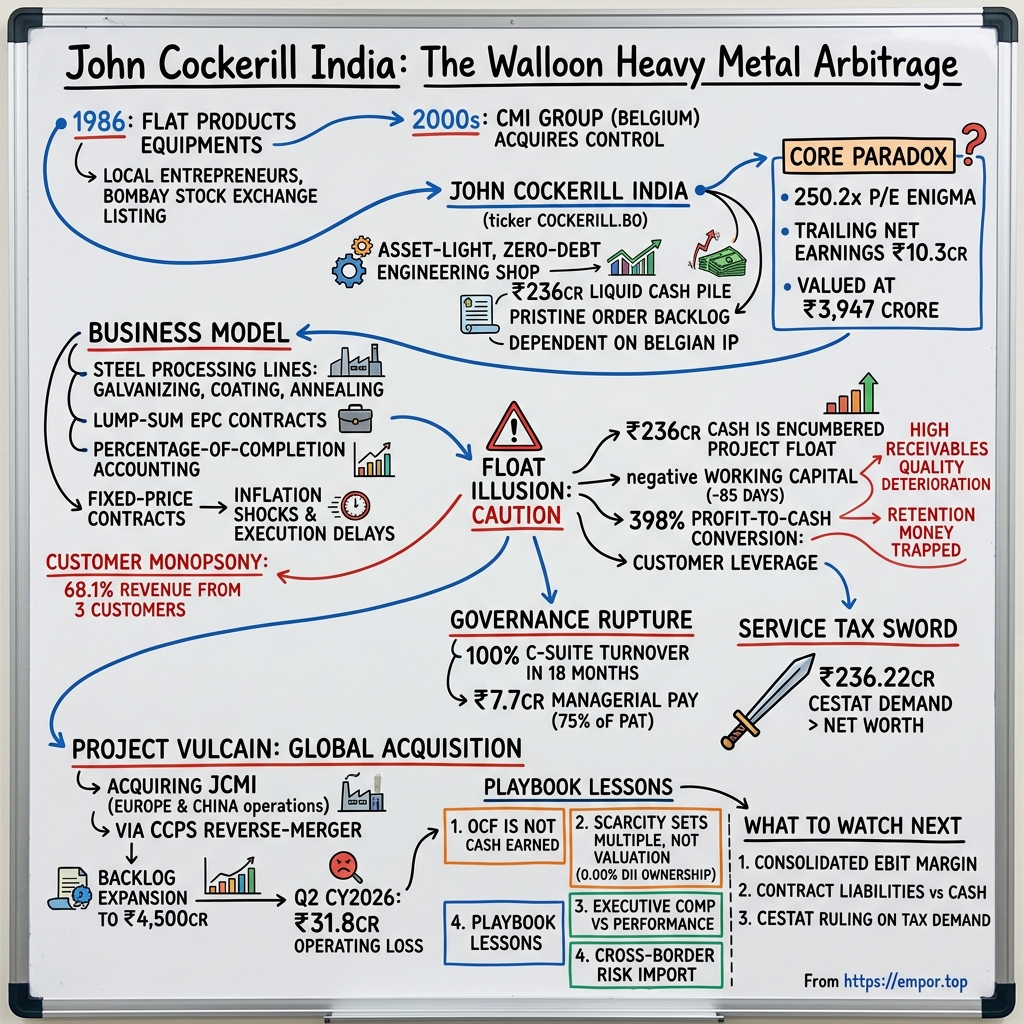
Now picture the screen of a retail trader in Pune on the morning of October 1, 2026. The ticker for this same workshop, John Cockerill India, reads ₹7,989.55 a share. That price values the company at about ₹3,947 crore, or roughly $410 million1. The last full year of earnings, the twelve months to December 2025, produced net profit of about ₹10.3 crore, a little over $1 million2. Divide one by the other and the market is paying about 250 times earnings for this business, about 158 times EV/EBITDA, and about 11 times sales1.
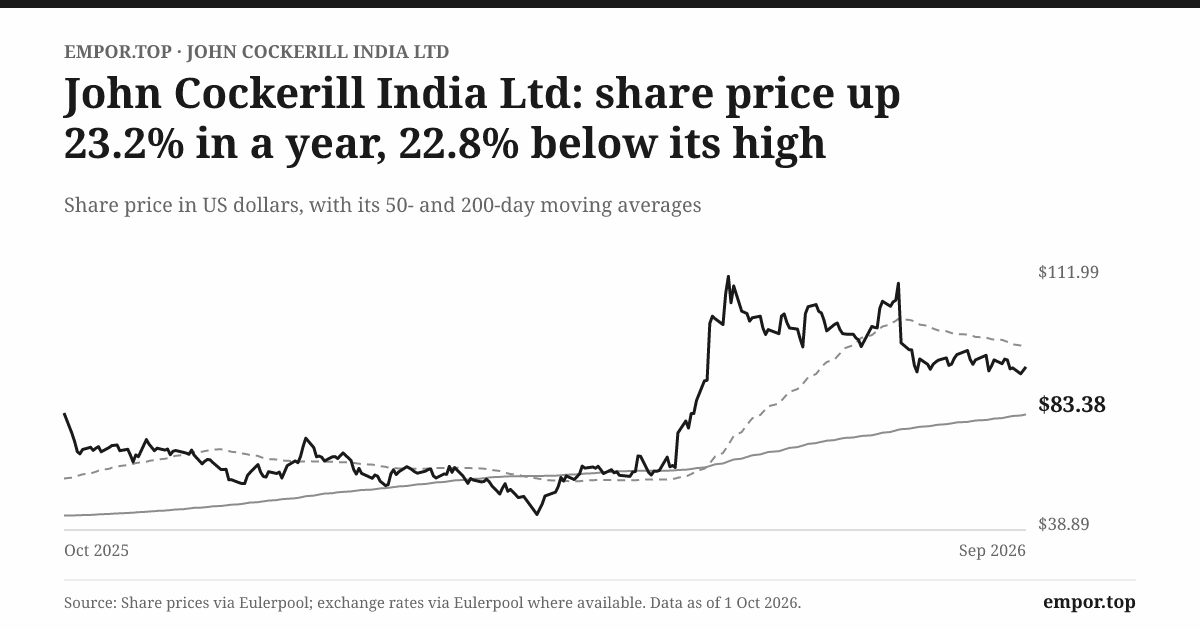
Those numbers do not belong to a heavy-engineering contractor. They belong to a software company with a monopoly. And yet the stock is not some forgotten micro-cap that nobody has noticed. Over the past year it has traded as high as ₹10,294 and as low as ₹4,084, a range that tells you the market cannot decide what this thing is1.
The Belgian Lineage
This story has two ancestors. The first is an Indian company incorporated in 1986 as Flat Products Equipments (India) Ltd, a maker of equipment for steel strip processing that listed on the Bombay Stock Exchange in the late 1980s2. The second is far older. In 1817, an English industrialist named John Cockerill set up ironworks at Seraing, on the Meuse river in Wallonia, and turned the valley into one of the furnaces of Continental Europe's industrial revolution. Locomotives, steam engines and steel poured out of Seraing for generations. The modern group that carries his name, John Cockerill SA, adopted it in 2019 after decades as CMI (Cockerill Maintenance & Ingénierie), marking two centuries of history3.
Somewhere along the way, the Belgian group took control of the Indian strip-line specialist, renamed it, and kept it listed. By December 2025, John Cockerill SA owned about 70% of it, and the rest sat with Indian retail investors2. In 2026, the parent chose this small Indian listing as the vehicle into which it folded its global metals business.
The Core Paradox
On paper, John Cockerill India looks like a dream. It has no bank debt. It sits on about ₹236 crore of cash and deposits. It sells high-value finishing lines to India's largest steelmakers just as the country builds out steel capacity and the world talks about green steel2. Its parent has handed it a global platform.
Underneath the paper, the picture changes. Every one of its four top officers was replaced within about eighteen months. Executives took home roughly three-quarters of last year's profit. A service tax demand larger than the company's entire net worth has been pending before a tribunal for close to a decade. A customer has dragged it into arbitration over a cold rolling mill that allegedly did not perform. And the first quarter after the global acquisition showed up with a net loss of about ₹31.8 crore, three times the whole of the prior year's profit24.
So which is it: a hidden global engineering champion priced for a long runway, or an execution desk whose cash belongs to its customers and whose valuation is set by a float that institutions refuse to touch?
Roadmap of the Story
The story runs in six movements. First, the origins: how a Taloja rolling-mill fabricator became a Walloon corporate outpost. Second, the unit economics of steel processing lines, where 18-to-36-month fixed-price contracts and percentage-of-completion accounting set a trap for anyone reading the income statement. Third, the float illusion: why a decade of operating cash nearly four times net profit is evidence of customer leverage rather than earnings quality. Fourth, the governance rupture: the executive clean sweep, the pay, and the ₹236 crore tax case. Fifth, Project Vulcain, the reverse-merger mechanics by which the Indian entity acquired John Cockerill Metals International with preference shares. Finally, the frameworks, the bull and bear collision, the lessons, and the moments that will decide what this company actually is.
It begins, as most Indian industrial stories do, with a workshop and a protected market.
 Subscribe on LinkedIn
II. From Flat Products to Walloon Heavy Metal: The Making of an MNC Subsidiary (10:00–22:00)
A Workshop in the License Raj
In 1986 India's steel industry was a creature of the state and of licenses. Steel Authority of India dominated, a handful of private mills operated under quotas, and importing a complete processing line meant foreign exchange approvals that could take years. That scarcity created an opening for local engineering shops that could build the machines steelmakers needed without a trip to Düsseldorf or Linz. Flat Products Equipments (India) was one of them, incorporated in 1986 to supply equipment for flat steel: cold rolling mills, shearing and slitting lines, the plumbing of the strip-processing world2.
The company built its reputation the slow way, through heavy fabrication at workshops in the Taloja and Hedavali belt of Maharashtra. It listed on the BSE in the late 1980s, and its share capital was set at a size that has barely moved since: about ₹4.94 crore, divided into 4,937,813 shares of ₹10 each2.
The Belgian Suitor Enters
After liberalization opened the market in 1991, Indian steel capacity started to grow and global equipment makers arrived to sell into it. The Belgian group then known as CMI was one of them. Its specialty overlapped almost perfectly with the Indian company's: CMI had built a global business in cold rolling mills, galvanizing lines and acid regeneration plants. Buying control of a listed Indian fabricator gave it something it could not easily build from scratch, which was a low-cost workshop with local customer relationships and Indian engineering talent.
The Belgian parent eventually held 75% of the shares, the maximum a promoter can hold while keeping a company listed under Indian rules2. The Indian workshops became part of a global supply chain: detail engineering, fabrication and site execution in India, with process technology and licensing flowing from Belgium. When the group took the John Cockerill name in 2019, the Indian subsidiary took it too3.
The Missing IP Layer
Here is the first test of the investment case. Investors who pay 250 times earnings for an engineering company are implicitly paying for technology, for something competitors cannot copy. So where is the technology?
The annual report answers plainly. In its disclosure on research and development, John Cockerill India states capital R&D spending as nil, and says recurring R&D is "charged to normal heads and not determinable." Asked to list technology imported over the past five years, it writes "NIL"2. The company had 378 permanent employees at the end of 20252.
That is not a scandal. It is a design choice. The process know-how that makes a John Cockerill galvanizing line a John Cockerill galvanizing line lives in Belgium, and the Indian company pays for access: about ₹1.78 crore in brand fees and ₹2.67 crore in technical and referral royalties to the parent in 2025, about 1% of turnover2. Navi Mumbai supplies execution, detail engineering and workshop labor. The intellectual property is rented, not owned.
The verdict on the "technology moat" claim, then, is that the history narrows it sharply. The listed company has execution skill and customer access. The deep moat, if one exists, belongs to its parent, which decides what the Indian entity can sell and on what terms.
Capital Discipline or Frozen Shell?
The second clue is the share count. For more than a decade, John Cockerill India issued no new equity, ran no rights issue, and did no buyback. Share capital sat at ₹4.94 crore2. It is tempting to call that discipline. A more accurate description is that the company never needed outside capital, because its customers funded its working capital (more on that in section IV), and its parent had no reason to put money in or take it out through the listed vehicle.
What was preserved was a structure: 75% with the parent, 25% with the public, small and illiquid. The company paid almost nothing in dividends. Over ten years it generated about ₹355 crore of free cash flow and paid out roughly ₹3.4 crore, about 1% of it25. The cash stayed in the company, in bank deposits.
The long view captures what kind of business this produced. Shareholders' equity hovered between about $22 million and $29 million for a decade, the property, plant and equipment line shrank from about $10.6 million to $6.6 million, and the company never borrowed money from banks2. The book did not grow because profits were thin and the parent did not need it to grow.
For investors, the takeaway is that the listed entity was built as a captive executor for the group's global steel business, not as a compounder. That matters, because the 2026 transformation asks shareholders to believe it has suddenly become something else. To judge that claim, the next step is to understand how the business actually earns money, project by project.
III. The Cold Rolling Moat and the 36-Month Milestone Trap (22:00–37:00)
A Line in Kalinganagar
Kalinganagar, in Odisha, is where Tata Steel has been building one of India's largest integrated steel complexes. Among its newer pieces of equipment are a continuous annealing line and a continuous galvanizing line, packages John Cockerill India helped engineer and supply2. On a project like this, the Indian company's engineers spend months on site, supervising erection, threading the first strip, tuning furnace temperatures and zinc-pot chemistry, and running the performance tests that decide when the customer will release the last slice of payment.
Meanwhile, back in Navi Mumbai, the procurement team watches the prices of plate steel, motors, drives and freight. Every rupee those prices rise during the project comes out of the margin, because the contract price was fixed the day it was signed.
The Technology Portfolio, in Plain English
The equipment matters to the story, so a short tour. A steel mill's hot strip mill produces coil that is thick, scaly and rough. To make car-body steel or appliance sheet, that coil goes through a sequence of finishing lines.
An acid regeneration plant (ARP) recovers the hydrochloric acid used to strip scale off the coil, which is both a cost and an environmental requirement. A cold rolling mill squeezes the strip thinner at room temperature. A continuous annealing line (CAL) reheats the hardened strip in a long furnace to restore its formability. A continuous galvanizing line (CGL) dips it in molten zinc to stop rust. A colour coating line (CCL) paints it. Think of these as the finishing school for steel: they are where most of the value in flat steel is added, and they are what John Cockerill India sells2.
Contract Architecture and the Fixed-Price Vulnerability
The company sells these lines as lump-sum turnkey projects. It designs, engineers, supplies, erects and commissions the line, over 18 to 36 months, for a fixed price, with liquidated damages that can reach 5% to 10% of contract value if it is late or the line underperforms2. About 84% of revenue in 2025 came from this kind of project work; spare parts brought in about 12% and maintenance and revamp services about 3.6%2.
Accounting for such contracts follows Ind AS 115, the Indian version of the global revenue standard. The company recognizes revenue as the project progresses, usually by comparing costs incurred to total expected costs. The trap is that reported profit depends on management's estimate of the final cost of a project that may not finish for two years. If the estimate is too optimistic, profits are booked early and reversed later. That is precisely the pattern visible in the quarterly record: a quarter with a 24% operating margin in mid-2024 followed by negative margins in the next three quarters26.
A 5% to 10% liquidated-damages cap matters because the company's operating margin in its best recent year was about 4.7%2. In other words, a single delayed project can erase a year of profit on that contract and more. Fixed price plus punitive delay penalties plus thin margins equals operating leverage in both directions.
Customer Monopsony and Counterparty Clout
Who sits on the other side of these contracts? A handful of very large, very sophisticated steelmakers. In 2025, John Cockerill India's top three customers generated about 68% of revenue. The largest accounted for about a third. The next two, linked to ArcelorMittal Nippon Steel India and Jindal Steel Odisha, accounted for about 19% and 16%2. In 2024 the concentration was even more extreme: the top three were 92% of revenue27.
When three buyers account for most of your revenue, they set the terms. They decide milestone schedules, they hold back retention money until they are satisfied, and they demand bank guarantees for every advance they pay. A steelmaker deciding between John Cockerill, SMS group, Danieli and Primetals for a galvanizing line has options. The Indian company has a few customers and, in any given year, a handful of live projects.
The Latent Operational Flare-Up
After the close of 2025, the risk of this model surfaced in a concrete way. An unnamed customer started arbitration against the company, alleging defective performance of a cold rolling mill it had supplied and seeking liquidated damages and lost profits2. The company does not name the customer or quantify the claim. But the shape of the dispute shows the mechanism: profits that were booked as the mill was built can turn into a contingent liability once the customer argues the mill does not meet its guarantees.
Historical Falsification: Is This a Stable Grower?
The bull narrative is that India's steel buildout gives John Cockerill India a long, steady runway. The company's own decade says otherwise. Revenue was about $77 million in the year to March 2018, fell to about $28 million two years later, climbed to about $107 million in the year to March 2024, and dropped back to about $41 million in calendar 2025278. Over the three years to 2025, local-currency revenue shrank about 7% a year2. Losses appeared in the year to March 2020 and again in calendar 202427.
That record rejects the "stable growth" version of the thesis. It leaves intact a narrower claim: when Indian steelmakers spend on finishing capacity, the company can win large packages and execute them. But orders arrive in lumps, margins are set by the buyer, and the gaps between capex waves are long and painful. The KPI that would change this verdict is a sustained operating margin, excluding interest income, above the single digits through a full cycle, which the company has not delivered in the past decade.
If the income statement is this volatile, how has the company built up so much cash? The answer is that most of it is not really the company's.
IV. The Float Illusion: When ₹236 Crore in Cash Belongs to the Customer (37:00–52:00)
The Treasury Desk
Inside the finance office in Navi Mumbai, the most profitable activity in 2025 was not building galvanizing lines. It was rolling over fixed deposits. The company earned about ₹6 crore of bank interest that year2. Total other income, including a gain from selling fixed assets, was about ₹9 crore, which equaled roughly 80% of reported pre-tax profit of about ₹11.35 crore2.
At the same desk, project managers were tracking something larger: about ₹191 crore of advances that customers had paid for work not yet done2. The cash and the advances are, in a real sense, the same money.
Unpacking the 398% Cash Conversion Paradox
Over the ten years to 2025, John Cockerill India reported cumulative net profit of about ₹96 crore and cumulative operating cash flow of about ₹382 crore, almost four times as much25. In most companies, that would be a sign of extraordinary earnings quality. Here, it is a sign of who funds the business.
In lump-sum contracting, customers pay mobilization advances up front, then milestone payments as engineering and supply progress. If the contractor collects faster than it spends, it holds the customer's cash. The company's working capital days stood at about minus 85 in 2025, meaning customers were effectively financing almost three months of revenue2.
The swing between 2024 and 2025 shows how violently this float moves. In 2024, operating cash flow was negative by about ₹66 crore. In 2025, it was positive by about ₹159 crore27. Profit did not drive that swing; a jump of about ₹83 crore in contract liabilities (money received ahead of work) and about ₹30 crore of collections did2. A single year's new advances explain most of the cash on the balance sheet.
Think of it like a travel agent who takes your money for a holiday six months away. The bank balance looks splendid. But the hotels and airlines still have to be paid, and when they are, the cash disappears.
Receivables Quality: The Retention Trap
The other side of the ledger is less flattering. At the end of 2025, gross trade receivables were about ₹236 crore, and about two-thirds of that, roughly ₹158 crore, was retention money2. Retention is the slice of each payment a steelmaker holds back until the line passes its final acceptance and performance guarantee tests. It is real money, but it is conditional money, and the customer decides when the conditions have been met.
On top of that, the company carried about ₹107 crore of contract assets: work it had performed and recognized as revenue but had not yet been able to invoice2. And the quality of receivables worsened. The expected credit loss allowance nearly doubled in 2025, from about ₹7.6 crore to about ₹14 crore; about ₹26.5 crore was past due, and about ₹12.6 crore was classed as credit-impaired2. Debtor days, at 335, were the second-highest reading since 20202.
Put those clues together and the reveal is uncomfortable. The company has collected advances on new projects while waiting to collect retention on old ones, some of which are now disputed. Cash is high because the new projects are early; receivables are high because the old projects are not closed.
Treasury as the Operating Crutch
The cash itself is safe in the narrow sense. It sits in bank deposits earning roughly 6.5% to 7.5%, with no mutual funds or equities2. The total was about ₹236 crore, of which about ₹20.5 crore was margin money held against bank guarantees and about ₹9.2 crore was restricted non-current deposits2.
But the role of that interest income in the profit-and-loss account is telling. In 2024, the core business lost about ₹7.2 crore before other income; the ₹4.9 crore of other income reduced, but did not eliminate, the loss27. In 2025, interest and asset-sale gains carried most of reported pre-tax profit2. The treasury is not a fortress funding shareholder wealth; it is a cushion that hides how thin the operating economics are.
The verdict: the ₹236 crore is encumbered project float. It will fall as projects move from engineering into procurement and installation, and the 2024 swing shows how quickly that can happen. For an investor, the right comparison is not cash against market value. It is cash against contract liabilities of about ₹251 crore2. On that measure, the company's net position is roughly zero.
That brings the story to the people responsible for managing this float, and to a tax claim that would dwarf it.
V. The C-Suite Clean Sweep and the Shadow of Mumbai CESTAT (52:00–1:07:00)
The 40th AGM
On June 25, 2026, John Cockerill India held its 40th annual general meeting9. A retail shareholder who had attended the meeting two years earlier would have recognized almost no one in charge. The chairman was new. The managing director was new. The chief financial officer was new. The company secretary was new2.
The resolutions passed with about 99.99% approval10. That near-unanimity says less about shareholder enthusiasm than about arithmetic: the parent controlled about 70% of the votes, and the rest of the register is scattered among more than thirteen thousand small holders25.
The Executive Exodus
The sequence ran over 2024 and 2025. In May 2024, Chairman Sebastien Roussel gave way to Francois-David Martino. In October 2024, CFO Kiran Rahate was replaced by Marc Dumont. In August 2025, Managing Director Michael Kotas stepped down and Frederic Rene Martin took over. In December 2025, long-serving Company Secretary Haresh Vala resigned and Nidhi Salampuria was appointed2.
The company frames the new team as part of a global alignment: experienced group executives arriving to run an entity that would soon consolidate the group's metals business2. That explanation is plausible, and the timing fits the acquisition. But the turnover also coincided with the worst stretch in the company's recent record: a net loss in 2024, cash losses of about ₹3.56 crore that year flagged by the auditor, a doubling of credit-loss provisions, and the customer arbitration2. The company does not publish the reasons for each departure. Both readings fit the evidence; what the record shows clearly is that institutional memory in the listed entity's top tier was replaced in under two years, just as its business became far more complex.
Remuneration vs. Performance
Pay tells its own story. Key managerial personnel received about ₹7.70 crore in 2025, about 75% of the year's net profit. In 2024, when the company lost about ₹5.4 crore, they received about ₹4.84 crore2. The managing director's pay was about 21 times the median employee's2.
In absolute terms, this is not lavish by multinational standards. The issue is proportion. In a company whose profits are this thin and this cyclical, executive pay behaves like a fixed cost that ranks ahead of shareholders. Profits swing; pay does not.
The ₹236 Crore Sword of Damocles
Now the tax case. The Large Taxpayer Unit Commissionerate demanded service tax, interest and penalties totaling about ₹236 crore, arguing that the company's contracts from 2010 to 2017 were single, indivisible "works contracts" rather than separate contracts for equipment supply (taxed as goods) and installation (taxed as services)2. The distinction matters enormously. If the contracts were divisible, most of their value was outside the service tax net. If they were one works contract, a much larger share was taxable.
The disputed amount exceeds the company's standalone net worth of about ₹210 crore2. The company paid a pre-deposit of only about ₹3.6 crore and appealed to the Customs, Excise and Service Tax Appellate Tribunal in Mumbai, under appeal number ST/85847/17, where it has been pending for years211. Management and its legal advisers believe the precedents favor treating such contracts as divisible, and the company has not provided for the claim2.
The auditor, S R B C & CO LLP, an EY network firm, did not qualify the accounts. In its CARO report it listed the disputed service tax principal of about ₹53 crore among unpaid disputed dues and noted the 2024 cash loss2. That is the auditor recording the dispute, not endorsing it.
How should an investor weigh this? Tax tribunals in India have often sided with taxpayers on divisible-contract questions, and the demand has hung over the company for years without crystallizing. But the asymmetry is stark. A favorable ruling removes an overhang the market has largely ignored. An unfavorable one, even partially, could consume the standalone equity and the encumbered cash at the same time. With a 250x multiple, the market is pricing the favorable outcome as near certain.
Promoter Sell-Down and Captive Float
In late December 2025, John Cockerill SA sold 225,000 shares in the open market, about 4.56% of the company, cutting its stake from 75% to 70.44%25. The timing created headroom: the forthcoming preference share issue to the parent would push its holding back up, and Indian rules cap promoter ownership at 75% for listed companies.
Who bought? Not institutions. At the end of 2025, domestic mutual funds, insurers and banks owned 0.00% of the company, and foreign portfolio investors owned 0.02%, a little over a thousand shares5. The public float of about 27% belonged to about 13,224 resident individuals, Hindu undivided families and small corporate holders25.
That ownership pattern is the single most important clue about the valuation. A stock with no institutional holders has no analysts, no investor calls of note, and no buyers who anchor on cash flow. Its price is set by a small pool of retail holders trading a small float, which is exactly the environment in which a 250x multiple can persist.
With the people and the tax case in view, the next question is what the parent did with this listing in 2026.
VI. Project Vulcain: Importing the Global Empire or Walloon Losses? (1:07:00–1:25:00)
January 1, 2026
On the first day of 2026, the Indian company became the owner of John Cockerill Metals International SA, the Belgian holding company for the group's metals businesses in Europe and China2. Internally, the transaction was known as Project Vulcain, after the Roman god of the forge. For the first time, the BSE-listed subsidiary sat above its sister companies rather than beside them.
Seven months later, the first consolidated quarter under the new perimeter arrived. Revenue for the quarter to June 2026 was about ₹299 crore, up about 264% from a year earlier. The bottom line was a net loss of about ₹31.8 crore4.
The Architecture of Project Vulcain
The logic, from the parent's side, is straightforward. John Cockerill SA wanted to consolidate its global metals division under one listed roof, and it already owned 70% of a listed metals company in India trading at a very high multiple. Selling the European and Chinese metals operations to that company, and taking payment largely in the listed company's own securities, converts unlisted assets into a stake in a richly valued listed vehicle.
The amended price was about €24.32 million. About €5 million was payable in cash by June 30, 2026. The remaining €19.32 million, roughly ₹204 crore, was settled by issuing 35,185 non-cumulative compulsorily convertible preference shares (CCPS) of ₹100 face value to the parent, at about ₹58,029 each212. Each converts into ten equity shares, for a total of 351,850 new shares, taking the share count to 5,289,6632. The parent's stake rises to about 72.3%2.
The implied price per equity share, about ₹5,803, was well below the ₹7,989 the stock fetched on October 1, 202612. Indian preferential pricing rules anchor the issue price to recent trading averages, so the gap reflects the stock's subsequent rise rather than a giveaway. Still, minority shareholders should note who set the terms. The buyer and seller sit under the same parent, and the parent's votes decided the approval.
The Balance Sheet Accounting Quirk
Because the deal is between companies under common control, Indian accounting rules (Ind AS 103, Appendix C) require the acquirer to record the target's assets and liabilities at their existing book values, without creating goodwill. Any difference between the price paid and the net assets acquired goes straight against reserves2.
The effect was striking. Data providers now show a consolidated book value of about minus ₹194 per share1. Standalone equity at the end of 2025 was about ₹210 crore, or about ₹426 per share2. CARE Ratings, which rates the company's bank facilities at CARE BBB / CARE A3+, kept them on "Rating Watch with Developing Implications" in April 2026, citing among other things the absorption of JCMI and the initially negative consolidated net worth before preference share recapitalization13.
A negative book value does not by itself mean the company is insolvent; it is partly an artifact of common-control accounting. But it does mean that the consolidated entity carries more liabilities than book assets, and that the cushion against a bad tax ruling or a bad project has shrunk.
The Reality Check of Q2 2026
Look at the quarter more closely. Revenue roughly tripled because the European and Chinese operations were now included. But the consolidated operating margin swung to about minus 10%, from about plus 0.5% a year earlier46. The net loss of about ₹31.8 crore was roughly three times the standalone company's profit for all of 202524.
The company does not publish a segment breakdown that isolates JCMI's contribution, so the causes cannot be split exactly. What the results show is that the acquired businesses brought cost overruns on legacy European contracts, integration costs and heavier overheads that the Indian engineering margin could not absorb4. One quarter does not establish a trend. But it falsifies the simplest bull story, which is that the Indian entity was being handed a profitable global platform.
Management highlights the other side: a consolidated order backlog of about ₹4,500 crore, against a standalone backlog of a little over ₹1,100 crore before the deal213. That is roughly four years of revenue at the new run rate. The question is what margin that backlog carries. A backlog is a promise of work, not of profit, and a backlog of fixed-price contracts in Europe that are already overrunning is a liability as much as an asset.
Related-Party Entanglements
Even before Vulcain, the listed company was deeply intertwined with its parent. In 2025 it bought about ₹17.8 crore of goods from fellow subsidiaries, mainly a Beijing technology affiliate; paid about ₹11.7 crore for shared IT and administrative services to a group service company; and paid the brand fees and royalties noted earlier2. It also recognized about ₹61.7 crore of unbilled work for John Cockerill Industry North Americas, which in turn paid it about ₹45 crore of advances2.
That North American contract alone was equivalent to about a sixth of 2025 revenue. After Vulcain, intra-group flows become much larger, and transfer pricing between the Indian entity, its new European subsidiaries and the Belgian parent will shape reported margins in ways outside shareholders cannot easily audit.
The verdict: Project Vulcain has turned a small, cyclical Indian contractor into the listed front end of a global metals business, at the cost of immediate losses, a negative consolidated book, and a far larger web of related-party dealings. Whether it imported an empire or a set of problems is not yet settled; the first evidence leans toward problems. What lessons does this story teach that apply beyond one company?
VII. Playbook: Business & Investing Lessons (1:25:00–1:37:00)
Lesson 1: Cash flow from operations is not always cash earned.
The moment: a company that converted ₹96 crore of profit into ₹382 crore of operating cash over a decade, while holding about ₹251 crore of contract liabilities at the end of it25. A screen that ranks companies by cash conversion would put John Cockerill India near the top. A reader of its balance sheet would see that nearly every rupee of that cash is owed back, in steel, motors and labor, to the customers who advanced it.
The wider lesson for founders and investors is that in any business paid in advance, whether contracting, subscriptions or travel, operating cash flow measures the timing of obligations as well as profitability. The only test that works is to set the cash beside what is owed for it.
"In lump-sum contracting, a ballooning cash pile is often just a debt owed in equipment and labor."
Lesson 2: Watch who holds the other quarter of the float.
The moment: a company valued at about $410 million in which domestic institutions own nothing and foreign portfolio investors own two-hundredths of a percent, with the entire public float spread across about thirteen thousand individuals15. When the parent sold 4.56% in December 2025, it was retail money that absorbed it.
Valuation multiples are set by the marginal buyer. Where institutions are absent, nobody is anchoring the price to cash flows, and a thin float makes price moves larger in both directions. A one-year volatility of about 53% and a five-year maximum drawdown of about 60% are what that looks like in practice1.
"When institutions refuse to own a stock at any price, the multiple is set by scarcity, not valuation."
Lesson 3: Executive pay in a down year reveals governance reality.
The moment: managers paid about ₹4.84 crore in a year the company lost about ₹5.4 crore, and about 75% of profit the next year, just as the entire top tier turned over2. In a business whose margins depend on estimates of the final cost of 36-month projects, managers who are paid regardless of outcome, and who may not be there when those projects close, have little reason to be conservative.
For investors, pay that does not move with the cycle is a claim on the business that ranks ahead of equity. For boards, the lesson is that in project businesses, compensation should be tied to closed and cash-collected projects, not to booked revenue.
"When leadership extraction stays fixed while earnings swing with the cycle, shareholders are the true junior debt."
Lesson 4: Cross-border reverse acquisitions often export the parent's headache.
The moment: the Indian subsidiary paying its parent €24.32 million, mostly in its own preference shares, for the group's European and Chinese metals arm, and reporting its largest quarterly loss in years six months later24. The deal was approved with the parent's own votes, priced by the parent's own counterparties, and accounted for at book value under common-control rules that hide what was really paid for.
When a parent moves assets into a listed subsidiary trading at a high multiple, the first question is not whether the subsidiary gets bigger. It is which side of the transaction gets the better deal, and why that party chose this moment.
"Never mistake a global asset injection for a corporate promotion until you have audited the transferred liabilities."
These lessons are about mechanics. The deeper question is about durable advantage, and that is where the frameworks come in.
VIII. Frameworks: Porter's 5 Forces, 7 Powers & Bear vs. Bull Case (1:37:00–1:52:00)
The Peer Table, Told as a Story
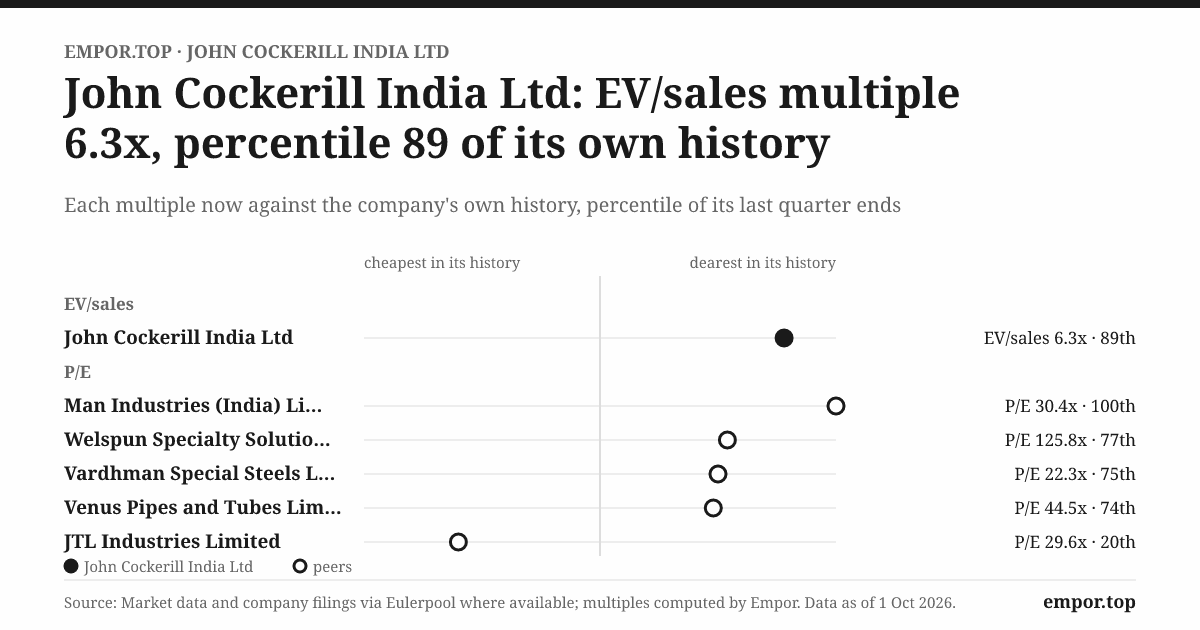
Imagine three Indian capital-goods companies lined up beside John Cockerill India. ISGEC Heavy Engineering, a diversified boiler and process equipment maker, trades around 22 times earnings. Praj Industries, the ethanol and bio-process technology company, trades around 38 times. Elecon Engineering, a gear and material-handling specialist, trades around 32 times2. John Cockerill India trades at about 250 times, against its own five-year median of about 148 times12. Its return on capital employed in 2025 was about 7%; its return on invested capital in the year to March 2025 was negative1.
So the market prices this company at roughly seven to eleven times the multiple of its closest Indian peers, despite lower returns. What does that price assume? Either that earnings will grow many-fold quickly, as the global perimeter becomes profitable, or that the float will remain scarce enough that the multiple does not matter. The frameworks help test the first assumption.
Porter's Five Forces
Bargaining power of buyers: high. This is the force that dominates. A small oligopoly of Indian steelmakers, among them Tata Steel, AM/NS India, JSW Steel and Jindal Steel, accounts for most of revenue, with the top three customers at 68% to 92% in the last two years27. They set payment milestones, retain about 10% of payments until final acceptance, demand bank guarantees and, as the cold rolling mill arbitration shows, litigate when they are unhappy2.
Threat of substitutes: moderate. There is no substitute for a galvanizing line if you want galvanized steel. But steelmakers can delay new lines, refurbish old ones, or buy secondhand equipment, and in downturns they do all three. The revenue collapse from 2018 to 2020 shows what that looks like2.
Bargaining power of suppliers: moderate to high. Lines depend on specialized drives and automation from a few global vendors, heavy forgings and rolls, and structural steel whose price moves with the same cycle that drives customer demand. Fixed-price contracts mean the company absorbs these swings.
Threat of new entrants: low to moderate. Steelmakers are conservative buyers. A new entrant without reference installations will struggle to win a ₹500 crore line, and that protects incumbents. But the incumbents are formidable: SMS group, Danieli, Primetals Technologies and Chinese equipment makers all compete for Indian tenders.
Rivalry: high. That competition from global giants, bidding on a handful of large tenders each year, keeps margins in the low single digits. The company's best operating margin of the past decade, about 6% in the year to March 2019, would be considered poor in most industries2.
Hamilton Helmer's 7 Powers
Scale economies: weak. Each line is custom-engineered. The Taloja and Hedavali workshops carry fixed costs, but more volume does not make each line much cheaper to build.
Network effects: none. One steelmaker's line does not make the next customer's more valuable.
Counter-positioning: none. The company uses the same turnkey EPC model as its global competitors.
Switching costs: low before the sale, higher after. At the tender stage, steelmakers switch easily. Once a line is running, the original supplier has an advantage in spares and revamps. But spares are only about 12% of revenue, which limits how much of this power reaches the income statement2.
Branding: moderate. The John Cockerill name carries two centuries of heritage and real recognition among steel engineers. The Indian company pays its parent for it2.
Cornered resource: weak for the listed entity. The core process technology and patents sit with John Cockerill SA. The Indian company licenses them2.
Process power: the one real candidate. Decades of detail engineering and site execution on acid regeneration plants and galvanizing lines in Indian conditions constitute real, hard-to-copy know-how. It reduces the risk of catastrophic field failures. But the arbitration over a cold rolling mill shows that even this power is not complete.
The conclusion of the frameworks is clear. John Cockerill India has narrow process power and a respected brand, but no structural moat in the listed entity. Buyer power and global rivalry cap returns. Nothing in the historical record supports the idea of durable, high returns on capital, and the 250x multiple cannot be explained by the business's competitive position.
The Bull Case
The strongest version of the bull case runs like this. First, the consolidated backlog of about ₹4,500 crore gives several years of revenue visibility across India, Europe and China2. Second, global steel decarbonization, including hydrogen-based direct reduced iron, electrical steels for electric-vehicle motors and more efficient processing lines, puts the John Cockerill group in the path of a large capex wave3. Third, if the group routes European engineering and fabrication through Indian workshops, it could lift group margins substantially by arbitraging labor costs. Fourth, with the parent at about 72% and no institutional supply, scarcity could sustain an elevated multiple for a long time.
Tested against the record: the backlog is real, but its margin is unproven and the first consolidated quarter was deeply negative4. Decarbonization is a group-level opportunity; the listed entity's share of it depends on how the parent allocates work and sets transfer prices. Labor arbitrage is a plausible mechanism, but the company has not published a plan, a margin target, or a timeline. The bull case is not rejected, but it is unproven at every step, and its most important variable sits in Belgium.
The Bear Case
The bear case is more concrete. The valuation, at about 250 times earnings and 11 times sales, assumes a transformation the business has never achieved1. The first consolidated quarter showed the acquired perimeter diluting margins rather than lifting them4. The tax case, if lost, could erase standalone equity2. And the float that funds the cash pile will reverse as projects move into procurement, as it did in 2024 when operating cash flow swung deeply negative27.
An activist short would focus on three questions. Why did the parent sell shares at market prices in December 2025 and then issue new shares to itself at a lower price in 2026? What did the acquired business earn in the year before the deal, and why is that not disclosed in a way minority holders can easily use? And why was the entire top management team replaced before the restructuring closed? None of those questions has a public answer from the company that settles it.
Key Performance Indicators to Track
Three numbers matter most.
First, consolidated operating margin excluding other income. The latest quarterly reading was about minus 10%, down from slightly positive a year earlier46. It needs to turn sustainably positive to show the integration works.
Second, cash against contract liabilities. At the end of 2025, about ₹236 crore of liquid funds sat against about ₹251 crore of contract liabilities, a roughly balanced position2. If cash falls faster than liabilities are discharged, the float is unwinding.
Third, retention and overdue receivables. Retention money stood at about ₹158 crore, with about ₹26.5 crore past due and rising credit-loss provisions2. Retention collected on time is the clearest proof that old projects are actually closing.
Those KPIs frame the decisive moments ahead.
IX. Epilogue (1:52:00–1:58:00)
Where John Cockerill India Stands Tonight
On the evening of October 1, 2026, John Cockerill India is two companies stacked on top of each other. One is the Taloja and Hedavali workshop that has built strip-processing lines for India's steelmakers for four decades, with thin margins, lumpy orders and customers who hold the cash. The other is the newly listed front end of a global metals business, with a backlog of about ₹4,500 crore and a first consolidated quarter deep in the red24.
The share price, about 22% below its 52-week high but still near historic highs, reflects neither company's economics so much as the scarcity of its float1. And the next year will test which of the two stories the numbers support.
The Deciding Moments Ahead
Moment 1: the audited consolidated 2026 annual report. This will be the first full year including JCMI, published in the first half of 2027. If the consolidated business reports a positive operating margin for the year, the June quarter will look like an integration hiccup and the bull case gains its first real evidence. If losses persist, the market will have to price the company as the owner of a loss-making European engineering business, and the gap to peers at 22 to 38 times earnings becomes hard to defend.
Moment 2: the CESTAT Mumbai ruling on appeal ST/85847/17. A win removes a tail risk that already exceeds standalone equity. A loss, even partial, would force provisions, strain the bank guarantees the business needs to bid for new work, and could trigger a further downgrade from CARE213.
Moment 3: the cold rolling mill arbitration. An award or settlement will establish what a disputed project actually costs the company, and set a reference point for the other retention balances still outstanding2.
Moment 4: operating cash flow in 2026 and 2027. As the projects behind the 2025 advances move into procurement and installation, operating cash should turn down. If it stays positive because new orders bring new advances, the float survives. If it turns sharply negative, the ₹236 crore cash cushion will be revealed for what it was.
The central question remains the one the story opened with: is this a hidden global engineering platform, or a captive contractor priced as if it were one? Tonight, the evidence leans to the second; the answer will come in the numbers of the next four quarters.
X. Outro (1:58:00–2:03:00)
In 1817, an Englishman named John Cockerill arrived in the Meuse valley and built ironworks, blast furnaces and engines that helped power Continental Europe's industrial dawn. Two centuries later, the company that carries his name uses a small, illiquid ticker on the Bombay Stock Exchange to build galvanizing lines in Odisha and to hold a global metals business, while about thirteen thousand Indian retail shareholders own the slice of it that trades at 250 times earnings.
The welders in Taloja are doing the same work they did in 1986. The price on the screen says something has changed. John Cockerill India is an industrial paradox: an engineering subcontractor priced like a monopoly, funded by its customers' advance payments, and carrying the liabilities of two continents on an equity base that, until this year, had not changed in decades.
References
-
BSE Corporate Announcements: John Cockerill India Ltd. (Scrip Code: 500147) — Bombay Stock Exchange, 2026-09-30 ↩↩↩↩↩↩↩↩↩↩↩
-
Annual Report 2025 (FY Ended December 31, 2025) — John Cockerill India Ltd., 2026-06-05 ↩↩↩↩↩↩↩↩↩↩↩↩↩↩↩↩↩↩↩↩↩↩↩↩↩↩↩↩↩↩↩↩↩↩↩↩↩↩↩↩↩↩↩↩↩↩↩↩↩↩↩↩↩↩↩↩↩↩↩↩↩↩↩↩↩↩↩↩↩↩↩↩↩↩↩↩↩↩↩↩↩↩↩↩↩↩↩
-
Group Metals Industry Overview and Technologies — John Cockerill SA, 2026-05-01 ↩↩↩
-
Unaudited Financial Results for the Quarter Ended June 30, 2026 — John Cockerill India Ltd., 2026-08-14 ↩↩↩↩↩↩↩↩↩↩
-
Shareholding Pattern for the Period Ended December 31, 2025 — Bombay Stock Exchange, 2026-01-15 ↩↩↩↩↩↩↩↩
-
Investor Relations: Quarterly / Annual Results and Presentations — John Cockerill India Ltd., 2026-08-14 ↩↩↩
-
Annual Report 2024 (FY Ended December 31, 2024) — John Cockerill India Ltd., 2025-04-15 ↩↩↩↩↩↩↩
-
Annual Report December 2023 — John Cockerill India Ltd., 2024-04-18 ↩
-
Investor Relations: Annual Reports Portal — John Cockerill India Ltd., 2026-06-05 ↩
-
Voting Results and Scrutinizer's Report of the 40th AGM — John Cockerill India Ltd., 2026-06-26 ↩
-
Customs, Excise and Service Tax Appellate Tribunal (CESTAT) Mumbai Appeal Status ST/85847/17 — CESTAT, 2026-01-01 ↩
-
Corrigendum to the Notice of the 40th AGM and Annual Report 2025 — John Cockerill India Ltd., 2026-06-05 ↩
-
Rating Rationale: John Cockerill India Limited — CARE Ratings, 2026-04-10 ↩↩↩
 LinkedIn
 WhatsApp
 Reddit
 Hacker News
 Email
Email Kindle
 RSS Feed
 Spotify
 Apple Podcasts
 Amazon Music
 Audible
 YouTube