Caliber Mining and Logistics: India's Capital-Intensive Mining Powerhouse
I. Introduction & Episode Roadmap
On the morning of Friday, July 24, 2026, a company almost nobody outside central India had heard of six months earlier opened for trading on the National Stock Exchange at ₹500.25 a share, an 18% premium to its issue price of ₹424.1 On the BSE it did marginally better, printing ₹504.1 Somewhere in Nagpur, four cousins who had spent the previous decade buying dump trucks and excavators on borrowed money watched a number on a screen convert their family's iron into a public market capitalisation.
Getting there had required something that, on the surface, looks like the opposite of prudent pre-IPO housekeeping.
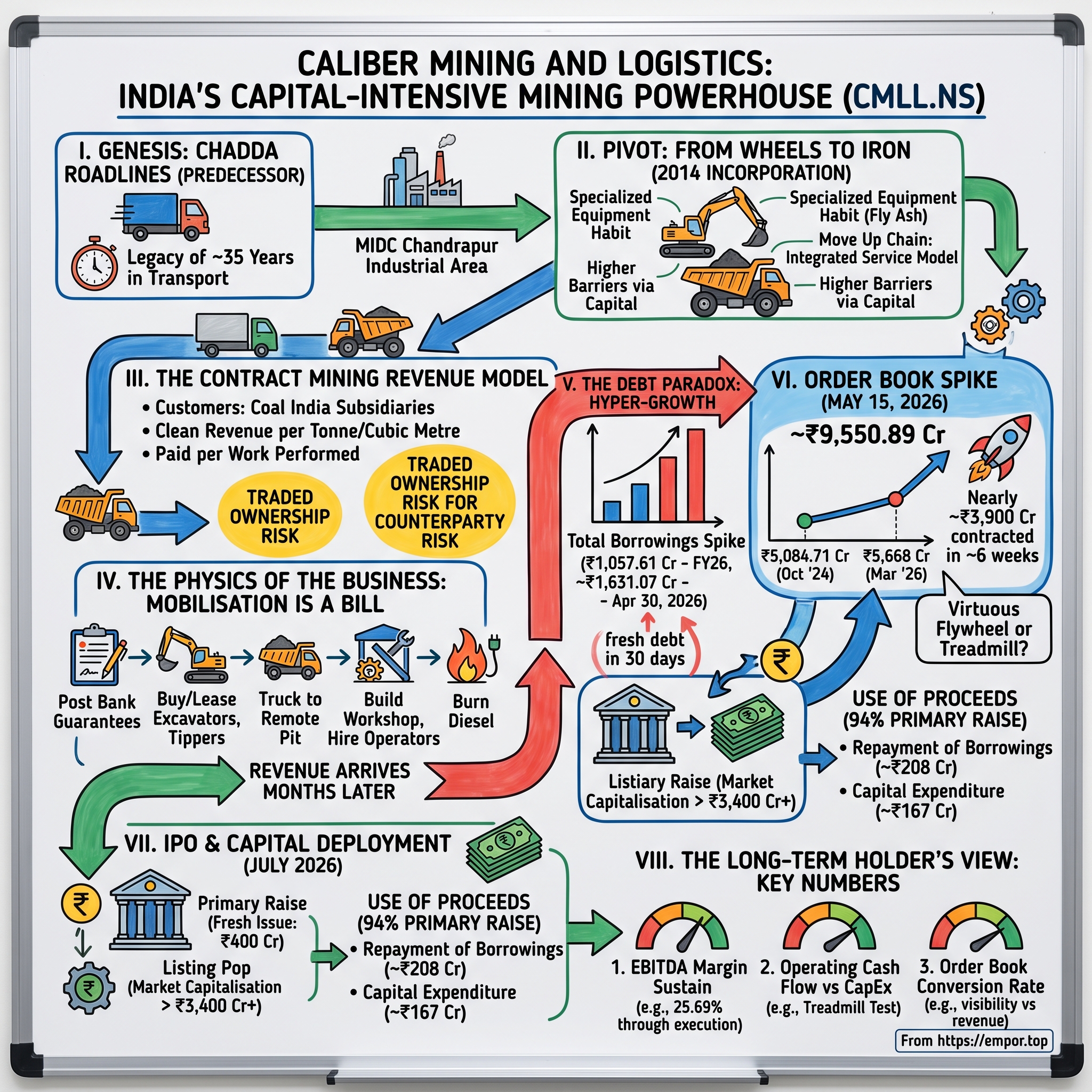
Most companies approaching a listing spend the final quarter tidying the balance sheet. They pay down revolvers, defer discretionary capital expenditure, and walk into the roadshow with a clean leverage story. Caliber Mining and Logistics did the reverse. Its total borrowings stood at ₹1,057.61 crore on March 31, 2026 — already up 63% in a single year from ₹649.27 crore.2 One month later, as of April 30, 2026, outstanding financial indebtedness had reached ₹1,631.07 crore.4 That is roughly ₹573 crore of fresh debt raised in thirty days, by a company that was weeks away from asking public investors for ₹450 crore.1
The explanation is not financial engineering. It is the physics of the business. Over that same window, Caliber's order book went from ₹5,668 crore to ₹9,550.89 crore as of May 15, 2026 — an addition of nearly ₹3,900 crore of contracted work in about six weeks.4 In contract mining, an order win is not a revenue event. It is a bill. Before a single cubic metre of earth is moved, the contractor must mobilise: post bank guarantees, buy or lease the excavators and tippers, truck them to a remote pit, build a workshop, hire and house several hundred operators, and start burning diesel. Revenue arrives months later, and gets paid months after that.
So the debt spike and the order book spike are the same event, viewed from opposite sides of the balance sheet. Whether that is a virtuous flywheel or a treadmill is the question this story turns on.
The scale is real. As of April 30, 2026, Caliber operated 1,911 vehicles, plant and machinery items — 883 tippers, 362 tip trailers, 162 excavators and 64 loaders, of which only 100 units were leased.9 It employed 5,521 people.8 In fiscal 2026 it extracted 4.48 million tonnes of coal and removed 128.07 million cubic metres of overburden across seven open-cast mining projects.3 Revenue from operations reached ₹1,677.66 crore, with reported operating EBITDA of ₹430.91 crore and profit after tax of ₹157.90 crore.23
And yet the company owns no mines. Every rupee of that comes from being hired by someone else — overwhelmingly, by subsidiaries of the Indian government's coal monopoly.
That single sentence contains both the opportunity and the trap. Caliber has no exploration risk, no reserve accounting, no exposure to the price of coal, and no obligation to fund a mine's development. It is paid per cubic metre and per tonne for work it performs, which is about as clean a revenue model as heavy industry offers. It also has no mineral asset, no captive demand, and no ability to walk away from a customer that decides its rates are too high. In the language of corporate strategy, Caliber has traded ownership risk for counterparty risk, and the entire investment debate is an argument about whether it got a good deal.
The core question, then: how does a family transport business from Maharashtra's coal belt, incorporated in its current form only in July 2014, scale to a nearly ₹1,700 crore revenue contract miner in a little over a decade — and can a management team whose customer base is effectively one buyer defend operating margins near 26% while carrying more than a billion and a half rupees of debt for every ₹430 crore of EBITDA?
Here is the road ahead. First, the origin: a Punjabi trucking family in Chandrapur, a fleet of cement carriers, and the unglamorous economics of moving bulk material for a living. Second, the pivot from wheels on the road to iron in the earth, and why India's state coal machine started handing its own core work to private contractors. Third, the growth surge and the debt paradox that sits at the centre of this business. Fourth, the IPO and what the proceeds actually fix — and what they do not. Fifth, a war-game of the competitive position using Hamilton Helmer's 7 Powers and Porter's framework. Sixth, an activist-style stress test of the concentration, governance and accounting exposures. And finally, the handful of numbers that will tell a long-term holder whether this worked.
It starts with a truck.
 Subscribe on LinkedIn
II. The Genesis: Chadda Roadlines & Nagpur's Coal Belt
To understand Caliber, you have to understand where it sits on the map. Nagpur is the geographic centre of India — the "Zero Mile" marker sits in the middle of the city — and about 150 kilometres south of it lies Chandrapur, a hot, dusty district that is simultaneously one of India's largest coal-producing zones, home to a super thermal power station, and a cluster of cement plants that feed off the limestone and the captive power. Coal comes out of the ground here. Cement, fly ash and iron move through here. If your business is shifting heavy, low-value-per-tonne material, this is one of the densest addressable markets in the country.
Caliber's registered office is in the MIDC Chandrapur Industrial Area; its corporate office is in Nagpur.5 That is not a coincidence of real estate. It is the whole strategy, encoded in two addresses.
The family's story begins with a man who was not from there at all. Kishan Kumar Chadda came from Hoshiarpur district in Punjab, worked in trading in Hyderabad, and eventually bought his first truck, founding Shree Chadda Roadlines in Chandrapur.6 This is the archetypal Indian road-transport origin story: one vehicle, one route, one relationship. Growth is measured in units of steel. By 2004 the fleet had reached 50 vehicles, and the breakthrough came in the form of a contract with Manikgarh Cement — the kind of anchor customer that converts an owner-driver into a business.6
Two things about that early period matter for what came later.
The first is the choice of assets over aggregation. Indian logistics has always offered an easier path: broker the freight, don't own the trucks. Aggregators take a spread on capacity they don't finance, don't maintain and don't staff. It is capital-light, and it scales fast. The Chaddas went the other way. By the time Motorindia profiled the firm, Shree Chadda Roadlines ran 400 vehicles — 200 open-body trucks for cement, 135 bulkers for fly ash, 35 tippers for coal and 24 payloaders — serving customers including ACC, Ambuja Cement and Manikgarh Cement, on a turnover of about ₹175 crore.6 The fly-ash line had been added in 2008, an early demonstration of a habit that recurs: find an adjacent material flow that requires specialised equipment, buy the equipment, own the flow.6
It is worth pausing on why that choice is harder than it sounds. A truck bought on debt has to be paid for whether or not it is loaded. Its driver has to be paid, housed and retained. Its tyres wear out on a schedule set by road surface and load, not by revenue. In a market where cement companies and coal buyers can switch transporters in a phone call, the owner-operator carries every unit of risk that the broker sheds. The only justification for accepting that risk is if owning lets you deliver at a cost the broker cannot match — and that only becomes true at density, with disciplined maintenance, and with routes stable enough that the assets stay loaded. The Chaddas were, in effect, making a bet that they could out-operate the market well enough to earn a return on capital that asset-light rivals never had to earn at all.
The second thing that matters is what the family optimised for. In that same profile, the operating detail that gets emphasised is not route density or customer wins. It is tyres. The firm had taken its fleet to 70% radialisation in partnership with JK Tyre, an association described as running for sixteen years, and claimed a 150% improvement in mileage worth roughly ₹30 lakh a year in savings.6 For a sophisticated investor, that anecdote is more revealing than any strategy statement. In a business where the customer sets the price, the only variable you control is cost per unit of work — cost per kilometre, cost per tonne, cost per bank cubic metre. A management team that obsesses over tyre compounds and fuel efficiency at ₹175 crore of revenue is a management team building a cost-position muscle it will need at ₹1,700 crore.
The corporate entity that public investors now own, however, is younger than the family business. Caliber Mercantile Private Limited was incorporated on July 3, 2014, in Maharashtra.7 It was renamed Caliber Mining and Logistics Limited in July 2024 and converted to a public limited company in September 2024 — the standard two-step that precedes an Indian IPO.2 The company describes itself as "a rapidly growing second-generation business house based in Central India, boasting a rich legacy of over 35 years."5
That legacy framing deserves a moment of scepticism, because it is doing real work in the equity story. The listed company is twelve years old. The 35-year claim reaches back to the predecessor transport partnership, which is a legitimate lineage but a different balance sheet, a different customer set and a different risk profile. Public sources on the predecessor firm also carry inconsistent founding dates. An investor should treat the operating heritage as genuine — the family has clearly been moving bulk material in this geography for decades — while treating the audited track record as what it is: three years of scaled financial history disclosed in an offer document, covering fiscal 2024 through fiscal 2026.2 Long heritage does not confer a long earnings record.
The promoter group carries the second generation. Mohit Satishkumar Chadda is Chairman and Managing Director; Manish Krishanlal Chadda, Rahul Roshanlal Chadda and Priya Anuj Chadda serve as whole-time directors, with Anuj Krishanlal Chadda also a promoter.102 Their shareholdings before the offer were disclosed as Mohit at 34.00%, Anuj at 24.09%, Manish at 18.50%, Rahul at 11.94% and Priya at 0.21%, with the promoter group in aggregate holding 90.91% of pre-issue capital.27 Indian naming convention embeds the father's given name in the middle position, which places the four male promoters across three branches of the family rather than in a single sibling set — a structure that matters less for control today, given the concentration, than it may in a future generation when cousin branches have divergent interests.
What the family had by the mid-2010s was a cost-disciplined, asset-owning transport operation with deep local relationships in a coal district. What it did not have was margin. Road haulage of bulk commodities is a price-taking business with diesel as the dominant input and near-zero barriers to a competitor showing up with ten trucks and a lower quote. The customer's decision variable is rupees per tonne per kilometre, and there is no version of a truck that carries coal more cleverly than another truck.
Worse, the ceiling is low even if you win. A transport contract's value is bounded by the distance and the tonnage. A mining contract's value is bounded by the volume of earth that has to be moved to get at the same tonnage — and as established, that volume is an order of magnitude larger. The pool of rupees available to a contractor who removes overburden is simply much bigger than the pool available to a contractor who hauls the coal afterwards, for the same underlying mine.
There is a second, subtler reason to move up the chain. The mine owner would rather sign one contract than five. A bidder who can offer overburden removal, extraction, in-pit hauling, loading and railhead coordination under a single agreement removes coordination risk from the customer's desk. That does not command a price premium in a reverse auction, but it does widen the set of tenders a contractor is qualified to bid for — and in a business where the binding constraint is winning work at all, qualification breadth is worth real money.
So the logic of the pivot was straightforward: bigger addressable spend per mine, higher barriers from the capital required, and a wider set of biddable packages. What it demanded in exchange was a step-change in the size and sophistication of the asset base, and a willingness to finance it. The Chaddas incorporated the vehicle for that in 2014 and spent the next decade paying for it.
That meant going to the mine face.
III. The Strategic Pivot: From "Wheels on the Road" to "Iron in the Earth"
Picture an Indian open-cast coal mine from the rim. What you see is not a hole full of coal. It is a vast terraced amphitheatre of grey and brown rock, benched in steps hundreds of metres across, with excavators the size of two-storey buildings gnawing at the walls and a continuous procession of dump trucks grinding up haul roads. Almost none of what is moving is coal.
This is the single most important operational fact about the business, and it is worth explaining plainly.
Coal seams in India are typically buried under a thick cap of soil, clay, weathered rock and sandstone. That cap is called overburden. To reach one tonne of coal, a contractor may have to remove several cubic metres of overburden first — drill it, blast it, load it, haul it out of the pit, and dump it somewhere it will not slide back in. Overburden removal is measured in bank cubic metres, or BCM: the volume of material as it sits in the ground, before blasting fluffs it up. The industry's shorthand for how much work a pit demands is the stripping ratio — cubic metres of waste per tonne of coal.
Caliber's fiscal 2026 numbers make the ratio concrete. The company extracted 4.48 million tonnes of coal and removed 128.07 million cubic metres of overburden.3 That is roughly 28 cubic metres of dirt moved for every tonne of coal produced. Think of it as digging out an entire swimming pool of rock to recover a car-boot's worth of fuel. The coal is the product; the overburden is the job.
And that asymmetry is why contract mining exists as a business at all. Moving 128 million cubic metres of rock a year is not a skill problem — it is a capital, uptime and logistics problem. It requires heavy earthmoving machinery running around the clock, a maintenance organisation that can keep it running in 45-degree heat and monsoon mud, fuel supply into remote locations, and thousands of trained operators. That is a very different capability from owning a mineral lease.
Which brings us to the customer.
Coal India Limited and its subsidiaries dominate Indian coal. In fiscal 2025 the country produced a record 1,047.6 million tonnes of coal, of which Coal India contributed roughly 74%; private and captive miners produced about 136.59 million tonnes, growing over 34% year on year.14 India targeted a further step up to 1.15 billion tonnes in fiscal 2026, with the power sector absorbing 82% of dispatches and the domestic share of total coal consumption rising from 77.7% in fiscal 2021 to 82.5% in fiscal 2025.14 This is a state-directed production drive with import substitution as an explicit objective.
A distinction matters here, and it is one that gets blurred in commentary. The Mine Developer and Operator model, in its full form, hands a private party responsibility for developing and running a mine over a long horizon — sometimes two decades — including clearances, land, infrastructure and production, with the operator's fortunes tied to the mine's life. Contract mining, which is what Caliber does, is narrower and shorter: the mine owner retains the lease and the development obligations, and tenders discrete packages of physical work — so many million cubic metres of overburden, so many million tonnes of coal — for a term measured in a few years.
The difference is not academic. An MDO signs up for geology and permitting risk and gets duration in exchange. A contract miner avoids both risks and gets no duration. Caliber sits firmly in the second category: it owns no mines, holds no leases, and carries no exploration or clearance risk, which is a genuine simplification of its risk profile.9 The price of that simplicity is that its contracts end, and when they end they go back out to tender.
Coal India's problem is that it is structurally ill-suited to executing the production ramp itself. It carries a large legacy workforce, faces well-known constraints on capital allocation and procurement speed, and operates under public-sector wage and hiring norms. Buying and operating thousands of new dump trucks on its own balance sheet, at the pace required, is not something it can do quickly. So it does what the government has encouraged through the Mine Developer and Operator model and related reforms: it outsources the physical work.14 Value Research, summarising the offer document's industry section, noted that outsourced mining's share of Coal India's production was around 63% in fiscal 2025 and was projected to climb to roughly 70% by fiscal 2030.4
That is the tailwind. It is real, it is policy-backed, and it is measurable. It is also, importantly, not a moat — it is a market. Everyone in the sector reads the same projection.
What Caliber did with it is the more interesting part. The company positioned itself not as a hauler bidding for transport packages, but as an integrated operator taking overburden removal, coal extraction, loading, road transport and rail coordination under a single contract.3 The revenue mix tells you how decisively that shift landed. In fiscal 2026, coal mining services accounted for 86.08% of revenue from operations, up from 80.55% the prior year, contributing ₹1,444.18 crore; logistics fell to 12.44% from 16.39%, at ₹208.67 crore.3 In two years the company essentially inverted its identity — the trucking business that once was the whole company became a service line inside a mining contractor.
Its share of the contractual coal mining market moved with it, from about 3.4% in fiscal 2024 to 5.1% in fiscal 2026.4 That is meaningful share gain in a fragmented field, and it is the clearest evidence available that Caliber has been winning competitive tenders on something other than luck.
So what does it actually win on? Three mechanisms are visible in the disclosures, and they are worth grading honestly.
Geographic density. Operations are clustered in Maharashtra, Madhya Pradesh and Chhattisgarh, with Value Research highlighting that Caliber's sites sit within roughly a 40-kilometre radius, enabling centralised maintenance and equipment redeployment.4 In a business where a stranded excavator earns nothing and a spare part flown across the country costs a week of production, cluster density is a genuine cost advantage. It is also a geographic concentration risk, and the same disclosure that makes it a strength makes it a vulnerability: Maharashtra alone accounted for 55.49% of fiscal 2026 revenue.2
Owned fleet. Of the 1,911 units in the fleet, only 100 were leased — the company owns roughly 95% of its iron.911 Owning rather than renting removes the lessor's margin from the cost stack and gives the operator full control over maintenance schedules and deployment. Combined with in-house workshops and, per the IPO analysis, direct bulk fuel procurement from refineries, this is the structural explanation for margins that run above asset-light competitors.11 It is also, of course, the structural explanation for the debt.
Local operating capability. This one resists quantification but is real in Indian mining: managing labour, local politics, land rehabilitation, and district administration is a competence, and an outsider bidding into Chandrapur or Singrauli without it will discover the difference in mobilisation time. The company employed 5,521 people as of April 30, 2026, up from 3,742 as of October 31, 2024 — hiring at that pace in remote locations is itself an operational achievement.815
Underneath all three sits a single operating variable that decides whether a contract mining business makes money: availability. An excavator that is running earns; an excavator waiting for a hydraulic seal costs money in three directions at once — the depreciation continues, the finance cost continues, and the tippers assigned to it idle with their drivers. In a pit running around the clock, a few percentage points of availability across a fleet of 162 excavators is the difference between hitting contracted volumes and paying delay penalties.9 This is why the in-house workshop decision is strategic rather than administrative. A third-party service contract optimises for the servicer's economics — parts margin, technician utilisation, batch scheduling. An in-house workshop optimises for the machine being back in the pit tonight.
The same logic explains the rest of the service stack. Loading coal into railway rakes and coordinating rail movement are low-margin activities that contribute almost nothing to Caliber's revenue, but they close the loop from pit to railhead, which is what lets the company bid integrated packages rather than fragments.3 They exist to make the core contract winnable, not to make money themselves.
None of these advantages is a legal or structural barrier. They are execution advantages, which means they are defensible only for as long as execution stays superior. That is a very different proposition from a licence, a patent or a network effect, and investors should not confuse the two.
The rebranding to Caliber Mining and Logistics in July 2024 formalised what the numbers had already decided.2 What happened next was a growth burst that tested the model's financial limits.
IV. The Hyper-Growth Phase & The Pre-IPO Debt Paradox
Growth in contract mining does not look like growth in a software company. There is no moment where the marginal customer costs nothing to serve. Every increment of revenue arrives strapped to a purchase order for machines.
Start with the top line, because the trajectory is genuinely unusual. Revenue moved from ₹372.08 crore in fiscal 2022 to ₹953.12 crore in fiscal 2024 — a compound annual growth rate the company itself put at 60.05%.5 From there, revenue from operations reached ₹1,430.40 crore in fiscal 2025 and ₹1,677.66 crore in fiscal 2026, working out to roughly 32.7% compounded over the two years.34 Total income for fiscal 2026 was ₹1,684.66 crore.2
Profitability scaled alongside. Reported EBITDA rose from ₹243.14 crore in fiscal 2024 to ₹349.76 crore in fiscal 2025 and ₹430.91 crore in fiscal 2026, holding an operating margin of 25.69% at the top.2 Profit after tax moved from ₹95.90 crore to ₹131.55 crore to ₹157.90 crore.2 Net worth nearly doubled over the same span, from ₹295.93 crore to ₹647.54 crore, entirely through retained earnings — the company paid no dividends during the reported periods, having adopted a dividend policy only in September 2024.2
Hold the margin number up to the light for a second, because it is the crux of the equity case. A 25.69% EBITDA margin in a business where the customer is a government monopsony running competitive tenders is, on its face, surprising. It implies either that Caliber's cost position is genuinely better than the bidders it beats, or that the tenders it has won were priced in a favourable window, or some combination. The owned-fleet and cluster-density arguments support the first reading.
But there is a check on it further down the income statement. On an EBIT basis, margins were far more ordinary — roughly 18.0% in fiscal 2024, 17.2% in fiscal 2025 and 17.4% in fiscal 2026.4 The gap between a 26% EBITDA margin and a 17% EBIT margin is depreciation, and in this business depreciation is not an accounting abstraction. It is the machines wearing out. EBITDA flatters asset-heavy contract miners systematically, and the honest way to read Caliber's profitability is that it converts about 17 paise of every revenue rupee into operating profit after the cost of consuming its own iron.
There is a second layer worth pulling apart, because it explains where the headline return on equity comes from. Return on equity ran at roughly 32.4% in fiscal 2024, 33.5% in fiscal 2025 and 28.8% in fiscal 2026 — figures that look like those of a high-quality franchise.4 Return on capital employed over the same years was 15.1%, 20.7% and 19.4%.4 The spread between the two is leverage. A business earning under 20% on total capital and near 30% on equity is being amplified by debt, and the amplification works in both directions.
The declining ROE in the most recent year, even as absolute profit grew, reflects the equity base nearly doubling through retained earnings faster than profit could keep pace — a mechanical effect of growing net worth, and not in itself a warning sign. The more informative number is the ROCE, which is what the business earns before the financing decision, and at roughly 19% it is respectable rather than exceptional for the risk being taken.
Fiscal 2025 also deserves a note, because it is the one year in the disclosed record that runs against the narrative. Borrowings actually fell that year, from ₹717.88 crore to ₹649.27 crore, while revenue grew 50% and operating cash flow jumped to ₹278 crore.24 That is a year in which the model worked exactly as the bull case claims it can: growth funded internally, leverage declining, margins holding. It is a single data point, and it was followed immediately by two years of borrowing that more than doubled the debt. But it is evidence that the treadmill is not a law of physics — it is a function of whether new contract wins arrive faster than existing contracts generate cash. In fiscal 2025 they did not. In fiscal 2026 and April 2026 they very much did.
Now the iron itself. Between October 31, 2024 and April 30, 2026, the fleet went from 1,473 units — 600 tippers, 446 tip trailers, 96 excavators and 46 loaders — to 1,911 units comprising 883 tippers, 362 tip trailers, 162 excavators and 64 loaders.59 Look at what changed inside that mix. Tippers up by nearly 300. Excavators up 69%. Tip trailers, which are road-transport equipment, actually down. That is the pivot rendered in machinery: the company bought digging and in-pit hauling capacity and stopped adding highway capacity. Strategy is what you buy, not what you say.
Which brings us to the debt, and to the sequence that defines this story.
Borrowings were ₹717.88 crore at the end of fiscal 2024, fell to ₹649.27 crore at the end of fiscal 2025 — a genuine year of deleveraging — and then jumped 63% to ₹1,057.61 crore at the end of fiscal 2026.28 Then came April. As of April 30, 2026, total outstanding financial indebtedness was ₹1,631.07 crore.4 Roughly ₹573 crore of incremental borrowing in a single month, immediately before a public offering.
The stated cause is the order book. As of May 15, 2026, it stood at ₹9,550.89 crore, having been ₹5,668 crore about six weeks earlier — with roughly 96% of the value from coal mining and overburden removal contracts running out to 2031.4 For context on the trajectory, the order book had been ₹5,084.71 crore as of October 31, 2024, meaning it was essentially flat for eighteen months and then nearly doubled in six weeks.
The mechanics of why an order win consumes cash are worth being precise about, because this is the part that a reader coming from an asset-light mental model will get wrong. Winning a Coal India subsidiary's tender obliges the contractor to mobilise on a defined schedule. That means performance bank guarantees, which lock up working capital limits. It means machines physically present at the pit — bought or leased, delivered, commissioned. It means a workshop, fuel storage, a camp, and hundreds of people on payroll. The contractor is paying for all of it before the first measurement certificate is raised, and then waits again for a public-sector customer to verify volumes and release payment.
So the order book and the debt are two readings of the same instrument. The uncomfortable question is whether the instrument ever reads zero.
The cash flow statement gives the most honest answer available. Operating cash flow improved sharply, from ₹48 crore in fiscal 2024 to ₹278 crore in fiscal 2025 and ₹411 crore in fiscal 2026 — cash conversion of roughly 2.5 times net profit in the final year, which is exactly what you would expect from a depreciation-heavy business and is a genuine positive.4 And yet, as Value Research put it, even Caliber's best cash year fell about ₹281 crore short of its own capital expenditure.4 Cash at year-end was ₹7.4 crore against borrowings measured in four figures.4
That is the treadmill, stated numerically. Operating cash flow is strong and improving. Capital expenditure is stronger still, because every new contract front-loads equipment. The gap is funded with debt. Finance costs consumed roughly ₹81 crore in fiscal 2026, about 28% of EBIT, leaving interest coverage near 3.6 times — adequate, not comfortable, for a business with monsoon-driven quarterly volatility.4
For investors, the analytical conclusion is not that leverage is imprudent — in a contract-mining ramp it is close to unavoidable. It is that Caliber's growth is not yet self-funding, and the evidence that it can become self-funding does not exist in the three years of history disclosed. The order book guarantees revenue. It does not guarantee free cash flow. Those are different promises, and the equity story tends to conflate them.
Which is precisely why the company needed outside capital.
V. IPO and Capital Deployment: De-leveraging the Iron Monster
The offer was modest relative to the balance sheet it was meant to repair. Caliber raised ₹450 crore in total: a fresh issue of ₹400 crore that goes to the company, and an offer for sale of ₹50 crore that goes to selling shareholders — split evenly, with Mohit, Anuj, Manish and Rahul Chadda each selling ₹12.5 crore of stock.3 The price band was ₹402 to ₹424 per share with a lot size of 35 shares, a minimum retail application of ₹14,840, and the book ran from July 17 to July 21, 2026, with allotment on July 22 and listing on July 24.2 DAM Capital Advisors ran the book; KFin Technologies was registrar.2
Two features of that structure are worth noting before the numbers.
First, the offer for sale is deliberately small — about 11% of the issue. Promoters took ₹50 crore off the table collectively against a business generating ₹158 crore of annual profit. Compared with Indian IPOs where the OFS component dwarfs the primary raise and the listing is functionally an exit, this is a raise, not a cash-out. That is a point in management's favour, and it is an observable behaviour rather than a stated intention.
Second, the use of proceeds is unusually specific and unusually unglamorous: ₹208 crore towards repayment or prepayment of outstanding borrowings, ₹167 crore towards capital expenditure for commercial vehicles and plant and machinery, and the balance for general corporate purposes.3 There is no acquisition line, no "strategic initiatives" bucket, no technology platform. Roughly 94% of the fresh issue is earmarked for the two things this business actually consumes: debt service and machines.
Now the arithmetic that matters. Against indebtedness of ₹1,631.07 crore at end-April 2026, a ₹208 crore prepayment leaves roughly ₹1,423 crore outstanding — still around 27% higher than the fiscal 2026 year-end figure of ₹1,057.61 crore.4 The IPO does not deleverage this company. It arrests the rate of releveraging and buys perhaps a year of headroom. Anyone underwriting a sharp expansion in profit after tax purely from lower interest expense is overestimating what ₹208 crore does against a debt pile of that size. The realistic saving on prepaid high-cost debt is a modest annual number set against ₹81 crore of finance cost — helpful at the margin, not transformative.
The market did not appear troubled by any of this. The anchor book, allotted ahead of the opening, mobilised ₹135 crore from Carnelian India Amritkaal Fund, Abakkus Four2Eight Opportunities Fund, Ashoka India Equity Investment Trust Plc, Quant Mutual Fund and Helios Mutual Fund — a list weighted towards domestic mid- and small-cap specialists rather than long-only global institutions.1 The book then closed 146.64 times subscribed, with qualified institutional buyers at 240.71 times, non-institutional investors at 267.36 times, and retail at 41.15 times, against 78,35,821 shares on offer.1
A word on what that subscription number does and does not tell you. In the Indian primary market of 2026, triple-digit oversubscription in a small, well-priced issue is a liquidity phenomenon as much as a verdict on business quality. The institutional and HNI books were both bid over 240 times; retail was bid at a fraction of that. Heavy leveraged HNI participation in particular is a listing-pop trade, not a statement of long-term conviction. The signal in the anchor list is more informative than the signal in the multiple.
On valuation, the issue was priced at roughly 17.55 times fiscal 2026 earnings at the upper band, implying a post-issue market capitalisation near ₹2,772 crore, with price-to-book cited at 7.33 times on pre-issue book and around 2.6 times adjusting for the fresh capital.11415 Against listed comparables, that sat below NCC Limited's roughly 13.59 times on the metric used in the offer document's peer set only in the sense of being in the same neighbourhood — and at a clear premium to Dilip Buildcon at about 4.95 times.12 Value Research's read was that "at 17 times FY26 earnings, the price is fair for a company compounding revenue at 33 per cent a year," while noting the valuation gave no discount for the leverage.4 That is a reasonable summary: priced for the growth, not for the balance sheet.
Post-issue, the promoter group holds roughly 74%.4 The dilution from over 90% is real but leaves control absolute and the family's net worth overwhelmingly in the listed equity.7 The alignment argument here is straightforward and genuine.
The caveat is equally straightforward. A 74% promoter holding means minority shareholders have essentially no mechanism to compel a change of direction, and every governance protection they enjoy depends on the independent directors and the auditor rather than on votes. The board lists four independent directors — Rajendra Prasad Shukla, Kawal K Jaggi, Anil Kumar Jha and Balasubramanyam Danturti — alongside the family executives, with Nikhil Karwa as Chief Financial Officer.10 That structure is only months old in practice, having been assembled around the September 2024 conversion to a public company.2 There is no track record yet of how it behaves under stress.
There is one more structural consequence of that ownership level worth naming. A promoter holding of roughly 74% leaves a free float of about a quarter of the company. Thin float amplifies price moves in both directions, makes the stock harder for large institutions to build meaningful positions in, and means the market capitalisation printed on a screen reflects the marginal preferences of a small pool of tradeable shares rather than a broad consensus on value. It also puts the company on a clock: Indian listing rules require promoters to bring holdings down over time toward the minimum public shareholding threshold, which implies future supply of stock at some point. None of this is unusual for a recently listed Indian mid-cap. It is simply a reason to treat early post-listing prices as weak evidence about intrinsic value.
The anchor allotment is a more useful signal, and it repays a closer look. Carnelian, Abakkus, Ashoka and Helios are funds known for concentrated, research-led positions in Indian small and mid-caps rather than index-tracking flows, and Quant brings a large domestic mutual fund's balance sheet.1 Anchor investors accept a lock-in, which means these are not listing-day trades. Their participation is a reasonable proxy for a set of professional investors having read the same offer document described here and concluded the price compensated for the leverage. That is meaningful. It is not dispositive — anchor books are also allocated relationships, and a ₹135 crore commitment is small for funds of this size.
In the days after listing the stock kept running. By July 27, 2026, it traded at ₹570.55, up 8.02% on the session, on a market capitalisation of ₹3,455 crore, having ranged between ₹463.35 and ₹624.40 since debut, with a trailing price-to-earnings multiple of 21.88 and debt-to-equity of 1.73.13 In roughly two trading sessions, the market had rerated the company about 35% above its issue price. The order book had not grown in that time. Only the enthusiasm had.
That gap between contracted work and market expectation is where the competitive analysis has to start earning its keep.
VI. The Contract Mining Playbook: How Caliber Wins & Competes
There is a moment in every mining tender that decides the next five years of a contractor's economics, and it lasts about as long as it takes to open a bid envelope. Coal India's subsidiaries tender packages with defined volumes of overburden and coal over a defined term. Qualified bidders submit a rate. Lowest compliant rate typically wins. The customer is sophisticated, price-focused, and has no particular reason to care which contractor's logo is on the dump trucks.
That is a brutal structure for a supplier. It is worth walking through Hamilton Helmer's 7 Powers framework not to award Caliber a strategic grade, but to be precise about which advantages here are structural and which are simply good operations that could erode.
Scale economies: moderate, and narrower than they appear. A 1,911-unit fleet buys procurement leverage on tyres, spares and fuel, and the disclosed practice of buying fuel in bulk directly from refineries is a concrete example of scale converting into cost.119 But the more powerful version of scale here is not national — it is local. Machines and mechanics clustered within a tight radius can be redeployed between pits, and one workshop can serve several sites.4 Density, not size, is the mechanism. A competitor with twice the national fleet but scattered sites would have worse economics in central India than Caliber does. That also caps the advantage: it does not travel. When Caliber bids in Odisha or Jharkhand, where it has stated ambitions and where it began iron ore logistics work back in fiscal 2023, it starts without it.1115
Switching costs: moderate, and asymmetric. Once a contractor has mobilised hundreds of machines into an operating pit, removing them mid-contract is genuinely disruptive for the mine owner — production stops, haul roads degrade, and re-mobilisation takes months. That gives some protection during a contract term. It gives essentially none at renewal. Value Research flagged this precisely: contracts typically run two to three years, occasionally five, with no automatic renewal, and it noted contracts worth roughly ₹2,229 crore reaching the end of their term and requiring competitive re-tender — with precedent for large contracts being lost purely on price.4 Switching costs that vanish on a known date are not a moat; they are a delay.
Process power: the strongest claim, and the hardest to verify. Running 1,900 machines around the clock, keeping availability high through monsoon and heat, controlling diesel consumption across remote sites, and sequencing excavators and tippers so neither waits on the other is a real organisational capability that compounds with experience and does not transfer easily. The circumstantial evidence supports it: margins above peers, in-house maintenance, and market share that roughly halved the gap to the leaders between fiscal 2024 and fiscal 2026.4 The problem is that no external investor can observe equipment availability or utilisation directly, because the company does not publish them. Process power is the pillar the entire thesis rests on, and it is the one pillar for which public evidence is indirect.
Counter-positioning: none. Caliber does nothing that incumbents cannot copy without cannibalising an existing business. Its model is a more disciplined version of what every serious contract miner attempts.
Network economies: none. There is no mechanism by which an additional customer makes the service more valuable to existing customers.
Branding: none that carries pricing power. Reputation matters for pre-qualification in tenders — a contractor with a record of delay penalties gets screened out — but it does not let you bid a higher rate and win.
Cornered resource: none disclosed. Caliber owns no mineral rights. Its access to equipment, fuel and labour is available to competitors on similar terms.
That is one strong power, two moderate ones, and four absent. It is not a damning scorecard for an infrastructure services business — most of the sector would score worse — but it establishes the shape of the risk. Caliber's advantage is operational, not structural. It must be re-earned at every tender.
On competition, the offer document's peer comparison places the company against listed construction and infrastructure names including NCC Limited and Dilip Buildcon, with the company's post-issue multiple sitting between them.12 The broader landscape includes Power Mech Projects and Sindhu Trade Links among listed contractors with mining exposure, and a set of large unlisted mining contractors that compete for the same Coal India packages. The comparison is imperfect in an important way: most listed comparables are diversified construction firms for which mining is one vertical, whereas Caliber is a pure-play.
That cuts both ways. It makes the margin comparison flattering — a specialist with a clustered fleet should out-earn a generalist EPC contractor at the EBITDA line — and it makes the risk comparison unflattering, because the generalists can redeploy capital when one end market turns and Caliber cannot.
Run the war-game from a competitor's side of the table and the picture sharpens further. Suppose you are a large diversified infrastructure group with an engineering and construction franchise and idle heavy equipment coming off a completed highway project. Bidding a coal overburden package is attractive precisely because your machines are already bought and your alternative is letting them depreciate in a yard. You can rationally bid below the rate that would justify buying new equipment, because your incremental cost is fuel, operators and maintenance. That is the mechanism by which margin gets destroyed in this industry, and it does not require anyone to behave irrationally — only to have spare iron and a fixed cost base to cover.
Caliber's protection against that is that a bidder parachuting in without a local workshop, without a labour organisation on the ground, and without other sites nearby to share spares with will discover its true cost per cubic metre is higher than it modelled. That protection is real, and it is why cluster density is the most durable thing here. But it is protection against the average opportunistic bidder, not against a determined competitor willing to build a regional presence. And it works only inside Caliber's cluster. The expansion ambitions in Odisha and Jharkhand, if pursued, put the company in the position of being the opportunistic outsider bidding against someone else's density.11
The differentiation management leans on is the owned-fleet model against sub-contracting rivals. The logic holds: a contractor who wins a tender and then rents capacity from third parties gives away margin and loses control of uptime, which in turn risks the delay penalties that public-sector contracts impose. Owning removes both problems and is the most plausible explanation for the margin gap.11 It also converts operating risk into financial risk. Asset-light competitors can shrink when volumes fall; Caliber cannot lay off an excavator. The model is superior in an up-cycle and materially worse in a down-cycle, and the company has not yet operated through one as a listed entity.
Customer behaviour offers some evidence on relationship durability: repeat customers accounted for about 84% of fiscal 2026 revenue, and roughly 76.12% of revenue came from large-scale contracts requiring competitive bidding.12 Read together, those two figures say something subtle. The same customers keep coming back — but they keep coming back through tenders. Continuity here reflects the fact that there are only a handful of buyers, not that Caliber has locked them in.
Finally, proportionality on the rest of the business. Coal trading contributed 0.92% of fiscal 2026 revenue, down from 1.11%; rake loading 0.54%, down from 1.37%; and rail transportation coordination 0.02%, down from 0.57%.3 Together those three lines are under 1.5% of revenue and shrinking in both share and, in the case of rail coordination, near-absolute terms. They are best understood as service completeness — the ability to sign a single contract covering pit-to-railhead — rather than as growth options. Coal trading in particular carries price risk that the core contract business explicitly does not, since mining fees are earned per tonne or per cubic metre regardless of what coal sells for.11 Its shrinkage is arguably good news. Investors should size these lines as rounding, and should be sceptical if a future management narrative tries to promote them into growth engines.
All of which sets up the harder conversation: what happens when the single customer that pays nearly every bill decides to squeeze.
VII. The Activist / Skeptical-Investor Stress Test & Risk Radar
Imagine a short-seller building the bear file on Caliber in the week after listing. They would not need to allege anything. Every element of the case is in the offer document.
Exhibit one: this company has one customer wearing three hats. The top three customers accounted for 90.11% of fiscal 2026 revenue, with Northern Coalfields Limited alone contributing 44.16%.2 Those customers are subsidiaries of the same parent. Coal India sets group-level procurement norms, production targets, capital plans and payment practices. So the diversification implied by having three named counterparties is largely nominal — in economic terms Caliber sells to one buyer, and that buyer is a state monopoly whose objectives include keeping the cost of coal down.
This is monopsony, and its consequences are asymmetric. When the customer's targets are rising, the contractor's order book fills. When the customer decides rates are too generous, or slows bill certification, or reprioritises capital, the contractor has nowhere to go. There is no second market for a mobilised fleet inside a Coal India pit. Note also that the concentration deepened as the company grew — coal mining services rising to 86.08% of revenue means the modest diversification the logistics business once provided has been actively reduced.3
Exhibit two: the order book was won during a bidding surge, and the margin proof comes later. Adding roughly ₹3,900 crore of contracted work in six weeks is either exceptional business development or aggressive pricing.4 Both explanations fit the observed facts, and no external party can currently distinguish them, because none of that work has been executed at scale. The historical 25.69% EBITDA margin was earned on an older book.2 If the new contracts were priced tighter to win volume, the margin deterioration will not appear for several quarters, by which time the capital will already be spent. This is the single most important thing to watch, and it is unfalsifiable today.
Exhibit three: the working capital and payment cycle. Indian public-sector customers are structurally slow to certify and pay, and a contractor whose costs — diesel, wages, EMIs — are weekly and monthly while receipts are lumpy will always be reliant on short-term bank limits. Caliber's cash balance of ₹7.4 crore at fiscal 2026 year-end against borrowings measured in thousands of crores leaves effectively no liquidity buffer.4 A two-month delay in bill certification at NCL is not an inconvenience; it is a financing event.
Exhibit four: input concentration. The top ten suppliers accounted for 91.94% of material procurement costs in the reported period.2 The bulk of that is fuel and consumables. Diesel escalation clauses in public-sector contracts help, but they typically reset with a lag against a published index, which means a sharp fuel move produces a real margin hit before the compensation arrives. This is a timing exposure rather than a permanent one, but it lands in exactly the quarters when a leveraged company can least absorb it.
Exhibit five: contingent liabilities and legal overhang. Contingent liabilities stood at ₹458.53 crore as of March 31, 2026 — a figure larger than fiscal 2026 EBITDA and roughly 71% of net worth.2 Contingent liabilities in Indian infrastructure companies are usually dominated by performance bank guarantees, which are a normal cost of doing business and rarely crystallise. But they are not disclosed here in a way that lets an outsider separate guarantees from tax disputes or contractual claims, and an item of that magnitude deserves scrutiny in the first annual report. Separately, the offer document disclosed a pre-litigation notice against the company and outstanding criminal proceedings involving promoters.2
Criminal proceedings against promoters are common enough in Indian mining and transport — often arising from vehicle accidents, environmental notices or local disputes — that their existence alone is not disqualifying. Their existence undisclosed in detail is a reason to read the litigation schedule of the first annual report carefully.
Exhibit six: seasonality that the annual numbers hide. Open-cast mining stops working properly when pits flood. During the monsoon, roughly July through September, haul roads soften, blasting is disrupted and volumes collapse. This means Caliber's earnings are structurally back-ended within the fiscal year, and its first reported quarter as a listed company — the September 2026 quarter — will be its seasonally weakest. Investors accustomed to reading quarterly progressions linearly will misread it. Anyone comparing the first post-listing quarter to the fiscal 2026 full-year run rate will conclude something has broken when nothing has.
Exhibit seven: the terminal question. Every rupee of this business depends on Indian thermal coal volumes continuing to grow. The near-term policy direction is unambiguous — record production targets, import substitution, and coal as the backbone of baseload power.14 But the contracts in the order book run to 2031, and the machines being bought today have useful lives that extend beyond it.4 The energy transition risk is not that Indian coal demand falls in the next five years; it is that terminal value for a pure-play coal services company is genuinely uncertain beyond that, and the equity market's willingness to capitalise those earnings can compress long before volumes do. The company's exploratory moves into iron ore and critical minerals are a rational hedge, but they are early and immaterial to current revenue.415
Myth versus reality
Three consensus statements circulated around this listing. Each is partly true and partly misleading, and separating the halves is most of the analytical work.
"A ₹9,550 crore order book means five to six years of guaranteed revenue." Reality: it means five to six years of contracted work, which is not the same thing. Order books in contract mining are stated at contract value over the full term, and the term runs to 2031 — so the annual conversion rate is what matters, not the headline multiple.4 Roughly ₹9,550 crore spread across five years is under ₹2,000 crore a year, which is growth over fiscal 2026 but not the transformational figure the multiple implies. Order books can also be descoped by the customer, delayed by clearances, or executed at volumes below contracted maxima. The word "guaranteed" is doing more work in that sentence than the disclosure supports.
"Customer concentration is fine because the customer is the government." Reality: sovereign-linked counterparties reduce credit risk and increase pricing and timing risk. Caliber will almost certainly get paid eventually. Whether it gets paid on time, and at what rate on renewal, are entirely different questions, and both sit outside its control.2 The version of this argument that holds is narrow: default risk is low. The version being sold — that a state customer makes concentration safe — conflates getting paid with earning a return.
"The IPO fixes the balance sheet." Reality: it improves it at the margin. A ₹208 crore prepayment against roughly ₹1,631 crore of indebtedness leaves the company more leveraged than it was twelve months earlier, and the ₹167 crore capital expenditure tranche funds a fraction of what the new order book will require.34 The listing's real value to the company is not the ₹400 crore. It is permanent access to equity markets for the next round — which is a genuine strategic benefit, and also a hint about what the next few years may involve.
There is also a governance dimension an activist would press on. With roughly 74% promoter ownership, four of the eight board seats held by family executives, and a chief financial officer and independent board assembled only around the 2024 public-company conversion, the checks that matter to minorities are new and untested.102 Related-party dealings between a listed contract miner and a family that has operated transport partnerships in the same geography for decades are an obvious area to monitor in the first annual report. Nothing disclosed suggests a problem. The point is that the disclosure history is too short for the absence of evidence to be reassuring.
Finally, credibility. This is the one area where an investor genuinely cannot form a view yet. Caliber has no earnings call history, no guidance track record, no record of explaining a miss, and no instance of a strategy shift to test for narrative consistency. Everything currently known about management's intentions comes from a document drafted to sell shares. The first two or three quarterly results and the first investor call will therefore carry unusual informational weight — specifically, whether management volunteers operating metrics like equipment availability and order book conversion, or retreats to revenue and EBITDA. What they choose to disclose when they are not legally required to will say more about them than anything in the prospectus.
Set against all of this is a business that has grown revenue at over 30% compounded, gained share, generated ₹411 crore of operating cash, and secured ₹9,550 crore of contracted work.4 Both things are true simultaneously. That is what makes it interesting.
VIII. Key Business & Investing Lessons
Step back from the ticker for a moment, because there are three transferable ideas here that outlast whatever Caliber's share price does.
Asset-heavy is not a synonym for low quality. A generation of investors has been trained to prize capital-light business models — software, marketplaces, franchising — where incremental revenue costs almost nothing to deliver. That training is a liability when analysing physical infrastructure. In a market where the buyer runs price-based tenders and the deliverable is measured in cubic metres, the contractor who owns the machines, maintains them in-house and buys fuel at refinery gate can bid lower and still earn more than the contractor who rents. Caliber's margin advantage over asset-light rivals is not a paradox; it is the direct consequence of removing intermediary margins from a cost stack that the customer scrutinises line by line.11
But the corollary is the part people skip. Asset-heavy advantage is purchased with balance sheet risk, and it is only an advantage while volumes hold. The same owned fleet that delivers superior economics at full utilisation delivers fixed costs and depreciation at half utilisation. The model does not merely have higher returns; it has higher variance around them. Investors who admire the margin should be equally attentive to what happens to it in a bad year — and Caliber has not shown them one.
There is a second corollary that applies specifically to Indian industrials. The asset-heavy model works here partly because of a labour and maintenance cost structure that does not exist in developed markets. Keeping a workshop staffed around the clock at a remote pit, rebuilding components rather than replacing them, and running machines well past the service life a Western operator would accept are all economically rational at Indian wage levels. That is a genuine local advantage — and it is also a quiet risk, because the strategy depends on being able to keep hiring and retaining skilled mechanics and operators in locations people do not want to live. Wage inflation in that specific labour pool would erode the model from underneath, and it would show up in the margin long before anyone wrote about it.
For a capital-intensive firm, capital allocation is the strategy. There is no meaningful separation here between what the company decided to be and what it decided to buy. The shift from road transport to contract mining was executed through a purchase order: more excavators, more tippers, fewer tip trailers.59 Any investor evaluating an infrastructure or industrial company should read the fixed asset schedule and the capital expenditure line before the strategy section, because the former is a record of decisions actually made and the latter is a record of decisions described. When they disagree, the machines are telling the truth.
The same lens applies to what a company chooses not to buy. Caliber did not acquire a mineral lease, did not vertically integrate into coal trading at scale, and did not diversify into unrelated construction verticals during a period when it clearly had access to credit.3 Restraint is harder to observe than expansion, and it is usually more informative. The shrinkage of the trading, rake loading and rail coordination lines over the last two years is, read this way, a small piece of positive evidence about focus — the kind of thing that gets no attention at IPO and matters a great deal over a decade.
Growth in a mobilisation business consumes cash before it produces it — and that changes what "revenue visibility" means. A ₹9,550 crore order book is genuinely valuable; it substantially de-risks the top line for several years.4 It also obliges the company to spend heavily up front to service it. A backlog is simultaneously an asset and a liability, and treating it as pure good news is the most common analytical error in this sector. The useful mental model is that an order book converts to profit only after passing through a capital expenditure gate and a working capital gate, and both gates are funded before the customer pays. That is why a company with ₹411 crore of operating cash flow and ₹9,550 crore of contracted work still had to sell equity.4
A fourth observation follows from the first three, and it is about how to read a company that has just listed. Caliber's entire public record is an offer document. Offer documents are audited, legally exacting, and simultaneously written to sell equity — the facts are reliable, the emphasis is not. The most useful discipline for an investor in this situation is to separate the two by asking, of every claim, what number would falsify it. "Integrated service model" is not falsifiable. "EBITDA margin above 25% sustained through the execution of the fiscal 2026 order additions" is. "Strong customer relationships" is not falsifiable. "Retained the contracts coming up for re-tender at comparable rates" is. Building that list before the first quarterly result — rather than after — is how a reader converts a prospectus into a thesis that can actually be tested.
Which is the natural place to lay out the two competing readings of what happens next.
IX. The Investment Case: Bull vs Bear Case & KPIs
The bull case
Start with visibility, because it is the strongest card. An order book of ₹9,550.89 crore against fiscal 2026 revenue of ₹1,677.66 crore is roughly 5.7 times annual sales, with about 96% of it in coal mining and overburden removal and contracts extending to 2031.43 For a company whose historical risk was whether it could keep winning work, that question is largely answered for the medium term. The execution question replaces it.
Second, the structural demand backdrop is unusually clear for a commodity-linked business. India produced a record 1,047.6 million tonnes of coal in fiscal 2025 and targeted 1.15 billion tonnes in fiscal 2026, with the power sector taking 82% of dispatches and policy explicitly pushing domestic substitution for imports.14 Layered on top is the outsourcing shift within Coal India, from around 63% of production in fiscal 2025 towards roughly 70% by fiscal 2030.4 Caliber does not need to take share to grow — though it has been taking share, from 3.4% to 5.1% of the contractual coal mining market in two years.4 The market itself is expanding on two axes simultaneously.
Third, the operating model has produced measurable superiority so far: an EBITDA margin of 25.69%, return on equity in the high twenties to low thirties across three years, and operating cash flow that improved nearly ninefold from fiscal 2024 to fiscal 2026.24 Cash conversion at 2.5 times net profit in the latest year suggests the earnings are real rather than accrual artefacts, which is not something that can be said of every Indian infrastructure contractor.4
Fourth, there is an underappreciated compounding mechanism in the cluster model. Each additional contract won inside the existing geographic footprint improves the economics of everything already there — the workshop serves more machines, spares inventory turns faster, operators can be redeployed between pits during a monsoon shutdown at one site, and the fixed regional overhead is spread wider. If Caliber's share gains continue within central India rather than through geographic expansion, incremental margins on new work should be better than average margins on existing work. That is a testable claim, and it is the most plausible route by which margins could hold or improve despite competitive tendering.
Fifth, incentive alignment is about as tight as public markets allow. The family retains roughly 74% and sold only ₹50 crore in the offer.43 They cannot exit without the market noticing, and their wealth compounds only if the equity does.
The bear case
The bear case is not that any of the above is false. It is that all of it is contingent on a counterparty the company does not control and cannot replace.
Zero pricing power is the core of it. When 90.11% of revenue comes from three subsidiaries of one state monopoly and 44.16% from a single one, the contractor is a price-taker in every negotiation that matters.2 Coal India's institutional incentive is to lower the delivered cost of coal. A tightening of tender rates, a change in outsourcing policy, or a slowdown in production targets transmits directly to Caliber's income statement with no offsetting lever.
Then the capital expenditure treadmill. Heavy mining machinery working around the clock in abrasive conditions wears out fast, which is why the gap between the EBITDA margin and the EBIT margin is roughly nine percentage points.4 Replacement capital expenditure is not optional and not deferrable for long — a fleet with rising average age produces falling availability, which produces penalties. Free cash flow in this business is what remains after both growth and maintenance capital expenditure, and on the disclosed record that number has not yet been reliably positive.4
Then leverage into a re-tender cycle. Post-IPO borrowings around ₹1,423 crore, cash of a few crore, interest coverage near 3.6 times, and contracts worth roughly ₹2,229 crore facing competitive renewal is a combination that leaves little tolerance for a bad monsoon or a delayed payment run.4 If a large contract is lost on price at renewal, the machines assigned to it do not disappear — the depreciation and the loan repayments continue while the revenue stops.
And execution risk is not theoretical in Indian mining. Environmental clearances, local protests, land rehabilitation disputes, labour actions and geological surprises can each halt a pit, and public-sector contracts carry delay penalties that transfer the cost of stoppage to the contractor. A contractor with a clustered footprint is more exposed to correlated stoppages than the raw site count suggests: a regional labour action or an unusually severe monsoon in Vidarbha affects several sites at once, precisely because they are close together. The efficiency benefit of density and the concentration cost of density are the same fact seen from two angles.
Finally, there is a scaling question that the growth record has not yet tested. Doubling a fleet is a procurement exercise; doubling an operating organisation is not. Going from 3,742 people to 5,521 in eighteen months, across remote sites, while commissioning several hundred new machines, is the kind of expansion where supervision quality, maintenance discipline and safety standards typically slip before anyone notices in the financials.158 The margin is the early-warning indicator for that, which is another reason it sits at the top of the metrics list.
There is also a quieter risk that neither camp usually prices: key personnel. This is a company where the operating knowledge — which pits behave how, which district officials to call, how to staff a remote camp, how to keep availability up in August — lives with a small group of family executives and a few site heads. The board's independent directors are new, the chief financial officer function is newly public-facing, and the institutional depth below the promoter layer is not disclosed in any detail.10 For a business whose only real power is process execution, the concentration of that process knowledge in a handful of people is a genuine fragility, and it is the kind that does not show up in any ratio.
Porter's five forces, applied honestly
Buyer power: very high, and the dominant force in this industry. A concentrated state buyer running reverse auctions for a standardised deliverable is close to the textbook worst case for a supplier. Everything else is secondary to this.
Supplier power: moderate. Equipment makers and fuel suppliers have some leverage, and procurement is concentrated at 91.94% across ten suppliers, but these are competitive global markets and a fleet of Caliber's size is a customer worth having.2
Threat of new entrants: moderate. Capital and pre-qualification requirements screen out the smallest players, and cluster density is hard to replicate quickly. But there is no licence, no proprietary technology and no exclusive resource. A well-capitalised construction group can enter, and several already have.
Threat of substitutes: low near-term, real long-term. Nothing substitutes for physically removing overburden. What can substitute is the coal itself, over a horizon longer than the current order book.14
Competitive rivalry: high. Price-based tendering among capable contractors with expensive idle capacity to fill is a recipe for periodic margin destruction, and the industry's history shows large contracts changing hands purely on rate.4
Read the two frameworks together and a clear picture emerges. Caliber has one real power — operational process — sitting inside an industry structure that is hostile to supplier profitability. Historically it has out-executed that structure. The investment question is whether it can keep doing so at twice the scale, in a re-tender cycle, with a leveraged balance sheet. That is a genuine open question, not a settled one, and the current valuation of roughly 21.88 times trailing earnings after the post-listing run leaves less room for the answer to be mediocre than the issue price did.13
The three KPIs that actually matter
Not a dashboard. Three numbers, each mapping to one of the ways this thesis can break.
One: EBITDA margin on the executed book. The entire premium rests on Caliber earning materially more per unit of work than commoditised competitors. If the order book that doubled in six weeks was bought with price, the margin will tell before anything else does. What matters is the trend across the next four to six quarters, seasonally adjusted, as new contracts move from mobilisation into full execution. Sustained margin at the historical level would validate the cost-position claim with evidence rather than assertion; visible erosion would reframe the order book from an asset into a commitment.
Two: operating cash flow against total capital expenditure, and the resulting net debt to EBITDA. This is the treadmill test, and it is the metric that separates a compounding contractor from a serially dilutive one. The disclosed history shows the best year still short of self-funding.4 Watch whether that gap narrows as mobilisation spending for the new contracts completes and those contracts start billing. A year in which operating cash flow covers total capital expenditure would be the single most important datapoint this company could produce.
Three: order book conversion and re-tender win rate. Revenue recognised as a share of opening order book measures whether contracted work is actually being executed on schedule rather than sitting stalled behind clearances or equipment shortfalls. Alongside it, whether Caliber retains the contracts coming up for renewal — and at what rate — is the direct test of whether switching costs and reputation mean anything at the only moment they are priced.4
Receivable days, equipment availability and utilisation matter too, and the second of those is the metric management should be pushed to disclose. But if a long-term holder tracked only these three, they would know most of what there is to know.
X. Epilogue & Outro
There is a particular kind of Indian business story that does not usually get told in the language of moats and compounding: the one where a family buys a truck, then fifty trucks, then four hundred, and eventually finds itself moving 128 million cubic metres of rock a year for the state.3 It is not a technology story or a consumer brand story. It is a story about being physically present at a bottleneck in the energy supply chain of a country adding electricity demand faster than almost anywhere on earth, and about being willing to finance the iron required to stand there.
What the Chaddas built is genuinely impressive on the evidence available: a clustered, owned, in-house-maintained fleet operating at margins above the sector, share gains in a competitive tendering market, and a contracted backlog several times annual revenue.42 What they have not yet demonstrated is the thing that separates a good operator from a good listed company — that the machine can grow without consuming more cash than it produces, and that the family can behave like public-market capital allocators when the incentive to keep bidding is strong and the constraint of a 74% holding is weak.
It is worth naming what the sceptic and the optimist actually disagree about, because it is narrower than it appears. Both sides accept the demand backdrop, the share gains, the margin history and the concentration. The disagreement is entirely about the direction of causation on the balance sheet. The optimist reads rising debt as the visible cost of capturing an expanding market, a temporary phase that ends when the current mobilisation wave completes and the new contracts start billing. The sceptic reads it as the permanent operating condition of a business whose customer captures most of the surplus and whose growth is only ever rented from lenders. Three years of disclosed history is genuinely insufficient to settle that, which is why the next few years of cash flow statements will matter more than any strategic narrative either side can construct.
There is also a longer question sitting behind the ticker. Caliber is, at bottom, a bet that India will keep burning coal at scale for at least as long as its machines last, and that the state will keep paying private operators to dig it. The first half of that looks well supported by policy and by the demand arithmetic of a country still building out baseload capacity.14 The second half is a political choice that has held for a decade and could be revisited. Pure-play exposure to a single commodity, purchased by a single buyer, in a single country, under a single policy regime is a concentrated bet however good the operator is — and the company's tentative steps toward iron ore and other minerals are best understood as an acknowledgement of exactly that.415
The next twelve months will start answering the nearer question. There will be a monsoon quarter that looks alarming and is not. There will be a first earnings call, where the choice of what to disclose will be more revealing than what is said. There will be re-tenders, and the market will learn what Caliber's relationships are actually worth when a rival bids ten rupees a cubic metre lower. And at some point the order book will stop being a promise and start being a margin.
The iron is bought. The contracts are signed. Now it has to be dug.
References
-
Caliber Mining and Logistics shares list at 18% premium over IPO issue price on NSE — Upstox, 2026-07-24 ↩↩↩↩↩↩
-
Caliber Mining and Logistics IPO Details & Analysis — Anand Rathi, 2026-07 ↩↩↩↩↩↩↩↩↩↩↩↩↩↩↩↩↩↩↩↩↩↩↩↩↩↩↩↩
-
Caliber Mining and Logistics IPO ends with 146.64 times subscription — ICICI Direct / Capital Market, 2026-07-22 ↩↩↩↩↩↩↩↩↩↩↩↩↩↩↩↩
-
Caliber Mining and Logistics IPO: Should you apply? — Value Research Online, 2026-07 ↩↩↩↩↩↩↩↩↩↩↩↩↩↩↩↩↩↩↩↩↩↩↩↩↩↩↩↩↩↩↩↩↩↩↩↩↩↩↩↩↩↩↩↩↩↩
-
Caliber Mining and Logistics Limited — Official Website ↩↩↩↩↩
-
JK Tyre's power partnership with Shree Chadda Roadlines — Motorindia ↩↩↩↩↩
-
Caliber Mining & Logistics IPO Date, Price, GMP, Details — IndiaIPO, 2026-07 ↩↩↩
-
Caliber Mining & Logistics IPO — Flattrade Kosh, 2026-07 ↩↩↩↩
-
IPO Corner: Caliber Mining And Logistics Limited — Indian Economy & Market, 2026-07-20 ↩↩↩↩↩↩↩
-
Board of Directors — Caliber Mining and Logistics Limited ↩↩↩↩
-
Caliber Mining IPO Review, GMP — INDmoney, 2026-07 ↩↩↩↩↩↩↩↩↩
-
Caliber Mining & Logistics IPO Date, Price, GMP, Review, Details — Samco Securities, 2026-07 ↩↩↩
-
Caliber Mining and Logistics Share Price Today Live NSE/BSE — Angel One, 2026-07-27 ↩↩
-
India Poised for Record 1.15 Billion Tonnes Coal Output in FY26 — Construction World, 2026 ↩↩↩↩↩↩↩
-
Caliber Mining & Logistics IPO Review 2026 — IPOJI, 2026-07 ↩↩↩↩↩↩
 LinkedIn
 WhatsApp
 Reddit
 Hacker News
 Email
Email Kindle
 RSS Feed
 Spotify
 Apple Podcasts
 Amazon Music
 Audible
 YouTube