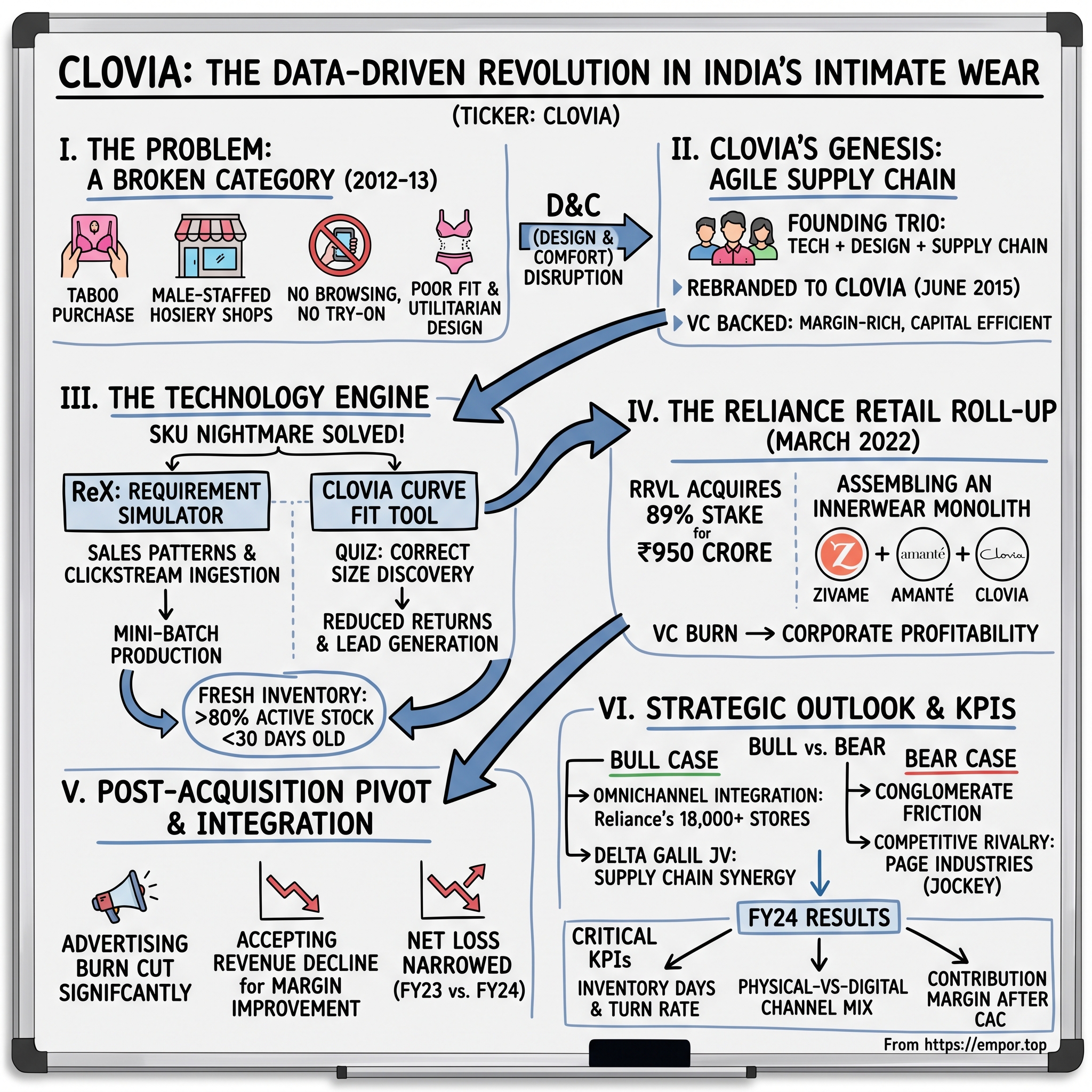
Clovia: The Data-Driven Revolution in India's Intimate Wear
There is a particular kind of business that never gets to test itself in public. It grows up in the venture-capital hothouse, burns money to buy customers, builds a genuinely clever operating engine, and then — just as the market is about to demand that it prove it can make money on its own — it disappears inside a conglomerate. The public never gets to price it. The founders get liquidity, the strategic acquirer gets a capability, and the question of what the thing was actually worth is settled in a private room by two parties who both had reasons to agree.
Clovia — legally Purple Panda Fashions Pvt. Ltd. — is that kind of business. In March 2022, Reliance Retail Ventures Limited (RRVL), the retail arm of Mukesh Ambani's empire, paid ₹950 crore, about $125 million, for an 89% equity stake in the company.12 The founders and management kept the rest.2 From that moment Clovia stopped being a startup that might one day file a prospectus and became a line item inside the largest retailer in India — a retailer that has itself been rumoured, for years, to be preparing the biggest initial public offering the country has ever seen.
That is the frame this story has to hold in two hands at once. Clovia is tagged a startup, and its operating story is a genuine startup story: a category nobody wanted to disrupt, a taboo product, a proprietary demand-forecasting engine, and a founding team that shortened the fashion design cycle from three seasons to three weeks. But its investment story is no longer its own. Whatever Clovia is worth today accrues to Reliance Retail's shareholders, and the only public-market listing that will ever price it is Reliance Retail's — where Clovia is a rounding error. Holding both truths honestly is the whole job here: to tell the company's story with the respect it earns, and to underwrite it with the skepticism a public-market investor owes to any private mark carried forward unchallenged.
I. Introduction & Episode Roadmap
Start with the number everyone repeats, because it is the number that requires the most care. Reliance paid ₹950 crore for 89% of Purple Panda Fashions.13 If you take that at face value and gross it up, the implied 100% equity value is roughly ₹1,067 crore — call it $140 million.3 That is the figure the internet has settled on as "Clovia's valuation," and it is worth pausing on why grossing up a controlling-stake price is a shortcut, not a fact.
A 89% acquisition price is not a per-share market quote struck between a willing buyer and a marginal seller. It bundled a secondary purchase — cash out to existing shareholders — with a primary investment of fresh capital into the company, and it carried a control premium: RRVL was buying the right to direct the business, integrate it, and fold it into a category strategy, none of which a passive minority investor would pay for.1 The company's own disclosures describe the ₹950 crore as covering both the secondary stake and the primary infusion.1 So the "₹1,067 crore valuation" is a reasonable order-of-magnitude marker, but it embeds a strategic buyer's motives, and it says nothing about what public common shares in a standalone Clovia would fetch. Price and value are different questions, and a control-deal price answers neither cleanly.
The business behind the number was, by the standards of Indian direct-to-consumer (D2C), a real one. In the trailing period around the acquisition Clovia's revenue was estimated in the ₹250–300 crore range,3 making the deal roughly a 3.5x to 4x multiple of sales — disciplined by the standard of the 2021 venture bubble, when American and European D2C brands changed hands at 5x to 10x revenue. And the acquirer was not a financial sponsor chasing a flip. Reliance Retail operates a physical footprint that, by FY24, spanned 18,836 stores and 79.1 million square feet, serving a registered customer base above 300 million.4 Clovia was not bought to be flipped; it was bought to be plugged in.
The scale mismatch between acquirer and target is the fact that most decisively reframes the entire underwriting, so it is worth stating in numbers. Reliance Retail Ventures Limited — the entity that owns Clovia — was valued at roughly $100 billion in 2023, when the Qatar Investment Authority put in $1 billion for a 0.99% fully diluted stake and KKR added $250 million at the same mark, up from about $62 billion when KKR first invested in 2020.5 Set Clovia's implied ~$140 million against RRVL's ~$100 billion and the arithmetic is brutal: Clovia is on the order of 0.14% of its parent. Whatever a public-market investor eventually concludes about Reliance Retail, Clovia will move that conclusion by a fraction of a rounding error. This is the first discipline the story imposes — the "value" of Clovia is not a question that a Reliance Retail shareholder will ever need to answer precisely, and the private $140 million mark is interesting mainly as a case study in how strategic buyers price capabilities, not as a live valuation anyone is carrying on a public balance sheet.
It also imposes a second discipline, on the capital structure itself. There is no public capitalisation table for Clovia in any form a listing would require: no disclosed split between common and preferred shares, no option or restricted-stock pool, no warrant or convertible schedule, no voting-rights breakdown. Before the 2022 deal, Clovia had raised across multiple preferred rounds, and preferred shares in a venture-backed Indian company typically carry liquidation preferences, anti-dilution protection, and conversion terms that make them economically distinct from the common shares founders and employees hold.6 None of those terms were publicly disclosed, and after an 89% control acquisition they are largely moot — RRVL now sits atop the structure and the residual ~11% is held by founders and management.2 The practical consequence for anyone valuing Clovia is that a "market capitalisation" cannot be built from the bottom up because the share count and its rights are not public; the ₹1,067 crore figure is a top-down inference from a single control price, and it should be read as a rough implied value with an unknown internal structure, not as a fully diluted equity value.
This episode traces three arcs. The first is the operating story — how three founders attacked the hardest inventory problem in apparel with software, and built a business where more than 80% of active stock was under 30 days old in a category where dead stock is the primary killer of margins.6 The second is the consolidation story — how Reliance rolled up Zivame, Amanté, and Clovia between 2020 and 2022 to assemble an instant digital-and-physical position in innerwear. The third is the underwriting story — what happens to a VC-scaled brand when the burn is switched off, the growth reverses, and the losses narrow, and what that transition tells us about whether the operating model can ever produce durable free cash flow rather than merely smaller losses.
Three themes recur. The SKU nightmare: why lingerie is the most operationally punishing vertical in fashion. The tech-in-lingerie claim: whether Clovia's demand-forecasting engine, ReX, is genuine defensible technology or a smart inventory system wearing a data-science costume. And the consolidation playbook: why the deepest-pocketed retailer in India decided that the way to win intimate wear was not to build a brand but to buy three.
 Subscribe on LinkedIn
II. The Taboos of the Indian Lingerie Market: Why the Category Was Broken
To understand why a data company could win in lingerie, you have to understand how comprehensively broken the category was when Clovia's founders looked at it in 2012 and 2013. This is not colour; it is the entire source of the opportunity, and it explains why the moat, such as it is, was built on friction that legacy players had no incentive to remove.
For most of the 2000s, buying a bra in India meant walking into a cramped, multi-brand neighbourhood hosiery shop — often staffed exclusively by men, with the merchandise stored behind a counter, out of reach and out of sight.67 A woman could not browse. She could not try. She often could not even say the product's name aloud without discomfort. The transaction was engineered, almost perfectly, to minimise the amount of information exchanged, which is a disastrous property for a product whose entire value depends on fit. The result was a market in which, by the company's own oft-repeated framing, a large majority of Indian women did not know their correct bra size — not because the information was hard, but because nothing in the buying experience ever surfaced it.6
The product itself matched the channel. Legacy manufacturers treated innerwear as a utilitarian commodity: a narrow range of designs, drab colours, and a handful of "standard" cup sizes that fit almost no one well. The category was run on a hosiery logic — high volume, low variety, long production runs — which is the opposite of what an intimate, fit-sensitive, fashion-inflected product demands.
Above that mass floor, the market bifurcated in a way that left an enormous middle unserved. At the low end sat commodity brands offering poor fit and cheap synthetic fabric. At the top sat imported and premium labels — Marks & Spencer, Triumph, Wacoal — priced for a metropolitan elite and effectively unavailable, both physically and financially, to the middle-class woman in a Tier 2 or Tier 3 city.7 There was no comfortable, well-fitting, fashionable, affordable option, and there was certainly no dignified way to buy one.
Into that vacuum walked a demographic tailwind that the incumbents were slow to register: a rapidly expanding cohort of young, working, financially independent women who wanted better product and had money to spend, but who had no environment in which to spend it comfortably. The demand existed; the supply and, crucially, the purchase experience did not. That gap — a real, budgeted, under-served demand meeting a humiliating retail experience — is the closest thing to a genuine market inefficiency a consumer founder ever gets. The question was who would build the private, safe, information-rich channel to close it.
The size of that opportunity is worth stating with the restraint the numbers actually warrant, because the difference between a category's headline total addressable market and a single brand's reachable market is where most consumer investment theses quietly overreach. India's lingerie market was valued at roughly $5 billion in 2024 and is projected to reach close to $9.6 billion by 2030 at an 11%-plus compound rate, while the broader innerwear category — including men's and children's — runs to around $10 billion and grows in the high single digits.8 Those are large, genuinely fast-growing pools, and they are the numbers a bull will lead with. But the market a brand like Clovia can actually reach is a fraction of the fraction: the branded, women's, mid-to-premium slice, sold through the channels Clovia participates in, at price points its Tier 2/3 customer will actually pay. A double-digit category CAGR is a tailwind, not a business plan, and the same growth that lifts Clovia lifts Page, Zivame, Amanté, Nykd, and every Shopify entrant simultaneously. The correct reading is that the category is expanding fast enough to reward several winners and punish no one for showing up — which is precisely why the competitive question, not the TAM question, decides the outcome.
III. The Genesis of Cloe and the Rise of the Agile Supply Chain
The people who built it were an unusually well-matched trio. Purple Panda Fashions was incorporated in 2012, and in 2013 it launched a women's intimate-wear brand first called "Cloe," renamed Clovia in June 2015.67 Pankaj Vermani brought the technology and commercial spine — an IIT Delhi and IIM Ahmedabad background, prior e-commerce experience, and, not incidentally, a father who had run a lingerie store in Meerut, which meant the category was not abstract to him.6 Neha Kant, a National Institute of Fashion Technology alumna, brought the product and design instinct. Suman Choudhary brought supply chain and operations.6 The founding cap table also included Abhay Batra on finance.2 The mix mattered: this was not a pure tech team bolting a website onto someone else's product, nor a fashion team learning to code. It was design, operations, and technology in the same room from the start.
The human texture of the founding matters because it shaped the company's temperament. Vermani and Kant were married, which meant the business was built at the intersection of a personal and professional partnership — an arrangement that concentrates both commitment and risk. Vermani's inheritance of the category was literal: a childhood around his father's lingerie store in Meerut gave him an intuition for a product most technologists would have found awkward to discuss, let alone build a company around.6 That comfort with an "uncomfortable" category is not a soft detail; it is arguably why the team was willing to attack a market that better-pedigreed founders avoided precisely because of its taboos. Kant became the public face of the brand's mission — the argument that better-fitting, better-designed intimate wear was a form of everyday empowerment for the Indian woman — while Vermani drove the technology and unit-economics discipline and Choudhary ran the supply chain that turned the philosophy into shipped product.6 After the Reliance acquisition, the founders retained their residual stake and Vermani continued to lead the brand under the new owner, a continuity that is mildly reassuring on the "was this a capability or a person?" question, though it also means the agility that defined Clovia now depends on founders operating inside a hierarchy they no longer control.2
The core insight was that the online medium was not merely a cheaper sales channel — it was a different channel, one whose properties happened to solve the category's specific pathologies. A website is private, which removes the social discomfort. It is discreet, which the packaging reinforced. And, most importantly for the economics, it is instrumented: every click, every size selected, every return, every abandoned cart is data. In a category where the incumbents had spent decades deliberately minimising information exchange, Clovia's channel maximised it. The medium was the private, safe space Indian women had never had to discover their size and shop without a chaperone — and it was simultaneously a feedback machine.
That feedback machine is what let Clovia reject the legacy structure. Traditional apparel brands sell through a three-tier wholesale chain — distributor, sub-distributor, retailer — which means the signal from a customer's actual preference takes six to nine months to travel back to the design desk, if it ever arrives intact. Clovia went full-stack and D2C from the beginning: it designed, sourced, and sold, capturing real-time signals on sizing, fabric, and colour and compressing the design-to-production cycle to under 30 days.6[^7] In a fashion sub-category defined by rapid taste changes, collapsing a nine-month feedback loop to under a month is not a marketing claim; it is the operational difference between guessing and knowing.
The capital arrived as the model proved itself, though never in the torrents that flowed to more fashionable consumer categories. Clovia raised a ₹30 crore Series A led by IvyCap Ventures in June 2015, with later rounds drawing in Singularity Ventures, AT Capital, Mountain Partners, and individuals such as Ravi Dhariwal, the former CEO of Bennett, Coleman & Co.6[^7] Across its private life the company raised on the order of $25 million or more before the Reliance deal — a modest figure that matters to the underwriting.6 It means the ₹950 crore exit was not a markup on a $500 million war chest; it was a real return on comparatively thin capital, which in turn is why the founders could build the discipline they did. What attracted the investors was the margin structure underneath: women's lingerie routinely carries gross margins above 60%,6 and a 60%-plus gross margin is what buys a young brand the room to fund fast iteration — provided the money it saves on dead stock is not simply handed back to Meta and Google in customer-acquisition cost.
The investors who backed it were making a specific bet, and naming it clarifies what they did and did not underwrite. IvyCap Ventures and the syndicate that followed were not betting on a winner-take-all platform; they were betting on a margin-rich, capital-efficient category run by an operationally serious team — the kind of business that can compound quietly without the blitz-scaling that defined the era's more famous consumer bets. Women's lingerie's 60%-plus gross margin was the whole attraction, because it offered the theoretical room to absorb acquisition costs and still print a profit at scale.6 The unspoken risk in that thesis, which the subsequent years exposed, was that the acquisition cost was not a fixed toll but a rising one, set by an auction the brand did not control. A margin-rich category is only a good business if the cost of reaching its customers stays below the margin; when that cost climbs, the thesis inverts, and the very digital channel that made the brand possible becomes the thing that keeps it unprofitable. Clovia's backers underwrote the margin; they under-weighted the auction.
It is worth dwelling on that capital efficiency, because it is the trait that most distinguishes Clovia from the wider D2C class of its era and the trait most relevant to a public-market reader. The archetypal 2019–2021 D2C brand raised enormous sums, spent them on paid acquisition to manufacture a growth curve, and presented that curve to the next investor as evidence of product-market fit — a machine that ran beautifully until the funding stopped. Clovia raised roughly a tenth of what the marquee names did and still built a business at a few hundred crore of revenue with an industry-leading inventory profile. That is the profile of a team that treated capital as scarce, which is rarer and more valuable than it sounds. But the same modesty caps the upside interpretation: a business that raised ~$25 million and sold for ~$125 million delivered a good, not spectacular, venture outcome, and the return was earned by operational virtue rather than by the winner-take-all scale that justifies a category-defining valuation. The honest read of the funding history is that it validates the discipline and simultaneously bounds the ambition — this was never priced, privately, as the next Page Industries; it was priced as a well-run niche brand with a clever supply chain.
IV. The "Clovia Curve" & ReX: Deconstructing the Tech-Driven Engine
Here is where the story earns or loses its "data-driven" adjective, so it deserves the most scrutiny. The claim is that Clovia built proprietary technology that solved the structural nightmare of lingerie inventory. The skeptic's counter-claim is that "proprietary AI engine" is a fund-raising phrase draped over a competent inventory system. The truth sits in the middle, and the evidence points to something real but narrower than the marketing.
Begin with the nightmare itself, because it is not exaggerated. A single bra style is not a product; it is a matrix. Across six band sizes (say 32 to 42) and five cup sizes (A to E), one design becomes 30 distinct stock-keeping units.[^7] Multiply that by dozens of styles, then by colours, and a modest-looking catalogue explodes into thousands of SKUs, each of which must be forecast, manufactured, warehoused, and — if it does not sell — written down. Lingerie is arguably the worst SKU-proliferation problem in all of apparel, and SKU proliferation is where working capital goes to die. Any brand that solves it has solved the category's central economic problem; any brand that does not is one bad season from a balance sheet full of unsellable inventory.
Clovia's answer was a backend demand-forecasting system it called ReX — a "requirement simulator" that ingested sales patterns, clickstream behaviour, and return data to forecast demand at the SKU level.[^7] The operationally important feature was not the forecast in the abstract but what it enabled: mini-batch production. Where a legacy manufacturer commits to a run of, say, 10,000 units of a style to justify the setup, Clovia used ReX to trigger initial runs as small as a few hundred units.[^7] A style that gained traction automatically pulled raw-material allocation and factory scheduling for a rapid restock; a style that failed died cheap, its write-down measured in hundreds of units rather than tens of thousands.[^7] This is the real innovation, and it is less "AI" than manufacturing philosophy — Zara's fast-fashion logic ported into lingerie and wired to a D2C data feed. It is genuinely hard to copy, because it requires owning or tightly controlling the supply chain, which is exactly what the three-tier wholesale incumbents did not.
On the consumer-facing side sat the Clovia Curve fit tool — an interactive quiz-style engine that the company said was built on more than 140 million proprietary customer data points and designed to tell a woman her correct size.6 Read strategically, the tool was two things at once. It was a genuine solution to the "fit uncertainty" that historically pushed online lingerie return rates above 20% — every return being a double cost of reverse logistics plus a unit that must be re-inspected and re-sold. And it was a lead-generation funnel: to get her result, a customer handed over her sizing profile and her email, converting an anonymous browser into a known, targetable, re-marketable customer. The 140-million-data-point figure is the company's own and cannot be independently audited, but the direction of the claim — that fit data compounds and creates a better recommendation than a global brand using Western body models — is plausible and consistent with the operating results.
There is a further reason to treat the "proprietary AI engine" framing with measured skepticism, and it is a general one about how such claims should be read before a filing exists. Every venture-backed company describes its internal systems in the most defensible-sounding language its fund-raising requires; "demand-forecasting algorithm" and "140 million data points" are the kinds of phrases that are simultaneously true and unfalsifiable from the outside. The right test is not the adjective but the outcome the adjective is supposed to produce. If ReX is genuine forecasting technology, it should show up as unusually low markdowns, unusually fresh inventory, and unusually high full-price sell-through — operational fingerprints that a mere tracking dashboard would not leave. If it is inventory tracking dressed as data science, those fingerprints would be absent and the story would rest entirely on the narrative. So the question is not whether to believe the label; it is whether the numbers behave the way the label predicts.
Because the operating results are the real test, and they are the strongest evidence in Clovia's favour. Pre-acquisition, the company kept more than 80% of its active inventory under 30 days old — an industry-leading freshness metric in a business where ageing stock is the primary destroyer of gross margin.6 That number, if accurate, is the single most persuasive piece of proof that ReX did something real: you do not achieve that inventory freshness in a 30-SKU-per-style category by luck or by spreadsheet. It is the operating signature of the mini-batch engine working. In a category where write-downs of unsold, wrong-size stock are the usual cause of death, an 80%-under-30-days inventory book is the closest thing to a smoking gun that the forecasting engine converts data into a real working-capital advantage — and working capital, not headline margin, is where lingerie brands actually live or die.
And yet the same period exposes the limit of the moat, which is the fact the bulls tend to skip. Excellent backend inventory technology does not touch the front of the funnel. Clovia still had to acquire customers, and it acquired them the way every D2C brand did — by bidding against everyone else for attention on Meta and Google, in an auction where costs only rise. High customer-acquisition cost (CAC) steadily consumed those 60%-plus gross margins, which is the structural reason a company with an industry-leading inventory metric and enviable gross margins was still losing money.6 The lesson generalises: backend operational excellence can protect the cost of goods, but it cannot, on its own, escape a competitive customer-acquisition market. That gap — brilliant at inventory, captive to the ad auction — is precisely the gap a physical-retail giant was positioned to fill, and it is why the next chapter was probably inevitable.
It is worth making the unit-economics logic explicit, because it is the hinge on which the entire "great business or merely clever one" debate turns, and because Clovia's public disclosures never gave outsiders the cohort data to settle it. A D2C brand's profitability is a race between two numbers: the contribution margin it earns on a customer over time — gross margin, less returns, shipping, and payment costs — and the customer-acquisition cost it pays to win that customer in the first place. Clovia's 60%-plus gross margin and its low-write-down inventory gave it an unusually strong numerator; its dependence on Meta and Google auctions inflated the denominator. When acquisition cost rises faster than the lifetime value a customer delivers — as it did across Indian D2C through 2021 and 2022 as every brand bid for the same eyeballs — even a company with enviable product economics loses money, because it is effectively buying revenue at a loss and hoping repeat purchases eventually pay it back. Whether Clovia's customers repeated often enough, and paid back their acquisition cost fast enough, is exactly the cohort question no external observer can answer from the fragments on file. What the persistent losses on healthy gross margins strongly imply, though, is that the payback was slow and the acquisition cost high — which is the same conclusion the switch to Reliance's owned distribution is designed to fix, and the reason the channel-mix KPI matters more than any margin headline.
V. The Reliance Retail Roll-Up: Building the Intimate Wear Monolith
Reliance Retail did not need lingerie the way a founder needs a first customer. It needed it the way a sovereign needs a border province: to complete a map. By the early 2020s Reliance had overwhelming scale in grocery, consumer electronics, and mass fashion, but it was under-penetrated in high-margin specialty apparel — and innerwear, with its 60%-plus gross margins and its fragmented, brandable structure, was among the most attractive specialty categories going.6 The strategic vacuum was real; the only question was build or buy, and Reliance, characteristically, chose buy — three times.
The roll-up came in tiers, each brand occupying a distinct position on the price-and-channel map. Zivame, the pioneer of online lingerie in India, came first, with Reliance taking control across 2020 in a deal valued around $160 million; it served as the premium-to-mid digital destination and category explorer, the widest catalogue.[^7] Amanté followed in late 2021, acquired from the Sri Lankan apparel giant MAS Holdings — the premium, classic, heritage-inflected label, adding manufacturing pedigree and a more mature brand.[^7] Clovia arrived in March 2022 as the third and most operationally distinctive piece: the fast-fashion, high-growth, bridge-to-premium engine with the deepest reach into Tier 2 and Tier 3 markets and the only one of the three built around a proprietary demand-forecasting stack.1[^7] Three acquisitions, three positions, one category — an instant oligopoly assembled by cheque rather than by brand-building.
The logic of buying three brands rather than building one is worth taking seriously, because it is the logic of a firm that values time over elegance. Building a lingerie brand to national scale organically takes a decade of design iteration, trust-building, and distribution — time during which the category keeps growing at 11% and someone else keeps capturing it. Buying Zivame bought the widest online catalogue and the category's original brand equity; buying Amanté bought premium positioning and MAS Holdings' manufacturing know-how; buying Clovia bought a supply-chain engine and Tier 2/3 penetration. For a conglomerate whose true competency is capital allocation and distribution rather than fashion design, purchasing the assembled position and then pointing its scale, logistics, and store network at it is a more natural play than trying to out-design the specialists. The risk, which the roll-up's own results are now testing, is that three brands under one roof compete for the same shelf, the same customer, and the same internal attention — the classic tension between owning a category and diluting the very identities that made each brand worth owning.
On the specifics of the Clovia transaction, the disclosed facts are relatively clean and the inferred ones are not. RRVL paid ₹950 crore for 89% of Purple Panda Fashions, a deal on which the advisory firm BDA Partners acted for Clovia.19 The consideration combined a secondary purchase from existing shareholders with a primary investment into the company, and the founding and management team retained the residual ~11%.1 Grossing the price up implies a ~₹1,067 crore equity value; against trailing revenue estimated at ₹250–300 crore, that is an EV/Sales — more precisely an equity-value/sales, since Clovia's net debt was not publicly disclosed and enterprise value therefore cannot be reliably constructed — multiple of roughly 3.5x to 4.2x.3 The distinction is not pedantic. Comparing a private control-deal equity multiple against a public enterprise-value multiple is a common way to arrive at a confident and wrong conclusion, and the honest statement is that the equity price is known, the debt is not, and so no reliable bridge to enterprise value can be built.
What can be said is that the pricing was disciplined by the standards of its moment. In 2021 and early 2022, US and European D2C darlings were trading hands, on the way up and on the way down, at 5x to 10x sales on the strength of transient digital traffic. Reliance paid roughly half that, and it appears to have been paying for durable assets — the proprietary technology, the factory partnerships, the Tier 2/3 penetration, and the omnichannel option value of plugging the brand into its own stores — rather than for a growth curve it assumed would continue. A strategic acquirer buying at 4x sales the ability to distribute a product through 18,000 of its own stores is making a very different bet than a crossover fund buying at 10x sales the hope that Meta's ad auction stays cheap. Whether the bet pays is a question the post-acquisition financials began to answer almost immediately — and the answer, as the next section shows, was mixed.
There is one more layer a careful reader has to add before treating the 2022 price as a valuation anchor, and it concerns the motives and information on each side of the table. A strategic buyer like RRVL does not value a target the way a public investor values a share; it values it net of the synergies only it can capture — the store network, the buying power, the manufacturing scale — which means Reliance could rationally pay a price that reflected worth to Reliance rather than worth on a standalone basis. That synergy premium is invisible to an outsider and non-transferable to anyone else. At the same time, the seller-side information advantage cut the other way: the founders and their venture backers knew the CAC pressure and the true state of unit economics far better than any external observer, and they chose to sell control at a 3.5x–4x multiple rather than push for another private round or an eventual independent listing. That choice is itself a data point. It is at least consistent with a team concluding that the independent path — outspending better-capitalised rivals for customers indefinitely — was harder than the acquired one, and that a disciplined strategic price in hand was worth more than a growth story that still had to be financed. None of this makes the price wrong; it makes it specific to this transaction, which is exactly why grossing it up to a general "valuation" strips out the very context that produced it.
VI. Post-Acquisition Pivot: From VC Burn to Corporate Profitability
Acquisitions announce themselves in press releases; integrations reveal themselves in the numbers a year or two later. Clovia's post-acquisition financials tell the story of a classic, deliberate, and slightly uncomfortable transition: from a business optimised to grow to a business optimised to stop bleeding. Both are legitimate goals. They are not the same goal, and the switch from one to the other is visible line by line.
Under venture ownership, Clovia's growth had been subsidised by aggressive digital advertising — the CAC engine described earlier. Under Reliance, that subsidy was withdrawn on principle. The clearest window into the philosophy comes from sister brand Zivame, whose disclosures are more granular: its advertising spend was cut from roughly ₹146 crore in FY23 to about ₹42 crore in FY24, a 71% reduction, and its revenue fell in near lock-step, from about ₹328 crore to about ₹192 crore, a 41% decline, while its net loss actually widened by 34% to around ₹39 crore.[^9]10 That is the roll-up's operating thesis stated as an experiment: turn off the ad tap, accept that the top line deflates, and find out how much of the revenue was real demand versus rented traffic. For Zivame in FY24, an uncomfortable amount turned out to be rented.
Clovia's own trajectory rhymes rather than repeats. Its operating revenue plateaued and then dipped, from ₹295.51 crore in FY23 to ₹262.93 crore in FY24 — an 11% decline, milder than Zivame's, consistent with Clovia's less ad-dependent, more supply-chain-driven model.119 The more encouraging line ran the other way: Clovia's standalone net loss narrowed sharply, from ₹80.93 crore in FY23 to ₹28.53 crore in FY24.11 Losing ₹28 crore on ₹263 crore of revenue is a roughly 11% net loss margin — still a loss, but a far cry from the ~27% loss margin of the prior year. This is the textbook corporate transition: sacrifice growth you were paying too much to buy, and let the P&L heal.
The underwriter's job is to read that pair of numbers without flinching in either direction. The bull reads a 65% reduction in losses as a business marching toward profitability. The bear reads a shrinking top line and asks the harder question: is the loss narrowing because the unit economics improved, or simply because the company stopped spending to grow? Those are very different futures. If contribution margin per order genuinely improved — better full-price sell-through, lower returns, cheaper fulfilment — then the path to durable profit is real. If the loss narrowed mostly because a big discretionary marketing line was slashed, then Clovia has bought margin by mortgaging growth, and the moment it needs to grow again the losses can return. The public disclosures available do not decompose the improvement cleanly, and that ambiguity is itself the finding: what must be proven is that the smaller loss is structural, not just smaller spending.
The mechanism Reliance is betting will make it structural is omnichannel integration, and this is where the parent's scale becomes the whole argument. Rather than renting customers from Google and Meta at auction prices, Clovia's products are increasingly routed into shop-in-shops and shelf space inside Reliance's own formats — Reliance Trends, Azorte, Centro, and Smart Bazaar among them — riding a physical network of over 18,000 stores and roughly 79 million square feet that the parent already pays for.4 Layer on Clovia's own expanding exclusive brand outlets in Tier 2 and Tier 3 malls, and the pure-digital play becomes a localised omnichannel one. The theoretical prize is enormous: near-zero-marginal-cost customer acquisition, because the foot traffic is already inside the door. Whether that theory converts into real, attributable, profitable Clovia sales — rather than shelf space that cannibalises the brand's premium positioning or sits ignored between larger labels — is the single most important operational question in the entire underwriting, and it will not be answered by a press release. It will be answered by the channel mix, order by order, over the next several years.
Setting the path to durable profitability — as opposed to a one-time loss reduction — requires reconciling several lines that the fragmentary subsidiary disclosures only partly reveal. On the encouraging side, the raw materials of a profitable model are present: gross margins reported above 60%, an inventory book that ties up less working capital than peers because stock turns fast, and a capital-light manufacturing model that leans on partners rather than owned factories, which keeps capex modest.6 On the demanding side, the FY24 result still shows a business spending more than it earns, and the loss reduction to ₹28.53 crore came alongside an 11% revenue decline, which means the improvement was at least partly bought by shrinking rather than by scaling.[^9]11 The test of durability is therefore specific and falsifiable: revenue must resume growing while the loss keeps closing, driven by contribution margin that holds or improves as sales shift into Reliance's stores. If instead the next two years show flat-to-down revenue with losses that stop narrowing, or that re-widen the moment marketing is switched back on, the "path to profitability" was a mirage — a marketing budget cut, not a business fixed. The evidence that would falsify the bull case is exactly the evidence that would confirm it: the joint trajectory of the top line and the contribution margin, which no single reported number captures.
The governance and public-market-readiness questions are, in Clovia's case, unusually simple to state and unusually hard to see into — a paradox worth naming rather than glossing. Because RRVL owns 89% and the founders retain roughly 11%, there is no independent board, no minority public shareholder to protect, and no proxy statement; Pankaj Vermani has continued to lead the brand under Reliance ownership, but strategy, capital allocation, and pricing now sit with the parent.26 For a future public investor the relevant exposures are almost entirely related-party in nature: Clovia increasingly buys manufacturing capability from a Reliance-controlled supply chain (soon including the Delta Galil joint venture) and sells through Reliance-owned stores, so its reported standalone revenue and margins are shaped by inter-company arrangements whose pricing is not externally visible. That is not evidence of anything improper — it is the normal condition of a wholly-directed subsidiary — but it is precisely the sort of thing a real filing would have to disclose and a diligent reader would want to see: transfer-pricing terms, the true economics of shelf space "gifted" by the parent, and how much of Clovia's channel-cost saving is genuine versus a subsidy the parent could withdraw. These are diligence items for a document that does not yet exist, and their current invisibility is not the same as their absence. Treating the silence as safety would be the exact mistake the underwriting is meant to guard against.
VII. Playbook & Strategic Powers
Strip away the narrative and the question underneath is whether Clovia, inside Reliance, possesses any durable competitive advantage — a power, in Hamilton Helmer's precise sense: a condition that lets a business sustain returns above its cost of capital because rivals cannot or will not neutralise it. Run Clovia through that lens honestly and the picture is of one or two real powers borrowed from the parent, one plausible power of its own, and a great deal of contested ground.
Scale economies are the parent's genuine power, not Clovia's. Reliance's buying weight in yarn and fabric, its manufacturing capacity, and its logistics network create a cost position that no independent D2C brand can match, and the pending Delta Galil manufacturing joint venture (discussed below) deepens it.13 But this is a power Clovia rents from ownership; it strengthens the brand only so long as Reliance chooses to point that scale at it, and it is available equally to Zivame and Amanté. It is real, and it is not proprietary to Clovia.
Cornered resource is where Clovia's own claim lives: the ReX engine and the accumulated fit database, built on the company's stated 140-million-plus data points, forecasting Indian body-shape patterns better than global brands designing for Western frames.6 This is the most defensible-sounding power, and it is partly earned — the inventory-freshness record is corroborating evidence.6 But a data advantage is only a cornered resource if it compounds and cannot be replicated, and here the skeptic has room: Nykaa, Zivame, and Page all accumulate Indian fit data too, and the marginal predictive value of the ten-millionth data point is far below the first million. The resource is real but its exclusivity is eroding as every competitor digitises. Call it a weakening cornered resource rather than a permanent one.
Switching costs are the most interesting and probably the most under-appreciated. Once a woman finds a bra style and cup that fits her particular body, the cost of switching — the cognitive load of re-discovering fit elsewhere, plus the real risk of getting it wrong — is genuinely high, higher than in almost any other apparel category.6 This is a real, product-rooted switching cost, and it is the one power Clovia holds that is intrinsic to the product rather than borrowed from the parent. Its limit is that it operates at the style level, not always the brand level, and a customer delighted by one Clovia style is only loosely locked to the next.
Counter-positioning has decayed by design. In its startup life Clovia counter-positioned brilliantly against the cramped brick-and-mortar hosiery shop — a business the incumbents could not follow it out of without cannibalising their own model. But as a Reliance subsidiary, Clovia has crossed the floor from disruptor to incumbent consolidator. It no longer holds a position rivals refuse to copy; it is the position rivals are attacking. Counter-positioning, once thick, is now thin to absent.
Porter's five forces fill in the industry structure around those powers, and the reading is sobering. The threat of new entrants is high: launching a D2C apparel brand on Shopify has never been cheaper, and the innerwear category attracts a steady stream of them. The bargaining power of buyers is high: online switching costs at the point of purchase are low, marketplace comparison is one tap away, and the result is chronic promotional discounting. The intensity of rivalry is extreme. It is anchored by Page Industries — the licensee of Jockey in India — which posted roughly ₹4,580 crore of revenue from operations in FY24 and distributes through a physical network reported in the vicinity of 100,000-plus points of sale, a distribution moat built over decades.14[^14] It now includes well-funded digital-native challengers such as Nykaa's Nykd, which crossed ₹160 crore of GMV in FY25 to become the top lingerie brand on Nykaa Fashion, and legacy houses like Modenik (Enamor).15 In an industry with high entry threat, high buyer power, and extreme rivalry, powers do not have to be permanent to matter — but they had better be real, and Clovia's are a mixture of borrowed, weakening, and genuine.
Netting the powers analysis against the five forces produces the sharpest single conclusion of the whole underwriting. Clovia's most durable advantages — scale economies and, increasingly, manufacturing cost position — are not Clovia's at all; they are Reliance's, lent to the brand and equally available to its sister labels. Clovia's own advantages — the fit-data cornered resource and the style-level switching cost — are real but bounded, one weakening as rivals digitise and the other operating at the product rather than the franchise level. And the force arrayed against all of it, competitive rivalry, is not merely intense but structurally intense: an industry where anyone can start a brand on Shopify, buyers switch on a whim, and the incumbent champion has a hundred-thousand-door head start is an industry that grinds returns toward the cost of capital unless a competitor holds something rivals genuinely cannot copy. Reliance's scale is such a thing; whether Clovia specifically captures enough of it to earn an excess return, rather than simply surviving inside a well-defended parent, is the question the frameworks pose but cannot answer. The frameworks clarify that Clovia is well-protected; they leave open whether it is independently valuable.
VIII. Bull vs. Bear Case: The Investment-Story Spine
Because Clovia will almost certainly never list on its own, the "investment case" here is really two nested cases: the case for Clovia as a business, and the case for Clovia as a contributor to whatever value Reliance Retail eventually asks the public to price. Both deserve their strongest form and their sharpest rebuttal.
The bull case begins with the Reliance physical moat. The single most expensive, rising, and unavoidable cost for every independent D2C brand in India is digital customer acquisition — the Meta-and-Google auction that quietly ate Clovia's gross margin for years. Reliance can, in principle, bypass it entirely, placing Clovia in front of hundreds of millions of shoppers already walking through 18,000-plus of its own stores at essentially zero marginal acquisition cost.4 If that integration works, Clovia escapes the trap that is currently killing its independent peers, and its narrowed losses convert into structural profit. The second bull pillar is the Tier 2/3 premiumisation wave: Clovia's bridge-to-premium price point is well positioned for the double-digit discretionary-spending growth in smaller Indian cities, exactly where its data-driven fit advantage is most differentiated from global brands. The third is supply-chain synergy: the 50/50 joint venture RRVL announced with Israel's Delta Galil in September 2024 — a global intimate- and activewear manufacturer — gives the group in-house fabric R&D, design, and cost structure aimed squarely at Page Industries' cost leadership.1316
The bear case attacks each pillar at its joint. Conglomerate friction is the first and most credible: Clovia's entire operating edge was speed — a sub-30-day design cycle and mini-batch production driven by a real-time engine. That kind of agility is culturally fragile, and it is exactly the sort of thing that a large, process-heavy corporate machine erodes without meaning to, replacing fast decisions with approval chains. If ReX's agility drowns in Reliance's bureaucracy, the cornered resource stops compounding and the whole "data-driven" thesis hollows out. The second bear pillar is brand dilution and cannibalisation: three innerwear brands — Zivame, Amanté, Clovia — under one owner, with overlapping price bands and a shared parent incentive to push whatever moves through Reliance's shelves, risks blurring the distinct identities that justified buying three brands in the first place. The third is the sheer immovability of Jockey: Page Industries' distribution reach, built over a generation and spanning a reported 100,000-plus retail points, is the definition of a durable moat, and dislodging it in the mass and mass-premium tiers where volume lives is a multi-decade project, not a data-science one.14[^14]
Building a genuinely comparable peer set forces a distinction the headline "lingerie" label blurs, and the distinction matters because the wrong comparison manufactures a wrong valuation. The nearest direct comparables to Clovia are its own sister brands — Zivame and Amanté — because they share the customer, the geography, the channel economics, and, tellingly, the same post-acquisition experience of shrinking top lines and cut marketing. That comparison is not flattering: Zivame's FY24 revenue fell 41% and its losses widened even after a 71% marketing cut, which is the cautionary version of the same integration Clovia is undergoing, and it argues for the sober end of any valuation range.1011 The most-cited comparable, Page Industries, is an aspirational category leader, not a direct peer, and treating it as one is the classic error. Page is a mass and mass-premium hosiery-and-innerwear manufacturer with a ~100,000-point distribution network, roughly ₹10,000-11,000 crore of net sales, a return on equity above 50%, and — critically for valuation — a public market that rewards that durability with a price-to-earnings multiple around 70x and an EV/sales multiple in the high single digits to low teens.12 Applying Page's revenue multiple to Clovia would be indefensible: Page earns a fat, consistent profit and Clovia does not yet earn one at all, and the multiple is the market's price for proven durable profitability, which is exactly the thing still unproven at Clovia. Nykaa's Nykd is a closer strategic analogue — a digitally native challenger crossing ₹160 crore of GMV — but it too is a fast-growing, not-yet-independently-profitable brand embedded in a larger platform.15 The correct peer frame is therefore not "lingerie trades at 10x sales because Page does"; it is "a sub-scale, not-yet-profitable, controlled D2C brand is worth some multiple of sales discounted for its lack of independence, its declining top line, and its unproven margin — a multiple far below the category champion's."
Reconciling the two, the intrinsic picture is a wide range rather than a point. On the encouraging reading, if omnichannel integration genuinely lowers customer-acquisition cost, revenue re-accelerates from the FY24 base toward and past its old peak, and the model matures to a mid-single-digit to low-double-digit operating margin at, say, ₹500–800 crore of scale, Clovia could support an equity value comfortably above its 2022 acquisition mark — a business finally earning its keep. On the discouraging reading, if the top line keeps drifting, the loss reduction proves to be mostly withdrawn marketing rather than structural improvement, and Clovia settles into life as a modest internal label feeding Reliance's stores, its standalone value is plausibly below the ₹1,067 crore implied in 2022 — a fine acquisition for a strategic that values distribution optionality, a poor one for anyone who paid for growth. The honest output is that wide band and its sensitivities: the value hinges almost entirely on the channel-mix shift and on whether contribution margin, not just headline loss, is really improving.
To make that framework transparent rather than gestural, it helps to name the assumptions that drive it, treating the output as a range with explicit sensitivities rather than a target. A base case might assume Clovia stabilises the FY24 revenue base near ₹260–300 crore, grinds toward a low-single-digit operating margin over several years as omnichannel lowers acquisition cost, and reinvests modestly given its capital-light supply chain; discounted at a cost of capital appropriate for a small, controlled Indian consumer business — comfortably into the mid-teens — that profile supports an equity value not dramatically different from the 2022 mark, because a barely-profitable no-growth brand is worth roughly what a disciplined strategic paid for its optionality. A bull case assumes revenue re-accelerates to sustained double digits as Reliance's stores convert into a real, low-cost acquisition channel, and margins mature toward the high-single-digit to low-double-digit operating range the gross-margin structure could in principle support at ₹600–800 crore of scale; that combination could justify a value comfortably above the acquisition mark. A bear case assumes revenue keeps eroding, the loss narrowing stalls, and Clovia never clears the bar of independent profitability, in which case its value as a standalone concern falls below what RRVL paid and its only worth is as a component of the parent's distribution machine. The spread between those cases is wide precisely because so little is settled, and the sensitivity that dominates all others is the same one the KPIs track: does the shift into owned physical distribution actually lower the cost of acquiring a profitable customer, or not.
Reconciling the intrinsic and comparable views yields a single, clarifying statement of what any given price would embed. To justify a value at or above the 2022 mark, a buyer has to believe Clovia can grow again from a base that is currently shrinking, hold a gross margin north of 60% while doing so, convert Reliance's physical footprint into genuinely cheaper customers, and reach a durable operating profit it has never yet posted — a stacked set of assumptions, each individually plausible and jointly demanding. A price below the mark embeds the opposite: that the FY24 decline is the trend, not a blip, and that the brand's fate is to be a small, managed label. The reason a market — if one ever priced Clovia directly — might sit above a sober central estimate has less to do with the business than with forces the underwriting must name and discount: the scarcity appeal of a "Reliance-backed D2C" narrative, the momentum of the premiumisation story, and the thin float and controlled structure that would make any traded stub illiquid and prone to sentiment. None of those forces is business value. They are reasons a price can detach from value, and the discipline is to price the business on its cash-generating capacity and treat the narrative premium as exactly that.
Which is why the underwriting reduces to three KPIs, and only three. Inventory days and turn rate — whether the sub-30-day freshness that was the operating signature of ReX survives contact with Reliance's scale, or stretches as distribution widens and the discipline slackens. The physical-versus-digital channel mix — the share of Clovia sales flowing through Reliance's own stores and Clovia's EBOs rather than through paid digital, the single cleanest gauge of whether the zero-CAC thesis is converting from PowerPoint to P&L. And contribution margin after CAC and logistics — the metric that reveals whether narrowing losses reflect real, durable unit economics or merely a marketing budget that was cut and can always be un-cut. If those three move the right way together over the next several years, the bull case is being proven in the only language that counts. If they diverge, the bear case is quietly winning regardless of what any press release says.
The catalysts that would force the market's eventual reckoning are identifiable even though the timeline is not. The largest is a Reliance Retail listing itself: RRVL has been openly described as considering a public offering, and the day it files, the innerwear cluster — Zivame, Amanté, Clovia — would for the first time be subject to real disclosure obligations, segment reporting, and the scrutiny of investors who can no longer be told a story without numbers behind it.5 Short of that, the ramp of the Delta Galil manufacturing joint venture over its stated 18-month horizon is a concrete near-term milestone that will test the "supply-chain synergy" pillar of the bull case in observable cost terms.1316 The continued expansion — or quiet stagnation — of Clovia's exclusive brand outlets and shop-in-shop presence is another, visible on the ground rather than in a filing. And each subsequent year of registry-filed standalone accounts for Purple Panda Fashions is a low-resolution but genuine data point on whether the loss-narrowing of FY24 was a turn or a pause. A public-market investor watching from outside has no earnings call to attend and no guidance to parse, but the annual filings and the parent's own eventual disclosures are the events that will, slowly, replace narrative with evidence. Until they do, any price attached to Clovia is a price attached to a story, and prices attached to stories move on mood and momentum in ways that have nothing to do with whether the business is compounding value — a distinction worth holding without ever mistaking it for a reason to act.
IX. Epilogue & Outro
The lesson Clovia leaves for the way businesses like it get valued is a lesson about disappearing before the reckoning. Clovia never had to stand in front of a public market and defend its unit economics, disclose its cohort retention, or explain quarter by quarter why its losses persisted despite those beautiful gross margins. It solved the hardest part of its problem — inventory — with genuine ingenuity, and it was rescued from the part it never solved — customer acquisition — by a buyer with the one asset that makes the problem disappear: 18,000 stores it already owned.4 The result is that the market's verdict on Clovia is a single private number struck in 2022, and everything since has to be inferred from fragments of standalone financials filed by a subsidiary that no longer sets its own strategy.
For the founder, the takeaway is almost the inverse of the venture folklore. Clovia's exit was not earned by growth-at-all-costs; it was earned by operational discipline — the sub-30-day inventory, the mini-batch supply chain, the proprietary fit data — that made it an unusually attractive thing for a strategic consolidator to own.6 A business that keeps 80% of its stock under a month old in the most SKU-punishing category in apparel is not just a good brand; it is a capability, and capabilities are what conglomerates buy when they decide to own a category rather than build one. The uncomfortable corollary is that the same discipline that makes you acquirable also makes you dispensable as an independent story: you become a component, and components are priced by what they contribute, not by what they dreamed.
There is a broader lesson here about how emerging markets consume their own innovators. Clovia proved that a small, disciplined team could out-think a legacy category with software and supply-chain design — that the design-to-shelf cycle could be compressed from seasons to weeks, that fit data could substitute for the fitting room, that dead stock could be engineered down rather than discounted away. But it also proved the limit of that kind of cleverness in a market where physical distribution is destiny. Beyond a certain scale, the binding constraint on an Indian consumer brand stops being product or even brand and becomes reach — the number of doors, physical and digital, through which the product can find a customer without paying a rising toll to an advertising duopoly. Clovia hit that constraint, and the resolution was not to raise more venture money and keep paying the toll; it was to be absorbed by the one entity that already owned the doors. The moral is uncomfortable for the venture model: sometimes the most rational endgame for a brilliantly-run niche brand is not independence but acquisition by the infrastructure it could never afford to build.
That is the frame a public-market investor has to keep when Clovia's name surfaces, as it eventually will, inside the disclosures around a Reliance Retail listing. Clovia will not appear as a company to be valued; it will appear, if at all, as a brand within an innerwear cluster within a fashion segment within a retail giant whose total value dwarfs the ₹1,067 crore this whole story has circled. The temptation will be to carry the 2022 mark forward as though a control-deal price were a market quote, and the discipline is to refuse — to remember that price and value are different questions, that a private preferred-laced control transaction is not a public common share, and that the only evidence that will ever settle what Clovia is worth is the boring, unglamorous, still-unresolved question of whether the smaller loss was structural or just smaller. Until those three KPIs answer it, the honest position is not a number. It is a range, a set of conditions, and a clear-eyed acknowledgement that the most interesting company in Indian lingerie was priced exactly once, in a private room, by two parties who both had reasons to shake hands.
References
-
Media Release: RRVL acquires 89% equity stake in Purple Panda Fashions Pvt. Ltd. (Clovia) — Reliance Industries Limited, 2022-03-20 ↩↩↩↩↩↩↩
-
Reliance Retail acquires majority stake in D2C brand Clovia for $125 million — TechCrunch, 2022-03-20 ↩↩↩↩↩↩
-
Reliance Retail acquires 89% stake in Clovia operator Purple Panda for Rs 950 cr — Business Today, 2022-03-20 ↩↩↩↩
-
Reliance Retail Fact Sheet 2024 — Reliance Industries Limited, 2024-08-27 ↩↩↩↩
-
Qatar fund invests $1B in Ambani's Reliance Retail at $100B valuation — TechCrunch, 2023-08-23 ↩↩
-
Clovia — Founders, Business Model, Revenue Model & Funding — StartupTalky, 2023-01-15 ↩↩↩↩↩↩↩↩↩↩↩↩↩↩↩↩↩↩↩↩↩↩↩↩
-
This Noida-based start-up is making the most of India's big lingerie market — Business Today, 2016-11-08 ↩↩↩
-
India Lingerie Market Size, Share, Growth and Report — IMARC Group, 2024-01-01 ↩
-
Clovia — Funding, Revenue & Investors — Inc42, 2026-01-01 ↩↩
-
From big spends to budget cuts, what defined India's D2C landscape in 2024? — Exchange4media, 2024-12-05 ↩↩
-
Zivame Reports 34% Widening in Net Loss for FY24 Amid Revenue Decline — Indian Retailer, 2024-11-08 ↩↩↩↩
-
Page Industries Ltd — Key Insights, Market Cap and P/E — Screener.in, 2026-01-01 ↩
-
Media Release: Reliance Retail Ventures and Delta Galil Announce Strategic Partnership in India — Reliance Industries Limited, 2024-09-10 ↩↩↩
-
Page Industries Limited: Ratings reaffirmed (FY24 revenue from operations ~₹4,581 crore) — ICRA ↩↩
-
Nykd by Nykaa Expands Footprint, Grows 28-Plus Outlet Chain (FY25 GMV over ₹160 crore) — Indian Retailer, 2025-05-20 ↩↩
-
Reliance Retail and Delta Galil's Joint Venture to Transform Apparel Market — Goodreturns, 2024-09-10 ↩↩
 LinkedIn
 WhatsApp
 Reddit
 Hacker News
 Email
Email Kindle
 RSS Feed
 Spotify
 Apple Podcasts
 Amazon Music
 Audible
 YouTube