Cipla Limited: The Sovereign Pharmacy of the Global South
I. Episode Introduction & The Core Investment Thesis
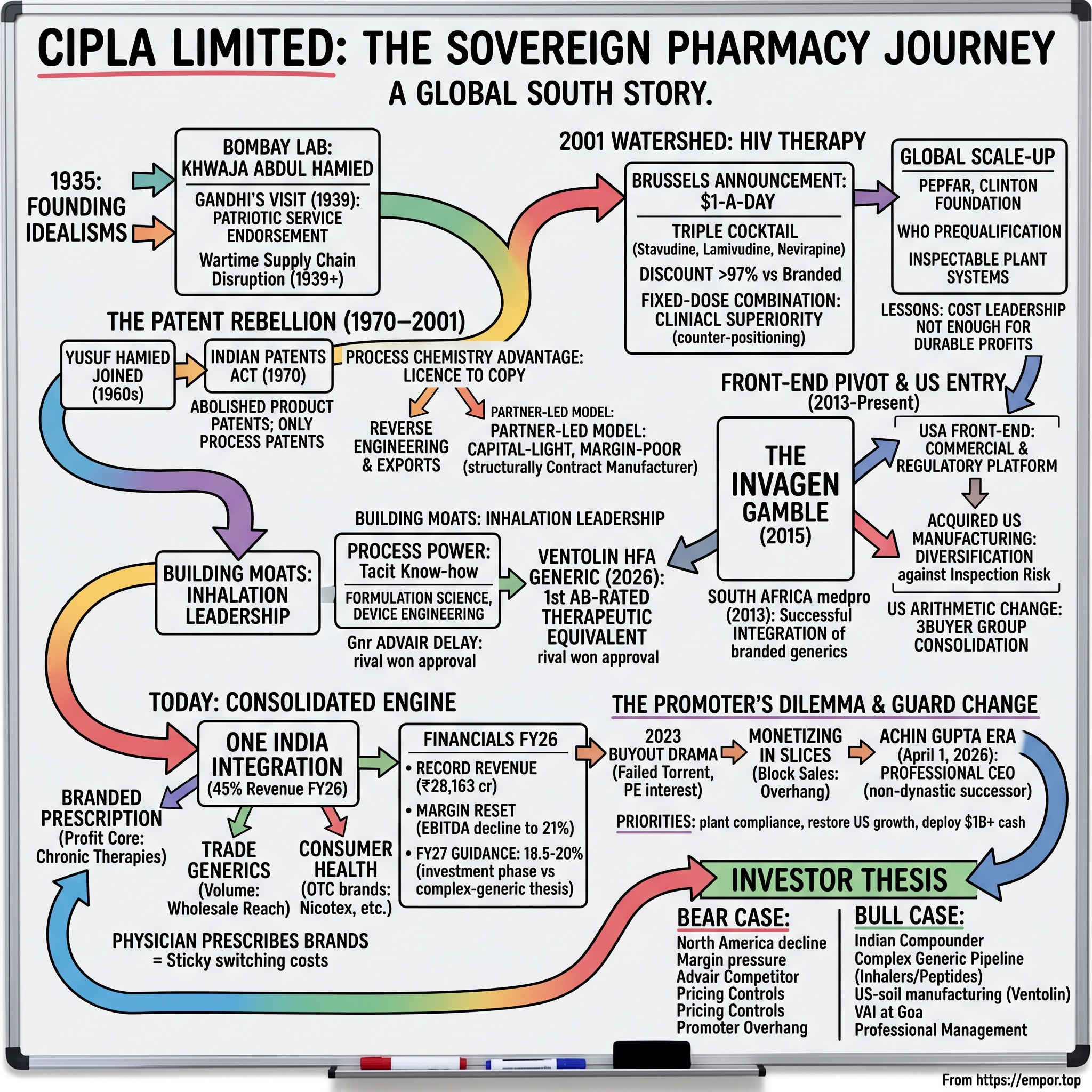
In February 2001, a soft-spoken chemist with a Cambridge doctorate walked into a room full of European health officials and detonated the economics of an entire industry.
The setting was a European Commission gathering in Brussels on HIV/AIDS, malaria, tuberculosis and poverty reduction. The speaker was Dr. Yusuf Khwaja Hamied, chairman of an Indian pharmaceutical company most delegates could not have picked out of a lineup. The subject was a three-drug antiretroviral cocktail — stavudine, lamivudine and nevirapine — that had turned HIV from a death sentence into a manageable chronic illness for patients in New York, London and Paris, and had done absolutely nothing for the roughly 25 million people living with HIV in sub-Saharan Africa. The reason was arithmetic. Branded triple therapy cost somewhere around $10,000 to $15,000 per patient per year. In countries where annual per-capita health spending was measured in single-digit dollars, that was not a price. It was a wall.
Hamied's offer was that Cipla would supply the same three-drug regimen — later marketed as a fixed-dose combination called Triomune — to Médecins Sans Frontières for $350 per patient per year.1 Roughly a dollar a day. Against a prevailing combination cost of about $12,000 a year for the individual branded drugs at the time, that was a discount of more than 97%.2
What happened next is one of the great case studies in how a single pricing decision can reorder a global market. The multinational originators, who had spent 2001 in a South African courtroom trying to block generic imports, withdrew their litigation under public pressure. Donor institutions — the Global Fund, the Clinton Foundation's HIV/AIDS Initiative, and later the United States' PEPFAR program — discovered that if generic Indian antiretrovirals cost a few hundred dollars instead of tens of thousands, the same budget could treat fifty times as many people. Within a decade, first-line HIV treatment costs had collapsed by well over 99% from their late-1990s peak, and tens of millions of patients were on therapy.1
It is a genuinely extraordinary story. It is also, for an investor, a slightly dangerous one — because the halo it created has followed Cipla for twenty-five years, and halos are not cash flows.
So here is the transition worth sitting with. How does a company founded in 1935 as an explicitly nationalist, anti-colonial project in British-ruled Bombay — blessed in person by Mahatma Gandhi — become a modern, professionally managed enterprise that recorded ₹28,163 crore of revenue in the financial year ended March 2026, roughly $3.3 billion at prevailing exchange rates?3 And more importantly: is what it has become actually a good business, or a very good story attached to an average one?
The FY26 numbers make that question unusually live. Revenue reached a record. Profitability did not. EBITDA fell to ₹5,925 crore, a 21.0% margin, from ₹7,128 crore and 25.9% the year before; profit after tax dropped to ₹3,879 crore from ₹5,273 crore.5 The fourth quarter was worse still, with a 15.2% EBITDA margin.5 Management has guided FY27 EBITDA margins to a range of 18.5% to 20%.15 A company whose bull case rests on complex-generic moats has just told the market to expect margins several hundred basis points below where they sat two years ago. That deserves explanation, not applause.
Four threads run through this story, and each one is a testable proposition rather than a slogan.
The branded generics engine. India is not a generics market in the Western sense. It is a branded generics market, where physicians prescribe brand names rather than molecules, pharmacists rarely substitute, and a fifty-year-old brand can compound quietly for decades. This produces switching costs and gross margins that would look impossible to a US generic manufacturer. Cipla's One India business generated ₹12,680 crore in FY26, roughly 45% of group revenue.5 The question is whether that engine can keep growing at high single digits against price controls and increasingly capable domestic competition.
The front-end pivot. For most of its history Cipla sold to partners rather than through its own commercial organisation. That model was capital-light and margin-poor. The decision to buy a US front end — InvaGen and Exelan, for $550 million in 2015 — was the single largest capital allocation bet in company history.17 Whether it was a good one depends entirely on what you compare it against.
The complexity moat. Oral solid generics are a commodity. Inhalers are not. Cipla's wager is that device-plus-formulation complexity in respiratory medicine creates a durable barrier that ordinary generic competition cannot cross. In April 2026 that wager produced its most striking validation yet: the first AB-rated generic of GlaxoSmithKline's Ventolin HFA, addressing a US albuterol market IQVIA sized at roughly $1.5 billion.11 It has also produced its most striking counterexample, in the form of a rival Indian firm reaching generic Advair approval first.[^14]
The promoter's dilemma. The Hamied family tried to sell the company in 2023, failed to agree on price, and has since been monetising in slices. Promoter holding stood at about 29.2% in mid-2026, down from 33.47% before the block sales began.32 There is no third-generation family successor in an executive seat. As of April 1, 2026, for the first time in ninety-one years, Cipla is run by a professional CEO with no founder-family shadow in the operating chain of command.36
That last transition is where this story is actually happening right now. But to understand why it matters, you have to start in a laboratory in Bombay, in a country that did not yet exist.
 Subscribe on LinkedIn
II. The Gandhi Disciple & The Birth of Indian Pharma (1935–1970s)
Picture Bombay in the mid-1930s. The city is the commercial capital of a colony, and its pharmacies are stocked almost entirely with imported bottles: German, British, Swiss. If you needed a basic sulfa drug or a vitamin preparation, you bought it from a European firm at a European price, converted at a colonial exchange rate, in a country where the overwhelming majority of people earned a subsistence income. India manufactured almost none of its own medicine. It had chemists. It did not have a chemical industry.
Into that gap walked Khwaja Abdul Hamied, a chemist who had taken his doctorate in Berlin and returned home with two convictions that would define the next century of his family's business: that chemistry was a legitimate instrument of national self-determination, and that a country which could not make its own medicines was not really independent regardless of what its flag said. In 1935 he founded The Chemical, Industrial and Pharmaceutical Laboratories in Bombay — a name so unwieldy that its acronym, Cipla, became the brand.6
The founding was ideological before it was commercial. This was the era of swadeshi — the nationalist movement's doctrine of domestic self-reliance, which had begun with hand-spun cloth and expanded into an argument that India should manufacture the industrial goods it was being sold. A pharmaceutical laboratory was swadeshi in its purest form: import substitution in a category where the imports were literally a matter of life and death.
The moment that sealed the association came in 1939, when Mahatma Gandhi visited Cipla's Bombay laboratories. Gandhi's endorsement — that the enterprise was performing a patriotic service by making India self-sufficient in medicine — gave a small chemical works something no marketing budget can buy: moral standing.6 Wartime helped too. With European supply lines severed after 1939, a domestic manufacturer of basic pharmaceuticals suddenly had a captive market and government attention.
Then came independence in 1947, and with it a peculiar disappointment.
The British left. Their patent framework stayed. India inherited the Patents and Designs Act of 1911, a colonial statute that granted full product patents on chemical compounds and medicines — precisely the legal architecture that had let multinational firms hold Indian pricing at whatever the traffic would bear. For roughly the next two decades, the pattern held: foreign firms dominated the Indian market, held the patents on the antibiotics and cardiovascular drugs that mattered, and priced them at levels that made India one of the more expensive drug markets in the world relative to income. Indian chemists were legally barred from making the compounds they were perfectly capable of synthesising.
This is the crucial thing to understand about Cipla's first thirty-five years: the company was, commercially speaking, minor. It made what it was allowed to make — vitamins, some anti-infectives, veterinary products, a slate of active ingredients. It was a respected national institution with a limited business, hemmed in by a legal regime designed for someone else's benefit.7
That constraint is the seed of everything that follows. Cipla's defining competitive behaviour — a willingness to attack incumbent pricing structures head-on, a comfort with regulatory and legal confrontation, an instinct that the intellectual property regime is a policy choice rather than a natural law — was formed in the twenty-three years between independence and 1970, when the company had the technical capability to make medicines cheaply and no legal permission to do so.
Someone was going to change the law. As it happened, the founder's son had just come home from Cambridge.
III. The Patent Rebellion: Yusuf Hamied's Crusade (1970–2001)
Yusuf Hamied joined his father's company in 1960 with a PhD in organic chemistry from Cambridge, where he had studied under Lord Todd, a Nobel laureate.6 By training and temperament he was a synthetic chemist — a person whose professional instinct, when handed a molecule, is to ask how many different routes exist to make it. That instinct turned out to be a business model.
What he found in Bombay was a talent problem in reverse. Cipla had capable chemists who could, given a published structure, work out a synthetic pathway to almost any small molecule then on the market. What it did not have was the legal right to sell what they made. Hamied's conclusion was not that the company should work around the law. It was that the law should be changed.
Rewriting the rules
Through the 1960s, Hamied became one of the most persistent voices in the Indian Drug Manufacturers' Association, arguing to a receptive post-colonial government that pharmaceutical product patents were a transfer of wealth from a poor country to rich ones with no offsetting benefit — no local manufacturing, no technology transfer, no affordable supply.7 The argument landed in a political environment already sympathetic to economic self-reliance.
The result was the Indian Patents Act of 1970, and it is impossible to overstate its consequences. The Act abolished product patents for medicines, food and agrochemicals. It recognised only process patents — and it shortened their term.
Here is what that meant in practice, in plain language. Under a product patent, the molecule is protected: whoever discovered aspirin owns aspirin, no matter how you make it. Under a process-only regime, the molecule is free; only the specific recipe is protected. If an Indian chemist could find a genuinely different synthetic route to the same compound — different starting materials, different intermediates, different catalysts — they could make and sell it legally.
For a country full of clever, cheap synthetic chemists, this was a licence to build an industry. And it rewarded exactly the capability Cipla had accumulated by accident during the years it was legally constrained: process chemistry. India spent the following two decades systematically reverse-engineering the world's pharmacopoeia. By the 1990s the country was manufacturing a large share of the world's active pharmaceutical ingredients and had earned the label "pharmacy of the developing world."
Two analytical points are worth pausing on, because the romantic version of this story tends to skip them.
First, this was a policy-created advantage, not an inherent one. Indian pharma's cost position was real — labour, engineering talent, and capital costs were all lower — but the profit pool existed because a legislature decided it should. When India joined the WTO and became TRIPS-compliant in 2005, product patents returned for new molecules, and the free-copying era ended. Everything Cipla has built since is an attempt to answer the question: what do you do when the regulatory arbitrage that made you expires?
Second, process power in chemistry is genuinely durable in a way that patent arbitrage is not. Knowing that a molecule can be made is different from knowing how to make it at scale, at purity, at yield, at cost, reproducibly, in a plant an inspector will approve. Cipla spent thirty years compounding that knowledge across hundreds of molecules. That capability did not expire in 2005.
The partner-led model — and its hidden cost
Through the 1980s and 1990s Cipla built an export business on a deliberately asset-light logic. Rather than fund expensive commercial infrastructure in Europe and North America — sales forces, distribution contracts, regulatory affairs teams, working capital — it supplied APIs and finished formulations to local partners who owned the customer relationship and took the downstream margin.
The upside was obvious: Cipla could reach dozens of markets without the capital or the country risk. The downside took twenty years to become intolerable. In a partner-led model you are, structurally, a contract manufacturer with better chemistry. You bear the R&D cost, the regulatory filing burden, the plant investment and the USFDA inspection risk; your partner books the customer relationship and, in lucrative markets, the majority of the economics. You are also one renegotiation away from irrelevance.
Cipla lived with that trade-off for a generation because the alternative was expensive. By the early 2010s the arithmetic had changed — and by then, the company had also demonstrated something about itself that no balance sheet captured.
IV. The Watershed Moment: $1-a-Day HIV Therapy & Global Scale-Up (2001–2010s)
By the late 1990s, the moral arithmetic of the HIV epidemic had become impossible to look at directly. Highly active antiretroviral therapy, introduced in the West in 1996, had produced one of the fastest mortality declines in the history of infectious disease. In sub-Saharan Africa, where the great majority of infections were, essentially nothing changed. The drugs existed. They were simply priced for a different planet.
The standard defence of that pricing was the innovation argument, and it deserves to be stated fairly: developing a novel antiretroviral cost enormous sums, most drug candidates fail, and patent-protected pricing is how that risk is financed. The counter-argument, which Hamied made repeatedly and bluntly, was that the argument only holds where the alternative to a high price is no sale. In Africa, the alternative to a high price was not a lower-margin sale. It was no sale, and mass death. The originators were defending a price in markets where they had essentially no revenue to lose.
The offer, and the machinery behind it
Cipla's Brussels announcement in 2001 was not a gesture; it was a manufacturing claim with a specific product behind it.2 The technical achievement was as important as the price. Triple therapy in the West meant three separate branded products, on three separate schedules, requiring a level of pill-management that is difficult for patients anywhere and close to impossible in settings without refrigeration, reliable clinics or literacy in the prescribing language. Cipla combined stavudine, lamivudine and nevirapine into a single fixed-dose tablet taken twice a day.
That mattered clinically as much as commercially. Adherence drives resistance; resistance drives treatment failure. A fixed-dose combination that a patient can actually take is a better drug than three loose ones they cannot. Because the originator molecules were owned by different companies, none of them had any commercial incentive to combine their product with a competitor's. Only a generic manufacturer, unencumbered by ownership of any single molecule, could build the combination the epidemic actually needed. This is counter-positioning in its textbook form: Cipla adopted a business model that incumbents could not copy without destroying their own economics.
The aftermath
The immediate consequence was a collapse of the industry's legal position. A coalition of multinational firms had sued the South African government over legislation permitting parallel importation and compulsory licensing of medicines; in the face of overwhelming public opposition and the demonstrated existence of a $350 alternative, the case was abandoned. The broader consequence was structural: once donors could see a credible low price, funding became rational. The Global Fund, the Clinton Foundation's negotiated pricing agreements, and PEPFAR built their procurement models on the assumption that quality-assured generics from Indian manufacturers would supply the volume.1
Cipla scaled into that demand — and, importantly, into the WHO prequalification and USFDA tentative-approval regimes that PEPFAR procurement required. This is an underappreciated part of the story. The HIV programme dragged Cipla into stringent-regulator quality systems years before its commercial ambitions in the West would have forced the issue. The company learned to be inspected.
For investors, the honest reading of this episode is three-sided.
The reputational asset is real and durable, particularly in Africa, where Cipla is not a foreign supplier but a name associated with the end of the worst years of the epidemic. That brand equity has commercial value in tender markets and with health ministries, and it is the reason the South African acquisition a decade later worked as well as it did.
The financial return was modest. Antiretrovirals sold to donor-funded programmes at a dollar a day are, by construction, a low-margin business. This was not a profit engine; it was an institutional identity purchased at the price of forgone margin.
And the strategic lesson was the one that shaped everything after. Cipla had proven it could beat the world on cost in small-molecule chemistry — and had proven, simultaneously, that cost leadership alone yields a thin, donor-dependent, politically exposed business. If the company wanted a durable profit pool, it had to own either the customer or the technical barrier. Over the following fifteen years it went after both.
V. The Front-End Pivot & US Market Entry: The InvaGen Gamble (2015–Present)
By around 2013, the strategic conversation inside Cipla had become uncomfortable. The company was supplying products into the world's largest pharmaceutical market and capturing a fraction of the value. Its partners owned the relationships with the three buying groups that had come to control the American generic supply chain. Cipla's name meant nothing to a US pharmacy benefit manager.
Two acquisitions, on two continents, defined the response. They produced opposite outcomes, and the contrast is the single most useful window into how this management team allocates capital.
South Africa first: the deal that worked
In 2013 Cipla acquired full control of Cipla Medpro South Africa, a JSE-listed distributor it had previously supplied, for approximately ZAR 4.5 billion — around $512 million.1920 The Medpro shares were delisted from the Johannesburg exchange in July 2013.19
The strategic logic was that South Africa was not, in the relevant sense, a Western generics market at all. It behaved like India: doctors prescribed brands, patients stayed loyal, and a large government tender channel provided volume alongside a profitable private market. Cipla was buying a branded-generics franchise in a country where it already had extraordinary reputational standing from the HIV years.
Integration was harder than the thesis implied. The rand depreciated sharply against the rupee in the years following the deal, compressing the translated return. South Africa's medicines regulator carried a substantial product registration backlog, slowing new launches. And two organisations with different quality systems, cultures and incentive structures had to be merged. Cipla's response was a multi-year integration programme, appointing local leadership and harmonising systems rather than imposing an Indian operating model wholesale — a case study that has since been taught at business schools in South Africa.21
The result held up. In FY25, the One Africa segment contributed ₹3,827 crore, about 14% of group revenue, with the South African private market business outgrowing the overall market by roughly 270 basis points, and the tender business scaling Cipla to the second-largest position in the country's tender channel.9 In FY26 One Africa recorded $483 million in revenue.5 Thirteen years on, South Africa is a genuine second home market rather than an export destination — the outcome the acquisition was designed to produce.
America second: the deal that arrived at the top
In September 2015, Cipla announced the all-cash acquisition of InvaGen Pharmaceuticals and Exelan Pharmaceuticals for $550 million, closing the transaction in February 2016.1718 The two businesses together carried roughly $230 million of revenue.17 What Cipla bought was a portfolio of approved abbreviated new drug applications across central nervous system, anti-infective and diabetes categories, a pipeline of filings, a US commercial and regulatory organisation, and — critically — a manufacturing site in Hauppauge, New York.
That last item deserves emphasis, because it is the piece the market consistently undervalues. For an Indian pharmaceutical company, every dollar of US revenue is hostage to the outcome of USFDA inspections of Indian plants. A domestic American manufacturing site is diversification against a specific, recurring, company-killing risk. Cipla would learn exactly how valuable that is within a few years.
The timing of the purchase was, however, close to catastrophic. Cipla bought a US oral-solids generics business at what turned out to be the peak of the American generic pricing cycle. Almost immediately afterwards, the buy side consolidated with brutal speed: three purchasing consortia — Red Oak Sourcing, ClarusONE and WBAD — came to control the overwhelming majority of US generic purchasing volume. When three buyers face several hundred sellers of an interchangeable product, the price goes one direction. US generic price erosion ran at severe double-digit rates for years. Cipla subsequently recognised non-cash impairment charges against the acquired intangibles.
An activist investor looking at this in isolation would say Cipla overpaid at a cycle top for a commodity asset and wrote down the difference. That is defensible on the numbers. But it is incomplete, for two reasons.
First, the counterfactual matters. The alternative to buying a front end was remaining a partner-dependent supplier into the same collapsing price environment — capturing less of a falling pool while bearing the same manufacturing and regulatory risk. The price erosion would have happened either way. What the acquisition bought was a platform through which Cipla could later sell products the commodity players cannot make.
Second, look at what the platform subsequently carried. North America generated $934 million in FY25, roughly 29% of group revenue — the highest annual figure the segment had recorded.910 That business was not built on the oral solids Cipla bought; it was built on respiratory and differentiated products routed through the commercial organisation it acquired.
The uncomfortable coda arrived in FY26, when North America revenue fell to $780 million.4 The causes were specific rather than structural — erosion in generic Revlimid as that opportunity matured, and a supply disruption in lanreotide following a USFDA Form 483 issued to a partner's manufacturing facility in Greece, which halted production with resumption not expected until the first half of FY27.1413 But a 16% single-year decline in the segment that was supposed to be the growth engine is precisely the kind of event that separates a durable franchise from a portfolio of temporary opportunities. The honest verdict on the front-end pivot is that it is not yet proven — it is a platform whose value depends entirely on what Cipla can put through it. Which brings us to the inhalers.
VI. Building the Moats: Inhalation Leadership & Device Complexity
Here is a way to understand why inhalers are different from pills.
A tablet is a delivery problem with a forgiving margin of error. The patient swallows it, the gut absorbs it, and the bloodstream does not care much whether the particles were forty microns or sixty. To prove your generic works, you show it dissolves and produces equivalent blood levels. It is chemistry.
An inhaler is a physics problem with almost no margin of error. The drug has to be aerosolised into particles in a narrow size window — roughly one to five microns — because larger particles impact in the throat and never reach the lung, and smaller ones are simply exhaled. The particle size distribution depends on the crystal habit of the drug, the propellant, the valve, the actuator geometry, the canister coating, and how hard the patient inhales. Change the supplier of a plastic component and the deposition profile can shift. Bioequivalence for an inhaler therefore means matching not just a molecule but an entire electromechanical and aerodynamic system, including how it behaves in the hands of a patient who does not use it perfectly.
This is why generic inhalers took decades to appear while generic tablets appeared within months of patent expiry. And it is why Cipla, which had been making inhalers for the Indian asthma market since long before it mattered commercially in the West, found itself sitting on a capability that was suddenly worth a great deal.
Process power, demonstrated
In Hamilton Helmer's framework, process power is an advantage embedded in an organisation's activities that competitors cannot replicate quickly even with full knowledge of what you are doing, because the know-how is tacit and accumulates only through years of doing the thing. Toyota's production system is the canonical example: fully documented, endlessly studied, still not successfully copied at speed.
Inhalation generics fit that description. The formulation science, the analytical methods for characterising aerosol performance, the device tooling, the clinical endpoint studies, and the manufacturing controls all take years to build and cannot be bought off a shelf. Cipla's advantage here is not a patent. It is an institutional memory of how to make a device-drug combination behave.
The commercial evidence is concrete. In the US albuterol metered-dose inhaler market, Cipla's share rose from around 13% in FY24 to roughly 18% in FY25, and reached about 22% by the week ending September 19, 2025 — the leading position in the category.912 Rising share in a category where an entrant must clear a regulatory bar most competitors cannot clear is meaningful evidence of a real barrier, not merely of aggressive pricing.
The most significant validation came on April 23, 2026, when the USFDA granted final approval for Cipla's albuterol sulfate inhalation aerosol at 90 mcg per actuation as the first AB-rated generic therapeutic equivalent of GlaxoSmithKline's Ventolin HFA.11
The AB rating is the whole point, and it is worth explaining. Without it, a generic inhaler is a separate product that a physician must specifically prescribe — meaning the manufacturer has to fund a sales force to persuade doctors, one at a time, to write its name. With an AB rating, the pharmacist can substitute automatically at the counter under state substitution laws. It converts a marketing problem into a plumbing problem. In a US albuterol market IQVIA sized at approximately $1.5 billion for the twelve months to February 2026, that distinction is worth a great deal of revenue.11 Cipla indicated it would launch in the first half of FY27, manufacturing at a newly built dedicated inhalation facility in Fall River, Massachusetts.11
That the product will be made in Massachusetts rather than Goa is a strategic decision, not a logistical one. Cipla is putting its highest-value US franchise behind a domestic firewall, insulated from the inspection risk that has repeatedly disrupted Indian-made supply.
Where the moat leaks
An honest assessment has to include the counterevidence, and there is some.
Generic Advair Diskus — the dry powder inhaler combining fluticasone and salmeterol — has been the most sought-after inhalation opportunity of the past decade and one Cipla has pursued for years. In January 2026, a rival Indian manufacturer, Aurobindo Pharma, secured USFDA approval for a generic Advair inhaler ahead of Cipla. Cipla's shares fell nearly 2% on the news, touching a nine-month low. Citi Research characterised the development as a marginal negative, projecting $30–40 million of annual US revenue for the competitor's version while expecting Cipla's own approval to follow and potentially contribute around $50 million to US revenue in FY27.[^14] Analysts have tracked a broader FY27 respiratory slate for Cipla including generic Advair, Dulera, Symbicort and Redihaler alongside three peptide assets.13
Two conclusions follow. The barrier is real — it took the industry roughly a decade to produce a handful of approved generic Advair products, which is not what commodity competition looks like. But the barrier is a delay, not a wall. Competitors do get through, and when they do, the pricing that a first mover enjoys compresses. Process power in inhalation buys Cipla years of exclusivity-like economics on each asset, not permanent rents. The business model that follows from that is a pipeline treadmill: the company must keep converting new complex assets at a rate faster than its existing ones commoditise. Management has framed the ambition as filing 40 to 50 products over three years and reaching a $1 billion exit run-rate in North America by the end of FY27.16
That is a specific, falsifiable promise. It should be held to.
VII. "One India" Integration: The Branded Generics Cash Engine
Walk into a small pharmacy in a tier-three Indian city and watch a transaction. A patient hands over a prescription. The chemist reads a brand name — Asthalin, or Foracort, or Budecort — pulls that exact box off the shelf, and hands it over. No one mentions the molecule. No one offers a cheaper equivalent. If the chemist is out of stock, the patient will often go to another shop rather than accept a substitute.
To an American reader this is bewildering. In the United States, the entire generic system is built to make substitution automatic and invisible; the whole point of the AB rating discussed above is to remove the physician from the decision. In India, the physician is the decision, and the physician prescribes brands.
Why? Because trust in Indian pharmaceutical retail has historically been a function of the manufacturer's name rather than the regulator's stamp. In a market with tens of thousands of manufacturers and uneven enforcement, a doctor recommending an inhaler for a child with asthma is not primarily choosing a molecule — they are choosing a company they believe will deliver a consistent product. Once that habit is formed across a physician's patient base, it is extraordinarily sticky. The brand is a proxy for quality assurance, and the switching cost is borne by the doctor's reputation, not the patient's wallet.
The economics that fall out of this are the reason India is Cipla's crown jewel. Branded generics command materially higher realisations than commodity generics and require no price-driven bidding war, and the customer acquisition cost is a field force call rather than a tender. One India delivered ₹11,615 crore in FY25 and ₹12,680 crore in FY26 — roughly 45% of group revenue, growing around 9% year on year with double-digit growth across branded prescription, trade generics and consumer health.9515
The three-channel structure
The strategic move of the past five years has been to stop running India as one business and start running it as three, integrated under a single organisation. Achin Gupta joined Cipla in 2021 to lead the One India business before rising to Global COO and ultimately to the top job.37
Branded prescription is the profit core: chronic therapies in respiratory, cardiovascular, oncology, urology and diabetes, sold through a field force that calls on specialists. Chronic medicines are the good kind of pharmaceutical revenue — a hypertension or asthma patient takes the product for decades, so a prescription won today is an annuity rather than a transaction. Cipla holds the number two rank in the chronic segment, and Foracort, its inhaled combination for asthma and COPD, crossed ₹1,000 crore in annual revenue in FY26 — a single brand at roughly $120 million.165
Trade generics is the volume channel, and it is the one outsiders misunderstand most. These are unbranded or lightly branded products sold through regional wholesalers into small towns where there may be no specialist physician for fifty kilometres and the pharmacist is the de facto clinician. The margins are thinner but the distribution reach is enormous, and it lets Cipla monetise its manufacturing scale in geographies its field force will never economically cover.
Consumer health, run through Cipla Health Limited, is the over-the-counter arm — brands including Nicotex nicotine gum, Cofsils lozenges, Omnigel topical analgesic and Cipladine antiseptic. This channel operates on entirely different logic: brand advertising to consumers, retail shelf competition, FMCG-style working capital. It was incubated substantially under Samina Hamied's tenure.33
What the structure actually buys
The strategic claim is that owning all three channels lets a single molecule be monetised across the entire Indian income distribution — premium brand to the urban specialist, trade generic to the small-town chemist, consumer pack to the retail shelf — while sharing manufacturing, procurement and regulatory overhead. That is a genuine structural advantage, and few domestic competitors run all three at Cipla's scale.
But the moat has three visible pressure points, and a serious investor should watch all of them.
Price control. The National List of Essential Medicines caps prices on drugs deemed essential, and each expansion sweeps more of Cipla's high-volume portfolio into a regime where price increases are capped by a wholesale inflation formula. In a controlled category, growth must come from volume or from launching outside the list. This is not a hypothetical risk; it is a permanent structural tax on the domestic business.
Competitive intensity. Sun Pharma, Torrent, Mankind, Lupin and Dr. Reddy's all run capable Indian field forces. Indian pharma field-force productivity has been under pressure for years as everyone adds representatives to chase the same specialists. Cipla's respiratory franchise is genuinely differentiated; much of the rest of the portfolio is not.
The digital channel. Online pharmacy platforms are gradually inserting a price-comparison layer between prescription and purchase in urban India. The branded-generics moat rests on the absence of a substitution decision at the point of sale. Any mechanism that reintroduces that decision — an app suggesting a cheaper equivalent molecule — erodes it at the margin. This is slow-moving and easy to dismiss, which is exactly why it merits attention.
The India engine is the reason Cipla can afford to fund a multi-year complex-generics pipeline in America without leverage. It is also, on current trajectory, the segment carrying the group. That is a comfortable position — and a concentration.
VIII. The Promoter's Dilemma: Family Succession, Block Sales, & The 2023 Buyout Drama
In the summer of 2023, Indian financial journalists began working a story that would have been unthinkable a generation earlier: the Hamied family was exploring the sale of Cipla.
The bare facts were startling enough. Yusuf Hamied, non-executive chairman, was in his late eighties. His brother M.K. Hamied, non-executive vice-chairman, was of similar vintage. The family collectively held 33.47% of a company then worth well over $15 billion. And the third generation — represented in the business by Samina Hamied, M.K. Hamied's daughter, who had spent more than a decade driving the professionalisation agenda — was not lining up to take operational control.
This is the promoter's dilemma in its purest Indian form. A founding family that built an institution over ninety years arrives at a generational boundary with enormous wealth locked in a single illiquid position, no obvious successor, and a professional management team already running the company competently. Every option is unattractive. Hold, and the family's wealth remains concentrated in one stock with no family voice in its operation. Sell in the market over time, and you create a permanent overhang that suppresses the price you are selling into. Sell the whole block at once, and you hand over the family name to a buyer whose stewardship you cannot control.
The auction that wasn't
By July 2023, Blackstone and Baring Private Equity Asia-EQT were reported to be in discussions to acquire a stake of up to 20%.25 In August, Torrent Pharmaceuticals entered the race — a strategically fascinating development, because Torrent's premium chronic-therapy portfolio and Cipla's distribution engine were genuinely complementary in a way no financial buyer could replicate.26 By September, Torrent was reported to be assembling financing from large private equity houses to fund what would have been among the largest leveraged buyouts in Indian corporate history.27 Dr. Reddy's was also linked to the situation.28
Then it stalled. The reasons that emerged were unglamorous and instructive.
Price. Reports indicated the family was anchored on a valuation buyers would not underwrite — with figures around ₹1,350 per share cited in press accounts.29 This was 2023: the global cost of capital had repriced violently upward, and a leveraged buyout that penciled at 2021 rates did not pencil at 2023 rates.
Family alignment. Multiple accounts described a lack of agreement among promoter family members on a common valuation and on whether to exit at all.29 A block of shares held by several individuals with different ages, different liquidity needs and different emotional relationships to the legacy is not a single seller.
Deal complexity. Buyers were reported to have weighed risk factors including exposure to US antitrust litigation over generic drug pricing — a sector-wide overhang for Indian generic manufacturers.29 For a debt-funded acquirer, contingent legal liability of uncertain size is the kind of item that kills a financing package.
Monetising in slices
What followed instead was the classic second-best outcome: not a transaction, but a drip.
In May 2024, promoter entities including Shirin Hamied, Rumana Hamied, Samina Hamied and Okasa Pharma sold approximately 2.53% of the company through block deals, raising in the region of ₹2,637 crore, with proceeds described as funding liquidity needs including philanthropy.30 Notably, Cipla's shares rose around 5% on the news — the market reading a clarifying, priced supply event as better than open-ended speculation.30 In late November 2024, promoters moved to sell a further roughly 1.72% via block deal.31 By mid-2026 promoter holding stood at approximately 29.2%, with foreign institutional investors at roughly 22.6% and domestic institutions around 13.3%.32
The activist read
A skeptical investor looking at this governance picture would build the following case, and it is worth stating in full rather than dismissing.
The promoter block is a declining holding with a demonstrated willingness to sell and a demonstrated inability to sell all at once. That is close to the definition of an overhang: every rally is a potential exit window for a seller whose remaining position is more than a quarter of the company. Each successive block deal reduces the family's economic alignment with minority shareholders while leaving them with enough voting power to shape board composition — the least attractive combination for outside investors, because influence outlasts alignment.
The 2023 process also revealed something about the asset. Sophisticated buyers with deep sector knowledge — a global private equity firm and a direct competitor — looked at Cipla's books and declined at the family's price. That is not proof the asset is mediocre. But it is a data point about what informed parties thought it was worth, and it sits awkwardly against any argument that the market persistently undervalues the franchise.
There is a more constructive reading. A company with 29% promoter ownership, a fully professional executive team and a large institutional register is closer to a Western governance structure than most Indian pharmaceutical peers, several of which remain tightly promoter-controlled. If the overhang eventually clears, what remains is an institutionally-owned company with a professional board — historically a structure that trades better, not worse.
Which brings us to the moment the professionalisation actually completed.
IX. The Changing of the Guard: Umang Vohra's Legacy & Achin Gupta's 2026 GCEO Era
On March 31, 2026, Umang Vohra ran his last day as managing director and global chief executive of Cipla, closing out a decade that reshaped the company more than any period since 1970.
Vohra came to the role from an unusual angle. A finance executive by background, he had served as chief financial officer at Dr. Reddy's Laboratories before joining Cipla, and he brought a capital-allocation sensibility to an organisation whose historical instincts were scientific and moral rather than financial. He took over as global CEO in 2016, inheriting a company that had just spent $550 million on an American front end and was about to walk into the worst generic pricing environment in modern history.
Three things define his record.
He made the company inspectable. Cipla under Vohra spent years grinding through USFDA compliance problems that could have been existential. The Pithampur facility received a warning letter dated November 17, 2023, citing failures in methods and controls to conform with good manufacturing practice — a serious action that, while it did not halt existing sales, blocked approvals for new products from that site and triggered analyst downgrades.222324 The Goa facility had its own troubled history. The eventual outcome at Goa was a Voluntary Action Indicated classification communicated on October 30, 2024, following a June 2024 inspection — the clearance that permitted Goa-manufactured products to reach the US market.[^26] Grinding a plant from adverse classification to VAI is unglamorous, multi-year, expensive work, and it is the difference between having a US business and not.
He built the complex-generics platform. The respiratory franchise that now anchors the American business, and the dedicated inhalation plant in Massachusetts, were decisions made on his watch.
He kept the balance sheet clean. Cipla ended FY26 with a net cash position exceeding $1 billion.5 For a mid-cap pharmaceutical company in a sector littered with debt-funded acquisitions that destroyed value, running net cash through a decade of disruption is a defensible record — though it invites the obvious question of whether the cash is being put to work or merely stockpiled.
The board's parting gesture was itself a governance data point. Vohra's FY26 pay package was reported at ₹45.73 crore, up sharply year on year, though excluding a one-time ₹25 crore long-term incentive and retiral benefits his pay actually declined roughly 25% in his final year.38 A one-off retention payment to a departing CEO is a legitimate mechanism for securing an orderly handover of a complex organisation. It is also, reasonably, the kind of item minority shareholders should ask about.
The successor
Achin Gupta was appointed MD and global CEO designate from January 1, 2026, taking the role fully on April 1, 2026 for a five-year term.36 Cipla announced the succession on October 30, 2025 — a fourteen-month runway from announcement to full handover.35 That is unusually generous planning by Indian corporate standards, and it is a meaningful signal: a board that stage-manages a transition this far in advance is a board that treats key-person risk as a governance matter rather than an emergency.
Gupta's path to the job was operational rather than dynastic. He joined Cipla in 2021 from Glenmark Pharmaceuticals to run the One India business — the segment that has since become the group's principal growth engine — and was elevated to global chief operating officer in February 2025, taking responsibility for commercial markets, APIs, manufacturing and supply chain.3637 By the time he became CEO he had run the largest revenue segment and then the entire industrial base. Whatever else is uncertain, he is not learning the company on the job.
He also inherited a difficult first year. The FY26 result he presented in his opening weeks showed record revenue accompanied by the sharpest margin decline in years, driven by elevated people and R&D investment — R&D ran at ₹1,974 crore, roughly 7.0% of revenue — combined with the North American disruptions.515 The board recommended a final dividend of ₹13 per share.40
Management's guidance for FY27 EBITDA margins of 18.5% to 20%, with improvement weighted to the second half, is the sentence the new CEO will be measured against.15 It is worth reading carefully in the context of narrative consistency. Cipla spent several years telling investors that the shift to complex generics would structurally improve margins. It is now telling them that the same shift requires an investment phase during which margins fall. Both statements can be true — building an inhalation and peptide pipeline genuinely does front-load cost — but they are not the same story, and the burden of proof sits with management.
The nuance on the US target is similarly instructive. Management clarified that the $1 billion North America ambition refers to an exit run-rate at the end of FY27, not full-year FY27 revenue.15 That is a precise and materially less demanding formulation than a casual listener might have taken from earlier commentary. Whether one reads that as appropriate specificity or as quiet goalpost management depends on how the intervening quarters land. Either way, it is exactly the kind of definitional detail long-term investors should track across successive calls rather than accept at face value.
The immediate agenda is clear enough: sustain the Goa compliance position and resolve outstanding observations at Pithampur; restore North American growth as lanreotide supply resumes and the Ventolin generic launches; keep One India compounding at high single digits against price caps; and deploy a billion dollars of net cash without repeating 2015.
X. Financial Analysis, The 7 Powers, & Bear vs. Bull Cases
Strip away ninety-one years of history and the question for an investor in 2026 is narrow: does Cipla possess advantages that will still be generating excess returns in ten years, and what would prove otherwise?
Porter's five forces, applied honestly
Threat of new entrants. Genuinely low in the two places that matter. Building an Indian branded-generics franchise requires a field force calling on specialists over decades to accumulate prescription habit — capital and time, not capital alone. Building an inhalation generics capability requires formulation science, device engineering and regulatory experience that cannot be hired quickly. In commodity oral solids, by contrast, entry barriers are close to nil, which is precisely why that business earns nothing.
Bargaining power of buyers. This is the sharpest asymmetry in the business. In India, the buyer is a fragmented mass of patients and physicians with no purchasing coordination and low price sensitivity at the point of prescription — power sits with the seller. In the United States, three purchasing consortia control the great majority of generic volume, and their power over an undifferentiated seller is close to absolute. Cipla's entire US strategy is an attempt to escape that asymmetry by selling products for which there are few or no alternative suppliers. The albuterol share gains suggest it partially works.
Supplier power. Underrated and rising. Indian formulation manufacturers depend heavily on China for key starting materials and intermediates in several categories. That is a concentrated supply chain with geopolitical exposure, and it is not solvable quickly — backward integration into fine chemicals is capital-intensive and low-return. The lanreotide episode, where a Form 483 at a partner's European plant halted a US product line for multiple quarters, is a live demonstration that supply dependency converts directly into lost revenue.14
Threat of substitutes. Modest at the molecule level, real at the modality level. The most interesting long-term question is whether GLP-1 receptor agonists and the metabolic-disease treatment wave reshape chronic prescribing in ways that advantage or disadvantage a respiratory-and-cardiometabolic portfolio. Cipla's peptide programmes, including liraglutide, indicate management sees this.13
Rivalry. Ferocious in oral solids and standard domestic formulations; meaningfully moderated in inhalation, where the field of credible competitors is small. But as generic Advair showed in January 2026, small is not zero, and the field grows over time.[^14]
The 7 Powers scorecard
Process power is the strongest claim, and the albuterol franchise plus the first AB-rated Ventolin generic constitute real evidence rather than assertion.11 The qualifier is that it delays competition rather than excluding it.
Brand and switching costs are the most durable, and they live in India and South Africa rather than America. A physician's prescribing habit for a chronic-disease brand is among the stickiest commercial relationships in any industry.
Scale economies exist in manufacturing and distribution but are shared with several domestic peers of comparable size — a cost floor, not a differentiator.
Counter-positioning was overwhelming in 2001, when Cipla adopted a low-price fixed-dose model that patent-holding incumbents could not match without cannibalising their own economics. It has essentially no application to Cipla's operations today. This is worth saying plainly because the 2001 story is often deployed as though it describes a current competitive advantage. It does not.
Network economies, cornered resource and branding power in the luxury-pricing sense are not meaningfully present.
Net: Cipla holds two real powers in specific segments. It does not hold a company-wide moat, and its consolidated financials — where a high-margin Indian business is blended with a volatile American one and a mid-margin African one — will always reflect that mixture.
Risk radar
Regulatory quality risk is the dominant single-point failure. The mechanism is worth spelling out because it is frequently understated. An adverse USFDA classification at a critical site does not merely stop shipments; it freezes approvals of new products from that site. For a company whose entire US thesis rests on a treadmill of complex launches, an approval freeze is a multi-year stagnation in the highest-margin part of the portfolio. Cipla has lived through this at both Goa and Pithampur, and the Pithampur warning letter of November 2023 remains the reference case.2224
Price regulation in India is a permanent margin tax that expands with each NLEM revision, structurally capping pricing power in the segment generating the group's best economics.
Supply chain concentration in Chinese key starting materials and in single-source partner manufacturing, as the lanreotide disruption demonstrated.
Margin credibility. The gap between a 25.9% EBITDA margin in FY25 and 18.5–20% guidance for FY27 is large.515 If it proves to be a genuine investment phase, it is fine. If it proves to be the true steady-state economics of a business whose US differentiation is thinner than advertised, the entire complex-generics thesis needs re-underwriting.
Governance overhang from a promoter block that has shown both the desire and the mechanism to keep reducing.
The bull case: the compounder
The optimistic reading is straightforward. A ₹12,680-crore Indian branded business growing at high single digits with structurally superior margins throws off predictable cash.5 That cash — plus over a billion dollars already on the balance sheet — funds a complex-generics pipeline that ordinary generic competitors cannot replicate.5 The Ventolin AB-rated approval opens automatic substitution into a $1.5 billion category, manufactured on US soil and therefore insulated from Indian inspection risk.11 Lanreotide supply normalises in the first half of FY27; generic Advair and the peptide slate follow.13 South Africa compounds quietly as a second home market. Goa's VAI status holds, the pipeline converts, margins recover toward historical levels in the second half of FY27, and a professional CEO who has already run both the largest segment and the industrial base executes without the distraction of family politics.
For this to be right, the pipeline conversion rate has to be real and the margin decline has to be genuinely transitional.
The bear case: the overhang
The pessimistic reading is equally coherent. North America fell from $934 million to $780 million in a single year, exposing how much of the segment's peak depended on time-limited opportunities like generic Revlimid rather than a durable differentiated base.94 Margins have compressed by nearly five percentage points, and management's own FY27 guidance does not restore them.515 Complex-generic exclusivity is a delay mechanism, and competitors are arriving — Advair proved it.[^14] The India business faces permanent price-control pressure and intensifying field-force competition. The promoter family tried to sell the whole company, could not agree a price sophisticated buyers would pay, and continues to distribute stock into the market. There is over a billion dollars of idle cash, and the last time this company deployed capital at scale into the US it wrote part of it off.
For this to be right, the FY26 margin reset has to be structural rather than cyclical, and the pipeline has to underdeliver against a specific, publicly stated target.
The useful thing about this particular setup is that both cases resolve on evidence within a reasonable horizon. This is not a thesis that takes a decade to falsify.
Three KPIs that matter
One India revenue growth. This is the cash engine and roughly 45% of the group. Sustained high single-digit or better growth confirms the branded-generics moat is holding against price caps and competition; a slip toward low single digits would mean the most reliable part of the company is deteriorating, and everything else becomes harder to fund.
US complex-generic conversion. Two things to watch together: albuterol market share following the Ventolin AB-rated launch, and the count of high-value approvals converting from the pipeline — generic Advair, the peptide assets, the broader respiratory slate. Management has committed to a $1 billion North America exit run-rate by the end of FY27 and 40 to 50 filings over three years.16 Those are the numbers to hold them to.
Consolidated EBITDA margin against guidance. Management has put 18.5–20% for FY27 on the record with improvement weighted to the second half.15 Whether reported margins track that path — and whether the explanation for any miss is specific or vague — is the cleanest available test of both the investment-phase narrative and the new CEO's guidance discipline.
Ninety-one years after a chemist opened a laboratory in Bombay to prove that a colony could make its own medicine, the questions facing Cipla have become entirely ordinary ones: can it convert a pipeline, defend a margin, and deploy a billion dollars sensibly. That is what a company looks like when the crusade is over and the business remains.
References
-
How Yusuf Hamied's Cipla developed an affordable generic medicine for Aids — Scroll.in ↩↩
-
Cipla achieves highest-ever annual revenue of Rs. 28,163 crore in FY26 — Indian Pharma Post, 2026 ↩
-
Cipla Reports Strong FY26 Growth Led by India Business — The Machine Maker, 2026 ↩↩
-
Cipla Q4 and FY26 Financial Performance Results — InvestyWise, 2026 ↩↩↩↩↩↩↩↩↩↩↩↩
-
YK Hamied: Cipla's fearless crusader — Forbes India, 2016 ↩↩↩
-
Yusuf Hamied Oral History — Harvard Business School, Creating Emerging Markets ↩↩
-
Cipla FY25 Performance: Rs 27,547 Cr Revenue & 28% Profit Surge — India CSR, 2025 ↩
-
Cipla Receives U.S. FDA Approval for First AB-Rated Generic of Ventolin HFA — PR Newswire, 2026-04-23 ↩↩↩↩↩↩
-
Cipla USFDA approvals boost US respiratory pipeline 2026 — Multibagg Market Pulse ↩
-
Cipla Ltd — Q3FY26 Result Update, Axis Direct, 2026-01-27 ↩↩↩↩
-
USFDA Issues Form 483 to Pharmathen's Greece Plant; Cipla Pauses Lanreotide Production Until FY27 — ScanX, 2026 ↩↩
-
Cipla Q4FY26: Record FY26 Revenue, but margins reset under pressure — Multibagg Market Pulse, 2026 ↩↩↩↩↩↩↩↩
-
Cipla Limited Q4 FY26 Earnings Call Summary — InvestyWise, 2026 ↩↩↩
-
Cipla to acquire 100% of generic businesses in US for $550M — PR Newswire, 2015-09-04 ↩↩↩
-
Cipla completes $550 million acquisition of US cos InvaGen, Exelan — Business Standard, 2016-02-18 ↩
-
Cipla to buy Cipla Medpro South Africa for $512 mn — BioSpectrum Asia, 2013 ↩↩
-
Cipla made a healthy R4.5-bn investment in SA — Rand Merchant Bank ↩
-
Cipla-Medpro Acquisition: Pre- and Post-Merger Story — Stellenbosch Business School ↩
-
Warning Letter: Cipla Limited (660904) — U.S. Food and Drug Administration, 2023-11-17 ↩↩
-
Troubled Cipla plant slammed with FDA warning letter for ongoing problems — Fierce Pharma, 2023 ↩
-
Cipla faces downgrade after USFDA warning letter — Business Today, 2023-11-29 ↩↩
-
Blackstone, Baring in race to buy up to 20% stake in pharma firm Cipla — Business Standard, 2023-07-27 ↩
-
Torrent Pharma joins race to acquire stake of Cipla promoters — Business Today, 2023-08-23 ↩
-
Torrent seeks financiers to buy Cipla promoters' stake — Business Today, 2023-09-01 ↩
-
Courting Cipla: Why giants like Blackstone, Torrent Pharma and Dr Reddy's want to buy the pharma major — Business Today, 2023-10-16 ↩
-
Cipla's Promoter Stake Sale In Jeopardy Due To High Valuation Target — Outlook Business, 2023 ↩↩↩
-
Cipla promoters sell 2.53% stake worth Rs 2,637 cr to fund philanthropy — Business Standard, 2024-05-15 ↩↩
-
Cipla promoters may sell 1.72% stake worth Rs 2,000 crore via block deal — Business Standard, 2024-11-29 ↩
-
In major boardroom reshuffle, Samina Hamied steps down from Cipla Board — Business Standard, 2024-07-26 ↩
-
Cipla's Executive Vice Chairperson, Samina Hamied resigns from her role — The Finance Story, 2024 ↩
-
Cipla's global CEO Umang Vohra to step down, COO Achin Gupta to take over — Business Standard, 2025-10-30 ↩
-
Achin Gupta to succeed Umang Vohra as Cipla MD & GCEO effective April 1, 2026 — Cipla Ltd., 2025-10-30 ↩↩↩
-
Cipla appoints Achin Gupta as next MD & GCEO as Umang Vohra steps down — People Matters, 2025 ↩↩
-
Divi's Labs MD's payout tops ₹100 cr on commissions, leads industry peers — Business Standard, 2026-07-20 ↩
-
Caring For Life: Cipla Limited Annual Report 2024-25 — Cipla Ltd. ↩
-
Cipla FY26 revenue rose to ₹28,162.59 crore; net profit was ₹3,861.74 crore; ₹13 dividend proposed — Quartr via TradingView, 2026 ↩
-
Pace of new product launches, filings key for Cipla's future growth — Business Standard, 2026-05-14 ↩
-
Cipla Limited Q3 FY26 Earnings Conference Call Transcript — Cipla Ltd., 2026-01-23 ↩
 LinkedIn
 WhatsApp
 Reddit
 Hacker News
 Email
Email Kindle
 RSS Feed
 Spotify
 Apple Podcasts
 Amazon Music
 Audible
 YouTube