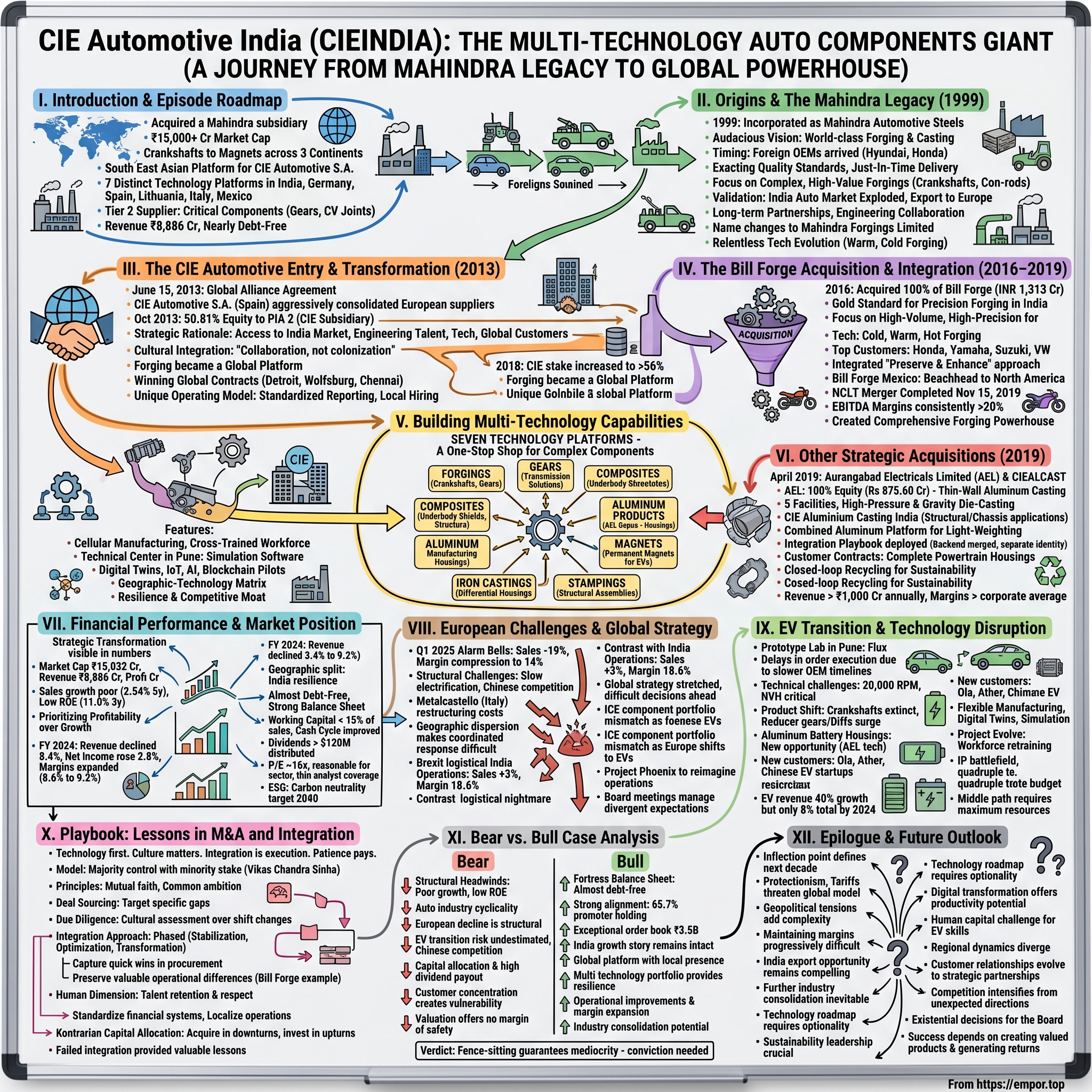
CIE Automotive India: The Multi-Technology Auto Components Powerhouse
I. Introduction & Episode Roadmap
There is a particular kind of industrial business that almost never gets written about. It does not make the car. It does not make the badge on the car. It makes the forged steel knuckle that connects the wheel to the suspension, the aluminium housing that keeps the motor from cooking itself, the gear that transmits torque inside a Caterpillar excavator. If it does its job, nobody ever learns its name. If it fails, a vehicle recalls.
CIE Automotive India is that kind of business — and it has spent the last thirteen years quietly executing one of the more unusual corporate transformations in Indian manufacturing. The company trades on the NSE as CIEINDIA and on the BSE as 532756, carries a market capitalisation of roughly ₹14,566 crore, and is controlled — 65.7% of the equity — by a Spanish industrial group headquartered in Bilbao.123 Its Indian plants supply Mahindra, Bajaj Auto, and Maruti Suzuki. Its European plants supply Volkswagen, Renault, and Caterpillar. And the whole thing began life as a collection of loss-making forging shops that Mahindra & Mahindra bought across Germany and the UK in the mid-2000s, watched bleed through the financial crisis, and eventually handed to a Spanish partner to fix.
That is the central arc of this story, and it is worth stating plainly because it cuts against the usual Indian corporate narrative. This is not a founder-led compounding machine. It is a restructuring story. An ambitious parent built an empire through acquisition, the empire failed to deliver, and a different set of operators took the pieces apart, sold the worst of them at a loss, and rebuilt the remainder into a business generating mid-teens EBITDA margins with a net cash balance sheet.45
The paradox that hangs over the equity is easy to state and harder to resolve. Profitability has been transformed: consolidated operating margins have sat in the mid-teens for four consecutive years, debt has gone from ₹1,899.5 crore at the end of CY2020 to a net cash surplus, and interest cover improved to 18.4 times in CY2024.4 But growth has been unremarkable. Consolidated revenue in CY2025 was ₹9,122 crore, only about 15% above the CY2018 level of roughly ₹8,032 crore — seven years of near-stagnation at the top line, made worse by a European business that shrank 6% in euro terms during CY2025 even as it grew 2% in reported rupees.125 Return on equity was 11.1% in CY2025, dragged down by the very cash pile that makes the balance sheet look so safe.2
So the question this story circles is not whether management is competent. The operating record largely settles that. The question is whether operational discipline, absent revenue growth and absent deployed capital, is an investment thesis or merely a well-run holding pattern. In the first half of CY2026 the company posted its strongest growth in years — consolidated sales up 13% to ₹5,084 crore and PAT up 18% to ₹485 crore — which suggests the holding pattern may be breaking.67 Whether that is a durable inflection or a GST-cut sugar high is the live debate, and management's own words on recent calls give ammunition to both sides.
This story traces the Mahindra Systech agglomeration and why it failed; the 2013 alliance that changed the operating system; the two domestic acquisitions that actually created value and the German assets that destroyed it; the technology portfolio as it stands today; the competitive position against Bharat Forge and the domestic forging complex; management's promises measured against outcomes; the electric-vehicle transition, which is simultaneously the biggest opportunity and the most overstated one; and finally what would have to be true, and what would have to break, for the current setup to work.
The analysis starts where the trouble started: a boardroom in Mumbai in 2006, and a very ambitious idea about German steel.
 Subscribe on LinkedIn
II. Genesis: The License Raj Legacy & Mahindra Systech's M&A Spree (1999–2012)
On 28 September 2006, Mahindra & Mahindra announced it was acquiring 67.9% of JECO Holding AG, a German forging group with more than 120 years of history, at an enterprise value of €140 million — roughly ₹830 crore at the time, making it the largest outbound auto-component acquisition ever attempted by an Indian company.8 JECO brought 100,000 tonnes of annual forging capacity, supplied blue-chip OEMs including Daimler, ZF, MAN, Volvo, and Renault, and manufactured essential heavy components for European commercial vehicles: gearbox parts, axle components, hubs, and piston heads.
Three months later, on 1 January 2007, Mahindra closed a second German transaction, purchasing 90.47% of Schöneweiss & Co. GmbH — a 140-year-old family firm across Hagen and Gevelsberg with annual turnover of roughly €90 million, 550 employees, three plants, and a claim to being one of the top five axle-beam makers in the world.9 Anand Mahindra called the deal "a strong European base," while Hemant Luthra, head of the Systems & Technologies division, praised Schöneweiss for its technical abilities and deep customer relationships. The UK-based Stokes Group was subsequently brought into the fold with an effective date of 1 April 2007.
The underlying logic appeared sound at the time. Mahindra Systech had been created in 2004 to capitalise on India's auto-component boom, assembled from existing Mahindra companies alongside acquisitions spanning forgings, stampings, castings, gears, magnetic products and composites.4 Acquiring European forging capability was intended to provide Indian operations with advanced technology, credibility with global OEMs, and a design-to-delivery footprint across three continents. Luthra described the group as "uniquely positioned to serve customers from three locations."8
In practice, the structure operated as a loose federation rather than an integrated corporation. Systech spanned multiple separately listed and unlisted entities — Mahindra Forgings, Mahindra Ugine Steel, Mahindra Hinoday, Mahindra Gears, and Mahindra Composites — each with its own balance sheet, its own board and its own capital-allocation logic.4 No single executive owned the consolidated return on capital, because there was no unified corporate entity to own it. Combined with cross-border debt taken to fund European purchases and heavy end-market exposure to commercial vehicles — the most cyclical segment in automotive manufacturing — the design flaw became obvious in hindsight: the group had used borrowed money to buy volatility while distributing accountability across half a dozen entities.
Then the 2008 global financial crisis struck.
European truck sales fell roughly 60%, and the German truck-forging business — the very asset built for that market — collapsed with them.10 Structural vulnerabilities hidden during the boom surfaced all at once. The Gevelsberg plant sat in a residential area and could not run 24-hour operations, creating fatal economics for a capital-intensive forge. Machining had been outsourced, and quality failures generated customer damage claims of roughly ₹30 crore. Crisis-era cost cutting eliminated skilled workers who could not be replaced when demand partially returned in 2011. EBIT margins that had hovered around 11% before the crisis simply evaporated.10
The falsification pass: did European scale deliver technological supremacy?
The claim that justified the spending spree was that owning high-cost European forging assets would give the Indian operations technological superiority and global scale. That thesis can be tested directly against the company's public disclosures over the subsequent decade.
By the financial year ended March 2015 — nine years after the JECO deal — the entity that had absorbed these assets carried brought-forward accumulated losses of ₹834.7 million on its standalone books, and management had already decided to close Jeco-Jellinghaus GmbH's operations in a phased manner, shifting machinery to other locations and outsourcing most of its machining.11 The flagship 2006 acquisition was being wound down within nine years by a management team that described the closure as an efficiency exercise from which no revenue loss was expected. Concurrently, Metalcastello, the Italian gear business, was undergoing headcount reductions and inventory write-offs.
This record does not describe a successful technology transfer. It illustrates the risk of buying cyclical, labour-heavy, energy-intensive assets at the top of a cycle in an expensive manufacturing jurisdiction. Forging proved to be an inherently regional business: heavy components incur prohibitive shipping costs, preventing Indian plants from backfilling German capacity or extracting meaningful purchasing leverage from European volumes.
The evidence rejects the original scale thesis. What European ownership eventually provided was narrower and indirect: customer relationships and operating discipline that arrived years later under a different parent company on different terms. Meanwhile, legacy German assets remained a drag that required restructuring and divestment as recently as 2023.
By 2012, the position had become untenable. Mahindra Systech remained a leveraged, fragmented collection of low-return businesses inside a group optimized for manufacturing tractors and SUVs, not running industrial forges in Westphalia. Mahindra needed an operating partner with specialized expertise in managing auto-component assets — and in Bilbao, such a partner existed.
III. The Strategic Masterstroke: The 2013 CIE-Mahindra Alliance
On 15 June 2013, the board of what was then Mahindra Forgings approved two schemes of amalgamation. The first—the "Integrated Scheme"—folded Mahindra Hinoday Industries, Mahindra Ugine Steel, Mahindra Gears International, Mahindra Investments (India), and a Spanish holding vehicle called Participaciones Internacionales Autometal Tres into the listed entity. The second folded in Mahindra Composites.11 Regulatory observation letters from SEBI followed in March 2014, shareholders approved the plans at court-convened meetings on 5 June 2014, and the Bombay High Court sanctioned both schemes on 31 October 2014.
When the deal finalized on 31 March 2015, the shareholder register reflected the real shift in power. Participaciones Internacionales Autometal Dos—CIE Automotive S.A.'s Indian holding vehicle—held 53.18% of the equity, while Mahindra & Mahindra retained 20.21%.11 The Indian industrial group that had assembled the business was now the minority partner. The company took the name Mahindra CIE Automotive, but the second name signaled who was in charge.
What CIE actually brought
It is tempting to describe what followed as "Spanish operational discipline," but the specific tool CIE Automotive imported was an unyielding operational scorecard. Every plant was measured against five parameters: an EBIT margin of 10% or better; return on capital employed of 20% or better; debt below two times EBITDA; investment recovery within three years; and free cash flow equal to half of EBITDA.10 Plant managers owned their own P&L statements. Capital was not allocated based on strategic narratives; it was awarded only if a plant hit its benchmark numbers.
That is a methodical system, and its strength lies in its simplicity. It requires no operational magic—only the discipline to say no to plant managers and the resolve to shut down facilities that cannot clear the hurdle. Where Mahindra's leadership had struggled to restructure assets it had personally championed, a new owner with no emotional attachment to the 2006 deals acted without hesitation.
The results showed up quickly in the operating metrics. Consolidated operating margins expanded to about 11% in 2016 from 8.5% in 2015, while EBIT margins improved to 6.3% from 1.1%—nearly a sixfold gain in operating profitability driven by product mix, scrap reduction, and headcount rationalization rather than raw volume.10 Reported net profit swung from a loss of ₹78 crore in CY2015 to ₹169 crore in CY2016.1
The initial post-merger performance showed how much heavy lifting remained. For the financial year ended March 2015, the merged standalone entity reported total income of ₹16,624.8 million (about ₹1,662 crore) compared with ₹3,929.9 million the prior year—a jump inflated by the amalgamation itself and explicitly flagged by directors as non-comparable. Net profit reached ₹776.7 million, driving a merger-adjusted swing that moved the accumulated profit and loss balance from negative ₹655.0 million to positive ₹1,740.5 million.11 Management recommended no dividend. The operating footprint was concentrated in Maharashtra, where industrial power tariffs had just increased. Directors' commentary focused on unglamorous priorities: plant efficiency, higher value-added components, headcount reduction, overtime controls, inventory write-offs, and the shutdown of an unprofitable German subsidiary.
These operational turnaround efforts stand in contrast to management's broader valuation targets. During this period, Chairman Hemant Luthra publicly stated an ambition to "double MCIE's market cap from $1.25 billion to $2.5 billion by 2020."10 Measured against the company's market capitalisation of roughly ₹14,566 crore—about $1.65 billion—that target was missed by a wide margin, six years past its deadline.1 The operational turnaround was real, but the valuation expansion promised to public shareholders did not materialize on schedule. Investors weighing current management commentary on growth acceleration should evaluate both records.
Mahindra's long goodbye
Mahindra & Mahindra did not exit in a single move, selling down its stake over eight years. The group trimmed its holding through the late 2010s, reduced its stake from 9.25% to roughly 3.20% by March 2023, and sold its remaining 12,122,068 shares—a 3.195% equity stake—on 26 May 2023 at ₹447.6501 per share for ₹543 crore, bringing its holding to zero.12[^13] Ten days before that final transaction, on 16 May 2023, approval was granted to drop the Mahindra name, officially changing the corporate identity from Mahindra CIE Automotive Limited to CIE Automotive India Limited.1213
The rebranding was far more than cosmetic. It marked the end of a decade in which an Indian conglomerate's brand underwrote customer relationships, transitioning the business to stand strictly on its Spanish parent's operational credentials. Credit rating agency ICRA explicitly noted that the company "acts as the auto component division for the South Asian and South-East Asian markets" for the CIE group and is "strategically important" to it—a status that underpins its strong credit rating while establishing clear limits on the Indian entity's strategic autonomy.4
For investors, the 2013 alliance salvaged a struggling asset portfolio and instituted a disciplined operating framework. However, it also turned a listed Indian company into a regional subsidiary dominated by a 65.7% foreign promoter with a relatively small public float. Key corporate decisions—including capital allocation, acquisition strategy, and cash management—are governed by that overarching parent-subsidiary structure.
With the new operating system established, the next challenge was applying it to assets that could deliver sustainable growth.
IV. Crown Jewel M&A: The Bill Forge & AEL Acquisitions (2016–2019)
By 2016, European restructuring had stabilized, leaving the company with a dilemma most turnarounds would envy: a functioning operating system with nowhere new to deploy it. Meanwhile, India’s two-wheeler market was compounding rapidly, a growth engine in which the company barely participated.
Bill Forge addressed that gap. On 12 September 2016, the board approved acquiring the Bengaluru-based precision forging specialist for ₹1,331.2 crore from private equity firm Kedaara Capital and the Haridas family, completing the transaction on 27 October 2016.[^15]14 For the fiscal year ended 31 March 2016, Bill Forge generated ₹582.3 crore in revenue, ₹120.5 crore in EBITDA, and ₹51.4 crore in net profit.14
At roughly 25.9 times trailing earnings and 2.3 times sales, the valuation appeared rich for an industrial forge, especially alongside a legacy forging complex that had spent the preceding decade destroying capital. The deal’s funding structure was equally revealing: roughly half was paid from internal cash reserves, while the remainder was financed by issuing 31.99 million shares to Bill Forge's sellers at ₹200 per share and another 22.5 million shares to the Spanish parent's holding vehicle at the same price.14 By paying partly in equity while allowing the promoter to top up its stake, management funded the acquisition without debt, but diluted minority shareholders' proportional ownership in the process.
The transaction delivered specialized capabilities that the group lacked and could not easily construct internally: cold and warm forging for high-volume precision parts, an entry into two-wheelers via Bajaj Auto, and a manufacturing plant in Mexico supplying North American vehicle programs.[^15]14 The distinction between forging methods explains the strategic value. Hot forging heats steel until malleable before hammering it into shape—a fast, low-cost process that yields looser dimensional tolerances and demands extensive post-machining. Cold forging deforms steel at room temperature. Although tooling is more complex, it yields tighter tolerances, reduces machining requirements, and offers superior fatigue strength, as the steel's grain structure is mechanically worked rather than thermalized. For critical components like bearing races or two-wheeler crankshafts, that structural integrity separates durable parts from warranty claims.
The Bill Forge deal also included a secondary asset that required nearly a decade to deliver on its promise: CIE Hosur, a precision forging plant in Tamil Nadu that executives repeatedly praised as world-class yet acknowledged was underutilized. On the February 2026 earnings call, when asked which delayed orders were finally materializing, strategy head Vikas Sinha highlighted the facility first, noting that "the main one which was delayed to an extent, was CIE Hosur... it's a very excellent plant that we have and — but we took a little bit more time to fill that up. So now it should be reaching full capacity in the coming quarters."5 The delay highlights the operational realities of automotive manufacturing. Unlike software scaling, bridging the gap between commissioning a forge line and filling it with validated, price-approved OEM programs takes years, during which fixed depreciation continues to accrue. Capacity expansion announcements must therefore be evaluated against this historical operational lag.
Nearly three years later, on 12 March 2019, the board approved acquiring 100% of Aurangabad Electricals Limited (AEL) at an enterprise value of roughly ₹857 crore—including up to ₹62.2 crore in deferred consideration—completing the purchase by 10 April 2019.15[^18] Founded in 1985, AEL operated five facilities across Aurangabad, Pune, and Pantnagar with over 3,300 employees, generating approximately ₹850 crore in revenue at a 12% EBITDA margin by manufacturing aluminum high-pressure and gravity die-cast engine, brake, and body components.15 Ander Arenaza, then Chief Executive of Mahindra CIE, presented the acquisition as an entry into aluminum die-casting technology and a step toward customer diversification.
While that framing accurately reflected the technical acquisition, it proved optimistic regarding immediate business growth.
The falsification pass: is CIE India's M&A actually disciplined?
The bull case contends that the company acquires market-leading domestic specialists at reasonable valuations and enhances them through its operating system. Three historical facts test this premise.
First are the inherited European assets. Regardless of their original purchase cost under Mahindra, exiting them required significant capital from CIE India, culminating in an ₹847.5 crore loss from discontinued operations in CY2022 that turned an otherwise profitable year into a reported consolidated loss of ₹136 crore.15 A capital allocation history requiring write-offs of that scale reflects a competent operator paying to clean up a flawed portfolio rather than pure M&A discipline.
Second is AEL's operational trajectory. During the Q4 CY2025 earnings call in February 2026, an analyst observed that the aluminum division had posted flat to low-single-digit growth since its acquisition. Arenaza offered an unusually candid response, admitting that "till now, our performance was not very good because in terms of sales because we were — we are mainly dependent on Bajaj 2-wheelers," a vulnerability compounded by CNG vehicle programs that "did not succeed."5 Sinha added that the vertical had spent "the last 2 or 3 years" undergoing restructuring that remained "not fully done." An acquisition executed in 2019 to secure aluminum capability and customer diversification delivered the technology, but failed to deliver diversification for six years. The record demonstrates that CIE India successfully acquires technical capability, but achieves top-line growth less reliably.
Third, the company has not completed a transaction since acquiring AEL. On the Q1 CY2026 call in April 2026, when asked how management intended to deploy accumulating cash reserves, Arenaza acknowledged: "unfortunately, in the last years, we did not close any operation, but we continue to be active on this area."16 He attributed the hiatus to elevated domestic valuations, stating that "the price and the expectations are very high."
Refusing to overpay reflects prudent capital discipline. However, maintaining that stance for seven years while cash accumulates and return on equity sits at 11.1% carries its own opportunity cost.2 The empirical evidence supports a nuanced conclusion: CIE India can integrate acquired technology and expand plant-level margins, but it has yet to prove it can consistently source new acquisitions at acceptable valuations. The benchmark for investors is straightforward: either management executes an acquisition that clears its internal return hurdles, or cash will continue earning treasury yields while return on equity remains constrained.
There was, however, one capital allocation decision from this era that proved unambiguously effective—and it involved subtraction.
V. Pruning the Deadwood: The German Forgings Exit (2022–2023)
By the end of 2022, the industrial environment in Europe had deteriorated. Russian natural gas supplies had stopped, industrial energy costs had surged beyond what heavy manufacturing could absorb, and European commercial vehicle production was slowing. Against this backdrop, CIE Automotive India held four German forging subsidiaries — Schöneweiss, Gesenkschmiede Schneider, Falkenroth Umformtechnik, and Jeco-Jellinghaus — employing roughly 600 workers and generating €220 million in 2022 revenue, with sales heavily concentrated in the European truck sector.1718
Nearly two decades of Indian ownership in Germany had generated scale without structural profitability. On 15 December 2022, the board voted to discontinue the German forging operations, classify the entities for sale, and write down their net assets to realisable value.19 That impairment landed in the CY2022 financial accounts, resulting in a reported net loss for the year despite strong underlying performance that generated an adjusted consolidated profit after tax of ₹673.5 crore.5
The exit closed the following year. In August 2023, private equity firm Mutares SE & Co. KGaA agreed to acquire the four German units at an enterprise value of €55.5 million — equivalent to roughly five times 2023 pro-forma recurring EBITDA. The deal completed on 16 October 2023, with economic effect retroactive to 1 July 2023.17185 Jesús María Herrera, chief executive of parent company CIE Automotive S.A., stated the rationale plainly, noting the assets were non-core and that the sale aimed at "redirecting financial and management resources to higher return businesses."18
The falsification pass: was there ever a transatlantic forging synergy?
The strategic premise advanced from 2006 through the mid-2010s held that an integrated cross-border forging platform spanning India and Europe would create unique supply-chain efficiencies. Nearly two decades of operating data have disproven that thesis, a reality management has since acknowledged.
When asked on the February 2026 earnings call whether manufacturing capacity would relocate from Europe to India, head of strategy Vikas Sinha described the industry trend plainly: "forgings and iron castings are two areas where you do see a lot of churn happening from Europe to other emerging nations." CEO Ander Arenaza confirmed that the company was transferring press lines and gear-production cells from Europe to India beginning in April 2026.5 However, that equipment movement stems from unviable European operating costs rather than inherent group synergies, and capacity shifts to whichever low-cost jurisdiction proves most competitive. Sinha was equally candid about the limits of domestic manufacturing, noting that "if the Indian plants are not efficient, it is not going to happen," as high industrial power tariffs in key Indian states and freight expenses can erode raw labor cost savings.
The historical record indicates that heavy forging remains an inherently regional business where localized plant efficiency matters far more than cross-border ownership. The exit from Germany succeeded not through complex portfolio engineering, but by eliminating manufacturing assets unable to meet internal return benchmarks under any owner.
What the exit actually bought
The financial impact of the divestment materialized quickly. In CY2023, consolidated EBITDA margins expanded to 17.1% from 15.4% in CY2022, while the remaining European operations — freed from the German truck-forging drag — expanded their margin to 17.8% from 14.5% the previous year.5 Return on net assets reached 21.3%, exceeding 20% for the first time in group history. The balance sheet closed with a net cash surplus of ₹820 crore, supported by ₹376 crore in cash proceeds generated from the divestment.5
That margin expansion warrants careful interpretation. Divesting unprofitable operations improves aggregate corporate margin percentages through simple arithmetic without necessarily enhancing the productivity of the remaining facilities. The primary operational benefit was distinct: management eliminated a persistent operating loss, freed management attention from an unviable asset, and added ₹376 crore in liquid capital.
The broader capital allocation lesson centers on the willingness to divest failed assets. Over a seventeen-year cycle from 2006 to 2023, the group acquired German forging capacity, attempted restructuring, shuttered facilities, absorbed impairments, and ultimately divested the remaining assets at a loss relative to original invested capital. The Spanish management team that executed the final exit was unencumbered by the original acquisition decisions, enabling an objective divestment. For investors assessing industrial holding companies, a management team's discipline in exiting unprofitable divisions provides a critical measure of capital stewardship.
What was left after the pruning is a genuinely unusual portfolio, and understanding it requires walking through the technologies one at a time.
VI. Multi-Technology Segment Anatomy & Economics
An investor presentation slide for CIE India displays seven technology verticals mapped across four market segments and dozens of customers. This structure defines what the business can and cannot control.
The geography, restated
A reporting realignment introduced in CY2025 provides essential context for the segment numbers. The company shifted its Mexican forging operation—historically grouped with Indian operations for legacy reasons—under CIE Galfor in Europe following a capital increase, restating all CY2024 comparatives accordingly. The Mexican business remains small, generating roughly ₹300 crore in annual revenue.5 On this updated basis, Indian plants accounted for 65% of consolidated sales in CY2025, with Europe and Mexico contributing the remaining 35%.
Indian operations generated ₹5,937 crore in CY2025 revenue—an 8% increase—delivering an EBITDA margin of 17.5% compared to 18.2% in the prior year.35 That 70-basis-point margin compression resulted primarily from discrete items: a ₹13.2 crore one-time gratuity expense tied to India's updated labor codes, higher power tariffs in Maharashtra, and a CY2024 comparison base boosted by a ₹22 crore government subsidy in the aluminum division. On an adjusted, like-for-like basis, management noted that domestic operating margins remained flat year over year.5
European operations reported revenue of ₹3,185 crore, representing a 2% gain in reported rupees but a 6% contraction in euro terms, with EBITDA margins contracting to 13.3% from 15.7%.35 Approximately 1.5 percentage points of that margin decline stemmed from one-off operational restructuring at the Metalcastello gear facility in Italy and the Legazpi plant in Spain. Across all geographies, consolidated revenue reached ₹9,122 crore, yielding a 16.0% EBITDA margin and a net profit after tax of ₹828 crore.3
The Indian end-market portfolio in CY2025 was divided among light vehicles at 53%, two- and three-wheelers at 23%, agricultural tractors at 13%, and heavy commercial vehicles at 11%. European operations remain far more concentrated, with forgings comprising roughly 80% of sales and light vehicles accounting for over half of total volume.5 This structural divergence defines the corporate profile: Indian operations function as a diversified multi-technology platform, whereas the European footprint represents a concentrated bet on heavy forging within a stagnant automotive market.
The seven technologies, and what they actually do
Forgings remain the operational backbone—producing critical engine and drivetrain components including crankshafts, steering knuckles, constant-velocity joint parts, and bearing races—divided between Bill Forge's precision plants in Bengaluru, legacy domestic facilities, and the European forging network. Aluminum high-pressure die casting, managed through AEL, supplies complex thin-walled structural, braking, and electric vehicle housings by injecting molten alloy into steel molds under pressure to eliminate post-machining. Stampings process sheet steel into body and chassis panels, while iron castings supply heavier structural and engine blocks. Gears—produced at Metalcastello in Italy alongside Indian facilities—serve agricultural tractor and off-highway transmission systems, with Caterpillar acting as a key client. Composites manufacture glass-fiber-reinforced structural parts, counting industrial conglomerate Larsen & Toubro as a primary non-automotive customer.5 Magnetic products forms the seventh and smallest division.
That final division warrants realistic sizing rather than promotional framing. Strategy head Vikas Sinha noted in February 2026 that the magnetic products unit generates under ₹200 crore in annual sales, faces "a lot of competition from Chinese suppliers as well as a lot of technology changes," and requires the company to "up our game."5 Representing roughly 2% of consolidated revenue and currently undergoing operational restructuring, the unit remains a minor line item rather than a material growth driver.
The Italian outlier
Metalcastello operates on an economic cycle distinct from the rest of the portfolio. Because its primary output consists of heavy off-highway transmission gears supplied directly to Caterpillar, its performance tracks North American construction and mining capital expenditure rather than European vehicle assemblies. That independence cut against the business during CY2023 and CY2024, when a slump in US off-highway equipment demand forced a division-wide restructuring in the second quarter of CY2025.255 Following the intervention, Chief Executive Ander Arenaza reported that the restructuring was "finished," workforce levels had "adapted to the new demand scenario," profitability had recovered to pre-downturn levels, and no additional structural changes would be required "in the next few years."5
When an analyst questioned in April 2026 why Metalcastello's sales remained flat while Caterpillar reported double-digit North American revenue growth, management pointed to component-level specialization.16 A specialized supplier provides gear assemblies for specific machinery platforms rather than capturing a customer's total top-line growth. For investors, it underscores that auto-component supplier performance depends on specific vehicle and machinery program allocations rather than parent-brand headline growth.
Corporate simplification has also trimmed administrative overhead across the Indian footprint. Entity BF Precision Private Limited was dissolved following an order from NCLT Chennai on 5 June 2025, while management initiated the merger of AEL directly into the parent entity, leaving CIE Hosur as the primary operational Indian subsidiary.516 While structural consolidation eliminates intra-group transaction friction for equity holders, it also reduces granular segment disclosure in financial reports.
Where the profit actually sits
Forgings and aluminum die casting generate the vast majority of consolidated EBITDA, but capital allocation highlights the strategic direction. India generates nearly two-thirds of consolidated revenue at operating margins four percentage points above European levels, attracting 95% of total growth capital expenditure as of the first quarter of CY2026.16 European operations are now managed primarily for cash preservation; as Sinha summarized: "in Europe, we need to wait and watch. India is much more straightforward, much happier situation."5
The optionality, sized honestly
Management points to two primary avenues for top-line expansion: international exports and electric vehicle components. Direct exports represented approximately 11% of Indian sales in CY2025, with roughly 3 percentage points bound for North America and the remainder for European OEMs.16 A major iron-castings export program serving the US market was slated to begin commercial production around June 2026.5 In parallel, the company has developed component lines for electric drivetrains, including inverter housings, e-drive gears, battery enclosures, and motor housings.
Order book disclosures put the pace of that transition into perspective. Of the roughly ₹870 crore per year in new Indian order wins secured during CY2025, approximately 10% was allocated to electric vehicle programs, with the remaining 90% tied to conventional internal combustion engine platforms.5 In the first quarter of CY2026, annualized new order wins of roughly ₹350 crore maintained an 11% electric vehicle allocation.16 While electric vehicle component manufacturing capabilities are established and receiving capital, they represent roughly one-tenth of current incremental order flow. Market commentary framing the business primarily around electric mobility is not supported by actual order bookings.
Underlying these segment dynamics is an exceptionally unleveraged balance sheet, setting up the competitive dynamics of the domestic market.
VII. Competitive Landscape & Microeconomics (7 Powers & 5 Forces)
The Indian forging and precision-components industry is a genuinely competitive arena, and CIE India is not its largest player. Bharat Forge reported consolidated FY2026 revenue of ₹16,812 crore, up 11.2%, with profit after tax of ₹1,089 crore — nearly double CIE India's top line — backed by a defence order book of ₹10,961 crore and aerospace revenue that expanded roughly fivefold from FY2021 through FY2026.20 Ramkrishna Forgings posted FY2026 revenue of about ₹4,238 crore.21 On the aluminium and two-wheeler side, Endurance Technologies, Sundram Fasteners, and Craftsman Automation all compete for overlapping content.
The strategic divergence is stark and worth dwelling on. Bharat Forge has spent a decade diversifying out of automotive into defence and aerospace — higher margin, longer cycle, government-anchored. CIE India has explicitly refused to follow. Asked directly on the February 2026 call about defence and industrial opportunities, Sinha's answer left no ambiguity: "On your question on non-auto — defence, etcetera. No, we are not in defence, oil and gas. No, we are not considering that. It's a very different business model."5
That is a defensible choice and a consequential one. It keeps the company inside a business model it understands, and it forecloses the single highest-growth adjacency its largest domestic competitor is exploiting. An investor who believes Indian defence indigenisation is a multi-decade structural theme should note that CIE India has opted out of it by design.
Seven Powers, tested rather than asserted
Process Power is the power most often claimed for this company, resting on Bill Forge's cold-forging tooling and the CIE group's plant-level efficiency system. What is the actual evidence? Sinha's own formulation on the February 2026 call was careful: "CIE is one of the most efficient producers in Europe... I cannot produce any study to prove my point, but perhaps the most efficient producer because if you look at the margins and the numbers that CIE generates in Europe."5 That is management inferring efficiency from its own margins — circular, though not therefore wrong. The stronger supporting evidence is external: European operations sustained a 13.3% EBITDA margin in CY2025 including restructuring charges, and recovered to 15.9% by Q2 CY2026, in a market where European light-vehicle production has fallen from 19–22 million units pre-2019 to 15–16 million and numerous German and French suppliers are visibly struggling.5616 Holding mid-teens margins through that downturn is a genuine signal. Process Power is present, but it should be described as a cost position sustained by systems and measurement rather than a proprietary technology moat.
Switching Costs are the most defensible power here, and they are structural to the industry rather than specific to this company. Safety-critical powertrain and chassis components go through extended OEM validation, and suppliers are rarely swapped mid-platform. The evidence appears indirectly in the concentration data: Mahindra (auto and tractors), Bajaj, and Maruti together account for close to 50% of Indian business, with a second tier of 10 to 15 customers each contributing 1% to 5% — the largest being Hyundai, Kia, and Tata Motors.5 Relationships that dense do not persist without real friction to displacing them. The same data reveals the mirror risk: half the Indian business rides on four customer relationships.
Scale Economies are moderate and largely borrowed. The company benefits from the CIE group's global procurement and technology access — ICRA cites exactly this as a rating strength.4 But CIE India is not the scale leader in India, and in Europe it is competing against a shrinking market where scale is being destroyed industry-wide.
Counter-position and Cornered Resource are absent. There is nothing here a well-capitalised competitor could not replicate given time and tooling investment.
The pricing-power counter-finding
The most important microeconomic fact about this business is that it does not set prices. Tier-1 and Tier-2 component contracts in the automotive industry carry annual productivity givebacks, and input costs pass through with a lag. Both dynamics showed up in CY2026. On the Q1 call, CFO K. Jayaprakash confirmed that commodity pass-through worked but diluted percentage margins, and Arenaza explained the mechanism: aluminium prices spiked, pass-through lagged by roughly a month, "the absolute value of the EBITDA will be the same, but the turnover will be higher because of this pass-through."16 By Q2 CY2026, Indian EBITDA margin had compressed to 16.7% from 17.5% a year earlier, explicitly attributed to geopolitically driven cost inflation.6
That is the honest shape of this business model. Rupee EBITDA is defended; percentage margin is not fully controllable. Investors who anchor on margin percentage will misread perfectly healthy quarters as deterioration, and vice versa.
The consolidation trade, and why it keeps not happening
The most frequently cited European bull argument is that supplier consolidation will hand volume to survivors. It has been cited for four years without resolving, and Sinha explained the mechanism for the delay better than most sell-side notes manage: consolidation "actually happens when the production goes out of the supply chain — it is completely scrapped. That will take some time before that happens."5 Distressed suppliers do not exit gracefully; they limp, discount, and keep capacity available at marginal cost, which suppresses pricing for everyone, including healthy operators. Only when assets are physically scrapped does the survivor's pricing improve.
There is a further wrinkle that cuts against the simple version of the trade. Sinha's own framing was that some of the released volume "will shift out to other emerging markets depending on which is the most efficient country" — meaning that even successful European consolidation may route work to Turkey, Morocco, or India rather than to CIE's European plants.5 That outcome is fine for the consolidated entity if the work lands in its Indian plants, but not fine at all if it lands elsewhere. The bull case here is contingent on a competitive outcome, not on a structural entitlement.
Porter's Five Forces, briefly
Buyer power is high and permanent — a handful of OEMs, annual price-down clauses, and full visibility into supplier cost structures. Supplier power is moderate: special steel and aluminium are commodities with pass-through mechanics, though Arenaza flagged that Middle East conflict had disrupted aluminium production and raised prices globally.16 Entry barriers are genuinely high for zero-defect safety-critical parts, given validation cycles and capital intensity. Substitution is the real long-term threat, and it is not a competitor — it is powertrain architecture change, which is addressed in the next section. Rivalry is intense in India and brutal in Europe, where consolidation has been anticipated for years without fully materialising; Arenaza's April 2026 assessment was appropriately hedged: "It is difficult to say if we will gain in this moment, but we expect that we will win and the market will continue consolidating."16
The people making these calls have a track record worth examining directly.
VIII. Current Management, Incentives & Capital Allocation Record
Ander Arenaza Álvarez is an industrial engineer from the Bilbao engineering school with an MBA from Deusto University, more than thirty years of automotive experience, and a career inside CIE Automotive dating to 2007, when he managed the group's global machining and aluminum high-pressure die-casting divisions before taking the India role.22 He serves as Executive Director and Group CEO of CIE Automotive India.
On earnings calls, Arenaza frequently adopts a candid tone regarding capacity planning. In February 2026, unprompted, he addressed potential investor critiques of the company's expansion timeline: "my message would be that we could have done this before that could be one of the questions from the investors. And the answer is yes, but we decided to do it in the same way with — in a conservative way."5 Later on the same call, he noted his own cautious approach before offering an optimistic assessment: "You know that I'm usually very conservative. In this case, I can say that India is in a very good path."
Vikas Sinha, Senior Vice President of Strategy and Chief Investor Relations Officer, holds a mechanical engineering degree from IIT Delhi and an MBA from IIM Ahmedabad. He began his career as a quality engineer at Maruti Suzuki, moved to Tata Strategic Management Group, and later joined Mahindra & Mahindra's Group Strategy Office—where he worked on the transaction that brought CIE into India—before joining the combined entity at its 2013 inception.22 As the institutional memory of the transaction, Sinha has directly confronted execution gaps on analyst calls. When challenged in February 2026 over an Indian growth shortfall that an analyst described as "a very negative surprise," Sinha acknowledged the critique: "We do recognize that we need to do more growth. There is no question about that... Could some of these projects have been done a little earlier? Maybe that question will always remain — that is a criticism we'll happily take."5
The rest of the senior executive team includes Manoj Mullassery Menon, Executive Director and CEO overseeing the gears, composites, foundry, stampings, and magnetics divisions; K. Jayaprakash as CFO, bringing more than 35 years of finance experience, including a prior role as CFO at Big Bazaar; Sunil Narke as CEO of the forging divisions; and Anup Mishra as Chief Business Controller and CIO.22 Above the domestic leadership team sits Jesús María Herrera, CEO of Spanish parent CIE Automotive S.A., who framed the German divestment rationale and stated on the parent company's Q2 2026 earnings call regarding India: "We are really putting our stakes on India," emphasizing a corporate preference for "profitability instead of growth."1823
The capital allocation record, examined
The balance sheet transformation represents the company's clearest financial milestone. Total debt declined from ₹1,899.5 crore at the end of CY2020 to ₹570 crore by December 2024, lowering gearing to 0.1 times, reducing total debt to EBITDA to 0.4 times, and raising interest coverage to 18.4 times.4 Net financial debt reached a net cash surplus of ₹1,880 crore by the end of CY2025, expanding from a net cash position of ₹1,200 crore a year earlier, while the first-half CY2026 net cash balance stood at roughly ₹1,420 crore after funding capital expenditures and dividend distributions.57 Unencumbered cash and liquid investments totaled approximately ₹793 crore as of 30 June 2025.4
Capital expenditure has adhered strictly to internal controls. Total capital outlay for CY2025 was ₹380 crore—remaining within the group's 5%-of-sales benchmark—with ₹230 crore allocated to growth projects concentrated in India.5 Operating cash flow conversion reached 71% of consolidated EBITDA, expanding from 60% in CY2023.5 Dividends were maintained at ₹7 per share,3 representing a payout ratio of roughly 27% and a dividend yield near 1.8%.1
A capital spending expansion is now underway. In April 2026, Arenaza projected Indian capital expenditures of ₹400 crore to ₹500 crore for CY2026—temporarily exceeding the internal 6% target during the second half—to fund three new forging lines, a metal stamping line, and an iron-casting moulding line.16
The activist's case
A critical analysis of this financial structure highlights three main concerns for minority shareholders.
First is cash drag. Earning an 11.1% return on equity while maintaining a net cash surplus of ₹1,880 crore dilutes underlying profitability.5 Management has neither deployed these reserves into acquisitions over the past seven years nor returned capital beyond the 27% dividend payout ratio. When asked about potential share buybacks on the parent company's Q2 2026 call, Herrera acknowledged that the board was "very unhappy with the valuation," yet confirmed no buyback was planned.23 For minority shareholders in the Indian entity, holding substantial liquid balances at modest yields while equity trades at a perceived discount presents a persistent capital allocation friction.
Second is related-party transaction complexity. At the CY2025 annual general meeting, shareholders approved related-party transactions with Mahindra & Mahindra up to an aggregate annual limit of ₹2,500 crore, alongside cash-pooling arrangements and service agreements linking wholly owned subsidiary CIE Galfor to ultimate parent CIE Automotive S.A.24 Cash pooling with a 65.7% controlling shareholder represents standard practice in multinational corporations and is fully disclosed, though it structurally enables subsidiary liquidity to support group-wide balance sheets. The Q4 CY2025 earnings call highlighted a specific example: ₹230 crore in net loans extended during the quarter, which Jayaprakash explained as European cash generation "invested within the group at a good market rate."5 While compliant and transparent, such intercompany cash flows require ongoing investor attention.
Third is top-line growth lagging broader domestic market expansion. Indian revenue grew 8% in CY2025, compared with weighted average market growth estimated by an analyst at 20% to 21%. Management attributed the gap to specific operational factors—including a failed CNG motorcycle program, revenue recognition changes in the aluminum division, and portfolio restructuring—which Sinha acknowledged accounted for much of the deficit, but "not the full thing."5 While individual operational explanations are plausible, relying on recurring one-off factors to explain lower top-line growth points to lingering execution risks.
A review of management's disclosures over a multi-year period reveals greater narrative consistency regarding customer diversification. In February 2024, when asked if diversification implied shifting away from Mahindra & Mahindra, Sinha stated that the company remained "extremely focused" on supporting its anchor clients while "just adding more customers as our capabilities grow."25 By February 2026, management provided detailed disclosure confirming that structure: four anchor customers accounted for nearly 50% of Indian revenue, supported by a second tier of 10 to 15 accounts contributing 1% to 5% each, with Hyundai, Kia, Tata Motors, and Royal Enfield targeted for growth.5 This alignment over two years demonstrates steady execution rather than unannounced strategic shifts.
Near-term growth guidance has also proven reliable. In February 2026, management projected a progressive recovery in domestic growth, outlining a trajectory of "7%, 9% and 12%... Hopefully, that arithmetic progression can continue." The company subsequently reported 15% growth in Q1 CY2026 and 13% in Q2.5166
That leaves the central commitment that has yet to be tested.
IX. EV Transition & Historical Falsification Pass
Every internal combustion engine contains components that an electric motor simply does not require. A crankshaft converts the reciprocating motion of pistons into rotational force, whereas an electric motor generates rotation natively. A multi-speed manual transmission manages a narrow engine torque band, while electric motors deliver peak torque from zero revolutions. For an auto-component manufacturer, powertrain electrification is not merely a question of market share—it represents an existential risk to specific product categories.
Credit rating agency ICRA sizes this exposure at roughly 10% to 15% of consolidated revenue dependent on internal combustion engine-specific components, and singles out Spanish subsidiary CIE Galfor—among the most profitable operations in the entire CIE group—as primarily serving crankshaft demand for European passenger vehicles, the exact segment adopting electric vehicles fastest.4 That concentration defines the core risk: exposure is not distributed evenly across the portfolio, but sits heavily within the highest-margin European asset.
Operational mitigation efforts are active across several divisions. In Bengaluru, the forging business is developing low-pressure fabricated fuel rails for petrol and compressed natural gas vehicles alongside large, fully finished precision forgings for drivelines. The aluminium division is building competencies in housings for electric two- and four-wheelers while expanding into high-tonnage machined castings. Meanwhile, iron castings is increasing machining content, stampings is investing in high-tonnage press panels, and the gears and composites units are upgrading processes for electric vehicle requirements.5 Much of this portfolio remains powertrain-agnostic—a steering knuckle or structural body panel functions identically regardless of powertrain architecture.
Aluminium carries structural importance well beyond its current share of order wins. Electric vehicles carry heavy battery packs weighing several hundred kilograms, making weight reduction critical for preserving driving range. Automotive designers consequently substitute lightweight aluminium for steel wherever structural physics allows, including housings, enclosures, brackets, and structural castings. A die-casting operator with the capacity to manufacture large, thin-walled, dimensionally stable parts gains higher content per vehicle even in a flat volume market. That structural shift explains why management's plan to develop high-tonnage machined castings and launch higher-value components in the second half of CY2026 represents its most strategically significant capital allocation.5
The commercial counterweight is equally straightforward: that content tailwind is available to every competent die caster in India, several of whom maintain larger aluminium operations than CIE India, and it arrives subject to standard annual price-down clauses. Increasing content per vehicle does not automatically translate into expanding operating margins.
Falsification pass 1: does multi-technology diversification insulate against cyclical downturns?
CIE India's European operations generate roughly 80% of their revenue from forgings, serving a market that structurally contracted from 19 to 22 million light vehicles annually before 2019 down to 15 to 16 million.5 In CY2024, European sales dropped 14% year on year before falling another 19% in the first quarter of CY2025.4 For the full CY2025 period, euro-denominated revenue contracted an additional 6%.5 Multi-technology diversification across seven verticals failed to prevent top-line contraction because diversification is concentrated in India, leaving European operations heavily exposed to a single technology.
However, the underlying thesis requires qualification. Across this period of regional contraction, the company sustained consolidated operating margins in the mid-teens and restored European EBITDA margin to 15.9% by the second quarter of CY2026, up from 12.5% a year earlier, achieving recovery through operational restructuring rather than volume growth.46 The evidence demonstrates that while multi-technology diversification cannot protect revenue against regional downturns, aggressive cost restructuring can protect operating earnings. Going forward, the key metric for investors will be the relative growth split between Indian and European operations.
Falsification pass 2: does the global platform accelerate top-line share gains?
When evaluated from the CY2018 peak of roughly ₹8,032 crore to CY2025's ₹9,122 crore, consolidated sales expanded at a compound annual rate of about 2% over seven years—a period that included divesting the German forging operations, which improved margin percentages while reducing headline revenue.13 If measured instead from the pandemic trough of CY2020, revenue compounded at roughly 9% annually, reflecting recovery from depressed baseline levels.1
Evaluating both baselines shows that while the global platform has successfully driven margin expansion and balance-sheet repair, it has yet to generate market-share gains that translate into sustained top-line acceleration over a full industrial cycle. Validating an inflection in top-line growth would require sustaining the domestic momentum recorded across recent quarters—posting Indian growth of 12% in Q4 CY2025, 15% in Q1 CY2026, and 13% in Q2 CY2026—past the point where baseline comparisons normalize following India's September 2025 GST reduction.5166 Strategy head Vikas Sinha acknowledged this comparison baseline challenge, cautioning analysts that "there might be some tapering down of the market."16
Falsification pass 3: is the EV pivot going as management described?
Management's past projections provide a clear baseline for evaluating electric vehicle execution.
On the Q4 CY2023 earnings call in February 2024, Group CEO Ander Arenaza expressed strong confidence in the European order book, noting that electric vehicle programs accounted for "73% of our new orders" in forgings and 51% at Metalcastello.25 He concluded that despite a flat European market, "with the increase of the electric vehicles we expect to maintain our business... we see our future stable."
Two years later, execution departed from that guidance. By February 2026, the Legazpi forging facility in Spain—which Arenaza acknowledged had "made a big bet on electric vehicle components"—required €2 million in restructuring expenses, equal to roughly 2.5% of sales, with management warning that "if the electric vehicle delays more, perhaps we will need to do some additional activity."5 European electric vehicle penetration expanded modestly from 13% in CY2024 to 16% in CY2025, falling short of the platform production volumes implied by earlier order bookings.5
Furthermore, strategy head Vikas Sinha highlighted an unpriced headwind: expanding European EV sales failed to translate into supplier volume because "the Chinese have their own supply chain." Asked directly whether Chinese vehicle manufacturers entering Europe threatened group volume, Sinha offered an unhedged response: "yes, their growth does pose a risk to us. There is no doubt about it."5
This divergence illustrates a common structural challenge in auto-component manufacturing: securing component nominations does not guarantee revenue, as order books convert into sales only when customer vehicle platforms achieve commercial volume. For the younger Indian transition, current order intake provides the clearest measure of progress: electric vehicle components account for roughly 10% to 11% of new order wins.516 Investors should evaluate management's electric vehicle strategy through verified revenue growth in specialized divisions—primarily aluminium housings—rather than through order book announcements.
X. Strategic Playbook: Lessons for Founders & Investors
In February 2026, on a quarterly earnings call, Chief Executive Officer Ander Arenaza mentioned that presses and gear-production cells would begin moving from European plants to India starting around April.5 It was a minor logistical detail, but it provided a closing bracket on a process that began in 2006 when an Indian manufacturer acquired German industrial assets. The move completely inverted the original thesis: capital that previously flowed from east to west to buy technical capability is now returning from west to east, where that capacity can be operated profitably.
Strip away the operational specifics, and this two-decade sequence yields four transferable lessons for industrial founders and investors.
Distressed industrial assets are worth buying only if an owner is willing to shut them down. Mahindra purchased German forging operations in 2006 with a clear strategic rationale, but struggled to close them when that logic failed—demonstrating that the sunk cost of a flagship acquisition is as much emotional as financial. By contrast, CIE Automotive closed Jeco-Jellinghaus's operations within two years of assuming control, wrote down the remaining assets in 2022, and sold the rest in 2023.111917 The crucial capability was not turnaround operational skill, but the absence of sentimental attachment. Investors evaluating distressed acquisitions should identify whether management possesses the discipline to enforce an exit if the thesis falters.
The Tier-2 multi-technology position functions as a risk hedge rather than a pricing moat. Supplying seven distinct manufacturing processes across four automotive segments and dozens of customers ensures that losing a single vehicle platform is not fatal and component obsolescence is not terminal. That diversification provides real protection during a powertrain transition. However, it also means no individual component commands a premium, no single customer is dependent on the supplier, and contracts remain subject to annual price-down clauses. The Tier-2 position converts existential risk into continuous margin pressure, making purchase valuation the central determinant of investment returns.
Operational efficiency without top-line expansion reaches a visible return-on-capital ceiling. While CIE India transformed its plant-level profitability, return on equity stood at 11.1% in CY2025 because the business generates more cash than it can productively redeploy.5 The underlying math is straightforward: a company earning high operating margins while building an idle, low-yielding cash surplus inevitably sees its total return on equity dragged down over time. Management is attempting to address this balance by increasing organic capital expenditures rather than pursuing acquisitions.16 While building internal capacity at hurdle rates above the cost of capital is preferable to overpaying for M&A, executing that expansion remains unproven at scale, and the seven-year pause since the last acquisition reflects capital allocation constraints alongside high domestic seller valuations.
Management quality is revealed in how executives address challenging questions on quarterly calls. During the February 2026 earnings call, an analyst directly characterized the company's growth shortfall as a disappointment. Executive leadership acknowledged the critique, explained the specific operational causes without deflecting accountability, and outlined corrective steps. While articulate communication does not guarantee capital compounding, defensive behaviors—such as vague explanations, blame-shifting, refusal to quantify headwinds, or sudden unannounced strategy shifts—provide clear warning signs during earnings calls. In this instance, management's disclosure and transparency have consistently outpaced headline financial results.
Alongside these lessons sits a structural consideration specific to controlled subsidiaries. A listed regional subsidiary of a foreign parent company operates within a broader corporate group whose strategic priorities may not perfectly align with those of minority equity holders. This alignment gap manifests in disclosed intercompany arrangements: surplus European cash lent within the broader group at prevailing market rates, group-wide cash-pooling structures, and the transfer of a Mexican facility from the Indian reporting segment to Europe following a capital increase subscribed by a sister entity.5 None of these transactions represent governance violations, and all are fully disclosed. However, each reflects corporate-level decisions regarding value location, where minority shareholders in the Indian listed entity participate through a register controlled 65.7% by the Spanish parent.1 Analyzing a controlled subsidiary requires evaluating related-party footnotes alongside segment financials to monitor potential group-versus-minority tensions.
This structural setup frames the core debate facing investors.
XI. Bear vs. Bull Case Analysis
The bear case
The core bear argument is that this is a well-run business with a structurally capped return profile. European operations — 35% of revenue — serve a market that IHS forecasts as stagnant at 16 to 17 million units through roughly 2030, with Sinha noting that IHS "is reputed to be conservative" while offering no counter-forecast.5 Consolidated ROE has sat near 11–12%, below what an investor should demand from a cyclical industrial.15
Second, customer concentration. Four anchor relationships — Mahindra auto, Mahindra tractors, Bajaj and Maruti — account for close to 50% of Indian business.5 A platform loss at any one of them, or a repeat of the CNG programme collapse that visibly dented CY2025 growth, moves the whole company.
Third, ICE obsolescence concentrated in the highest-margin asset. ICRA's identification of CIE Galfor's crankshaft exposure is the single most important risk disclosure in the credit file, precisely because that operation is among the group's most profitable.4
Fourth, competition from two directions. Domestically, Bharat Forge operates at roughly twice the scale with a defence and aerospace mix CIE India has explicitly declined to pursue.205 In Europe, Chinese suppliers arrive attached to Chinese OEMs whose supply chains CIE does not sit in — and, as Sinha conceded, neither the Indian entity nor the Spanish parent knows those OEMs.5
Fifth, the input-cost and geopolitical channel. The Middle East conflict raised aluminium prices and gas costs and disrupted export schedules across two consecutive quarters in CY2026, with management also flagging fertiliser supply-chain risk feeding into monsoon sowing and thence into tractor demand.166 These are not abstractions; they are the transmission mechanism by which macro shocks reach a components supplier's P&L.
The bull case
The bull argument starts with the balance sheet, and it is the strongest single fact here. Net cash of roughly ₹1,880 crore at CY2025 close, gearing of 0.1 times, interest cover of 18.4 times, ICRA's [ICRA]AA (Stable)/[ICRA]A1+ reaffirmed in July 2025 with a "Strong" liquidity assessment.45 In a cyclical industry, that is genuine downside protection — this business does not face refinancing risk in a downturn, which is more than most of its European competitors can say.
Second, the operating inflection is visible in the numbers, not just in commentary. Indian growth of 12%, 15% and 13% across three consecutive quarters, consolidated H1 CY2026 revenue up 13% and PAT up 18%, and European margin recovering to 15.9% in Q2 CY2026 from 12.5% a year earlier.51667 Return on net assets of 19.4% in H1 CY2026.6
Third, the Indian macro setup. India's September 2025 GST reduction on automobiles produced an immediate cross-segment demand jump; a negotiated 18% US tariff arrangement removed an export uncertainty; and an EU–India free trade agreement should favour Indian forging and iron-casting exports specifically.5 Arenaza's assessment — "the automotive sector in India will be one of the winners in 2026 for sure" — is unusually definite for a CEO who repeatedly describes himself as conservative.
Fourth, capacity is being added against orders already in hand rather than speculatively: three forging lines, a stamping line, an iron-casting moulding line, plus presses and gear cells physically transferred from Europe.165 Indian new-order intake has run consistently at ₹800–1,000 crore per year.5
Fifth, the European consolidation option. If European supplier capacity genuinely exits the industry, a solvent low-cost operator inherits volume. This is the most speculative bull point and should be weighted accordingly — Arenaza has been careful to say the results of that consolidation are "not yet obtained."16
Myth versus reality
Three consensus statements about this company deserve correction, because each is repeated often enough to have become background assumption.
Myth: the German exit was a surgical margin-clearing move. Reality: it was a necessary cleanup of a seventeen-year mistake, executed competently and at a cost. The ₹847.5 crore booked from discontinued operations in CY2022 is the price tag, and it exceeded the entire enterprise value received for the assets.517 Praising the exit without accounting for the loss mistakes damage control for value creation.
Myth: the company is a beneficiary of the EV transition. Reality: it is currently an ICE-weighted supplier building EV optionality at roughly a tenth of new order intake in India, whose most profitable European operation supplies crankshafts to the fastest-electrifying vehicle market on earth.45 The EV portfolio is a hedge in progress, not a growth engine.
Myth: the 5-year revenue CAGR of roughly 9% shows the growth problem is solved. Reality: that figure is measured from a COVID-collapsed CY2020 base of ₹6,050 crore.1 Measured from the pre-pandemic CY2018 peak, compound growth has been closer to 2%. The recent quarters are genuinely better than either number, but a base-effect CAGR is not evidence of structural acceleration.
Reconciling them
The two cases are less contradictory than they appear. The bear case is about structure: a Tier-2 supplier without pricing power, half its India book with four customers, a third of revenue in a shrinking region, and surplus cash suppressing ROE. The bull case is about the current cycle: India accelerating, Europe's cost base reset, a clean balance sheet meeting a capex ramp.
Structure changes slowly; cycles change fast. Which means the reasonable posture is that CIE India's earnings power over the next two to three years is likely better than the CY2024–25 record suggests, while its long-run return on equity is likely capped near the low-to-mid teens unless one of two things changes — the cash gets deployed at group hurdle rates, or the European asset base is either grown or further reduced. Both are decisions management controls. Neither has been made yet.
The three KPIs that matter
Ignore the noise and track three things.
First, India revenue growth versus weighted-average end-market growth. This is the metric management itself is judged on internally and the one analysts attack hardest on calls. CIE India previously guided to outpacing the market by 3 to 5 percentage points and has recently been running roughly in line with it.16 Sustained outperformance would confirm the new-order narrative; persistent in-line growth would confirm that this is a market-follower with good margins.
Second, the EV share of new order intake in India. Currently about 10–11%.516 This is the cleanest available proxy for whether the powertrain transition is being converted into forward revenue or merely discussed. It should rise materially over the next several years; if it does not, the ICE-obsolescence bear case strengthens.
Third, deployment of the net cash balance. Whether via acquisition, a step-change in growth capex, or distribution, the disposition of roughly ₹1,400–1,900 crore of net cash is the single largest discretionary lever on future ROE.57 Seven years of accumulation without deployment is itself a result.
XII. Epilogue & Future Outlook
The strategic trajectory for CIE Automotive India has already been outlined by its parent company. On Spanish parent CIE Automotive's second-quarter CY2026 earnings call, Chief Executive Jesús María Herrera described India as a priority market, favoring greenfield expansion and technology transfers over acquisitions due to elevated domestic valuations — aligning with the rationale Group Chief Executive Ander Arenaza presented three months earlier.2316 Coupled with the physical relocation of European press lines and gear-production cells to Indian facilities, the strategic direction is clear: CIE India is being established as the group's manufacturing and engineering hub for Asia, while developing into a cost-advantaged export base for European customers who, as Arenaza noted, were once reluctant to adopt overseas sourcing models but are now eager to do so.5
While this operational repositioning is supported by empirical evidence, its execution remains incomplete. Success hinges on a crucial distinction highlighted by strategy head Vikas Sinha: an Indian footprint provides a durable cost advantage only if local facilities are genuinely efficient, rather than merely lower-cost.5 Operational efficiency, rather than regional wage differentials, defines the core thesis.
The overall record supports a balanced conclusion between the bull and bear narratives. CIE Automotive India is a disciplined, net-cash industrial supplier operating with mid-teens EBITDA margins. The company has demonstrated proven capability in restructuring underperforming assets, divesting non-core divisions, and integrating acquired technologies. However, it has yet to prove it can generate top-line revenue growth across a full industrial cycle or redeploy surplus cash reserves at internal return hurdles. The business operates in the middle of a powertrain transition that threatens legacy components, with electric vehicle applications capturing roughly one-tenth of current new order wins. Its European footprint represents a well-managed asset within a structurally contracting market, while its Indian operations constitute an efficient platform benefiting from strong domestic momentum.
Whether this setup offers a compelling investment opportunity depends on entry valuation and capital allocation decisions that management has explicitly deferred. The evidence justifies confidence in the underlying operating machine, but it does not yet support the top-line acceleration required to classify the business as a long-term compounder.
References
-
CIE Automotive India Ltd — Consolidated Financials & Key Ratios — Screener.in ↩↩↩↩↩↩↩↩↩↩↩
-
CIE Automotive India Ltd (532756) — BSE India Company Page ↩↩↩↩
-
CIE Automotive India Reports Full-Year CY2025 Revenue Growth Amid Margin Pressure — AlphaStreet, 2026-02-19 ↩↩↩↩↩↩
-
CIE Automotive India Limited (erstwhile Mahindra CIE Automotive Limited): Ratings Reaffirmed — ICRA, 2025-07-28 ↩↩↩↩↩↩↩↩↩↩↩↩↩↩
-
CIE Automotive India Limited Q4 CY'25 Earnings Conference Call Transcript — CIE Automotive India, 2026-02-20 ↩↩↩↩↩↩↩↩↩↩↩↩↩↩↩↩↩↩↩↩↩↩↩↩↩↩↩↩↩↩↩↩↩↩↩↩↩↩↩↩↩↩↩↩↩↩↩↩↩↩↩↩↩↩↩↩↩↩↩↩↩↩↩↩↩↩↩
-
CIE Automotive India Ltd (BOM:532756) Q2 2026 Earnings Call Highlights — GuruFocus, 2026-07-23 ↩↩↩↩↩↩↩↩↩
-
CIE Automotive India Q2 CY26 Sales Rise 11% to ₹2,540 Cr; EBITDA Up 17% — Whalesbook, 2026-07 ↩↩↩↩
-
Mahindra to Acquire JECO Holding — Deal Valued at Enterprise Value of €140 Million (Rs 830 Crs) — Mahindra & Mahindra, 2006-09-28 ↩↩
-
Mahindra Consolidates European Presence — Acquires Leading Forging Company Schoneweiss — Mahindra & Mahindra, 2007-01 ↩
-
How Focusing On Diverse Strategies Helped Mahindra CIE — Forbes India ↩↩↩↩↩
-
M&M Sells Entire Stake in Mahindra CIE Automotive for Rs 543 Crore — Autocar Professional, 2023-05-26 ↩↩
-
Mahindra CIE Rebranded as CIE Automotive India — Autocar Professional, 2023-06-08 ↩
-
Mahindra CIE Automotive Limited Completed the Acquisition of Bill Forge Private Limited from Kedaara Capital and the Haridas Family — MarketScreener, 2016-10-27 ↩↩↩↩
-
Mahindra CIE to Acquire Aurangabad Electricals, Marks Foray into Aluminium Die Casting — Autocar Professional, 2019-03-12 ↩↩
-
CIE Automotive India Limited Q1 CY'26 Results Conference Call Transcript — CIE Automotive India, 2026-04-24 ↩↩↩↩↩↩↩↩↩↩↩↩↩↩↩↩↩↩↩↩↩↩↩
-
Mutares Has Successfully Completed the Acquisition of the Forging Business in Germany of CIE Automotive — Mutares SE & Co. KGaA, 2023-10-16 ↩↩↩↩
-
CIE Automotive Sells Its Forging Business in Germany to Mutares — Autocar Professional, 2023-08 ↩↩↩↩
-
Mahindra CIE to Divest German Forging Business to Mutares for €55.5 Million — Moneycontrol, 2022-12-15 ↩↩
-
Bharat Forge FY26 Consolidated Revenue Up 11.2%, PAT Rises 19.3% — Whalesbook, 2026 ↩↩
-
Ramkrishna Forgings Q4 FY26 Results: Revenue Jumps 28% YoY, FY27 Guidance Highlights Growth Targets — ScanX ↩
-
Earnings Call Transcript: CIE Automotive Posts Strong Q2 2026 Results — Investing.com, 2026-07 ↩↩↩
-
CIE Automotive India Limited Concludes 27th Annual General Meeting with Key Business Approvals — IndiaIPO ↩
-
Transcript of CIE Automotive India Limited Q4 CY2023 Results Conference Call — CIE Automotive India, 2024-02-20 ↩↩↩
 LinkedIn
 WhatsApp
 Reddit
 Hacker News
 Email
Email Kindle
 RSS Feed
 Spotify
 Apple Podcasts
 Amazon Music
 Audible
 YouTube