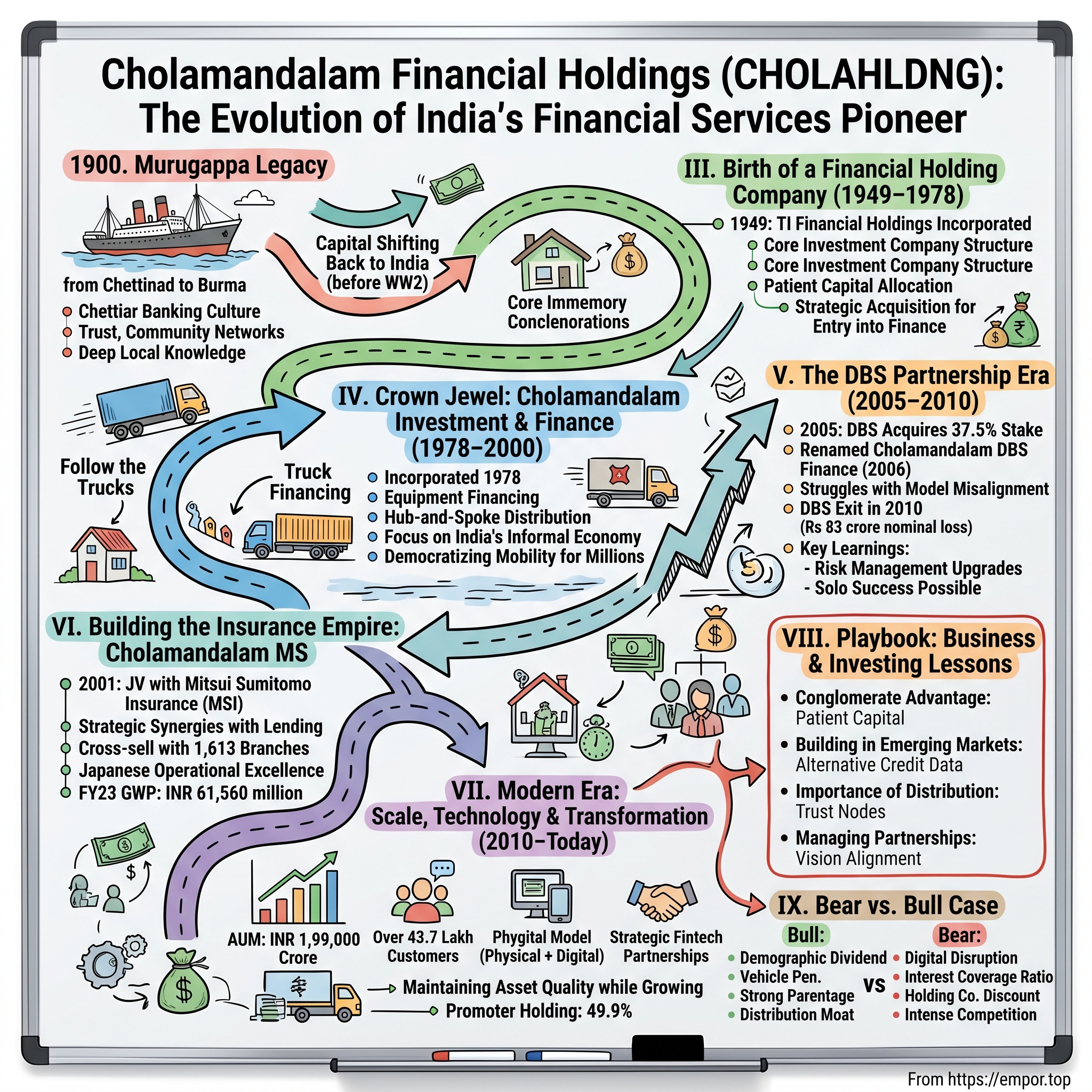
Cholamandalam Financial Holdings: The Evolution of India's Financial Services Pioneer
I. Introduction & Episode Roadmap
A distinct category of Indian financial enterprise remains largely unrecognized outside the country, despite financing commercial trucks and tractors across rural India while trading on the National Stock Exchange at a valuation that appears, at first glance, contradictory.
On September 3, 2026, shares of Cholamandalam Financial Holdings Limited traded at roughly ₹1,503, giving the company a market capitalization of about ₹28,255 crore.1 Its primary asset is a 43.74% stake in Cholamandalam Investment and Finance Company Limited, the Murugappa Group's lending arm, which the market valued at approximately ₹1,57,942 crore on the same date.12 The holding company's share of that lending business alone was worth roughly ₹69,000 crore — more than two and a half times the market valuation of the entire parent company. That gap exists even before assigning value to its 60% ownership of Cholamandalam MS General Insurance.
This valuation gap is typically the first feature investors notice about CHOLAHLDNG. As this analysis shows, however, the holding company discount is a symptom rather than the main story; evaluating the company requires examining the operating businesses underneath.
Those underlying operations represent a major footprint in Indian retail finance. Cholamandalam Investment and Finance Company — commonly known as Chola — closed the quarter ending June 2026 with assets under management of ₹2,54,392 crore, up 23% year over year. Over that three-month period, the lender disbursed ₹29,612 crore and recorded an after-tax profit of ₹1,654 crore, a 46% increase.3 It operates 2,508 touchpoints across India, serving over 43 lakh (4.3 million) customers, with the majority of its business centered in rural and semi-urban markets.3 At the holding company level, consolidated quarterly revenue reached ₹11,214 crore with net profit of ₹1,789 crore.4
The general insurance arm forms the second main pillar, though it currently faces underwriting headwinds. Chola MS General Insurance, a 60:40 joint venture with Japan's Mitsui Sumitomo Insurance (三井住友海上火災保険), wrote ₹7,762 crore of gross direct premium in the fiscal year ending March 2026 while posting a combined ratio of 115.2% — paying out ₹115.20 in claims and expenses for every ₹100 of premium earned.5 In the June 2026 quarter, that combined ratio deteriorated to 120.4%.4 Intended to serve as a value-accretive pillar within the structure, the insurance business currently drags on consolidated profitability.
The standard sell-side thesis attributes Chola's edge to field-based underwriting of unbanked borrowers — single-truck operators, small shop owners, and farmers without traditional proof of income — supported by low borrowing costs derived from the Murugappa Group's backing.
While Chola's rural reach and field network are well established, other parts of this narrative require scrutiny. Chola does not carry a AAA credit rating: ICRA rates the company at AA+ with a Positive outlook, one notch below the highest tier, alongside an A1+ short-term rating.6 Its history of international joint ventures includes two partnerships that eventually ended in separation. Furthermore, while vehicle finance is considered its core strength, historic credit stress emerged from newer, non-vehicle lending segments.
This article examines these dynamics across eight core themes:
- The Chettiar inheritance. How a money-lending business founded in Burma in 1900 influenced the governance and analytical structure of a modern non-banking financial company (NBFC) — separating core operational principles from corporate lore.
- The long apprenticeship (1949–2004). The origin of the holding company during the License Raj, the founding of the finance company in 1978, and its initial foreign joint ventures.
- The DBS chapter (2005–2010). DBS Bank's entry into Indian retail credit at ₹150 per share, its exit at ₹91 per share, and the operational lessons learned by the Murugappa Group.
- The rebuild (2010–2017). Managing Director Vellayan Subbiah's turnaround strategy, the expansion of the field-credit model, and the delinquency spike in unsecured loans.
- The demerger and the CIC cage (2017–2020). The regulatory driver behind the Core Investment Company (CIC) structure and why capital rules sustain the holding company discount.
- Insurance underwriting. The performance of the 60% general insurance stake, contrasting management's long-term optionality thesis with ongoing underwriting losses.
- Scale and diversification (2020–present). Expansion into seven lending verticals, internal incubation of gold loans across a ₹2.5 lakh crore balance sheet, and whether diversification reduces or redistributes credit risk.
- Strategic positioning and outlook. Management execution against long-term targets, an assessment using Hamilton Helmer's 7 Powers framework, and the key financial metrics shaping future performance.
The history begins in Burma.
 Subscribe on LinkedIn
II. The Murugappa Legacy & Chettiar Banking Origins
At the turn of the twentieth century, Moulmein, in British Burma, was a bustling teak port on the Salween estuary, thick with rice mills and river traffic. It was home to a community of South Indian merchant-bankers who had followed imperial trade routes east. Among them, in 1900, Dewan Bahadur A.M. Murugappa Chettiar established a money-lending and banking business under the name AMM Rm Firm.7 From that single firm grew a conglomerate generating an annual turnover of roughly ₹1,05,582 crore across ten listed companies.7
The Nagarathar Chettiars were not commercial bankers in the modern sense. They operated an informal, caste-based credit network across British Malaya, Ceylon, the Dutch East Indies, and French Indo-China without deposit insurance, central banks, or enforceable cross-border contracts. The system relied on three elements: meticulous handwritten ledgers, unlimited personal liability, and a tight reputational network. Defaulting on a Chettiar lender in Rangoon effectively ended an individual's credit in Madras within weeks. Interest rates were set collectively, and capital moved between family firms on trust and telegram.
Corporate narratives often draw a direct line from that historical network to a modern non-banking financial company's underwriting manual. A closer examination suggests a more nuanced inheritance. What endured was not a formal technical model, but an operational posture: a comfort with lending against observed character and unbanked cash flow, alongside an assumption that loan recovery is a relationship-driven process rather than a legal one. When a credit officer in Salem assesses a used-truck buyer by inspecting his route, trip sheets, and standing in the local transport association, the evaluation structurally mirrors a Chettiar agent's approach in 1920. What did not carry over was immunity to macroeconomic shocks; the Chettiar network's defining chapter was not its expansion, but its eventual collapse.
A second, less recognized inheritance lies in the Chettiar firm's organizational structure. A principal in Chettinad deployed capital through agents assigned for fixed terms in overseas ports, with each agent managing a branch ledger and facing strict accountability at the end of their tenure. Because communication took weeks, authority had to be decentralized, while risk control remained absolute and personal. Modern branch-led lenders face the exact same structural challenge: balancing decentralized credit approvals near the borrower with centralized risk policies and audits at headquarters. This structure carries an inherent vulnerability: if central oversight weakens, distributed authority turns into distributed risk. Both sides of this inheritance resurface later in the Cholamandalam story, separated by four decades.
Between 1915 and 1934, the group expanded beyond money-lending into textiles, rubber plantations, insurance, and stockbroking across Malaya, Ceylon, and Vietnam.7 As geopolitical tensions escalated in the 1930s ahead of World War II, the family executed a pivotal capital allocation decision: it liquidated and repatriated its Southeast Asian assets back to India prior to the Japanese invasion.7 Families that remained lost nearly everything as land was confiscated, ledgers were burned, and accumulated capital was erased.
That episode underscores a core trait of the Murugappa Group: its primary focus has historically been capital preservation across regulatory and political regimes—from colonial rule to independence, through the License Raj to liberalisation, and from family governance to professional management. That conservative instinct persists in Cholamandalam's modern lending operations, which maintain ₹23,984 crore in total liquidity against a ₹2.5 lakh crore balance sheet, with no negative cumulative asset-liability mismatch in any time bucket.3 Financial conservatism functions not as a marketing slogan, but as an entrenched operational principle.
The repatriated capital was redeployed into manufacturing in Madras. Over the subsequent decades, the group assembled its current industrial portfolio: abrasives under Carborundum Universal; fertilizers and sugar through Coromandel International and E.I.D.-Parry; bicycles and precision tubes via Tube Investments of India; and power-equipment manufacturer CG Power, acquired in 2020.7 Today, the conglomerate employs approximately 94,000 people across businesses spanning agriculture, engineering, and finance.3
This diversified industrial base holds significant implications for Cholamandalam's capital structure. Because the financial services unit is not the parent group's sole source of cash flow, the parent has not needed to extract high dividends to support group cash requirements. While single-engine business groups often drain operating subsidiaries to fund holding operations, Murugappa's income from agriculture and engineering allows the lending arm to retain the vast majority of its earnings. The operating lender's low dividend yield of roughly 0.11% may frustrate income-seeking investors, but it reflects a strategy of internal capital retention. By reinvesting earnings, the company has funded annual asset growth exceeding 20% without having to repeatedly return to shareholders for equity.2
Corporate governance evolved along a similar path. The Murugappa Group separated family capital allocation at the board level from day-to-day management by professional CEOs decades before that division became common among Indian family conglomerates. This model is not without friction; family succession disputes have occasionally reached the courts, and governance authority remains concentrated among family members and holding entities like Ambadi Investments. However, the structure maintains exceptional ownership stability: promoters have held a steady 46.44% stake in Cholamandalam Financial Holdings,1 which in turn anchors a 49.23% promoter block in the operating lender.2 With zero promoter share pledging and stable ownership, the group's commitment to long-term capital allocation is supported by the shareholding structure.
That historical foundation leads to 1949, when the parent entity was incorporated for a purpose entirely different from the financial services enterprise it represents today.
III. Birth of a Financial Holding Company & Early Years (1949–2004)
India in 1949 was two years old, desperately short of industrial capacity, and about to spend four decades regulating its way toward it. The entity that is today Cholamandalam Financial Holdings was incorporated that year as part of the Tube Investments of India manufacturing complex—a precision-tube and bicycle business serving a domestic economy that would soon be walled off from imports.8 For nearly seventy years, the listed entity that CHOLAHLDNG shareholders own today was, legally speaking, a manufacturer. The finance business was the appendage.
That inversion remains a central structural paradox of the group's history: the holding company did not build a lender; a manufacturer created a financial services unit, and that lending arm eventually claimed the manufacturer's public listing.
The lender itself arrived in 1978. On August 17 of that year, M.A.M. Arunachalam, M.V. Murugappa, and M.V. Subbiah incorporated Cholamandalam Investment and Finance Company Limited, which commenced business that November as an equipment financing firm.83 The License Raj context was decisive: with bank credit strictly rationed and directed by state priorities, a captive finance arm serving South Indian industrial firms functioned less as a high-growth vehicle than as an essential liquidity mechanism. Chola leased machinery, discounted trade paper, and financed industrial equipment for group companies and their commercial client networks.
Then came the strategic shift that altered the company's trajectory. In 1991–92, as India's balance-of-payments crisis catalyzed economic liberalization, Chola expanded into vehicle finance.8 The move capitalized on structural shifts: deregulation triggered a rapid expansion in road transport through national highway investments, a shift of freight from rail to road, and the rise of single-truck owner-operators who lacked access to conventional banking.
This underserved borrower segment became the core of Chola's business model. Small road transport operators often owned just one or two vehicles, lacking audited accounts, tax filings, or formal bank statements. Traditional banks, reliant on standardized credit scoring, classified them as unbankable. Chola, by contrast, deployed field credit officers to evaluate cash flows directly—verifying transport routes, checking load factors, consulting local truck transport associations, and assessing the secondary market value of the underlying vehicle. That labor-intensive approach enabled Chola to price and manage credit risk effectively, earning yields that traditional institutions could not capture.
That field-based model served as the company's primary growth engine. Chola completed an initial public offering in January 1995 and spent the remainder of the decade expanding its network of dealers, operators, and single-truck owners across Tamil Nadu, Andhra Pradesh, and Karnataka.8 Its distribution advantage rested on physical reach: local branches staffed by credit officers embedded in the communities where their borrowers operated.
This informal underwriting model required a distinct operational approach. While formal retail lending relies on credit bureau data to evaluate a borrower's credit history, informal vehicle finance assesses an operational question: whether a specific revenue-generating asset can produce sufficient cash flow under a specific operator's control on a designated route. Evaluating credit by direct physical inspection rather than automated data entry requires higher operating costs and limits initial scalability. However, it also operates in a far less competitive market segment, creating an underwriting capability that remains durable even as credit bureau scoring becomes commoditized across formal banking.
A lesser-known episode from this era highlights an early attempt at international partnership. In 1986, Standard Chartered Bank acquired a 28% stake in Chola—later increased to approximately 30%—before divesting its entire holding in 1993.8 The subsequent DBS Bank partnership in 2005 was therefore not an isolated experiment, but the second instance in which a foreign banking institution invested in the lender, encountered strategic misalignment, and exited. While international joint ventures can provide initial capital, operational frameworks, and institutional credibility, this historical record demonstrates the recurring complexity of aligning global banking strategies with a specialized domestic field-lending model.
By the early 2000s, Chola operated as a profitable, mid-sized vehicle financier, but remained regionally concentrated and constrained by capital from expanding nationally. In 2002, the group laid the groundwork for broader financial services diversification by establishing a general insurance joint venture with Japan's Mitsui Sumitomo, retaining a 60% stake in Chola MS.9 By 2005, the company prepared for a major expansion in retail credit—setting the stage for one of the most critical operational lessons in its history.
IV. The DBS Partnership Era: Expansion, Missteps & Strategic Buyback (2005–2010)
In June 2005, the announcement landed with the confidence of an era. Singapore's DBS Bank would spend roughly ₹228 crore acquiring a 37.5% stake in Cholamandalam Investment and Finance, buying at ₹150 per share through a combination of purchases from Tube Investments, an open offer to public shareholders, and a preferential allotment.10 The Murugappa group would step down to a matching stake. By January 2006 the company had a new name on its letterhead: Cholamandalam DBS Finance Limited.8
The logic was seductive, and in 2005 it was close to consensus. India's consumer credit market was about to inflect. DBS brought international risk frameworks, product design, and an appetite for the retail banking suite it could not build alone under Indian branch-licensing rules. Murugappa brought distribution into towns where DBS would never open a branch. The joint venture would layer urban banking products onto rural reach. On paper, it was arbitrage.
The structure got messy almost immediately. The preferential allotment was dropped in October 2005 to avoid further delay, and the transaction was restructured into an open offer plus a purchase from the promoters — DBS finally completing its 37.5% for about ₹213 crore in June 2006, a year after the announcement.11 A deal that takes twelve months to close because its structure keeps being renegotiated is rarely a deal in which both partners share one view of the destination.
Then the venture did the thing that destroys lenders. It grew fast in a product it did not understand.
Cholamandalam DBS pushed hard into small-ticket unsecured personal loans and consumer credit, alongside an asset management business, DBS Cholamandalam Asset Management. The underwriting philosophy imported from a foreign bank was scorecard-based: build an algorithm, score the applicant, approve or decline, collect through agencies. That model works when borrowers have documented, verifiable, formal-sector incomes and when the courts and collection infrastructure behind the loan are functional. Applied to mass-market Indian borrowers in 2006–2008, with no collateral to repossess and no field officer who knew the customer, it was a machine for converting growth into losses with a two-year delay.
The delay expired in 2008. By September of that year, with the global financial crisis compounding domestic delinquencies, management abandoned the strategy — deciding to stick to vehicle financing and loans against shares, shutting roughly 75 branches and laying off about 200 employees.12 Then came the funding squeeze: in March 2009 the company received ₹750 crore of support to correct an asset-liability mismatch, the classic NBFC failure mode in which short-term borrowings fund longer-term assets and the short-term market simply closes.13 In January 2009 the board approved a capital restructuring that used ₹323.53 crore sitting in the securities premium account to absorb provisions and write-offs, and by May 2009 a further ₹200 crore provision against bad loans was created.14 In September 2009 the asset management arm was sold to L&T Finance for ₹45 crore.8
Read that sequence as an investor rather than a historian. A finance company that has to raid its securities premium account to absorb credit losses is a finance company whose current earnings cannot absorb them. This was not a soft patch. It was a balance-sheet event.
The endgame came in March 2010. The Murugappa group bought DBS's entire 37.48% stake at ₹91 per share, taking group holding to roughly 74.96%.[^15]12 DBS's chief executive Piyush Gupta framed the exit strategically — the bank had decided to focus on affluent and mass-affluent retail customers in India, while the partners wanted to build secured asset finance for the mass market.12 That is a graceful way of saying the two shareholders no longer agreed on what the company was for. On Moneylife's calculation, DBS crystallised a loss of about ₹83 crore on the venture, roughly 39% of what it put in.11
Two details in that exit are worth extracting, because they generalise. First, the buyer of a failing joint venture stake is almost always the partner who still believes in the underlying business — which means the price is set by the seller's urgency, not by the asset's worth. The Murugappa group did not buy at ₹91 because it was a clever entry point; it bought because DBS wanted out and the alternative was a strategic partner with no interest in the strategy. Second, and more instructive, the exit price was struck at a slight premium to the prevailing market price rather than at a distressed discount, which tells you the public market had already fully absorbed the bad news by early 2010.[^15]12 By the time control changed hands, the write-offs, the branch closures and the securities-premium restructuring had all been disclosed. The transaction was the epilogue, not the crisis.
Testing the claim: is Murugappa capital allocation flawless? This is the moment to confront the thesis that gets repeated most often about this group. The evidence says no, and says it clearly. Between 2006 and 2010, Chola drifted into a business it had no capability in, funded it with a mismatched liability profile, took losses large enough to require capital restructuring, closed branches, cut staff, and exited an entire asset management franchise at a price that reads like a salvage sale. If the same facts appeared in a company without a century-old brand attached, they would be described as a near-death experience.
But the evidence does not reject the broader claim either — it narrows it. What the record actually supports is a group that makes strategic mistakes at roughly the industry base rate and corrects them faster and more completely than most. Between 2008 and 2010 the sequence was: recognise, stop, provide, sell the non-core, buy out the partner, rename, restart. Compare that with the many Indian NBFCs of the same vintage that kept growing an impaired unsecured book for another two years hoping the cycle would rescue them. The revised claim is narrower and more useful: Murugappa's edge is speed and completeness of retreat, not accuracy of entry.
The forward test for that revised claim is specific and available every quarter: credit costs in the non-vehicle retail businesses through a full cycle. Investors should watch whether losses in the consumer and unsecured-adjacent segments stay contained without a repeat of the 2008 pattern — growth first, recognition later. As Section VIII shows, that test is live right now.
By June 2010 the company had reverted to its original name.8 What it did over the following seven years is the part of the story worth studying most closely.
V. Core Vehicle Finance Mastery & Turnaround (2010–2017)
On August 19, 2010, Vellayan Subbiah assumed leadership as managing director of a lender emerging from the most turbulent four-year period in its history.15 At 38, Subbiah was a fourth-generation member of the Murugappa family with a civil engineering degree from IIT Madras and an MBA from the University of Michigan. Crucially, he was not a career banker; his background spanned McKinsey & Company, outsourcing firm 24/7 Customer, and Sundaram Fasteners. He brought a methodology grounded in first-principles operational analysis rather than banking orthodoxy—a direct pivot from the strategy that had failed during the DBS partnership.
His strategy ran counter to prevailing market trends. While rival Indian financial institutions prioritized digital platforms, cross-selling, and urban retail consumers, Chola refocused on commercial vehicles, tractors, and small-town collateral, expanding its physical branch network.
The operational model built during this period established the company's primary competitive advantage. Standard retail lenders underwrite documented financial histories, relying on pay stubs, tax filings, bank statements, and credit bureau scores. Chola instead underwrites a cash flow it observes directly. Before approving a loan for a light commercial vehicle, a field credit officer assesses the specific transport route, current freight rates, realistic monthly trip frequencies, the borrower's standing within local dealer networks, and the asset's secondary market value. In agricultural financing, officers evaluate land acreage, cropping cycles, crop yields, and local dairy collection receipts.
This field-intensive model requires significant operational investment. It relies on localized branches staffed by credit officers familiar with regional transport and farming ecosystems. Unlike automated credit scoring systems, this structure integrates origination with collections: the same field personnel who evaluate the loan also monitor repayment schedules and oversee asset recovery. The unit economics function effectively on two conditions: lending yields must remain sufficient to cover field infrastructure costs, and loss given default must stay low through efficient collateral recovery and liquidation. Chola's active presence in used-vehicle markets completes this loop, using the same dealer network to appraise trucks at origination and resell them upon repossession.
Expansion proceeded systematically across the country. By fiscal year 2017, Chola operated 703 branches, with 92% situated in Tier-II, Tier-III, and Tier-IV towns. Loan disbursements were distributed evenly across national markets: South India accounted for 27%, North India 26%, East India 25%, and West India 22%.16 For an institution historically perceived as a regional South Indian lender, this geographical distribution marked a major structural evolution.
Testing the claim: is Chola's vehicle underwriting immune to downturns? Market consensus often suggests that major macroeconomic shocks—such as the 2013–2015 industrial slowdown and the November 2016 demonetization policy—demonstrated the complete resilience of Chola's underwriting model. A closer examination of the historical data reveals a more specific record.
The currency demonetization shock directly strained operations. Chola's overall 90-plus days past due ratio had dropped from 4.4% in March 2016 to 4.2% in September 2016, but rose to 4.5% in December 2016 as cash shortages disrupted collections in cash-reliant borrower segments, before recovering to 4.2% by March 2017.16 Loan disbursements in the quarter ending December 2016 grew by just 3% year over year.17 The liquidity shock affected performance, but stress remained contained and resolved within two quarters.
In contrast, non-vehicle segments experienced more severe credit deterioration. In Chola's home equity division—loans against property, long regarded as a low-risk, collateralized category—the 90-plus days past due ratio rose from 4.3% in March 2016 to 5.8% in March 2017, reaching 6.0% by June 2017 across a portfolio representing 28% of total assets under management.16 Over that same timeframe, the 90-plus days past due ratio in vehicle finance improved, declining from 4.4% to 3.6% and then to 3.5%.16 Rating agency ICRA noted that roughly 88% of the home equity portfolio was secured by self-occupied residential property with loan-to-value ratios between 50% and 55%—indicating that risk protection derived primarily from collateral value rather than cash-flow underwriting.16
This divergence provides a critical insight into the company's risk profile. Chola's competitive edge does not rest on default prevention; its borrowers default at mid-single-digit rates that would exceed traditional retail bank risk tolerances. Rather, the advantage lies in loss recovery—driven by field collections, asset repossession, and secondary market liquidation. Furthermore, this protection is strongest where Chola has been doing it longest. When the company expands into adjacent credit products with less mature field infrastructure, credit stress increases before stabilization occurs—a pattern observed in unsecured lending during 2008 and in home equity during 2016.
This leads to a revised analytical framing: Chola's primary underwriting strength lies in minimizing loss given default through field recovery networks, an advantage that is product-specific rather than uniform across all lending lines. Consequently, the key performance indicator for evaluating expansion is not gross non-performing assets, but net credit cost—the metric reflecting actual losses post-recovery—particularly when comparing newer business segments to core vehicle finance.
The financial outcomes of the restructuring were reflected across key operating metrics. In fiscal year 2017, Chola reported an after-tax profit of ₹719 crore on a managed asset portfolio of ₹34,167 crore. Return on managed assets rose from 1.9% to 2.1%, net interest margin held steady at 6.5%, annual credit costs dropped from 1.4% to 0.9%, and return on equity reached 18.0%.16 By the time Vellayan Subbiah completed his tenure as managing director on August 18, 2017, the lender had shifted from operational recovery to sustained financial compounding.15
By that point, Subbiah was already guiding a broader corporate initiative: rearchitecting the legal and capital structure governing the parent entity and its underlying operating assets.
VI. The Corporate Demerger & Creating the CIC Structure (2017–2019)
Corporate restructurings rarely make for good storytelling. This one is worth the effort, because it explains why CHOLAHLDNG exists as a separate ticker at all — and why the discount that opens this article is not simply an inefficiency waiting to be arbitraged away.
Until 2017, one listed company contained two entirely unrelated businesses. Tube Investments of India manufactured precision steel tubes, bicycles and automotive components. It also happened to own the group's stakes in a fast-growing NBFC and a general insurer. Investors were being asked to value a metals-and-cycles manufacturer and a financial services franchise inside a single share price, using a single multiple, with a single set of capital allocation decisions.
The fix was a scheme of arrangement with an appointed date of April 1, 2016, sanctioned by the National Company Law Tribunal in Chennai by an order dated July 17, 2017.18 The manufacturing business was transferred into a newly incorporated entity that took the Tube Investments of India name and listing. The original 1949-vintage company retained the financial services holdings and was renamed TI Financial Holdings Limited — and then, in 2019, renamed again to Cholamandalam Financial Holdings Limited.118
Two clean listed entities. One manufacturer, one financial holding company. In pure value-unlocking terms, the demerger worked: separating a manufacturer from a lender let each attract its natural shareholder base, and the manufacturing entity subsequently became the vehicle through which the group executed its most celebrated turnaround, the acquisition and revival of CG Power.
But the new financial entity came with a regulatory cage attached. On January 6, 2020, Cholamandalam Financial Holdings received its certificate of registration from the Reserve Bank of India as a Non-Deposit Taking Systemically Important Core Investment Company — a CIC-ND-SI.19
The CIC framework deserves plain-English explanation, because it is the single most important structural fact about this security. A Core Investment Company is a regulatory category the RBI created for entities whose whole business is holding stakes in group companies. To qualify, the company must hold at least 90% of its net assets in the equity, preference shares, or debt of group companies, with at least 60% of net assets specifically in equity. In exchange for accepting those limits, it escapes the full weight of NBFC lending regulation. There are further constraints: a minimum capital ratio of 30% and a maximum leverage ratio of 2.5x.20
Look at what those rules produce in practice. As of June 30, 2025, CFHL's standalone balance sheet was almost comically simple: total assets of ₹1,357.80 crore, of which ₹1,357.09 crore was investments and bank deposits; other liabilities of ₹4.31 crore; standalone quarterly income of ₹3.65 crore and standalone profit after tax of ₹2.11 crore.20 Its investment in group company equity was 99.984% of net assets against the 90% minimum, its capital ratio was 2,168.86% against a 30% minimum, and its leverage ratio was 0.0001 against a 2.5x maximum.20
Read those numbers again. The regulatory ratios are not close to their limits — they are absurdly far from them, in the conservative direction. The holding company has essentially no debt, essentially no operating activity, and essentially no purpose other than owning shares in two subsidiaries. Its adjusted net worth of ₹28,058.76 crore, which counts the market value of those holdings, sits atop owned funds of ₹1,334.67 crore.20
That is the anatomy of the discount, and it explains why the discount is structural rather than merely sentimental. Three mechanisms drive it:
Cash flow leakage. CFHL's only income is dividends from its subsidiaries. Chola pays a modest dividend — the operating company's dividend yield sits around 0.11%, because it retains capital to fund 20%-plus asset growth.2 Those dividends flow up, get taxed in the shareholder's hands again on their way out, and in the meantime the holding company itself generated ₹2.11 crore of standalone quarterly profit.20 An investor buying CHOLAHLDNG is not buying a claim on cash. They are buying a claim on a claim.
No route to consolidation. The obvious remedy — merge CFHL into CIFCL and delete the holding layer — is not straightforward. The CIC registration is the group's chosen vehicle for holding a combination of a listed NBFC and an unlisted insurer. A merger of the holding company into the lender would push a 60% general insurance stake into an RBI-regulated NBFC's balance sheet with its own regulatory consequences, and would dilute the promoter block's control architecture. Management has not announced any such plan, and investors should not underwrite one.
Opacity of the second asset. Chola MS is unlisted. There is no market price, so every sum-of-the-parts model has to guess. When one of two assets is unpriced and currently loss-making at the underwriting level, the rational analytical response is to apply a larger haircut, not a smaller one.
Put the arithmetic together as of September 3, 2026. CFHL's 43.74% of CIFCL was worth roughly ₹69,000 crore at the operating company's ₹1,57,942 crore market capitalisation, against CFHL's own market value of about ₹28,255 crore.12 That is a discount of roughly 59% to the listed stake alone, before assigning any value at all to the insurance business. It is materially wider than the 30–50% range that Indian holding companies typically trade at, and wider than the range this structure has historically commanded.
There is a second-order effect worth naming, because it shapes how the discount behaves over time rather than just how wide it is. Because CHOLAHLDNG consolidates the lender, its reported consolidated earnings look enormous relative to its market capitalisation — which is precisely why its headline price-to-earnings multiple screens so cheaply. But consolidation is an accounting convention, not an economic one: a large share of that consolidated profit belongs to the other 56% of the lender's shareholders and is deducted as non-controlling interest.1 Investors screening on consolidated earnings multiples will therefore systematically overstate how cheap this security is. The only defensible way to value it is on a look-through basis: what is the holding company's share of each underlying business actually worth, and what does the structure cost to maintain? On that basis the security is cheap, but not nearly as cheap as a stock screener suggests.
For investors, the takeaway is uncomfortable but clear: CHOLAHLDNG is a leveraged expression of a view on CIFCL plus an option on the insurance business, minus a structural drag that has no announced catalyst for reversal. The stock's own trailing multiple — a price-to-earnings ratio of about 10.6 against the operating company's 27.5 — reflects that reality rather than contradicting it.12 Whether the discount is "too wide" is a judgement about how much the unpriced insurance asset is worth. So let's price it.
VII. The General Insurance Pillar: Chola MS (60% Stake)
Every conglomerate has an asset that management describes as optionality and the market views as a question mark. At Cholamandalam Financial Holdings, that asset is its 60% stake in Cholamandalam MS General Insurance Company Limited.
The joint venture was formed with Japan's Mitsui Sumitomo Insurance, part of MS&AD — one of the world's largest insurance groups, operating in 48 countries and leading the ASEAN region — which holds the remaining 40%.20 The strategic fit was evident at its 2002 inception and remains clear today: Chola finances commercial and retail vehicles, those vehicles require coverage, and a captive lending network offers one of the lowest-cost customer acquisition funnels in general insurance.
For years, the insurance unit expanded steadily. Gross written premium compounded at 13.2% annually between FY2021 and FY2025 to reach ₹8,328 crore — roughly 1.5 times the broader industry's growth rate — securing a 5.2% share of the Indian motor insurance market by the June 2025 quarter.20 Motor lines account for approximately 70% of total underwriting, making Chola MS primarily a motor insurer complemented by smaller portfolios in health, fire, marine, engineering, and crop insurance.1721
That distribution synergy claim, however, requires critical scrutiny, as it provides the main rationale for keeping an insurance asset inside a lending group. If motor policies were genuinely being acquired at minimal cost through the parent company's branch footprint, the insurer's overhead structure should compare favorably against competitors that rely on brokers and digital aggregators. Yet in FY2026, Chola MS recorded an expense of management ratio of 30.46% of premium, or 29.12% excluding the accounting impact of the "1/n" premium recognition rule.5 That cost structure shows little evidence of a structural distribution advantage. While cross-selling a motor policy alongside a vehicle loan creates convenience at the margin, the operational data does not support a durable cost moat. Furthermore, recent profit degradation stems from elevated claims rather than acquisition costs, pointing to issues in pricing and risk selection rather than distribution efficiency.
The underlying operational challenge is straightforward: Chola MS has failed to generate an underwriting profit for multiple consecutive years.
The insurer's combined ratio — which measures claims and operating expenses against earned premium, where any reading above 100% indicates an underwriting loss offset only by investment returns — stood at 109.9% in FY2024 and 110.2% in FY2025.20 Performance deteriorated further in FY2026 to a combined ratio of 115.2% — or 112.2% excluding the 1/n accounting rule adjustment — driven by a claims ratio of 81.3% and additional motor third-party reserve building.5 For the full year FY2026, profit before tax reached ₹454 crore on gross direct premium of ₹7,762 crore, yielding a return on equity of 10.4%, compared to its three-year average ROE of approximately 14.4%.5
Underwriting pressures deepened in the June 2026 quarter. The combined ratio rose to 120.4%, up from 114.8% in the prior-year period, generating ₹252 crore in quarterly underwriting losses.4 Gross direct premium grew by just 2.6% year over year, lagging the broader industry's 8.3% expansion.21 Motor own-damage loss ratios breached 80%, up sharply from the 71% to 73% range maintained in FY2025, while motor third-party loss ratios climbed to 84.4%.421 Consequently, net profit for the quarter dropped 19.7% to ₹86 crore.4
On the quarterly earnings call, Managing Director Rajive Kumaraswami, who assumed leadership on June 1, 2026, addressed the performance directly. Stating that the company could not tolerate sustained losses across a segment representing 70% of its portfolio, he outlined targets to bring motor loss ratios back to the late 70s and eventually the mid-70s through disciplined repricing, stricter claims management, and portfolio rebalancing.21 Chola MS has already curtailed underwriting in lower-margin two-wheeler and fire lines, while management highlighted a four-year regulatory freeze on statutory motor third-party tariffs as an external margin squeeze.520 Analysts on the call questioned whether motor loss ratios can realistically recover amid intense market competition, noted the deliberate contraction in health coverage while industry volume grew, and raised concerns regarding a pending Supreme Court case on compensation claims for which no formal financial provisions have been set aside.21
Testing the claim: is Chola MS an unlisted jewel awaiting an IPO? In June 2025, previous management indicated that Chola MS would likely pursue a public listing within five years, aligning with regulatory encouragement for mature insurers to list on national exchanges.22 Evaluating that prospect against recent operating results refutes the narrative of an imminent, high-value spin-off.
An insurer operating with combined ratios consistently above 100%, experiencing a ten-percentage-point margin deterioration over two years, generating a 10.4% return on equity against a medium-term target of 15%, and expanding at a fraction of industry growth cannot command a premium market valuation.521 Because net earnings rely entirely on investment portfolio yields to absorb underwriting deficits, the business operates structurally like a leveraged bond portfolio backed by insurance liabilities. Meanwhile, its solvency ratio of 1.93x to 1.96x remains adequate but offers limited balance-sheet cushion.521
A more accurate assessment recognizes Chola MS as a well-established, top-ten private general insurer with broad reach and strong foreign partner backing, but one that currently acts as an earnings drag rather than a value catalyst for the parent company. While long-term optionality remains, it cannot be monetized on favorable terms under current operating conditions — a reality reflected in management's extended five-year listing timeline.
For investors, the milestone for a revaluation is clear: achieving a sustained combined ratio below 100% — and ideally under 98% — for eight consecutive quarters, alongside motor loss ratios back in the mid-70s. Until those operational targets manifest in quarterly disclosures, standard sum-of-the-parts valuations should benchmark Chola MS at book value rather than a growth multiple. The general insurance pillar currently widens the holding company discount rather than providing a rationale for it to narrow.
That dynamic leaves the core lending business as the primary driver of the investment thesis.
VIII. Modern Era: Scale, Multi-Product Pivot & Transformation (2020–Today)
March 2020 presented an acute operational challenge for a lender whose borrowers earn cash daily and make monthly repayments in person. India's national lockdown halted commercial vehicle traffic, shuttered small enterprises, and grounded the field credit officers whose physical presence underpins Chola's collection model. Every structural feature that made the business defensible—informal borrowers, cash collections, and physical verification—became an immediate operational bottleneck.
Yet the institution did not break. In the six years since, Chola has executed a transformation far more fundamental than simple operational recovery: it has ceased to be exclusively a vehicle finance company.
As of June 30, 2026, total assets under management reached ₹2,54,392 crore, representing a 23% year-over-year expansion. Vehicle finance accounted for ₹1,24,132 crore—up 19% and remaining the largest single division, though now comprising less than half of the total loan portfolio. Loan against property grew 23% to ₹54,130 crore, while home loans rose 22% to ₹23,644 crore. Small and medium enterprise lending expanded 39% to ₹9,923 crore, and consumer and small enterprise loans grew 12% to ₹15,884 crore. Meanwhile, secured business and personal loans increased 40% to ₹3,730 crore, and gold loans—a business introduced only two years prior—reached ₹2,143 crore across 171 dedicated branches.3
Across these seven lending verticals, the product shift reflects a deliberate commercial objective.
A vehicle finance relationship is inherently transactional, bounded by a five-to-seven-year loan term. Once a commercial truck is fully amortized, customer retention depends on whether the operator purchases another vehicle, requiring ongoing marketing and origination costs to replace maturing loans. Expanding into property-backed, small-business, and consumer credit converts isolated vehicle transactions into broader customer relationships with multiple touchpoints. Crucially, this strategy enables existing branch infrastructure and field personnel to generate additional revenue per unit of fixed operational cost. The diversification strategy is thus driven as much by branch economics as by portfolio risk management.
The commercial rationale for product diversification is clear. Vehicle financing is cyclical, tied directly to freight volumes, industrial production, and automotive manufacturing cycles. A portfolio heavily concentrated in commercial vehicles leaves earnings vulnerable to broader economic downturns. Reducing vehicle exposure toward half of total assets, while expanding into property-secured and enterprise lending with distinct demand cycles, dampens overall earnings volatility—provided the newer credit lines maintain rigorous underwriting standards.
That condition remains the critical analytical variable. Historical experience shows that when the institution expands into products where its field underwriting infrastructure is less mature, initial credit losses tend to elevate before stabilizing. The contemporary performance across new lending divisions requires careful examination against that precedent.
Secured Business and Personal Loans (SBPL) functions primarily as micro-loans against property, extending small-ticket credit secured by self-occupied residential real estate in semi-urban areas at yields above core vehicle finance. The business leverages tangible real estate collateral and local field collections. At ₹3,730 crore, the portfolio remains modest in scale and has not yet been tested through a full credit cycle.3
Consumer and Small Enterprise Loans (CSEL) represents a higher-risk segment, comprising small-ticket credit originated partly through digital channels and fintech partnerships. As the second-largest non-vehicle segment at ₹15,884 crore, its credit losses have run substantially higher than the broader portfolio, recording a 5.2% loan loss rate in the March 2026 quarter against a segment return on assets of 2.3%.23 Management noted on an analyst call that pre-tax return on assets for CSEL is targeted to exceed 3% in the current fiscal year, highlighting that roughly 80% of its ₹5,000 crore business loan book is enrolled under the government's Credit Guarantee Fund Trust for Micro and Small Enterprises (CGTMSE), which transfers a portion of credit loss to a sovereign-backed entity.23
Reliance on government credit guarantees reveals an important operational distinction. While sovereign backstops protect portfolio returns, they also indicate that underlying loan economics do not rely exclusively on standalone field underwriting at current price points. This structure reflects a policy-supported lending model operating within the broader organization, rather than an extension of the traditional informal-underwriting framework.
Regulatory intervention also constrained risk-taking in unsecured lending. On November 16, 2023, the Reserve Bank of India increased risk weights on unsecured consumer credit exposures for banks and non-banking financial companies by 25 percentage points to 125%, while excluding housing, education, vehicle, and gold-secured loans, with mandatory compliance by February 29, 2024.24 The regulatory shift raised capital requirements for unsecured expansion across the sector. In February 2025, the Reserve Bank partially modified the policy, restoring original risk weights on bank exposures to NBFCs and reducing the risk weight on consumer microfinance loans back to 100%.25
In response to these regulatory adjustments, Chola moderated its unsecured lending growth rather than accelerating volume. Growth in the consumer and small enterprise division slowed to 12% year over year by the June 2026 quarter—the lowest rate among all product lines—while secured lines such as small enterprise lending, secured business loans, and loans against property expanded between 23% and 40%.3 This disciplined capital reallocation reflects a structured risk response consistent with historical operational adjustments.
Consolidated profitability across the expanded portfolio remained robust. For the quarter ending June 2026, total net income reached ₹4,930 crore, representing a 28% increase, while profit before tax rose 45% to ₹2,220 crore, yielding a pre-tax return on assets of 3.7% and a return on equity of 21.2%.3 During the earnings call, management reported a 42 basis point year-over-year improvement in net interest margins and a 24 basis point decline in credit costs, bringing net credit costs to the 1.5% target down from 1.8% in the prior year, while noting an anticipated 10 basis point rise in funding costs and a 60 basis point decline in home loan yields during the quarter.26
Asset quality trends present a more nuanced picture following changes in reporting disclosures. Stage 3 assets under accounting standards stood at 3.29% in June 2026, up from 3.05% in March 2026, supported by a provision coverage ratio of 45.73%.3 However, gross non-performing assets measured under stricter Reserve Bank regulatory guidelines reached 4.50%, with net non-performing assets at 2.95%.3 These regulatory-basis metrics represent the more conservative measure of credit stress and have trended upward from 4.36% gross and 2.87% net in the preceding quarter.3 Management attributed this quarter-over-quarter increase to seasonal collection patterns.26 The persistence of this trend will require verification in subsequent quarterly reporting.
Capital ratios remain sufficient to support ongoing asset growth. The total capital adequacy ratio stood at 19.81% against the 15.0% regulatory minimum, anchored by a Tier-I ratio of 14.81%.3 Capital reserves were further strengthened through a ₹2,000 crore compulsorily convertible debenture issue, of which ₹1,370 crore converted to equity during fiscal year 2026, ₹200 crore converted in July 2026, and the remaining ₹430 crore is scheduled for conversion in October 2026.3 While convertible debentures provide temporary Tier-II capital structure flexibility, their eventual conversion expands the equity base and increases overall share count.
The physical distribution footprint continues to expand. Physical branches reached 1,761 by March 2026, with 88% located in Tier-III through Tier-VI towns, bringing total customer touchpoints to 2,508 by June 2026.233 While competing financial institutions prioritize digital-only origination strategies, Chola continues to invest in small-town branch infrastructure—a strategy that highlights the central role of physical distribution in its long-term operational model.
IX. Management, Governance & Capital Allocation Record
Financial companies are, more than most businesses, a bet on the people running them. A lender's balance sheet is an accumulation of thousands of individual judgement calls made over years, and its true quality only becomes visible when a cycle turns. So the question is not whether Cholamandalam's managers are impressive on paper — they are — but whether their behaviour over time matches what they say.
Vellayan Subbiah is the central figure. Having run the lender as managing director from August 2010 to August 2017, he moved on to lead the group's manufacturing arm, where he executed the acquisition and revival of the debt-laden CG Power — a restructuring widely regarded as one of the more difficult corporate turnarounds in recent Indian industrial history.15 He was named EY Entrepreneur of the Year for 2023, cited for transforming existing businesses and pursuing acquisitions and diversification, and subsequently EY World Entrepreneur of the Year 2024.2715 Then, effective April 1, 2025, he returned to Chola as executive chairman — a whole-time role, not a ceremonial one.28
That return is a governance fact worth sitting with rather than glossing over. A family principal moving from non-executive chairman to executive chairman of the group's largest listed profit pool signals that the family wants direct operational involvement in the diversification programme. Investors can read it two ways: as the group's most capable operator taking personal responsibility for the riskiest phase of the strategy, or as a concentration of authority in a promoter figure at a company whose professional management had been performing well. The evidence to date supports the first reading — the operating metrics have improved since — but it is a reading, not a proof, and the relevant test is whether the executive chairmanship coincides with more disciplined capital allocation or with faster expansion into products where the field model is unproven.
Ravindra Kumar Kundu became managing director on October 7, 2024, for a five-year term, having been executive director previously.29 His credentials are the opposite of a parachuted-in banker: 24 years at Chola, 36 years across the automobile and financial services industries, and a career built inside the vehicle finance and distribution organisation that is the company's core.29 Elevating the person who built the field network to run the company is a coherent statement about where management believes the franchise's value sits.
D. Arul Selvan, president and chief financial officer of the lending company, is the continuity figure on the liability side. His public commentary tends toward the specific rather than the promotional — on the March 2026 quarter call, explaining a ₹200 crore precautionary management overlay taken against global uncertainties including crude and refined fuel price volatility and LPG supply risk, he clarified that the overlay involved no change to the underlying probability-of-default or loss-given-default assumptions.23 That is an unusually precise disclosure. A management team creating a buffer provision while explicitly stating it has not touched its risk models is doing the opposite of earnings smoothing; it is flagging exactly what it did and why.
At the holding company level the governance is deliberately thin, in line with a CIC's function. M M Murugappan serves as chairman and non-executive director, with Vellayan Subbiah and Sridharan Rangarajan as non-executive directors and three independent directors — B Ramaratnam, Vasudha Sundararaman and K Balasubramanian — carrying accounting, finance and banking backgrounds.30 The CFO role changed hands during FY2026: N Ganesh concluded his tenure as CFO and manager on June 14, 2026, with Shyam Shankar taking over from June 15.31 For an entity with a ₹1,358 crore standalone balance sheet, this is appropriate proportionality rather than governance minimalism.20
One useful test of any management team is whether its language changes when its numbers do. Across the March 2026 and June 2026 calls, the framing at the lending company stayed notably stable: the same handful of metrics, the same target levels, and explicit acknowledgment when something moved against them — the rise in gross NPAs, the 60 basis point fall in home loan yields, the expected increase in cost of funds.2326 Contrast that with the insurance company, where the combined ratio deteriorated across consecutive reporting periods before a newly arrived managing director made the first blunt public commitment to fixing motor loss ratios.521 Same promoter group, same board architecture, two visibly different records of getting ahead of a problem. For investors trying to judge governance quality at the holding company level, that contrast is more informative than any board-composition disclosure.
The cost of funds question. The most frequently repeated claim about this company is that Murugappa parentage buys it a materially cheaper cost of borrowing than standalone NBFC peers. The evidence supports a moderate version of that claim and not a strong one. Chola is rated AA+ with a Positive outlook by ICRA and A1+ on short-term instruments, with India Ratings and CARE at AA+/Stable on long-term debt; ICRA upgraded the outlook to Positive from Stable rather than upgrading the rating itself.620 It is not AAA. Its Tier-I perpetual debt instruments carry a lower AA rating.20
A single-notch difference between AA+ and AAA is worth real money at ₹1.8 lakh crore of borrowings, and the difference between AA+ and the AA or A-category ratings carried by weaker NBFCs is worth considerably more. But the funding advantage is a rating advantage, not a brand advantage — and ratings can move in both directions. The borrowing mix itself is genuinely diversified: as of the June 2025 quarter, bank term loans were about 44% of a ₹1,81,304 crore borrowing book, with privately placed debentures, securitisation, commercial paper, external commercial borrowings and public debentures making up the remainder.20 That diversification is real risk management. It also means roughly half the liability book reprices with bank lending rates, which is why management's warning about a 10 basis point increase in cost of funds matters more than it sounds.26
Incentive alignment is where disclosure is thinnest. Management speaks consistently in terms of return on total assets, return on equity, and net credit cost, and has publicly guided to specific levels for each — a pre-tax return on total assets of about 3.5%, net interest margins around 8%, net credit cost improving to about 1.5%, and AUM growth of 20–23% for FY2027.23 The precise linkage of executive compensation to those metrics is not disclosed in the materials reviewed here. What is verifiable is the track record against the guidance: for the June 2026 quarter, pre-tax return on assets came in at 3.7% against a 3.5% target, net credit cost at 1.5% against a 1.5% target, and AUM growth at 23% against a 20–23% range.32326 Management set targets and hit them.
That is the most important credibility datapoint in this section, and it should be weighted properly: one year of guidance met is a fact, not a pattern. The 2006–2010 record establishes that this management culture is capable of narrative drift when a growth product is working. The 2024–2026 record establishes that it is currently setting conservative targets and beating them modestly. Both are true. The tiebreaker will be what happens to the guidance when growth gets harder.
X. Strategic Position, Hamilton Helmer's 7 Powers & Skeptical Investor Stress Test
Strip away the history and one question remains: why does Cholamandalam earn a 21% return on equity in a business — lending money — where the product is a commodity, the raw material is available to everyone, and the competition includes institutions with vastly cheaper deposits?
Hamilton Helmer's 7 Powers framework asks what makes an advantage both material and persistent. Applied honestly, Chola scores well on two, moderately on two, and poorly on three.
- Scale Economies — genuinely present, moderately strong. The fixed cost of a branch network is spread across ₹2,54,392 crore of assets, and a larger, better-rated balance sheet borrows more cheaply than a smaller one.3 But scale in lending differs fundamentally from scale in software. Every incremental rupee of assets requires incremental capital, and India has three NBFCs of comparable or greater scale in adjacent segments. Scale here provides a cost advantage, not an entry barrier.
- Process Power — the strongest of the seven. Decades of accumulated data and workflow on underwriting and collecting from undocumented borrowers in small-town India are embodied in trained field staff rather than automated code. This advantage is difficult to copy because it is tacit, geographically distributed, and requires years to build. The empirical proof of its effectiveness is a net credit cost of 1.5% on a portfolio where most borrowers cannot produce tax returns.26 The evidence of its limits is equally clear: segments where this process is newest exhibit loss rates several times higher.23
- Counter-Positioning — moderate and narrowing. Chola serves customers that large private banks structurally avoid because institutional cost-to-serve and compliance overhead make a ₹4 lakh used-truck loan in a Tier-IV town uneconomic. While that asymmetry remains real, fintech lenders, small finance banks, and public-sector banks pursuing financial-inclusion mandates are attacking this customer segment from multiple directions.
- Cornered Resource — weak to moderate. Dealer and distributor relationships across 2,508 touchpoints, alongside the Murugappa brand in South India, represent valuable commercial assets but not cornered resources.3 Dealer relationships remain contestable on pricing.
- Switching Costs — weak. Borrowers with established repayment records can easily refinance vehicle or property loans with competitors. Intense balance-transfer competition in home loans and loans against property explains why home loan yields fell 60 basis points in a single quarter.26
- Network Effects — absent. Additional borrowers do not enhance product utility for existing borrowers.
- Branding — moderate. Brand trust is critical in Indian financial services, and the Murugappa name provides institutional credibility, particularly in Southern India. However, brand strength does not yield pricing power over competitors; it primarily secures customer consideration.
The summary of the 7 Powers framework is that Chola possesses one genuine, durable advantage — its accumulated capability to underwrite and collect from undocumented borrowers in small-town India — supported by a moderate cost-of-capital edge and brand credibility. Most financial institutions lack durable competitive advantages entirely, deriving returns from balance-sheet leverage and credit cycle timing. However, this positioning defines the primary operating risk: sustained outperformance depends on deploying that underwriting capability into new products and regions faster than competitors replicate physical distribution.
Turning to Porter's Five Forces, the analysis evaluates structural pressures that compress the industry's profit pool:
- Rivalry: high, and structurally so. Shriram Finance, Mahindra & Mahindra Financial Services, Sundaram Finance, Bajaj Finance, and numerous regional NBFCs compete for overlapping customer segments. Retail credit in India features more lending capacity than creditworthy demand.
- Supplier power (lenders) — moderate. With bank term loans accounting for roughly 44% of total borrowings, commercial banks exercise real leverage over Chola's marginal funding cost, though a diversified liability mix mitigates concentration risk.20
- Buyer power (borrowers) — moderate and rising. Undocumented borrowers face limited options and accept higher borrowing costs. Conversely, prime, documented borrowers command options, and Chola's expansion into home loans and loans against property increases exposure to this competitive borrower base.
- New entrants — low in the core, high at the edges. Replicating 1,761 branches in Tier-III through Tier-VI towns is difficult to execute quickly.23 However, digital lenders bypass physical branch networks to compete directly in higher-margin adjacent credit lines.
- Substitutes — moderate. Public sector banks expanding rural auto credit, captive OEM financiers, and digital platforms offer functional substitutes at the margin.
The skeptical investor's cross-examination. A rigorous evaluation of this corporate structure addresses five primary challenges:
"Why would an investor hold the parent holding company instead of the operating lender?" A shareholder in CHOLAHLDNG receives identical underlying operational exposure while incurring dividend tax friction, zero operating cash flows, no direct corporate control, and a holding company discount without an explicit elimination mechanism.20 The main rationales for holding the parent entity are the potential discount narrowing if Chola MS is eventually listed and priced, alongside a wider margin of safety relative to underlying asset value. Both represent valid considerations, but neither constitutes a formal strategic commitment from management.
"Does product diversification reduce portfolio risk or merely rebrand it?" Vehicle finance's share of total assets has declined, while consumer and small enterprise loan loss rates reached 5.2% — well above the portfolio average — supported in part by sovereign credit guarantees.23 Conversely, management deliberately slowed consumer lending growth to 12% while expanding secured lines by 23% to 40%, demonstrating capital discipline.3 The structural verdict is that while diversification is operational policy, underwriting efficacy in newer product lines remains unproven through a complete credit cycle.
"How do earnings react to rising funding costs?" With approximately 44% of borrowings in bank term loans and net interest margins near 8%, sustained interest rate increases compress net spreads unless passed through to borrowers.2023 In vehicle finance, where credit access outweighs interest rate sensitivity, repricing is achievable. In competitive home loans and prime property-backed loans, pricing power is limited — precisely the segments absorbing higher growth.
"Does the general insurance stake offer substantial upside?" As detailed in Section VII, current underwriting losses preclude a premium valuation.
"How should investors interpret disclosure practices and accounting discretion?" Two reporting items require ongoing monitoring. First, the gap between Stage 3 gross assets (3.29%) and regulatory RBI-basis gross NPAs (4.50%) means headline asset-quality metrics reflect the less conservative accounting standard.3 Second, the ₹200 crore management overlay represents a discretionary provision — functioning as a credit buffer, but also providing scope for earnings smoothing.23 Management's explicit confirmation that underlying probability-of-default and loss-given-default models remained unchanged provides transparency, though investors must track whether this overlay is released to support earnings during softer quarters.
XI. Analysis & Bear vs. Bull Case
The strategic frameworks establish the operational identity of the group. The investment evaluation is narrower: what must go right, what could go wrong, and how to determine which trajectory unfolds.
The bull case rests on four pillars.
First is growth runway. Formal credit penetration in semi-urban and rural Indian markets remains low relative to developed economies, and borrowers continue transitioning from informal moneylenders to formal financial institutions. A lender operating 1,761 branches—88% of which sit in Tier-III through Tier-VI towns—is positioned directly where formalization is taking place rather than where it is complete.23 A 23% expansion in assets under management during the June 2026 quarter, built on an already substantial base, demonstrates that this growth runway remains active.3
Second is current operating efficiency. A return on equity of 21.2% and pre-tax return on assets of 3.7% represent historic highs for the lender's modern era, compared to an 18.0% return on net worth and a 2.1% return on managed assets a decade prior.316 Net interest margins near 8% today compare favorably with 6.5% in fiscal year 2017.2316 The product mix shift toward higher-yielding lending lines has proved earnings-accretive, even as net credit costs declined to 1.5%.26
Third is product diversification. A lender split evenly between vehicle finance and property-backed, small-business, and consumer loans exhibits a far more resilient earnings profile during industrial downcycles than one concentrated primarily in commercial vehicles.
Fourth is the general insurance option, properly framed. Chola MS does not currently represent a value unlock; it is an unpriced asset that becomes a repricing catalyst only if underwriting performance improves. That functions as a conditional call option, which the market currently prices near zero—a valuation justified by its 120.4% combined ratio.4
The bear case relies on a distinct set of operational risks.
First is the structural holding company discount. At roughly 59% relative to the value of its listed stake alone, the discount remains unusually wide compared to historical Indian holding company averages, and management has announced no structural plan for elimination.12 Holding company discounts of this magnitude can persist indefinitely. For example, Bajaj Holdings has traded at a persistent discount to its stake in Bajaj Finance for years. Investors anticipating an automatic narrowing of this discount risk relying on a catalyst that may not materialize.
Second is asset quality cyclicality, where recent data reveals emerging pressure. Regulatory RBI-basis gross non-performing assets rose from 4.36% to 4.50% in a single quarter, while net NPAs ticked up from 2.87% to 2.95%. Over the same period, accounting Stage 3 assets climbed from 3.05% to 3.29%, while provision coverage declined from 47.29% to 45.73%.3 Management attributed this quarter-over-quarter uptick to seasonal collection patterns.26 As established by the lender's operational history, delinquency ratios track rural cash flows, monsoon cycles, fuel costs, and freight rates, with credit surprises historically originating in newer lending lines rather than the core vehicle book. Notably, management flagged below-average monsoon forecasts as an operational risk during its recent earnings call.26
Third is the operational drag from the general insurance business. A combined ratio deteriorating from 109.9% to 120.4% over three years—in a portfolio concentrated 70% in motor coverage and exposed to fixed regulatory third-party tariffs that have remained stagnant for four years—creates a risk of capital calls rather than cash returns.2045 Compounding this risk is an unquantified legal overhang: pending Supreme Court litigation regarding compensation claims for which no financial provisions have been set aside.21
Fourth is competitive yield compression across growth segments. Home loan yields dropped 60 basis points in a single quarter.26 Simultaneously, commercial banks are aggressively expanding into loans against property. While product diversification reduces cyclicality, it also increases exposure to banked borrowers with alternative credit options—a demographic that inherently compresses lending spreads.
Fifth is regulatory risk. The Reserve Bank of India has altered non-banking financial company capital and risk-weight requirements twice in three years with minimal notice.2425 Operating as an upper-layer NBFC subject to scale-based regulation and mandatory liquidity coverage ratios, Chola maintains ₹7,614.93 crore in high-quality liquid assets—primarily government securities and treasury bills—to comply with regulatory mandates.3 Capital tied up in statutory reserves represents liquidity that cannot earn retail lending spreads.
Weighing the evidence. The bull and bear cases are not symmetric in their evidentiary support. The thesis for the operating company rests on empirical, recent financial performance: strong asset growth, robust margins, elevated return metrics, and disciplined credit costs. In contrast, the thesis for the holding company depends heavily on structural discount narrowing and an insurance turnaround—neither of which is supported by immediate operating data. That asymmetry forms the central analytical conclusion of this evaluation. An investor holding CHOLAHLDNG gains exposure to the underlying lending franchise, but carries a structural holding company drag and an underperforming insurance asset, offset primarily by a discounted entry valuation.
A secondary risk asymmetry stems from the differing nature of tail risks between the two operating units. The lending company's primary risk is a credit downturn—a macro-driven cycle that manifests in quarterly delinquency metrics prior to earnings impact, which the lender has historically managed. By contrast, the general insurer's primary risk is a reserving shortfall, where historical claims exceed provisioned reserves, manifesting abruptly. Chola MS has already augmented motor third-party reserves once and maintains unprovided exposure to pending Supreme Court compensation litigation.521 While credit risk builds incrementally in public disclosures, insurance reserving risk can materialize without early warning. Evaluating the parent structure requires treating these risks as qualitatively distinct rather than merely different in scale.
Key metrics to monitor. While corporate reports publish numerous operational metrics, three indicators provide the clearest signal of long-term performance:
- Net credit cost, split by lending segment. This metric directly tests the durability of the field-underwriting model across new products. If vehicle finance credit costs remain at or below 1.5% while consumer and secured business lending costs converge toward the portfolio average, it confirms that underwriting capabilities transfer to new categories. Conversely, if consumer loan losses remain near 5% while expanding as a proportion of total assets, it indicates that product diversification redistributes rather than mitigates credit risk.
- Chola MS combined ratio. A combined ratio sustained below 100% for eight consecutive quarters would convert the insurance business from an earnings drag into an accretive asset, establishing a credible path toward narrowing the holding company discount. Conversely, with the combined ratio remaining above 110%, the insurance stake contributes little to valuation and risks requiring additional equity support.
- The holding company discount relative to the CIFCL stake. Derived from relative market capitalizations and ownership stakes, this discount represents the primary economic distinction between holding parent shares versus operating subsidiary shares. Tracking whether this discount compresses, stabilizes, or expands reveals whether structural value is unlocking over time.
Secondary operational milestones—such as quarterly disbursement totals, branch additions, and aggregate asset figures—remain downstream of these core drivers.
XII. Epilogue & "If We Were CEOs"
The path to Cholamandalam's current position has been far from linear. A firm that began in 1900 as a Chettiar money-lending house in a Burmese river port was rebuilt from repatriated wartime capital into a South Indian industrial conglomerate. It spun a leasing arm out of a bicycle manufacturer in 1978, nearly ruined that lender by adopting a foreign partner's consumer credit playbook, bought out that partner at a 39% loss to the seller, and ultimately scaled the business into a ₹2.5 lakh crore (₹2.5 trillion) financial institution. It is less a story of uninterrupted growth than a narrative of institutional survival paired with an effective compounding engine.
Looking ahead to the next decade, the core question is whether this corporate structure can be optimized. Four strategic priorities emerge, each accompanied by distinct trade-offs.
First, address the holding company structure — or clarify its long-term rationale. The 59% holding company discount represents substantial equity value that fails to accrue to CHOLAHLDNG shareholders.12 Management could pursue three potential paths: merge the holding entity into the operating lender, list Chola MS to establish a market price for the insurance asset, or maintain the core investment company structure while raising dividend payouts to shareholders. The first option presents regulatory hurdles and alters promoter control. The second requires resolving insurance underwriting losses before an offering. The third represents the most straightforward option: for a Core Investment Company whose standalone balance sheet primarily holds equity stakes and cash deposits, passing through a larger portion of incoming dividends would provide a tangible cash yield to anchor valuation.20 Operating without an articulated capital strategy for the discount leaves investors without clarity on value realization.
Second, resolve general insurance underwriting before seeking monetization. Managing Director Rajive Kumaraswami stated that Chola MS must restore motor loss ratios to the mid-70% range.21 Sustained combined ratios above 115% erode the return on equity base required to support a premium valuation upon listing. While general insurers often attempt to outgrow underwriting deficits by expanding volume, management has begun curtailing lower-margin two-wheeler and fire coverage.21 Operational metrics must demonstrate sustainable underwriting discipline prior to any public offering.
Third, maintain discipline in secured credit allocation. Historical precedents from 2008 and 2016 demonstrate that credit losses escalate fastest in segments where field underwriting infrastructure is least mature. Maintaining unsecured credit as a strictly limited portion of the total portfolio protects long-term capital efficiency over short-term asset expansion, particularly during favorable macro cycles when underwriting standards face industry-wide pressure.
Fourth, leverage the customer ecosystem across product cycles. Serving over 43 lakh (4.3 million) active customers provides a distribution framework for cross-selling general insurance policies, home loans, and gold loans into established borrower relationships.3 Acquiring insurance premiums and mortgage assets through an existing branch and borrower footprint offers a path to improve returns without expanding risk exposure. The limited realization of these synergies over the past two decades indicates, however, that operational integration across distinct financial units remains challenging to execute.
The defining operational trait in Cholamandalam's history has been management's willingness to curtail underperforming lines: exiting unsecured credit expansion in 2008, unwinding the DBS joint venture in 2010, and curtailing unprofitable crop and two-wheeler insurance underwriting in 2026. In retail finance, where failure typically stems from aggressive lending late in economic cycles, strategic restraint functions as a key risk mitigator.
Evaluating this operational discipline requires tracking whether credit growth accelerates in segments experiencing rising default rates. The primary area requiring ongoing assessment is consumer and small enterprise lending, where management recently moderated disbursement growth while segment credit losses remained elevated relative to core vehicle finance. Should aggressive asset expansion resume before credit costs stabilize in newer segments, historical precedents suggest treating the shift as an early signal of potential balance-sheet stress.
XIII. Recent News & Developments
The last twelve months have been unusually eventful for a company whose defining characteristic is continuity.
Leadership settled at the lender, changed at the insurer and the holding company. Ravindra Kumar Kundu completed his first full year as managing director of the lending company, having taken office in October 2024, working alongside Vellayan Subbiah in the executive chairman role he assumed on April 1, 2025.2928 At Chola MS, Rajive Kumaraswami was introduced as managing director designate on the March 2026 quarter call and took office effective June 1, 2026 — arriving precisely as the combined ratio deteriorated to its worst level in years.54 At the holding company, N Ganesh concluded his tenure as chief financial officer and manager on June 14, 2026, succeeded by Shyam Shankar the following day.31
FY2026 closed strongly at the lender. For the year to March 2026, Cholamandalam Investment and Finance reported profit after tax of ₹5,220 crore, up 23%, with profit before tax of ₹6,973 crore, up 21%, and AUM of ₹2,42,630 crore, up 21%.32 Fourth-quarter disbursements grew 25% year on year to ₹32,913 crore, net interest margins improved 40 basis points to 8.4%, and the board recommended a dividend.2332 At the holding company level, consolidated FY2026 profit after tax was ₹5,485 crore, up about 16%.33
The ₹2.5 lakh crore milestone was crossed. The June 2026 quarter saw AUM pass ₹2.5 trillion for the first time, at ₹2,54,392 crore, with disbursements of ₹29,612 crore and quarterly profit of ₹1,654 crore, up 46%.334 Consolidated holding-company profit for the quarter reached ₹1,789 crore on revenue of ₹11,214 crore, with earnings per share of ₹42.92.4 The 77th annual general meeting of the holding company was held on August 14, 2026, confirming a final dividend of ₹1.30 per share.35
Capital was strengthened without a fresh equity raise. The staged conversion of the ₹2,000 crore compulsorily convertible debenture issue continued — ₹1,370 crore converted during FY2026, ₹200 crore in July 2026, with ₹430 crore remaining for October 2026 — leaving capital adequacy at 19.81% against a 15% requirement.3 ICRA reaffirmed its AA+ rating with a Positive outlook and A1+ on short-term instruments as recently as April 2026, and securitised vehicle-loan pools it rates showed monthly collection efficiency of 98.66–99.16% through the March 2026 payout month.6
Gold loans scaled from nothing. A business that did not meaningfully exist two years ago disbursed ₹2,469 crore during FY2026 and operated 171 dedicated branches with AUM of ₹2,143 crore by June 2026 — with management fielding analyst questions on how it intends to compete against entrenched specialists Muthoot Finance and Manappuram Finance.233
The insurance business went the other way. Chola MS closed FY2026 with gross direct premium of ₹7,762 crore — reduced by ₹590 crore for the year from the loss of crop insurance business to re-tendering — a combined ratio of 115.2%, profit before tax of ₹454 crore and return on equity of 10.4%.5 The June 2026 quarter brought a 120.4% combined ratio, ₹252 crore of underwriting losses, and a 19.7% decline in quarterly profit to ₹86 crore, on premium growth of 2.6% against industry growth of 8.3%.421
The share price has reflected the split. Over the year to September 3, 2026, CHOLAHLDNG traded between ₹1,305 and ₹2,064, closing the session at ₹1,503 — below both its 50-day and 200-day averages — while the operating company traded near the upper end of its own range at ₹1,849.12 The market has spent the past year re-rating the lender and de-rating the holding company. Given what the insurance business did over the same period, that is not irrational.
Ownership stayed institutional and stable, with one telling asymmetry. On the latest disclosures, domestic institutions held about 26.89% of the holding company and foreign institutions about 13.00%, against a promoter block of 46.44%. At the operating company, the equivalent split was roughly 24.46% foreign and 20.62% domestic institutional against a 49.23% promoter holding.12 Foreign institutional ownership is therefore close to twice as high in the operating company as in the holding company — a reasonable proxy for how international investors have already resolved the choice between the two securities, and a datapoint that argues the discount is a considered judgement rather than an oversight.
References
-
Cholamandalam Financial Holdings Ltd — Screener.in company page ↩↩↩↩↩↩↩↩↩↩↩
-
Cholamandalam Investment & Finance Company Ltd — Screener.in company page ↩↩↩↩↩↩↩↩↩↩
-
Unaudited Financial Results for the Quarter Ended 30th June 2026 — Cholamandalam Investment and Finance Company Limited, 2026-07-28 ↩↩↩↩↩↩↩↩↩↩↩↩↩↩↩↩↩↩↩↩↩↩↩↩↩↩↩↩
-
Cholamandalam Q1 FY27 slides: 42% profit surge masks insurance woes — Investing.com, 2026 ↩↩↩↩↩↩↩↩↩↩
-
Chola Holdings Q4 FY26 earnings call: Chola MS posts GDPI of ₹2,048 crore, combined ratio at 115.2% — ScanX, 2026 ↩↩↩↩↩↩↩↩↩↩↩↩
-
Cholamandalam Investment and Finance Company Limited: Ratings reaffirmed for PTCs — ICRA, 2026-04-24 ↩↩↩
-
Cholamandalam Investment & Finance Company Ltd — Company Summary and History, IIFL Capital ↩↩↩↩↩↩↩↩
-
Cholamandalam MS General Insurance Company Limited (CholaMS) — Cholamandalam Financial Holdings ↩
-
DBS to pay Rs 228 cr for 37.5% in Chola Inv — Business Standard, 2005-06-17 ↩
-
DBS loses Rs83 crore in its four-year affair with Cholamandalam — Moneylife, 2010 ↩↩
-
DBS Chola to shut down 75 branches — Business Standard, 2008-10-16 ↩↩↩↩
-
Chola DBS gets Rs 750 crore to correct asset-liability mismatch — Business Standard, 2009-03-05 ↩
-
Cholamandalam DBS set for capital restructuring — Business Standard, 2009-05-14 ↩
-
Vellayan Subbiah — Executive Vice Chairman, Tube Investments of India, EY India ↩↩↩↩
-
Cholamandalam Investment and Finance Company Limited — Rating Rationale, ICRA, 2017-09-07 ↩↩↩↩↩↩↩↩
-
Note-ban hits Cholamandalam; loan growth slips to 3%, net up — Business Standard, 2017-01-25 ↩↩
-
Cholamandalam Financial Holdings Limited — Corporate Presentation, Q1 FY26 ↩↩↩↩↩↩↩↩↩↩↩↩↩↩↩↩↩↩
-
Earnings call transcript: Cholamandalam MS General Insurance under pressure — Investing.com, 2026 ↩↩↩↩↩↩↩↩↩↩↩↩↩
-
Cholamandalam MS General Insurance likely to go public in five years: MD — Business Standard, 2025-06-23 ↩
-
Cholamandalam Investment Q4 FY26: Strong disbursements, improved ROA, and cautious overlay amid global uncertainty — ScanX, 2026 ↩↩↩↩↩↩↩↩↩↩↩↩↩↩↩↩
-
RBI increases risk weight on consumer credit exposure of banks, NBFCs — Business Today, 2023-11-16 ↩↩
-
RBI reduces risk weights for bank credit to NBFCs — Business Standard, 2025-02-25 ↩↩
-
Cholamandalam Investment and Finance Co Ltd Q1 2027 Earnings Call Highlights — Yahoo Finance, 2026 ↩↩↩↩↩↩↩↩↩↩↩
-
Vellayan Subbiah is the EY Entrepreneur of the Year 2023 — EY India, 2024-02 ↩
-
Cholamandalam Investment appoints Vellayan Subbiah as executive chairman — Business Standard, 2025-03-25 ↩↩
-
Cholamandalam Investment and Finance appoints Ravindra Kumar Kundu as MD — Business Standard, 2024-07-27 ↩↩↩
-
Board of Directors — Cholamandalam Financial Holdings Limited ↩
-
Board of Cholamandalam Financial Holdings approves change in CFO — Business Standard, 2026-05-08 ↩↩
-
Cholamandalam Investment FY26 PAT rises 23% to ₹5,220 crore, dividend declared — ScanX, 2026 ↩↩
-
Cholamandalam Financial Holdings FY26 PAT up 16% to ₹5,485 crore; CFO transition announced — ScanX, 2026 ↩
-
Cholamandalam Investment and Finance Q1 profit surges 46% to ₹1,656 crore — Business Standard, 2026-07-28 ↩
-
Cholamandalam Financial Holdings approves FY26 results at 77th AGM — ScanX, 2026 ↩
 LinkedIn
 WhatsApp
 Reddit
 Hacker News
 Email
Email Kindle
 RSS Feed
 Spotify
 Apple Podcasts
 Amazon Music
 Audible
 YouTube