Chennai Petroleum Corporation Limited: The Sovereign Tollbooth with an Iranian Dilemma
I. Prologue: The Sovereign Tollbooth on the Bay of Bengal
Night falls slowly over Manali, the industrial belt that sprawls north of Chennai toward the Ennore creek. The distillation columns stand like lit chess pieces against a violet sky, venting plumes of steam that drift inland on the sea breeze. Offshore, a crude carrier rides at anchor, its cargo pumped ashore through pipelines that run from the port to the refinery's tank farm. Inside the plant, crude is heated, split, cracked and treated, and by morning it has become diesel, petrol, jet fuel and liquefied petroleum gas, flowing into the terminals of Indian Oil Corporation and onward to pumps across Tamil Nadu.
What the observer never sees is a Chennai Petroleum logo on a forecourt. The company that turns more than eleven million tonnes of crude a year into the fuel of southern India does not own a single retail petrol pump. Its products leave the gate under someone else's brand, at a price set by a formula referenced to Singapore.
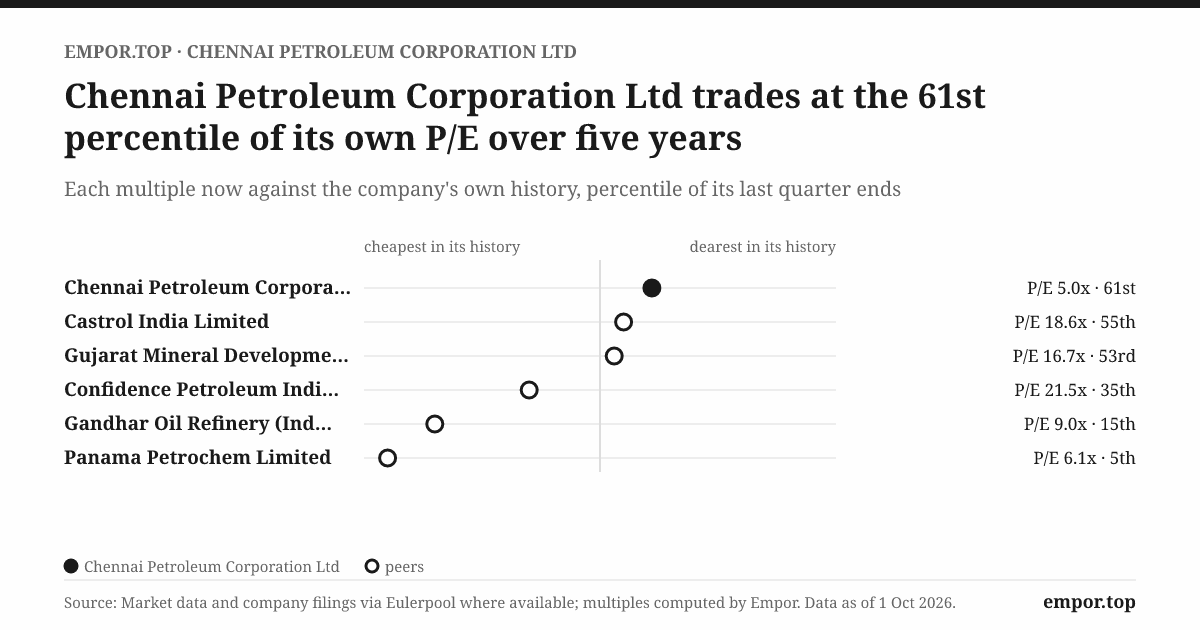
That is the riddle at the centre of Chennai Petroleum Corporation Limited, or CPCL. In fiscal 2026 (the year to March 2026), the Manali refinery processed 11.71 million tonnes of crude against a nameplate capacity of 10.5 million tonnes, which works out to roughly 112% utilisation.1 On 1 October 2026 the market valued the whole equity at about ₹20,847 crore, roughly $2.2 billion, at ₹1,400 a share.[^2] That is five times trailing earnings, an earnings yield of about 20%, and 3.6 times EBITDA.[^2]
Those are the multiples of a business investors expect to shrink. Yet over the twelve years from fiscal 2015 to fiscal 2026, CPCL turned about ₹11,650 crore of cumulative net profit into roughly ₹20,200 crore of operating cash, about 173 cents of cash for every rupee of reported profit.[^2] Most of the gap is depreciation on a large, old plant, plus working capital that the parent clears almost as fast as it is invoiced. The question this story tries to answer: is CPCL a compounding infrastructure utility hiding in plain sight, or a hyper-cyclical commodity tollbooth trapped inside a state-owned parent?
What CPCL is, and what it is not
Before the story starts, the entity boundary. CPCL is a listed, standalone refining company. It operates the 10.5 million-tonne-per-annum Manali refinery and holds a 25% equity stake in Cauvery Basin Refinery and Petrochemicals Limited (CBRPL), the joint venture building a new refinery at Nagapattinam.1 Indian Oil Corporation (IOCL) owns 51.89% of it.2
CPCL does not own IOCL's retail network, its national trunk pipelines or its marketing margins. When a motorist in Coimbatore pays for a litre of diesel, the margin on that sale belongs to IOCL. CPCL earned its money earlier, on the spread between what crude cost and what the formula says the refined product is worth. Everything in this article, from cash flows to debt to return on equity, is CPCL's own, not the group's.
The road ahead
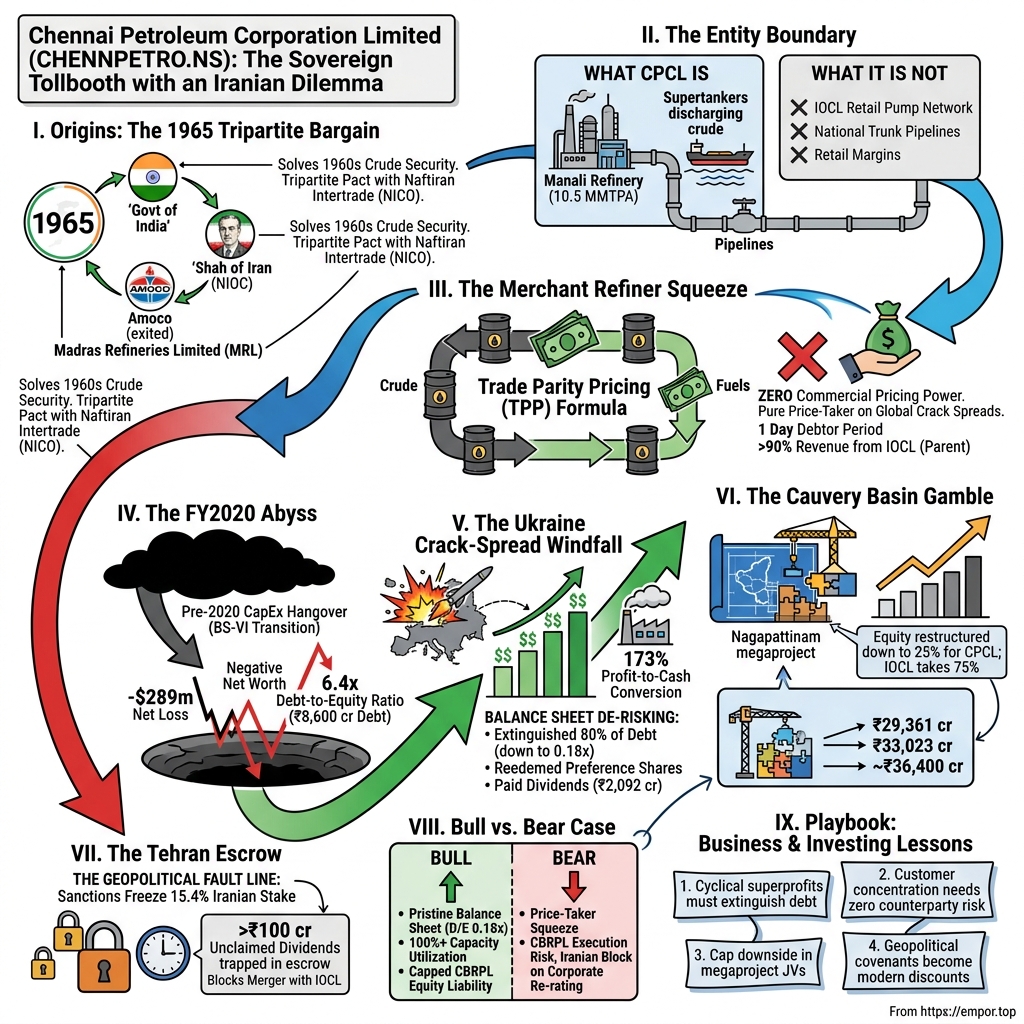
The story runs in six movements. First, a 1965 bargain between the Indian government, the Shah of Iran's national oil company and the American major Amoco, which created the refinery and left an Iranian state shareholder on the register that is still there today. Second, the economics of being a merchant refiner whose only significant customer is its controlling parent. Third, the near-death of fiscal 2020, when debt ran to more than six times equity. Fourth, the windfall that followed Russia's invasion of Ukraine and how management spent it. Fifth, the ₹36,400-crore question at Nagapattinam. Sixth, the 15.4% Iranian stake that freezes the company's structure in place.
The verdict, stated once and tested throughout: CPCL is an indispensable, high-efficiency production engine for southern India, but its equity value is capped by merchant-refiner economics and a pricing formula set above its head. To see why, the story has to begin in a Cold War negotiating room.
 Subscribe on LinkedIn
II. Origins: The 1965 Tripartite Bargain
In the mid-1960s, India was a country that imported much of its refined fuel and had just fought a war with Pakistan. Refining capacity was a strategic asset. The government of Lal Bahadur Shastri wanted refineries on Indian soil, and it needed partners with crude and technology.
The partners it found made an unusual triangle. On one side sat the Government of India. On another, the National Iranian Oil Company (NIOC), the state oil company of the Shah's Iran, which had crude to place and every reason to want an assured outlet in a large, growing market. On the third, Amoco, the American major that brought refining know-how. Together they incorporated Madras Refineries Limited in 1965 to process Iranian crude at Manali, near Madras port.3
It is worth pausing on how strange that cap table looks from 2026. An Indian state company, a Persian monarchy's oil arm and an American oil major sharing a board. In 1965 it made perfect sense: India got crude security and technology, Iran got a captive buyer, Amoco got a fee and a foothold. Nobody at the table was planning for a revolution in Tehran fourteen years later, or for American sanctions on Iranian oil fifty years later.
The triangle shifts
The triangle did not hold its shape. Amoco exited in the 1980s, selling its stake back to the Indian government.3 In 2001, as part of a broader consolidation of state refining under the national oil marketers, the government transferred its controlling stake to Indian Oil Corporation, and the company was renamed Chennai Petroleum Corporation Limited.3 Its parent today holds 51.89%.2
The Iranian side never left. NIOC's holding sits with Naftiran Intertrade Company, a Swiss-registered trading affiliate, which owns 15.40% of CPCL to this day.2 The share capital itself has barely moved. CPCL's equity capital is ₹148.91 crore, divided into roughly 14.89 crore shares of ₹10 face value, and the company has done no rights issue, public offering, preferential allotment or buyback in at least the past decade.2 Net worth has grown from about ₹1,650 crore in fiscal 2015 to roughly ₹11,000 crore by March 2026 entirely through retained profit.2 A cap table frozen for decades is, in most companies, a sign of stability. In CPCL's case it is also a sign of something stuck.
The sanctions freeze
The stuck part became obvious after 2018. When the United States reimposed secondary sanctions on Iranian oil, Indian refiners that had processed Iranian grades for decades had to stop. CPCL halted Iranian crude intake to stay clear of sanctions exposure.[^5] The crude that the refinery was originally built for no longer arrives at Manali.
A second consequence was quieter. Dividends owed to Naftiran could not easily travel through international banking channels, and by 2023 more than ₹100 crore of CPCL dividends due to the Iranian shareholder was reported to be stuck in India.4 Naftiran remains on the register as a large, passive holder whose money cannot leave and whose shares cannot easily be bought.
The falsification test: did group ownership ever unlock the retail margin?
The natural bull case for a subsidiary like CPCL is that one day the parent will absorb it. A merger into IOCL would fold CPCL's refining margin into an integrated chain that also captures marketing profit, and would let minority holders swap into a company that trades at higher multiples. The idea has circulated in Indian policy discussions for years.
The record does not support it. More than two decades after IOCL took control, CPCL remains a separately listed refiner. The obstacle is the cap table. A share-swap merger would hand IOCL shares to Naftiran, putting an entity affiliated with a sanctioned state oil company directly onto the register of India's largest oil company, with its dollar bonds, international bank lines and global crude procurement. However often consolidation is discussed, that obstacle has not been engineered away. The 1965 charter solved the crude-security problem of the 1960s and left a lasting geopolitical fault line under the company. The reader should hold that thought, because it returns as a valuation issue in Section VII. First, the more immediate question of how CPCL actually makes money.
III. The Merchant Refinery Squeeze: Why CPCL Doesn't Own a Single Petrol Pump
Picture two desks, a few kilometres apart. At an IOCL forecourt in Chennai, an attendant fills a delivery van with diesel at the retail price, a number displayed on a board that motorists check every morning. At Manali, CPCL's accounting team raises the day's invoices to IOCL. Those invoices are not negotiated. They are calculated from Platts assessments for Singapore and the Arab Gulf, plus freight, insurance and duties, converted into rupees.
The motorist pays the retail price. IOCL takes the marketing margin between that price and its refinery-gate cost. CPCL takes whatever is left between the refinery-gate formula and the cost of crude. If you want a single image of the business, it is this: CPCL bears the refining risk, and IOCL keeps the steadier slice.
How the formula works
The mechanism has a name: trade parity pricing. For the transport fuels that make up most of CPCL's output, diesel and petrol, the refinery-gate price is a weighted blend of what it would cost to import that fuel into India and what it would fetch if exported, with import parity carrying most of the weight.1 Jet fuel, LPG and petrochemical feedstocks are priced off similar import or export benchmarks.1
An analogy helps. Imagine a baker whose bread can only be sold to one supermarket, at a price the supermarket calculates each day from wheat-and-bread prices in Singapore. The baker controls how efficiently the oven runs, how little flour is wasted and how many loaves come out per hour. The baker controls nothing about the price. That is CPCL. Its margin, the gross refining margin or GRM, is expressed in dollars per barrel of crude processed, and it moves with global "crack spreads", the gap between product prices and crude prices.
The customer who is also the owner
IOCL buys more than 90% of what CPCL makes, under long-term offtake arrangements that feed its retail and bulk distribution across Tamil Nadu and the neighbouring southern states.1 Product sales to IOCL run at something like ₹60,000–70,000 crore a year, approved by shareholders under omnibus related-party mandates.1 Crude buying is pooled through IOCL's central procurement desk, which gives CPCL access to the parent's volume discounts, shipping fixtures and supplier credit, but also means CPCL has no independent trading arm.1
The related-party question an investor should ask is whether IOCL extracts value from its subsidiary through transfer prices. The evidence points the other way: pricing follows published benchmarks, and CPCL pays no material brand royalty or management fee to IOCL.1 The parent does not skim CPCL. It simply decides what CPCL does: where crude comes from, where product goes and which projects to build. Strategic discretion is subordinated to the parent's priorities, even if prices are clean.
The debtor days
One number shows the upside of this dependence. In fiscal 2015, CPCL's receivables equalled about 17 days of revenue. By fiscal 2025 and 2026, it was one day.[^2] IOCL settles almost as fast as product leaves the gate, and the company has no history of bad-debt write-offs from its main customer.1
For a business with revenue of about $7 billion, cutting receivables from 17 days to one frees billions of rupees of working capital. It also removes any meaningful counterparty risk. CPCL never worries whether its customer will pay. It worries only about what the formula says it will be paid.
The falsification test: does operating excellence protect profits?
Here is the claim worth testing: a refinery this efficient, running this hard, should earn decent margins through the cycle. The record from fiscal 2025 answers it.
That year, Manali processed about 10.45 million tonnes, essentially full nameplate capacity.1 The plant did its job. Yet CPCL's reported GRM halved, from $8.64 a barrel in fiscal 2024 to $4.22.1 Operating profit fell by about 64%, from roughly $659 million to $239 million, and net profit collapsed by more than 90%, from about $332 million to $25 million.[^2] In the September 2024 quarter the company posted an operating loss.[^2]
Nothing broke at Manali. Asian crack spreads narrowed, and inventory losses followed falling crude prices. The lesson is blunt: operational competence is necessary but nowhere near sufficient. CPCL's moat, to the extent there is one, protects volume, not margin. Investors buying its earnings are buying Singapore cracks with an Indian refinery attached. The next section shows what happens when those cracks turn hostile for long enough, and the balance sheet is already stretched.
IV. The $1.2 Billion Debt Mountain and the FY2020 Abyss
March 2020. Crude prices are falling off a cliff, a Saudi-Russian price war colliding with the first wave of the pandemic. India announces a national lockdown. Trucks stop. Flights stop. Fuel demand, which every refiner treats as a given, simply evaporates for weeks. At Manali, tanks hold crude bought at one price and now worth far less.
When CPCL closed its books for fiscal 2020, it reported a net loss of about $289 million.[^2] Shareholders' equity had shrunk to roughly $191 million, while borrowings stood at about $1.2 billion. Debt was 6.4 times equity.[^2] Return on equity for the year was minus 151%.[^2] For a strategically vital refinery owned by India's largest oil company, those are the numbers of a company that would have struggled to borrow in its own name.
How the hole was dug
The crisis of 2020 was not a single blow. It was a sequence. Through the second half of the 2010s, CPCL spent heavily on compliance and upgrading: meeting the BS-VI clean fuel standards, revamping units, and adding residue-upgrading capacity that squeezes more value out of each barrel.1 Capital spending ran well above today's levels; cash from investing was an outflow of $150–182 million a year from fiscal 2016 to fiscal 2019.[^2]
That spending was necessary. India mandated cleaner fuels, and a refinery that cannot make them cannot sell them. But it did not add crude capacity. It was money spent to stay in the game, not to grow. And it was funded largely with debt.
The first rescue
CPCL had already needed one rescue. In fiscal 2015 the company reported a loss and its equity cushion thinned.[^2] In fiscal 2016, IOCL subscribed ₹1,000 crore of 6.65% non-convertible cumulative redeemable preference shares, which shored up the balance sheet without issuing a single new common share.1 The instrument was treated as debt and carried a coupon. It was a parent's lifeline, priced as a loan. CPCL redeemed half in June 2018.1
The double whammy
Then came fiscal 2019 and 2020. Fiscal 2019 already ended in a loss, as margins weakened and inventory values swung.[^2] Fiscal 2020 brought both disasters at once: inventory losses as Brent fell from the sixties to around $20 a barrel, and demand collapsing under lockdown.
A refinery holds weeks of crude and product in its tanks and pipelines. When prices fall sharply, that inventory is revalued downward, and the loss hits profit even if the refinery runs perfectly. For a business without a marketing arm to absorb swings in retail prices, the hit lands directly on equity.
The falsification test: was CPCL self-funding through the downturn?
The claim to test is that CPCL's operations could carry its spending and its debt through a bad patch. The record says no. Free cash flow was negative in fiscal 2017, fiscal 2019, fiscal 2020 and fiscal 2021, by roughly $87 million, $207 million, $226 million and $16 million respectively.[^2] Operating cash flow was itself negative in both fiscal 2019 and 2020.[^2] Over those years, the refinery could not cover capital expenditure and interest from its own cash.
Borrowings kept climbing, peaking at about ₹9,238 crore in fiscal 2022.1 What prevented a refinancing spiral was not CPCL's standalone strength. It was its parent. Rating agencies explicitly anchor CPCL's AAA ratings to IOCL's operational, managerial and financial support.15 Lenders were lending to IOCL's subsidiary, not to a lone refinery.
That is the honest verdict on this period. A capital-intensive refiner without a retail cushion is exposed to solvency shocks in a downcycle, and CPCL survived because of a sovereign-backed parent, not because of its own financial design. It also explains why the next chapter matters so much. If a refinery like this gets lucky, what it does with the luck decides whether it ever faces another 2020.
V. The Ukraine Crack-Spread Windfall: Turning Superprofits into a Debt Extinguisher
In late February 2022, Russian tanks rolled into Ukraine. Within weeks, Europe was scrambling to replace Russian diesel. Global middle-distillate cracks, the premium of diesel and jet fuel over crude, jumped to levels refiners had rarely seen. For a refinery that turns a large share of its crude into diesel, the effect was immediate and enormous.
At Manali, this was the moment the business model finally swung in its favour. The same formula that crushed margins in 2020 now passed through extraordinary global spreads. CPCL's revenue reached about $11.3 billion in fiscal 2023, its highest ever.[^2] Operating profit hit about $913 million and net profit about $440 million.[^2] Return on capital employed touched nearly 60%.[^2]
The question that matters is not how much money arrived. It is where it went.
The conversion machine
Start with how profit becomes cash. Across the twelve years to fiscal 2026, CPCL's cumulative operating cash flow ran at about 173% of net profit.[^2] Two mechanisms explain most of it. Depreciation, a non-cash charge of roughly ₹550–600 crore a year on a large, old asset base, is added back.1 And working capital has been squeezed, with IOCL settling invoices almost immediately.1
Fiscal 2023 was the peak: operating cash flow of about $716 million and free cash flow of about $664 million in a single year.[^2] That one year generated more free cash than CPCL had produced in the previous five combined.
Where the cash went
Over the full twelve years, CPCL generated about ₹10,182 crore of free cash flow.[^2] The allocation is unusually easy to read.
Capital spending stayed lean, around $50–105 million a year since fiscal 2023, roughly 1% of revenue.[^2] Dividends took about ₹2,092 crore, around a fifth of the free cash.[^2] The rest went to repairing the balance sheet. Borrowings fell from about ₹9,238 crore in fiscal 2022 to about ₹1,964 crore by March 2026, a reduction of almost four-fifths.1 Along the way, CPCL redeemed ₹810 crore of non-convertible debentures and repaid the remaining ₹500 crore of preference shares owed to IOCL.15
Cash, which had been essentially nil for most of the decade, built up to about ₹1,342 crore by March 2026, held in bank fixed deposits.[^2]1 Net debt is now about ₹622 crore, and interest coverage was about 25.5 times in fiscal 2026.1 Debt-to-equity fell from 6.4 times in 2020 to 0.18 times.[^2]
What the deleveraging reveals
This is the part of the story where CPCL looks best, and it deserves a precise compliment rather than a sweeping one. Management did not chase a vanity acquisition with windfall cash. It did not launch a new crude unit at Manali in the middle of a boom. It used temporary profits to retire permanent obligations. For a commodity business that had come close to running out of equity two years earlier, that was the right call.
Two caveats keep the verdict honest. First, CPCL's room for adventure was limited by design: a state-controlled subsidiary whose parent decides strategy is not free to go on an acquisition spree. Discipline here was partly structural. Second, the big strategic capital decision, Nagapattinam, was routed through a joint venture, so the absence of heavy capex on CPCL's own cash-flow statement does not mean the absence of commitments. That is the next section's subject.
Other income stayed small, about ₹99 crore in fiscal 2026, mostly interest on deposits.1 The earnings are refining earnings, not treasury tricks.
The falsification test: can investors rely on the dividend?
At ₹1,400 a share, CPCL shows a trailing dividend yield of about 4.4%.[^2] That headline invites investors to treat the stock as an income instrument. The record does not support that reading.
Payouts have been wildly erratic. CPCL paid nothing for fiscal 2016, 2020 and 2021, distributed less than 1% of fiscal 2023's record profit, and then paid more than three times fiscal 2025's net profit, a payout ratio of about 383%, because profit had collapsed while a dividend was still declared.[^2] For fiscal 2026 the payout was back to about 6% of profit.[^2]
The pattern says management treats dividends as a residual, paid when cash and the parent's needs allow, not as a commitment. In the windfall years that was arguably wise: debt reduction came first. But it means the yield is an artefact of timing, not an annuity. The cash that once went to lenders now has a new claimant waiting in the wings, on the coast south of Chennai.
VI. The Cauvery Basin Gamble: A ₹36,400-Crore Question at Nagapattinam
Drive about 300 kilometres south from Chennai, past the temple towns of the Cauvery delta, and you reach Panangudi, in Nagapattinam district. For decades, CPCL ran a small refinery here, with capacity of about one million tonnes a year: tiny by modern standards, low in complexity, and eventually shut. Today the site is being cleared for something far larger: a 9 million-tonne-per-annum grassroots refinery and petrochemical complex.6
It is CPCL's next act. It is also the biggest capital question in the company's future.
The vision
The logic is straightforward. Southern India consumes more fuel than it refines, and demand keeps growing. A modern refinery at Nagapattinam, built to BS-VI specifications and with petrochemical units producing products like polypropylene, would replace an obsolete relic with world-scale capacity close to a growing market.67 It would also give the CPCL name a second large asset, reducing its exposure to a single site, a weakness rating agencies explicitly flag.1
The cost creep
The project's cost has already moved. An earlier estimate of about ₹29,361 crore was revised to ₹33,023 crore by early 2024.8 Scope changes toward higher petrochemical yield have since pushed estimates toward roughly ₹36,400 crore.17 That is almost a quarter more than the original figure, before full construction.
The ownership has moved too. The original idea was that IOCL and CPCL would each hold 25%, with outside strategic or financial investors taking the other half. Those investors did not arrive in the form planned. Grassroots refining in an age of energy transition is not easy to syndicate. In 2024, the structure was reset: IOCL took 75% and CPCL 25%.6
That restructuring is the single most important decision for CPCL shareholders in this story. Had CPCL been left at 50%, with costs rising, it would have been staring at a commitment several times larger relative to its balance sheet. At 25%, its equity check is estimated at roughly ₹2,750–3,000 crore.1
Can CPCL afford it?
The arithmetic is now manageable. Net debt is about ₹622 crore, cash about ₹1,342 crore, and annual operating cash flow in a normal year runs to several thousand crore.1[^2] Spread over three or four years, a ₹3,000-crore equity contribution can be funded internally without stretching the balance sheet back toward 2020 territory.
The harder question is what that equity earns, and when. Money injected into CBRPL will sit as an investment in a project under construction, earning nothing until the refinery is commissioned and running. The project also needs to reach financial close on its debt; if lenders demand more equity because costs rise further, the 25% share will be 25% of a bigger number.
The falsification test: do Indian PSU megaprojects arrive on time and on budget?
The honest base rate is poor. Large Indian state refinery projects, including IOCL's Paradip refinery, BPCL's Kochi expansion and HPCL's Rajasthan refinery at Barmer, have each faced lengthy delays and substantial cost overruns. Nagapattinam has already shown cost escalation before full construction. Management's framing of the project as a growth engine therefore deserves to be weighed against that base rate rather than accepted on its face.
The verdict: the 25% restructuring narrowed CPCL's exposure from a potential balance-sheet threat to a manageable option on new capacity. It did not make the option valuable. That depends on execution, on whether margins in 2030 justify a grassroots refinery planned in 2020, and on whether global capacity additions in China and the Middle East depress the spreads the new plant will sell into. The KPI to watch is CBRPL's financial closure and the schedule of CPCL's equity calls. And if CPCL ever wanted to escape these questions by folding itself into its parent, it would run straight into the shareholder it cannot pay.
VII. The Tehran Escrow: The 15.4% Iranian Hostage to Fortune
Every year, CPCL's annual general meeting follows the familiar choreography of an Indian listed company. Resolutions are tabled. E-votes are counted. The scrutiniser files a report with the stock exchanges.9 The board declares a dividend, and the registrar prepares payments to roughly 150,000 shareholders.2
One payee is different. Naftiran Intertrade, holder of 15.40% of the company, is entitled to its share of every dividend. Getting that money to its owner is another matter. As noted earlier, more than ₹100 crore was reported to be stuck by 2023.4 Each new dividend adds to the pile.
The shape of the register
CPCL's promoter group holds 67.29%: IOCL 51.89% and Naftiran 15.40%.2 That leaves a free float of 32.71%. Within that float, foreign institutions behave like traders in a commodity derivative. Their holding rose from about 11% in September 2023 to about 16% a year later as margins boomed, fell below 9% by June 2025 as margins collapsed, and climbed back to about 15% by June 2026.2 Domestic institutions hold about 1%.2
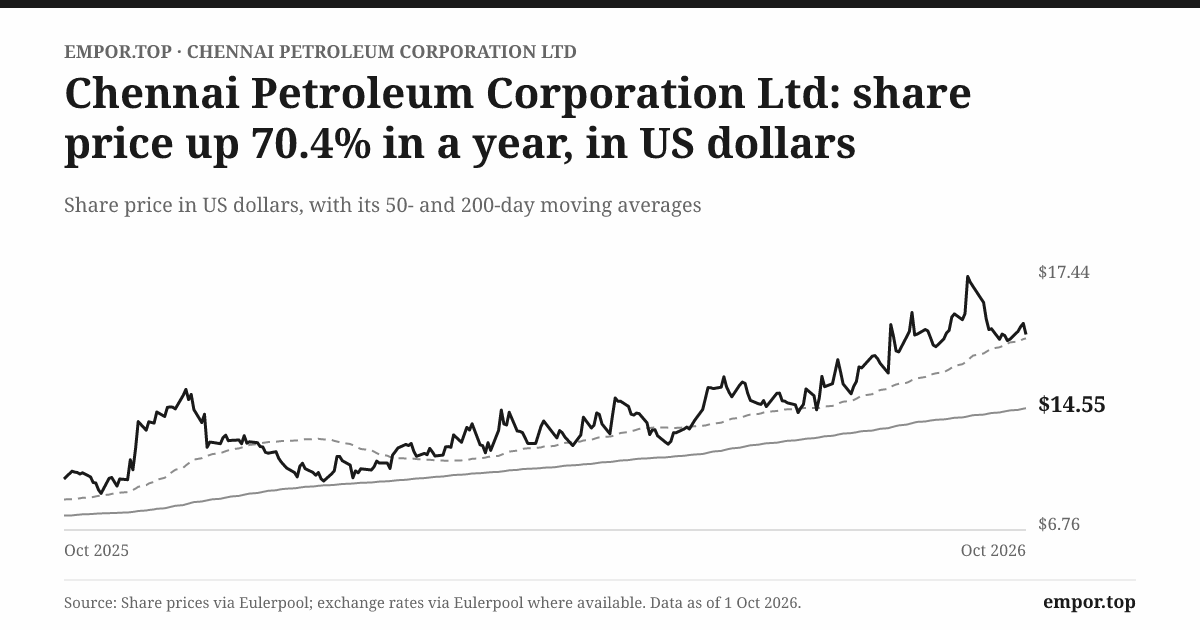
Retail investors arrived in waves too. The shareholder count roughly doubled from about 101,000 in September 2023 to a peak of about 207,000 in March 2025, before falling back to about 150,000.2 The share price tells the same story: over the past year it has ranged from about ₹724 to about ₹1,604, with one-year volatility of about 51%, and the stock has suffered a 63% fall at some point in the past five years.[^2] Shareholders treat this as a cycle trade, not a long-term holding, and the register shows it.
The merger impasse
As noted earlier, the efficient move for the group—merging CPCL into IOCL to integrate refining with marketing—is blocked by Naftiran's presence on the register. Handing IOCL shares to an entity affiliated with Iran's state oil company would create sanctions exposure at the parent level, leaving a clean share swap effectively off the table.
The falsification test: could someone just buy Naftiran out?
If the stake is the problem, why not buy it? Two reasons. Paying an Iranian state-linked entity in hard currency for its shares runs into the same sanctions problem as paying it dividends. A rupee settlement requires Iran to accept rupees for a strategic asset, on terms both governments can defend. In more than two decades of IOCL control, no buyout has happened.
The evidence leaves the claim that Naftiran's stake is a structural poison pill intact. It blocks consolidation, limits how much institutional capital will commit to a stock exposed to geopolitical headlines, and keeps CPCL priced as a standalone refiner. It is not formally permanent; a change in US-Iran relations could reopen options. But no investor should underwrite that change. With the structure fixed, the remaining question is whether the business inside it has any real competitive edge.
VIII. Analysis: Porter's 5 Forces, 7 Powers, and the Bull vs. Bear Case
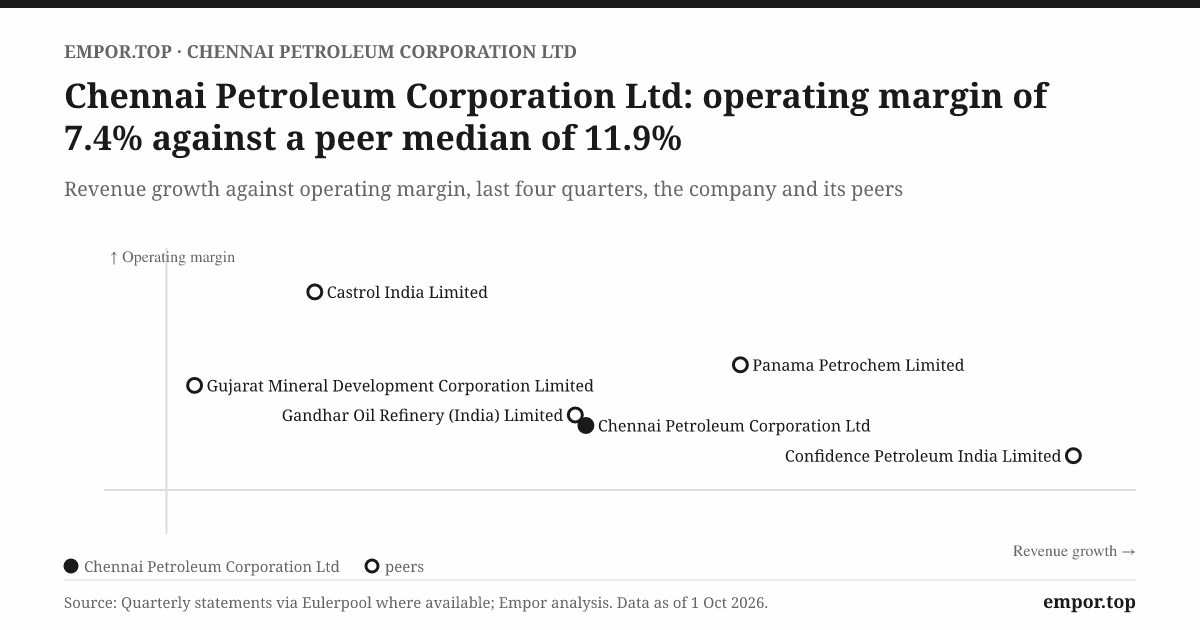
On an equity research screen in Mumbai, the downstream sector arranges itself into two clusters. Standalone refiners, CPCL and Mangalore Refinery and Petrochemicals (MRPL), sit at low multiples: price-to-earnings around 5–7 times, EV/EBITDA around 3.5–4.5 times.2 The integrated oil marketers, IOCL, BPCL and HPCL, sit higher, at roughly 6–9 times earnings.2 The market pays more for refineries attached to petrol pumps.
CPCL's own numbers look strong. For fiscal 2026, return on capital employed was about 35% and return on equity about 28%; the stock trades at 1.8 times book value.[^2] The question is whether those returns reflect a durable advantage or a good year in a cycle.
Hamilton Helmer's 7 Powers
Cornered resource. CPCL's strongest claim. The Manali site is a coastal refinery connected by pipelines to Chennai's port and to IOCL's distribution terminals. Building a new 10.5-million-tonne refinery on the coast of northern Tamil Nadu today would face land, environmental and political obstacles that may be impossible to clear. The existing site has replacement value no newcomer can easily match. The limit of the power: it protects CPCL's ability to sell volume, not its ability to set price.
Process power and scale. The refinery runs consistently above nameplate, at about 112% in fiscal 2026.1 Headcount has slowly fallen to around 1,366 employees.1 Running a plant this hard with a lean workforce spreads fixed costs over more barrels. But this power is visible in operating rates, not in pricing; fiscal 2025 showed that it does not defend margins.
Scale economies beyond the plant are limited. CPCL is a single-site refiner, not India's largest; its crude-buying advantages come from pooling with IOCL, not from its own size.1
Missing powers. CPCL has no brand (its products are sold under IOCL's), no network effects, and no switching costs for its buyer; IOCL would face its own logistics costs in replacing Manali's output, but it is the parent, not a customer who could defect. Counter-positioning works against CPCL: the energy transition favours new entrants in electric mobility and gas, not incumbents with a single liquid-fuels refinery.
The Helmer verdict: CPCL has a real but narrow cornered resource and real process strength, both of which protect volume and survival. It lacks the powers that protect price.
Porter's Five Forces
Buyer power: extreme. One customer buys over 90% of output at a formula price.1 This is the decisive force. It removes credit risk and offtake risk, and it removes pricing power entirely.
Supplier power: moderate. Crude is a global commodity bought through IOCL's desk.1 No single supplier dominates, but CPCL has no buying power of its own, and its loss of Iranian crude after 2018 shows that geopolitics can redraw the supply map at a stroke.[^5]
Threat of new entrants: very low. Grassroots refining requires enormous capital, environmental approvals and long lead times; even the state's own new project at Nagapattinam has needed IOCL to take three-quarters of the equity.6
Threat of substitutes: low today, rising over time. Electric two-wheelers and cars, gas in transport and eventually hydrogen will chip away at petrol and diesel demand in states like Tamil Nadu, which has courted EV manufacturing. That threat is slow-moving but structural.
Rivalry: moderate. CPCL operates within a regional deficit market where local demand exceeds regional refining output, so its volume is absorbed. But its prices are set by global rivalry, by refineries in Singapore, the Gulf and China.
The skeptical investor's stress test
An activist or short seller examining CPCL would push on three points.
Pay with no stake. Under public-sector pay rules, the managing director earns around ₹70–85 lakh a year and the finance director around ₹65 lakh, with no stock options or profit-linked bonuses.12 There is no self-enrichment risk. There is also no equity alignment: executives rotate between group companies, and their incentives point to IOCL and the ministry, not to CPCL's minority shareholders.
Board composition. CPCL has periodically fallen short of the number of independent directors required under listing rules, because appointments depend on the petroleum ministry's process.1 Minority shareholders have limited ability to change this.
Environmental tail risk. In December 2023, during Cyclone Michaung, oil from the Manali area entered the Buckingham Canal and Ennore creek. The Tamil Nadu Pollution Control Board assessed environmental compensation of about ₹74 crore.1 In March 2025, the National Green Tribunal's southern bench granted an interim stay, conditional on a bank guarantee of about ₹19 crore.10 The sum is small against CPCL's cash, but the episode is a reminder that an ageing refinery on a cyclone-prone coast beside dense settlements carries environmental and reputational risk. Separately, the company is contesting tax and duty claims totalling several hundred crore, not acknowledged as debts.1
Myth versus reality
Myth: CPCL's 28% ROE shows a high-quality compounder. Reality: ROE has ranged from minus 151% to 55% over twelve years.[^2] The fiscal 2026 figure is one point on a violent cycle.
Myth: A P/E of 5 is obviously cheap. Reality: CPCL's own five-year median P/E is about 3.7.[^2] The stock trades above its own history; the market has always priced it as a cyclical, and is currently less pessimistic than usual.
Myth: IOCL milks its subsidiary. Reality: Transfer prices follow published benchmarks. The parent controls CPCL's strategy, not its margin.1
The bull case
- Balance sheet. With debt at 0.18 times equity and net debt around ₹622 crore, CPCL can absorb a downcycle like fiscal 2025 without returning to the 2020 abyss.1[^2]
- Valuation. At 5 times earnings, 3.6 times EBITDA and an earnings yield of about 20%, the stock prices in a large decline in profits.[^2]
- Volume certainty. The regional fuel deficit and IOCL's offtake keep Manali running above nameplate, removing volume risk.1
- Capped optionality. At 25% of CBRPL, CPCL gets exposure to 9 million tonnes of new capacity without carrying the majority of execution risk.6
The bear case
- Price-taker economics. When Singapore cracks compress, profits evaporate regardless of operating performance, as fiscal 2025 proved.1[^2]
- Nagapattinam drag. Further cost overruns or delays would divert cash from dividends into an investment that earns nothing for years.
- The Iranian lock. Naftiran's 15.4% blocks merger, privatisation and probably sustained institutional re-rating.2
- Energy transition. Electrification of two-wheelers and cars in Tamil Nadu will erode petrol demand growth over the life of the asset.
Weighing the two: the bull case rests on today's balance sheet and price, both well evidenced. The bear case rests on structural features that have held for decades. That combination describes a cyclical value instrument, not a compounding moat.
The three KPIs that matter
- Gross refining margin in dollars per barrel, against the Singapore benchmark. Latest reading: $9.28 for fiscal 2026, up from $4.22 in fiscal 2025.1 This is the single largest driver of profit.
- Crude throughput and utilisation. Latest reading: 11.71 million tonnes in fiscal 2026, about 112% of nameplate, up from 10.45 million tonnes.1 Sustaining above 100% is the operational part of the thesis.
- CBRPL financial closure and equity calls. The latest framework caps CPCL's share at 25%, with an estimated ₹2,750–3,000 crore commitment.1 Any increase would be the first sign of the bear case arriving.
IX. Playbook: Business & Investing Lessons
Lesson 1: A windfall is a loan from the cycle
In fiscal 2020, CPCL had debt of more than six times equity. Within four years of Russia's invasion of Ukraine, it had repaid most of its borrowings and built cash, bringing leverage down to 0.18 times. It did this not by being cleverer than other refiners but by refusing to treat a war-driven spike in diesel spreads as the new normal.
The wider lesson for anyone running or owning a commodity business: profits that come from the cycle should be spent buying freedom from the next cycle. "In a commodity business, a windfall is not proof of genius. It is a temporary lease on survival, and the rent is paid in retired debt."
Lesson 2: One customer can be a fortress and a cage at once
CPCL sells over 90% of its output to the company that owns it, and collects its money in about a day. No bad debts, no lost customers, no marketing expense. Also no ability to set a single price.
Founders who build around one dominant buyer should know which half of that bargain they are getting. "When your biggest customer owns your boardroom, you will never have a bad debt, and you will never have a price."
Lesson 3: Own the option, not the overrun
When Nagapattinam's costs rose and outside investors stayed away, CPCL's share fell from a planned 50%-plus partnership role to 25%, with IOCL taking the rest. The project may still overrun. CPCL's exposure to that overrun was cut in half before the first major construction cheque.
For investors watching any company commit to a megaproject: the best protection is not optimism about the budget; it is the size of the commitment. "If a project's cost can climb by a fifth before the foundations are poured, own a slice of it, not the whole bet."
Lesson 4: Cold War paperwork becomes a modern discount
A refinery founded in 1965 to secure Iranian crude for Madras now cannot take Iranian crude, cannot pay its Iranian shareholder, and cannot merge into its own parent because of that shareholder. Every year, more dividends pile up in an account that cannot be cleared.
The lesson travels well beyond India: the founding structure of a company outlives the politics that created it. "Corporate charters outlive empires, and a handshake with the Shah became a valuation discount sixty years later."
X. Epilogue
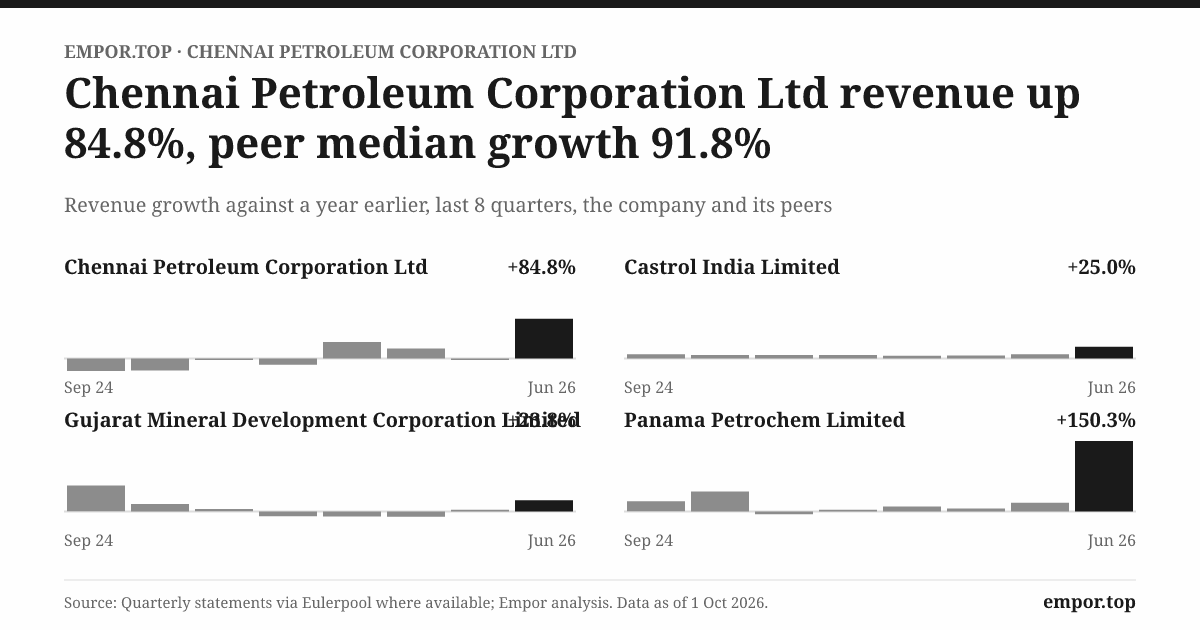
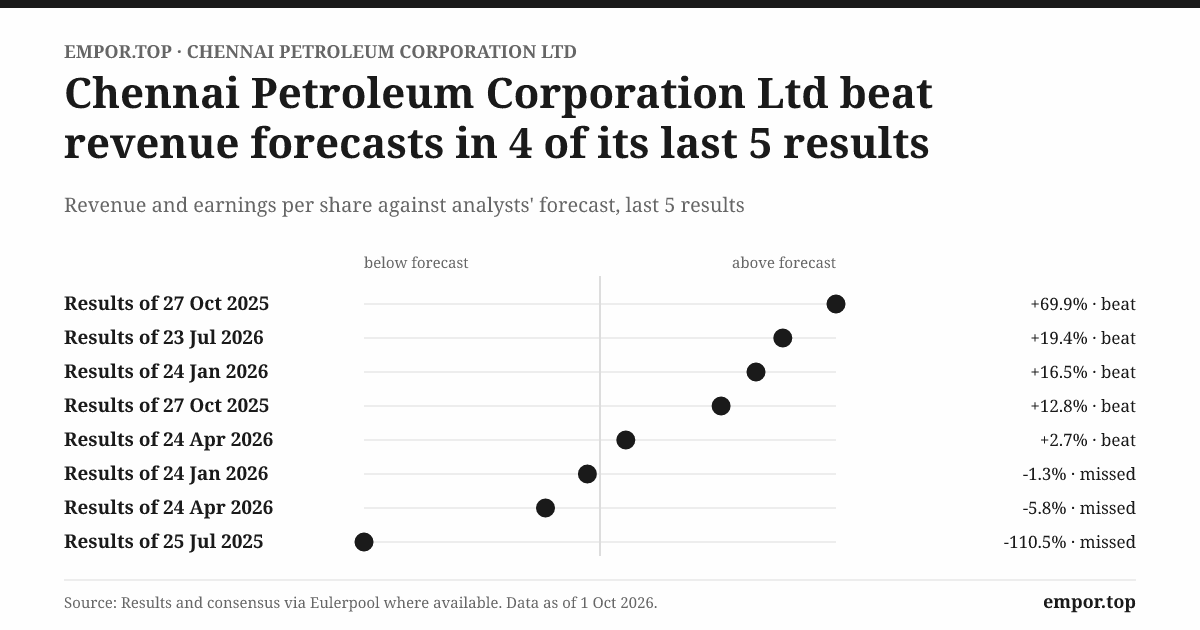
Tonight, CPCL is the strongest it has been in more than a decade. Debt is small, cash is real, the refinery runs above capacity, and profits for the twelve months to June 2026 were about $459 million.[^2] The June 2026 quarter alone delivered revenue of about $2.9 billion, up about 85% on a year earlier.[^2] The stock sits about 13% below its 52-week high, after nearly doubling from its low.[^2]
Three moments will decide what comes next.
The Nagapattinam financing. CBRPL needs to close its project debt. If lenders sign without demanding more equity, CPCL's commitment stays near ₹3,000 crore and its balance sheet stays clean. If costs rise again or equity calls grow, cash that could have gone to shareholders will go into a construction site that earns nothing until the refinery runs.
The crack-spread normalisation. Fiscal 2026's GRM of $9.28 a barrel was strong.1 New refineries in China, the Middle East and elsewhere are adding capacity that will compete for the same Asian market. If CPCL's margin holds near current levels through that wave, the 5 times earnings multiple will look too cautious in hindsight. If it reverts to fiscal 2025's levels, today's earnings will look like a peak, and the multiple like a mirage.
The diplomatic chessboard. Any thaw between Washington and Tehran, or a bilateral settlement mechanism between India and Iran, could reopen the question of Naftiran's stake. A clean exit would unlock merger options that have been frozen for decades. Until then, the 15.4% stays.
The tension does not resolve. CPCL operates with elite efficiency and survives because it is indispensable to the state. Yet the value of its equity is decided by spreads in Singapore, by a joint venture's construction schedule, and by the foreign policy of two governments, none of which Manali controls.
XI. Outro
Return to Manali after dark. The flares still burn over the Bay of Bengal. Crude still comes ashore from the tankers off the coast, and fuel still flows invisibly into IOCL's pipes and onward into millions of engines across southern India. The plant does not look like a company that nearly ran out of equity in 2020, nor like one that paid off most of its debt with a war-driven windfall. It just runs.
That is the paradox CPCL leaves behind. It survived near-insolvency, repaid its lenders with a boom it did not create, and now sits on a clean balance sheet, still unable to buy out its Iranian co-founder or set the price of a single litre. Chennai Petroleum is an indispensable sovereign utility running at more than a hundred percent of capacity, and a price-taking prisoner of global crack spreads and Cold War history.
References
-
Chennai Petroleum Corporation Limited Rating Rationale — CRISIL Ratings, 2025-11-07 ↩↩↩↩↩↩↩↩↩↩↩↩↩↩↩↩↩↩↩↩↩↩↩↩↩↩↩↩↩↩↩↩↩↩↩↩↩↩↩↩↩↩↩↩
-
CPCL Financial Overview, Balance Sheet and Ratios — Screener.in, 2026-10-01 ↩↩↩↩↩↩↩↩↩↩↩↩↩↩
-
Ministry of Petroleum & Natural Gas: CPCL Corporate History and Joint Venture Background — MoPNG, Government of India ↩↩↩
-
Iranian Firm's ₹100 Crore CPCL Dividends Trapped Under US Sanctions — Business Standard, 2023-08-14 ↩↩
-
Chennai Petroleum Corporation Limited: Ratings Reaffirmed — ICRA Limited, 2024-09-11 ↩↩
-
Indian Oil Corporation, CPCL to Form 75:25 JV for Cauvery Basin Refinery — The Hindu, 2024-03-29 ↩↩↩↩↩
-
CPCL Restructures Cauvery Basin Refinery Project to Boost Petrochemical Yield — Chemical Industry Digest, 2025-06-12 ↩↩
-
CPCL's Nagapattinam Refinery Cost Escalates to ₹33,023 Crore — Business Standard, 2024-03-28 ↩
-
CPCL AGM Voting Results and Scrutinizer Report — National Stock Exchange of India, 2026-08-25 ↩
-
National Green Tribunal Southern Bench Interim Stay on TNPCB Demand for Ennore Oil Spill — The Hindu, 2025-03-18 ↩
 LinkedIn
 WhatsApp
 Reddit
 Hacker News
 Email
Email Kindle
 RSS Feed
 Spotify
 Apple Podcasts
 Amazon Music
 Audible
 YouTube