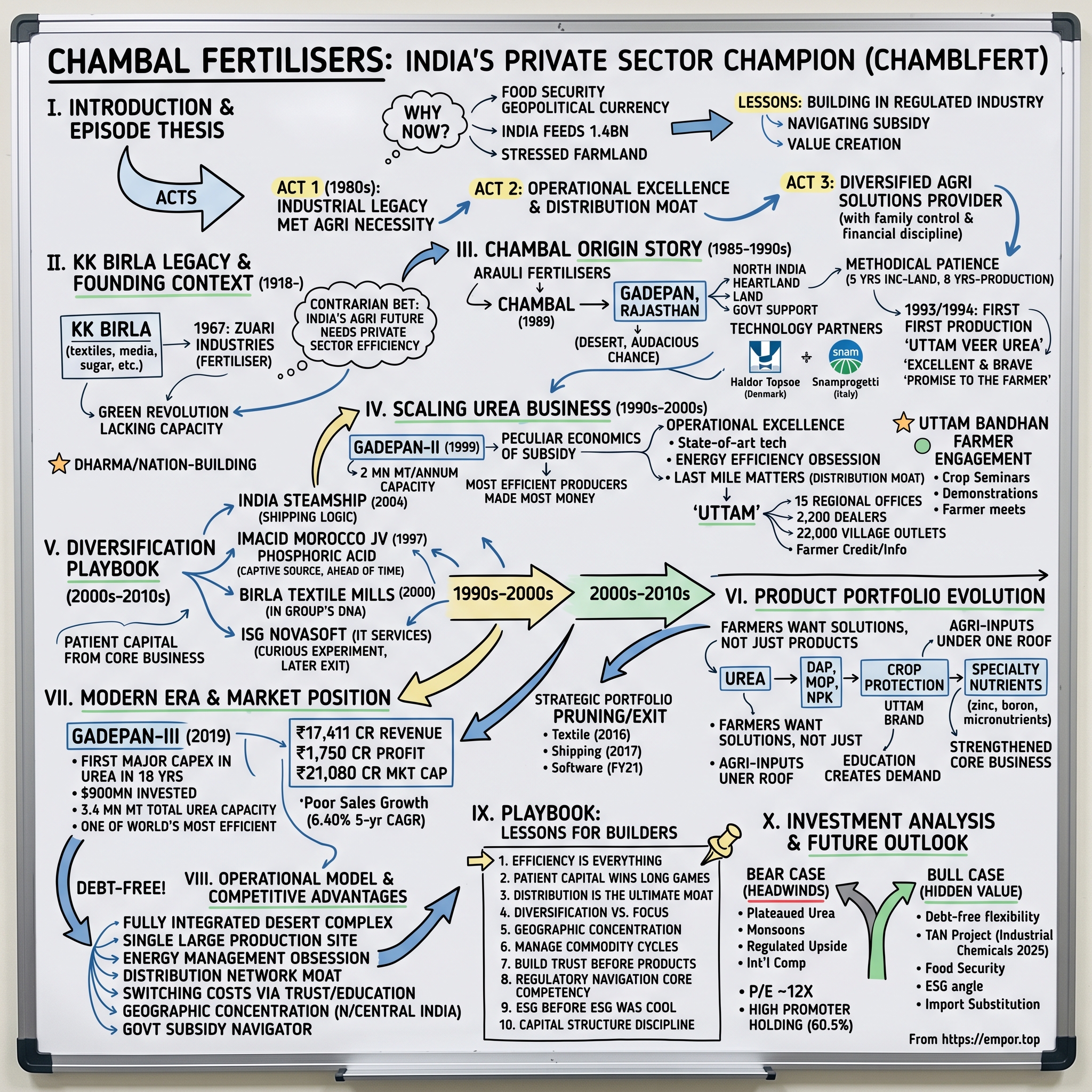
Chambal Fertilisers: The Private Giant of Indian Agriculture
I. Introduction & Episode Thesis
On the morning of August 20, 2026, in a semi-arid stretch of Kota district in Rajasthan, a plant operator opened a valve, sending a stream of small white beads falling through a prilling tower. Those beads were high-density ammonium nitrate—the raw explosive filler that blasts coal out of Indian mines and cuts highway alignments through hills. For Chambal Fertilisers and Chemicals, this marked the first product in its 40-year history that no farmer would ever buy and no government subsidy cheque would ever reimburse.19
That single detail frames the entire investment question. Chambal represents an unusual industrial franchise in India: a company generating roughly ₹20,000 crore in revenue and close to ₹2,000 crore in net profit by selling a product whose retail price it cannot set, to customers it does not choose, at a margin determined by a government formula. In the fiscal year ended March 2026, standalone revenue rose about 25% to ₹20,794 crore, while net profit grew roughly 18% to ₹1,950 crore.2 The balance sheet closed the year with effectively zero net debt—cash reserves almost fully offsetting short-term borrowings—after the company prepaid the entire long-term loan stack raised to fund its third urea plant.17
The manufacturing engine behind those figures sits on a single site: three ammonia-urea production trains at Gadepan, with a combined installed capacity of about 3.4 million tonnes of urea a year, making it India's largest private-sector urea complex.4 Chambal accounts for roughly a tenth of the country's urea output and stands as its largest private producer.12 Its third train, Gadepan-III, features a 141.5-metre prilling tower that management describes as the world's tallest.9 While Gadepan is an efficient manufacturing site, whether it constitutes a world-class business remains the central question.
The central question. In 1985, when Chambal was incorporated, Indian fertiliser manufacturing was overwhelmingly a state and cooperative affair. Public sector units and cooperatives like IFFCO and KRIBHCO led the Green Revolution; private capital was tolerated rather than courted. A late entrant promoted by Zuari Industries, a K.K. Birla Group company, possessed no obvious structural edge.3 How did that late entrant become the premier low-cost private operator in a strategic commodity—and does that position represent a genuine moat or merely a well-managed seat within a government scheme?
The thesis, stated honestly. Chambal's core competence is real but narrow. In urea, the government caps the farmer's retail price and reimburses manufacturers against a cost formula benchmarked to normative energy consumption. Every gigacalorie of energy a plant saves below its prescribed norm flows directly to the operator's bottom line. Chambal has consistently beaten these benchmarks: in FY2025, Gadepan-I operated at 5.407 Gcal per tonne of urea against a target norm of 5.501, while Gadepan-II achieved 5.410 against a 5.443 target, earning energy-saving certificates under the government's Perform, Achieve and Trade scheme.7 That mechanism is the primary way a urea manufacturer earns returns above the regulated rate. It is durable and measurable, but also capped: a plant cannot save its way past the thermodynamic limits of ammonia synthesis.
Around that manufacturing core, Chambal built a second asset: a rural distribution network spanning 13 states and one union territory. The company uses this network to distribute not only its own urea but also imported phosphatic fertilisers, crop protection chemicals, specialty nutrients, biologicals, and seeds.7 That distribution footprint serves as the platform for scaling higher-margin product lines.
A third leg forms the crux of the market's current debate: whether Chambal can convert its surplus ammonia supply and strong balance sheet into an unregulated industrial chemicals business. The technical ammonium nitrate complex is that core strategic bet.
What this story will test. Four specific claims, evaluated against the company's historical record rather than management's promotional narrative. First, that scale and energy efficiency at Gadepan produce durable, protected cash flows—tested against the fact that the specific policy regime granting Gadepan-III its economics expires in December 2026, a timeline management acknowledged during its July 2026 earnings call.6 Second, that management demonstrates disciplined capital allocation—tested against a 15-year period in which the company owned crude oil tankers, a US mortgage software business, and a cotton spinning mill, before eventually exiting all three.131415 Third, that trading imported phosphatic fertilisers is an attractive growth channel—tested against quarters in which the managing director admitted to analysts that marketing di-ammonium phosphate (DAP) was simply unviable.17 Fourth, that technical ammonium nitrate provides a high-margin exit from subsidy dependence—tested against substantial competing capacity entering the market during the same window, including expansion by the industry's largest buyer.2022
The roadmap. The analysis moves from the Birla family's industrial blueprint and a site selected for its proximity to a gas pipeline, through the engineering of three production trains and the roughly US$900 million investment in Gadepan-III. It conducts a candid audit of value-destroying past diversifications, examines the regulatory mechanics governing urea profitability, and evaluates the reach of the distribution network and the Uttam brand. It assesses current leadership, share buybacks, and dividend track records, scrutinizes the ammonium nitrate pivot and its key risks, applies the Porter and Helmer competitive frameworks, analyzes active operational risks—including current gas supply constraints—and concludes with bull and bear valuation cases grounded in the key metrics that matter.
It begins, as most Indian industrial sagas of that era do, with a family, a licence, and a map.
 Subscribe on LinkedIn
II. Founding Context & The KK Birla Heritage
In the mid-1980s, the Indian fertiliser landscape was defined by national security imperatives. Having endured the humiliations of ship-to-mouth food imports in the 1960s, India's political class operated on a straightforward principle: a country unable to manufacture its own urea could not feed itself on its own terms. State enterprises and cooperatives dominated plant construction. Private industrialists were licensed, price-controlled, and strictly regulated.
Into that environment entered the K.K. Birla Group. Krishna Kumar Birla—son of G.D. Birla, the industrialist who helped finance the independence movement—inherited a corporate portfolio concentrated in sugar, textiles, and newspapers. His strategic mandate was to reallocate family capital into core infrastructure for the newly industrialising republic. Fertiliser fit that mandate precisely: capital-intensive, essential to agriculture, and protected by industrial licensing.
The group's manufacturing foundation was Zuari Agro Chemicals, established in Goa during the late 1960s. Zuari demonstrated that the group could execute and operate a complex chemical facility. Yet its growth potential remained constrained: Goa sits far from the northern agricultural heartland, and urea logistics depend on two basic variables—how feedstock gas enters the plant and how bagged fertiliser leaves it.
That logistical reality led to a key strategic choice, making a single site decision that underwrites Chambal's cost position four decades later.
The site choice. Incorporated in 1985 as Aravali Fertilisers Limited, the company was renamed Chambal Fertilisers and Chemicals Limited in 1989 and completed land acquisition at Gadepan in Kota district, Rajasthan, in 1990.5 Gadepan lacked an obvious industrial rationale: it had no deepwater port, no major metropolitan labor pool, and no local natural resources. Its advantage lay entirely in its position at the intersection of two critical infrastructure corridors.
The first was the Hazira-Vijaypur-Jagdishpur (HVJ) gas pipeline—the trunk line delivering natural gas from Gujarat's coast across central India, which continues to supply Gadepan through GAIL's network today.3 Positioning a urea complex directly on that trunk line eliminated the need for proprietary long-distance gas pipelines and avoided costly coastal real estate. The second was rail access: the complex sits on the West Central Railway corridor with its own dedicated siding, an asset the company still carries on its balance sheet and depreciates over a 30-year useful life.7 Because urea moves most economically by rail rakes rather than trucks, a private siding avoids third-party handling margins on every tonne shipped.
The geographical result remains significant. From Kota, rail rakes reach Rajasthan, Madhya Pradesh, Uttar Pradesh, Haryana, and Punjab—the core of India's irrigated wheat and mustard belt—with minimal transport distance. Chambal has historically positioned itself as the primary urea supplier across Rajasthan, Madhya Pradesh, Punjab, and Haryana.4 Physical proximity to primary demand centres in an industry where freight represents a substantial portion of delivered cost creates a structural advantage that competitors cannot easily replicate. It represents the one durable cost shield that predates every subsequent regulatory policy shift.
Why the founding era matters less than the site. While licence-era origins are often framed as political maneuvering, the pragmatic reality is simpler: Chambal's founders made a single location decision that proved more consequential than any commercial choice the company made over the next two decades. Subsequent regulatory frameworks shifted repeatedly—from the Retention Price Scheme to concession schemes, the New Pricing Scheme, the New Investment Policy 2012, the New Urea Policy 2015, gas pooling, and Direct Benefit Transfer. Throughout those policy cycles, the pipeline connection and rail siding remained fixed assets.
That distinction establishes an important analytical framework. A cost advantage grounded in geography and logistics is stable, but inherently finite: it does not compound automatically, expand into adjacent categories, or insulate the firm from government price caps. Chambal's subsequent strategic moves—into shipping, software, textiles, phosphatic trading, crop protection, and technical ammonium nitrate—can be understood as attempts to generate compounding returns beyond its original manufacturing base.
The initial plant was commissioned in October 1993, the company listed on public exchanges that same year, and commercial production began on January 1, 1994, under the Uttam Veer urea brand.5 That product brand has survived multiple policy regimes and an era of corporate diversification. Evaluating those core manufacturing operations provides the foundation for analyzing the company's evolution.
III. Engineering Gadepan: Scale Economies & Manufacturing Power
To understand why energy efficiency dictates profitability in Indian urea, the chemistry can be stripped down to a two-stage process. First, natural gas and air are combined under high pressure and temperature to strip hydrogen from the gas and bond it with atmospheric nitrogen, producing ammonia. Next, that ammonia reacts with carbon dioxide—a byproduct of the first stage—to yield liquid urea. The liquid is then dropped down a tall prilling tower against a rising column of air, solidifying into small white beads. The prilling tower explains why urea manufacturing facilities resemble lighthouses.
Because natural gas serves as both feedstock and fuel, energy accounts for almost the entire operating cost of production. Consequently, the industry evaluates plant efficiency through a single metric: gigacalories of energy consumed per tonne of urea produced. Across plants manufacturing an identical, price-controlled commodity, a variance of one gigacalorie per tonne separates an economically self-sustaining operation from one reliant on state support.
Three plants, three generations of technology. Gadepan-I paired a Haldor Topsøe ammonia synthesis loop from Denmark with a Snamprogetti urea process from Italy, rated for daily capacities of 1,770 tonnes of ammonia and 3,100 tonnes of urea.9 When commissioning Gadepan-II in 1999, management switched vendors, choosing a Kellogg Brown & Root ammonia train from the United States and Toyo Engineering's ACES urea process from Japan, rated at 1,710 and 3,000 tonnes per day respectively.95 The vendor change underscored a persistent operational priority: licensor preference yields entirely to energy efficiency.
Gadepan-III, the complex's largest train, also selected KBR ammonia and Toyo urea technology, designed for daily outputs of 2,200 tonnes of ammonia and 4,000 tonnes of urea under its 141.5-metre prilling tower.9 Chambal invested approximately US$900 million in the project to add roughly 1.34 million tonnes of annual capacity, pushing total site capability past 3.4 million tonnes.4 Following site preparation in March 2016, the facility was commissioned in 2018 and entered commercial production on January 1, 2019.5 Executing a capital project of this scale on schedule remains a central operational credential; during the July 2026 earnings call, when asked what underpinned confidence in a larger prospective build, the managing director cited the company's execution record, noting that "the most important is time to execution."6
Where the margin actually comes from. Under Indian urea pricing regulations, the government reimburses manufacturers against benchmark normative energy consumption levels. Operating below the prescribed norm yields an un-reimbursed cost saving that accrues directly to net margin, whereas exceeding the norm forces the operator to absorb the excess energy expense. Chambal has systematically beaten these benchmarks. Financial disclosures for FY2025 show both older trains operating below their target energy norms and generating tradable energy-saving certificates.7 In a March 2026 credit assessment conducted during gas supply disruptions, ICRA expected the units "to maintain energy consumption better than the normative norms despite the lower operating rates," treating this efficiency as an intrinsic structural characteristic rather than a transient operational gain.3
Within Hamilton Helmer's competitive strategy framework, this dynamic reflects a combination of scale economies and process power: three production trains co-located on a single site, sharing utility infrastructure, ammonia storage, a dedicated rail siding, and a single administrative structure, overseen by an engineering team with three decades of experience refining catalyst performance and steam generation. Management's rationale for evaluating a potential fourth plant at Gadepan explicitly relies on this structure, describing the resulting savings in fixed overhead, staffing, and shared infrastructure on the July 2026 call as "tremendous."6
Now the falsification. The critical thesis to evaluate is the strong claim that Gadepan's scale and physical efficiency render its cash flows durable and insulated from structural shocks. Historical disclosures qualify that assertion across three operational dimensions.
First, physical process efficiency does not shield the balance sheet from working capital delays inherent in the government subsidy clearance cycle. In the fiscal year Gadepan-III entered service, Chambal's debt-to-equity ratio rose to 2.64 times from 1.94 times in the prior year, driven by a combination of project debt service and increased short-term borrowings to cover delayed subsidy disbursements.11 Total subsidy receivables reached approximately ₹4,322 crore by March 2019.11 Even an energy-efficient manufacturing plant requires substantial credit lines when sovereign receivables stall.
Second, the precise efficiency data for the flagship unit remains unverified in official public energy registries. As of the FY2025 annual report, Gadepan-III was not registered with the Bureau of Energy Efficiency, leaving its audited specific energy consumption absent from official comparative tables alongside Gadepan-I and Gadepan-II.7 Although management characterizes Gadepan-III as one of the world's most energy-efficient urea facilities, that designation remains a corporate assertion rather than an independently published benchmark.4 Consequently, financial evaluations of Gadepan-III's cost advantage rely on management guidance and segment margin inference.
Third—and most critically—Gadepan-III's return profile represents a temporary policy environment rather than a permanent structural entitlement. The facility was constructed under the New Investment Policy 2012 (NIP-2012), which provides revenue terms linked to the US dollar for an eight-year duration starting from commercial startup.7 On the July 2026 earnings call, management confirmed that NIP-2012 coverage expires in December 2026, noting that post-expiration regulatory terms remain under evaluation by the Department of Fertilizers and that "the department is at the moment doing its internal workings."6 The managing director highlighted the financial significance of this transition, pointing out that the unit would be "just about eight years into the production" and thus not fully depreciated, whereas older regulatory frameworks assume a 15-year asset depreciation cycle.6
Synthesizing these elements reveals that while Chambal's low-cost physical manufacturing structure is durable, the specific return on capital earned by its largest asset remains tied to an eight-year regulatory framework ending in December 2026. The key determinant of future earnings stability is not an internal manufacturing metric, but the regulatory structure notified by the Department of Fertilizers for post-NIP-2012 facilities.
This regulatory transition sets up the next key analytical question: before Chambal established its current operational focus, the company spent fifteen years deploying balance sheet capital into unrelated corporate diversifications.
IV. The Conglomerate Diversification Traps: Failed Bets & Capital Exits
In 2004, Chambal expanded into energy transportation by acquiring India Steamship, one of India's oldest shipping companies. The shipping division eventually operated five Aframax crude oil tankers with a combined capacity exceeding 500,000 deadweight tonnes.13
The strategic rationale reflected its era: global trade was booming, charter rates were elevated, and Indian industrial groups were encouraged to capture the commodity supercycle by acquiring shipping assets. In hindsight, however, operating a gas-fed ammonia facility in Rajasthan provided no natural operational overlap or advantage in timing global maritime tanker cycles.
What actually happened. The tanker market peaked and subsequently endured a prolonged downturn. Chambal systematically divested its fleet over the following decade—executing an agreement to sell one of its final vessels, the Ratna Shalini, on May 2, 2017—before dissolving the division's corporate structures.7
The Singapore subsidiary, India Steamship Pte. Ltd., was struck off the corporate registry on April 6, 2020. The domestic entity, India Steamship Limited, was formally dissolved through voluntary liquidation under an order from the Jaipur bench of the National Company Law Tribunal on February 9, 2021.14
Sixteen years after entering the sector, the venture left behind only accounting artifacts: tax reserves established under the tonnage tax regime, a gratuity fund for an erstwhile shipping division, and a legacy service tax dispute over CENVAT credit claimed years prior.14
The software bet was worse, because it lasted longer. Chambal established a software unit in 1998 and later acquired New Jersey-based Novasoft, creating what became ISGN—a US mortgage technology and business process outsourcing operation held through a Cayman Islands holding company, CFCL Ventures.14
The entry proved vulnerable to macro shocks: a business tied directly to American mortgage origination volumes collided with the 2008 subprime crisis. What followed was an extended, costly unwinding marked by capital calls, structural complexity, and a decade of corporate disclosures for an operation unrelated to agricultural chemicals.
The financial fallout emerged in annual reporting. For the fiscal year ended March 2020, after subsidiaries transferred assets and liabilities to buyers, Chambal remeasured the fair value of its investment and recognized a loss of ₹72.15 crore, which included an investment impairment of ₹28.53 crore recorded as an exceptional item.14
The divestment also carried continuing liabilities. Chambal signed keepwell agreements with the buyers, guaranteeing that the divested subsidiaries could satisfy indemnity obligations capped at ₹119.92 crore.14 Additionally, the Indian entity held ₹83.89 crore in unbilled foreign-currency receivables from the US operation in the prior year, which the subsidiary deemed doubtful given the US unit's financial condition—receivables that existed primarily to meet transfer pricing requirements.14
By FY2021, the remaining corporate entities were non-operational: the annual report noted no business activity in these subsidiaries, and the final operating unit, Inuva, was dissolved on May 3, 2021.14
The textile mill was the tidiest exit, and the most awkward. Chambal also owned Birla Textile Mills in Baddi, Himachal Pradesh, a yarn-spinning facility with 83,320 spindles that had entered commercial production in May 2000.15
In March 2015, the board of Sutlej Textiles and Industries approved acquiring the mill on a slump-sale basis—transferring the entire business unit for a lump sum without assigning individual asset values.15 Chambal executed the purchase agreement that year, removing the facility from its balance sheet, and textiles ceased to appear as a reporting segment.7
The transaction highlighted a notable governance dynamic: Sutlej Textiles was chaired by Chandra Shekhar Nopany, who simultaneously served as a non-executive promoter-group director on Chambal's board.7 While slump sales between affiliated entities are legal and fully disclosed, the transaction underscores the importance of monitoring related-party governance within a broad promoter corporate footprint.
So what does the record actually say about capital allocation?
Across three non-core ventures and three lengthy exits, Chambal absorbed a substantial cumulative economic cost that management never consolidated into a single reported figure—the charges remain distributed across exceptional items, asset impairments, uncollectible receivables, and liquidation filings spanning more than a decade.
A rigorous evaluation of this period reveals a clear behavioral pattern. Over fifteen years, leadership repeatedly deployed capital into sectors where the firm lacked operational capability, customer reach, or cost advantages, and subsequently required roughly a decade to complete each divestment.
A fair counter-perspective notes that all three exits were completed before the current managing director took office, with the proceeds and managerial focus redirected back into core operations. The 2015 textile sale coincided with initial work on the Gadepan-III expansion, and by FY2025 Chambal had prepaid ₹1,773 crore in Gadepan-III project debt, leaving the balance sheet with zero long-term borrowings.7
Nevertheless, the historical pattern warrants continued scrutiny. The 2004 diversification drive occurred when the core urea business was generating strong cash flows and internal growth options appeared constrained. By 2026, the urea business is again generating robust cash flows, and management is proposing another expanded capital expenditure suite: a potential fourth urea train estimated at ₹10,000 crore, an expanded ammonium nitrate complex, a downstream nitric acid chain, and an international phosphatic joint venture.6
The key distinction in 2026 is operational alignment. A fourth ammonia-urea train on an existing site, an ammonium nitrate facility supplied by internal ammonia, and a phosphoric acid joint venture alongside existing operations in Morocco represent direct extensions of core capabilities rather than speculative bets on shipping rates or software services. This alignment reflects a structural improvement in capital allocation quality.
However, the historical record does not support claiming that Chambal's board has maintained uninterrupted long-term capital discipline. It demonstrates disciplined execution in recent years during a period of high cash generation under a management team focused on core operations. The test of future discipline remains specific: whether the proposed fourth urea plant is evaluated strictly on return metrics rather than top-line scale, and whether management adheres to its July 2026 commitment that any final investment decision remains subject to board approval.6
Understanding what generates the cash flow to fund these growth plans requires examining the regulatory mechanics of urea profitability.
V. The Regulatory Engine & Economics of Indian Fertilizer
The economics of Indian urea begin with a retail price the manufacturer cannot set. A 45-kilogram bag of urea sells to an Indian farmer at a statutorily fixed maximum retail price of ₹242, excluding neem coating charges and taxes.16 That retail price has remained capped for years, detached by design from the underlying cost of production.
The difference between total production and delivery costs and the fixed retail price is remitted to the manufacturer as a government subsidy. The Indian government acts simultaneously as Chambal's largest customer, its price regulator, and its chief source of working capital risk.
How urea economics work. Three policy features govern operator profitability.
First, cost pass-through is selective. Urea manufacturers are reimbursed based on actual natural gas costs paired with a standardized normative energy consumption benchmark. While gas price fluctuations are broadly passed through to the state, operating efficiency relative to the target norm is not reimbursed. Efficiency gains below the benchmark flow directly to earnings, making energy consumption per tonne the primary internal profit lever.
Second, raw material input prices are pooled. Under the national gas pooling mechanism, domestic natural gas and imported regasified liquefied natural gas (RLNG) are combined and delivered to urea plants at a uniform price through GAIL. This structure neutralizes feedstock cost variations across competitors, leaving operational efficiency and fixed-cost absorption as the primary differentiators. In the June 2026 quarter, Chambal's pooled gas cost stood at US$17.25 per unit on a net calorific value basis, based on a provisional government price.6
Third, volume produced beyond reassessed capacity carries different margin terms. For output exceeding a plant's reassessed baseline, reimbursement covers variable gas costs plus a standardized industry fixed-cost allowance, subject to a cap tied to the global import parity price of urea. As disclosed in the FY2025 annual report, elevated gas costs paired with soft import parity prices can render incremental production unattractive.7 Consequently, volume above nameplate capacity offers real upside, but remains vulnerable to margin inversion when international prices decline relative to domestic feedstock costs.
The non-manufacturing trading book. Chambal also imports and markets di-ammonium phosphate (DAP), muriate of potash (MOP), and nitrogen-phosphorus-potassium (NPK) complex fertilisers under the government's Nutrient Based Subsidy (NBS) regime. Under this framework, the state fixes a per-nutrient subsidy rate while importers and manufacturers nominally set retail market prices.
Although styled as a market mechanism, retail prices remain politically sensitive in practice. The Ministry of Chemicals and Fertilizers enforces informal "reasonability" guidelines that effectively limit profit before tax margins on the traded portfolio to around 8%, assessed across the aggregate product basket rather than grade by grade.17
The phosphatic trading operation is therefore a low-margin, working-capital-intensive distribution business. Its profitability rests entirely on the spread between volatile international procurement costs and administratively determined subsidy rates—a margin that can compress or invert without advance notice.
Testing the asset-light growth thesis. The empirical performance of the traded segment challenges the view that phosphatic distribution functions as a reliable growth vector. During the global commodity spike in FY2023, standalone revenue expanded to ₹27,773 crore while net profit contracted to ₹1,034 crore.10 That divergence—sharply higher revenue paired with shrinking net earnings—illustrates the structural limitation of passing through inflated raw material costs under a capped margin ceiling.
When global commodity cycles reversed, international prices dropped faster than government subsidy adjustments, pushing trading economics into deficit.
Management confirmed these margin pressures during an earnings call in February 2024. Addressing analyst inquiries regarding traded profitability, the managing director noted that volumes were "down almost 60% - 70% from last year," that there was "very little margin both in MOP and DAP," and that the negative effect had already been absorbed through stock valuation in the previous quarter.17
When pressed on whether unit margins had narrowed or vanished entirely, leadership stated that trading was operating at "more or less a no profit no loss situation," adding explicitly: "As of now, the situation with the NBS is, that it is not viable to do DAP at all."17
Leadership also highlighted the opacity of regulatory adjustments. When asked whether updated NBS subsidy rates would apply from January or April, management replied that "the answer lies in the files of the Government. We are not privy to that." On the persistent gap between international procurement costs and Indian subsidy rates, leadership noted that for "the last five or six seven quarters for the industry that adjustment in subsidy is not visible, especially in the case of DAP."17
The operational fallout. The misalignment between international import costs and domestic subsidies forced a sharp contraction in trading volumes. Combined sales of DAP and triple superphosphate (TSP) fell from 5.56 lakh tonnes in FY2024 to 1.86 lakh tonnes in FY2025—a two-thirds collapse in a single year, which the FY2025 annual report attributed to "policy related issues" and to headwinds in pricing.7 Revenue from branded marketed products fell from ₹5,224.98 crore to ₹3,487.44 crore over the same period.7
This volume contraction illustrates the primary operational risk of an administered trading market: when regulatory subsidy adjustments lag international procurement costs, operators protect balance sheets by curtailing commercial activity.
Trading rebounds and procurement dynamics. The segment recovered sharply in FY2026, with complex fertiliser revenue rising about 175% to ₹7,025 crore and sales volumes more than doubling to 12.31 lakh tonnes—but segment EBIT margin was only about 4%.1 In the June 2026 quarter, complex fertiliser revenue fell 18% year on year while segment EBIT rose 67%, because the company had bought phosphatic material forward at lower prices before the season.6
Asked whether that margin was sustainable, management did not oversell it, explaining that margins "will decline because as the averaging of the prices happen," while maintaining "a certain number."6
This quarterly performance underscores the fundamental nature of the non-urea business. Quarters driven by raw material procurement timing demonstrate commercial agility and distribution scale, but represent cyclical trading gains rather than structural compounding.
Evaluating the trading thesis. The argument that traded complex fertilisers provide an asset-light growth engine fails in its strong form. In practice, the division offers volume scale, distribution channel relevance, and periodic procurement windfalls, operating on a capped and policy-dependent margin that compressed to zero within recent fiscal years.
Sustained improvement in this segment can be confirmed only by tracking complex fertiliser EBIT margins across a full commodity cycle rather than individual peak quarters, alongside potential policy shifts toward a floating retail price framework—a possibility management referenced as a faint signal back in early 2024.17
Because the traded fertiliser book does not constitute a structural competitive moat, the analytical focus shifts to the physical platform that supports all of Chambal's commercial product lines: its distribution and marketing network.
VI. The Distribution Moat & "Uttam" Brand Ecosystem
A rake of urea leaving Gadepan carries roughly 2,600 tonnes of product across forty rail wagons. It arrives at a railhead in Madhya Pradesh or Punjab, where it must be transformed into 50-kilogram bags for a farmer purchasing perhaps ten bags twice a year on credit during a brief, rain-dependent planting window.
That last mile represents the portion of the fertiliser business that capital alone cannot build. It requires decades of dealer relationships, credit histories, and brand familiarity—forming Chambal’s second core asset.
The Uttam house of brands. The company distributes its products under a master brand established at its inception: Uttam Veer urea, launched alongside the original manufacturing plant in 1994.5 That brand architecture has since expanded across the broader agricultural input portfolio, encompassing bulk fertilisers, crop protection chemicals, specialty nutrients, biologicals, and seeds.
Two biological offerings illustrate how Chambal is extending the brand up the value chain: Uttam Superrhiza, a biofertiliser, and Uttam Pranaam, a biogenic nano-phosphorus product containing 10% $\text{P}_2\text{O}_5$ with encapsulated biomolecules introduced in the first quarter of FY2025. Together, these two products had covered nearly 3 million acres from their respective launches through the end of FY2026.1
This adoption scale highlights the distribution platform's primary function: it introduces new molecules directly to farm acreage without requiring the company to build a standalone route to market.
The physical network. While older company profile materials listed 15 regional offices, 2,200 dealers, and 22,000 village-level outlets across ten states,4 the operational footprint has expanded significantly. As of FY2025, Chambal served 13 states and one union territory through dealers, distributors, and retailers.7 Company presentation data places the network at 19 regional offices, 4,765 dealers, and over 76,000 retailers, covering approximately 90% of its target market.10
This expansion indicates that retail touchpoints roughly tripled during the same multi-year period in which Chambal constructed its third urea plant.
How the network gets used. Chambal maintains direct farmer engagement uncommon for a bulk commodity producer. Under its Seed to Harvest initiative, the company covered approximately 2,862 villages and 344,000 farmers in FY2025, collecting more than 83,000 soil samples.7
Its monthly agricultural publication, Chambal ki Chitthi—established in 1997—reached over 100,000 farmers and channel partners, while an automated WhatsApp service connected with more than 1.4 million farmers across 21 campaigns.75 By FY2026, the Uttam Krishak Mitra mobile application had recorded over 100,000 downloads and the company's YouTube channel passed 100,000 subscribers.1
While digital engagement metrics like app downloads do not automatically translate into product demand, structured field support through soil testing and demonstration plots provides the commercial mechanism for selling farmers higher-value inputs, such as biostimulants priced at ₹1,200 per bottle alongside regulated ₹242 bags of urea.
Does the mix shift show up in the numbers? Yes — and this is the strongest evidence in the entire story.
In FY2026, the crop protection chemicals, specialty nutrients, and seeds segment generated revenue of ₹1,203 crore—a 30% year-on-year increase—at an EBIT margin of roughly 23.5%.1 By comparison, the traded complex fertiliser segment recorded ₹7,025 crore in revenue that same year, but at an EBIT margin of only about 4%.1
Consequently, a division one-sixth the size of the traded fertiliser business generated comparable segment operating profit due to margins roughly six times higher. The pattern continued into the June 2026 quarter: despite a 6% revenue decline caused by delayed sowing, crop protection and specialty revenues of about ₹430 crore delivered ₹108 crore in segment EBIT at approximately a 25% margin.6
This financial performance demonstrates the independent economic value of the distribution network. Chambal monetises shared logistics, dealer accounts, and farm-level customer touchpoints with proprietary product lines yielding five to six times the margin of its core commodity volume.
The limits of the moat, stated plainly. Three structural constraints qualify this distribution advantage.
First, retail distribution is non-exclusive. Indian agricultural input dealers routinely stock competing lines, and company disclosures indicate that market receivables represent credit extended to sustain dealer inventory—a distribution relationship grounded partly in working capital provision rather than pure brand loyalty.7
Second, channel economics remain bound to agricultural seasonality and weather patterns. In the June 2026 quarter, summer sowing reached only 18.3 million hectares by the end of June—down 23% year-on-year due to a delayed monsoon—which depressed immediate product offtake before sales recovered in July.6
Third, high-margin product categories remain modest in absolute scale. Even after 30% annual growth, the crop protection, specialty nutrients, and seeds segment represents under 6% of total corporate revenue.12 The distribution network operates as a proven delivery platform, but not yet as the primary engine of consolidated earnings.
The refined analysis indicates that Chambal possesses a physical distribution footprint in northern, central, and western India that effectively converts channel reach into high-margin product revenue near a 25% segment margin. Sustaining this advantage requires demonstrating continued double-digit segment growth through adverse monsoon cycles, whereas margin compression from competing chemistries across the same dealer base would invalidate the thesis.
Evaluating the leadership team that directs this network and allocates its cash flow provides the next analytical benchmark.
VII. Current Management, Governance, & Capital Allocation
On Chambal earnings calls, the dominant voice belongs to an executive who addresses analyst hypotheticals directly and without fluff. Asked in July 2026 about the financial impact if the government reclassified Gadepan-III into an older policy group, Managing Director Abhay Baijal offered a blunt assessment: "this is a hypothetical question for which no answer can be given."6
Baijal took office on July 21, 2023, and the board re-appointed him in February 2025 for another three-year term starting July 21, 2025.7 He conducts quarterly calls alongside a broad executive team—spanning manufacturing, sales, finance, legal, and, since January 2025, a dedicated business head for technical ammonium nitrate.67
Baijal's public communication emphasizes specific operational metrics over promotional rhetoric. He provides plant-level sales splits, discloses gas procurement prices, and acknowledges when regulatory policies create headwinds. He also places operational targets on the public record, noting in May 2026 that Chambal's manufacturing head "has promised me" 75% to 80% capacity utilization at the new technical ammonium nitrate plant in its initial year.1 Whether this transparency reflects realistic execution or creates operational vulnerability will become clear by mid-2027.
Governance structure and board leadership. Saroj Kumar Poddar serves as chairman, with Shyam Sunder Bhartia as co-chairman.7 Poddar married Jyotsna Birla, daughter of K.K. Birla, and assumed leadership of Zuari and Texmaco in 2008, later unifying the family's holdings under the Adventz Group umbrella in 2011—a conglomerate encompassing over twenty companies across fertilisers, engineering, infrastructure, and retail.8
Poddar's foundational commercial deal predated the fertiliser division: he initiated talks with Gillette in 1970 and secured a partnership in 1977, launching its Indian operations in 1984.8 For investors, Poddar functions as a portfolio owner across a broad family enterprise rather than a single-company operator. This corporate structure elevates the importance of monitoring related-party governance and capital allocation across group entities, as demonstrated by the earlier sale of Birla Textile Mills to a company associated with a fellow board member.
Independent board oversight remains relatively limited. Alongside the chairman, co-chairman, a promoter-group director, and the managing director, the board includes three non-executive independent directors.7 Shareholders approved Poddar's continuation as director past seventy-five years of age—a standard procedural vote that nevertheless maintains long-standing promoter control.7
Deleveraging and balance sheet strength. The most substantial operational achievement of the current leadership team is its balance sheet transformation.
In FY2019, Chambal carried a debt-to-equity ratio of 2.64 times alongside subsidy receivables exceeding ₹4,300 crore. By March 2025, the company had fully prepaid ₹1,773 crore in Gadepan-III project debt, eliminating long-term borrowings entirely.711 CRISIL Ratings revised Chambal's outlook to positive in April 2025 while reaffirming its AA+ rating, highlighting a net cash position of approximately ₹2,985 crore as of December 2024, zero adjusted gearing, and an interest coverage ratio above twenty times.12
ICRA reaffirmed this financial standing in March 2026 during gas supply disruptions, noting a robust credit profile supported by minimal working capital borrowing, zero long-term debt, and roughly ₹780 crore in free cash and liquid investments.3
This six-year transition from a highly leveraged project balance sheet to a net-cash position—achieved while maintaining uninterrupted annual dividend payouts—provides concrete evidence of management's focus on balance sheet discipline.
Capital return framework. On January 8, 2024, the board authorized a tender-offer share buyback of up to 1.56 crore equity shares at ₹450 each, totaling ₹700 crore, with a record date of January 18, 2024, in which promoter entities indicated their intention to participate.18 Based on the equity share count implied by the FY2025 dividend distribution of ₹400.65 crore at ₹10 per share, the transaction repurchased nearly 4% of outstanding equity.718
Proportional promoter participation in a tender buyback distributes cash to all shareholders, including the controlling family, rather than signaling promoter confidence through stake concentration. While standard corporate practice, it represents broad capital distribution rather than asymmetric insider alignment.
Dividend distributions have shown greater consistency. Chambal paid ₹10 per share for FY2025—totaling ₹400.65 crore, up from ₹7.50 per share in FY2024—and increased the total payout to ₹11 per share for FY2026.71 For FY2025, this payout represented approximately 25% of net profit, matching management's stated target payout ratio.6
Testing capital discipline on future growth. Capital return priorities shifted in 2026 as management evaluated major growth investments. Asked about further share buybacks in May 2026, leadership stated that "there is no such proposal on the table as of now."1 By July 2026, management clarified that while standard dividend payouts would continue, share buybacks were off the table while capital project options were active, stating that "buyback is subject to the fact that if we are not able to, we don't have a visibility in terms of projects," concluding that "I don't think a buyback is on the horizon."6
This posture signals a strategic decision to retain balance sheet cash for capital investments—specifically a proposed ₹10,000 crore fourth urea train—rather than returning excess funds to shareholders. Historically, surplus cash combined with limited core investment options led Chambal into unrelated ventures, including shipping tankers and mortgage software.
The current growth suite differs constructively because proposed expansions center on Gadepan's existing site, shared infrastructure, and established commercial channels. However, project scale introduces renewed risk: a ₹10,000 crore capital expenditure represents five times the cost of the technical ammonium nitrate facility and would absorb multiple years of free cash flow to expand a core urea segment where return on capital, as management acknowledged, remains "dilutive" under current policy terms compared to prior frameworks.6
The central test of capital allocation discipline lies in whether the board approves this project based strictly on financial returns. That evaluation directs attention to the smaller, active strategic expansion that forms the anchor of Chambal's non-subsidy strategy.
VIII. The Hidden Growth Engine: Technical Ammonium Nitrate (TAN) & Nitric Acid
The industrial logic underpinning Chambal's move into technical ammonium nitrate stems from a basic operational imbalance: its Gadepan complex generates more ammonia than its urea plants can consume. The FY2025 annual report states plainly that ammonia production runs at a surplus "due to technical reasons," leaving the excess to be sold into the merchant market, where realisations depend on volatile global prices that proved subdued that year.7
Selling excess ammonia on the open market leaves margins exposed to global commodity swings. Converting that feedstock into an industrial product with steady domestic demand offers far better strategic economics. Technical ammonium nitrate represents a structured effort to capture that higher value.
What the plant makes, in plain terms. The manufacturing process converts ammonia and air over a catalyst into nitric acid, which is then reacted with additional ammonia to produce ammonium nitrate. Once dried into dense prills, the material serves as the chemical oxidiser that, when combined with fuel oil, forms the bulk explosive used across coal mines, iron ore pits, limestone quarries, and infrastructure construction. It applies the same nitrogen chemistry as agricultural fertiliser, directed to industrial buyers.
The project. To execute the expansion, Chambal awarded Larsen & Toubro a lump-sum turnkey contract for engineering, procurement, construction, and commissioning, with Switzerland's Casale supplying the process licence. The facility at Gadepan integrates a 240,000-tonne annual capacity ammonium nitrate plant with a 210,000-tonne weak nitric acid unit.7 Project costs totalled ₹1,645 crore, with ₹1,183 crore deployed through the December 2025 quarter.10
The schedule, told honestly, because it slipped. Project execution, however, experienced timeline revisions. Initial guidance in the FY2025 annual report targeted commercial operations for January 2026.7 By February 2026, construction reached 92.65% completion, pushing the expected startup date to April 30, 2026.10 During its May 2026 earnings call, management maintained that April target while confirming dry runs were underway.1 Production of weak nitric acid and ammonium nitrate melt commenced in mid-June 2026, leading to full commercial production of prilled high-density ammonium nitrate on August 20, 2026.619
While a seven-month delay on a complex chemical build remains manageable and management disclosed updates transparently, the slippage provides a useful reference point against claims of flawless project execution.
What has actually been earned so far: almost nothing, by design. In financial terms, initial commercial output has not yet reached segment operating profit. Sales generated during the June 2026 quarter were excluded from reported earnings, as pre-commissioning accounting standards require those proceeds to offset capitalised project costs. As Managing Director Abhay Baijal explained to analysts: "So, as of now, whatever sales we have made are not a part of the profit and loss account. Rather, it goes towards adjustment or decapitalization."6
This accounting treatment is standard and fully disclosed, but it underlines an important distinction: early output, customer sampling, and positive pricing commentary mark operational milestones rather than reported financial earnings.
The bull case, and management's own numbers behind it. The near-term commercial setup remains favorable. Management reported tight domestic supply, noting that "the market has responded well to our product in terms of the quality, in terms of delivery schedules, in terms of pricing," with realized prices exceeding initial budget assumptions.61 The company budgeted realisations of ₹37,000 to ₹38,000 per tonne, with a daily run rate of roughly 700 tonnes implying nine-month production volumes of 160,000 to 170,000 tonnes.1
To support distribution, Chambal is establishing dedicated storage, with one facility completed and two nearing completion as of July 2026, targeting full marketing infrastructure readiness by December 2026.6 Pricing also benefited from Russian export restrictions on ammonium nitrate to India, a market dynamic management acknowledged during the May 2026 analyst call.1
These factors create an advantageous near-term environment: a tight domestic market, low captive ammonia costs, and initial pricing above budget.
Now the falsification, and it is substantial.
First, the import protection that supports domestic pricing has already been withdrawn once. India imposed definitive anti-dumping duties on ammonium nitrate from Russia, Indonesia, Georgia, and Iran in September 2017. However, following a sunset review initiated in June 2021, the government terminated those duties on September 11, 2022, declining to adopt the trade authority's extension recommendations.21 Domestic pricing power remains vulnerable to shifts in trade policy, making current market tightness dependent on temporary trade constraints that can reverse.
Second, supply is arriving in the same window. Deepak Fertilisers, the leading domestic producer, reached 96% completion by June 2026 on a ₹2,675 crore plant in Gopalpur designed to add 376,000 tonnes of annual capacity, with commissioning targeted for the second quarter of FY2027—raising its total capacity toward one million tonnes.20 Chambal's entire 240,000-tonne facility is smaller than the single capacity expansion its primary competitor is bringing online at virtually the same time.
Addressing potential oversupply, Managing Director Abhay Baijal offered a pragmatic assessment, acknowledging the market could become "slightly long" for "not more than a year or so," a period the company would "have to manage."6
Third, and most structurally, the dominant buyer is becoming a producer. Industrial demand for ammonium nitrate is driven primarily by coal mining, where Coal India commands the market. In 2026, Bharat Coal Gasification and Chemicals Limited—a joint venture owned 51% by Coal India and 49% by BHEL—commenced work on a coal gasification complex at Lakhanpur in Jharsuguda district, Odisha. With a project cost exceeding ₹25,000 crore, the facility is designed to produce 0.66 million tonnes of technical-grade ammonium nitrate per year, targeting commissioning for September 2029.22
That single state-backed project represents nearly three times Chambal's total capacity, built by its largest end-customer using captive coal to replace imports.
Combined, these three dynamics highlight a structural monopsony risk. Chambal is introducing an undifferentiated commodity into a market dominated by a single buyer that sets tender conditions, is building its own production capacity, and operates in a regulatory environment where import protections have previously lapsed.
Fourth, a very large potential entrant. During the July 2026 earnings call, analysts inquired about reports that Reliance Industries was considering entering the ammonium nitrate sector. Baijal characterized the questions as "extremely pertinent," declining to comment on potential timelines or scale while observing that "as of now, I see no roadblocks."6 While transparent, the response highlights an open competitive risk.
The calibrated conclusion. These market realities challenge the narrative that technical ammonium nitrate offers Chambal guaranteed, high-margin growth independent of government subsidies. The stronger, more realistic assessment is that the plant efficiently converts surplus ammonia into a higher-margin product than merchant gas sales, entering a favorable market window of two to three years before major competitor expansions and state-backed projects alter supply dynamics.
On financial contribution, widely circulated estimates projecting that non-subsidy operations will raise operating profit share from under 10% to over 25% do not originate from company disclosures or credit rating profiles. CRISIL's April 2025 rating commentary noted only that expansion in agrochemicals and technical ammonium nitrate would help reduce subsidy reliance.12 Such precise margin projections represent market speculation rather than official management targets.
Evaluating the long-term success of the project will depend on concrete operational indicators: segment realisations per tonne and EBIT margins once financial reporting begins in the second half of FY2027, alongside capacity utilization relative to the 75% to 80% first-year target management placed on record.1
Evaluating whether those margins can hold requires examining the broader competitive landscape and market structure.
IX. Industry Structure & Competitive Landscape
Indian fertiliser manufacturing operates not as a single market, but as three distinct segments stacked upon one another, each governed by a different competitive logic. Chambal maintains commercial operations across all three.
Layer one: urea, a regulated allocation regime. The central government fixes the farmer's retail price, controls distribution allocation, pools raw feedstock gas, and reimburses production costs. Manufacturers do not compete on retail pricing; instead, operators compete against a regulatory cost-and-energy formula rather than directly against one another.
Applying Michael Porter's competitive framework to this segment yields atypical results.
Threat of new entrants: structurally low, but rising under policy incentives. Constructing a world-scale urea facility requires a capital commitment of approximately $1 billion alongside multi-year execution risk. Such investments do not occur without a government investment policy that guarantees capital returns, causing industry capacity additions to arrive in distinct policy waves rather than continuously.
A new investment wave is underway. Following government approval of an updated investment policy for urea in 2026, Chambal is preparing a bid for a fourth plant at Gadepan estimated at ₹10,000 crore, targeting completion by 2030.6 Managing Director Abhay Baijal outlined the practical entry barriers during a 2026 earnings call, noting that applicants must complete construction within five years, navigate a tight global pool of qualified plant vendors where equipment slots fill early, and post bank guarantees of ₹300 crore to ₹400 crore—observing that "in case you are not confident, you might not go in."6
This policy framework carries direct implications for prospective returns: management projects steady-state EBITDA of roughly ₹12,000 per tonne under the new rules, while acknowledging that projected returns are dilutive compared to NIP-2012.6 Industry capacity is thus being evaluated at lower return metrics than the legacy assets operating beside it.
Bargaining power of suppliers: high and acute. Feedstock natural gas is pooled across domestic producers but priced against global liquefied natural gas, leaving Chambal reliant on imported energy supplies. In the June 2026 quarter, the company's pooled gas cost stood at US$17.25 per unit.6 In the phosphatic sector, input constraints are more pronounced: India imports approximately 60% of its di-ammonium phosphate (DAP) requirements and all of its potash, leaving raw material supply chains dependent on a small group of global exporters.10
Management's supply chain assessment highlights these market constraints: Morocco remains a primary exporter for both Indian and global markets, China has largely remained absent from the phosphatic export market for nearly two years, and Saudi Arabian expansion has faced logistics bottlenecks.6 Chambal's primary structural hedge is its 33.33% equity stake in IMACID in Morocco alongside Tata Chemicals and OCP, which is expanding its phosphoric acid capacity from 500,000 to 700,000 tonnes.146 However, that hedge experienced operational interruptions in the June 2026 quarter, when IMACID suspended operations temporarily to avoid negative margins amid a global sulphur shortage.6
Bargaining power of buyers: absolute, exercised via state regulation. Farmers do not negotiate retail prices; the central government establishes retail rates by statute. In the technical ammonium nitrate business, buyer power follows commercial dynamics but remains highly concentrated, anchored by a single state-owned mining enterprise.
Threat of substitutes: lower than initial consensus projections.
Evaluating nano urea. From 2021 onward, market consensus posited that liquid nano urea—sold in half-litre bottles by the Indian Farmers Fertiliser Cooperative (IFFCO)—would rapidly displace conventional 45-kilogram bags, curbing nitrogen tonnage and government subsidy outlays.
Empirical evidence has countered that narrative. Independent field trials published by Punjab Agricultural University in December 2024 revealed that nano urea reduced grain yields by about 13% in rice and 17.2% in wheat, with marked reductions in grain protein content.23 In March 2026, the Ministry of Agriculture issued two Fertiliser Control Orders—one prohibiting the forced bundling of nano fertilisers with traditional inputs, and another reducing the maximum permitted nano dosage from 50% to 25% of recommended fertiliser applications, effectively signaling a preference for conventional product.23 IFFCO disputes the trial findings and cites its own internal results.23
For Chambal, these regulatory interventions indicate that the primary technological substitution threat to conventional urea has been narrowed by government oversight. While near-term displacement risks have receded, long-term risks remain if alternative formulations or balanced nutrition policies eventually reduce overall nitrogen demand.
Layer two: the phosphate and complex fertiliser trade, where commercial rivalry dominates. In the complex fertiliser market, Chambal competes against private domestic producers—notably Coromandel International, which holds a leading position in southern India supported by captive manufacturing, and Paradeep Phosphates—as well as major cooperative entities.
A structural difference defines this competition: while Coromandel manufactures complex fertilisers domestically, Chambal operates predominantly as an importer and distributor. Domestic manufacturing provides access to production-based subsidy formulas and tighter control over product grades; importing offers capital flexibility and lower fixed overhead. The FY2026 results demonstrate the scope of this trading model, achieving substantial volume expansion on an EBIT margin of roughly 4%.1 To strengthen supply security, Chambal is pursuing an overseas phosphatic joint venture aimed specifically at supplying finished granulated product into India, on which management stated "some progress has been made."6
Against public sector peers such as National Fertilizers Limited and Rashtriya Chemicals and Fertilizers, Chambal's edge is operational efficiency rather than structural position. Against cooperatives like IFFCO and KRIBHCO, Chambal faces a distribution network gap, as cooperative society outlets provide deep rural access that private networks must build over decades.
Layer three: industrial chemicals, where Chambal enters as a challenger. In technical ammonium nitrate, Chambal enters as a market challenger rather than an established incumbent. It competes against Deepak Fertilisers—which holds roughly 40% of the domestic market and is bringing nearly one million tonnes of total capacity online—as well as prospective output from Coal India's planned gasification project and potential entry by Reliance Industries.20226
Evaluating Chambal across Hamilton Helmer's 7 Powers framework yields a focused competitive profile: - Scale economies: Demonstrated at the Gadepan complex through shared site infrastructure and multi-train operating efficiencies. - Process power: Established through sustained operational energy efficiency that consistently outperforms government target norms. - Cornered resource: Absent; raw materials are either pooled domestically or imported at prevailing global market prices. - Switching costs: Weak in bulk commodity fertilisers; moderate in crop protection and specialty nutrients, supported by dealer credit and field advisory services. - Branding: Established regionally through the Uttam brand, though price-capped in core urea. - Network economies: Absent. - Counter-positioning: Absent.
This evaluation highlights a business anchored by two distinct strategic powers—scale economies and process power—concentrated within a single manufacturing site and operating under a regulated policy regime. While Gadepan represents a highly efficient manufacturing complex, its long-term return profile remains tied to the evolving regulatory policies governing Indian agriculture.
X. Strategic Risk Radar & Skeptical-Investor Stress Test
In late February 2026, a risk that had remained theoretical for Indian fertiliser producers for a decade became an immediate operational reality.
Conflict in West Asia disrupted supply through the Strait of Hormuz, a blocked maritime choke point handling roughly half of India's liquefied natural gas imports. The region also supplies 80% to 85% of the Indian fertiliser sector's total ammonia requirement. On March 9, 2026, the central government issued the Natural Gas (Supply Regulation) Order, restricting urea plants to gas supplies equivalent to 70% of their average consumption over the preceding six months.3
That restriction underlines the most critical current condition facing the business: Chambal's manufacturing trains are operating below full capacity not due to weak farm demand or scheduled maintenance, but because the state is rationing feedstock gas.
Risk one: gas availability and the input chain. ICRA assessed that the Gadepan plants would continue operating at reduced rates until alternative LNG cargoes or a geopolitical resolution restored supply, while expecting the complex to keep outperforming normative energy targets.3 Chambal's financial results for the June 2026 quarter reflected the disruption: a temporary shutdown at Gadepan-I combined with an extended outage at Gadepan-II—which management noted "got bunched due to the geopolitical situation"—reducing quarterly urea revenue by 8% to ₹2,860 crore.6
Global ammonia prices rose to between US$850 and US$900 per tonne, while sulphur reached US$900 to US$950 per tonne during the March 2026 quarter, compressing margins across the phosphatic supply chain even where raw materials remained available.1 The spike demonstrated a persistent vulnerability: both of Chambal's core manufacturing and trading inputs transit the same volatile geography.
Risk two: subsidy receivables and working capital. The balance sheet receivable line serves as a direct indicator of the central government's fiscal headroom.
Recent fluctuations illustrate how quickly working capital requirements can expand. Outstanding subsidy receivables stood at roughly ₹468 crore in December 2023 and declined to ₹265 crore by March 2025, a period in which the annual report noted that timely government disbursements kept working capital needs contained.177 By March 2026, total receivables climbed to about ₹2,075 crore—with subsidy claims accounting for ₹1,954 crore—and reached ₹3,300 crore by June 2026, of which ₹2,460 crore remained outstanding subsidy.16
Full-year subsidy cash receipts of about ₹12,276 crore in FY2026 remained broadly aligned with the ₹11,945 crore collected the prior year, indicating that delayed disbursements represent a timing lag rather than sovereign non-payment.1 Yet timing lags carry real balance-sheet consequences: in FY2019, a delayed receivable pool exceeding ₹4,300 crore forced Chambal to fund working capital with debt, driving its debt-to-equity ratio to 2.64 times.11 Statutory auditors continue to identify the recoverability and timing of subsidy revenue as a key audit matter requiring significant judgement—a standing reminder that a substantial share of reported earnings depends on administrative clearance timelines.7
Risk three: the policy cliff on Gadepan-III. The regulatory transition governing Gadepan-III stands as the single largest earnings variable over the next twelve months. The facility's eight-year coverage under the New Investment Policy 2012 expires in December 2026, and its post-expiration regulatory terms remain unnotified—a critical uncertainty given that Gadepan-III was the dominant contributor to urea operating margins in the June 2026 quarter, supported further by dollar-linked revenue terms.6
Risk four: monsoon and season timing. Agricultural performance in FY2026 benefited from favorable weather, with monsoon rainfall reaching 108% of the long-period average, reservoir levels standing at 126% of normal, and national food-grain production achieving a record near 348 million tonnes.1 The FY2027 season opened with a delayed monsoon before recovering in July, when daily urea sales rebounded to between 19,000 and 20,000 tonnes.6 Monsoon volatility rarely alters total annual nitrogen consumption; instead, it shifts sales between quarters and determines whether farmers purchase higher-margin, discretionary crop protection products.
The skeptical investor's case. When assembled systematically, the bearish investment thesis presents a coherent challenge to the company's valuation.
Growth in the core remains nominal rather than real: urea sales volumes totaled 34.71 lakh tonnes in FY2025 and 34.06 lakh tonnes in FY2026, reflecting a manufacturing footprint operating near capacity where revenue gains primarily mirror natural gas price pass-through.71 The headline 25% revenue surge in FY2026 stemmed overwhelmingly from tripling a low-margin phosphatic trading book that generated an EBIT margin of only about 4%, rather than earning more on the underlying manufacturing asset.1
This structural mix underpins the market debate over Chambal's valuation multiple. Skeptics argue the company functions as a well-managed, utility-like proxy for Indian agriculture—where capital returns are capped by government formula—and should trade at regulated fertiliser multiples until non-subsidy operations demonstrate pricing power across a full cycle. The counter-argument stresses that the crop protection and specialty nutrient division already earns margins near 23% to 25% while growing at 30%, and that technical ammonium nitrate introduces a second unregulated revenue stream.1 Both positions carry merit, but historical disclosures have not yet resolved the debate.
Governance considerations also inform the skeptical view: a broad promoter family footprint across multiple listed entities, a legacy asset previously sold to a company chaired by a serving board member, a long-tenured chairman serving past customary age thresholds, and leadership's explicit preference to retain surplus cash for a potential ₹10,000 crore capital project rather than returning it.76
Finally, the historical capital allocation record invites scrutiny. The same corporate balance sheet previously funded ventures in shipping tankers, US mortgage software, and textile spinning. The key analytical question is not whether management intends to remain disciplined—an intent reiterated consistently on analyst calls—but whether a massive fourth urea plant, whose steady-state returns management has acknowledged will be dilutive compared to earlier regulatory frameworks, represents the most efficient deployment of shareholder capital.
Resolving that central tension forms the core task of evaluating Chambal's valuation outlook.
XI. Investment Thesis: The Bull vs. Bear Case
Strip away four decades of history, and the central investment question simplifies to a single dilemma: is Chambal a low-cost chemical manufacturer operating within a subsidy framework, or a regulated subsidy recipient that happens to operate efficiently?
The empirical record suggests it historically functioned as the second, but is actively trying to transition into the first.
The bull case, made properly.
The manufacturing platform is well-capitalised and operationally proven. Three production trains sit on a single site, operating below normative energy benchmarks, with FY2025 disclosures confirming that both audited units outperformed target norms and earned energy-saving certificates.7 Furthermore, the long-term debt raised to build Gadepan-III has been fully prepaid.7 That combination—a world-scale manufacturing complex with zero project debt and a low-cost baseline confirmed by credit rating agencies even during gas rationing—remains rare among domestic commodity producers.3
The balance sheet provides strategic flexibility rather than requiring financial repair. A CRISIL rating of AA+ with a positive outlook, zero adjusted gearing, and interest coverage exceeding twenty times indicates the company can fund the ammonium nitrate ramp, its annual maintenance capital expenditure of ₹160 crore to ₹180 crore, and early evaluation of a potential fourth urea train without equity dilution.126
The shift toward higher-margin non-urea products is reflected in financial reporting rather than management projections. Crop protection, specialty nutrients, and seeds expanded 30% in FY2026 at segment EBIT margins of roughly 23.5%, while biological volumes rose approximately 30% alongside a 57% revenue gain.1 By the end of FY2026, two flagship biological products covered nearly 3 million acres.1 These proprietary formulations move through established commercial channels at operating margins four to six times higher than bulk fertiliser trading.
The expansion into technical ammonium nitrate is strategically aligned with existing manufacturing operations, converting surplus ammonia previously sold into a subdued merchant market into an industrial chemical where India faces domestic supply constraints.76
Domestic demand for conventional urea remains robust. National consumption stands at roughly 404 lakh to 405 lakh tonnes per year against domestic production of 305 lakh to 306 lakh tonnes, leaving an annual deficit of roughly 100 lakh tonnes bridged by imports.6 That structural gap ensures steady domestic offtake for efficient local producers.
The bear case, made equally properly.
Core manufacturing earnings remain constrained by administrative formulas. The company does not determine retail prices or customer allocation, earning returns above regulated rates primarily through energy efficiency savings that are physically capped. Crucially, the key earnings variable over the next twelve months—the post-expiration regulatory framework for Gadepan-III when its NIP-2012 terms end in December 2026—remains subject to pending Department of Fertilizers determination.6
The phosphatic trading business carries volatile, low-margin risk. During FY2024, management acknowledged that trading di-ammonium phosphate had become unviable as subsidy adjustments lagged global procurement costs.17 While segment revenues rebounded sharply in FY2026, management cautioned that margin expansion was driven by early raw material procurement timing and would normalize across subsequent cycles.6
The technical ammonium nitrate venture enters an increasingly competitive landscape. Leading producer Deepak Fertilisers is adding 376,000 tonnes of annual capacity—a project alone larger than Chambal's total 240,000-tonne facility—while state-owned Coal India is developing a 0.66 million tonne captive gasification project, and historical anti-dumping duties on imported material were allowed to lapse in 2022.202221 Management acknowledged that domestic market conditions could remain oversupplied for about a year following startup.6
Volumetric growth in core urea remains static. Total sales volumes were essentially unchanged between FY2025 and FY2026, meaning top-line gains stemmed primarily from expanding lower-margin complex fertiliser trading, which operated at an EBIT margin of roughly 4%.71 Meanwhile, the largest prospective expansion project—a ₹10,000 crore fourth urea train—would require substantial capital deployment under policy terms that management conceded are return-dilutive compared to NIP-2012.6
The historical capital allocation record requires continued scrutiny. Over a fifteen-year period, capital was deployed into non-core ventures including crude oil tankers, US mortgage software, and a textile spinning mill, requiring extended divestment timelines.131415
Where the frameworks land.
Applying Porter's Five Forces framework reveals an industry defined by high capital entry barriers, absolute buyer power exercised through state pricing, acute supplier pricing exposure on imported feedstocks, and suppressed competitive rivalry in regulated urea alongside intense commercial rivalry in complex fertilisers and crop protection, while substitution risks from nano urea have eased following agricultural trial evaluations.23
Under Helmer's 7 Powers framework, Chambal's competitive position is anchored by scale economies and process power concentrated at a single manufacturing site. The business lacks network effects, counter-positioning, or cornered raw material resources. Consequently, an investment in Chambal represents an underwriting of manufacturing efficiency within a price-regulated environment, paired with growth options in high-margin crop protection and industrial chemicals.
Myth versus reality, three at once.
A factual evaluation clarifies three common market misconceptions. First, the perception of a regional distribution monopoly is inaccurate: retail dealers routinely multi-source competing brands, with Chambal providing trade credit to sustain channel inventory.7 Second, concerns that liquid nano urea would rapidly displace conventional bagged urea have been tempered by regulatory orders restricting recommended application dosages.23 Third, characterizing Chambal as entirely debt-free requires qualification: while long-term project debt was eliminated by March 2025, short-term borrowings fluctuate with government subsidy disbursement cycles, resulting in net borrowings of approximately ₹200 crore by June 2026 as receivables expanded.76
The three KPIs that actually matter.
Because headline revenue figures fluctuate with natural gas cost pass-throughs, long-term operational performance is best tracked through three core indicators.
First, specific energy consumption per train in gigacalories per tonne. This metric determines whether manufacturing operations generate returns above statutory normative baselines. Official figures are published for Gadepan-I and Gadepan-II, whereas audited performance data for Gadepan-III has not yet been registered in Bureau of Energy Efficiency reporting.7
Second, the proportion of segment EBIT generated by non-subsidy operations. In FY2026, the crop protection, specialty nutrients, and seeds division contributed ₹1,203 crore in revenue at a 23.5% EBIT margin against total corporate revenue exceeding ₹20,000 crore.12 Tracking the earnings trajectory of this division alongside upcoming ammonium nitrate disclosures provides the most direct test of business model diversification.
Third, subsidy receivable days. Working capital requirements and short-term debt levels depend directly on sovereign disbursement timelines. Outstanding receivables expanded from ₹265 crore in March 2025 to ₹3,300 crore in June 2026, illustrating how government fiscal clearance schedules directly influence balance sheet liquidity.76
The final synthesis.
Chambal Fertilisers presents a structural paradox: its central competitive advantage—operating a low-cost manufacturing asset within a national strategic program—is simultaneously the factor that caps its return ceiling under administrative formulas. Executive leadership has executed operational improvements by eliminating project debt, completing divestments of legacy non-core assets, and developing a higher-margin crop protection portfolio upon its established distribution network.
However, the commercial growth drivers expected to re-rate the business remain early in execution. The technical ammonium nitrate complex has commenced commercial production, but has not yet reported segment operating profits. A potential fourth urea train would commit substantial balance sheet cash over multiple years at policy returns described by management as dilutive. Furthermore, the dollar-linked NIP-2012 policy framework governing Gadepan-III expires in December 2026.
The upcoming four quarters will provide crucial clarity on these strategic transitions. Key operational monitors include the Department of Fertilizers' official policy notification for post-NIP-2012 urea units, initial segment revenue and margin disclosures for technical ammonium nitrate, the board's formal evaluation of the proposed fourth urea train, and the resolution pace of outstanding subsidy receivables following their June 2026 peak.
References
-
Q4 FY2026 Earnings Conference Call Transcript — Chambal Fertilisers and Chemicals Limited, 2026-05-15 ↩↩↩↩↩↩↩↩↩↩↩↩↩↩↩↩↩↩↩↩↩↩↩↩↩↩↩
-
Chambal Fertilisers Q4 Profit Rises 46% To ₹145 Crore, FY26 Revenue Climbs To ₹20,794 Crore — The Free Press Journal, 2026-05-14 ↩↩↩
-
Chambal Fertilisers & Chemicals Limited: Update on Entity — ICRA, 2026-03-26 ↩↩↩↩↩↩↩
-
Who We Are — Chambal Fertilisers and Chemicals Limited ↩↩↩↩↩
-
Our History & Milestones — Chambal Fertilisers and Chemicals Limited ↩↩↩↩↩↩
-
Q1 FY2026-27 Earnings Conference Call Transcript — Chambal Fertilisers and Chemicals Limited, 2026-07-31 ↩↩↩↩↩↩↩↩↩↩↩↩↩↩↩↩↩↩↩↩↩↩↩↩↩↩↩↩↩↩↩↩↩↩↩↩↩↩↩↩↩↩↩↩↩↩
-
Annual Report for the Financial Year 2024-2025 — Chambal Fertilisers and Chemicals Limited ↩↩↩↩↩↩↩↩↩↩↩↩↩↩↩↩↩↩↩↩↩↩↩↩↩↩↩↩↩↩↩↩↩↩↩↩↩↩↩↩↩
-
For Adventz Chairman Saroj Poddar, Gillette Was Just The Beginning — Forbes India ↩↩
-
Our Facilities — Chambal Fertilisers and Chemicals Limited ↩↩↩↩
-
Chambal Fertilizers and Chemicals Limited — Company Research Note, JRK Group, 2026-02-13 ↩↩↩↩↩
-
Annual Report for the Financial Year 2018-2019 — Chambal Fertilisers and Chemicals Limited ↩↩↩↩
-
Chambal Fertilisers and Chemicals Limited — Rating Rationale, CRISIL Ratings, 2025-04-24 ↩↩↩↩
-
Annual Report for the Financial Year 2020-2021 — Chambal Fertilisers and Chemicals Limited ↩↩↩↩↩↩↩↩↩↩
-
Sutlej Textiles to acquire Birla Textile Mills located in Himachal Pradesh on slump sale basis — Yarns and Fibers, 2015 ↩↩↩↩
-
MRP of 45 kg bag of urea is statutorily fixed at Rs. 242 per bag — Global Agriculture, 2021-08-06 ↩
-
Q3 and 9 Months FY2024 Earnings Conference Call Transcript — Chambal Fertilisers and Chemicals Limited, 2024-02-06 ↩↩↩↩↩↩↩↩
-
Chambal Fertilisers' board approves Rs. 700 crore repurchase via tender offer — Indian Chemical News, 2024-01-08 ↩↩
-
Chambal Fertilisers commences commercial production of TAN at Gadepan — Indian Chemical News, 2026-08 ↩↩
-
Deepak Fertilisers Q1 FY27 slides: profits double on margin surge — Investing.com, 2026 ↩↩↩↩
-
India: Termination of antidumping duty on imports of ammonium nitrate from Russia, Indonesia, Georgia and Iran — Global Trade Alert ↩↩
-
Shattered dreams: How India's nano fertiliser strategy came a cropper — Business Today, 2026-04-14 ↩↩↩↩↩
 LinkedIn
 WhatsApp
 Reddit
 Hacker News
 Email
Email Kindle
 RSS Feed
 Spotify
 Apple Podcasts
 Amazon Music
 Audible
 YouTube